The Man They Asked for ID Was the Reason Their Garden Still Had a Gate
Chapter 1: The ID Demand Beside the Locked Garden Gate
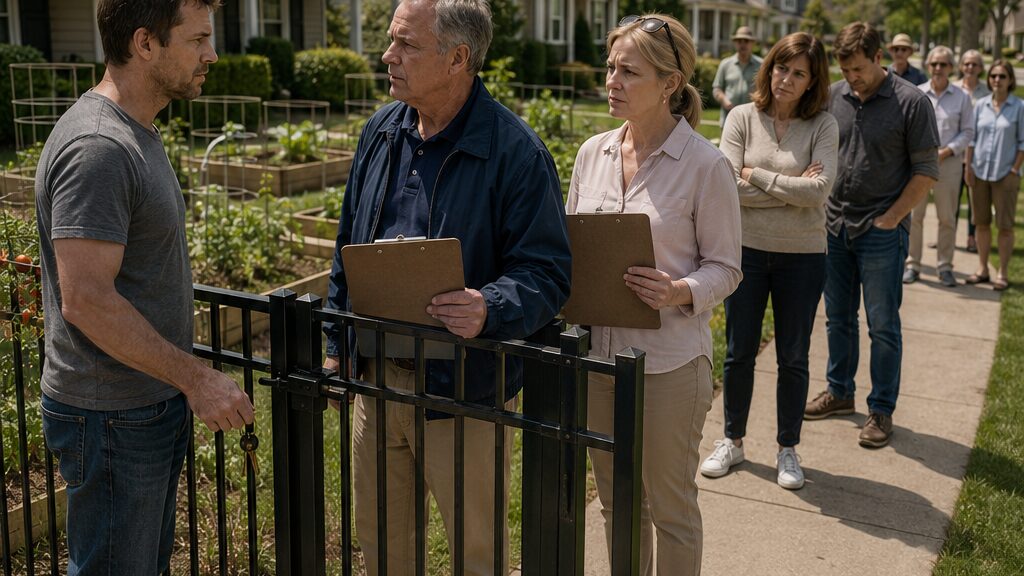
Gregory Wilson stepped between Joshua Harris and the garden latch as if the little black gate were the entrance to a bank vault.
“Sir,” Gregory said, one palm lifted, the other holding a clipboard against his chest, “we need to see your ID.”
Joshua’s hand stayed where it was, two inches from the chipped metal latch. The ring of keys hung from his fingers. One of them was old brass, worn smooth around the teeth from years of use. Behind the gate, tomato cages leaned in neat rows, bean vines twisted up strings, and a child’s plastic watering can sat upside down beside the herb bed.
Joshua looked at Gregory’s palm, then at the beige polo shirt stretched across Gregory’s retired-police shoulders. “Why?”
The question was quiet enough that the neighbors along the sidewalk had to lean in to hear it.
Gregory glanced behind him.
That was when Joshua saw Nancy Roberts standing near the curb with her sunglasses pushed up into her blond hair and a clipboard tucked under one arm. She wore the expression people used in board meetings when they had already decided what the vote should be before anyone spoke.
“Several residents have raised concerns,” Nancy said.
Joshua waited.
Nancy’s mouth tightened. “They say you don’t belong here.”
A small sound passed through the group near the sidewalk. Not quite agreement. Not quite embarrassment. The kind of sound people made when someone said aloud what they had been whispering in driveways.
Joshua saw Stephanie Brown near the mailbox path with her arms folded. Michael Adams stood half a step behind her, looking at the ground as if the seams in the concrete had suddenly become important. A delivery driver had stopped at the curb, trapped behind the little gathering, one hand still on the steering wheel of his van.
Joshua lowered his keys.
“I live on Willow Bend,” he said.
Nancy gave a brief, professional smile. “Then this should be simple.”
“It usually is.”
Gregory shifted his weight. He did not look angry. That somehow made it worse. His face had the bland patience of a man doing a task he had been given and did not want questioned.
“Can I ask what this is about?” Joshua said.
Nancy tapped a page on her clipboard. “The community garden is for authorized residents and supervised use only. We’ve had reports of people entering at odd hours, doing maintenance, moving tools, changing the lock, and accessing the beds without sign-in.”
Joshua looked past her at the gate. The hinge on the right side sagged again. He had meant to tighten it before the weekend heat swelled the frame. The new lock was still stiff. The little wooden sign beside the path said COMMUNITY GARDEN in green letters someone had repainted badly, leaving old brushstrokes visible beneath the fresh paint.
“Changing the lock,” he repeated.
Gregory cleared his throat. “Ma’am, maybe we should just verify and move on.”
Nancy did not look at him. “If you can’t prove residency, you’ll need to leave the garden area until we determine whether further action is necessary.”
The words were polished, but Joshua felt the rough edge underneath them. Leave. Garden area. Prove. They made him aware of his gray T-shirt, the dirt under his fingernails, the old sneakers he wore when he expected to kneel in mulch. He had not shaved that morning. He had come out with a wrench in his back pocket and coffee cooling on his kitchen counter.
He could have ended it immediately. The ID card was in his wallet. The board packet was in his truck. His name was on every email approving the amended garden access rule. But something in Nancy’s tone made him pause.
Not anger. Not quite.
A sadness that had learned to stand still.
Joshua looked at the neighbors. Stephanie stared back, chin lifted. Michael’s eyes flicked once toward the gate, then away.
Joshua let the silence stretch until Nancy’s smile thinned.
“Before I show you anything,” he said, “can I ask one question?”
Nancy gave a small laugh through her nose. “Go ahead.”
Joshua turned to Gregory. “Who approved the new community garden access plan?”
Gregory blinked. “What?”
“The plan,” Joshua said. “The amended access plan. Who approved it?”
Nancy’s eyes moved to Gregory, warning him not to play along. But Gregory was a procedural man. Ask him a procedural question, and some part of him answered before politics could catch up.
“The board president,” Gregory said.
Joshua nodded. “Did he approve the lock change too?”
Gregory’s brow furrowed. “Yes.”
“And the weekend maintenance schedule?”
“Yes, but—”
“And the resident volunteer list?”
Nancy stepped closer. “Sir, this is not—”
Joshua took his wallet from his back pocket.
He did not do it quickly. He did not snap it open or throw anything on the clipboard. He pulled out the plastic HOA identification card issued after the election three weeks earlier, the one he had almost refused because it felt too much like pretending importance. His photo looked worse than he remembered. Tired eyes. Crooked collar. A face that belonged behind a lawn mower, not at the head of a meeting table.
He handed it to Gregory.
Gregory took the card with two fingers, still wearing the slight frown of a man expecting inconvenience, not reversal.
Then his eyes stopped.
The clipboard lowered an inch.
He looked at the card. Then at Joshua. Then back at the card.
“Joshua Harris,” Gregory read under his breath.
Nancy’s face changed so quickly most people might have missed it. The certainty did not disappear; it cracked. Behind it was something sharper than embarrassment.
Fear.
Joshua saw it before she covered it.
Gregory swallowed. “Board president.”
Stephanie’s arms came unfolded. Michael looked up at last.
Joshua held out his hand for the card. Gregory gave it back without a word.
“The lock sticks,” Joshua said, slipping the card into his wallet. “The right hinge is pulling out of the post. I was going to fix it before the children’s group comes through this afternoon.”
No one spoke.
A bird landed on the fence rail behind the lettuce bed, hopped once, then flew off as if even it had decided the scene was too uncomfortable.
Nancy recovered first. “Mr. Harris, I wasn’t aware—”
“I know.”
Her cheeks flushed. “The concern was not personal.”
“It sounded personal.”
That landed harder than he intended. Gregory looked down. Michael closed his eyes for half a second. Stephanie’s mouth opened, but no words came.
Nancy adjusted the papers on her clipboard. “There was a resident report. More than one, actually. We have a duty to investigate.”
Joshua looked at the clipboard. The top page had a yellow sticky flag on it. FORMAL ACCESS COMPLAINT. He caught only the header before Nancy shifted the board against her body.
“A duty to investigate,” he said, “usually starts before the public confrontation.”
Gregory inhaled as if he might speak. Nancy touched his elbow, barely, and he stopped.
The delivery driver finally edged his van around the group, tires whispering along the curb. Everyone stepped aside except Joshua, who remained by the gate.
He put the old brass key into the lock.
It turned reluctantly, with a metal scrape he felt through his fingers. The gate opened inward a few inches, then caught on the uneven stone.
Joshua crouched, lifted it slightly, and eased it free.
That small movement did more than the ID card. It showed the watching neighbors something he had not said: he knew the problem in the gate the way a person knew a loose stair in his own house. He did not tug. He did not curse. He knew exactly how much pressure to use.
Nancy watched his hands.
“You should have identified yourself,” she said.
Joshua looked up from the hinge. “When?”
“When approached.”
“I was approached as a trespasser.”
“That is not the term I used.”
“No,” Joshua said. “You were careful.”
The garden smelled of damp soil and mint. Somewhere inside the beds, a drip line clicked and shuddered before releasing a thin pulse of water. Joshua stepped through the gate and turned back.
Gregory stood with his clipboard held flat at his side now, no longer as a shield. “Mr. Harris,” he said, “I apologize. I didn’t recognize you from the board notice.”
Joshua nodded once. He believed Gregory. That was not the same thing as excusing him.
Nancy’s hand tightened around the clipboard.
“I’ll need a copy of the complaint,” Joshua said.
“It will go through the normal process.”
“I am the normal process.”
A few neighbors shifted. Not applause. Not support. Just the discomfort of people realizing the scene had turned without asking their permission.
Nancy looked down at the page, then back at Joshua. The fear had returned, hidden beneath a layer of procedure.
“Of course,” she said. “You’ll have it by end of day.”
Joshua studied her face. He had expected annoyance, maybe humiliation. But what he saw was not a woman embarrassed by a mistake.
It was a woman who had made a move too early and knew something else was already in motion.
As Joshua reached for the sagging hinge, Nancy turned away with the clipboard pressed against her ribs like evidence she wished she had not brought outside.
Chapter 2: The Complaint That Was Already Waiting
The complaint had been filed twenty-seven minutes before Gregory stopped him at the gate.
Joshua saw the timestamp twice before he let himself believe it.
10:02 a.m.
Gregory had asked for his ID at 10:29.
He sat alone in the HOA office, a narrow room behind the clubhouse with beige walls, humming fluorescent lights, and a printer that sounded like it was chewing paper even when it was idle. His garden key lay on the desk beside the copied complaint. Dirt from his thumb had smudged the edge of the page.
The property manager had left him the folder with a careful expression and the sentence people used when they did not want to be pulled into board conflict.
“This came in through committee channels.”
Joshua turned the first page over.
FORMAL ACCESS COMPLAINT: COMMUNITY GARDEN ENTRY AND MAINTENANCE IRREGULARITIES.
Below that, in Nancy Roberts’s precise handwriting, was a summary of resident concerns: unauthorized entry, suspected non-resident use, unapproved modifications to lock hardware, possible liability exposure, potential violation of common-area supervision rule.
The words were dry enough to pass inspection. But Joshua had just stood in front of the gate while those same words were given a body, a face, and a public accusation.
He flipped to the resident statement page.
The first signature was Stephanie Brown’s.
Joshua did not react at first. He simply looked at her name and the address beside it. Willow Bend Court. Three houses from the garden path.
Under hers was Michael Adams, his signature smaller, slanted, crowded near the line as if he had added it after the paper had already begun to move away.
There were six more. Some were people Joshua recognized from annual meetings. Some were people who had never spoken about the garden except to complain when mulch bags sat near the curb too long.
The office door opened with a soft tap.
The property manager leaned in. “You okay?”
Joshua set the page down. “Was this complaint reviewed before Nancy went outside?”
The manager’s eyes moved to the folder. “I received it electronically. Committee marked it urgent.”
“That doesn’t answer the question.”
“No,” the manager said after a moment. “It wasn’t reviewed.”
Joshua looked back at the timestamp. “But she brought Gregory.”
“She said there was an access concern and asked him to verify residency if needed.”
Joshua gave a short nod. The phrase verify residency had done a lot of work that morning.
The manager came inside and closed the door halfway. “There’s another issue.”
Joshua waited.
“The garden access rule may need to be suspended until the board clarifies supervision requirements.”
The hum of the lights seemed to grow louder.
“Suspended,” Joshua said.
“Temporarily.”
“The children’s group comes Saturdays. Ruth Martinez’s row is on a raised bed because she can’t kneel anymore. Half the volunteers water after work because that’s when they can get here.”
“I know.”
“Do you?”
The manager did not answer right away. That was to her credit. “I know what the paperwork says. And the paperwork is thin.”
Joshua leaned back.
The office was smaller than he remembered from election night. Back then, people had congratulated him in this room with paper cups of coffee and quick handshakes, relieved someone else had agreed to take the unpaid job no one wanted until they wanted to complain about it. Nancy had smiled tightly and said continuity mattered. He had said he hoped she would stay involved. He had meant it.
Now her complaint sat on the desk like a trap set in plain sight.
“What exactly is thin?” Joshua asked.
“The original approval allowed the garden as a common-area amenity,” the manager said. “The amended plan allowed ‘supervised community use by residents and approved guests.’ But it doesn’t define approved guests clearly. It doesn’t define who supervises after hours. It doesn’t define whether volunteer maintenance counts as access or work.”
Joshua rubbed his thumb across the old brass key. “That language passed.”
“It passed because no one challenged it.”
“Nancy was in the room.”
“She abstained.”
Joshua remembered. Nancy sitting with her hands folded, saying she would reserve comment until implementation. He had taken that as irritation, not strategy.
The manager slid another page from the folder. “She attached a requested remedy.”
Joshua read it.
Immediate temporary closure of the garden gate pending review by architectural committee and risk committee.
He looked up. “There is no risk committee.”
“There is if the board creates one.”
“Nancy chairs architectural.”
“Yes.”
Joshua laughed once, quietly. It had no humor in it.
The property manager watched him with concern. “You can reject it procedurally.”
“I can.”
“You’re board president.”
“I know what I am.”
But the words sounded different now than they had at the gate. Outside, they had corrected a public mistake. In the office, they sounded like a warning to himself.
He could send one email. Complaint dismissed due to improper escalation. Gregory retrained. Nancy censured. Garden remains open. He had the authority to begin all of it.
Instead he saw Stephanie’s face near the mailboxes. He saw Michael looking down. He saw Nancy’s fear after reading the ID card.
Not sorry.
Afraid.
Joshua tapped the complaint with one finger. “Who gets notified if we suspend access?”
“All residents.”
“Who drafts the notice?”
“Usually the committee chair submits language.”
Of course she did.
A knock landed on the office door before either of them could speak again. Not hard. Just formal enough to announce that whoever stood outside believed the room belonged partly to them.
Nancy opened the door without waiting.
She had changed from sunglasses to reading glasses, and her clipboard had been replaced by a slim folder. The effect was deliberate. Less sidewalk, more procedure.
“Mr. Harris,” she said. “I was told you were reviewing the complaint.”
“I am.”
“Good. Then you understand this is larger than this morning’s misunderstanding.”
Joshua let the word sit between them.
Misunderstanding.
The property manager looked at the desk.
Nancy stepped inside. “The committee has a duty to prevent unregulated use of common areas. I understand the optics were unfortunate.”
“The optics were residents watching you ask the board president if he belonged in his own neighborhood.”
Her mouth tightened. “That is not an accurate summary.”
“It’s a generous one.”
For the first time, Nancy looked genuinely stung. Then she recovered by opening her folder.
“I’ve scheduled an emergency architectural committee session for Thursday evening,” she said. “To recommend temporary closure until the board votes.”
Joshua held her gaze. “You scheduled it before speaking to me.”
“I scheduled it after receiving resident complaints.”
“You scheduled it after filing a complaint that used me as evidence without knowing who I was.”
Nancy did not deny it. That bothered him more than denial would have.
“The identity of one individual does not remove the underlying issue,” she said. “If anything, it complicates it.”
“How?”
“You approved a system you personally access, modify, and maintain.” Her eyes dropped briefly to the key on the desk. “That raises questions.”
The property manager drew a breath but said nothing.
Joshua’s hand closed around the key before he realized he had moved.
Nancy saw it. Her expression shifted again, and in that shift Joshua understood something he had not understood at the gate. Nancy did not know the whole truth, but she knew there was one. She had sensed a door behind his silence and decided to pry it open with rules.
He placed the key flat on the desk.
“Send me the meeting notice,” he said.
Nancy nodded. “Already done.”
She turned to leave, then paused at the doorway.
“One more thing,” she said. “Until Thursday, I recommend you avoid further work on the gate. For everyone’s protection.”
After she left, Joshua opened his email.
The notice was already there.
Emergency Committee Review: Community Garden Access, Lock Control, and Resident Safety.
Sent to the full board. Copied to the property manager. Drafted by Nancy Roberts.
Joshua stared at the subject line, then at the brass key beside his hand.
The morning’s embarrassment was no longer the problem.
It had been the opening move.
Chapter 3: The Rule That Made Everyone Nervous
Nancy Roberts placed a highlighted rule packet in front of every board member before Joshua had even taken his seat.
The packets were identical: clipped at the upper left, marked with yellow tabs, and titled COMMUNITY GARDEN ACCESS REVIEW in a font large enough to make a volunteer amenity look like a lawsuit. At the top of Joshua’s copy, a sticky note read: Please disclose any personal involvement before discussion.
He recognized Nancy’s handwriting.
The HOA meeting room smelled faintly of dry-erase markers and coffee that had been sitting too long. Folding chairs lined the back wall, though only board members had been invited to sit at the long table. Through the closed blinds, Joshua could see shadows passing outside now and then. Residents knew something was happening even if they had not been asked in.
Nancy sat two seats to his right, composed, pale blouse pressed, pen aligned with her packet. Gregory Wilson sat near the end of the table as a liaison, not a voting member. He looked smaller without the sidewalk behind him.
Joshua opened the packet.
The first highlighted sentence came from the amended garden plan.
Supervised community use by residents and approved guests shall be permitted during posted hours.
Nancy tapped the same sentence on her copy. “The problem is obvious.”
A board member across from her frowned. “Is it?”
“Yes,” Nancy said. “Who approves guests? Who supervises them? What constitutes posted hours if volunteers are entering with keys outside normal use? And who authorized hardware changes?”
Joshua kept his hands still.
He could answer each question. Some answers were clean. Some were not. The lock change had been approved by email after the old combination appeared in a neighborhood social media thread. The volunteer list was maintained informally because the original sign-up sheet kept getting wet in the storage bin. Posted hours had never matched watering needs because August did not care what an HOA calendar said.
The garden worked because people acted responsibly around imperfect language.
Nancy’s point was that imperfect language could be used against them.
“The complaint,” Joshua said, “began with an assumption that I was unauthorized.”
Nancy lifted her chin. “The complaint began with a pattern of unsupervised access.”
“A pattern you chose to confront by asking for ID in public.”
Gregory shifted at the end of the table.
Joshua looked toward him. “Gregory, did you confirm my identity before approaching me?”
Gregory’s face reddened. “No.”
“Did you check the board directory?”
“No, sir.”
“Did anyone tell you I might be a non-resident?”
Gregory glanced at Nancy.
The room changed. Not loudly. Just enough. Pens stopped moving. A chair creaked.
Gregory folded his hands. “I was told residents were concerned an unidentified man had been accessing the garden and changing the lock. I was asked to assist with verification.”
“By Nancy?”
“Yes.”
Nancy’s pen tapped once against the packet. “And I stand by the need to verify access. I do not stand by any implication that I intended to embarrass Mr. Harris.”
Joshua heard the carefulness in it. Not an apology. A boundary.
A board member leaned forward. “But the man was the board president.”
Nancy turned to him. “Which is exactly why we should be discussing conflict of interest.”
The sentence landed harder than Joshua expected.
He looked down at the highlighted rule. Supervised. Residents. Approved guests. Posted hours. Every word seemed harmless until someone wanted it to cut.
“What conflict?” he asked.
Nancy opened to the next page. “Mr. Harris personally approved the amended access plan. Mr. Harris personally holds a key. Mr. Harris personally performed maintenance. Mr. Harris appears to have authorized lock changes. The board should determine whether those actions were taken in his official capacity or as a private resident with an undisclosed interest.”
“A private resident maintaining a common-area gate is not an undisclosed interest.”
“Is that all it is?”
The room went still again.
Joshua met her eyes.
Nancy had not raised her voice. That was her skill. She could make an accusation sound like a request for clarification.
“What are you suggesting?” he said.
“I’m suggesting that transparency protects everyone.”
He almost laughed at the word. Transparency, from the woman who had filed a complaint before asking one question at the gate. But he did not laugh, because beneath her tactic sat the one thing he could not dismiss.
He had not been transparent.
Not fully.
When he ran for board president, he had talked about maintenance reserves, contractor bids, communication, sidewalk repairs. He had not talked about the garden. He had not told them that his late wife had spent three summers building volunteer lists, coaxing older residents outdoors, teaching children the difference between basil and weeds. He had not told them the old gate made a sound he could recognize from inside his house if the wind was right.
He had not told them because grief was not a governance argument.
Nancy turned another page. “I am recommending temporary closure until the board clarifies access, supervision, liability, and key control.”
“No,” Joshua said.
The word came too quickly.
Nancy’s eyebrows lifted. She had been waiting for that.
“On what grounds?” she asked.
Joshua looked around the table. “Because temporary closures become permanent when no one wants to reopen the hard thing.”
“That is not a procedural answer.”
“No,” he said. “It isn’t.”
The admission cost him.
A board member at the far end rubbed his forehead. “Joshua, I’m not against the garden. But Nancy’s not wrong that the language is vague.”
Another nodded reluctantly. “If someone gets hurt after hours, we need to know who’s responsible.”
Gregory cleared his throat. “For what it’s worth, I should have checked the directory. I didn’t. That’s on me.”
Joshua looked at him, surprised.
Gregory continued, uncomfortable but steady. “But I also don’t think we were given clear instructions. If we’re asking volunteers to maintain common areas, they shouldn’t be treated like trespassers.”
Nancy’s face tightened. “No one used that word.”
“You didn’t have to,” Gregory said.
The room breathed differently after that. Joshua felt a small opening, but not victory. Nancy had brought a real flaw wrapped around a public wrong. If he ignored the flaw, he would become exactly what she wanted the board to see: a man using offense as cover.
The property manager, seated near the wall, slid a copy of the garden map toward the center. It showed the gate, the walking path, the storage bench, the four raised beds, and the side opening near the drainage easement.
Nancy pointed to the side opening. “This is not fenced.”
“It was never meant to be locked down like a pool,” Joshua said.
“It is common property.”
“It is a garden.”
“It is a liability.”
“It is a place people use.”
“Then define use,” Nancy said. “Define people. Define who gets a key. Define who supervises. Define why you are there alone on Saturday mornings with tools.”
There it was.
Not the rule. Not the lock. Him.
Joshua felt every face turn toward him. His hand moved toward his pocket, where the brass key usually sat, then stopped when he remembered it lay on his desk at home. Without it, his fingers closed on nothing.
A board member spoke carefully. “Joshua, maybe this is unfair, but I do think we need to ask. Do you have a personal conflict of interest with the garden?”
The old fluorescent lights hummed above them.
Nancy looked down at her packet, but Joshua could see the stillness in her shoulders. She had forced the question into someone else’s mouth.
Joshua opened his own packet again, as if the highlighted sentence might rearrange itself into an answer that did not require memory, or grief, or the truth he had kept out of every meeting.
He looked at the printed map of the garden gate.
For the first time since Saturday, he did not know whether silence would protect the garden or finally close it.
Chapter 4: Ruth Remembers Who Planted the First Row
The closure notice was zip-tied to the garden gate when Joshua arrived with his socket wrench.
It hung crookedly from the top rail, laminated against weather that had not yet come, the HOA logo stamped at the top like a warning label. TEMPORARY ACCESS REVIEW. RESIDENTS ARE ADVISED NOT TO ENTER UNTIL FURTHER NOTICE. Below that, in smaller print, was Nancy’s committee name.
Joshua stood outside the gate with the wrench in his hand and the old brass key in his pocket, feeling the ridiculous urge to apologize to the tomatoes.
The hinge had pulled farther from the post since Saturday. One more hard push and the gate would drag badly enough to bend the latch plate. The notice told him not to enter. The hinge told him the gate might not open at all by Friday.
He cut the zip tie with the small blade on his keychain, folded the notice once, and set it on the top of the fence.
“That paper doesn’t weigh as much as she thinks it does.”
Joshua turned.
Ruth Martinez stood on the garden path behind him, one hand on the handle of her rolling cart. She wore a straw hat with a faded ribbon and had a pair of pruning shears tucked into the cart’s front basket. Her knees had been bad for years, but she still moved with the stubborn dignity of someone who refused to let any joint in her body cast a vote.
“You shouldn’t be out here if the gate’s closed,” Joshua said.
“I could say the same to you.”
“I’m fixing the hinge.”
“I know.” Ruth looked at the wrench. “You always fix the hinge.”
Joshua crouched and fitted the socket over the first bolt. “It keeps loosening.”
“No,” Ruth said. “People keep leaning on the gate while they decide whether they’re welcome.”
The wrench paused.
Ruth rolled the cart closer. “That notice went up this morning. Stephanie took a picture of it before the zip tie was tight.”
Joshua tightened the first bolt until the wood groaned. “Of course she did.”
“She posted that the board was finally taking safety seriously.”
“The board hasn’t voted.”
“The internet doesn’t care.”
He moved to the lower bolt. The screw hole had widened. He had brought wood filler in his toolbox, but he would need to reset the plate if he wanted it to last. He worked with his head down, glad for the task because Ruth had a way of standing beside silence until it gave up.
After a minute, she said, “You didn’t answer them.”
“At the meeting?”
“At the meeting. At the gate. For years, if we’re being honest.”
Joshua pulled the bolt free and inspected the threads. “I answered what needed answering.”
“That’s the trouble with men who think doing the work is the same as telling the truth.”
He almost smiled. Almost.
Ruth’s eyes moved past him to the first raised bed on the left. It was empty except for a row of wooden markers and new soil turned dark from watering. “She planted snap peas there the first spring.”
Joshua’s hand closed around the bolt.
Ruth did not say his wife’s name. She rarely did unless Joshua did first, and he almost never did. That was one of the small courtesies they had built between them, like stepping around a loose board.
“She said children would eat anything if they picked it themselves,” Ruth continued. “I told her peas were not magic. She told me I lacked imagination.”
Joshua looked at the bed.
He saw the row as it had been then, not as it was now. Green shoots. Twine. His wife kneeling in dirt with her hair clipped badly at the back of her neck, laughing because one of the neighborhood children had eaten three pea pods and then pretended he had hated them.
He put the bolt in his palm and stared at it.
Ruth’s voice softened, but only a little. “That was the first row. Not the prettiest. Not the biggest. But it was the first one people touched.”
Joshua set the bolt in the toolbox. “This can’t become about her.”
“It already is about her if you’re hiding her from it.”
“I’m not hiding her.”
“What would you call it?”
He stood too quickly. The gate shifted behind him, scraping the stone.
“I would call it keeping a community amenity from turning into a memorial nobody asked for.”
Ruth studied him. “That sounds like something you practiced alone.”
Joshua looked away.
A car rolled slowly past on the street. The driver looked toward the garden, saw Joshua and Ruth, then kept going. In this neighborhood, curiosity wore tinted windows and drove ten miles under the speed limit.
Ruth reached into her cart and pulled out a folded cloth bundle. “She didn’t start this garden so people could cry over it.”
“I know.”
“Do you?”
He said nothing.
“She started it because Mrs. Collins down the block couldn’t drive after surgery, and because the kids were bored, and because the stormwater corner was ugly, and because she believed people complained less when their hands were busy.” Ruth’s mouth twitched. “She was wrong about that last part.”
Joshua breathed through his nose.
The garden had begun as a practical nuisance. A soggy strip of common area no landscaper wanted to maintain. His wife had persuaded the old board to let volunteers try raised beds for one season. One season became two. People brought extra seedlings. Children painted rocks. Ruth organized watering after her hip surgery because she said basil needed discipline.
Then his wife got sick, and the garden became the place no one knew what to do with because everyone thought grief made a person fragile, when really it made ordinary questions unbearable.
Should we keep the cucumber trellis?
Do you want her gloves back?
Should the sign stay?
Joshua had answered most things by fixing something else.
Ruth placed the folded bundle on the fence rail. “Open it.”
He looked at her.
“Don’t make me stand here holding history all afternoon.”
Joshua wiped his hands on his jeans and unfolded the cloth.
Inside was a small wooden sign, weathered gray at the edges. The paint had faded, but the handwriting remained visible in green letters.
Take what you need. Leave what you can. Close the gate gently.
His chest tightened so sharply he had to set the sign against the fence.
The letters were hers. Not neat. Never neat. Slightly slanted, the word gently squeezed smaller because she had run out of space.
“I thought this was gone,” he said.
“I took it down when the new sign went up. I meant to give it to you.” Ruth shrugged. “Then you became impossible to talk to.”
He let out a breath that nearly broke into a laugh but did not.
Ruth looked toward the closed beds. “Nancy can call this access control. Stephanie can call it neighborhood standards. You can call it an amenity until your jaw cracks. But that sign says what it was.”
Joshua touched the edge of the wood with one finger.
“I promised her I wouldn’t make it about loss,” he said.
Ruth nodded. “Good promise.”
“So I kept it quiet.”
“Bad method.”
He looked at her then.
Ruth’s expression did not soften into pity. That was why he could stand there. Pity would have ruined him. Ruth gave him something heavier and cleaner: expectation.
“At the meeting,” he said, “Nancy asked if I had a personal conflict of interest.”
“And did you?”
“Yes.” He swallowed. “No. I don’t know.”
“You have a personal connection. That isn’t the same as a conflict.”
“It can be, if I’m the only one who knows about it.”
Ruth accepted that with a small nod. “Then stop being the only one.”
A laugh came from the sidewalk. Two children on scooters slowed near the path, saw the notice, and stopped at the edge of the grass. One pointed toward the garden.
“Is it closed?” the child asked.
Joshua looked at the notice folded on the fence rail.
“For now,” he said.
The child’s face fell. “But the bean tunnel was almost over the string.”
“I know.”
The children rolled away, wheels clicking over the seams in the sidewalk.
Ruth watched them go. “That’s what closes when you let Nancy define the gate.”
Joshua picked up the hinge plate and held it in place against the post. The screw holes were too worn. Tightening would not be enough. It needed new wood, a new angle, a repair that admitted the old place had failed.
He lowered the hinge.
“What happens if I tell them?” he asked.
“Some will think you used your wife to win an argument.”
“Yes.”
“Some will think you should have told them sooner.”
“They’d be right.”
“Some will still want the gate locked.”
He looked toward Stephanie’s house, though it was hidden by hedges. “I know.”
Ruth placed the old sign into his hands. “Then tell them anyway. Not to win. To stop letting the wrong story be the only story.”
Joshua held the sign carefully, his thumb below the word gently.
Ruth turned her cart toward the sidewalk. “And fix that hinge properly. If we’re going to fight over a gate, it should at least know how to open.”
She rolled away before he could answer.
Joshua stood beside the closed garden with the notice on the rail, the broken hinge at his feet, and his wife’s handwriting in his hands. For the first time since the ID demand, he understood that the thing he had called restraint had started to look exactly like concealment.
When he picked up his toolbox, he took the old sign with him.
Chapter 5: The Petition Changes Hands at the Mailboxes
Stephanie Brown was collecting signatures beside the cluster mailboxes with a travel mug, a blue folder, and the posture of someone doing public service she expected to be thanked for later.
Joshua saw her before she saw him.
The evening mail rush had begun. Garage doors hummed open. A dog barked from behind a white vinyl fence. Two residents stood at the parcel lockers pretending not to read the top page in Stephanie’s folder. Michael Adams hovered a few feet behind her, one hand in his pocket, the other holding envelopes he had not sorted.
Joshua parked at the curb and stepped out with his own mail key in hand.
Stephanie looked up.
For half a second, the folder dipped.
Then she lifted her chin. “Joshua.”
Not Mr. Harris. Not board president. Joshua.
He crossed the sidewalk to the mailboxes. “Stephanie.”
The resident at the parcel locker closed it too quickly and walked away with nothing in his hands.
Stephanie tapped the folder against her palm. “I assume you heard there are more concerns.”
“I saw the first complaint.”
“This isn’t about Saturday.”
“It started before Saturday.”
Color rose at the edge of her cheeks, but she did not step back. “People are allowed to care about safety.”
“Yes.”
That answer seemed to irritate her more than argument would have.
Joshua unlocked his mailbox. The brass garden key was in the same hand as the small mailbox key, and when he pulled the door open, the heavier key slipped forward against his knuckles. Stephanie’s eyes dropped to it.
“There,” she said. “That’s part of the problem.”
“A key?”
“Private access.”
“It’s an HOA key.”
“Held privately.”
Michael shifted. “Steph—”
She glanced back, and he stopped.
Joshua took the envelopes from his mailbox. Utility bill. Grocery flyer. A postcard from the county extension office about seasonal planting classes. He set them under one arm.
“Do you want to tell me what you think happens inside that gate?” he asked.
Stephanie’s mouth tightened. “I think rules get loose when people like the reason for breaking them.”
“That’s a good sentence.”
“It’s a true one.”
“Sometimes.”
She looked thrown by that.
Joshua leaned against the mailbox frame, careful not to crowd her. “I’m not here to embarrass you.”
“You already did that Saturday.”
“I didn’t ask Gregory to stop me.”
“No, you just waited until everyone was watching to reveal who you were.”
The accusation surprised him because part of it was true.
Michael looked at Joshua then, quickly, as if checking whether the blow had landed.
Joshua slid the mail under his arm more tightly. “I could have shown ID first.”
Stephanie blinked. She had not expected agreement.
“I didn’t,” he said. “I wanted the assumption named before I corrected it.”
A car slowed near the mailboxes, then continued when the driver saw the three of them. Stephanie watched it go.
“So you made a point,” she said.
“Yes.”
“And now you’re offended that other people are making theirs?”
Joshua nodded once. “Fair.”
Michael stared at him.
Stephanie did not soften, but the angle of the folder changed. Less shield. More paper.
Joshua said, “What do you want?”
“I want the gate locked unless a board-approved supervisor is present.”
“That means most weekday watering stops.”
“Then schedule it.”
“Volunteers have jobs.”
“Then find volunteers who don’t need special treatment.”
Michael looked down at the envelopes in his hand.
Joshua turned to him. “You signed the petition.”
Michael’s shoulders tightened.
Stephanie answered for him. “We both did.”
“I asked Michael.”
The silence that followed was small but sharp.
Michael rubbed the back of his neck. “I signed it.”
“Why?”
“Because there were people going in and out.”
“People?”
Michael looked toward the garden path. From the mailboxes, the top of the gate was just visible between two hedges. “I saw you there sometimes.”
Stephanie turned. “You saw him?”
Michael did not answer her.
Joshua held still.
Michael’s face had the drawn look of a man who had hoped a small silence would never be asked to stand up in daylight. “I saw you fixing the gate. A couple times. Early. After work once. I didn’t know you were board president.”
“But you knew I wasn’t breaking in.”
Michael’s mouth opened, then closed.
Stephanie’s eyes flashed. “Why didn’t you say that?”
“I did say someone was maintaining it.”
“You said there was a man there.”
“I said maybe he was supposed to be.”
“You didn’t say that.”
“I did,” Michael said, softer. “You said Nancy would know.”
Joshua looked from one to the other and felt his anger change shape. It did not leave. It became less clean.
Stephanie pressed the folder against her ribs. “This is not about one person with a wrench.”
“What is it about?”
She exhaled, frustrated. “It’s about the fact that we paid for a private neighborhood. People bought here for quiet. For standards. Then suddenly there’s a garden path with people coming through, children leaving scooters near the curb, guests parking on Willow Bend, soil bags stacked by the fence, and no one wants to say it looks messy because then you’re the bad neighbor.”
Joshua listened.
The words were not kind. But they were more honest than the complaint.
“You could have come to a meeting,” he said.
“I did. Last year. I was told the garden brought community value.”
“It does.”
“To some people.” Stephanie’s voice caught, not with sadness exactly, but with the strain of being disliked and deciding to deserve it. “To others, it brings traffic and strangers looking over fences.”
“Approved guests,” Joshua said. “Not strangers.”
“Then approve them out loud.”
That stopped him.
Stephanie saw it and pressed on. “Post the hours. Post the names. Put someone there. Don’t just tell us to trust that the right people know the right people.”
Joshua thought of Ruth’s sign. Take what you need. Leave what you can. Close the gate gently. It had worked when the garden was small and everyone knew the hands that opened it.
The neighborhood had changed. Or he had stopped noticing who felt left outside even while trying to keep others in.
“The petition asks for closure,” he said.
“It asks for control.”
“It asks for closure until control exists.”
“Yes.”
“And if control exists?”
Stephanie looked at the folder.
Michael spoke before she could. “Would you withdraw it?”
She turned on him. “Michael.”
“I’m asking.”
Her jaw tightened. She looked at Joshua again. “If the gate stays locked except during posted supervised hours, I’ll withdraw my name.”
“That would close it to the people who need flexible access.”
“It would make it accountable.”
“It would make it decorative.”
“Maybe decorative is safer than careless.”
Joshua felt the word careless strike deeper than she meant it to. He had been careful. Painfully careful. Careful not to mention his wife. Careful not to turn the garden into a shrine. Careful not to push the board too hard. Careful not to ask residents to feel what he felt.
And still, here they were, standing by mailboxes, arguing over whether care counted if no one trusted it.
He gathered his mail. “There’s a meeting Thursday.”
“I know.”
“It shouldn’t have been closed.”
Stephanie’s eyes narrowed. “Then open it.”
“I intend to.”
“With rules?”
“With rules that don’t begin by treating volunteers like trespassers.”
Her face tightened again, but she did not answer.
Joshua turned toward his truck.
“Mr. Harris.”
It was Michael.
Joshua stopped near the curb.
Michael stepped away from Stephanie, just enough to make the choice visible and not enough to escape it. “I’ll speak at the meeting, if you need me to.”
Stephanie stared at him.
Michael kept his eyes on Joshua. “About seeing you at the gate. About knowing it didn’t look like trespassing.”
Joshua waited.
“But,” Michael added, voice lowering, “please don’t make it about Stephanie. She’s not trying to hurt anybody.”
Stephanie let out a disbelieving laugh, but it sounded wounded.
Joshua looked at the folder in her hand, then at Michael’s face. A partial ally. A protected accuser. Another person asking him to use truth carefully so no one they loved had to feel the full weight of it.
He nodded once, though he had not decided whether that nod meant yes.
As he got into his truck, the brass garden key pressed into his palm, leaving a clean half-moon mark in the skin.
Chapter 6: The Emergency Vote Behind Closed Blinds
Residents were waiting outside the clubhouse when Joshua arrived, but the meeting room blinds were already closed.
That was the first thing he noticed.
Not Nancy’s car in the front space. Not the printed agenda taped to the glass door. Not Stephanie Brown standing near the entrance with her blue folder held at her side. The blinds. Closed from inside, slat by slat, cutting the board table away from the people whose names filled the petition.
Joshua got out of his truck with Ruth’s old sign wrapped in a towel under his arm.
Gregory Wilson stood near the clubhouse door, no clipboard this time, just a folded copy of the agenda. He looked at the towel, then at Joshua’s face.
“Evening,” Gregory said.
“Evening.”
Gregory lowered his voice. “I didn’t know she was closing it.”
“The gate?”
“The meeting.”
Joshua looked through the glass. Shapes moved behind the blinds.
“She isn’t,” he said.
But when he stepped inside, the property manager met him in the hallway with the expression of someone holding bad news in both hands.
“Nancy opened committee discussion early,” the manager said.
Joshua stopped. “Without quorum?”
“She called it preliminary.”
“Preliminary with residents outside?”
The manager glanced toward the meeting room. “She said space was limited.”
Joshua set his jaw and opened the door.
The room went quiet.
Nancy sat at the far side of the table with rule packets stacked in front of her. Two board members were already seated. Another stood near the coffee urn, cup untouched in hand. The closed blinds made the room feel smaller than usual, the fluorescent lights harsher, every paper brighter than it needed to be.
Nancy looked at the towel under Joshua’s arm. “We were just reviewing the agenda.”
“You were reviewing it before the noticed time.”
“Informally.”
“With the blinds closed.”
Her lips tightened. “Residents will be invited in when appropriate.”
Joshua placed the towel on the table and did not unwrap it. “They’re appropriate now.”
A board member near the coffee urn cleared his throat. “Maybe we should keep this efficient. It’s already tense.”
“That’s why it shouldn’t look hidden,” Joshua said.
Nancy folded her hands. “This is not hidden. This is orderly. There’s a difference.”
“There is,” Joshua said. “And we’re on the wrong side of it.”
No one moved.
The old Joshua—the one who fixed hinges before notices, who let silence do work it had never agreed to do—would have stopped there. Let the words hang. Wait for someone else to decide whether they mattered.
Instead he walked to the blinds and opened them.
Light from the lobby cut across the room. Faces appeared beyond the glass: Stephanie, Michael, Ruth in her straw hat, several residents Joshua knew by sight but not by name. Their attention shifted inward all at once.
Nancy’s chair scraped softly. “Mr. Harris.”
He turned. “Yes?”
“You are making this theatrical.”
“No. Saturday was theatrical. This is governance.”
The board member with the coffee cup looked down quickly, but Joshua saw the corner of his mouth move.
Nancy’s face flushed. “Then perhaps we should begin with disclosure.”
“Fine.”
She tapped the top packet. “Before this board considers any motion regarding the garden, I believe Mr. Harris should disclose the nature of his personal involvement.”
Joshua felt the towel under his fingers.
There it was. The question he had avoided until avoidance had become its own answer.
He looked through the glass. Ruth was watching him without expression. Michael stood half behind Stephanie, but not hidden. Gregory had stepped into the room and remained near the wall.
Joshua unwrapped the towel.
The old sign lay on the table, gray-edged and worn, its green letters faded but readable.
Take what you need. Leave what you can. Close the gate gently.
The room stilled.
Nancy stared at it. “What is that?”
“A sign from the first year of the garden.”
“We are discussing current access policy.”
“Yes.”
“Then why is it here?”
Joshua touched the edge of the wood. “Because I should have brought it sooner.”
No one spoke.
“My wife helped start the original garden,” he said.
A board member looked up. Gregory’s eyes dropped to the sign.
Joshua kept his voice level. Not cold. Not pleading. Just steady enough to survive being heard.
“She worked with Ruth Martinez and a few other residents when that stormwater corner was nothing but mud and complaint emails. They started with three raised beds and a hose that leaked. The idea was simple. Residents could grow what they used, leave extra for neighbors, and give the kids something real to take care of.”
Nancy sat very still.
“When she got sick,” Joshua continued, “I started fixing things because that was easier than talking about them. After she died, I kept fixing things because people still needed the place to work. The hinge. The lock. The watering schedule. The sign-up sheet. I told myself if I didn’t make it personal, no one could accuse me of using her memory to get my way.”
He looked at Nancy. “That was a mistake.”
She did not blink.
“I should have disclosed the connection when I ran for board president,” he said. “I should have made the access process clearer after the lock changed. I should not have assumed quiet work would be understood as responsible work.”
The admission changed the room more than denial would have. He felt it in the board members’ posture. Nancy felt it too; he saw the brief frustration in her face when the clean accusation became messier.
Then she leaned forward.
“I appreciate that history,” she said, voice controlled. “But emotional significance does not eliminate risk. If anything, it confirms that your judgment may be compromised.”
The words landed with a force that made Gregory look up sharply.
Joshua did not move.
Nancy’s fingers pressed flat against the packet. “You have just acknowledged a personal attachment to the common area under review. You personally changed or authorized hardware. You personally maintained access. You personally resisted closure. I am not questioning your grief. I am questioning whether grief has been allowed to become policy.”
Beyond the glass, Ruth’s hand tightened on her cart handle.
Joshua felt heat rise in his neck. For one second, he wanted to do exactly what Nancy expected: snap, defend, make the room choose between his dead wife and her rule packet. It would feel good for perhaps three seconds. Then the garden would lose.
He placed both hands flat on the table.
“You’re right to question the policy,” he said.
Nancy blinked.
“You’re wrong to use grief as proof of misconduct.”
Her face went pale.
Joshua turned to the property manager. “Please confirm the meeting notice.”
The manager opened a folder. “Emergency committee review was emailed Monday evening. However, the agenda item recommending closure was revised this afternoon.”
Joshua looked at Nancy. “By whom?”
The manager hesitated. “Submitted by the architectural chair.”
Nancy spoke quickly. “To clarify the remedy.”
“Was the revised remedy sent to residents?” Joshua asked.
“No,” the manager said.
“To the full board?”
“This afternoon. Not with the original notice.”
Joshua nodded. The room understood before he said it.
“You can’t rush a closure recommendation under an agenda residents didn’t receive,” he said.
Nancy’s jaw tightened. “We can recommend temporary safety action.”
“The board can consider emergency safety action if there’s immediate danger. A sagging hinge and vague guest language are problems. They are not an immediate danger requiring a closed-door rush.”
“There are liability concerns.”
“Then we address them in public.”
A board member leaned forward. “What are you proposing?”
Joshua picked up the old sign. Its wood was lighter than he remembered.
“Tonight, no closure vote. The gate remains under current posted hours through Saturday, with volunteer maintenance logged. Gregory drafts a verification procedure so no resident is publicly challenged without basic directory confirmation. The property manager drafts temporary guest language. Saturday morning, we hold an open resident session at the garden and rewrite the access rule where everyone can see what we’re talking about.”
Nancy gave a short, incredulous breath. “You want to conduct policy at the gate?”
“I want people to stop treating the gate like an abstraction.”
Stephanie’s voice came from the doorway. “And if residents still want it locked?”
Everyone turned.
She stood just inside the room, blue folder against her hip. The residents behind her had drifted closer once the blinds opened.
Joshua could have told her she was out of order. Nancy certainly would have.
Instead he said, “Then they can say that Saturday.”
Stephanie looked at the sign on the table. Something in her face shifted when she read the handwriting, but she recovered quickly.
“And will you listen?” she asked.
Joshua glanced at the board, at Gregory, at Nancy, at Ruth beyond the doorway.
“Yes,” he said. “But listening doesn’t mean letting fear write the rule alone.”
Nancy closed her packet. “This is irregular.”
Joshua looked at the closed blinds now stacked open against the windows. “So was asking me for ID at my own gate.”
For once, she had no immediate answer.
The board did not vote to close the garden that night. They voted instead to postpone action until Saturday’s open session, with temporary logging at the gate and no unsupervised lock changes. It was not victory. The gate could still close. The rule could still narrow until the garden became a display piece residents looked at instead of used.
But when the meeting broke, Ruth stopped by the table and touched the old sign once, not long enough to be sentimental.
“Better,” she said.
After the room emptied, Joshua stayed behind with the sign and the revised agenda packet. Nancy gathered her papers in silence.
At the door, she turned back. “Saturday may not go the way you think.”
Joshua folded the towel around the sign. “Probably not.”
“You opened the door.”
He looked at her then. “No. I opened the blinds.”
Nancy held his gaze for a moment, then left.
Joshua stood alone in the harsh meeting room light, holding the sign that should have been shown years earlier, knowing Saturday would not just decide whether the gate stayed open.
It would decide what kind of truth the neighborhood was willing to stand in front of.
Chapter 7: The Gate Opens Only After the Truth Does
Gregory Wilson stood at the garden gate Saturday morning with nothing in his hands.
No clipboard. No folder. No laminated notice. Just Gregory in a plain navy jacket, shoulders squared, eyes fixed on the latch as residents gathered along the sidewalk and pretended not to remember exactly where he had stood one week earlier.
Joshua noticed that first.
The second thing he noticed was the gate.
He had repaired the hinge properly Friday evening, replacing the stripped screws with longer ones and setting the plate at a cleaner angle. The gate no longer dragged against the stone. It rested closed, not locked, the brass key waiting in Joshua’s pocket like a question he had not yet answered.
Ruth Martinez’s old sign leaned against the inside fence, still wrapped in the towel. The new HOA sign remained posted by the path, stiff and official, listing temporary hours in black print. Beside it, the property manager had set a folding table with a sign-in sheet, draft rule language, and a stack of pens.
Nancy Roberts stood near the table.
She had dressed carefully: pale blouse, beige slacks, sunglasses on her head though the morning was overcast. Her committee folder was thinner than usual. Joshua wondered if that was intentional too, a way of appearing less armed.
Stephanie Brown stood with Michael Adams near the mailbox side of the path. Stephanie held no folder today. Michael held two paper cups of coffee, one of which she had not taken.
A child on a scooter rolled toward the path and stopped when an adult touched his shoulder.
Joshua stepped up beside Gregory.
Gregory looked at him. “I checked the directory this morning.”
Joshua glanced at him.
Gregory’s mouth pulled into something that was not quite a smile. “For everyone scheduled to speak. Habit I’m trying to build.”
“Good habit.”
“I should have had it last week.”
Joshua did not let him off quickly. He had learned that quick forgiveness sometimes protected the wrong person from the right lesson.
After a moment, he said, “Today matters more.”
Gregory nodded.
The residents quieted when Joshua walked to the folding table. There were more of them than he expected. Not a crowd, exactly. A neighborhood did not need many people to feel crowded when everyone knew which house everyone returned to afterward. Board members stood to one side. The property manager held copies of the draft rule. Ruth waited near the raised beds, her cart parked by the fence.
Joshua placed the old sign flat on the table but left the towel folded beneath it.
He began without raising his voice. “We’re here for three things. First, to correct what happened at this gate last Saturday. Second, to clarify the garden access rule. Third, to decide whether this gate is going to be used to manage responsibility or to measure belonging.”
A few faces shifted at the last word.
Nancy looked down at her folder.
Joshua turned toward Gregory. He had not asked Gregory to speak first. Gregory had offered in an email sent at 6:18 that morning, brief enough to feel painful.
Gregory stepped forward.
“Last Saturday,” he said, “I asked Mr. Harris for identification before I had confirmed basic information available to me as security liaison. I acted on a resident concern and a committee request, but I did not do my own verification first.”
He swallowed.
“I also let the situation happen in public when it could have been handled with more respect. That was my mistake. Going forward, I’m recommending no resident be challenged at a common area without checking the directory, board contact list, or property manager first unless there is an immediate safety issue.”
His eyes flicked to Joshua. “I apologize.”
Joshua nodded once.
The apology was not dramatic. It did not erase anything. That was why it helped.
Nancy’s turn came next, though she did not step forward immediately. For a moment it seemed she might ask to defer, or fold her statement into the rule discussion, or make the kind of procedural comment that acknowledged everything except harm.
Then she closed her folder.
“The architectural committee received complaints about garden access,” she said. “Some concerns were legitimate. The way I escalated them was not.”
Stephanie’s head lifted.
Nancy kept her eyes on the residents, not Joshua. “I should have verified Mr. Harris’s identity. I should not have allowed a concern about access policy to become a public implication that a resident did not belong in this neighborhood.”
Her voice tightened around the last sentence, but she got through it.
“I also submitted revised closure language without proper resident notice. That was an error.”
Joshua heard the careful word. Error. Not violation. Not wrongdoing.
The property manager looked at him, waiting.
Joshua could press it. He could turn error into violation in front of everyone. He had the notice timeline. He had the agenda revision. He had the timestamped complaint from before the ID demand. He could make Nancy stand inside the exact structure she had built for him.
Then he saw Ruth watching him from beside the beds.
Not soft. Expectant.
He said, “The board will record that the revised closure recommendation was improperly noticed and will not be considered as submitted.”
Nancy’s jaw moved once.
“That means,” Joshua continued, “the architectural committee does not have unilateral authority over garden access, lock control, or resident verification. Those procedures will go through the board.”
There was a small ripple through the group. Practical, not theatrical. Authority moving from one hand to several.
Nancy lowered her eyes. She understood the consequence. Her committee title remained; her private control did not.
Joshua picked up the first draft page. “Now the rule.”
The conversation that followed was not clean.
A resident asked whether guests could come at all. Another asked who would be liable if someone tripped on a hose. Ruth said hoses could be reeled properly if the HOA bought reels that did not crack in one summer. Someone else complained about weekend parking. A board member suggested posted volunteer hours. The property manager recommended a sign-in log. Gregory proposed a contact number for access questions instead of confrontations.
For a while, it was exactly the kind of meeting Joshua disliked: ordinary, repetitive, too many small fears wearing the costume of principle.
Then Michael Adams stepped away from Stephanie.
It was a quiet movement, but Joshua saw Stephanie go still.
Michael stood near the folding table, coffee cup untouched in his hand. “I need to say something.”
Stephanie’s mouth tightened. “Michael.”
He glanced at her, and the pain in that glance made several residents look away.
“I signed the petition,” Michael said. “But before I signed it, I had seen Joshua at the gate. More than once. Fixing it. Not sneaking. Not causing trouble. Working.”
The street seemed to quiet behind him.
“I didn’t know he was board president,” Michael said. “But I knew enough to say that the way this got framed wasn’t fair.”
Stephanie stared at the grass.
“I didn’t say it clearly,” Michael continued. “Not to Nancy. Not to Stephanie. Not when Gregory asked for ID. I stood there and let it happen because it was easier to be vague than to make my own house uncomfortable.”
His voice cracked slightly on house, and he stopped.
Joshua felt the old familiar temptation to rescue him from the silence. He did not. Michael had chosen to stand in it.
“I’m sorry,” Michael said, looking at Joshua now. “Not because you turned out to be board president. Because I should’ve said something before that mattered.”
Joshua nodded. “Thank you.”
Stephanie’s face had gone pale. Her eyes were wet, but she looked angry enough to keep the tears from becoming public.
“That still doesn’t fix the access problem,” she said.
A few heads turned toward her with irritation, but Joshua lifted one hand before the group could make her the next easy target.
“No,” he said. “It doesn’t.”
Stephanie looked at him sharply, as if she had expected him to use Michael’s admission against her.
Joshua turned toward the table. “That’s why the new rule needs to do both things. Protect access and define responsibility.”
He held up the draft.
“Residents may use the garden during posted hours. Approved guests may enter with a resident host or during listed community programs. Volunteer maintenance can happen outside posted hours only by residents on the volunteer list, logged with date and task. Keys will no longer be held privately by committee chairs. One lockbox code will be issued to approved volunteers and changed quarterly. Concerns about access go to the property manager before any resident is approached.”
Nancy looked up at the sentence about committee chairs.
Stephanie crossed her arms. “So people still get in when no one’s watching.”
“People water when plants need water,” Ruth said.
Stephanie turned. “That sounds nice until something happens.”
Ruth’s eyes narrowed. “Something already happened. You just didn’t call it safety because no one fell.”
Stephanie flushed.
Joshua placed both hands on the table. “Stephanie, what would make you feel the garden isn’t being run on private understandings?”
She hesitated. Suspicion and exhaustion moved across her face together.
“Names,” she said finally. “Hours. A number to call. A rule that isn’t just ‘trust us.’ And no guests wandering through because they know somebody.”
“That’s reasonable,” Joshua said.
She blinked.
“But locking the gate except for supervised hours would end the garden for residents who can’t come on a committee schedule,” he continued. “So we’re not doing that.”
The firmness surprised even him. Not anger. Not a plea. A line.
Stephanie looked at Michael, then back at Joshua. “And if the rule is ignored?”
“Then we enforce the rule,” Joshua said. “Not assumptions about who looks like they belong.”
The silence after that did not feel empty. It felt like people measuring themselves against the sentence.
Joshua lifted the old sign from the towel.
Several residents leaned closer to read it.
Take what you need. Leave what you can. Close the gate gently.
“This was from the first year,” Joshua said. “My wife painted it. Ruth saved it. I didn’t bring it here to make anyone vote out of sympathy.”
He looked at Nancy, then Stephanie, then the board members.
“I brought it because it says what the garden was supposed to do before we buried it under unclear rules and private resentment. It was not supposed to be an open door to anyone. It was not supposed to be a locked display case either. It was supposed to be a shared responsibility.”
Ruth’s chin dipped once.
Joshua took the brass key from his pocket.
The same key Gregory had blocked him from using a week earlier. The same key Nancy had stared at as if it proved something secret. The same key Joshua had held alone too many mornings, telling himself maintenance was enough.
He put it into the lock.
The gate opened smoothly this time. No scrape. No lift. No small act of compensation hidden inside a normal movement.
The sound was almost nothing.
That was why everyone heard it.
Joshua stepped aside. “Before we vote, walk through. Look at what you’re deciding.”
For several seconds, no one moved. Then Ruth rolled her cart in first, as if she had been waiting years to do exactly that. Gregory followed, then two board members, then residents who had signed the petition and residents who had complained about the petition, all entering through the same gate with varying degrees of discomfort.
Stephanie remained outside.
Michael waited beside her.
Joshua did not ask her in.
Inside the garden, Ruth set the old sign near the first raised bed. A child, released from adult caution, crouched near the bean tunnel and whispered that it had reached the top string. Someone laughed. Someone else noticed the hose reel was cracked. A board member asked the property manager to add it to the maintenance list.
Ordinary things began to happen. That, more than any apology, weakened the argument that the garden was only a problem.
The vote took place at the folding table twenty minutes later.
The closure failed.
The revised access rule passed with two amendments: quarterly review and a posted contact process for concerns. The architectural committee lost independent control over common-area lock changes. Gregory’s verification procedure was added to the resident conduct policy. Nancy voted yes on the final version, her face unreadable.
When the residents began to disperse, Stephanie approached the gate. She did not enter.
“I still think you waited too long,” she said.
Joshua looked at her. “I did.”
That stopped whatever else she had planned to say.
Michael stood a few feet behind her, quiet now.
Stephanie looked at the old sign inside the fence. “I don’t know if I can undo the petition.”
“You can stop carrying it.”
Her mouth tightened. “That sounds easier than it is.”
“I know.”
She gave him a look that suggested he might.
Nancy was the last to leave.
Joshua had expected her to avoid him, but she walked straight to the table after everyone else had moved toward the sidewalk. Gregory watched from near the path. Ruth pretended to adjust something in her cart while clearly listening.
Nancy opened her thin folder and took out a small envelope.
“I found this in the architectural committee drawer,” she said.
Joshua looked at it.
She held it out. “It should have been transferred when the new board took office.”
Inside was a key.
Not his brass key. A newer silver one, labeled GARDEN ACCESS – COMMITTEE COPY in Nancy’s neat writing.
Joshua looked up.
Nancy’s face was controlled, but the control had lost its polish. “I told myself keeping it made sense until the access issue was clarified.”
“And before that?”
Her eyes flicked once toward the gate. “Before that, I told myself many things made sense because I was used to being the person people came to.”
It was not an apology. Not fully. But it was more honest than anything she had said all week.
Joshua took the envelope.
Nancy’s fingers released it quickly, as if the metal inside had become hot.
“I’ll note the transfer in the record,” she said.
Joshua watched her walk away, then looked down at the second key in his palm.
One key had opened the gate.
The other had explained why Nancy was so afraid when she saw his ID.
Chapter 8: The Key Left Where Everyone Could Reach It
Joshua found Stephanie Brown watering the end row two weeks later, and for one strange second he thought he had walked into the wrong garden.
She stood inside the gate in clean white sneakers, holding the hose too high so the water battered the soil instead of soaking it. Her shoulders were stiff. Her hair was pulled back. A folded instruction sheet from the new volunteer binder stuck out of her back pocket like evidence she intended to deny if challenged.
The new lockbox hung from the inside post, black and practical, bolted below the latch where anyone approved could reach it. Joshua’s brass key no longer lived in his pocket. The committee copy no longer lived in Nancy’s drawer. Both had been logged, labeled, and placed where the rule said they belonged.
Stephanie saw him and lowered the hose too quickly, splashing mud onto the edge stones.
“I signed up,” she said.
“I can see that.”
“Ruth said the end row needed water.”
“It does.”
“She also said I was drowning the basil.”
“She has strong opinions about basil.”
Stephanie looked toward Ruth’s raised bed, though Ruth was not there yet. “She has strong opinions about everything.”
Joshua stepped through the gate and closed it behind him, not locked, just closed. The hinge moved cleanly. The small sound still gave him a quiet satisfaction he did not try to name.
The garden had changed in two weeks. Not dramatically. Real change in neighborhoods rarely announced itself. A plastic sign-in box sat under the covered bench. A laminated sheet listed posted hours, volunteer maintenance rules, and the property manager’s contact number. The cracked hose reel had been replaced after three separate residents mentioned liability in three different ways. The bean tunnel had gone wild over the top string and now sagged in the middle like a green doorway.
Near the first raised bed, Ruth’s old sign had been mounted on two cedar stakes.
Take what you need. Leave what you can. Close the gate gently.
Joshua looked at it every time he came in. It hurt less now. Or perhaps it hurt more honestly.
Stephanie adjusted the hose. This time the water fell softer.
“Better,” Joshua said.
She did not smile, but her shoulders loosened. “I watched a video.”
“On watering?”
“On not killing herbs by accident.”
“That’s a good start.”
She glanced at him, wary of kindness. “I’m not doing this as some grand apology.”
“I didn’t think you were.”
“Ruth said if I was going to complain about supervision, I could supervise myself for one shift.”
“That sounds like Ruth.”
Stephanie looked back at the row. “She also said people who fear messy places should try being useful in one.”
Joshua almost laughed. “That definitely sounds like Ruth.”
The gate clicked behind them.
Nancy Roberts entered with no folder.
Joshua noticed because he had never seen her approach a community issue empty-handed. She wore a pale blue blouse and carried a single sheet of paper folded in thirds. Her sunglasses were not on her head today. Without them, she looked less like someone prepared to inspect and more like someone uncertain of where to put her eyes.
Stephanie stiffened.
Nancy noticed, and the old version of her might have corrected Stephanie’s hose angle just to reestablish position. Instead, Nancy walked to the sign-in box, took the pen, and wrote her name on the volunteer log.
Joshua watched the pen move.
Nancy capped it carefully, then came toward him.
“This is for the board file,” she said, holding out the folded paper.
He opened it.
Corrected Notice: Community Garden Access Review Resolved.
The language was plain. No warning tone. No committee drama. It stated that the garden remained open under revised access rules, that resident verification procedures had been updated, and that all future common-area access concerns should be directed to the property manager rather than handled by individual confrontation.
At the bottom, Nancy had written one additional sentence.
The prior notice did not reflect a completed board action and should not be treated as evidence of resident misconduct.
Joshua read it twice.
When he looked up, Nancy was studying the hose reel.
“You could have emailed this,” he said.
“I know.”
Stephanie shut off the hose. The sudden quiet left the drip line ticking in the next bed.
Nancy’s gaze moved briefly to her, then back to Joshua. “I also wanted to see the lockbox.”
Joshua nodded toward the gate.
Nancy looked at it for a long moment. “It’s less attractive than the keyed lock.”
“It’s more useful.”
“Yes,” she said. “I’m beginning to understand how often those aren’t the same.”
It was the closest thing to humor he had ever heard from her. Stephanie’s mouth twitched before she stopped it.
Joshua folded the notice. “Thank you.”
Nancy nodded once. “I still think the first draft was loose.”
“It was.”
“I still think resident access needs review in six months.”
“It will get one.”
She looked at the old sign. “And I still think sentiment can make boards careless.”
Joshua followed her gaze. “It can.”
Nancy seemed surprised he had not argued.
He placed the corrected notice on the bench beside the volunteer binder. “So can fear.”
The words hung there, not accusation exactly. Nancy accepted them with a small inhale.
Ruth arrived then, pushing her cart through the gate with the timing of someone who either heard everything or had made peace with being suspected of it.
“I see nobody has killed the basil yet,” she said.
Stephanie raised one hand. “I’m trying.”
“Trying is what people say before they read the instructions.”
“I watched a video.”
Ruth stared at her. “Heaven help the basil.”
This time Stephanie laughed. It was small and uncomfortable, but real enough to stay in the air.
Ruth rolled her cart to the first bed and stopped in front of the old sign. She reached into the basket and pulled out a cloth. Without ceremony, she wiped dust from the words Joshua’s wife had painted years before.
Take what you need.
Ruth wiped slowly.
Leave what you can.
The cloth caught on a rough corner.
Close the gate gently.
Joshua looked away before memory could become performance. His wife had believed in simple instructions. Not because people were simple, but because they forgot less when words gave their hands something to do.
Nancy helped Stephanie coil the hose, awkwardly at first, then with the efficiency of women who had spent years organizing separate things and now found themselves handling the same stubborn rubber loop.
Ruth noticed Joshua watching.
“You going to stand there looking meaningful, or are you going to move that compost bag?” she asked.
Joshua lifted the compost bag.
The garden worked around him. Not perfectly. Not healed in some grand sense. Stephanie still glanced toward the path whenever someone passed. Nancy still straightened the volunteer sheets when no one asked her to. Gregory’s new verification policy had already annoyed two residents who thought being known by sight should be enough. Michael had signed up for Saturday mulch duty and then quietly asked Joshua what mulch duty involved.
None of it was clean.
That was why Joshua trusted it more.
Near dusk, after Stephanie had left with mud on one sneaker and Nancy had gone to deliver the corrected notice to the property manager’s box, Joshua stayed behind with Ruth.
She stood by the sign, one hand resting on the top rail of the fence.
“You did not make it a memorial,” she said.
Joshua looked at the beds.
“No.”
“You made it harder than a memorial.”
“What’s that?”
“Shared.”
He let the word settle.
The lockbox code had been sent to approved volunteers that morning. The key inside was not special now. That had taken more from him than he expected. For years, the brass key in his pocket had felt like a promise only he could keep. Removing it had felt, for one sharp afternoon, like another loss.
Then he had watched Ruth open the lockbox without asking him.
He had watched a child sign the log with letters too large for the line.
He had watched Stephanie water badly and try again.
A promise kept by one person could become a burden. A promise shared could become a place.
Joshua walked to the gate as the evening settled over Willow Bend. The streetlights had just come on. Somewhere, a garage door closed. The air smelled of tomato leaves, damp soil, and cut grass.
Ruth rolled her cart through first. “Don’t lock me in. I’m too old to climb fences.”
“I wouldn’t dare.”
She paused outside the gate and looked back at the sign. “She would have liked the lockbox.”
Joshua smiled faintly. “She would have hated the paperwork.”
“She would have made better paperwork.”
“That too.”
Ruth started down the path.
Joshua remained at the gate.
He took the brass key from the lockbox, checked the latch, then put the key back inside and closed the little black door. He spun the numbers with his thumb until they blurred. For a moment, his hand rested on the metal box.
Then he closed the garden gate.
It moved easily, no scrape, no lift, no private correction needed. The latch settled into place with a soft click.
Not locked against the neighborhood.
Not left carelessly open.
Closed gently, the way the sign asked, waiting for the next person who knew the code to come through.
The story has ended.