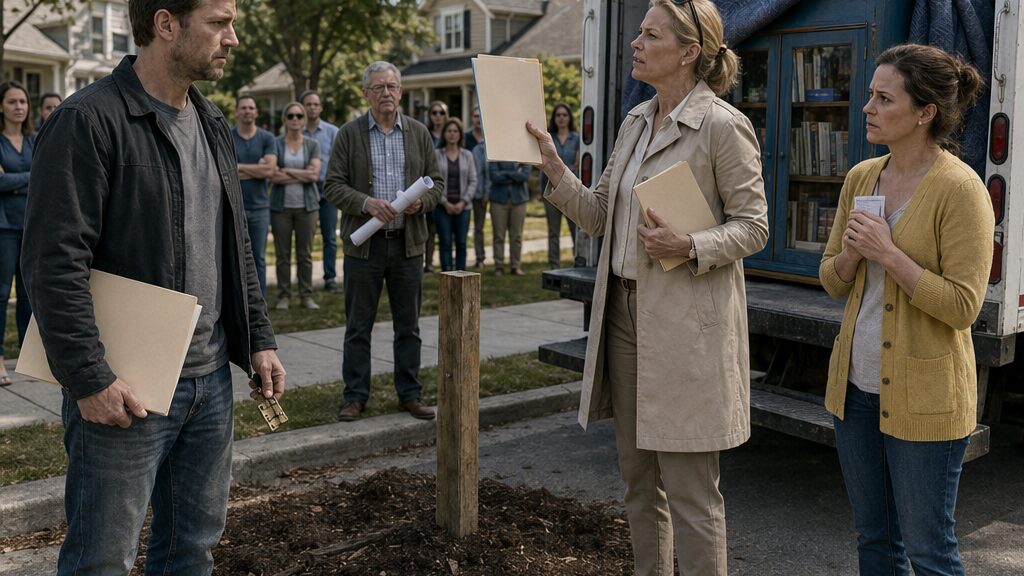
When They Took the Little Blue Library, the Whole Street Finally Started Reading
Chapter 1: The Morning Kathleen Called the Little Library Clutter
“That little library has to go.”
Kathleen Clark said it with one finger lifted toward the blue box at the edge of Eric Moore’s yard, as if she were pointing out a dead branch, a cracked window, or something that had begun to rot.
Eric had been kneeling beside the post, tightening the lower hinge with a stubby screwdriver, when her shadow cut across the grass. He looked up first at her white sneakers, then at the beige slacks pressed sharp enough to hold a crease, then at the folder tucked against her ribs. Her sunglasses rested on top of her clipped-back hair. Even in the soft heat of late Saturday morning, Kathleen looked ready for a hearing.
“It’s not a little library,” she said. “It’s visual clutter.”
Eric remained crouched. The screwdriver was still in his hand. Behind the glass door, three children’s paperbacks leaned against a stack of mystery novels, a cookbook with a cracked spine, and a row of early readers Richard Rivera had dropped off the week before. The box was painted a bright, stubborn blue, the color a shade too cheerful for the beige and gray houses along Hawthorne Bend.
“It’s been here eight months,” Eric said.
Kathleen’s mouth tightened. “That doesn’t make it approved.”
A minivan slowed at the corner. The driver glanced toward them, then rolled on. Across the street, a sprinkler clicked in nervous half-circles over Amanda Hall’s front lawn. Eric could see Amanda on her porch, phone in hand, pretending not to watch while watching every second.
Kathleen opened the folder. Inside were printed photographs of the library from three angles, each one marked with a red circle around the blue box. Eric stared at the pictures for a moment. Someone had stood in the street, maybe even on Amanda’s side, and photographed the library as if gathering proof of a crime.
“Is that really necessary?” he asked.
“What’s necessary,” Kathleen said, “is keeping a consistent appearance in this neighborhood. We have guidelines for structures, signage, exterior additions, and lawn ornaments.”
“It’s a box of books.”
“It’s an unauthorized exterior structure.”
Eric set the screwdriver on the grass. A laugh almost came out of him, but it died before reaching his throat. He wiped his thumb along the bottom edge of the library door, where a chip of blue paint had lifted overnight. The door used to stick in damp weather. He had fixed it twice. Children pulled too hard when they were excited. Adults were gentler, though most of them used the box when no one was looking.
“People use it every day,” he said.
Kathleen glanced toward the books, then toward the sidewalk, as if hoping no one had heard him. “That is not the point.”
“It feels like the point.”
“The point is that residents are not allowed to install personal projects in common visual areas.”
“It’s on my yard.”
“It faces the street.”
That was the kind of sentence Kathleen liked, Eric thought. Short enough to sound final, vague enough to stretch over whatever she wanted.
Amanda stepped off her porch then, still holding her phone. She crossed her arms as she reached the edge of her driveway. She wore a yellow sweater despite the heat, the kind of outfit that looked casual only because it had been chosen carefully.
“I told you this would happen,” Amanda called lightly. “The street was starting to look like a school fundraiser.”
Eric looked at her. “Good morning, Amanda.”
She gave him a small smile, not quite friendly. “I’m just saying. We all have to live with what people put out front.”
Kathleen seemed relieved by the support. She turned half a step, enough to include Amanda but not surrender control of the scene.
“Exactly,” Kathleen said. “Standards only work when everyone respects them.”
Eric stood slowly. He was not tall enough to make the movement intimidating, and he did not try. His knees clicked from crouching too long. He picked up a paperback that had been left on the small lower shelf outside the door, a thin adventure book with a bent cover. A folded index card slipped from between the pages and landed face down on the grass.
He bent before Kathleen could say anything.
The card had a penciled line across the top: Took this one on Tuesday. Bringing it back because my brother wants it too.
No name. Just careful handwriting, rounded and uneven, probably from a child who had pressed too hard with the pencil. Eric held it for a beat longer than he should have. The card felt soft at the fold, handled more than once.
Kathleen’s eyes dropped to it. “Eric.”
He slid the card into his back pocket. “What?”
“This is exactly why it’s a problem.”
“A note from a kid?”
“Uncontrolled use. Unknown traffic. Items coming and going. We don’t know who is stopping here.”
Amanda made a small sound, almost a laugh. “It’s not exactly the public library.”
“No,” Eric said. “It’s quieter.”
The word landed badly. Amanda looked down at her phone. Kathleen closed her folder.
“You have until tomorrow morning to remove it,” she said.
Eric stared at her. “Tomorrow?”
“The notice will reflect that you were verbally informed today.”
“I haven’t received any notice.”
“You are receiving it now.”
“That’s not how the process works.”
Kathleen’s expression shifted, not into anger exactly, but into the tight patience of someone being forced to explain something to a person she had already decided was unreasonable. “The board has had complaints.”
“From who?”
“We don’t disclose residents who raise concerns.”
“Were they written?”
Her eyes flicked once to Amanda, fast enough that Eric might have missed it if he had not been watching. Amanda lifted her chin and looked down the street.
“Kathleen,” Eric said, “were they written?”
“The committee has discretion to address visible violations.”
“The committee, or you?”
For the first time, the porch doors and windows along Hawthorne Bend seemed too close. A curtain shifted at the house two doors down. Somewhere a dog barked once and stopped. Eric felt the shape of the neighborhood around him, all the quiet squares of lawn and porch and driveway, all the people who had taken books and left books and never said anything when Kathleen stood in front of him with a folder full of photographs.
Kathleen stepped closer to the box. Her finger hovered near the blue door, not touching it.
“This kind of thing starts small,” she said. “A box here, a homemade sign there, toys left out, planters on the sidewalk. Then people wonder why the neighborhood doesn’t feel maintained anymore.”
Eric wanted to tell her that maintained was not the same as alive. He wanted to tell Amanda that he had seen her pause beside the box one evening in March after checking the mail, her hand resting on a paperback with a torn dragon on the cover. He wanted to say that some things were allowed to exist without making the street less valuable.
Instead, he looked at the tiny fingerprints smudged on the glass door.
“People like it,” he said.
Kathleen’s voice softened, which somehow made it worse. “People like plenty of things that don’t belong in front yards.”
Amanda turned away, as if the matter had reached its obvious conclusion. “Maybe now the street can look normal again.”
Eric felt heat climb the back of his neck. Not rage. Not yet. Embarrassment first, which annoyed him more. He was a grown man standing in his own yard, being spoken to like someone who had left trash out after collection day.
He opened the library door and straightened the books with one hand. A copy of Charlotte’s Web had tilted forward. He touched the spine, then pushed it carefully back into place.
Kathleen watched him. “Please don’t make this more difficult than it needs to be.”
Eric shut the door. The little brass latch clicked.
“What happens if I don’t remove it by tomorrow?”
Kathleen held the folder tighter. “Then the association will take appropriate action.”
“Which means?”
“It means we will correct the violation.”
Eric let out one quiet breath. He looked at the post sunk into the grass, at the strip of blue paint along the roofline, at the small sticker inside the door that said Take one. Leave one. Come back soon. The words were faded from sun.
He could explain. He knew he could. He could say the thing that would make Amanda look away and make Kathleen lower her folder for at least a second. He could turn private grief into public leverage and maybe win the morning.
His hand moved toward his back pocket, where the folded card pressed against his wallet.
Then he stopped.
“I’ll look at the rules,” he said.
Kathleen blinked, perhaps expecting more. “You do that.”
Eric nodded once.
It must have looked like surrender, because Amanda smiled a little as she started back across the street. Kathleen took a step away, then paused beside the sidewalk.
“Every day, you said?” she asked.
Eric looked at her.
“The people using it,” Kathleen said. “Every day?”
“Most days.”
Her smile was clean and small. “Not after today, Eric.”
Chapter 2: The Empty Post at the Edge of the Yard
The little blue library was gone before Eric made coffee.
He stood in the front doorway with his keys in one hand and stopped so abruptly the screen door bumped his shoulder from behind. For a second his mind refused to understand the shape of the yard. The post was still there, a square wooden stump rising out of the mulch, but the box itself had vanished. Four pale screw holes showed where the mounting bracket had been. The grass around the post was scuffed flat, and a thin crescent of blue paint lay in the mulch like a broken fingernail.
Eric crossed the lawn barefoot.
The morning air was cool enough to raise bumps on his arms. Someone had worked early or late, before the street filled with joggers and garage doors and sprinklers. The cuts on the post were rough. Whoever removed it had not bothered to preserve the wood.
He crouched and touched one of the screw holes.
The box had been solid. He had overbuilt it. He remembered standing in the garage with clamps on the frame, waiting for wood glue to set. Remembered sanding the edges because small hands would use the door. Remembered painting the second coat of blue after midnight, when the house was too quiet.
A car door shut across the street.
Amanda stood by her driveway, robe tied over leggings, a coffee mug in her hand. She took one look at Eric crouched beside the empty post and raised her eyebrows.
“Well,” she said, loud enough for him to hear, “maybe someone finally cleaned up the neighborhood.”
Eric straightened slowly.
“Did you see who took it?”
Amanda sipped her coffee. “No.”
“Did you hear anything?”
“I sleep at night.”
The answer came too fast. Eric wiped his thumb across the blue paint chip and stood with it stuck to his skin.
“I’m asking because it was on my property,” he said.
Amanda’s face changed, just a little. Not guilt, not exactly. More like discomfort at a word she did not want included. Property made the issue sound less like taste and more like trespass.
“You should ask Kathleen,” she said. “She’s the one handling it.”
“Handling it.”
“That’s what committees are for.”
Eric looked down the street. Most houses still had blinds drawn. The empty post seemed louder than the box had ever been. Yesterday the library had been a cheerful little interruption in the line of lawns. Now its absence made people slow down. A man walking a dog paused, looked at the post, looked at Eric, then tugged the dog along without speaking.
Eric went back inside for shoes and his phone. By the time he returned to the curb, Richard Rivera was walking toward him with a canvas tote folded under one arm. He wore a faded cap and moved carefully, like someone whose knees had negotiated terms with him years earlier.
Richard stopped at the edge of the lawn.
“Oh,” he said.
Eric nodded.
Richard looked at the post for a long moment. “I brought three more.”
He opened the tote slightly. Inside were children’s books, their covers bright and worn. Eric recognized the careful way Richard arranged them, spines aligned, corners protected. Retired librarian habits, he had once joked. Richard had not denied it.
“Not much use now,” Eric said.
Richard’s mouth tightened. “Who did it?”
“I don’t know.”
“You have a notice?”
“Verbal warning yesterday. Nothing written.”
“That doesn’t sound right.”
“Doesn’t feel right either.”
Richard stepped onto the grass and crouched with some effort. He examined the post, the screw holes, the torn bracket mark. “They didn’t remove it clean.”
Eric said nothing.
Richard glanced up at him. “Half the children’s books in there were mine.”
“I know.”
“I don’t mean I want credit.” Richard pressed a palm against his knee and stood. “I mean it wasn’t just yours, Eric.”
That landed harder than Eric expected. He looked toward the street so Richard would not see his face change.
A sedan slowed near the curb. Inside, a child’s head turned toward the post. The car kept moving. Eric heard a muffled question through the window, then an adult voice answering too quietly to catch.
His phone buzzed in his hand.
A new email had arrived from the Hawthorne Bend Homeowners Association. Subject line: Confirmation of Corrective Action.
Eric opened it with his thumb.
The message was only three paragraphs. It stated that the unauthorized exterior structure at his property had been corrected following prior verbal notice. It advised him not to reinstall the structure without architectural approval. It mentioned possible fines for repeated violations.
At the bottom was Kathleen Clark’s name, followed by Architectural Committee Chair.
No board signatures. No attachment. No vote record.
Richard read over his shoulder and made a low sound. “Corrected.”
Eric locked the phone. “That’s a word for it.”
Amanda was still across the street. She had turned slightly, pretending to inspect one of her planters.
Eric started toward her, then stopped. The urge to ask again, sharper this time, rose through him. He imagined saying, You know who did this. He imagined Amanda looking past him toward Kathleen’s house, pretending offense. He imagined half the street deciding he was the kind of man who yelled at women on Sunday morning over a box.
He stayed where he was.
Richard noticed. “You don’t have to swallow everything.”
“I’m not swallowing it.”
“You’re holding it in your mouth, then.”
Eric almost smiled, but the empty post pulled his eyes back.
A front door opened two houses down. Donna Smith stepped out, carrying a slim binder against her chest. She saw Eric and hesitated. For a second, he thought she would turn back inside. Instead, she crossed the sidewalk with short, careful steps.
“Eric,” she said quietly.
“Donna.”
Her eyes went to the post. “I didn’t know they were doing it this morning.”
“They?”
She pressed the binder closer. “I shouldn’t say anything out here.”
Richard gave her a look over the top of his glasses. “That usually means something should be said out here.”
Donna’s cheeks colored. She lowered her voice. “The board didn’t vote on removal.”
Eric waited.
Donna swallowed. “There was a discussion item for Monday’s meeting. Kathleen said the structure was noncompliant and that she had received resident concerns. The board agreed to review the guideline language. That’s all.”
Eric felt something inside him go very still. “Review.”
“Yes.”
“Not remove.”
“No.”
Amanda had stopped pretending now. She stood in her driveway, mug held near her chest.
Donna opened the binder just enough for Eric to see the page clipped inside. Her finger found a line halfway down.
Architectural Committee Report: Lending Library Structure — discussion only.
The words were plain, printed in the same tidy font as every other agenda item. Discussion only. No urgency. No authorization. No corrected violation.
“Can I take a picture of that?” Eric asked.
Donna hesitated.
He heard the garage door open at Kathleen’s house down the block.
Donna looked toward the sound, then back at Eric. Her fear was small but visible, the kind that came from years of avoiding scenes and calling it professionalism.
“Not yet,” she said. “Please. Let me check the minutes first.”
“Donna.”
“I’m trying to do this correctly.”
Eric wanted to tell her that correctly had already been left in the mulch. He wanted to ask why everyone’s caution seemed to cost him something and cost Kathleen nothing.
Instead, he looked once more at the line.
Discussion only.
Donna closed the binder.
Down the street, Kathleen stepped out of her garage in walking clothes, phone in hand. She paused when she saw the small group around Eric’s post. For a moment, nobody moved. Then Kathleen lifted her chin in greeting, as if Sunday morning had unfolded exactly as it should.
Donna slid the binder under her arm and spoke so softly Eric barely heard her.
“I’ll bring the minutes tomorrow.”
She turned and walked back toward her house, leaving Eric beside the empty post with blue paint on his thumb and the words still sharp in his mind.
Discussion only.
Chapter 3: The Complaints That Nobody Signed
Kathleen read the violation aloud as if the missing library were sitting in the meeting room with its head bowed.
“Unauthorized exterior structure,” she said, standing beside the folding table at the front of the clubhouse. “Installed without architectural approval. Visible from the street. Subject of multiple resident concerns. Removed after verbal notice and corrective action.”
Eric sat in the second row with a folder on his lap and his hands flat against the cover. The clubhouse smelled faintly of floor cleaner and old coffee. Metal chairs faced the board table in uneven rows. A bulletin board behind Kathleen advertised pool hours, trash pickup reminders, and a faded notice about keeping garage doors closed.
The little blue library had been reduced to a sentence.
Donna sat at the end of the board table with her laptop open, fingers resting near the keys but not moving. She had not looked at Eric since he walked in. Richard sat two seats to Eric’s left, a stack of children’s books tied with twine at his feet. Amanda had come too. She took a chair near the back wall and crossed her legs, her phone face down in her lap.
Kathleen continued, “The homeowner was informed of the violation and given an opportunity to comply.”
Eric raised his hand.
The board president, a broad-shouldered man with reading glasses low on his nose, sighed before speaking. “Mr. Moore, you’ll have a chance during homeowner comments.”
“She just said something inaccurate.”
Kathleen looked at him. “I said the structure was removed after notice.”
“You said I was given an opportunity to comply. I was told Saturday. It was gone Sunday morning.”
“That is an opportunity.”
Richard made a soft sound beside him. Eric did not look over.
The board president tapped his pen. “Let’s keep this orderly.”
Orderly. Eric wondered how many things could be done badly as long as people said the word orderly afterward.
Kathleen turned one printed page over. “Because the structure has now been removed, the remaining question is how to prevent repeated noncompliance.”
Eric’s hand tightened against the folder. Inside were three printed photos of the empty post, the email from Kathleen, and the folded card from the adventure book. He had almost left the card at home. It felt wrong to use it. It also felt wrong to hide it again.
The board president nodded toward Donna. “Do the minutes from last week show action authorized?”
Donna’s fingers moved to the laptop. She clicked once, then again. The room quieted around the small sound.
“The item was listed for discussion,” she said.
Kathleen turned her head. “Correct. The committee had discussed it.”
Donna’s eyes stayed on her screen. “The board did not vote on removal at that meeting.”
The president frowned. “Was there a separate committee action?”
Kathleen’s smile remained, but it thinned. “The architectural committee has authority to enforce visible violations.”
“Was the action recorded?”
Donna did not answer immediately.
Eric looked at her. He could see how badly she wanted the question to pass around her. She had spent years writing minutes that made arguments look cleaner than they had been. Now the words were not cleaning anything.
“I have no recorded vote from the committee,” Donna said.
A small movement passed through the room. Not a gasp, not drama. Just neighbors shifting in chairs, recalculating.
Kathleen placed both palms on the table. “We are losing sight of the issue. The structure was never approved.”
Eric stood before anyone told him to.
The president began, “Mr. Moore—”
“It wasn’t approved,” Eric said. “I understand that. I should have filed the form.”
Kathleen’s eyes sharpened with satisfaction.
Eric hated that. He hated giving her the clean piece of truth she wanted while the rest sat complicated in his throat.
“I built it last fall,” he continued. “I painted it blue. I put books in it. People added more. If the issue is a form, I’ll file the form. If the issue is placement, tell me where the guidelines allow it. If the issue is size, give me a measurement. But no one had authority to take it off my yard Sunday morning.”
Amanda looked down at her phone.
Kathleen lifted a page. “The association received complaints.”
“Written complaints?” Eric asked.
“Resident concerns.”
“Signed complaints?”
Kathleen’s lips pressed together.
The president looked from Kathleen to Donna. “Do we have copies?”
Kathleen said, “Residents often prefer confidentiality.”
“That’s not what he asked,” Richard said.
The president looked annoyed. “Sir, you’ll have a chance—”
“I donated books to that box,” Richard said, standing slowly. “So did others. If people complained, I’m sorry to hear it. But if the complaint is that no one used it, that’s simply false.”
“No one said no one used it,” Kathleen replied.
“You implied it was one homeowner’s personal clutter.”
“It was a private structure.”
Richard untied the stack of books at his feet with careful hands. “This one disappeared twice and came back both times. This one had a note in it asking for more animal stories. This one was taken after school so often I had to reinforce the spine.”
Kathleen looked embarrassed for him, which irritated Eric more than anger would have.
“That is very nice,” she said. “But sentiment does not override rules.”
Eric felt the card in his folder as if it were warm.
He could speak then. He could tell them why the rules had not been the first thing on his mind when he built the box. He could tell them who had chosen the color. He could tell them why the words Come back soon were painted inside the door instead of outside. His mouth even opened.
Nothing came out.
The room waited for a story he could not give them.
Kathleen used the silence. “To avoid confusion going forward, I recommend a fine schedule for any reinstallation without prior approval. One hundred dollars per day until removed.”
Amanda’s head came up.
“One hundred dollars?” Eric said.
“For repeated violations,” Kathleen answered.
“It’s already gone.”
“And it should remain gone until properly reviewed.”
The president rubbed his forehead. “Let’s not jump to amounts tonight.”
Kathleen turned to him. “If we don’t set a clear consequence, we encourage residents to test the guidelines.”
Eric sat down. He could feel Richard looking at him, waiting for him to push harder. Donna’s face was pale in the laptop glow. Amanda’s thumb moved once across her phone screen, then stopped.
Homeowner comments opened ten minutes later. Richard spoke first. He did not raise his voice. He told them the box was used after school, on weekends, by retirees and parents and children who liked choosing books without anyone keeping score. He said the library had done more good than most approved lawn ornaments.
A woman in the back row said she had left cookbooks there. A man near the door said his grandson liked the dinosaur books. Each comment was short, almost apologetic, as if neighbors were embarrassed to admit they had participated in kindness without permission.
Eric listened with his eyes on the folded card in his folder.
Then Amanda spoke from the back.
“I don’t hate books,” she said, sounding defensive before anyone accused her. “I just think there has to be a standard. The street can’t become everyone’s personal project.”
Kathleen nodded faintly.
Amanda continued, “And some of those books were old. One had a torn cover. The dragon one, I think.”
Eric’s hand froze.
The dragon one.
He knew that book. Richard had donated it in January. A children’s fantasy paperback with a torn green dragon on the front, the same one that had disappeared for three weeks and come back with a strip of clear tape carefully placed along the spine. Eric had found a card inside it once, the handwriting small and tense.
Can I keep this longer? I read slow.
Amanda was still talking, but Eric no longer heard the whole sentence. She had recognized that book. Not glanced at it. Not noticed it from the sidewalk. Recognized it.
He turned in his chair and looked at her.
Amanda stopped mid-word.
For the first time since Saturday, her face lost its practiced brightness. Her eyes flicked to Eric’s folder, then away.
Kathleen cleared her throat. “The condition of donated items is exactly another concern.”
Eric did not look at Kathleen. He kept looking at Amanda.
“You saw the dragon book?” he asked.
Amanda’s fingers tightened around her phone. “I said I might have.”
“From the sidewalk?”
Her mouth opened. Closed.
The president tapped his pen again, but nobody spoke over the silence this time.
Eric looked down at his folder. The folded card was tucked beneath the printed email, hidden but not gone.
Amanda stared at the floor as if the answer were written there.
And Eric understood, all at once, that one of the people acting like the little library had lowered the street had known exactly what was inside it.
Chapter 4: The Book Amanda Did Not Want to Recognize
The dragon book was on Amanda Hall’s porch Wednesday afternoon, tucked beneath a plastic watering can as if someone had tried to hide it and failed.
Eric saw it from the sidewalk while carrying his trash bin back up the driveway. He stopped with both hands on the handle, looking across the street at the torn green dragon peeking out from behind the can. The cover had a strip of clear tape along the spine. Richard’s tape. Eric had watched him smooth it down with the edge of a library card months ago.
Amanda’s front door opened before Eric could decide whether to walk over.
She stepped onto the porch with a laundry basket against her hip, saw him looking, and froze.
For a moment neither of them spoke. The sprinkler clicked behind her, sending water across the grass in bright little arcs. The dragon book sat there between them, too small to justify the heat that rose in Eric’s chest.
Amanda shifted the basket higher. “Can I help you?”
Eric pointed, not at her, but at the porch. “That book came from the library.”
Her eyes flicked down. “A lot of books look alike.”
“Not that one.”
“It’s a children’s book, Eric.”
“It has a repair on the spine.”
Amanda set the basket on the porch bench too carefully. “Are you accusing me of stealing from your illegal yard box?”
The words were sharp, but her voice had gone thin at the edges.
Eric crossed the street. He stayed on the sidewalk at first, then stopped at the base of her porch steps. He did not want to crowd her. He did not want to look like the angry neighbor Kathleen had been trying to make him into.
“I’m asking why you recognized it at the meeting,” he said.
Amanda folded her arms. “I didn’t recognize anything. I said maybe. People say maybe.”
“You knew the cover was torn.”
Her jaw tightened.
From inside the house, something bumped softly, followed by a quick hush. Eric’s eyes moved toward the door. Amanda moved too, stepping half a pace to block his view.
“Leave my house out of this,” she said.
“I’m not interested in your house.”
“You are standing on my walkway over a book.”
“I’m standing here because you helped Kathleen make that box sound like garbage, and now one of the books is on your porch.”
Amanda looked past him toward Kathleen’s house. The motion was quick, almost automatic. Eric noticed it and wished he had not, because now it meant something.
She lowered her voice. “Not every favor needs a sob story.”
The sentence hit him wrong. It was not just cruel. It was defensive, as if she were answering something he had not said.
Eric kept his hands at his sides. “I didn’t give one.”
“No, you never give anything. You just stand there like everyone else is supposed to understand what you mean.”
He almost answered. He almost told her that understanding had never been something he expected from Hawthorne Bend. Polite nods, maybe. Borrowed tools returned late. A wave from behind a windshield. But not understanding.
Instead, he looked at the book again.
“Who read it?” he asked.
Amanda’s face closed. “No one.”
The door behind her opened three inches.
A small hand appeared first, fingers curled around the door edge. Then the child leaned out just enough for Eric to see one eye, a slice of cheek, and the anxious press of lips. The child looked at the book, then at Eric.
Amanda turned. “Go inside.”
The door closed.
The anger in Eric changed shape. It did not disappear, but it lost its clean edge.
Amanda picked up the dragon book fast, pressing it against the laundry basket. “You don’t get to drag children into your fight with Kathleen.”
“I didn’t.”
“You were about to.”
“No,” Eric said. “I was about to ask why you lied.”
Her face flushed. “Because people talk. Because Kathleen talks. Because one minute it’s a cute little box and the next minute everyone knows whose kid is taking books home because the school library has a waiting list and the town library closes before we can get there.”
The words spilled out and stopped. Amanda looked as if she had surprised herself by saying them.
Eric stood still.
The street behind him hummed with ordinary afternoon sounds: a mower two blocks over, a delivery van braking at the corner, wind dragging dry leaves along the gutter. Amanda’s porch suddenly felt less like a stage and more like a place where someone had been trying to manage more than her lawn.
She looked down at the book in her hands. “It was supposed to be anonymous.”
“It was.”
“Not anymore.”
“I haven’t said anything.”
“You looked at me in that meeting like you’d caught me.”
“I did catch you.”
Her eyes flashed.
Eric regretted it as soon as he said it. Not because it was untrue, but because it was too easy.
He took a breath. “I caught you pretending the library didn’t matter.”
Amanda’s mouth trembled once before she pressed it flat. “You think you’re the only person who doesn’t want people in their business?”
He did not answer.
She sat on the porch step, the laundry basket forgotten beside her. The dragon book rested on her knees. Up close, Eric could see a folded card inside, tucked where a bookmark might go. Amanda saw him notice and covered it with her palm.
“It helped,” she said, barely above a whisper. “The box. It helped more than I wanted it to.”
Eric looked away from her hand. “Then why side with Kathleen?”
Amanda laughed once, short and bitter. “You think I’m on Kathleen’s side?”
“You sounded like it.”
“That’s different.”
“Not from where I was standing.”
She stared at the lawn. “Kathleen kept saying the box was attracting attention. People stopping. Kids cutting across yards. Cars slowing down. She said if the management company saw unauthorized structures before the review, they’d start looking harder at everything. Fences, paint colors, porch storage, all of it.”
“That bothered you?”
Amanda’s eyes lifted. “I have a cracked side gate I can’t afford to replace this month. I have a basketball hoop my kid still uses even though it’s technically not supposed to stay out overnight. Kathleen notices things when she wants to.”
Eric absorbed that. Kathleen’s rules were not only rules. They were weather. People changed their routes around them.
“So you let her point at me.”
Amanda looked ashamed for half a second, then angry because of the shame. “I didn’t take your box.”
“I didn’t say you did.”
“But you wanted to.”
He could not deny that. On Sunday morning, he had wanted to ask her in front of everyone. He had wanted her smile to disappear. He had wanted the street to see someone else caught.
“I wanted someone to answer for it,” he said.
Amanda’s shoulders dropped.
From behind the door came the faint sound of movement again. A child trying not to listen.
Amanda pulled the folded card from the dragon book. She did not hand it to Eric at first. She just looked at it. Then she extended it halfway, as if still unsure whether releasing it would cost her something.
Eric took it gently.
The writing was small and careful.
Can I keep this longer? I read slow.
Below it, in different pencil pressure, was a second line.
Thank you for not asking my name.
Eric’s throat tightened so abruptly he had to look at the card rather than Amanda.
“That’s why,” she said.
“Why what?”
“Why I didn’t say anything at the meeting.” She wiped at one eye with the heel of her hand, irritated by the need. “If Kathleen turned it into a list of who used the box, my kid would never touch another book from it. Not there. Not anywhere someone might see.”
Eric folded the card along its old crease.
“I wouldn’t have used this against you.”
“You don’t know what you would’ve done once everybody started looking at you.”
That was unfair. It was also close enough to something true that Eric did not defend himself. He had almost used the card in his folder. He had almost made a child’s note into evidence.
Amanda seemed to read the thought on his face. Her voice softened. “I’m not saying Kathleen is right.”
“But you helped her.”
“I know.”
The admission changed the air between them. Not forgiveness. Not trust. Just a crack in the performance.
Eric handed the card back. “Keep it.”
Amanda stared at it. “You don’t need it?”
“I need the truth more.”
Her fingers closed around the card.
A car rolled slowly past Kathleen’s house and turned into a driveway. Amanda watched it until it stopped. “She said the box was attracting the wrong kind of attention.”
Eric looked at her.
Amanda held the dragon book against her chest now, like something fragile. “That’s the phrase she used. Not clutter. Not rules. The wrong kind of attention.”
“When?”
“Last week. Before she talked to you.”
Eric felt the empty post across the street without looking at it.
“What did she mean?”
Amanda shook her head. “I don’t know. But when I asked, she said if people wanted charity projects, they should move somewhere that needed them.”
The words settled between them, heavier than the book, heavier than the porch heat, heavier than the silence from behind Amanda’s door.
Eric looked down Hawthorne Bend toward Kathleen’s neat house, where every hedge was squared and every curtain hung exactly level.
For the first time, he wondered whether Kathleen had removed the library because it broke a rule, or because it had told the truth about the street before anyone was ready to hear it.
Chapter 5: The Rule Kathleen Needed More Than the Truth
“That’s not a code violation,” the county clerk said.
Eric stood at a scratched laminate counter under fluorescent lights, one hand resting on a folder full of photographs and printouts. He had expected a longer process, a form, maybe a fee. Instead, the clerk had taken one look at the photo of the little blue library, adjusted her glasses, and said the sentence so plainly that Eric almost asked her to repeat it just to make sure it stayed true.
“It’s not?”
“Not by county code.” She turned the photo around with two fingers. “Small book exchange structures like this usually fall under accessory decorative or community-use items, assuming they’re not blocking sightlines, sidewalks, utilities, or drainage. Yours was set back from the sidewalk?”
“Three feet.”
“Anchored?”
“Yes.”
“Commercial signage?”
“No.”
“Electrical?”
“No.”
“Then this isn’t us.” She slid the photo back. “Your HOA may have its own guidelines, but don’t let anyone tell you the county ordered it removed.”
Eric felt a slow pressure ease from his chest, followed by a sharper one underneath. “They already removed it.”
The clerk paused. “The HOA did?”
“The committee chair.”
Her expression became careful. “You’ll want to review your association documents.”
“I have.”
“Review the enforcement section. And architectural approval. Sometimes they can require an application, but removal before notice and appeal is usually addressed somewhere.”
Usually. That was the kind of word that did not fix anything but handed him a direction.
Eric thanked her and stepped outside into the glare of the parking lot. He sat in his truck with the engine off and the folder open across the steering wheel. The printed county guideline lay beside the photos of the blue box, one official page next to three images Kathleen had treated like evidence of decay.
He should have felt satisfied.
Instead, he thought of Amanda’s porch. The dragon book. The line written by a child who read slow.
Thank you for not asking my name.
Eric folded the county printout and placed it behind the HOA email. Evidence. That was what he had now. Not enough to restore the box, maybe, but enough to stop Kathleen from making the story smaller than it was.
On the way home, he saw Kathleen outside her house, speaking with a man in a dress shirt beside a dark sedan. The man held a tablet. Kathleen held a folder. Her posture was composed, but her hands moved too quickly.
Eric parked in his driveway and did not get out right away.
The man glanced down the street toward the empty post. Kathleen followed his gaze, and even from three houses away Eric saw her face tighten. She said something, and the man typed on the tablet.
Management review, Amanda had said.
Eric got out and crossed the street before caution could talk him out of it.
Kathleen saw him coming. “Eric, this isn’t a good time.”
“I need to ask about the county code.”
The man with the tablet lifted his eyebrows. Kathleen smiled at him, thin and professional. “This is a homeowner matter.”
“I am the homeowner.”
The man excused himself with the polite speed of someone paid not to witness neighborhood disputes and walked toward his sedan.
Kathleen waited until he was out of earshot. “You shouldn’t approach people during an association review.”
“I went to the county office.”
Her face changed by a fraction.
“They said the library wasn’t a code violation.”
“I never said it was county code.”
“You let people think it was more than an HOA preference.”
“It is not a preference. It is an architectural standard.”
“Which standard?”
Kathleen looked toward the sedan as it pulled away. The mask slipped enough for Eric to see the strain beneath it. She looked tired. Not sympathetic tired. Cornered tired.
“You have no idea what I’m dealing with,” she said.
The sentence surprised him more than anger would have.
“With a box of books?”
“With a neighborhood that wants low dues, perfect landscaping, full amenities, and no management oversight until something goes wrong.” She lowered her voice. “The management company is reviewing the association because people complain we don’t enforce uniformly. If they recommend outside enforcement, dues go up. Violations get stricter. People like Amanda with side gates and half the cul-de-sac with unapproved paint colors will have much bigger problems than your little project.”
Eric studied her. For the first time, he could see the logic she lived inside. Not kindness. But logic.
“So you made an example out of the smallest thing on the street.”
“I addressed the most visible unauthorized structure.”
“It was visible because children used it.”
“It was visible because it was bright blue.”
The word blue came out with a kind of accusation.
Eric almost told her then. About the paint. About the promise. About why he had picked a color no one could miss. But Kathleen’s face had hardened again, and he could feel the old door inside himself closing.
“You could have asked me to file an application,” he said.
“I did not trust you to comply.”
“You never gave me the chance.”
“You installed it without asking.”
“That doesn’t give you the right to take it.”
Her eyes flashed. “The association corrected a violation.”
“The board didn’t approve that.”
Kathleen’s silence was brief, but enough.
Eric nodded once. “That’s what I thought.”
He turned before she could answer.
“Be careful,” Kathleen said behind him.
He stopped.
“If you make this a fight,” she continued, “the board may decide to enforce every part of the guideline exactly as written. You may not like what that means.”
Eric looked back. “For me?”
“For everyone.”
There it was. Not a threat shaped like revenge. A threat shaped like responsibility. Kathleen could make harm sound like stewardship. Maybe she even believed it.
Eric walked home with the county printout in his folder and her warning behind him.
That evening, Donna let him into the HOA records room through the side door of the clubhouse. She had called it a storage room on the phone, but it was smaller than that, a closet with a copier, boxes of pool wristbands, and file cabinets labeled by year.
“I can’t give you originals,” she said.
“I only need copies.”
“I’m not supposed to take sides.”
“You’re supposed to keep records.”
Donna flinched, and Eric regretted the sharpness.
She opened a drawer. “The enforcement section is here. Architectural review here. Committee authority here.”
They worked in uneasy quiet. Eric found the language the clerk had hinted at: written notice, opportunity to cure, board review for disputed violations, appeal rights before fines. He found nothing authorizing overnight removal from an owner’s property for a non-emergency structure.
Donna copied the pages. The machine warmed the small room with a dusty smell.
“I should have stopped it earlier,” she said.
Eric looked up.
Donna kept her eyes on the copier. “Kathleen asked me to draft the confirmation email. I told her there hadn’t been a vote. She said committee enforcement didn’t require one. I wasn’t sure enough to argue.”
“Were you sure enough to send it?”
Her face tightened.
He had done it again. Taken the easy hit because he had one.
“I’m sorry,” he said.
Donna swallowed. “No. You’re not wrong.”
The copier spat out the final page.
Eric gathered the papers. “Do you know where the library is?”
Donna did not answer.
His hands stilled around the warm copies. “Donna.”
“She said it was being stored.”
“Where?”
“I don’t know. I heard her tell the maintenance contractor to remove and dispose if necessary.”
Dispose.
The word seemed to drain the air from the room.
By the time Eric reached Richard’s house, dusk had settled along the street. Richard opened the door before Eric knocked twice, as if he had been expecting him. Eric held up the copied guidelines and the county printout.
“She didn’t have the authority,” Eric said.
Richard looked past the papers to his face. “And the box?”
Eric shook his head.
Richard stepped aside and let him in.
The front room was lined with bookshelves, every shelf full, some stacked two rows deep. On the dining table lay a set of folded plans, a measuring tape, and a pencil. Richard had already drawn something in careful lines: a cabinet with double doors, a sloped roof, side vents, clear front panels, and a base wide enough to meet setback requirements.
Eric stared at it. “What is that?”
“What I should have suggested before,” Richard said. “A lending library that is too properly built to dismiss.”
“I don’t have the original back.”
“No,” Richard said gently. “You may not get it back.”
Eric looked down at the plans. The cabinet was larger than the blue box, almost the size of a small hutch. On one corner, Richard had written salvaged trim if available.
“I’m not sure I can do this again,” Eric said.
Richard picked up the pencil and laid it across the drawing. “Then don’t do it again.”
Eric frowned.
Richard tapped the plans. “Do it differently. Do it where they have to see it isn’t just yours.”
Chapter 6: The Promise Hidden Inside the Blue Paint
The broken door came back in a black trash bag Friday night.
Eric found it leaning against his garage when he returned from the hardware store, the bag knotted at the top and speckled with sawdust. For one strange second he thought someone had left yard waste at the wrong house. Then he saw the strip of blue through a tear in the plastic.
He set down the bag of screws and stood very still.
The garage light hummed above him. Across the street, Amanda’s curtains shifted, then fell back into place. No one stepped outside. No one called out. Whoever had left the bag had done it quietly and gone.
Eric untied the knot with fingers that did not want to work.
The door slid out first, one hinge still attached, the other bent backward. The glass was cracked in one corner. The little brass latch was gone. Along the inside panel, the painted words were still there, faded but readable.
Take one. Leave one. Come back soon.
Eric sat on the garage step with the door across his knees.
The rest of the box was in pieces. A roof panel split along the grain. A side wall scraped raw where the blue paint had been dragged against concrete. A few screws clung to wood fibers. The careful thing he had built had become debris.
He touched the inside words with two fingers.
Come back soon.
He had painted that line last, after everything else dried. Not on the outside, where neighbors would see it. Inside, where only someone opening the door would read it. A small message for whoever needed to leave and return without being watched.
Behind him, his workbench held Richard’s plans, the HOA guidelines, the county printout, and a new application form Donna had emailed with no message except: Use this one.
Eric lifted one of the broken side panels. Something shifted inside it.
At first he thought it was a loose screw. Then a folded scrap slid from behind a panel seam and landed near his shoe. He picked it up.
The paper was soft and worn, folded into a square. Pencil marks crossed the front.
Thank you. My mom read this with me when the lights were out.
Eric stared at it.
He set it on the workbench and lifted the side panel closer. There was a narrow gap where the inner plywood had pulled from the frame. More paper waited there, flattened against the wood by months of weather and pressure.
He found six notes before he had to stop.
One said, I left two books because my sister grew out of them.
Another said, Do you have more space books?
Another had no words, only a crooked drawing of the blue box with a sun above it.
Eric laid them in a row beneath the garage light. None had names.
His eyes burned, and he was angry at himself for it. He turned away, grabbed a rag, wiped sawdust from his hands, then wiped them again though they were already clean.
The promise had started in a hospital reading room with bad chairs and donated paperbacks on a metal cart.
He did not let himself go there often. Not fully. It was safer to remember pieces: the squeak of the cart wheel, the way small hands searched book covers before choosing, the blue marker someone had used to write RETURNS on a cardboard box. The child who had told him books were easier than people because books waited.
He had promised there would always be books somewhere close.
Not a dramatic promise. Not one made under music or ceremony. Just a tired sentence spoken because he needed to say something and because the child had believed him.
After the funeral, people brought casseroles and cards and suggestions about grief groups. Eric accepted all of them politely and used almost none. Months later, he built the box. He did not tell the street why. He did not want the library to become a memorial people approached with careful voices. He wanted children to yank open the door without knowing anything about loss. He wanted adults to drop off mysteries and cookbooks without feeling they were walking through someone else’s sadness.
So he painted it blue and let it stand.
Then when Kathleen pointed at it, he had kept the same silence. The silence had protected the promise from pity. It had also left the promise undefended.
A knock sounded at the open garage door.
Eric turned too quickly.
Amanda stood at the edge of the driveway with the dragon book in both hands. She did not step into the garage.
“I saw the bag,” she said.
Eric nodded.
“Was that it?”
“Part of it.”
Her eyes moved to the broken panels, then to the notes lined on the workbench. “I didn’t know.”
“No one did.”
She accepted that with a small, painful nod. “My kid wanted to return this before anything else happened.”
Eric looked at the book.
Amanda came forward and set it on the workbench, away from the broken wood. A folded card stuck out from the pages. She did not take it back this time.
“I won’t mention the name,” Eric said.
“I know.”
That trust, small as it was, made him look down.
Amanda shifted her weight. “Kathleen filed something.”
Eric’s head came up.
“She emailed the block captains. Emergency motion. Temporary ban on all curb-facing structures until revised standards are adopted.” Amanda’s mouth twisted. “She wrote that unauthorized projects create liability and invite nonresident traffic.”
Eric gave a short, humorless laugh. “Nonresident traffic.”
“I’m not defending it.”
“No?”
“No.” She looked at the broken door. “Not anymore.”
The garage seemed to hold that sentence for a while.
Amanda crossed her arms. “She’s scared.”
“People keep telling me that.”
“She is. But she uses scared like a hammer.” Amanda looked toward the street. “I did too, I guess.”
Eric had no ready answer. Outside, a car passed slowly. The headlights moved across the garage wall, over the plans, over the notes, over the blue door across his knees.
Amanda noticed the drawings. “Is that a new one?”
“Maybe.”
“It’s big.”
“Compliant,” Eric said.
That made her smile despite herself. “That sounds like something Kathleen would hate more than small.”
Eric almost smiled too.
After Amanda left, Richard arrived with a cardboard tube of revised drawings and a tin of blue paint he had found in his shed. Donna called ten minutes later, voice low, to say Kathleen’s emergency motion had been added to Saturday’s agenda. If Eric wanted to speak before the vote, he had to submit a request before midnight.
Eric stood at the workbench after the call ended.
The request form was open on his laptop. Name. Address. Topic. Three-minute comment.
Three minutes to explain eight months of books. Three minutes to explain a promise he had not explained to neighbors who had stood ten feet away while the box disappeared. Three minutes to speak without turning grief into a weapon.
He looked at the old notes again.
Do you have more space books?
He opened a drawer and took out an envelope he had not touched in months. Inside was a photograph, creased at one corner, of the original blue door drying on sawhorses in his garage. On the back, in his own handwriting, was the color code from the paint store.
He had written it down so he could match it someday.
Eric placed the photograph beside Richard’s plans. Then he took the broken door and set it upright against the wall, where the inside words faced the garage.
Come back soon.
He sat at the laptop and typed his name.
For topic, he wrote: Community lending library replacement and approval standard.
His finger hovered before he submitted the request. Some part of him still wanted to keep the promise private, to rebuild quietly in some smaller way, to avoid the room and the eyes and Kathleen’s careful voice.
Then he looked at the notes that had been hidden inside the blue paint.
The box had not been only his for a long time.
Eric clicked submit.
A minute later, his phone buzzed with Donna’s reply.
You’re on the agenda.
Eric picked up the broken brass hinge from the workbench, closed it in his fist, and stood facing the blue door until the garage light clicked off behind him.
Chapter 7: When the Delivery Truck Stopped at the Curb
The white delivery truck stopped in front of Eric’s house while Kathleen was still standing beside the empty post.
For a moment, no one on Hawthorne Bend moved. The truck’s brakes sighed, the hazard lights blinked, and the driver leaned out the open window with a clipboard in his hand.
“Delivery for Moore?” he called.
Eric stood at the edge of his driveway with Richard’s rolled plans under one arm and the folder of papers held against his side. He had expected the truck later, after the meeting, after the vote, after permission had been argued into shape. Richard had said the cabinet maker could hold it until Monday if needed. Apparently, Richard’s idea of holding and the cabinet maker’s idea of holding were not the same.
Kathleen turned toward the truck slowly. Her face went still in a way Eric had learned to distrust.
“What is that?” she asked.
The delivery driver stepped down and walked to the back. “Community lending cabinet. Says here curbside drop, residential.”
“It is not approved,” Kathleen said.
The driver looked at Eric, then at Kathleen, then back at his clipboard. “I just deliver.”
Garage doors were beginning to open. A man in running shorts slowed near the corner. Amanda came out of her house with her hair pulled back, wearing the guarded expression of someone who had already decided not to run away but had not yet decided how brave she was going to be.
Richard arrived from two houses down, moving faster than his knees liked. “They’re early.”
“You think?” Eric said.
Richard glanced at Kathleen. “Maybe early is useful.”
The driver lifted the rear door.
Inside stood the new cabinet, wrapped in moving blankets and strapped upright. Even covered, it looked large. Larger than Eric had allowed himself to picture. It had the shape of a small hutch, broad at the base, with a sloped roof and two front doors fitted with clear panels. The trim along the roofline had been painted blue, not the full bright blue of the old box, but enough that the color flashed when the blanket shifted.
Kathleen pointed at the truck. “You cannot place that here.”
Eric felt every neighbor’s attention turn to him. This was the moment he usually hated, when a private choice became public weather. His first instinct was to tell the driver to wait, to avoid making it worse, to make everything smaller until no one could accuse him of forcing a scene.
He looked at the empty post.
Then he looked at the broken hinge in his palm, the one he had brought from the garage without meaning to. He closed his fingers around it.
“Set it in the driveway,” he told the driver. “Not on the lawn yet.”
Kathleen’s eyes narrowed. “That does not change the violation.”
“It changes whether you can call it installed,” Eric said.
A murmur moved through the neighbors.
The driver shrugged, relieved by the practical instruction, and began lowering the lift gate. Richard helped guide the cabinet down, though he was mostly there to touch one corner and pretend he could help. Amanda came to the curb and stood several feet from Eric, arms folded around herself.
Kathleen turned toward the gathering street. “Everyone should understand that this is exactly why rules exist. One homeowner decides personal feelings outweigh established standards, and suddenly the board is being pressured in public.”
Eric opened his folder. His hands shook only slightly.
“The board meeting starts in twenty minutes,” he said. “I’m on the agenda.”
“You are on the agenda to comment,” Kathleen said. “Not to stage a delivery.”
“I didn’t schedule the truck for an audience.”
Richard made a small cough that was not quite innocent.
Kathleen heard it. “Of course.”
The cabinet touched the driveway with a wooden thud. The moving blanket slipped, revealing the front doors. Inside, empty shelves waited in clean rows. A narrow piece of salvaged blue trim from the old library had been fixed just under the roof, scratched and imperfect against the new wood.
Amanda saw it and looked away.
The board meeting, held in the clubhouse, was more crowded than Eric had ever seen it. People stood along the walls. Someone had brought the email Kathleen sent about the emergency motion, printed and folded into thirds. Donna sat at the secretary’s table with her laptop already open, her face pale but steady.
Kathleen began before the board president had fully called the meeting to order.
“We have a serious issue of escalation,” she said. “This morning, despite ongoing review, a resident arranged delivery of a substantially larger curb-facing structure.”
Eric remained seated. The folder rested on his knees. The broken hinge was in his pocket, pressing against his thigh.
The president lifted a hand. “We’ll proceed in order.”
Kathleen sat, but not before giving Eric a look that said order would not save him.
When his name was called, Eric stood and walked to the front. The room blurred at the edges. He laid the county guideline, the HOA enforcement pages, Richard’s scaled drawing, and the application form on the table. Then he placed a small stack of folded cards beside them.
He had not planned to start with the cards. He had planned to start with setbacks, materials, height, door latches, sightlines, and approval process. Safe things. Things that did not shake in his voice.
Instead, he touched the top card.
“This was inside one of the books,” he said.
No one spoke.
He read only one line. “Can I keep this longer? I read slow.”
Amanda lowered her head.
Eric set the card down. “I built the first library without filing the right form. That part is on me.”
Kathleen’s chin lifted slightly.
“But it was removed from my property without a board vote, without written notice, and without an appeal. That part is not on me.”
Donna’s fingers moved across the laptop.
Eric turned one page. “The county says the structure was not a code violation. The HOA guidelines allow exterior structures if approved and maintained. So I’m not asking the board to ignore the rules. I’m asking the board to apply them.”
Kathleen stood. “He is omitting the fact that this neighborhood is under review. Unauthorized additions create exposure for everyone.”
“I’m not omitting it,” Eric said. “I’m saying fear of review is not permission to skip process.”
A few neighbors murmured approval. Kathleen’s face flushed.
Eric looked down at the cards. “The first box was blue because I wanted children to see it from the sidewalk. I put the words inside the door because I wanted people to feel they could come back without being watched.”
His throat tightened. He stopped before the room could become too quiet.
Richard stood near the back. He did not speak. He only nodded once.
Eric forced the next words out carefully. “The box started as a promise. Someone I loved once told me books were easier than people because books waited. After that, I wanted a place where books waited. I didn’t tell people because I didn’t want pity attached to it.”
He looked at Kathleen then, not to wound her, but to keep from hiding.
“That silence was my mistake. It let other people define it as clutter.”
Amanda moved before anyone expected her to. She stepped away from the wall and walked to the front with something held between both hands.
Kathleen said, “Amanda, this is not the time.”
Amanda did not stop.
She placed an unsigned checkout card on the table beside Eric’s stack. “My child wrote this.”
The room shifted again, more deeply this time.
Amanda’s voice was low but clear. “I was embarrassed. I thought if people knew we used it, they’d think things about us. Kathleen said the box was attracting the wrong kind of attention, and I let myself believe that meant someone else. Not us.”
Kathleen’s face went rigid. “That is not what I meant.”
Amanda looked at her. “I don’t know what you meant anymore.”
Eric did not look at the card. He did not need to. He knew the line by heart.
Thank you for not asking my name.
The board president removed his glasses and set them on the table. “Donna, do the records show a vote authorizing removal?”
Donna looked up. “No.”
“Do the records show written notice before removal?”
“No.”
Kathleen gripped the back of her chair. “The committee acted to protect the association.”
“Without recorded authorization,” Donna said, her voice small but firm.
The room went quiet.
Kathleen turned on Eric then, not with the sharp certainty from Saturday, but with something messier. “You are using sympathy to break rules.”
Eric felt the accusation strike the old place in him, the place that feared exactly that. He could have retreated. He almost did.
Instead, he slid the application form forward.
“No,” he said. “I’m using the rules to keep sympathy from being the only reason this survives.”
The president read the form. He read Richard’s plan. He read the county guideline. Around the room, neighbors who had borrowed quietly, donated quietly, watched quietly, began adding their names to a support sheet Richard passed along without ceremony.
The vote was called after nearly an hour.
Kathleen stood beside the window where, through the clubhouse glass, the top of the delivery truck was still visible down the street. Eric could see the blue-trimmed cabinet in his driveway, waiting beside the empty post like a question made out of wood.
“All in favor of conditional approval,” the president said, “with final placement subject to the submitted setback and maintenance standard?”
Hands rose.
Not every hand. Kathleen’s did not. Two board members hesitated before lifting theirs. Amanda raised hers from the back wall, eyes fixed on the floor.
The motion passed.
Kathleen did not sit.
The president cleared his throat. “One more matter. Effective immediately, removal of owner property for non-emergency architectural violations will require documented board authorization. Committee chairs may not act unilaterally.”
That vote passed too.
No one clapped. Eric was grateful. Applause would have made the room feel like a trial with a winner. Instead, people stood slowly, gathering purses, papers, water bottles, and the uneasy knowledge that they had all let a small thing become a test of them.
Outside, the delivery driver was still waiting by the truck, eating chips from a small bag.
“So,” he said, “am I putting this thing somewhere or taking it back?”
Eric looked at Kathleen. She stood near the empty post, arms folded, her face pale with anger and humiliation.
He could have smiled. He could have said something sharp. The street might even have liked it.
Instead, he looked at the cabinet, then at the post, then at the neighbors watching from sidewalks and driveways.
“Set it beside the post for now,” he said. “We’ll mark the exact placement together.”
Chapter 8: The Street That Learned What Clutter Really Meant
The first book returned to the new cabinet had no note inside it.
Eric found it on a Saturday morning two weeks after the vote, tucked neatly between a row of space books and a paperback mystery Richard insisted was appropriate for “advanced young readers and impatient adults.” It was the dragon book. The tape on the spine had been pressed down again, smoother this time, and the cover had been wiped clean.
Eric stood with one hand on the cabinet door and waited for the ache to settle into something he could carry.
The new library was no longer little, though everyone still called it that. It stood beside the old post, set back exactly three feet from the sidewalk, level on a small paver base, with clear doors, weather stripping, and a laminated maintenance schedule Donna had suggested. The roofline held one strip of salvaged blue trim from the first box. The rest was warm stained wood, sturdy enough to look less like a decoration and more like a promise with permits.
Inside, the shelves had labels now. Children. Mystery. Cooking. Take One, Leave One. A small drawer at the bottom held blank checkout cards and golf pencils tied with string.
Eric had not wanted the labels at first. They made the cabinet feel official in a way that embarrassed him. Richard had told him official was not always the enemy. Sometimes official was how a thing survived people who were afraid of feelings.
Across the street, Amanda walked down her driveway with a book in one hand and a grocery bag in the other. She paused when she saw Eric at the cabinet.
“Morning,” she said.
“Morning.”
She held up the book. “Donation.”
He opened the door wider.
She slid it onto the children’s shelf without explaining where it came from. Eric did not ask. That was part of the new rule no one had written down.
Amanda looked at the dragon book and smiled faintly. “It came back.”
“It did.”
“Good.”
The word was small, but it stayed.
More changes had happened than Eric expected, fewer than some neighbors wanted, and none as cleanly as the story would sound if someone told it at a cookout. Kathleen remained on the board. She no longer chaired the architectural committee alone; the board had added two rotating members and a written review log. Donna’s minutes became longer and less polished. Richard somehow became responsible for inventory despite insisting he was retired.
The old box was still gone.
That was the part Eric did not say when people told him everything worked out.
Only pieces remained: the cracked door, two side panels, a bent hinge, and the strip of blue trim now fixed beneath the new roof. The rest had been hauled away before anyone admitted who gave the final instruction. Kathleen never apologized for that part. She did say, during the next board meeting, that procedures should have been clearer. It was not enough. It was also more than Eric had expected.
He was restocking the lower shelf with early readers when he saw Kathleen coming down the sidewalk.
She wore walking clothes, not committee clothes. No folder. No sunglasses on her head. For a second, Eric considered stepping away from the cabinet to make the encounter easier. Then he stayed where he was.
Kathleen slowed beside the library.
“Eric,” she said.
“Kathleen.”
Her eyes moved over the shelves, the labels, the sign-in drawer, the blue trim. She did not compliment it. He did not expect her to.
“The shelf tag is crooked,” she said.
He looked. The label for Cooking had slipped under one corner of the tape.
Before he could respond, Kathleen reached through the open door and straightened it with two careful fingers.
Amanda, still near the curb, saw the gesture and went very still.
Kathleen withdrew her hand. “Moisture will get under it if you leave a gap.”
Eric looked at the label, then at her. “Thanks.”
She nodded once.
For a moment, the three of them stood in a silence that did not know what kind it was. Not friendly. Not hostile. A space where something could pass without being forced to become a speech.
Kathleen looked at the lower shelf. “You have a lot of children’s books.”
“People keep bringing them.”
“I see that.”
A child came down the sidewalk with an adult walking a few steps behind. The child slowed at the cabinet, glanced at Eric, then at Kathleen, then at Amanda. Eric stepped back first. Amanda stepped back too. After a second, Kathleen did the same.
The child opened the door and chose a space book from the middle shelf. A checkout card came from the drawer. The child wrote for a long time, shielding the words with one hand, then slipped the card inside the book and walked away holding it against the chest.
No one asked a name.
Kathleen watched them go. Her face had no soft transformation, no sudden regret large enough to satisfy anyone who wanted a cleaner ending. But when she turned back to Eric, her voice was lower.
“I thought if we let one thing slide, everything would slide.”
Eric closed the cabinet door gently. “I thought if I didn’t explain, the thing would speak for itself.”
“Did it?”
“Not loudly enough.”
Kathleen accepted that without looking at him.
Amanda shifted the grocery bag from one arm to the other. “Maybe the street was louder than the box.”
Kathleen gave her a look, but it had no real force behind it.
Eric almost laughed. Not because it was funny, exactly, but because two weeks ago that sentence would have sounded like an accusation. Now it sounded like something the street had earned the right to hear.
Later that afternoon, Richard came by with a packet of blank cards cut to size. Donna stopped after him with a plastic sleeve for the maintenance schedule. A neighbor Eric barely knew brought three cookbooks and asked whether oversized hardcovers were allowed. Someone left a puzzle book. Someone else left a novel with a note that said, Good for waiting rooms.
By sunset, the drawer held six filled cards.
Eric read none of the names, because there were none. He read only the messages when they were left open.
I liked the planet book.
Brought back two.
Can we have more dogs?
Thank you.
He placed each card in a small metal box he had fixed to the inside wall, not hidden exactly, but protected. The first library had swallowed notes by accident, holding them behind loose panels until the damage revealed them. This one would keep them on purpose.
When the street settled into evening, Eric brought the last piece of salvaged blue trim from his garage. It was narrow, scratched, and uneven at one end. He had sanded it lightly but not enough to erase the old paint. The shade was brighter than the new cabinet, a blue that still looked a little too cheerful for Hawthorne Bend.
He knelt beside the lower door with a pencil, a small drill, and two brass screws.
The old post stood a few inches away, cut down but not removed. After the vote, the board had asked if he wanted it dug out. Eric had almost said yes. Then he thought of the empty morning, the blue chip in the mulch, Donna’s line on the agenda, Amanda’s porch, Kathleen’s finger in the air, the notes hidden in the broken wood.
“No,” he had said. “Leave it.”
Now the post held a small plaque Richard had made from scrap wood. It did not mention Eric. It did not mention Kathleen. It did not mention the HOA.
It read: Books wait here.
Eric pressed the salvaged blue strip against the new cabinet door and drove the first screw in slowly. The drill whirred, then caught. He drove the second screw until the trim sat firm.
From the sidewalk, the blue looked like a repaired sentence.
Eric sat back on his heels.
Across the street, Amanda’s porch light came on. Down the block, Kathleen paused during her evening walk, saw the new strip, and kept going. Richard lifted one hand from his driveway. Donna’s window glowed blue-white behind her curtains, probably with minutes open on her laptop.
Eric opened the cabinet door and placed the dragon book on the lower shelf, cover facing out.
Then he took one blank checkout card and wrote a line in pencil, slowly enough that the words came out steady.
Come back soon.
He slipped the card inside the drawer with the others, closed the door, and listened for the soft click of the latch.
The story has ended.