The Overcast University Quad Where The Memorial Bench Stood Inviolate
CHAPTER 1: THE BOOT ON THE CAST IRON
The overcast autumn afternoon hanging over the historic central lawn of Meadowgate University was chilled by a brisk mountain breeze drifting down from the Blue Ridge ridgeline, rustling the golden canopies of ancient sugar maples and scattering crisp brown oak leaves across the wide red-brick quadrangle. At two in the afternoon, the campus was quiet, enveloped in the subdued, reverent hush that always accompanied mid-semester examinations. The stately neoclassical brick pavilions and white Doric colonnades designed after the Virginia architectural tradition stood timeless and serene under a pearlescent gray sky.
Ethel Vance sat peacefully on the heavy, dark-green cast-iron bench situated beneath the spreading boughs of a century-old weeping beech tree, fifty feet from the steps of the Rotunda library. She was seventy-four years old, petite and elegant, wearing an emerald wool beret over neatly pinned silver hair, a warm lavender floral cardigan, a heavy charcoal wool skirt, and dark leather orthotic walking boots. Because she had been profoundly deaf since childhood, Ethel experienced the university not through spoken voices, but through tactile harmony: the rhythmic vibrations of student bicycles rolling across the brick pavers, the gentle sway of the autumn wind through the beech boughs, and the deep, concussive toll of the carillon bell tower vibrating through her spine.
Parked neatly beside the bench on the level brickwork was her compact electric mobility scooter, its chrome basket carrying a canvas tote bag filled with classical music scores and a thermos of hot chamomile tea. In her lap, Ethel held her smartphone, equipped with a fine-point rubber stylus, which she used to exchange text messages with her nineteen-year-old granddaughter Lily, who was currently completing a chamber music performance evaluation inside Old Cabell Hall across the quad.
A violent, concussive metallic crash made the cast-iron bench shudder violently.
A heavy, black tactical combat boot kicked the curved iron support leg of the bench with concussive force, sending the metal screeching across the damp brick pavers with a harsh, grating screech that scattered a shower of dry oak leaves across Ethel’s boots.
Ethel looked up, completely calm, her eyes serene behind her gold-rimmed spectacles.
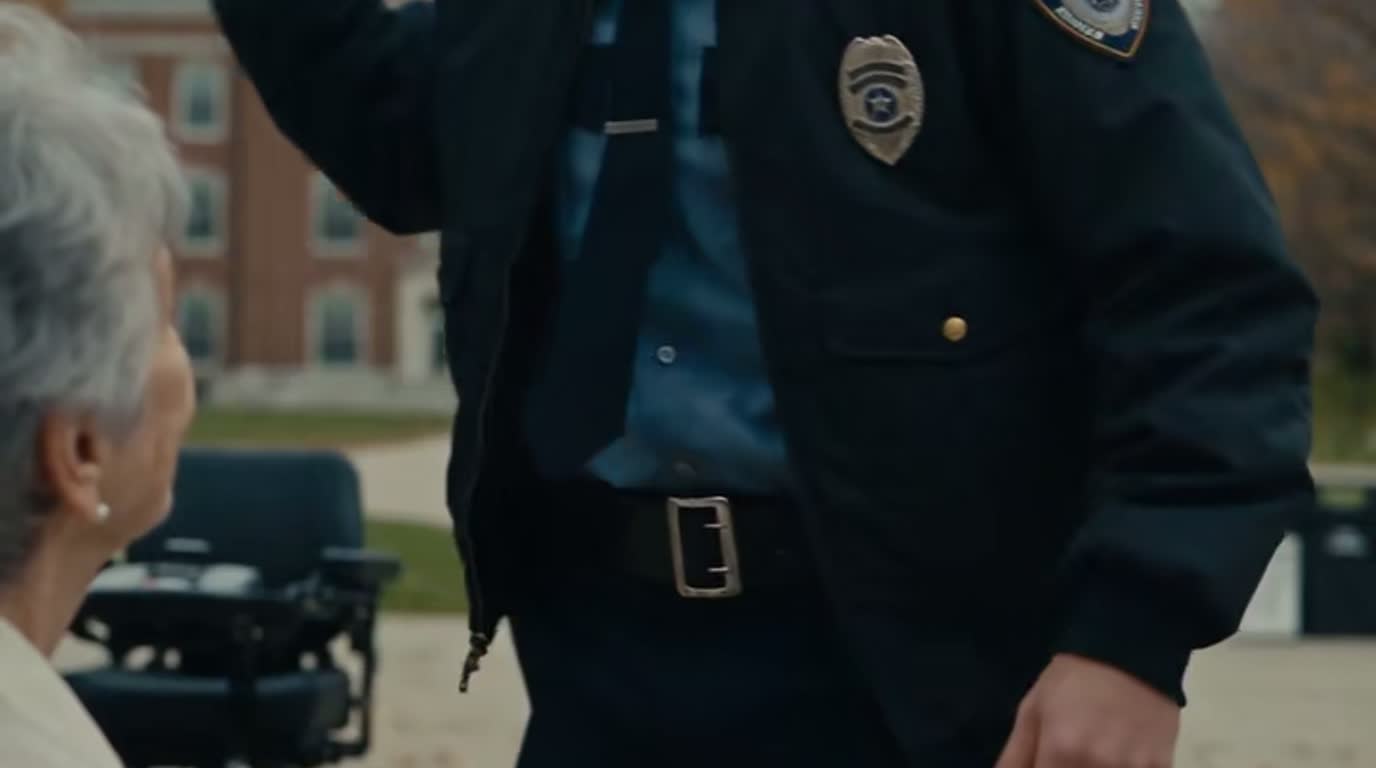
Looming directly over her was Officer Kyle Prine. He was twenty-four years old, tall and gangly inside a razor-creased black tactical polo shirt bearing the embroidered shoulder patch of Meadowgate Campus Safety Services. Despite the sunless, overcast gloom, he wore dark, mirrored wrap-around sunglasses perched aggressively on the bridge of his narrow nose. His thumbs were hooked into the heavy nylon duty belt supporting a radio, handcuffs, and a wooden nightstick. His face was pinched, narrow-jawed, and set into an expression of petty, inflated authority, his chest puffed out like a bantam rooster asserting control over an empty barnyard.
“Move it along, lady!” Prine’s voice barked down, loud, grating, and dripping with aggressive condescension as he pointed a gloved finger toward an aluminum campus sign mounted twenty feet away on a lamppost. “Can’t you read the sign? Quad regulation section four. No loitering on primary academic walkways! You’ve been occupying this bench for over an hour. This isn’t a retirement home patio!”
Ethel could not hear his abrasive voice, but she had taught high school literature for thirty-eight years; she knew the universal language of petty bullies. She saw the aggressive jab of the finger, the hostile hunch of the shoulders, and the sneering curl of his thin lips.
Without shifting her posture or displaying the slightest flicker of annoyance, Ethel picked up her smartphone. Her fingers moved with swift, fluid precision across the virtual keyboard, enlarging the text to forty-eight points in crisp white lettering against a stark black background.
She turned the phone upward toward Prine’s mirrored sunglasses.
The screen read: I AM DEAF. I CANNOT HEAR YOU. I AM RESTING WHILE WAITING FOR MY GRANDDAUGHTER’S MUSIC EXAM TO FINISH.
Prine didn’t even read the sentence. He let out a loud, mocking scoff that made his thin chest heave, crossing his arms over his tactical vest with theatrical arrogance.
“Deaf?” Prine sneered, tapping the butt of his nightstick against his thigh with rhythmic, irritating thuds. “I don’t care if you’re deaf, blind, or from another planet, lady! The sign beats your little phone note every single day of the week! The university is hosting an alumni board reception on this lawn tonight, and my orders are to clear all unauthorized loiterers off the central walkways! Either you pack that bag and drive that little scooter off this quad right now, or I will call a flatbed tow truck, impound your scooter at the campus motor pool, and cite you for trespassing!”
Ethel looked at Prine’s sunglasses, then reached out her gloved index finger, pointing down toward the center backrest of the bench.
Bolted securely to the dark-green painted cast-iron slats between their knees was a heavy, weathered bronze plaque, verdigris clinging to its deeply engraved Roman lettering.
Prine didn’t look down. He waved his gloved hand with dismissive contempt, stepping closer until his boots nearly touched her feet.
“I don’t care about a piece of brass, lady!” Prine yelled. “You’re leaving!”
“Step away from that bench, Officer Prine!”
During her thirty-eight years teaching American literature and rhetoric at Charlottesville High School, Ethel Vance had emphasized that the architecture of a democracy was revealed in its treatment of public spaces. She had taught her students that a civilization could be judged by the physical accommodations it provided for its elders, its disabled citizens, and those who traveled without private carriage. She had spent decades guiding students through the essays of Emerson and Thoreau, instilling the conviction that the natural landscape was a sacred commons belonging equally to all who walked beneath its skies.
Officer Prine’s display of aggressive insecurity was a pattern Ethel had seen in hundreds of callow young men who mistook an official badge for personal stature. Lacking the internal gravity that comes from self-discipline, Prine relied on theatrical bluster—the loud boot impact, the mirrored sunglasses, the hostile posturing—to mask an acute fear of intellectual confrontation. But Ethel had spent a lifetime holding the attention of crowded classrooms; she was completely unbothered by juvenile arrogance.
A crisp, authoritative voice rang out from the colonnade walk.
Walking swiftly across the brick plaza with an aluminum facilities clipboard in hand was Priya Nair, twenty-two, the university’s assistant facilities director and historic preservation coordinator, her eyes burning with fierce indignation.
CHAPTER 2: THE INSCRIPTION IN THE VERDIGRIS
Priya Nair strode across the brick pavers of the quadrangle with purposeful, rapid strides, the brass keycards on her lanyard chiming in rhythmic cadence with her heels. She was twenty-two years old, a graduate student in historic architectural preservation and the newly appointed coordinator of campus facilities, wearing a tailored navy blazer, dark wool trousers, and a silver university pin on her lapel.
Priya stepped smoothly between Officer Prine and the cast-iron bench, positioning her body to shield Ethel Vance. Her sharp, dark eyes fixed upon Prine’s mirrored sunglasses with the cold, analytical intensity of an inspector uncovering an egregious safety hazard.
“Lower your voice, Officer Prine,” Priya commanded, her tone dropping into an icy register that cut through the autumn breeze. “And step back three paces from this bench right now.”
Prine’s face flushed an angry crimson around the edges of his dark sunglasses. He shifted his weight, his thumbs hooking defensively into his duty belt, attempting to maintain his domineering posture.
“Ms. Nair,” Prine blustered, his voice cracking slightly with defensive indignation. “I am carrying out direct security directives for the Alumni Association Gala! We have an executive mandate to clear all unauthorized pedestrian loiterers from the central lawn before the corporate hospitality tents arrive! This woman has been sitting here for ninety minutes with an unauthorized motorized mobility device on a pedestrian walkway!”
“Unauthorized?” Priya repeated, her eyebrows arching with devastating skepticism. She looked down at Ethel, who greeted her with a warm, serene nod. Priya turned her attention back to Prine, pointing her clipboard directly at the weathered bronze plaque bolted between the cast-iron slats.
“Did you bother to read this plaque before you kicked this bench, Kyle?” Priya asked, her voice carrying clearly across the quiet quad.
“It’s just an old memorial plate,” Prine scoffed, waving his hand dismissively. “Every bench on this campus has someone’s name on it. It doesn’t grant an exemption from daily security enforcement.”
“Read it aloud, Officer Prine,” Priya ordered, stepping back so the engraved Roman lettering was fully visible under the overcast light. “Read every single word on that bronze plate right now. Or I will have the Director of Facilities and the Vice Chancellor on this lawn in three minutes.”
Prine swallowed hard, his Adam’s apple bobbing. He hesitated, his jaw working soundlessly, then reluctantly tilted his head downward, adjusting his wrap-around sunglasses so he could see through the dark tint.
The bronze plaque was cast in solid architectural bell-metal, weathered with a delicate patina of green verdigris, its deeply incised lettering bearing the official seal of Meadowgate University and the Board of Visitors:
THE DEAN ARTHUR VANCE MEMORIAL RESTING SEAT
Dedicated in October 1964 by the Board of Visitors and the Faculty of Humanities.
“In perpetual honor of Dean Arthur Vance, who taught that the lawns of this university belong to the weary, the contemplative, and the truth-seeker forever.
This seat is endowed in perpetuity with unrestricted, permanent sitting rights for all citizens, exempt from all curfew, fee, or administrative exclusion for all time.”
Prine stared at the bronze letters. His throat clicked as he swallowed again, his mouth slightly agape.
Then Priya leaned in close, her eyes boring into him with lethal clarity:
“Dean Arthur Vance was the longest-serving dean of humanities in the history of Meadowgate University,” Priya stated with surgical precision. “He established the university’s first endowed scholarships for working-class and disabled students in nineteen-fifty-eight. And the woman sitting on this bench, Officer Prine, is Ethel Vance—his widow, who donated three million dollars to construct the music library where her granddaughter is currently performing.”
Prine’s wrap-around sunglasses slipped three inches down the bridge of his sweaty nose, revealing wide, bloodshot eyes filled with absolute, paralyzing horror.
“M-Mrs. Vance?” Prine stammered, his limbs trembling as his face drained of every ounce of color. “I… I didn’t know… nobody told me…”
Ethel Vance looked at the young guard through her gold-rimmed glasses, her expression carrying neither anger nor malice, but only the quiet, sorrowful pity of an educator witnessing human ignorance.
With deliberate poise, Ethel reached out her gloved hand, tapped the glass of her smartphone screen with her stylus, and displayed a newly typed message:
Priya Nair’s master’s thesis in architectural preservation had focused extensively on the preservation covenants governing mid-twentieth-century university campuses across the American South. She understood that the post-war era had witnessed a profound democratization of higher education, driven by the GI Bill and the civil rights movement, which sought to transform previously insular, elite academic grounds into open, welcoming public commons. The memorial benches installed along the central quadrangle during the nineteen-sixties had been deliberately commissioned as physical symbols of this democratic opening, designed to ensure that ordinary citizens could rest and reflect within the academic sanctuary without fee or impediment.
Under federal Title III accessibility mandates, a public institution receiving state and federal funding was strictly prohibited from enforcing arbitrary time limits or loitering codes against individuals utilizing motorized mobility equipment. Prine’s threat to impound an electric mobility scooter from an elderly deaf grandmother was an astonishing display of official malfeasance that exposed the university and its contract security vendor to immediate federal civil rights sanctions.
Ignorance of the law does not justify cruelty, young man.
Before Prine could stammer an apology, the heavy canvas side flap of a commercial flatbed truck clattered open at the north gate of the quad, and four laborers in orange jumpsuits began unloading heavy steel crowd-control barricades onto the grass.
CHAPTER 3: THE BLUEPRINTS IN THE COLONNADE
The sound of steel crowd-control barricades clattering onto the historic brick walkway echoed across the quiet quadrangle like the rattle of heavy chains. Priya Nair turned sharply, her eyes widening as she saw an unmarked twenty-foot flatbed truck parked directly upon the fragile turf of the central lawn, its dual rear wheels carving deep ruts into the century-old sod.
A man in an expensive grey cashmere overcoat and leather driving gloves stepped down from the truck’s passenger cab, unrolling a large architectural blueprint across the truck hood. It was Raymond Cross, forty-eight, the regional director of Crown Hospitality Services—a private luxury corporate event concessionaire that had recently secured a controversial dining contract with the university administration.
Priya looked at Officer Prine, whose trembling hands were frantically trying to push his sunglasses back onto his nose.
“Kyle,” Priya said, her voice dropping into a dangerous whisper, “hand me the clipboard tucked into your duty bag. Right now.”
Prine flinched, instinctively clutching his nylon field satchel against his hip. “Ms. Nair, that’s private security contractor paperwork—”
“Hand it over, Kyle,” Priya said, holding up her facilities master keycard. “Under university operations policy, the facilities directorate possesses absolute oversight over all commercial contractors operating on campus grounds. Give it to me, or I will have campus police impound that flatbed truck immediately.”
Prine’s shoulders sagged. With trembling fingers, he pulled an aluminum clipboard from his satchel and surrendered it to Priya.
Priya flipped past the standard shift checklists. Clamped behind the security roster was a full-color architectural rendering titled The Meadowgate Executive Pavilion: A Premier Corporate Hospitality Experience.
Priya’s breath hitched in her throat as she read the site plan.
The rendering depicted the entire central quadrangle—from the Rotunda steps to the historic colonnade—enclosed by eight-foot privacy fences draped in black velvet fabric. Inside the enclosure were elevated champagne bars, private dining cabanas, and corporate sponsor lounges reserved exclusively for donors paying five thousand dollars per ticket for the upcoming Homecoming Gala.
Most horrifying of all was the notation printed in bold red ink over the central walkway: PHASE 1 OBSTACLE REMOVAL — DEMOLISH AND REMOVE SIX CAST-IRON BENCHES. INSTALL TEMPORARY VIP VALET DROPOFF.
The exact location marked for demolition was the Dean Arthur Vance Memorial Seat.
“They’re planning to tear this bench out of the ground tonight,” Priya whispered, holding the blueprint in front of Ethel so the older woman could read the site notes.
Ethel looked down at the rendering, her silver hair catching the autumn light as she studied the drawing with clinical detachment. Her fingers touched the cool verdigris bronze of the plaque, feeling the deep contours of her late husband’s name.
Ethel picked up her smartphone and typed with calm, deliberate speed:
Arthur always said that private wealth tries to turn public heritage into private profit. They want to tear down the memory of public service to build a champagne tent.
Priya looked up, her jaw setting with ferocious determination. “Not on my watch, Mrs. Vance. Not while I draw breath in this department.”
Raymond Cross was already walking toward them across the grass, his polished leather shoes crunching over the fallen leaves. He was an oily, fast-talking corporate executive with slicked-back dark hair and a manufactured, patronizing smile.
“Afternoon, folks!” Cross called out breezily, holding an ivory corporate pass. “Officer Prine, excellent work clearing the perimeter. The heavy equipment is arriving in two hours to unbolt the iron seating. We need this entire lawn enclosed before the six o’clock VIP cocktail hour.”
The rapid corporatization of public universities had become a growing crisis across the Commonwealth of Virginia. Private concessionaires like Crown Hospitality routinely sought to enclose historic academic spaces, commodifying the prestige of collegiate architecture to sell high-priced corporate access to wealthy benefactors. What had once been open lawns dedicated to student study and public contemplation were increasingly carved into exclusive, barricaded VIP zones where private security guards harassed students and community members who failed to display commercial credentials.
The discovery that the Dean Arthur Vance Memorial Seat was marked for demolition was a direct desecration of the university’s living memory. Dean Vance had spent forty years defending the principle that Meadowgate belonged to the people of Virginia, fighting to keep tuition affordable and establishing the university’s first open-enrollment seminars for working adults. To replace his memorial bench with a private valet drop-off for a corporate champagne tent was the ultimate symbol of institutional decay.
Cross glanced dismissively at Ethel Vance sitting on the bench, then turned to Priya with an impatient frown.
Priya inspected the commercial rendering with a trained architectural eye, identifying multiple critical violations of the university’s master preservation covenant. The proposed enclosure would block primary emergency egress routes from the Rotunda, obstruct the subterranean stormwater retention basins that protected the academic pavilions from foundation damp, and require the driving of heavy steel anchoring stakes directly into the root zones of the historic weeping beech trees. The private hospitality vendor had treated the historic lawn not as a delicate architectural monument, but as an expendable open-air parking lot to be exploited for transient corporate revenue.
Ethel sat calmly watching Cross’s nervous pacing. She had lived long enough to witness the transient nature of corporate hubris; men who believed they could purchase public memory with private funds inevitably found themselves confronted by the enduring permanence of community truth. She adjusted her lambskin gloves and picked up her stylus, writing a note for Lily on her phone: Do not be afraid, sweetheart. The roots of this lawn run deeper than their bulldozers.
“Miss, you need to assist this elderly woman and her scooter to the shuttle stop. This entire sector is officially closed to the public under private lease agreement Alpha-Nine.”
CHAPTER 4: THE MIDNIGHT AUDIT AT SPECIAL COLLECTIONS
Priya Nair did not move an inch from the front of the bench. She stood tall, her facilities clipboard pressed against her chest like an iron breastplate, her dark eyes locking onto Raymond Cross with absolute, unyielding defiance.
“This sector is not closed, Mr. Cross,” Priya stated, her voice carrying across the lawn like a bronze bell. “And you are not unbolting a single bolt on this quadrangle. This bench is a permanently designated historic landmark, endowed under an irrevocable covenant signed by the Board of Visitors in nineteen-sixty-four.”
Cross let out an amused, patronizing chuckle, pulling a leather-bound document folio from beneath his arm.
“Young lady, I have a fully executed commercial concession lease signed by Vice Chancellor Harold Sterling,” Cross said, waving the signature page in the air. “Crown Hospitality paid four hundred and fifty thousand dollars for exclusive operational control of this quadrangle for Homecoming weekend. Our contract gives us full authority to remove any structural impediments that interfere with our event layout. Now move this woman, or my crew will remove her ourselves.”
Ethel Vance reached out, touching Priya’s sleeve gently. Ethel pointed with her stylus toward the massive limestone portico of Alderman Library, standing fifty yards away at the western edge of the quad.
Beneath the library’s neoclassical colonnade lay the Albert and Shirley Small Special Collections Library—home to the university’s historic charter documents, board minutes, and original land patents dating back to the founding of the Commonwealth of Virginia.
Ethel typed on her phone, displaying the screen for Priya:
The nineteen-sixty-four endowment charter is stored in Box 14 of the Vance Faculty Archive in Special Collections. It contains the original deed of gift signed by Governor Harrison. Go to the archives, Priya. Lily and I will hold this bench.
Priya looked at Ethel’s calm, resolute face, understanding the strategic brilliance of the older woman’s instruction. Under Virginia property law, an administrative contract signed by a university vice chancellor could never override an original deed of gift ratified by the state general assembly. If they could place that charter into the hands of the university president, Cross’s commercial lease would be legally incinerated on the spot.
“Officer Prine,” Priya commanded, turning on the trembling security guard with fierce authority, “you will stand guard beside this bench. If anyone attempts to touch Mrs. Vance, her scooter, or this cast-iron frame, you will immediately call the university police dispatcher. If you fail to protect this memorial, you will be named as an individual defendant in a federal civil rights lawsuit before sundown. Do you understand me?”
Prine swallowed hard, his face pale as chalk, and nodded frantically: “Y-yes, ma’am! Fully understood!”
Priya turned on her heel and sprinted across the red-brick plaza toward the bronze doors of Alderman Library.
Inside the climate-controlled vaults of the Special Collections division, three floors beneath the library lawn, the air was conditioned to a precise fifty degrees with thirty percent relative humidity, smelling of aged rag paper, leather binding, and historical wax seals.
Priya flashed her facilities credentials to the head archivist, Dr. Eleanor Wright, who had been a graduate student under Dean Arthur Vance in the late nineteen-seventies.
“Box Fourteen of the Vance Archive, Eleanor!” Priya said, breathing heavily. “We need the nineteen-sixty-four memorial bench endowment charter immediately! Crown Hospitality is trying to demolish the memorial seat on the lawn right now!”
Dr. Wright gasped, her eyes flashing with immediate protective fury. “They wouldn’t dare! Arthur’s bench? Over my dead body!”
Within four minutes, Dr. Wright unlocked the steel rolling stacks of Section 4, pulling down a heavy acid-free archival box bound with red silk ribbon. She opened the lid, revealing a parchment deed embossed with the Great Seal of the Commonwealth of Virginia and the signatures of the entire 1964 Board of Visitors.
Dr. Wright pointed to the central paragraph, her finger trembling with righteous excitement:
“It is hereby ordained and covenanted that the Dean Arthur Vance Memorial Seat shall stand in perpetuity upon the central quadrangle of Meadowgate University. Any attempt to alter, relocate, monetize, or exclude the public from said seat shall trigger an immediate and automatic reversion of all private concession authority granted within the academic district, and shall render any commercial contract regarding the central lawn void ab initio under the laws of this Commonwealth.”
“A statutory land-reversion covenant,” Priya breathed, her heart pounding with exhilaration. “Harold Sterling didn’t just sign an illegal lease; he signed away his own authority to privatize the university.”
The Special Collections vault of Alderman Library was a subterranean sanctuary of historical memory, housing over fourteen million manuscripts, rare books, and historic state land patents. The Vance Faculty Archive comprised over forty linear feet of correspondence, administrative records, and legal briefs documenting the university’s mid-century expansion. Dr. Eleanor Wright, who had been mentored by Dean Vance during her undergraduate studies, knew every folder in the collection with intimate familiarity.
The nineteen-sixty-four deed of gift had been drafted with extraordinary legal precision by former Virginia Governor Mills Godwin, who had recognized that future university administrators might yield to commercial temptation and attempt to monetize the historic lawn. The inclusion of an automatic statutory land-reversion covenant was an impenetrable legal firewall: if the university violated the terms of the memorial gift, the entire central quadrangle would automatically revert to the direct stewardship of the Virginia Department of Historic Resources, stripping the university administration of all operational jurisdiction.
Suddenly, Priya’s phone buzzed with an urgent text message from an unknown number:
Priya, this is Lily Vance. I just finished my jury exam. A flatbed tow truck just backed onto the grass toward Grandma’s bench with a pneumatic winch. You have ten minutes.
CHAPTER 5: THE STANDOFF AT THE WROUGHT-IRON GATE
Priya Nair burst through the heavy bronze doors of Alderman Library, holding the archival charter in an acid-free leather portfolio pressed tightly against her chest.
The scene that met her eyes across the sunlit quadrangle made her blood boil.
An industrial flatbed tow truck with flashing amber strobes had backed onto the central brick walkway, its heavy steel underlift idling three feet from Ethel Vance’s mobility scooter. Raymond Cross stood beside the truck cab, gesturing wildly to a pair of demolition workers equipped with pneumatic impact wrenches and heavy pry bars.
Surrounding the bench, however, was a visual spectacle of breathtaking student solidarity.
Standing shoulder-to-shoulder in a tight, unbroken circle around Ethel and her bench were over forty music students from Old Cabell Hall, still holding their violins, cellos, and brass instruments in their cases. At the front of the circle stood Lily Vance, nineteen years old, with fiery dark eyes and her grandfather’s resolute jaw, holding a heavy cello case in one hand and her grandmother’s gloved fingers in the other.
Officer Kyle Prine was standing directly in front of the tow truck’s front bumper, his arms spread wide, sweating profusely as he shouted at the truck driver:
“Shut the engine down! Turn the truck off! I am an authorized campus officer, and I am ordering you to step away from this bench!”
Raymond Cross was screaming at Prine, his face purple with rage:
“Get out of the way, you idiot security guard! Harold Sterling signed this work order! If these benches aren’t cleared by five o’clock, Crown Hospitality will sue the university for breach of contract! Tow that scooter and hook that bench right now!”
“Touch that bench, Mr. Cross, and you will be arrested by the State Police for destruction of state historic landmarks!”
Priya’s voice sliced through the drone of the diesel engine like an axe through dry oak.
Priya marched down the center aisle of students, who parted respectfully to let her pass. She stood directly before Raymond Cross, holding the 1964 charter open so that the gold seal of the Commonwealth of Virginia gleamed under the grey sky.
“This is the nineteen-sixty-four Board of Visitors deed of gift,” Priya announced, her voice ringing off the brick pavilions. “Under Section Four of this covenant, ratified by the General Assembly, any commercial contract attempting to alter or remove this memorial bench triggers an immediate and automatic forfeiture of all private concession licenses across this university.”
She thrust the document into Cross’s face.
“You do not have a valid lease, Mr. Cross. Your contract was void from the second Harold Sterling signed his name. And if your workers touch this cast iron with an impact wrench, every student here will bear witness to felony destruction of state historic property.”
A tremendous cheer erupted from the assembled music students. Behind them, dozens of passing undergraduates, graduate teaching fellows, and faculty members joined the circle, surrounding the flatbed truck until it was completely immobilized on the brick pathway.
The tow truck driver leaned out of his cab, looked at the sea of determined students, looked at the gold state seal on Priya’s parchment, and shook his head with disgust.
“I’m not going to jail for a corporate party, Cross,” the driver muttered, pulling his air-brake lever with a loud, definitive hiss. “Take it up with the dean.”
The driver killed the ignition, pulled his keys from the dash, and stepped down from the cab, crossing his arms and leaning against his truck fender.
The spontaneous gathering of the music students around the memorial bench was a magnificent demonstration of the enduring spirit of student activism. For these young musicians, Ethel Vance was not a stranger; she was a revered presence on campus, a gentle patron who frequently attended student recitals and who had donated the very practice rooms in which they honed their craft. To see an armed tow truck attempting to intimidate this beloved grandmother had mobilized the student body with the force of an electric current.
As the students held their instruments aloft, their peaceful, disciplined circle formed an unbreakable human barricade against commercial aggression. The flatbed tow truck driver’s refusal to carry out the demolition order was a testament to the power of collective moral clarity. Working people understood the difference between legitimate employment and highway robbery; the driver recognized that no paycheck was worth participating in the destruction of a community’s sacred heritage.
Cross’s mouth opened and closed soundlessly, his face turning the sickly grey of wet clay.
The circle of students surrounding the bench grew by the minute as word of the standoff spread across campus messaging channels. Student government representatives arrived carrying copies of the university student constitution, while campus newspaper photographers climbed onto the stone steps of Cabell Hall to document the standoff from multiple high-angle perspectives. The physical contrast between the armed flatbed demolition truck and the peaceful assembly of young musicians holding cello and violin cases was a visually arresting tableau of non-violent civic resistance that electrified the university community.
Officer Prine stood beside the front bumper of the flatbed, his heart pounding in his chest as he realized the magnitude of the transformation taking place around him. For the first time in his life, he was not acting as an unthinking enforcer of arbitrary authority, but as a defender of real human dignity. When the truck driver killed the engine and stepped down from the cab, Prine let out a long, ragged breath of profound relief, recognizing that true courage lay not in bullying the vulnerable, but in standing alongside those who defended what was sacred.
At that moment, the double mahogany doors of the Rotunda swung open, and Dean Marcus Sterling, Dean of Arts and Sciences, strode down the marble steps flanked by two university police captains in full dress uniform.
CHAPTER 6: THE HEARING IN THE ROTUNDA
The interior dome room of the Meadowgate University Rotunda was an architectural masterpiece of classical light and space, its soaring coffered ceiling and circling gallery of Corinthian columns designed to inspire contemplative wisdom and democratic virtue.
Inside the vaulted chamber, the entire executive committee of the Board of Visitors had assembled for an emergency hearing. At the head of the circular mahogany conference table sat University President Dr. Catherine Thornton, flanked by Dean Marcus Sterling and University Legal Counsel James Montgomery.
Standing at the presentation lectern was Priya Nair, accompanied by Ethel Vance and Lily Vance. Ethel sat in a comfortable upholstered armchair, her hands resting calmly on her lap, while Lily stood beside her, translating the spoken proceedings into graceful, expressive American Sign Language.
At the far end of the table sat Vice Chancellor Harold Sterling and Raymond Cross, their high-priced corporate defense attorneys whispering frantically into their ears.
President Thornton adjusted her spectacles, her gavel coming down with a single, resonant strike that echoed up into the soaring dome.
“This emergency session has been called pursuant to an immediate petition for injunctive relief filed by the Department of Facilities and the Faculty of Humanities,” President Thornton announced, her voice firm, dignified, and filled with severe gravity. “We are reviewing the commercial hospitality contract executed between Crown Hospitality Services and Vice Chancellor Harold Sterling regarding the central quadrangle.”
University Counsel Montgomery rose to his feet, holding the 1964 charter retrieved from Special Collections.
“Madam President,” Montgomery stated, “the legal situation is indisputable. The Dean Arthur Vance Memorial Seat was deeded to this institution with an explicit perpetual public covenant. Vice Chancellor Sterling possessed zero legal authority to execute a commercial concession lease that authorized the demolition, relocation, or private enclosure of that historic asset. Furthermore, internal audit logs show that Vice Chancellor Sterling received a forty-thousand-dollar ‘consulting retainer’ from Crown Hospitality’s parent company two weeks prior to signing this agreement.”
A collective gasp of shock and outrage swept through the assembled deans and trustees.
Vice Chancellor Sterling’s face turned an ash-gray color. He opened his mouth to stammer a defense, but President Thornton silenced him with an icy glare that could have frozen boiling water.
“Harold,” President Thornton said, her voice shaking with quiet, devastating fury. “You attempted to monetize the sacred memory of one of this university’s greatest leaders. You attempted to evict his widow from the very bench dedicated in his honor so that a private vendor could sell champagne to donors. Your conduct is a catastrophic betrayal of every standard of honor and academic integrity that Meadowgate represents.”
President Thornton turned her gaze upon Ethel Vance, her expression softening into one of profound humility and reverence.
“Mrs. Vance,” President Thornton said, pausing to allow Lily to sign each word, “on behalf of the Board of Visitors, the faculty, and the entire student body of Meadowgate University, I offer you our deepest, most unreserved institutional apology. We are humbled by your grace, your patience, and your enduring devotion to this community.”
Lily Vance stepped to the lectern, holding a handwritten letter that Ethel had penned during the assembly:
“‘My late husband Arthur believed that a university is not defined by its endowments, its private contracts, or its corporate galas,'” Lily read aloud, her voice clear and resonant. “‘A university is defined by the open ground it keeps free for all people. The moment we fence off our public lawns, the moment we tell an elderly grandmother or a disabled student that they do not belong on a public bench, we cease to be an institution of higher learning and become an exclusive club for the privileged. Keep the lawns open. Keep the benches free. Let the truth ring forever across this quad.'”
The entire assembly of trustees, deans, and students rose to their feet in a thunderous standing ovation that echoed through the Rotunda like an anthem of victory.
President Thornton brought her gavel down with an explosive, final crack:
The interior of the Rotunda was charged with an atmosphere of profound historical reckoning. In the circular gallery beneath the soaring coffered dome, faculty members in academic regalia, student leaders, and community elders stood witness as the executive committee confronted the reality of administrative corruption. President Thornton’s leadership was swift, uncompromising, and deeply grounded in institutional honor; she recognized that protecting the university’s moral legitimacy was far more vital than any corporate sponsorship deal.
When Lily Vance finished reading her grandmother’s letter, the silence in the chamber was absolute. The words of the elderly deaf teacher cut through decades of corporate jargon and administrative rationalization, reminding the assembled leadership of the core purpose of a great university. The unanimous vote to rescind the contract and permanently protect the memorial benches was not merely a victory for Ethel Vance; it was a triumphant renewal of the university’s sacred covenant with the people.
“It is the unanimous resolution of the Board of Visitors that the commercial contract with Crown Hospitality Services is terminated immediately with prejudice. Vice Chancellor Harold Sterling is relieved of all executive duties pending formal state criminal referral. Officer Kyle Prine’s contract security license is permanently revoked. And the Dean Arthur Vance Memorial Seat is hereby declared an inviolable historic monument of the Commonwealth of Virginia in perpetuity.”
Raymond Cross and Harold Sterling slumped in their chairs, completely broken, as university police officers stepped forward to escort them from the chamber.
CHAPTER 7: THE AUTUMN SUNLIGHT OVER THE LAWN
Two weeks later, the gray overcast clouds had completely cleared, replaced by an Indian summer afternoon of radiant, golden splendor that bathed Meadowgate University in breathtaking warmth. The brick colonnades glowed with a rich, rosy hue, and the weeping beech tree showered the central quadrangle in a gentle, swirling cascade of amber and topaz leaves.
The flatbed trucks and crowd-control barricades were gone forever. Across the wide green expanse of the lawn, hundreds of students sat in open study circles, reading textbooks, laughing, and enjoying the crisp mountain air.
At the center of the walkway, the Dean Arthur Vance Memorial Seat stood pristine and radiant. The cast-iron frame had been freshly coated in rich, forest-green enamel, its cedar slats hand-rubbed with warm linseed oil, and the weathered bronze plaque polished until its Roman lettering shone like burnished gold under the afternoon sun.
Sitting comfortably upon the bench, wearing her favorite lavender floral cardigan and emerald beret, was Ethel Vance. Her mobility scooter was parked neatly beside her, its chrome basket filled with fresh yellow chrysanthemums that students had left as tokens of affection throughout the week.
Beside Ethel sat her granddaughter Lily, holding her cello case, resting her head affectionately on her grandmother’s shoulder.
Officer Kyle Prine, dressed in a humble civilian wool coat, walked slowly down the brick path, hesitating before the bench with his hat held respectfully in both hands. He stopped three feet away, his head bowed, his face filled with sincere, humble remorse.
Prine pulled a small notepad from his pocket, wrote a brief message, and held it out for Ethel to read:
Mrs. Vance, I am deeply sorry for my arrogance and cruelty. I was blind to what truly mattered. Thank you for teaching me what honor really means.
Ethel read the note through her gold-rimmed spectacles. She looked up at the young man, a gentle, forgiving smile gracing her face. She reached out her gloved hand, taking his trembling fingers in a warm, reassuring clasp, nodding with quiet understanding. Grace was the ultimate lesson of a life dedicated to wisdom; there was room on the lawn for everyone who sought to learn.
Prine wiped a tear from his cheek, bowed his head respectfully, and walked away into the sunlit afternoon, a transformed young man.
A moment later, Priya Nair strode across the brick pavers, accompanied by Dean Marcus Sterling. Priya carried two steaming porcelain mugs of hot spiced cider from the faculty pavilion, handing one to Ethel and one to Lily.
“The State Historic Preservation Commission officially approved the landmark status this morning, Mrs. Vance,” Priya said, smiling warmly as Lily translated. “The entire central lawn is now permanently protected under state law. No private corporate fence will ever touch this grass again.”
Dean Sterling leaned down, resting his hand gently upon the polished bronze plaque.
“Arthur would be so proud of you, Ethel,” Dean Sterling said softly. “You defended the soul of this university.”
Lily reached into her instrument case, lifting her cello and resting the endpin against the red brick pavers. With a gentle, graceful sweep of her bow, she began to play the opening notes of Bach’s Cello Suite in G Major.
The rich, resonant melody soared into the clear Virginia sky, drifting through the white colonnades, echoing across the sunlit Rotunda, and vibrating through the ancient cast-iron slats of the bench.
The sweet, resinous scent of fallen beech leaves and warm woodsmoke filled the sunlit afternoon air along the colonnade. As Lily’s cello notes danced across the lawn, students paused on their way to classes, sitting on the grass in quiet appreciation of the music. The quadrangle had reclaimed its true purpose: an open, democratic sanctuary of learning, beauty, and shared human dignity.
Ethel looked down at the bronze plaque gleaming between the cast-iron slats, her heart overflowing with quiet joy. The memory of Arthur lived on, not in cold bronze or stone, but in the vibrant, fearless spirit of the young people who had stood their ground to defend it. As the music reached its final, triumphant cadence, rising toward the endless blue Virginia sky, Ethel knew that the lawn would remain free, welcoming, and open for all generations to come.
Ethel closed her eyes, resting her hand against the polished wood, feeling the deep, musical vibrations pulsing through the steel and stone into her very heart.
As the warm afternoon sun bathed the Rotunda lawn in golden light, students and faculty gathered around the Dean Arthur Vance Memorial Seat for an impromptu open-air academic seminar on the public trust doctrine and historical preservation. Passing community members, dog walkers, and prospective students joined the gathering, sitting on the warm brick pavers and listening as Dean Sterling reflected on the enduring legacy of Dean Vance’s vision.
Ethel took a slow sip of her spiced cider, breathing in the crisp mountain air. She felt an overwhelming sense of fulfillment and serenity. The university had not merely protected a piece of cast iron and bronze; it had reaffirmed its core democratic promise. The quadrangle belonged to the thinkers, the seekers, and the weary travelers who sought rest beneath its trees. As Lily’s cello notes drifted into the twilight, Ethel smiled, knowing that the light of truth would shine forever across these historic grounds.
The air was warm, the sky was limitless, and the ground was free. Memory had stood its ground, truth had triumphed, and the legacy of love remained unbroken for all generations to come.