The Wooden Box Everyone Wanted Gone Was the One Thing Holding the Neighborhood Together
Chapter 1: The Box Margaret Decided Did Not Belong
Margaret Wright already had one hand on the wooden lid when Eric Mitchell stepped out of his front door.
For half a second, he did not recognize what he was seeing. Margaret stood in the strip of grass between his front walk and the low hedge, bent slightly at the waist, her fingers hooked beneath the warped edge of the box as though she meant to test its weight.
Then the lid shifted.
“Don’t.”
The word came out harder than Eric intended.
Margaret straightened at once. Her hand stayed on the wood.
Eric crossed the porch without closing the door behind him.
“I said don’t touch it.”
She looked at him with the offended composure of someone who believed offense belonged to her. At seventy, she was small and upright, with silver hair cut neatly below her ears and a cream windbreaker zipped to the throat despite the mild morning.
“I heard you,” she said.
“Then take your hand off.”
Something in his face must have reached her, because she did.
For years, they had lived across the street from one another without a real argument. They waved while bringing in trash cans. They accepted misdelivered packages. Margaret had once called him when his garage door stayed open after dark.
Now she stepped back and pointed at the box.
“This has been sitting here for months.”
“Longer than that.”
“That doesn’t help your case.”
Eric looked down at it.
The structure stood nearly three feet high on a low timber base beside the hedge. Weather had silvered the boards. One corner bore a dark water stain. The lid was pitched slightly forward and patched with a narrow strip of cedar that did not match the older wood.
To anyone else, perhaps, it did look abandoned.
“You need to remove it,” Margaret said.
“No.”
She blinked. “No?”
“No.”
“That is your entire answer?”
Eric glanced toward the street. A delivery truck rolled past the entrance to the subdivision. Somewhere a leaf blower started and stopped. Two doors down, a neighbor was loading a child’s backpack into an SUV.
He lowered his voice.
“It’s on my property.”
“So is the dead section of your hedge. That doesn’t mean the association has to pretend it looks good.”
“The hedge is coming back.”
“The box isn’t.”
He almost said, You don’t know what it is.
Instead he said nothing.
Margaret folded her arms. “I asked you about it three weeks ago.”
“You told me you didn’t like it.”
“I asked what it was.”
“And I told you it was taken care of.”
“That is not an answer.”
“It’s the answer I gave you.”
Her mouth tightened.
Eric knew that look. He had seen it at annual meetings when someone suggested raising dues or changing parking rules. Margaret did not raise her voice first. She gathered certainty.
“I’m not the only person concerned,” she said.
“Then they can talk to me.”
“They have.”
“No. They’ve talked to you.”
Her cheeks colored.
Eric immediately regretted the line, not because it was false but because he knew exactly what would happen next.
Margaret looked past him toward the open front door.
“Carolyn would never have let the front of this house go like this.”
The morning seemed to contract.
Eric did not move.
Margaret’s expression changed almost at once. Not apology. Recognition.
She knew she had found something she should not have touched.
“Don’t use her,” he said.
“I’m saying she cared about the neighborhood.”
“You don’t get to tell me what she cared about.”
“I knew her too.”
“No. You knew her from across the street.”
Margaret looked away first.
For several seconds, neither spoke.
Then a low vibration moved through the box.
It was faint enough that Margaret might have mistaken it for a truck on the far road. Eric did not. He heard the change in pitch immediately, the living density under the boards, the colony responding to the lid’s movement and the shadows passing over it.
His attention dropped to the narrow entrance near the base.
Three bees emerged.
One circled low over the grass. Another disappeared into the hedge. The third hovered near Eric’s knee before turning toward the morning light.
Margaret took a step back.
“What was that?”
“Nothing you need to worry about.”
Her eyes returned to the box.
“Eric.”
He moved between her and it.
That was the moment the disagreement changed.
Until then, Margaret had been annoyed by an ugly object. Eric saw the exact second annoyance became suspicion.
“What is in there?”
“It’s handled.”
“You keep saying that.”
“Because it is.”
“Is it an animal?”
He did not answer.
“Are you storing chemicals?”
“No.”
“Then why are you acting like this?”
Eric looked at the box, then at her.
“Because you were opening something on my property after I asked you not to.”
“I was checking whether it was full of standing water.”
“You were lifting the lid.”
“Because no one knows what it is.”
“I do.”
The calmness of his own voice sounded brittle now.
Margaret picked up the reusable grocery bag she had set by the curb.
“This is exactly the problem,” she said. “You think because you don’t explain yourself, nobody has the right to ask questions.”
Eric nearly laughed, but there was nothing funny in it.
“What I think is that you should go home.”
Her face settled.
“Fine.”
She crossed the street without another word.
Eric waited until her front door closed.
Then he crouched beside the box.
The hum had steadied. He placed two fingers against the wood, feeling the faint vibration through the grain.
“Easy,” he murmured.
The word was not for himself.
He checked the entrance, the shade line, the small tray beneath the rear vent. One screw on the cedar patch had lifted slightly. He pressed it with his thumb and made a note to replace it before evening.
He had done some version of this every morning for three years.
Before coffee. Before email. Before the first client called about cabinet doors or stair rails or a kitchen drawer that would not close.
Carolyn used to tease him that he could detect a sixteenth-inch gap from across a room but could walk past a pile of laundry for three days.
The thought arrived so cleanly that he stood too fast.
He went inside.
By noon, the argument had already changed shape.
An email from the HOA property manager appeared with the subject line: PROPERTY APPEARANCE CONCERN — REQUEST FOR INFORMATION.
Eric read it standing at his kitchen counter.
The message referred to “a deteriorated freestanding wooden structure visible from the common roadway” and asked him to provide its purpose, dimensions, and any relevant approvals within five business days.
He closed the message.
Opened it again.
There was no violation yet. Only a request.
He knew that distinction mattered.
He also knew Margaret had not waited even one hour.
At two thirty, another email arrived.
This one came directly from Amy Johnson, the HOA board president.
Eric had met Amy perhaps six times. She was efficient, careful with words, and always seemed to be carrying three problems at once. Her message was polite.
Mr. Mitchell,
A resident has raised an additional concern that the structure may contain or attract pests and may present a safety issue. Given that allegation, I would appreciate a brief site review this week so we can determine whether the matter falls under architectural standards, nuisance provisions, or neither.
Please advise on your availability.
Eric stared at the phrase contain or attract pests.
His jaw tightened.
He could answer in two sentences.
He could write: It is a managed hive.
He could attach the old program paperwork.
He could end at least half the mystery.
Instead he set the phone facedown.
The paperwork was not in the kitchen file drawer.
He knew where it was.
That was the problem.
At four, he went outside with a screwdriver to replace the lifted screw. The box sat in late sunlight, plain and awkward beside the hedge.
Across the street, Margaret was watering two planters on her porch.
She did not look at him.
Eric knelt, removed the loose screw, and fitted a new one.
His phone vibrated in his pocket.
Another email.
Amy again.
Mr. Mitchell,
Because the complaint now includes a potential hazard allegation, I have scheduled an on-site review for Thursday morning at 9:00. Please note that if access or documentation is refused, the board may have to proceed based on available information.
Thank you for your cooperation.
Eric read the message twice.
Then a final line loaded beneath the signature, part of the forwarded complaint history.
Resident reports unknown contents, possible infestation, and homeowner refusal to disclose.
Eric looked across the street.
Margaret had stopped watering.
This time, she was looking directly at him.
Chapter 2: The Complaint Became Official Before Anyone Asked Why
The yellow marker stood six inches from the wooden box.
Eric saw it before he reached the bottom porch step.
A narrow plastic stake had been pushed into the soil beside the timber base, with a strip of bright survey tape tied near the top. The tape snapped in the morning breeze, obscene against the faded wood.
He crossed the yard and pulled it out.
On the plastic tab, someone had written SITE REVIEW in black marker.
Eric stood with the stake in his hand.
The box hummed softly beside him.
“Unbelievable.”
He carried the marker inside, set it on the kitchen counter, and immediately picked it up again. Throwing it away would be interpreted as interference. Keeping it felt like submission.
He put it in the garage.
At nine exactly, Amy Johnson arrived in a dark crossover with a magnetic HOA placard on the door. She stepped out holding a tablet and a paper folder.
Margaret was already outside.
Of course she was.
Eric met Amy at the walkway.
“Mr. Mitchell.”
“Eric is fine.”
“Thank you for meeting me.”
“I wasn’t given much choice.”
Amy’s expression barely changed, but he saw the fatigue in it.
“I understand this is frustrating.”
“Do you?”
“I understand that a complaint does not equal a violation.”
Margaret crossed the street before Eric could answer.
“I appreciate you coming,” she said.
Amy turned. “Margaret, this is an information review. I need to speak with the homeowner first.”
“I only wanted to make sure you knew the concern is broader than appearance.”
“You included that in your complaint.”
“It’s gotten worse.”
Eric looked at her. “Since yesterday?”
Margaret ignored him.
Amy exhaled through her nose.
“Let’s keep this procedural.”
That phrase made Eric want to walk back into the house.
Instead he stood beside the box while Amy photographed it from the sidewalk and measured the approximate distance to the property line.
“What is the structure used for?” she asked.
“It’s maintained.”
Amy lowered the tablet.
“That is not what I asked.”
Eric heard Margaret shift behind her.
“What provision are you reviewing?” he asked.
“Possibly exterior structure standards. Possibly nuisance. Possibly none.”
“Then determine which one applies.”
“I’m trying to.”
“You’re asking me to prove I haven’t violated a rule you haven’t identified.”
Amy’s mouth tightened.
For the first time, he saw that she was not enjoying this.
“Eric, I have three residents asking whether an unknown structure contains pests. I have one board member asking about liability. I have a property manager telling me the governing documents do not clearly address this kind of object. I am not here because I woke up wanting to inspect your yard.”
“Three residents?”
Margaret looked away.
Amy hesitated.
“That is what I’ve received.”
Eric knew better than to ask for names.
Still, the number landed harder than he expected.
He looked toward the neighboring houses. Curtains. Driveways. A man pretending to adjust something in the bed of his pickup.
The box had become public without moving an inch.
“Do you have documentation for it?” Amy asked.
“Yes.”
The answer came too quickly.
Amy waited.
Eric felt the old reflex rise in him: say less, give nothing away, let people exhaust themselves against facts they did not understand.
“Can I see it?” she asked.
“Not today.”
Margaret let out a small sound.
Amy glanced at her. “Please.”
Then back to Eric.
“Why not today?”
“It’s stored.”
“Where?”
He stared at her.
Amy’s voice softened, which somehow made it worse.
“I’m not asking to go through your house. I’m asking whether there is an approval, registration, maintenance record, anything that clarifies what this is.”
Eric thought of the locked file drawer in the small home office.
He had not opened it since the week after Carolyn’s funeral.
At first there had been practical reasons. Death certificates. Insurance. School district correspondence. The stack of garden program forms she had brought home in a canvas tote.
Then the reasons stopped being practical.
“I’ll find it,” he said.
“When?”
“I said I’ll find it.”
Amy studied him.
“All right. But I need you to understand the consequence of leaving a hazard allegation unanswered.”
“There is no hazard.”
“Then help me document that.”
Eric said nothing.
The yellow tape, replaced now at Amy’s request, fluttered beside the box.
By Thursday afternoon, the neighborhood message board had turned ugly.
Eric rarely checked it. Carolyn used to. She had known who needed a casserole, whose sprinkler line had broken, when the common pool closed early.
He opened the site only because a client canceled a cabinet installation and he found himself staring at an unexpected hour.
Margaret’s post was near the top.
Concerned neighbors should be aware that an unapproved yard structure on our street is under review for a possible pest and safety issue. Children regularly walk nearby. I hope the association acts before someone gets hurt.
There were twenty-three comments.
Some were cautious.
Has anyone confirmed what’s actually in it?
Others were not.
Why would anyone refuse to say?
Call the county.
HOA needs to do its job for once.
One resident wrote: Illegal hive maybe? I’ve heard buzzing over there.
Eric stopped scrolling.
Illegal hive.
The phrase had not come from Amy.
It had not come from him.
He read Margaret’s post again.
Possible pest and safety issue.
Someone had supplied the rest.
Or Margaret had in conversation.
His phone rang.
Amy.
He answered.
“Did you see it?” she asked.
“Yes.”
“I did not authorize that post.”
“I assumed.”
“I’ve asked that the wording be corrected.”
“Will it?”
A pause.
“I don’t control residents.”
“No. You just mark their neighbors’ yards.”
“Eric.”
He closed his eyes.
Amy continued, more quietly.
“This is getting away from both of us.”
“Then tell them there’s no violation.”
“I can’t do that without information.”
“You’ve seen the box.”
“Yes, and I still don’t know what’s inside it.”
The sentence hung there.
Eric looked through the kitchen window toward the hedge.
A few bees moved in and out of the entrance, nearly invisible from the road.
Amy said, “I requested municipal review this morning.”
His grip tightened on the phone.
“You did what?”
“The complaint now alleges a biological hazard. Our association is not qualified to assess that.”
“Because Margaret wrote a post?”
“Because multiple residents contacted the property manager.”
“After the post.”
“I know.”
For the first time, Amy sounded angry too.
Not at him alone.
“I have an election in six weeks,” she said. “Half the neighborhood thinks the board harasses people. The other half thinks we ignore everything until it costs money. I am not going to guess about a possible safety issue because you prefer not to explain yourself.”
Eric leaned against the counter.
There it was.
Not malice. Pressure.
That should have made him feel better.
It did not.
“When?” he asked.
“Friday morning.”
“Who?”
“Municipal property and environmental inspection. Daniel Ramirez.”
Eric knew the name faintly. Carolyn had mentioned a Ramirez once, though he could not remember in what context.
Amy added, “Please have any paperwork ready.”
After the call, Eric walked to the home office.
He stood outside the door.
The room had become storage by degrees. Rolled drawings. Hardware catalogs. A broken lamp he meant to repair. Carolyn’s canvas tote still hung from the inside knob.
He opened the door.
Dust shifted in the light.
The file cabinet stood beneath the window.
Eric crossed the room and put his hand on the top drawer.
Locked.
He knew where the key was.
He also knew, suddenly and with perfect clarity, that Amy’s accusation had not been entirely wrong.
He wanted everyone to trust that he had handled things.
He had not looked at the documents in years.
His phone buzzed.
A new message from an unknown number.
Mr. Mitchell, this is Daniel Ramirez with municipal inspection. I’ll be at the property tomorrow at 8:30 a.m. Because the complaint concerns unknown contents, I will need access sufficient to identify what is inside the structure.
Eric read the message.
Outside, beyond the office wall, the colony’s faint hum seemed to enter the house.
He looked at the locked drawer.
Then at Carolyn’s canvas tote.
Tomorrow, he would have to open one of them.
Chapter 3: When the Inspector Lifted the Lid, Nobody Stepped Closer
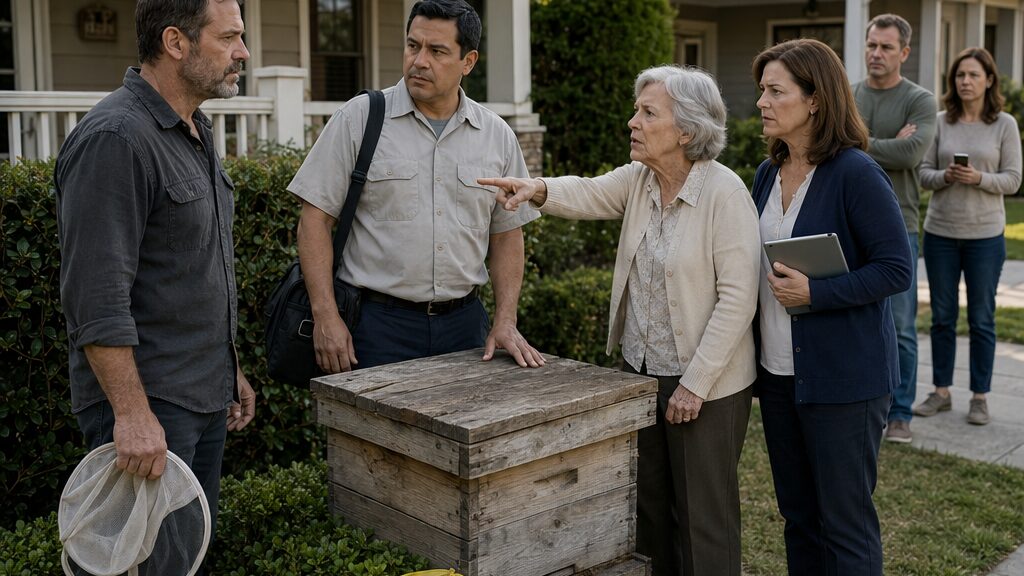
“Everybody needs to move back before I touch that lid.”
Daniel Ramirez said it quietly, but the sidewalk emptied by three feet.
Margaret stepped behind Amy.
One of the neighbors who had been pretending to check his mailbox crossed to the far side of his driveway. Another raised a phone, then lowered it when Daniel looked in his direction.
Eric stayed where he was.
Friday morning had turned his front yard into a small public hearing without chairs.
Daniel stood beside the box in work boots and a pale municipal shirt, his inspection bag open near the hedge. He was in his forties, broad-shouldered, with a careful way of looking at things before speaking.
He had spent ten minutes examining the outside.
No rot severe enough to collapse the structure.
No standing water.
No visible chemical storage.
No obvious rodent activity.
Each finding had made Margaret more rigid.
Now Daniel pointed toward Eric.
“You know what’s in here?”
“Yes.”
“You maintain it?”
“Yes.”
“And you chose not to disclose that to the association?”
Eric glanced at Amy.
“I chose not to discuss it with neighbors.”
Amy’s eyebrows lifted. “That distinction is doing a lot of work.”
Daniel ignored the exchange.
“Any reason opening it creates an immediate hazard?”
“Not if it’s done correctly.”
Margaret made a sound behind him.
Daniel looked at Eric again.
“Then you’re opening it.”
Eric had expected that.
Still, something in his chest tightened.
“No,” he said. “You can lift the lid. I’ll handle what’s under it.”
Daniel paused.
Then nodded once.
“Protective equipment?”
“In the garage.”
Eric went inside and returned with a light-colored veil and a pair of gloves. He put on the veil but left the gloves tucked into his back pocket.
Margaret stared.
“What is that for?”
Eric did not answer.
Daniel did.
“Please stay back.”
The tone changed her expression more effectively than any argument Eric had made all week.
Daniel placed one hand on the warped wooden lid.
The yard went still.
Eric could hear the colony before anyone else did.
Not loud. Not threatening.
Alive.
The sound thickened as Daniel lifted.
The first inch revealed darkness.
The second showed the pale top edge of a wooden frame.
Then the lid came free.
Margaret stepped backward.
“Oh my God.”
The box was full of bees.
Thousands moved over the frames in a dark, shifting pattern. Honeycomb showed through in warm bands beneath them. A few bees rose immediately into the open air, circling above Daniel’s shoulder.
Someone on the sidewalk swore under his breath.
Amy froze with her tablet against her chest.
For one bright second, Eric felt something almost like satisfaction.
Not because Margaret was frightened.
Because the box could no longer be called debris.
It could no longer be described as abandoned.
It was alive in front of them.
Organized. Maintained. Working.
Then a frame near the left side shifted.
Eric saw it before Daniel did.
“Don’t move.”
Daniel stopped.
Eric stepped in.
A narrow wooden top bar had lifted from its rest, probably loosened by the lid vibration. If it tipped farther, it could crush bees or trigger a defensive surge.
Eric moved slowly.
One hand on the frame.
Two fingers beneath the edge.
He adjusted his breathing without thinking.
The same way Carolyn had taught children at the garden plots.
Slow hands. No swatting. No drama.
A bee landed on the mesh near his cheek.
Behind him, Margaret said, “There are children on this street.”
Eric did not look up.
“Yes.”
“You knew this was here.”
“Yes.”
“You let everyone walk past it.”
His fingers tightened almost imperceptibly on the frame.
Daniel spoke first.
“Mrs. Wright, give him room.”
Eric settled the frame.
The hum softened.
He lowered his hand.
Daniel’s eyes had changed.
Not friendliness.
Attention.
“You’ve done this before,” he said.
“Yes.”
“How long?”
Eric looked at the frames.
“Years.”
Amy recovered enough to speak.
“Why didn’t you just say it was a hive?”
Eric removed the veil but kept his eyes on the open box.
“Would that have stopped the complaint?”
Nobody answered.
A bee drifted above the yellow tape beside the timber base.
Margaret folded her arms.
“So it is a hazard.”
Daniel turned toward her.
“I haven’t said that.”
“It’s a box full of bees ten yards from a sidewalk.”
“It’s a managed colony.”
“That makes them not sting?”
“No.”
The bluntness silenced everyone.
Daniel crouched to inspect the inner wall.
“Managed colonies can still present concerns. Placement matters. species and temperament matter. maintenance matters. local requirements matter. But this is not an abandoned pest nest.”
Amy looked at Eric.
The sentence landed between them.
Not abandoned.
Not junk.
Margaret’s face had lost the certainty it wore earlier.
Daniel leaned closer to the inside of the lid.
“Hold on.”
Eric felt his stomach tighten.
Daniel brushed a thumb across a faded mark burned into the wood.
Part of it was obscured by propolis and age. A small circular emblem. Beneath it, a number.
Daniel looked at Eric.
“Where did you get this box?”
“It was built here.”
“By you?”
“Mostly.”
“For whom?”
Eric did not answer.
Daniel straightened.
“I know this mark.”
Amy stepped closer before remembering herself and stopping at the tape.
“What is it?”
“Old county pollinator initiative.”
The words moved through the small group like another species of silence.
Margaret stared at him.
“You’re saying this is government property?”
“No.”
“A protected hive?”
“I didn’t say that either.”
Eric felt the brief surge of relief collapse.
Daniel took out his phone and photographed the mark.
“This identifier was used on registered habitat sites and managed pollinator projects. Years ago.”
Amy looked from the emblem to Eric.
“You had approval?”
Eric said, “We did.”
The pronoun escaped before he could stop it.
Amy caught it.
“We?”
Eric put the veil on top of his inspection bag.
Daniel asked, “Do you have the registration record?”
“I have records.”
“Current?”
Eric said nothing.
Margaret’s shoulders lowered slightly.
Not triumph yet.
Something waiting to become triumph.
Daniel’s gaze stayed on Eric.
“When was the last renewal?”
“I don’t remember.”
“That’s not a small detail.”
“It was active.”
“I’m asking when.”
Eric looked into the open box.
The frames were full.
Bees moved around one another with the strange disciplined confusion of a healthy colony. No one bee seemed to direct the rest. Yet the work continued.
He remembered emails arriving after Carolyn died.
Messages he had opened halfway.
One from a county address.
One from an elementary-school volunteer.
One with the subject line Annual Site Confirmation.
He had told himself he would deal with them when he could think clearly.
Then he had stopped opening them.
Daniel closed the lid carefully.
The visible miracle disappeared.
Once more, it was only a weathered wooden box.
Amy said, “So what happens now?”
Daniel wiped his hands on a cloth.
“Now I check the identifier.”
Margaret pointed toward the box.
“And until then?”
“Until then, nobody disturbs it.”
“That’s it?”
“That is what I’m telling you.”
“You saw the bees.”
“Yes.”
“My grandson visits this house.”
Daniel looked at her.
“Does he have a documented allergy?”
Margaret’s expression changed so quickly Eric almost missed it.
“Yes.”
The single word came out flat.
Daniel nodded.
“Then that matters. It does not automatically determine the outcome, but it matters.”
Eric turned toward her.
Margaret did not look at him.
For the first time all week, he felt something other than anger when he saw her.
Not sympathy exactly.
A crack in the shape he had made of her.
Daniel collected his tools.
“I’ll make calls this morning.”
Amy asked, “Can the HOA issue a removal order?”
“You can issue whatever your documents authorize. Whether removal is advisable or lawful is a separate question.”
“That’s not very helpful.”
“It’s accurate.”
One of the neighbors laughed softly and then pretended not to.
Margaret’s face hardened again.
“So he gets to keep it because of some old sticker?”
Daniel looked at her.
“No. He does not get anything yet.”
Then to Eric:
“And neither do you.”
The satisfaction that had been building in Eric’s chest disappeared completely.
Daniel walked toward his vehicle.
Amy followed him for several steps, asking about written findings.
Margaret remained by the sidewalk.
She looked at the box.
Then at Eric.
“You could have told me.”
He almost said, You could have asked without touching it.
Instead he said, “You had already decided what it was.”
Margaret’s eyes narrowed.
“So had you.”
He frowned.
But she crossed the street before he could ask what she meant.
At eleven seventeen, Daniel called.
Eric was in his workshop cutting a cabinet rail when the phone vibrated across the bench.
He shut off the saw.
“Mitchell.”
“It’s Ramirez.”
Eric waited.
“I found the identifier.”
His hand settled on the edge of the bench.
“And?”
“It was legitimate.”
Relief came so sharply that Eric had to sit down.
Daniel continued.
“Registered pollinator corridor. Educational partnership component. Initial site approval valid.”
Eric closed his eyes.
For one second, he saw Carolyn at the kitchen table with dirt under her fingernails, arguing that children would care about insects if adults stopped teaching them to fear everything small.
Then Daniel said, “There’s a problem.”
Eric opened his eyes.
“What problem?”
“The last confirmed annual site record I can find is from two years ago.”
The workshop seemed to go quiet around him.
Daniel kept speaking.
“There may be additional paperwork somewhere else. County systems changed. Programs got consolidated. I’m still checking.”
Eric stared at the sawdust on his boots.
“But right now,” Daniel said, “I cannot confirm current registration, current stewardship, or current maintenance responsibility.”
Eric said nothing.
Daniel’s voice softened by a fraction.
“You told me you had records.”
“I do.”
“Then find them.”
After the call ended, Eric remained on the stool.
Through the open workshop door, he could see the front corner of the wooden box beyond the hedge.
For days, he had believed the danger came from Margaret.
Then from Amy.
Then from the inspector.
Now he understood the worse possibility.
The thing most likely to destroy Carolyn’s hive might be the years he had spent insisting he was the only person capable of protecting it.
Chapter 4: The Permit Was Old, and So Was Eric’s Promise
The key stuck halfway into the lock.
Eric pulled it out, wiped it against his jeans, and tried again.
The top drawer of the file cabinet opened with a dry metallic scrape that sounded far too loud in the small office.
For three years, he had walked past that cabinet.
Now, on Friday afternoon, with Daniel’s warning still fresh in his head and the possibility of removal no longer theoretical, Eric stood over a drawer packed with Carolyn’s handwriting.
Folders leaned against one another in uneven rows. School garden receipts. Seed orders. Volunteer lists. County brochures. A stack of photographs held together with a faded rubber band.
He touched none of them at first.
Then his phone buzzed.
Amy.
He let it ring once before answering.
“Eric, I just got off the phone with Daniel.”
“That was quick.”
“He told me current status is unconfirmed.”
“Unconfirmed isn’t illegal.”
“I know that.”
“Does Margaret?”
A pause.
“I’m asking you not to turn this into another argument.”
Eric looked at the open drawer.
“I didn’t start it.”
“No,” Amy said. “But you are making it harder to stop.”
He almost ended the call.
Instead he waited.
Amy continued, “The board treasurer wants an emergency review if you can’t produce valid documentation. I’ve held that off through the weekend.”
“How generous.”
“Eric.”
The exhaustion in her voice stopped him.
“I have residents forwarding screenshots to each other. I have one person threatening to contact the association’s insurer. I have another accusing the board of targeting you because you’re a widower. None of this is getting more rational.”
Eric pressed his thumb against the edge of the drawer.
“What do you need?”
“A current plan. Registration, maintenance responsibility, placement approval, something I can defend.”
“And if I don’t have it?”
Amy did not answer immediately.
“Then Monday evening we vote on whether to begin removal action under the nuisance provisions.”
The words entered the room and settled among Carolyn’s papers.
Eric said, “You haven’t even decided it’s a nuisance.”
“No. But if there is no responsible registered steward and there’s a documented allergy concern nearby, that changes the board’s risk analysis.”
He closed his eyes.
“You’ve got until Monday,” Amy said. “That is the most time I can give you.”
The call ended.
Eric put the phone on the desk.
Then he reached into the drawer.
The first folder he opened contained nothing useful. A school calendar from six years earlier. Permission slips for a garden club. Receipts for lumber he recognized because he had bought it.
The second folder was labeled POLLINATOR CORRIDOR in Carolyn’s handwriting.
His knees weakened.
He sat.
Inside were maps.
Not official maps. Carolyn’s.
She had printed the subdivision plat and marked yards with colored pencil. Small yellow circles showed flower beds. Blue arrows traced likely flight paths between Eric’s property, the common garden edge, and four private yards.
Across the top she had written:
Not one garden. A corridor.
Eric stared at the sentence.
A photograph slipped from between two pages and landed facedown near his boot.
He picked it up.
The wooden box stood in the picture, newer then, the cedar still warm-colored rather than gray. Carolyn crouched beside it wearing a veil pushed back from her face. Behind her, sunflowers rose above the fence line.
Three children stood several feet away.
One of them held a clipboard.
Eric turned the photograph over.
First observation day. Nobody ran.
He sat very still.
He remembered taking that picture.
He remembered complaining that the light was wrong.
He did not remember the children’s names.
By dusk, the office floor was covered in paper.
Eric found the original county project approval.
He found site notes.
He found a maintenance schedule with Carolyn’s checks running down the margins.
He found an email printed for some reason, thanking her for coordinating with the common garden volunteers.
Then he found the renewal messages.
The first was dated a little more than two years earlier.
Dear Mr. Mitchell,
Following the passing of Carolyn Hall, please confirm whether you intend to continue as site steward or wish to transfer stewardship to another participating household.
Eric read it twice.
There was another.
And another.
The third had been printed but never answered.
A later one was addressed only to him.
Annual Site Confirmation Required.
He remembered seeing the subject line on his phone.
He remembered standing in a grocery store parking lot and deciding he would answer later.
He had not.
The discovery did not feel like being caught.
It felt worse.
It felt like recognizing his own handwriting on damage.
Saturday morning, Eric carried one of the old photographs outside.
The current box looked smaller than it had in the picture.
Or perhaps everything around it had changed.
The sunflowers were gone. Carolyn’s broad strip of native flowers had narrowed after he converted part of the bed back to mulch. One neighboring yard no longer had a garden at all.
He looked at the photograph again.
Not one garden. A corridor.
Across the street, Margaret opened her front door.
She saw him.
For a moment, neither moved.
Then Eric crossed the street.
Margaret stayed on the porch.
“I need to ask you something.”
Her posture stiffened.
“If this is about the message board—”
“It isn’t.”
That stopped her.
Eric held up the photograph.
“Daniel asked yesterday whether your grandson has an allergy.”
Margaret’s face closed.
“He does.”
“How serious?”
Her eyes sharpened. “Serious enough.”
“I’m asking because placement matters.”
“You’re asking now?”
The accusation was quiet.
Eric lowered the photograph.
“Yes.”
Margaret looked toward his yard.
“When he was seven, he got stung at a park during a family picnic. One sting. His throat started closing before the ambulance arrived.”
Eric said nothing.
“He carries epinephrine now. My daughter checks expiration dates like they’re religious holidays.”
Margaret folded her arms tightly.
“He visits me every summer.”
Eric looked at the box.
“You never told me.”
Her laugh was small and without humor.
“You never told me there was a hive.”
The sentence landed cleanly.
No shouting.
No exaggeration.
Just fact.
Eric felt his first impulse rise—managed colony, low traffic, established flight path, years without incident.
He swallowed all of it.
Margaret continued.
“When I heard buzzing near that thing last month, I asked you what it was. You said it was handled.”
“It was.”
“You don’t get to decide that for everyone.”
He looked at her.
She seemed almost surprised by her own words.
Then some of the anger left her face.
“I know bees aren’t hunting people,” she said. “I’m not stupid.”
“I didn’t say you were.”
“No. You just act like anyone who worries is interfering.”
Eric looked down at the photograph in his hand.
Carolyn’s smile stared back at him from another year.
Margaret noticed.
Her expression changed.
“Is that her?”
He handed over the picture.
Margaret took it carefully.
For several seconds, she said nothing.
Then, “I remember those sunflowers.”
Eric looked toward the faded bed.
“Do you?”
“Yes.”
Her finger touched the edge of the photograph but not Carolyn’s face.
“They came up over my fence line.”
“You complained.”
“I did.”
Despite himself, Eric almost smiled.
Margaret handed the picture back.
“I didn’t know the box was part of that.”
“You didn’t ask.”
Her eyes met his.
“I did.”
He had no answer.
By Sunday afternoon, Eric had assembled everything he could find into three stacks.
Valid history.
Expired responsibilities.
Unanswered requests.
The middle stack was the smallest.
The last was the one he could not stop looking at.
At five twelve, his email chimed.
Amy Johnson.
EMERGENCY BOARD MEETING — MONDAY 6:00 P.M.
The message was formal and brief.
Unless current documentation or an acceptable corrective plan was received before the meeting, the board would consider immediate action concerning the hive’s location.
Eric read the final paragraph twice.
Then he looked at Carolyn’s old map spread across his desk.
Four yards.
The common garden.
His own property.
A corridor.
He had spent three years believing he had kept her promise because the colony was still alive.
For the first time, he wondered whether he had mistaken survival for success.
Chapter 5: The Woman Everyone Blamed Had Been Afraid All Along
Margaret admitted it before Eric finished accusing her.
“Yes,” she said. “I knew Daniel had not ordered the hive removed.”
They stood in her kitchen Sunday evening with the back door open and the smell of coffee gone cold between them.
Eric had expected denial.
The quick confession left him with nowhere to put the anger he had carried across the street.
“You let people say it was illegal.”
“I said it was under review.”
“You knew what they thought.”
Margaret gripped the edge of the counter.
“I knew what some of them thought.”
“You wrote that children were being exposed to a hazard.”
“I believe they are.”
“That isn’t the same as illegal.”
“No.”
The word came reluctantly but clearly.
Eric stared at her.
“You could correct it.”
“I could.”
“But you haven’t.”
Margaret looked toward the small table near the window. A child’s drawing was held to the refrigerator by a magnet.
Eric followed her gaze.
“You want it gone.”
“Yes.”
“Even after Daniel told you it was managed.”
“Yes.”
“Why?”
Her face tightened.
“I already told you about my grandson.”
“That explains fear. It doesn’t explain lying by omission.”
Margaret turned back to him.
“And your wife explains yours?”
The kitchen went silent.
Eric’s jaw set.
“Don’t.”
“No. You came into my house.”
“You spread something you knew was misleading.”
“And you let an entire street live beside a hive without telling anyone because you decided your reasons were enough.”
Eric took a step back.
Margaret’s voice did not rise.
“That’s what you don’t understand. I was wrong about the box. Fine. I thought it was junk. Then I thought it might be rats. Then bees. But every time anyone asked, you treated the question like an insult.”
Eric looked toward the open door.
He could leave.
Three days earlier, he would have.
Instead he said, “Carolyn built the project.”
Margaret’s face changed.
“Not the box. I built most of that. But the project was hers.”
“I know.”
Eric looked at her.
Margaret went still.
“What do you mean, you know?”
She looked down.
There it was—a hesitation too slow to miss.
“Margaret.”
“She asked me to participate.”
The anger inside him shifted shape.
“When?”
“Years ago.”
“How many?”
“I don’t remember.”
“You remember.”
Margaret pressed her lips together.
“Before she got sick.”
Eric felt the room tilt slightly.
“What did she ask you?”
“To plant along my back fence. Some native flowers. She said the yards could connect to the common garden.”
Eric said nothing.
Margaret continued because the silence demanded it.
“She asked whether I’d be an alternate contact for the hive if you two were away.”
He stared at her.
“You never told me.”
“I said no.”
“Why?”
“I didn’t want bees.”
The honesty was almost brutal.
“My grandson had already had the reaction. Carolyn knew that. She explained distances and flight paths and all of it, but I still said no.”
Margaret folded a dish towel that did not need folding.
“She was very polite.”
Eric could hear Carolyn in that phrase.
Polite when angry.
Polite when disappointed.
Sometimes devastatingly so.
“What did she say?”
Margaret looked at the towel.
“She said fear should get a chair at the table. Not the whole table.”
Eric shut his eyes.
Yes.
That sounded exactly like her.
When he opened them, Margaret was watching him.
“I was embarrassed,” she said.
“About saying no?”
“About being relieved when the garden project got quieter after she died.”
The sentence stripped the room bare.
Margaret’s eyes shone, but she did not cry.
“I thought the box was just something you couldn’t let go of. Then when I suspected bees, I thought you had kept them secretly because you knew people would object.”
Eric looked away.
“That’s not entirely wrong.”
She studied him.
He hated how much it cost to say the next words.
“I ignored the renewal notices.”
Margaret’s grip loosened on the towel.
“All of them?”
“I don’t know yet.”
“That’s not good.”
“No.”
“You told Daniel you maintained it.”
“I did maintain the colony.”
“But not the rest.”
Eric did not answer.
Margaret gave a short, tired exhale.
For once, there was no victory in her face.
Only two people standing inside consequences they had each helped make.
When Eric left, she did not apologize.
He was grateful.
An apology then would have been too easy.
He crossed the street as dusk settled over the subdivision.
In his workshop, the spare repair boards for the hive leaned against the wall.
He had cut them months ago.
One cedar side piece.
Two narrow rails.
A replacement landing board.
All untouched.
He ran a hand over the top edge of the cedar.
Carolyn had always hated unused materials.
“Wood doesn’t become a promise because you stack it nicely,” she had once told him when he delayed building raised beds for the school garden.
He had accused her of making that up.
She had admitted she had.
Eric returned to the office and opened the pollinator folder again.
This time he stopped reading only for proof.
He read Carolyn’s notes.
Most were practical.
Call county coordinator.
Check water source.
Ask common garden volunteer re: fall asters.
Then, near the back, he found a stapled draft.
NEIGHBORHOOD POLLINATOR CORRIDOR — STEWARDSHIP CONTINUITY
The document was unfinished.
No signatures.
Several sections blank.
But beneath “Participating Households / Alternate Stewards,” Carolyn had written addresses.
Not names.
Addresses.
His own.
The house beside the common garden.
Two farther down the block.
And Margaret’s.
Eric stared at the list.
She had not removed Margaret after the refusal.
Beside the address, Carolyn had written:
Not ready. Ask again next spring.
Eric sat down slowly.
A folded page slipped from the back.
It was not an official form.
Just Carolyn’s handwriting.
The hive should never depend on one person being brave, healthy, available, or alive forever.
Eric read the sentence once.
Then again.
The workshop clock ticked in the next room.
For three years, he had told himself that no one else would care properly.
No one else would check before dawn.
No one else would notice a shifted frame by sound.
No one else would remember how Carolyn liked the entrance angled away from the sidewalk.
That belief had made his grief feel useful.
Now the paper in his hands made it look like what it had become.
Control.
His phone buzzed.
A message from Amy.
Tomorrow’s vote remains scheduled. Any alternative plan must be submitted before 5:00 p.m.
Eric looked at the unfinished stewardship draft.
Then at the addresses.
He had less than twenty-four hours to decide whether saving Carolyn’s hive meant giving up the right to call it his.
Chapter 6: Saving the Hive Meant Admitting He Had Failed It
“The recommended action before the board is removal.”
Amy Johnson said it before Eric had taken off his jacket.
The HOA meeting room was small enough that every chair scrape sounded hostile.
Six residents sat along the back wall. Margaret occupied the end seat nearest the door. The board treasurer had a yellow legal pad in front of him. Amy sat at the center of the folding table with Eric’s printed submission clipped beneath one hand.
Eric remained standing.
“Removal of the colony?” he asked.
“Removal of the hive from its current location,” Amy said. “What happens to the colony depends on the permitted process.”
The distinction should have reassured him.
It did not.
On the table lay Carolyn’s documents.
Her maps.
Her old approvals.
Her unfinished stewardship draft.
For the first time since her death, other people had copies.
Eric felt exposed in a way the public inspection had not come close to touching.
Amy gestured toward the empty chair.
“Please sit.”
He did.
She began with procedure.
Complaint history.
Site inspection.
Daniel’s finding that the structure was a managed hive with prior program affiliation.
Current registration unconfirmed.
Nearby allergy concern documented by a resident.
No current HOA standard specifically addressing managed pollinator habitat.
Eric listened.
Every sentence was accurate.
That made them harder to resist.
The board treasurer adjusted his glasses.
“Mr. Mitchell, you submitted old county materials and a proposed stewardship transfer. Do you have current authorization?”
“No.”
The answer caused movement along the back wall.
Amy looked at him.
“You understand that matters.”
“Yes.”
“Do you have evidence that you responded to the renewal requests?”
“No.”
Margaret lowered her eyes.
The board treasurer tapped his pen.
“So, to be clear, you maintained an active hive after the project record lapsed.”
Eric felt the old instinct rise again.
Explain the colony was healthy.
Explain that maintenance and paperwork were different things.
Explain that nobody had been stung.
He looked at Carolyn’s draft.
Then he said, “Yes.”
Amy waited.
Eric continued.
“I ignored the requests.”
A resident in the back shifted forward.
Eric kept his eyes on Amy.
“After Carolyn died, the county contacted me about continuing stewardship or transferring it. I didn’t answer.”
“Why?” Amy asked.
He almost said grief.
The word would have been true.
It would also have been incomplete.
“Because I thought I knew better.”
The room went still.
Eric rested both hands on the table.
“I maintained the hive. I checked the colony. I repaired the box. I watched the entrance and kept the flight path away from the sidewalk.”
His throat tightened.
“But I stopped doing the part that required other people.”
Amy’s expression changed slightly.
Eric went on before he could retreat.
“I told myself the paperwork was bureaucracy. I told myself volunteers would lose interest. I told myself explaining it to neighbors would create more problems than silence.”
He looked toward Margaret.
“I was wrong.”
Margaret did not move.
The board treasurer said, “That doesn’t solve the liability issue.”
“No.”
Eric turned back.
“It doesn’t.”
The admission seemed to unsettle the room more than an argument would have.
Amy looked down at his proposal.
“You’re asking for transfer to shared stewardship.”
“Yes.”
“You’ve listed the common garden edge as an alternative site.”
“Yes.”
“Approximately twenty yards from the current location.”
“Yes.”
“And you propose remaining primary technical steward for one year while training alternates.”
“If the county accepts it.”
A voice from the back asked, “Why should anybody trust that after two years of missed renewals?”
Eric recognized the neighbor from the mailbox on Friday.
He did not turn around.
“They shouldn’t just trust it.”
The room quieted.
“They should require records.”
Amy looked up.
Eric tapped the proposal.
“Inspection log. Emergency contacts. Current registration posted with the HOA. Written notice if stewardship changes. Annual review.”
The board treasurer frowned.
“You wrote this?”
“Mostly.”
“Mostly?”
Eric looked at Carolyn’s unfinished draft.
“She started it.”
No one spoke for a moment.
Amy picked up the page.
Her voice was quieter when she said, “The county pollinator coordinator responded this afternoon.”
Eric’s head came up.
“You contacted them?”
“Yes.”
“What did they say?”
“That a transfer path exists.”
Relief struck him, but Amy lifted one hand.
“Listen to the rest.”
He did.
“The existing front-yard placement does not satisfy the current setback guidance adopted after the original project. The colony cannot remain exactly where it is if the site is reactivated.”
Eric stared at her.
The box.
The patch of morning light.
The angle Carolyn had chosen.
The cedar repair strip beneath his hands.
“No.”
Amy’s face hardened slightly.
“Eric.”
“You said a transfer path exists.”
“It does.”
“Then renew it.”
“Not in the same spot.”
He looked down at the papers.
For days he had been fighting to prevent removal.
Now the only available way to save the colony required moving the thing he had sworn not to let anyone touch.
The board treasurer asked, “How soon?”
Amy checked her notes.
“Daniel says relocation should be supervised and conducted according to the environmental guidance. The county coordinator is willing to review the common garden edge as a provisional site.”
Margaret spoke for the first time.
“Farther from the sidewalk?”
Everyone turned.
Amy nodded.
“Yes.”
“And marked?”
“If approved, yes.”
Margaret looked at Eric.
There was no satisfaction in her face.
That almost made it worse.
Eric heard Carolyn as clearly as if she were beside him.
Not one garden. A corridor.
He had thought the promise lived in the boards.
He had thought moving the box would mean losing the last arrangement of her hands on his life.
Amy said, “The board needs to vote.”
“Wait.”
Eric stood.
The chair legs scraped behind him.
Amy’s expression became guarded.
“What are you requesting?”
“Forty-eight hours.”
The treasurer shook his head immediately.
“For what?”
“To move it.”
A murmur went through the room.
Eric looked at Amy.
“Daniel supervises. County guidance. The common garden edge, if they approve the provisional placement.”
“You can do that in forty-eight hours?”
“Yes.”
The board treasurer said, “And if there’s a problem?”
“Then it’s my responsibility.”
Amy’s gaze sharpened.
“That is exactly the kind of thinking that got us here.”
The words hit.
Eric stopped.
She was right.
He looked at the stewardship draft again.
Then corrected himself.
“No.”
The room waited.
“It’s not only my responsibility.”
He turned enough to see the residents behind him.
“I’ll do the technical move. Daniel supervises. The HOA keeps the site record. The county coordinator reviews the placement. Any alternate steward who signs on gets the inspection log.”
His eyes moved to Margaret.
“And the allergy concern goes into the emergency plan.”
Margaret’s face changed.
Eric turned back to Amy.
“I’m asking for forty-eight hours to stop treating this like something one person owns.”
For several seconds, nobody spoke.
Then Amy looked at the other board members.
The vote to delay removal was not unanimous.
It passed anyway.
After the meeting, Eric walked home carrying Carolyn’s papers under one arm.
The subdivision was dark except for porch lights and the white wash of streetlamps across the pavement.
When he reached his yard, the wooden box was barely visible beside the hedge.
He stood in front of it.
Tomorrow he would have to measure the route.
Check the destination.
Prepare the colony.
Ask other people to stand close enough to help.
His phone buzzed.
A message from Daniel Ramirez.
Wednesday, 6:00 a.m. I can supervise. County has provisionally accepted common garden edge pending final site check. Do not move the hive before I arrive.
Eric read it twice.
Then he placed one hand on the weathered lid.
For three years, every promise he had made to Carolyn had sounded like the same sentence.
I kept it here.
Now, with forty-eight hours left, he had to find out whether the promise could survive leaving.
Chapter 7: The Box Moved Twenty Yards, but the Promise Changed Hands
Eric put both hands beneath the wooden box before he was ready.
“Not yet,” Daniel said.
Eric froze.
The hive rested on two temporary rails at the edge of his front yard, wrapped for transport but not sealed airtight, the entrance reduced and secured according to Daniel’s instructions. Yellow survey tape stretched from Eric’s hedge to two stakes near the sidewalk, forming a rough boundary around the work area.
It was six in the morning.
Too early for a crowd.
There was one anyway.
Three residents stood beyond the tape. Amy waited near the common garden path with a clipboard. The county pollinator coordinator had arrived before sunrise and was checking the provisional stand twenty yards away.
Margaret stood across the street.
Eric did not look at her.
Daniel crouched beside the box and checked the retaining strap again.
“Lift on my count. Keep it level. No heroics.”
“I know.”
Daniel glanced at him.
“That sentence has caused enough trouble already.”
Eric almost smiled.
Almost.
The box looked different prepared for movement.
Its weathered sides were the same. The cedar patch was still visible. The dark stain still marked one corner. But the yellow tape around the work area and the transport strap across the lid made it look less like an object in a yard and more like something accountable to other people.
The thought unsettled him.
Daniel stood.
“You take the near side. I’ll take the far side until the first turn.”
Eric looked toward the common garden.
The new stand waited near a line of low shrubs and flowering beds, farther from the sidewalk and angled toward open green space. It was not where Carolyn had placed the hive.
It was not where he had promised to keep it.
The county coordinator waved from the destination.
“Site is ready.”
Eric tightened his grip.
Daniel said, “Now.”
They lifted.
The weight came into Eric’s forearms slowly, then all at once.
He knew the box weighed more than people expected. Wood, frames, stores, living colony. Years.
They took the first steps carefully.
Behind the tape, someone moved closer.
Daniel stopped.
“Back, please.”
The resident hesitated.
“I’m not near it.”
“You’re inside the marked distance.”
“I just want to see.”
Daniel’s expression hardened.
Before he could say more, Margaret crossed the street.
“Behind the tape.”
The resident looked at her.
Margaret pointed.
“He said behind it.”
Something in her tone allowed no debate.
The resident stepped back.
Another neighbor raised a phone.
Margaret moved along the boundary.
“Don’t crowd them. Stay on the sidewalk.”
Eric looked at her then.
She noticed.
For a second, neither looked away.
Then Daniel said, “Keep moving.”
Eric faced forward.
They carried the box past the hedge.
That was the first threshold.
The front yard opened behind him.
He had seen the hive from his kitchen window every day for years. He had shaped his mornings around its exact position. The absence was visible already: a pale rectangle in the grass where the timber base had rested.
He nearly stopped.
Daniel felt the hesitation through the weight.
“You good?”
Eric looked at the empty patch.
“No.”
Daniel waited.
Eric adjusted his hands.
“Keep going.”
At the first turn, the elementary-school garden volunteer stepped in as planned to replace Daniel on the far side. She wore protective gear and moved carefully under Daniel’s direction.
Eric hated that for half a second.
The feeling was instant and shameful.
Someone else touching the box.
Someone else carrying it.
Then the volunteer said, “I remember these.”
Eric glanced at her.
“What?”
“The corridor maps.”
He nearly missed a step.
She nodded toward the garden beds.
“Carolyn used to bring copies to volunteer meetings. She tracked bloom gaps by month.”
Eric stared at her through the mesh of his veil.
“You knew her?”
“A little.”
He wanted to ask why she had never contacted him.
Then he remembered the unanswered emails.
The question died before reaching his mouth.
They moved on.
Near the common garden, the route narrowed between a low retaining wall and the taped perimeter. Amy stood ahead, directing two residents away from the path.
The box shifted.
Eric felt it immediately.
Not the whole hive.
Something inside.
A small knock of wood against wood.
He stopped so abruptly that the volunteer nearly lost balance.
“Hold.”
Daniel was beside them in two steps.
“What?”
“Frame shifted.”
The hum inside thickened.
Several bees moved near the reduced entrance.
One resident backed away.
Another swatted instinctively at the air though nothing was near him.
“Hands down,” Eric said.
The sharpness in his voice stopped everyone.
He lowered his side a fraction.
The internal frame knocked again.
Daniel crouched.
“Can you stabilize without opening?”
“I think so.”
“You think?”
Eric listened.
The colony’s sound was different now. Agitated, but not surging.
He pictured the frame arrangement.
Left side.
The same one that had loosened during inspection.
He had repaired the top rest afterward, but perhaps not enough.
His mistake.
Again.
Eric closed his eyes for one second.
Then he said, “I need another set of hands.”
The words surprised him as much as anyone.
Daniel looked up.
“Who?”
Eric turned.
Amy was closest but unprotected.
The garden volunteer already bore weight.
Margaret stood behind the tape.
Eric looked at her.
She understood before he spoke.
“No,” she said.
Not angrily.
Fearfully.
Eric nodded once.
“All right.”
Margaret looked at the box.
A bee circled above the lid.
Her face lost color.
Then she said, “What would I have to do?”
Eric did not answer too quickly.
“Hold the outer strap. Nothing else. Keep tension while Daniel checks the base.”
Margaret stared at him.
Daniel said, “You don’t have to.”
She looked toward the street.
Perhaps she saw her grandson in some remembered park. Perhaps only the hive.
Then she stepped to the protective gear Daniel had set aside.
Her hands shook while she put on the veil.
Eric noticed.
He pretended not to.
Margaret approached.
“Here?”
He pointed.
“Two hands. Steady pressure. Don’t pull.”
She gripped the strap.
The box hummed between them.
For the first time since the dispute began, Margaret stood close enough to touch it with permission.
Daniel checked the lower rail.
“Frame’s likely seated but loose. We can finish the move if we keep it level.”
Eric nodded.
Margaret did not release the strap.
“You can step back now,” he said.
Her eyes stayed on the box.
“Are you sure?”
Eric looked at her trembling hands.
“No.”
Then, “But yes.”
She stepped away.
They moved again.
The last twenty feet felt longer than the first twenty yards.
When the box finally settled onto the new stand, Eric kept his hands beneath it after the weight was gone.
Daniel touched his shoulder.
“Let go.”
Eric did.
The words cut deeper than Daniel could have known.
The county coordinator checked the alignment. The volunteer secured the stand. Daniel removed the transport strap only after confirming the box was stable.
The entrance remained reduced for the time being.
Yellow tape now marked a safety boundary around the new site.
The same bright color that had first declared suspicion beside Eric’s yard now kept curious residents at a responsible distance.
Amy approached with the clipboard.
“Provisional placement recorded.”
Eric nodded.
“We still need final documentation,” she said.
“I know.”
“And the annual review.”
“I know.”
Amy looked at the hive.
“So this is where it stays?”
“If approved.”
The answer hurt less than he expected.
Across the grass, several early-blooming plants moved in a light breeze.
The garden volunteer said quietly, “These beds used to be part of the route.”
Eric looked at her.
She pointed toward two yards farther down.
“And those. Carolyn coordinated with people who planted at different times so something would usually be flowering.”
He followed the line with his eyes.
One yard.
Then another.
The corridor had not disappeared entirely.
He had simply stopped seeing anything beyond his own box.
Behind him, Margaret removed her veil.
Amy walked over to her.
They spoke too quietly for Eric to hear.
Then Margaret shook her head.
“No,” she said.
Amy glanced toward Eric.
Margaret continued, louder this time.
“I need to correct the message myself.”
The residents near the tape went quiet.
Margaret held Amy’s gaze.
“I said the hive was illegal before anyone had established that. I let people keep repeating it after I knew the inspector had not ordered removal.”
Amy said, “You can post a clarification.”
“I will.”
Margaret looked at Eric.
Her face was tired.
“It won’t fix all of it.”
“No,” Eric said.
She nodded.
For once, neither asked the other to make the truth easier.
Behind them, the colony’s hum steadied inside the weathered box.
Chapter 8: By Spring, Nobody Called It an Ugly Box Anymore
Eric saw Margaret standing beside the hive before she saw him.
He stopped at the edge of the common garden path.
Three months had changed the ground around the box.
Low native plants filled the bed in front of it. Early flowers opened in uneven patches, some bright, some barely noticeable. The old yellow survey tape was gone, replaced by a small permanent marker showing the approved boundary and emergency contact information.
The box itself remained weathered.
Eric had repaired the damaged side board and replaced the landing strip, but he had refused to sand away every gray stain.
Not everything old needed disguising.
Margaret stood outside the marked boundary with her hands in her coat pockets.
When she noticed him, she did not wave.
Neither did he.
“You’re early,” she said.
“So are you.”
“I wasn’t aware I had an appointment.”
Eric walked closer.
The hive entrance was active. Bees moved out across the garden in small, purposeful lines.
Margaret watched them.
“I posted the correction again.”
Eric looked at her.
“Again?”
“Someone revived the old thread.”
He exhaled.
She continued.
“I wrote that the hive had prior legitimate program history, that current compliance had required relocation, and that I had described it as illegal before that was established.”
“That’s accurate.”
“Yes.”
She looked annoyed by how little relief accuracy provided.
“It didn’t erase everything.”
“I didn’t expect it to.”
“Some people still think you hid a dangerous hive.”
“I did hide information.”
Margaret turned toward him.
“That is not the same thing.”
“No.”
He looked at the box.
“But it isn’t nothing either.”
For a moment, they stood with the kind of silence that had once ended every conversation between them badly.
Now it held.
The HOA had adopted the revised habitat standard two weeks earlier.
Managed pollinator structures were no longer lumped automatically with deteriorated yard debris, but approval required current registration where applicable, a named steward, emergency contact information, documented placement review, and annual confirmation.
Amy had insisted on the final clause.
Eric had agreed.
The shared stewardship plan now included the elementary-school garden volunteer and another household near the common garden. Eric remained primary technical steward for the first year.
Every inspection went into a log.
Every renewal had a deadline.
No one had to trust his silence anymore.
Margaret cleared her throat.
“My grandson is coming in June.”
Eric looked at her.
She kept her eyes on the hive.
“He knows about the bees.”
“All right.”
“He’s not frightened of them.”
“That’s good.”
“I am.”
Eric said nothing.
Margaret glanced at him.
“I thought you might argue.”
“I’m learning.”
That earned the smallest movement at one corner of her mouth.
Then she said, “I want to be added to the safety contact list.”
Eric did not answer immediately.
Margaret’s posture tightened.
“Not as a steward.”
“I know.”
“I’m not opening boxes.”
“I know.”
“And I’m not planting anything that grows over my fence.”
Eric looked toward her house.
“Wouldn’t dream of it.”
This time she almost smiled.
He took out his phone.
“I’ll add you.”
Margaret nodded.
The request was practical.
That was why it mattered.
She looked toward the common garden.
“Carolyn asked me once.”
Eric felt the old ache arrive, but it no longer shut the world around it.
“I know.”
Margaret turned sharply.
“You know?”
“I found her draft.”
Her face changed.
Eric continued.
“She listed your address.”
“I told her no.”
“She wrote, ‘Not ready. Ask again next spring.’”
Margaret looked down.
For several seconds, only the hive filled the space between them.
“She was irritating,” Margaret said.
Eric laughed before he could stop himself.
The sound startled them both.
“Yes.”
“She always acted like patience was a weapon.”
“It was.”
Margaret rubbed one hand over the other.
“I’m sorry.”
Eric looked at her.
She did not rush the words that followed.
“About the post. About pushing Amy before the inspection was complete. About using Carolyn’s name that first morning.”
He felt that one.
Margaret saw it.
“I knew better.”
“Yes.”
Her face tightened, but she nodded.
Eric looked at the repaired box.
“I’m sorry I made everyone guess.”
Margaret studied him.
“That doesn’t excuse what I did.”
“No.”
“And my grandson’s allergy doesn’t excuse it either.”
“No.”
She breathed out.
“You are very difficult to apologize to.”
“So I’ve been told.”
The tension eased, but did not vanish.
Eric was glad.
A clean reconciliation would have felt false.
They had hurt each other in different ways. They had both been certain too early. Some neighbors had never retracted what they said. Amy still kept every email. Margaret still worried when the colony became active. Eric still felt a flash of possessiveness when another steward opened the lid without him.
Change had not made any of them new people.
It had only made old habits easier to recognize before obeying them.
A bee moved low across the path.
Margaret stepped back.
Eric noticed but said nothing.
Then he remembered something.
“Wait here.”
She frowned.
“Why?”
He walked to the storage cabinet near the garden shed and unlocked it.
Inside hung protective veils, gloves, inspection forms, and a small first-aid kit. The shared equipment had been one of the county coordinator’s conditions.
At the back was an older veil.
Cream-colored mesh.
A faded fabric band.
Carolyn’s spare observation veil.
Not the one she had worn.
The one she kept for neighbors.
Eric took it down.
When he returned, Margaret stared at it.
“No.”
“You haven’t even heard me.”
“I know what that is.”
“It’s a veil.”
“I can see that.”
“She kept it for people who wanted to watch without getting close.”
Margaret did not reach for it.
Eric held it between them.
“I don’t want to inspect the hive.”
“I’m not asking you to.”
“I may never use it.”
“That’s fine.”
She looked at the old fabric band.
“Why me?”
Eric considered the question.
Three months earlier, he might have given her a sentence sharp enough to protect himself.
Now he said the truth.
“Because she thought you weren’t ready yet.”
Margaret closed her eyes.
Only for a moment.
Then she took the veil.
Her fingers settled carefully around the faded band.
Eric released it.
The transfer was small.
No one applauded.
No board member witnessed it.
No phone recorded it.
Margaret stood beside the garden holding something Carolyn had once saved for a neighbor who might change her mind.
Eric looked toward the weathered box.
Bees moved through the spring air, leaving one yard for another, crossing boundaries no one could see.
The box was no longer where Carolyn had put it.
It no longer belonged to Eric alone.
For the first time, that did not feel like losing it.
The story has ended.