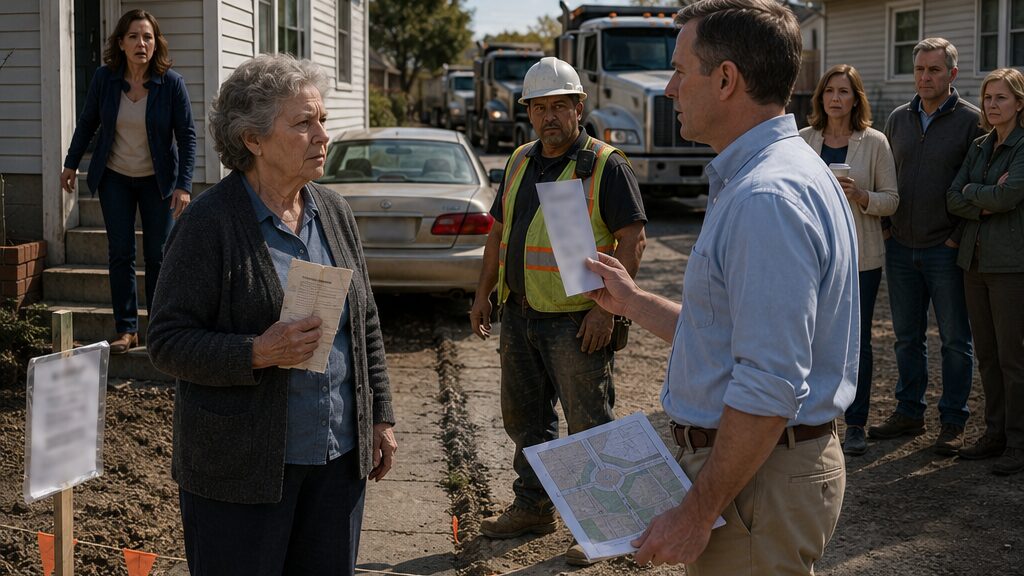
They Paved Over Her Driveway for the New Development, Then Learned Why the Whole Block Needed Her Permission
Chapter 1: The Morning Orange Flags Crossed Betty Hall’s Driveway
The first load of gravel landed across Betty Hall’s driveway at 7:12 on Monday morning.
She was standing at the kitchen sink in her robe when the metal bucket of a loader tipped forward and released several tons of gray stone onto the narrow strip beside her house—the same strip she had backed across every morning for thirty-eight years.
For three seconds, she simply watched.
Then the loader reversed with a shrill electronic beeping that seemed absurdly cheerful.
Betty set down her coffee.
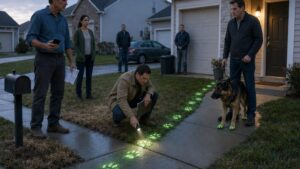
By the time she reached the side door, a construction worker in a reflective vest had planted an orange flag beside her hydrangeas. Another flag stood halfway down the drive. A third had been pushed into the grass near the mailbox.
They formed a line.
Not beside her property.
Across it.
“Excuse me.”
The loader kept moving.
Betty stepped farther into the drive. “Excuse me.”
A man near the fence looked up from a tablet. He wore a white hard hat and a vest with the contractor’s name across the back. Thick work boots, radio clipped at his shoulder, expression already impatient.
Thomas Rivera.
Betty knew the name because Jonathan Adams had introduced him at the spring HOA meeting, when the redevelopment was still shown as neat colored rectangles on a projector screen.
Thomas walked toward her.
“Ma’am, you need to stay clear of the equipment.”
“You need to move that gravel.”
He glanced behind him, then back at her. “This is the rear access.”
“This is my driveway.”
His jaw tightened slightly, the expression of a man deciding how much time a problem deserved.
“We’re working from the approved site plan.”
“I don’t care what plan you’re working from.”
“I understand.”
“No, you don’t.”
Another truck rumbled at the end of the lane. Betty felt its engine through the soles of her slippers.
Thomas pointed toward the street. “I need you to move your car before the concrete trucks start coming through.”
Betty looked at her twelve-year-old sedan parked beside the house.
“My car is parked in my driveway.”
“This corridor is part of the project circulation.”
The phrase irritated her more than shouting would have.
Corridor.
As if the strip where her husband had taught Laura to ride a bicycle had become an arrow on somebody’s diagram.
Betty folded her arms. “Who told you that?”
Thomas looked past her.
“Jonathan.”
She turned.
Jonathan Adams was coming up the common lane in pressed khakis and a pale blue shirt, carrying a rolled tube under one arm. At fifty-something, he still moved like a man entering a room where people expected answers. HOA president for four years. Redevelopment liaison for almost one.
He had once brought Betty’s trash cans up during an ice storm.
Now he stopped beside an orange flag and said, “Betty, we were going to speak with you.”
“You’re a little late.”
His eyes moved to the gravel.
“I thought the site team was staging farther east this morning.”
Thomas said, “The circulation route is marked exactly as issued.”
Something passed between the two men. Brief. Irritated. Gone.
Betty saw it.
Jonathan unrolled the tube against the hood of a parked pickup.
“Come here a second.”
“I can see my own driveway from here.”
“Betty.”
She hated the tone. Not cruel. Worse. Patient.
She walked over.
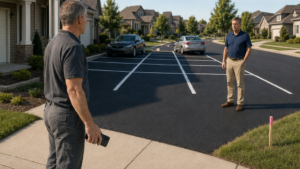
Jonathan flattened a glossy site plan with both hands. Colored blocks showed the new retail building beyond the old rear lots, stormwater work, landscaping, an eighty-space parking area, and a broad gray line curving behind the homes.
His finger followed that line.
“This is the approved rear service circulation.”
Betty leaned closer.
The gray route crossed the narrow strip beside her house.
“No.”
Jonathan looked at her. “It’s on the association planning map.”
“That doesn’t make it yours.”
“I didn’t say it was mine.”
“You’re driving trucks over it.”
“The association has treated this as shared access for years.”
Betty stared at him.
“No, it hasn’t.”
“Maintenance crews have used it.”
“With permission.”
“Landscapers—”
“With permission.”
“Utility access—”
“With permission, Jonathan.”
Thomas shifted his weight. A truck idled behind him.
Jonathan lowered his voice.
“This project was approved by the board. The county permits are active. The circulation plan was reviewed.”
“Then somebody reviewed it badly.”
His mouth hardened.
“Please don’t turn this into something it doesn’t have to be.”
Betty looked at the orange flags.
One stood three feet from the patch of cracked concrete where her husband had once knelt with a trowel and told her not to walk there until morning. She could still see the difference in color between the old slab and his repair.
“What exactly do you think I’m turning it into?”
Behind Jonathan, Thomas raised his radio.
“Hold the next truck.”
The driver’s engine dropped to idle.
Betty heard a screen door slam across the lane. Cynthia Green had stepped onto her porch, arms folded.
Watching.
That was how it always began in a neighborhood. Not with a crowd. With one person watching.
Then another curtain moved.
Jonathan rolled the plan halfway closed.
“Betty, we can sit down this afternoon. I’ll show you the recorded materials.”
“Recorded where?”
“The association office.”
“That isn’t what I asked.”
His patience thinned.
“The project has lawyers, surveyors, engineers. Nobody decided this over coffee.”
Betty felt the fear then.
Not because he had raised his voice. He had not.
Because he sounded certain.
For one ugly moment she wondered whether she had missed something. A notice. An amendment. One of the thick envelopes she sometimes set aside when the HOA filled three pages with language that seemed designed to make a person tired before reaching the point.
Laura had been saying for months that Betty should let her help with paperwork.
Betty had been saying she was fine.
Thomas spoke into his radio. “We’ve got a temporary hold at the west access.”
Jonathan looked sharply at him.
Betty heard the word access.
Not driveway.
Access.
She turned toward the house.
“Where are you going?” Jonathan asked.
“To find something.”
“Betty, moving your car would help us keep this calm.”
She stopped.
“My car isn’t making this uncalm.”
Then she walked inside.
The old deed envelope was not where she first looked.
Not in the desk drawer with the tax bills. Not in the metal file box beneath the guest-room bed. She pulled out insurance papers, appliance warranties, her husband’s death certificate, three years of assessment notices.
Outside, machinery idled.
Every few seconds came the soft flap of an orange flag in the disturbed air.
Her phone rang.
Laura.
Betty considered letting it go.
She answered.
“Mom, Jonathan called me.”
Of course he had.
“That was quick.”
“He said you’re standing in front of construction equipment.”
“I’m in my house.”
“Now.”
“Yes.”
A pause.
“Mom, please don’t confront these people alone.”
“These people are in my driveway.”
“Then call me before you do anything.”
“I know how to make a phone call.”
“That’s not what I mean.”
Betty closed her eyes.
There it was. The thing beneath every conversation lately.
Don’t climb the step stool.
Don’t drive after dark.
Don’t handle contractors alone.
Don’t pretend you can keep up with the house forever.
“I have to go,” Betty said.
“Mom—”
She ended the call.
For several seconds she stood beside the guest bed, ashamed of the small satisfaction she felt.
Then she saw the envelope.
Yellowed at the corners, wedged beneath a folder of mortgage releases.
She pulled it free.
Her husband’s handwriting crossed the front:
HALL PROPERTY — ORIGINAL.
Betty sat down.
The deed was inside, folded with an old survey description.
She carried both to the kitchen table, put on her reading glasses, and traced the legal description line by line.
Lot numbers.
Bearings.
Distances.
The western boundary.
She stopped.
Read it again.
Then she went to the window and looked toward the orange flags.
Forty feet was difficult to judge by eye.
On paper, it was not.
Betty took the deed to the side door just as Jonathan was rolling up his glossy map.
“I’ll come to the office this afternoon,” she said.
He nodded as though the matter had settled itself.
“Good.”
Betty held the deed against her chest.
“Bring that plan.”
“I will.”
“And don’t move the flags.”
Jonathan frowned. “Why?”
Betty looked from the first orange marker to the last.
“Because according to this, your map and my property line can’t both be right.”
Chapter 2: The Map in the HOA Office Did Not Match Her Deed
Jonathan slid the stamped site plan across the conference table and placed one finger directly on Betty’s driveway.
“There.”
Betty remained standing.
The HOA office occupied a converted room beside the community pool, with beige walls, metal blinds, and a framed photograph of the neighborhood taken before half the rear lots had been cleared. The air conditioner clicked too loudly.
On the table, the development plan looked official enough to make doubt feel childish.
County review stamps.
Engineering notes.
Revision dates.
Jonathan tapped the gray route.
“Rear service circulation.”
Betty put her deed beside it.
“My western boundary runs forty feet farther than your map shows.”
Jonathan sat back.
“You’re comparing a private deed description to a conceptual association layer.”
“You just called this an approved plan.”
“It is.”
“Then why is my property conceptual?”
Across from them, Cynthia Green opened a binder.
As HOA treasurer, Cynthia had the habit of touching documents before speaking, as if every opinion required supporting paper.
“Betty, nobody is saying your house isn’t yours.”
“I didn’t say they were.”
“The strip has been used for access.”
“With permission.”
Cynthia exhaled.
“We may be talking about a long-standing use right.”
“May be?”
Jonathan said, “That’s why I asked you to come.”
Betty looked at him.
“No. You asked me to come after a loader dumped gravel across it.”
His face tightened, but he did not argue.
That bothered her.
She sat.
Jonathan rotated the plan so she could read the labels. “This circulation alignment came from the association’s archived property maps. The project team relied on it during design.”
“Which archived map?”
He reached for a folder.
The document he produced was older than the glossy plan but newer than Betty’s deed. A black-and-white site map showed homes, common areas, utility lines, and a dashed corridor along the rear.
The dashed line widened near her property.
A typed label read SHARED CIRCULATION ACCESS.
Betty’s certainty shifted.
Only slightly.
Enough.
She leaned closer.
“What year?”
“Nineteen ninety-eight revision.”
“We bought in eighty-six.”
Jonathan nodded. “I know.”
Betty found her lot.
The outline was wrong.
Or her deed was wrong.
She looked again.
For thirty-eight years she had believed the edge of the drive belonged to her because her husband believed it, because the tax map seemed to support it, because nobody had ever told them otherwise.
Belief was not record.
She heard Laura’s voice without wanting to.
Let me help with the paperwork.
Jonathan watched her face.
“We’re not trying to take your home.”
“Stop saying that.”
“I’m trying to reassure you.”
“You’re trying to make the smaller thing sound harmless.”
Cynthia closed her binder.
“The smaller thing may cost the rest of us a great deal.”
Betty turned.
Cynthia’s expression was not hostile. That made the words land harder.
“What does that mean?”
Jonathan said, “Cynthia.”
“No,” Cynthia replied. “She should know.”
She folded her hands.
“The redevelopment agreement covers part of the drainage reconstruction along the east basin. You know what happened last summer.”
Betty did.
Three garages flooded after a storm. The association’s reserve fund had already been thin.
Cynthia continued. “If the project stalls and the developer walks from the cost-sharing arrangement, the HOA has to fund more of that work directly.”
“How much?”
“We don’t have a final figure.”
“How much?”
Cynthia looked at Jonathan.
He said, “Potentially several thousand per household.”
The room seemed to narrow around the table.
Betty thought of two neighboring homeowners on fixed incomes. She thought of Cynthia, whose husband had been out of work for months before moving away. She thought of her own furnace making a low knocking sound every time it started.
“So that’s it,” she said.
Jonathan frowned. “What?”
“You pave first because nobody wants to be the person who costs everyone money.”
“That is not what happened.”
“But it’s useful.”
His chair scraped softly as he leaned forward.
“Betty, I have spent three years trying to keep this association from imposing another special assessment. The drainage system is failing. Insurance costs are rising. Half the owners scream if dues go up twenty dollars and the other half scream because repairs don’t happen fast enough.”
He stopped.
The anger in his voice had not been directed entirely at her.
For the first time, Betty saw the exhaustion beneath his careful clothes.
Then he made the mistake of continuing.
“We finally have a project that solves several problems at once. I’m asking you not to derail it over a strip everyone has treated as access for decades.”
The sympathy vanished.
“Everyone except the person paying taxes on it.”
Jonathan’s lips pressed together.
Cynthia looked down.
Betty gathered her deed.
At home, Laura was waiting in the kitchen.
She had driven over without asking and placed two grocery bags on the counter as if food could disguise an intervention.
“You hung up on me.”
“I was busy.”
“You’re always busy when you don’t want to answer.”
Betty set the deed on the table.
Laura saw it.
“What happened?”
“They have a map.”
“What kind?”
“One that says the strip is shared access.”
Laura pulled out a chair. “And yours?”
“Says my boundary is wider.”
“Then get a survey.”
“Those cost money.”
“So does a lawsuit.”
“I am not suing anyone.”
“Not yet.”
Betty took off her glasses and rubbed the bridge of her nose.
Laura’s voice softened.
“Mom, maybe this is exactly why you should think about selling.”
Betty looked up.
There it was.
Not hidden now.
Laura continued carefully. “The roof needs work. The back steps are getting worse. You told me the furnace—”
“I should never have mentioned the furnace.”
“That is not the lesson.”
“What is?”
“That you don’t have to keep proving you can do everything.”
Betty laughed once, without humor.
“And moving me somewhere smaller proves what?”
“It proves nothing.”
“It proves you were right.”
Laura stared at her.
“This is not a contest.”
“It becomes one when everyone keeps deciding what I can manage.”
“Who is everyone?”
Betty looked toward the window.
Orange flags were visible beyond the side yard.
Laura followed her gaze.
For a moment neither spoke.
Then Laura picked up the deed.
“Show me.”
Betty almost took it back.
Instead she pointed to the legal description.
They measured the stated boundary against the lot dimensions shown on the tax summary Betty kept with her annual bill. The numbers were dense, imperfect, and not enough to settle anything.
But one fact remained.
The frontage and depth calculations appeared to give Betty more land than the HOA map did.
Laura checked twice.
“This looks wider.”
“I know.”
“Not by two feet.”
“No.”
“How much?”
“Close to forty.”
Laura sat back.
Betty should have felt vindicated.
Instead she felt more frightened.
If she was right, the project had made a serious mistake.
If she was wrong, she had stood in front of neighbors and construction crews defending land she did not own.
Her phone rang.
Unknown county number.
Betty answered.
A clerk returned the message she had left earlier.
Betty explained the conflicting documents, slowly this time.
The clerk asked for subdivision information and the property parcel number. Papers clicked on the other end.
Then silence.
“I see the recorded deed,” the clerk said.
“And?”
“I can’t interpret ownership for you.”
“I understand.”
“There is something else in the subdivision file.”
Betty stood straighter.
“What?”
“An older access sheet tied to the original plat.”
Laura watched her face.
Betty gripped the phone.
“Does it show my driveway?”
“I can’t tell you what it means legally, ma’am. But it predates the association map you’re describing.”
“Can I see it?”
“Yes.”
“When?”
The clerk hesitated.
“We close in forty minutes.”
Betty was already reaching for her keys.
Chapter 3: Forty Feet of Concrete Became the Whole Project’s Weak Point
The county clerk unfolded the old subdivision sheet so carefully that Betty stopped breathing until all four corners lay flat.
“This was filed before the later revisions,” the clerk said.
The paper was larger than the desk. Thin, yellowed, covered in survey lines and handwritten references copied into cleaner typed notes along one edge.
Laura stood behind Betty’s chair.
They had arrived nine minutes before closing.
Betty found her street first.
Then her lot.
Then the narrow strip.
“There,” she said.
The clerk adjusted the desk lamp.
On the old sheet, Betty’s western boundary extended along the side drive exactly where her deed suggested it should. Beyond it, the rear development parcels sat like locked boxes.
A separate notation marked a service approach from the south.
Betty followed it with one finger.
“What is this?”
The clerk leaned closer.
“Original rear-access concept.”
“It doesn’t cross my property.”
“No.”
“Where does it go?”
The clerk traced the line.
“To this parcel.”
Laura bent over Betty’s shoulder.
The parcel was shaded and labeled for drainage control.
The clerk said, “Later stormwater dedication.”
Betty looked from the drainage parcel to the development lots.
“So the original access route disappeared.”
“I wouldn’t put it that way.”
“What way would you put it?”
The clerk gave her a patient look.
“I would say the records changed over time and you need someone qualified to interpret the legal effect.”
Betty almost smiled.
Retired school office administrators respected people who refused to answer questions outside their authority.
“Fair enough.”
She returned to the map.
If the southern route was no longer usable, then the rear lots had another problem.
“How do vehicles reach these parcels now?”
The clerk did not answer.
Laura did.
“Through Mom’s drive.”
Betty felt the meaning settle slowly.
Not triumph.
Something colder.
The trucks had not crossed her property because it was convenient.
They had crossed because the project had nowhere else practical to go.
The clerk made copies of the relevant sheets and stamped the request receipt. By the time Betty and Laura reached the parking lot, the county offices were locking their glass doors.
Laura held the copies against the evening breeze.
“Mom.”
“I know.”
“No, I don’t think you do.”
Betty unlocked the car.
Laura stayed where she was.
“If this says what it looks like it says, the whole rear circulation depends on that strip.”
Betty looked at the old map.
Forty feet.
For years, it had been the place where she rolled trash cans, where delivery drivers left packages, where her husband washed mud from the tires after gardening.
Now it appeared to be the throat of an entire project.
“I need to verify it,” she said.
Laura stared at her.
“Who are you and what have you done with my mother?”
Betty opened the driver’s door.
“Get in.”
The next morning, the first truck arrived before eight.
Betty was ready.
She had placed her sedan sideways across the upper part of the drive, still entirely within the boundary shown on her deed. Beside it she fixed a laminated notice to a temporary wooden stake.
PRIVATE ACCESS
WRITTEN PERMISSION REQUIRED
The orange flags still crossed the strip.
She had left them untouched.
Thomas saw the sign from halfway down the lane.
He stopped walking.
Then he looked at the line of trucks behind him.
“Mrs. Hall.”
“Betty is fine.”
“Move the car.”
“No.”
His shoulders rose with one controlled breath.
“We have concrete scheduled.”
“I noticed.”
“You are blocking active site access.”
“I’m parked on my property.”
“That is disputed.”
“Not as much as it was yesterday.”
She held up the county copies.
Thomas’s eyes changed.
Not fear.
Calculation.
“What did you find?”
Before Betty could answer, Jonathan’s SUV turned into the lane.
By then, neighbors had begun appearing. Cynthia crossed from her house carrying coffee. Another homeowner stood near the mailbox. Someone farther back lifted a phone, though Betty could not tell whether they were recording or checking messages.
Jonathan got out quickly.
“What is this?”
Betty touched the laminated notice.
“English.”
“Betty.”
He glanced at the trucks.
Then at Thomas.
“How long have they been waiting?”
“First one, twelve minutes.”
Jonathan lowered his voice. “Every idle truck is costing the project money.”
Betty said, “Then I would stop sending them across land you haven’t confirmed you can use.”
Cynthia approached.
“Betty, please.”
Betty turned.
Cynthia looked tired rather than angry.
“If this becomes a shutdown, we all know where the cost lands.”
There it was.
The first public weight.
Not law.
Not ownership.
Neighbors.
Thomas said, “Mrs. Hall, I need a clear route.”
“And I need a clear answer.”
Jonathan stepped closer.
“You have one. The association map identifies shared access.”
Betty removed the copied subdivision sheet from a folder.
“And the recorded deed identifies my boundary.”
She placed the deed copy against the hood of Jonathan’s SUV.
Then she laid his glossy circulation map beside it.
The contrast was almost ridiculous.
Old legal description.
Bright modern plan.
One narrow strip drawn two different ways.
Jonathan stared down.
Betty pointed.
“Your route needs my property.”
He said nothing.
“The old subdivision sheet shows the southern access path ending at land later dedicated for drainage.”
Thomas looked sharply at Jonathan.
Betty saw it.
Again, that quick exchange.
She continued.
“So unless one of you has a permanent easement I haven’t seen, every truck in that line crosses forty feet I own.”
One of the neighbors said, “Is that true?”
Jonathan’s face flushed.
“This is not the place to interpret historical documents.”
“You chose the place when you poured gravel on it.”
“Betty—”
She kept her voice level.
“I’m not stopping your project. I’m asking why your project needs my permission after you already started.”
Silence.
Even the trucks seemed quieter.
Thomas looked at the maps.
Then toward the drainage parcel beyond the fence.
Jonathan said, “You are making an enormous assumption.”
“Then show me the permanent easement.”
“We have documented access.”
“Show me.”
His jaw tightened.
Cynthia stepped nearer the papers.
“Jonathan?”
He ignored her.
Betty felt something dangerous then: the first clean edge of victory.
She had been right about the dimensions.
Right about the old route.
Right to question the flags.
She should have recognized how quickly certainty could become pride.
Jonathan walked back to his SUV.
He opened the rear door, reached into a leather portfolio, and removed a single sheet of paper.
When he returned, his expression had changed.
The defensiveness was gone.
That frightened Betty more.
He held the page where the gathered neighbors could see it.
“Before everyone decides Mrs. Hall’s permission was never requested,” he said, “they should probably know she signed it.”
Betty’s stomach dropped.
Laura, standing near the porch steps, went still.
Jonathan turned the paper toward Betty.
She recognized the letterhead first.
Then the date.
Then her signature.
Her own handwriting curved across the bottom of a document she had not told Laura existed.
Cynthia looked from the page to Betty.
“What is that?”
Jonathan answered without taking his eyes off her.
“Written access authorization.”
The small crowd shifted.
The power of the scene changed so completely that Betty felt it physically.
A moment earlier, the orange flags had looked like evidence of invasion.
Now every one of them seemed to point toward her.
Laura came down one step.
“Mom?”
Betty could not answer.
Because she remembered the afternoon she had signed.
She remembered exactly why.
Jonathan lifted the page slightly.
“You said nobody asked you.”
Betty looked at her own signature.
Behind him, the concrete trucks waited.
And for the first time since the loader dumped gravel across her drive, Betty wondered whether the person who had made the dispute harder to understand was not Jonathan.
It was her.
Chapter 4: The Signature Betty Never Told Her Daughter About
Laura waited until the last concrete truck had backed away before she spoke.
“Why didn’t you tell me?”
They were in Betty’s kitchen. The county copies lay beneath a ceramic sugar bowl to keep the corners from curling. Jonathan’s photocopy of the signed letter sat alone near the edge of the table.
Betty took off her reading glasses.
“I was going to.”
Laura laughed once.
“No, you weren’t.”
Outside, the construction site had gone strangely quiet. The trucks had been rerouted to a holding area while Jonathan “reviewed the documentation,” which Betty knew meant he was calling people who billed by the hour.
She looked at the letter.
Her signature was unmistakable.
BETTY HALL.
Blue ink.
A date from eleven months earlier.
Laura pushed the page toward her. “What exactly did you sign?”
“I know what I signed.”
“Then tell me.”
Betty stood, carried her coffee cup to the sink, and rinsed it although it was already empty.
Laura waited.
That was one of the things Betty found hardest about her daughter now. As a child, Laura had filled silence. As an adult, she had learned to let it corner people.
Finally Betty said, “Jonathan came by after the first redevelopment meeting.”
“And?”
“He said surveyors needed temporary access along the side.”
Laura’s expression sharpened. “Temporary.”
“Yes.”
“For what?”
“Measurements. Soil checks. Boundary verification.”
“And you agreed.”
“I did.”
Laura picked up the letter.
“Why?”
Betty turned off the faucet.
Because the roof estimate had arrived that week.
Because the furnace repairman had warned that one more winter might be all the old unit had left.
Because the back steps shifted half an inch every spring.
Because Jonathan had mentioned, gently and without pressure, that the developer might eventually make offers to adjoining homeowners.
Because for one entire evening Betty had imagined handing over the keys, moving somewhere with no leaves to rake, no gutters to clear, no rooms that still held the shape of her husband’s absence.
She said only, “I was considering my options.”
Laura stared at her.
“You were considering selling.”
Betty folded the dish towel.
“I considered it.”
“And you never told me.”
“I hadn’t decided anything.”
“That isn’t the point.”
“It is exactly the point.”
Laura stood.
“No, the point is you let me spend the last year worrying about you staying here alone while you were privately talking to the same people you now say are trying to take advantage of you.”
“I was not talking to the developer.”
“You signed access.”
“For survey work.”
“You signed something.”
Betty’s face warmed.
“And there it is.”
“What?”
“The thing you’ve been waiting for.”
Laura’s anger stopped.
Betty continued.
“Proof that I missed something. Proof that maybe I can’t keep track of my own affairs.”
“Mom, I did not say that.”
“You don’t have to.”
Laura looked toward the letter.
Her voice lowered.
“I’m angry because you shut me out.”
“And I shut you out because every time I tell you a pipe leaks, you send me listings for condos.”
“That is not fair.”
“No. It isn’t.”
The words stayed between them.
Betty sat down again.
For the first time that morning, the anger left enough room for shame.
She pulled the letter closer.
“Read it.”
Laura did.
Not quickly.
The page was titled TEMPORARY SITE ACCESS AUTHORIZATION.
It permitted the association, developer consultants, and approved survey personnel to enter the side strip for measurement, environmental review, staking, and related preconstruction assessment.
Laura read the final paragraph twice.
“Mom.”
“I see it.”
“No, look.”
She turned the paper and pointed.
Authorization expires upon completion of preliminary site investigation or six months from execution, whichever occurs first.
Betty put on her glasses.
Six months.
The date at the top was eleven months old.
Laura traced another line.
“It doesn’t say trucks.”
“No.”
“It doesn’t say paving.”
“No.”
“It doesn’t grant a permanent easement.”
Betty said nothing.
The small payoff should have relieved her.
Instead it made the morning worse.
Jonathan had not invented the letter. He had not forged her name. She had opened the door, however narrowly, then forgotten—or chosen not to remember—that she had ever considered letting the project into her life.
Laura lowered herself into the chair.
“So he had a reason to think you’d cooperate.”
“A reason to ask.”
“Yes.”
Betty looked out the window.
One orange flag leaned sideways in the grass.
“He never asked again.”
By late afternoon, a notice had been taped to the HOA clubhouse door announcing an emergency information meeting for the following evening.
Before dinner, the first messages began circulating.
Cynthia did not send them, but she showed Betty one.
PROJECT DELAY MAY RESULT IN DIRECT OWNER COSTS.
Another said:
ONE HOMEOWNER SHOULD NOT HOLD THE ENTIRE COMMUNITY HOSTAGE.
The word hostage made Betty laugh.
Then she saw that someone had attached a photograph of her car parked across the drive.
The laugh stopped.
At six, Jonathan called.
She let it ring twice before answering.
“We need to talk,” he said.
“We’ve done a lot of that.”
“The letter matters.”
“It expired.”
“That is not the only issue.”
“It is if you are calling it permanent consent.”
“I never called it that.”
“You stood in front of my neighbors and said I authorized access.”
“You did authorize access.”
“For survey work.”
Jonathan exhaled.
“Betty, you signed after discussions about the redevelopment. You knew the strip was under review.”
“I knew people were measuring it.”
“You knew access was being evaluated.”
“Evaluated is not granted.”
His voice hardened.
“And your conduct matters too.”
“What conduct?”
“You allowed crews onto that strip repeatedly.”
“Survey crews.”
“You did not object to staking.”
“Because I signed for staking.”
“You didn’t remove the markers.”
Betty looked toward the window.
Orange flags.
She understood suddenly how something temporary became normal. Not in one dramatic act. In layers.
A surveyor came through.
Then a marker stayed.
Then a map changed.
Then a truck arrived.
Then somebody said everyone had always understood.
“Jonathan,” she said, “did you have a permanent easement when the paving started?”
Silence.
Not long.
Long enough.
He answered carefully.
“We relied on the project documentation available to us.”
“That wasn’t my question.”
“We’ll discuss it tomorrow.”
The line went dead.
At the emergency HOA meeting the next evening, Betty arrived ten minutes early and found half the chairs already occupied.
Nobody shouted at her.
That was worse.
People lowered their voices.
One neighbor gave a stiff nod. Another looked away.
Cynthia sat at the front beside a stack of financial summaries.
Jonathan had not yet arrived.
Laura took the chair beside Betty.
“I’m staying.”
“I didn’t ask you to.”
“I know.”
Betty nearly told her to leave.
Instead she put the expired letter on the table in front of them.
The room filled.
Jonathan entered with the association attorney and began arranging papers.
Then the side door opened again.
Thomas Rivera stood there without his hard hat.
His eyes found Betty.
He waited until Jonathan turned toward the attorney, then crossed the back of the room and stopped beside her chair.
His voice was low.
“Mrs. Hall.”
“Betty.”
He glanced toward the front.
“Did Jonathan ever show you a permanent easement?”
Betty felt Laura go still beside her.
“No.”
Thomas looked at the expired letter.
Then back at Betty.
“Did anybody?”
“No.”
He nodded once.
Not satisfaction.
Decision.
Betty leaned closer.
“Why are you asking me?”
Thomas looked toward Jonathan again.
“Because before we paved that strip, I asked the same question.”
Chapter 5: The Superintendent Had Warned Them Before the Paving Began
Thomas placed his site log on the folding table and opened it to a page dated twelve days before the first gravel truck arrived.
Betty read the line twice.
WEST ACCESS — VERIFY EXECUTED PERMANENT ACCESS RIGHTS BEFORE MOBILIZATION.
Beside it was a handwritten notation.
PENDING OWNER/ASSOC. DOC.
The site trailer smelled of coffee, damp plywood, and dust carried in on work boots. Through the small window Betty could see the fresh concrete strip beside her house, bright and smooth where the old cracked surface disappeared beneath it.
Laura stood behind her.
Thomas remained near the door.
“You wrote this?” Betty asked.
“Yes.”
“Who saw it?”
“Project management.”
“Jonathan?”
“I sent the access checklist to him and the developer representative.”
“When?”
“The date’s there.”
Betty looked again.
Twelve days before paving.
Her anger returned, but not in the same form.
Yesterday it had been humiliation. A hot need to prove she had not imagined her own boundary.
Now the feeling was colder.
Specific.
“What did they tell you?”
Thomas crossed his arms.
“That the association had historical access documentation and owner cooperation.”
Betty touched the expired letter.
“This?”
“I wasn’t shown that until later.”
“What were you shown?”
“A circulation plan. Survey control. Permit package.”
“An easement?”
“No.”
The word was plain.
Laura asked, “Then why did you proceed?”
Thomas looked at her.
“Because I run construction. I don’t determine title.”
“That sounds convenient.”
“It is not supposed to sound like anything.”
His tone sharpened, then he checked it.
“I had a schedule. Crews booked. concrete windows. Equipment rentals. The project team said legal access was being handled.”
Betty studied him.
“You told me to move my car.”
“Yes.”
“You acted like I was the problem.”
“Yes.”
No excuse.
That surprised her.
Thomas looked through the window toward the idle route.
“I thought you were a holdout.”
“For money.”
“That was my assumption.”
“Why?”
“Because I’ve seen it before.”
Betty almost said that assumptions were what had caused this.
Then she remembered her own letter.
Her own silence.
Her certainty on the driveway before Jonathan held up her signature.
Thomas continued.
“Owners agree in principle, project spends money, then somebody sees leverage.”
“And now?”
“Now I think management treated temporary cooperation like permanent access.”
The trailer door opened.
Jonathan entered.
He stopped when he saw the log on the table.
For a moment nobody spoke.
Then Jonathan said, “Thomas, I thought we agreed internal project records would go through counsel.”
Thomas closed neither the book nor his expression.
“I’m answering a factual question.”
Jonathan looked at Betty.
“This is getting ahead of the review.”
“No,” Betty said. “The paving got ahead of the review.”
His shoulders dropped slightly.
He seemed older than he had Monday morning.
“Can we speak privately?”
“No.”
Laura shifted beside Betty, but Betty did not look at her.
Jonathan glanced around the trailer.
“Fine.”
He pulled out a chair.
“The project had a financing deadline.”
Thomas looked away.
Betty said, “What does that have to do with my property?”
“Everything, unfortunately.”
Jonathan sat.
“The redevelopment agreement is tied to staged funding. If access certification had been delayed, the lender could have suspended a draw.”
“Could have?”
“Likely would have.”
“How much?”
“That isn’t the point.”
“It is becoming the point.”
Jonathan rubbed one hand over his face.
“The developer had contractors mobilized. The association had already committed to drainage coordination. A pause could have triggered change orders, remobilization costs, and questions about whether the overall site plan remained viable.”
Laura said, “So you knew access was incomplete.”
Jonathan looked at her.
“I knew documentation was not in final form.”
Betty’s voice stayed level.
“That means yes.”
“I believed it would be resolved.”
“By whom?”
“Counsel. The developer. The association.”
“Not me.”
“You had already granted temporary access and had participated in discussions.”
“There it is again.”
Jonathan frowned.
“What?”
“You keep turning my willingness to discuss something into permission to finish it without me.”
The words landed harder than Betty expected.
Thomas looked down at the log.
Jonathan did not answer immediately.
When he did, his voice was quieter.
“Betty, I was trying to prevent a collapse.”
“Of what?”
“The project. The drainage agreement. The board’s finances.”
He stood.
“You think this is about me wanting a ribbon cutting? We have reserve shortfalls. We have homeowners who cannot absorb another assessment. I promised people we had found a path that did not require writing five-figure checks.”
Laura said, “So you risked someone else’s property.”
Jonathan turned toward her.
“I relied on a project team telling me access could be cured.”
Betty caught the phrase.
“Cured.”
He realized it too late.
Thomas shut the log.
The county access-review inspector arrived twenty minutes later.
The review took place outside.
No dramatic confrontation. No instant ruling.
The inspector measured, photographed, compared the county sheet to the project plans, and asked for documents nobody could produce on the spot.
Permanent easement.
Recorded license.
Current owner agreement.
Jonathan called the association attorney.
Thomas called his project office.
Betty stood beside the orange flags and watched people search folders.
At last the inspector said, “Until the access basis is clarified, I’m directing heavy construction traffic not to use this strip.”
Jonathan’s face changed.
“For how long?”
“Until review.”
“We have scheduled pours.”
“Then route them elsewhere.”
Thomas said nothing.
Because everyone present now understood the problem.
Elsewhere was the drainage parcel.
Elsewhere was not a route.
The first practical victory felt nothing like Betty expected.
No thrill.
No applause.
A delivery truck at the end of the lane shut off its engine.
A second one turned away.
The project went quiet by degrees.
Cynthia arrived just as the inspector was leaving.
She looked at the stopped trucks.
Then at Jonathan.
“What happened?”
He did not answer.
Betty did.
“Temporary halt.”
Cynthia closed her eyes.
“For how long?”
“We don’t know.”
That evening Jonathan came to Betty’s porch alone.
No folder.
No rolled plan.
He stood at the bottom step.
“I need you to understand what this could mean.”
Betty stayed behind the screen door.
“I understand more than I did Monday.”
“That’s not what I mean.”
He looked toward the darkened construction site.
“If redesign is required, we may lose part of the developer contribution to the drainage work.”
“You said that before.”
“I’m saying there are numbers now.”
Betty waited.
Jonathan’s voice was flat.
“Preliminary exposure is in the six figures.”
She opened the screen door.
“For the developer?”
“For the project overall.”
“And the HOA?”
“Potentially a substantial share.”
“How substantial?”
“We don’t know yet.”
Betty looked across the lane at the neighboring houses.
Porch lights.
Curtains.
People inside calculating money they did not have.
Jonathan stepped closer.
“I made the wrong call.”
It was the first time he had said it.
Betty felt no satisfaction.
He continued.
“I should have stopped mobilization until the permanent access was complete.”
“Yes.”
“But stopping now does not erase what comes next.”
“No.”
“If you close that strip entirely, the neighborhood may pay for my mistake.”
Betty gripped the screen-door handle.
There it was.
The choice she had wanted when she believed the facts were simple.
Her land.
Her decision.
Only now the cost had faces.
Jonathan looked at her.
“Tomorrow night, they’re going to ask what you intend to do.”
Chapter 6: When the Neighborhood Learned What Jonathan Had Risked
By the time Betty entered the emergency HOA meeting, someone had placed a handwritten sign on the refreshment table.
NO MORE DELAYS.
Nobody admitted writing it.
The room was fuller than the night before. Folding chairs lined the walls. Two homeowners stood in the back. Cynthia sat with a calculator, a legal pad, and three pages of preliminary cost estimates.
Jonathan stood at the front without a jacket.
Betty noticed that first.
He always wore one for formal meetings.
Laura walked beside her but did not touch her arm.
Betty had asked her not to.
Not because she wanted distance.
Because she wanted to enter under her own balance.
The orange flags were in Betty’s hand.
Three of them.
She had pulled them from the edge of the disputed strip before leaving home.
A neighbor near the aisle saw them.
“What are those for?”
Betty placed them on the front table.
“To make the line visible.”
A low murmur moved through the room.
Jonathan called the meeting to order.
The first question came before he finished the opening statement.
“How much is this costing us?”
Cynthia answered.
“We have estimates, not final numbers.”
“How much?”
She looked at the page.
“Depending on duration and redesign scope, association exposure could range significantly.”
“That means what?”
“Potentially over one hundred thousand dollars.”
The room erupted.
Not shouting all at once. Worse.
Individual voices.
“My dues already went up.”
“We were told the developer was covering drainage.”
“Why was construction started without access?”
Then one voice from the back:
“Why is one homeowner blocking it?”
Silence followed.
Betty looked toward the speaker.
A neighboring homeowner she had known for years would not meet her eyes.
Jonathan stepped forward.
“We need to separate two issues.”
Betty said, “No.”
Every head turned.
She had not planned to interrupt.
Jonathan looked at her.
Betty walked to the front.
Her knees felt less steady than she wanted.
She placed her temporary-access letter beside the orange flags.
“I signed this.”
The room stilled.
Laura shifted in her chair.
Betty continued.
“Eleven months ago, I gave temporary permission for survey crews to enter the side strip beside my house.”
Someone whispered.
Jonathan said nothing.
Betty looked around the room.
“I did not tell my daughter. I did not tell some of you when this dispute started. That was wrong.”
The admission hurt more publicly than it had in her kitchen.
She kept going.
“I was considering whether I might sell someday. I was tired of repairs. I was embarrassed by that. So when construction began, I talked as if I had never opened the door at all.”
A man in the back said, “So you did give permission.”
“For surveys.”
She lifted the page.
“Six months. Measurements, testing, staking. Not paving. Not permanent truck access.”
Another voice: “But the HOA thought—”
Betty turned toward Jonathan.
“Tell them.”
He looked at the room.
The association attorney sat beside him, expression unreadable.
Jonathan took a breath.
“The permanent access documentation was incomplete when mobilization proceeded.”
The room changed.
Not dramatically.
People leaned forward.
Cynthia stopped writing.
A neighbor asked, “You knew?”
Jonathan answered carefully.
“I knew final access documentation had not been recorded.”
“Then why did you start?”
He looked toward the financial pages.
“Because delay threatened project financing and the drainage agreement.”
Someone said, “You gambled.”
Jonathan’s face tightened.
“I made a decision based on the expectation that access would be resolved.”
Betty heard the anger growing and understood suddenly how easy it would be to let it carry her.
To stand back.
To let Jonathan absorb everything.
Thomas had warned them.
Jonathan had proceeded.
The county had halted traffic.
She could let the room turn him into the simple villain she had wanted.
Then Cynthia spoke.
“My basement flooded last August.”
The room quieted again.
She looked at Betty, not Jonathan.
“I supported the redevelopment because I cannot afford another assessment. That is the truth.”
Betty nodded.
Cynthia continued.
“I also thought the access had been handled. I should have asked harder questions.”
Jonathan said, “Cynthia—”
“No.”
She turned toward him.
“You told the board the remaining documentation was routine.”
“It was expected to be.”
“That is not the same thing.”
A woman near the wall said, “So what happens now?”
Cynthia looked down at the estimates.
“If access stays closed indefinitely, we face delay costs, possible redesign, and uncertainty in the drainage contribution.”
The pressure moved toward Betty again.
She could feel it without anyone saying her name.
Laura watched her.
Betty thought of the porch conversation with Jonathan.
The six-figure gap.
The special assessment.
Her own anger.
The strip beside her house.
Forty feet everyone had treated as too small to matter until it mattered to all of them.
One homeowner asked, “Can’t she just let the trucks through while this gets sorted out?”
Betty answered.
“No.”
A groan came from somewhere in the room.
She raised one hand.
“Not like before.”
That stopped it.
Betty picked up an orange flag.
“When these appeared Monday morning, I thought they meant somebody was taking my property.”
She placed the flag upright in a heavy glass water pitcher on the table.
“Then I found out I had signed temporary access months earlier.”
A second flag.
“I thought that meant maybe I had caused the whole mess.”
She placed it beside the first.
“Then I learned the permanent right was never finished and construction continued anyway.”
The third flag remained in her hand.
Jonathan watched her.
Betty said, “There is enough blame in this room already.”
No one moved.
“I am not giving away the strip.”
A few faces hardened.
“I am also not saying the neighborhood can never cross it under any circumstances.”
Jonathan looked up sharply.
Laura did too.
Betty set the third flag on the table.
“If the project wants access, then for the first time since this began, we will discuss access before using it.”
The room remained silent.
A neighbor asked, “What does that mean?”
“It means written limits.”
Jonathan said, “Betty—”
She turned to him.
“You asked what I intend to do.”
He stopped.
Betty looked at Cynthia.
“Construction only. Specific hours. No permanent public circulation. Repair responsibility. Insurance. An end date.”
The association attorney began writing.
Betty continued.
“And the route does not become shared because people use it temporarily.”
Jonathan’s eyes stayed on her.
“What are you asking for financially?”
“I haven’t decided.”
A murmur rose.
She let it.
Then said, “But I am not interested in holding eighty homes hostage, and I am not interested in being told that means I owe anyone free use of mine.”
Cynthia slowly closed the calculator cover.
The room’s anger had nowhere simple to land now.
Betty picked up the expired letter.
“My first mistake was thinking I could consider selling without telling anyone close to me because admitting I was tired felt like weakness.”
Laura looked down.
“My second mistake was thinking being right about the deed made me right about everything.”
Jonathan’s expression shifted.
Betty faced him.
“Your mistake was bigger.”
He nodded once.
“Yes.”
No speech.
No excuse.
Just the word.
It did more to the room than an apology prepared by counsel would have.
Betty gathered the orange flags.
“I’ll meet tomorrow.”
The developer representative, who had been silent near the wall, spoke for the first time.
“To discuss temporary access?”
Betty looked at him.
“To discuss whether you can use my property under conditions I choose to accept.”
“And if we cannot agree?”
“Then you redesign.”
The representative’s jaw tightened.
Betty turned toward the door.
Behind her, Jonathan said, “What conditions?”
She stopped.
For the first time all week, she did not feel the need to answer immediately.
She looked at Laura.
Laura did not step forward.
Did not offer to speak for her.
She simply waited.
Betty faced the room again.
“I’ll bring them tomorrow.”
Chapter 7: Betty Refused the Buyout and Offered Something Harder Instead
The developer representative arrived at Betty’s porch Thursday morning with a number already printed on paper.
He did not hand it to her immediately.
That was the first thing she noticed.
He sat across from her at the small metal table where her husband used to sort screws into coffee cans, placed a leather folder between them, and spoke for nearly five minutes about schedule recovery, neighborhood stability, and the value of reaching a clean resolution.
Laura sat near the porch rail.
Jonathan stood at the bottom of the steps.
The association attorney had brought a legal pad.
Thomas remained by the project fence, close enough to answer construction questions but far enough to make clear he was not part of the negotiation.
Betty listened.
When the representative finally opened the folder, he turned one page toward her.
“This would be for outright acquisition of the strip.”
Betty looked at the figure.
It was more money than she had expected.
Enough for the furnace.
Enough for the roof.
Enough to rebuild the back steps and still leave a sum that would have frightened her eleven months earlier with its ability to make difficult decisions seem easy.
Laura inhaled softly.
Jonathan watched Betty’s face.
The representative said, “We would cover closing costs and survey work.”
Betty read the number again.
“Permanent transfer.”
“Yes.”
“You own it.”
“The developer would.”
“And after construction?”
“It becomes part of the final circulation system.”
“Public traffic?”
“Service and operational traffic as permitted under the site plan.”
Betty slid the paper back.
“No.”
The representative blinked.
Jonathan looked away.
The attorney stopped writing.
“Mrs. Hall,” the representative said, “perhaps you would like time to consider—”
“I considered it.”
“You have had the offer for less than a minute.”
“I’ve had the question longer.”
Laura shifted.
Betty saw the old instinct in her daughter—the urge to ask whether she understood the amount, whether she should sleep on it, whether refusing quickly was pride.
Laura said nothing.
Betty appreciated the silence more than she could tell her.
The representative folded his hands.
“Then what are you proposing?”
Betty reached beside her chair and lifted a yellow legal pad.
Her conditions filled two pages.
“Temporary construction access only.”
The attorney leaned forward.
“Define temporary.”
“Through a fixed end date, with any extension requiring a new written agreement.”
She continued before anyone could interrupt.
“Weekdays only, except emergencies approved in writing. No customer traffic. No permanent service circulation. No assumption that repeated use creates a continuing right.”
The attorney wrote faster.
“Weight limits to be agreed with the contractor. Photographs of the strip and house foundation before access resumes. Repairs at the project’s expense.”
Thomas spoke from near the fence.
“Foundation monitoring is reasonable with heavy traffic that close.”
The representative glanced at him.
Betty continued.
“Insurance naming me where appropriate. Dust control. No idling before seven-thirty. No staging in front of my house.”
Jonathan said, “Compensation?”
“Yes.”
The representative’s attention sharpened.
“How much?”
Betty named a figure.
It was not ruinous.
It was not symbolic.
It was enough to acknowledge that the project had asked one homeowner to absorb risk for everyone else.
The representative leaned back.
“You are declining a purchase multiple times larger than that.”
“I am.”
“Why?”
Betty looked toward the narrow strip.
Fresh concrete ran beside the house in a pale gray band. Orange flags marked the disturbed edge.
“Because I don’t want to sell it.”
The answer seemed to irritate him by refusing to become financial.
He tried again.
“Your home would remain fully accessible.”
“That is not the issue.”
“What is?”
Betty looked at Jonathan.
He met her eyes.
She said, “You all keep asking what would make me give it up.”
The porch went still.
“I am telling you what would make me let you use it.”
Laura lowered her gaze.
Something in her expression changed.
Not surprise.
Understanding.
The representative closed the purchase page.
“Temporary access creates uncertainty.”
“Yes.”
“The project needs reliability.”
“So do I.”
“What happens after the term?”
“You use the redesigned route.”
Jonathan frowned.
“What redesigned route?”
Thomas stepped closer.
“We’ve looked at reducing the rear circulation pattern and creating a narrower controlled connection on the east side.”
The representative turned sharply.
“That was preliminary.”
Thomas shrugged.
“It exists.”
The attorney asked, “Cost?”
“More than using Mrs. Hall’s strip forever. Less than a full shutdown.”
Jonathan looked from Thomas to the representative.
“You had an alternate design?”
“A partial alternate,” the representative said. “It reduces parking efficiency.”
“How many spaces?”
“Potentially several.”
Cynthia was not there, but Betty could imagine her reaction to the word several when eighty spaces had once been treated as untouchable.
Jonathan’s face tightened.
“So this was never access or nothing.”
The representative answered carefully.
“It was the preferred configuration.”
Betty almost laughed.
Preferred.
Another word like corridor.
A word large organizations used when someone else was expected to carry the inconvenience.
She stood.
“Then you have my proposal.”
The representative remained seated.
“We would need broader operational flexibility.”
“No.”
“Weekend access during critical phases.”
“By written request.”
“A longer base term.”
“No.”
“Automatic extension for delay events.”
“No.”
His patience thinned.
“Mrs. Hall, construction schedules are not exact.”
“Neither are promises.”
Jonathan looked down.
The representative closed the folder.
“If we cannot reach commercially workable terms, redesign remains an option.”
Betty nodded.
“That is what I said last night.”
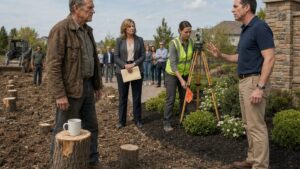
The meeting moved from porch to boundary because Thomas needed to show where temporary truck wheels would pass.
They stood beside the orange flags.
One marker had been planted several feet inside the line supported by Betty’s deed and the county sheet.
Thomas pointed.
“For safe turning, we would want this width.”
Betty shook her head.
“That is not the boundary.”
“It’s the working envelope.”
“It’s my flower bed.”
He looked.
She was right.
The marker cut through the edge where daffodils came up every spring.
Thomas removed his hard hat and scratched his temple.
“We can pull the turn.”
“How far?”
He paced it.
“About three feet. Drivers will need a spotter.”
“Then use a spotter.”
The representative started to object.
Thomas said, “It’s workable.”
Betty bent down and pulled the orange flag from the soil.
For a moment she held it in her hand.
Four days earlier, those flags had appeared while she stood in her robe feeling as though the world had moved a line and expected her not to notice.
Now she walked to the edge shown by the survey reference and pushed the flag into the ground herself.
Not hard.
Just deep enough to stand.
“There,” she said.
Thomas looked along the line.
“That’s tighter.”
“Yes.”
He nodded.
“We can work with tighter.”
Jonathan stared at the reset marker.
Betty wondered whether he understood what had changed.
The flag was still orange.
The project was still large.
Her strip was still only forty feet.
But this time the marker stood where it did because she had put it there.
The representative asked for the afternoon to review terms.
By five, they had a framework.
Not final language.
Not forgiveness.
A framework.
Temporary paid construction access. Defined hours. Revocable for material breach. No permanent easement. Partial redesign required for long-term circulation. Damage responsibility assigned to the project.
Jonathan would have to present the redesign consequences to the board.
The developer would lose several spaces.
The HOA would still absorb part of the cost.
Nobody walked away untouched.
After the others left, Laura stayed by the porch steps.
“You could have taken the money.”
“I know.”
“It was a lot.”
“I know.”
Laura smiled faintly.
“I’m practicing not asking whether you’re sure.”
Betty folded the legal pad.
“How is it going?”
“Poorly.”
That made Betty laugh.
Laura looked toward the new boundary line.
“I thought you wanted to beat them.”
“So did I.”
“What changed?”
Betty took longer to answer.
“I kept thinking about Jonathan saying the neighborhood might pay for his mistake.”
“That wasn’t your fault.”
“No.”
“But?”
“But being innocent of his mistake didn’t make me innocent of every consequence.”
Laura leaned against the rail.
“And the access?”
Betty looked at the strip.
“I wanted somebody to ask.”
Laura’s face softened.
Betty continued before the softness became pity.
“I wanted them to understand that needing something from me did not make me difficult.”
“No.”
“And I wanted you to understand that helping me is not the same as deciding for me.”
Laura took that without defense.
After a moment, she nodded.
“Fair.”
The next morning, a final site walk was scheduled before counsel completed the temporary agreement.
Betty stood at the porch door with her keys.
Laura was heading toward her car.
“Laura.”
She turned.
Betty almost changed her mind.
Instead she said, “Stay.”
Laura looked toward the project.
“For the walk?”
“Yes.”
“Are you sure?”
Betty gave her a look.
Laura smiled.
“Sorry.”
Betty opened the screen door wider.
“I didn’t say take over.”
“I know.”
“Just stay.”
Laura came back up the steps.
Together, they walked toward the orange flag Betty had moved with her own hand.
Chapter 8: The Driveway Stayed Hers, but She Stopped Standing There Alone
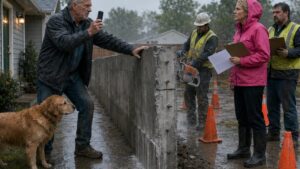
Three months later, a delivery truck stopped at the new boundary and waited.
Betty noticed because the engine went quiet.
She was trimming dead blooms beside the porch when the driver climbed down, checked a clipboard, and looked toward the small access-control box mounted near the project fence.
He did not roll across the strip.
He did not lean on the horn.
He waited.
A site worker came out, checked the delivery against the approved construction window, and opened the temporary gate.
Only then did the truck move.
Slowly.
A spotter walked beside it.
The tires stayed inside the marked lane.
Betty returned to her flowers.
The project had not disappeared.
That was never going to happen.
The retail building stood framed against the rear lots now. Several parking spaces had been removed from the final plan. The east-side circulation route had been redesigned, narrower and less convenient than the original concept but permanent.
For the remaining construction period, trucks used Betty’s strip under the written agreement.
They paid for it.
They repaired a cracked edge near the street.
They washed concrete dust from her siding after one bad week.
And every driver stopped unless access had been cleared.
The HOA still took a financial hit.
Cynthia had shown Betty the revised numbers without pretending they were painless. Some reserve funds were redirected. A modest dues increase passed after an ugly meeting.
No one applauded.
Two homeowners remained angry with Betty.
One stopped waving.
Another eventually started again.
Jonathan stayed on the HOA board but resigned as redevelopment liaison.
He came by one afternoon to tell her himself.
“I thought about leaving entirely,” he said.
Betty stood beside the strip.
“Why didn’t you?”
“Because that felt too much like making the mess and handing someone else the broom.”
She considered that.
“Probably.”
He gave a tired smile.
“I’m still not sure whether you like me.”
“I’m sure.”
He laughed once.
Then became serious.
“I was wrong.”
“You said that before.”
“I know.”
This time Betty did not need more.
Jonathan looked at the boundary markers.
The temporary construction lane was painted with removable lines. Beyond it, a low curb separated Betty’s property from the permanent redesigned route.
“I kept thinking the paperwork would catch up,” he said.
Betty clipped a dead leaf from a plant.
“People say that when they mean someone else will eventually agree.”
Jonathan nodded.
“Yes.”
He left without asking forgiveness.
Betty respected him more for that.
Laura visited on Saturdays now, though not every Saturday.
That distinction mattered.
Sometimes she brought groceries.
Sometimes she arrived empty-handed.
She had stopped sending condo listings.
Betty had stopped pretending the furnace did not need replacement.
One afternoon they stood in the kitchen while a technician carried the old unit out through the side entrance.
Laura said, “You know, I could have helped pay for that.”
“I know.”
“And?”
“And I paid for it.”
Laura rolled her eyes.
Betty smiled.
“But you can help me choose the new handrail for the back steps.”
Laura stopped.
“That sounds dangerously close to cooperation.”
“Don’t make me regret it.”
Near the end of the three-month access term, the same delivery truck returned.
Again it stopped.
Again the driver waited for written clearance.
Betty watched through the window.
The routine had become ordinary.
That was the strangest part.
What had once required confrontation, county records, public meetings, and halted equipment was now a simple procedure.
Ask.
Confirm.
Enter.
The strip had not grown wider.
Its value had not come from concrete.
It came from the fact that the line was recognized.
That evening Laura helped Betty carry two porch cushions inside.
At the door, Betty opened the small drawer beneath the telephone table.
Inside lay the original deed envelope.
Laura glanced at it.
Betty closed the drawer.
Then she reached into her pocket and held out a key.
Laura stared.
“What’s that?”
“You know what it is.”
“The house?”
“The side door.”
Laura did not take it immediately.
Betty almost became impatient.
Then she realized her daughter was giving her the same courtesy she had demanded from everyone else.
Waiting for clarity.
Betty extended her hand farther.
“I want you to have it.”
Laura took the key.
“Okay.”
“No surprise visits before eight.”
“Understood.”
“No reorganizing my papers.”
“Cruel, but fair.”
“And if I don’t answer the phone, that does not automatically mean I’m lying on the floor.”
Laura closed her fingers around the key.
“What does it mean?”
“It means call twice.”
Laura laughed, but her eyes had gone bright.
Betty looked away first.
Outside, the last truck of the day reached the boundary.
It stopped.
The driver waited.
A worker checked the authorization.
Then the gate opened.
Betty stood beside her daughter and watched the truck cross the narrow strip that still belonged to her.
Not because nobody could stop it.
Not because a map had assumed it.
Not because a board had approved it.
Because she had said yes.
The story has ended.