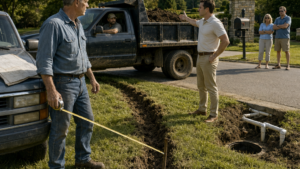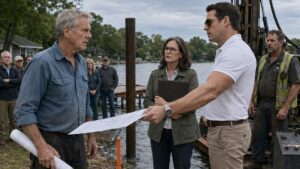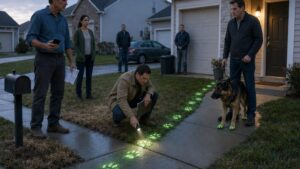
The Will Cut Him Out Six Weeks Before She Died, But The Deed Told Another Story
Chapter 1: The Reading Where His Name Disappeared
“The lake house passes in full to Rebecca Green.”
Charles Ramirez said it as if he were reading a line from a utility bill.
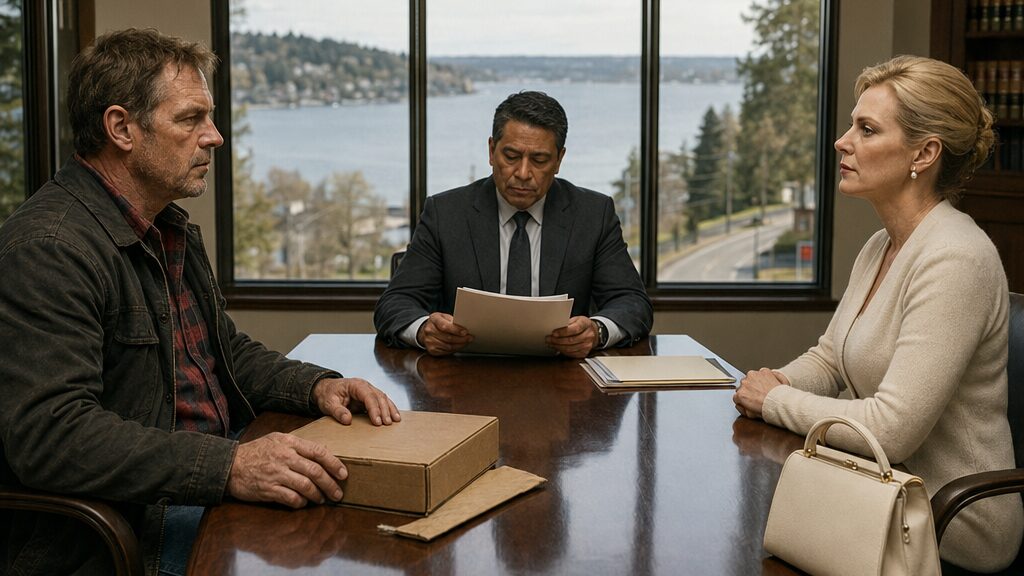
William Hall looked at the paper in the attorney’s hand, then at the windows behind him. Beyond the glass, the road curved downhill toward the lake, toward the pines and the steep roofs of cabins that looked private even from a distance. His mother’s house sat somewhere beyond those trees, two bends past the marina, with the porch rail Brenda Hall had painted every spring even after her hands began to shake.
William waited for the next sentence.
There wasn’t one.
Charles lowered the page a fraction. He was a compact man in a charcoal suit, his tie held in place by a silver clip, his expression arranged into professional sympathy. On the table between them lay three neat stacks: the will, a summary of assets, and a folder marked with Brenda’s full legal name. Rebecca sat to William’s left, ankles crossed, hands folded over a white leather purse on her lap. She had not looked at him since they walked in.
William heard the wall clock. He heard a car pass outside. He heard himself breathe once, too loudly.
“What about me?” he asked.
Charles glanced down as though the answer might change if he checked again. “You are not listed as a beneficiary in this version of the will.”
“This version.”
Rebecca shifted in her chair.
Charles set the page down. “Your mother executed this document on February eighteenth. It revokes all prior wills and codicils.”
William’s hand, resting on his knee, closed slowly until the knuckles tightened. February eighteenth. Six weeks before Brenda died. A week after she had called him at midnight asking whether her father was still coming for supper. A day before she had mistaken the television remote for the phone and cried because she thought nobody had answered her.
Rebecca spoke before he could.
“Mom changed her mind. That was her right.”
William turned toward her. She wore a pale sweater and small pearl earrings, dressed the way she dressed for meetings at the tennis club, polished enough to suggest nothing messy had happened before she arrived. Her face was calm, but her thumb worried the clasp on her purse.
“Six weeks before she died,” William said, “she couldn’t remember what month it was.”
Rebecca’s mouth thinned. “That’s not fair.”
“No,” he said. “It isn’t.”
Charles lifted one hand, not quite interrupting. “I understand this is difficult. Capacity is a legal standard, not an emotional impression. The document was notarized, witnessed, and properly executed.”
“When exactly was it signed?” William asked.
Charles paused. “As I said, February eighteenth.”
“What time?”
“I don’t have that in front of me.”
“Who was there?”
“The witnesses and notary are listed on the execution page.”
“Were you there?”
Charles’s fingers pressed the paper’s edge. “My office prepared the documents based on instructions received.”
“From my mother?”
Rebecca turned sharply. “William.”
He kept his eyes on Charles. “From my mother?”
Charles did not answer quickly enough.
Rebecca leaned forward. “Mom wanted the house protected. You know what that place meant to her. You were always talking about fixing things, moving things, maybe renting it out when bills got tight—”
“I never said I would sell it.”
“You said you couldn’t keep up with the taxes.”
“I said I’d help pay them.”
“You said a lot of things when it didn’t require actually handling any paperwork.”
The sentence landed harder than William wanted it to. Not because it was true in the way Rebecca meant it, but because some part of it was. He had changed light fixtures, shoveled the driveway, sat beside Brenda through appointments, cooked soup when she stopped wanting meat. Rebecca had handled forms. Rebecca had answered calls from banks, insurance offices, tax collectors, lawyers.
William had let her.
He had told himself paperwork was her language and care was his. He had told himself their mother knew the difference.
Charles slid the summary toward him. “The estate plan leaves personal effects to be distributed at the executor’s discretion. Rebecca has indicated she is willing to discuss items of sentimental value.”
“Sentimental value,” William repeated.
Rebecca exhaled. “Don’t make it sound ugly.”
“There was a box,” he said.
Her eyes flicked up.
He noticed.
“In Mom’s closet,” he continued. “Brown file box. Blue tape on the lid. She called it the deed packet. She told me twice not to let it get thrown away.”
Rebecca’s expression hardened so quickly that he knew the box mattered.
“She kept old papers,” Rebecca said. “Expired policies, tax receipts, things from twenty years ago. None of that changes the will.”
“I didn’t say it did.”
“You’re acting like there’s some secret in a cardboard box.”
Charles looked between them. “If there are older documents, they may be relevant for context, but the February will controls unless challenged.”
“Challenged,” Rebecca said, as if the word tasted bitter. “Two weeks after her funeral and you’re already there.”
William looked at the folder bearing Brenda’s name. His mother’s signature sat on the bottom of the top page, thinner than he remembered, the B in Brenda wavering as if the pen had been too heavy. He had seen her sign birthday cards with more force while sitting up in a hospital bed.
He wanted to say Rebecca had done this on purpose. He wanted to say she had waited until he was back at work, waited until Brenda was frightened, waited until the house and the bills and the future could be folded into one clean legal sentence.
But wanting was not proof.
So he asked the only question that did not shake.
“Can I have a copy?”
Charles nodded. “You are entitled to request one.”
Rebecca gave a small, humorless laugh. “Of course. Start a file.”
William looked at her then. “I should have started one months ago.”
For the first time, something crossed her face that was not confidence. It looked almost like fear, then disappeared under irritation.
Charles gathered the papers. “I would urge both of you to communicate through my office regarding estate property. Until probate progresses, Rebecca is the nominated executor.”
“Nominated?” William asked.
“Pending formal appointment.”
Rebecca stood, lifting her purse. “Which will happen.”
William stayed seated.
She looked down at him, and for a second he saw them as children in the back room of the lake house, fighting over who got the top bunk while Brenda threatened to send them both outside. Back then Rebecca’s anger had always passed fast. It had been loud, then gone. This was different. This had signatures under it.
“Don’t go to the cabin,” she said.
Charles closed his folder.
William slowly raised his eyes. “Why?”
“Because it isn’t yours,” Rebecca said. “And because if you make me handle you like a trespasser, I will.”
She left before he could answer, her heels tapping down the hallway with a sound too steady for someone who had nothing to hide.
Chapter 2: The Moving Truck At The Lake House
Rebecca crossed the driveway in white tennis clothes while William had one hand on his mother’s old cedar chest and the other on the handle of a rented moving truck.
“You have got to be kidding me,” she shouted.
The cabin rose behind him, all dark logs and tall windows catching the afternoon light. The lake flashed between the pines, silver and indifferent. On the gravel beside the truck sat three cardboard boxes William had already carried from the mudroom: winter gloves, chipped mugs, a stack of bird guides with Brenda’s notes in the margins. He had told himself he would take only what could not be sold, only what had his mother’s fingerprints on it.
He had also told himself Rebecca would not come.
That had been stupid.
She held her phone up as she marched toward him. Her visor threw a clean shadow across her face. Behind her, near the road, a neighbor had slowed beside a mailbox and made no effort to pretend she wasn’t watching.
“You were told not to come here,” Rebecca said.
William set the cedar chest down before anger made him drop it. “I came for Mom’s personal things.”
“You came onto estate property without permission.”
“I texted you yesterday.”
“And I didn’t grant permission.”
“You didn’t answer.”
“That was an answer.”
He glanced at the open cabin door. The entryway smelled like lemon cleaner instead of pine dust and coffee. Someone had moved the coat rack. Brenda’s walking stick was gone from the corner.
Rebecca stepped closer. “Load those boxes back inside.”
“No.”
Her eyes widened, not with surprise exactly, but with offense that he had used a small word and meant it.
“William, I am not doing this in the driveway.”
“We’re already doing it.”
“You don’t own this house.”
“Neither does probate yet.”
“I am the executor.”
“Pending appointment.”
The phrase struck. He saw it by the way she blinked.
Then her phone came higher. “I own this block now. Get out, or I’m calling 911.”
The neighbor by the mailbox looked down quickly, then looked back.
William felt heat climb his neck. Not fear. Shame first. Shame that people could see him standing there in worn jeans and a red plaid shirt beside a rented truck, looking exactly like someone hired to haul away furniture. Shame that Rebecca knew how to make him look that way. He took his hand off the truck handle and let both arms hang loose.
“Call if you need to,” he said.
“I’m serious.”
“So am I.”
She tapped the screen.
While she spoke to dispatch, William turned back to the boxes because standing still under her accusation felt worse. In the third box, under a folded quilt, he found a flat manila envelope he had not packed. The tab was soft from age. Across the front, in Brenda’s slanted handwriting, were the words: Lake deed copy — William knows.
His throat closed.
Rebecca stopped talking mid-sentence.
“What is that?” she asked.
He lifted the envelope but did not open it.
“What is that?” she repeated.
“Old paperwork.”
Her face changed. Not much. Enough.
A police SUV arrived twelve minutes later, lights flashing silently against the cabin windows. By then Rebecca had positioned herself near the front steps, arms folded, phone still in hand. William stood beside the truck with the envelope tucked under his palm on the dolly handle. The neighbor had disappeared, though two curtains across the road had shifted.
The officer stepped out and asked for an explanation.
Rebecca gave hers first.
“My brother is trespassing on property under my authority as executor of my mother’s estate. He was explicitly told not to enter. He is removing items without permission.”
The officer looked at William. “Sir?”
William kept his voice level. “My mother died three weeks ago. Her will is being probated. I came to retrieve personal belongings. I was her caregiver. Some of these items are mine or things she set aside for me.”
Rebecca cut in. “That has not been established.”
The officer’s gaze moved to the boxes. “Do you have paperwork showing you have permission to be here?”
William held up the manila envelope. “I found an old deed copy that references the property. My mother kept a packet—”
“A copy?” Rebecca said. “That’s not authority.”
The officer looked uncomfortable in the way people did when grief wore legal clothes. “Do either of you have current estate documents?”
Rebecca already had them. Of course she did. She pulled folded pages from her purse, the will summary, Charles’s letterhead, her name under executor, the lake house listed under her share. She handed them over as if she had practiced.
The officer read enough to retreat into procedure. “Sir, this appears to give your sister current authority over the estate property. I’m not saying who owns what long-term, but today, if she’s asking you to leave, you need to leave.”
William looked at the cabin. Through the open door he could see the hallway wall where Brenda’s framed lake photograph had hung. A pale rectangle remained in the dust.
“I’m not stealing from my mother,” he said.
“I understand,” the officer said, and his tone suggested he did not, not really. “But I need you to close the truck and step away from the house.”
Rebecca’s shoulders lowered. Victory made her look tired instead of pleased.
William placed the manila envelope on top of the nearest box and opened the flap. Inside was a photocopy of an older deed transferring the cabin from Brenda’s parents into Brenda’s sole name after their deaths. Behind it sat a property tax receipt and a yellow sticky note with Brenda’s handwriting, brittle at the edges: Keep with will until updated.
Until updated.
He looked at Rebecca. “Where’s the full packet?”
“I don’t know what you mean.”
“You know exactly what I mean.”
The officer shifted. “Let’s keep this calm.”
Rebecca’s voice dropped. “Old papers don’t change anything.”
“Then why were you scared when I picked it up?”
“I wasn’t scared.”
“You told me not to come here before I even knew this was still in the house.”
Rebecca looked past him, toward the officer. “Can you please make him leave?”
The officer handed back her papers. “Sir.”
William closed the envelope. He wanted to argue. He wanted to make the officer understand that the wrong paper had arrived first, that his mother’s handwriting was sitting in his hand like a pulse. But he could see how the scene looked: a man with a rented truck, a sister with the will, a dead woman who could no longer correct anyone.
He loaded the three boxes back onto the dolly.
Rebecca watched every movement.
When the officer walked with him toward the truck, William heard her behind them, speaking quietly enough that she thought only the officer would catch it.
“The deed box was removed for safekeeping,” she said. “He gets fixated on old things.”
William stopped with one boot on the truck ramp.
The officer did not turn. Rebecca did not look at William.
But now he had heard the word removed.
Chapter 3: Six Weeks Before She Died
“You are not authorized to request those estate files.”
The probate clerk said it without looking unkind, which somehow made it worse. She sat behind thick glass under fluorescent lights, with a line of people behind William shifting folders from one arm to the other. On her side of the counter, Brenda Hall’s name had become an entry in a system. On his side, it was still a hand on his shoulder at the stove, a voice calling him from the porch, a note on an envelope saying he knew where the deed belonged.
William slid the form back toward himself. “I’m her son.”
“I understand.”
“I was her caregiver.”
“I understand.”
“I was at the hospital. I was on hospice contact sheets.”
“This request concerns the estate file. Until executor status is formally challenged or you are recognized by the court as an interested party with standing, there are limits to what can be released.”
Standing.
He almost laughed. He had stood beside Brenda’s bed when her ankles swelled, stood at the sink crushing pills into applesauce, stood in the driveway while his sister called him a trespasser. But here, standing was a word that belonged to paper.
“What can I see?” he asked.
The clerk’s expression softened by half an inch. “Public filings once they’re entered. Recorded deeds through the county recorder. For medical information, you would need to go through the provider and whatever authorization they have on file.”
He thanked her because she had done her job and because anger at the wrong person was how people lost useful doors.
At the recorder’s office, he found less than he wanted and more than he expected. The current recorded deed still showed Brenda Hall as owner. No new transfer had been recorded yet. The older deed matched the copy from the cabin box. Nothing there gave him the house. Nothing there supported Rebecca’s certainty either.
He sat in his truck afterward with the copied pages spread over the passenger seat. The lake road was twenty minutes away. The hospice office was twelve.
He drove to hospice.
The lobby smelled of coffee, disinfectant, and artificial lavender. A receptionist asked him to wait. He stood beside a table of pamphlets about grief support and stared at one titled When Family Members Disagree. The cover showed two hands loosely touching. He turned it facedown.
A nurse he did not know came out first. She told him records requests needed forms. He filled them out. She told him some details might require prior authorization. He said Brenda had signed releases months ago, back when he drove her to appointments. The nurse went away. He waited.
Then a woman stopped near the hallway and said, “Mr. Hall?”
William looked up.
She was in blue scrubs with a cardigan over them, her hair pulled back, a badge clipped to her pocket. Laura Miller. He recognized her after a moment. She had come to the cabin twice near the end, once when Brenda refused broth and once when Rebecca was there, moving around the kitchen too fast.
“You probably don’t remember me,” she said.
“I do.”
Her fingers touched the edge of her badge. “I’m sorry about your mother.”
“Thank you.”
She looked toward the reception desk, then back at him. “Are you here about records?”
“Yes.”
Her face closed a little. “I can’t discuss private care details in the lobby.”
“I understand.”
But he did not move. Maybe she saw that he was holding himself together with both hands.
Finally she said, “There were notes. Cognitive notes. Confusion, mostly. Medication changes. Some good days, some not-good days.”
“February eighteenth,” he said.
Laura’s eyes flicked toward the hallway.
“That’s the day she signed a new will,” William said.
Laura did not answer.
“Do you remember that week?”
“I remember your mother was tired.”
“That’s not what I asked.”
Her mouth tightened, not in anger. In caution. “Families hear what they’re ready to hear.”
“I’m trying to hear what happened.”
A door opened behind her. She lowered her voice. “Rebecca was present for several visits near the end.”
“I know.”
“No,” Laura said. “I mean present in a way that made it hard to ask your mother questions alone.”
William felt something cold move through him.
He had been there so often, and still there were days he had missed. Days he told himself Rebecca could handle. Days he let her because he was tired of being the son with sawdust on his sleeves and no patience for forms.
“Why didn’t I ask more?” he said, not really to Laura.
She glanced at him then, and her face gentled. “Caregivers get exhausted. That doesn’t mean they stop loving.”
The sentence almost undid him. He looked down at the recorder’s copies, at Brenda’s name printed in square legal type.
“Will you say what you just said on paper?” he asked.
Laura stepped back. “I can’t. Not like this. Not without a formal request, and not without knowing exactly what you’re alleging.”
“I’m alleging my mother may not have understood what she signed.”
“That’s a serious thing.”
“I know.”
“Then be careful. Don’t build it on a feeling.”
He nodded, ashamed because that was exactly what he had brought first: grief, suspicion, an old envelope, his mother’s shaky handwriting.
Laura looked toward the hallway again. “There was a Thursday.”
William stilled.
“The week of the eighteenth?” he asked.
She did not confirm it directly. “Your mother had an outside appointment listed. Not medical. I remember because Rebecca was upset about timing, and your mother kept asking whether you were coming for dinner.”
William’s hand tightened around the folder.
Laura’s voice dropped further. “Ask who drove her to the notary that Thursday.”
Then she walked back through the hallway door before he could ask anything else.
Chapter 4: The Settlement Offered Before The Truth
Rebecca slid the paper across Charles Ramirez’s conference table before William had taken off his jacket.
It stopped near the edge, facedown, one crisp white rectangle between his empty chair and the place card Charles had not bothered removing from some prior meeting. Rebecca’s purse sat beside her like a second witness. Charles stood at the window with his hands behind his back, looking toward the road instead of at the paper.
William did not sit.
“What is it?” he asked.
Rebecca’s voice was calm. “A way for you to stop embarrassing yourself.”
Charles turned. “It is a proposed family settlement. Informal at this stage.”
“Family,” William said.
Rebecca’s jaw tightened. “Don’t do that.”
He pulled the chair out and sat because standing made him look like the angry one. The page held a dollar amount, access terms for “approved personal property,” and a paragraph stating he would not contest the will, question Brenda Hall’s capacity, challenge Rebecca’s executor authority, or make further claims against estate assets.
The number was not small enough to insult him outright. That made it worse. Rebecca had chosen something that could be described later as generous.
“You had this prepared before I asked who drove her to the notary,” he said.
Charles returned to his chair. “This is not an admission of irregularity.”
“I didn’t ask if it was.”
Rebecca leaned in. “You think there’s some mystery because Mom kept an old deed copy in a box. There isn’t. She changed the will because she wanted the house protected.”
“Protected from who?”
“From falling apart. From unpaid taxes. From you deciding one winter that you couldn’t handle it and letting strangers rent it by the weekend.”
William looked at the settlement again. “I fixed that roof after the storm.”
“You patched it.”
“I slept in the hallway for three nights when she was afraid to be alone.”
“And I paid the insurance premium you forgot to ask about.”
He lifted his eyes.
Rebecca’s face had gone bright with something sharper than anger. “You want to talk about love like paperwork is beneath you. Fine. But property taxes don’t care who sat by the bed. The county doesn’t care who made soup. Mom didn’t either, not by the end. She cared about whether the house would survive.”
Charles said her name quietly.
“No,” Rebecca said. “He needs to hear it. He shows up with a moving truck and a folder and acts like he’s the only one who carried anything.”
William felt the words hit places he had tried not to examine. There had been envelopes he had set aside because he needed to leave for work. Calls he had told Rebecca to handle because she was better with them. There had been one afternoon when Brenda asked whether the property taxes were paid, and he had said, “Rebecca has it,” without checking.
“What did you pay?” he asked.
Rebecca blinked.
“The taxes. How much?”
“That isn’t the point.”
“It seems to be part of your point.”
She looked at Charles. He opened a folder reluctantly and slid out a ledger copy. William saw numbers circled in blue ink. Back taxes. Insurance. A lake association fee. Repairs he had not known about because Rebecca had not told him, and because he had not asked.
The amount did not buy what she had done. But it explained the posture in her shoulders. It explained the way she said protected as if it meant rescued.
“You should have told me,” he said.
“I tried telling you for years that Mom needed a plan.”
“No. You told me I was bad with forms.”
“You were.”
He folded the settlement paper once, not sharply. “Maybe. But that doesn’t answer who explained a new will to her when she couldn’t remember whether I’d been there that morning.”
Rebecca’s composure cracked. “She knew enough to know you’d let the house become a burden.”
William looked at Charles. “The signatures are verified?”
Charles nodded. “Yes. The notary log is consistent with the execution page. Two witnesses signed. The will itself is facially valid.”
“Who was present when she signed?”
“The notary and witnesses.”
“And who gave her the document?”
Charles hesitated.
Rebecca’s hand moved toward her purse clasp again.
William saw it and pressed. “You said your office prepared it based on instructions received. Who brought those instructions?”
Charles glanced down. “Communications came through Rebecca for scheduling, but the estate-planning questionnaire bore Brenda’s signature.”
“Questionnaire,” William said. “So not a meeting.”
“There may have been telephone contact.”
“May have been?”
Charles’s tone cooled. “Mr. Hall, this is precisely why I advise against accusatory framing without legal counsel.”
“I’m asking what happened.”
Rebecca pushed the settlement paper back toward him. “And I’m telling you what happens next. You take that, you get the personal things you’re so worried about, and we stop turning Mom into a case file.”
William flinched despite himself.
Rebecca noticed. Her voice dropped. “You think I don’t miss her? You think I wanted the last year to be bills and pill bottles and listening to her ask the same question five times? You got the soft part, William. You got her thanking you. I got the part where everything had to be decided.”
“That doesn’t make the decision yours.”
“She made it mine.”
“Or you made her afraid enough to sign it.”
Rebecca stood so fast the chair legs scraped. “Careful.”
Charles raised a hand. “Both of you.”
William did not rise. He wished he could take back the sentence because it had come too hot, too close to the accusation he could not yet prove. But he also saw that it had landed exactly where Rebecca did not want him looking.
Charles gathered the pages into a neat stack. “The settlement offer remains open for ten days. If you intend to contest, you should retain independent counsel.”
“I intend to know who she understood herself to be signing for,” William said.
Charles looked tired then. Not guilty, exactly. Tired in the way men looked when a closed file reopened under their fingers.
“In the interest of clarity,” he said carefully, “I should say this. I did not personally meet with Brenda Hall on the day of execution.”
Rebecca’s head turned.
William went still.
Charles slid the settlement paper back into its folder, but his eyes stayed on William. “My office prepared the documents. The signing was handled off-site.”
Chapter 5: The Calendar Nobody Wanted Read Aloud
Brenda’s bedroom had been cleaned so thoroughly it looked less like a room than a denial.
The quilt was gone from the bed. The nightstand held no water glass, no lip balm, no paperback folded facedown the way Brenda used to leave them when she was too tired for bookmarks. The framed photograph of William and Rebecca on the dock as teenagers had been removed from the dresser, leaving a rectangle in the dust that the cleaner had missed.
William stood in the doorway with the moving crew member behind him and Rebecca at the end of the hall.
“You have one hour,” she said.
The moving crew member looked at his clipboard, embarrassed to be alive in the middle of it.
William stepped inside. “Where are her things?”
“In storage.”
“Whose storage?”
“Estate storage.”
He looked back. “That isn’t an answer.”
“It’s the answer you’re getting today.”
He almost said what he had come prepared to say. He almost told her Charles had already admitted the signing was off-site, that Laura had mentioned Thursday, that the recorded deed still hadn’t changed. But he had learned something in the last two weeks: Rebecca reacted fastest when she knew what he had. So he swallowed the sentence and opened the closet.
Empty hangers.
The shelf above held one shoebox, two folded blankets, and a plastic bin of old greeting cards. No brown file box. No blue tape. No deed packet.
He took the shoebox down. Inside were receipts, a broken watch, a handful of buttons in a medicine bottle. Brenda never threw buttons away. “You never know when something small keeps the whole thing closed,” she used to say.
William set the bottle carefully into a box.
The kitchen still looked like Brenda only might have stepped out. Her yellow mug was in the cabinet. The drawer by the stove held rubber bands, batteries, three screwdrivers, and takeout menus from places that had closed years ago. On the wall near the pantry hung the old calendar, still turned to February.
Rebecca followed him in. “The kitchen items are not all yours.”
“I’m looking.”
“For what?”
He reached for the calendar.
“Leave that,” she said.
His fingers stopped on the bottom edge.
Rebecca’s eyes were fixed on his hand.
So he took it down.
The paper curled where steam from the stove had touched it month after month. Brenda wrote in a narrow, slanted hand that had grown uneven near the end. Some days had only single words: nurse, bills, Rebecca, pills. February fourteenth had William dinner? written with a question mark. February seventeenth had Rebecca — notary? crossed out once, then written again on February eighteenth.
And on February twelfth, in darker ink: William knows deed.
The words sat there without explanation, small and stubborn.
William read them twice before he allowed himself to breathe.
Rebecca stepped closer. “That calendar is estate property.”
He did not turn. “She wrote my name.”
“She wrote a lot of things by then. She wrote that Dad was coming home one afternoon.”
“She wrote notary twice.”
Rebecca’s voice sharpened. “Give it to me.”
“Why?”
“Because you are taking things out of context.”
“What’s the context for notary?”
“She had documents to sign.”
“What documents did she think she was signing?”
Rebecca’s silence filled the kitchen.
The moving crew member shifted in the doorway. “Should I wait outside?”
“Yes,” Rebecca snapped.
“No,” William said, at the same time.
The man froze.
Rebecca pointed toward the front door. “This is a family matter.”
William finally looked at her. “It became a legal matter when you put her signature on a will that erased me.”
“I did not put her signature anywhere.”
“No. You just drove her there?”
Rebecca’s face went pale in two quick stages.
He had guessed. Or nearly guessed. The way she reacted told him he had found at least part of the road.
“You don’t know what you’re talking about,” she said.
“Then tell me.”
“Mom wanted peace. She wanted the house safe. She was tired of worrying about you making promises you couldn’t keep.”
“She asked if I was coming for dinner that week.”
“She asked for people who weren’t alive anymore.”
“That’s my point.”
Rebecca reached for the calendar. William pulled it back, not far, but enough.
Her eyes flashed. “You are not walking out of here with that.”
“She wrote my name on it.”
“She wrote my name on it too. She wrote everybody’s name. That doesn’t make it yours.”
He looked down again. February eighteenth. Rebecca — notary? The question mark mattered. Brenda put question marks beside things she wanted confirmed, not things she understood.
In the pantry, on the second shelf behind a row of mason jars, something blue caught his eye.
Tape.
William moved before Rebecca saw what he had seen. He shifted the jars aside and found only a torn strip of blue painter’s tape stuck to the wood. No box. Just the label edge, ripped as if someone had pulled tape from cardboard in a hurry. One word remained in Brenda’s handwriting.
Deed.
Rebecca said nothing.
William peeled the tape carefully from the shelf and pressed it to the inside cover of the calendar.
“That’s enough,” Rebecca said.
He closed the calendar. “No. It’s the first thing that makes sense.”
She stepped into his path. “If you take that, I’ll report it as theft.”
“Then report the deed box too.”
Her lips parted.
The moving crew member looked at the floor.
William walked past Rebecca with the calendar against his chest. At the door, she spoke low enough that the crew member could pretend not to hear.
“You always did this,” she said. “You made Mom feel sorry for you, and then you called it love.”
He stopped, but he did not turn around.
His phone rang as he reached the porch. He almost ignored it. Then he saw the hospice number.
Laura’s voice came through tight and quiet. “Do you still have the calendar?”
William looked back through the open door. Rebecca stood in the kitchen beneath the blank square where the calendar had hung.
“Yes,” he said.
“Bring it,” Laura said. “I’m ready to tell you what I saw that week.”
Chapter 6: What Brenda Meant By Protected
“Your mother asked for you on the day Rebecca said she didn’t want visitors.”
Laura said it in the church meeting room with both hands wrapped around a paper cup she had not drunk from.
William sat across from her at a folding table. The room was used for grief groups and winter coat drives; a stack of metal chairs leaned against the wall beneath a bulletin board of volunteer schedules. It was not a legal office. Maybe that was why Laura had chosen it. No glass, no letterhead, no one pretending paper could keep a voice from shaking.
William placed the calendar between them.
Laura did not touch it. “I want to be clear. I’m not saying your mother didn’t have lucid moments. She did. Some days she knew exactly who was in the room and what she wanted for lunch. Other days she asked me why the lake was on the wrong side of the house.”
William stared at the calendar’s curled edge. “February eighteenth.”
Laura nodded once. “That morning, Rebecca was there before I arrived. Your mother was dressed to go out. Nice blouse, coat, shoes. She looked exhausted. Rebecca said they had an appointment.”
“With the notary.”
“She didn’t say. Your mother asked if you were coming too.”
William’s hand moved to the calendar, then stopped.
Laura continued, each word chosen with visible care. “Rebecca said you were busy and that this was something they could handle without upsetting you.”
“Upsetting me.”
“That was the word.”
He felt a pressure behind his ribs. Not surprise. Something worse: recognition. Rebecca had always translated conflict into protection when it suited her. Don’t tell William; he’ll take it wrong. Don’t bother Mom; she’ll get anxious. Don’t ask questions now; it will upset everyone.
“What did Mom say?” he asked.
“She said, ‘William knows the deed.’ Rebecca told her the deed wasn’t enough anymore.”
Laura looked down at the cup. “Then your mother said, ‘Protect the house.’”
The words should have helped. Instead they opened another wound.
Because he could hear Brenda saying them. Tired, frightened, aware that the house was more than boards and glass and tax bills. Protect the house. Protect the place where both children had belonged before they learned to count who did more.
“Did she say give it to Rebecca?” William asked.
“No.”
“Did she say cut me out?”
“No.”
Laura’s eyes lifted. “But she did say she was worried. About money. About the roof. About you working too much and not asking for help. Rebecca kept telling her the house needed one person responsible.”
William closed his eyes briefly.
One person responsible.
That was how Rebecca had done it. Not with a threat, maybe not even with a lie at first. With a phrase their mother already feared. With the one thing Brenda could still understand: the house might be lost if her children kept disagreeing.
“Will you tell Charles this?” he asked.
Laura hesitated. “I can tell him what I observed. I can’t tell him what your mother legally understood.”
“I know.”
“I also need you to know something else.” Her voice became softer. “Rebecca looked tired too. Angry, yes. Controlling, yes. But tired. I don’t think she walked in that morning thinking, ‘I’m going to steal from my brother.’ I think she believed if she didn’t take charge, everything would fall apart.”
William looked at the calendar. “Then she should have taken charge in daylight.”
Laura nodded. “Yes.”
He carried the calendar to the cabin that afternoon because Charles had asked both siblings to meet there before any formal step was taken. William arrived first and stood on the porch, looking at the water through the trees. The moving truck was gone now. The gravel still held faint tire marks from the day the officer came.
Rebecca arrived in her own car, not in tennis clothes this time, but in jeans and a navy jacket. She looked less polished at the lake house than she did in offices. More like the sister who had once scraped her knee on the dock and refused to cry until Brenda left the room.
Charles came last. He held a slim folder and looked unhappy.
“We need to discuss the calendar,” he said.
Rebecca’s eyes went to William’s hands. “You brought Laura into this.”
“She brought herself.”
“You had no right.”
William stepped closer to the porch table and set the calendar down. “Mom asked for me that week.”
Rebecca looked away.
“She asked for me, and you told her I was busy.”
“You were busy.”
“You didn’t call me.”
“You were always at work or under a sink or driving back and forth half-asleep. She was scared, William. She needed decisions, not another conversation about what we’d figure out later.”
“She needed both of us.”
Rebecca laughed once, a sound with no humor in it. “You got that luxury. You got to be the one she wanted. I got to be the one who said no, the one who paid bills, the one who watched the numbers and listened to her panic about losing everything.”
“She didn’t ask you to erase me.”
“She asked me to protect the house.”
“You decided that meant from me.”
Rebecca’s eyes filled, but she did not let the tears fall. “Because you would have let it drown slowly. Not because you’re bad. Because you never wanted to look at the numbers. Because Mom would ask you for comfort and me for answers, and then everyone acted like comfort was love and answers were greed.”
The porch went quiet except for water tapping under the dock.
For the first time, William did not answer quickly. He wanted to deny all of it, but that would be another kind of lie. He had hated the numbers. He had hated how small they made Brenda’s life look. He had let Rebecca become the hard one because it kept his hands clean.
Then he looked at the calendar, at Brenda’s handwriting trapped between their versions of her.
“You can be right about the bills,” he said, “and still wrong about the will.”
Rebecca’s mouth trembled.
Charles opened his folder. “The hospice note and the calendar raise enough concern that any probate challenge would not be frivolous. I am advising emergency mediation before this becomes more expensive and more damaging for both of you.”
Rebecca turned on him. “Now you’re advising that?”
“I am advising it because the circumstances of execution are less clear than the document suggests.”
“The document is legal.”
“The document may be legal,” Charles said. “That does not mean the process is safe from challenge.”
William watched Rebecca absorb the difference.
Legal. Safe. True.
They were not the same word.
Rebecca picked up the calendar. For one second William thought she might tear the page out. Instead she touched the February square with their mother’s handwriting.
“Mom wanted me to keep it from being sold,” she said.
“Maybe,” William said. “But she didn’t want me standing in the driveway like a thief.”
Charles closed his folder. “I’ll file the mediation request today.”
Rebecca looked at William then, and whatever apology might have been forming did not survive her pride.
“If you push this,” she said, “I will close the estate as fast as the court allows.”
William slid the calendar back toward himself. “Then I’ll bring every date with me.”
That evening, before he reached the bottom of the lake road, Charles called and said the mediator had agreed to an emergency session after reviewing the medical note, the calendar copy, and the off-site signing record.
Chapter 7: The Deed That Could Not Tell Everything
“Who explained the new will to Brenda Hall before she signed it?”
The mediator asked the question only once, but it seemed to take up the whole room.
Rebecca sat across the table with her hands folded so tightly her knuckles looked pale. Charles Ramirez sat beside her, no longer arranged behind a desk or shielded by letterhead. William sat with the calendar, the hospice note, the recorder’s deed copy, and the torn strip of blue tape laid in front of him like pieces of something that had once been whole.
The mediator waited.
Rebecca looked first at Charles, then at the tabletop. “The notary was there.”
“That is not what I asked,” the mediator said.
William did not move. He had promised himself on the drive over that he would not fill silence just because silence hurt. For months, maybe years, he had let other people put clean sentences over messy things. This time he let the question sit.
Rebecca swallowed. “I explained that Mom needed to make the house simple.”
“Simple how?” the mediator asked.
“So it wouldn’t get sold. So it wouldn’t get tied up between us. So there was one person responsible.”
William looked down at Brenda’s calendar. The February square with Rebecca — notary? had begun to blur at the edges from being handled, copied, argued over. His mother had left no perfect sentence. Only fragments. Questions. Names.
The mediator turned a page. “Did Brenda say she wanted William removed from the will?”
Rebecca’s lips pressed together.
Charles leaned slightly toward her, but did not speak.
“Did she use those words?” the mediator asked.
“No,” Rebecca said.
The word was small, but it moved through William like a door opening in a house he thought had burned down.
Rebecca’s eyes flashed up. “She said protect the house.”
William heard Laura’s voice in the church room: She did not say give it to Rebecca. She did not say cut me out.
The mediator nodded, making a note. “And you understood that to mean ownership should pass entirely to you.”
“I understood that if it was divided, it would be fought over, neglected, sold, refinanced, whatever William decided on a bad month.”
William almost answered. The old reflex rose in him, quick and defensive. Instead, he set one hand over the deed copy.
Rebecca saw it. Her voice cracked around the edge. “You think that old paper proves everything. It doesn’t. Mom owned the house. Mom had the right to change her mind.”
“I know,” William said.
That stopped her.
He looked at the deed copy, then at the torn blue tape. “That paper doesn’t give me the house. I know that now. It doesn’t fix the will. It doesn’t prove what she understood that day.”
“Then why are we here?”
“Because it proves she kept a place for the old promise. And because you took the box that held it before anyone else could read what she kept with it.”
Rebecca turned away.
The mediator looked up. “Where is the original deed packet?”
Rebecca’s shoulders lifted and fell. “In estate storage.”
“Can it be produced today?”
“It’s in a storage unit.”
“Under whose control?”
Rebecca did not answer right away.
William felt the familiar anger come, but under it was something heavier. He did not want the house to become a prize. He did not want Brenda reduced to a signing date. He did not want to spend two years paying lawyers to ask questions his mother would have answered at the kitchen table if they had been brave enough to ask while she was still there.
Charles cleared his throat. “My concern, legally speaking, is that the combination of the medical note, the hospice observation, and the off-site execution could create risk for probate. It does not guarantee a challenge would succeed.”
“I understand,” William said.
Rebecca looked at him. “Do you?”
“Yes.”
“If you drag this out, the taxes keep running. Insurance keeps running. Maintenance doesn’t stop because you’re hurt.”
“I’m not only hurt.”
“I know.” She looked down. “You’re right too.”
No one moved.
William had wanted those words. For weeks he had imagined them as a kind of release. But spoken there, under fluorescent lights, they did not restore anything. They only proved how much had already been broken.
Rebecca wiped under one eye with the side of her finger, angry at the tear for existing. “Mom was scared. You weren’t there that morning. I was. She kept saying the house had to be protected. She kept saying you knew the deed, like that meant something. I told her deeds and wills were different. I told her if she wanted it safe, she had to make one person responsible.”
“Did you tell her that person would be you?”
Rebecca’s mouth trembled. “Yes.”
“Did you tell her I would get nothing?”
She closed her eyes.
The mediator’s pen stopped.
“No,” Rebecca said.
William leaned back. The chair gave a small sound under him. There it was. Not a confession that solved everything. Not a villain unmasked. Something harder to carry because it sounded human and still did damage.
Charles folded his hands. “There may be a path to resolve this without full litigation.”
The proposed terms took nearly two hours to shape. Rebecca would not give up the house outright. William did not ask her to. The estate would acknowledge a disputed execution process in a confidential memorandum tied to probate records. Rebecca would produce the original deed packet, Brenda’s personal papers, and all household items marked or reasonably identified for William. If Rebecca sold or refinanced the lake house within five years, William would receive a defined share, not as charity, but as a correction of Brenda’s incomplete intent. If Rebecca kept it, she would buy out that share over time.
It was imperfect. It was legal language trying to hold grief with paper clips.
When the mediator asked William if he accepted the framework, he looked at Rebecca.
“I want Mom’s cedar chest,” he said.
Rebecca’s face tightened, then softened. “It’s in storage.”
“The yellow mug.”
She nodded once.
“The bird guides. The calendar. The deed packet. All of it.”
“The deed packet is old.”
“It’s still hers.”
Rebecca looked at the table, then at Charles. “He can have it.”
William did not thank her. Gratitude would have made it too easy for both of them.
At the end, the mediator left to make copies. Charles stepped into the hallway to take a call. Rebecca remained seated, her purse in her lap, her posture finally spent.
“She did love you,” she said.
William looked at the calendar. “I know.”
Rebecca’s eyes filled again. “I hated that you knew without needing proof.”
He had no answer that would not wound them both.
Two days later, William drove the rented moving truck back to the lake house. This time no police SUV came up the road. No neighbor slowed at the mailbox. Rebecca stood on the porch in a gray sweater, a key ring in her hand and the original brown file box at her feet.
Blue tape crossed the lid.
William stopped at the bottom step.
Rebecca looked down at the box. “It was in the storage unit.”
He did not ask why she had taken it. He knew as much as he was going to know.
Inside the cabin, several boxes waited near the door. Cedar chest. Kitchen. Books. Personal. Brenda’s handwriting appeared on some labels, Rebecca’s on others. The yellow mug had been wrapped in newspaper and placed on top of the first box as if it might break under any other weight.
William lifted it, then set it back carefully.
Rebecca held out the key. “The mediator said you can take your time today.”
“Our mother said that first,” William said.
She flinched, but she did not argue.
He loaded the cedar chest himself. Then the bird guides. Then the kitchen box. He carried the deed packet last, not because it was heavy, but because it had become the thing everyone had tried to make into proof of only one side. He set it on the passenger seat instead of in the back with the rest.
When he closed the truck door, Rebecca was still on the porch.
“You’ll tell people I stole from you,” she said.
William rested one hand on the open window frame. “No.”
She looked surprised.
“I’ll tell them the will didn’t tell the whole story.”
The lake moved behind her, bright between the pines. For a moment they both looked older than they had at the funeral, older than they had in Charles’s office, older than two people should have looked standing outside a house where they had once fought over the top bunk.
William started the truck.
As he pulled down the driveway, no one told him to leave. No one called him a trespasser. No flashing lights followed him to the road.
On the passenger seat, the blue-taped deed packet shifted with the turn, and William steadied it with one hand before driving on.
The story has ended.