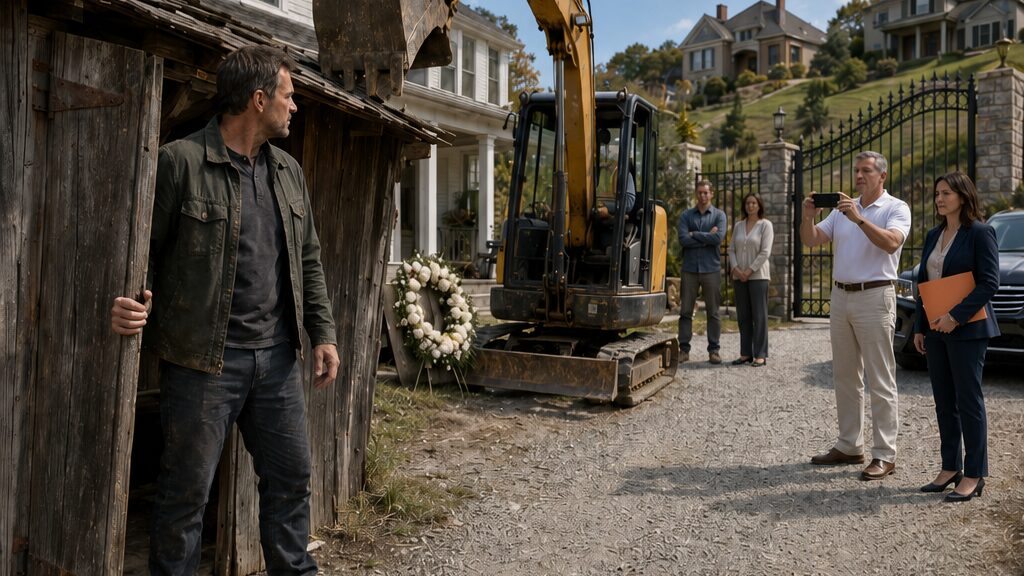
The Neighbor Ordered His Father’s Shed Demolished, Then Learned Who Controlled the Only Road Home
Chapter 1: The Excavator Arrived Before the Funeral Flowers Faded
Benjamin Davis hit the gravel hard enough to skin both palms.
For a second he stayed there, one knee twisted beneath him, staring at the white funeral wreath leaning against the farmhouse porch. Eleven days earlier, the same wreath had stood beside his father’s casket. Now several lilies had browned at the edges, and one loose ribbon dragged in the dust beside Benjamin’s hand.
George Wilson stood over him in a spotless white polo.
“I told you not to step in front of me,” George said.
Benjamin pushed himself upright. “You walked onto my property.”
“I came to give you one last opportunity.”
George pointed past him toward the cedar shed beside the drive. The building leaned slightly toward the ditch, its boards silvered by rain and sun. One corner of the roof had sunk. The door hung crooked, resting most of its weight on the lower hinge.
“Have that removed by Friday,” George said. “Or the association will remove it for you.”
Benjamin looked from the shed to the black iron entrance gate farther uphill. Beyond it, the roofs of the Stonebridge development rose above trimmed hedges and ornamental maples. George’s house stood highest, a pale structure with three garage doors and a circular drive.
The farmhouse had been here before all of it.
Benjamin wiped blood from his palm onto his work pants.
“This isn’t part of Stonebridge.”
George gave him the patient expression of a man explaining something to a child.
“The road is. The approach is. The visual corridor is. Your father was given years to bring this frontage into compliance.”
“My father wasn’t in your association.”
“He benefited from association maintenance.”
Benjamin almost laughed. The gravel under his boots had ruts deep enough to hold rainwater for days.
George removed a folded sheet from beneath his arm. “Community standards exist for a reason. Lenders notice blight. Buyers notice it. Everyone pays when one owner refuses basic upkeep.”
“He died eleven days ago.”
“I’m aware.”
Nothing in George’s voice changed.
That was the moment Benjamin’s numbness cracked—not into rage, but into something colder. He took the paper.
Across the top was the logo of a property management company. Beneath it, in bold letters, was a notice of architectural and nuisance violation. It ordered the removal of an unsafe accessory structure and warned of escalating fines, contractor costs, and legal fees.
At the bottom was Stephanie Flores’s name.
George tapped the deadline with one manicured finger.
“Friday.”
Benjamin folded the notice once, then again.
“You shoved me over a shed.”
“You blocked my path while I was documenting a violation.”
“You were taking pictures through the window.”
“I was photographing the exterior.”
Benjamin glanced toward the farmhouse. From here he could see the kitchen window above the sink. Inside, foil-covered casseroles filled half the counter because no one had known what else to bring after the funeral. The refrigerator held more. He had eaten almost none of them.
George followed his gaze.
“This property needs a decision,” he said. “Sell it, repair it, clear it. But letting it rot isn’t a decision.”
Benjamin stepped closer.
George stopped speaking.
Benjamin was six inches shorter, but years of industrial maintenance had thickened his shoulders and taught him how to stand still around men who mistook noise for control.
“I’ll make the decisions here,” Benjamin said.
George’s mouth tightened. “Then make one by Friday.”
He walked back uphill without looking behind him.
Benjamin remained by the drive until the gate closed.
Inside the farmhouse, the air smelled of coffee grounds, furniture polish, and the faint medicinal odor that had settled into every room during Jerry Davis’s last months. Benjamin had opened the windows twice, but the smell remained.
He placed the notice on the kitchen table beside the estate folder.
He had come home with a plan: sort the tools, call an auction company, meet a real estate agent, sign whatever county forms were required, and leave. He had told himself efficiency was kindness. The faster the house was emptied, the less time he would spend noticing the indentation in his father’s recliner or the chipped mug still sitting beside the sink.
On the table lay three unopened letters from Stonebridge Community Association.
Benjamin had seen them in the mail pile on his first day back. He had set them aside without reading them. Jerry had collected complaints the way the shed collected dust—quietly, stubbornly, without asking anyone for help.
Now Benjamin opened the oldest letter.
It complained about visible debris, peeling exterior surfaces, and an unapproved accessory structure. The next added a daily fine. The third referred to “prior owner acknowledgment of community frontage obligations.”
Benjamin read that phrase twice.
In the estate folder, he found Jerry’s latest property tax statement. He laid it beside the demolition notice.
The tax bill identified the farmhouse tract as Parcel 18-442-B.
The notice cited Parcel 18-442-D.
Benjamin stared at the letters.
A mistake, probably. A clerical error. The kind of thing an office corrected after a phone call.
Yet the notice described the shed exactly. It listed approximate dimensions, distance from the road, and photographs taken two weeks before Jerry died.
Benjamin carried both documents outside.
The shed door resisted when he pulled it. He lifted the handle, shifting the weight off the lower hinge, and the door opened with a long scrape across the concrete threshold.
Inside, his father’s tools hung in precise rows.
Jerry had never been sentimental about objects. A cracked wrench was discarded. A dull blade was sharpened. Lumber scraps were sorted by length. Even during the last year, when his hands had begun trembling, he had kept the shed more orderly than the house.
Benjamin ran his fingers over the lower hinge.
The screws did not match. Some were brass, some steel. Around them, the cedar bore old filled holes—one repair over another, perhaps six or seven in total. Jerry had rehung the same door repeatedly instead of replacing it.
Benjamin crouched and examined the threshold.
A line had been cut into the concrete beneath the door, straight and narrow, then darkened with age. It might have been nothing more than a guide mark from construction.
Behind him, tires rolled slowly over gravel.
A dark crossover stopped near the drive. Stephanie Flores stepped out carrying a tablet and a bright orange contractor packet.
She wore low heels unsuited to the ruts and paused when one sank into the ground.
“Mr. Davis?”
Benjamin straightened.
“I’m Stephanie Flores. I manage Stonebridge on behalf of the board.”
“I saw your name.”
“I’m sorry for your loss.” Her eyes flicked toward the wreath, then back to the tablet. “I understand the timing is difficult.”
“Then change it.”
She exhaled through her nose. “The board has been addressing this structure for eighteen months.”
“With my father.”
“Yes.”
“He’s dead.”
“I know.”
“Then you’re addressing it with me now.”
Stephanie looked toward the shed. “The board authorized removal after the final cure period. Mr. Wilson asked me to provide you a brief extension through Friday.”
“He called three days a favor?”
“The authorization was already active.”
She offered him the orange packet. Inside was a contractor work order scheduled for Monday at eight in the morning.
Benjamin turned to the parcel number.
18-442-D.
“Where did you get this?”
“From the board’s compliance file.”
“This isn’t my father’s parcel.”
Stephanie’s professional expression held, but only just. “It may be a sub-parcel designation.”
“May be?”
“I’ll verify it.”
“Before Monday?”
“Yes.”
“And until then?”
“The work order remains scheduled unless our counsel directs otherwise.”
Benjamin handed the packet back.
“No one touches the shed.”
“That may expose you to additional costs.”
“So will sending equipment onto land you don’t control.”
Stephanie studied him more carefully now. “Do you have documentation showing the structure is outside the association’s jurisdiction?”
“I have a tax bill showing you cited the wrong property.”
“That isn’t the same thing.”
“No. It’s the reason you should stop pretending you know the difference.”
A flush rose along her neck. She closed the packet.
“I’ll request the plat.”
“Request it before the excavator gets here.”
She walked back to her vehicle, stepping around the deepest ruts.
Benjamin returned to the kitchen table. He spread out the tax statement, the violation notices, and Jerry’s deed. The legal description on the deed was a block of bearings, distances, and references to iron pins that meant little to him.
At the bottom of the oldest HOA letter, a sentence had been highlighted:
Owner’s failure to object shall constitute acknowledgment of the association’s authority over the affected frontage.
Jerry had never objected in writing.
Benjamin felt the first pulse of anger at him.
Not at George. Not at Stephanie.
At Jerry.
His father had let letters pile up. He had ignored calls. He had left Benjamin a house full of unanswered questions and then died before Benjamin could ask why.
The phone rang.
Stephanie’s name appeared on the screen.
“That was quick,” Benjamin said.
“I found the county’s online parcel map.”
“And?”
“The map is not clear enough to settle the boundary.”
“But?”
A pause.
“The parcel number in the work order belongs to the Stonebridge entrance tract.”
Benjamin looked through the kitchen window toward the road climbing past the shed.
“Not the farmhouse.”
“No.”
“Then whose shed did you authorize them to demolish?”
“I’m suspending nothing until I speak with counsel,” she said carefully. “But I recommend you obtain a certified survey.”
“Monday is four days away.”
“I understand.”
The call ended.
Benjamin pulled Jerry’s tax bill closer and placed it over the demolition notice. The numbers did not merely differ.
The HOA had cited its own entrance parcel while ordering the destruction of a structure on his father’s land.
Chapter 2: The Shed Door Became the Boundary Line
The excavator bucket rose above the shed roof at eight twelve Monday morning.
Benjamin stood in the open doorway of the farmhouse with one boot unlaced, coffee cooling untouched on the porch rail. The compact machine had arrived on a flatbed, followed by a dump truck and Stephanie’s dark crossover.
George was already there.
He held his phone horizontally, recording as the operator unloaded the excavator onto the gravel.
Benjamin descended the porch steps.
“I told you the parcel number was wrong.”
Stephanie met him near the funeral wreath, now dry enough that the lilies crumbled when the breeze touched them.
“The association’s counsel reviewed the recorded development plat,” she said. “The board’s position is that the structure occupies the controlled entrance frontage.”
“The board’s position isn’t a boundary.”
“The contractor is authorized to proceed.”
George lowered his phone.
“You had your chance to handle this privately.”
Benjamin looked at the excavator. The operator had turned the machine toward the shed but had not moved the boom.
“Who gave you the work order?” Benjamin called.
The operator pointed toward Stephanie.
“Who owns the parcel listed on it?”
The operator glanced between them. “I’m here to remove a structure.”
“Read the parcel number.”
George stepped forward. “Do not interfere with contracted association work.”
Benjamin ignored him.
The operator climbed down from the cab, took the orange packet from the seat, and read the number aloud.
“Eighteen-four-forty-two-D.”
Benjamin held up Jerry’s tax bill.
“This shed sits on eighteen-four-forty-two-B.”
Stephanie said, “The entrance tract includes common frontage rights.”
“Rights aren’t ownership.”
George raised his phone again. “You are now obstructing authorized maintenance.”
Benjamin walked to the shed and opened the cedar door.
The bottom edge dragged across the threshold. He lifted it the way Jerry always had, then removed the upper hinge pin with a hammer and nail punch. The lower hinge groaned when he pulled the door free.
Stephanie’s voice sharpened. “What are you doing?”
Benjamin carried the door into the road.
It was heavier than it looked. Cedar dust marked the front of his shirt, and one edge caught against his leg. He laid it flat across the narrow gravel approach between the shed and the subdivision gate.
George stared at him.
“You think putting debris in the road helps you?”
Benjamin returned to the porch, picked up a folded photocopy, and spread it over the door.
It was not yet certified. He had found it the previous afternoon in the county’s online archive after searching the legal description from Jerry’s deed. The scan was faint, dated 1962, and marked with a corridor running from the public road across the Davis tract.
The line passed within feet of the shed.
Then it continued uphill beneath the paved Stonebridge entrance.
Benjamin placed two wrenches on opposite corners to hold the paper down.
“Here’s what helps me,” he said. “Your entrance appears to cross my parcel.”
George gave a short laugh. “That road has existed for decades.”
“So has the shed.”
“The development has recorded access.”
“Then show the operator.”
George turned toward Stephanie. “Call counsel.”
She was already dialing.
The excavator operator crouched beside the door and examined the copy.
“I’m not a surveyor,” he said.
“Neither are they,” Benjamin replied.
George pointed his phone toward Benjamin’s face. “Move that door. You’re blocking the only entrance to thirty-seven homes.”
A vehicle had stopped below them on the county road, waiting to turn uphill. Another rolled down from Stonebridge and halted behind the gate.
Benjamin looked at the trapped cars, then at the cedar door.
His first impulse was to leave it there.
Let them wait. Let George explain why the road to his polished neighborhood rested on a warped piece of Jerry Davis’s shed.
But the two drivers had nothing to do with the demolition order.
Benjamin dragged the door three feet aside, clearing a single lane while keeping the survey visible.
“I’m not closing the road,” he said. “I’m stopping you from touching the shed until you prove where your authority ends.”
George’s expression hardened. “You don’t get to invent conditions.”
“No. The deed does.”
Stephanie ended her call.
“Our attorney says the association possesses an easement benefiting the entrance parcel.”
“Possesses what kind?”
“Access and maintenance.”
“Does that include demolition?”
She did not answer immediately.
Benjamin turned to the operator. “Did your insurer approve work on a disputed parcel?”
The operator looked down at the work order again.
George said, “His insurance is none of your concern.”
“It will be when the bucket crosses the wrong line.”
The operator folded the packet.
“I need a boundary confirmation.”
Stephanie’s shoulders dropped slightly. “The board has indemnified the contractor.”
“That’s not the same as confirming ownership,” he said.
George moved close enough that Benjamin could smell mint on his breath.
“You are creating a record of interference,” George said quietly. “Emergency counsel can obtain an injunction. The sheriff can remove an obstruction. Every hour this equipment sits here will be billed to the property.”
“Which property?”
George’s jaw tightened.
Benjamin pointed to the orange work order.
“Say the number.”
Neither George nor Stephanie spoke.
The operator climbed back into the excavator, but instead of moving toward the shed, he swung the boom inward and lowered the bucket to the ground. The engine idled.
A small victory. Temporary and expensive, but real.
George ended his recording.
“You have until noon,” he said. “Then this becomes a legal access issue.”
“It already is.”
George walked uphill through the gate.
Stephanie remained.
“You could have called me before making a public scene,” she said.
“I called Friday. You sent the machine anyway.”
“I relied on counsel.”
“You relied on George.”
Her face tightened, not in anger this time but recognition.
Benjamin folded the map copy and lifted the cedar door. The lower hinge screws rattled in the wood.
Stephanie watched him carry it back.
“Where did you get that survey?”
“County archive.”
“That copy is incomplete.”
“I know.”
“There may be later instruments.”
“I know that too.”
She looked toward the uphill road. “If the association’s access is burdening your parcel, that doesn’t necessarily give you authority to block it.”
“I cleared the lane.”
“You made the point.”
“The point was the shed is still standing.”
Stephanie glanced at the excavator.
“For now.”
At eleven thirty, the contractor loaded the machine back onto the flatbed. George did not return. Stephanie issued no written cancellation, only a temporary suspension pending title review.
Benjamin waited until the trucks disappeared before rehanging the door.
The upper hinge aligned. The lower did not.
He studied the layers of screw holes again. The oldest set sat farther left, suggesting the door had once hung nearly two inches closer to the road. Jerry had moved it over time, shaving the edge, resetting the hinge, preserving the same slab of cedar even as the frame shifted.
Inside the shed, Benjamin found a carpenter’s level and laid it along the concrete threshold.
The narrow cut he had noticed before continued beneath the frame and into the floor. When he brushed away dirt, he found faded red pigment inside the groove.
A marked line.
His phone rang.
Ruth Roberts spoke before he could introduce himself.
“This is the county records office. You left a message about the Davis tract and the Stonebridge entrance.”
“Yes.”
“I pulled the 1962 survey.”
Benjamin looked down at the red line beneath the shed door.
“Does it show the boundary?”
“It shows several things.”
“Is the shed outside the HOA parcel?”
“Based on the recorded plat, yes. But I’m not a surveyor, and I can’t give you a legal opinion.”
“What else does it show?”
“The access corridor.”
“That crosses my father’s land.”
“It appears to.”
“Then they need permission.”
Ruth was silent long enough for Benjamin to hear papers moving on her end.
“Mr. Davis, the 1962 survey is not the only instrument tied to that road.”
His grip tightened on the phone.
“What else is there?”
“A consent recorded twenty-three years later.”
“Signed by who?”
“Jerry Davis.”
Chapter 3: The County Archive Held His Father’s Compromise
Ruth Roberts placed the newer document directly over the 1962 survey.
The green-shaded lamps on the records counter cast both pages in the same yellow light, but the differences were immediate. The survey was broad and spare, drawn in ink with bearings, distances, and hand-lettered notes. The second document was dense with typed paragraphs and stamped recording marks.
At the bottom was Jerry Davis’s signature.
Benjamin recognized the heavy downward stroke of the J.
“What did he consent to?” he asked.
Ruth adjusted her glasses. “I can help you locate and copy records. I cannot interpret legal rights.”
“You called me because this mattered.”
“I called because you were about to have a structure demolished over a boundary dispute.”
“So read the title.”
She looked at the document.
“Consent to Residential Access and Maintenance.”
Benjamin leaned over the counter.
The first paragraph identified Jerry as owner of the burdened tract. The second granted the developer, its successors, and future residential owners continuous passage across a defined corridor connecting the county road to the planned subdivision.
Continuous passage.
Not temporary. Not revocable at will.
George had been right about that much.
Benjamin read faster.
The consent permitted paving, drainage work, snow removal, utility access, and ordinary repairs. It prohibited unreasonable interference by the Davis tract owner. It also stated that the rights would run with the benefited property.
The language felt like a door closing.
“So I can’t block the road.”
Ruth folded her hands. “That is a legal conclusion.”
“It says continuous access.”
“It does.”
“And no unreasonable interference.”
“It does.”
Benjamin straightened.
For two days he had imagined George receiving a certified letter informing him that his mansion depended on Benjamin’s permission. He had imagined the gate left open, the road narrowed to its lawful width, the HOA forced to ask instead of command.
Now Jerry’s signature sat beneath language that seemed to have given them everything.
“Why wasn’t this on the online map?”
“Recorded documents aren’t always linked cleanly to parcel viewers. Especially older ones.”
“Did my father get paid?”
“There’s no purchase price listed. It says consideration received.”
“That could mean ten dollars.”
“It often does.”
Benjamin looked through the glass wall toward the courthouse hallway. People moved past carrying folders, renewing licenses, paying fees. No one knew that a dead man’s signature had just changed the shape of a road outside town.
Ruth slid the 1962 survey partly free.
“The shed is still outside the Stonebridge boundary.”
“That stops the demolition.”
“It should require them to establish another basis.”
“But the road stays.”
“The road was always likely to stay.”
Benjamin looked at her. “You knew my father.”
“A little.”
“How little?”
“He filed permits here. Asked for copies. Complained when indexing fees went up.”
That sounded like Jerry.
“Did he ever mention this agreement?”
Ruth’s eyes returned to the papers. “Once, years ago, he asked whether a handwritten condition carried the same weight after a typed instrument was recorded.”
Benjamin pulled the consent closer.
“What handwritten condition?”
“I don’t remember the wording.”
“You said there was one.”
“I said he asked.”
“Did you see it?”
Ruth hesitated.
That hesitation mattered more than anything she had said.
She opened the document to the final page and pointed near the margin. A faint line of handwriting slanted upward beside Jerry’s signature. The microfilm copy had cut off part of it.
Benjamin could make out only fragments:
shared upkeep…
retained emergency passage…
subject to attached…
“Where’s the attachment?”
Ruth checked the recording stamp. “Not imaged with this copy.”
“Lost?”
“Possibly misindexed.”
“Convenient.”
Her expression cooled. “County archives are imperfect, Mr. Davis. They are not conspiracies.”
Benjamin regretted the word as soon as he said it, but he did not apologize.
“How long to find it?”
“If it was recorded separately, I need the book and page reference. If it was never recorded, it may not be here.”
“The HOA attorney will file for an injunction.”
“Then you should speak to your own attorney.”
“I’m trying to find out what my father did before I pay someone four hundred dollars an hour to explain it.”
Ruth removed her glasses and rubbed the bridge of her nose.
“Your father came in here more than once after the development was built,” she said. “He never asked how to cancel the road.”
“What did he ask?”
“How to document maintenance.”
Benjamin looked back at the consent.
“Maintenance by who?”
“That would be interpretation.”
“Ruth.”
She met his eyes.
“By whoever was supposed to be sharing it.”
The answer opened a larger space than the one it closed.
Benjamin requested certified copies of everything.
While Ruth processed them, he examined the original 1962 survey under the lamp. The access corridor began at the county road, crossed the Davis tract, then bent uphill. A thin boundary line ran beside the shed footprint.
The shed had been drawn onto the survey.
Not as an obstruction. As an existing structure.
Its western edge aligned almost exactly with the corridor limit.
Ruth returned with a ruler.
“The shed predates the subdivision plat by at least nine years,” she said.
“Then they never had authority over it.”
“Not through the architectural covenants I found.”
That was the first clean answer of the morning.
Benjamin let it settle.
The shed was safe from the HOA’s design rules. But the road remained protected by Jerry’s consent, and the incomplete handwritten clause suggested the bargain had included obligations that no one was discussing.
His phone vibrated.
An email from Stephanie contained a letter from the HOA attorney. It demanded that Benjamin cease obstructing association access and preserve all structures pending an emergency title review. It also stated that the board reserved the right to recover contractor delay charges.
Below the letter was a proposed acknowledgment form.
Benjamin opened it.
By signing, he would confirm the association’s permanent access and maintenance authority over the entrance frontage and waive objections arising from prior enforcement notices.
The form included a line for the owner of Parcel 18-442-B.
His parcel.
They had corrected the number.
Ruth saw his expression.
“What is it?”
“They want me to sign before they admit the first notice was wrong.”
“Are you going to?”
Benjamin thought of the auction company waiting for a date. The real estate agent had told him buyers disliked title uncertainty. Signing might clear the problem. The shed could remain. The road could remain. He could sell the farmhouse and leave George, Stephanie, and Stonebridge to argue with someone else.
That had been his plan from the beginning.
He printed the form at a public terminal.
At the signature table near the wall, he uncapped a pen.
Jerry’s signature on the 1985 consent seemed to follow him across the room.
Benjamin placed the pen tip above the line.
Then he saw the phrase maintenance authority.
Not obligation. Authority.
The form gave Stonebridge the right to enter, alter, repair, and control the frontage. It said nothing about sharing costs, preserving farmhouse access, or respecting the shed boundary.
He capped the pen.
Ruth watched from behind the counter but said nothing.
Benjamin returned to the records desk.
“I need everything indexed under Jerry Davis from 1980 through 2005.”
“That could take hours.”
“I have hours.”
They searched deed books, easement ledgers, plat cabinets, and scanned indexes. Most records led nowhere: a roof permit, a septic inspection, a utility acknowledgment.
Near closing time, Ruth found an unindexed reference written in the margin of a developer’s drainage filing.
Book 611, page 94.
The page contained a one-paragraph memorandum signed by Jerry and the original developer. It referred to a temporary maintenance schedule and an attached private agreement. The attachment was absent, but the memorandum repeated two conditions.
Shared upkeep of the access corridor.
Retained emergency passage for the Davis residence.
Benjamin read the words twice.
“Retained from what?”
Ruth pulled the original survey closer. “The paved road shifted over time. Your father’s old driveway once joined the corridor near the shed.”
“And now?”
“Now the Stonebridge landscaping and gate occupy most of that connection.”
Benjamin pictured the stone pillars, hedges, and keypad island. Jerry’s gravel spur ended below them, narrowed by drainage rocks and ornamental shrubs until barely a pickup could pass.
The development had kept its access.
The farmhouse had lost part of its own.
Ruth made a certified copy of the memorandum.
As she stamped it, Benjamin noticed a faint notation on the back of the maintenance consent. It had been missed in the scan because the page had been copied one-sided.
Three words were legible beneath Jerry’s handwriting:
See attached schedule.
Below them, in darker ink, someone had later written:
No longer observed.
Benjamin pointed to the note. “Who wrote that?”
Ruth examined it.
“I don’t know.”
“Can handwriting be compared?”
“With what?”
Benjamin thought of the unopened filing boxes in the shed, the rows of tools, the repaired cedar door, and the red line cut into its threshold.
“With whatever my father kept because nobody else did.”
He left the courthouse carrying a certified survey, the consent, the memorandum, and a question more dangerous than the one he had brought in.
Jerry had not simply given Stonebridge the road.
He had made a bargain.
And someone had stopped honoring it.
Chapter 4: The Road Was Maintained by Only One Family
The first invoice fell from behind the shed door when Benjamin pulled out the lower hinge screws.
It landed face down in a drift of cedar shavings, brittle at the folds and spotted with rust where a nail had held it to the frame. Behind it were more—dozens of receipts, work orders, handwritten mileage notes, and canceled checks pressed flat between the wall stud and a thin sheet of plywood.
Jerry had built an archive inside the door.
Benjamin lowered the plywood to the floor and began sorting.
Gravel delivery, 1997.
Culvert replacement, 2001.
Emergency snow clearing, 2004.
Drainage ditch excavation, 2008.
Each invoice named the Davis property as the billing address. Several described work extending “from county pavement to Stonebridge gate.” A few were marked half paid in Jerry’s block handwriting, followed by question marks that grew darker over the years.
By noon, the kitchen table was buried beneath records.
Benjamin created two columns on a legal pad: Davis paid and Stonebridge paid.
The second column remained nearly empty.
He found three checks from the original developer during the first five years. After that, nothing. Jerry had covered crushed stone, equipment rental, culvert pipe, salt, grading, and fallen-tree removal. Twenty years of work had kept the road open while the development grew from six houses to thirty-seven.
Benjamin turned over a receipt for emergency plowing during a February ice storm. Jerry had written beside the total:
No truck could pass. Cleared both lanes before dawn.
There was no complaint beneath it. No demand. Just the fact.
Benjamin’s phone rang before he could add the amount.
Stephanie Flores spoke quickly. “The board has imposed a temporary daily fine for obstruction of common access.”
“I didn’t obstruct the road.”
“You placed the shed door across it.”
“For ten minutes. Then I cleared a lane.”
“George submitted video.”
“Of me clearing it?”
“He submitted the portion he believed relevant.”
Benjamin leaned back in Jerry’s chair.
“How much?”
“Two hundred dollars a day until written assurance is provided that you will not interfere with access.”
“You still haven’t withdrawn the demolition order.”
“It is suspended.”
“That isn’t withdrawn.”
“No.”
Benjamin looked at the invoices.
“Did the board authorize the original enforcement?”
“The management file contains board direction.”
“That wasn’t my question.”
Silence.
Stephanie lowered her voice. “I requested the minutes.”
“And?”
“There is no recorded vote specifically authorizing enforcement against Parcel B.”
Benjamin sat forward.
“You sent an excavator without a vote.”
“I acted on the president’s written instruction and counsel’s interpretation of the covenants.”
“George’s instruction.”
“Yes.”
“Does counsel know the shed is outside the HOA boundary?”
“They know the issue is disputed.”
“It isn’t disputed on the plat.”
“Mr. Davis, I am not calling to argue.”
“Then why are you calling?”
Another pause.
“To tell you not to sign the acknowledgment form yet.”
Benjamin looked toward the window.
George’s gate stood visible beyond the shed roof, black bars between stone pillars.
“Why?”
“Because I cannot verify that the board had authority to demand it.”
It was the first sentence Stephanie had spoken that cost her something.
Benjamin set down his pen.
“Will you put that in writing?”
“No.”
“Then it doesn’t help me.”
“It may keep you from making the problem worse.”
“The problem arrived on a flatbed.”
“I know.”
Her voice carried no apology, only fatigue.
Before ending the call, she gave him the time of the next board meeting and warned that George intended to seek emergency validation of the enforcement actions.
Benjamin spent the afternoon walking the road.
The corridor climbed from the county pavement past the farmhouse, bent at the shed, and narrowed beside a drainage ditch. Beyond the Stonebridge gate, smooth asphalt replaced gravel. On Benjamin’s side, stormwater had eaten a channel along the shoulder deep enough to expose roots.
He found Jerry’s repairs everywhere once he knew how to look.
A culvert headwall built from salvaged stone.
A patch of compacted gravel where the road had slumped.
A steel post driven beside the ditch to protect a drainage pipe.
None carried Jerry’s name. They simply worked.
At the HOA office, Stephanie let him into a conference room after business hours. She had spread meeting minutes across the table.
“These are the records I could locate,” she said. “I’m not giving you copies without counsel’s approval.”
Benjamin remained standing.
“Show me the vote.”
“There isn’t one.”
“Then why did you issue the notice?”
“George forwarded a compliance history showing that your father had received repeated warnings.”
“Warnings aren’t jurisdiction.”
“I understand that now.”
“Now?”
Her eyes hardened. “Property managers do not survey land. We enforce the documents the board provides.”
“And when the board provides the wrong parcel?”
“We correct the file.”
“You sent machinery.”
“And the contractor did not proceed.”
“Because I stopped him.”
Stephanie closed one folder more sharply than necessary.
“You think I don’t know that?”
The room went quiet.
She looked toward the glass door, checking that no one stood outside.
“The management contract renews next month,” she said. “George has already told the board that delays in resolving the entrance issue could constitute failure to perform.”
“So you’re protecting your job.”
“I’m doing my job.”
“Those aren’t always the same thing.”
“No,” she said. “They aren’t.”
She pulled a maintenance ledger from beneath the minutes.
The first pages listed regular payments to Jerry. Then the entries stopped.
“When?” Benjamin asked.
“After the developer transferred control to the homeowners.”
“Why?”
“The board classified the road as county-maintained.”
“It isn’t.”
“I know.”
“You know now.”
Stephanie met his gaze. “Yes.”
A handwritten note appeared beside the final payment:
Future maintenance responsibility under review.
It had never been resolved.
Benjamin opened his folder and placed several invoices on the table.
“He paid all of it after that.”
Stephanie read the totals. The color left her face.
“Where did you find these?”
“Behind the shed door.”
She touched one invoice but did not lift it.
“This road served your father too.”
“Not equally.”
“No.”
“Stonebridge had thirty-seven homes. Jerry had one.”
Stephanie studied a receipt dated nine years earlier. “This says emergency removal.”
Benjamin turned it toward himself.
A mature oak had fallen across the road during a summer storm. Jerry had hired a crew at two in the morning. The handwritten notation listed a requestor.
George Wilson.
Beside it was a phone number Benjamin recognized from the HOA letters.
The invoice included a second note in Jerry’s handwriting:
Child transported after road cleared. Wilson said board would reimburse.
No reimbursement was attached.
Benjamin read the line again.
“What child?”
Stephanie’s expression changed. “George’s granddaughter had a severe allergic reaction. The ambulance couldn’t reach the house because of the tree.”
“And my father cleared it.”
“I heard about the storm. I didn’t know who opened the road.”
Benjamin folded the invoice carefully.
George had stood beside the funeral wreath and called Jerry’s shed trash.
Yet when his family needed the road, he had called Jerry.
The next morning, Benjamin found an envelope wedged beneath the farmhouse door.
Inside was a settlement invitation on George’s personal stationery.
It requested a private meeting at his home before the lender’s title review.
At the bottom, beneath the proposed time, George had written one sentence by hand:
We should resolve this before the entire community learns whose paperwork failed.
Chapter 5: George Finally Explained What He Was Protecting
George’s first offer was not about the fines.
It was a purchase price.
He slid a single-page proposal across the stone table on his back terrace and placed two fingers on the number as if keeping it from blowing away.
“For the shed parcel and the frontage strip,” he said.
Benjamin did not sit.
Below them, the disputed road curved past the cedar shed. From George’s terrace, the farmhouse looked smaller than it was, partly hidden by old maples and the slope of the hill.
The offer was generous enough to make Benjamin read it twice.
“It includes demolition and cleanup,” George said. “At no cost to you.”
“You still want the shed gone.”
“I want the title problem gone.”
“That isn’t the same thing.”
“Today it is.”
Benjamin placed the proposal back on the table.
George wore a pale blue shirt instead of golf clothes. Without the board binder or phone in his hand, he looked older. Not less controlled, only more tired.
“The lender’s review begins Friday,” George said. “Stonebridge is refinancing the private road reserve and several common-area obligations. If access is challenged, the package stops.”
“Your package.”
“The association’s.”
“Your house is the one with the largest assessment exposure.”
George’s eyes narrowed. “You’ve been reading the budgets.”
“I’ve been reading everything my father paid while your board pretended the county owned the road.”
“The original developer created that confusion.”
“And you kept it.”
George walked to the terrace rail.
“When the homeowners took control, we inherited contradictory plats, incomplete schedules, and promises made by men who had already dissolved their companies. We did what every board does. We relied on continuous use.”
“You relied on Jerry not objecting.”
“He didn’t object.”
“He kept invoices.”
“That is not the same as an objection.”
Benjamin took the emergency tree-removal receipt from his folder and set it beside the offer.
George recognized it immediately.
His hand stopped on the rail.
“You called him,” Benjamin said.
“Yes.”
“He opened the road for your granddaughter.”
“Yes.”
“You promised reimbursement.”
George turned around. “The board rejected it.”
“You were president.”
“Not then.”
“You joined six months later.”
George said nothing.
Benjamin tapped the invoice.
“Did you ever pay him yourself?”
“No.”
“Did you ever thank him?”
“I did that night.”
“Then eighteen years later you sent an excavator to his shed.”
George’s face tightened, but he did not deny it.
“The shed is unsafe.”
“The county inspector hasn’t said that.”
“It is visibly deteriorated. It depresses every appraisal on this side of the hill.”
“And that mattered more than what he did.”
“Do not simplify this into gratitude and betrayal.”
“Why not? You simplified my father into blight.”
George picked up the offer and squared it with the edge of the table.
“You want the truth? The lender found the easement discrepancy before your father died. We had ninety days to correct it. Jerry would not sign the permanent amendment.”
“Why?”
“He stopped returning calls.”
“Before or after he got sick?”
George looked away.
Benjamin felt the answer before he heard it.
“After.”
“You knew.”
“I knew he was ill.”
“And you kept sending notices.”
“The shed enforcement was separate.”
“It was leverage.”
George’s silence confirmed it.
Benjamin stepped closer to the table.
“You thought I’d come here, bury him, sign whatever cleared the sale, and leave.”
“I thought an heir who did not live here would prefer certainty.”
“You mean money.”
“I mean an exit.”
The word struck because it was true.
Benjamin had wanted exactly that.
George saw it in his face.
“This does not have to become a war,” he said. “Thirty-seven households rely on that entrance. Several owners are refinancing. Two sales are pending. If the title company marks access as disputed, innocent people pay for a fight they did not start.”
“You started it.”
“I mishandled it.”
“You authorized work on land you knew might not belong to the HOA.”
“I believed the association’s maintenance rights covered removal of a hazard.”
“You believed pressure would be faster than correction.”
George held Benjamin’s gaze.
“Yes.”
The admission was quiet and unadorned.
For the first time, Benjamin could see the shape of George’s fear. It was not losing the view. Not only that. It was losing control in front of people who had trusted him to turn incomplete records into certainty.
That did not excuse the excavator.
It made it more understandable, which was less satisfying.
Benjamin’s phone vibrated. The attorney he had finally hired was returning his call.
He stepped away from the terrace.
After hearing the summary, the attorney’s answer was blunt.
“Do not block the road.”
“Even if it exceeds the corridor?”
“Not without a survey and court order. Continuous residential access creates reliance. You could expose yourself to damages from every owner, not just the HOA.”
“So George gets what he wants.”
“No. It means your leverage is correction, not closure.”
Benjamin looked down at the road. A delivery van climbed toward the gate.
“What about the shed?”
“Separate issue. If it is outside the covenants, they likely cannot remove it under HOA authority. But do not turn the door into a barricade again.”
When the call ended, George remained by the table.
“You heard him,” George said.
“I heard that you put other homeowners between yourself and accountability.”
“That road is their road too.”
“It crosses my land.”
“And serves your house.”
“Barely. Your gate landscaping narrowed my father’s spur.”
George frowned. “The farmhouse has county-road frontage.”
“Not safe ambulance access from the north during flooding. The old agreement preserved a connection.”
“That clause was never fully recorded.”
“You knew about it.”
“I knew Jerry claimed it.”
“Different answer.”
George gathered the purchase proposal.
“My offer expires tomorrow.”
Benjamin left it on the table.
That evening, he returned to the shed and searched until his shoulders ached.
Jerry’s filing system was practical but personal. Receipts behind the door. Warranty papers in coffee cans. Survey stakes tied beneath the workbench. Benjamin found copies of letters never mailed, each beginning firmly and ending mid-sentence.
The final box sat beneath a stack of cedar boards.
Inside was a draft titled Permanent Easement Correction and Maintenance Agreement.
The document widened Stonebridge’s legal access, assigned proportional road costs to the association, preserved a connecting spur for emergency vehicles to reach the farmhouse, and required the gate and landscaping to remain outside the original corridor boundary.
It was unsigned.
Jerry had marked several paragraphs in pencil. Most changes were small: ditch specifications, snow-clearance timing, liability insurance.
One clause had been underlined three times.
Existing shed foundation and threshold shall remain undisturbed as the monument marking the western limit of the access corridor.
In the margin, Jerry had written:
They want this deleted. No.
Benjamin sat on the workbench.
The cedar door leaned against the wall where he had left it after the excavator confrontation. Without it, the threshold was fully visible. The dark red groove crossed the concrete from one side to the other.
Jerry had not refused to surrender the shed because it held old tools.
He had refused because once the foundation disappeared, the visible line disappeared with it.
Benjamin turned to the final page.
A blank signature line waited beneath Jerry’s typed name.
Clipped behind it was a note in George’s handwriting, dated six months before Jerry’s death:
Remove monument language and we can finish this.
Chapter 6: The Clause His Father Would Not Remove
The county surveyor drove the new pin into the earth six inches from the shed threshold.
The steel rod rang beneath the hammer, a clean metallic note that silenced everyone standing along the road.
Benjamin looked from the pin to the red groove in the concrete.
They aligned.
The surveyor stretched a bright line uphill toward the Stonebridge gate. It passed through the edge of a decorative stone planter, clipped a hedge, and crossed the outer hinge of the black iron gate.
George watched from the pavement.
“That cannot be correct.”
The surveyor checked the instrument again. “It matches the 1962 monument calls and the surviving iron pin at the county road.”
“The paved entrance has been in this location for thirty years.”
“That does not change the recorded corridor.”
Stephanie stood beside George with a folder pressed against her ribs. Two neighboring homeowners waited behind them, speaking in low voices.
Benjamin crouched beside the threshold.
Jerry’s repeated hinge repairs now made sense. Each time the frame shifted, he had moved the door inward but kept the original concrete edge intact. The shed was not simply beside the boundary.
It preserved it.
The surveyor pointed uphill. “The legal corridor is twenty-two feet wide here. The paved entrance, including the gate island, occupies twenty-eight.”
“What does correction require?” Stephanie asked.
“The hedge and part of the planter need to move. The outer gate leaf must shift east. The drainage inlet may also need redesign.”
George looked toward his house. “That will cost tens of thousands.”
Benjamin stood.
“My father spent more than that maintaining your road.”
“That figure is not established.”
“I have the invoices.”
George’s jaw tightened.
The emergency HOA meeting began an hour later in the development clubhouse. Benjamin entered carrying Jerry’s unsigned agreement, the certified records, and a photograph of the survey pin beside the cedar threshold.
George sat at the head of the table. His board binder lay open, though he had stopped touching it.
The HOA attorney joined by speakerphone.
“The recorded 1985 consent provides strong continuous-access rights,” the attorney said. “However, the association’s authority over the Davis structure is unsupported by the development covenants currently before me.”
Stephanie placed a written suspension of all enforcement fines on the table.
“Pending formal board action,” she said.
George looked at her. “You did not have authority to issue that.”
“I had authority to correct an unsupported compliance charge.”
“You acted without consultation.”
“So did the demolition instruction.”
The two neighboring homeowners looked from one to the other.
Benjamin did not enjoy the fracture. Stephanie had participated in the pressure, but she was now risking the management contract to stop it. That mattered, though it did not erase what came before.
The attorney continued.
“The handwritten maintenance language creates ambiguity. The memorandum referencing shared upkeep and retained emergency passage may support Mr. Davis’s position, especially when read with historical performance.”
“Historical performance by one party,” Benjamin said.
He laid the invoices on the table.
The pages spread farther than he expected. Gravel, culverts, clearing, drainage, plowing. Jerry’s handwriting appeared on nearly every one.
One homeowner picked up the ice-storm receipt.
“We never knew he paid this.”
“You were told the county maintained the lower road,” Stephanie said.
George’s voice sharpened. “Because that was the board’s understanding.”
“No,” Benjamin said. “That was the board’s convenience.”
George looked at him. “You have made your point.”
“Not yet.”
Benjamin placed Jerry’s unsigned agreement beside the invoices.
“This was the permanent correction your lender wants. My father agreed to preserve residential access. He agreed to let the association pave, drain, plow, and maintain the corridor.”
The attorney’s voice came through the speaker. “Subject to the unexecuted conditions.”
“Shared maintenance,” Benjamin said. “Emergency access to the farmhouse. Gate and landscaping outside the legal corridor.”
He placed the photograph of the survey pin on top.
“And the shed foundation remains as the boundary monument.”
One homeowner leaned forward. “Why would anyone use a shed as a monument?”
“Because it was already there when the road was surveyed. Because the concrete line matches the deed calls. Because removing it would erase the easiest visible proof of where the corridor ends.”
George folded his hands.
“The iron pins remain.”
“One was buried beneath your planter.”
No one spoke.
Benjamin opened the agreement to the clause Jerry had underlined.
“George asked him to delete this.”
“That draft was never executed,” George said.
“Neither was your correction.”
“The association still has access under the 1985 consent.”
“Yes.”
The answer surprised George.
Benjamin could have threatened closure. Three days earlier, he wanted to. He had imagined chaining the gate, billing the HOA, making George stand below the farmhouse and ask permission to reach his own home.
But the road carried more than George’s pride. It carried children, deliveries, ambulances, elderly homeowners, and people who had never seen Jerry’s invoices.
Benjamin had nearly turned them into leverage because anger felt cleaner than grief.
He closed the folder.
“I’m not closing the road.”
The room shifted. One homeowner exhaled audibly.
George’s shoulders loosened, but Benjamin continued.
“I’m also not signing your acknowledgment. I will sign a corrected easement that preserves continuous access under enforceable conditions.”
The attorney asked, “What conditions?”
“The association assumes proportional maintenance from the county road to the gate. It reimburses documented emergency repairs where records support them, with the amount negotiated rather than invented. The farmhouse receives permanent emergency passage through the north spur. The gate, planter, and hedge move outside the surveyed corridor.”
George’s face hardened again. “And the shed.”
“Stays.”
“You expect residents to accept a decaying structure at the entrance?”
“I expect the HOA to stop pretending appearance creates ownership.”
“What if the building becomes unsafe?”
“Then the county can inspect it, and I’ll repair what requires repair.”
George looked toward the photograph.
“You are keeping it because of your father.”
“Partly.”
“That is not a property standard.”
“No. This is.”
Benjamin tapped the survey pin.
The deeper truth settled in him as he spoke. Jerry had not been wholly right. He had waited too long, trusted memory instead of signatures, and left his son to finish a fight he would not explain. Preserving the shed did not require pretending otherwise.
“My father should have completed the agreement,” Benjamin said. “He should have documented every breach when it happened. He should have told me what he was doing.”
The words tightened his throat, but he kept his voice level.
“I won’t repeat that.”
He distributed copies of his proposed terms.
The final section allowed access rights to remain continuous but permitted formal suspension of nonemergency association maintenance privileges if cost-sharing obligations were ignored after notice and mediation. Residents could still reach their homes. The HOA could not continue altering Benjamin’s frontage while refusing its duties.
George read the section twice.
“You drafted this as a threat.”
“I drafted it as a consequence.”
“The lender may reject conditional language.”
“Then the lender can explain why Stonebridge needs unconditional control over land it does not own.”
Stephanie turned a page.
“This also requires annual disclosure to homeowners.”
“Yes.”
George looked up. “You want the board to announce that the entrance is burdened.”
“I want the title to tell the truth.”
One homeowner nodded slowly. The other did not, but she stopped avoiding Benjamin’s eyes.
The HOA attorney spoke after a long pause.
“These terms are negotiable. They are not facially unreasonable.”
George stared at the cedar-threshold photograph.
For years, the road had looked entirely his. Paved, gated, landscaped, rising toward his house. The farmhouse and shed had seemed like remnants outside the order he managed.
Now one steel pin and one red line had restored the older shape of the land.
George closed the proposal.
“You know shifting that gate will be visible from every house on the lower loop.”
Benjamin gathered Jerry’s documents.
“So was the excavator.”
The meeting ended without a vote.
Outside, dusk had settled over the road. The survey line remained strung from the shed toward the gate, bright enough to catch the headlights of every car entering Stonebridge.
Benjamin stopped beside the cedar door, still leaning within the shed.
He ran his thumb over the lowest hinge repair.
Jerry had kept moving the hinge without surrendering the threshold. Compromise without erasure. Benjamin had mistaken that for stubbornness because he had not stayed long enough to understand the difference.
His phone rang as George emerged from the clubhouse.
It was Benjamin’s attorney.
“The HOA counsel sent a response,” she said. “They’ll negotiate maintenance and the gate correction.”
“And the shed?”
“No enforcement claim.”
Benjamin watched George walk down the road toward him.
“There’s a condition,” the attorney continued. “The board wants assurance that access can never be blocked over a payment dispute.”
Benjamin looked at the homes beyond the gate, their porch lights appearing one by one.
“Emergency and residential access stays open,” he said. “But if they stop maintaining the bargain, they lose the right to alter my land until mediation.”
“I can write that.”
“Write it clearly.”
George stopped several feet away.
When the call ended, Benjamin handed him a clean copy of the terms.
George did not take it at first.
“You could make this easier,” he said.
“So could you.”
“For everyone.”
“That’s who the road is for.”
George finally accepted the pages.
Benjamin pointed toward the survey line cutting through the planter and gate hinge.
“Move what crossed the boundary. Fund the road you use. Restore the farmhouse passage. Put it in the title records where no one can pretend they didn’t know.”
“And if the board refuses?”
Benjamin looked at the shed threshold, then back at George.
“The road remains open for residents and emergencies. Everything else stops at that line until the obligations are honored.”
George followed his gaze to the steel pin.
For the first time since the funeral, he did not look past the shed as though it were debris.
He looked at it as a boundary.
Chapter 7: The Only Road Home Stayed Open
George arrived at the county mediation room without the blue HOA binder.
For months, Benjamin had seen him carry it under one arm like a badge. That morning George held only a thin legal folder and a pair of reading glasses. He took the chair opposite Benjamin, placed the folder on the table, and waited for the mediator to begin.
Stephanie sat at the far end beside the HOA attorney. Her management-company badge was gone from her jacket, though Benjamin could still see the two pale pinholes where it had been.
The mediator looked around the room.
“We are here to resolve access, maintenance, enforcement, and boundary correction. If we cannot, the parties understand that the title dispute and association actions may proceed separately.”
George opened his folder.
“We understand.”
His voice had lost the smooth certainty Benjamin remembered from the gravel drive.
Three weeks had passed since the survey pin landed beside the shed threshold. During that time, the Stonebridge board had withdrawn the demolition order, suspended every fine against the Davis parcel, and hired an engineer to redesign the lower gate. None of it was final. The lender had extended its deadline once, and the extension ended in six days.
The mediator turned to Benjamin.
“Your proposed agreement preserves residential and emergency passage. Is that still your position?”
“Yes.”
“And you will not physically obstruct the entrance over a maintenance dispute?”
“Correct.”
George glanced up, as though he had expected Benjamin to qualify the answer.
Benjamin continued.
“But the association does not receive unlimited authority to enter or alter my property. Work outside ordinary road maintenance requires notice. Boundary monuments remain undisturbed. If the association stops meeting its obligations, nonessential alterations pause until mediation.”
The HOA attorney nodded. “We can work with that language.”
George leaned back.
“Before we spend the morning on clauses, I have another proposal.”
He slid a document across the table.
Benjamin read the first page.
The amount was higher than the offer George had made on his terrace. It covered the shed parcel, the frontage strip, and a narrow section of land beside the drainage ditch. The HOA would pay closing costs and remove every past violation from the record.
“You’re still trying to buy the problem,” Benjamin said.
“I’m trying to create clean ownership.”
“By moving it from my deed to yours.”
“By eliminating a conflict that will otherwise return with every future owner.”
The argument was not empty. Benjamin knew that. If he sold the farmhouse next year, a new owner might ignore maintenance notices, challenge the easement, or tear down the shed without understanding what its foundation marked.
George folded his hands.
“You said you came here to settle the estate. This lets you do that.”
For one moment, Benjamin saw the path exactly as George intended him to see it.
A signed deed. Money transferred. Auction trucks clearing the house. The farmhouse listed without an easement dispute attached to every disclosure. Benjamin returning to his apartment and his work schedule, where machines failed for reasons that could be measured and repaired.
It was the exit he had wanted before Jerry’s funeral flowers dried.
Benjamin closed the offer.
“No.”
George’s eyes tightened. “You have not heard the final number.”
“The number isn’t the problem.”
“Then what is?”
“You keep treating permanence as something one side has to own.”
George looked toward the mediator.
Benjamin pushed the offer back.
“The road works because both properties need it. The agreement should say that plainly. Not hide it under ownership language that leaves one side dependent on the other’s goodwill.”
The mediator made a note.
Stephanie opened her folder.
“There is another matter before we continue.”
George turned toward her.
She removed a packet of board emails, contractor instructions, and compliance logs.
“I completed the internal enforcement review requested by association counsel,” she said. “The demolition authorization originated from a direct instruction by the board president. There was no recorded board vote, no verified parcel review, and no structural inspection.”
George’s face remained still.
Stephanie placed the packet on the table.
“I also found that the compliance history was edited after Mr. Davis’s death to describe the shed as lying within the association entrance tract.”
The room went quiet.
Benjamin looked at George.
“Did you edit it?”
George did not answer immediately.
“I directed the description to be clarified.”
“You changed the land it sat on.”
“I described the affected frontage.”
“You used the wrong parcel to send an excavator.”
George’s jaw worked once.
“Yes.”
The admission did not bring Benjamin the satisfaction he had expected. It sounded smaller in the mediation room than it had felt beside the funeral wreath.
The HOA attorney spoke carefully.
“The board has voted to rescind the enforcement action in full. The association will provide written confirmation that the Davis property is not subject to Stonebridge architectural covenants.”
Stephanie added, “The contractor delay charge and all legal fees connected to the demolition notice are withdrawn.”
The mediator looked at George.
“And your position as board president?”
George removed his reading glasses.
“I resigned this morning.”
No one congratulated Benjamin. No one raised a voice. The fluorescent lights hummed above a table covered in plats, receipts, and draft language.
It was better that way.
The negotiation lasted four more hours.
The final agreement divided routine road costs according to use, with Stonebridge responsible for most of the expense. Emergency repairs required prompt notice when possible, but either property owner could act immediately to preserve access. The farmhouse received a permanent northern connection wide enough for an ambulance or fire engine. The association agreed to move the hedge, rebuild part of the planter, and shift the outer gate leaf beyond the surveyed corridor.
Jerry’s old invoices were not reimbursed dollar for dollar. Too many were incomplete, and some work had benefited the farmhouse as well. Instead, the HOA credited a negotiated amount toward the first years of maintenance and paid for restoring the drainage ditch Jerry had repaired repeatedly.
The shed foundation was formally recognized as a reference monument, subject to confirmation by the recorded survey. Benjamin retained the right to repair or replace the structure within its existing footprint.
When the final draft reached him, Benjamin read every line.
George waited across the table.
“You found another problem?” he asked.
“No.”
“Then sign it.”
Benjamin looked at him.
“That tone is how we got here.”
George lowered his eyes to the agreement.
“You’re right.”
The apology was not warm. It did not include Jerry’s name. It did not ask forgiveness.
But it was accurate.
Benjamin signed.
George signed after him.
Outside the county building, George stopped beside the steps.
“The disclosure meeting is Thursday,” he said. “Every homeowner will receive the corrected title summary.”
“You should tell them about the enforcement review too.”
“I will.”
“Not Stephanie.”
“I said I will.”
Benjamin nodded.
George looked toward the parking lot.
“My granddaughter remembers your father.”
Benjamin had not expected that.
“She remembers the night of the tree,” George continued. “She remembers him standing in the rain with a chain saw while the ambulance waited below.”
“Did you tell her what you did to his shed?”
“No.”
“Maybe you should.”
George accepted that without protest.
“I may.”
It was not reconciliation. Benjamin did not need it to be.
At the farmhouse, the gate contractors had already removed the outer planter stones. The black iron leaf stood on temporary braces several feet east of its old position. For the first time in years, the gravel spur to the farmhouse was visible at its full width.
An ambulance could have passed.
So could Jerry’s pickup.
Benjamin spent the next two days repairing the cedar door.
He replaced the rotten lower rail but kept every sound section of the original wood. He cleaned the brass and steel screws Jerry had used over the years, sorting them in a shallow tray. The oldest hinge holes were too worn to hold, so Benjamin filled them with cedar dowels and drilled new pilot holes exactly where the frame required.
Not where memory required.
Where the door would work.
Stephanie stopped by while he was fitting the lower hinge.
“The board approved the management contract renewal,” she said.
Benjamin glanced at her. “After your report?”
“After it.”
“George voted?”
“He wasn’t on the board anymore.”
She looked at the repaired road shoulder and the open emergency spur.
“I should have stopped the contractor before you had to.”
“Yes.”
“I relied on a file I knew had gaps.”
“Yes.”
Stephanie nodded once.
“I’m sorry.”
Benjamin tightened the final screw.
“Then don’t do it to the next person.”
“I won’t.”
He believed she intended that. Whether intention would survive another board, another deadline, another confident instruction was something only time could prove.
When she left, Benjamin lifted the door into place.
It swung without scraping.
He opened it twice, then closed it gently. The lower edge passed above the concrete threshold, revealing the red survey groove for a moment before covering it again.
Inside the shed, Jerry’s tools remained in their rows. Benjamin had sold none of them.
He had canceled the auction and told the real estate agent he would not list the property yet. One year, he decided. He would keep the farmhouse through every season before choosing what came next.
It was not a promise to stay forever.
It was a refusal to leave without understanding.
Near sunset, a car descended from Stonebridge. It passed through the shifted gate, followed the corrected road, and continued toward the county pavement without slowing.
Benjamin stood beside the shed.
The road remained open. The farmhouse had its passage back. Stonebridge had access recorded honestly, with obligations no longer hidden in a dead man’s files.
He placed his hand against the cedar door.
For weeks, he had thought preserving it meant choosing his father over himself. Now he understood that Jerry had not needed blind defense. He had needed someone to finish the work, correct the mistakes, and write down what trust alone had failed to protect.
Benjamin stepped inside, turned off the light, and pulled the door toward him.
It closed cleanly against the frame.
Beyond it, tires continued along the only road home.
The story has ended.