The HOA Threatened His Service Dog, Then Learned Who Owned the Ground Beneath Their Homes
Chapter 1: The Vest Left Wet on the Tile
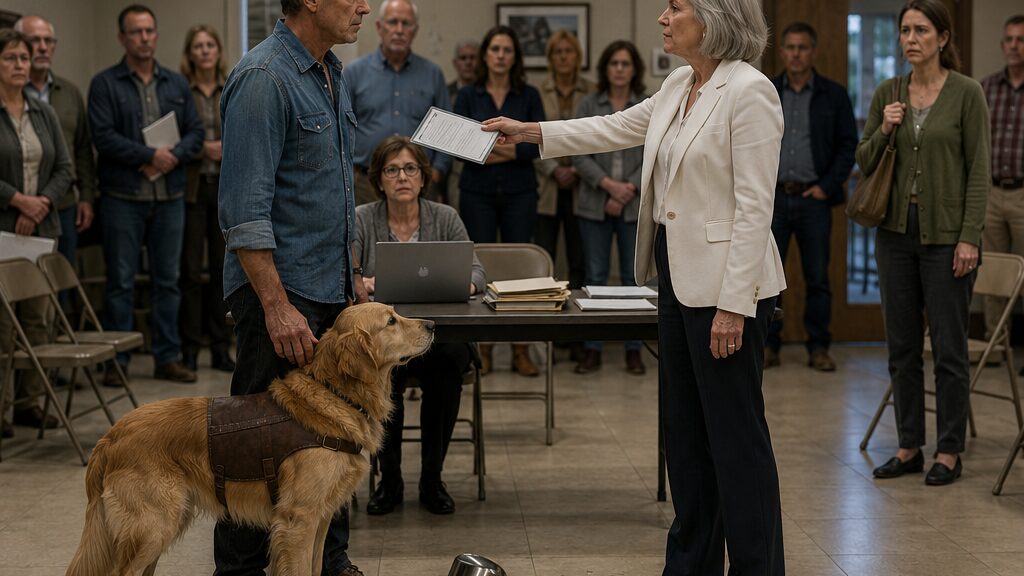
Susan Carter’s shoe struck Ranger’s water bowl hard enough to send it skidding across the clubhouse lobby.
The stainless-steel dish spun twice on the pale tile, spraying a crescent of water across the floor before stopping beneath a row of folding chairs. Ranger flinched but did not bark. He pressed his shoulder against Robert Allen’s leg and lifted his face toward him, waiting.
The room went quiet in the particular way crowded rooms did when everyone had decided silence was safer than involvement.
Robert felt Ranger’s weight. He fixed his eyes on the brass buckle of the dog’s worn leather vest and counted his breathing.
In for four.
Hold.
Out for six.
Susan stood in front of them in a white blazer that looked too formal for a monthly compliance session. Her silver hair was set neatly, and a blue folder rested beneath one arm.
“I told you not to bring that animal into this building.”
“He’s allowed to be here,” Robert said.
His voice came out lower than he expected.
One of the board members shifted behind the registration table. No one looked at Robert directly. Along the wall, residents held violation notices, landscaping applications, and envelopes containing dues checks.
Susan glanced toward them before answering.
“This is a private association facility. Our rules apply inside it.”
Robert had delivered his accommodation packet three weeks earlier. It included the veterinarian’s records, a letter from his physician, and a written request for reasonable accommodation. He had handed it to the board secretary at that same table and watched her stamp the date on the cover sheet.
“I submitted the documentation,” he said.
Susan’s mouth tightened. “You submitted papers. The board has not recognized the animal.”
Ranger lowered himself into a sit. His damp nose touched Robert’s knuckles.
Susan looked down at the dog as if his calmness were another form of defiance.
“He has already frightened residents.”
“No complaint names an incident.”
“A child was injured by a dog in this development last year.”
“That wasn’t Ranger.”
“It was a dog.”
The distinction seemed, to Susan, almost insulting.
Robert noticed Rachel Nelson standing near the rear doors. She had been beside her mailbox that afternoon when Susan stopped him on the sidewalk and told him to remove “that mutt” from her street. Rachel had watched from less than twenty feet away. So had two other neighbors.
None of them had spoken then.
Rachel looked at the water spreading over the tile now and gripped the strap of her purse with both hands.
Susan reached down without warning.
Robert moved, but she was already holding the edge of Ranger’s vest.
“Don’t touch him.”
The command sharpened the room.
Susan pulled once. The buckle caught beneath Ranger’s chest, and he rose uncertainly. Robert caught the leather before it tightened against the dog’s shoulder.
“He is working,” Robert said.
Susan released the strap only to seize the top panel. With one brisk motion, she dragged the vest backward. The loose buckle slipped free. The vest fell into the water beside Robert’s shoe.
Ranger stood bare-backed, his golden fur flattened where the leather had rested.
Something inside Robert narrowed.
He could hear the hum of the vending machine, the scrape of a chair, the small click of someone silencing a phone. The clubhouse walls seemed to tilt inward.
Ranger stepped across Robert’s foot and leaned against his knee.
Robert crouched.
He picked up the vest with both hands. Water ran from its edge onto his sleeve. The leather was darkened and soft, the stitching worn pale where he had repaired it twice. He wiped the inside against his jeans and fastened it around Ranger carefully.
Susan waited until he stood again.
Then she removed a laminated notice from her folder.
“This is the board’s decision.”
She pressed it against his chest. Robert took it before it slid.
At the top, beneath the association seal, was his address. Below that, in bold type, were the words CONTINUING ANIMAL VIOLATION.
The first assessment was four hundred dollars.
A smaller line stated that the amount would repeat for every day the violation remained unresolved.
Robert read it twice.
“Four hundred a day?”
“Beginning tomorrow.”
“For a service animal.”
“For an unapproved animal.”
A murmur moved along the wall, too soft to belong to any one person.
Susan turned slightly, making sure the room could see her profile.
“The board has been patient. Mr. Allen has chosen not to comply with the same standards everyone else follows.”
Robert looked down the page. Near the bottom, a paragraph had been highlighted in yellow.
REMOVE ANIMAL FROM PROPERTY OR TRANSFER OWNERSHIP OF UNIT WITHIN THIRTY DAYS.
The faded yellow door of his house came to mind. The porch swing. The narrow kitchen. The back room where Ranger slept outside the door when Robert’s breathing turned bad at night.
“You’re telling me to surrender him or sell my home.”
“I’m telling you the remedies available under the declaration.”
“You received my accommodation request.”
Susan’s eyes flicked toward the registration table.
“The board found it incomplete.”
“What was missing?”
“That is not the purpose of tonight’s meeting.”
Robert waited.
Susan did not answer.
He looked toward the secretary, a tired woman seated behind a laptop and a stack of meeting packets. She lowered her eyes.
Robert turned the laminated notice over. A signature line had been marked with a red tab.
“I’m not signing this.”
“Your signature is only acknowledgment of receipt.”
“I acknowledge that you handed it to me.”
Susan’s cheeks colored.
“Refusal will be noted.”
“Then note something else.”
He placed the notice flat on the registration table.
The secretary’s fingers hovered over the keyboard.
Robert kept his voice even.
“Has the association renewed the utility-access license for the rear corridor?”
For the first time that evening, Susan’s expression changed without calculation.
It lasted less than a second.
Then she gave a short laugh.
“This has nothing to do with your dog.”
“I asked whether it was renewed.”
One of the board members leaned toward Susan. “What corridor?”
Susan did not look at him.
“That is an infrastructure matter. It is not relevant.”
“It becomes relevant when the board starts talking about ownership and remedies.”
The secretary looked up.
Robert saw recognition in her face—not understanding, but the alarm of someone remembering a document she had not expected anyone else to mention.
Susan took the notice from the table and pushed it back toward him.
“You have thirty days.”
Robert left it where it was.
He bent, lifted Ranger’s empty bowl from beneath the chairs, and walked toward the doors. Residents stepped aside without meeting his eyes. Rachel moved last. As Robert passed, she opened her mouth, but whatever she meant to say did not emerge.
Outside, the evening air felt colder than it had twenty minutes earlier.
The clubhouse sat at the center of Hawthorn Ridge, surrounded by trimmed hedges and stone planters. Irrigation heads clicked along the lawn. Water arced in identical silver fans beneath the streetlights.
Ranger shook once, sending droplets from his vest.
Robert rested a hand between the dog’s shoulders.
“You did fine,” he said.
The words were for both of them.
Behind him, the clubhouse door opened.
The secretary hurried out carrying the laminated violation. She stopped several feet away, glancing back through the glass.
“Mr. Allen.”
Robert turned.
She lowered her voice.
“I checked the digital index while they were arguing.”
He waited.
“There’s no renewal agreement in this year’s file.”
“That doesn’t mean it wasn’t signed.”
“No.” She looked at the sprinklers crossing the lawn. “But the paper file is missing too.”
Chapter 2: The Narrow Strip Behind Thirty-Six Homes
The blue line on Robert’s kitchen map passed beneath thirty-six backyards.
It began behind his small lot at the edge of Hawthorn Ridge, narrowed between two retaining walls, then curved through the development like a vein no one had bothered to notice. Irrigation mains, fiber conduit, sanitary laterals, and access points had been drawn over it in different colors during different phases of construction.
Robert held the map flat with a coffee mug, a socket wrench, and Ranger’s steel water bowl.
The vest hung over the back of a kitchen chair. Its leather had begun to dry in uneven patches, leaving the darker shape of Susan’s hand near the top panel.
Ranger lay beneath it.
Robert opened the metal file box he had not touched in almost five years.
The documents were exactly where he remembered: plat copies, inspection notes, easement descriptions, utility exhibits, and a thin recorded deed with a transfer price of two dollars.
Two dollars had sounded absurd even then.
The developer had been weeks from dissolving the project company. The last roads were finished, most houses had sold, and several utility questions remained unresolved. Robert had still been working municipal surveys at the time. He understood what happened when ownership of a shared access strip became uncertain. Contractors stopped entering. Repairs stalled. Residents discovered that no one was legally responsible until something failed.
The deed had been a practical solution.
At least that was what he had told himself.
Robert found the annual license agreement beneath a stack of inspection sketches. The association received nonexclusive access to maintain installed utilities. In exchange, it paid a modest yearly fee, carried liability insurance, restored disturbed ground, and provided notice before nonemergency entry.
He read the revocation clause.
Then he read the paragraph below it.
Emergency entry could not be unreasonably denied where delay threatened health, safety, or substantial property damage.
Robert sat back.
He had remembered the right to refuse access.
He had forgotten the duty not to misuse it.
Ranger rose when Robert’s breathing changed. The dog moved beside his chair and placed his head across Robert’s thigh.
“I’m all right.”
Ranger did not move.
Robert ran a thumb along the dog’s ear until the kitchen walls returned to their proper distance.
At eight the next morning, he drove his dented pickup to the county recorder’s office. The building occupied a brick government complex near the highway, between the tax office and a probation department. Nothing about it suggested the power of the papers stored inside.
The clerk at the counter took the parcel number and disappeared into a records room.
Robert waited beneath fluorescent lights while a real-estate agent argued softly about a lien release two windows down. His hands smelled faintly of wet leather.
The clerk returned with a printed index.
“The corridor parcel is still vested in Robert Allen.”
“No transfer?”
“None recorded.”
“Any amended easement?”
She scrolled through the entries.
“There are utility exhibits. A license memorandum from the association. A renewal notice from last year.”
“This year?”
She checked again.
“No.”
Robert slid the old deed under the glass.
“What about restrictions on revocation?”
The clerk did not read legal meaning into documents; she made that clear before printing the recorded memorandum. Robert thanked her and carried the pages to a bench near the lobby doors.
The memorandum confirmed the arrangement. The HOA’s access depended on annual renewal. The most recent term had ended on May thirty-first.
Six weeks ago.
Robert stared at the date.
Susan had issued the first written complaint against Ranger four weeks ago.
He took out his phone and photographed the page.
For a few minutes, vindication came cleanly.
Susan had stood in front of a crowded room and spoken as if every rule in Hawthorn Ridge belonged to her. She had touched Ranger. She had told Robert to surrender the dog or sell. All the while, the association had failed to renew its legal access to infrastructure buried beneath land Robert owned.
He imagined placing the document in front of her.
Not shouting. Not threatening.
Only turning the page toward her and waiting.
Then he read the emergency clause again.
The satisfaction thinned.
At the recorder’s public terminal, Robert pulled the corridor plat and enlarged it parcel by parcel. The line crossed behind Susan’s house, beneath the irrigation manifold near the clubhouse, alongside a fiber junction serving the western loop, and past the private pond belonging to a neighbor at the top of the hill.
Thirty-six homes.
Thirty-six families with no knowledge that an old technical arrangement had become a weapon between two people.
Robert printed the full plat.
Back in the truck, he called Heather Martinez.
She answered on the fourth ring.
“I haven’t heard from you in months,” she said.
“I need a procedural opinion.”
“That sounds like you.”
He looked through the windshield at the county building.
“My HOA ignored a service-animal accommodation.”
Heather’s tone changed. “What did they do?”
He told her about the notice. He did not tell her about the water bowl or Susan’s hand on the vest. Those details felt too close to confession.
“And the procedural question?” Heather asked.
“I own their utility corridor. Their annual license expired.”
Silence.
“Robert.”
“It’s recorded.”
“I don’t doubt that.”
“They’re operating without renewal.”
“Do you want an accommodation, or do you want leverage?”
He tightened his grip on the phone.
“Both may be the same thing now.”
“They are not the same thing.”
“I’m not shutting off anything.”
“Good, because ownership of access land is not ownership of the utilities. And emergency-service language matters.”
“I know.”
“Do you?”
Robert looked at the printed plat folded across the passenger seat.
“I’m reading it.”
Heather exhaled.
“Get a lawyer before you send anything. And send me the accommodation denial if they gave you one.”
“They didn’t.”
“That helps you.”
“It didn’t help last night.”
“What happened last night?”
Robert watched a woman lead a child across the parking lot. He could still hear the vest buckle striking tile.
“They made their position clear.”
Heather waited, but he offered nothing more.
“All right,” she said. “Just don’t confuse having a right with having no limits.”
After the call, Robert drove home by the eastern entrance to Hawthorn Ridge.
Stone columns framed the road. New ornamental trees stood in fresh mulch. A bronze sign had been installed beneath the subdivision name, polished enough to reflect passing cars.
Robert remembered seeing the entrance-improvement proposal in an HOA newsletter. New lighting. New masonry. Decorative fencing. The board had described it as an investment in values.
He had never voted on it.
At home, Ranger met him at the yellow door.
Robert spread the new printouts across the kitchen table. He aligned the recorded memorandum with the old license and compared dates.
The term had not merely expired.
The association had been sent a renewal reminder in February.
A delivery receipt showed that the notice had been accepted at the clubhouse.
The signature was unreadable, but the address was not.
Robert turned toward the vest drying on the chair.
Susan might not have known.
The secretary might have misplaced it.
The board might have assumed renewal was automatic.
He opened the HOA’s online meeting archive. The March minutes listed landscaping contracts, entrance improvements, reserve allocations, and insurance review.
No utility license.
April contained one line under executive session: infrastructure obligation deferred pending counsel review.
Robert read it again.
Deferred.
Not forgotten.
Someone knew.
Chapter 3: Certified Letters and the First Brown Lawn
Thirty-six certified envelopes covered Robert’s kitchen table by noon Tuesday.
He had arranged them in four rows, each labeled with a parcel number and street address. Inside every envelope were three pages: notice of expired access authorization, proposed temporary access terms, and an estimate showing the likely cost of rerouting affected utilities outside the corridor.
The estimates were not threats. Robert had requested them years earlier when the developer dissolved.
They looked like threats now.
Some exceeded sixty thousand dollars per home.
Ranger stood beside the chair where his vest had dried. Before Robert reached for it, the dog nudged the leather with his nose.
Robert fastened it around him slowly.
The stain from the clubhouse water remained visible along one edge.
At the post office, the clerk counted the envelopes twice.
“Homeowners’ association?” she asked.
Robert nodded.
She looked at the stack. “That’s never good.”
By Wednesday morning, residents had begun signing for them.
By Wednesday afternoon, Susan called.
Robert let the first call go to voicemail. The second came from the clubhouse number.
He answered.
“You have created a serious legal problem for yourself,” she said.
No greeting.
“The license expired.”
“You do not have authority to interrupt essential services.”
“The notices preserve emergency access.”
“You demanded payment from individual homeowners.”
“I offered temporary access terms because the association has no active agreement.”
“You are retaliating over an animal violation.”
Robert looked at Ranger, asleep beneath the window.
“I requested an accommodation before the license expired.”
“That is not how this will be characterized.”
“How will it be characterized?”
“As extortion.”
The word was intended to frighten him. It almost worked.
Robert kept his voice flat. “Have the association’s attorney contact mine.”
“You don’t have an attorney.”
“You don’t know what I have.”
Susan hung up.
The small victory left no warmth behind.
On Thursday morning, an irrigation technician parked beside the clubhouse pump enclosure. Robert saw the truck while walking Ranger. Two board members stood nearby with their arms folded.
When the technician opened the gate toward the rear corridor, Robert stopped him.
“Do you have emergency work?”
The man looked at the board members, then at Robert.
“Pressure check and seasonal adjustment.”
“Any active leak?”
“No.”
“Any risk to property?”
“Not that I know of.”
“The access license expired. Nonemergency entry needs written authorization.”
One board member stepped forward. “You cannot block association contractors.”
Robert held out a copy of the recorded memorandum.
“I’m not blocking emergency work.”
“This is routine maintenance.”
“Then it can wait for an agreement.”
The technician took the page, read the first paragraph, and closed the gate.
“I’m not getting in the middle of this,” he said.
His truck left ten minutes later.
By evening, several lawns on the western loop had begun to show dull patches where sprinkler zones had not reset after a pressure fault. The grass was not dead. Nothing had failed catastrophically. But in Hawthorn Ridge, one brown crescent beside a driveway drew more attention than a broken porch step.
A neighbor approached Robert near his mailbox.
“You’re shutting off the sprinklers now?”
“No.”
“The contractor says he couldn’t get in.”
“He was performing nonemergency work without authorization.”
The neighbor stared at him.
“That sounds like shutting them off with extra words.”
Robert could have explained the difference between refusing access and disabling equipment. He could have described the expired license, the notice periods, the board’s failure.
Instead he said, “Talk to the HOA.”
The neighbor’s face hardened.
“That’s what they told us about you.”
He walked away.
Robert stood beside the mailbox long after Ranger had turned toward home.
His silence had once felt like discipline. Lately, it kept becoming evidence for whoever spoke first.
That night, the neighborhood message board filled with accusations. Residents posted photographs of dry grass, copies of Robert’s letter, and portions of the rerouting estimates.
One message called him unstable.
Another said no legitimate service-dog owner would endanger an entire community over a paperwork dispute.
Susan posted only once.
The board is taking all lawful steps to protect residents from an individual attempting to exploit infrastructure ownership for personal retaliation.
Robert read the sentence three times.
He began drafting a reply.
Then deleted it.
On Friday morning, a fiber contractor knocked on his yellow door.
The man wore a reflective vest and carried a tablet.
“We need to inspect a junction box behind lot twenty-eight.”
“Emergency?”
“Intermittent signal loss. No full outage yet.”
“Medical or safety priority on that line?”
The contractor glanced at the tablet.
“I don’t have customer details.”
“Then I need the association to request limited access in writing.”
The man frowned. “We usually just enter under the blanket agreement.”
“The blanket agreement expired.”
“I heard.”
Robert waited.
The contractor shifted his weight. “Look, I’m not here for the politics. I’m trying to keep the loop stable.”
“So am I.”
“Then sign the work order.”
Robert looked past him toward the street. Curtains moved in two houses across the way.
“Bring me a written scope and confirmation that access is limited to the junction.”
The contractor hesitated, then nodded.
“That may take until Monday.”
“That’s your company’s choice.”
After he left, Rachel Nelson appeared at the end of Robert’s driveway.
She had no purse this time. Her hair was pulled back, and she held one of the certified envelopes against her chest.
“My mother’s equipment uses the fiber connection,” she said.
Robert’s stomach tightened.
“What equipment?”
“She stays with us three nights a week. Her oxygen concentrator has a backup battery, but her monitoring system reports through the internet. We also have a cooling unit in the downstairs room because she can’t regulate temperature well.”
“I didn’t know.”
“You didn’t ask.”
The words landed cleanly because they were true.
“The contractor said there isn’t an outage.”
“Not yet.”
“I offered emergency access.”
“You sent us an estimate for sixty-two thousand dollars.”
“That is the rerouting cost if the association refuses a new agreement.”
“It reads like you plan to make us choose.”
Robert glanced toward Ranger, who sat just inside the open door.
Rachel followed his gaze.
“What Susan did was wrong,” she said.
“You watched her do it.”
Color rose along Rachel’s neck.
“Yes.”
“Twice.”
“Yes.”
“Then you waited until your house was affected.”
She looked down at the envelope.
“I’m not asking you to forgive that.”
“What are you asking?”
“To make sure my mother’s line stays stable.”
Robert heard the old clubhouse silence between them.
“I’ll authorize emergency work.”
“Thank you.”
“Limited scope. In writing.”
Rachel nodded.
She took two steps toward the sidewalk, then stopped.
“Susan knew about your paperwork.”
Robert’s attention sharpened.
“How do you know?”
“I saw the packet in the board folder before the meeting.”
“Why didn’t you say anything?”
Rachel folded the envelope once, then seemed to realize what she was doing and flattened it again.
“I can’t answer that here.”
She left before he could stop her.
An hour later, Heather arrived in a city sedan.
She carried Robert’s letter and the recorded memorandum. Her expression told him she had already read both.
“You preserved emergency access,” she said.
“I did.”
“You also sent individual homeowners rerouting estimates and proposed fees before counsel reviewed the license.”
“The association ignored me until I did.”
“That explains it. It doesn’t make it careful.”
Robert crossed his arms.
“They threatened my home.”
“And you answered thirty-six households.”
“They benefit from the corridor.”
“So does the woman whose mother depends on the fiber loop.”
“I approved the work.”
“After she came to your door.”
Robert looked toward the kitchen chair. Ranger’s vest no longer hung there. It was on the dog, where it belonged, the stained leather rising and falling with each breath.
Heather lowered her voice.
“Susan used a rule without regard for the person standing in front of her.”
Robert said nothing.
Heather placed his certified notice on the table.
“This may be lawful,” she said. “But right now, it is morally indiscriminate.”
Chapter 4: The Board’s Missing Renewal Money
By Saturday morning, three residents stood outside the clubhouse holding irrigation invoices, and a fourth carried a dead router as if it were evidence from a crime scene.
Susan had called the emergency meeting for nine. By eight forty-five, every folding chair was taken. People lined the walls beneath framed photographs of Hawthorn Ridge in its first year, when the entrance trees were saplings and the clubhouse carpet had not faded along the center aisle.
Robert entered with Ranger at his left side.
Conversation dropped, then resumed in smaller pieces.
He recognized words without hearing full sentences.
Fees.
Fiber.
Lawsuit.
Dog.
Susan stood behind the board table arranging folders. Her white blazer had been replaced by navy, but the effect was the same: deliberate, polished, untouchable. Rachel sat two places down with the treasurer’s binder open in front of her. She did not look at Robert.
A resident near the front lifted a brown patch of sod in a plastic grocery bag.
“This came out of my side yard,” he said. “I’d like to know who’s paying to replace it.”
“You pulled it out yourself,” another resident said.
“That’s not the point.”
Susan struck the gavel once.
“This meeting concerns a deliberate attempt by one homeowner to hold essential community infrastructure hostage.”
Several faces turned toward Robert.
Ranger sat.
Robert kept one hand loose near the dog’s shoulder.
Susan continued. “Mr. Allen has distributed financial demands to thirty-six households and interfered with authorized contractors. The board considers these actions retaliatory and potentially unlawful.”
“Was the access license renewed?” Robert asked.
The room shifted.
Susan’s eyes found him. “You will have an opportunity to speak.”
“That question has been pending since Monday.”
A board member adjusted his microphone. “I’d like the answer too.”
Susan’s jaw tightened.
“The agreement is under legal review.”
“That means no,” someone said from the back.
Murmurs spread.
Susan raised her voice. “The absence of a completed renewal does not give a private owner the right to disrupt services.”
Robert stood.
“I have not disabled a single utility. Emergency access remains available. I refused routine entry after the annual agreement expired.”
A resident held up Robert’s certified letter. “You sent me a sixty-four-thousand-dollar estimate.”
“That is the projected cost of relocating the lines if the association declines new terms.”
“It reads like a threat.”
Robert glanced at Heather, who stood near the rear wall. She had not come as a city representative. She had made that clear. Still, her presence felt like a line drawn beside him, not necessarily in his favor.
“I should have explained the difference more clearly,” Robert said.
Susan gave a short, humorless laugh.
“There is no difference. He is exploiting a technicality because the board enforced a valid pet restriction.”
Ranger shifted closer.
Susan pointed toward him.
“The vest does not change the animal’s impact on residents. Anyone can buy something like that online. It is performative.”
Heat rose through Robert so quickly that the room blurred at its edges.
Ranger stood before Robert consciously moved. The dog pressed his body across Robert’s knees, blocking him from stepping forward.
The leather vest rose and fell beneath Robert’s hand.
Susan watched.
For once, she seemed uncertain whether she had won the moment.
Robert bent his fingers into the worn seam until the pressure in his chest eased.
“You received the medical accommodation packet,” he said.
“The packet did not eliminate the board’s responsibility to evaluate risk.”
“Did you read it?”
Susan looked toward the board secretary.
That was enough.
Rachel closed the treasurer’s binder.
A soft sound, but everyone heard it.
Susan turned. “Rachel?”
Rachel slid a folded sheet across the table toward Robert.
Susan put her hand over it before he could reach.
“That document is confidential.”
“It’s a budget summary,” Rachel said.
“It came from executive materials.”
“It shows where the renewal money went.”
The room became still.
Susan kept her palm on the paper.
Rachel did not pull it back. “The corridor fee was in the reserve schedule. So was the insurance rider.”
A board member leaned closer. “How much?”
Rachel named the amount.
It was not large compared with the association’s annual budget. It was less than the new stone columns at the east entrance.
Robert looked toward the framed photograph on the wall, then back at Susan.
“The entrance project,” he said.
Rachel nodded.
Susan removed her hand from the paper as if it had become dirty.
“The improvement was approved.”
“Not the transfer,” Rachel said. “The board approved the project. You moved the corridor funds afterward.”
“For an urgent property-value concern.”
“The columns were cosmetic.”
“They addressed a decline in curb appeal noted by the lender.”
A resident near the front stared at her. “You let the utility agreement expire for a sign?”
“It was not allowed to expire. Counsel was reviewing revised terms.”
“Did counsel tell you not to pay the renewal?”
Susan did not answer.
Robert unfolded the sheet.
There it was: annual utility-access allocation, crossed out in blue ink. Beside it, entrance enhancement overage.
The handwriting was Susan’s. He recognized the narrow capital letters from the violation notice.
His satisfaction lasted only a moment.
Rachel was breathing too quickly.
Susan saw it too.
“You understand,” Susan said quietly, “that association financial information includes delinquency records.”
Rachel’s face drained.
The threat passed beneath the words, visible only if one knew where to look.
Robert did.
Rachel stood so abruptly that her chair struck the wall.
“Do not do that here.”
Susan’s expression remained composed. “I am reminding you of your fiduciary obligations.”
“You reminded me at every vote.”
Residents began speaking at once.
Rachel gathered her binder against her chest.
“My family is refinancing,” she said, not to the room exactly. “We fell behind after my mother moved in. Susan said if I opposed the entrance transfer, she would require immediate collection action.”
Susan’s control slipped.
“You signed the resolution.”
“Because you told me a lien notice would reach the lender.”
“That is standard procedure.”
“You used it to control my vote.”
The board member beside Susan pushed his chair back.
Robert looked at Rachel and remembered her standing by the sidewalk, saying nothing while Susan threatened Ranger.
Her silence had not been empty.
It had been purchased.
That did not absolve it. But it changed its shape.
The emergency meeting dissolved into demands for records. Susan tried to return to the agenda, but no one followed her. Residents wanted bank statements, counsel invoices, reserve schedules, and every document connected to the corridor.
Robert left before the shouting reached its peak.
Rachel caught him near his truck.
“Wait.”
Ranger stopped with him.
Rachel held out the treasurer’s binder.
“I can’t give you originals. But there are minutes you need to see.”
Robert did not take it.
“Why me?”
“Because they’ll remove my access by Monday.”
“That doesn’t make me your ally.”
“I know.”
She led him to her garage three houses away. The door remained open. Boxes of medical supplies were stacked beside a chest freezer. A portable cooling unit hummed near the interior door.
Rachel placed the binder on a workbench and opened to the March executive-session minutes.
The language was restrained. The meaning was not.
The board had received the renewal reminder. Susan had proposed delaying payment until after an insurance and lending review. She had also noted that unresolved animal-accommodation requests could complicate the review.
Robert turned the page.
Attached was an intake log.
His name appeared beside the date he delivered the packet.
Status: Received.
Review: Deferred by president.
Susan had not merely known the papers existed.
She had held them back.
Robert looked at Rachel.
“She had this before the clubhouse meeting.”
Rachel nodded.
“Before the first written complaint too.”
Chapter 5: What Susan Was Trying to Hide
Susan’s offer arrived before Robert sat down.
“Withdraw the corridor notices and transfer the parcel to the association,” she said, “and every fine against you disappears.”
The county mediation room had no windows. A round table occupied most of the space, with four water bottles lined along its center. Robert sat beside Heather. Susan sat opposite them with one board member and the association’s attorney.
Ranger lay beneath Robert’s chair.
His repaired vest rested on the tabletop.
Robert had placed it there deliberately.
The leather had dried stiff where the water struck it. One buckle no longer closed cleanly. He had reinforced the torn seam with dark thread, but the repair showed.
Susan kept her eyes away from it.
Robert opened the proposed settlement.
The transfer price for the corridor was ten dollars.
“You want thirty-six households’ utility access for ten dollars,” he said.
“The association is offering to resolve an unstable ownership condition.”
“You created the instability.”
“The developer created it.”
“You deferred the renewal.”
“On advice.”
The attorney shifted slightly. “The board was reviewing whether the agreement remained commercially reasonable.”
Heather touched one page of the proposal.
“This also requires Mr. Allen to waive all disability-accommodation claims.”
Susan answered before her attorney could.
“It provides global resolution.”
“It buys silence,” Robert said.
Susan folded her hands.
“It keeps you in your home with your dog.”
The words were almost gentle. That made them worse.
Robert looked at the vest.
“Ranger was already allowed in my home.”
“That point is disputed.”
“No. You disputed it.”
The mediator, seated at the head of the table, asked them to separate the issues. Utility access. Fines. Accommodation. Conduct.
Susan resisted each separation.
The corridor, she argued, proved Robert’s animal complaint had become a financial scheme. Robert’s refusal to restore routine access demonstrated instability. The damaged lawns and threatened fiber loop created exposure the board had been obligated to prevent.
Robert listened until she described the clubhouse incident as “an attempt to verify the animal’s status.”
His hand closed around the broken buckle.
Heather glanced at him.
“Verify it how?” Robert asked.
Susan hesitated.
“The vest was not official.”
“There is no official federal service-dog vest.”
“The board could not know that.”
“You had the packet.”
“The packet raised additional concerns.”
“What concerns?”
Susan looked toward the attorney.
He said, “Medical privacy limits what can be discussed.”
“My privacy,” Robert said. “I am waiving it for this question.”
The room tightened.
He had not planned to say that.
Heather turned toward him, alert now.
Robert felt Ranger’s head lift beneath the table.
Susan’s composure changed. Not much. A small withdrawal at the corners of her mouth.
“The documentation referenced panic episodes,” she said.
Robert waited.
“And?”
“And an incident during your prior employment.”
The trench came back in pieces.
A steel ladder angled against wet soil. A radio transmitting from somewhere under a machine’s engine noise. The wall giving way before anyone reached the worker below.
Robert’s fingers went numb.
Ranger rose and pressed against his shin.
Heather spoke quietly. “Robert, you do not have to continue.”
He kept his eyes on Susan.
“What did that have to do with Ranger?”
“The insurer had already asked whether the association was aware of residents presenting elevated behavioral or animal-related risk.”
“Behavioral risk.”
“That was their language.”
“And you decided forcing me out would simplify the review.”
Susan looked down at the settlement.
The silence answered first.
The board member beside her stared.
Susan finally spoke. “Last year, a resident’s dog knocked down a child near the west pond. The claim was mishandled. The carrier warned that another incident could affect renewal.”
“Ranger has never touched anyone.”
“You were asking the board to make an exception while the lender was reviewing deferred obligations and the insurer was reviewing animal controls.”
“So you combined them.”
“I managed them together.”
“You hid my accommodation request.”
“I delayed a decision.”
“You issued fines before deciding.”
Susan’s voice sharpened.
“Because once the corridor lapse became public, every financial weakness in the association would be examined. The reserve transfer. The insurance claim. The lender’s questions. You lived in the smallest house, you had already challenged two maintenance assessments, and you had no family here. I believed you would sell.”
The board member beside her turned slowly.
Susan seemed to realize what she had admitted.
She tried to repair it.
“I believed relocation would be the least disruptive outcome.”
“For whom?” Heather asked.
Susan did not answer.
Robert felt no triumph.
He had imagined this moment as a clean exposure. Susan would admit what she had done, the room would recognize it, and something inside him would settle.
Instead he saw the structure of her fear.
A lender asking questions.
An insurer threatening rates.
Residents demanding perfect lawns and low dues.
Susan, terrified that one exposed failure would make every other failure visible.
It explained her.
It did not excuse her hand on Ranger’s vest.
The mediator asked whether Robert would consider a temporary restoration of ordinary access while a long-term agreement was drafted.
“No,” Robert said.
Heather looked at him.
The mediator continued carefully. “Emergency access is preserved?”
“Yes.”
“But routine maintenance remains restricted?”
“Until the fines are withdrawn and the accommodation is recognized.”
Susan leaned back.
“There. That is retaliation.”
Robert turned the broken buckle between his fingers.
“Call it leverage.”
Heather’s expression closed.
The word remained in the room.
The attorney requested a break.
In the hallway, Heather waited until the door shut behind them.
“She admitted targeting you,” Robert said.
“She did.”
“She admitted burying the packet.”
“Yes.”
“And you are still looking at me like I lost.”
“You did not lose the case.”
“What did I lose?”
Heather glanced through the narrow glass pane in the mediation-room door.
“The distinction you asked everyone else to see.”
Robert said nothing.
“She treated your needs as pressure points,” Heather continued. “Now you’re treating every maintenance request as one.”
“They can sign an agreement.”
“They will. But you have made suffering part of the negotiation.”
“No one is suffering.”
Heather’s face tightened.
“Rachel’s mother came within hours of a monitoring interruption.”
“I authorized the work.”
“After the risk reached your porch.”
Robert looked down the empty county hallway.
“I am not giving Susan ordinary access.”
“Then say it plainly. You want her to feel what it is like to have permission withheld.”
He could not deny it without lying.
The mediation ended without agreement.
Outside, the association’s attorney took a call beside the parking lot. His voice carried through the warm afternoon air.
Robert heard only fragments.
Emergency relocation.
First light.
Carter property.
The attorney ended the call and approached Susan.
“The fiber company will not wait,” he said. “They are routing around the disputed junction.”
Susan frowned. “Around it how?”
“The nearest viable trench line crosses your rear garden.”
For the first time since Robert had known her, Susan looked stripped of an answer.
The attorney added, “Crews begin marking at dawn.”
Chapter 6: The Promise Hidden in a Two-Dollar Deed
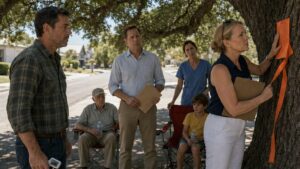
Orange paint crossed Susan’s ornamental garden before sunrise.
By seven, utility flags stood between the clipped boxwoods, through the gravel path, and beside the stone koi pond. A contractor’s white truck idled at the curb while two workers measured the route from the street.
Susan stood on her patio in a robe beneath a raincoat, demanding alternatives.
Robert watched from the public sidewalk with Ranger.
He had not come to enjoy it.
That was what he told himself.
A worker stretched a measuring tape across a bed of pale roses.
Susan saw Robert.
“You did this.”
“The fiber company chose the route.”
“You made the existing route inaccessible.”
“Routine access was never renewed.”
Her gaze moved to Ranger, then away.
The contractor drove a survey stake near the edge of the corridor. Ranger stepped around it, but the loose edge of his vest caught on the splintered top.
The leather pulled tight.
Robert freed it quickly.
The repaired seam opened enough to reveal the older stitching underneath—three different repairs in three different shades of thread.
He ran a finger over them.
The vest had never been replaced because Ranger trusted it. New leather made him restless. The familiar weight told him when work began.
Robert had treated that familiarity as something Susan could not understand.
Standing beside the flags in her garden, he realized understanding was not required for restraint.
His phone rang.
Nicholas Moore’s name appeared on the screen.
Robert answered.
“I heard you’re using the corridor,” Nicholas said.
“I’m enforcing it.”
“That isn’t what I asked.”
Robert looked at the painted line running through Susan’s yard.
“What do you want?”
“For you to come to my workshop before you do something neither of us can put back.”
Nicholas lived twenty minutes north, beyond the newer subdivisions. His workshop occupied a converted equipment shed behind a low brick house. Rolled plans stood in bins along one wall. Survey instruments, most too old for current field use, filled a glass cabinet.
Nicholas had aged into a thinner version of the engineer Robert remembered. His shoulders remained square, but his hands trembled when he poured coffee.
“You waited until now,” Robert said.
“I hoped the association would handle it.”
“They handled it by telling me to surrender my dog.”
Nicholas looked at Ranger’s vest.
“I heard about that too.”
“Then why call about the corridor instead of that?”
“Because I know why you own it.”
“So do I.”
Nicholas opened a steel drawer beneath his drafting table.
“No. You remember the paperwork.”
He removed a long envelope yellowed along its edges.
Robert recognized his own handwriting before Nicholas laid it down.
The date was seventeen years earlier.
At the time, Hawthorn Ridge had been unfinished. The developer was selling the final lots while dissolving separate entities tied to roads, ponds, and utility access. Nicholas had discovered that the rear corridor would be left under a shell company with unpaid taxes.
The association had not yet assumed full control.
The county would not take it.
Without an owner, emergency repairs could become a legal maze.
Robert had agreed to accept the parcel because he understood the maps and because someone had to remain reachable.
The two-dollar price had never been a favor.
It had been consideration sufficient to record the transfer.
Nicholas slid the letter toward him.
“Read the last paragraph.”
Robert did.
If I accept title, it will be solely to preserve continuous access for residents and utilities until a stable community agreement can be established. I will not use ownership of the corridor to extract advantage from homeowners who had no role in the developer’s failure.
The words seemed written by someone more certain than he had ever been.
Robert placed the page down.
“There was supposed to be a permanent agreement.”
“Yes.”
“You were supposed to draft it.”
Nicholas looked toward the workshop window.
“The developer closed before counsel finished. The first board preferred annual fees because they were cheaper. Every board after that renewed without asking why.”
“And you said nothing.”
“I told myself the arrangement worked.”
“You told yourself you were done.”
Nicholas accepted that without protest.
“I was ashamed,” he said. “I helped build a neighborhood with obligations scattered through companies designed to disappear. You took one of those obligations because I asked you.”
Robert stared at the letter.
“Susan knew the renewal expired.”
“Yes.”
“She used my dog to push me out before anyone looked at the books.”
“That is on her.”
“I sent every homeowner a rerouting estimate.”
“That is on you.”
The directness struck harder than accusation.
Ranger lay beneath the drafting table, the opened seam of his vest visible against his side.
Robert folded the old letter along its original crease.
“I preserved emergency access.”
Nicholas nodded.
“You followed the clause.”
“I had the right to refuse routine entry.”
“You did.”
Robert looked at him.
Nicholas did not rescue him from the rest.
The drive home took longer than twenty minutes.
At the entrance to Hawthorn Ridge, the new stone columns shone in the afternoon sun. Behind them, irrigation flags marked lawns beginning to lose their uniform color. A fiber van waited near Susan’s house. Residents stood in pairs along the sidewalk, looking from the equipment to Robert’s passing truck.
At home, he sat on the porch with the old letter.
Ranger leaned against his boot.
Robert remembered the man trapped in the trench—not the collapse itself, but the minutes before it, when everyone on the crew had noticed something wrong and assumed someone else had authority to stop the work.
Silence had consequences even when it looked disciplined.
So did procedure without purpose.
He took out his phone and called the board secretary.
“I’m requesting an emergency special meeting tonight.”
There was a pause.
“Susan controls the agenda.”
“Not under the member-petition provision. Rachel has enough signatures.”
“What is the purpose?”
Robert looked at the certified-mail receipts stacked inside his front window.
“Review of the corridor notices.”
“The association’s notices?”
“Mine.”
The secretary became quiet.
“Do you want to withdraw them?”
“Put them on the agenda.”
He ended the call and opened his laptop.
The first document he drafted restored immediate routine access for safety, medical, and system-stabilization work.
The second capped temporary fees at documented costs.
The third began with a sentence he deleted four times before allowing it to remain:
I exercised a lawful right in a manner broader than the harm required.
At six twelve, the board secretary confirmed the meeting.
At six thirteen, Susan sent a community-wide message accusing Robert of attempting to manipulate residents with a staged concession.
Robert read it once.
Then he attached his old two-dollar deed, his seventeen-year-old promise, and his own certified notices to the public agenda.
For the first time, he did not let anyone else describe what he had done.
Chapter 7: The Meeting Where Robert Read His Own Mistake Aloud
Robert began the meeting by withdrawing the most punitive part of his own notice.
The clubhouse was fuller than it had been on Saturday. Residents stood along the rear wall and crowded the doorway. The irrigation technician waited beside a fiber contractor near the windows. Heather sat in the front row with a legal pad on her knee. Nicholas stood farther back, holding the yellowed envelope that contained Robert’s seventeen-year-old letter.
Susan sat behind the board table.
Ranger rested beneath Robert’s chair, wearing the repaired leather vest. The dark stitching showed along one side. No one reached toward it.
Robert placed a revised access order on the table.
“Effective immediately,” he said, “routine entry for system stabilization, medical necessity, public safety, and prevention of property damage is restored.”
A low murmur moved through the room.
Susan leaned toward her microphone.
“So the threat was unnecessary.”
Robert looked at her.
“No. The board’s failure was real. My response was broader than it needed to be.”
The room quieted.
Susan had expected a defense. Robert could see it in the way she glanced toward the association’s attorney, waiting for him to exploit whatever came next.
Robert continued.
“I am also withdrawing the individual rerouting demands sent to homeowners. Temporary access fees will be limited to documented inspection, restoration, insurance, and administrative costs.”
A resident near the center raised a hand without waiting to be recognized.
“Does that mean the sixty-thousand-dollar estimates are gone?”
“They remain estimates of what permanent rerouting would cost. They are not bills, and they should not have been presented in a way that made them feel like immediate demands.”
The resident lowered his hand.
Not satisfied. But listening.
Susan spoke again.
“Mr. Allen is attempting to appear reasonable now because counsel informed him that his actions exposed him to liability.”
“My attorney advised me of that risk before the letters were sent.”
That drew several looks.
Robert did not turn away from them.
“I sent the letters anyway.”
Heather’s pen stopped.
Robert placed the original certified notice beside the revised terms.
“The association used rules without regard for the person standing in front of it. I answered by using ownership without enough regard for the people behind the board.”
A woman near the back said, “That does not excuse what they did to your dog.”
“No,” Robert said. “It does not.”
Susan shifted in her chair.
Robert felt the old instinct to stop there. The facts were in his favor now. Rachel’s minutes had exposed the diverted funds. The accommodation intake log showed Susan had received his documents. The mediator had heard her admission.
He could let the papers speak.
That was what he had always done.
Ranger raised his head.
Robert rested one hand against the vest.
“I have not explained why Ranger works with me,” he said. “I believed I should not have to.”
No one moved.
“I still believe privacy matters. But I also used privacy as a wall. When people made assumptions, I waited for documents to correct them.”
The trench returned as sound before image: soil breaking, metal striking metal, a radio voice becoming too calm.
Robert kept his eyes on the tabletop.
“I worked utility surveys for the city. During a trench collapse, one worker died before we could reach him. Afterward, enclosed spaces, machinery noise, and sudden loss of control began causing panic episodes. Ranger interrupts them before I stop functioning.”
Susan looked down.
Robert did not know whether the movement came from shame or strategy. He no longer needed to decide.
“The board had documentation sufficient to evaluate the accommodation. They delayed it. They treated my medical history as a liability. Susan then used Ranger to pressure me into leaving before the expired corridor agreement became public.”
The association’s attorney rose.
“We dispute that characterization.”
Rachel opened the treasurer’s binder.
“I do not.”
Her voice was unsteady, but it carried.
She read the date of Robert’s accommodation packet, the notation deferring review, and the executive-session entry linking animal restrictions to insurance and lending concerns.
A board member asked Susan directly, “Did you instruct the secretary not to circulate the packet?”
Susan folded her hands.
“I instructed staff to wait for counsel.”
“Did counsel tell you to issue daily fines before review?”
“The board had to manage risk.”
“Did counsel tell you to remove the vest?”
The question came from the other board member.
Susan’s face hardened.
“That moment has been exaggerated.”
Robert touched the repaired seam.
“It was wet on the floor.”
No one spoke after that.
Nicholas came forward when Robert called him.
He did not offer a history of the entire development. He explained only what mattered: the developer had nearly abandoned the corridor under a dissolving company; Robert had accepted title to preserve continuous utility access; and the annual agreement had been intended as temporary until the community adopted stable terms.
Then Nicholas unfolded Robert’s old letter.
“You should read it,” he said.
Robert took the page.
The paper trembled once in his hand.
He read the final paragraph aloud.
“If I accept title, it will be solely to preserve continuous access for residents and utilities until a stable community agreement can be established. I will not use ownership of the corridor to extract advantage from homeowners who had no role in the developer’s failure.”
The room did not absolve him.
That mattered.
A man in the second row crossed his arms. A woman near the door shook her head slightly. Rachel stared at the binder. Heather watched Robert without softening her expression.
Robert placed the letter beside his certified notices.
“I broke the spirit of that promise.”
Susan seized the opening.
“Then the corridor should be transferred immediately.”
“No.”
Her head lifted.
Robert slid a proposed agreement toward the board.
“I will not transfer ownership to the same institution that concealed the expiration and used an accommodation request as leverage.”
“Then nothing has changed.”
“Everything changes if the terms do.”
He outlined them without ornament.
A ten-year renewable agreement.
Independent accounting of corridor funds.
Emergency and medical access guaranteed.
Routine work authorized through documented notice.
Fees capped at actual costs plus a modest reserve contribution.
No transfer of ownership without a resident vote and county review.
A binding service-animal accommodation policy drafted with accessibility guidance.
Mandatory board training.
External review of fines involving disability claims.
“And,” Robert said, “all fines against me related to Ranger are withdrawn.”
Susan leaned back.
“You are dictating governance.”
“I am defining access to property I own.”
“That is coercion.”
“It is negotiation with limits.”
The association’s attorney read the first page. His expression did not reveal whether he approved, but he did not dismiss it.
One board member asked, “Would the temporary access restoration remain in effect while counsel finalizes this?”
“Yes.”
“And if the board rejects it?”
Robert looked around the room.
“Emergency and safety access continue. Routine access returns to written requests. I will not send homeowners individual rerouting demands again.”
A resident near the aisle asked, “What prevents the next owner of your house from doing this all over?”
“A recorded agreement binding successors.”
That answer changed the room more than any accusation had.
The issue was no longer whether Robert could punish them. It was whether they could replace hidden dependence with clear rules.
Susan saw the shift.
“You are all forgetting how this began,” she said. “An animal exception was requested during an insurance review. I made a decision intended to protect this association.”
“You made a decision intended to protect yourself,” Rachel said.
Susan turned toward her.
Rachel’s hands tightened around the binder, but she continued.
“You threatened collection action against me if I opposed the fund transfer. You delayed his packet. You told us the corridor renewal was being handled when you knew the money was gone.”
“I made difficult decisions while others avoided responsibility.”
“That does not make every decision yours to make.”
Susan looked at the other board members.
“We should adjourn and refer all matters to litigation.”
The association’s attorney said quietly, “Litigation will make the executive minutes discoverable.”
The words landed with almost no sound.
Susan stared at him.
“You represent the board.”
“I do.”
“Then advise it.”
“I am.”
A motion was made to accept Robert’s temporary terms pending final legal review, withdraw the fines, and place the accommodation policy on an expedited agenda.
It passed.
Susan voted no.
Then Rachel made a second motion.
Her voice faltered at the beginning and steadied before the end.
“I move to remove Susan Carter as board president, effective immediately, while preserving her elected seat until the membership can consider further action.”
Susan stood.
“You cannot do this because residents are angry.”
“We can do it because the bylaws allow officers to be removed by board vote.”
“You will destroy this association.”
Rachel looked at Robert, then at the damaged vest beside his hand.
“No,” she said. “We are trying to stop governing it through fear.”
The first board member voted yes.
The second voted yes.
Rachel held the deciding vote though the result was already clear.
She said yes anyway.
Susan remained standing as the secretary recorded the motion.
No one applauded.
The silence was not the silence from the night the water bowl crossed the tile. That silence had protected harm.
This one allowed consequence to remain in the room without turning it into spectacle.
Susan gathered her folders.
At the door, she stopped beside Robert.
“This will not make them loyal to you,” she said.
“I did not ask them to be.”
“You think admitting your mistake makes you different.”
Robert looked down at Ranger, then back at her.
“No. What I do after admitting it might.”
Susan left.
The clubhouse door closed behind her.
Robert looked at the signed temporary agreement and the vest resting untouched beside it.
For the first time since the conflict began, he had protected his home without hiding behind the ground beneath everyone else’s.
He still did not know whether he wanted to remain above it.
Chapter 8: The Yellow Door Stayed Open
The permanent corridor marker was installed behind Susan’s former showpiece garden six weeks later.
It stood only fourteen inches above the ground: a plain metal post with an engraved parcel reference and an emergency-access number. No association crest. No decorative stonework. No polished bronze.
Robert watched the county surveyor check its position against the recorded plat.
The orange excavation paint had faded from the grass. Susan’s roses had been replanted along a narrower bed, leaving clear access to the fiber route. The koi pond filter hummed steadily behind the hedge.
Susan no longer attended board meetings.
She remained an owner in Hawthorn Ridge and, until the membership election, technically held a board seat without office. Residents saw her occasionally at her mailbox or driving through the east entrance. She offered no public apology.
Robert had stopped expecting one.
The long-term corridor agreement took five weeks to complete.
The association’s new temporary officers hired independent counsel. Heather helped draft the service-animal policy, though she refused to let the board bury it in a general pet-rule revision. The policy required prompt acknowledgment, individualized review, written reasons for any denial, and outside consultation before fines could be imposed.
Robert insisted on one more provision.
No board member or employee could touch, distract, remove equipment from, or interfere with a service animal except during an immediate safety emergency.
The clause occupied three lines.
He read them every time a new draft arrived.
The corridor agreement was less personal but more complicated. Ten years. Automatic renewal unless either party gave a full year’s notice. Emergency access without delay. Routine access by written scope. Insurance requirements. Restoration standards. Audited reserve contributions.
The annual payment was enough to cover taxes, legal administration, and a maintenance reserve.
Nothing more.
When the final document was recorded, Robert placed a copy in the same metal file box that had held the two-dollar deed.
He placed his old promise on top.
That afternoon, an envelope appeared beneath the faded yellow door.
There was no postage and no name on the front.
Inside lay Ranger’s original brass buckle.
Susan had kept it after tearing the vest loose in the clubhouse. Robert had assumed it had been lost beneath a chair or thrown away.
The metal was scratched along one edge.
A folded sheet of blank paper had been wrapped around it. No explanation. No apology.
Robert turned the buckle in his palm.
Ranger watched from the hallway.
“You want it back?”
The dog thumped his tail once.
Robert carried the buckle to the workbench in the spare room. The repaired vest lay beside a tin of leather conditioner. He had bought a replacement vest weeks earlier, but Ranger had resisted it, turning his body away each time Robert lifted it.
The old one fit the shape of him.
Robert cleaned the leather slowly. He worked conditioner into the dry edges and checked every seam. He removed the temporary buckle and installed the original one where it had been.
The scratched brass did not look restored.
It looked returned.
He left it that way.
Rachel came by near dusk carrying a folder.
She stopped on the porch instead of entering.
“The membership approved the final agreement,” she said.
“I heard.”
“Seventy-eight percent.”
“That is more than enough.”
She handed him the folder. Inside was a certified copy of the vote and the adopted accommodation policy.
“My mother’s monitoring system has been stable,” she said.
“I’m glad.”
Rachel looked through the screen door at Ranger.
“I should have spoken the first day.”
“Yes.”
She nodded as if she had expected nothing else.
“Susan knew about our delinquency because I asked for a payment plan. I kept thinking that if I stayed useful to her, she would leave us alone.”
Robert rested one hand on the doorframe.
“Did it work?”
“For a while.”
“And when it stopped?”
“I watched her do the same thing to you.”
The evening remained quiet between them.
Rachel did not ask forgiveness.
Robert did not offer it.
She touched the edge of the folder.
“The board needs someone to review the new utility requests. Someone who understands the corridor.”
“No.”
Her expression showed relief and disappointment in equal measure.
“I thought that might be your answer.”
“I will review requests as the owner. I will not join the board.”
“Fair.”
She stepped off the porch, then turned back.
“The yellow looks better than the approved gray would have.”
Robert glanced at the faded door.
The HOA had cited it twice in seven years. Each time, he had touched up the peeling paint with the same imperfect shade.
“Do not put that in the minutes,” he said.
Rachel almost smiled.
Three days later, a real-estate agent left a card in Robert’s mailbox.
The agent represented a buyer willing to pay well above recent comparable sales. The offer mentioned the recorded corridor agreement, the development’s improved reserve position, and the rarity of Robert’s edge lot.
The number was large enough to replace the old pickup, buy a quieter house outside any association, and leave money untouched.
Robert placed the offer on his kitchen table.
Ranger rested beside the chair, his conditioned vest catching the afternoon light.
For two days, Robert considered leaving.
He drove past a small house on three acres north of town. No matching mailboxes. No clubhouse. No board president. The road ended near a line of trees.
The quiet appealed to him.
So did the distance.
But when he imagined moving, he did not see escape. He saw Susan’s ultimatum completed through a different route.
Sell the house.
Remove the dog.
Make the problem disappear before anyone examined the structure beneath it.
Robert declined the offer.
He did not announce the decision. He signed the rejection, scanned it, and placed the paper in the recycling bin.
Staying did not mean the neighborhood had earned him.
It meant the choice belonged to him again.
The first person to use the new accommodation policy was not Robert.
A man from the western loop arrived at his porch one Saturday morning with a cane in one hand and a folder in the other. His balance had been affected by a recent injury, and a rehabilitation specialist had suggested a service dog. He had no idea how to begin.
“I was told you might know what paperwork the board needs,” the neighbor said.
Robert looked at the folder.
“Probably less than they told you.”
The man shifted uneasily.
“I heard there was trouble.”
“There was.”
“Is it over?”
Robert glanced toward the corridor behind the houses. The new marker stood beyond the fence line, plain and permanent. Sprinklers clicked in the distance. A fiber contractor worked from an authorized access point with a copy of the written scope clipped to his vest.
“Some of it,” Robert said.
Ranger stepped through the doorway.
He approached the neighbor slowly, then stopped without touching him. The man lowered his hand. Ranger looked back at Robert, waiting.
The brass buckle on the old leather vest held firm.
Robert opened the faded yellow door wider.
“Come in,” he said. “We’ll start with what the dog is supposed to help you do.”
Ranger turned and led the way into the house.
The story has ended.