My Neighbor Smashed My Mailbox Over Six Inches, Then His Own Rules Turned Against Him
Chapter 1: The Six Inches George Claimed Gave Him Authority
Daniel Rivera heard the second blow before he saw the first broken letter in the street.
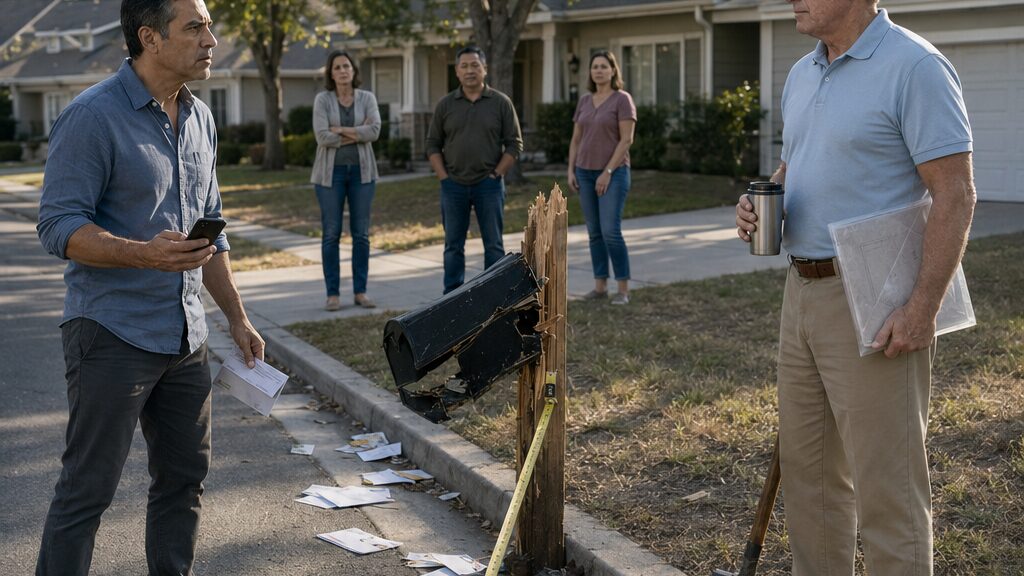
The sound came through the kitchen window like a splitting board—wood, metal, then the hollow clatter of something rolling along the curb. He set down his coffee and crossed the living room without running. By the time he opened the front door, George Campbell had raised the sledge again.
“Don’t,” Daniel said.
George brought it down anyway.
The black mailbox folded sideways. Its red flag snapped free and landed near the storm drain. Envelopes slid across the asphalt, white against the dark pavement. One stopped beneath George’s polished pickup. Another caught in the grass beside Daniel’s driveway.
George rested both hands on the sledge handle. In his left hand, somehow still upright, was the stainless travel mug he carried every morning.
“You were warned,” he said.
Daniel stepped off the porch. Across the street, a garage door had stalled halfway open. A woman stood behind it in slippers. Farther down the block, a man walking a terrier had stopped without pretending otherwise.
“By whom?”
George nodded toward the broken post. “Architectural standards. Forty-two inches maximum from the curb line. Yours was forty-eight.”
“That isn’t an answer.”
“It’s six inches too high, Daniel.”
George said his name the way people did when they wanted restraint to sound like condescension.
Daniel looked at the exposed screws, the split cedar post and the mail scattered beside George’s shoes. His first impulse was not to strike him. It was worse. It was to make George understand, instantly and completely, how much damage one stupid decision could cause.
Instead, Daniel took out his phone.
George smiled. “Go ahead.”
Daniel photographed the post, the mailbox shell, the letters in the road and George standing beside them. He moved slowly enough that no one could later describe him as agitated.
“Are you claiming the board authorized this?” Daniel asked.
George lifted his mug. “I’m saying they should have handled it before it became necessary.”
“That wasn’t my question.”
“They knew about the violation.”
“Did they authorize you to destroy my mailbox?”
George’s smile thinned. “You always want everything in writing.”
Daniel looked toward the small camera mounted beneath his roofline. Its blue status light was on.
“Yes,” he said. “I do.”
A delivery truck turned onto the street, slowed near the gathering and then continued without stopping. The driver glanced twice at the wreckage.
George set his mug on the hood of his truck and opened the rear door. He returned with a folded sheet protected by a cloudy plastic sleeve.
“There,” he said.
The page showed a mailbox diagram, a curb line and two measurements printed beside arrows. At the top was the faded logo of the Maple Ridge Community Association. One figure read forty-two inches. Another, partly obscured by a crease, appeared to refer to post setback.
Daniel held out his hand.
George did not give him the page. “You received this.”
“No.”
“It went to everyone.”
“When?”
“Years ago. Standards don’t expire because you ignored them.”
Daniel enlarged a photograph of the diagram on his phone. At the bottom corner, beneath George’s thumb, he caught a revision date.
Six years earlier.
Daniel had bought the house four years ago.
The woman behind the half-open garage came closer. “Was there an actual violation notice?”
George answered before Daniel could. “There were conversations.”
“With him?” she asked.
“With the board.”
Daniel crouched beside the wreckage. He picked up an envelope addressed to his late wife. The sender was an insurance company that had not updated its mailing list despite three calls. Elena’s name, printed in block letters, was smeared where the envelope had dragged through dirt.
For one sharp moment, the street disappeared. There was only the envelope in his hand and George standing over the remains of something Elena had chosen.
She had ordered the mailbox herself after they closed on the house. Matte black, plain, no decorative scrollwork. She had stood at the curb while Daniel installed it and told him to lift the post another inch because the street dipped.
“We earned the right to be boring here,” she had said.
George tapped the paper sleeve. “You can make this dramatic, or you can correct it.”
Daniel rose.
“Do you have a tape measure?”
George gave a small laugh. “You’re looking at the result.”
“I asked whether you have one.”
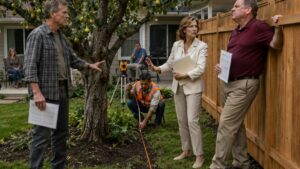
The terrier owner retrieved a steel tape from his garage. Daniel hooked it at the asphalt beside the curb and pulled it vertically against the remaining post. The jagged top sat just below the original mounting screws.
Forty-three and three-quarter inches.
George stepped in. “You’re measuring from the wrong point.”
Daniel reset the tape at the gutter lip, then at the road surface, then from the curb crown. None produced forty-eight inches.
George’s jaw tightened. “The box itself sat higher.”
Daniel placed one broken side panel against the screws and measured again.
Forty-five inches at the highest edge.
The neighbor with the terrier leaned closer. “That’s not six inches.”
“It was out of compliance,” George said. “The board has been letting these things slide for years.”
Daniel photographed every measurement. Then he laid the steel tape across the broken post, its yellow blade bright against the splintered cedar and gray road.
George reached toward it. “That proves nothing without the proper standard.”
Daniel blocked his hand without touching him. “Then send me the current standard.”
“I just showed you.”
“You showed me a page dated six years ago.”
The garage-door neighbor looked at George. “Are you still on the architectural committee?”
George took his mug from the truck. “I still help where I’m needed.”
That answer changed the silence around them. Until then, the neighbors had watched a dispute. Now they were measuring George too.
Daniel gathered the undamaged mail and placed it on the porch. He left the broken pieces where they had fallen.
“Move your truck,” he said. “I’m calling the police.”
George’s face colored, but his voice remained level. “You want officers out here over a mailbox when this could have been resolved months ago?”
“You destroyed property that didn’t belong to you.”
“I corrected a violation.”
“No. You chose a tool.”
George looked around at the people watching him. “Everyone complains that the board does nothing. Then someone takes responsibility and suddenly that’s the problem.”
He climbed into his truck, leaving the old diagram on the hood for one second before snatching it back. The engine started with a smooth, expensive hum.
As he pulled into his driveway across the street, Daniel noticed that George’s travel mug remained in the cup holder, steady as if the morning had proceeded exactly as planned.
The responding officer arrived twenty minutes later. Daniel gave concise answers, showed the photographs and pointed out the camera. George watched from inside his garage but did not come back across the road.
When the officer asked about the value of the mailbox and post, Daniel hesitated.
“Replacement value,” the officer clarified. “Not sentimental value.”
Daniel looked at Elena’s envelope on the porch.
“About three hundred dollars,” he said.
After the officer left, Daniel went inside and opened the security-camera application. The footage began with an empty street, then George crossing from his driveway carrying the sledge and his mug.
Daniel watched without sound first.
George inspected the post. He measured nothing. He struck once, stepped back, and looked toward Daniel’s house. Then he struck again.
Daniel turned up the volume.
Wind hissed across the microphone. Metal cracked. George muttered something after the first blow, too low to hear. Daniel replayed it, increased the volume and leaned toward the screen.
On the fourth attempt, the words became clear.
“They should have let me handle it months ago.”
Daniel froze the frame.
George was not looking at the mailbox when he said it. He was looking toward Patricia Clark’s house at the end of the block.
Chapter 2: The Rule Book Did Not Match the Warning
The HOA portal showed no open violation under Daniel’s address.
He searched again using his lot number, street name and account ID. The results remained the same: annual dues paid, landscaping review closed, roof-color request approved, no active enforcement matters.
No mailbox warning. No hearing notice. No architectural demand.
Daniel printed the page anyway.
His kitchen table had become a records desk by noon. On one side sat the broken red flag, two bent screws and the police incident card. On the other were the current community handbook, George’s photographed diagram and a legal pad divided into columns: date, source, claim, contradiction.
Daniel worked for the municipal records office downtown. He knew that people lied in conversation and made mistakes in memory. Documents did both less often, but not never.
The current handbook had been revised eighteen months earlier. Under Mail Receptacles, it required installation consistent with postal guidelines and listed an acceptable height range of forty-one to forty-five inches from road surface to the point of mail entry.
Daniel’s box had been forty-four and a half.
George’s older sheet listed forty-two inches, but its arrow ended at the bottom of the box rather than the mail-entry point. If both diagrams were followed literally, they could produce different measurements for the same installation.
Daniel placed them side by side.
Beside one, he wrote: Current standard.
Beside the other: Distributed when? By whom?
His phone rang.
“Mr. Rivera?” the officer said. “I reviewed your video.”
Daniel straightened. “All of it?”
“Yes. The act appears intentional. I’m documenting it as property damage, not an accident or maintenance dispute.”
“And the HOA issue?”
“Separate matter. A homeowners association can issue notices or seek remedies under its documents. That does not authorize a neighbor to destroy your property.”
The sentence should have satisfied him. It did, briefly.
“Will you speak to George?”
“I already did.”
Daniel glanced through the window. George’s garage was closed.
“What did he say?”
“That he believed he was abating a violation. Belief doesn’t transfer ownership.”
The officer explained the next procedural steps. The report would be available after review. Daniel could provide repair estimates and additional records. Charges, if any, would depend on the complete facts and local standards.
No dramatic arrest. No immediate judgment. Just a case number and a process.
Daniel thanked him and wrote the time of the call on his legal pad.
At 12:47, Patricia Clark emailed.
Daniel,
I understand there was an unfortunate incident this morning. Before materials are circulated broadly, I would appreciate an opportunity to speak with both parties and determine whether a neighbor-level resolution remains possible.
Please refrain from uploading video to the association portal until we can assess privacy and liability concerns.
Patricia Clark
Board President
Daniel read the message twice.
She did not ask whether he was safe. She did not ask whether his mail had been damaged. She called it an unfortunate incident and placed the first explicit request on him.
He attached the current rule, the photographed old diagram and a still image of George holding the sledge. Then he stopped before sending.
Elena would have told him to wait ten minutes.
Not because Patricia deserved protection. Because anger liked to dress itself as efficiency.
Daniel set a timer.
At minute seven, Patricia called.
“I’d rather not have a permanent written misunderstanding before we’ve spoken,” she said.
“It became permanent when George broke the post.”
A pause. “I’m not minimizing that.”
“You asked me not to submit evidence.”
“I asked you to delay. The association must consider privacy rights, insurance reporting and whether the camera captured neighboring property.”
“It captured my mailbox.”
“And portions of the street.”
Daniel looked at the paused image on his laptop. George stood in the center, face visible, sledge raised.
“Did you give him authority to inspect my property?”
“No.”
“Did any board member?”
“Not to my knowledge.”
“Did you send him the old diagram?”
Another pause, shorter this time.
“George has retained materials from when he volunteered with the architectural committee.”
“Is he still on it?”
“No.”
“Does he perform inspections for the board?”
“We do not use that term.”
Daniel leaned back. “What term do you use?”
“Daniel, Maple Ridge has always depended on residents raising concerns. George has lived here a long time. He notices things.”
“So do security cameras.”
Her tone cooled. “I am asking for several hours to speak with counsel and management.”
“You had months, apparently.”
“What does that mean?”
Daniel played the clip through his laptop speakers. George’s voice emerged beneath the wind: They should have let me handle it months ago.
Patricia did not speak.
“Who is ‘they’?” Daniel asked.
“I can’t interpret a private remark.”
“He looked toward your house.”
“That is not evidence of authorization.”
“No. But it is a reason not to wait.”
Daniel ended the call before she could turn the conversation back into procedure.
At 1:18, he uploaded the footage, photographs, police incident number and both diagrams to the HOA portal. He selected Board Review and Property Damage. In the description box, he wrote only verifiable facts.
When he clicked submit, a small rush moved through him—not relief, exactly, but the clean satisfaction of a door locking.
He disliked that feeling enough to notice it.
By midafternoon, the management representative acknowledged receipt. A code-enforcement inspector scheduled a site visit for later in the week. Daniel ordered replacement estimates but did not authorize work; the post remained evidence.
At 3:06, Patricia sent another message.
This one contained no greeting.
The board will review your submission. Please understand that dissemination beyond necessary parties may complicate resolution.
Attached beneath her message was a forwarded email chain. Patricia had apparently intended to send only the top reply, but the older messages remained below it.
Daniel scrolled.
One board member had complained about a basketball hoop left near the curb.
Another had mentioned trash bins visible from the street.
Then, six months earlier, Patricia had written:
George can include it in his neighborhood checks. He usually gets voluntary compliance without forcing us to open a formal case.
Daniel read the line again.
Below it, George had replied from his personal address.
I’ll take care of it.
There were eleven similar exchanges in the chain.
None called him an inspector. None explicitly authorized destruction. But each gave him an address, a complaint and the expectation that he would make the problem disappear.
Daniel printed the entire thread.
On the final page, beside George’s name, he wrote a new question.
How many times had “I’ll take care of it” meant something no one wanted recorded?
Chapter 3: When One Broken Mailbox Stopped Being Private
Benjamin Garcia did not look impressed by the police report.
He read the first page, glanced at the photographs and pushed the papers back across the postal counter.
“We can hold your mail,” he said. “We cannot simply pretend the delivery point still exists.”
“I’m replacing it.”
“When?”
“As soon as the police and code inspector release the site.”
Benjamin folded his hands. He was broad-shouldered, gray at the temples and spoke with the careful flatness of someone who had spent years explaining rules to people already angry before they arrived.
“Your address is part of a curbside sequence,” he said. “The carrier approaches from the same direction, serves seven boxes and exits through the turnaround. Yesterday there was debris in the road, people standing in the delivery path and a damaged post leaning toward the lane.”
“That was one morning.”
“The carrier filed a safety notice.”
Daniel felt an answer forming—George caused it—but Benjamin continued.
“Until the obstruction is cleared and the receptacle is restored, we can hold affected mail or approve a temporary delivery arrangement. We do not deliver around an unsafe stop because the homeowner did not create the hazard.”
“How many addresses are affected?”
“Potentially seven for letter delivery. Parcel handling varies.”
Daniel stared at him. “Seven houses?”
“Potentially.”
“It’s one mailbox.”
“It’s one designated stop inside a connected route.”
Six inches, Daniel thought.
Six inches had become seven houses.
Benjamin handed him a yellow form and marked three boxes. Mail could be collected at the station with identification. Prescription items could be prioritized if residents contacted the supervisor. Larger parcels might be routed to a distribution facility fourteen miles away, depending on timing and carrier capacity.
“Fourteen miles?”
“That is where held parcels from this route may be staged.”
Daniel imagined George hearing the number. He imagined watching the casual confidence drain from his face.
The thought gave Daniel a brief, shameful pleasure.
He completed the form.
By the time he returned to Maple Ridge, the neighborhood email chain had already begun.
Does anyone know why mail was not delivered today?
The carrier told me there is a safety dispute.
Are we seriously losing package delivery because two homeowners cannot resolve a mailbox issue?
Daniel parked in his driveway and saw Emily Johnson waiting beside the broken post.
She held her phone in one hand and a white pharmacy notification in the other.
“Tell me this isn’t because of your complaint,” she said.
Daniel closed the car door. “The complaint is about George destroying my property.”
“My father’s medication was supposed to come this morning.”
“I didn’t stop delivery.”
“The post office said there’s a route hold tied to this address.”
“George created the hazard.”
“And you left it here.”
The words struck harder because they were partly true.
“The police asked me not to alter the scene until it was documented.”
“Was it documented?”
“Yes.”
“Then why is it still in the road?”
“It isn’t in the road.”
Emily pointed to the splintered base leaning toward the curb. “The carrier thinks it is.”
Daniel looked at the wreckage as the delivery driver must have seen it: jagged wood, exposed screws, broken metal and a camera pointed toward the lane. Not evidence. Risk.
“I just spoke to the supervisor,” he said. “Prescription items can be released for pickup.”
“My father doesn’t drive.”
“I’ll take you.”
Emily’s expression shifted, but not enough to become gratitude. “That doesn’t fix tomorrow.”
“No.”
“Did you know other houses could be affected when you filed?”
“No.”
“Do you know now?”
Daniel met her eyes. “Yes.”
She folded the pharmacy notice into quarters. “Then put that in your email to everyone. Not just what George did. What happens next.”
He almost told her the board had been using George for unofficial enforcement. He almost showed her Patricia’s email chain and the current measurements and the officer’s classification.
Instead, he heard how it would sound: more evidence offered when someone needed medicine.
“I’ll send the pickup instructions,” he said.
Emily nodded once. “Good.”
Daniel drove her to the station. Benjamin located the prescription package and released it after checking identification and authorization. On the return trip, Emily sat with the padded envelope on her lap.
“My father thinks the HOA is the government,” she said.
Daniel glanced at her.
“He gets every envelope and assumes someone can take the house if he signs the wrong line. George came by last year about our trash cans. Dad moved them into the garage even though he couldn’t lift the lid afterward.”
“Did George say he was with the board?”
“He said he was helping the board avoid a formal violation.”
That was careful language. Not quite a lie. Not honest either.
“Why didn’t you complain?”
Emily looked out the window. “Because moving the cans was easier.”
There it was—the small surrender that had made George useful.
Back home, Daniel wrote a message to the affected residents. He explained the safety notice, included the station address, pickup hours, identification requirements and Benjamin’s direct extension for urgent medication. He also offered transportation to anyone who needed it.
He did not mention that he had felt satisfied when the process began tightening around George.
He did not mention that, until Emily confronted him, he had viewed every new consequence as proof that he had chosen the correct path.
Replies arrived within minutes.
Two neighbors thanked him.
One accused him of weaponizing the post office.
Another asked why he had called police instead of allowing George to replace the box.
Patricia wrote privately:
This is precisely the broader disruption I hoped to prevent.
Daniel typed, George could have prevented it by not destroying the mailbox.
He deleted the sentence and replaced it with:
Please provide written confirmation that George Campbell has no authority to inspect, alter or enforce conditions on private lots.
Patricia did not answer.
Near sunset, Daniel carried the largest mailbox fragment into his garage. He left the damaged post standing but removed loose screws and swept splinters from the delivery lane. Then he placed two reflective cones around the base.
Across the street, George watched from his driveway.
His black pickup had been washed. His travel mug sat on the hood.
When Daniel finished, George crossed the road carrying a boxed replacement mailbox and a new cedar post.
“I’ll install this tonight,” he said.
Daniel looked at the box. It was the same plain black model Elena had chosen.
“How did you know which one?”
“I looked up the property file.”
“You still have access to property files?”
George ignored the question. “This ends the route problem.”
“It doesn’t end the complaint.”
George lowered his voice. “I’ll pay for the materials. I’ll do the labor. You withdraw the police report, the code complaint and the board submission.”
Daniel studied him. For the first time since the destruction, George was not performing for neighbors. No one else stood nearby. His shoulders were rigid, and he kept glancing toward Patricia’s house.
“You said you corrected a violation,” Daniel said. “Why are you offering to replace it at the same height?”
George’s fingers tightened around the cardboard handle.
“Because this has gone far enough.”
“For whom?”
George set the box on the driveway between them.
“For everyone,” he said. “Withdraw the complaints, and tomorrow morning the problem disappears.”
Daniel looked down at the replacement mailbox, then across the street at George’s closed garage.
George was not afraid of the cost.
He was
Chapter 4: The Apology That Asked Daniel to Stay Silent
The replacement mailbox was waiting in Daniel’s driveway when he came home Wednesday evening.
It sat inside an open cardboard box beside a new cedar post, a bag of concrete mix and a polished black mounting bracket. Someone had arranged the pieces neatly enough to resemble a delivery, but there was no receipt, no note and no permission.
A red pencil line circled the post six inches below its top.
Daniel remained behind the wheel for a moment, looking at it through the windshield. The mark was too deliberate to be a measurement made by a store clerk. George had drawn it so Daniel would understand the point before either of them spoke.
Across the street, George’s garage door stood open.
His pickup was backed inside beneath bright ceiling lights. Every tool on the wall hung within a painted outline. George stood at a workbench with his stainless travel mug near his elbow, though the hour was close to dinner.
Daniel took photographs of the materials before touching anything. Then he carried the mailbox box across the street and placed it inside the threshold of George’s garage.
“You left this on my property.”
George did not turn around. “I said I would fix it.”
“You said you would fix it if I withdrew the complaints.”
“That was the sensible part.”
Daniel glanced along the garage wall. Levels, clamps and drill bits were ordered by size. On one shelf sat three white binders labeled ARCHITECTURAL, LANDSCAPING and EXTERIOR STANDARDS.
“You looked up my property file,” Daniel said.
George capped the marker in his hand. “I confirmed the mailbox model.”
“Through what system?”
“I have records.”
“That isn’t what you said yesterday.”
George faced him. Without the audience of the street, his confidence looked thinner. “I served this community for eleven years. Files do not become worthless because a new board decides to reorganize.”
“You were removed from the committee.”
“My term ended.”
“Patricia said you were removed.”
The muscles along George’s jaw tightened. “Patricia changes words to match whoever is standing in front of her.”
Daniel looked at the white binders again. “Does the board still send you complaints?”
George picked up his mug, but did not drink. “People call me because they know I answer.”
“That wasn’t my question.”
“You like that sentence.”
“It keeps being necessary.”
George set the mug down harder than he intended. Coffee rose beneath the lid and wet the rim.
“The board sends messages sometimes,” he said. “A loose fence panel. A basketball hoop. Trash cans left out all week. Things that can be resolved with one conversation instead of certified letters and attorney fees.”
“And my mailbox?”
“I raised it.”
“With Patricia?”
“With more than one person.”
“What did they tell you to do?”
“They told me they would review it.”
“So you destroyed it.”
George stepped closer. “For four months I watched that box sit above the line. I told you twice.”
“You said it looked high.”
“You dismissed me.”
“I asked for the current rule.”
“You always ask for paper as if conversation has no value.”
Daniel heard the grievance beneath the accusation. George had not merely wanted compliance. He had wanted his word to carry weight.
“You could have filed a formal complaint.”
“And waited six months while the board sent polite reminders? Standards only work when someone maintains them.”
“Standards didn’t swing the sledge.”
George looked past Daniel toward the street. His voice lowered.
“I made a mistake in method.”
It was the closest thing to an apology Daniel had heard from him.
“In method,” Daniel repeated.
“The box should have been removed through the association.”
“It should not have been removed at all.”
George’s eyes hardened again. “That remains disputed.”
Daniel nearly laughed. Instead, he pointed toward the replacement materials in his driveway.
“You marked the new post six inches lower.”
“I marked the old standard.”
“The current standard says my original height was allowed.”
“The current standard is vague.”
“Then why replace it with the same model?”
“Because people need their mail.”
“Emily needed her father’s medication yesterday.”
Something changed in George’s face. Not guilt. Recognition.
“She got it,” he said.
“Because I drove her fourteen miles.”
George turned away and aligned a wrench that was already straight. “This is exactly why we should settle it.”
“We?”
“You withdraw the police report, code complaint and board submission. I install the new post tonight. Delivery resumes tomorrow. No fines. No insurance claim. No public hearing.”
“And what happens the next time you decide someone’s fence, tree or mailbox is wrong?”
“I won’t touch your property again.”
“That wasn’t what I asked.”
George’s hand remained on the wrench. “You want me stripped of every role I have left.”
The words settled between them.
For the first time, Daniel saw the garage not merely as proof of George’s need for control, but as the place where he stored the evidence that he had once mattered. Committee binders. Old inspection photographs. Copies of standards no longer in force. A neighborhood reduced to folders he could still open.
It did not excuse the sledge.
It made the fear behind his offer visible.
“You told everyone you acted for the board,” Daniel said.
“I said the board knew about the violation.”
“You let them believe you had authority.”
“I had more authority than Patricia wants to admit now.”
“Then put that in writing.”
George turned sharply. “Why?”
“So the record is complete.”
“There it is.” George gave a humorless smile. “The record. You don’t want repair. You want a file thick enough to bury me.”
Daniel felt the accusation land because part of it was true.
He imagined the code citation, the police report, the HOA fine and the insurance demand arriving one after another. He imagined George forced to explain each one. The picture was satisfying in a way Daniel did not want to examine.
“You stood in front of my house,” Daniel said, “with my mail in the street, and told people you corrected me.”
“I was wrong to damage it.”
“Say the rest.”
George looked at him for several seconds. “Withdraw the complaints.”
“No.”
“Then don’t pretend this is about a mailbox.”
Daniel stepped out of the garage.
“It stopped being about a mailbox when you made it public.”
He crossed the street, carried the replacement materials to the side of his house and photographed the six-inch mark again. Then he went inside and opened the evidence folder on his computer.
Patricia’s forwarded email chain sat at the top.
Daniel added George’s offer, the unapproved replacement materials and a written account of their conversation. He attached the photograph of the white committee binders visible inside George’s garage. He knew the image did not prove continued authority, but he included it anyway.
The upload page asked whether the submission contained all relevant evidence.
Daniel checked yes.
Then, still angry, he added the entire neighborhood email chain—including messages from residents who had blamed him for the delivery hold.
That material did not prove what George had done.
It proved how far the consequences had spread.
Daniel knew the distinction. He clicked submit anyway.
The satisfaction returned, sharper this time.
At 9:12 that night, Patricia called.
“You have expanded this beyond the property-damage complaint,” she said.
“George admitted the board still sends him resident concerns.”
“He made that statement to you?”
“In his garage.”
“Was it recorded?”
“No.”
“Then we need to be careful.”
“You were careful for years. That’s the problem.”
Patricia exhaled. “An emergency hearing has been scheduled for tomorrow at seven. Both you and George will receive formal notice.”
“What is being reviewed?”
“Unauthorized enforcement activity, property damage and disruption to community services.”
“George caused the disruption.”
“The delivery interruption followed actions taken by several parties.”
Daniel stood very still. “What violation are you claiming I committed?”
“I am not claiming anything yet.”
“Then why am I under review?”
“Because your decision to pursue overlapping police, postal, code and association remedies may have amplified the impact on other residents.”
Daniel looked through the window at the reflective cones around the broken post.
“I used the procedures available to me.”
“Yes,” Patricia said. “And the board will determine whether both owners failed to mitigate the resulting harm.”
Before ending the call, she promised to send the agenda.
It arrived two minutes later.
George Campbell was listed beneath Unauthorized Alteration of Private Property.
Daniel Rivera was listed beneath Community Disruption and Failure to Mitigate.
The notice warned that daily fines could be assessed against either property.
Chapter 5: The Board Had Used George Until He Became Dangerous
Daniel’s name appeared on the projection screen before he entered the meeting room.
COMMUNITY DISRUPTION — RIVERA PROPERTY.
Below it, in smaller type, were the phrases route interruption, unresolved roadside hazard and escalation across multiple agencies.
George sat in the front row with his arms folded. His travel mug rested beneath his chair.
Patricia occupied the center seat at the board table. Two other board members sat beside her, both avoiding Daniel’s eyes. The management representative arranged papers near a laptop, while residents filled the folding chairs behind them.
Daniel chose a seat beside the aisle.
Emily sat two rows back with her father’s empty prescription envelope folded inside her notebook.
At seven, Patricia called the emergency session to order.
“This hearing concerns a serious breakdown in neighbor relations,” she began, “with consequences extending beyond the two properties directly involved.”
Daniel watched George at the words neighbor relations. The phrase reduced a destroyed mailbox to mutual friction.
Patricia summarized the chronology without naming who had swung the sledge until the fourth minute. She mentioned an alleged height discrepancy, informal communications, property damage, law-enforcement involvement and temporary postal restrictions.
Then the management representative displayed Daniel’s photograph of the tape measure.
The yellow blade stretched from the curb to the broken post. Letters lay in the gutter behind it.
A second image appeared beside it: George’s older diagram.
“Mr. Campbell relied upon this standard,” Patricia said.
Daniel raised his hand. “That document was superseded before I purchased the house.”
“You will have time to respond.”
The current guideline appeared next. Forty-one to forty-five inches measured at the point of mail entry.
“Mr. Rivera’s submitted photographs indicate an original height of approximately forty-four and one-half inches,” Patricia said. “The association has found no formal open violation for the property.”
A murmur moved through the chairs.
George leaned toward the table. “That rule was revised without a neighborhood notice.”
“One at a time,” Patricia said.
“You asked me to address it under the old standard.”
The room went quiet.
Patricia’s face did not change, but one board member looked down at his papers.
“I did not ask you to damage property,” she said.
“I didn’t say you did.”
“You just implied authorization.”
“I said you sent me the address.”
Daniel felt the room turn.
The management representative attempted to interrupt. “We should distinguish between reporting conditions and enforcement—”
George pointed toward the screen. “Patricia sent me a photo in February. She asked whether the box looked high. I told her it did. She said, ‘See whether Daniel will correct it without making this formal.’”
Patricia’s voice became precise. “That was not authority to enter his property.”
“No. It was authority to speak with him.”
“And you exceeded it.”
George laughed once, quietly. “Now I exceeded it. For years, I saved this board from sending letters over things that could be fixed in five minutes.”
Daniel looked toward Patricia. “Is that true?”
She rested both hands on the table.
“We permitted long-term residents to communicate concerns informally.”
“Not residents,” Daniel said. “George.”
“One of several.”
“Name another.”
Neither board member answered.
Daniel opened the printed email chain. “You wrote, ‘George can include it in his neighborhood checks. He usually gets voluntary compliance without forcing us to open a formal case.’”
A resident near the wall said, “Neighborhood checks?”
Patricia’s composure cracked—not into panic, but fatigue.
“Formal enforcement costs money,” she said. “Management letters, inspections, counsel review. Many issues are simple. A bin left out, an overgrown hedge, a portable hoop. George was willing to speak with people.”
“And if they didn’t listen?” Emily asked.
Patricia looked toward her.
“My father moved our trash cans because George told him a formal violation could threaten the house,” Emily said. “Was that from the board?”
George turned in his chair. “I never said the board would take his house.”
“You told him fines could become liens.”
“They can.”
“He is seventy-eight.”
“And the cans were visible from the street for nine days.”
The answer carried no cruelty in George’s mind. That was what made it worse. He believed the number settled the question.
Patricia rubbed one thumb along the edge of her agenda.
“We should have ended the informal practice when George left the committee,” she said.
“Left?” Daniel asked.
One board member finally spoke. “He was removed after repeated complaints about tone and entering side yards without appointments.”
George turned toward him. “You voted to thank me for my service.”
“We did not tell residents clearly that you no longer represented the committee,” the board member said.
Patricia closed her eyes for half a second. “No, we did not.”
There was the deeper truth: George’s authority was unofficial, but it had not been invented from nothing. The board had used his certainty because it was cheaper than governance. Residents had complied because resistance took time. George had mistaken usefulness for permanent jurisdiction, and the board had allowed that misunderstanding to serve them.
Daniel should have felt vindicated.
Instead, he saw Emily’s prescription envelope and the heading above his own name.
Patricia moved to the postal disruption. “The association acknowledges Mr. Campbell created the initial hazard. However, Mr. Rivera delayed immediate replacement while pursuing documentation.”
“The police asked me to preserve the scene,” Daniel said.
“For the morning,” George replied. “You left it there another day.”
“I removed every loose screw and cleared the lane.”
“After deliveries stopped.”
Daniel faced him. “You destroyed it.”
“And you made sure everyone felt it.”
The accusation drew scattered agreement from the back rows.
Daniel looked at the projected photograph again. The tape measure had once represented control: an exact number against George’s claim. Now the letters in the gutter mattered more.
Patricia said, “Mr. Rivera, did the postal supervisor explain that nearby addresses might be affected?”
“Not until Tuesday.”
“After learning that, did you authorize immediate replacement?”
“No.”
“Why not?”
Daniel could say evidence preservation. He could say the site inspection had not occurred. Both were true.
Neither was complete.
“Because George conditioned replacement on withdrawing the complaints,” he said.
“That happened Tuesday evening,” Patricia replied. “What about after you rejected the condition?”
Daniel heard the trap, but it was not fabricated.
“I wanted the code inspector to see the original installation.”
“And did you understand residents might continue collecting parcels fourteen miles away?”
“Yes.”
Emily shifted behind him.
Daniel turned slightly toward her. “I sent pickup instructions. I drove Emily to get the medication.”
“You did,” Emily said.
The room waited.
She continued, “He also arranged rides for two other residents and gave everyone the supervisor’s number. But I had to confront him before he understood the rest of us were part of it.”
Daniel lowered his eyes.
The small defense hurt more than full support would have.
George leaned forward. “He knew exactly what he was doing. Every agency he could call, he called. Police, postal service, code enforcement, HOA. He wanted pressure.”
Daniel looked at him. “Yes.”
The answer silenced the room.
Patricia frowned. “Yes to what?”
“To pressure.” Daniel stood, though no one had invited him to. “I wanted a complete record. I wanted George unable to call this a misunderstanding. And after the route hold started, there was a point when I stopped caring whether the consequences reached anyone else.”
Emily watched him without blinking.
“I did not cause the damage,” Daniel continued. “I did not create George’s authority. But I treated every new procedure as proof that I was winning. That was wrong.”
George’s expression shifted with surprise, then opportunity. “So this is mutual.”
“No.”
Daniel’s voice remained quiet.
“My mistake does not make your act mutual. It makes my part mine.”
He placed a folder on the table. Inside were the current standard, George’s diagram, Patricia’s emails, the police classification and the postal notices.
The board had prepared a settlement. Daniel had received it an hour before the meeting: George would pay replacement costs and a reduced association fine. Daniel would withdraw his code complaint, accept a warning for failure to mitigate and agree not to circulate internal correspondence.
Patricia slid a copy toward him now.
“This resolves the immediate issues,” she said.
Daniel did not touch it.
“It resolves the paperwork.”
“It restores the mailbox and assigns costs.”
“It preserves the practice that caused this.”
Patricia’s eyes hardened. “The board has already acknowledged the practice was poorly managed.”
“Poorly managed means you might manage it again.”
George stood. “What do you want, Daniel? My house?”
“No.”
“My savings?”
“No.”
“A public apology?”
Daniel considered it. Days earlier, he would have said yes.
“No,” he said again.
He removed a second packet from his folder and placed copies before all three board members.
“I reject the settlement.”
The management representative began to speak, but Patricia raised a hand.
Daniel looked at the photograph still projected behind them—the six-inch measurement, the broken post, the letters in the gutter.
“This is my proposal instead.”
Chapter 6: Daniel Chose a Rule That Applied to Everyone
Daniel’s proposal began with an admission.
I failed to act quickly enough after learning that the damaged delivery point affected neighboring households. Any settlement should acknowledge that failure without equating it to the intentional destruction of property.
Patricia read the sentence twice on Friday morning in the HOA office.
“You understand this could be used against you,” she said.
“It already has been.”
The management representative sat beside her with a legal pad. George had declined to attend the first settlement session, but his attorney had sent written objections.
Daniel’s proposal contained no demand for the largest possible fine. It did not ask the association to publish George’s name or release the security footage.
It required five things.
George would pay the verified replacement cost and accept responsibility for entering Daniel’s property and destroying the mailbox. The board would issue written notice that George held no enforcement authority. All informal neighborhood checks would end. Complaints would go through a documented process with notice and appeal. Finally, the board would create a temporary delivery plan with the postal service until the permanent installation passed inspection.
Patricia tapped the third page.
“This language exposes the association.”
“The emails expose the association.”
“We are trying to resolve a dispute, not draft a confession.”
“You sent private residents to pressure other private residents.”
“We asked volunteers to communicate.”
“Then the new rule should not frighten you.”
The management representative cleared his throat. “The concern is retroactive interpretation. If the association admits George acted as an agent—”
“I didn’t write that.”
“No. You wrote that residents could reasonably believe he did.”
“They could.”
Patricia looked toward the office window. Outside, the Maple Ridge entrance sign stood behind clipped hedges and a bed of seasonal flowers. Everything visible from that room had been designed to suggest order.
“Why remove the daily fine?” she asked.
Daniel had reduced the proposed penalty to documented repair costs, administrative expenses and a limited violation assessment.
“Because the fine is not the point.”
“It was three days ago.”
“Yes.”
She studied him, perhaps searching for a tactic.
Daniel opened the replacement diagram. A red line still marked the cedar post six inches below George’s intended mounting point. He crossed it out.
“The code inspector measured the original screws yesterday,” he said. “The box complied. I want the new one installed at the verified height. Not lower to satisfy George. Not higher to make a point.”
Patricia looked at the crossed-out mark.
“And if George refuses your statement?”
“Then the complaints continue.”
By afternoon, Benjamin Garcia met Daniel, Patricia and the delivery carrier at the curb. The damaged post had been removed after the code inspection. A bright utility flag marked the hole, and the replacement materials remained stacked beside Daniel’s garage.
Benjamin surveyed the seven-house sequence.
“If the association provides written permission for temporary use of the entrance pull-off, we can serve a secured cluster unit there for up to thirty days,” he said. “Residents would receive keys. Parcels too large for the unit would still be held.”
Patricia glanced toward the entrance. “The pull-off is common property.”
“That is why I need written authorization.”
“How soon?”
“Once the unit is available, two business days.”
Daniel expected Patricia to ask about liability. Instead, she took out a pen.
“Send me the form.”
It was a small movement, but it was the first time she had chosen repair before containment.
The temporary unit was approved Monday. Residents no longer needed to travel fourteen miles for ordinary mail. Emily’s father received his next prescription at the station only because it had already entered the hold system; Benjamin flagged future medication for priority handling.
That evening Emily stopped beside Daniel’s driveway.
“He says thank you,” she said.
“For the ride?”
“For fixing what happened after.”
Daniel looked across the street. George’s blinds were closed.
“I should have moved sooner.”
“Yes,” Emily said.
There was no cruelty in it.
Then she added, “You also should not have had to solve all of this because someone broke your mailbox.”
The two truths stood together without canceling each other.
On Tuesday, George appeared at the second settlement session. He wore a blue button-down shirt instead of his usual polo. The travel mug was absent.
He read Daniel’s proposal without looking up.
“I will pay for the mailbox,” he said. “I will accept the property-damage violation. I will not sign paragraph four.”
Paragraph four stated that George had falsely invoked HOA authority when confronting Daniel and had continued informal enforcement after leaving the architectural committee.
“It is accurate,” Daniel said.
“I did not falsely invoke anything. The board sent me the complaint.”
“You told residents you corrected a violation.”
“There was a violation under the standard I was given.”
“You were given an outdated standard.”
“By the board.”
Patricia said, “George, the board did not authorize removal.”
“I have acknowledged the method.”
Daniel watched him retreat into the word again.
“The method was the act,” Daniel said.
George pushed the packet away. “Remove the sentence about false authority, and I sign.”
The management representative proposed alternatives: misunderstood authority, unclear volunteer role, actions beyond communicated expectations.
Each phrase distributed responsibility until none remained.
Daniel could have accepted one. The police report and code case would still exist. George would still pay. The mailbox would be restored. The board would adopt most of the reform.
For several minutes, Daniel stared at the settlement total.
It was less than the amount daily fines could have reached. Less than the insurance demand he could pursue. Enough to replace the property, not enough to humiliate George.
Daniel moved the financial page aside.
“I will waive the request for enhanced fines,” he said. “I will not remove the authority statement.”
George’s eyes narrowed. “So the money never mattered.”
“It mattered when I wanted you trapped.”
“And now?”
“Now I want the next resident to know whether the person at their door can actually enforce anything.”
Patricia read paragraph four again.
“What if we add the board’s failure?” she asked.
George turned toward her.
She took a pen and wrote beneath the disputed sentence:
The association failed to notify residents clearly that Mr. Campbell’s committee service had ended and continued to route informal concerns through him after that date.
The room became very still.
George looked at Patricia as though she had broken something more valuable than the mailbox.
“You are blaming me for doing what you asked.”
“I am accepting that we asked,” she said.
For the first time, her voice carried no procedural shield.
George did not sign.
He stood, gathered none of the papers and left.
The following morning, the board voted to adopt an interim no-self-enforcement policy while settlement continued. All complaints required written intake. Volunteers could not enter lots, issue instructions or imply that fines had been approved.
It was not yet permanent. But it applied to everyone.
Daniel returned home after work to find a woman standing beside George’s pickup. She was in her forties, with George’s posture and none of his certainty. Several cardboard file boxes sat in the truck bed.
“I’m his daughter,” she said.
Daniel waited.
“He told me the board was trying to erase what he did for this place.”
“I’m not asking them to erase it.”
“I know.”
She lowered the tailgate. Inside the boxes were committee minutes, inspection sheets, resident photographs and old copies of architectural standards. Some folders went back more than a decade.
“He kept everything after they removed him,” she said. “He said someone had to remember the rules correctly.”
Daniel touched none of it.
“Why bring it here?”
“Because he won’t.”
She lifted the first box and set it on the pavement between them.
“He started doing those checks before he retired. After my mother died, they were most of what he had left.”
Daniel looked across the street at George’s dark front window.
“That explains why he kept doing it,” he said.
“It doesn’t explain why he broke your mailbox.”
“No.”
She nodded, relieved that he had not offered forgiveness on her behalf.
At the bottom of the second box lay the original committee notice removing George from service. Attached to it was a draft letter intended for all Maple Ridge residents.
The letter stated clearly that George Campbell no longer represented the architectural committee and had no authority to conduct inspections.
Across the top, in Patricia’s handwriting, were three words:
Do not distribute yet.
The draft had never been sent.
Chapter 7: The New Mailbox Stood at the Same Height
The installer held the level against the new cedar post and looked at Daniel over the top of it.
“You want me to drop it six inches?” he asked. “Might save you trouble.”
The old hole had been cleaned out and widened. Fresh concrete waited in a gray mixing tub beside the curb. Behind them, the temporary cluster mailbox still stood near the Maple Ridge entrance, its metal doors marked with strips of blue painter’s tape and handwritten house numbers.
Daniel looked across the street.
George’s blinds were open, but no one stood at the window.
“No,” Daniel said. “Use the verified standard.”
The installer glanced at the paperwork clipped to his board. “Forty-four and a half at the entry point.”
“That’s right.”
“Same as before?”
“The same.”
The installer shrugged and returned to the post. For him, the number was only a number. He adjusted the base, checked the bubble and braced the cedar in place while his assistant mixed the concrete.
Daniel watched the red pencil line George had drawn disappear beneath the mounting bracket.
Three weeks had passed since George’s daughter delivered the committee files. The boxes had not contained a secret order authorizing destruction. They held something less dramatic and more damaging: years of blurred boundaries.
There were emails asking George to “take a look” at properties. Notes thanking him for “handling” complaints. Photographs taken from sidewalks, driveways and, in several cases, side yards. Beside minor issues, George had written dates and short outcomes.
Spoke to owner. Corrected.
Owner resistant. Mention lien possibility.
No formal case needed.
The records also showed that George had once been useful in ways no one at the final meeting denied. He had noticed a failing retaining wall before it collapsed. He had persuaded a resident to move a portable basketball hoop that blocked a fire hydrant. He had organized volunteers after a windstorm and kept contractor vehicles from tearing up newly repaired common landscaping.
Then the notes changed.
After his wife died and his committee service ended, his handwriting became tighter. The word corrected appeared more often. Addresses replaced names. Small deviations became evidence of decline.
The board had prepared a letter telling residents his authority was over. Patricia had stopped it because, according to her handwritten note, distributing it might embarrass a long-serving volunteer and provoke unnecessary questions.
Avoiding one difficult conversation had allowed dozens of smaller ones to continue at other people’s doors.
At the final board meeting, the draft letter lay on the table beside Daniel’s photograph of the broken mailbox.
George attended but sat in the last row.
He wore the same light-blue polo he had worn the morning of the destruction. His travel mug was absent. He kept both hands on his knees while Patricia read the proposed resolution.
The association would acknowledge that George had no authority to conduct inspections or direct residents to alter private property after his removal from the architectural committee. It would also acknowledge that the board had continued forwarding informal concerns to him and had failed to notify residents clearly that his committee role had ended.
All future complaints would require written intake, review by management and formal notice before enforcement. No resident, board volunteer or former committee member could enter another lot, remove property or imply that a fine had been approved.
George would pay Daniel’s replacement costs, the postal unit’s temporary installation fee attributable to the incident and a limited association penalty. The code complaint would remain part of the public record. Daniel would receive no enhanced daily fine payment.
Patricia finished reading.
One board member moved to adopt the resolution. The other seconded.
Before the vote, Patricia looked toward Daniel. “Do you wish to add anything?”
The room turned.
Three weeks earlier, Daniel had imagined this moment differently. He had imagined George in the front row, forced to listen while every document closed around him. He had imagined the satisfaction of hearing the board describe the act in the exact language George could not avoid.
Now George looked smaller than he had in the street, but not innocent. The damage remained deliberate. The fear behind it did not erase the choice.
Daniel stood.
“The mailbox was compliant,” he said. “That matters because George claimed a rule gave him the right to destroy it.”
George’s face remained still.
“But the larger problem was not six inches. It was that the board allowed private pressure to replace an accountable process. George used that permission farther than anyone admits they expected. The board kept benefiting from it after they knew he should have stopped.”
Patricia lowered her eyes.
Daniel continued. “I also let procedure become punishment. When the delivery hold affected other houses, I was too slow to care because I wanted every consequence tied back to him. I cannot ask for one standard to apply to George and another to me.”
Emily sat near the aisle with her father. She gave no sign of approval, but her shoulders eased.
“I support the resolution,” Daniel said. “Not because it makes what happened equal. It doesn’t. I support it because it names each part separately.”
He sat down.
George did not speak.
Patricia called the vote.
It passed unanimously.
Afterward, residents gathered around the printed policy posted near the exit. Some read every line. Others left quickly, perhaps disappointed that the meeting had ended without shouting or removal by police.
Emily’s father stopped beside Daniel.
“That man told me the association could take my house,” he said quietly.
Daniel glanced toward George.
“Under certain circumstances, unpaid assessments can become serious,” Daniel said. “But George had no authority to threaten you.”
The older man nodded as if Daniel had repaired something the policy could not reach.
At the back of the room, Patricia approached George. Their conversation was too low to hear. George answered once, then walked past Daniel without looking at him.
No apology came.
The following Monday, Benjamin Garcia inspected the restored delivery point. He measured the road surface to the mail-entry opening, checked the setback and ran one hand over the secure mounting bolts.
“Forty-four and a half,” he said.
Daniel signed the service-restoration form.
The temporary cluster unit was removed two days later. The delivery carrier returned to the normal route. At Daniel’s house, the truck slowed, the window opened and a small stack of letters slid into the new box with an ordinary metal thump.
The sound stopped Daniel in the driveway.
For weeks, the absence of mail had marked the conflict. Now the return was almost disappointingly quiet.
He opened the box.
There was a utility bill, a grocery flyer, an insurance notice addressed to Elena and a plain envelope from the association containing the final policy.
Daniel held Elena’s letter separately.
He had once believed belonging meant never giving anyone a reason to question whether he had earned his place. That fear had made documentation feel safer than conversation and punishment feel cleaner than vulnerability.
Elena had understood something he had not.
They had earned the right to be ordinary, not the obligation to be beyond criticism.
That evening, Daniel removed the last reflective cone from the curb. As he carried it toward the garage, George crossed the street.
He had no mug, no binder and no document in his hands.
Daniel stopped beside the new mailbox.
George looked at the post, then at the curb. “They used the old hole.”
“The original location complied.”
“I know.”
The admission was quiet enough that traffic from the main road nearly covered it.
George reached into his back pocket and removed a bent metal ruler. It was Daniel’s old twelve-inch shop ruler, the one that had been lying near the broken post after the police finished their photographs. One edge was scraped, and the center bowed where the sledge or mailbox had struck it.
“I took this that morning,” George said.
Daniel looked at him. “Why?”
“I thought it was mine.”
It was not an apology. It was, perhaps, the most accurate sentence George had offered.
He held out the ruler.
Daniel accepted it.
George glanced toward the black mailbox standing at exactly the same height as before.
“The board should have sent that letter,” he said.
“Yes.”
“They asked me to keep helping.”
“Yes.”
George’s mouth tightened. “I still made the choice.”
Daniel waited.
George looked across the street toward his garage. “I paid the invoice this morning.”
“I received the notice.”
Another silence followed. Neither man attempted to fill it with forgiveness they did not possess.
Finally, George nodded toward the ruler. “It won’t lie flat anymore.”
Daniel ran his thumb along the bend.
“No,” he said. “But it still measures.”
George returned home.
Daniel remained at the curb until the garage door across the street closed. Then he placed the bent ruler inside the new mailbox for a moment, its twelve inches resting beneath the ordinary letters.
Six inches had started the argument. The other six had been everything neither man had measured: pride, fear, permission, grief, consequence and the distance between being right and doing right.
Daniel carried the ruler inside.
The mailbox stayed where it had always belonged.
The story has ended.