They Called Him the Angry Neighbor Until the School Pickup Line Reached His Front Door
Chapter 1: The Minivan That Stayed Twenty-Two Minutes
The silver minivan appeared in the corner of Scott Adams’s computer screen before he noticed it through the window.
He was sharing a network diagram with six people when the vehicle rolled across the mouth of his driveway and stopped sideways, its hazard lights blinking against the afternoon glare. The front bumper covered one edge of the concrete apron. The rear extended past the other.
Scott lost his place in the presentation.
“Scott?” his client said through the headset. “You were saying the failure point was between the two servers?”
He looked back at the monitor. His cursor rested over the diagram, but the words had gone.
“Yes,” he said. “Sorry. The secondary server isn’t receiving the updated certificate.”
Outside, the minivan’s driver lifted a paper coffee cup from the console. Her other hand held a phone.
Scott continued the explanation while watching the hazards pulse beyond the home-office window. On. Off. On. Off. A bright yellow sign stood on the fence post four feet from the minivan’s passenger window.
NO PARKING
PRIVATE PROPERTY
DRIVEWAY MUST REMAIN CLEAR
He had installed it three years earlier, after the first month of afternoon traffic from the elementary school two blocks away. The sign was not subtle. Its yellow surface had faded around the edges, but the black lettering remained sharp.
The minivan did not move.
At 2:51, Scott muted himself, typed a note in the meeting chat, and stepped outside.
The driver glanced up only after he tapped lightly on the glass. She was a woman in her early forties, wearing sunglasses pushed into her hair. A canvas school tote sat on the passenger seat beside a stack of folders.
She lowered the window two inches.
“You’re blocking my driveway,” Scott said.
She looked toward the school, then at him. “I’m only going to be another minute.”
“I need you to move now.”
Her mouth tightened. “I’m waiting for my daughter.”
“I understand. You still can’t block the driveway.”
She glanced at the yellow sign as if seeing it for the first time, though its reflection stretched across her side window.
“There’s nowhere else,” she said.
“There are spaces farther down.”
“I’ll be gone in a minute.”
Scott stood there, expecting the brake lights to change.
Instead, she raised the window.
He remained beside the driveway for several seconds, arms at his sides. Then he returned to the house because his meeting was still running, his client was still waiting, and he could already hear the woman’s version of the encounter forming: a strange man standing beside her car while she waited for her child.
Back at his desk, he apologized without explanation and resumed the presentation.
The minivan stayed visible through the window.
At 2:58, a second vehicle stopped along the curb opposite his house. At 3:03, children began appearing at the end of the block in small clusters, backpacks bouncing behind them. At 3:07, the minivan was still there.
Scott checked the time again.
The woman had said one minute.
He had learned, over the years, that a temporary inconvenience became permanent the moment everyone agreed not to count it. A trash bin left in the street for one extra day. A dog allowed off leash just this once. A contractor’s truck across the sidewalk until the job was done.
Hazard lights had become the neighborhood’s way of saying rules no longer applied.
At 3:11, his client asked whether he could stay ten minutes past the scheduled end of the call.
Scott looked at the minivan.
“Yes,” he said.
At 3:13, the woman’s daughter climbed into the passenger side. The driver did not pull away. She handed the child something from the back seat, checked her phone, and took another drink of coffee.
Scott’s jaw tightened.
At 3:14, he picked up his own phone and photographed the vehicle from inside the office. The image captured the license plate, the yellow sign, the concrete driveway, and the blinking hazards.
At 3:15, the minivan finally moved.
Twenty-two minutes after the woman had promised one.
Scott wrote the times in a small notebook beside his keyboard.
2:53 — asked driver to move.
3:15 — vehicle left.
He closed the notebook before the meeting ended.
The next afternoon, three cars crowded the curb near his house. None blocked the driveway completely, but one stopped close enough that Scott would have needed to make a sharp turn to enter. He went outside with three handwritten notes.
Please keep this private driveway clear. It is in active use during school pickup hours. Thank you.
He placed one beneath each windshield wiper.
The gesture felt almost embarrassingly mild. He preferred that. A note allowed everyone to correct the behavior without being publicly wrong.
By Thursday, two of the same cars had returned.
One note lay crumpled in the gutter.
The silver minivan came last. It stopped with its rear tire across the edge of the driveway, not enough to seal it completely, but enough to make the intention clear.
Scott stepped onto the porch.
The driver saw him. She looked directly at the house, then turned away.
He walked down the path.
This time she lowered the window before he reached the vehicle.
“You again,” she said.
“You’re in the driveway again.”
“I’m not blocking the whole thing.”
“That isn’t the rule.”
She gave a short laugh. “You have plenty of room.”
“It’s my driveway.”
“And this is school pickup. Everybody’s trying to get their kids.”
Scott felt the familiar pressure in his chest, sharp and unreasonable in its speed. He looked past her toward the yellow sign. For a moment the present scene thinned, and another vehicle occupied the same space, another afternoon, another phone vibrating in his hand.
He pushed the memory down before it could form.
“Please move,” he said.
The woman took off her sunglasses.
“What’s your name?”
He did not answer immediately.
“That’s what I thought,” she said. “You come out here taking pictures of women in their cars, and then you act like we’re doing something to you.”
“I photographed a vehicle blocking my property.”
“You threatened to have me removed.”
“I asked you to move.”
Her expression changed—not softer, but more certain. She had found the version of him she wanted.
“You need to calm down.”
Scott stepped back from the window.
The minivan remained until her daughter arrived.
That evening, he was washing a coffee mug when his phone vibrated on the counter. The message came from a neighbor who rarely contacted him.
Thought you should see this.
Below it was a screenshot from a neighborhood parent thread.
Amanda Carter had posted a photograph of Scott’s house. The frame cut off most of the driveway and showed only part of the yellow sign. Beneath it, she had written:
Be careful near the corner house. The angry driveway man came out taking pictures and threatening moms again.
The replies had already begun.
One person called him unstable.
Another said he should park on the street like everyone else.
A third asked whether the HOA knew he was photographing children.
Scott enlarged the screenshot until the words blurred.
At the top of the thread, Amanda had added one final message.
Don’t engage with him alone.
Chapter 2: The Notes They Hid Inside Their Glove Compartments
The note appeared beneath the windshield wiper of Scott’s own car on Friday morning.
It was one of his handwritten warnings, folded twice and damp around the edges. Someone had placed it there after dark.
He opened it on the porch.
His original message remained visible on the inside. Across the back, in blue ink, someone had written:
Find a hobby.
Scott looked toward the street. The neighborhood was quiet except for a sprinkler clicking across a lawn. His yellow sign stood where it always had, facing the road.
He carried the note inside and placed it beside the notebook containing the minivan’s arrival and departure times.
At noon, he drafted an email to the HOA board.
He attached photographs, listed dates, and described the obstruction in plain language. He did not mention Amanda by name. He did not include the group-chat screenshot. He ended with a request that the association remind residents and school visitors not to block private driveways.
He read the message twice.
Then he saved it instead of sending it.
The HOA had a talent for turning one complaint into six meetings. Scott had stopped attending those meetings after his wife died. At first people had invited him back. Then they had stopped asking, which had been a relief until he realized absence did not prevent people from deciding what he thought.
By 2:40, the first vehicles were arriving.
Scott watched from the office window as drivers tucked his notes into cup holders and glove compartments. He recognized the paper by the uneven edges from the pad he kept in the kitchen. One woman read hers, looked toward the house, and passed it to the driver behind her. They both laughed.
At 2:47, Amanda’s silver minivan stopped beside the sign.
Not across the entire driveway this time. Just enough that the rear bumper extended over the concrete.
Scott remained inside.
His refusal to go out felt disciplined for the first two minutes and cowardly by the fifth. He told himself that confrontation had already failed. He told himself that every new exchange gave Amanda another sentence to distort.
His phone vibrated.
The same neighbor had sent another screenshot.
The parent thread had grown.
A photograph showed the entrance to Scott’s driveway from an angle that made the concrete apron look like a widened curb. The yellow sign appeared at the far edge of the frame, its wording too small to read.
One parent wrote:
It honestly looks like public shoulder space.
Amanda replied:
Exactly. He acts like the whole street belongs to him.
A third message followed.
Everyone should keep doing normal pickup. He can’t bully the whole school.
Scott stared at the photograph. It was not false. That bothered him more than if it had been. The angle simply removed everything that made the truth obvious.
He opened his saved HOA email and added the screenshots.
Then he deleted the draft.
At 3:19, after the last minivan left, he called the municipal code office.
The clerk who answered sounded tired before Scott finished introducing himself.
“Private driveway obstruction is usually a police matter if access is immediately needed,” the clerk said. “For private towing, it depends on signage and authorization.”
“I have a posted sign.”
“What does it say?”
Scott read the wording.
“How long has it been installed?”
“Three years.”
“Visible from the street?”
“Yes.”
“Any association rules governing the curb?”
“I don’t know.”
The clerk paused. Keys clicked in the background.
“You’ll need to distinguish the public right-of-way from your actual driveway. But if a vehicle is on private property and the notice meets the code, towing can be authorized by the owner or lawful occupant.”
Scott looked at the photograph on his screen.
“What qualifies as notice?”
The clerk read from the ordinance. Letter height. Placement. Contact information for the tow operator. Language stating that unauthorized vehicles could be removed at the owner’s expense.
Scott’s sign lacked the tow-company information because, until that moment, there had been no tow company.
“So the sign I have isn’t enough.”
“It warns people,” the clerk said. “It may not satisfy every requirement for unattended private-property removal. You’d need a compliant sign and an agreement with a licensed operator.”
Scott wrote each requirement in his notebook.
The clerk continued, “You should also contact the school if dismissal traffic is causing the issue.”
“I’ve never been told the school directed anyone here.”
“I didn’t say they did.”
But the suggestion stayed with him.
Scott called the elementary school office next.
A receptionist transferred him twice before an administrative assistant answered. Scott described the traffic and asked whether parents had been told to use neighborhood driveways.
“Not private driveways,” the assistant said quickly.
“Have they been told to use this block?”
There was a pause.
“We’ve had congestion since the west pickup lane closed for utility work.”
“How long?”
“About six weeks.”
The timing matched the increase in cars.
The assistant explained that staff had encouraged families to avoid stopping on the main road. They had suggested spreading out along nearby streets and walking the final block.
“Did anyone tell them not to block residential access?”
“That’s included in our dismissal reminders.”
Scott looked outside at the sign.
“Is it written anywhere?”
Another pause.
“I’d have to check.”
That afternoon, Amanda parked farther down the curb. Two other vehicles occupied the area around Scott’s driveway instead. The pattern had changed without improving.
At 3:05, a child ran between two stopped cars. A crossing guard shouted. Brakes squealed.
The incident lasted less than three seconds. No one was hurt.
Scott stood behind the office window with his hand on the curtain. For the first time, he saw the problem beyond his driveway: a broken pickup system spilling into a street not designed to hold it.
Then one of the drivers rolled forward and stopped directly across his entrance.
Understanding the cause did not make the obstruction acceptable.
That evening, Scott printed the towing ordinance and read it at the dining table. He highlighted each requirement. He searched licensed operators within the city and found Wright Recovery and Towing, a small company with municipal authorization for private-property removals.
Before calling, he reopened the neighborhood thread.
Amanda had posted again.
Several parents are worried about tomorrow. Please don’t let one homeowner intimidate you into unsafe parking farther away.
Scott placed the phone facedown.
When Wright Recovery answered, a man introduced himself as Jonathan.
Scott explained the driveway, the sign, the photographs, and the school traffic.
Jonathan listened without interrupting.
When Scott finished, he asked, “Do you have a standing authorization agreement?”
Scott looked at the yellow highlights covering the ordinance.
“No.”
“Then that’s where you start.”
Chapter 3: The First Flatbed Arrived Before the Children Did
The flatbed waited around the corner at 2:32 on Friday afternoon, its engine idling beneath the bare branches of a maple tree.
Scott could see only the rear edge of the truck from his kitchen window. Jonathan had parked out of sight of the school traffic, exactly as they had discussed.
“This isn’t a trap,” Jonathan had said when they met the previous evening. “The sign goes up first. Clear, visible, compliant. Anyone who parks after that makes their own decision.”
They had replaced Scott’s old yellow sign at sunrise.
The new one was larger and carried the towing company’s name and number beneath the warning. Scott had hesitated before removing the original. Its screws were rusted. The lower corner had a small bend from years of wind.
Jonathan had watched him hold it.
“You keeping that?”
“Yes.”
Scott placed the old sign in the garage rather than throwing it away.
Now the new yellow sign stood bright against the fence post, impossible to mistake.
At 2:41, the first minivan entered the block.
It slowed near Scott’s driveway, the driver reading the sign. Then it continued another forty yards and parked legally.
Scott felt his shoulders loosen.
A second car did the same.
For several minutes, he believed the sign might be enough.
At 2:48, a dark SUV pulled across the driveway. The driver activated the hazards and began typing on her phone.
Scott photographed the vehicle through the front window. The image included the sign, the plate, the driveway line, and the time stamp. He sent it to Jonathan.
The reply came almost immediately.
Confirmed. On private surface. Dispatching.
The flatbed rounded the corner.
The SUV driver looked up when the truck stopped behind her. She opened the door before Jonathan had lowered the bed.
“I’m leaving,” she called.
Jonathan pointed toward the street. “Then leave now.”
She did.
The first confrontation ended without a tow. The SUV disappeared, and several drivers farther down the block moved their vehicles as well.
Scott experienced a brief, unexpected disappointment.
He disliked himself for it.
The goal was access, not punishment.
At 2:57, Amanda’s silver minivan arrived.
She slowed beside the new sign.
Scott watched her head turn toward it.
For one second, he thought she would continue.
Instead, she pulled across the driveway and stopped in nearly the same position as Tuesday. The hazard lights began blinking.
On. Off. On. Off.
Scott took the required photographs.
His finger hovered over the message button.
He could go outside. He could give her one final warning. He could point to the new language and tell her that this time the consequence was real.
Then he remembered the screenshot: Don’t engage with him alone.
Any conversation would become another story.
He sent the photographs.
Jonathan’s response was one word.
Valid.
The flatbed returned at 3:03.
Amanda was no longer in the vehicle. She had apparently walked toward the school, leaving the minivan unattended.
Jonathan examined the sign, checked the photographs on Scott’s phone, and measured the vehicle’s position relative to the property line.
“You’re sure?” he asked.
Scott looked at the empty driver’s seat.
“Yes.”
Jonathan attached the wheel straps.
Metal clicked against pavement. The bed tilted. The minivan’s front tires lifted first, then the rear. Its hazards continued blinking as the entire vehicle rose above the driveway.
For years, Scott had imagined relief as silence.
Instead, it sounded like a hydraulic motor and chains tightening under load.
A parent across the street held up a phone. Another stepped into the road and called toward Jonathan.
“She’s getting her child.”
Jonathan continued working.
“You can’t just take it.”
“It’s authorized private-property removal.”
“It’s school pickup.”
Jonathan nodded toward the sign. “It’s also a driveway.”
The minivan settled onto the flatbed. Its blinking lights reflected in the truck’s steel rails.
Scott stood inside the kitchen, one hand resting on the counter. The driveway opened in front of him, empty from the garage to the street.
He should have felt vindicated.
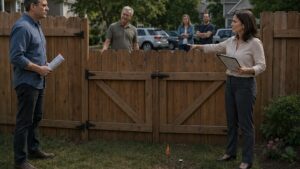
He did, for several seconds.
Then a woman near the corner said, “Her daughter’s still in there.”
Scott looked toward the school.
Children were streaming through the gate. Parents gathered in shifting clusters. Amanda appeared near the crossing guard, scanning the curb where her minivan had been.
She saw the flatbed.
Her body stopped before the rest of her did.
Then she began running.
Jonathan had already climbed into the cab.
Amanda reached the street as the truck pulled away. She slapped the side of the flatbed once, then jumped back from the moving wheels. The minivan’s hazards blinked above her head as it disappeared around the corner.
“My daughter’s backpack is in there!” she shouted.
Jonathan did not stop.
Amanda turned toward Scott’s house.
Their eyes met through the kitchen window.
He had expected anger. What he saw first was panic.
Her daughter came up behind her, gripping the straps of a purple backpack. The child looked from Amanda to the empty driveway and then to the yellow sign.
Scott stepped away from the window.
His phone rang.
Jonathan’s number appeared.
“The vehicle is going to our south lot,” Jonathan said. “Registered owner can release it with identification and payment. You don’t negotiate the fee. You don’t reimburse. You don’t argue about custody of property. Direct everything to us.”
“All right.”
“You did what the agreement allows.”
Scott looked at the clear driveway.
“That doesn’t mean they’ll see it that way.”
“No,” Jonathan said. “It doesn’t.”
After the call ended, Scott walked to the garage and opened the door.
He backed his car out slowly.
For the first time in weeks, he did not need to angle around a bumper, ask anyone to move, or wait with his hand on the horn. He drove to the end of the block, turned around, and entered the driveway cleanly.
The motion was so ordinary it felt ceremonial.
When he stepped from the car, Amanda was standing on the sidewalk.
Her daughter remained several feet behind her. Two other parents had joined them, both holding phones at chest height.
Amanda’s face had gone pale beneath the anger.
“You had my car stolen,” she said.
Scott closed his car door.
“It was towed.”
“You knew I was getting my daughter.”
“I knew you parked across my driveway after reading the sign.”
“You could have warned me.”
“I did.”
“Not today.”
“The sign warned you today.”
Her daughter looked toward the fence post.
Amanda followed the child’s gaze, then looked back at Scott.
“You’re going to pay the release fee.”
“No.”
One of the parents raised her phone higher.
Amanda stepped onto the walkway leading to Scott’s porch.
“You don’t get to punish an entire neighborhood because you don’t like families near your house.”
Scott felt the pressure return to his chest, faster than thought. He saw the open driveway behind her. He saw the hazards still blinking in memory. He saw another afternoon trying to reach a car he could not move.
He went inside without answering.
Amanda followed as far as the porch.
Her fist struck the front door before Scott reached the hallway.
Once.
Twice.
A third time, hard enough to shake the narrow window beside the frame.
Scott opened the drawer where he had placed the tow authorization and the receipt for the original yellow sign.
Outside, one of the parents said, “Start recording.”
Amanda raised her fist again.
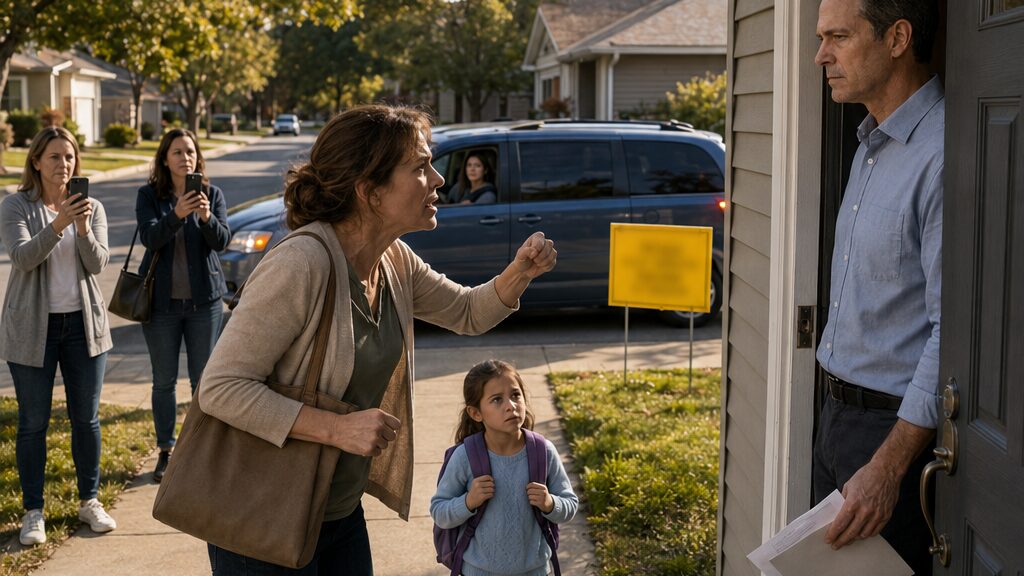
Scott opened the door before she could knock.
Chapter 4: The Doorway Argument Everyone Thought They Understood
Scott opened the door while Amanda’s fist was still raised.
For a second, neither of them moved.
Amanda stood on the top step with her shoulders drawn forward, breath quick from anger and the run from the school. Behind her, two parents held their phones upright. Her daughter remained near the sidewalk, clutching her backpack against her chest.
Scott kept the door half closed.
In one hand, he held the standing tow authorization. In the other, he held the receipt from the hardware company that had installed the original yellow sign three years earlier.
Amanda stared at the papers.
“You planned this,” she said.
“I followed the posted procedure.”
“You waited for me to walk away.”
“You left your vehicle on private property.”
“For ten minutes.”
Scott glanced past her.
A blue minivan had stopped across the lower third of his driveway while its driver watched the confrontation through an open window. The hazard lights flashed steadily.
On. Off. On. Off.
Scott pointed toward it.
“That vehicle is blocking the driveway right now.”
One of the parents recording turned her phone toward the street. The driver in the blue minivan looked down, shifted into gear, and pulled away.
No one spoke until the driveway was clear.
Amanda recovered first.
“That doesn’t make what you did right.”
Scott raised the receipt slightly. “This sign was installed three years ago.”
“I don’t care when you put it up.”
“You said I never warned you.”
“You didn’t warn me you were calling a tow truck today.”
“The replacement sign says unauthorized vehicles will be towed.”
“You expect people to read fine print while they’re trying to get their children?”
The new sign was large enough to read from the opposite curb.
Scott could have said that. Instead, he unfolded the receipt and held it where Amanda could see the date.
“This isn’t a reaction to this morning,” he said. “It isn’t a reaction to you personally.”
Her expression hardened. “Then why was mine the car you took?”
“It was the car in the driveway.”
“You knew it was mine.”
“Yes.”
“And you did it anyway.”
“Yes.”
The answer made one of the parents lower her phone for a moment.
Amanda’s daughter came closer. She did not step onto the porch.
“Mom,” she said quietly.
Amanda did not turn.
“Not now.”
The child looked at the yellow sign. “Why did you park there if it said not to?”
The question was soft enough that Scott almost pretended not to hear it.
Amanda’s jaw tightened.
“Because there was nowhere safe to stop.”
“There were spaces down the street,” Scott said.
“With children crossing between cars. With people double-parking on both sides. You sit in this house and look out the window like we’re invading you, but you don’t know what pickup is like.”
Scott felt heat climb into his face.
“You don’t know what happens inside this house.”
“No, because you don’t talk to anyone.”
The sentence landed more cleanly than her shouting had.
Amanda turned toward the phones.
“He sends notes. He takes pictures. He calls tow trucks. But he never comes to meetings, never answers questions, never asks why people are here.”
“I asked you to move.”
“You ordered me to move.”
“I said please.”
“You stood beside my window with your arms crossed.”
“Because you said one minute and stayed twenty-two.”
Amanda looked at him sharply. “You timed me?”
“Yes.”
A parent on the walkway made a sound that might have been disbelief.
Scott heard how the admission sounded. He also remembered every minute.
Amanda laughed once, but there was no humor in it.
“That’s normal to you?”
“No. Blocking someone’s driveway after being asked to move isn’t normal to me.”
She stepped closer to the threshold.
“My daughter was still at school when you sent my car away.”
“Your daughter was supervised.”
“You didn’t know that.”
Scott said nothing.
Amanda saw the hesitation.
“That’s the problem,” she said. “You didn’t care.”
The accusation struck the place he kept sealed. His grip tightened around the receipt until the paper bent.
“I cared about access to my property.”
“It’s unused space for twenty minutes.”
The hallway behind Scott seemed to narrow.
Unused space.
The same phrase had appeared years earlier when a driver told him he could wait because Scott was not going anywhere. The same casual certainty. The same assumption that an empty driveway had no purpose until a vehicle occupied it.
Scott heard a phone ringing in memory.
He saw a hospital number.
He saw himself standing at this door, unable to back out because a contractor’s van had been left across the entrance.
His control broke, not in volume but in precision.
“You do not get to decide when my driveway is needed.”
Amanda drew back slightly.
Her daughter watched him with wide eyes.
Scott lowered the documents.
The parent closest to the porch said, “Is that a threat?”
“No,” Scott said. “It is the boundary.”
A car horn sounded from the direction of the school. More vehicles were entering the block, moving slowly around the people gathered near Scott’s house.
Amanda looked past him into the hallway.
“You’re going to reimburse me.”
“No.”
“The tow yard wants two hundred and thirty-five dollars.”
“That is between you and the towing company.”
“You called them.”
“You parked there.”
Amanda’s face changed. The anger remained, but beneath it was something thinner and more exposed.
“I can’t leave my daughter waiting,” she said.
Scott almost asked why. Almost.
Instead, he held out the towing company’s card.
“They’ll release the vehicle when you arrive with identification.”
She slapped the card from his hand. It spun onto the porch.
Her daughter flinched.
Amanda looked down at the card, then at the child. For the first time, shame crossed her face.
It vanished quickly.
“Come on,” she said.
The girl did not move.
“Mom, did you see his note before?”
Amanda’s eyes flicked toward Scott.
The two parents stopped recording only with their faces. Their phones remained raised.
“What note?” Amanda asked.
“The paper you put in the glove box,” the child said. “The one that said not to park here.”
Silence settled over the porch.
Scott remembered the notes disappearing beneath dashboards. He had suspected they were being ignored. He had not known Amanda’s daughter had seen one.
Amanda took the child by the shoulder, not roughly, but firmly enough to end the conversation.
“We’re leaving.”
She descended the steps.
One parent followed. The other remained long enough to look at Scott with a less certain expression, then lowered her phone and walked away.
Scott bent to retrieve the towing card.
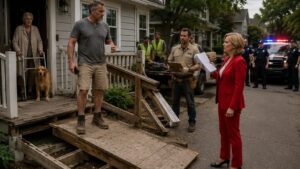
Before he could close the door, a woman in a navy blazer approached from the sidewalk. Rachel Garcia carried a leather folder against her chest. Scott recognized her from HOA mailers and the few meetings he had attended years ago.
“I was coming to speak with you before this happened,” Rachel said.
Amanda stopped at the curb.
Rachel looked from the phones to the sign to the open driveway.
“We’ve received nine complaints in less than an hour.”
“About the blocked driveway?” Scott asked.
“About the towing.”
“That happened because of the blocked driveway.”
“I understand your position.”
The phrase told him she did not.
Rachel opened the folder.
“There may be an access issue involving the curb apron. An old easement appears on the original subdivision plan.”
Jonathan’s caution returned to Scott: distinguish the public right-of-way from the actual driveway.
“The vehicle was beyond the curb,” Scott said.
“That may be true. We need to verify it.”
Amanda turned back toward the porch.
“So he might not have had the right to tow me?”
“I did not say that,” Rachel replied. “I said the board needs to review the boundary.”
Scott felt the documents in his hands lose some of their weight.
Rachel continued, “We’re holding an emergency hearing Monday evening. Until then, I strongly recommend no additional towing.”
“Recommend?”
Her eyes held his.
“The board’s attorney will review the easement. If vehicles were removed from a shared-access area, the association could become involved.”
“The association didn’t authorize the towing.”
“No, but this dispute is now affecting the neighborhood, the school, and association property.”
Amanda folded her arms. “I want that in writing.”
“You’ll receive notice with everyone else,” Rachel said.
Scott looked at the bright yellow sign. An hour earlier it had seemed absolute. Now an old line on a map had made certainty conditional.
Rachel removed a folded photocopy from her folder and handed it to him.
A narrow shaded strip crossed the front of his lot.
The label was faded but legible.
SHARED CURB ACCESS EASEMENT.
Chapter 5: The Map That Made Both Sides Look Wrong
Jonathan suspended the towing agreement at 8:07 Saturday morning.
His message arrived while Scott was spreading the subdivision map across the dining table.
Until boundary is verified, no removals. Call me when you have documentation.
Scott read it twice, then looked at the shaded strip running along the curb. On paper, the line seemed wide enough to swallow the entrance to his driveway. In reality, the area included the sidewalk transition and the shallow slope where the public street met private concrete.
He placed the old yellow sign across one corner of the map to keep it flat.
The sign’s scratched edge covered the word easement.
By ten, Rachel had arranged access to the HOA’s archived property records. Scott met her in the association office, a converted room at the back of the neighborhood clubhouse. Two board members sat at a folding table while Rachel opened a file box marked with the year the subdivision had been built.
“We’re not deciding fault today,” she said.
Amanda sat across from Scott with her daughter’s empty booster seat visible through the office window in a borrowed car. She did not look at him.
Rachel unfolded a larger version of the same map.
“The easement allows shared curb access for utilities, pedestrian passage, drainage maintenance, and emergency use,” she said. “It does not say parking.”
“Then why are we here?” Scott asked.
“Because the board attorney wants the physical boundary confirmed before anyone states the tow was unquestionably lawful.”
Amanda looked up. “The truck took my car from the apron.”
“It took your car from the driveway,” Scott said.
“That is the apron.”
“The rear wheels were past the sidewalk.”
“You were inside the house.”
“I photographed it.”
Rachel raised a hand.
“The photographs will be reviewed with the survey.”
One of the board members leaned over the map. “This shaded area runs across every lot on that side.”
“Which is why we need consistency,” Rachel said. “If parents have been stopping partly within the easement for years, the association may have allowed a pattern to develop.”
Scott looked at her.
“Allowed?”
Rachel’s expression shifted. “Failed to address.”
The distinction was small but deliberate.
Scott removed copies of his complaints from the folder he had brought.
“I was never told there was an easement. I was never told the HOA had approved school staging.”
“It hasn’t.”
“Then the pattern doesn’t create permission.”
“No,” Rachel said. “But it creates risk.”
For Scott, risk had always been something measurable. A failure percentage. A vulnerability. A cost attached to inaction.
Here, risk meant that an obvious boundary could become debatable because enough people had crossed it.
At noon, Rachel sent the surveyor’s preliminary appointment for Monday morning.
Until then, Scott went to the school.
Sarah Lewis met him in the administrative office. She wore an identification badge clipped to a gray cardigan and kept one hand on a stack of dismissal reports.
“I want to be clear,” she said before he sat down. “The school did not instruct anyone to park in your driveway.”
“You instructed them to use open space in the neighborhood.”
Her eyes narrowed.
“Who told you that?”
“The administrative assistant said families were encouraged to spread out.”
“That is not the same thing.”
“Did staff use the phrase ‘any open space’?”
Sarah looked toward the closed office door.
Scott waited.
Finally, she set down the reports.
“One staff member may have used informal language during a pickup delay.”
“One time?”
“We don’t know.”
“Then you don’t know how many parents heard it.”
“No.”
The admission changed the room.
Sarah sat back.
“The west lane closure cut our loading capacity by almost forty percent. We submitted a traffic request to the district. We requested a temporary crossing officer. We asked the city about opening the service lane.”
“What happened?”
“The district said we should manage within the existing dismissal plan. The service lane is not approved for student pickup. The city has not responded.”
“So the overflow came here.”
“It went everywhere.”
“To private property.”
Sarah’s restraint thinned.
“We dismiss more than five hundred children in twenty minutes. Parents arrive early because they’re afraid of being late. Residents complain if vehicles idle on the street. The police tell us not to stop traffic on the main road. The district tells us not to extend dismissal. Every available option belongs to someone who says no.”
Scott glanced at the stack of reports.
“Amanda requested something from the school.”
Sarah’s face became guarded.
“That is confidential.”
“She said she couldn’t leave her daughter waiting.”
“I can’t discuss a student.”
Scott stood.
“I’m not asking about the child. I’m asking whether you knew one parent was using my property because your system had failed her.”
Sarah was silent.
That was answer enough.
At the door, she said, “Last fall, there was a dismissal error.”
Scott turned.
“A child remained outside after the assigned pickup window because the parent was delayed and a staff handoff was missed. The child was safe, but frightened.”
“Amanda’s daughter?”
“I didn’t say that.”
“You didn’t have to.”
Sarah’s mouth tightened.
“Amanda requested a supervised late-pickup accommodation after that. The district declined because her work schedule did not meet the criteria for the after-school program.”
Scott thought of Amanda running toward the disappearing flatbed, panic reaching her face before anger did.
“She still knew the driveway was private.”
“Yes.”
The word came without hesitation.
Understanding did not erase responsibility. It simply made the shape of it harder.
Monday morning, the surveyor drove two metal pins into the grass beside Scott’s driveway and stretched a bright line between them.
Rachel, Amanda, and Scott watched from the sidewalk.
The surveyor measured twice, checked the archived plat, and marked the edge of the private surface with temporary paint.
Amanda’s minivan had been three feet beyond the shared curb easement.
Rachel exhaled.
“The tow occurred on private property.”
Amanda looked at the paint line.
“So that’s it?”
“No,” Rachel said. “It answers the boundary question.”
“It should answer the towing question,” Scott said.
Rachel faced him.
“Legally, perhaps. It does not answer what happens this afternoon.”
By 2:30, Jonathan had not resumed service. The school traffic would return. The west lane remained closed. The neighborhood still had no overflow plan.
Rachel followed Scott toward his porch.
“We need forty-eight hours,” she said.
“For what?”
“For the school to coordinate with the city.”
“They’ve had six weeks.”
“And you gave no one notice before beginning repeated removals.”
“I gave three years of notice.”
“You posted a sign. You did not tell the school or the board you had activated a tow contract.”
Scott stopped beside the yellow sign.
“I shouldn’t have to request permission to keep my driveway open.”
“No. But you knew this affected more than one driver after the first tow.”
He thought of the flatbed waiting around the corner. Of his disappointment when the first SUV moved before it could be taken.
Rachel lowered her voice.
“I’m asking you to permit temporary pickup use until the school changes the plan.”
Scott stared at her.
“You just confirmed it is private.”
“I did.”
“And now you want me to surrender it because the boundary is certain.”
“I want to prevent another child from being caught in an adult dispute.”
The sentence was carefully chosen. Scott heard the pressure inside it.
If he refused, he would become exactly what Amanda had called him.
If he agreed, the driveway would become shared space by emergency, then by habit, then by expectation.
Rachel held out a written proposal.
Five-minute staging. Driver remains in vehicle. No unattended parking. Temporary expiration after two weeks.
Scott did not take it.
“What happens when five minutes becomes twenty-two?”
“We enforce it.”
“How?”
Rachel had no immediate answer.
Behind them, the first hazard lights appeared at the end of the block.
Chapter 6: The Reason He Would Not Give Them One More Minute
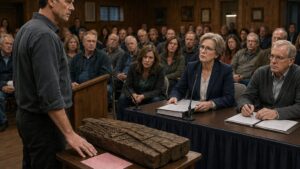
Amanda proposed the rule before Scott had even taken his seat.
“Five minutes,” she told the HOA board. “Driver stays with the vehicle. No one leaves a car unattended. That gives families a safe option without interfering with anyone for long.”
The clubhouse was nearly full.
Parents occupied the front rows. Residents sat along the walls. Sarah Lewis had arrived from the school with two folders and a district representative on speakerphone. Jonathan stood near the back, arms folded, present because Rachel had asked him to explain the towing procedure.
On the table before the board lay the old subdivision map, the survey report, the standing tow authorization, and Scott’s faded yellow sign.
Rachel had asked him to bring it.
Now it rested between him and Amanda like an exhibit from a case neither of them had meant to build.
A board member adjusted his glasses.
“Mr. Adams, would you accept a temporary five-minute staging allowance?”
“No.”
The room stirred.
Rachel leaned toward the microphone.
“Scott, the board is asking whether a narrow accommodation could prevent continued conflict while the school develops an alternative.”
“The school has had six weeks.”
Sarah said, “That is true.”
Several parents turned toward her.
She continued, “Our overflow guidance was inadequate. Staff language may also have implied that neighborhood space was available when it was not.”
Amanda looked at her sharply.
“But the immediate safety problem remains,” Sarah added.
Scott looked at the yellow sign.
Amanda spoke without waiting for recognition from the chair.
“No one is asking to own his driveway. We’re asking to use the empty edge for a few minutes.”
The word empty passed through him.
He placed both hands on the table.
“It is not empty.”
Amanda exhaled. “There is nothing there.”
“There doesn’t need to be.”
“That’s not what I meant.”
“It is exactly what you meant.”
Rachel said his name quietly, warning him.
Scott heard it and continued anyway.
“You see open concrete and decide it has no purpose until your vehicle is on it. You see a sign and decide it is unreasonable because the rule inconveniences you. You see me inside the house and decide I have nowhere to go.”
Amanda’s face reddened.
“You never told anyone otherwise.”
“No,” Scott said.
The room settled.
He had intended to stop there. He had brought the survey, photographs, receipts, and code language because documents did not shake when held. They did not require him to explain why an argument about five minutes could make his chest tighten.
But Rachel had been right about one thing.
His silence had not remained empty. Other people had filled it.
Scott touched the bent corner of the old sign.
“Four years ago, my wife called me from her doctor’s office.”
No one moved.
“She had been having chest pain. They were sending her to the hospital. She asked me to meet her there.”
He kept his eyes on the sign.
“A contractor’s van was parked across my driveway. The driver had gone into a house three doors down. I knocked. No one answered. I called the number on the van. It went to voicemail.”
The memory did not return as images first. It returned as sound: a phone vibrating in his hand while he stood beside the van, his wife’s name on the screen.
“I waited eleven minutes before the driver came back. He told me he thought the driveway wasn’t being used.”
Amanda’s expression changed.
Scott continued.
“I reached the hospital after she had been taken into surgery. She died that night.”
A chair creaked near the wall.
No one offered the phrases people usually offered. Scott was grateful.
“The delay did not cause her death,” he said. “I know that. The doctors told me that. I have told myself that every way a person can tell himself something.”
His fingers pressed against the table.
“But I did not get there when she asked me to. And every time someone says one minute, or five minutes, or unused space, I hear that phone ringing while I stand in my own driveway unable to leave.”
Amanda looked down at her hands.
Scott’s voice roughened.
“That does not make every parent responsible for what happened. It does not give me the right to enjoy watching cars disappear. And I did enjoy it, at first.”
Jonathan shifted near the back.
Scott looked toward him.
“When the first driver moved before you hooked the car, I was disappointed.”
The admission drew a quiet breath from the room.
“I had stopped thinking only about access. I wanted consequence. I wanted someone else to feel trapped by a decision they had dismissed.”
He turned toward Amanda.
“That was my mistake.”
Amanda met his eyes.
“But the boundary is not the mistake,” Scott said. “The driveway remains private. The answer cannot be to formalize the behavior that created this conflict.”
Rachel rested her hands on the table.
“What are you willing to do?”
Scott had spent the afternoon preparing an answer.
“I will pause towing for forty-eight hours. Not two weeks. Forty-eight hours.”
A parent near the front shook her head.
“That’s nothing.”
“It is enough time for the school, HOA, and city to decide whether this is an actual emergency or merely something residents are expected to absorb.”
Sarah opened one of her folders.
“The city owns a maintenance lane behind the recreation field. It is currently gated.”
Rachel looked at her. “Can it be opened?”
“Not under the existing dismissal permit. But a temporary supervised route could be authorized if the city approves traffic control.”
“How long?”
Sarah glanced at the phone carrying the district representative.
“Forty-eight hours is possible if everyone signs off tomorrow.”
Scott nodded.
“Then that is the condition. A supervised route, or towing resumes.”
Amanda’s voice was lower when she spoke.
“And until then?”
“No unattended vehicles in the driveway. No blocking access. If a driver is present, I will ask once before calling Jonathan.”
Rachel looked toward the board.
“That is more limited than the proposed staging rule.”
“It preserves the boundary,” Scott said.
Amanda rubbed one thumb across the other.
“My daughter was left outside last fall.”
The room turned toward her.
“She was safe,” Amanda said quickly. “A staff member found her. But she called me crying, and I was forty minutes away because of traffic. After that, I started arriving early. I asked the school for help. They said she didn’t qualify.”
Sarah did not interrupt.
Amanda looked at Scott.
“When you asked me to move, all I heard was someone else telling me the system was my problem.”
“It was not my driveway’s job to solve it.”
“I know.”
The words were so quiet that Rachel asked her to repeat them.
Amanda straightened.
“I knew the driveway was private.”
No one shifted this time.
“I saw the sign. I read his note. I put it in the glove compartment because I thought he would give up if enough of us ignored him.”
Her daughter’s question returned to Scott: The one you put in the glove box?
Amanda continued.
“I told the group he threatened me because I wanted people on my side. He said he would have the car removed. I called that a threat.”
Rachel’s face tightened.
“Why?”
Amanda looked toward the parents who had followed her into the room.
“Because it worked.”
The room did not turn against her all at once. That would have been easier. Some parents looked embarrassed. Others remained angry, as if Amanda’s honesty had betrayed a shared defense.
Scott felt no triumph.
Rachel drew the yellow sign closer to the center of the table.
“The board will confirm in writing that the private driveway begins beyond the surveyed curb easement. No vehicle staging will be authorized on Mr. Adams’s property.”
A board member began to object, but Rachel raised her hand.
“We will also review prior traffic complaints and coordinate with the school on the municipal route.”
She looked at Sarah.
“You have forty-eight hours.”
Sarah nodded once.
Scott stood.
Amanda remained seated.
As he lifted the old sign from the table, she said, “I can’t promise every parent will listen.”
“No,” Scott said. “But you can stop telling them not to.”
Outside the clubhouse, Sarah caught up with him beneath the parking-lot lights.
“The city traffic office opens at eight,” she said. “I’ll be there.”
Scott placed the faded sign in the back seat of his car.
“At 2:45 Wednesday,” he said, “the driveway stays clear because you have another route—or Jonathan comes back.”
Sarah looked toward the dark school buildings beyond the trees.
“Understood.”
For the first time, Scott had not hidden the reason behind a document.
Now the institutions had forty-eight hours to prove that hearing him would change anything.
Chapter 7: The Driveway Stayed Empty for a Different Reason
The first minivan slowed toward Scott’s driveway at 2:43 Wednesday afternoon.
Its right turn signal flashed once. The front tires angled toward the concrete apron.
Scott stood behind his office window with Jonathan’s number open on his phone.
At the end of the block, a crossing guard in a reflective vest raised one arm and pointed toward the school recreation field. A temporary sign had been fastened to a portable metal frame:
AUTHORIZED PICKUP ROUTE
FOLLOW STAFF DIRECTIONS
The minivan hesitated.
Then its wheels straightened, and it continued past Scott’s house.
He let out the breath he had been holding.
Beyond the roofs, vehicles were turning through the newly opened municipal maintenance gate. Orange cones divided the narrow lane into an entrance and exit. School staff checked family placards while another employee supervised children beneath a temporary canopy.
The plan was imperfect. The lane was barely wide enough. Cars backed up near the recreation field, and one driver ignored a cone until Sarah stepped in front of the vehicle and directed it back into line.
But the traffic was moving.
At 2:47, another minivan approached Scott’s driveway.
The driver slowed beside the new yellow sign and activated her hazard lights.
On. Off.
Scott’s thumb touched Jonathan’s number.
Before he could call, Amanda stepped from the sidewalk.
She wore her school tote over one shoulder. Her daughter stood near the crossing guard, talking to another child.
Amanda bent toward the open passenger window.
“You can’t stop here,” she said.
“I’ll be thirty seconds.”
“That is what everyone says. Use the field route.”
The driver pointed toward the line of cars beyond the school.
“It goes all the way around.”
“Yes.”
“I’m already here.”
Amanda placed one hand on the roof of the minivan and pointed at Scott’s sign with the other.
“This is private property. The route is open.”
The woman looked past her toward Scott’s house.
Scott stepped away from the curtain before their eyes met.
The minivan pulled forward.
Its hazard lights went dark.
Amanda did not look toward the office window. She returned to her daughter as though redirecting the car had been an ordinary responsibility rather than a public reversal.
Scott closed Jonathan’s contact without calling.
At three, Sarah sent a brief message.
First wave cleared. Twenty-six vehicles used the temporary lane. No neighborhood obstructions reported.
Scott read it while reconnecting to a client meeting he had postponed twice during the conflict.
The meeting began at 3:05.
For the next fifty-three minutes, no horn sounded outside. No hazard lights pulsed against the wall. No driver knocked on his door or stared through the window.
Scott explained a software migration, answered questions, and listened while the client described a failure in a remote office. Halfway through the call, he realized he had not looked toward the driveway once.
The realization nearly made him lose his place.
Instead, he finished the diagram.
When the meeting ended, the block was quiet. The school staff were removing cones from the field route. A few children walked home with parents. Scott’s driveway remained open from the garage to the street.
He went outside.
The replacement sign stood straight on the fence post, but one corner had loosened during the argument at his door. A shallow crack ran through the plastic around the top screw.
Scott fetched a screwdriver from the garage.
He had just removed the damaged screw when Amanda approached. Her daughter was not with her.
Scott set the screwdriver on the fence rail.
Amanda stopped several feet away.
“The route worked,” she said.
“It worked today.”
“They approved it through the end of the utility project.”
“Sarah told me.”
Amanda looked at the cracked sign.
“I did that.”
Scott waited.
“When I came to your door,” she said. “I grabbed the edge after you closed it. I pulled harder than I meant to.”
He had found the sign twisted the next morning but had assumed someone in the crowd had struck it.
Amanda held out a folded check.
“This is for a replacement.”
Scott did not take it.
“The sign still works.”
“It is damaged because of me.”
He looked at the check, then at her.
“Did the tow yard release your vehicle?”
“Yes.”
“How much?”
“More than I wanted to pay.”
“That was the point.”
Her mouth tightened, but she nodded.
“I know.”
A maintenance truck passed at the end of the block, heading toward the newly opened route. Amanda watched it go.
“The board sent an email this morning,” she said. “They found four older traffic complaints from residents near the south entrance.”
Scott had not heard that.
“What happened to them?”
“Nothing. One resident was told school traffic was outside HOA authority. Another was told to contact the city.”
“Why did the board act now?”
Amanda looked toward the clubhouse.
“Because this time enough people with children complained. And because vehicles were towed.”
The answer held no apology on the board’s behalf. Only fact.
Scott picked up the screwdriver.
“So the problem mattered when it became expensive.”
“Yes.”
“And visible.”
“Yes.”
Amanda unfolded the check.
“I’m not asking you to forgive me.”
“I know.”
“I’m not asking to be friends.”
“I know that too.”
A trace of impatience crossed her face, familiar but smaller now.
“Could you let me finish?”
Scott rested the screwdriver against his palm.
Amanda glanced toward his house.
“I made you into a person people could ignore. It was easier than admitting I knew I was wrong.”
The words did not erase the screenshots or the phones raised outside his door. They did not return the hours he had spent documenting his own right to leave home.
But they were precise.
Scott took the check.
“I’ll use it to repair the sign.”
Amanda nodded.
Before she left, she said, “You were right about the driveway.”
Scott looked at the open concrete.
“I was wrong about some of the rest.”
She seemed surprised.
“I should have contacted the school and the board before the first tow,” he said. “Not for permission. For notice.”
Amanda considered that distinction.
“Would it have changed anything?”
“Maybe not.”
“No,” she said. “It probably would not have.”
She walked away without offering her hand.
Scott watched her cross toward the field route. At the corner, she stopped a driver who was preparing to wait beside a fire hydrant and directed him toward the open gate.
Several weeks later, the utility work ended, but the city kept the maintenance lane available during afternoon dismissal. The school added two rotating staff members and a supervised late-pickup bench inside the main office. Amanda’s daughter was among the students authorized to wait there when necessary.
The HOA adopted a written no-staging rule for private driveways and confirmed the boundary shown by the survey. Rachel included the four neglected traffic complaints in the meeting record and proposed a requirement that future access complaints receive a written response within ten business days.
No one applauded at the board meeting.
Two members objected to the added work. One parent complained that the field route used too much fuel. A resident near the maintenance gate wanted additional noise restrictions.
The solution was not perfect.
It was simply no longer Scott’s driveway.
On a Friday afternoon, he replaced the cracked corner of the yellow sign with a new metal bracket. Beside it, the school had installed a smaller directional marker pointing toward the authorized route.
The two signs did not compete.
One said where vehicles could not go.
The other showed where they should.
At 2:45, the pickup line moved beyond the end of the block. Scott heard distant whistles from the crossing guard and the low rhythm of engines turning through the field gate.
No hazards blinked outside his window.
He returned to his desk and opened the bottom drawer.
The standing tow authorization lay beneath a folder of property records. Jonathan had offered to cancel it completely, but Scott had asked him to mark it inactive instead.
Scott removed the document and read the final clause.
Authorization may be reinstated upon written request after confirmation of compliant signage and private-property boundaries.
He considered tearing it in half.
Instead, he placed it inside the folder with the survey, the dated installation receipt, and the photographs.
A boundary did not become less humane because it could be enforced.
It became humane when enforcement was no longer the only language available.
Scott closed the folder and returned it to the drawer.
Outside, a silver minivan passed his house without slowing. Amanda was driving. Her daughter sat beside her, talking with both hands while Amanda followed the crossing guard’s signal toward the field route.
She did not wave.
Scott did not expect her to.
He watched until the minivan turned the corner, then faced his computer as the next client joined the call.
Behind him, the driveway remained empty.
This time, it was not empty because people feared the tow truck.
It was empty because they finally understood it had never been theirs to fill.
The story has ended.