The HOA Moved His Grandmother’s Headstone, Then Learned What He Had Kept for Thirty Years
Chapter 1: The Excavator Was Already Between the Graves
The excavator was backing away from the place where Ruth Jackson’s headstone had stood.
Its steel bucket hung above the cemetery grass, packed with red clay and broken roots. Hydraulic joints hissed as the machine turned between two rows of graves. One track had pressed a dark groove through the ground where Anthony had walked every Sunday for nearly thirty years.
He stopped at the open gate.
For a moment, he did not understand the empty rectangle ahead of him. The concrete base remained, pale and raw beneath the morning sun, but the weathered gray marker was gone. Ruth’s name, her dates, the shallow chip along the upper corner—everything that had made the stone hers—had disappeared.
The operator saw him and lowered the engine to an idle.
“You can’t be in here,” Anthony said.
He did not raise his voice. The words came out thin enough that the operator leaned from the cab.
“Work order says we can.”
“From whom?”
The man pointed toward a white utility truck parked near the cemetery fence. A magnetic sign on its door showed the logo of a monument contractor Anthony had never used. Behind the truck stood a wooden pallet holding several old stones upright between padded braces.
Anthony counted four.
One belonged to a child who had died in 1948. Another bore the surname of a family whose farmhouse had once stood where the subdivision pool now shimmered behind a privacy fence. Ruth’s marker stood at the end of the pallet, a yellow inventory tag looped around its base.
Next to the old stones, wrapped in clear plastic, were three polished granite samples. They were identical except for color.
Anthony walked past the operator without answering him.
The tag on Ruth’s stone read:
REMOVE — NONSTANDARD
REPLACEMENT PENDING
He touched the chipped corner with two fingers. The stone was cold despite the rising heat. A faint smear of mud crossed the carved word BELOVED.
“Sir,” the operator called. “I need you outside the flagged area.”
Anthony turned. “Who authorized this?”
The man climbed down from the cab, wiping his hands on his jeans. He looked tired rather than defiant.
“Cypress Ridge Homeowners Association. We were told this section was association-maintained property.”
“It isn’t.”
The operator glanced toward the truck as though the paperwork might defend him from the conversation. “That’s between you and them.”
“When did you start?”
“Yesterday afternoon.”
Anthony looked across the hill. Orange flags marked a second row of graves, including several stones half-hidden beneath cedar shade.
“What do those mean?”
The operator hesitated.
“The next phase.”
“When?”
“Monday.”
The answer changed the air around Anthony. Until then, the missing stone had felt impossible, something so wrong that a phone call might force everyone involved to admit a mistake. The orange flags made it a schedule.
He took out his phone and photographed every stone on the pallet, every tire track, every flag and machine. He photographed Ruth’s empty base from four angles. His hands remained steady until he framed the chipped corner through the screen.
The operator watched him.
“You family?” he asked.
Anthony lowered the phone. “Yes.”
“I’m sorry.”
It was the first honest sentence anyone had offered him that morning.
At home, a red light blinked on the answering machine beside his bed. He had left his cell charging overnight, and the association still used the landline number listed in its oldest directory.
He pressed PLAY.
“Mr. Jackson, this is Tyler Martin, president of the Cypress Ridge Homeowners Association. I’m calling regarding the cemetery beautification work approved during our recent common-area review.”
Anthony sat on the edge of the bed.
Tyler’s recorded voice had the calm, practiced rhythm of someone explaining a late fee.
“Several monuments were determined to be inconsistent with the updated appearance and safety standards. Your grandmother’s marker was among those requiring removal. The original stone will remain available for collection for thirty days. Owners or family representatives may select a compliant replacement through the association’s approved monument provider.”
Anthony stared at the framed photograph on his dresser.
Ruth stood beside a vegetable garden in the picture, one hand shielding her eyes from the sun. She had worn that same expression whenever someone attempted to tell her what belonged to whom.
The message continued.
“The association has negotiated preferred pricing, and the replacement designs have been chosen to blend appropriately with the Cypress Ridge community. Please contact the management office before Monday if you have questions.”
The machine clicked off.
Anthony played the message again.
On the third time, he heard what anger had hidden from him during the first two: Tyler had not called the cemetery a cemetery. He had called it a common area.
Anthony went downstairs and opened the narrow closet beneath the staircase. Cardboard archive boxes filled the shelves from floor to ceiling. Each one bore his careful block lettering: deeds, surveys, annexations, tax plats, correspondence. He had labeled them after retiring from the county records office, promising himself he would sort the rest when he had more time.
He pulled out a box marked JACKSON CEMETERY — PRESERVATION.
Dust lifted from the lid.
Inside lay the original easement copy, maintenance receipts, hand-drawn grave maps and letters Ruth had sent to descendants before holiday cleanups. Anthony felt the old confidence returning as he placed the documents in neat rows across the dining table.
The easement was where it should be.
The county correspondence was intact.
Then he reached the tab marked DESCENDANT REGISTRY.
Behind it lay one unsigned renewal form dated seventeen years earlier.
Nothing followed it.
Anthony checked the box again, then the shelf, then every folder on the table. The annual registry that was supposed to identify living family representatives was missing because it had never been completed.
At the bottom of the unsigned form, in his own handwriting, were four words:
Call families next week.
Chapter 2: The Papers Protected More Than He Remembered
Anthony held the unsigned form under the dining-room light until the ink began to look like someone else’s handwriting.
Call families next week.
He remembered writing it after Ruth’s funeral, when sympathy cards still crowded the mantel and relatives had filled his house with casseroles. At the time, a week had seemed like a reasonable distance from grief. Then the week became a month, the month became a year, and the renewal form stayed inside the folder where no one could ask about it.
He laid it beside the easement.
The language in the easement was stronger than he remembered. The cemetery tract was reserved for burial, visitation and preservation in perpetuity. No later owner or association could remove markers, restrict descendant access or materially alter the grounds without consent from recognized family representatives and county review.
But another paragraph required the designated steward to maintain a current registry of those representatives.
Anthony had been designated after Ruth’s death.
He had kept the grass cut. He had paid for fence repairs. He had replaced a fallen cedar limb before it cracked two stones. Yet the one duty that required calling people, explaining relationships and inviting them back had remained undone.
At nine the next morning, he carried copies of the easement and plat into the county records office. The building smelled the same as it had during his career: paper, floor wax and overheated machinery.
The clerk behind the counter recognized him.
“You finally miss us?” she asked.
“Not enough to come socially.”
His attempt at humor failed to change her expression when she saw the documents.
She scanned the easement number, then disappeared into the records room. Anthony stood beside a public terminal while printers chirped and stamped pages slid into trays around him.
The clerk returned with a subdivision plat and an annexation file.
“The cemetery reservation was recorded in 1962,” she said. “Cypress Ridge didn’t incorporate the association until 1996. The subdivision plat recognizes the tract and access lane.”
“So the association never owned it.”
“Not according to this.”
She tapped a shaded rectangle above the subdivision lots. The cemetery sat outside the common-property boundary, connected to the county road by a narrow easement that later landscaping had made look like an HOA path.
Anthony felt a brief, dangerous relief.
“Then the removal was unauthorized.”
“Likely. But records doesn’t enforce preservation restrictions.”
“I know.”
She studied him over the plat. “Do you?”
The question was not unkind. That made it worse.
Anthony showed her the unsigned registry renewal.
Her lips tightened. “Is there a later one?”
“No.”
“Any successor designation?”
“No.”
“Current descendant list?”
“Not one I can certify.”
She pushed the documents back toward him. “The land restriction doesn’t vanish because the registry lapsed. But the county will want to know who has authority to demand restoration. The association’s attorney will say the cemetery was abandoned or that no authorized representative objected.”
“They removed stones without notice.”
“They’ll say they notified the address on file.”
“My address.”
“And if the file shows one inactive steward and no other current contacts, they’ll use that.”
Anthony looked through the glass wall toward the records room. For years he had believed that if documents were clear enough, people could not change the truth. The clerk had just reminded him that truth still required someone to stand beside it.
“What can I file today?”
“A preservation complaint and request for emergency review. Take photographs. Include the work order if you can get it. The preservation office can seek a temporary stop, but don’t expect them to order full restoration before they establish standing and ownership.”
Anthony gathered the papers.
The clerk kept one hand on the unsigned form. “You should call the families.”
“I don’t know where most of them are now.”
“That’s what records are for.”
Outside, Anthony sat in his car and completed the emergency complaint across the steering wheel. In the space asking for his authority, he wrote:
Recorded steward; descendant of Ruth Jackson; registry update pending.
He did not soften the last three words.
By afternoon he was back at the cemetery. The excavator had been moved beyond the gate, but the orange flags remained. Ruth’s stone still stood on the pallet beneath a blue tarp.
Anthony used the old hand-drawn map to check the disturbed row. The contractor had removed four surface markers but had not excavated the graves themselves. That distinction mattered legally. It did not matter when he saw Ruth’s name under the tarp.
He began calling numbers from the last completed registry.
Two had been disconnected. A third belonged to someone who said the family named on Anthony’s list had moved away years ago. One woman listened long enough to tell him her father had handled those matters and had died in 2011.
“Why are you calling now?” she asked.
Anthony looked at the orange flags.
“Because I should have called before.”
She gave him an email address but made no promise to help.
Near dusk, a dark SUV stopped beside the cemetery entrance. Tyler Martin stepped out wearing pressed slacks and a Cypress Ridge polo. He was younger than Anthony by at least twenty years, with the alert, polished manner of someone who rarely entered a conversation without knowing how he wanted it to end.
“I heard you spoke to the contractor,” Tyler said.
“I told him the work was unauthorized.”
“The board approved it.”
“The board does not own this tract.”
Tyler glanced toward the graves. “Our counsel reviewed the governing documents. Cypress Ridge is responsible for maintaining the surrounding area and addressing safety issues.”
“Which stone was unsafe?”
“Several were unstable.”
“Ruth’s wasn’t.”
Tyler’s jaw shifted slightly. “This doesn’t need to become adversarial.”
“It became adversarial when you put her name on a pallet.”
For the first time, Tyler looked directly at the covered stones.
“We’re holding a community hearing tomorrow evening,” he said. “You can present whatever documents you believe are relevant. The vendor will display the replacement options so families understand what’s being offered.”
“Families?”
“We used the contact information available to us.”
“You had one number.”
“We had the registry provided to the association.”
Anthony heard the opening Tyler intended to use. An outdated list. An absent steward. A neglected-looking tract. The facts would not excuse the removal, but they would prevent the clean victory Anthony had imagined at the records counter.
Tyler returned to his vehicle.
“You should know,” he said before closing the door, “our attorney believes the board has administrative control until a recognized cemetery authority proves otherwise.”
That night, a notice appeared in every Cypress Ridge email inbox.
COMMUNITY HEARING: CEMETERY IMPROVEMENT AND MONUMENT REPLACEMENT OPTIONS.
Below the meeting time was a photograph of three polished granite markers arranged in a row.
Anthony read the notice twice.
Then he opened the attachment listing affected graves. Ruth Jackson’s name appeared first.
Chapter 3: They Displayed a Replacement Beside Her Name
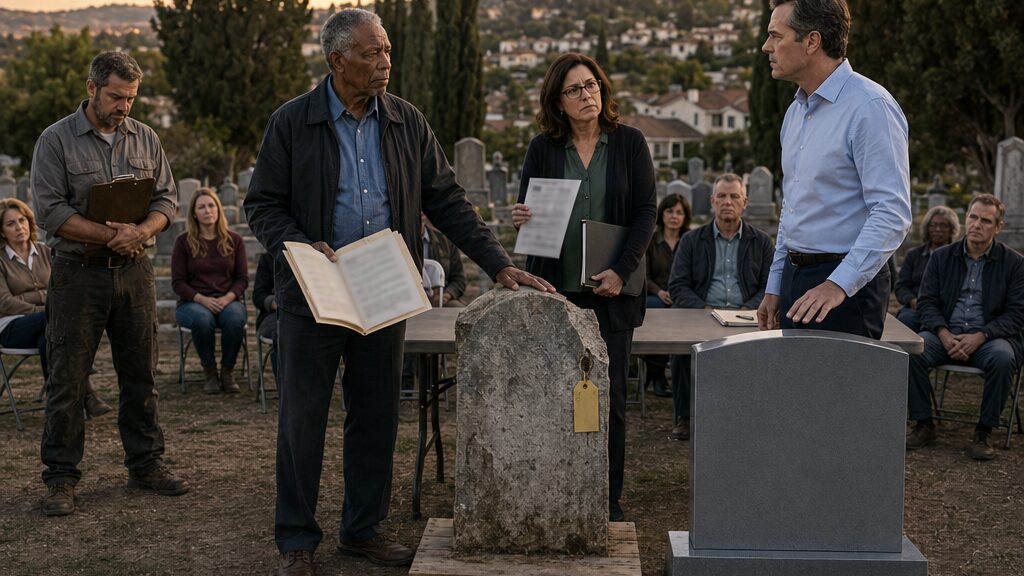
Ruth’s headstone stood on a contractor pallet at the edge of the hearing area, its yellow removal tag facing the rows of folding chairs.
Beside it, under a portable light, the approved monument vendor had placed a polished gray replacement. The blank stone had beveled edges, a uniform base and no sign that weather, hands or thirty years of cemetery wind had ever touched it.
A laminated card rested against the sample:
CYPRESS RIDGE HERITAGE DESIGN
AVAILABLE AT PREFERRED COMMUNITY PRICING
Anthony arrived carrying one archive box.
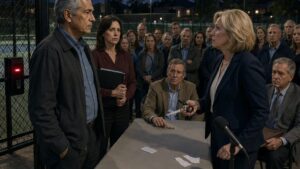
Neighbors filled nearly every chair. Some had come out of concern; others had come because the association’s email had used the phrase legal uncertainty. Two board members sat behind a folding table. Michelle Garcia, the treasurer, arranged a stack of reserve reports near her elbow.
Tyler stood beside the replacement stone.
“Mr. Jackson,” he said, loud enough for those nearby to hear. “We reserved a seat for you in front.”
“I’ll stand.”
A local reporter had set up a camera near the cemetery gate. Anthony had not called the station. Someone else had understood what the pallet would look like on video.
Tyler opened the hearing with a prepared statement about safety, consistency and fiscal responsibility. He described the cemetery as a “historic feature located within the Cypress Ridge maintenance envelope.” He said several stones had become unstable and that the board had negotiated reduced replacement costs to avoid unexpected burdens on families.
He never said the stones had been removed before the hearing.
When he finished, he placed one hand on the polished sample.
“We recognize that memorials are personal. That is why affected representatives may select from three tasteful designs rather than bearing the expense of custom fabrication.”
A neighbor in the second row raised her hand. “What happens to the old ones?”
“They may be collected within thirty days.”
“And after that?”
Tyler looked toward the contractor.
The contractor cleared his throat. “Unclaimed materials are disposed of according to the service agreement.”
A murmur moved through the chairs.
Anthony looked at Ruth’s stone. Mud still darkened the carved letters. He stepped forward and set his archive box on the board’s table.
“I’m not choosing a replacement.”
Tyler nodded as if Anthony had followed the expected script. “You’re entitled to decline participation, although the association may still need to address noncompliant conditions.”
“Her stone is not a condition.”
“Mr. Jackson—”
“It is a grave marker on land your association does not own.”
Anthony removed the recorded plat and opened it beneath the portable lamp. He did not hold it up like a weapon. He rotated it so Tyler, Michelle and the two board members could read the shaded tract.
“This cemetery was reserved in 1962. The subdivision was platted around it. The association’s common property ends here.”
He traced the boundary with one finger.
“The access lane is an easement. Maintenance of nearby landscaping does not create ownership. The preservation covenant prohibits removing markers without descendant consent and county review.”
Tyler drew a stapled memorandum from his folder.
“Our counsel addressed that document. The covenant identifies a family stewardship group that is no longer active. In the absence of a recognized authority, the association has administrative responsibility for conditions affecting residents.”
“Administrative responsibility does not include taking headstones.”
“It includes correcting hazards.”
Anthony looked toward the operator, who stood behind the vendor’s display. “Did your crew classify Ruth Jackson’s marker as unstable?”
The operator shifted his weight.
The contractor answered instead. “We were asked to remove all markers listed in the work order.”
“Did you inspect them first?”
“We performed a site review.”
“That wasn’t my question.”
Tyler stepped between them. “This is not a deposition.”
“No,” Anthony said. “If it were, the answers would be under oath.”
Several people turned toward the reporter’s camera. Tyler noticed and lowered his voice.
“The board acted on legal advice and the information available.”
Anthony opened the easement copy to the stewardship section.
“The information available included this covenant. It also included a descendant registry naming me as steward.”
“An expired registry,” Tyler said.
The words landed with more force than Anthony expected.
Tyler lifted a photocopy from his folder. It was the same renewal form Anthony had found unsigned in the archive.
“This document has not been updated in seventeen years. No current family council is registered. No annual contact list was filed. The grounds have no formal operating body, no insurance certificate and no published maintenance schedule.”
The crowd’s attention shifted toward Anthony.
Tyler did not smile. That made the challenge more effective.
“You’re asking residents to believe the association invaded an actively managed cemetery,” he continued. “The records suggest something more complicated.”
Anthony could have attacked the removal first. He could have emphasized that a failed registry did not transfer ownership. Every sentence would have been legally true.
Instead, he looked at Ruth’s stone.
“The records are incomplete because I did not complete them.”
The chairs went still.
“I was designated after my grandmother died. I maintained the grounds, kept the deeds and paid for repairs. I did not maintain the descendant registry. I told myself the documents were enough.”
Tyler’s expression changed, not to triumph but caution.
Anthony placed the unsigned renewal on the table.
“That failure is mine. It does not give this board permission to remove a single marker. But I won’t pretend my silence left no opening for you to claim the hill had been abandoned.”
Michelle leaned forward to examine the form.
A man near the aisle asked, “So who actually has authority?”
“The covenant still controls the land,” Anthony said. “The county must determine current representation. Until then, no one should disturb anything.”
Tyler raised the legal memorandum.
“Our counsel disagrees.”
“Did your contractor?”
The question was directed at Tyler, but the contractor answered.
“We raised a concern about ownership.”
Tyler turned sharply.
The contractor rubbed his thumb across the edge of his clipboard. “The work order listed the HOA as authorizing party. During the site review, we noted that the parcel number did not match the association’s common-area schedule.”
“When?” Michelle asked.
“Before mobilization.”
“Did you put that in writing?”
“Yes.”
The quiet that followed was different from the silence after Anthony’s admission. That silence had contained judgment. This one contained calculation.
Michelle looked at Tyler. “Was the warning included in the board packet?”
“The management company handled vendor coordination.”
“That isn’t what I asked.”
Tyler set down the memorandum. “Counsel determined the association had sufficient administrative authority.”
“After the contractor flagged ownership?”
“Our deadline required a decision.”
“What deadline?” someone called from the chairs.
Tyler faced the audience. “Cypress Ridge is undergoing a reserve review and refinancing process. Deferred maintenance and unresolved common-area conditions affect borrowing terms. Every homeowner has an interest in preventing higher assessments.”
A few residents nodded. Others looked toward the cemetery, where four empty bases showed pale against the grass.
For the first time, Anthony understood that Tyler had not removed the stones merely because he disliked them. He had chosen speed over uncertainty and convinced himself that protecting property values made the choice responsible.
That did not make the pallet less obscene.
Tyler lifted the legal memorandum again.
“This opinion supports the board’s position until a court or county authority says otherwise. We will pause further removals through tomorrow, but we cannot leave the project unresolved indefinitely.”
Anthony read the first page. The memo relied heavily on the inactive registry and described the cemetery as an “unadministered historical parcel.” It did not mention the contractor’s ownership warning.
“May I have a copy?”
“It will be provided with the meeting record.”
Michelle was no longer watching Anthony. She was looking through the reserve papers beside her. Her finger stopped at a line item, then returned to it.
Vendor coordination services — 8%.
She turned several pages backward and compared dates.
Tyler called for public comments, but the mood had moved beyond his agenda. Residents asked who approved disposal, why the hearing came after removal and whether the management company earned money from the preferred replacements.
Michelle said little. She gathered the reserve report, the vendor schedule and the project invoice into one stack.
When the chairs had emptied and the camera crew began packing, Anthony covered Ruth’s stone with the tarp himself.
Behind him, Michelle remained at the folding table under the portable light.
The removal invoice in her hand was dated three days before the board’s recorded vote. Beneath the contractor’s charge appeared a second payment Anthony had not seen.
Management coordination fee: $4,860.
Chapter 4: The Board’s Clean Story Began to Split
The removal invoice was dated three days before the board had voted to approve the cemetery project.
Michelle Garcia checked the date against the meeting minutes, then checked it again against the electronic ledger on her laptop. The numbers did not change.
The contractor had billed Cypress Ridge on Thursday.
The board vote had occurred Sunday.
Below the removal charge sat the management coordination fee: $4,860.
Michelle closed her kitchen blinds before opening the vendor agreement.
She told herself the gesture was foolish. No one stood outside watching her work. Still, the meeting footage had already begun circulating through the neighborhood, and her phone had not stopped vibrating since dawn. Some residents wanted the entire board removed. Others wanted to know whether the cemetery dispute would increase their dues. One man had written that old stones should not be allowed to bankrupt living families.
Michelle muted the phone.
The vendor agreement described the management company as a project coordinator entitled to eight percent of all monument removal, replacement and landscaping services. The percentage did not return to the HOA. It went directly to the company that employed Tyler as a property-management consultant.
His role as board president was unpaid.
His consulting compensation was not.
Michelle found an email attached to the project file. The contractor had written that the cemetery parcel number did not appear on the association’s common-property schedule and recommended verifying ownership before mobilization.
Tyler’s reply contained one sentence.
Proceed under administrative-maintenance authority. Timing is critical.
Michelle printed the email.
Across the subdivision, Anthony sat at his dining table with the old descendant registry open beside a county directory. His archive boxes, once arranged by year and document type, had begun to lose their order. Photocopies covered the chairs. Handwritten family trees stretched across yellow legal pads.
He had spent years believing disorder meant carelessness. Now the scattered pages represented people he had finally begun to call.
The first return call came from a woman whose grandfather was buried two rows below Ruth. She lived ninety miles away and had not visited the cemetery since childhood.
“My father said the subdivision locked the gate,” she told Anthony.
“They never legally closed it.”
“He drove up once and couldn’t find the entrance.”
Anthony looked toward the narrow window facing the hill. Cypress Ridge landscaping had narrowed the access lane with shrubs and decorative stones, making the cemetery appear private even when the gate remained unlocked.
“I should have told your family how to get in.”
The woman was silent.
Then she said, “Send me the photographs.”
By noon, three families had responded. One wanted immediate restoration. Another wanted proof that the graves had not been disturbed below ground. The third had no interest in joining a dispute but agreed to verify its family representative.
It was not a council. It was not enough for county certification. But three voices existed where Anthony had allowed only his own to remain.
His doorbell rang shortly after one.
Michelle stood on the porch holding a manila envelope against her chest.
“I need to show you something,” she said.
Anthony let her in.
She declined coffee and remained standing beside the dining table. Her attention moved across the open boxes, the names, the crossed-out phone numbers.
“You’ve been contacting them.”
“I’ve been trying.”
Michelle placed the invoice, agreement and email in front of him.
Anthony read without speaking.
“Did the board know about the fee?” he asked.
“The vendor relationship was disclosed in general terms. Not the amount. Not that the removal invoice came before our vote.”
“Did you vote for it?”
“Yes.”
The answer came without defense.
“I thought we were authorizing a survey and stabilization plan. The board packet said no physical work would begin until family notice was complete.”
Anthony looked at the contractor’s warning.
“Tyler told them to proceed.”
“Yes.”
“Why bring this to me instead of the board attorney?”
“Because the attorney represents the association, not the truth.”
Anthony lifted his eyes.
Michelle seemed uncomfortable with her own sentence. She pulled out a chair but did not sit.
“The reserve fund is below target,” she said. “The clubhouse roof needs replacement. Two retaining walls are failing. Tyler negotiated refinancing to spread those costs over several years. The lender’s inspection flagged the cemetery slope and what they called unmanaged visual liabilities.”
“Gravestones.”
“That was not the word in the report.”
“It rarely is.”
“If the refinancing fails, some homeowners could face a large special assessment. Tyler believes every delay puts them at risk.”
“That explains urgency.”
“It doesn’t excuse this.”
“No.”
Michelle finally sat down. “If I release these documents publicly, people will say I helped conceal them.”
“Did you?”
“I did not look closely enough.”
Anthony set the papers beside his unsigned registry form.
“That can do damage too.”
Her eyes moved to his handwriting: Call families next week.
Neither of them needed to explain the resemblance.
Anthony’s phone rang. Stephanie Rivera’s name appeared on the screen.
He answered on speaker.
“I have the emergency review,” Stephanie said. Her voice was precise, familiar from years of county meetings. “The preservation office is issuing a temporary stop-work directive effective immediately.”
Anthony closed his eyes for half a second.
“How broad?”
“No further removal, relocation, excavation or disposal for seventy-two hours.”
“Restoration?”
“Not authorized.”
“The stones are sitting on a pallet.”
“And they will remain there until we establish lawful representation and confirm the original placements.”
“The plat shows the placements.”
“The plat shows the tract. Your hand map is useful, but it is not a certified grave survey.”
Anthony heard the clerk’s warning again. The records protected more than he remembered, but not everything he needed.
Stephanie continued. “You must submit current descendant statements and a proposed stewardship structure by Friday morning. Without that, the county can preserve the status quo but may not compel permanent action.”
“Seventy-two hours.”
“Yes.”
“After that?”
“The association may petition to resume limited work under protective supervision.”
Michelle leaned closer to the phone. “This is Michelle Garcia, Cypress Ridge treasurer. Does the county know the removal was ordered before the board vote?”
A pause followed.
“No,” Stephanie said. “Send me whatever establishes that.”
Michelle looked at Anthony.
He nodded once.
By late afternoon, copies of the financial records were in Stephanie’s hands, but Anthony resisted posting them publicly. Evidence released without context could turn the neighborhood’s fear into panic before the county hearing. Michelle agreed to preserve the originals and notify the remaining board members.
At five, an email arrived from the HOA attorney.
The proposal was carefully phrased. Without admission of wrongdoing, the association would restore Ruth Jackson’s original marker at HOA expense. Anthony would acknowledge that the restoration resolved his personal claim and would refrain from seeking emergency action regarding other markers until the stewardship question was settled.
Michelle read over his shoulder.
“They’re offering you exactly what you asked for on Saturday.”
“No,” Anthony said. “They’re offering me my grandmother in exchange for everyone else.”
“The other families may not establish standing before Friday.”
“I know.”
“If the stop expires, the board could argue the remaining stones are unclaimed.”
“I know that too.”
He reread the proposal. Ruth’s marker could be back on its base within forty-eight hours. He could touch the chipped corner where it belonged. He could close the archive boxes and let the county sort out names that had never been his responsibility alone.
That was the temptation—not victory, but permission to withdraw again.
Anthony opened a blank reply.
Michelle watched him type.
The original markers were removed under one work order and one claim of authority. I will not accept restoration limited to my family while the others remain displaced. Preserve all stones, suspend the vendor agreement and address the entire cemetery through the county process.
He added his name and sent it.
Within a minute, the attorney replied that the offer would expire at noon the next day.
Anthony printed both messages and placed them in the archive.
Then he pulled the old registry closer and began dialing the next family number while the seventy-two-hour clock continued to run.
Chapter 5: His Grandmother Had Asked for People, Not Boxes
The woman standing at Anthony’s dining table picked up an uncataloged photograph and said, “That’s my father.”
Anthony had never seen her before Thursday morning.
She had driven in with two other descendants after receiving the images of the displaced stones. The photograph showed a cemetery cleanup sometime in the late 1980s. Ruth stood near the gate with a rake in one hand. Behind her, a younger man balanced on a ladder, cutting a dead branch away from the fence.
The woman touched his face through the glossy paper.
“He told me he used to come up here every spring.”
Anthony looked at the back. Ruth had written only: Cleanup day.
No date. No names.
“I should have labeled it,” he said.
“You should have sent it.”
The words were not cruel. They were worse than cruelty because they were true.
The dining table had disappeared beneath opened boxes. Letters lay beside death certificates, maps beside family photographs, maintenance receipts beside lists of disconnected phone numbers. Anthony had guarded every piece of paper from fire, moisture and careless handling. Yet the people to whom the papers belonged had not known they existed.
One descendant sorted photographs while another compared grave locations with the hand-drawn map. Michelle sat near the end of the table, explaining the proposed trust structure and the county’s requirements. She had formally notified the board that she would disclose the vendor records at the commission hearing.
Her phone rang twice during the morning. She let both calls go unanswered.
Anthony opened a thin box marked RUTH — PERSONAL.
He had avoided it while assembling the legal file because it contained nothing recorded, notarized or certified. Inside were sympathy cards, a church program and the small spiral notebook Ruth had carried during cemetery cleanups.
A folded letter rested beneath the notebook.
His name appeared on the front.
Anthony recognized the envelope. He had read the letter after her funeral, then placed it where it could not surprise him again.
He unfolded it.
The paper had softened along the creases.
Anthony,
The hill will not stay remembered by itself. Papers matter, and you understand them better than I ever did. Keep them safe. But do not let the boxes become the cemetery. Call the families. Bring the children up. Let people argue over flowers and food and whose memory is right. A place disappears when no one has a reason to return.
Do not keep it alone.
Ruth
The room continued moving around him. Pages turned. Someone read a surname aloud. Michelle asked for an email address.
Anthony sat with the letter in both hands.
For seventeen years, he had remembered the first instruction and buried the rest beneath it. Keep them safe. That had suited him. Paper did not ask why he had stopped organizing cleanup days after Ruth died. Paper did not notice when he entered the cemetery alone or left without calling anyone.
The woman with the photograph pulled out the chair beside him.
“Was that hers?”
He gave her the letter.
She read it, then passed it to the next person without comment. By the time it returned to Anthony, the room had gone quiet.
“I failed that part,” he said.
No one rushed to reassure him.
He was grateful for that.
“I kept the records,” he continued. “I maintained the grounds. I told myself those were the difficult duties. They weren’t. Calling people was harder, so I treated it as optional.”
Michelle folded her hands over the trust draft. “What happens now?”
Anthony looked around the table.
“We stop making one person the cemetery.”
By early afternoon, the descendants had agreed to form an interim stewardship committee. Michelle offered to prepare a basic accounting structure separate from the HOA. Two families volunteered to verify the grave map. Another agreed to contact relatives who might know the identities behind damaged markers.
The document was imperfect. It lacked signatures from several family lines and would need county approval. But when Anthony placed the pages beside the old registry, the difference was visible. The new list contained current phone numbers, emails and names written by the people themselves.
At three, Tyler appeared at Anthony’s front door.
He did not enter.
The strain in his face had replaced the polished confidence he had carried at the cemetery hearing.
“You’re releasing the vendor documents tomorrow,” he said.
“Michelle is.”
“She shouldn’t.”
“She believes the board should have seen them.”
“The board should have asked more questions. That includes her.”
“She knows.”
Tyler glanced through the doorway at the crowded dining table.
“You’ve found descendants.”
“They found the footage.”
“That hearing clip has been shared across the county.”
“The pallet was difficult to explain.”
Tyler ignored the remark. “The lender contacted the management company this morning. If the county determines the project involved unauthorized work, refinancing may be suspended.”
Anthony stepped onto the porch and closed the door behind him.
“How large would the assessment be?”
“Possibly six to eight thousand dollars per household if the major repairs come due together.”
Anthony thought of the elderly couple at the end of his street, the single mother near the playground, the families whose names he did not know because he had spent years walking past their houses without stopping.
Tyler lowered his voice.
“You think I did this for a vendor fee.”
“Did you receive it personally?”
“No.”
“Did your employer?”
“Yes.”
“Did you disclose that before the vote?”
“It was in the management contract.”
“Not in the project packet.”
Tyler looked toward the cemetery hill.
“I was trying to close the refinancing before the reserve review triggered an assessment. Every unresolved item added cost. The cemetery looked abandoned. No current contacts, no operating body, broken edging, leaning stones.”
“So you decided no one would object.”
“I decided delay had consequences.”
“You were warned the association might not own the land.”
“I had counsel saying administrative authority was defensible.”
“You had a contractor saying stop and verify.”
Tyler’s restraint broke just enough to show what sat beneath it.
“You had seventeen years to verify the steward,” he said. “You left an empty file and now you’re speaking as though everyone else woke up one morning and erased history.”
Anthony felt the accusation strike because part of it belonged to him.
“I left an opening,” he said. “You drove an excavator through it.”
Tyler looked away.
When he spoke again, his voice was quieter.
“If you present everything tomorrow, the lender may walk. People who had nothing to do with this will pay.”
“If I hide it, the same people remain governed by a board that can remove property first and invent authority later.”
“There is a middle ground.”
“The private settlement?”
“Restore all four markers. Cancel the replacement program. Handle the rest internally.”
“And the vendor fee?”
“Reimburse it.”
“The warning?”
“Add it to the minutes.”
“The public record?”
Tyler’s silence answered.
Anthony understood the offer. It would produce practical repair without public exposure. It might preserve refinancing. It would also allow the board to describe the entire event as a procedural misunderstanding, protecting the habits that had made the removal possible.
Behind the closed door, he heard descendants reading Ruth’s letter again.
“I’ll speak tomorrow,” Anthony said.
Tyler studied him. “Then decide what you want more—punishment or restoration.”
After he left, Anthony returned to the dining room.
Michelle had heard enough through the door to understand.
“He’s right about the assessment risk,” she said.
“Yes.”
“Are you still going to submit the records?”
“Yes.”
The descendants watched him, waiting for certainty he no longer possessed.
Anthony placed Ruth’s letter on top of the proposed trust documents.
“I will submit all of it,” he said. “Including my unsigned registry. If the commission is going to decide what repair costs, it should know who failed and how.”
He signed the request to speak at Friday’s hearing.
For the first time, the archive would not protect him from the truth it contained.
Chapter 6: The Truth Cost More Than Winning
Tyler was waiting outside the county commission chamber with a settlement folder in his hand.
“We still have ten minutes,” he said.
Anthony stopped beside the closed hearing-room doors. Through them came the muted scrape of chairs and the testing of microphones.
Michelle stood farther down the corridor with a banker’s box containing the vendor records. Stephanie Rivera was speaking with the county attorney near the security desk. Several descendants had gathered beside the wall, holding the interim stewardship documents Anthony had helped assemble the day before.
Tyler opened the folder.
The revised agreement restored all four markers, terminated the approved replacement program and reimbursed the coordination fee. In return, the parties would request cancellation of the public enforcement hearing and resolve remaining questions through confidential mediation.
“It gives you the stones,” Tyler said. “All of them.”
“It gives them back because you’re afraid of the hearing.”
“I’m afraid of what happens after it.”
“So am I.”
“Then sign.”
Anthony turned one page. The agreement described the removals as actions taken under a good-faith interpretation of maintenance authority. It did not mention the contractor’s warning, the invoice date or the management company’s financial interest.
“You want repair without responsibility.”
“I want repair without destroying the financing.”
“The two are not the same.”
“They may be today.”
The chamber doors opened. A clerk called the cemetery matter.
Tyler held out a pen.
Anthony closed the folder and returned it.
Inside, every seat was occupied. The local reporter stood along the rear wall, but there were no television lights or dramatic clusters of cameras. Most people present were residents who looked worried rather than angry.
Anthony preferred that. Worry was closer to the truth.
The commission chair summarized the issue: removal of historic grave markers, disputed administrative authority, incomplete stewardship records and possible conflicts in the vendor arrangement.
Stephanie testified first.
She confirmed that the 1962 covenant protected the cemetery tract and that the Cypress Ridge HOA did not hold title to it. She also confirmed that Anthony’s descendant registry had lapsed, leaving the county without a current certified stewardship body.
“The lapse did not authorize marker removal,” she said. “It did, however, complicate immediate restoration because the county could not initially identify all lawful representatives or verify every original placement.”
The HOA attorney presented next. He argued that the board had acted under a reasonable interpretation of maintenance obligations and had paused work as soon as the dispute arose.
Michelle shifted beside her banker’s box.
Anthony listened without interrupting. The attorney’s account was clean because it omitted the moments when the board had chosen not to know more.
When Anthony’s name was called, he carried one photograph and a thin folder to the lectern.
The photograph showed Ruth’s headstone on the contractor pallet beside the blank approved replacement. Mud crossed her name. The yellow tag remained tied around the base.
He entered it into the public record.
Then he entered the easement, the unsigned registry renewal and Ruth’s letter.
The commission chair glanced at the last item. “Is this relevant to legal stewardship?”
“Not by itself,” Anthony said. “It is relevant to mine.”
He described the cemetery’s history without embellishment. He explained Ruth’s work, the annual contact requirement and his own failure to continue it. He did not describe himself as the sole protector of the graves. He told the commission that his silence had helped the association portray the tract as abandoned.
Across the aisle, Tyler watched him.
“The board did not create every weakness in this situation,” Anthony said. “But it used those weaknesses to justify action it had been warned not to take.”
The HOA attorney objected to the characterization.
Anthony opened the contractor email.
Michelle stood.
“I can authenticate that record,” she said.
The commission chair recognized her as board treasurer.
Michelle carried the banker’s box forward and placed it on the evidence table. She submitted the invoice dated before the board vote, the management coordination fee and Tyler’s instruction to proceed despite the parcel warning.
The attorney asked for a recess.
The chair denied it until Michelle finished her initial statement.
Her voice trembled only once.
“I voted for a survey and stabilization project. I did not understand that physical removal had already been ordered. I should have reviewed the vendor structure more closely. The management company’s fee created an incentive that was not clearly presented to the board.”
A resident called from the back, “So we were paying them to take the stones?”
The chair struck the gavel and warned against interruptions.
Tyler requested permission to respond.
He approached the lectern without notes.
“The fee was part of an existing management agreement,” he said. “It did not go to me personally. The refinancing deadline was approaching, and the lender had identified the cemetery area as an unresolved maintenance concern. If refinancing failed, Cypress Ridge faced immediate capital pressure.”
“Were you informed of the parcel discrepancy?” the chair asked.
“Yes.”
“Before removal?”
“Yes.”
“Why did you proceed?”
Tyler looked toward the residents behind him.
“Because the legal opinion said administrative authority was defensible, and because waiting carried financial consequences. I believed preserving the refinancing protected the greatest number of homeowners.”
“Did you inform the full board of the contractor’s warning?”
“No.”
“Did you disclose that your employer would receive a coordination fee?”
“It was contained in the management contract.”
“That was not the question.”
Tyler’s shoulders lowered.
“No.”
The admission did not produce applause. It produced the sound of several residents shifting in their seats.
The county attorney outlined possible enforcement measures: civil penalties, restoration orders, independent surveying costs and referral for further review. The maximum immediate financial exposure was enough to jeopardize the reserve fund.
Anthony listened as the numbers accumulated.
Every penalty sounded satisfying until it was translated into roofs, retaining walls and household assessments.
The commission chair asked him what remedy he sought.
The room expected anger. Anthony had carried enough of it into the chamber to give them what they wanted.
Instead, he looked at Ruth’s photograph.
“I want the original stones returned to their verified positions,” he said. “I want the approved-vendor agreement canceled. I want the cemetery removed from the association’s appearance standards and protected by a written access and maintenance protocol.”
He paused.
“I also want an independent audit of the project and a descendant-community trust recognized as steward. The association should fund restoration because it caused the removal. But I am not asking you to impose penalties that consume the money needed to repair the cemetery.”
The reporter’s pen stopped moving.
The chair leaned forward. “You are declining punitive relief?”
“I am asking that accountability be tied to correction.”
The HOA attorney seized on the distinction. “Then perhaps the parties can resolve this without formal findings.”
“No,” Anthony said.
The attorney turned.
“The findings matter. The warning matters. My failed registry matters. If the record erases any of that, the next board will inherit a cleaner lie.”
Tyler’s eyes met his.
For the first time, neither man looked stronger than the other. They looked like two people whose decisions had placed costs in the hands of neighbors.
The commission recessed for twenty minutes.
In the hallway, residents surrounded Michelle with questions about the reserve fund. She answered what she could and refused to estimate what she could not. Several descendants stood with Stephanie, reviewing the requirements for trust recognition.
Tyler remained alone near the windows.
Anthony joined him.
“You could have asked for the maximum penalties,” Tyler said.
“They would have paid for revenge before restoration.”
“You still want findings that may kill the loan.”
“I want the lender to know what happened. Hiding risk does not remove it.”
Tyler pressed his fingertips to the glass.
“If the agreement requires public responsibility, the board may reject it.”
“Then the county will enforce.”
“And residents will pay.”
“They may pay either way. The difference is whether they know why.”
The chamber reconvened.
The commission issued preliminary findings that the cemetery tract was protected, that the HOA lacked authority to remove the markers and that the project had proceeded despite documented ownership uncertainty. It also found that the lapsed registry contributed to confusion but did not transfer control.
Then the chair announced the condition that changed the dispute.
Formal penalties would be held in abeyance if Cypress Ridge entered a binding restoration agreement within ten business days. The agreement had to fund an independent grave survey, return all original markers, terminate the vendor program, reimburse improper fees, establish a cemetery protocol and recognize the descendant-community trust once certified.
Failure would trigger enforcement and penalties.
The HOA board would have to vote publicly.
As the chamber emptied, Stephanie handed Anthony a copy of the order.
“You got the structure you asked for,” she said.
“Not yet.”
“No.”
Across the room, Tyler spoke with the HOA attorney while Michelle stood apart from them holding the financial records.
Ten days had replaced seventy-two hours.
But one question remained beyond Anthony’s control: whether the board would accept responsibility while it still had the choice—or force the county to take it from them.
Chapter 7: They Returned the Stone Without Replacing Its Scars
The crane lifted Ruth Jackson’s headstone from the same contractor pallet where Anthony had found it six weeks earlier.
A wide canvas strap held the weathered stone upright as it rose above the grass. The yellow removal tag was gone, but the pale line where it had rubbed against the base remained visible. So did the chipped corner. So did the mud-darkened groove in the carved letter R.
The restoration crew had offered to clean and polish the surface.
Anthony had said no.
Now the original marker moved slowly across the cemetery while descendants, residents and county staff stood behind a temporary rope line. No one clapped. The only sounds were the crane’s low engine, the clicking of a survey instrument and the contractor calling measurements to the crew near the repaired base.
“Two inches east,” the surveyor said.
The operator adjusted the boom.
Anthony watched from beside Ruth’s final letter, folded inside the breast pocket of his jacket.
The HOA had signed the restoration agreement on the ninth business day. The vote had been four to one. It terminated the monument-vendor program, required reimbursement of the management fee and placed cemetery expenditures under independent review. Formal penalties remained suspended as long as the association completed every condition.
Tyler had signed the agreement as president.
He resigned the following morning.
His statement to residents had contained no dramatic apology. He acknowledged withholding the contractor’s warning, accepted responsibility for moving ahead before ownership was settled and said he had allowed financial urgency to narrow his judgment. He also warned that the refinancing remained uncertain.
Both things were true.
The lender had not withdrawn, but it had demanded revised disclosures and a new reserve analysis. Homeowners might still face higher dues. The county’s order had not transformed consequences into something painless.
Michelle stood near the trust committee with a clipboard pressed against her side. She had been appointed interim financial officer for the cemetery trust, though she had refused the title of chair.
“That belongs to a descendant,” she had told Anthony.
He had refused the title too.
In the end, the committee selected one of the other family representatives, a woman who had driven ninety miles after recognizing her father in Ruth’s photograph. Anthony accepted a narrower role: records steward for one year, with every file duplicated and every decision shared.
The crane paused above the base.
The crew chief looked toward Stephanie Rivera.
Stephanie checked the certified grave survey against the placement diagram. Four brass reference points had been installed below the surface, invisible unless someone knew where to search.
“This is the original position,” she said.
The stone descended.
For a moment, its shadow crossed the empty concrete rectangle. Then the base received its weight with a muted scrape.
The crew removed the straps.
Ruth’s name stood upright again.
Anthony did not move toward it immediately. He had imagined this moment every night since the removal. In those private versions, he had been alone. He had placed his hand on the stone and felt the matter close.
Instead, the descendant beside him began crying quietly. An elderly resident from Cypress Ridge removed his cap. A child asked why the stone looked older than the others, and someone answered that being old was the reason they had put it back.
Anthony waited until the crew finished checking the level.
Then he approached.
The chipped corner fit beneath his fingers exactly as he remembered. No new polish covered it. No approved design had corrected the irregular lettering. Ruth’s stone carried every year it had spent on the hill and the weeks it had spent displaced.
“It’s leaning,” a resident said behind him.
The crew chief checked the instrument.
“Half a degree,” he replied. “Within preservation tolerance.”
Anthony looked at the slight lean.
“Leave it.”
The other three markers were returned before noon. Each placement was photographed, measured and entered into the new cemetery register. Families supplied dates, relationships and contact information. Where details remained uncertain, the register said uncertain rather than filling the space with assumption.
By early afternoon, every known grave had a verified record.
Every known grave except one.
The unidentified marker stood near the cedar line. Its inscription had eroded beyond recognition, and no surviving map clearly assigned it to a family. The survey confirmed the burial location but not the name.
Stephanie placed an archival tag beside its entry.
UNIDENTIFIED — RESEARCH OPEN.
Anthony stared at the words.
Once, an incomplete record would have felt like failure. He would have carried it home, placed it in a box and worked alone until the uncertainty became something he could control.
The trust chair stepped beside him.
“We’ll keep asking,” she said.
Anthony nodded.
“We will.”
At the community room that evening, the new cemetery protocol lay on a long table where vendor catalogs had been displayed six weeks earlier. It guaranteed descendant access, required county review before physical changes and separated cemetery maintenance from HOA appearance standards. Any future work order needed signatures from the trust, the county and the association.
Michelle reviewed the restoration account. The vendor fee had been returned. The association had covered surveying, transport, base repair and archival work. The remaining balance would fund safe access improvements rather than cosmetic standardization.
Residents asked difficult questions.
Would dues rise?
Possibly.
Could the management company be replaced?
The board was reviewing the contract.
Could Tyler be sued personally?
The agreement reserved legal rights but prioritized restoration.
No answer satisfied everyone. That, Anthony had begun to understand, was different from an answer being dishonest.
When the questions ended, he carried a ring of archive keys to the trust committee.
The keys were heavier than they looked. One opened the closet beneath his stairs. Another opened a fireproof cabinet containing deeds and original correspondence. A third belonged to the county archive box the trust had rented that week.
Anthony placed them on the table.
The trust chair looked at him. “You don’t have to give us the house key.”
“It only opens the document closet.”
“That closet is in your house.”
“For now.”
Michelle lifted one eyebrow. “You’re planning to move the boxes?”
“Copies first. Originals where the trust decides they belong.”
The words felt unnatural in his mouth. Not wrong. Simply unused.
He had spent three decades arranging the archive so that no one else needed to touch it. Now descendants took responsibility for scanning photographs, verifying names and recording oral histories. The county would store the easement and certified survey. The trust would maintain the working files.
Anthony would still help.
He would no longer be the only person who could.
The trust chair closed her hand around the keys.
“That must be difficult.”
“It should have happened years ago.”
She did not tell him it was not his fault. She only said, “It’s happening now.”
After the meeting, Anthony returned to the cemetery alone.
The temporary rope had been removed. Evening light lay across the restored stones, revealing small differences in color where the bases had been repaired. Ruth’s marker cast a narrow shadow toward the unidentified grave.
Anthony unfolded her letter.
The paper had been handled by so many people over the past weeks that the creases had begun to soften further. At the county hearing, it had become evidence. At his dining table, it had become an accusation. Now it felt closer to what Ruth had intended: an instruction that belonged to more than one person.
He had considered returning it to the personal box.
Instead, he drove to the county records office before closing.
The clerk met him at the counter. Between them lay a new archival folder labeled JACKSON CEMETERY TRUST — FOUNDING RECORDS.
Anthony placed Ruth’s letter inside a transparent preservation sleeve.
“Original or copy?” the clerk asked.
“Original.”
She looked up. “You’re sure?”
Anthony glanced through the glass wall toward the records room, where thousands of lives survived because people had decided their papers should remain accessible after they were gone.
“Yes.”
The clerk entered the accession number and slid the folder into a transfer tray.
Anthony watched it pass through the opening in the wall.
For thirty years, he had believed keeping something meant holding it where no one else could lose it. Ruth had asked for something harder. She had asked him to let memory depend on people again.
The next Sunday, several families came to the hill.
Children carried flowers. Two residents brought folding chairs. Someone disagreed about where the old cleanup table had stood, and three people offered different versions of the same family story.
Anthony listened without correcting them.
Near Ruth’s restored headstone, the new register rested open on a portable table. Her name appeared on the first completed line.
Farther down the page, beside the unidentified grave, the research field remained blank.
A child pointed toward it and asked, “Who’s buried there?”
Anthony looked at the families moving between the stones.
“We don’t know yet,” he said. “But we’re looking together.”
The story has ended.