The Garden Bed Was Never Over the Line, but the Truth Still Cost Them Both
Chapter 1: The Notice Beside the New Cedar Bed
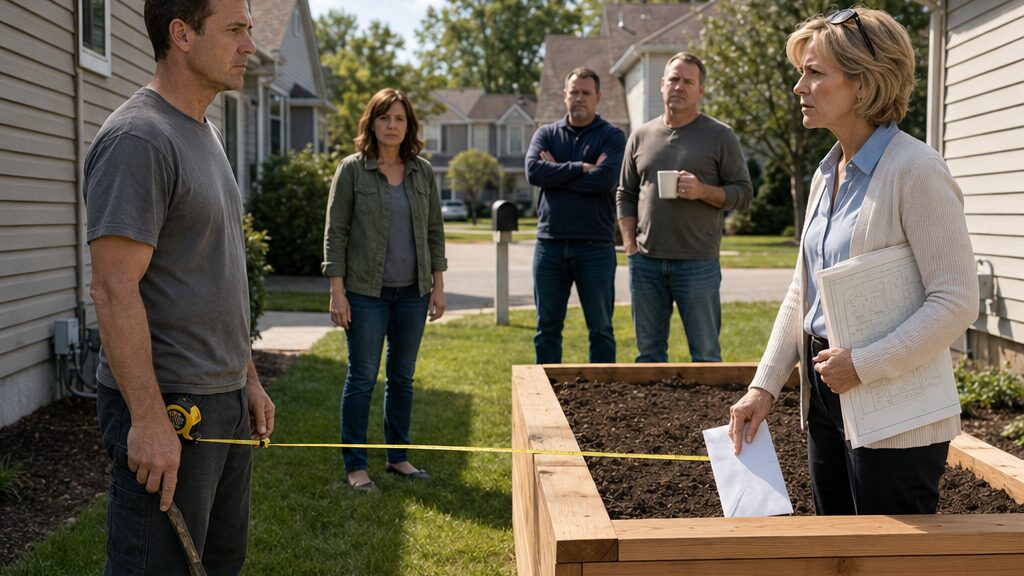
Angela Roberts pressed a white envelope against the damp cedar board as if she were pinning evidence to a wall.
“Move it today,” she said.
James Hall stopped with a shovel in his hand. The new raised bed ran twelve feet along the side yard, square to the house and filled halfway with dark soil. He had spent two Saturdays leveling the ground, cutting the boards, and fastening the corners. The cedar still smelled sharp and clean in the late-morning heat.
Angela removed her hand. The envelope stayed propped against the board.
“That’s an HOA violation notice,” she said. “Your garden is over the property line.”
James looked from the envelope to the strip of grass between their houses. There was no fence, only a shallow slope, two air-conditioning units, and a row of faded utility flags left from work done years ago.
“Which line?”
Angela pointed past the bed toward his foundation. “The line between our lots.”
“I know what a property line is.”
“Then you should have checked before building.”
James set the shovel down carefully. He had learned, at work, that placing a tool down slowly was sometimes the only warning he could give himself. At the apartment complex where he supervised maintenance, people often spoke to him as though the uniform shirt erased whatever he knew. He had spent years letting facts answer for him.
He looked again at the bed. Its nearest corner sat several feet from where he had always understood the boundary to be.
“Who measured it?” he asked.
Angela folded her arms. “The committee has the neighborhood map.”
“That wasn’t my question.”
Her mouth tightened. “I chair the landscaping committee. I know where the line runs.”
James picked up the envelope but did not open it. Through the front window, he could see his teenage daughter standing in the kitchen, pretending not to watch.
Angela glanced toward the house, then back at him. “You have until this evening to begin dismantling it.”
“You don’t have authority to order same-day removal.”
“The board can approve escalating fines.”
“Has the board met?”
“We had an emergency committee call.”
“You had a landscaping committee call.”
“We documented the encroachment.”
Angela lifted her phone. On the screen was a photograph of James kneeling beside the bed the previous afternoon, one hand on a level and the other adjusting a corner brace.
He stared at the picture longer than he meant to.
“You photographed me working?”
“We photographed the violation.”
From across the street, a garage door stopped halfway down. Someone had heard raised voices. James felt the familiar heat move up the back of his neck. It was not anger alone. It was the sensation of being turned into an example before he had been told the rule he had supposedly broken.
“Show me the marker,” he said.
Angela’s confidence flickered.
“What marker?”
“The corner monument. Pipe, pin, rebar—whatever the recorded survey uses. Show me what you measured from.”
She adjusted her sunglasses. “The map is clear.”
“So you didn’t find a marker.”
“I didn’t need to dig up anyone’s lawn.”
James looked at the grass near the bed. He could not see a pin or cap. He had bought the house eleven years earlier, and the closing packet contained a small copy of the subdivision plat, but he had never hired a surveyor. He had trusted the mow lines, the position of the air conditioners, and the way both households had used the side yard.
That trust suddenly felt thin.
Angela tapped the envelope with one fingernail. “There’s a committee meeting at two. You should attend if you want to explain yourself.”
James heard the invitation as a verdict with a chair provided.
“I’m not explaining a violation you haven’t proved.”
“Then don’t complain when the process continues without you.”
She turned toward her driveway.
“Angela.”
She stopped.
“If you’re wrong, are you withdrawing this in writing?”
She looked back over her shoulder. “You’re the one who built first and asked questions later.”
Then she walked away.
James opened the envelope after she entered her house. The notice cited unauthorized construction, landscaping encroachment, and failure to obtain architectural approval. The last item was technically possible; he had read the guidelines and believed vegetable beds under eighteen inches did not require approval, but he had not submitted anything.
The encroachment allegation was underlined.
His daughter came outside and stood beside him.
“Is she making you take it apart?”
“No.”
“You don’t know that.”
James folded the notice along its existing crease.
“I know where I built it.”
She looked at the open garage. A scarred yellow steel tape measure hung from a nail beside the workbench.
“Then measure it.”
He followed her gaze.
A tape could establish distance only from a reliable point. The house corner was not enough unless he had the setback dimensions and knew the foundation had been placed exactly as shown. Still, the sight of the tape steadied him. Measurement was a language he trusted.
His daughter nudged the envelope with one finger. “Are you going to the meeting?”
“No.”
“Why?”
“Because I’m not sitting in a room while they discuss whether I know my own yard.”
“That sounds like exactly why you should go.”
James tucked the notice into his back pocket.
“At two o’clock, I’ll be finishing the bed.”
He resumed shoveling. For the next hour, he moved soil with more force than the work required. Each load landed against the cedar with a heavy thump.
At two fifteen, Sarah Green crossed the street carrying a glass of iced tea. She stopped at the edge of his driveway rather than stepping into the disputed strip.
“You missed the meeting,” she said.
“I didn’t miss it.”
Sarah studied him over the rim of the glass. “Angela showed pictures.”
“I know.”
“She also showed a map.”
“Did it have survey monuments marked?”
“I wouldn’t know.”
“Did anyone ask?”
Sarah lowered the glass. “Mostly people asked what happens if you refuse.”
James drove the shovel into the soil.
“And what did the committee decide?”
“They’re sending it to the board president.”
“So they decided nothing.”
“They decided you were being difficult.”
The word struck harder because Sarah did not say it accusingly. She said it as a report.
James looked toward Angela’s house. Her blinds were angled down, but one panel moved.
Sarah said, “You could have gone in there and said what you just said to me.”
“I shouldn’t have to defend myself against a guess.”
“No. But when you leave the chair empty, someone else gets to describe why.”
She set the iced tea on his workbench and left.
Near sunset, James finished spreading the soil. The bed stood straight and solid, exactly as he had planned it. He washed the shovel, hung it beside the yellow tape, and went inside.
At eight thirty, the doorbell rang.
No one stood on the porch. A second envelope lay beneath the light.
This one carried the HOA property manager’s printed signature and a new deadline: twenty-four hours to remove the alleged encroachment or daily fines would begin.
Stapled behind the notice was a grainy neighborhood diagram.
A thick black line passed directly through James’s new garden bed.
Chapter 2: The Line Nobody Had Ever Measured
By eight the next morning, Angela had an audience.
Sarah stood near the curb with two other homeowners. One held a coffee cup; the other had brought nothing and looked as though he wanted that fact understood. Angela waited beside the disputed strip of lawn with a clear plastic folder tucked beneath one arm.
James stopped at the open garage.
He had expected resistance. He had not expected spectators.
His daughter handed him the yellow tape measure. “Measure twice,” she said quietly.
He clipped it to his belt and carried a narrow digging tool toward the side yard.
Angela looked at the tool. “You’re finally checking?”
“I’m finding the monument.”
“You could save yourself the trouble.” She raised the clear folder. “The map is right here.”
James crouched near the back corner of his house.
Angela followed him by several steps. “When you confirm it, I expect an apology. Not just to me. To the committee.”
He pressed the tool into the turf.
“For what?”
“For implying I fabricated this.”
“I said you didn’t measure.”
“You said it in front of people.”
James glanced toward the curb. “And now you brought more.”
One neighbor looked down into his coffee.
James pulled the tape from the housing and hooked it over a masonry edge near the foundation. He had found the subdivision dimensions in his closing papers before dawn. The copy was small, but it gave enough distances to estimate where the rear monument should lie.
The tape clicked as it extended across the grass.
Angela said, “That’s not how the committee map measures it.”
“What does it measure from?”
“The shared side-yard line.”
“You can’t measure from the line you’re trying to locate.”
She opened the folder. “This is what the HOA has used for years.”
James stood long enough to look at the page. It was the same diagram stapled to the notice: house footprints, driveways, planting zones, and thick boundary lines. There were no dimensions, bearings, monument symbols, recording stamps, or surveyor’s seal.
“That’s a landscaping map.”
“It shows the lots.”
“It shows where the landscapers stop mowing.”
“Which follows the property lines.”
“Usually isn’t legally.”
Angela’s cheeks colored. “You think you know more than everyone because you own a tape measure?”
“No. I think a tape measure needs a fixed point.”
He crouched again.
The estimated distance led toward a patch of compacted turf just beyond the garden bed’s far corner. The grass there was thinner, pressed flat by years of mower wheels.
James drove the narrow blade down.
It struck something with a small metallic knock.
The sound changed the posture of everyone watching.
James scraped away soil with the blade, then used his fingers. Beneath an inch of dirt was a dark circle no wider than a quarter. He cleared around it until a rusted pipe emerged, set firmly into the ground.
Sarah stepped closer. “Is that it?”
“It could be.”
Angela gave a short laugh. “A piece of old pipe proves nothing.”
“No,” James said. “Its position might.”
He wiped his fingers on his work pants and returned to the tape. Using the distances on the subdivision plat, he checked from the rear corner, then measured forward toward the street. He repeated the process from a second reference point.
The numbers agreed within less than an inch.
He stretched the tape from the rusted monument toward the front of the property, keeping it aligned with the approximate bearing shown on the plat. The yellow ribbon ran past the garden bed.
Not through it.
Past it by nearly four feet.
The homeowners at the curb shifted. No one spoke.
James measured again.
Angela came closer, the folder held against her chest.
“You’re angling it,” she said.
“I’m following the recorded bearing as closely as I can without instruments.”
“You just admitted it isn’t exact.”
“It doesn’t have to be exact to show the bed isn’t crossing your lot.”
He moved the tape slightly toward Angela’s side, deliberately giving her the most favorable plausible line.
The cedar remained well inside James’s yard.
Sarah looked from the rusted marker to the bed. “That’s not close.”
Angela opened her folder and pulled out the landscaping diagram.
“The HOA line goes here.” She pointed at the grass near the bed’s edge.
James left the tape stretched across the lawn.
“Show me what that line is based on.”
“It’s the approved community map.”
“That’s not an answer.”
“It has been used since before either of us moved here.”
James brushed the last dirt from the rusted pipe. Soil had packed beneath his nails. He held two fingers against the metal so no one could pretend the object was still hidden.
“Angela, we’ve been arguing over a line you never measured.”
Her eyes moved toward the neighbors.
For a moment, the certainty left her face. What replaced it was not simple embarrassment. It was alarm, quickly covered.
“I relied on the association’s records,” she said.
“You told me to dismantle a finished bed in one day.”
“Because the records show an encroachment.”
“The records show a thick black line with no reference point.”
“You refused to attend the meeting.”
“That doesn’t move the property.”
The neighbor with the coffee cup turned away to hide a reaction. Sarah gave him a warning look before facing Angela.
“Did anyone verify the map?” Sarah asked.
Angela pressed the paper flat against the folder. “The landscaping committee is not a surveying office.”
“Then why issue an encroachment notice?”
Angela’s voice sharpened. “Because waiting until there is damage is not responsible.”
James heard the word damage and looked at her.
“What damage?”
She glanced toward her house. “That isn’t the issue.”
“It sounds like it might be.”
“The issue is that you built without approval and ignored a committee directive.”
“The bed is under the height exemption.”
“That exemption doesn’t apply inside restricted areas.”
“What restricted area?”
Angela slid the landscaping map back into the folder.
“The board can answer that.”
James reeled in the tape. Its metal edge snapped lightly against the housing.
“I’m hiring a surveyor.”
“That will be at your expense.”
“If the survey confirms this monument and the line, the violation is withdrawn.”
“The board decides that.”
“You signed the first notice.”
“As committee chair.”
“Then correct it as committee chair.”
Angela looked toward the rusted pipe again. Her grip on the folder tightened until the plastic bowed.
“The HOA will enforce the map currently in its records,” she said. “If you want to challenge it, bring a licensed survey.”
“And until then?”
“The deadline remains.”
Sarah stepped between them without fully blocking either one. “Angela, you can’t seriously fine him after this.”
“I can’t suspend an official notice because someone dug up metal and stretched a tape.”
James felt the morning’s satisfaction drain away. He had imagined the marker would end the matter. The line would be visible, the accusation would collapse, and Angela would have to decide how to live with being wrong.
Instead, she had moved the argument from the grass into procedure.
He pointed toward the cedar bed. “You know that isn’t on your property.”
“I know you have not provided a certified survey.”
“That’s not the same thing.”
“No,” Angela said. “It’s the difference between what you believe and what the board can act on.”
She walked back toward her house.
The two neighboring homeowners drifted away, deprived of a clean ending. Sarah remained beside the exposed monument.
James looked down at the rusted circle in the dirt.
A fact could remain buried for decades and still be true. He had assumed exposing it would be enough.
Sarah nodded toward Angela’s folder. “Whatever she’s afraid of, it isn’t only four feet of grass.”
James clipped the tape measure to his belt.
“Then she should have said so.”
Sarah looked at him. “Maybe you should have gone to the meeting.”
He called a surveyor before he went inside.
By noon, Patrick Lee had agreed to come Wednesday morning. The fee was higher than James expected, and the earliest written certification would arrive several days after that.
At one fifteen, the property manager emailed him.
The daily fine had been activated.
Attached beneath the landscaping map was a new sentence James had not seen before:
The association’s recorded plan shall govern unless superseded by professional verification supplied at the homeowner’s expense.
Chapter 3: A Correct Boundary and a Different Problem
Patrick Lee rested one boot beside the exposed monument and said, “The pipe is real, but it isn’t the only line here.”
James had been waiting three days to hear the first half of that sentence. The second half landed like a tool dropped from a height.
“What other line?”
Patrick unfolded a field tablet mounted on a short tripod. He was compact, gray at the temples, and economical in every movement. He had already located the front monument near the sidewalk and confirmed the rear pipe James uncovered.
“The ownership boundary is where you thought it was,” he said. “Your bed does not cross onto the Roberts lot.”
James looked toward Angela’s house. Her car was gone. He wished it were not.
“How far inside?”
“At the closest point, three feet, eight inches.”
James let out a breath through his nose.
Patrick tapped the screen. “But your subdivision plat shows a drainage easement running across this side yard.”
James moved closer. The display showed thin lines, numbers, arrows, and notes far more precise than the HOA diagram.
“I never saw that.”
“Most homeowners don’t. Easements aren’t always obvious on the ground.”
“Does it follow the property line?”
“Not exactly.”
Patrick set a second marker and pulled out his own measuring tape. James unclipped the yellow tape from his belt.
“Use yours,” Patrick said. “I’ll call the distances.”
They worked from the verified rear monument. The ownership line ran straight toward the front pin. Patrick then called a separate offset from the rear boundary and angled toward a low point near the street.
James stretched the yellow tape across the grass.
The second line crossed the first near the far corner of the cedar bed.
For several seconds, both lines existed only in numbers and Patrick’s gestures. Then Patrick pushed two temporary flags into the turf.
The easement clipped one corner of the bed.
“How much?” James asked.
“Roughly eighteen inches at the widest point.”
“That doesn’t mean the bed blocks anything.”
“No. It means the association may have rights concerning drainage access or flow. Different question.”
James looked at the cedar corner. Eighteen inches was one board, part of a brace, and perhaps a quarter-yard of soil. It was not the whole bed. It was also not nothing.
Patrick crouched and examined the slope.
“Which way does water move during heavy rain?”
“Toward the street.”
“Mostly?”
James followed the grade with his eyes. “Mostly.”
Patrick looked toward Angela’s foundation. “Any history of pooling?”
“Not on my property.”
“That wasn’t my question.”
James recognized the correction and disliked it because it was fair.
“I’ve seen water run between the houses,” he said. “Before the bed was built.”
“From where?”
“Backyards. Downspouts. The upper lots.”
Patrick walked the corridor toward the street, studying the ground. Near the curb, the grass dipped beneath a layer of decorative mulch installed around a community tree.
“There should be an inlet somewhere down here.”
“I don’t remember one.”
Patrick used the heel of his boot to move mulch aside but found only landscape fabric.
“Could be covered. Could be farther over.”
James folded his arms. “Can you certify the property line today?”
“Yes.”
“And state that there is no encroachment?”
“Yes.”
“That’s what I hired you for.”
Patrick straightened. “I’ll state what I found. I’ll also show the easement because omitting it would make the survey incomplete.”
James looked at the bed again. For three days he had pictured handing Angela and the board a clean document that left no room to change the accusation. He had imagined the word encroachment struck from the record, the fines canceled, and the burden returned to the people who had placed it on him.
Now the proof had an asterisk.
At the county records office that afternoon, James requested the full subdivision plat rather than the reduced closing copy he owned. The clerk brought out a large scanned image on a monitor.
The drainage note was printed along the lower margin:
TEN-FOOT PRIVATE DRAINAGE AND ACCESS EASEMENT AS SHOWN.
James compared it with a photograph of the HOA map on his phone. The association diagram showed a bold line near the same area, but no easement label, no dimensions, and no monuments. Someone had simplified the original until ownership and use restrictions looked like the same thing.
“Can I get a certified copy?” he asked.
The clerk nodded. “Paper or digital?”
“Both.”
While she processed the request, he studied older filings associated with the subdivision. There was no amendment moving his property line. No correction plat placed the garden on Angela’s lot. The monument and Patrick’s measurements were right.
The clerk returned with stamped pages.
James should have felt finished.
Instead, he kept seeing the second yellow line crossing the cedar corner.
When he arrived home, an email from Patrick waited in his inbox. The preliminary drawing contained two clearly labeled lines: PROPERTY BOUNDARY and DRAINAGE EASEMENT.
The garden bed sat completely inside the first.
One corner entered the second.
James forwarded the boundary page to the property manager, Angela, and Elizabeth Martin, the HOA board president. His message contained one sentence:
The attached licensed survey confirms that no portion of my garden bed encroaches on the Roberts property.
Elizabeth replied within forty minutes.
Thank you for the documentation. The association acknowledges that the neighboring-lot encroachment allegation requires correction. However, the survey also indicates construction within a recorded drainage easement. The existing violation will therefore remain active pending board review under the easement and common-drainage provisions.
James read the paragraph twice.
Then a third time.
His daughter stood in the kitchen doorway. “Did you win?”
“They changed the charge.”
“Can they do that?”
“They just did.”
“What does the surveyor say?”
“That the bed isn’t on her land.”
“That sounds like winning.”
James turned the laptop so she could see the two labeled lines.
She traced the easement with her finger without touching the screen. “Is this real?”
“Yes.”
“Did you know about it?”
“No.”
“Did Angela?”
James thought of her saying damage, then refusing to explain.
“I don’t know what she knew.”
The board notice arrived that evening. The hearing was scheduled for the following Thursday. James was ordered to provide a drainage-impact explanation or remove the structure before the hearing to avoid further enforcement.
The last paragraph stated that the board could authorize removal of improvements interfering with easement access.
James carried the laptop into the garage and set it on the workbench beneath the hanging tools. The yellow tape lay beside it, still dusted with soil from the monument.
He pulled the tape across the concrete floor and marked eighteen inches with a carpenter’s pencil.
It was a small distance.
It was also the exact width by which being right had failed to settle anything.
Chapter 4: What Angela Feared Beneath Her House
Sarah Green stood at the edge of James’s driveway with her arms folded against the morning chill.
“You need to see her basement,” she said.
James had one hand on the garage door track. “No.”
“She asked me to bring you.”
“That doesn’t make it a good idea.”
Sarah glanced toward Angela’s house. The blinds were open, but no one stood behind them. “You keep asking what she knew. This is part of the answer.”
James looked at the survey drawing spread across his workbench. Two clean lines crossed near the garden bed: one proving he had not trespassed, the other refusing to let the dispute end.
“The hearing is next week,” he said. “She can explain herself there.”
“She won’t.”
“That’s her choice.”
Sarah stepped closer. “You made the same choice when you skipped the committee meeting.”
James closed the garage door harder than necessary.
Angela was waiting beside her open side door. She wore an old sweatshirt instead of the pressed blouses she usually appeared in at neighborhood meetings. Without sunglasses, she looked more tired and less certain.
“I didn’t ask for an audience,” James said.
Sarah answered before Angela could. “Good. Neither of you performs well with one.”
Angela led them down a narrow set of basement stairs. The air changed halfway down, cooler and carrying the mineral smell of concrete. Plastic storage bins had been pulled away from the far wall. A horizontal repair line ran across the foundation, gray epoxy against older concrete.
Angela switched on a work light.
“This opened during the spring storms two years ago,” she said.
James moved closer. The crack had been sealed and reinforced with short metal plates. Near the floor, pale water stains rose in uneven shapes behind the furnace.
“You had water in here?”
“Three times.”
“Before I built the garden.”
Angela’s jaw tightened. “Yes.”
James looked at Sarah. She did not soften the fact for either of them.
Angela opened a folder on a folding table. Inside were contractor photographs, invoices, and a typed report. The total at the bottom of the first invoice was more than James had expected.
He read the date twice.
Two years before the cedar bed.
“The contractor said runoff was collecting along this wall,” Angela said. “He told me to get the association to clear the drainage path.”
“Did you?”
“I sent six emails.”
“What did the board say?”
“That the common drainage system was functioning and that homeowners were responsible for keeping private landscaping from interfering.”
James turned another page. There was a photograph of muddy water pooled near the basement window. The picture had been taken from inside, through the glass.
“You never mentioned any of this.”
“You never asked.”
“You accused me of building on your land.”
“Because the map showed the line through the bed.”
“The map wasn’t a survey.”
“I know that now.”
James looked up. “You knew it before the notice.”
Angela did not answer.
Sarah set one hand on the folding table. “Angela.”
Angela picked up a small metal ruler from beside the invoices. She crossed to the wall and placed it against a thin hairline crack extending beyond the repaired section.
“This was barely visible in May,” she said. “It is wider now.”
James watched her align the ruler with careful fingers. The movement was precise and practiced.
“When I saw the soil going into that bed,” she continued, “I saw another wall repair. I saw another contractor telling me to wait until the next storm before anyone would admit there was a problem.”
“That doesn’t explain the property-line claim.”
“I used the map the association gave us.”
“You used it like proof.”
“Yes.”
The admission came quietly.
James had imagined forcing it from her in the hearing room. He had imagined a clean moment where she either lied again or finally said the words in front of everyone. Hearing them here, beside a repaired wall, gave him no satisfaction.
Angela set the ruler down.
“I thought if I said drainage, they would delay,” she said. “They delayed before. Encroachment gets immediate attention.”
“So you changed the complaint.”
“I described what the map appeared to show.”
“You told me you knew.”
“I was afraid.”
James felt anger rise again, sharper because he understood her now. Fear explained the choice. It did not erase it.
“You let them fine me.”
“You refused the meeting.”
“That was pride. This was authority.”
Angela flinched, but she did not look away.
Sarah opened the contractor report. “The estimate says the water entered from the rear side yard.”
Angela nodded. “That is where it collects.”
James traced the photographed waterline with one finger. The slope between the houses should have carried runoff toward the street. If water had been standing against Angela’s foundation before the garden existed, something downstream had already failed.
“Did anyone inspect the inlet?” he asked.
“The property manager said maintenance had checked it.”
“When?”
“I don’t know.”
“Did you see them?”
“No.”
James straightened.
The basement no longer felt like evidence against the garden. It felt like a room built beneath a larger failure, one both of them had been pushed into misunderstanding.
Angela folded the invoice closed. “I am not asking you to forgive the notice.”
“Good.”
“I am asking you not to treat the easement like another invented line.”
James looked again at the repaired wall. “I won’t.”
The answer seemed to surprise her.
He added, “But I’m not removing the whole bed because the board ignored this for two years.”
Angela’s expression hardened slightly. “Then what are you going to do?”
“Find out where the water is supposed to go.”
Outside, Sarah waited until they reached the driveway before speaking.
“That went better than I expected.”
“It didn’t go well.”
“No. It went somewhere.”
James looked toward his garden. The cedar boards held their straight shape in the sun. The corner inside the easement looked no different from the rest.
Sarah lowered her voice. “There’s something else.”
“What?”
“The downstream grate near the community tree used to be cleared every spring.”
“Used to be?”
“Three years ago, the board cut the grounds-maintenance contract. Mulching stayed. Drainage clearing went to ‘as needed.’”
“Who decided when it was needed?”
“The property manager.”
James looked toward the curb where Patrick had pushed mulch aside and found only landscape fabric.
Sarah said, “One of the former board members told me they stopped scheduling it because the reserve account was low.”
“So the inlet may have been buried while they blamed private landscaping.”
“May have been.”
James walked to the street and stood beside the community tree. The mulch ring looked neat from above, dark and freshly turned. He pushed his shoe into it. Beneath the top layer, the material was packed hard.
Sarah joined him.
“Where exactly was the grate?” he asked.
She pointed toward a shallow depression nearly hidden beneath the mulch.
James crouched and pulled away a handful.
Black landscape fabric appeared underneath.
Then, at the edge of his fingers, something solid and metal resisted.
Chapter 5: The Map the Board Preferred to Believe
The county plat and the HOA map did not share a single reliable reference point.
James laid them side by side across a table in the association records room. The certified plat showed bearings, distances, monuments, easement widths, and a county recording number. The HOA sheet showed simplified house shapes, planting beds, and bold black lines drawn without labels.
Elizabeth Martin stood at the other end of the table.
“They were created for different purposes,” she said.
“That is the problem.”
“The association map was never intended to replace a survey.”
“It was used to accuse me of encroachment.”
Elizabeth glanced toward the property manager, who sat beside a locked filing cabinet. “The committee relied on the information available.”
“The information available was wrong.”
“Incomplete,” Elizabeth said. “Not necessarily wrong.”
James slid the HOA map forward and placed his finger on the thick line that passed through his garden bed.
“What is this?”
“A lot boundary.”
“Based on what?”
Elizabeth did not answer immediately.
The property manager said, “It may reflect mowing limits.”
James looked at him. “Then it is wrong.”
Elizabeth rested both palms on the table. “We have already acknowledged that the neighboring-property allegation requires correction.”
“You kept the same violation active.”
“Because your own survey identifies an easement issue.”
“That does not turn a false accusation into a true one.”
“No. It creates a separate compliance concern.”
“Then issue it separately and remove the first one.”
The property manager shifted in his chair. Elizabeth’s expression remained controlled, but James saw the tension in her jaw.
“We are trying to avoid procedural confusion,” she said.
“You created procedural confusion.”
“I understand you are frustrated.”
James almost laughed. The phrase belonged to people who wanted emotion to replace the subject under discussion.
“I requested maintenance records for the drainage inlet,” he said.
Elizabeth glanced at the property manager again. “Those records are being reviewed.”
“The hearing is in two days.”
“We will provide what is relevant.”
“I asked for all inspections and clearing schedules from the last five years.”
“Some vendor files are archived.”
“Then unarchive them.”
Elizabeth closed the folder in front of her. “This meeting was intended to clarify the map discrepancy, not conduct discovery.”
James looked at the locked cabinet.
The association had moved quickly when Angela called his garden an encroachment. Now every record required review, context, or time.
He gathered his papers.
“Will you provide the maintenance history before the hearing?”
Elizabeth said, “We will provide the board’s summary.”
“That wasn’t my question.”
“No,” she said evenly. “It was not.”
He left before pride turned his next sentence into something useful to them.
At the community tree, James knelt beside the depression Sarah had shown him. He wore work gloves and carried the yellow tape, a flat shovel, and his phone.
The top layer of mulch came away easily. Beneath it, the material was wet and compressed. Someone had spread fresh chips over older layers without removing them.
He cut through the landscape fabric.
The shovel struck metal.
James widened the opening until the rectangular edge of a storm-drain grate appeared. Half its slots were packed with soil, decomposed mulch, and fibrous roots.
Water marks darkened the curb above it.
He measured the grate, then the width of the shallow drainage corridor leading from the side yards. Patrick’s drawing showed a ten-foot easement. The maintained opening at the street had been reduced to less than three feet by the tree ring and accumulated mulch.
Sarah arrived while he was taking photographs.
“You found it.”
“They landscaped over it.”
She crouched beside him. “Recently?”
“Some of this mulch is fresh. The rest has been here for years.”
James used the flat shovel to lift a compacted slab. Beneath it lay a crushed plastic bottle and several layers of black fabric.
He pictured stormwater moving down the slope, reaching the street, and finding most of its outlet sealed. The water would slow, spread, and back up along the lower ground between the houses. Angela’s foundation sat on that path.
The cedar bed might narrow a corner of the corridor during an extreme storm. But the blocked grate had been narrowing the entire outlet before James ever bought lumber.
Back in his garage, he laid the survey, county plat, HOA map, contractor invoice dates, photographs, and measurements across the workbench. His daughter helped him tape sheets to a piece of cardboard.
“You’re making a school project,” she said.
“I’m making it understandable.”
“Same thing.”
He drew the property boundary in pencil and the drainage easement in blue. He marked the garden bed, Angela’s foundation, and the buried inlet.
The water path became obvious once all the lines occupied the same page.
His phone rang.
Elizabeth asked whether he could come to the HOA office before closing.
When he arrived, she was alone. A thin folder lay on the conference table.
“I reviewed your photographs,” she said.
“And the maintenance records?”
“Some.”
She opened the folder but kept one hand over the pages.
“The board would like to resolve this before the hearing.”
James sat without removing his coat.
“What does resolve mean?”
“The association will cancel the accrued fines if you remove the garden bed from the easement before Thursday.”
“The whole bed?”
“Yes.”
“Why the whole bed?”
“To eliminate uncertainty.”
“The survey identifies the affected corner.”
“The board does not want continuing disputes over partial compliance.”
James looked at her hand covering the records.
“And the encroachment allegation?”
“The notice will be closed.”
“Corrected?”
“Closed.”
“That means it stays in the file as a resolved violation.”
Elizabeth paused. “Internally, yes.”
“It was false.”
“The easement concern is valid.”
“That is not the same allegation.”
“We are offering you a practical outcome.”
James understood the offer. He could protect his money, avoid the hearing, and rebuild later somewhere no one could challenge. The cost would be two weekends of labor and a permanent record saying the board had been justified.
“What happens to the map?” he asked.
“It remains an internal landscaping reference.”
“Even though it misstates property lines.”
“We can add a disclaimer.”
“What happens to the drain?”
“The grounds vendor will inspect it.”
“Inspect the grate I already uncovered?”
Elizabeth’s face tightened. “There is no need to make this adversarial.”
“It became adversarial when your committee fined me for crossing a line that wasn’t there.”
“I am trying to prevent more expense for everyone.”
“By making me carry it.”
She removed her hand from the folder. The top page was a vendor schedule. Several years showed spring and fall drainage clearing. The most recent two years had blank spaces.
James reached toward it.
Elizabeth closed the folder.
“These are preliminary records.”
“They show the cleaning stopped.”
“They show that we have not yet located separate work orders.”
“Do they exist?”
“I don’t know.”
James stood.
“If I accept this, do I agree not to raise the map or maintenance issue at the hearing?”
“There would be no hearing.”
“That wasn’t my question.”
Elizabeth met his eyes. “The settlement would include mutual non-disparagement regarding the dispute.”
James thought of Sarah saying that when he left the chair empty, someone else described why. This offer was another empty chair, padded this time with canceled fines.
He picked up his folder.
“No.”
“James, be careful about turning a manageable issue into a community-wide conflict.”
“It already is community-wide. Your map affects every lot. Your drain carries water from more than mine.”
“You may not get a better result at the hearing.”
“I may get a worse one.”
Elizabeth seemed surprised by the admission.
James continued, “But it will be on the record.”
He walked to the door.
“Are you rejecting the settlement?” she asked.
He looked back at the closed maintenance folder.
“Yes. And I want the hearing open to homeowners.”
Chapter 6: The Hearing Where Both Claims Failed
Elizabeth Martin read the false accusation into the official record before James had finished setting down his papers.
“Original complaint,” she said, “unauthorized garden construction extending beyond the Hall property boundary and interfering with association drainage access.”
James remained standing.
“The first half has been disproved.”
Elizabeth looked up from the page. The clubhouse meeting room held four board members, the property manager, Angela, Sarah, and nearly twenty homeowners seated in folding chairs.
“The record will reflect your objection,” Elizabeth said.
“It should reflect the survey.”
“It will.”
“Then call it a corrected complaint.”
A board member shifted toward the microphone. “Mr. Hall, you will have time to present.”
James sat.
The yellow tape measure rested on the table beside his folder. He had brought it without deciding whether he would use it. In the room’s fluorescent light, its scratched casing looked ordinary and almost out of place among the laptops and printed packets.
Elizabeth summarized the violation history. Her wording made the dispute sound like a smooth administrative sequence: complaint, inspection, notice, survey, revised concern. The public accusation, the photographs, the fines, and the changing rationale disappeared into dates.
Then Angela spoke.
She sat at the end of the board table rather than among the homeowners. Her hands remained folded over a thin stack of papers.
“I reported what I believed was an encroachment based on the association map,” she said. “The licensed survey shows that belief was incorrect.”
A murmur moved through the chairs.
Angela kept her gaze forward.
“I did not measure from a legal monument before making the complaint.”
James had wanted those words. Hearing them did not return the mornings he had spent proving them.
Elizabeth thanked her and shifted immediately to drainage.
“The board’s present concern,” she said, “is whether construction within the recorded easement creates risk to neighboring property or limits maintenance access.”
James carried his cardboard diagram to an easel. He placed the county plat and survey beside it.
“This black line is the ownership boundary,” he said. “This blue band is the drainage easement. They are not the same.”
He pulled out the yellow tape and extended it across the floor between two strips of painter’s tape he had placed earlier with permission. The metal ribbon clicked through the quiet room.
“This is the ten-foot easement width.”
He marked the position of the garden bed with a cedar offcut.
“One corner enters the easement by approximately eighteen inches.”
A homeowner in the back asked, “So it is in the drainage area?”
“Yes.”
Angela turned toward him.
James saw the change in the room. Some people had expected him to deny everything. Admitting the overlap cost him the clean role they had assigned him.
He continued.
“That corner could narrow emergency flow during an unusually heavy storm. I did not know the easement was there when I built it.”
Elizabeth leaned toward the microphone. “Then the removal request is appropriate.”
“No.”
The word came out calm.
James placed photographs of the community inlet on the easel.
“This is the downstream grate that serves the corridor. It was covered by landscape fabric, old mulch, fresh mulch, roots, and compacted soil.”
The property manager said, “The vendor has not confirmed those materials were placed by the association.”
“The tree ring is association-maintained.”
“That does not establish timing.”
James held up a photograph showing multiple layers of fabric beneath fresh chips. “The timing matters less than the condition. The outlet was blocked before my bed existed.”
He added Angela’s foundation contractor invoice, with the amount covered and the date visible.
“This repair predates my garden by two years.”
Angela looked down.
Sarah spoke from the audience. “The grate used to be cleared twice a year.”
Elizabeth lifted one hand. “Public comments will come later.”
James placed the vendor schedule beside the invoice. “The records provided last night show routine drainage clearing stopped two years ago.”
Elizabeth’s head turned toward the property manager.
He said, “The absence of entries does not prove the work was not performed.”
“Then produce the work orders.”
“We are still searching archived files.”
James looked at the homeowners. “I am not claiming the garden has zero effect. I am saying the board chose the easiest object to remove because it was visible.”
One board member examined the photographs. “If the grate is restored, does the bed remain a concern?”
James answered before anyone else could.
“One corner does.”
Angela raised her eyes.
James touched the cedar offcut.
“I can rebuild that corner outside the easement. I can leave the full ten-foot width open.”
The admission tightened something in his chest. For days, he had feared that offering any change would let the board say the accusation had been justified all along.
Elizabeth said, “Removing the entire structure would provide greater certainty.”
“Greater convenience,” James replied. “Not greater accuracy.”
“The board has discretion to require full removal of improvements within an easement.”
“Then use that discretion consistently. Survey every structure, fence, tree ring, and landscape wall crossing the same corridor.”
Several homeowners turned toward one another.
Elizabeth’s voice cooled. “This hearing concerns your property.”
“The map you used concerns everyone’s.”
James placed the HOA landscaping diagram beside the county plat. The thick black line had no dimensions or monument references.
“This drawing was treated as a boundary map. It is not one. If you leave it in circulation with a disclaimer, the next homeowner will still see a line and assume it is legal.”
A board member asked the property manager, “How many violation decisions have relied on this?”
The manager hesitated. “I would have to review prior files.”
The room changed again. The issue was no longer James’s garden alone.
Elizabeth called a brief recess.
No one left. The board members gathered near the wall and spoke in low voices. Angela remained seated.
James returned to his chair. Sarah leaned forward from the row behind him.
“You gave them the corner,” she whispered.
“I gave them the truth.”
“You could have forced them to prove impact.”
“I already know it could narrow the flow.”
Sarah nodded once.
Across the room, Angela stood and walked toward James. She stopped on the other side of the yellow tape stretched across the floor.
“I should have told you about the basement,” she said.
“Yes.”
“I thought if I admitted the line might be wrong, the board would ignore the drainage again.”
“They did ignore it.”
“I still used you to make them listen.”
James looked at the tape between their shoes.
“Yes.”
Angela did not ask him to forgive her. She returned to her seat when Elizabeth called the meeting back to order.
The board proposed a resolution: James would remove the entire bed within ten days; fines would be waived; the drainage inlet would be inspected; the map would be reviewed at a future meeting.
James listened until Elizabeth finished.
“No.”
A few homeowners shifted as if the word itself had weight.
Elizabeth said, “This is the board’s proposed remedy.”
“It preserves every mistake except mine.”
“It eliminates immediate risk.”
“It eliminates the evidence that your first accusation was false.”
“This is not about pride.”
James placed both hands on the table.
“It became about pride when I skipped the first meeting. I gave Angela and the committee an empty chair and told myself the measurements would speak later. That was my mistake.”
The room remained still.
“But correction is not the same as surrender. I will redesign the eighteen-inch corner because it is inside the easement. I will not dismantle a legal garden bed to help the association avoid correcting its records.”
Elizabeth looked toward the board members.
James continued before she could close the discussion.
“My offer is this: withdraw the encroachment violation in writing. Remove the fines. Reimburse the licensed survey that became necessary because the association relied on an unverified map. Restore and document drainage maintenance. Correct every copy of the landscaping map so it cannot be used as a property survey. I will rebuild the affected corner outside the full easement width.”
“And if the board declines?” Elizabeth asked.
“Then issue a written decision saying why complete removal is necessary after the outlet is cleared and the easement is restored.”
The property manager whispered something to her. Elizabeth’s face remained composed, but the certainty had left it.
James retracted the yellow tape. It snapped into the case, removing the bright line from the floor.
The board voted to enter closed deliberation and issue a decision within five business days.
As people stood, Angela approached the microphone before Elizabeth could switch it off.
“For the record,” she said, “the garden bed was never on my property.”
Elizabeth closed her eyes briefly.
The statement remained in the room after the microphone went dark.
Chapter 7: What They Chose to Mark Correctly
The HOA crew found the drain only after removing nearly a foot of mulch.
James stood at the curb with his hands in his jacket pockets while two workers cut back landscape fabric and lifted compacted debris from the grate. Water trapped beneath the material released in a dark, slow sheet and ran along the gutter.
One worker looked at the other.
“This should never have been covered.”
The property manager, standing several feet away with a clipboard, wrote something without answering.
Three weeks had passed since the hearing. In that time, the board had issued a six-page decision, two corrected notices, and a new maintenance schedule. The language was formal enough to conceal how much had changed.
The encroachment allegation had been withdrawn as unsupported.
The daily fines had been removed.
James’s survey expense would be reimbursed.
The landscaping map would no longer be used to determine ownership boundaries, and any future property-line enforcement would require professional verification.
The board had also ordered the full drainage corridor inspected before the next storm season.
James had read the decision twice before allowing himself to believe it.
It did not contain an apology.
It did contain the truth.
Sarah stood near the community mailbox with several printed copies of the revised policy. She handed one to a neighbor, who glanced toward James and then away, embarrassed by the memory of the Sunday audience.
No one applauded. No one needed to.
Angela arrived carrying the yellow tape measure.
James recognized it before he recognized the gesture. It was his tape, the scarred steel case he had left on the clubhouse table after the hearing. She held it carefully, as though returning something more delicate than a tool.
“You forgot this,” she said.
“I noticed.”
“I kept meaning to bring it over.”
James took it from her. The casing was clean. She had wiped away the soil around the clip.
Behind them, the crew dragged a packed slab of roots and mulch onto a tarp. The exposed grate was larger than it had appeared when James uncovered one edge.
Angela watched the water move through it.
“They said the channel behind my house will be regraded next week.”
James nodded.
“The board approved your redesign too,” she added.
“I saw.”
His new plan did not remove the garden bed. It shortened one end, angled the far corner away from the easement, and left the full drainage width open. Patrick had marked the revised line on the survey. The board had approved it with no fine, no admission of violation, and no condition that James remain silent.
Angela looked toward the cedar bed.
“When are you changing it?”
“Today.”
“I can help.”
James clipped the tape to his belt.
“I’ve got it.”
She accepted the answer without arguing.
By late morning, James had removed the soil from the affected corner and stacked it on a tarp. His daughter carried out tools, then disappeared when the work became repetitive. Sarah stopped by long enough to hold one end of a chalk line.
James measured from the verified monument first.
Then he measured the easement.
The yellow ribbon crossed the grass in two directions, but this time neither line was being used to defeat anyone. One protected ownership. The other protected flow.
He marked the new corner with stakes.
Angela watched from her driveway for several minutes before walking over. She stopped outside the measured boundary.
“The board sent the correction to the neighborhood email list,” she said.
James kept his eyes on the cedar board clamped to his workbench.
“I saw.”
“I wrote the statement myself.”
He had read that too.
It was direct. Angela had stated that her original encroachment allegation was not supported by a licensed survey, that James’s garden bed had never crossed onto her property, and that the drainage concern should have been raised separately.
The statement did not ask anyone to excuse her.
James appreciated that more than he wanted to say.
“The committee elected a new chair,” she said.
He looked up.
Angela pressed her lips together. “I resigned.”
“Was that required?”
“No.”
James returned to the cut line.
The saw moved through the cedar with a dry, steady sound. When the board separated, the removed section fell softly onto the grass.
Angela looked at it. “That’s all you have to change?”
“That corner and the brace.”
“They wanted the whole thing gone.”
“I know.”
She stood with her hands at her sides. Without the folder, phone, or committee title, she seemed uncertain where to place them.
“I thought if I admitted the map might be wrong,” she said, “the board would ignore me again.”
“They might have.”
“I decided that made the lie useful.”
James set the saw down.
“It made it useful to you.”
“Yes.”
The answer remained between them.
He lifted the shorter board into place. It created an angled corner that cleared the marked easement by several inches. The garden looked different, but not damaged. If anything, the new shape followed the slope more naturally.
Angela said, “I don’t expect us to be fine.”
“We’re not.”
She nodded.
A gust moved through the open drainage corridor, lifting the grass along the measured line. At the curb, water continued to slip cleanly through the uncovered grate.
James held the board while reaching for the drill. The position was awkward. He could brace it with his knee, but the angle would shift before the first screw caught.
Angela stepped closer, then stopped.
“May I cross?”
James looked at the yellow tape lying across the grass.
For weeks, the line had meant accusation, proof, risk, and defense. Now Angela waited at its edge instead of claiming she knew what lay beyond it.
He moved the tape aside with his shoe.
“Yes.”
She crossed onto his lawn and placed both hands against the cedar.
“Here?”
“Lower.”
She adjusted her grip.
James checked the level, drove the first screw, then the second. Angela held steady without speaking. When the brace was secure, he stepped back.
The rebuilt corner sat entirely outside the easement. The bed remained full-sized enough for the tomatoes his daughter had chosen, and the drainage path lay open beside it.
Angela released the board.
James extended the yellow tape one last time. Together, they confirmed the distance from the rusted monument, then the width of the corridor.
The numbers matched.
He retracted the tape slowly, guiding the metal ribbon so it would not snap.
Angela looked toward the repaired line of her foundation, hidden beyond the wall of her house.
“Thank you for changing the corner,” she said.
“I didn’t change it because you accused me.”
“I know.”
“I changed it because the water needs somewhere to go.”
“I know that too.”
James clipped the tape back onto his belt.
At the community mailbox, Sarah removed the old landscaping diagram from the glass notice case. In its place, she posted the new policy: property boundaries required verified records; easements had to be identified separately; maintenance complaints could not be converted into unrelated violations.
The old map curled in her hand as she walked away.
James gathered the cut cedar and carried it toward the garage. Angela remained beside the finished bed, careful not to step over the open drainage line.
The garden had never been on her property.
The corner had still needed to move.
Both facts could stand together now, measured correctly.
The story has ended.