The HOA Called Her Property Line Flexible Until the Red Notices Reached Their Clubhouse
Chapter 1: The Concrete Forms Against the Cedar Fence
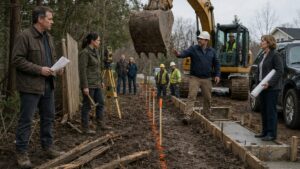
The first bolt had been driven through Cynthia Walker’s cedar fence post.
She saw it from thirty yards away, a bright steel head where no metal had been the evening before. On the other side of the fence, plywood concrete forms ran along the edge of the homeowners association’s clubhouse site. One form pressed so tightly against the cedar that the post leaned toward her orchard.
Cynthia set down the pruning shears she had been carrying and walked across the dry grass.
A compressor coughed behind the fence. Hammers struck in irregular bursts. Above the forms, vertical bars of reinforcing steel rose in two parallel rows, close enough that she could reach between the cedar boards and touch one.
She did not.
Instead, she crouched and studied the ground.
The boundary had been surveyed the previous spring when she replaced the northern section of fence. The posts followed the recorded line, offset inward by four inches so no neighbor could later claim the fence itself sat on shared land. The clubhouse foundation should have been several feet beyond it.
Now one plywood form was touching the post.
“Excuse me,” she called.
A worker looked over, then turned toward a broad man in a faded safety vest. Larry Nelson had introduced himself two weeks earlier as the foreman. He crossed the dirt with the careful expression of someone already expecting a complaint.
“Morning, Ms. Walker.”
“You’ve fastened your form to my fence.”
Larry glanced at the bolt. “Temporary brace.”
“It is on my property.”
“We’ll pull it after the pour.”
Cynthia looked past him. A concrete truck was not yet present, but the rebar cage was tied, the forms oiled, and the anchor templates laid out. This was not preliminary work. They were preparing to make the encroachment permanent.
“Where is your setback line?”
Larry pointed vaguely along the trench. “Plans are approved.”
“That wasn’t my question.”
His mouth tightened. Behind him, two workers stopped pretending not to listen.
Cynthia stepped to the end of the fence and sighted along the cedar posts. The plywood form disappeared behind them instead of remaining visible on the association’s side. Either the fence had moved overnight or the foundation crossed the line.
She knew which possibility was more likely.
“Did a surveyor stake this foundation?” she asked.
“Management handled all that.”
“Thomas Miller?”
Larry nodded.
“Then call him.”
“He’s at the clubhouse office.”
“Tell him I’m asking that work beside this fence stop until the boundary is verified.”
Larry exhaled through his nose. “I can’t shut down a crew because a neighbor has a concern.”
“This is not a concern. It is a location.”
He looked at the form again. For a moment, Cynthia thought he might order the workers away from it. Then a nail gun cracked behind him, and his shoulders settled.
“Mr. Miller says there’s an access agreement along this side,” he said. “The line is flexible for the project.”
Cynthia stared at him.
“Flexible,” she repeated.
“I’m telling you what I was told.”
“A surveyed boundary is not flexible.”
Larry lowered his voice. “Look, we’re trying to finish before the summer opening. The board has penalties in the contract if we miss the date. If you’ve got paperwork, take it to management. I have a crew to keep moving.”
He turned away.
“Larry.”
He stopped.
“When is the pour?”
His hesitation was brief but visible. “Tomorrow afternoon.”
Cynthia walked back along the fence without answering. The old anger rose first—the useless kind, hot and imprecise. She let it pass. Anger did not establish coordinates. Anger did not stop concrete.
Near the corner post, she knelt in the weeds and began clearing the soil with the flat edge of her pruning shears.
She remembered where the survey technician had set the monument: eighteen inches south of the old irrigation valve, just inside her parcel. Last summer she had covered it lightly to keep the mower blade from striking it.
The dry earth gave way in pale flakes. Beneath an inch of soil, metal flashed.
Cynthia brushed it clean with her thumb.
The brass survey marker was no larger than a coin. A stamped center point sat within a ring of worn lettering. She placed the tip of her shears on that point and looked toward the next recorded monument near the gravel road.
The plywood form stood on her side of the projected line.
Not by inches of optical confusion. By enough that the rebar cage would place part of the concrete footing inside her parcel.
Larry watched from beyond the fence. He did not approach.
Cynthia took out her phone and photographed the marker, the fence post, the bolt, the form, and the reinforcing steel. Then she fetched a tape measure from the barn and recorded distances in a small field notebook she had not used since retirement.
At the clubhouse office, Thomas Miller stood beside a new glass door while a delivery driver unloaded stacked patio chairs. His pale shirt was pressed despite the dust. He listened to Cynthia’s description with his eyes on the chairs rather than on her.
“The county approved the expansion,” he said.
“I asked whether your foundation was independently staked.”
“We have a variance.”
“A setback variance does not move a property boundary.”
Thomas finally looked at her. “The association has access rights along your fence. This has all been reviewed by counsel.”
“Then you won’t object to showing me the document.”
“I’m not distributing association legal files at a construction site.”
“You are building against my fence.”
“We’re improving a community facility that serves eighty-six households. I’m not stopping a contracted crew because you believe a cedar post is a legal monument.”
“The cedar post isn’t the monument.”
His expression changed slightly.
Cynthia saw that he understood the distinction.
“The pour is tomorrow,” she said. “You have until then to verify the line.”
Thomas gave a small, tired smile. “Ms. Walker, property lines in older rural subdivisions are rarely as clean as people imagine. There are easements, shared-use corridors, maintenance rights. It’s not as simple as stretching a string between two points.”
“For you, perhaps.”
The driver looked away to hide a reaction.
Thomas’s smile disappeared. “Send your concerns in writing.”
“I will.”
Cynthia returned home and opened the county records portal on the desktop computer in her study. She entered her assessor’s parcel number and downloaded the recorded survey. The scanned plat appeared exactly as she remembered it: bearings, distances, monument references, and the narrow rectangular strip along the northern edge.
A notation beside that strip referred to an access easement.
She clicked the linked instrument number.
The document opened slowly, one gray page at a time. Cynthia read the legal description, then scrolled to the signature page.
At the bottom, beneath the acknowledgment stamp, was her own name.
Beside it were the initials she had written fifteen years earlier.
C.W.
Chapter 2: The Agreement She Never Wanted to Read Again
Cynthia enlarged the signature until the ink broke into square pixels.
There was no possibility of mistake. The initials were hers, formed with the same narrow C and hard downward stroke she still used. The date beside them belonged to the winter her husband had begun missing appointments because the medication left him confused.
She printed the document and carried it to the kitchen table.
The easement consisted of seven pages. She remembered only the final one.
A representative from the development company had come to the house with a notary and a folder of forms. The association’s original water line ran close to Cynthia’s fence, he had explained. The company needed legal access for maintenance and emergency repairs. Her husband had been sleeping in the next room after a hospital visit. Cynthia had skimmed the first page, asked whether the agreement changed ownership, and signed when the man said no.
Her husband had read the papers that evening.
“You should have made him wait,” he had said.
“I asked the important question.”
“You asked one question.”
She had resented the remark because he was ill and frightened, and she was doing everything else. Meals, medications, insurance calls, appointments, repairs. She had placed the folder in a cabinet and never opened it again.
Now the words sat under her reading glasses.
The easement granted the association and its agents access over a twelve-foot strip for inspection, maintenance, repair, and replacement of underground utilities. It permitted temporary entry by vehicles and equipment when reasonably necessary.
Cynthia turned the page.
A later clause prohibited permanent structures, storage, or obstructions within the easement unless separately authorized by the landowner.
She read it twice.
The agreement gave Thomas access. It did not give him land. It certainly did not authorize a clubhouse foundation.
Relief came first, clean and technical. Then shame followed it.
Thomas knew the easement existed. He might have read only the broad grant of access. Or he might be relying on the fact that most residents would never distinguish between entry rights and construction rights. Either way, Cynthia’s legal position was stronger than his.
Her personal position was less comfortable.
She had confronted him as though the agreement were unknown to her. If he produced her signature publicly, the fact that she had forgotten it would sound like denial. If she explained when and why she had signed, she would have to speak about the months she had compressed into silence after her husband died.
Cynthia made three stacks on the table.
The first contained the recorded survey and monument notes. The second held photographs and measurements from the fence. The third contained the easement.
She left the third stack where it was.
At the county records office, a clerk confirmed that no later boundary adjustment had been recorded. The brass monument remained controlling unless a licensed survey established an error. The clerk also searched the building database.
“There’s an alteration permit for the existing clubhouse,” she said. “And a grading permit.”
“What about the pool deck and two-story addition?”
The clerk tried several address variations. “I’m not seeing separate numbers.”
“Could they be covered under the alteration permit?”
“Possibly. You’d need Building and Safety to interpret scope.”
Cynthia wrote the permit number in her field notebook. “May I have certified copies of the survey and easement?”
The clerk nodded toward a request form. “Twenty minutes.”
While she waited, Cynthia studied the plat again. The brass marker appeared as a tiny circle at the northern corner. On paper, the line was thin and unemotional. Outside, men had bolted lumber across it.
By three o’clock, she stood in the HOA management office with a folder under her arm.
Thomas sat behind a desk crowded with invoices, finish samples, and a construction schedule marked in red. Anna Ramirez, the board president, stood near the window speaking quietly with the HOA treasurer. They stopped when Cynthia entered.
“I brought the recorded survey,” Cynthia said.
Thomas leaned back. “You could have emailed it.”
“I wanted to know whether you would look at it.”
Anna glanced between them. “Is this about the fence?”
“It is about the clubhouse foundation crossing my boundary.”
Thomas accepted the survey but gave it only a few seconds before setting it on the desk.
“This doesn’t show the access agreement,” he said.
“It shows ownership.”
“It shows one interpretation of the line.”
“It is a recorded survey.”
“And the association has recorded rights in the same area.”
Cynthia felt the easement pages inside her folder, separate from the packet she had prepared. She could have placed them on his desk. She could have opened to the clause prohibiting permanent structures.
Instead, she said, “Access is not ownership.”
Thomas’s eyes sharpened. “So you’re aware of the agreement.”
The room seemed to narrow around that sentence.
“I’m aware there are recorded documents,” Cynthia replied.
Anna folded her arms. “Have you reviewed the specific easement?”
Cynthia met her gaze. “I am reviewing every relevant instrument.”
It was technically true. The precision made it worse.
Thomas turned the survey toward Anna and tapped the boundary notes. “Our counsel reviewed the title package before construction. The easement gives the association operational use of that corridor. We’ve spent months on plans, financing, and contractor commitments. We cannot treat every late objection as a shutdown order.”
“This is not late,” Cynthia said. “The forms reached my fence this morning.”
“The project has been publicly discussed for a year.”
“The plans shown to residents did not include a foundation on my parcel.”
Anna raised a hand before Thomas could answer. “What are you asking for today?”
“A pause beside the northern boundary until a licensed surveyor stakes the line.”
“How long?”
“One day, perhaps two.”
Thomas gave a short laugh. “A canceled pour means remobilization charges, crew delay, and potential liquidated damages. That becomes an association expense.”
Anna’s expression tightened. Cynthia saw the pressure there—not loyalty to Thomas, exactly, but fear of numbers she had already promised residents would not rise.
“Send me your full documentation,” Anna said. “I’ll circulate it to the board.”
Cynthia placed the survey packet on the desk.
Not the easement.
Thomas watched the folder close. He knew something was missing. She could see it in the patience of his expression.
At home, Cynthia drafted a formal notice of disputed construction. She attached the survey, photographs, measurements, and the permit information she had found. When she reached the list of recorded instruments, her hands stopped above the keyboard.
She typed: Relevant access rights do not authorize permanent construction.
Then she deleted the sentence.
She sent the packet without the easement.
At six seventeen, every resident in the association received an email from Thomas.
The subject line read: CLUBHOUSE EXPANSION PREVIEW—TOMORROW AT 2:00 P.M.
The message invited homeowners to view construction progress, review planned amenities, and meet the project team before the next concrete placement.
The final paragraph mentioned “recent confusion raised by an adjacent property owner regarding a long-standing access agreement.”
Thomas had not named Cynthia.
He did not need to.
Chapter 3: The Survey Line Through the Foundation
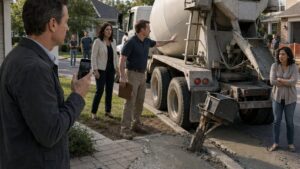
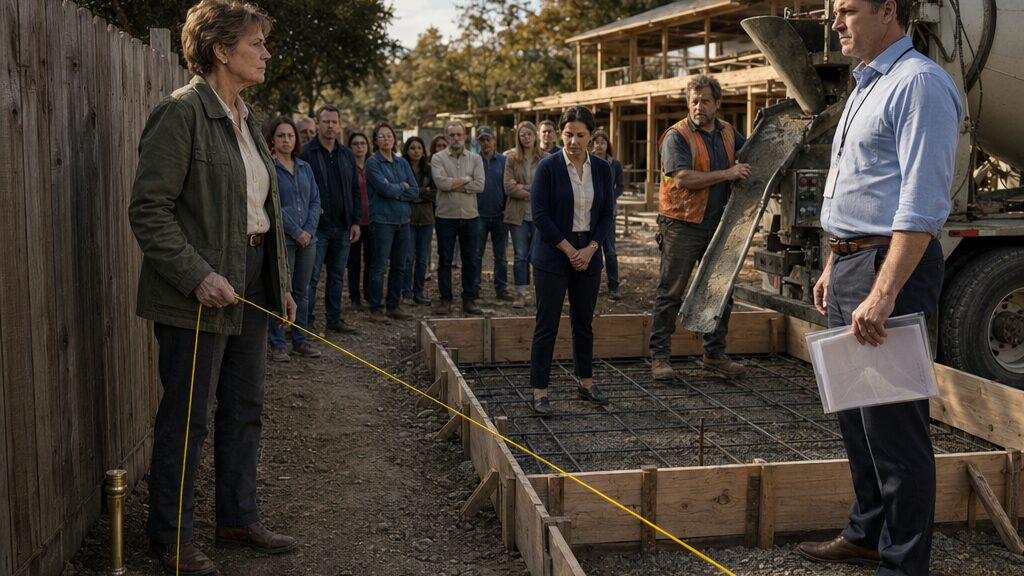
The concrete truck arrived before half the residents had finished signing the preview sheet.
Its rotating drum growled as it backed toward the clubhouse addition, guided by a worker whose hand signals were nearly lost among the balloons tied to the temporary railing. Folding tables held bottled water, glossy renderings, and blue wristbands printed with the association’s logo.
Cynthia stood outside the gathering with a reel of survey cord in one hand.
Thomas noticed her immediately.
“Ms. Walker,” he said, loud enough for the nearest residents to hear. “I’m glad you came. Perhaps we can clear up the misunderstanding.”
Conversation softened around them.
Anna stood beside the rendering board. Emma Lee was there with her young daughter, studying an illustration of the future pool. Several residents Cynthia recognized from passing cars and annual notices had formed a loose semicircle near the fresh foundation forms.
“There is no misunderstanding about the line,” Cynthia said.
Thomas smiled toward the group. “As some of you know, our neighbor has concerns about an old access agreement that predates much of the community. Counsel has advised us that the association’s rights are valid.”
A few people nodded. Cynthia saw the story taking shape in their faces: an older woman outside the HOA, objecting to a pool she would never use.
The concrete truck’s warning alarm began to beep.
Cynthia walked to Larry. “I need ninety seconds before you pour this section.”
Larry looked toward Thomas.
“You don’t have authorization to enter the site,” Thomas said.
“I don’t need to enter it. One monument is on my land. The second is accessible from the road shoulder.”
“Cynthia,” Anna said, using her first name for the first time, “we agreed the board would review your documents.”
“You agreed to review them while allowing the pour to proceed.”
Thomas stepped between her and the form. “This demonstration is unnecessary.”
“That depends on what it shows.”
The residents had stopped looking at the renderings.
Cynthia handed the free end of the cord to a survey technician she had hired that morning. He had verified the two recorded monuments but had not yet prepared a formal report. At the road, he fixed the line over the center point of the southern marker.
Cynthia crouched beside the cedar fence and cleared the remaining soil from the brass disk.
Emma’s daughter moved closer until Emma caught her shoulder.
“What is that?” the child asked.
“The corner of my property,” Cynthia said.
Thomas folded his arms. “According to one historical survey.”
“According to the recorded monument your title documents reference.”
Cynthia hooked the survey cord over a narrow pin centered on the brass marker. The technician pulled the line taut from the road.
The yellow cord rose above the dry grass, passed beside the leaning cedar post, and continued toward the clubhouse foundation.
For twelve feet, it lay on Cynthia’s side of the fence.
Then it entered the plywood form.
The cord crossed the cavity where concrete was about to be placed, slipped between two vertical bars of reinforcing steel, and emerged near an anchor bolt template.
No one spoke.
The image required no explanation. The property line ran directly through the foundation.
Larry raised one hand toward the concrete truck. The driver stopped the chute assembly.
Thomas said, “That line does not account for the easement.”
“The easement does not relocate the boundary.”
“It grants the association use of the corridor.”
“Temporary access for utility work.”
“You are presenting a legal conclusion.”
“I am presenting a physical line.”
Cynthia stepped back so everyone could see it clearly.
The survey cord trembled in the warm air. Against the gray steel and pale plywood, it looked almost too slight to stop anything. Yet the crew had stopped. The concrete truck idled. Residents began taking out their phones.
Anna approached the form. “How far over?”
The technician answered before Cynthia could. “The outer face varies. At this point, approximately twenty-two inches onto Ms. Walker’s parcel. The footing would extend farther underground.”
A man near the water table muttered something Cynthia could not hear.
Emma looked from the cord to the pool rendering. “You said the project had been surveyed.”
Thomas’s composure tightened. “It was reviewed against the association’s recorded access rights.”
“That isn’t what she asked,” Cynthia said.
He turned to her. “And you have not been fully transparent about those rights.”
From a leather portfolio, Thomas removed a document in a clear plastic sleeve.
Cynthia recognized the final page before he raised it.
Her signature showed at the bottom.
Thomas held the easement where the residents could see the notary seal and the names of the parties.
“This agreement was not imposed on Ms. Walker,” he said. “She signed it. The association relied on it when planning improvements along this corridor.”
The silence changed.
A moment earlier, Cynthia had been the only person with visible proof. Now Thomas had proof of his own, simpler and more personal than bearings or coordinates.
Emma looked at Cynthia. “You signed permission?”
“I signed an access easement.”
“For this area?”
“For utility maintenance.”
Thomas opened to the first page. “It grants entry by vehicles, equipment, employees, contractors, successors, and assigns.”
“And later prohibits permanent obstruction.”
“Subject to interpretation by counsel.”
“Words do not stop meaning what they say because a contractor has a deadline.”
Anna reached for the document. Thomas gave it to her.
“Did you include this in the packet you sent last night?” she asked Cynthia.
Cynthia heard the concrete truck turning behind her, the heavy drum continuing its slow rotation. Every answer available to her carried a cost.
“No,” she said.
Emma’s expression hardened. “Why not?”
Because her husband had been dying.
Because she had signed the document while counting hours between medications and trying not to imagine the empty chair that would remain afterward.
Because he had warned her to read it, and she had been too tired, too proud, or too frightened to admit that she could not carry one more responsibility carefully.
Cynthia looked at the residents. None of them had asked for that history. They wanted to know whether she had hidden a relevant document while accusing their manager of hiding facts.
“I should have included it,” she said.
“That isn’t an answer,” Emma replied.
“It is the answer relevant to the construction.”
Thomas stepped closer to Anna. “The association disclosed the easement to its consultants. Ms. Walker withheld it while demanding an emergency shutdown.”
“I withheld a document that supports my position.”
“Then why withhold it?”
Cynthia could feel the explanation pressing against her teeth. She refused to offer her husband’s illness as courtroom evidence before a crowd gathered for bottled water and pool renderings.
“Because I made a poor decision,” she said.
The admission did not restore the room. It gave Thomas more of it.
He turned toward Larry. “Proceed outside the disputed section.”
Larry looked at the cord passing through the form. “This is the section scheduled today.”
“Then prepare the southern wall while the board reviews the claim.”
“The pump and crew are here now.”
“That is a contractor issue.”
Larry’s face reddened, but he signaled the truck to hold.
Anna examined the easement, then the survey cord. “No concrete goes into this form today.”
Thomas stared at her. “The board authorized construction.”
“The board did not authorize building on land it may not own.”
A few residents murmured approval, but others began asking about delay costs. Someone mentioned assessments. Another asked whether the opening would be canceled.
Anna raised her voice. “Emergency board hearing. Seven tonight. Management office.”
“And the crew?” Thomas asked.
“Work may continue where there is no boundary dispute.”
“That still costs us a day.”
“It may cost us more if we pour.”
Thomas closed his portfolio. His eyes settled on Cynthia, not angry now, but calculating.
“You wanted this public,” he said quietly.
“No. I wanted it measured.”
He looked toward the phones still raised around them. “There may no longer be a difference.”
As the residents dispersed, Emma passed Cynthia without speaking. Her daughter glanced back at the yellow cord cutting through the steel cage.
Larry began directing workers away from the form. The small victory should have felt solid. Instead, Cynthia stood beside the brass marker with the knowledge that she had demonstrated the line perfectly and damaged her own credibility just as precisely.
Anna paused before returning to the clubhouse.
“Bring everything tonight,” she said.
“I will.”
“Everything, Cynthia.”
At seven, the board would decide whether the easement meant what Thomas claimed, whether Cynthia’s omission mattered more than the concrete crossing her land, and whether the pour could resume before anyone with authority settled the difference.
Chapter 4: The Board Believed the Cheaper Version
Thomas had arranged the cost sheets at every seat before Cynthia entered the meeting room.
The first page showed a number in bold type: $412,600. Beneath it were smaller columns for contractor delay, concrete remobilization, engineering revisions, and potential legal expenses. At the bottom, a yellow box estimated the possible special assessment per household.
No survey appeared on top of the stack.
Residents filled the folding chairs along the back wall. Emma sat near the aisle with her arms crossed. Anna occupied the center seat at the board table, flanked by the treasurer and two silent board members. Thomas stood beside a projector screen displaying the clubhouse schedule.
Cynthia placed her folder on the empty table reserved for her.
Anna called the meeting to order.
Thomas spoke first.
“If tomorrow’s work is interrupted beyond the disputed strip,” he said, “the contractor can invoke delay provisions. If the foundation must be redesigned, we may also lose material deposits and the summer opening window.”
The treasurer adjusted his glasses. “The reserve fund cannot absorb the full exposure.”
A resident in the back asked, “What does that mean for us?”
Thomas clicked to the next slide. “In the worst case, a special assessment.”
The room stirred.
Cynthia looked at the projected figure. It was not imaginary. The association had committed money, and delay would cost more. Thomas had chosen the most expensive version of the future and placed it before the legal question, but the fear on the residents’ faces was real.
Anna turned to Cynthia. “You may respond.”
Cynthia opened the recorded plat.
“The foundation form crosses the surveyed property line by approximately twenty-two inches at the point measured today. The underground footing may extend farther. The association’s access easement does not transfer ownership and expressly prohibits permanent obstruction without separate authorization.”
Thomas leaned toward his microphone. “That is your interpretation.”
“It is the language of the instrument.”
“Counsel disagrees.”
“Is counsel’s written opinion available?”
Thomas paused. “It is privileged.”
“Then the board is being asked to rely on a conclusion it cannot examine.”
One of the board members looked toward Anna. The treasurer kept his eyes on the cost sheet.
Cynthia distributed copies of the easement. She had highlighted the relevant clauses, including the paragraph she had failed to provide the night before.
Emma raised her copy. “So you had this yesterday.”
“Yes.”
“And you left it out.”
“Yes.”
“Why?”
The question landed harder in the smaller room than it had beside the concrete truck.
Cynthia could have repeated that the omission did not alter the clause. She could have told them only what was necessary.
Instead, she said, “I signed it fifteen years ago and had not reviewed it since. When I found it yesterday, I was ashamed that I had forgotten the details. I sent an incomplete packet.”
Emma’s voice stayed controlled. “You accused management of not disclosing things while you were doing the same.”
“I withheld a relevant document. That was wrong.”
The direct admission quieted the room, but it did not restore trust. Several residents looked at one another. Thomas did not smile. He simply allowed the silence to work for him.
Anna asked, “Does the agreement give the association any right to build?”
“No,” Cynthia said. “It gives access for utility inspection, maintenance, repair, and replacement. Permanent structures require separate permission.”
Thomas tapped the cost sheet. “The project design treats the corridor as operational association space. That is how the consultants read it.”
“Which consultants?”
“Our project team.”
“The same team paid to keep the project moving?”
Thomas’s expression hardened. “And you hired a survey technician after construction began.”
“I hired him after your foundation reached my fence.”
The treasurer cleared his throat. “Can the work continue elsewhere?”
Cynthia looked at the plans projected behind Thomas. The southern wall did not affect her boundary. The disputed footing did.
“Yes,” she said. “Provided no work loads, braces, stores material, or moves equipment through my parcel without notice.”
A resident near the door said, “So she can hold up the entire project over less than two feet?”
Cynthia turned toward him. “Concrete does not become harmless because the distance is small.”
“But you signed access.”
“Access is not ownership.”
The phrase returned to the room again and again, each side hearing something different.
Anna pressed her fingers together. “The board needs an independent reading. We will request a forty-eight-hour document review from outside counsel and a county planning contact.”
Thomas stepped forward. “Forty-eight hours will put us beyond the scheduled pour.”
“Then the disputed section waits.”
“We’ll incur charges.”
“We may incur greater charges if Cynthia is correct.”
“And if she’s wrong?”
Anna looked toward the residents. “Then we proceed with a documented basis instead of an assumption.”
It was not a victory. It was a pause purchased with uncertainty.
Thomas gathered his papers. “Work outside the disputed strip continues tomorrow morning. The contractor has no obligation to leave the entire site idle.”
Cynthia nodded. “Agreed.”
The decision loosened some tension. Residents began talking about reduced scope, deposits, and whether the pool would open that summer. Emma remained seated after most people left.
When Cynthia passed, Emma said, “My daughter has been counting the weeks.”
Cynthia stopped.
“To the pool?”
“To having somewhere safe to go after school. I work from home, but not in the way people think. I’m on calls all afternoon. The old recreation room is closed, and the nearest public pool is twenty minutes away.”
“I am not trying to take that away.”
“I know what you say you’re trying to do.”
Cynthia accepted the distinction.
Emma looked down at the easement. “But you knew this would look bad.”
“Yes.”
“And you still left it out.”
“Yes.”
Emma folded the document. “That makes it difficult to know when you’re telling us everything.”
Outside, Thomas stood beneath the office light speaking into his phone. He turned away when Cynthia emerged.
She drove home along the gravel road in darkness.
At seven the next morning, the sound of a diesel engine pulled her from the kitchen. A delivery truck had entered the twelve-foot access strip beside her fence, its rear wheels deep in the soft shoulder. The driver tried to correct, reversed sharply, and struck the cedar posts.
Wood cracked.
Cynthia ran outside as the truck lurched forward.
Three fence panels leaned toward the orchard. One post had split near the base. The plywood forms on the other side remained untouched.
The delivery driver climbed down, pale and apologetic. “They told me this was the equipment entrance.”
“Who told you?”
He pointed toward the construction trailer.
As Cynthia approached the damaged section, she saw fresh tire tracks running directly over the place where the brass survey marker lay buried.
Chapter 5: The Missing Warning in Thomas’s Project File
The brass marker had not been torn out.
It had been bent sideways under the truck’s tire, the protective soil scraped away and the stamped center point tilted toward the damaged fence. The metal sleeve beneath it still held in the ground.
Cynthia crouched and photographed it before touching anything.
The delivery driver stood several feet away, turning his cap in his hands.
“I didn’t see it,” he said.
“You weren’t expected to.”
“The site manager said to use the north corridor.”
“Did he give you a map?”
“A text.”
Cynthia asked him to preserve it. He nodded quickly and showed her the message without surrendering the phone. It directed all morning deliveries through “Walker easement access” to avoid blocking the clubhouse parking lot.
Thomas’s name appeared at the top of the thread.
The message did not order the driver to hit the fence. It did confirm that Thomas had chosen her property as the easier route after the board meeting.
Larry arrived from the job site and inspected the broken posts.
“We can repair this,” he said.
“Not until the marker is documented.”
He looked down and swore softly.
“You knew it was there,” Cynthia said.
“I knew there was a cap somewhere near the corner.”
“You watched me expose it yesterday.”
Larry rubbed a hand over his jaw. “The delivery route came from management.”
“And you did not object.”
“I told the driver to stay wide.”
“Wide in which direction?”
Larry did not answer.
Cynthia called the county survey division and requested guidance on protecting a disturbed monument. Then she added the photographs, driver’s text, and fence damage to her evidence file. This time she included the full easement and a statement correcting her earlier omission.
At the county records office, the same clerk recognized her.
“You’re back quickly.”
“The situation changed.”
Cynthia submitted the correction letter and asked for all documents associated with the clubhouse permit. The clerk searched the file system, then requested a paper jacket from storage.
The permit record was thinner than Cynthia expected. It contained the original clubhouse drawings, a grading approval, contractor insurance, and correspondence about revised drainage. The two-story addition appeared only in a later set of plans stamped “review copy.”
“Is there a final approval attached to these?” Cynthia asked.
The clerk shook her head. “Not in this folder.”
She pulled one sheet from the back. A yellow routing slip was clipped to it.
The attachment was a preliminary site review prepared by a survey consultant. A red triangle marked the northern foundation corner. Beside it, typed comments warned that the proposed footprint appeared to conflict with the recorded parcel boundary and narrowed the required emergency access route.
Cynthia read the note again.
“Who received this?”
“The routing page lists the applicant contact.”
The applicant contact was Thomas Miller.
There was no signature acknowledging receipt.
“No email record?”
The clerk searched. “The portal shows the attachment was uploaded to the applicant account, but that doesn’t prove who opened it.”
“It proves it was available.”
“Yes. Not that he read it.”
Cynthia requested a certified copy.
The setback issue was no longer only about ownership. The site review warned that the expansion reduced the clear width needed for emergency vehicles between the clubhouse and her fence. If a fire engine or ambulance had to enter, the new foundation could turn the corridor into a bottleneck.
At the construction trailer, Thomas stood over a table of revised delivery schedules.
Cynthia placed the certified warning on the table.
“Your applicant account received this before the forms were built.”
He read the first paragraph. “Preliminary comments are not final determinations.”
“It warned about the boundary and emergency access.”
“It asked for clarification.”
“Where is the clarification?”
“With the project consultants.”
“Show it to the board.”
Thomas set the document down. “You have moved from protecting your land to searching for anything that can stop this project.”
“My land was the first thing your project ignored.”
“The truck damage will be repaired.”
“You used the easement as a delivery entrance after the board limited work.”
“The agreement allows equipment.”
“For utility maintenance.”
“You keep repeating that as though repetition settles the issue.”
“And you keep using the widest possible meaning because it saves time.”
Thomas’s face changed. The polish remained, but fatigue showed beneath it.
“You think I want this conflict?” he asked. “The board sold residents an expansion without fully funding it. Material costs rose. The contractor’s window narrowed. If we miss summer, revenue assumptions collapse and the reserve takes the hit. People on fixed incomes receive assessments they cannot absorb.”
“You knew there was a boundary warning.”
“I knew there were preliminary comments among dozens of preliminary comments.”
“Did you read this one?”
“I do not personally review every uploaded attachment.”
It was not an answer.
Cynthia gathered the document. “The inspector can ask you.”
Thomas lowered his voice. “Once the county is involved, you lose control over scope. They will not inspect only your fence. They may stop the entire site.”
“That depends on what they find.”
“It depends on whether you care more about being right than about what happens to everyone else.”
The accusation followed her home because part of it had weight. Cynthia wanted the foundation removed. She wanted Thomas’s certainty broken. But she had seen Emma’s face at the meeting and the treasurer’s hands over the reserve figures.
Protecting the community did not require surrendering her property. It did require telling the whole truth.
At her desk, Cynthia rewrote her complaint. She disclosed the easement, her prior omission, the damaged fence, the delivery instruction, and the preliminary warning. She attached every document, including those Thomas could use against her.
The final paragraph requested a site inspection and independent determination of the boundary, permit scope, and emergency access.
She sent copies to the county and Anna.
At four thirty, Anna called.
“I received your correction.”
“I should have sent the easement the first time.”
“Yes.”
Cynthia waited for comfort that did not come.
Anna continued, “The warning attachment concerns me. Thomas says it was never elevated to him.”
“It lists him as applicant contact.”
“That is not the same as proof he read it.”
“I know.”
“The county may ask for portal logs.”
“They should.”
Anna was silent. “You understand that a full stop could force us into litigation.”
“I understand.”
“And you are still requesting inspection.”
“Yes.”
After the call, Cynthia went outside and placed two stakes around the bent brass marker so no worker or vehicle could cross it again. The cedar panels leaned beside her like loosened teeth.
A truck slowed on the gravel road but did not turn in.
Then her phone vibrated.
The message came from Larry.
I need to show you something. Not at the site. Diner on Route 12. Seven tonight. Come alone if you want the truth about that foundation.
Chapter 6: The Foreman Who Kept Working Anyway
Larry arrived at the diner carrying a folded sheet of paper inside a clear plastic bag.
He chose a booth near the back, away from the counter and the two construction workers eating near the entrance. Cynthia sat opposite him but did not reach for the bag.
“What is it?”
“A copy of a field instruction.”
“From Thomas?”
Larry looked toward the front window. “From management through the project portal.”
He slid the bag across the table.
The paper contained a sketch of the northern foundation corner. One dimension had been crossed out and replaced by a handwritten note: SHIFT FORM NORTH 18–24 INCHES TO MAINTAIN POOL CLEARANCE. USE ACCESS CORRIDOR.
The initials beside the revision were T.M.
Cynthia examined the date. It was three days after the preliminary survey warning had been uploaded.
“You kept a copy.”
“I print every field change. Half the time the portal gets updated and the old instruction disappears.”
“Did Thomas sign this in front of you?”
“No. It came through his account.”
“Did you speak to him?”
Larry stared at the untouched coffee the server had poured.
“He called me that morning. Said the architect had tightened the pool deck and we needed to preserve the inside dimension. I told him the north form was already close to the fence.”
“What did he say?”
“That the association controlled the corridor.”
“Did you mention the marker?”
Larry’s thumb pressed against the edge of the paper bag.
“I had seen the cap.”
“Before you moved the forms?”
“Yes.”
The word sat between them.
Cynthia had imagined this meeting as a clean transfer of evidence. Larry would admit Thomas’s order, and the responsibility would move neatly upward. Instead, the foreman’s own choice remained on the table with the field instruction.
“You knew the survey marker was there,” she said, “and you shifted the forms anyway.”
“I asked whether they had legal clearance.”
“Who did you ask?”
“Thomas.”
“The person demanding the shift.”
“He was the client representative. His answer matters.”
“So does yours.”
Larry’s face tightened. “You think I don’t know that?”
The workers near the entrance laughed at something. Neither Larry nor Cynthia looked toward them.
“I have eight people on that crew,” he said. “Two were laid off all winter. One is behind on rent. The contract says we follow issued plans unless there’s an immediate safety hazard. A property dispute is not something I get to decide.”
“You fastened a form to my fence.”
“That was wrong.”
“You directed deliveries through the corridor.”
“I told them to avoid the posts.”
“You saw the marker.”
“Yes.”
His admission was quieter the second time.
Cynthia folded her hands. “Why show me this now?”
“Because Thomas told the board the layout came from the contractor. He’s preparing to say we interpreted the plans on our own.”
“Did you?”
“We made the shift. He ordered it.”
“Both can be true.”
Larry looked at her sharply.
“You want me to take all of it?”
“No. I want you not to hand me a document and pretend it erases your decision.”
He leaned back. For several seconds, anger hardened his face. Then it drained, leaving exhaustion.
“My company can lose the contract,” he said.
“My property can lose a permanent strip of land.”
“I know.”
“The emergency access may be too narrow.”
“I know that now.”
“You knew enough to ask.”
The server approached with menus, sensed the table, and retreated.
Larry pulled a paper placemat closer. With a pen, he drew the cedar fence, the brass marker, and the original form line. Then he added the shifted line cutting north.
“This is what happened,” he said. “Original plans gave us thirty feet from the pool edge to the wall. The revised equipment layout needed more clearance inside. Thomas said the easement gave us room outside. We moved the form. I thought if there was a legal problem, management would carry it.”
“Concrete carries itself once it cures.”
He gave a humorless nod.
Cynthia studied the sketch. “Will you tell the county?”
“If they ask me formally.”
“Why only then?”
“Because if I volunteer this to you and you use it publicly, Thomas calls it stolen project information. If an inspector asks, I answer truthfully as the foreman.”
“You want a shield.”
“I want procedure.”
The word sounded familiar in his mouth.
Cynthia understood it too well. Procedure could protect truth. It could also protect a person from acting until someone else forced the moment.
She slid the field instruction back.
“Keep the original. Send a copy to your company’s records.”
“You’re not taking it?”
“I photographed it.” She held up her phone. “The county will request it properly.”
Larry looked surprised.
“I’m not asking you to become innocent,” she said. “I’m asking you not to lie.”
He folded the placemat and placed it inside the plastic bag with the instruction.
Outside, the evening traffic moved along Route 12. Cynthia drove home with the image of the brass marker drawn in blue diner ink. The conflict no longer divided neatly into one careful landowner and one reckless manager. Thomas had pushed. Larry had complied. Anna had preferred a cheaper interpretation. Cynthia herself had withheld the easement.
Different pressures had bent everyone toward the same line.
At her property, the damaged fence cast angled shadows across the access strip. Cynthia set a temporary barrier around the marker and checked her email.
A county building inspector had replied to her complaint.
The message confirmed a site visit for Friday at one in the afternoon. The inspector would review the property boundary, permit scope, emergency access, active structural work, and related improvements attached to the clubhouse project.
Friday at one was also the scheduled clubhouse launch event.
Cynthia read the final sentence twice.
Because the inspection may involve occupied or publicly accessible areas, please advise association management that all relevant structures must remain available for review.
Beyond the fence, workers were hanging a banner over the clubhouse entrance.
Chapter 7: Red Notices Across the Community Clubhouse
The county vehicle arrived while a volunteer was fastening blue wristbands around residents’ wrists.
It rolled past the balloon arch at one in the afternoon, white doors marked with the county seal, and stopped beside the unfinished pool deck. The conversations near the clubhouse entrance faltered one by one.
Cynthia stood beyond the damaged cedar fence with her folder under one arm.
Thomas crossed the parking lot before the inspector had closed the vehicle door.
“We were not expecting enforcement activity during a private association event,” he said.
“This is a scheduled site inspection,” the inspector replied. “You received notice.”
Thomas lowered his voice. “The public areas are occupied.”
“Then we’ll begin by confirming they’re safe to occupy.”
The answer carried farther than he intended. Residents turned from the refreshment tables. Emma drew her daughter closer and removed the child’s wristband.
Anna came down the clubhouse steps holding a binder. “I’ll provide access.”
Thomas looked at her. “The board should have counsel present.”
“We were told to make the structures available.”
The inspector accepted Anna’s binder but did not open it immediately. He asked for the approved plans, permit cards, inspection history, and site contact information. Thomas supplied a folder from the management office.
The inspector compared the papers with the building in front of him.
The two-story addition rose behind temporary railings. New windows had been installed, but unfinished siding exposed weather barrier and nail patterns. The pool deck extended toward Cynthia’s fence, its steel edge forms still empty after the delayed pour.
“Where is the northern property monument?” the inspector asked.
Cynthia led him to the brass marker.
She had left it tilted exactly as the delivery truck had bent it. Two stakes protected it, and a strip of orange tape marked the damaged ground without touching the cap.
The inspector crouched beside it. “Has this been reset?”
“No. I requested that it remain undisturbed until documented.”
He photographed the marker, then asked the survey technician to identify the second monument near the road. Together they ran a measuring line between the points.
The line followed the same path Cynthia’s yellow cord had traced at the preview. It crossed the damaged fence, passed through the rebar cage, and entered the concrete form.
Several residents moved closer.
Thomas said, “There is a recorded easement through that corridor.”
The inspector remained focused on the measuring device. “An easement may authorize a use. It does not change the parcel boundary.”
Cynthia heard the sentence move through the crowd.
Not triumphantly. Quietly, as people repeated it to one another.
Larry stood with his crew near the construction trailer. When the inspector called him over, he brought the field instruction and the original foundation layout. He spoke for almost fifteen minutes. Cynthia could not hear everything, but she saw him point toward the brass marker, then toward the shifted form.
Thomas interrupted twice.
The second time, the inspector raised a hand. “I’ll speak with each party separately.”
That silenced him.
The inspection expanded outward.
The pool deck lacked a posted permit card. The retaining wall below it had been built higher than the approved grading plan. A stair landing differed from the review drawings. Inside the clubhouse addition, electrical work had been covered before a required inspection.
Thomas followed the inspector from one item to the next, explaining revisions, consultant assumptions, and portal delays.
Some explanations were plausible.
None produced final approvals.
At the edge of the launch area, Emma said to Cynthia, “Did you know all of this was wrong?”
“No.”
“You suspected it.”
“I suspected the boundary and permit scope required review.”
Emma watched the inspector measure the fire-access corridor. “That path is where emergency vehicles are supposed to come through?”
“Yes.”
“There wouldn’t be enough room?”
“Not after the northern wall and deck were completed.”
Emma looked at her daughter, who was tracing a finger over the glossy pool rendering. “No one mentioned that.”
“Most people were shown the finished picture, not the clearance plan.”
The inspector returned to the clubhouse entrance carrying a red notice pad.
The first notice went on the pool deck frame.
The second went on the retaining wall.
A third was attached to the unfinished addition.
Residents began taking photographs, but the mood had changed from the preview. No one seemed pleased to be recording it.
Thomas stepped in front of the main doors. “This building is existing and occupied. The disputed work is outside.”
“The addition is structurally connected to the clubhouse,” the inspector said. “And I cannot verify that the altered exit route received final approval.”
“You are closing the entire facility over documentation?”
“I am restricting occupancy until the county verifies the life-safety work.”
He placed a red notice on the glass door.
Through the damaged fence, Cynthia could see the paper clearly. It moved slightly each time the door pressed against the latch from inside.
The same people who had gathered for a launch now stood in the parking lot holding unused wristbands. One resident demanded to know who would pay for refunds on reserved events. Another asked whether dues would rise. The treasurer pulled Anna aside and spoke in a low, urgent voice.
Thomas turned toward Cynthia.
“This is what you wanted.”
“No,” she said. “I wanted the foundation kept off my land.”
“You invited the county to inspect related improvements.”
“I asked them to determine what was lawful.”
“And now eighty-six households carry the result.”
His voice was controlled, but something underneath it had broken loose. Fear, Cynthia thought. Not only anger. He was watching his contract, his bonus, and perhaps his career being posted in red sheets across the property.
Anna approached with the inspector’s preliminary order.
“Thomas,” she said, “the board is suspending your authority over the project pending review.”
He stared at her. “You cannot manage the corrective process without the management company.”
“We are not terminating the service contract today. You will not direct construction.”
“You’re making me responsible for decisions approved by this board.”
Anna’s face tightened. “The board approved an expansion based on representations that permits and site control were in order.”
“The board wanted the opening date protected.”
“And you told us it could be.”
For a moment, neither denied the other’s part.
Thomas walked away toward the management office.
The inspector explained that all work must stop until revised plans, boundary verification, and required inspections were submitted. The portion crossing Cynthia’s land would likely require removal. Other corrective work depended on engineering review.
“How much removal?” Anna asked.
“I can’t tell you today.”
The treasurer showed her a reserve spreadsheet. Cynthia saw the color leave Anna’s face.
Later, as residents dispersed, Thomas found Cynthia beside the fence.
He held a single-page agreement.
“The association can compensate you for a boundary adjustment,” he said. “Market value plus legal fees. We record the transfer, preserve the current footprint, and reduce the corrective cost.”
Cynthia did not take the page.
“You want to buy the strip after building on it.”
“I want to prevent unnecessary loss.”
“And the fire-access width?”
“The architect can address it separately.”
“You received a warning before the forms were shifted.”
Thomas glanced toward Larry. “That will be disputed.”
“Not by me.”
His hand lowered. “You can force demolition. You can watch the reserve disappear and tell yourself the line mattered more.”
“The line does matter.”
“More than the people?”
Cynthia looked at the clubhouse door, the red notice, and Emma helping her daughter remove the abandoned balloons from the railing.
“No,” she said. “That is why I will not sell it to preserve an unsafe design.”
She handed the agreement back.
At the emergency board meeting that evening, Anna summarized the inspector’s findings and the projected financial exposure. Residents filled every chair and stood along the walls.
When public comment opened, Cynthia rose with no folder.
“I am not asking the board to defend the existing plan,” she said. “I am asking permission to return with another one.”
Anna studied her. “Another what?”
“A revised layout. One that stays inside the association parcel, restores emergency clearance, and preserves as much of the clubhouse function as the site allows.”
The treasurer looked doubtful. “Who would prepare it?”
“I will prepare a concept at no charge. A licensed architect and engineer must review it.”
Thomas, seated at the back without his usual place at the table, said nothing.
Anna looked around the room.
Then she nodded. “You have one week.”
Chapter 8: The Line They Agreed Not to Move Again
Cynthia began the final hearing by placing the easement on the table.
“I signed this document,” she said, “and I failed to include it in my first complaint.”
No one interrupted.
Three weeks had passed since the red notices appeared. The clubhouse remained closed. The pool deck framing had been partly dismantled, and temporary fencing now separated the construction area from the parking lot.
Cynthia stood before the board with a rolled set of revised drawings.
“I signed during a difficult period in my life,” she continued. “That explains my carelessness. It does not excuse my omission. I expected everyone else to rely on complete records while I withheld one because I was ashamed of it.”
Emma sat in the second row beside her daughter. Larry stood near the door. Thomas occupied a chair along the wall, no longer at the project table.
Cynthia unrolled the plan.
The new clubhouse addition was narrower by eight feet. The pool deck shifted south, replacing one planned seating bay with a planted buffer. The retaining wall was shortened. A clear emergency lane ran between the association’s structure and Cynthia’s boundary.
The brass marker appeared on the drawing inside a small protective circle.
“This option removes every permanent element from the easement and my parcel,” Cynthia said. “It restores the required access width and retains the pool, family room, accessible restrooms, and most of the covered deck.”
The treasurer studied the cost summary prepared by an independent architect. “We still need a special assessment.”
“A smaller one,” Anna said.
“And the opening moves to next spring.”
No one pretended otherwise.
A resident asked why the association should accept less after paying for the original design.
Anna answered before Cynthia could. “Because the original design cannot lawfully or safely be completed.”
The room received the statement without protest.
That was new.
Thomas raised his hand. Anna recognized him.
“The proposed plan reduces revenue capacity,” he said. “Fewer private events, fewer deck tables, lower rental projections.”
Cynthia looked toward him. “The previous projections depended on space the association did not own.”
“The association can still acquire it.”
He placed the old settlement proposal on the table.
The amount had increased.
Several residents turned toward Cynthia.
She did not touch it.
“I am not selling the boundary to rescue a design created by ignoring it.”
Thomas’s jaw tightened. “You would receive more than the strip is worth.”
“The strip is worth what it protects.”
“That sounds emotional for someone who has insisted this is technical.”
A few people shifted in their seats.
Cynthia considered the remark.
“It is both,” she said. “That is what I was too proud to admit.”
She rested one finger on the revised emergency lane.
“A boundary protects ownership. This clearance protects access when someone needs an ambulance or a fire engine. The old easement protects the association’s ability to repair utilities. None of those protections becomes flexible because another use is more profitable.”
Anna looked down the board table. “The independent architect confirms this concept is feasible. County planning has agreed to expedited review if the board authorizes correction.”
The vote was not unanimous.
One board member opposed the cost. The treasurer abstained after warning that reserves would remain strained. Anna and the remaining members approved the redesign, the removal of the encroaching footing, and an independent audit of the project records.
They also adopted a new rule: no future construction could proceed near a parcel boundary without verification by a surveyor who was independent of the design team.
Thomas’s management company retained the general association contract through the end of its term, but Thomas was removed from all construction authority. He accepted the decision without apology.
When the meeting ended, he stopped beside Cynthia’s plans.
“You got your line,” he said.
“No. It was always there.”
He looked at the protective circle around the brass marker.
“You made the board choose a smaller future.”
Cynthia rolled the drawings slowly. “You promised them a future that used someone else’s ground.”
Thomas glanced toward Anna, who was explaining the assessment schedule to a group of residents.
“They wanted me to solve the numbers,” he said. “Every meeting, every email, every delay. Make it work without raising dues. Make the pool bigger. Keep the opening date. No one asks which requirement you ignored until it becomes visible.”
“You still chose which one.”
“Yes.”
The admission did not repair anything. It did, however, end the argument that pressure had made the choice for him.
Outside, Emma waited beside the temporary fence.
“My daughter wants to know whether you still hate the pool,” she said.
Cynthia looked at the child, who was holding a small nursery pot containing a young lavender plant.
“I never hated the pool.”
Emma gave her a tired smile. “I know that now.”
Construction resumed two months later under a different project coordinator. The encroaching concrete was cut and removed. Workers rebuilt the northern foundation entirely within the association parcel. The damaged cedar panels came down one at a time.
Before setting the replacement corner post, a survey technician excavated the bent monument and verified its coordinates. The brass cap remained accurate despite the truck strike.
He reset it upright inside a steel protective sleeve sunk below grade, with a removable cover at the surface.
Larry supervised the fence repair but did not direct the foundation crew. He approached Cynthia while the concrete for the new post footing was being mixed.
“We can center the post over the cover,” he said. “Would hide it and keep the line clean.”
Cynthia looked at the open sleeve.
“No.”
Larry nodded once. “Offset four inches?”
“Four inches inside my parcel. Same as before.”
He marked the location.
Emma and her daughter came later with lavender, sage, and two low-growing grasses selected for the strip beside the repaired fence. Cynthia had not asked for help. When Emma offered, her first instinct had been to say she could handle it.
Instead, she handed Emma a shovel.
They planted far enough from the access corridor that utility crews could still enter. Cynthia showed the child the metal cover over the survey marker and explained why nothing permanent should be placed above it.
“So everyone can find the line?” the child asked.
“So no one has to guess.”
The child pressed the soil around the lavender.
Across the fence, the revised clubhouse no longer towered directly over Cynthia’s orchard. The narrower deck left open sky between the building and the cedar boards. The change was visible, but it did not look like defeat. It looked like a structure finally made to fit the land beneath it.
Anna arrived with a copy of the recorded correction plan. She gave it to Cynthia without ceremony.
“The county released the first phase,” she said. “The assessment notices go out Monday.”
“How bad?”
“Unpopular. Manageable.”
“And the independent audit?”
“Still uncomfortable.”
Cynthia almost smiled. “Good.”
Anna looked toward the repaired boundary. “We should have paused when you first asked.”
“I should have sent the easement when I first wrote.”
They stood with both truths between them.
At sunset, the workers installed the final cedar post. It rose straight beside the protected brass marker, offset precisely four inches inside Cynthia’s land.
No concrete covered it.
No fence concealed it.
The small metal circle remained visible at ground level between the new post and the lavender, marking the place where access ended, ownership began, and several people had finally agreed that necessity did not give anyone the right to move the line.
The story has ended.