He Let Their Children Cross His Yard Until Their Father Built Something Permanent There
Chapter 1: The Swing Set Was Already in His Yard
The metal post had been driven into Robert Nelson’s lawn less than six feet from the chair where he drank his coffee every morning.
For several seconds, he stood on the back step with the mug suspended near his mouth, trying to make the object belong to some other explanation. A temporary marker. A delivery mistake. Something left by a contractor who had confused one yard with another.
Then he raised his eyes.
The blue-and-yellow swing set occupied most of the Mitchells’ backyard, but one side of its frame crossed the worn strip of grass between the houses and landed squarely on Robert’s property. The nearest support leg had been sunk into fresh concrete. Damp soil formed a dark ring around it.
A plastic slide pointed toward Thomas Mitchell’s patio. Two empty swings moved slightly in the morning air. The structure looked bright, expensive, and permanent.
Robert lowered his coffee.
The path beneath it had begun as a faint line two summers earlier, when Thomas and Carol had moved in with their three children. Their backyard did not connect conveniently to the corner where the school bus stopped. Robert’s did.
On their first week in the neighborhood, Thomas had asked whether the children could cut across occasionally when they were running late.
“Of course,” Robert had said.
At the time, Sharon had been gone nine months. The house still felt arranged around her absence: her gardening gloves in the mudroom, her handwriting on freezer labels, her half-finished list of people to invite for Labor Day. She had always believed that a neighborhood survived through small permissions.
So Robert had opened the gate.
Occasionally became every school morning. Then every afternoon. Then bicycles rolled through on weekends. Balls landed in his flower beds. Empty drink pouches appeared near the hedge. Once, a bicycle had been left across his patio until dark.
Each time Robert considered speaking to Thomas, the problem seemed too small when separated from the others.
The children were not malicious. Thomas was busy. Carol usually waved apologetically. Robert told himself that objecting would sound petty.
When Thomas texted once—Hope the kids aren’t bothering you—Robert had answered, No problem.
He had meant, Not enough of a problem to start a dispute.
Thomas, apparently, had understood something else.
Robert set the mug on the patio table and walked toward the swing set.
The worn path was wider now than he remembered, its center packed hard and pale. The new support leg stood directly over one edge of it. Robert crouched and pressed two fingers into the disturbed soil.
The installer had dug deep. This was not something a child had dragged across the property while playing. Someone had measured, marked, poured concrete, and left without knocking on his door.
He looked toward the Mitchell house. Their blinds were still closed.
Robert returned to his garage and took a narrow garden trowel from the wall. He knew approximately where the rear survey marker lay because he had helped Sharon plan the lilac beds years ago. The marker had once been exposed, then gradually disappeared under soil and grass.
He dug near the fence line, scraping carefully.
The first thing he struck was stone. The second rang against metal.
Robert cleared the dirt until a round iron pin showed beneath the grass.
He stood and sighted from the pin toward the front marker near the driveway. The line ran not along the outer edge of the swing set, as he had briefly hoped, but through its frame. The buried pin was well inside the structure.
Three feet, perhaps a little more.
His first feeling was relief.
The boundary was not uncertain. He had not become the kind of man who invented offenses because he lived alone and had too much time to notice what other people did.
Then relief hardened into something heavier.
Thomas had built over the line.
Robert went inside and opened the cabinet beside the refrigerator. The property documents were in a fireproof box Sharon had insisted they buy after a neighbor lost records in a basement flood. He carried the box to the kitchen table, unlocked it, and found the closing papers, insurance policies, tax records, and finally the folded survey.
The paper opened with a dry crackle.
A licensed surveyor’s stamp appeared in the lower right corner. Measurements ran along the lot lines in small black type. Robert placed one finger on the rear boundary and followed it toward the house.
There was no ambiguity.
The support leg stood on his land.
A memory came without invitation: Sharon at the same kitchen table, listening while Robert complained about a former neighbor who parked too close to their mailbox.
“You can be right and still make living next to somebody impossible,” she had said.
He had remembered that sentence often.
He had forgotten what she said afterward.
But then, he had been better at remembering the part that asked nothing of him.
Outside, an engine slowed in the cul-de-sac.
Robert folded the survey, picked up his coffee, and stepped to the front window. A white SUV with the Briarwood Ridge Homeowners Association logo on the door turned toward the houses.
It stopped at the curb between his property and the Mitchells’.
Patricia Roberts climbed out carrying a clipboard.
She had served as HOA president for six years and had known Sharon through the neighborhood garden committee. Patricia usually dressed as though every conversation might become a meeting: pressed slacks, low shoes, cardigan even in warm weather.
Today she was accompanied by the property manager.
They did not walk toward Thomas’s front door.
They came directly toward Robert’s side yard.
By the time he met them near the back gate, Thomas had appeared on his patio in jeans and a gray sweatshirt. He held a phone in one hand and wore an expression of mild concern that seemed prepared in advance.
“Morning,” Thomas said.
Robert looked from him to Patricia.
Patricia offered a careful smile. “Robert, we received a complaint about a potential obstruction and threatened fence installation along a shared-use area.”
Robert said nothing for a moment.
The swing set gleamed behind her. One of its legs sat in his lawn, surrounded by fresh soil, while the complaint in Patricia’s hand named him as the person creating the problem.
“Shared-use area?” Robert asked.
Thomas gave a small shrug. “That’s what it’s been for two years.”
Robert looked at the clipboard.
At the top of the form, beneath the HOA logo, his address appeared beside the words: HOMEOWNER ACTION CREATING ACCESS AND SAFETY CONCERN.
The complaint had been filed before Robert had even discovered the swing set.
Chapter 2: Forty-Eight Hours Across a Bright Survey Line
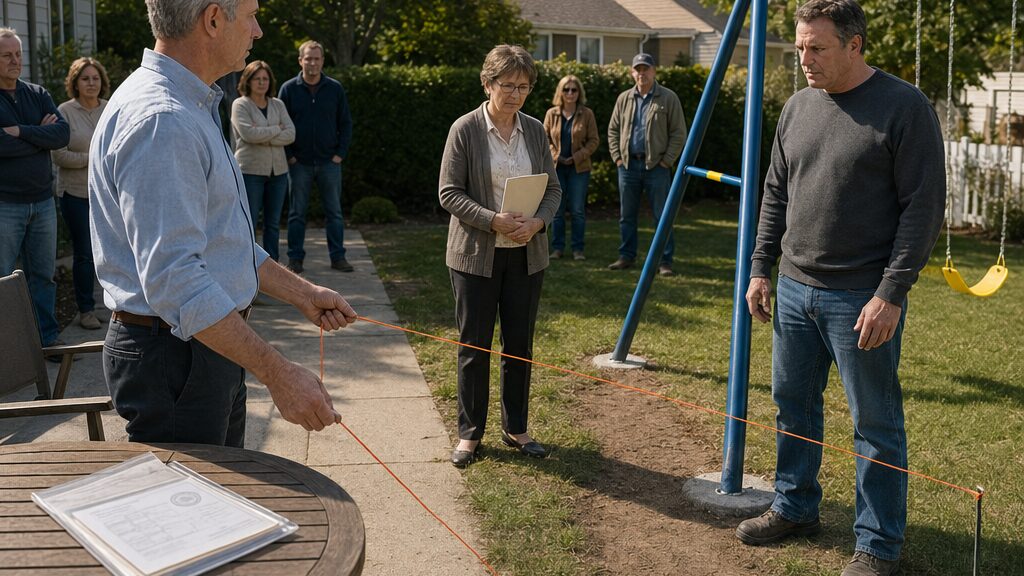
Thomas laughed when the bright orange survey cord passed beneath the swing-set leg.
It was not a loud laugh. That made it worse.
He looked at Patricia, then at the two neighbors who had slowed near the sidewalk to watch the Saturday inspection, as if Robert had staged an elaborate demonstration over something no reasonable person could possibly care about.
Robert tightened the cord between the rear iron pin and the front marker near the driveway. The line ran straight across the yard, slicing through the worn path and disappearing beneath the blue metal frame.
“There,” Robert said.
Thomas folded his arms. “You could make a string say anything.”
“It’s tied to the survey pins.”
“According to you.”
“The licensed surveyor uncovered them yesterday.”
The surveyor had returned Friday afternoon after Robert called the number printed on the original document. He confirmed both markers, added temporary flags, and issued a brief written verification. Robert had paid the expedited fee without hesitation.
Now the stamped survey lay on the patio table beneath a clear plastic sleeve.
Patricia stepped carefully over the cord. “No one is disputing that you have paperwork, Robert.”
“That sounds exactly like what’s being disputed.”
“I’m saying the association also has records.”
The property manager opened a folder and removed a faded plan printed on oversized paper. Pale green shapes represented lawns and landscaping beds. Dashed lines showed walkways between houses.
Thomas moved beside her. “That’s the original community layout.”
Robert studied it from where he stood.
The document showed a narrow open corridor along the side of his lot. The dashed route looked uncomfortably close to the path the children had worn through his grass.
Patricia tapped it with one finger. “This indicates shared pedestrian flow toward the bus corner.”
“Does it show property boundaries?”
“It shows intended use.”
“That wasn’t my question.”
Thomas exhaled through his nose. “Robert, come on. You told us the kids could cross. They’ve crossed every day for two years. Nobody hid that from you.”
“I allowed them to walk through.”
“You allowed us to use the space.”
“I allowed your children to take a shortcut.”
“And you never said there were conditions.”
The words landed harder than Robert expected because they were not entirely false.
He looked at the path. Small shoe prints crossed yesterday’s damp patch near the hedge. A flattened juice-box straw lay beside the survey cord.
“I didn’t say you could build on it,” he said.
“It’s a swing set, not a garage.”
“One leg is three feet over the line.”
“Three feet of grass you weren’t using.”
Robert felt the old instinct rise: lower the temperature, soften the language, find a compromise that let everyone leave without embarrassment.
That instinct had kept him silent while the path widened.
He picked up the stamped survey and placed it beside the HOA diagram.
The difference was immediately visible. His survey included bearings, measurements, parcel references, a seal, and a certification number. The association’s paper had decorative trees, walkway arrows, and a developer’s logo.
Robert pointed to the lower corner of Patricia’s plan. “Conceptual landscaping plan. Not for recording or construction.”
The property manager leaned closer.
Patricia’s expression changed slightly.
Thomas said, “That doesn’t mean it’s useless.”
“It means it isn’t a boundary survey.”
“No one said it was.”
“You said the HOA file contradicted mine.”
Patricia straightened. “It suggests the area was meant to remain open.”
“Open is not owned.”
One of the watching neighbors turned away as though the sentence had been directed at everyone.
Thomas rubbed a hand across the back of his neck. For the first time, the confidence in his face thinned.
Then one of the children called from inside the Mitchell house, asking when the swings would be ready.
Thomas glanced toward the sound.
When he looked back, his jaw was tight.
“You know what this cost?” he asked Robert quietly. “They waited all summer. The old set broke before we moved. Carol and I saved for this.”
Robert heard the strain beneath the anger. It was not only pride. There was money in it, and the fear of walking back into the house to tell three children that the promised playground had to be dismantled.
For one moment, Robert nearly offered more time.
Then he looked down at the concrete around the leg.
Thomas had known enough about boundaries to file an HOA complaint before Robert objected. He had prepared a defense before giving Robert the courtesy of a knock.
“The structure has to be moved,” Robert said.
Thomas’s face closed again. “Or what?”
Robert slid a second document from the plastic sleeve. It was the fence contractor’s estimate, dated Thursday afternoon.
Patricia saw the company name. “Robert, you have not received architectural approval for a fence.”
“I submitted the application yesterday.”
“That is not approval.”
“The contractor is scheduled for Monday.”
The property manager looked up sharply.
Patricia lowered her voice. “You cannot proceed merely because you filed an application. The covenants require written approval.”
“The covenants also say the association cannot compel an owner to surrender exclusive use of deeded property.”
“That isn’t what anyone is asking.”
“It is exactly what this swing set asks.”
Thomas stepped over the survey cord, bringing himself closer. “You’re going to put up a six-foot wall because children walk across your grass?”
Robert could see the faint crease between Thomas’s eyebrows, the sign of someone who had expected irritation but not resistance.
“This isn’t because they walk across it.”
“Then what is it?”
“Because you built on it and filed a complaint against me before telling me.”
Thomas opened his mouth, then looked at Patricia.
That glance told Robert more than the argument had.
Thomas expected the board to restrain him. He expected procedure to restore the arrangement Robert’s silence had created.
Patricia closed the folder. “I am asking both of you to pause until the board can review the documents.”
“When?”
“Our next meeting is in eleven days.”
Robert shook his head. “The swing set will not remain on my property for eleven days.”
“Then perhaps it can be moved temporarily while the access issue is reviewed.”
Thomas gave a short, incredulous sound. “Do you know what it takes to move that thing?”
“Yes,” Robert said. “A crew, equipment, and the willingness to correct a mistake.”
The children had come to the sliding door now. The youngest pressed both hands against the glass.
Robert did not look away from Thomas, but he felt their presence.
It would have been easier if Thomas had been openly cruel. Easier if the children had been careless strangers instead of familiar figures who had waved through Robert’s kitchen window, chased balls beneath Sharon’s old lilac bushes, and once left a hand-drawn thank-you card on his porch after he found their missing dog.
Thomas followed Robert’s gaze and lowered his voice.
“You’re really going to do this in front of them?”
The question was meant to shame him.
It nearly succeeded.
Robert gathered the survey and contractor estimate, aligning their edges with deliberate care.
“I’m not dismantling it,” he said. “I’m giving you the opportunity to move it.”
“How generous.”
“You have forty-eight hours.”
The watchers on the sidewalk went still.
Patricia said his name in warning. “Robert.”
“The contractor arrives Monday at seven-thirty. The fence will be placed inside my surveyed boundary. Anything still crossing that boundary will prevent the work and become a separate issue.”
Thomas stared at him.
For the first time since the inspection began, he did not laugh.
“You wouldn’t,” he said.
Robert untied the orange cord from the rear pin and wound it slowly around his hand.
“Monday,” he said. “Seven-thirty.”
Chapter 3: The Playground Vanished but the Argument Remained
At dawn, four dark holes remained where the swing set had stood.
Robert saw them from his kitchen window before the coffee finished brewing. Torn grass surrounded each opening. A drag mark crossed the Mitchell lawn toward their side gate, and the worn path between the houses had been churned into mud by wheels or heavy equipment.
The swing set itself was gone.
No message waited on Robert’s phone. No apology had been left at his door. Thomas had complied in silence sometime after sunset.
Robert carried his coffee outside.
The yard looked larger without the structure, but not restored. The empty holes resembled missing teeth. One lay close enough to Robert’s survey marker that the disturbed soil had exposed its rust-colored cap.
He crouched and touched the metal.
For the first time in days, the boundary felt undeniable even without a cord stretched above it.
At seven twenty-three, the fence contractor’s truck backed into Robert’s driveway. A second truck followed with cedar panels stacked upright. The crew moved with the brisk coordination of people who had already discussed the possibility of trouble.
The contractor walked the line with Robert and the survey verification in hand.
“We’ll stay six inches inside,” he said. “That gives you room for maintenance and keeps every post clear of the legal line.”
Robert nodded. “Good.”
“You still waiting on the association?”
“I submitted everything.”
“That wasn’t what I asked.”
Robert looked toward the Mitchell house. Their curtains remained closed.
“I’m not waiting.”
The contractor studied him for a moment, then folded the survey. “Your property. Your decision.”
The auger began at eight.
Its engine shattered the morning quiet and pulled soil from the first post hole in a dark spiral. By nine, three posts stood where the children’s path crossed the rear third of the yard.
Robert watched from the patio, coffee cooling beside him.
He expected satisfaction. Instead, each new post produced a second feeling beneath it—a pressure behind his ribs that had nothing to do with Thomas.
The path had once been Sharon’s idea.
Not formally. Not with paperwork. One winter morning, she had noticed the previous neighbors’ daughter climbing over a snowbank to reach the bus corner. Sharon had opened the side gate and waved her through.
“No sense making a child take the long way in weather like this,” she had said.
The route had remained open afterward. When the Mitchells arrived, Robert simply continued what Sharon had begun.
But Sharon had asked people to close gates. She had corrected children who trampled the flower beds. She had never treated kindness as silence.
The contractor called for Robert to inspect the next position.
He walked over just as a white sedan stopped at the curb. The HOA property manager stepped out holding a folder and approached without greeting.
“You need to stop work immediately,” he said.
The auger continued for several seconds before the contractor shut it down.
Silence settled over the yard.
Robert said, “On what authority?”
“The association has not approved this installation.”
“My application includes the survey, specifications, material sample, and contractor license.”
“It has not been voted on.”
“The covenants give the board thirty days to respond.”
“And until it responds, construction cannot begin.”
The contractor removed his gloves. “We’re entirely inside the owner’s line.”
“This is not a boundary question. It is an architectural-compliance issue.”
Robert looked at the row of posts. Three stood upright. Two holes had been dug. The materials already filled his driveway. Stopping now would not restore the open route. It would leave a half-built barrier and expose him to rescheduling costs.
Thomas appeared at the edge of his patio.
He did not come closer. He simply watched.
The property manager handed Robert a printed notice. “If the work continues, the board may impose fines and require removal.”
Robert read the first line twice.
NOTICE OF UNAPPROVED EXTERIOR MODIFICATION.
He thought of the complaint Thomas had filed before the swing set’s concrete had dried. He thought of eleven days of delay while the structure remained on his land. He thought of every time he had said no problem because saying anything else required an awkward conversation.
The contractor waited.
“Can you confirm every post remains inside the verified line?” Robert asked.
“Yes.”
“And nothing crosses an easement?”
“Correct.”
Robert folded the notice.
“Continue.”
The property manager’s expression tightened. “You understand the association may act.”
“I understand.”
The auger started again.
Thomas turned and went inside.
By noon, the fence had reached the center of the yard. Cedar boards rose in a clean six-foot wall, cutting across the pale dirt path. From Robert’s side, the structure smelled fresh and sharp. From the Mitchell side, it blocked the view of his patio entirely.
The children came outside after lunch.
Robert heard them before he saw them: a ball bouncing, the youngest asking where the gate would be, an older child answering that there probably would not be one.
The ball struck one of the new panels with a hollow knock.
The crew paused.
Robert looked at the contractor. “Keep going.”
The final panel went into place shortly after three.
The contractor checked each post, walked the interior line, and handed Robert the completion sheet. “You’ll want to keep the survey and photos together.”
“I will.”
“You’re going to hear from the board.”
“I already have.”
The contractor followed Robert’s gaze toward the bright notice folded on the patio table.
“Sometimes the fence is the easy part,” he said.
After the trucks left, the yard became unnaturally quiet.
Robert poured fresh coffee, though he had already had too much, and stood near the completed fence. The old shortcut ended at the cedar boards. On his side, the packed earth looked like a road leading nowhere.
At four, the school bus stopped at the corner.
The Mitchell children came from the opposite direction now, having walked around the block. Their backpacks bounced against their shoulders. The youngest broke away from the others and ran toward the place where the path had been.
He stopped at the fence.
For a moment, he simply stared.
Then he pressed one palm against the wood and knocked twice.
“Mr. Nelson?”
Robert stood on the other side, close enough to hear the child’s breathing.
There was no gate.
The older child called from the Mitchell yard, telling him to come inside.
The youngest knocked once more, softer this time, then walked away.
Robert kept his hand around the coffee mug until the heat began to hurt.
A car door closed near the street.
Patricia came through his side gate carrying an orange violation notice and a roll of clear tape. She did not ask permission before fixing the notice to the new fence.
“This could have been avoided,” she said.
Robert looked at the paper, then at the place where the child’s hand had rested on the opposite side.
“Yes,” he said.
He was no longer certain which of them he meant.
Chapter 4: The Map in the HOA File Was Not a Survey
The certified envelope arrived before the association had even opened Robert’s damage claim.
He found it wedged beneath the brass flap of his mailbox on Tuesday afternoon, the green return-receipt card folded against the front. Inside was a formal notice assessing an initial fine for unauthorized exterior construction, followed by a warning that daily penalties could begin if the fence remained unresolved after the hearing.
Robert read the amount twice.
Then he laid the notice beside the photographs he had printed for his own claim: the swing-set leg inside the orange cord, the fresh concrete beside the survey pin, the widening dirt path, the holes left after the structure disappeared.
His kitchen table had become a records desk.
Sharon would have hated the clutter. She would have stacked the photographs by date, clipped each group together, and insisted that he eat somewhere not surrounded by conflict.
Robert turned the fine facedown and called Patricia.
She agreed to meet him that evening in the HOA records room, though her voice made the appointment sound like a concession.
The room occupied the back corner of the management office beside the clubhouse. Metal shelves held binders from twenty years of committee decisions, landscape approvals, roof-color samples, drainage complaints, and handwritten minutes from meetings no one remembered attending.
Patricia had already spread the disputed plan across a table when Robert arrived.
The property manager stood near a filing cabinet with his arms crossed.
“This is the document Thomas relied on,” Patricia said. “And the document the board reviewed before the inspection.”
Robert set down his folder. “It isn’t a survey.”
“We understand your position.”
“It isn’t a position.”
Patricia’s mouth tightened. “Robert, I’m trying to keep this productive.”
He leaned over the plan.
Up close, the weaknesses were clearer. The paper carried the developer’s logo and a date from before several homes on the street had been built. Trees were represented by green circles. A dotted pedestrian route passed between the lots and curved toward the bus corner.
No bearings appeared. No parcel numbers. No surveyor’s seal.
At the bottom, in letters smaller than the surrounding notes, were the words he had already shown Patricia in the yard: CONCEPTUAL LANDSCAPING AND PEDESTRIAN FLOW. NOT FOR RECORDING OR CONSTRUCTION.
Robert tapped the line.
The property manager shifted his weight.
Patricia said, “That does not mean the intended use is irrelevant.”
“It means you cannot use this to decide who owns the strip.”
“The board has never claimed ownership.”
“You fined me for blocking access across my property.”
“You were fined for building without approval.”
“After you delayed the approval because of this map.”
Patricia looked toward the property manager, but he offered nothing.
Robert removed the survey verification and placed it beside the developer’s plan. “One of these was prepared by a licensed surveyor. The other tells landscapers where shrubs might look good.”
A reluctant silence followed.
It should have felt like victory. Instead, Robert noticed how tired Patricia looked. There were faint shadows beneath her eyes, and one corner of the plan had been repaired with old transparent tape.
“This neighborhood has operated on that walkway for years,” she said at last. “Not just your lot. Several rear routes were left visually open because families used them.”
“Visually open isn’t legally shared.”
“No. But communities also depend on expectations.”
Robert almost laughed, though nothing about the room felt amusing.
“Whose expectations?”
Patricia closed the binder beside her. “Thomas says you approved the use.”
“I approved the children crossing.”
“He says you described the arrangement as permanent.”
“I never used that word.”
The property manager pulled a thinner folder from the cabinet. “There are emails.”
Robert turned.
The folder contained printed correspondence from neighborhood complaints and maintenance discussions. The manager selected three pages and placed them on the table.
The first was from the previous spring, when a board member had asked whether the children cutting across Robert’s yard were creating a nuisance.
Robert’s reply appeared beneath it.
No problem. They’re just getting to the bus.
A second email concerned grass damage near the side lot.
Nothing I can’t reseed.
The third followed a complaint from another resident about bicycles passing too close to Robert’s patio.
They’re kids. I’d rather not make an issue of it.
Robert read the lines in his own voice.
At the time, each response had seemed like restraint. Now, arranged in chronological order, they looked like permission repeatedly renewed.
Patricia watched him. “Can you understand why Thomas believed the arrangement was accepted?”
Robert kept his eyes on the pages.
“He could believe the walking was accepted.”
“And the use of the side yard?”
“That is not the same as installing a structure.”
“No,” she said. “It isn’t.”
The concession came quietly, without warmth.
Robert gathered the emails but did not put them away.
His anger had carried him into the room with a clean division in mind: his survey against their false map, his rights against their interference. The emails blurred that division.
Thomas had crossed a line. But Robert had spent two years refusing to draw any others.
He thought of every wrapper he had picked up without speaking. Every bicycle he had moved. Every time he had told himself that Sharon would have preferred peace.
Perhaps Thomas had mistaken silence for consent because Robert had worked hard to make the two look identical.
The property manager cleared his throat. “The fine remains pending until the hearing.”
Robert looked up. “Pending or increasing?”
“Pending for now.”
“And the fence?”
“No removal order before the board reviews the matter.”
That was something. Not enough, but something.
Robert placed the stamped survey on top of the emails.
“The map cannot be used as boundary evidence,” he said.
Patricia nodded once. “I’ll state that in the hearing packet.”
The small payoff left him with less satisfaction than he expected.
Outside, the parking lot lights had come on. Robert walked toward his truck with the folder under one arm. Carol Mitchell stood beside the passenger door, as though she had been waiting without wanting to be seen through the office windows.
She held her coat closed with one hand.
“Robert.”
He stopped.
Her face looked drawn. “I need to ask you something.”
He waited.
“When Thomas arranged the swing set, did you tell him where he could put it?”
“No.”
“Did you tell him he could use that side of your yard?”
“I told him the children could cross.”
Carol’s gaze dropped to the folder.
“He told the installer you approved the exact location,” she said.
Robert felt the cold before he understood the words.
Carol looked back toward the office, then toward her own street beyond the clubhouse.
“He told me the same thing.”
Chapter 5: What Thomas Saw Beneath the First Metal Post
Carol brought the invoice to Robert two mornings later.
She did not come through the front door. She waited beside the Mitchells’ driveway while the children were at school and Thomas’s truck was gone. When Robert approached, she held out a folded sheet as though it might burn her hand.
The playground company’s logo appeared at the top.
Most of the charges were ordinary: delivery, assembly, anchoring, disposal of packaging. Near the bottom, one line had been added in blue ink.
Relocation beyond marked placement: additional $640.
Beside it, someone had written: Customer declined.
Robert looked up. “What does this mean?”
“I don’t know exactly.” Carol rubbed her thumb against the edge of the paper. “I found it in the kitchen drawer. Thomas handles those things.”
“Did you ask him?”
“He said it was a standard note.”
“It doesn’t look standard.”
“No.”
The admission came almost inaudibly.
Carol glanced toward the house. “He told us you said it was fine. Not just the children crossing. The set. He said you didn’t care where the line was because you never used that part of the yard.”
Robert folded the invoice once, then opened it again.
“Why bring this to me?”
“Because the children think you changed your mind after it was built. They think you let us spend the money and then decided you didn’t want them near you.”
The accusation was not in her voice, but it was present all the same.
“I didn’t know about the set until it was in concrete.”
“I believe you now.”
Now.
The word carried the weight of the previous week.
Carol looked at him directly. “I don’t want this read at a meeting. I don’t want the kids hearing that their father lied about them.”
“It may matter.”
“I know.”
“And Thomas filed a complaint against me.”
“I know that too.”
Her face tightened. “I’m not asking you to accept what he did. I’m asking you not to use me to humiliate him.”
Robert looked past her at the Mitchell yard. The swing set had been reassembled farther from the property line, crowded near the rear patio. From this angle, the slide nearly touched a retaining wall.
Moving it had cost something. Perhaps the extra charge on the invoice. Perhaps another fee not written down.
Carol followed his gaze.
“We had expenses after the move,” she said. “The furnace went out. One of the children needed dental work. Thomas had promised the set before we knew all that. When the installer said it would cost more to shift it, he probably thought—”
She stopped.
“That I wouldn’t object,” Robert finished.
Carol’s silence answered him.
The playground company operated from a low warehouse near the highway. Robert drove there that afternoon with the invoice and his survey photographs in a folder.
The installer who had supervised the work remembered the property.
“Blue frame, yellow slide,” he said. “Tight side yard.”
Robert showed him the handwritten charge.
The man leaned back in his chair. “We marked the footprint where the customer directed. Once we started the first hole, we uncovered an iron pin. I told him it might be a boundary marker.”
“What did he say?”
“That the neighbor had approved it.”
“Did you recommend moving the structure?”
“Yes.”
“And he declined?”
The installer tapped the invoice. “That’s what this is.”
Robert felt something inside him settle into a harder shape.
“Do you have any record besides the invoice?”
The installer turned to a computer. “We photograph every installation before anchoring. Liability.”
He opened a file and scrolled through several images.
The first showed the swing set parts laid across the grass. The second showed Thomas standing near the partially assembled frame. Behind him, the worn path ran through Robert’s yard like a pale seam.
The third photograph made Robert lean closer.
A shallow hole had been dug beside the first support post. At its edge, clearly visible beneath loosened soil, was the round iron survey marker. A measuring tape stretched from it toward the frame.
The timestamp showed late Wednesday afternoon.
Thomas stood in the background with one hand on his hip, looking down at the marker.
“There,” the installer said. “That’s when we stopped.”
“What happened next?”
“He called somebody. Or pretended to. Then he told us the owner next door knew and that moving it would ruin the layout.”
“Did he mention the cost?”
“He asked how much. I gave him the number. He said finish it where it was.”
Robert stared at the photograph.
The image did not explain everything. It did not capture Thomas’s voice or prove whom he claimed to call. But it destroyed the possibility that Thomas had simply misunderstood the property line.
He had seen the marker.
He had been offered a correction.
He had chosen the cheaper option and relied on Robert’s silence to absorb the difference.
The installer printed the image and signed a brief statement describing the stop-work conversation. He was careful with his wording, making no claim about ownership, only what he had observed.
Robert thanked him.
In the parking lot, he sat behind the wheel without starting the engine.
He thought of Carol’s request.
The evidence could protect her. It showed that the lie had begun before she understood it. Yet using it publicly would also tear through the version of Thomas she had defended to the children and perhaps to herself.
Robert had spent years avoiding difficult truths because he feared the damage they might cause. Now he held a document proving what avoidance had permitted.
When he returned home, Carol was waiting near the fence.
“Well?” she asked.
“He saw the marker.”
Her shoulders lowered as though she had been carrying something heavy and had just learned she could not put it down.
“Are you sure?”
Robert handed her a copy of the photograph.
She looked at Thomas in the background, then at the exposed iron pin.
For a long time, she said nothing.
“He told me the installer never found anything,” she said.
Robert placed the copy of the invoice behind the photograph. “I won’t mention that you brought me the paperwork unless I have to.”
Carol’s eyes lifted quickly. “Thank you.”
“That is not the same as keeping the truth out of the hearing.”
“I understand.”
But her face suggested she had hoped for more.
That evening, another HOA envelope appeared on Robert’s porch.
This one had been hand-delivered.
Thomas had filed a supplemental complaint alleging that the fence created a safety hazard by blocking an established pedestrian route to the school-bus stop. He claimed the children were now forced to walk along a busier street without sidewalks for part of the way.
Attached was a request for emergency access through Robert’s property.
Robert read the final paragraph twice.
Thomas was no longer arguing only that he had misunderstood permission.
He was asking the board to turn that misunderstanding into a right.
Chapter 6: The Hearing Where Robert Admitted His Own Mistake
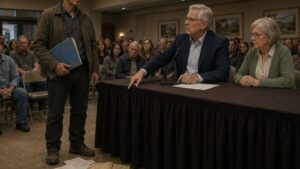
Thomas began the hearing with a photograph of his youngest child walking beside traffic.
The image appeared on a portable screen at the front of the clubhouse meeting room. A pickup truck passed in the background. The child’s backpack looked too large for his shoulders, and his shoes stood close to the white edge line.
“This is the route they take now,” Thomas said. “Because Robert closed the path they’ve used safely for two years.”
The folding chairs were nearly full.
Residents who had never attended an HOA meeting sat along the rear wall. Some had come because they cared about the fence. Others had come because conflict between neighbors traveled faster than any official notice.
Robert sat at a table facing the board with his documents arranged in narrow stacks. The stamped survey lay on top. Beneath it were the photographs, the installer’s statement, the fence application, the violation notice, and his own printed emails.
Carol sat behind Thomas with the children at home under a neighbor’s supervision. She had not looked at Robert since entering.
Patricia thanked Thomas and asked whether he was requesting removal of the fence.
“I’m requesting restoration of the access that existed before this dispute.”
“That means a gate?” one board member asked.
“Or an opening.”
Robert watched Thomas avoid the word property.
Patricia turned to him. “You may respond.”
Robert stood.
He had spent the afternoon rehearsing a clean presentation: survey first, developer’s map second, installation photograph third. Facts in order. No emotion. No unnecessary admissions.
Then Thomas had shown the child beside the road.
Robert looked at the enlarged photographs displayed on an easel near the board. One showed the original narrow route. Another, taken months later, showed bare earth stretching almost four feet wide. In the final image, the path disappeared beneath the swing-set frame.
It was a record of Thomas’s overreach.
It was also a record of Robert’s silence.
“The fence is inside my surveyed property,” he began. “The association’s landscaping diagram is not a boundary document. Patricia has agreed to include that distinction in the record.”
Patricia nodded.
“The swing set crossed the line by approximately three feet. Thomas was given forty-eight hours to remove it. He did.”
Thomas shifted in his chair. “Because you threatened to build around it.”
“I told you the contractor was coming.”
“You knew the board hadn’t approved the fence.”
“Yes.”
A murmur moved through the rear chairs.
Robert had expected the admission to feel dangerous. Instead, it felt cleaner than defending what he had plainly done.
“The board may decide I violated the architectural procedure,” he said. “I proceeded because the association asked me to leave a permanent structure on my land while it reviewed a non-survey map. That was not acceptable to me.”
One board member glanced at Patricia.
Robert continued. “But Thomas is right about one thing.”
Thomas looked up.
“I allowed the children to cross for two years.”
The room became quiet.
“I answered complaints by saying it was no problem. I reseeded the grass. I moved their bicycles. I picked up what they left behind. I never told Thomas clearly that the arrangement was limited.”
Patricia leaned forward slightly.
Robert heard Sharon’s voice in the back of his mind, not as a command but as something unfinished.
“I thought I was preserving peace,” he said. “What I was really doing was avoiding a conversation.”
Thomas seized the opening. “Exactly. We relied on that.”
“You relied on the shortcut,” Robert said. “That part I helped create.”
He lifted the photograph of the exposed survey pin.
“You did not rely on permission when you saw this.”
Thomas’s expression changed before he could control it.
Robert placed the installer’s signed statement beside the image.
“The installation crew stopped after uncovering the marker. They offered to move the swing set. You declined the additional cost and told them I approved the location.”
“That’s not what happened.”
“The installer signed his account.”
“He’s protecting his company.”
“Did you see the pin?”
“No.”
Robert looked at him.
Thomas folded his arms. “Not like that. I saw something in the dirt. Nobody told me it was official.”
“The installer says he did.”
“He said it might be a marker. Might.”
One of the board members asked, “Why not pause and confirm?”
Thomas turned toward the board. “Because the structure was half assembled. Because we had already paid. Because Robert had let us use that strip for two years and never once objected. I thought we were talking about inches, maybe a foot.”
“Three feet,” Robert said.
“According to a survey I didn’t see until afterward.”
“You saw the marker.”
Thomas’s hand struck the table lightly. “And you saw my children cross every day. You let them build their lives around it.”
The words silenced the room again.
There it was—the part Robert could not dismiss.
Thomas had made a dishonest choice. Robert had created the conditions in which Thomas believed dishonesty might work.
Patricia looked down at the emails. “Robert, why didn’t you address the route earlier?”
He could have said the children were young. He could have said the damage seemed minor. Both were true.
Neither was the whole truth.
He looked toward the empty chair beside him.
For years after Sharon died, any disagreement with a neighbor had felt like movement toward the isolated man he feared becoming. Sharon had known everyone on the street. She lent tools, collected mail, opened the gate. Robert had mistaken preserving her habits for preserving her.
“Because my wife believed this house should stay open to people,” he said. “After she died, I thought saying no meant I was becoming bitter.”
Patricia’s expression softened, but Robert did not want softness.
“So I kept saying nothing,” he continued. “And then I became angry at people for not hearing what I never said.”
No one moved.
The confession stripped something from Thomas’s argument. Not because it erased Robert’s fault, but because he had named it himself.
Patricia looked at the board members. “The homeowner’s admission concerns communication. It does not establish permanent access or permission to build.”
Thomas turned toward her. “So he gets rewarded for admitting he handled it badly?”
“No,” Patricia said. “The board still has to consider the unapproved fence. But his failure to object earlier does not transfer ownership.”
The property manager slid a copy of the installation photograph toward Thomas.
“Did you tell Carol that Robert approved the placement?” he asked.
Thomas’s eyes flicked toward the second row.
Carol sat very still.
“This is between Robert and me,” Thomas said.
“That was not the question,” Patricia replied.
Thomas leaned back. “My family understood there was permission.”
“Did you tell them that?”
“I told them what I believed.”
Robert looked at Carol.
She had asked him not to use her private disclosure. He had not. The invoice remained in his folder, untouched.
Thomas pointed at the screen. “The practical issue is those children walking beside traffic.”
“The practical issue,” Robert said, “can be discussed after the board recognizes the boundary.”
“You don’t care what happens to them.”
Robert’s hand tightened around the edge of the table.
He could have answered with the photograph. He could have described the knock on the fence, the small voice saying his name from the other side. Instead, he said, “I care enough not to promise something I cannot keep.”
Thomas gave a bitter laugh. “That’s convenient now.”
Patricia asked him once more, “Did you know Robert had not approved the swing-set location?”
Thomas looked toward Carol.
She lowered her eyes.
“No,” he said. “I did not.”
The lie entered the room differently from the others. It was smaller, flatter, almost exhausted.
Carol raised her head.
Thomas saw her move and whispered, “Don’t.”
She stood anyway.
The metal legs of her chair scraped across the clubhouse floor.
Patricia looked at her. “Carol?”
Carol held the printed installation photograph in both hands.
“Thomas knew where the boundary was,” she said.
Chapter 7: The Judgment Could Not Repair the Shortcut
“The fence is not fully recoverable as damages,” the magistrate said.
Robert sat very still.
Across the narrow courtroom, Thomas leaned back as though the sentence had settled everything. His attorneyless stack of papers remained uneven and partly unfolded. Carol sat one row behind him, hands clasped in her lap, looking toward the floor.
The magistrate adjusted her glasses and continued.
“You chose to construct a permanent improvement on your own property. The court is not persuaded that the entire cost of that improvement should be shifted to the defendant.”
Robert had expected resistance. He had not expected the rejection to come first.
The fence invoice lay in front of him, clipped to photographs of the completed cedar panels. Beside it were the survey fee, the lawn-repair estimate, certified-mail receipts, and printed images of the path at different stages of damage.
Thomas turned slightly, enough for Robert to see the beginning of a smile.
The magistrate looked toward him. “Mr. Mitchell, that does not mean the claim fails.”
The smile disappeared.
Robert released a breath through his nose.
The hearing room smelled faintly of old paper and cleaning solution. No jury box, no dramatic gallery, only two tables, a court clerk, and a clock whose second hand moved louder than it should have.
The magistrate picked up the earliest photograph.
“This appears to show ordinary foot traffic.”
“Yes,” Robert said.
“And this?”
“About eighteen months later.”
The later image showed bare ground where grass had once grown, bicycle tracks at the edges, and the pale route widening toward Robert’s patio.
Thomas said, “He allowed all of that.”
The magistrate turned to him. “You will have an opportunity to respond.”
“I’m just saying he can’t call it damage after telling us it was fine.”
Robert looked at the photograph.
There was truth in that. Not enough to excuse what followed, but enough that he had revised his claim before filing. He had removed several speculative amounts and included only what he could document.
When the magistrate asked why, he answered plainly.
“I did not object early enough. I’m not asking the court to charge him for every footprint.”
Thomas’s eyes moved toward him, suspicious of the concession.
Robert continued. “I’m asking for the cost of repairing the compacted strip after the use exceeded what I had allowed, the expedited survey verification, and the portion of the contractor’s work directly caused by the encroachment.”
The magistrate reviewed his figures.
Thomas unfolded the HOA landscaping plan. “This shows the area was intended for pedestrian access.”
“It is not a survey,” Robert said.
The magistrate held out her hand. Thomas passed it forward.
She read the small print at the bottom, then placed it aside.
“It appears to be a conceptual document.”
Thomas’s shoulders tightened. “It shows what the neighborhood was designed for.”
“It may show an intent concerning landscaping. It does not establish ownership or an easement.”
Robert felt no surge of triumph. He had heard the distinction before. What mattered now was whether the court believed Thomas’s decision had been careless or conscious.
The magistrate reached for the installer’s photograph.
The image had been enlarged on plain white paper. Thomas stood beside the half-built swing set while the exposed marker showed near the first post. The worn path crossed behind him, pale against the grass.
“When was this taken?” she asked.
The installer, seated near the aisle, gave the date and time.
“And what did you tell Mr. Mitchell?”
“That the metal pin might mark a property boundary and we should pause or shift the footprint.”
“Did you give him a relocation price?”
“Yes.”
“What did he say?”
“That the neighbor had approved it and to continue.”
Thomas leaned forward. “He said it might be a marker. He didn’t know.”
The magistrate looked at him. “Did you contact Mr. Nelson?”
Thomas hesitated.
“No.”
“Did you contact the association?”
“I believed the plan in the file supported the placement.”
“Did you show the installer that plan?”
“No.”
“Did you ask for a survey?”
“No.”
“Why not?”
For the first time, Thomas’s posture changed. His arms loosened. He looked less defiant than tired.
“Because the set was already there in pieces,” he said. “Because moving it would cost more. Because my kids had been waiting for months, and Robert had never cared about that part of his yard before.”
The magistrate allowed the silence that followed.
Robert saw Thomas not as the man laughing over the survey cord, but as someone who had made one selfish choice and then built an increasingly elaborate defense around it. Money had mattered. Pride had mattered more.
The magistrate folded her hands.
“Mr. Nelson’s prior tolerance may explain why you assumed continued passage was acceptable. It does not explain why you proceeded with permanent construction after a possible boundary marker was uncovered.”
Thomas looked down at the table.
The ruling took less than five minutes after that.
Robert was awarded the documented lawn-restoration cost, the expedited survey fee, the portion of contractor expenses attributed to correcting and securing the encroached area, and court costs. The total came to eighteen hundred dollars, plus filing and service fees.
Not the full fence.
Not punishment disguised as compensation.
Enough to place responsibility where the evidence supported it.
Outside the courthouse, the late afternoon traffic moved along the square. Robert waited near the steps while the clerk prepared certified copies.
Thomas came out first.
Carol followed several paces behind him.
Thomas stopped beside Robert but did not look directly at him. “You got your money.”
“That wasn’t all I wanted.”
“No. You wanted everyone to know you were right.”
Robert thought of the hearing, of admitting his own failure in front of neighbors. “Not exactly.”
Thomas gave a quiet, humorless laugh. “My kids won’t bother you again.”
Robert turned toward him.
“They won’t cross your yard. They won’t knock on your fence. They won’t ask you for anything.” Thomas finally met his eyes. “You can have every inch.”
Carol said his name softly, but he was already walking toward the parking lot.
The words should have sounded like surrender.
Instead, they followed Robert home like an accusation.
A letter from Patricia waited in his mailbox. The board had rescinded the fence fine after reviewing the survey, the developer’s map, and the hearing testimony. The fence would remain, subject to ordinary maintenance rules.
He had won there too.
Robert carried both decisions into the house and placed them on the kitchen table.
The room was quiet enough that he could hear the refrigerator cycle on.
He opened the fireproof box to return the court papers. Beneath an old packet of insurance documents, he found a small envelope with Sharon’s handwriting on the front.
Neighborhood supper ideas.
Inside were index cards, half a guest list, and a folded note she had apparently written while planning one of the block gatherings.
Robert recognized the sentence before he finished unfolding it.
Keep the door open when you can. Tell people the truth when you can’t. Welcoming someone doesn’t mean pretending everything is fine.
He sat down.
For years, he had remembered only the open door.
On the table beside Sharon’s note lay the judgment, the rescinded fine, and a photograph of the worn path reduced to measurements and dollar amounts.
He had recovered control of his property.
He had not yet decided what kind of neighbor would live behind the fence.
Chapter 8: The Gate Opened Only When Permission Was Clear
The youngest Mitchell child stood beside the road in heavy rain, holding a backpack over his head.
Robert saw him through the front window just after seven.
Water ran along the curb in shallow brown streams. Cars passed with tires hissing over the wet pavement. The longer route to the bus stop required the children to circle the block, and on mornings like this, the section without a sidewalk looked narrower than it had in Thomas’s photograph.
The older two children were farther ahead. The youngest had stopped to retie a shoe, then fallen behind.
Robert’s hand rested on the curtain.
For three weeks, the fence had remained closed.
The new grass seed had begun to take where the old path crossed his yard, thin green shoots rising through straw. Along the fence, a contractor had cut and framed a narrow pedestrian gate. It was not yet in use. The HOA had approved it after Robert submitted a second application with one condition attached: access would be private, revocable, limited to school travel, and controlled by a lock on Robert’s side.
The agreement sat on his kitchen counter.
He had written it in plain language, then asked the property manager to review it. No legal flourish. No claim of permanence. No confusion.
The children could cross on school mornings and afternoons with Carol’s supervision or written authorization. They would stay on the stone walkway. No bicycles, toys, guests, or unsupervised play. Robert could suspend access for maintenance, safety, or misuse.
Permission could be given.
Permission could also end.
Robert put on his raincoat and walked outside.
By the time he reached the gate, Carol had come down the street beneath a dark umbrella. She called to the youngest child, who turned toward her.
Then she saw Robert.
He held the agreement inside a clear plastic folder.
Carol slowed.
Thomas was not with her.
“I wasn’t sure you’d come,” Robert said.
“I almost didn’t.”
Rain tapped against the umbrella.
Beyond the fence, the narrow stone path crossed Robert’s yard toward the side gate. He had laid it himself over several evenings, following the old route but tightening it into a deliberate line. New grass covered the wider scars on either side.
Carol looked at the small gate. “The board approved it?”
“Yes.”
“And you’re willing?”
“Under written terms.”
Her expression changed slightly. Not disappointment. Recognition.
Robert passed her the folder.
She read each paragraph while the children waited at the curb. The oldest watched without pretending not to. The youngest lowered the backpack from his head and stared through the rain.
Carol reached the signature line.
“Thomas won’t sign this,” she said.
“I know.”
“You already asked him?”
“He returned it unsigned.”
A drop of water ran from the edge of her umbrella onto the plastic folder.
“He said taking the shortcut now would make it look like he admitted everything.”
Robert looked toward the Mitchell house. Thomas’s truck remained in the driveway.
“This isn’t about what it looks like.”
“It is to him.”
Robert had no answer that would help.
Carol read the supervision clause again. “It says either parent.”
“I can revise that.”
Her eyes lifted.
“The access can be under your authorization,” Robert said. “If Thomas does not agree, he does not use the gate or send the children through himself.”
“That will make things worse between us.”
“It might.”
The bluntness surprised both of them.
A month earlier, Robert would have softened the condition until it meant nothing. He would have said they could work something out, then resented whatever happened next.
Carol looked back at the children.
“What happens if they leave something in your yard?”
“The gate closes for a week.”
“And if one of them brings a friend?”
“The same.”
“You’ve thought about this.”
“I should have thought about it two years ago.”
Carol gave a tired smile that disappeared quickly.
“Thomas believes you did all this to prove he couldn’t push you around.”
“Part of me did.”
The admission hung between them.
Robert went on before he could retreat from it. “The fence was necessary. Some of what came after was anger. I don’t want the children carrying all of that.”
Carol looked at the signature line.
“And you trust me?”
“I trust clear terms more than assumptions.”
She took the pen clipped inside the folder and signed.
Robert signed beneath her.
He unlocked the gate.
The latch lifted with a clean metallic sound.
For a moment, no one moved.
Then Carol called to the children. “School route only. Stay on the stones.”
The oldest approached first, cautious and unsmiling. The second followed. The youngest stopped in front of Robert, rain dripping from his hair.
“Is it okay now?” he asked.
Robert looked at the narrow walkway, the written agreement in Carol’s hand, and the repaired grass beyond it.
“Yes,” he said. “Right now, it is.”
The child passed through.
Their shoes struck the stones instead of the lawn. They moved quickly across the yard and out the side gate toward the bus corner. No one ran near the patio. No backpack brushed the flower beds.
Carol remained by the open gate.
“Thank you,” she said.
Robert nodded.
Thomas stood on his back step across the fence line.
He had come outside without a coat. Rain darkened the shoulders of his shirt. He watched the children disappear toward the bus stop, then looked at the signed folder in Carol’s hand.
“You signed it,” he said.
“Yes.”
“Without me.”
“They needed a safe route.”
Thomas’s eyes shifted to Robert. “So now he decides when our children can walk?”
Robert kept one hand on the gate.
“I decide who enters my property.”
Thomas flinched as though the words were sharper than Robert had intended.
Carol closed the umbrella slightly against a gust. “You had a chance to sign.”
“I’m not asking permission for something we already had.”
“That,” Robert said, “is why the agreement matters.”
Thomas looked at the gate, then at the stone path. The old route remained visible only in fragments where the new grass had not fully filled in.
For a moment, Robert thought he might argue again.
Instead, Thomas stepped backward beneath the patio roof.
“This is between you and Carol,” he said.
It was not an apology. It was not reconciliation.
But it was the first time he had stopped claiming the route as his own.
The bus arrived at the corner with a low hydraulic sigh.
Several minutes later, the children returned to wave from the far side before climbing aboard. The youngest lifted one hand toward Robert.
Robert raised his in response.
After the bus pulled away, Carol closed the gate from her side. Robert turned the key in the lock.
The action no longer felt like punishment.
It felt like a boundary doing what a boundary should: opening by choice, closing without hatred.
Carol walked back toward her house. Thomas waited for her beneath the patio roof, leaving space between them that Robert could not repair and would not pretend not to see.
He carried his coffee into the backyard.
Rain softened to a mist. Along the old route, new grass covered most of the bare earth. Only the narrow stone walkway remained, clean and intentional, leading to the small gate in the cedar fence.
Robert stood where the path had once widened without limit.
Then he took a drink, locked the gate after the bus had gone, and watched the green shoots rise through the last exposed strip of soil.
The story has ended.