They Tore Down His Wall Over Four Inches—Then the Clubhouse Began Pulling Apart
Chapter 1: The Four Inches Everyone Could See
The sledgehammer struck before anyone opened Richard Adams’s appeal.
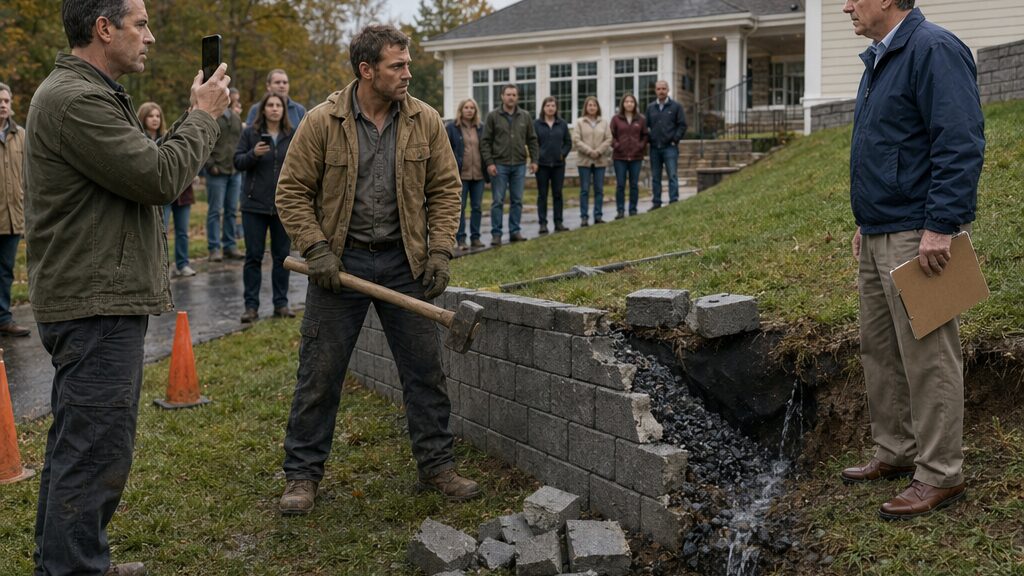
The first blow landed high on the gray block wall, close enough to the capstone that a wedge of concrete snapped free and dropped into the wet grass. A second strike followed before the first piece stopped rolling.
Richard stood ten feet away with his phone raised.
“Hold on,” he said.
Brian Nelson lowered the hammer but did not step back. He looked toward Kevin Thompson instead of Richard.
Kevin stood beside the clubhouse boundary with a clipboard tucked against his chest. Six homeowners had gathered along the walking path. Two held coffee cups. One had brought a folding chair, as if the demolition were an announced community event.
“The board’s decision is final,” Kevin said.
“My appeal hasn’t been heard.”
“It was received.”
“That isn’t the same thing.”
Kevin glanced at the small audience, then opened the clipboard. His voice took on the measured patience he used during meetings when he wanted everyone to know procedure was on his side.
“Section eight, paragraph four. No landscape retaining structure may exceed forty-four inches above finished grade without written architectural approval.”
Richard looked at the unopened white envelope beneath Kevin’s thumb. He had delivered the appeal by hand three days earlier, with a drainage analysis, soil photographs, and stamped drawings attached.
Kevin did not mention any of those.
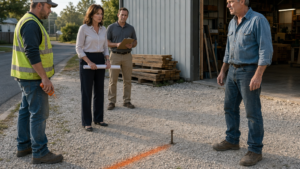
Instead, he nodded to the demolition laborer, who stretched a steel tape from the approved grade mark to the wall’s cap. The yellow blade trembled in the morning breeze.
Forty-eight inches.
Exactly four inches over.
“There,” Kevin said. “This isn’t personal. It’s measurable.”
A woman near the path lifted her phone and began recording.
Richard felt the back of his neck tighten. “The grade mark you’re using predates the drainage trench.”
“The rule does not say except when an owner prefers another measurement.”
“It isn’t preference. The lower course is buried because the slope is saturated.”
Kevin gave a brief smile. “You’ve made that argument.”
“I submitted calculations.”
“You submitted an unauthorized construction package after work had begun.”
“Before the wall was completed.”
“After excavation.”
Around them, the development looked orderly enough to make Richard appear unreasonable. Trimmed lawns stepped down toward the clubhouse. Young maples lined the path. The gray wall behind his home curved along the slope in clean, level courses. Nothing about it looked improvised.
That was part of the problem. The wall looked like landscaping.
Only Richard could see the system inside it: compacted stone, perforated drainpipe, filter fabric, weep channels, and the buried toe resisting the clay’s slow downhill pressure.
He turned to Brian. “Before you remove another block, tell me where the drain outlet runs.”
Brian shifted the sledgehammer against his thigh.
Kevin answered for him. “The contractor has been given the board’s scope.”
“I asked the contractor.”
Brian’s eyes moved over the wall. He had been quiet since arriving with the trailer. He was in his early thirties, broad through the shoulders, with dust already marking his work boots though the job had barely begun.
Richard repeated the question. “Where does the drain discharge?”
Brian looked toward the clubhouse, then down the slope.
“I saw the outlet on the plans,” he said.
“Where?”
“Near the east corner.”
“And what happens when you break the first course above it?”
Kevin closed the clipboard. “We’re not conducting an engineering seminar in front of the neighborhood.”
“No,” Richard said. “You’re altering a drainage structure in front of the neighborhood.”
That changed the air. A few people looked from Richard to the wall, but Kevin’s expression stayed composed.
“You were told to stop construction,” he said. “You continued.”
“I stabilized an open excavation before a forecasted storm.”
“You built the wall.”
“I completed enough of it to keep the slope from moving.”
“And now it’s coming down.”
Brian adjusted his grip. Richard could see that he understood more than Kevin wanted him to. Not the full slope analysis, perhaps, but enough to recognize stone backfill behind a block face, enough to know that water did not belong where Kevin assumed decorative soil should be.
Richard lowered the phone for one second.
“Brian, I’m asking you professionally. Pause until the board gets an independent review.”
Kevin stepped between them.
“You are not the engineer of record for the association.”
“I’m the engineer who designed what you’re demolishing.”
“You’re the homeowner in violation.”
The distinction was clean, almost elegant. It reduced every calculation Richard had made to a private interest.
A man near the path murmured that rules had to apply to everybody. Another homeowner said something about the oversized pergola approved two streets over. Kevin heard that and raised his voice.
“That is exactly why we are doing this. There have been complaints for years that enforcement depends on who you know. No more exceptions.”
For a moment, Richard understood the shape of Kevin’s argument. The board had allowed fence extensions, paint changes, storage sheds, and driveway alterations to drift through without consistent review. People had noticed. Kevin wanted one visible case that proved the board could still enforce its documents.
Richard’s wall had become that case.
Not because it was the most dangerous violation.
Because it was the easiest one to measure.
Kevin nodded to Brian.
The hammer rose.
Richard lifted his phone again.
The next strike fractured the cap block. Another broke the face from the course beneath it. Brian worked carefully at first, using the sledgehammer’s weight rather than rage. The laborer pried loose fragments and stacked them beside the trailer.
With the fourth block removed, a dark line appeared behind the wall.
Water slid through the exposed gravel.
It was not a dramatic gush. It was a steady, glassy thread that gathered along the broken edge and dripped onto the grass.
Brian stopped.
The homeowners closest to the path leaned forward.
Richard zoomed in with his phone. The camera caught the wet aggregate, the black edge of filter fabric, and the open cavity where the block had been.
Brian crouched and touched the gravel. When he stood, his fingertips shone.
“This is active,” he said.
Kevin’s jaw tightened. “It rained Thursday.”
“That’s why it’s active,” Richard said.
Brian looked at his father. “We should probably expose the outlet first.”
“We are not redesigning the job in the middle of it.”
“I’m saying we should see what we’re cutting into.”
“You were hired to remove an unapproved wall.”
Brian’s hand remained on the hammer handle, but he no longer looked ready to swing.
Richard moved closer, stopping outside the orange cones Kevin had placed along the work area.
“The clubhouse footing is downslope,” Richard said. “The rear roof drains already discharge too close to this grade. This wall intercepts part of that water and relieves pressure in the clay.”
Kevin’s eyes flicked toward the people watching. “And yet you never received approval.”
“That doesn’t change what the wall does.”
“It changes who is responsible.”
There it was.
Not whether the slope would move. Not whether water was trapped behind the wall. Responsibility.
Richard looked at the white envelope still held beneath Kevin’s clipboard. The appeal remained sealed.
He could argue until everyone grew tired enough to remember only his anger. He could stand in front of the wall and force Kevin to call law enforcement. He could make the scene larger and lose control of what it meant.
Instead, he stepped back.
“Continue,” he said.
Brian stared at him.
Richard raised the phone higher. “But I’m documenting the condition, the active drainage, and the request to stop.”
Kevin’s expression eased, mistaking the retreat for surrender.
“Document whatever you like.”
Brian did not move.
Kevin turned to him. “Finish the work.”
The hammer rose again.
By noon, the upper half of the wall lay in broken stacks. The gravel behind it had begun slumping into the openings. Water darkened the soil in narrow fans. Every strike sounded flatter than the one before, as if the hill itself were absorbing the blows.
Most of the homeowners drifted away once the spectacle became labor. One woman remained long enough to ask Kevin whether the association would restore the landscaping. He assured her it would be handled.
Richard recorded until his arm ached.
When Brian reached the section above the drain outlet, he stopped a second time.
“Dad,” he said quietly.
Kevin walked closer, irritated by the word more than the hesitation. “What?”
Brian pointed with the hammer. “The pipe runs toward the clubhouse side.”
Richard kept the camera steady.
Kevin noticed.
He straightened and spoke loudly enough for the recording and the remaining homeowners.
“The board has reviewed the matter. The association accepts responsibility for carrying out this enforcement action.”
Richard said nothing.
Kevin continued, perhaps believing the sentence strengthened his authority.
“Mr. Adams was notified. He declined to comply voluntarily. The board voted, and the board stands behind its decision.”
Behind him, water continued slipping through the broken wall.
Richard watched the red recording light on his screen.
Then Brian swung again.
Chapter 2: The Water Had Always Moved Downhill
On Monday morning, muddy water crossed Samantha Lewis’s property line in a ribbon wide enough to cover both of Richard’s shoes.
She stood beside her back fence in rubber boots, holding a garden rake like a staff. Brown water curled around the posts and spread across a section of lawn where the grass had already flattened.
“You said the wall was supposed to control this,” she said.
Richard crouched near the fence and pressed two fingers into the soil. The surface was soft, but the water was moving rather than pooling.
“The wall was controlling subsurface pressure,” he said. “This is surface runoff.”
Samantha gave him a hard look. “It’s in my yard.”
“I can see that.”
“Can you?”
He stood.
The broken wall was visible uphill through the trees. Kevin’s crew had removed most of the face blocks but left the gravel and exposed soil behind a low temporary barrier. It looked less like a completed demolition than an interrupted excavation.
Richard had spent Sunday cataloging the footage, exporting still frames, and writing a notice for the county. He had slept four hours. Samantha’s accusation reached him through a layer of exhaustion that made every word sound sharper than it was.
“The flow path changed when they opened the wall,” he said.
“You built it.”
“And they removed it.”
“After you built without approval.”
Richard looked toward her house. A child’s bicycle leaned beneath the covered patio. Two plastic storage bins had been moved onto concrete blocks near the foundation.
Samantha followed his gaze.
“This isn’t the first time,” she said.
She took out her phone and opened a folder of photographs.
The first image showed the same fence during a summer storm, water pressed against the lower boards. The second showed mulch scattered across her patio. In the third, muddy water had reached the base of the storage bins.
The dates were from the year before Richard bought his house.
He swiped to the next photograph. The water line ran from the upper lot—his lot—down the side yard.
“I sent these to the board,” Samantha said. “Twice.”
Richard enlarged the image. “This was before my wall.”
“That’s not the point.”
“It matters.”
“The point is water has always come from up there, and then you arrived and started digging without talking to anyone downhill.”
“I submitted a drainage plan.”
“To the board.”
“Yes.”
“Not to me.”
He almost answered that homeowners did not normally circulate engineered plans door to door. The words formed quickly, orderly and defensible.
He kept them inside.
Samantha tapped another photograph. “When I asked what you were building, you said it was code-compliant.”
“It was.”
“That was your whole answer.”
Richard remembered the conversation. He had been standing inside the excavation, measuring the crushed-stone base. Samantha had called over the fence. He had said the system was designed, permitted at the county level, and compliant with structural code.
He had not explained that the HOA approval was still pending.
He had not explained the drain alignment.
He had not asked what she had seen during previous storms.
“The wall wasn’t redirecting water into your yard,” he said, more carefully. “But the overall drainage here is incomplete. I should have reviewed your side before I finalized the outlet.”
Samantha’s grip loosened on the rake.
It was not an apology, but it was the nearest thing he had given her.
“So you don’t know if it made things worse.”
“I know what it was designed to do. I don’t know every condition beyond my property line.”
“That sounds different from Saturday.”
Saturday, he had known exactly what the wall protected. Monday, standing in Samantha’s flooded grass, certainty had edges he had not examined.
He took photographs of the mud line along her fence. It sat four inches above the lowest board at the deepest point.
The measurement seemed almost insulting.
By ten, Richard was at the county engineering office with a binder under one arm and a flash drive in his pocket.
Catherine Martinez met him in a small conference room with no windows. She wore a navy county badge clipped to her belt and had already opened the notice he had emailed before dawn.
“You’re asking us to declare an imminent slope hazard,” she said.
“I’m asking you to document that a drainage-retaining system was removed over professional objection.”
“Those are different things.”
“I know.”
She turned to the first page of his report. “Did you have HOA architectural approval when you started construction?”
Richard glanced at the approval form.
The board signature line was blank.
“I had submitted the variance.”
“That wasn’t my question.”
“No.”
Catherine rested one hand on the file. “County approval covers structural and grading requirements. It does not replace private covenants.”
“The excavation was already open. A storm was forecast.”
“So you made a risk decision.”
“Yes.”
“And now the board has made another one.”
“Yes.”
She studied him for a moment. “You understand that your decision complicates this.”
“It doesn’t make their demolition safe.”
“No. It doesn’t.”
That was the first sentence anyone had spoken since Saturday that held both truths at once.
Catherine reviewed the footage. She paused on the exposed gravel and water. Then she replayed Brian’s hesitation and Kevin’s statement accepting responsibility.
“This is useful,” she said.
“Can you order reconstruction?”
“Not from this alone. I can open a site review and record the notice. If we find active movement or a public-safety issue, our authority changes.”
“The clubhouse is directly downslope.”
“Show me.”
Richard spread the site drawings across the table. His plan showed the wall, his property line, the clubhouse foundation, and a stormwater line copied from an older survey.
Catherine traced the line with a pencil.
“Where are the clubhouse roof drains?”
“On the association’s plan.”
“Which sheet?”
He opened the digital file Kevin had provided during the variance process. Catherine checked each page, then returned to the overall drainage sheet.
The roof leaders were shown ending at the rear corners of the clubhouse.
There was no continuation.
“No outlet,” she said.
“It may have been omitted from the scan.”
“Maybe.”
She pulled up the county archive. The original subdivision plan loaded slowly, each page appearing as a pale gray image.
The approved stormwater design showed two rear drains connecting to a buried collector line. That line was supposed to cross the slope and discharge into a community basin beyond Samantha’s lot.
Catherine compared it with the HOA plan.
The entire collector line was missing.
Not relocated. Not revised.
Missing.
“Who prepared the association copy?” Richard asked.
“There’s no revision stamp.”
“Could the line have been abandoned?”
“Could have been. Could have failed. Could still exist somewhere other than shown.”
Richard thought of the water emerging behind his wall. The volume had been greater than ordinary groundwater seepage after a light rain.
Catherine zoomed in on the clubhouse corner.
“If those drains aren’t connected,” she said, “they may be discharging into the backfill.”
Richard looked at the blank space between the clubhouse and his property.
For two days he had been asking why Kevin refused to pause.
Now a larger question took its place.
Someone had been using an incomplete site plan.
And someone had decided the missing drainage did not need to be discussed.
Chapter 3: The Board Could Not Afford the Truth
Kevin’s letter was already on every chair when Richard entered the clubhouse meeting room.
NOTICE OF UNAUTHORIZED CONSTRUCTION AND ASSOCIATED DRAINAGE CONCERNS appeared across the top in bold type.
Richard read the first paragraph while homeowners filed in around him.
The retaining structure installed by Richard Adams had not received final architectural approval. Its removal was undertaken to restore compliance and protect neighboring properties from unreviewed alterations to established drainage patterns.
The wording was careful. Nothing in it directly said Richard had caused Samantha’s flooding. It merely placed the ideas close enough together for residents to make the connection themselves.
At the front table, Kevin arranged copies of the bylaws. Kimberly sat beside him with a laptop open and a yellow legal pad covered in figures.
Richard took a seat in the second row.
Samantha entered a minute later. She saw the letter in his hand and looked away before sitting across the aisle.
Kevin called the meeting to order at seven.
“We’re here because there has been a great deal of speculation,” he began. “The board intends to separate fact from alarm.”
Richard almost smiled at the phrase. Kevin had ordered a wall demolished while its appeal remained sealed, but alarm had become the problem.
Kevin summarized the violation, the vote, and the removal. He emphasized the four-inch excess height three times.
When he invited questions, Richard stood.
“I’m requesting an independent geotechnical and drainage review of the clubhouse slope before the next significant storm.”
Kevin folded his hands. “At association expense?”
“Yes.”
A murmur moved through the room.
Richard continued. “The original county plan shows a buried collector line behind the clubhouse. The association plan used during my review omits it. Until we know whether that line exists and functions, no one can reliably assess the slope.”
Kevin leaned back. “You are asking the community to pay for an investigation because your project was not approved.”
“I’m asking the community to investigate shared infrastructure.”
“You tied your wall into that infrastructure without authorization.”
“I did not tie into the clubhouse system. I intercepted groundwater and relieved soil pressure on my property.”
“Which affected downhill flow.”
“Everything on that slope affects downhill flow.”
Several residents began speaking at once.
One asked whether Richard could guarantee his wall had not worsened Samantha’s flooding.
Another wanted to know why the board had approved demolition without its own engineering review.
Kevin tapped the gavel against the table, not hard enough to silence anyone, but enough to remind them that he possessed one.
“This is precisely the issue,” he said. “Mr. Adams speaks with professional certainty while avoiding a simple fact. He chose to build before approval.”
Richard looked at Samantha.
She was watching him now.
“Yes,” he said. “I did.”
The room quieted more effectively than the gavel had.
Kevin’s expression changed by a fraction. He had expected an argument.
Richard went on. “The excavation was open, and rain was forecast. I believed leaving the slope unsupported presented a greater immediate risk than completing the structure while the variance was pending.”
“You believed,” Kevin said.
“Yes.”
“So you substituted your judgment for the board’s process.”
“I made a risk decision. The board made one too.”
Kevin’s mouth tightened.
Richard placed Catherine’s marked site plan on the display table. “The difference is that my decision was based on a documented soil condition. I’m asking what information supported yours.”
A board member at the far end leaned toward the drawing. “What exactly would this study cost?”
“Initial review and subsurface tracing, perhaps twelve to eighteen thousand dollars,” Richard said. “More if they need borings.”
The reaction was immediate.
Someone near the back said the association had just raised dues. Another asked whether insurance would cover it. A retired homeowner demanded to know why a private wall problem should cost every household.
Kevin waited until the complaints gathered weight.
“This is what the board has tried to prevent,” he said. “Every time an owner ignores the rules, the rest of the community is expected to absorb the consequences.”
Richard saw heads nod.
Kevin was not convincing them that the slope was safe. He was convincing them that Richard was expensive.
A homeowner in the front row raised her hand. “How much is actually in the reserve fund?”
Kimberly’s fingers stopped above the laptop.
Kevin answered without looking at her. “The association maintains reserves consistent with our current obligations.”
“That wasn’t the question.”
Kimberly closed the laptop halfway. “Reserve balances are reported annually.”
“What is the balance tonight?”
“This meeting is about the wall,” Kevin said.
“It’s about paying for a study,” the homeowner replied. “So how much money is available?”
Kimberly’s legal pad disappeared beneath her hand.
Richard noticed a printed spreadsheet beside it. At the bottom of one column, partially visible, was a figure beginning with 3.
Not three hundred thousand.
Thirty-something.
The development had sixty-four homes, a clubhouse, a pool, private roads, drainage facilities, and retaining slopes.
A reserve balance under forty thousand dollars would not cover even a modest structural failure.
Richard lifted the bylaw notice from his chair and placed it beside the visible edge of Kimberly’s spreadsheet. Four inches had justified emergency demolition. A six-figure reserve shortfall could not be spoken aloud.
“Has the board deferred drainage maintenance?” he asked.
Kimberly looked at Kevin.
Kevin said, “That question is outside the agenda.”
“It is the agenda.”
“No. The agenda is your unauthorized structure.”
“The county plan shows infrastructure missing from the association record. If maintenance was deferred—”
“You don’t have evidence of that.”
“I have evidence that the plan is incomplete.”
“And we have evidence you built without permission.”
The exchange had become exactly what Richard always created when he felt cornered: two sets of facts thrown across a room, each side waiting for the other to collapse under accuracy.
Samantha stood.
“Did anyone inspect the drains before the wall came down?”
Kevin turned toward her. “The board reviewed the relevant materials.”
“That’s not what I asked.”
Kimberly stared at the table.
One of the board members cleared his throat. “I thought Brian checked the area.”
Brian was standing near the rear door, still wearing work clothes. Richard had not seen him enter.
Kevin’s voice sharpened. “The contractor completed the assigned scope.”
Brian did not respond.
The homeowner in front asked again for the reserve balance.
Kimberly opened the laptop and whispered something to Kevin. He shook his head once.
She closed it.
That small refusal shifted the room. Residents who had nodded at Kevin’s fairness argument began exchanging glances. They might not understand saturated clay or collector lines, but they understood when a treasurer would not state a number.
Kevin called for a vote on Richard’s request.
The motion was to authorize an independent slope and drainage study, with costs drawn from reserves.
Two board members voted yes.
Kevin and Kimberly voted no.
The fifth member hesitated, then voted no.
Motion denied.
The gavel came down.
Richard remained seated while people gathered their papers. He had brought drawings, records, rainfall data, and video. He had believed that once the information was arranged in the correct order, the room would behave rationally.
Instead, the board had turned price into fear and his own mistake into a shield.
As he reached the hallway, Brian stepped away from the wall.
“I told him to stop,” Brian said.
Richard looked back through the open doors. Kevin was speaking quietly to Kimberly.
“On Saturday?”
“After the water came through. I said we should expose the pipe and call somebody who knew the site.”
“What did Kevin say?”
Brian rubbed concrete dust from the crease of his thumb, though the demolition had been a week earlier.
“He said if I stopped in front of everybody, it would make the board look like it didn’t know what it was doing.”
Richard studied him. “Will you say that at the next meeting?”
Brian’s eyes moved toward his father.
Th
Chapter 4: The First Crack Was Thin Enough to Ignore
The first major storm filled the trench where Richard’s wall had stood before sunrise.
By seven, water had pooled behind the temporary barrier and begun slipping through gaps in the loose gravel. The exposed slope shone dark beneath the rain, its surface cut by narrow channels that had not existed the night before.
Richard stood under the clubhouse eave with a flashlight in one hand and his phone in the other.
The clubhouse manager unlocked the rear door and stepped beside him.
“You’re not supposed to be back here without board approval,” the manager said.
Richard aimed the light toward the slope. “Then call Kevin.”
“I did.”
“And?”
“He said not to let you touch anything.”
“I’m not touching anything.”
The manager looked at the water flowing across the concrete walkway. “You’re measuring.”
“That isn’t touching.”
The answer came out too quickly, too much like every clipped response that had already cost him trust. Richard lowered the flashlight.
“I’m checking whether the grade is moving,” he said.
The manager pulled his jacket tighter. “Kevin says this is runoff from your property.”
“Kevin says many things before he checks them.”
The manager gave him a tired look and went back inside.
Richard stayed.
Rainwater gathered in the excavation and overflowed toward the clubhouse. Some of it crossed open ground. Some disappeared into the exposed gravel where the wall’s drainage system had been broken apart. The clay below absorbed what it could and released the rest slowly, invisibly, against whatever lay downslope.
At the east corner of the clubhouse, Richard found fresh silt against the foundation.
He photographed it beside a ruler.
Less than an eighth of an inch.
Thin enough to dismiss.
By noon, Kevin had sent a community email advising residents that heavy rainfall could cause temporary surface water and asking them not to enter the work area. Richard’s name appeared twice.
The message did not mention the missing collector line.
It did not mention Catherine’s county notice.
It did not mention that the board had voted against a drainage study.
Richard forwarded the email to Catherine with three photographs and no commentary. She replied that the county review remained open but that visible distress would be needed before emergency authority could be considered.
Visible distress.
Richard read the phrase twice.
The slope could shift beneath the ground for weeks before anyone saw what counted.
Two days later, the rain stopped. The trench drained slowly, leaving the gravel stained with bands of mud. Kevin’s crew installed a sheet of black plastic across part of the exposed slope and weighted it with landscape blocks salvaged from the wall.
From a distance, it looked temporary but responsible.
Up close, water ran beneath it.
Samantha found Richard near the property line that afternoon.
Her yard had dried except for a dark strip along the fence. She stood with her arms folded.
“Did you tell the county my property was flooding?”
“I included photographs of the flow path.”
“Without asking me.”
“It was evidence.”
“That’s what everything is to you.”
Richard closed the notebook he was holding. “The county needed to see where the water went.”
“And now my house is in some hazard file?”
“The site is under review.”
“That isn’t an answer.”
He felt the old instinct rise—to correct her terms, explain jurisdiction, define the difference between a notice and a declaration.
Instead, he said, “Your property is part of the slope system. I should have asked before sending the photographs.”
Samantha’s expression did not soften, but her shoulders lowered slightly.
“My son’s room is on the back side of the house,” she said. “When that water comes through, I don’t care whose calculation is right.”
Richard looked toward her foundation.
“I know.”
“No, you know soil pressure. That’s not the same thing.”
She walked away before he could decide whether the remark was unfair.
By mid-November, a second storm arrived and remained for three days.
The clubhouse manager called Richard on the second evening.
“The floor has a line in it,” he said.
Richard was across the development in six minutes.
The crack began near a utility closet and ran diagonally across the rear slab. It was narrow, barely more than a dark thread in the polished concrete. Someone had placed a strip of blue painter’s tape across it and written the date.
Kevin stood near the doorway with Kimberly and one of the board members.
“No one asked you to inspect this,” Kevin said.
“The manager called me.”
The manager looked down.
Kevin turned to him. “You were told to contact the board.”
“I did. You didn’t answer.”
Kimberly crouched near the crack. “Could this be normal settlement?”
“It could,” Richard said.
Kevin’s eyes narrowed, as if he had expected certainty.
Richard continued. “One crack proves very little by itself. Its location, direction, width, and change over time matter.”
“So you can’t say it was caused by the wall removal.”
“No.”
The board member exhaled audibly.
Richard knelt beside the blue tape. “I also can’t say it wasn’t.”
Kevin crossed his arms. “Convenient.”
Richard examined the slab with his flashlight. The crack passed beneath a storage cabinet and disappeared near the rear wall. At the baseboard, a patch of older sealant had separated.
He touched the edge.
The material was not new.
“Move the cabinet,” he said.
Kevin did not respond.
Richard looked at the manager. “Has this area been repaired before?”
The manager hesitated. “There was some work a few years ago.”
“What kind?”
“I don’t know. They came after hours.”
Kimberly stood. “Maintenance happens.”
“Foundation maintenance?”
“Don’t turn every repair into a conspiracy.”
Richard pulled gently at the loose sealant. A thin strip came away, revealing a filled crack underneath—older, wider, and painted over to match the wall.
The room went quiet.
Richard traced it toward the floor.
The fresh slab crack met the old repair almost exactly.
“This movement started before my wall was built,” he said.
Kevin’s face changed, but not toward relief.
“That means your wall didn’t prevent it.”
“It means the foundation already had distress.”
“And you knew?”
“No.”
Kimberly looked at the patch as if it had opened beneath her rather than the wall.
The manager spoke quietly. “There were invoices. I remember because the contractor asked where to send them.”
“To whom?” Richard asked.
The manager looked at Kimberly.
She stood too quickly. “This is not the time.”
Kevin stepped in front of the repaired crack. “The association will have it evaluated.”
“By an independent engineer?” Richard asked.
“By an appropriate professional.”
“That’s not the same thing.”
Kevin’s voice sharpened. “You do not control this building.”
Richard stood.
For one dangerous second, vindication burned through him. The old patch proved the drainage problem had not begun with his excavation. It weakened Kevin’s entire public story.
Then he looked around the room.
The rear slab was moving. Water was still entering the slope. Samantha’s property had flooded again. The reserve fund could not carry a major repair.
Being right had never looked less satisfying.
He stepped away from the crack.
“Mark both ends,” he told the manager. “Measure it daily. If the width changes or the rear door binds, close the room.”
Kevin laughed once. “You don’t get to issue orders.”
“I’m not issuing one. I’m telling him what failure looks like.”
The next weeks passed in measurements.
Richard kept a private log. The crack widened by fractions. Rainfall totals went beside each reading. Catherine visited once, photographed the exposed slope, and placed small monitoring pins near the clubhouse corner.
Kevin hired a general inspector who wrote that the visible crack was consistent with age-related settlement and recommended observation.
The report contained no soil analysis.
No drain tracing.
No explanation for the missing collector line.
Kevin distributed it to the community as reassurance.
Samantha read it standing beside Richard’s mailbox.
“So this means the building is safe?”
“It means the inspector observed a crack.”
“That’s not what Kevin’s email says.”
“No.”
She folded the report. “You could say that more plainly.”
Richard looked at her.
“The report doesn’t prove the building is safe,” he said.
“Thank you.”
In early December, Samantha’s yard flooded again.
This time the water reached her patio step.
Richard helped her move the storage bins without being asked. They worked in cold rain, saying little. When the last bin was raised, she stood with her hands on her hips and looked uphill at the black plastic over the demolished wall.
“Your wall didn’t fix this before,” she said.
“No.”
“But taking it down made it faster.”
“Probably.”
“You don’t like that word.”
“It means I’m not pretending certainty.”
She wiped rain from her face. “You used to.”
Richard had no answer that did not sound like another defense.
Three days later, the clubhouse manager called again.
Richard was in his kitchen when the phone rang. He heard strain in the manager’s breathing before the man spoke.
“The rear door won’t close.”
Richard was already reaching for his coat.
“Don’t force it,” he said.
“I didn’t.”
“Is the frame visibly out of square?”
“I don’t know what that means.”
Richard picked up his tape measure.
“It means the building has moved enough for the door to know before we do.”
Chapter 5: One Inch Changed the Entire Meeting
Richard’s tape measure disappeared into the gap beneath the clubhouse rear wall past the first marked line.
Three-quarters of an inch.
He shifted the blade deeper until it touched resistance.
Seven-eighths.
The clubhouse manager stood behind him holding the door open with both hands. The bottom corner scraped the threshold. Above them, a thin separation ran between the siding and the concrete slab.
Kevin arrived while Richard was still kneeling.
“What are you doing?”
“Measuring what the door already told us.”
Kevin stopped when he saw the gap.
For several seconds, he said nothing.
Then he turned to the manager. “Close the building.”
“It’s already closed.”
“Post a notice.”
Richard rose slowly. “You need emergency stabilization and a geotechnical review.”
Kevin looked at the tape measure in his hand. “You don’t get to come here and announce that your prediction came true.”
“This isn’t about my prediction.”
“It has been from the beginning.”
Richard almost answered with the list: unopened appeal, active drainage, missing collector line, old foundation patch, denied study. Each item waited behind his teeth.
Instead, he held out the tape.
“Measure it yourself.”
Kevin did not take it.
By evening, an emergency HOA meeting had been scheduled for the following night.
Every chair in the clubhouse’s front room was filled, though the rear half of the building had been roped off. Homeowners stood along the walls. Samantha sat near the center aisle. Brian remained at the back, arms folded.
An insurance adjuster occupied the seat beside the HOA attorney. A thick file rested on the table in front of her.
Kevin opened the meeting without the gavel.
“We have confirmed movement at the rear foundation,” he said. “The board is working with insurance and qualified contractors. At this stage, no final cause has been established.”
A homeowner asked how much movement.
Kevin looked toward the adjuster.
She answered. “Approximately seven-eighths of an inch at the largest accessible separation.”
The room shifted.
One inch was understandable in a way soil pressure was not.
Someone whispered, “Almost an inch,” and the phrase traveled farther than Kevin’s assurances had.
Kevin raised one hand. “The board believes the movement may be connected to unapproved grading and drainage work performed on the adjacent property.”
Every face turned toward Richard.
He had expected this. Still, the weight of it landed physically, like a hand between his shoulders.
Kevin continued. “Mr. Adams constructed a retaining wall without final approval, altered the slope, and created conditions the association did not authorize.”
Richard stood.
The attorney said, “Mr. Adams, you’ll have an opportunity—”
“I only need one question answered.”
Kevin’s expression hardened. “This is not your meeting.”
“Did the association know the clubhouse foundation had been repaired before my wall was built?”
Silence.
Kimberly stared down at the table.
The adjuster opened her file. “We have requested prior maintenance records.”
Kevin said, “Old cosmetic repairs are not evidence of structural failure.”
“The patch intersects the new crack,” Richard replied.
“That is your interpretation.”
“It is visible.”
A resident near the front stood. “Can we stop arguing about who is offended and find out whether the building is safe?”
Applause did not follow. Only several voices saying yes.
The adjuster spoke over them.
“Coverage review requires a documented timeline. That includes prior distress, maintenance decisions, drainage conditions, the wall’s construction, the board’s enforcement action, and all warnings made before removal.”
Kevin’s face tightened at the last phrase.
Richard took out his phone.
“I have the demolition recording.”
The attorney leaned toward Kevin. “We’ve seen excerpts.”
“Not this part.”
Richard connected the phone to the room’s display. The video appeared on the wall: gray blocks, orange cones, Brian’s hammer, water glinting through exposed gravel.
No one spoke while the recording played.
Brian’s voice filled the room.
“This is active.”
Then Richard’s request to pause.
Then Brian asking to expose the pipe.
Then Kevin ordering the work to continue.
Finally, Kevin’s own words: The association accepts responsibility for carrying out this enforcement action.
The screen went dark.
Kevin’s face had lost its meeting-room calm.
“That statement was about enforcement authority,” he said. “Not technical liability.”
The adjuster made a note.
Richard felt the room turning, and with it came the dangerous satisfaction he had imagined for months. Kevin’s certainty was collapsing in public. The people who had watched the wall come down were now watching the consequences climb the clubhouse foundation.
Then the adjuster looked at Brian.
“Mr. Nelson, were you instructed to continue after identifying active drainage?”
Brian remained against the back wall.
Kevin answered. “The video speaks for itself.”
“I asked the contractor.”
Brian’s jaw worked.
Kevin turned toward him. “You completed the board-approved scope based on the information provided.”
It was not quite an instruction, but everyone heard what it wanted from him.
Brian pushed away from the wall.
“I asked to stop,” he said.
Kevin stared at him.
Brian continued, looking at the adjuster rather than his father. “I told him we should expose the outlet and get someone to inspect it. He said stopping in front of the neighbors would make the board look unprepared.”
A sound moved through the room—not shock exactly, but recognition.
Kevin stood. “That is not an accurate account.”
Brian’s face flushed. “It is.”
“You were hired to remove a noncompliant structure.”
“And I should’ve walked off when I saw the water.”
The admission cost him. Richard could see it in the way Brian’s shoulders lowered after he said it, as if some support had been removed from under him too.
Kevin sat down.
For a moment, Richard’s victory seemed complete.
Then the adjuster turned to him.
“Mr. Adams, when did you begin construction?”
He knew the question before she finished it.
“September twelfth.”
“When did you submit the HOA variance?”
“September ninth.”
“When did you receive written approval?”
“I didn’t.”
The room changed again.
The adjuster opened another section of the file. “So excavation and construction began while the application was pending.”
“Yes.”
Kevin looked up, revived by the answer.
Richard continued before he could speak. “The excavation was open, the clay was saturated, and a storm was forecast. I completed the retaining system to stabilize the cut.”
“Did the board authorize that decision?”
“No.”
“Did you notify them before proceeding?”
“I sent an email.”
“Requesting permission?”
“Explaining the hazard.”
The adjuster’s expression remained neutral. “That distinction will matter.”
Samantha raised her hand, then spoke without waiting.
“Does it matter more than tearing it down after being warned?”
“It all matters,” the adjuster said.
The answer settled over the room more heavily than blame.
The attorney asked whether coverage remained available.
“We are reserving judgment,” the adjuster said. “The association may have notice issues. Mr. Adams’s unapproved construction may also affect causation and subrogation. We need the complete variance timeline, all maintenance invoices, prior engineering reports, and reserve records.”
Kimberly’s hand tightened around her pen.
A homeowner asked what would happen if insurance denied the claim.
No one answered immediately.
The adjuster finally said, “The association would remain responsible for necessary repairs.”
“With what money?” someone called.
The room erupted.
Kevin tried to regain order, but the questions came too quickly: special assessment, liability, clubhouse closure, property values, legal fees. One homeowner demanded Kevin resign that night. Another accused Richard of building first and asking later. Samantha stood and told both sides to stop speaking as if the rest of them were numbers on a balance sheet.
Richard remained beside his chair.
He had wanted the board exposed. He had wanted the recording heard. He had wanted Kevin’s choice fixed permanently in the community’s memory.
Now he saw a retired couple in the front row calculating what an assessment might mean. He saw Samantha thinking about the back bedroom of her house. He saw Brian staring at the floor after contradicting his father in public.
The structural gap was nearly one inch.
The distance between responsibility and consequence was much larger.
The adjuster closed her file.
“Mr. Adams,” she said, “I need your complete application, every revision, every email, and the exact date each phase of construction began.”
Richard nodded.
“By when?”
“Tomorrow morning.”
Kevin looked at him across the table.
For the first time, there was no confidence in his face. Only the raw hope that Richard’s mistake might be large enough to absorb his own.
Richard picked up the tape measure from beside his chair.
The case would no longer turn only on what Kevin had ignored.
It would turn on what Richard had done before anyone gave him permission.
Chapter 6: Being Right Was Not the Same as Being Clear
The insurance adjuster placed Richard’s unsigned approval page beside Kevin’s demolition authorization.
The two documents looked almost balanced.
On the left, Richard’s variance application carried his calculations, professional seal, and a blank signature line where the HOA approval should have been.
On the right, Kevin’s enforcement order carried three board signatures and no engineering review.
“One unauthorized action followed another,” the adjuster said.
Richard sat at the conference table with the HOA attorney, Kevin, Kimberly, and Catherine. Rain tapped lightly against the insurance office windows, too soft to threaten anything and too steady to ignore.
Kevin leaned forward. “The first action created the condition.”
Richard said, “The slope condition existed before either action.”
“And you altered it.”
“I stabilized it.”
“Without approval.”
Catherine looked between them. “You can repeat those positions all day. They will remain incomplete.”
The adjuster turned to Richard. “Why did you proceed?”
He had answered versions of the question many times: open excavation, forecasted storm, saturated clay, immediate risk. All true. None complete.
He looked at the four blank inches of signature space beneath the board approval line.
“Because I thought waiting was more dangerous,” he said.
“That’s in your email.”
“And because I didn’t believe the board would understand the urgency in time.”
Kevin gave a humorless laugh. “There it is.”
Richard did not look at him.
The adjuster asked, “Did you attempt an emergency meeting?”
“No.”
“Did you speak to affected neighbors?”
“No.”
“Did you propose temporary shoring while approval was pending?”
“I considered it inefficient.”
Catherine’s eyebrows lifted slightly.
Richard heard the word as everyone else did. Inefficient. A professional answer to a human problem.
He continued. “I had seen a retaining failure on a commercial site years ago. The calculations were correct, but a drainage change during construction wasn’t communicated. The slope moved after a storm. No one was injured, but three buildings were evacuated.”
The room stayed quiet.
“After that,” he said, “I stopped trusting informal assurances. I document conditions. I act before risk becomes damage.”
Kevin said, “You act before anyone can tell you no.”
Richard looked at him then.
The accusation was unfair.
It was also not entirely false.
The adjuster separated the documents. “The association had prior notice that demolition could affect drainage. That is significant. Mr. Adams proceeded without final private approval. That is also significant. Coverage may be limited on both grounds.”
Kimberly had said almost nothing. Her laptop remained closed in front of her.
The adjuster turned to her. “We still do not have complete reserve records or all prior maintenance invoices.”
Kimberly’s eyes moved to Kevin.
He said, “Our attorney is reviewing relevance.”
The attorney did not support him. “I advised production.”
Something in Kimberly gave way.
She opened the laptop.
“The current reserve balance is thirty-four thousand, eight hundred and twelve dollars,” she said.
Kevin’s head turned sharply.
Kimberly kept speaking.
“The last reserve study recommended one hundred eighty-seven thousand by this fiscal year. Pool equipment, private-road sealing, and drainage maintenance were all underfunded.”
“Kimberly,” Kevin said.
“I deferred the transfer twice.”
The words were quiet, but they changed the room more than any raised voice had.
“Why?” the adjuster asked.
“Because dues had already gone up. Three families were behind. Two owners told me another increase would force them to sell.” She folded her hands tightly. “I thought delaying the drainage work for one more year was less harmful than a special assessment.”
Catherine asked, “What drainage work?”
Kimberly opened a folder on the laptop and turned the screen.
Invoices appeared in a list. Camera inspection. Collector-line flushing. Rear foundation sealing. Emergency patching.
The oldest was five years old.
“The collector line was blocked,” she said. “The contractor couldn’t trace the entire run. We approved temporary work at the clubhouse and postponed replacement.”
Richard stared at the dates.
His wall had not created the missing system.
It had intercepted part of the water escaping from a failed one.
Kevin said, “We were managing limited resources.”
“You removed a functioning structure instead of disclosing the failed drain,” Catherine said.
“We enforced a covenant.”
“You did both.”
The adjuster closed her pen.
“Based on prior knowledge, deferred maintenance, and the decision to remove the wall after documented warning, the carrier will deny coverage for most of the structural and slope remediation.”
Kevin’s chair creaked as he leaned back.
“Most?”
“Emergency mitigation may receive limited consideration. The major repair will not.”
Kimberly looked at the floor.
Richard felt the old surge of vindication begin, then vanish under the number that would follow. Sixty-four homes. Foundation stabilization. Drain replacement. Slope repair. Legal costs.
The denial was not a clean victory.
It was an invoice passed through every front door.
That evening, Samantha sat across from Richard at his kitchen table.
He had spread the site plans between them, but she did not look at the drawings.
“You protected the slope,” she said.
“I tried to.”
“You keep saying it like that’s the whole answer.”
“It isn’t.”
“No.” She pointed toward the window, in the direction of her house. “You never asked what had happened downhill. You never told me what the wall was meant to do. You sent the board a packet full of terms none of us understood and acted surprised when they treated you like you were hiding behind your license.”
Richard folded the edge of a plan.
“I thought simplifying it would make it inaccurate.”
“You thought explaining it was beneath you.”
The sentence landed cleanly because it contained no technical ambiguity.
He looked at her.
“I didn’t trust the board.”
“You didn’t trust any of us.”
Outside, water moved through a temporary ditch cut along the ruined wall line. Richard could hear it faintly through the glass.
Samantha’s voice softened, but not enough to become forgiveness.
“My yard flooded before you moved in. That made me afraid of anything changing uphill. If you had shown me where the drain went, I might still have opposed the wall. But I would have understood what I was opposing.”
Richard looked at the site plan again.
Lines crossed property boundaries neatly on paper. Easements, outlets, flow paths. None of them showed resentment, fear, embarrassment, or the cost of being spoken to as if understanding were a privilege.
A knock came at the door.
Kimberly stood outside holding a storage box.
“I brought the rest,” she said.
Inside were maintenance records, board emails, reserve forecasts, and photographs of the old collector-line inspection. Kevin had objected to releasing them. Kimberly had copied them anyway.
“I’m not doing this for you,” she said.
“I know.”
“I voted against the study.”
“Yes.”
“I thought if people knew how bad the reserves were, they’d panic.”
“They’re going to panic now.”
Her mouth tightened. “I know.”
Richard took the box.
For the first time, Kimberly looked less like Kevin’s ally than someone who had spent years moving numbers between columns to postpone a day that had arrived anyway.
By midnight, Richard had arranged the records across his kitchen floor.
The cheapest safe solution was not to rebuild his wall exactly as it had been. Catherine’s notes confirmed what the documents now made clear: the collector line had to be replaced or bypassed, the clubhouse footing stabilized, and the drainage shared across several properties.
His original design had protected the slope near his house.
It had not solved the community system.
Richard opened a new drawing.
He lowered the wall height by four inches.
Then he added an overflow channel crossing the rear edge of his own yard, continuing through a proposed easement on Samantha’s property, and connecting to the basin beyond. It would cost him usable land. It would require residents to approve work across private boundaries. It would force him to explain every line to people who no longer trusted either engineers or boards.
At the top of the plan, he wrote a condition.
Full disclosure of all deferred-maintenance records before community approval.
The next morning, he sent the board a single-page offer.
He would provide the preliminary remediation design without charging professional fees.
He would participate in the public review.
He would acknowledge that he began construction before final HOA approval.
He would not waive claims arising from the demolition.
And he would do none of it unless the board released every drainage record, reserve report, and maintenance deferral to the homeowners.
Kevin called six minutes later.
“You think you can dictate terms now?”
Richard looked at the new plan spread across his table.
“No,” he said. “I think this is the first time I’ve offered them in language everyone can read.”
Chapter 7: The Distance Between Proof and Trust
Richard began the final community meeting by admitting the part everyone already knew.
“I started construction before the HOA approved the variance.”
The room did not react. No murmurs, no shifting chairs, no triumphant glance from Kevin. The admission had circulated for months in letters, arguments, and insurance files. Hearing Richard say it aloud changed nothing factual.
What changed was that he did not follow it with an excuse.
“I believed the slope could not safely remain open through another storm,” he continued. “I still believe completing the retaining system reduced an immediate risk. But I made that decision without giving the people downhill a clear explanation or a meaningful chance to question it.”
Samantha sat in the front row with the repair plan across her knees.
Richard looked at her, then at the other homeowners.
“I treated communication as something separate from engineering. It wasn’t.”
Behind him, three drawings had been mounted on the clubhouse wall. The first showed the failed collector line. The second showed the damaged foundation and temporary stabilization. The third showed the proposed repair: a lower retaining wall, a new overflow channel, replacement drainage, and easements crossing the rear edges of several properties.
Kevin sat at the board table beside Kimberly, though he was no longer chairing the meeting. One of the other board members handled the agenda.
The insurance denial had arrived in writing. Limited emergency work would be covered. Most of the foundation, drainage, and slope repair would not.
The foundation repair estimator had placed the total cost well beyond the association’s reserves.
Every option hurt.
Litigation against Richard could take years and would not stabilize the clubhouse. Litigation against Kevin or individual board members might recover something, but not soon. A full special assessment would place the heaviest burden on households least able to absorb it.
Richard’s plan reduced the cost by combining the clubhouse repair with a shared drainage system. It also required cooperation from people who had spent months blaming one another.
A homeowner near the aisle raised his hand.
“How much land are you asking us to give up?”
“Most easements are four feet wide,” Richard said. “They remain part of the owner’s property, but permanent structures could not be built over the channel.”
“And yours?”
“Six feet at the narrowest point.”
The man frowned. “Why more?”
“Because the main overflow transition crosses my yard.”
“So you lose the most usable space.”
“Yes.”
Someone in the back asked whether Richard would be paid for designing the system.
“No.”
Kevin spoke for the first time.
“But you retain your legal claims.”
Richard faced him. “Yes.”
A quiet tension returned to the room.
Kevin’s voice was controlled. “So this is not generosity. It is leverage.”
“It is both.”
The answer seemed to unsettle him more than denial would have.
Richard continued. “The association should not be allowed to treat the demolition as harmless. I should not be allowed to treat my own procedural decision as harmless either. The repair plan does not erase either one.”
Kimberly looked down at her copy.
The temporary board chair asked Catherine to summarize the county’s position.
She stood beside the drawings and pointed to the proposed channel.
“The safest affordable solution is shared,” she said. “The clubhouse drainage cannot be repaired in isolation from the slope. Rebuilding Mr. Adams’s original wall exactly as it stood would not address the failed collector line. Removing all retaining structures would increase movement. This design creates controlled storage, relief, and discharge.”
A homeowner asked, “Will it work?”
Catherine paused.
“It can be built to work. It will also require inspection and maintenance. No system remains safe because someone once drew it correctly.”
Richard felt the sentence settle where it belonged.
The board chair opened discussion of the easements.
At first, no one volunteered.
The proposed channel crossed Richard’s yard, then Samantha’s, then two narrow common strips before reaching the basin. Without Samantha’s property, the route would require a deeper pipe, additional excavation, and nearly thirty thousand dollars more.
Samantha stood.
She carried the plan to the front table and placed it beside the unsigned easement form.
“My son’s room is at the back of my house,” she said. “That’s why I fought the wall. I thought anything Richard did uphill meant more water for us.”
She looked toward him.
“He didn’t explain enough. I didn’t ask enough. The board told me enforcement would restore the property to the way it was before, and I wanted to believe that meant safe.”
She signed the easement.
The sound of the pen moving across paper was barely audible, but every person in the room watched it.
“I’ll grant the first one,” she said. “Provided the inspection reports go to every affected homeowner, not just the board.”
Richard nodded. “Agreed.”
A second owner asked to review the language with an attorney before signing. Another wanted compensation for landscaping. No one applauded. No one suddenly trusted everyone else.
But the discussion shifted from who had caused the disaster to what each person would have to surrender to repair it.
Halfway through the meeting, Kevin slid a folded sheet of paper toward the temporary chair.
Kimberly saw it first.
“What is that?” she asked.
“My resignation.”
Her face tightened. “You didn’t tell me.”
Kevin kept his eyes on the table. “I’m telling the board.”
The chair unfolded the page.
Kevin stood before it could be read aloud.
“I believed selective enforcement was damaging this community,” he said. “I believed making an exception for Richard would prove that professional status mattered more than the rules.”
Richard listened without moving.
Kevin’s hands rested against the back of his chair.
“I was also afraid that an engineering study would expose expenses we could not pay. I told myself those were separate issues. They weren’t.”
He looked toward Brian, who stood near the rear wall.
“When my contractor advised me to stop, I continued because I had made the decision publicly. Reversing it felt like admitting the board had no control.”
Brian did not respond.
Kevin turned toward Richard.
“I am not asking you to withdraw anything.”
It was not an apology in the shape the room expected. He did not ask forgiveness. He did not claim good intentions erased the result.
He simply sat down, no longer president.
The board voted after nine.
The independent remediation plan passed.
The reserve records would remain public to homeowners. Outside engineering inspections would be mandatory. A reduced assessment would fund the uncovered portion of the work, with a payment schedule for households needing more time.
Richard’s legal claim would continue separately.
By late April, excavation began.
Brian did not receive the primary repair contract. The insurer and county required an independent firm. He returned once to identify where his crew had encountered the old pipe and stayed long enough to show the workers the section where water had first appeared.
He and Richard spoke beside the new trench.
“I should’ve walked off,” Brian said.
“Yes.”
Brian nodded, accepting the answer.
After a moment, Richard added, “I should’ve made it harder for you to misunderstand what you were cutting into.”
Brian looked at him. “You did ask.”
“I asked one technical question in front of six angry people.”
“That’s usually enough for you?”
“It used to be.”
The new wall rose through May.
Its cap stopped four inches below the height of the old one. The reduction was not structurally necessary everywhere, but Richard kept it in the final design. The overflow channel behind it was wider, lined with stone, and connected visibly to inspection boxes that any homeowner could open.
On the morning the last capstone was set, Richard placed his steel tape against it.
Forty-four inches.
Samantha watched from the other side of the temporary fence.
“Exactly legal?” she asked.
“Exactly visible.”
She smiled faintly.
The channel took six feet from the rear of Richard’s yard. A narrow strip where he had planned to plant trees became shared infrastructure instead. Samantha lost part of a flower bed. Two common-area shrubs were removed. None of the sacrifices looked dramatic when measured alone.
Together, they made the system possible.
The first summer storm arrived in June.
Rain struck hard enough to flatten the grass and turn the street gutters silver. Richard stood beneath his back porch, resisting the urge to walk the channel with a flashlight before the flow reached it.
Samantha came through the side gate wearing the same rubber boots she had worn the morning mud crossed her fence.
“You’re waiting?” she asked.
“I’m observing.”
“That sounds like waiting with credentials.”
He almost corrected her.
Instead, he handed her the umbrella.
Water entered the upper collection basin, moved behind the lowered wall, and rose into the overflow channel. For several seconds, it gathered against the stone.
Then it advanced.
Not toward Samantha’s patio. Not beneath the clubhouse footing. It followed the shallow curve across Richard’s surrendered strip of yard, passed through Samantha’s signed easement, crossed the common ground, and emptied into the basin beyond.
The inspection box rattled once as air escaped.
Then the flow steadied.
Samantha watched until the muddy edge remained inside the channel.
“Is that all?” she asked.
“If the design works.”
She looked at him. “Plain language.”
Richard watched the water pass safely downhill.
“Yes,” he said. “That’s all.”
The rain continued, but the rear clubhouse door remained closed in its frame, and the distance between the wall and its approved height stayed exactly where everyone could see it.
The