The Shape of His Service
Part I — The Arm in the Earth
Captain Elinor Vane saw the left arm before she saw the man.
Rain had turned the excavation trench into a ribbon of mud, and the bones lifted from it looked pale and temporary under the floodlights, as if they might sink back into the ground the moment nobody watched. Jonah Mercer was still brushing soil from a rib cage when Elinor crouched by the fourth skeleton and felt something cold move through her.
The left humerus was thicker than the right. Not by accident. Not by birth.
Built.
She reached out with her good hand and hovered over it without touching. “He was a bowman.”
Jonah glanced up. He was young enough to still look startled whenever certainty arrived too fast. “From that alone?”
“Not alone.”
The shoulder was wrong too—worn into a shape the rest of the body had been forced to obey. Dense at the joint. Twisted in the socket. She could almost feel the years inside it, the repetition, the weight, the strain made ordinary through discipline.
A man remade by one motion.
Around them, the recovery team kept working. The local liaison, a narrow old Frenchman named Luc Delatour, stood at the edge of the trench with his umbrella angled uselessly against the wind. The sponsor from London had left an hour earlier, after saying the words heritage significance three times in twenty minutes.
Elinor kept looking at the arm.
There were other signs. Arrowhead corrosion near the pelvis. Burial depth too shallow for care. Bodies laid fast, close, and wrong, as if someone had wanted the work finished before dark or before pursuit.
Not a memorial burial. A hurried one.
Jonah shifted beside her. “The badge fragment came from this cluster too.”
He handed her the sealed bag. Inside, a sliver of metal showed through packed dirt—too damaged to read cleanly, but enough for rank association, maybe command attachment, maybe unit. It should have made the story simpler. Instead it made it worse.
Luc stepped down into the trench with a folded photocopy protected beneath plastic. “There is an old account,” he said in careful English. “Not official. A parish copy. It says men were buried here after a broken retreat. Archers among them.”
Elinor stood, her right shoulder tightening under the weight of the raincoat. She tried not to roll it. Jonah noticed anyway. People always noticed after a few days. The body betrayed what the face could still hide.
“A broken retreat from what?” she asked.
Luc gave a small, apologetic shrug. “That depends which century was lying.”
Jonah laughed softly. Elinor did not.
Luc unfolded the sheet. “There are later military references to a withdrawal in this sector during the Hundred Years’ War. Disputed. Some say orderly. Some say not.”
“Some say abandoned,” Elinor said.
Luc met her eyes. “Yes.”
That changed the trench. Not visibly. The mud was still mud, the bones still bones. But the air around the find sharpened.
A bowman buried in haste was one thing. A bowman left behind by his own command was another.
Jonah crouched again and carefully brushed away earth near the sternum. “There’s something here.”
It was small enough to be missed by anyone looking for metal. A dark knot of thread, almost gone, holding a little flattened token against the ribs. Not a coin. Not official issue. A private thing, sewn once, carried long, buried by chance.
Luc leaned closer. “Pilgrim charm, perhaps.”
Elinor stared at the token. Suddenly the skeleton refused to stay anonymous.
Useful had a way of swallowing names. She knew that too well.
Jonah said, “If this really is an English archer, the museum committee will want a clean narrative. Range, discipline, elite battlefield role. You know. Public-facing.”
Elinor looked back at the left arm.
Public-facing.
That usually meant the part of the story that hurt least.
“Nothing clean shaped that bone,” she said.
Jonah hesitated. “You think it’s more than wear?”
She almost answered lightly. She almost said of course it’s wear, what else would it be? But the old ache in her own shoulder throbbed beneath the raincoat, and she hated the neatness of that lie.
“It’s not just what he did,” she said. “It’s what it did to him.”
The floodlights hummed. Somewhere above them a truck door slammed.
Luc, still holding the photocopy, said, “There is another name in one version of the retreat. A knight. Survived.”
“Convenient,” Elinor said.
“You sound disappointed.”
“I’m rarely impressed by survival when the burial is this full.”
Luc looked at her for a moment, as if he had heard more in that sentence than she meant to give him. Then he passed her the photocopy.
A damaged Latin hand. Place names half-lost. A reference to wounded men brought over marsh ground toward a crossing. Rear archers. Mounted withdrawal.
And one line, rough even in translation: those left to answer for the rest.
Elinor folded the sheet back up.
The trench had given her a body, a token, a disputed retreat, and a surviving officer before midnight.
That was too much pressure for an accidental story.
Jonah said, more quietly now, “You’re invested.”
“No,” Elinor said.
Then, because he was smart enough to hear the lie anyway, she added, “Not yet.”
But when she straightened, the pain in her shoulder ran down her arm like wire, and she thought of a man six hundred years dead whose body had learned the same lesson more brutally.
A soldier can be turned into a shape.
The shape remains after everything else is gone.
And she was already afraid of what this one would say.
Part II — What the Bow Made
They set the bones on tables in the temporary field lab the next morning, under white lights that made the dead look examined rather than mourned.
Jonah worked in measurements and notes. Elinor worked in pattern. Luc, who had spent forty years guarding local battlefield records from weather, theft, and patriotic editing, came and went with photocopies, parish fragments, and the bitter patience of a man who trusted archives less the longer he lived with them.
By noon they knew enough to begin the past.
Male. Roughly thirty. English. Veteran strain. Old healing in the ribs. Microfractures in the drawing shoulder. Compensated spine. Tendon wear so severe Jonah fell silent halfway through dictating it.
“He didn’t become strong in battle,” Jonah said at last. “He was made this way over years.”
Elinor said nothing.
In her mind, the man had already acquired weather, mud, and breath.
He walked north through wet fields with the army, his bow unstrung over one shoulder, the string wrapped in cloth beneath his tunic to keep it dry. His name, when it came to her, came plain and solid: Thomas Grey. Not noble. Not decorative. A name with earth under it.
He marched with men who joked when they were frightened and slept like the dead when allowed. He kept his speech spare. Not because he was cold. Because energy mattered.
His left arm had already become its own history.
In the records, elite archers were often treated like numbers with remarkable range. But bodies were less obedient than chronicles. Bodies kept the truth in posture. In scars. In the quiet way a man favored one movement and disguised another.
Luc returned with a translated muster fragment and laid it beside the tables. “A yeoman levy attached to the household retinue of Sir Aldric Vale,” he said. “Your archer may have belonged to that command.”
“Belonged,” Jonah repeated.
Luc gave him a tired glance. “That is how the documents think.”
Elinor studied the name.
Sir Aldric Vale. Minor nobility. Mounted officer. Survived the retreat.
That gave Thomas shape by contrast.
She saw him on the march beside horse sweat and iron, beneath the eye of a man who valued him exactly because a bowman like that could change distance into death. Not an equal. Not a friend. Something more useful and less safe.
That afternoon, Luc found a campaign letter copied into a monastic ledger. Not by Thomas. Not by Aldric. By a clerk irritated enough to be honest.
The knight’s archers hold better than hired men, it read. One in particular draws as if his shoulder were timber.
Elinor read it twice.
“He was exceptional,” Jonah said.
“Yes,” she said. “That’s one way to say it.”
In the story taking shape behind her eyes, Thomas met Sir Aldric years too early and too often. On a training field first, perhaps. Or after an ugly little border skirmish where steadiness mattered more than courage. Aldric would have noticed what officers noticed: not humanity, not pain, not potential in the sentimental sense.
Reliability.
You could build campaigns on men like that. You could also ruin them.
By evening, another piece arrived.
A medical inventory from a field train. Mostly linen counts, salves, splints, half-legible notations. At the bottom of one page: one bowman, recurring strain, left shoulder swelling, advised rest, refused or denied.
No name.
But a hand followed it in the margin, smaller and sharper:
He is not refusing. Others are refusing for him.
Jonah looked up. “Who wrote that?”
Luc was already riffling through the accompanying notes. “The field surgeon attached to the baggage line. Margot Bell.”
That name entered the room like another witness.
Elinor imagined her at once: sleeves rolled, hands chapped from cold water and blood, too practical to waste speech, too observant not to be dangerous. She would have seen Thomas stripped to the truth of his body—not the range, not the reputation, not the utility. Just the joint, the swelling, the bad compensation down the spine.
She would have pressed two fingers into muscle gone hard as rope and said something unkind because kindness would have broken protocol.
In the reconstructed past, Thomas sat on an overturned barrel while she examined him after rain.
“Raise it,” she said.
He did.
Higher.
He stopped.
“Pain?”
“It’s there.”
“Where?”
“Shoulder.”
She moved his arm herself, and he went rigid before he could hide it.
Margot looked at him once, then at the darkening bruise near the joint. “The bow is remaking you.”
He almost smiled. “That’s the point.”
“No.” She wrapped the shoulder with efficient anger. “The point is that they prefer the weapon to the man carrying it.”
He said nothing. Men in service learned the uses of silence.
Outside, in that older world, command horses shifted in mud. Sir Aldric would have been somewhere close, issuing decisions with the clean face of a man required to stay decisive. He would have relied on Thomas already. Relied enough to ask little questions in a tone too neutral to challenge.
Can you still draw?
How many shafts remain?
How long can you hold the line?
Questions shaped like trust. Costs shaped like duty.
In the present, Elinor stood alone with Thomas’s bones after the others went for coffee. She touched her own shoulder through her shirt, exactly once, and dropped her hand.
There had been a year in Helmand when nobody used the word pain unless somebody bled visibly. There had been a doctor who told her the joint would stabilize if she stopped pretending it was fine. There had been a briefing six days later in which she reached for a map and felt the arm fail halfway up.
Bodies remembered what institutions edited out.
She looked back at Thomas’s arm on the table.
Useful enough, long enough, and the body stopped belonging entirely to you.
When Jonah came back, he found her reading Margot Bell’s line again.
“He is not refusing,” he read over her shoulder. “Others are refusing for him.”
“It’s not just medical frustration,” Elinor said.
“No.”
“It’s accusation.”
Jonah glanced at the bones. “You think Aldric knew.”
Elinor let out a breath that wasn’t quite a laugh. “Command always knows enough.”
That evening Luc brought a map copy with a stream crossing marked in faded ink.
Narrow ground. Retreat route. Rear action possible.
A place to leave men if you needed time and wanted history to call it necessity.
Jonah said, “If he died there, he didn’t die in the main line.”
“No,” Elinor said.
Thomas Grey was moving now, clearer and heavier in her mind.
Not at the glorious center of battle. At the narrowing edge of somebody else’s survival.
And for the first time since the trench opened, she was no longer asking only who he had been.
She was asking who had spent him.
Part III — The Cost of Obedience
Three days into the recovery, a colonel arrived from London with polished boots and a vocabulary designed to sand rough edges off the dead.
He stood over the tables with his hands clasped behind him and listened while Jonah described the findings. Veteran archer. Likely attached to the command retinue of Sir Aldric Vale. Significant musculoskeletal adaptation from long-term draw strain. Rapid burial after retreat conditions.
The colonel nodded at all the respectable parts.
Then he said, “The exhibition team would prefer a line of interpretation centered on elite military skill. Public engagement responds well to concrete distinction.”
Luc muttered something in French that sounded like a prayer and was not.
Elinor asked, “And the burial pattern?”
“We needn’t overstate uncertainty.”
“It isn’t uncertainty.”
“It is not yet consensus.”
That was the language she knew. Not falsehood. Something tidier. Something survivable on paper.
The colonel went on, “A national story about the mastery of the longbow is both accurate and accessible.”
Jonah said carefully, “Only if we ignore the context of the grave.”
The colonel turned to him with the look senior men reserved for civilians who had accidentally strayed into moral territory. “Context, Mr. Mercer, is precisely what we are trying to preserve.”
After he left, the lab felt smaller.
Jonah stared at the door. “He wants the arm without the abandonment.”
“He wants admiration without consequence,” Elinor said.
Luc laid another file on the table. “Then perhaps we had better work faster.”
Inside was the kind of record history survives by accident rather than design: copied letters from a convent infirmary that had taken in the wounded after one disastrous withdrawal. Margot Bell’s name appeared twice. Once in a supply dispute. Once in a deposition taken years later, after somebody important needed the past softened.
Elinor read the copied hand with her jaw tightening.
The men assigned rear cover were not told the mounted withdrawal had already begun. The wounded were moved late. Confusion increased at the crossing. Sir A. injured. Archers still firing after the order had changed.
Jonah looked up first. “They were used.”
“Yes.”
Luc said quietly, “There is more.”
Margot’s deposition had been interrupted in the surviving copy, but one line remained intact:
He stayed when obedience had already become another word for leaving us.
For a second the room disappeared.
Not merely abandoned, then. Not simply trapped.
He stayed.
Elinor looked at the devotional token sealed in its evidence bag. Something private. Something carried through years of mud and marching and pain. Not the sort of thing records cared to preserve unless it fell out beside the ribs.
“He disobeyed,” she said.
Jonah’s eyes moved to Thomas’s left arm. “To cover the wounded?”
“And maybe more than that.”
That night the past arrived in force.
The army was breaking under rain and pressure. Not a rout yet, but near enough to smell it. Horses slipping. Orders repeated. Men too exhausted to panic correctly.
Thomas stood by the crossing with his bow already biting into the bad shoulder.
Sir Aldric rode in caked mud, helmet gone, one side of his face bloodied where the old scar vanished into fresh damage. He looked composed because officers learned early that panic was contagious. But Thomas would have known the difference between control and strain. He had spent too long obeying the man not to.
Margot moved among the wounded train with hands blackened by work, binding one soldier, cursing another back to consciousness. Her face was all function until she saw Thomas draw and flinch.
She caught his arm when he came for fresh arrows.
“You can’t keep doing that.”
He pulled free gently. “I can for a little longer.”
“That is how men speak when they mean until they break.”
He glanced toward the crossing. “Then let it be useful.”
Margot’s mouth hardened. “Useful to whom?”
He didn’t answer, and that was answer enough.
Across the mud, command had begun to move before the rear had fully understood it. Not chaos. Worse. Decision.
Aldric reached Thomas at last, dismounted awkwardly, favoring one leg. “You’ll cover the withdrawal to the stream,” he said.
Thomas nodded.
Then Aldric added, lower, “When the horn sounds again, you fall back with the rest.”
A lie, perhaps. Or a hope he knew was thin. Or one last attempt to speak cleanly inside something already dirty.
Thomas looked beyond him and saw what had not been said: mounted men moving first, wounded delayed, rear archers placed where time could be purchased in blood.
“Will there be room to cross?” he asked.
Aldric held his gaze one beat too long.
There was the truth.
Not enough room. Not enough time. Not enough honesty to name it.
In the present, Elinor sat alone with Margot’s deposition and understood that the real fracture in the story had never been strategy. It had been language.
Cover the withdrawal.
Hold the line.
Buy time.
All the old military phrases that turned a person into a duration.
Her shoulder was throbbing badly now. She should have gone back to the hotel. Instead she opened the draft exhibit copy the colonel’s office had sent through.
One sentence stood out in particular:
This archer’s unusual skeletal development demonstrates the extraordinary power and discipline of England’s elite longbow tradition.
Elinor read it once.
Then again.
Not wrong, exactly.
Just incomplete in the way institutions preferred.
She closed the file and went back to Margot Bell.
There, in smaller copied lines pressed between supply notes and casualty tallies, was the part nobody would choose for a display wall:
His arm had become larger than the other long before the retreat. The body obeys service even when service will not protect the body.
Elinor put the page down and stared at the tables.
Thomas Grey had not been shaped by a glorious moment. He had been slowly altered by years of being depended on.
That was the midpoint. That was the wound beneath the wound.
It is one thing to die in service.
It is another to discover you were being spent long before the day you fell.
Part IV — The Order He Could Not Keep
By the time the identification package was due, every piece of the story had become an argument.
Jonah wanted the report to say what the evidence said.
The colonel wanted it to say what the institution could bear.
Luc, who had seen versions of this struggle in three different languages and four different wars, simply kept bringing papers until the dead became too specific to smooth over.
The last piece arrived folded inside a restoration file from Arras: a copied prayer inventory from a field chapel. One devotional token, stitched linen backing, recovered from the effects of Thomas Grey, bowman, transferred from the rear crossing dead.
Jonah looked at Elinor. “That’s him.”
Not noble heraldry. Not a triumphant chronicle. A small private object nobody would have forged for prestige.
His name entered the room quietly. It still changed everything.
Thomas Grey.
Elinor repeated it once under her breath.
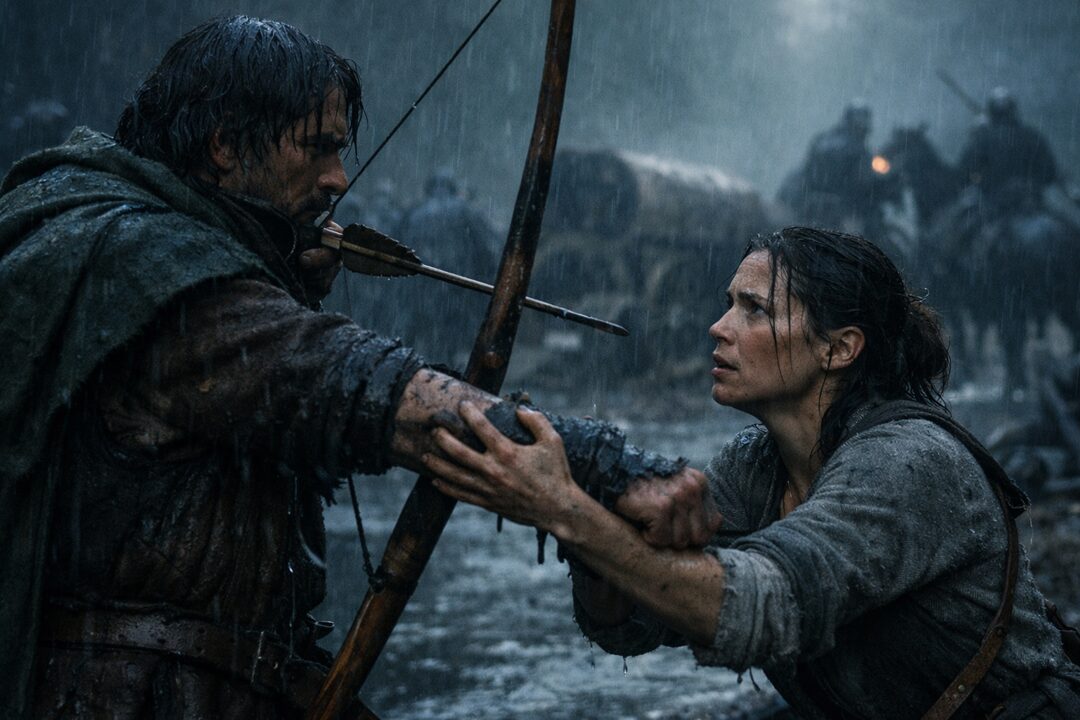
In the older world, the rain had become harder. The stream crossing narrowed between embankments slick with churned mud. Men shouted without hearing one another. Wounded were dragged, half-carried, cursed forward. A horse screamed somewhere upstream.
Thomas planted his feet and drew.
Pain ran through the left shoulder so sharply he tasted it. The bow answered anyway. Training had turned agony into sequence. Lift. Anchor. Release. Reach for the next shaft before the last one landed.
He was still magnificent at it. That was part of the cruelty.
Margot was at the crossing, trying to force a cart axle free while blood soaked the skirt of her wool gown. When she saw him still there, she dropped the rope and came toward him through the mud.
“The horn sounded.”
“I heard.”
“Then go.”
He did not look at her. “Not yet.”
“Thomas.”
That stopped him more than the order had.
Very few people in his life would have used his name at the worst possible moment. Fewer still with anger and fear braided so tightly.
He drew again, released, and this time the bow arm shook afterward.
Margot saw it. She always saw it.
She stepped close enough to be dangerous. “They have already chosen what to leave.”
He said, eyes on the far bank, “I know.”
“And you’re helping them do it.”
“No.” He swallowed once. “I’m helping you cross.”
For the first time she had no answer ready.
Not because the line was noble. Because it was plain.
Aldric appeared moments later, limping badly now, one gauntlet gone, mud dark to the knee. The men near him shifted instinctively, still giving rank its shape even while the world came apart.
“Grey,” he said.
Thomas turned.
“Fall back. Now.”
There it was. The order made clean at last, too late to stay clean.
Thomas looked past him to the mounted survivors already clearing the worst of the crossing, to the wounded still jammed behind the cart, to Margot with both hands buried in blood and rope, to the rear archers who had been made into time.
Sir Aldric knew it. Thomas knew he knew it.
“No,” Thomas said.
Aldric stared at him.
Not because he had misheard. Because in all the years of service, Thomas Grey had probably never spent disobedience on something this clear.
“Do you understand what I’m telling you?” Aldric asked.
“Yes.”
“Then obey it.”
Thomas shifted the bow in his hand. The shoulder nearly failed. He forced it steady.
“With respect, sir,” he said, “there’s no obedience left in it.”
The line landed between them like a blade laid down, not swung.
Aldric’s face changed almost invisibly. Not anger first. Shame.
He could have ordered another man to drag Thomas back. He could have used rank the way frightened men often did—loudly, wastefully. Instead he looked once toward the crossing, once toward the advancing pressure beyond it, and understood that command had already spent too much truth to demand more.
“Then hold,” he said at last.
It was not permission. It was failure shaped into dignity because that was all he had left.
In the present, Elinor sat before the final draft report with the cursor blinking after the phrase elite longbowman.
All she had to do was continue in the approved language. Range. distinction. battlefield mastery. It would not even be factually false.
That was the trap. The cleanest lies were often built from accurate pieces.
Jonah stood in the doorway, watching her not write.
“If you file the soft version,” he said, “he becomes a symbol again.”
Elinor kept her eyes on the screen. “He was a symbol. That’s part of the problem.”
“No.” Jonah stepped in. “He was made into one.”
She leaned back, and pain pulled through her shoulder hard enough to steal the breath from her for a second.
Jonah noticed. “You don’t have to—”
“Yes,” she said, more sharply than intended. Then quieter: “Yes, I do.”
Luc arrived with a pot of coffee that tasted like punishment and set it down without comment. On top of the stack he added Margot Bell’s copied deposition.
Elinor opened it to the line she knew by heart.
He stayed when obedience had already become another word for leaving us.
Her fingers moved to the keyboard.
Not elite longbowman.
Not symbol of martial excellence.
Thomas Grey, English archer attached to the retinue of Sir Aldric Vale, identified through distinctive long-term musculoskeletal adaptation of the left arm and shoulder associated with lifelong longbow use…
She kept going.
…and through associated devotional effects and surviving field records indicating he died in rear action during a disputed retreat in which wounded personnel were extracted under compromised command conditions.
Still not enough. Still too bloodless.
She deleted compromised command conditions.
Typed again.
…under a withdrawal in which rear archers appear to have been knowingly exposed to disproportionate risk.
Jonah let out a breath.
Luc said, “Better.”
Elinor kept writing until the report stopped hiding from itself.
Part V — The Crossing
They did not remember Thomas Grey because the battle had favored him.
They remembered him because pain did not stop his hands before choice sharpened them.
At the crossing, the first shaft took a man through the throat on the far bank. The second hit lower. The third went wide because Thomas’s shoulder buckled halfway through the draw, and the failure scared him more than the enemy did.
Not yet, he thought. Not yet.
Behind him, the cart finally lurched free. Margot shouted for the wounded to move. Someone called for Sir Aldric. Someone else was already crying from a gut wound and did not know it.
Thomas kept shooting.
Each draw tore farther down his back. The enlarged left arm that had made him valuable now felt swollen with heat and knives, every muscle a rope drawn past sense. Blood from somewhere—his own or not—slicked the grip.
Aldric was still there longer than he should have been, dragging one half-conscious man by the harness strap while shouting orders that were now too late to redeem anything. Thomas saw him stumble. Saw two soldiers catch him.
Saw the exact second the knight understood that the man buying his survival was the same man he had spent for years in smaller pieces.
Margot reached Thomas again between volleys.
“Enough,” she said.
He almost laughed. It would have hurt less.
“It will be,” he said.
“That isn’t what I mean.”
He looked at her then.
Rain in her lashes. Mud on her cheek. Anger failing into something worse.
If there had been another life for either of them, perhaps something might have been said earlier. Something human and badly timed. But war loved unfinished things.
She pressed the little stitched token into his palm—the one he had given her to hold when his tunic seam tore weeks before. “Then take this.”
He closed his fingers around it and tucked it inside his coat without looking down.
Another rush came at the bank.
He drew.
The shoulder gave with a bright tearing sensation that seemed to split his whole side open. For a second the bow dropped. His left hand spasmed.
Margot saw it happen. Her face changed.
“Thomas—”
“Go.”
It was the first direct order he had ever given her.
She did not obey immediately. That would have made the moment easier than it was.
Instead she stood there long enough for him to know she understood the full cost of leaving. Then she turned and went to the crossing with the wounded because that was her duty, and because love, when it exists under this much pressure, rarely looks romantic. It looks like carrying what can still be carried.
Thomas drew again.
This time he used the last of the shoulder rather than the strength of it. Different thing. Same result for one shot more.
Men crossed. Then fewer.
Sir Aldric was at the far side now, supported by two soldiers, his face pale beneath mud and blood. He looked back once across the stream.
The distance was not great. It might as well have been another century.
Thomas could not read the expression clearly through rain. He did not need to. There are some debts a man knows are being incurred before either of them survives to name them.
The enemy closed.
Thomas fired until the arrows were gone. Then he held the bow like a useless relic for one absurd second before dropping to one knee behind the churned bank with a knife he would never need if the timing held.
It held just long enough.
Long enough for the last wounded to clear. Long enough for the rear to collapse beyond recovery. Long enough for service to become choice.
When they found him later, if they found him at all, the left arm would still be larger. The shoulder would still be twisted. The body would still tell the patient truth of what had been asked of it for years before this final hour.
But now another truth would lie beside it.
He had not died because command used him well.
He had died because, at the end, he used what remained of himself for people rather than for orders.
In the present, Elinor stood at the podium in the temporary exhibit room with the report in her hand and the colonel three chairs behind her.
The audience was small. Historians, local officials, military representatives, a few journalists hoping for a patriotic line that could fit cleanly into print.
She felt the old ache in her shoulder under the formal jacket. Jonah stood near the side wall. Luc sat in the back, expression unreadable.
Elinor began with the bones.
Not the myth. The body.
She spoke of asymmetry, strain, adaptation, repetition. She spoke of the enlarged left arm and the shoulder worn by years of draw. She named Thomas Grey. She named Margot Bell’s field records. She named the devotional token recovered from the grave.
Then she said the sentence the colonel did not want.
“The evidence suggests that Thomas Grey died during a retreat in which rear archers were exposed to grave risk in order to secure the withdrawal of mounted command and wounded personnel.”
The room changed.
Not loudly. Truth rarely announces itself with noise. It alters posture. Breathing. Eyes.
Elinor looked down at the final line she had written for herself rather than for the sponsors.
“He should not be remembered only for what the longbow allowed him to do,” she said. “He should be remembered for what years of service did to him—and for the choice he made when obedience and humanity were no longer the same thing.”
Nobody interrupted.
That was how she knew it had landed.
Part VI — What Remains
Thomas Grey was reburied under a low gray sky that looked almost identical to the one that had given him back.
The ceremony was small. No triumph in it. No swelling language. Just a marked grave near the edge of the recovered field, where the ground kept more history than the monuments did.
Elinor stood with her left arm strapped beneath her coat, the sling hidden as much as possible. She had not worn it at the presentation. Pride, vanity, habit—she was no longer interested in separating them cleanly.
Jonah stood beside her with wet hair and cold hands shoved into his pockets. Luc stood on the other side, hat in both hands, as if old age had taught him the exact weight of respectful silence.
The chaplain spoke briefly.
Then there was only earth, wind, and the shape of the grave.
Elinor thought she might feel closure and knew at once that closure was the wrong word. This was not a solved thing. The wound did not end because it had been named correctly.
But anonymity had ended. That mattered.
Useful enough, long enough, and men disappeared into function. Archer. rear cover. casualty. asset. history.
Thomas Grey had been all those things.
He had also been a man with a private token sewn into his coat. A man whose body had been altered year by year until skill and damage were inseparable. A man who had looked at an order and understood that sometimes obedience is just a tidier word for abandonment.
Jonah said quietly, “You did right.”
Elinor watched the first clod of earth strike the coffin lid below and answer with a dull sound.
“I did something late,” she said.
“Still right.”
Maybe.
She thought of Margot Bell, writing in margins because margins were sometimes the only place truth could survive. She thought of Sir Aldric Vale living on with the knowledge that rank had not made him the better man at the crossing. She thought of Thomas drawing one shot past the point where the body should have refused him.
The wind shifted. Pain moved through her shoulder, familiar and graceless.
She let it stay.
After the others began walking back toward the road, Elinor remained a moment longer by the fresh grave. No speech. No gesture grand enough to lie on her behalf.
Just one soldier’s damaged body standing over another’s.
At last she said, so softly that no one else would have heard it anyway, “You were there.”
Not because history had recorded him properly.
Because the body had.
Then she turned and followed the others through the wet field, carrying the ache with her like something honest.