They Barred Him From the Neighborhood Path, Then Learned Who Actually Owned the Right of Way
Chapter 1: The Morning They Turned His Shortcut Into a Boundary
“You don’t belong through here.”
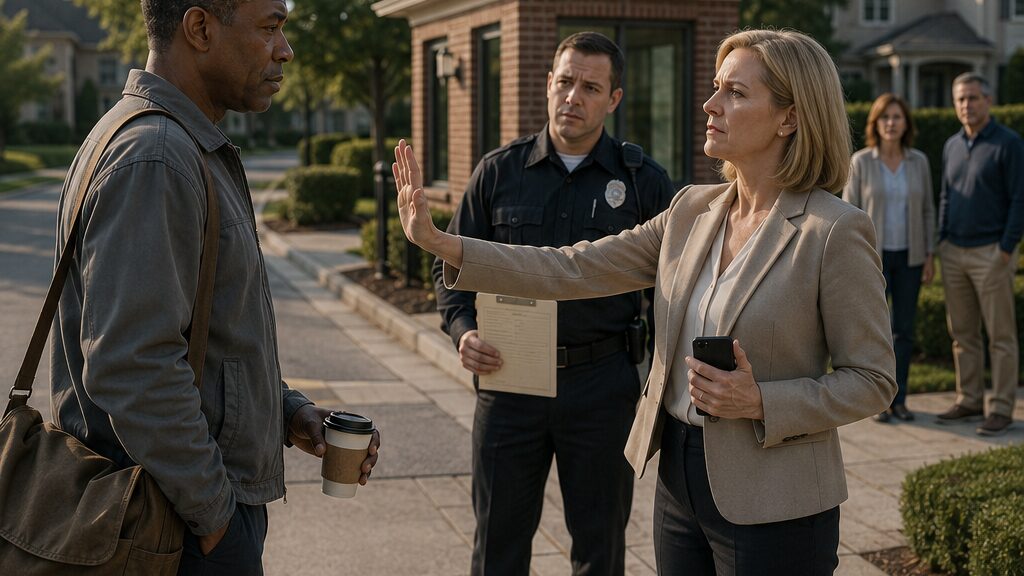
The woman stepped into the center of the sidewalk before Larry Williams had fully registered that she was speaking to him. One hand was raised, palm out. The other held a phone against the front of her beige jacket as if it were a badge.
Larry stopped with one foot on the seam where the county sidewalk narrowed between two beds of trimmed boxwood. His coffee shifted inside its paper cup. A dark line appeared beneath the lid.
Beyond the woman, Maple Grove looked the way it did every weekday morning: sprinklers ticking over short lawns, garage doors lifting, porch lights fading against the early sun. The path curved past the stone entrance sign, crossed three quiet blocks, and came out near the courthouse district.
He had walked it for eleven years.
“Good morning,” Larry said.
The woman did not return the greeting. “This is private property.”
Her name came to him after a moment. Sarah Clark. He had seen her photograph in the neighborhood newsletter left in a plastic box beside the road. NEW BOARD, NEW STANDARDS, the headline had said.
Larry adjusted the strap of his worn brown bag. “I’m using the sidewalk.”
“You’ve been reported three times.”
“For walking?”
“For entering the community.”
A gate officer approached from the small brick security building. He was younger than Larry, with a clipped mustache and a radio fixed high on his shoulder. His pace suggested he had been summoned but did not yet understand why.
Sarah turned toward him before he reached them. “This is the man residents have been emailing about.”
The officer looked at Larry’s gray zip-up jacket, dark slacks, coffee, and bag. Then he looked down the empty sidewalk.
“Sir,” he said, “do you live in Maple Grove?”
“No.”
Sarah folded her arms. “There.”
Larry waited.
The officer shifted his weight. “Are you visiting someone?”
“I’m going to work.”
“Through here?”
“It cuts about twenty minutes from the walk.”
Sarah gave a short breath that was not quite a laugh. “That doesn’t make it public.”
A car slowed behind them. The driver glanced over before rolling through the entrance. On the far side of the street, a woman in running clothes stopped to tighten a shoe that did not appear loose.
Larry could feel the scene taking shape around him. Not loud enough to become an argument. Not dramatic enough to draw open attention. Just visible enough that everyone nearby could watch without admitting they were watching.
He took a careful sip of coffee. It had already begun to cool.
“Is there a posted restriction?” he asked.
Sarah pointed toward the stone sign. “Residents and guests only.”
There were decorative letters naming the subdivision, a speed limit sign, and a notice about surveillance. Nothing he could see restricting pedestrian access.
“That isn’t what the sign says.”
Her expression tightened. “I am the HOA president.”
“I understand.”
“Then you understand I’m telling you to leave.”
The gate officer touched the brim of his cap, then glanced toward the security building. “Ms. Clark, maybe we should verify—”
“I already verified that he doesn’t live here.”
Larry looked at the officer. “That wasn’t what you were going to verify.”
The officer’s eyes met his for a second. Sarah’s did not.
She lifted her phone. “We have had a break-in, package thefts, and repeated complaints about unfamiliar people using the interior roads. The board has an obligation to respond.”
There it was: the explanation beneath the accusation. Not proof, but fear organized into a rule.
Larry knew enough about public complaints to recognize the moment when language hardened. First unfamiliar. Then suspicious. Then prohibited. By the time a form was printed, the uncertainty would disappear from the record.
He also knew what could happen if he introduced himself fully.
He could say he worked at the county courthouse. He could name the division. He could ask whether she wanted to explain her interpretation of the property boundary to someone who processed civil filings for a living.
He imagined the officer straightening. Sarah recalculating. The watchers suddenly finding somewhere else to look.
The thought gave him no satisfaction.
“May I continue this morning while you verify it?” he asked.
“No.”
“May I see the governing document you’re relying on?”
Sarah’s voice sharpened. “You don’t get to demand HOA records.”
“I asked what gives the association authority over this section of sidewalk.”
“The association maintains it.”
“That’s not the same question.”
The gate officer’s hand fell from his cap.
Sarah stared at Larry as though he had changed shape in front of her. “What exactly are you trying to do?”
“Get to work.”
“No. What are you trying to prove?”
Larry looked at the path beyond her, at the familiar bend near the first row of mailboxes. “Nothing.”
That answer seemed to anger her more than an argument would have.
She called someone from the board, speaking with clipped precision about a repeated trespasser who had refused to leave. Larry did not correct the phrase. He stood beside the curb and watched a bead of coffee slide down the cup onto his thumb.
The gate officer moved closer to him.
“You’ve walked here before?” he asked quietly.
“Most weekday mornings.”
“How long?”
“Eleven years.”
The officer looked past Sarah toward the curve of the sidewalk. “No one stopped you?”
“Not until today.”
Sarah ended the call. “A written notice is being prepared.”
The officer blinked. “A no-trespass notice?”
“Yes. That way there’s no confusion next time.”
“There’s some confusion now,” Larry said.
She ignored him.
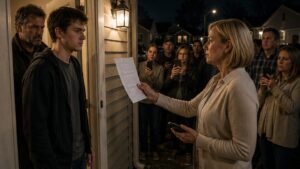
Twenty minutes later, a board member arrived from inside the subdivision carrying a cream-colored sheet on a clipboard. Sarah took it and signed near the bottom without reading the full page. Then she handed the clipboard to the officer.
The officer read it twice.
“Ms. Clark,” he said, “there’s no parcel number on this.”
“It identifies Maple Grove property.”
“It says ‘association-controlled pedestrian access.’”
“That is what this is.”
Larry held out his hand. “May I see it?”
The officer gave him the clipboard.
The notice instructed Larry Williams—his name copied from the identification the officer had requested—not to enter property “owned, managed, or controlled” by the Maple Grove Homeowners Association. Future entry could result in law-enforcement referral.
Larry read the location description again.
No lot number. No plat reference. No recorded parcel. No beginning or ending point.
He looked at Sarah. “What is the parcel number for the property you’re ordering me not to enter?”
She paused.
Only for a second, but the officer saw it.
So did Larry.
“The entire development is governed by the association,” she said.
“That isn’t a parcel number.”
“You are being told not to return.”
The board member looked from Sarah to the notice. The runner across the street had finished tying her shoe but had not moved.
Larry handed the clipboard back. “Will you note that I asked?”
Sarah pressed the pen into his hand. “Sign acknowledging receipt.”
“I’ll acknowledge receipt. I won’t acknowledge that the property description is accurate.”
Her jaw moved once. “Fine.”
Larry wrote received beside his name and added the time. The officer tore off the lower copy and gave it to him.
The paper felt heavier than it was.
Sarah stepped aside at last, but not toward the neighborhood. She opened the way back to the county road.
Larry folded the notice once, then again. He placed it against the side of his brown bag while he secured the coffee lid. The cup was no longer warm enough to steam.
“You could have avoided all this by turning around when I asked,” Sarah said.
Larry looked at her.
He could have told her that a person could obey an instruction and still be wronged by it. He could have told her that calm was not consent. Instead, he lifted the strap over his shoulder.
“I am turning around,” he said.
The longer route followed a six-lane road with narrow shoulders and two intersections timed for cars rather than pedestrians. By the time the courthouse came into view, his coffee was cold, and the ache along his left heel had climbed into his calf.
He entered through the employee side door seven minutes before the morning docket meeting.
At the security desk, he opened his bag for inspection. Inside were his lunch, a manila case folder, a black notebook, and the folded cream notice.
The guard waved him through.
Larry took the elevator to the civil division. At his desk, he removed the notice and smoothed it once with the heel of his hand. Then he placed it beside a file stamped by the County Court Administrator’s Office.
For several seconds, the two documents lay edge to edge.
One claimed authority without identifying the land.
The other belonged to the office that would eventually have to decide whether such claims meant anything.
Chapter 2: The Long Way Around Left More Than Sore Feet
Larry arrived after the docket meeting had begun, and every person at the table noticed.
No one said so. That made it worse.
He slipped into the empty chair beside the county clerk and opened his notebook while the presiding administrator continued reviewing the week’s filings. Larry had not been late to a Monday meeting in six years. The courthouse ran on small reliabilities, and punctuality was one of his.
When the meeting ended, the clerk waited until the others left.
“Everything all right?”
“Long walk.”
“You move?”
“No.”
She studied him, then nodded toward the cream paper protruding from his bag. “That part of the long walk?”
Larry pushed the notice deeper inside. “Something like that.”
At lunch, he ate at his desk and examined the copy again.
The form looked official enough from a distance. Maple Grove’s crest at the top. Sarah’s signature. A reference to board authority and future police contact. But the description of the restricted property was broader than any deed description could responsibly be. Owned, managed, or controlled covered almost anything the association touched.
Larry knew better than to research the matter using county systems unavailable to the public. He also knew better than to call someone in records and ask for a favor. If the dispute ever became formal, those choices would matter.
So he folded the notice along its original creases and put it away.
That evening, Rachel saw him limp before he reached the kitchen.
“What happened to your foot?”
“Nothing happened to it.”
“You’re walking like the floor owes you money.”
Larry set his bag on a chair. Rachel had let herself in with the key he had given her after his surgery two years earlier, and she still treated that permission as permanent. A pot simmered on the stove. She had brought groceries and reorganized half his counter.
“The shortcut was closed,” he said.
“Closed for construction?”
“Closed to me.”
She turned from the stove.
Larry told her the shortest version. Sarah. The gate officer. The notice. The longer route. He left out the spectators and the way Sarah had said unfamiliar people.
Rachel listened with both hands flat on the counter.
“You told them where you work?”
“No.”
“Why not?”
“It wasn’t relevant.”
“It became relevant when they threatened to call law enforcement.”
“My job doesn’t make me more entitled to use a public path than anyone else.”
“So you think it’s public.”
“I think the notice is poorly drafted.”
“That wasn’t my question.”
Larry took a glass from the cabinet. “I don’t know who owns the corridor.”
“But you knew enough to ask for the parcel number.”
“Yes.”
“And she didn’t have one.”
“No.”
Rachel stared at him. “Then why did you walk away?”
“Because standing there announcing that I work for the court would sound like pressure.”
“You could have corrected what she thought without threatening her.”
“She didn’t ask who I was.”
“She decided who you were.”
The sentence landed harder than Larry expected.
He filled the glass and drank without answering.
Rachel lowered her voice. “Dad, you always say not every insult needs to become a case.”
“That’s still true.”
“And sometimes you use that sentence so you never have to admit something hurt you.”
He set down the glass.
The old advice had been given years earlier, after Rachel had wanted to challenge a supervisor over a comment in a staff meeting. Larry had urged patience. Gather facts. Decide what outcome mattered. Do not let anger choose the forum.
She had listened then.
Now she looked at him as though the lesson had expired.
“I’m handling it,” he said.
“How?”
“By not making it worse.”
“For whom?”
Larry looked toward the bag on the chair.
The notice remained there through the week, stored flat between his notebook and a file jacket. Each morning, he took the long route around Maple Grove. Each morning, he left earlier. On Wednesday, rain soaked one side of his slacks when a passing truck struck a gutter puddle. On Thursday, his heel blister opened. On Friday, he bought coffee near the courthouse instead of carrying it from home because it never stayed warm long enough.
The practical inconvenience should have been small. That was what he told himself.
But the path had been part of the architecture of his life: the same stone sign, the same row of maples, the same elderly resident who watered flowers in slippers. Losing it altered more than his commute. It turned a familiar place into evidence that familiarity could be revoked by someone who spoke with enough confidence.
The following Monday, the county clerk placed a new batch of civil filings on Larry’s desk.
“HOA matter,” she said. “Counsel filed it late Friday.”
Larry’s hand stopped above the stack.
The top page carried Maple Grove’s crest.
He read the case caption without touching it. The association sought a declaration affirming its authority to exclude nonresidents from common areas and recover administrative costs connected to repeated unauthorized entry. Attached was the notice Sarah had issued.
His own name appeared in the factual statement.
For a moment, the room seemed to narrow to the dry rustle of paper.
The clerk leaned closer. “Larry?”
He closed the file.
“This cannot remain in our assignment queue,” he said.
“Because you’re named?”
“Because I’m the respondent described in the filing.”
Her face changed. “They filed against you?”
“They filed about me.”
“Do they know where you work?”
“I don’t think so.”
The clerk glanced toward the glass wall of the division office. “What do you want me to do?”
That question was precisely why Larry had not told Sarah.
He did not want anyone asking what he wanted done.
“Flag the conflict,” he said. “Remove our division from assignment. Send it through the ordinary reassignment procedure and document the reason.”
“You could ask administration to reject it as defective.”
“No.”
“It doesn’t even identify the parcel.”
“I know.”
The clerk looked at him for another second, then lifted the file.
Larry watched her walk toward the administrator’s office.
By noon, the conflict disclosure had been entered. By two, the matter had been transferred out of his division. Larry had used none of his authority to affect the merits.
Still, when he opened his bag that evening, the original notice no longer felt like a private insult.
It had become part of a public case.
Chapter 3: The File That Could Not Stay Quietly Buried
Emily Torres first noticed Larry’s employee identification number because it appeared where no private respondent’s number should have been.
She sat alone in her office with the Maple Grove file open beneath a desk lamp. The association’s complaint had been reassigned that morning, and the transfer notice included a conflict notation: respondent identified in factual allegations is an employee of the county court administrator’s office.
Emily read the line twice.
Then she opened the scanned exhibit.
The photograph attached to Sarah’s incident report showed a man in a gray jacket holding a paper coffee cup beside the Maple Grove entrance. His expression was calm. One hand rested on the strap of a worn brown bag.
Emily knew him.
Not well. They had exchanged greetings in courthouse hallways and attended the same procedural training the previous spring. Larry Williams was the person attorneys called when a filing had entered the wrong division or a hearing notice had been generated under the wrong case type. He was not a judge. He could not decide the merits. But he understood the machinery of civil procedure better than many lawyers who practiced inside it.
Emily picked up her phone.
Sarah answered on the fourth ring. “Tell me they finally assigned it.”
“They did.”
“Good.”
“No, Sarah. It is not good.”
A pause. “What happened?”
“The man you reported works for the county court.”
Silence replaced the impatient tapping Emily had heard in the background.
“In what capacity?”
“Court administration.”
“Does that mean he can dismiss it?”
“No. And he has already made sure he cannot touch it.”
Emily turned to the conflict notice.
“He disclosed the connection immediately. His entire division has been removed from assignment.”
Sarah exhaled. “Then there’s no problem.”
“There is still the property description.”
“We’ve discussed that.”
“We discussed it before you filed. I told you to verify the corridor.”
“The association maintains it.”
“That is not the same as owning it.”
Emily heard movement, a door closing. When Sarah spoke again, her voice was lower.
“What do you recommend?”
“Withdraw before the new division schedules anything. Correct the board record. Stop issuing notices on that path until ownership is confirmed.”
“You make it sound like we admitted fault.”
“You filed a declaration action over land you have not identified by parcel.”
“We had resident complaints.”
“Complaints do not establish title.”
Sarah said nothing.
Emily softened her tone. “This does not have to become larger than it is.”
By late afternoon, she had drafted a voluntary withdrawal and a private release. Maple Grove would dismiss the filing, waive costs, and permit Larry to use the route pending further review. In exchange, Larry would release the association from claims connected to the notice and agree that the resolution was not an admission of wrongdoing.
It was a practical document. Clean. Contained.
Emily arranged to meet Larry in a small conference room at the courthouse the following morning. He arrived carrying the same brown bag from the incident photograph.
She placed the withdrawal agreement on the table.
“The association is prepared to end the matter,” she said.
Larry remained standing long enough to read the first paragraph upside down.
“End which matter?”
“The filing and the access restriction.”
“Temporarily.”
“Pending confirmation of the records.”
“And the notice?”
“It would no longer be enforced.”
“That wasn’t my question.”
Emily looked at him. “The association is willing to withdraw it.”
“From where?”
“The active file.”
“It was distributed to board members, security staff, and counsel. It described me as a repeated trespasser.”
“We can send a correction internally.”
“Does the agreement require one?”
“No.”
Larry sat down.
Emily had expected anger. Instead, he opened his bag and removed the original cream notice. It was still folded into quarters. He placed it on the table, then opened it carefully along the creases.
The withdrawal agreement covered half of it.
“You recognized the problem at the gate,” Emily said.
“I recognized a problem.”
“You could have told them where you worked.”
“That would not have answered whether they had authority over the path.”
“It might have prevented the filing.”
“It might have prevented them from filing against me.”
Emily understood the distinction.
Larry read the release in silence. At the courthouse, quiet was rarely empty. It meant someone was measuring consequences.
“You would regain access,” she said.
“And the association would keep the right to say the original decision was reasonable.”
“The language is standard.”
“That doesn’t make it accurate.”
Emily leaned back. “What outcome are you seeking?”
Larry looked through the conference-room glass toward the hallway. Court staff moved past with files tucked against their chests.
“I have not decided.”
“Sarah believes this was a security response, not a personal attack.”
“Did she verify the property before issuing the notice?”
“No.”
“Did she describe me as threatening?”
Emily hesitated.
The incident report had used the phrase argumentative and resistant to instruction. The security officer’s supplemental note said Larry remained calm throughout the encounter.
“Yes,” she said.
Larry folded his hands.
“This is the point where people expect me to use my job,” he said. “To make one call. To let someone know they chose the wrong person.”
“You have done the opposite.”
“I know.”
“Then sign the release and let us close it.”
He looked at the agreement again.
For three weeks, he had told himself that restraint meant refusing to turn the courthouse into leverage. He had followed the long road. Disclosed the conflict. Removed himself from every procedural decision.
Now the association was offering exactly what he had claimed to want: access without spectacle.
Yet the words on the cream notice would remain uncorrected. Repeated trespasser. Unauthorized entry. Potential law-enforcement referral.
If he accepted, the path would reopen for Larry Williams because Maple Grove had discovered where he worked.
Not because the rule had been wrong.
“No,” he said.
Emily’s expression barely changed. “No to the release?”
“No to a private correction.”
“What would you accept?”
“A verified property determination. A written rescission of the notice. A correction to every person who received the accusation.”
“That will require board approval.”
“Then the board should approve it.”
“They may refuse.”
Larry slid the agreement back across the table. “Then the matter is not over.”
Emily gathered the pages slowly. “I need to advise you that continuing may expose you to costs even if the association’s filing is weak.”
“I understand.”
“And because of your position, every step will be scrutinized.”
“I understand that too.”
She stopped at the door. “Why didn’t you say more that morning?”
Larry looked down at the trespass notice.
“Because I thought walking away kept me from becoming what she had already decided I was.”
“And now?”
“Now I think walking away helped her put it in writing.”
After Emily left, Larry took out a pen.
He read the location description once more, then drew a neat circle around the phrase association-controlled pedestrian access.
Below it, where a parcel number should have appeared, there was only blank space.
Larry closed the pen.
Before deciding what the association owed him, he needed to answer the question Sarah had never answered at the gate.
Who, exactly, owned the path?
Chapter 4: The Map Showed Ownership, but Not the Whole Responsibility
The original subdivision plat showed a line that did not exist on Maple Grove’s current map.
Larry leaned closer to the public terminal in the county records office. The scanned page had yellowed at the edges, and the surveyor’s ink had faded into thin gray strokes, but the line was there—a narrow corridor running from the county road through the landscaped entrance and along the same sidewalk Sarah had ordered him to leave.
Beside it, in block lettering, were the words PUBLIC PEDESTRIAN ACCESS.
Larry read them twice.
The public-works records supervisor stood behind him with one hand resting on the back of an empty chair. “That plat was recorded when the subdivision was created.”
“And never amended?”
“Not in this index.”
Larry opened the folded trespass notice and placed it beside the screen. Sarah’s description—association-controlled pedestrian access—looked less certain under the cold light of the records room.
“Does the county own the corridor?” he asked.
“Not exactly.”
The answer pulled his eyes from the plat.
The supervisor sat down and enlarged a second document. “The developer dedicated public access across it. The underlying land remained part of the subdivision’s common area, but the public received a permanent right to pass.”
“So the association owns land it cannot close.”
“That appears to be the arrangement.”
“Appears?”
“The dedication is clear. The maintenance history is not.”
She brought up a later agreement recorded eight years after the original plat. Maple Grove had accepted responsibility for mowing, snow removal, lighting, and surface repairs along several common-area walkways. The corridor was listed among them, but the agreement did not transfer the public easement or authorize the association to restrict access.
Larry traced the wording with his finger without touching the screen.
Maintenance without control.
Responsibility without ownership.
Enough overlap for someone who wanted certainty to mistake one for the other.
“Why isn’t the corridor marked?” he asked.
The supervisor searched another index. “It was supposed to be.”
A county engineering note from more than twenty years earlier recommended public-access markers at both ends of the path. No completion record followed it. A later maintenance inspection referred to the corridor as an “HOA walkway,” language informal enough to create confusion but not strong enough to alter the recorded dedication.
Larry sat back.
For three weeks, he had imagined the conflict as a line between Sarah’s unsupported authority and his right to walk. The records showed something more untidy. Maple Grove had paid to maintain the path for decades. The county had accepted the public dedication and then failed to mark it. Residents saw landscapers, association lighting, and security patrols. The county saw a line on an old plat and assumed the public could find it.
The error had been cultivated by more than one institution.
But only one had handed him a notice.
“You’ll need certified copies,” the supervisor said.
“Yes.”
“For litigation?”
“For a public record.”
She gave him a measured look, then printed the request form.
Larry paid the copying fee at the counter. While he waited, he called Dennis Roberts, the HOA board member whose name appeared on the maintenance agreement’s recent review notes.
Dennis answered cautiously. “Mr. Williams?”
“You know who I am?”
“Emily told the board there might be a records request.”
“I found the original plat.”
A silence followed, filled by the distant mechanical thump of the records printer.
Dennis said, “Then you saw the corridor.”
“I saw the public dedication.”
“Right.”
“You don’t sound surprised.”
“I’m retired from county survey work. Not this county, but enough of it transfers.”
“Did you know before Sarah issued the notice?”
“I knew there was a problem with the maps.”
“That isn’t what I asked.”
Dennis exhaled. “I wasn’t certain what kind of problem.”
Larry watched the certified seal press into the first copy.
“Can you meet me at the path?” he asked.
An hour later, Dennis stood beside the Maple Grove entrance wearing a faded windbreaker and holding a rolled association map under one arm. Sarah was nowhere in sight. The gate officer watched from inside the security building but did not come out.
Dennis unrolled the map across the hood of his car.
The association version showed landscaped common property extending in one uninterrupted block from the entrance monument to the first residential lot. No separate corridor appeared.
“This was redrawn during the management-company transition,” Dennis said. “They simplified the common areas.”
“By removing a recorded access line.”
“They probably copied from a maintenance exhibit, not the plat.”
“Who is ‘they’?”
“The management company before the current one. Ten, maybe twelve years ago.”
Larry placed the certified plat beside it. The narrow public corridor was unmistakable.
Dennis rubbed his thumb over the edge of the association map. “I raised this last year when we discussed replacing the entrance lighting.”
“With Sarah?”
“With the board.”
“What did you tell them?”
“That the maps didn’t agree and we should verify before changing anything near the sidewalk.”
“And what happened?”
“The lighting project was delayed. Then we had the burglary.”
Dennis looked toward the first row of homes.
A resident’s garage had been entered through an unlocked side door two months earlier. Several tools had been taken. No arrest had been made. After that came complaints about delivery drivers turning around inside the development, teenagers cutting through after school, and unfamiliar pedestrians near the mailboxes.
“Sarah ran for president promising visible security,” Dennis said. “More patrols. Better cameras. Clearer boundaries.”
“Boundaries she knew were unclear.”
“I don’t know what she remembered.”
“You were at the gate when the notice was delivered.”
Dennis’s shoulders lowered slightly. “Yes.”
“You heard me ask for a parcel number.”
“Yes.”
“And you said nothing.”
“The situation had already gotten tense.”
Larry almost laughed, but there was no humor in it. “I was holding coffee.”
“I know.”
Dennis folded the association map once, then reopened it, as if unable to decide whether the conversation was finished.
“I should have stopped it,” he said. “At least until we checked.”
“Why didn’t you?”
“Because if the corridor was public, the board would ask why I hadn’t resolved it earlier. If it was private, Sarah would say I had undermined enforcement in front of security. I told myself we could sort it out afterward.”
Larry looked at the trimmed hedge, the clean pavement, the stone sign presenting Maple Grove as an orderly place. Every visible edge had been maintained. The uncertainty was hidden in paper.
“Afterward for whom?” he asked.
Dennis did not answer.
A county truck pulled onto the shoulder. The public-works supervisor stepped out with a measuring wheel and a set of fluorescent flags. She aligned the recorded measurements with the road marker, then walked the corridor slowly.
The wheel clicked at each rotation.
At the first bend, she pushed a flag into the grass. It stood less than two feet from the place where Sarah had blocked Larry.
“This is the western edge,” she said. “The public-access strip continues all the way through.”
The gate officer came outside.
“So he was allowed to walk here?” he asked.
“Yes,” the supervisor said. “The recorded documents indicate public pedestrian access.”
The officer looked at Larry, then toward the security building. “No one ever gave us that map.”
The supervisor straightened. “The county never installed the markers either.”
No one spoke for a moment.
Larry had the answer he had sought. He had been legally entitled to pass. The notice lacked authority over the corridor.
Yet victory did not arrive with the fact. It came burdened by an old county omission, an oversimplified HOA map, Dennis’s silence, and a security system trained to enforce a boundary nobody had properly identified.
Dennis rolled up the map.
“There’s something else,” he said.
Larry waited.
“The morning before Sarah stopped you, I emailed her the old plat reference.”
“Did you explain what it might show?”
“I told her the entrance corridor could be subject to public access and that we should not issue restrictions until counsel reviewed it.”
The fluorescent flag moved lightly in the wind between them.
Larry looked toward the homes beyond the gate.
Sarah had not acted because she knew nothing.
She had acted after being warned that she might be wrong.
Chapter 5: Sarah Had Feared Losing Control Before She Chose Harm
“When did you first learn the map was disputed?”
Emily Torres asked the question before Sarah had finished closing the conference-room door.
The closed board session had been scheduled for thirty minutes. Sarah had brought a folder of resident complaints, the burglary report, and three printed emails about strangers using the entrance. She placed them in a straight line before taking her seat.
Dennis sat across from her. Two other board members occupied the far end of the table. Neither met her eyes.
Sarah looked at Emily. “Dennis said there might be an old access notation.”
“That was not my question.”
Sarah removed the cap from her pen. “The day before the incident.”
Dennis shifted in his chair.
Emily placed a copy of his email on the table. “He advised against enforcement until the records were checked.”
“He said the maps might conflict.”
“He identified a public-access concern.”
“He did not say the path was public.”
“No,” Dennis said quietly. “I said we needed to find out.”
Sarah turned toward him. “And you had been sitting on that concern for a year.”
“That doesn’t change what you did.”
The words stung because they were accurate.
Sarah opened the folder of complaints. “We had twenty-three security emails in six weeks. People were asking why they paid dues for a staffed entrance if anyone could come through.”
“One person entered an unlocked garage,” Emily said. “There is no evidence that incident involved the corridor.”
“The residents didn’t make that distinction.”
“You were elected to make distinctions.”
Sarah pushed the burglary report toward her. “A family woke up and found their garage open. Their daughter’s bicycle was lying in the driveway. We had doorbell footage of people cutting through at night. Insurance asked what access controls we maintained. The previous board had spent a year arguing about flowers while residents stopped trusting us.”
Her voice had risen. She lowered it deliberately.
“When I took over, every decision was challenged. Add cameras, and half the neighborhood complained about privacy. Increase patrols, and the other half complained about cost. I said we would enforce the boundaries we already had.”
“The boundaries you had not verified,” Emily said.
Sarah looked down at the notice in front of her. Her copy was marked with notes in blue ink: repeat presence, nonresident, refused instruction. The words had seemed orderly when she wrote them.
“He was there three mornings in a row,” she said.
“He had been there for eleven years,” Dennis replied.
“No one told me that until he was standing at the entrance debating property law with security.”
“He asked a question.”
“He challenged me in front of residents.”
There it was.
The room became still enough that Sarah heard the ventilation system click off.
Emily folded her hands. “Was that why you issued the notice?”
“No.”
“Was it part of why?”
Sarah remembered the runner across the street, the board member arriving with the clipboard, the gate officer hesitating after Larry asked for a parcel number. She remembered the brief, sharp fear that if she paused, everyone watching would understand she did not know where the association’s authority ended.
She had pictured the neighborhood email chain before it existed.
New president refuses to enforce rules.
Security still confused.
Board cannot control entrance.
“I believed delaying would make the board look weak,” she said.
Dennis looked away.
Emily’s expression did not soften. “So you chose certainty in public after receiving uncertainty in private.”
“I chose to address a security concern.”
“You described Mr. Williams as argumentative and resistant.”
“He would not leave when I first asked.”
“He was waiting for the officer you called.”
Sarah pressed the pen cap against the table until it clicked.
One of the board members spoke from the far end. “The officer prepared the notice, correct?”
“No,” Dennis said. “We did.”
“The security company should still have verified the boundary.”
Emily turned to the board member. “The association instructed the officer that the path was private. The incident supplement states he questioned the missing parcel information.”
“Then perhaps the officer failed to follow procedure.”
Sarah looked up.
It would be easy. The officer was employed by a contractor. The board could say he should not have served a defective notice. The management company could revise training. The association could frame the event as an implementation mistake.
For one breath, relief appeared.
Then Sarah saw the officer again, holding the clipboard and asking her whether they should verify. She had overruled him in front of Larry and the watching residents.
“No,” she said.
The board member frowned. “No what?”
“We are not blaming the gate officer.”
“He served it.”
“Because I directed him to.”
Dennis studied her.
Sarah continued before courage could turn back into strategy. “I signed the notice. I told him the association controlled the path. He asked about the parcel number, and I said it was unnecessary.”
Emily closed the folder.
“That matters,” she said.
“It doesn’t mean I agree to a public confession.”
“No one used that phrase.”
“Mr. Williams wants every recipient notified. He wants the board record corrected. Once that goes out, the whole community will know.”
“The whole community received security messaging about an unauthorized person.”
“Not his name.”
“Security had his name. The board had his name. Counsel had his name. The court filing identified him.”
Sarah stood and walked to the dark clubhouse window. Outside, the entrance lights cast a pale strip across the path. She had once considered those lights proof of responsible management. Now they seemed to illuminate a line she had never bothered to see.
“What does he want from me?” she asked.
Emily answered carefully. “He wants the association to determine the legal status of the corridor, rescind the notice, correct the allegation, and change its policy.”
“And damages?”
“He has not requested money.”
“Removal from the board?”
“He has not requested that either.”
Sarah turned around. “Then why insist on an open correction?”
Dennis answered before Emily could.
“Because if we fix it privately, the next person stopped there won’t know we were wrong.”
Sarah looked at him. “You could have prevented this.”
“Yes.”
The bluntness left her nowhere to place the blame.
Emily slid a proposed resolution across the table. It acknowledged the recorded public access, suspended enforcement on the corridor, and required the association to coordinate signage with the county. The draft also rescinded Larry’s notice and corrected the incident description.
Sarah read the first page.
The wording did not call her prejudiced. It did not accuse the board of deliberate discrimination. It said the association had acted without verified authority and had inaccurately characterized Larry’s conduct.
Accurate words could still feel like punishment.
“We can adopt this in closed session,” she said.
“The policy can be drafted here,” Emily replied. “The correction should be entered at an open meeting because the original security directive affected the community.”
Sarah shook her head. “That becomes theater.”
“Only if someone makes it theater.”
A knock sounded at the door. The management representative entered and handed Emily a single sheet.
Emily read it, then passed it to Sarah.
It was a formal request from Larry Williams for placement on the next open board agenda. The subject line was simple:
Correction of Trespass Notice and Public Access Policy.
No demand for an apology. No threat. No reference to his court position.
Sarah held the page over her marked copy of the notice.
For weeks, she had told herself Larry’s silence proved the incident had not harmed him deeply. Now he was choosing a public room, a recorded agenda, and words that could not be withdrawn after the doors closed.
The question was no longer whether Maple Grove would correct the record.
It was whether Sarah would do so before Larry forced the truth into it.
Chapter 6: The Notice Returned to the Table as Evidence
Sarah called it an unfortunate misunderstanding before Larry had removed his coat.
The HOA clubhouse was fuller than he expected. Residents occupied the folding chairs along the back wall, some holding printed agendas, others sitting with arms crossed as though they had arrived to watch a dispute over dues. The gate officer stood near the door in his uniform. Rachel sat in the second row.
At the front table, Sarah faced the room beneath the association seal.
“We have confirmed,” she continued, “that historical county records contain language affecting pedestrian access near the west entrance. The board is working cooperatively with county staff to clarify maintenance and signage.”
Larry placed his brown bag on the small presentation table.
The sentence was polished enough to remove every human action from the event. Records contained language. Confusion occurred. Clarification was underway.
Sarah looked toward him. “Mr. Williams has been invited to address the board regarding the notice he received.”
Invited was generous. Larry had requested agenda time twice before Emily confirmed it.
He walked to the table and took out three documents: the certified plat, the maintenance agreement, and the folded cream notice. Its creases were soft now from repeated handling.
He did not unfold it yet.
“My name is Larry Williams,” he said. “I live two blocks east of Maple Grove. For eleven years, I used the pedestrian corridor at the west entrance on my way to work.”
A resident raised a hand. “Do you work for the county?”
Sarah glanced toward Emily.
Larry answered before anyone else could. “I work in county court administration. I do not decide property disputes, and I removed my division from every part of the association’s filing as soon as I learned about it.”
The room shifted. Several people looked at Sarah, waiting for the status reversal they had apparently expected.
Larry let the silence pass.
“My employment is not why I had the right to use the corridor.”
He opened the certified plat.
“This is why.”
Dennis connected a projector. The recorded map appeared on the wall, enlarged enough for the public-access line to run behind Sarah’s shoulder.
Larry pointed to it. “The original developer dedicated this strip for public pedestrian passage. Maple Grove later accepted maintenance duties. Those duties include landscaping, snow removal, lighting, and surface repair. They do not include the authority to close the corridor to nonresidents.”
A man in the back spoke without raising his hand. “If we pay to maintain it, why does everyone get to use it?”
Emily leaned toward her microphone, but Larry answered.
“Because maintenance and public access can exist together. The recorded documents created both obligations.”
“That sounds like the county gets the benefit and we get the bill.”
“It may be worth renegotiating the maintenance arrangement,” Larry said. “It does not make a trespass notice valid.”
The man sat back, dissatisfied but quiet.
Sarah folded her hands. “The board has already agreed that Mr. Williams may resume using the path.”
Larry looked at her. “That is not the correction I requested.”
A faint murmur moved through the chairs.
He unfolded the notice and laid it beside the plat. The cream paper no longer looked official next to the recorded map. It looked improvised.
“This notice says I entered association-controlled pedestrian access without authorization. It says I refused a lawful instruction and may be referred to law enforcement if I return.”
He read the location description aloud.
Then he looked toward the board.
“What parcel does that describe?”
No one answered.
Larry pointed to the blank space beneath the location heading. “There is no parcel number. No lot. No plat reference. No starting point. No ending point.”
Dennis adjusted his microphone.
“The board did not have verified ownership information when the notice was issued,” he said.
Sarah turned toward him, though she had known he would say it.
Dennis continued. “I had advised the board that our map conflicted with older records. I did not stop the notice when I should have. That was my failure.”
The admission did not solve the matter, but it changed the room. Until then, some residents had watched Larry as though he were presenting a personal grievance. Now a board member had placed responsibility inside the association itself.
Larry rested his palm beside the folded edge of the notice.
“The problem is not only that you stopped me,” he said. “The problem is what the association wrote after it stopped me.”
Sarah’s mouth tightened. “You did not leave immediately.”
“I waited for the officer you called.”
“You questioned the instruction in front of residents.”
“I asked what land the instruction covered.”
“You were challenging the board’s authority.”
“Yes,” Larry said. “Because the board had not established it.”
The answer was quiet. That made it harder to dismiss.
Sarah looked down at her copy of the agenda.
Emily spoke into the microphone. “The security officer’s supplemental report states that Mr. Williams remained calm and did not threaten anyone.”
Every face turned toward the officer near the door. He gave one restrained nod.
Sarah’s description of Larry as argumentative now sat exposed between two records: the officer’s account and the defective notice.
Rachel watched her father without moving.
Larry had imagined this moment during every long walk around Maple Grove. In some versions, he embarrassed Sarah with his knowledge. In others, he demanded her resignation. Those private scenes had been satisfying precisely because they required nothing from him except anger.
Standing in the clubhouse, he felt something less clean.
Sarah had made a harmful choice. Dennis had stayed silent. The county had failed to mark the path. Residents had pressured a new board to turn fear into visible enforcement. None of that erased what had happened. It did mean punishment alone would leave the machinery intact.
One of the board members cleared his throat. “What remedy are you asking for tonight?”
Larry looked at the residents.
“A written rescission sent to everyone who received the notice or incident description. A correction stating that I was using a recorded public-access corridor. Removal of the phrases repeated trespasser and threatening conduct from association records. Suspension of access enforcement until the county markers are installed. And a policy requiring parcel verification before any future no-trespass notice is issued.”
Sarah said, “You are asking the association to admit liability.”
“I am asking it to admit facts.”
“And if we do?”
“I will not seek damages.”
A sharper murmur followed.
Rachel’s head turned toward him. They had not discussed that decision.
Sarah studied Larry. “You could have asked for that privately.”
“I did.”
“You could have accepted the withdrawal.”
“That would have reopened the path for me while leaving everyone else subject to the same mistake.”
“Delivery drivers and teenagers are not parties to this dispute.”
“They use the same corridor.”
“Some residents are frightened by unfamiliar people near their homes.”
Larry nodded. “Fear may justify checking a fact. It does not justify replacing one.”
The room went still.
Sarah leaned back from the microphone. For the first time that evening, she looked less like an officer of the association and more like a person cornered by her own sentences.
“The morning I stopped you,” she said, “I had been told the map might be incomplete.”
Emily’s eyes lifted.
Sarah continued, each word appearing to cost her something. “I believed waiting would signal that the board was unwilling to enforce community rules. I chose to proceed before the ownership question was resolved.”
A resident whispered something behind Rachel.
Sarah looked directly at Larry. “That choice was mine.”
The statement was not an apology. It was narrower and, in that room, more useful.
Larry folded the notice once.
One of the board members proposed adopting Emily’s corrective resolution with Larry’s requested changes. Another asked to add a review of the maintenance agreement and county cost-sharing. Dennis moved that all previous warnings or notices issued for pedestrian use of the west corridor be identified and rescinded.
The vote was taken by raised hands.
Dennis voted yes.
Both board members voted yes.
Sarah’s hand remained on the table for a moment. Then she raised it.
The motion passed without applause.
The lack of celebration suited Larry. Nothing about the evening restored the mornings he had walked beside traffic or removed the moment Sarah had decided he did not belong. The vote did something smaller and more durable: it changed what the institution was permitted to say next time.
After the meeting, residents gathered in uneven groups. Some approached Dennis with questions about maintenance costs. Others left without looking at Larry.
Rachel waited near the presentation table while he placed the certified plat back into its folder.
“You didn’t tell me you were giving up damages,” she said.
“I hadn’t decided until tonight.”
“You should have made them pay something.”
“Maybe.”
“That’s not an answer.”
“No,” Larry said. “It’s the answer I have.”
Sarah remained behind the board table signing the adopted resolution. Emily stood beside her, marking places for initials.
The gate officer approached Larry.
“I’m sorry I handed you that notice,” he said.
“You asked the right question.”
“I still handed it to you.”
Larry looked at him. “Then remember both parts.”
The officer nodded and left.
Sarah finished signing. She did not come over. Larry did not wait for her.
He placed the original notice inside his brown bag rather than leaving it with the board. The document had begun as an order to disappear. Tonight it had become proof that authority could be corrected only after someone refused to let its errors remain private.
As Larry and Rachel reached the clubhouse door, Emily called the room back to order for one final procedural vote.
The board rescinded every notice ever issued against pedestrians using the west corridor.
This time, Sarah raised her hand first.
Chapter 7: The Same Morning Walk Carried a Different Weight
The temporary barrier was gone, but Sarah Clark was waiting beside the path.
Larry saw her before he reached the stone entrance sign. She stood near a newly planted metal marker, her hands clasped at her waist, wearing a dark cardigan instead of the beige jacket he remembered from the morning she stopped him.
The marker carried three plain words:
PUBLIC PEDESTRIAN ACCESS.
A second sign had been installed across the subdivision, where the corridor met the road behind the courthouse district. Fresh soil surrounded both posts. Orange utility flags still dotted the grass.
Larry slowed without meaning to.
His coffee was warm in his right hand. The brown bag rested against his left hip. Inside it, between his notebook and lunch, the folded trespass notice remained where he had placed it after the hearing.
For two weeks he had taken the long route, even after the board vote. The county wanted the markers installed before publicly reopening the corridor, and Maple Grove’s insurer required a temporary review of lighting and maintenance responsibilities.
This morning, the work was complete.
Sarah stepped away from the sign so the path remained open.
“You don’t have to stop,” she said.
Larry stopped anyway.
A county public-works truck was parked farther down the street. Dennis Roberts stood beside it speaking with the records supervisor. Neither looked toward them.
Sarah glanced at Larry’s coffee. “Same order?”
He looked down at the cup. “Usually.”
The familiarity in the question unsettled him more than hostility would have. She had observed him often enough to know his routine even while insisting he did not belong.
“I wanted to speak before the entrance got busy,” she said.
Larry waited.
“I’m not here on behalf of the board.”
“That may be difficult to separate.”
“I know.”
A delivery van turned into Maple Grove. The driver slowed near the new marker, checked it, then continued along the interior road without stopping at the gatehouse.
Sarah watched the van pass.
“The correction letters went out Friday,” she said. “To the board, the management company, security, counsel, and the court. The incident report has been amended.”
“I received my copy.”
“The old access notices were removed from the system.”
“I heard.”
She pressed her thumb against the side of one finger. The gesture was small and repetitive, nothing like the open palm she had raised to block him.
“The board also approved the parcel-verification policy,” she said. “No notice can be issued without a recorded description and counsel review.”
“That will matter.”
“I hope so.”
Larry looked at the new sign. It did not announce that he had been right. It did not name the association or describe the dispute. It simply marked the right of way that should have been visible all along.
Sarah drew a breath.
“I am sorry I stopped you.”
Larry’s fingers tightened slightly around the coffee cup.
She continued before he answered.
“I’m sorry I described you as threatening when you were not. I’m sorry I treated your question like a challenge I had to defeat. Dennis warned me that the map might be wrong, and I chose not to wait.”
There was no request attached. No explanation about the burglary. No mention of pressure from residents or the difficulty of leading the board.
Larry noticed the omissions.
They made the apology heavier.
Sarah looked toward the gatehouse. “I kept thinking that if I admitted uncertainty in front of everyone, I would lose control of the situation.”
“You did lose control.”
“Yes.”
“Just not in the way you feared.”
“No.”
A group of students appeared at the far end of the corridor, backpacks shifting as they walked. They paused briefly at the new sign, then continued toward the county road. One of them pointed at the marker while another stepped around a patch of fresh soil.
Sarah moved farther aside to give them room.
Larry remembered telling Rachel that not every insult needed to become a case. He still believed it. What he had not understood was that refusing spectacle did not require refusing speech.
“You corrected the record,” he said.
“I did.”
“That was necessary.”
“I know.”
He looked at her directly. “It does not make the morning disappear.”
Her face held steady, though the muscles near her mouth tightened. “I know that too.”
Larry believed her.
That did not require him to comfort her.
Sarah glanced down the path. “I don’t expect you to forgive me.”
“Good.”
The word came out harder than he intended.
She absorbed it without protest.
Larry shifted his bag. “I don’t mean that as punishment.”
“I understand.”
“I mean an apology should not arrive with instructions for what the other person must do with it.”
Sarah nodded once. “Then I won’t give you any.”
For several seconds, neither spoke. The gate officer lifted a hand from inside the security building. Larry returned the gesture. The officer did not come outside.
Sarah stepped back toward the stone sign. “The path is open.”
Larry almost told her that it had always been open.
Instead, he said, “It is marked now.”
He began walking.
The familiar curve felt narrower than he remembered. Newly trimmed hedges cast short shadows across the pavement. A sprinkler clicked behind a low fence, and water darkened the edge of the concrete without crossing the marked corridor.
At the first intersection, Dennis caught up with him.
“We matched both markers to the recorded measurements,” he said. “The county is adding the corridor to its online access map next week.”
“And the maintenance agreement?”
“Under review. The HOA may ask the county to share resurfacing costs.”
“That sounds reasonable.”
Dennis smiled faintly. “You know, I spent thirty years telling people a line on a survey only matters if someone respects it.”
Larry looked at the marker behind them. “Sometimes someone has to see it first.”
Dennis’s smile disappeared.
“I should have said something at the gate.”
“Yes.”
“I told myself Sarah was the president and the officer was there. I thought one of them would slow it down.”
“They thought you would.”
Dennis nodded. “That’s fair.”
He stopped beside the public-works truck while Larry continued alone.
The route returned piece by piece. The mailbox cluster. The first row of maples. The slight rise where the sidewalk caught the morning sun. Nothing had changed enough to justify how unfamiliar it felt.
Near the eastern exit, Rachel waited beside her car.
Larry frowned. “Are you following me now?”
“I wanted to see whether you actually used the path.”
“You could have asked.”
“You would have said you planned to.”
“That is usually what people say before doing something.”
She fell into step beside him. “Did Sarah talk to you?”
“Yes.”
“And?”
“She apologized.”
Rachel studied his face. “Did you accept?”
“I heard her.”
“That is not the same thing.”
“No.”
They walked a few yards.
Rachel pointed toward his bag. “You still have the notice, don’t you?”
Larry did not answer immediately.
She sighed. “I knew it.”
“Why does that bother you?”
“Because you won. The notice was rescinded. Keeping it feels like letting her keep walking with you.”
Larry stopped near the final access marker.
He opened the bag and removed the folded paper. The creases had whitened. Sarah’s signature remained visible beneath the association seal, along with the blank space where the parcel number should have been.
Rachel looked at it. “You don’t need proof anymore.”
“I may not.”
“Then why keep it?”
Larry turned the paper over. On the back, he had written the date of the board vote and the number of notices rescinded.
“Because the corrected policy will look obvious in a year,” he said. “People will read it and think the board always knew better.”
Rachel’s expression changed.
“If I throw this away,” he continued, “the mistake becomes easier to describe as confusion. Confusion sounds like nobody chose anything.”
“You think forgetting makes it repeatable.”
“I think clean records can hide how they became clean.”
Rachel touched one corner of the notice but did not take it.
“You used to tell me carrying every insult would make me bitter.”
“I did.”
“Was that wrong?”
“Not entirely.”
He folded the notice again along its old lines.
“Carrying the injury and carrying the record are not the same thing,” he said. “I’m still learning the difference.”
Rachel looked toward the path behind them.
“I wanted you to fight because I thought silence meant they had taken something from you.”
“Sometimes it did.”
“And now?”
Larry placed the notice back inside his bag.
“Now silence would be a choice again.”
Rachel nodded slowly.
At the county road, she turned toward her car. Larry continued toward the courthouse. His coffee was still warm when the building came into view.
Behind him, students crossed the subdivision without being stopped. A delivery driver rolled a cart along the same pavement. The gate officer remained inside his post, watching the entrance without treating every unfamiliar face as a violation.
Larry reached the final marker and stepped across the recorded public line.
No one moved aside for him.
No one needed to.
He walked at his normal pace.
The story has ended.