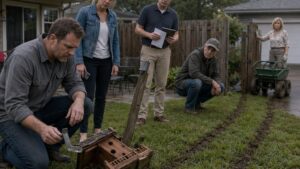
They Left Nine Weekends of Party Trash at His Curb, Then the Invoices Exposed Why
Chapter 1: Nine Sundays Beneath the Wooden Mailbox
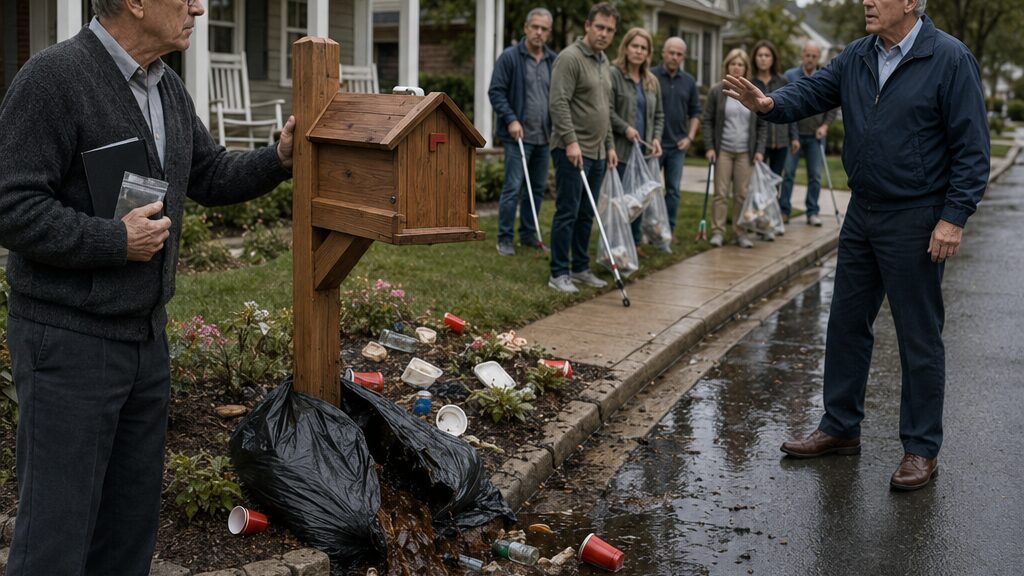
The black bag split when it struck the mailbox post.
A seam opened along its bottom, and a dark ribbon of coffee, melted ice, and grease ran over the cedar base Samuel Roberts had sanded by hand every spring for twenty-three years. Red cups rolled into the flower bed. A plastic fork lodged between two pale river stones. The smell of old onions and spilled beer reached him before he stepped off the porch.
Samuel stood with one hand on the railing and watched the liquid soak into the wood his father had shaped in a narrow garage behind the house.
Nine Sundays.
He did not need to check the notebook in his kitchen to know the number. He could have named every date, every bag, every complaint, and every reply without opening it.
Across the street, a neighbor paused beside her recycling bin. She looked at the trash, then at Samuel, and quickly returned her attention to the lid.
At the far end of the block, voices approached.
William Brown came around the bend wearing a navy windbreaker with the Maplewood Ridge crest stitched over the chest. Three board members walked behind him, each carrying a grabber or a roll of clear cleanup bags. The association called it the Sunday Community Walk, though no one had ever come far enough down Samuel’s street to collect the remains of Saturday’s clubhouse parties.
William slowed when he saw the pile.
“Well,” he said. “This is exactly what we’ve been trying to discourage.”
Samuel looked at him. “What is?”
“Improper curb disposal.”
One board member glanced at William, then at the leaking bag.
Samuel descended the porch steps carefully. He kept his eyes on the dark stain spreading around the post. The mailbox leaned slightly now, no more than half an inch, but he noticed.
“These bags came from your event,” he said.
William gave a short exhale through his nose, almost a laugh. “The association does not place trash on private lots.”
“My curb isn’t a private lot when you want to regulate it.”
“It is when you want someone else to remove what you put there.”
The neighbor across the street stopped pretending to adjust her recycling bin.
Samuel felt the answer rise into his throat. He saw himself saying everything at once—the nine mornings, the form letters, the calls returned three days late, the workers in fluorescent vests walking past his house before sunrise. But anger, once released, could be quoted without its cause. He had spent thirty-eight years in municipal records watching that happen.
He crouched instead and lifted one red cup from the flower bed.
The cup bore the caterer’s blue paper wristband, still stuck to its side. The same caterer had unloaded trays at the clubhouse the previous evening.
William noticed it. His expression did not change.
“You’ve made it clear you don’t approve of the socials,” he said. “But staging something like this won’t help your case.”
The words traveled farther than his voice. One of the board members looked directly at Samuel for the first time.
“Staging?” Samuel asked.
“I’m saying it appears designed to create a scene.”
Samuel set the cup beside the torn bag. “Are you formally denying that the cleanup crew used this curb?”
William’s jaw tightened. “I’m telling you the association did not authorize anyone to dump here.”
“That was not my question.”
“It’s the answer you’re getting.”
Samuel turned toward the mailbox.
William watched him open the small wooden door. The hinges gave their familiar muted squeak. Inside, behind two envelopes and a grocery circular, lay a sealed plastic sleeve. Samuel removed it, along with a narrow black notebook bound by an elastic strap.
He held up the sleeve.
“This contains four weekends of footage,” he said. “Time-stamped. Two camera angles.”
No one spoke.
Then he opened the notebook.
“June seventh,” he read. “Five bags, thirty-one cups, twelve bottles. June fourteenth, six bags, two food trays, broken glass. June twenty-first—”
“You’ve been recording workers?” William interrupted.
“I’ve been recording my front yard.”
“That raises privacy concerns.”
“On a public sidewalk?”
William’s eyes moved from the memory card to the faces around him. Samuel saw the calculation behind them. Not fear. Not yet. Annoyance at a meeting slipping beyond his control.
“You could have brought this to the board,” William said.
“I did.”
“You sent accusations.”
“I sent dates.”
“You refused to discuss reasonable alternatives.”
“I asked for the trash to go where the contract says it goes.”
A board member shifted her grabber from one hand to the other. “What contract?”
William turned slightly. “This isn’t the time.”
Samuel closed the notebook. “It became the time when you accused me in front of my neighbors.”
For a moment, the only sound came from liquid dripping off the bottom of the torn bag.
William lowered his voice. “Samuel, nobody wants this to become uglier than it already is.”
Samuel looked at the stain on the mailbox post. “Then stop making it my curb.”
William stepped closer, not enough to threaten, only enough to suggest the conversation had become private even while everyone could still hear.
“You’ve always believed paperwork gives you the last word,” he said.
Samuel’s fingers tightened around the notebook.
Years earlier, before William became president, they had stood together on Samuel’s porch drinking coffee after a winter power outage. William had admired the mailbox then. Asked who built it. Samuel had told him.
Now William looked at the same mailbox as if it were an inconvenience attached to an inconvenient man.
“The board will review whatever you submit,” William said. “Until then, you are responsible for material placed at your frontage.”
He turned toward the others. “Let’s keep moving.”
The group followed, though not as closely as before. One board member glanced back twice.
Samuel waited until they reached the corner. Then he set the memory card and notebook on the porch rail and began separating the mess. Bottles in one bag. Food waste in another. Sharp plastic wrapped in newspaper. He worked slowly around the mailbox post.
His mother had stood beside him when his father installed it. Kathleen had kept the first letter delivered there—a utility bill, of all things—because she said a home became real when the outside world learned where to find you.
Samuel had promised her he would keep the place intact.
He had interpreted that promise literally for years: fresh paint, trimmed hedges, stones reset after every winter. That morning, kneeling beside someone else’s leaking garbage, he understood that preserving a place also meant refusing what people decided it could absorb.
He lifted the final bag.
Something white clung to the wet pavement beneath it.
At first he thought it was a napkin. Then he saw a printed line, a partial company name, and a block of numbers. The paper had been torn diagonally, leaving only the bottom section.
Samuel peeled it from the concrete.
Across the top edge, one phrase remained legible:
EXTENDED STAGING LABOR.
Chapter 2: The Shortest Route Was Never Accidental
On the recording from the sixth Sunday, the two workers passed the entrance to the maintenance shed without slowing.
Samuel paused the video.
The correct route was visible in the upper corner of the frame: a paved service lane turning left behind the clubhouse, marked by a small green waste sign. The workers continued straight, each carrying two black bags. Fifty-eight seconds later, they reappeared on Samuel’s second camera and dropped the bags beside his mailbox.
He rewound the footage.
At 5:42:16, one worker glanced toward the service lane.
At 5:42:18, the other pointed down Samuel’s street.
At 5:42:21, they kept walking.
Samuel wrote the times in his notebook.
He had installed the first camera after the fifth Sunday, mounting it beneath the porch eave where it covered the flower bed, curb, and mailbox. The second went behind a window facing the clubhouse walkway. He had told no one. That silence had seemed prudent then. Now William was using it as evidence of hostility.
Samuel laid a printed neighborhood map beside the laptop. He marked the clubhouse in blue, the maintenance shed in green, and his house in red. The proper staging route measured roughly three hundred yards from the patio. His curb was less than half that distance if the workers cut through the pedestrian path.
Convenience explained the direction.
It did not explain the repeated choice of his house.
He turned to the stack of letters beside the computer.
The first complaint had been brief: Event waste was placed at my curb Sunday morning. Please confirm the cleanup vendor will use the designated collection area in the future.
The reply arrived four days later.
Thank you for contacting Maplewood Ridge Community Association. Your concern has been forwarded to the appropriate party.
The second complaint included photographs.
The reply used the same wording.
The third included dates, estimated quantities, and a request for the vendor’s disposal procedure.
That response came from Amanda Green at the management company.
The association has reviewed the matter and found no evidence of a recurring vendor issue. Residents are reminded that curbside materials remain the responsibility of the adjoining homeowner.
Samuel had folded each letter into thirds and placed it inside the mailbox after reading it, as if physical delivery somehow made the language more honest. Later, he moved the letters to his file cabinet. The habit remained from his working years: preserve the original, mark the date received, never rely on memory when a record existed.
He carried the invoice fragment to the kitchen sink and let it dry between two sheets of wax paper.
By noon, he was walking the route himself.
The clubhouse patio still smelled faintly of spilled beer and disinfectant. Folding tables stood against the brick wall. A caterer’s van was gone, but flattened boxes remained near the rear door.
Samuel followed the service lane to the maintenance shed.
The designated staging pad sat behind a wooden screen. It held two commercial dumpsters and a locked rolling bin. No bags had been left outside them.
He turned and retraced the path toward his street. The shorter route was obvious. A narrow sidewalk cut between two rows of townhomes, crossed the small park, and ended near his corner.
As he reached the intersection, a pickup belonging to the cleanup company rolled past. One of the workers from the footage sat in the passenger seat.
The man recognized him.
For a second, neither looked away.
Then the passenger raised one hand and pointed—not at Samuel, but toward Samuel’s house while speaking to the driver.
The truck continued.
Samuel stood still with the map folded in his pocket.
That gesture could have meant anything. There was the Roberts place. That was the man complaining. That was where we were told to go.
Samuel knew the danger of assigning meaning too early. He had spent his career correcting files built around assumptions that became facts merely because someone typed them first.
Still, when he returned home, he added one sentence beneath the morning’s timestamps:
Worker appeared to identify my property to driver.
Appeared. Not did.
On Monday, Samuel drove to the regional management office.
Amanda Green met him in a glass-walled conference room with a legal pad, a company mug, and the composed expression of someone whose day had been divided into thirty-minute problems.
“I reviewed the material you sent,” she said.
“All of it?”
“The photographs and correspondence.”
“Not the footage.”
“The file link required permission.”
“I granted permission Friday.”
Amanda looked down at her notes. “Then our system may not have updated.”
Samuel placed a flash drive on the table.
“I brought a copy.”
She did not touch it.
“Mr. Roberts, before this expands further, I need to be clear that the management company doesn’t direct vendor routes. That’s handled by the board and contractor.”
“You administer the contract.”
“We process it.”
“You sent me the response saying there was no recurring vendor issue.”
“Based on information provided by the board.”
“By William.”
“By the association president, yes.”
Samuel slid the route map toward her.
“The designated staging area is here. My property is here. The footage shows the crew walking past the correct turn four weekends in a row.”
Amanda studied the map despite herself.
Samuel placed the dried invoice fragment beside it.
Her eyes moved to the printed words.
“Where did you get this?”
“Under the ninth week’s trash.”
“This could be from any service call.”
“It could.”
The answer made her look up.
Samuel had expected resistance, and some part of him had prepared to meet it with equal force. Instead he heard his mother’s voice from years ago: If the record is strong, you don’t have to make it stronger than it is.
“I’m not asking you to guess,” he said. “I’m asking you to compare it.”
Amanda picked up the flash drive.
“I’ll review it.”
“When?”
“Within ten business days.”
“The trash comes every seven.”
A faint crease appeared between her brows. “I understand your frustration.”
“No,” Samuel said. “You understand the sentence. I’m asking you to understand the sequence.”
He regretted the sharpness as soon as he heard it, but Amanda’s expression had already closed.
“I’ll send you a written response,” she said.
The email arrived that afternoon.
Thank you for providing supplemental information. Management will coordinate with the board regarding vendor procedures. Please continue to follow normal residential disposal guidelines.
Samuel read it twice.
Then he printed it, wrote the received date in the upper-right corner, folded it into thirds, and walked outside.
The mailbox door opened with its familiar squeak.
He placed the letter inside, behind the sealed memory card sleeve, and shut it harder than necessary.
The phone rang before he reached the porch.
William’s name appeared on the screen.
Samuel answered.
“I hear you went to management,” William said.
“I did.”
“You’re creating unnecessary exposure for the association.”
“The exposure is already at my curb.”
William was silent for a beat. “We have a record that you agreed to allow isolated curb pickup.”
Samuel stopped halfway up the steps.
“What record?”
“You told the prior grounds committee that you preferred service away from the clubhouse.”
“That conversation was about storm debris after the oak came down.”
“You agreed to curb access.”
“For branches from my property.”
“The notes don’t distinguish.”
“Send them to me.”
“I’m not obligated to provide internal working notes.”
“You just used them to claim consent.”
William’s voice softened, which made it more dangerous. “Samuel, this can still be handled neighbor to neighbor.”
“For nine weeks, you handled it house to curb.”
“I’m trying to prevent this from becoming formal.”
Samuel looked back at the mailbox. Inside it sat four generic replies, a memory card, and no consent form he had ever signed.
“It already is,” he said.
After the call ended, he opened his notebook to a clean page and wrote one question across the top:
Who created the record of consent?
Chapter 3: The Consent Form Nobody Could Produce
Amanda Green placed a single-page document in front of Samuel and asked him to identify his signature.
There was no signature.
The bottom of the page contained a blank line labeled Resident Authorization. Above it, someone had typed Samuel Roberts—preferred curb service in a box marked Special Instructions.
Samuel did not touch the paper.
“Where did this come from?”
“The association’s vendor file,” Amanda said.
“That isn’t a consent form.”
“It may be an internal notation based on verbal approval.”
“Whose notation?”
“We’re determining that.”
“You asked me to identify my signature.”
“I asked whether this reflected an arrangement you recognized.”
“No.”
Amanda sat back. They were in the same glass-walled room, but the flash drive now rested beside her laptop, tagged with a yellow evidence label. A printed still from Samuel’s footage showed two workers carrying bags toward his street.
“William says there was a prior agreement,” she said.
“William also said the association had nothing to do with the trash.”
“He said it did not authorize dumping.”
“He said it publicly while the bags were leaking under my mailbox.”
Amanda glanced at the still image. “The terminology matters.”
“It matters most when someone changes it.”
Samuel opened his folder and removed the records from the fallen oak incident three years earlier. The work order specified storm branches generated on Samuel’s lot. It authorized one curbside collection on a dated Monday morning.
Amanda compared the documents.
“The special-instructions notation has no date,” Samuel said. “No initials. No linked work order. No term.”
“I see that.”
“It also says preferred curb service. Preferred by whom?”
Amanda did not answer.
For the first time since the complaints began, Samuel felt the balance shift—not in his favor exactly, but away from certainty on the other side.
Amanda closed the vendor file.
“There is no signed authorization in the documents management received.”
The sentence was careful, but it was real.
“Then remove the notation.”
“I can flag it as disputed.”
“It is not disputed. It is unsupported.”
Her mouth tightened. “Mr. Roberts, you are not the only party whose statement must be considered.”
“No. But I’m the only party whose name is on that page.”
Amanda held his gaze, then wrote unsupported—resident denies authorization across the top margin.
It was a small correction. Samuel felt it more sharply than he expected.
He had not come for sympathy. He had come because a false sentence had been placed into a file, and false sentences became decisions if no one challenged them.
Amanda slid the paper back into the folder.
“What are you planning to do next?”
“I have an appointment with county sanitation.”
Her expression changed. “Today?”
“In forty minutes.”
“You understand that a county citation would be assessed against the association, not William personally.”
“I understand.”
“Which means the cost belongs to all forty-seven homeowners.”
Samuel had considered that. He had considered it every night since finding the invoice fragment.
“Then all forty-seven homeowners should know what they are paying for.”
The county sanitation office occupied the first floor of a low brick building beside the vehicle licensing department. Samuel waited beneath fluorescent lights while a clerk copied his photographs, complaint letters, route map, and footage index.
The county inspector joined him at the counter.
She was practical, unsmiling, and more interested in sequence than outrage.
“Start with the first date,” she said.
Samuel did.
She asked where the bags originated, who controlled the clubhouse, whether the curb was public right-of-way, whether municipal pickup had been scheduled, and whether Samuel had ever authorized event refuse at his frontage.
“No.”
“Any written permission?”
“No.”
“Any compensation?”
“No.”
“Did you move the bags before photographing them?”
“Only after.”
“Did you open them?”
“No.”
“Did you speak directly to the workers?”
Samuel hesitated.
“No.”
The inspector looked up.
“I reported through the association.”
“That wasn’t my question.”
“No,” Samuel repeated. “I did not speak to the workers.”
“Why not?”
Because he had assumed the instruction came from above. Because he did not want a curbside argument at dawn. Because evidence seemed cleaner than conversation.
“I wanted a documented pattern,” he said.
The inspector wrote something.
Samuel felt irritation, then recognized it as embarrassment.
She watched the first video. On-screen, the workers passed the service lane and continued toward Samuel’s house.
“Play that again.”
He did.
She leaned closer when one worker pointed down the street.
“Can you identify the person giving directions?”
“No.”
“Can you prove the bags contain HOA event waste?”
Samuel produced photographs of caterer wristbands, branded napkins, and a discarded guest check bearing the clubhouse address.
The inspector arranged the images in a row.
“This may fall under county code for organizational refuse placed on residential frontage without consent,” she said. “I’m not making a determination today.”
“What happens now?”
“We open a case, notify the responsible entity, and request vendor and disposal records.”
She stamped the intake sheet.
The sound was ordinary. Samuel had heard thousands like it in municipal offices. Yet when she wrote the case number beneath the stamp and passed him a copy, his shoulders loosened.
The complaint now existed somewhere William could not revise with a phone call.
Outside, Samuel sat in his car and placed the county copy inside his folder. His phone showed six new messages.
The first came from the neighbor across the street.
I hope this can be resolved without hurting the community.
The second came from a board member.
William forwarded an email. Is it true you want the socials stopped?
Samuel opened his inbox.
The message had gone to every homeowner in Maplewood Ridge.
William described “an escalating complaint from a resident historically opposed to clubhouse programming.” He wrote that the board was working to preserve community events while addressing “unverified allegations concerning routine waste handling.” He warned that outside enforcement could create costs for all residents.
Samuel read the email once.
Then again.
William had not named him, but he did not need to. Everyone had seen the trash beneath Samuel’s mailbox. Everyone had seen the Sunday confrontation.
A third message arrived while he sat there.
Some of us enjoy living in a neighborhood instead of a courtroom.
Samuel began typing a reply.
He wrote that he had attended the spring picnic. That he had never asked anyone to cancel an event. That the issue was nine weeks of trash, a false consent record, and a board president who had denied what cameras showed.
He stopped.
The draft had become longer than William’s email. Each sentence invited a new argument. Each defense made him sound more defensive.
Samuel deleted it.
That evening, he printed William’s message, marked the date, and placed it with the other records. He did not answer the neighborhood thread.
For the next two days, greetings became shorter. A man walking his dog crossed the street before reaching Samuel’s driveway. The neighbor across from him raised one hand from her porch but did not come over.
Vindication, Samuel discovered, did not feel like being believed. It felt like possessing a document while everyone else possessed a version of you.
On Friday morning, the county inspector called.
“We’ve reviewed the initial submission,” she said. “The pattern is sufficient to proceed.”
Samuel stood beside the mailbox, one hand resting on the stained cedar post.
“What do you need?”
“All service invoices, route records, labor logs, and disposal documentation connected to the nine event dates.”
“From me?”
“From the association and its contractor.”
Samuel looked down the street toward the clubhouse roof.
The torn invoice fragment remained sealed in his folder. Until then, it had been only a clue—wet paper under a garbage bag.
Now the county wanted every invoice behind it.
Chapter 4: The Fine That Looked Like Victory
The county citation was taped to the clubhouse door before the board meeting began.
Its white paper looked small against the dark glass, but the number printed near the bottom drew every resident who entered close enough to read it.
$3,200.
Samuel stood at the edge of the walkway while people slowed, leaned forward, and exchanged the kind of quiet comments that were meant to sound private.
“Is that coming from reserves?”
“Who called the county?”
“I thought this was just trash.”
William Brown arrived ten minutes before the meeting carrying a leather portfolio. He stopped when he saw the citation, though only for a second. Then he removed it from the glass, folded it once, and took it inside.
Samuel followed.
The clubhouse meeting room had been arranged with folding chairs facing a long table. The HOA treasurer sat at one end with a calculator and a stack of financial statements. Amanda Green occupied the other end, her laptop open beside a thin county file.
William placed the folded citation in front of him.
“This meeting will come to order,” he said.
No one had finished settling.
A resident near the back raised her hand. “Are we paying that fine?”
William looked toward the treasurer. “The association has sufficient operating reserves.”
“That wasn’t the question.”
A murmur moved through the room.
William opened his portfolio. “The county has issued an administrative penalty related to improper placement of event refuse. We disagree with certain aspects of the finding, but in the interest of avoiding additional legal expense, I recommend payment.”
Samuel felt thirty faces turn toward him before anyone said his name.
William continued. “The vendor has been instructed to revise its route. The issue is corrected.”
Amanda looked up from her laptop. “The route has been revised temporarily. The vendor review is not complete.”
William’s hand paused over his papers.
The treasurer leaned toward him. “You told me management had closed the review.”
“I said the operational problem had been corrected.”
Amanda’s voice remained even. “The county requested nine weeks of invoices and labor records. We received them yesterday.”
William did not look at her. “And?”
“They are still under review.”
A man in the second row raised his hand without waiting to be recognized. “Why should forty-seven homeowners cover $3,200 for something a contractor did?”
William answered quickly. “Because the contract is held by the association.”
“Then we go after the contractor.”
“That may cost more than the fine.”
The room shifted again. Samuel heard chair legs scrape against the floor.
He had imagined this moment through nine Sundays. In those private versions, the citation arrived like a clean judgment. The board acknowledged the truth. William stopped talking. The trash disappeared.
Instead, the fine had become another assessment against people who had not carried a single bag to his curb.
The neighbor across the street sat three seats from the aisle. She did not meet his eyes.
William lifted the citation.
“The county’s position is that event refuse was placed at residential frontage without written consent. Management was unable to locate the authorization record.”
“Because there wasn’t one,” Samuel said.
William looked at him. “You will have an opportunity during homeowner comments.”
“You just described a missing document as if it might exist.”
“I described the county’s finding.”
“No. You described my consent as a filing problem.”
A board member shifted forward. “William, is there any signed authorization?”
“No signed authorization has been located.”
“That means no,” Samuel said.
William’s face tightened. “This kind of interruption is precisely why these matters become difficult to resolve constructively.”
Amanda closed her laptop halfway. “For clarity, management has found no signed or dated resident authorization permitting HOA event waste at Mr. Roberts’s curb.”
The room went quiet.
It was the first time someone besides Samuel had said it plainly in public.
The neighbor across the street finally looked at him.
Samuel felt a small release in his chest, followed almost immediately by something heavier. The truth had entered the room, but the $3,200 remained.
William moved to the next agenda item as if speed could carry him past the damage.
“I propose we authorize payment from the operating reserve and consider the sanitation matter closed pending routine vendor follow-up.”
The treasurer frowned. “We’ve already used reserves for irrigation repairs.”
“The balance is adequate.”
“Barely. If we pay this, we postpone the west fence replacement.”
Someone near the rear said, “So we all lose something.”
Another resident answered, “Because one person couldn’t let a few bags go?”
The sentence landed cleanly.
Samuel turned. He could not see who had spoken.
William did not correct it.
For nine weeks, Samuel had carried the trash himself after photographing it. He had sorted broken glass from cups and food waste. He had scrubbed the mailbox post until the stain faded from black to gray. He had done all of it without asking a neighbor for help.
Now the cost had become visible, and the cause had become him.
He rose during homeowner comments with his notebook in one hand.
“I did not ask the county to fine my neighbors,” he said. “I asked the association to stop placing event waste at my property.”
William leaned back, arms folded.
Samuel continued. “I reported it internally three times before I contacted anyone outside Maplewood Ridge. I provided photographs. Then footage. I was told there was no recurring issue and later told I had agreed to the arrangement.”
He looked around the room.
“The fine is not the beginning of this. It is what happened after the beginning was ignored.”
No one applauded. Samuel was grateful for that.
The HOA treasurer looked down at the financial sheet. “Can we recover the money from the vendor?”
Amanda reopened her laptop. “That depends on the contract and what the review establishes.”
William tapped his pen. “The county citation concerns disposal placement, not billing.”
Amanda did not answer immediately.
Samuel noticed a change in her posture. She was no longer sitting as management’s shield. She was reading something on the screen, one hand resting near the trackpad.
“What is it?” the treasurer asked.
Amanda turned the laptop slightly toward herself.
“The invoices list extended disposal staging on every event date.”
William’s pen stopped.
Amanda scrolled.
“Each invoice includes two labor hours for transferring waste from the clubhouse to the maintenance staging area.”
Samuel saw the torn paper beneath the ninth bag again. EXTENDED STAGING LABOR.
“The crew never used the staging area,” he said.
Amanda looked at him.
“Not according to your footage.”
William closed his portfolio. “Standard package language does not establish overbilling.”
“Perhaps not,” Amanda said. “But the invoices also certify completion of the listed services.”
The room became still in a different way.
The fine had looked like the end because it came with an exact number and a government seal. Now it seemed more like the first door anyone had bothered to open.
Amanda turned the laptop so the treasurer could see.
Nine invoices appeared on the screen.
Nine charges for a longer walk no one had taken.
Chapter 5: Every Invoice Included the Longer Walk
Amanda laid the nine invoices across the conference table in three careful rows.
They were nearly identical.
Each listed event cleanup, refuse collection, transfer to designated staging, and extended disposal labor. Each carried the same two-hour charge. Each ended with an electronic certification from Jack Mitchell’s cleanup company.
Samuel placed the torn invoice tag beside the ninth document.
The paper fibers aligned with the missing lower corner.
Amanda did not call it proof. She photographed the match, marked the position, and wrote possible physical association in her notes.
Samuel respected that.
Jack Mitchell sat across from them in a work jacket that still carried pale dust along one sleeve. He was broad through the shoulders, with the tired expression of a man who had expected a payment dispute and found something more serious waiting.
“These are package invoices,” he said. “The wording is standard.”
Amanda tapped the line reading transfer to designated staging.
“Was the waste transferred there?”
“Not every time.”
“Was the labor performed?”
“The crew still carried the bags.”
“To Mr. Roberts’s curb.”
Jack glanced at Samuel. “I didn’t know it was a problem at first.”
“For nine weeks?” Samuel asked.
Jack’s eyes narrowed. “You think I’m standing at every curb before dawn?”
“You certified every invoice.”
“I certified the job was completed.”
“The listed job wasn’t.”
Amanda raised a hand before Jack could answer. “We need the route instruction chain. Who directed the workers?”
Jack leaned back.
“The board wanted the lowest possible event rate. We gave them one.”
“That does not answer the question,” Amanda said.
“The clubhouse manager would point out the exit route. Sometimes a board member was there. Sometimes not.”
“Which board member?”
Jack rubbed a thumb across the edge of the table. “William handled most of it.”
Samuel watched him. Jack was not surprised by the name. He was deciding how much responsibility he could move without moving all of it.
Amanda opened a folder. “Your contract requires disposal at the maintenance staging area.”
“The staging gate was locked twice.”
“Which dates?”
“I’d have to check.”
“We checked,” Amanda said. “There are no lockout reports.”
Jack’s jaw shifted.
Samuel had expected satisfaction. Instead he felt the old danger returning—the desire to make every unanswered detail fit the worst version.
“You knew where the bags were going,” he said.
Jack looked at him. “I knew where some of them were going.”
“All nine invoices came from your company.”
“All nine events had different crews.”
“The same two workers appear on four recordings.”
“And neither of them owns the company.”
Amanda asked, “Can you make those employees available this afternoon?”
Jack hesitated, then nodded once.
They met behind the clubhouse near the service lane.
The maintenance staging area stood beyond the wooden screen, exactly as it had on Samuel’s walk. The rolling bin was open now. The distance from the patio seemed even more absurd when measured in silence: not impossible, not dangerous, simply inconvenient.
One cleanup worker arrived in a faded fluorescent vest. He recognized Samuel immediately.
He removed his cap.
“I didn’t know you hadn’t agreed,” he said before Amanda finished introducing anyone.
Samuel stared at him.
The worker looked toward Jack, then William’s empty parking space.
“Mr. Brown told us that house was the approved residential drop.”
“Approved by whom?” Samuel asked.
“You.”
The answer struck harder than denial would have.
The worker continued quickly. “He said you didn’t want crews near the clubhouse path by your backyard. Said you complained about noise and wanted isolated pickup at the street.”
“My backyard is nowhere near the clubhouse path.”
“I know that now.”
Samuel looked at the service lane, then at the worker’s hands. They were rough, one knuckle split and covered by a narrow bandage. He had imagined those hands tying bags with knowledge of where they would leak. He had watched the footage enough times that the workers had become part of a single intention.
“Why did you point toward my house?” he asked.
The worker swallowed. “The new driver asked which curb Mr. Brown meant.”
Not a signal of conspiracy. Directions.
Amanda asked, “Were you instructed to use the maintenance staging area on the invoices?”
“We were told the route was flexible.”
“By Jack?”
The worker looked at his employer.
Jack answered before he could. “By me. Based on what William told me.”
“And the two additional labor hours?”
“That’s the package,” Jack said again.
The worker frowned. “We never got two extra hours.”
No one spoke.
Amanda turned to him. “What do you mean?”
“We clocked out after the patio was clear. Usually took about an hour and twenty minutes total.”
Jack’s voice hardened. “Payroll time and billable service aren’t the same.”
“No,” Amanda said. “But completed staging labor and package pricing are not automatically the same either.”
The worker looked at Samuel. “I’m sorry about the mailbox.”
Samuel’s first impulse was to say the apology had come late. The second was to ask why the man had never knocked. But Samuel had not knocked either. He had watched through glass and turned movement into motive.
“Did every worker believe I approved it?” he asked.
“I can only speak for our crew.”
Samuel nodded.
It was not forgiveness. It was correction.
That evening, he sat on the porch with his notebook open. Under the entry describing the pointing gesture, he drew one line through his earlier sentence. He did not erase it.
Worker appeared to identify my property to driver.
Below it, he wrote:
Worker states he was identifying the location he had been told was approved.
The distinction cost him something. He had publicly called the entire crew complicit during the Sunday confrontation. The footage proved what they had done, not what each of them had known.
Across the street, the neighbor came to the edge of her driveway.
“I heard one of the workers apologized,” she said.
“He explained.”
“Is that different?”
“Yes.”
She looked toward the stained mailbox post. “William’s email made it sound like you wanted the parties gone.”
“I know.”
“You could have answered.”
“I could have.”
“Why didn’t you?”
Samuel closed the notebook.
“Because I thought the evidence would answer for me.”
“Evidence doesn’t knock on doors,” she said.
The sentence irritated him because it was true.
The next morning, Amanda called him back to the management office. Jack was already there, alone this time.
His posture had changed. The resistance remained, but the confidence had thinned.
“I need this contract,” he said. “You terminate us, I lay people off.”
Amanda folded her hands. “Then explain the charges.”
Jack looked at Samuel before answering.
“William demanded a lower bid than we could realistically perform under the written route. He said nobody checked service details as long as the clubhouse looked clean by morning.”
“Did he instruct you to bill services you did not perform?” Amanda asked.
“He told me to keep the invoice format unchanged.”
“That is not the same question.”
Jack rubbed both palms over his face.
“He said the board had approved flexibility.”
“Did the board approve it?”
“I dealt with William.”
Samuel asked, “Why my curb?”
Jack’s expression closed again. “He said it was already arranged.”
“That’s not an answer.”
“It’s the answer I had.”
Amanda slid a printed email across the table. “This is your message to William before the first event. You asked whether route documentation needed to match actual disposal.”
Jack read it without touching it.
His reply from William appeared beneath the question.
Maintain standard descriptions. We need the lowest bid and flexibility on execution.
Jack looked toward the window.
“I shouldn’t have accepted that,” he said.
“No,” Amanda said.
He gave a humorless breath. “Easy to say when you don’t have three trucks financed and payroll due Friday.”
The pressure did not excuse him. It made him visible.
Samuel understood that difference better than he would have a week earlier.
Jack pushed the email back.
“William wanted the cheapest number,” he said. “He promised flexibility on route documentation. I gave him both.”
Samuel stared at the phrase.
The false consent, the shortcut, the repeated invoices—none of it had begun at the curb.
But one question remained untouched.
Of forty-seven homes, why had William chosen his?
Chapter 6: The Old Grudge Behind the New Shortcut
The loose panel on the mailbox gave way beneath Samuel’s screwdriver, and a folded square of paper slipped into his palm.
He nearly dropped it.
The paper had yellowed along the creases. His mother’s handwriting crossed the front in blue ink.
For Samuel—when he starts fixing what isn’t only wood.
He sat down on the curb.
The mailbox post needed more than cleaning. Grease had worked into the cedar grain, and the ninth bag’s impact had loosened the lower brace. Samuel had removed the side panel to inspect the joint. He had not known his mother had hidden anything there.
Inside the note, Kathleen had written only four lines.
Your father built this to receive things, not keep them out.
Keep your records.
But remember they should keep people honest, including you.
Samuel read it twice.
Then a third time.
He could hear her saying it without softness. Kathleen had believed affection did not require decoration. She had also believed facts were useful only when they prevented a person from lying to others or himself.
Samuel folded the note along its old creases and placed it in his shirt pocket.
The special board hearing was three days away.
Amanda had arranged supervised access to the clubhouse archive room so Samuel could review older records connected to William’s claim of consent. The room occupied a narrow space behind the administrative office, lined with banker’s boxes and binders from past boards.
Samuel found the storm-debris file first.
His one-time curb authorization was there, properly dated and limited to branches from his property. Behind it sat records from the clubhouse expansion proposal six years earlier.
The memory returned before he opened the folder.
William had wanted to extend the patio, add an outdoor kitchen, and remove two mature trees near the drainage easement. He had called it an investment in community. Samuel, still newly retired, had reviewed the notice and discovered that the square footage on the board packet did not match the engineering submission sent to the county.
He had raised the discrepancy at a crowded meeting.
The permit vote was delayed. Revised costs increased. The project died.
William had never forgiven the public correction, though neither man had spoken of it directly since.
Samuel opened a printed email chain from the current year.
Jack Mitchell had asked where crews should stage refuse if the rear service route added labor beyond the bid.
William’s response appeared below.
Use the Roberts curb if needed. He always wants everything documented, so give him a clean route designation and keep the event area clear.
Samuel read the sentence again.
Not because the curb was closest.
Not only because the route was shorter.
Because it was his.
A later email from Jack asked whether resident approval had been secured.
William replied:
There is prior curb authorization in his file. He prefers separation from clubhouse activity.
Samuel felt heat rise through his chest.
The old storm work order had not been misunderstood. It had been repurposed.
He turned to Amanda, who stood near the doorway.
“You had these?”
“They were in the board archive, not the management upload.”
“He selected my house.”
“Yes.”
“Because of the expansion meeting.”
Amanda looked at the older file. “The timing suggests resentment. The current emails establish he chose your curb and misrepresented authorization. Motive is harder to prove.”
Samuel almost objected. Then he touched the note in his pocket.
Harder to prove was not the same as impossible. It was also not the same as established.
“What do they prove?” he asked.
“That William knew the written route differed from actual practice. He cited prior authorization that did not apply. He directed Jack to maintain standard invoice descriptions.”
“And the grudge?”
Amanda’s expression softened slightly. “That is the part people will understand fastest and argue about longest.”
Samuel closed the folder.
For days, he had imagined the hearing as a sequence of documents placed in perfect order. Camera footage. False consent notation. County citation. Invoice charges. Emails. Each page would narrow William’s options until denial became impossible.
Now the record contained something less clean: Samuel had overstated the workers’ knowledge. He had called the dumping targeted before knowing how the crew had been instructed. He had let neighbors believe he possessed certainty where he possessed only pattern.
William had used that silence against him.
But Samuel had supplied the silence.
At home that evening, he spread the documents across the kitchen table. The house felt smaller with every fact visible.
The neighbor across the street knocked at six.
Samuel opened the door.
“I brought back your container,” she said, though she had returned it two days earlier.
They both looked at the empty glass dish in her hands.
“You wanted to ask something,” Samuel said.
She nodded. “Did William choose your curb because of that old patio fight?”
“The records show he chose it. They don’t state why.”
“But you believe that’s why.”
“Yes.”
“Are you going to say it at the hearing?”
Samuel looked toward the kitchen table.
“I don’t know.”
She stepped inside when he moved aside.
The documents made the room look like a temporary office. She noticed the handwritten correction in Samuel’s notebook.
“You changed this.”
“One worker explained the gesture.”
“So you were wrong?”
“Partly.”
She set the glass dish down. “Will you say that too?”
Samuel disliked the question more than he had disliked her earlier remark about evidence not knocking on doors.
“If I don’t,” he said, “William will use it to discredit everything else.”
“That isn’t what I asked.”
Samuel took the note from his pocket and laid it beside the notebook.
The neighbor read the four lines without touching the page.
“My mother,” he said.
“She sounds difficult.”
“She was.”
A brief smile passed between them and disappeared.
At the hearing the next afternoon, the clubhouse room filled before the scheduled start. Amanda arranged invoice copies at one end of the board table. The county citation lay beside them. William sat alone in the president’s chair with a sealed envelope in front of him.
Samuel entered carrying his notebook and the archive emails.
William watched him take a seat near the aisle.
Before the meeting was called to order, William stood and approached.
“Can we speak privately?”
They moved into the short hallway beside the restrooms. Through the open meeting-room door, Samuel could hear chairs scraping and low conversation.
William held the sealed envelope at his side.
“I’m prepared to resign,” he said.
Samuel looked at the envelope.
“Effective when?”
“Immediately after tonight.”
“And the invoice complaint?”
William’s eyes remained steady. “Jack will lose the contract. The route issue is corrected. I’ll accept responsibility for poor oversight.”
“Poor oversight.”
“You want me gone. I’m offering that.”
“I want the record corrected.”
“It will be.”
“The billing records?”
William lowered his voice. “If management treats this as intentional misrepresentation, the association may have to notify its insurer. There could be legal costs. Reserve losses. A special assessment.”
“So your solution is silence.”
“My solution is containment.”
Samuel heard the logic in it. William had used the same logic for months: keep the event area clean, keep costs low, keep complaints inside, keep the invoice language unchanged. Every harm became acceptable if the institution remained undisturbed.
William extended the envelope.
“My resignation. You withdraw the invoice complaint and state that the disposal problem has been resolved.”
Samuel did not take it.
Inside the meeting room, Amanda called for board members to sit.
William’s hand stayed between them.
“This protects the neighborhood,” he said.
Samuel thought of the $3,200 fine, the delayed fence repair, Jack’s financed trucks, the worker’s split knuckle, and the stain that remained after scrubbing. Full disclosure would cost people who had not caused all the harm. Private resignation would leave the false record intact and allow everyone to call the matter a misunderstanding.
For most of his life, Samuel had believed the difficult choice was the one supported by the clearest document.
William’s envelope proved otherwise.
“Meeting’s starting,” Amanda called from the doorway.
William lowered his hand.
“You have one chance to end this without doing more damage,” he said.
Samuel touched the folded note in his pocket.
Then he walked into the hearing without answering.
Chapter 7: He Opened the Mailbox Before He Spoke
William’s resignation letter sat unopened beside the disputed invoices.
The envelope bore his name in the upper-left corner and the HOA’s return address beneath it, as though he were sending official notice to an organization he still controlled. Samuel stood at the end of the clubhouse table with his notebook under one arm and the archive emails in a plain folder.
No one had taken the president’s chair.
William remained standing behind it.
Amanda Green waited until the room settled, then looked toward Samuel. “You asked to present first.”
Samuel nodded.
He placed the notebook on the table but did not open it.
For weeks, he had imagined beginning with the footage. Images were difficult to argue with. He could have shown the workers passing the maintenance route, carrying bags down his street, and leaving them beneath the mailbox. He could have let the room watch William’s public denial afterward.
Instead, Samuel faced the residents.
“I need to correct something I said.”
William’s eyes lifted.
Samuel continued before he could lose the nerve.
“On the ninth Sunday, I said the cleanup crew had targeted my property. The footage proved they repeatedly placed the waste there. It did not prove every worker knew I had objected.”
A faint movement passed through the chairs.
Samuel opened the notebook to the amended entry.
“One worker has since explained that William told the crew my curb was an approved location. I believe him. I should not have described all of them as knowingly participating in retaliation.”
Jack Mitchell sat near the back with his hands clasped between his knees. One of the workers occupied the chair beside him.
Samuel looked at them briefly.
“I was right about what happened. I was not entirely right about what each person understood.”
William leaned forward against the chair.
“So we agree there was confusion.”
“No,” Samuel said. “We agree that your instructions created confusion.”
He removed the first email from the folder.
Amanda projected it onto the clubhouse wall.
Use the Roberts curb if needed. He always wants everything documented, so give him a clean route designation and keep the event area clear.
No one spoke while they read it.
Samuel placed the second email beneath the projector.
There is prior curb authorization in his file. He prefers separation from clubhouse activity.
The HOA treasurer turned toward William. “You knew that authorization was for storm debris.”
William’s face had gone still. “I relied on the file notation available at the time.”
“The work order was in the same file,” Amanda said.
“The system was poorly organized.”
Samuel opened the folder again.
“This email was sent after I filed my second complaint.”
The next message appeared.
Maintain standard descriptions. We need the lowest bid and flexibility on execution.
Jack lowered his head.
William looked around the room as if searching for one person who would accept the explanation before he gave it.
“The board was under pressure to control event costs,” he said. “Residents had made it clear they wanted the socials preserved without increased dues. Jack’s company offered a rate we could afford.”
The treasurer’s voice was quiet. “So you changed the route.”
“I approved a practical alternative.”
“You used Samuel’s house.”
“It was an accessible curb.”
Samuel felt the old anger move through him, but it no longer filled the whole room inside his head. There were other facts now. Other people. Other costs.
“You had forty-seven accessible curbs,” he said.
William looked at him.
“You chose mine.”
“That is your interpretation.”
Samuel removed the records from the failed clubhouse expansion.
Six years earlier, William had proposed removing two trees near a drainage easement. Samuel had found the square-footage discrepancy that stopped the vote until the permit could be corrected. The revised cost had ended the project.
Samuel placed the old board minutes beside the current emails.
“I cannot prove what you felt,” he said. “I can prove you remembered the dispute. I can prove you referred to my habit of documenting things when you selected my property. I can prove you used an unrelated authorization after I complained.”
William’s mouth tightened.
“What exactly do you want?” he asked. “An apology? A confession that I disliked being challenged six years ago?”
“No.”
The answer seemed to unsettle him more than accusation would have.
Samuel touched the notebook.
“I want the record to say what happened.”
Amanda opened a financial summary.
“The county penalty of $3,200 has already been paid from the association operating account. Management’s audit also identified eighteen billed labor hours for staging services not supported by route records or employee time logs.”
The amount below the county fine drew another murmur.
Jack stood.
“My company will reimburse the disputed staging charges,” he said. “I’m not admitting we intended to defraud anyone. I accepted invoice language I should have changed, and I billed the package after the route changed.”
Amanda looked at him. “The vendor agreement will still be terminated.”
“I understand.”
His voice was flat, but not surprised.
One of the board members asked, “What happens to the reserve fund?”
The treasurer answered. “The vendor reimbursement will restore part of it. The remaining county penalty stays with the association unless we pursue recovery.”
William reached for the resignation envelope.
“This is precisely what I tried to prevent,” he said. “Legal costs, vendor disruption, community division. I made a decision to keep the events running within budget. I handled the complaints poorly. I’m willing to resign.”
“You offered to resign privately,” Samuel said.
Several residents turned toward William.
Samuel had not planned to reveal that immediately. But the choice belonged in the same record as the rest.
“In exchange,” he continued, “you asked me to withdraw the invoice complaint and describe the dumping as resolved.”
William held the envelope between both hands.
“I offered a practical settlement.”
“You offered another clean route around the truth.”
The sentence remained in the room.
William looked down at the envelope. When he spoke again, the certainty had drained from his voice.
“You think rules are separate from consequences,” he said to Samuel. “They aren’t. Every investigation costs somebody. Every correction delays something else. People want events. Repairs. Low dues. They do not want to hear that all three cannot happen at once.”
Samuel understood the pressure. He could see how William had turned usefulness into identity. The events were full, the clubhouse busy, the budget praised. Each compromise had made the next one easier to name as necessity.
But pressure did not place the bags at Samuel’s curb.
Pressure did not create consent.
Pressure did not answer three complaints with denial.
“You were allowed to tell us the true cost,” Samuel said. “You chose to hide it.”
William’s eyes shifted toward the residents.
No one applauded. No one demanded that he leave. The silence was less satisfying and more honest.
The HOA treasurer moved that William be removed as president pending a formal board vote and management review. Another board member seconded it.
William did not vote.
He opened the resignation envelope, read the first line, then slid it across the table.
“Effective immediately,” he said.
Amanda accepted it.
The meeting continued for another hour.
The board authorized termination of Jack’s company, recovery of the disputed charges, and written notification to all homeowners explaining the county fine and billing review. Amanda proposed a new vendor policy requiring documented disposal routes, photographic confirmation of completed staging, and written resident consent for any use of private frontage.
When she asked Samuel whether he had comments on the policy, he looked at the notebook.
“I do,” he said. “But not tonight.”
Outside, the parking lot had emptied by half. William stood beside his car with the navy windbreaker folded over one arm.
Samuel passed him without stopping.
“Samuel.”
He turned.
William looked older without the crest over his chest.
“I should not have used your curb.”
“No.”
“I should have answered your first letter.”
“Yes.”
William waited, perhaps for something that would let both men leave with less weight.
Samuel could not give him absolution. He no longer wanted humiliation either.
“You knew what the mailbox meant,” Samuel said.
William looked toward the dark street leading to Samuel’s house.
“I remembered your father built it.”
“That made it easier for you to know where the line was.”
William’s face tightened once, then settled.
Samuel walked home.
The following Saturday, he replaced the damaged brace beneath the mailbox. He sanded the stained cedar until the surface felt even, though a gray shadow remained deep in the grain. He decided not to remove more wood merely to make the mark disappear.
Behind the side panel, he returned Kathleen’s folded note.
He added one thing beside it: a copy of the corrected notebook entry about the worker’s gesture.
Not as a monument to being right.
As a record of where he had not been.
Sunday morning arrived without voices at the curb.
Samuel opened the front door expecting, despite himself, to see black bags beside the post. The pavement was clear. No cups lay in the flower bed. No sweet, sour smell drifted from the gutter.
Inside the mailbox was a single folded sheet.
The handwriting belonged to Amanda.
The board is forming a temporary vendor-policy committee. We need someone who understands records, route verification, and where procedure failed. Participation does not require agreement with every board decision.
Below her signature, the neighbor across the street had added a line.
Evidence may not knock on doors, but you still can.
Samuel stood beside the repaired post with the paper in his hand.
From the clubhouse direction came the distant scrape of rolling bins being moved along the service lane. The sound continued past the turn his cameras had watched the workers ignore for four weekends.
This time, it went behind the maintenance shed.
Samuel folded the request and placed it inside the mailbox.
He went back to the porch, picked up his notebook, and returned to the curb.
The gray stain remained visible near the base. He ran his thumb across it once, then opened the mailbox again and took the request out.
At the kitchen table, he wrote three words beneath Amanda’s message.
I will help.
The story has ended.