He Marked One Strip of Grass, but the Green Dog Exposed Every Lie on the Block
Chapter 1: The Brown Patches Crossed the Property Line
The dead patch was three feet inside Thomas Adams’s yard.
He stopped at the edge of the driveway with his travel mug halfway to his mouth and stared at the patch as if it had moved during the night. Yesterday, the grass around the center sprinkler had been thick enough to hide the black plastic cap. Now a yellow-brown circle had opened beside it, wider than a dinner plate, with a dark wet clump pressed into the middle.
Thomas set the mug on the driveway.
The lawn was still silver with morning moisture. Every blade held a bead of water except those in the circle, which had folded flat and dull against the soil. A faint trail of bent grass ran from the sidewalk to the damaged area.
He fetched a grocery bag and a pair of work gloves from the garage. He removed the waste, rinsed the spot lightly, and stood with the hose in his hand longer than necessary.
Across the street, a garage door rose. A car backed out. Somewhere behind the houses, a mower coughed to life.
Thomas looked toward the sidewalk.
The first patch had appeared near the curb four mornings earlier. He had blamed a delivery driver’s dog or one of the loose animals that occasionally slipped from a backyard gate. The second patch had formed closer to the Japanese maple. The third had appeared just beyond the property pin he knew was buried beneath the sod.
This one was not near the edge.
Someone—or something—had crossed the lawn with purpose.
Thomas worked as a grounds supervisor for the city, which meant he spent most weekdays looking at grass other people ignored until it died. He could identify compacted soil from a tire track, fungal damage from irrigation burn, and fertilizer stripes left by a careless spreader. At home, he wanted one small piece of ground that responded to attention.
Each March, he aerated the front yard, spread a fescue blend, and covered the thinnest areas with clean straw. That spring, the seed and soil amendments had cost him nearly $180. He had watered before work and again after sunset, adjusting the sprinkler heads so no stream struck the sidewalk.
By April, the lawn had come in evenly.
Now a line of brown circles was creeping across it.
At lunch, Thomas printed an aerial image of the property from the county parcel map. He marked each damaged area with a red dot and wrote the date beside it. The dots formed a shallow diagonal from the sidewalk toward the front window.
He nearly laughed at himself.
It looked like evidence prepared for a trial no one else knew existed.
That evening, he carried the paper outside and checked the alignment. The route passed between the young maple and the irrigation box, then angled toward the center sprinkler. It was the easiest path from the sidewalk to the broadest section of grass.
A dog would choose it naturally.
An owner could stop it just as naturally.
Thomas looked next door at Daniel Roberts’s house. The porch light was on, though the blinds were closed. Daniel had a large pale dog with a square head and a slow, rolling walk. Thomas had seen them on the sidewalk most mornings before work. He had never watched closely enough to know where the dog went.
The possibility sat badly with him because Daniel had once been easy company. When Thomas first moved into Cedar Ridge, Daniel had loaned him a ladder without asking when he wanted it back. They had stood beside the same driveway drinking coffee while contractors replaced both roofs after a hailstorm.
Then Daniel’s father died, Daniel’s mother began spending more time at the house, and the casual conversations thinned into nods.
Thomas did not want suspicion to fill the space where familiarity had been.
The following morning, another wet mark appeared near the same route. No waste remained, but the grass had been flattened.
At work, Thomas requisitioned nothing, borrowed nothing, and used none of the city’s equipment. He stopped at an electronics store on the way home and bought a motion-activated camera with his own money.
He mounted it beneath the porch eave, angled low enough to capture the sidewalk and most of the front yard. He checked the view from his phone. The property line was visible as a subtle change in mowing direction, a faint seam where his grass met the common strip.
The thin line seemed suddenly important.
For two mornings, the camera recorded headlights, a newspaper delivery, and a rabbit that froze beneath the maple before bounding away.
On the third morning, Thomas woke at 6:52 to an alert.
Motion detected at 6:45 a.m.
He sat up and opened the clip.
The pale dog entered from the left side of the frame. Its leash stretched back toward the sidewalk, where only a hand and part of a dark sleeve were visible. The dog lowered its head, crossed the property seam, and followed the diagonal path between the maple and the irrigation box.
It stopped near the center sprinkler.
The person holding the leash did not pull it back.
Thomas replayed the clip. The image was grainy in the dawn light, but the dog was unmistakable. Daniel’s dog had a dark patch near one ear and a heavy tail that curved slightly at the tip.
The small confirmation brought no satisfaction. It only made the earlier damage feel more deliberate.
Thomas advanced the video frame by frame.
The dog finished. The leash slackened. A man stepped farther into view.
Daniel wore gray sweatpants and a dark sweatshirt. He stood on the sidewalk with one hand in his pocket while the dog remained in Thomas’s yard. He did not carry a waste bag. He did not look down at the grass.
Then he lifted his face toward the house.
Toward the camera.
For one second, Daniel stared directly into the lens.
Thomas held still, his thumb resting against the screen.
Daniel gave no wave and showed no surprise. He simply turned away and walked on, allowing the leash to drag across the faint boundary line behind him.
Chapter 2: Dogs Go, and Doors Close
Daniel opened the door holding the photograph Thomas had left beneath his windshield wiper.
He had folded it once through the center, so the printed image of his dog was split from the image of himself standing on the sidewalk.
“You could’ve just knocked,” Daniel said.
“That’s what I’m doing now.”
It was six that evening. Daniel wore a white T-shirt, athletic shorts, and no shoes. He leaned one shoulder against the frame, blocking the view into the house. Behind him, the pale dog barked once and then fell quiet.
Thomas kept his voice level. “Your dog’s been crossing my lawn every morning.”
Daniel looked at the photograph. “Looks like he stepped on some grass.”
“He’s been leaving waste. It’s burning out the new seed.”
“You sure it’s him every time?”
“I have three clips now.”
Daniel’s mouth tightened, not quite into a smile. “Then I guess you’ve got a new hobby.”
Thomas had expected denial. The dismissal was worse.
“I’m asking you to keep him on the sidewalk and clean up after him.”
“Dude, dogs go.” Daniel lifted the photograph slightly. “That’s just nature.”
“So are property lines.”
Daniel’s eyes sharpened. “You came over here to talk, or you came over here to quote something?”
Thomas removed a folded page from his back pocket. He had printed the municipal pet-waste ordinance and highlighted the section requiring owners to remove animal waste from property they did not own.
“I came over so this could stop without becoming a formal complaint.”
Daniel did not take the page.
For a moment, Thomas heard a television playing somewhere inside and the soft scrape of a chair. The dog pushed its nose around Daniel’s leg, but Daniel nudged it back with his heel.
“You work for the city,” Daniel said. “That doesn’t make you the city.”
“I didn’t say it did.”
“You brought me a law.”
“I brought you a reason to carry a bag.”
Daniel’s face changed then. The fatigue in it hardened into something personal.
“You know what, Thomas? Some of us don’t have twenty minutes every morning to inspect every blade of grass.”
“That doesn’t give you my yard.”
Daniel reached for the edge of the door.
Thomas held out the ordinance. “At least read it.”
The paper slid between the door and frame as Daniel shut it. For one absurd second, the highlighted paragraph remained visible, pinched in the narrowing gap.
Then the page bent, and the door closed.
Thomas stood on the porch with half the ordinance still in his hand.
The following morning, he called municipal animal control from his truck before starting work. The officer who answered listened without interruption.
“Do you have dates?” the officer asked.
“Four confirmed. More suspected.”
“Video?”
“Yes.”
“Clear identification of the owner?”
“Yes.”
“Then keep documenting. One incident usually gets a warning. Repeated incidents can support citations, but we need separate dates and a verifiable pattern.”
Thomas looked at the red dots on his parcel map lying on the passenger seat. “How many is a pattern?”
“That depends on what the footage shows.”
It was not the immediate remedy he wanted, but it was a process. Processes had steps. Steps could be followed.
At noon, he took copies of the map and still images to the Cedar Ridge HOA office. Pamela Moore met him in the small conference room beside the mailboxes. Her blazer was pale blue, and her expression carried the careful concern she used at annual meetings when someone complained about fence stain.
Thomas laid out the photographs.
Pamela studied them without touching them. “This appears to be an animal-control issue.”
“It’s also repeated use of another owner’s lot.”
“The association doesn’t govern where pets relieve themselves.”
“The covenants require owners to prevent nuisances and property damage.”
Pamela folded her hands. “Thomas, we try not to turn ordinary neighbor disagreements into enforcement matters.”
“I already spoke to Daniel.”
“And?”
“He shut the door.”
“That doesn’t mean the board should step between you.”
Thomas unfolded the parcel map and pointed to the thin boundary mark. “The damage started here. It’s moving inward.”
Pamela glanced at the map, then at him. “I understand that you take your landscaping seriously.”
The sentence was polite enough to pass unnoticed by anyone who had not heard years of similar sentences. Thomas heard what sat underneath it: more seriously than reasonable people did.
“It cost $180 to reseed.”
“You may submit receipts if you pursue reimbursement privately.”
“So the association has no role?”
“I’m saying this is best handled neighbor to neighbor.”
“I did that.”
Pamela slid the papers back toward him. “Then perhaps try again when emotions are lower.”
Thomas gathered them in silence.
On the drive home, he told himself Pamela’s response did not matter. Animal control had given him a path. The ordinance was clear. The footage was clear.
Facts did not become less true because people found them inconvenient.
Tuesday morning, his phone showed no motion alert. He allowed himself to believe Daniel had changed routes.
Then he stepped outside.
The deposit sat beside the center sprinkler, farther into the yard than any before it. The grass around it had been churned by heavy paws. A heel print pressed into the damp soil several inches away.
Not on the sidewalk.
Not at the edge.
Inside his yard.
Thomas crouched and studied the print. The tread pattern was broad and rectangular. Daniel’s gray walking shoes had the same blocky sole.
Thomas raised his eyes toward the neighboring house.
Daniel’s blinds were closed.
Near the sprinkler, the narrow stream of water had begun to run greenish-brown through the damaged grass. Thomas shut off the irrigation, removed his phone, and photographed the heel print before the moisture could soften it.
This time, Daniel had not merely watched from the sidewalk.
He had crossed the line.
Chapter 3: The Morning the Dog Turned Green
Before dawn, Thomas placed one drop of fluorescent dye on the thumb of his work glove.
Under the garage light, it looked almost yellow. When he turned his hand, it flashed an unnatural green so bright that the rest of the glove seemed gray.
He waited thirty seconds, then rinsed it beneath the utility sink. Most of the color washed away. A faint stain remained in the fabric.
On the workbench stood the original container, the safety sheet, a clean measuring cup, and a printout of the manufacturer’s instructions. Thomas had read every line twice.
The dye was made for turf marking—irrigation layouts, temporary field boundaries, underground utility paths. It was water-based, non-toxic when used as directed, and visible for several days depending on weather and dilution.
He had used similar products at work, though never for this.
Never for a dog.
That distinction made him pause.
He could file more reports. He could install a small fence, though Cedar Ridge required architectural approval and the review could take a month. He could continue cleaning Daniel’s refusal from his own grass each morning.
Or he could make the route impossible to deny.
Thomas mixed a weak solution in a hand sprayer. He walked outside at 5:40, while the streetlights still held small circles of amber over the pavement.
The lawn was damp. He found the path by memory: sidewalk edge, left of the maple, right of the irrigation box, then inward toward the center sprinkler.
He sprayed a line no wider than two fingers through the grass.
From standing height, it was nearly invisible. Only when he crouched could he see the faint green moisture clinging low on the blades. The line remained entirely within his property, several inches from the seam.
He checked the camera angle, returned to the house, and set the sprayer beside the safety sheet.
At 6:43, his phone vibrated.
Thomas stood in the darkened kitchen and opened the live feed.
The dog entered the frame first.
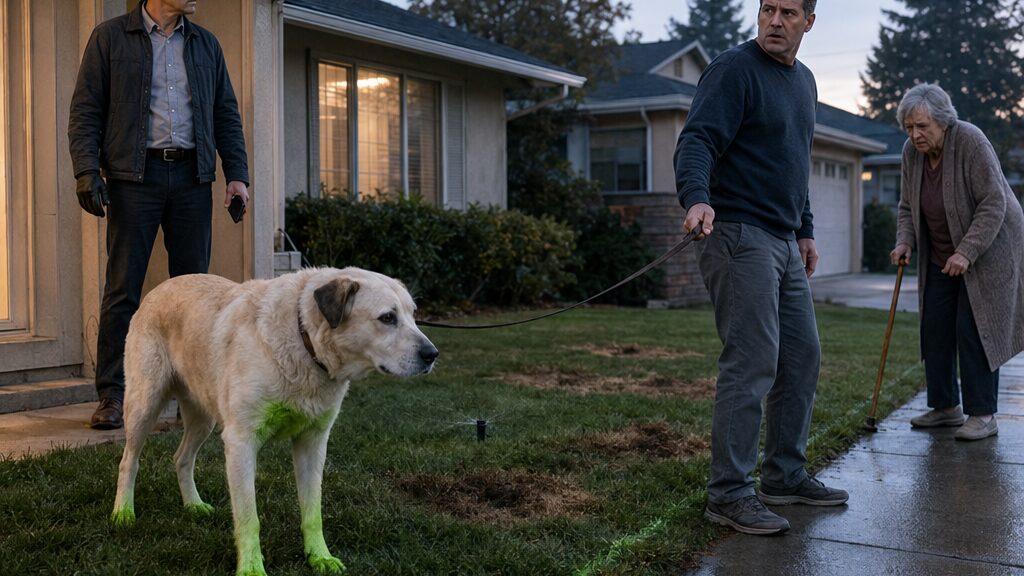
Its coat appeared nearly white in the gray morning. It moved with its usual heavy patience, nose low, leash extending behind it. Daniel followed along the sidewalk in a dark sweatshirt.
The dog reached the boundary.
For half a second, Thomas thought it might turn.
Then one front paw stepped into the treated grass.
The second followed.
Thomas felt his jaw lock.
The dog crossed the green line exactly where the earlier footage had shown. Moisture brushed its paws and lower legs. It continued toward the sprinkler, circled once, and stopped.
Daniel remained on the sidewalk.
He looked toward Thomas’s porch.
He knew about the camera. He knew about the complaint. He knew the ordinance had been placed in his hand.
Still, he did nothing.
The proof should have felt clean. Instead, Thomas noticed another shape at the edge of the frame.
An older woman stood near Daniel’s driveway.
Shirley Roberts wore a long cardigan over what looked like a nightgown. One hand gripped the top of a walking cane. The other rested against Daniel’s trash enclosure. Even through the camera’s grainy image, Thomas could see the unsteadiness in her knees.
She called something that the microphone did not catch.
Daniel turned toward her. His posture changed. The hardness left his shoulders, and he lifted one hand as if telling her to wait.
The dog finished and walked back across the same line. This time its chest brushed the damp grass where the ground sloped upward. Its paws were visibly green before it reached the sidewalk.
Daniel did not notice.
He shortened the leash and hurried toward Shirley.
Thomas watched the three of them move out of frame.
The first thing he felt was satisfaction.
Not joy exactly. A release. The kind that came when a difficult irrigation leak finally surfaced after hours of tracing pressure loss underground. The route was visible now. Daniel could deny intention, but he could not deny the path.
Then Thomas replayed the clip and stopped on Shirley.
6:46:12 a.m.
Her cane was angled badly. Her free hand pressed white against the fence.
Why had she been waiting outside before sunrise?
Thomas saved the video and went to work.
By 7:20, the neighborhood group chat began to fill.
A resident posted a photograph taken through a car windshield. Daniel’s pale dog was walking along Cedar Ridge Drive with fluorescent green paws. A streak crossed its chest. The caption read: DOES ANYONE KNOW WHAT HAPPENED TO THIS DOG?
Three laughing emojis appeared.
Then five.
Someone asked whether it had rolled in lawn paint. Someone else wrote that it looked radioactive. A third resident posted a closer picture of Daniel kneeling beside the dog near his driveway, his hands stained green as he tried to wipe its fur with a towel.
Thomas stood beside a city truck, reading the messages while his crew unloaded mulch.
He could have said nothing.
Instead, he typed: Temporary non-toxic turf dye. Applied to my property after repeated trespassing.
He attached a still frame from his camera showing the dog crossing the lawn.
The response was immediate.
So THAT’S where it’s been going.
Brilliant.
That’s cruel.
Did you put chemicals on an animal?
He didn’t. The dog entered his yard.
Poor dog has idiot humans.
Thomas locked his phone, but the vibration continued against his palm.
At 8:05, Daniel called.
Thomas watched the name appear until the call ended. A voice message followed.
“You think this is funny?” Daniel said. His breathing was hard, as though he had been moving quickly. “You put something where you knew my dog would walk. My mother touched him. Her hands are green. People are taking pictures outside my house.”
Thomas replayed the message once.
Daniel had not asked whether the dye was toxic. He had not mentioned the lawn.
At 8:22, Amanda Lewis sent Thomas a direct message.
I work at the veterinary clinic. Daniel brought the dog in. What exactly did you use?
Thomas photographed the label and safety sheet.
Her reply came ten minutes later.
This product should wash off and isn’t expected to injure him. I’ll confirm after the veterinarian checks him.
Relief loosened something in Thomas’s chest.
Then another message appeared.
Safe doesn’t automatically mean right.
Thomas put the phone away.
By noon, the green dog had become the only subject anyone in Cedar Ridge seemed able to discuss. A delivery driver slowed in front of Daniel’s house. Two teenagers walked past twice. Someone reposted the photograph in a local community page before an administrator removed it.
Thomas had imagined proof moving quietly through official channels: dated footage, a written complaint, perhaps a warning notice.
He had not imagined strangers laughing outside Daniel’s home.
At 1:17, Amanda called.
“The dog is fine,” she said. “No irritation. No breathing issue. They washed most of it off.”
“Good.”
“Shirley’s fine too.”
Thomas looked through the windshield at a row of city-planted trees waiting to be inspected. “She was outside this morning.”
“I know.”
“Why?”
There was a pause.
“You should ask Daniel.”
“He doesn’t answer questions.”
“That doesn’t mean the camera answered them.”
Thomas heard the rebuke and disliked that it landed.
“The dog crossed my property again,” he said. “Daniel stood there and let it happen.”
“I’m not defending that.”
“It sounds like you are.”
“I’m telling you two things can be true.”
Before Thomas could respond, his phone signaled an incoming email.
The subject line read: EMERGENCY NOTICE OF HOA VIOLATION.
He opened it while Amanda was still speaking.
The message cited an unauthorized chemical application, interference with a domestic animal, and conduct creating a visible neighborhood disturbance. A hearing had been scheduled within forty-eight hours. Failure to respond could result in daily fines.
Attached beneath Pamela Moore’s signature was a photograph of the green dog.
Not the security-camera image showing it crossing Thomas’s lawn.
The photograph from the group chat.
In it, Daniel knelt beside the dog while Shirley stood behind him, one hand gripping her cane and the other stained fluorescent green.
Chapter 4: The Rulebook Chose the Easier Target
Thomas’s security footage filled the conference-room wall before he had been offered a chair.
The image had been paused on the dog stepping across the property seam, both front paws stained green. Beside it, Pamela Moore had projected Thomas’s parcel map, the thin boundary line enlarged until it looked as wide as a road.
“The emergency meeting is limited to immediate safety concerns,” Pamela said. “The full hearing will address fines and corrective action.”
Thomas set the manufacturer’s safety sheet on the table. “Then start with safety.”
Pamela remained standing at the head of the table. The property manager sat beside her, typing without looking up. Two board members had joined by video, their faces occupying small rectangles on a laptop screen.
Daniel sat across from Thomas with his arms folded. He had changed into a collared shirt, but green still marked the creases around two fingernails.
“The dog was taken to a veterinarian,” Daniel said. “My mother got the substance on her hands.”
“And both are fine,” Thomas said.
“You didn’t know that when you sprayed it.”
“I knew what the product was.”
“You knew where my dog walked.”
Thomas looked toward Pamela. “That is the reason we’re here.”
Pamela lifted one hand. “Mr. Adams, no one is disputing that there was a neighbor conflict.”
“Repeated trespass isn’t a conflict. It’s conduct.”
“And applying a chemical where an animal was expected to enter may also be conduct.”
Thomas slid the safety sheet toward her. “Water-based turf marker. Non-toxic when used as directed. Approved for temporary landscape marking.”
The property manager finally looked up. “Was the application approved by the architectural committee?”
Thomas stared at him. “It was a two-inch temporary line in grass.”
“The landscaping standards require prior approval for visible alterations.”
“It wasn’t visible until Daniel’s dog entered my yard.”
Pamela’s lips pressed together. “It became highly visible.”
There it was. Not danger. Appearance.
Thomas glanced at the projected photograph from the group chat. Daniel kneeling beside the dog. Shirley behind him with her cane. The image made Thomas’s yard invisible. It contained none of the brown patches, none of the timestamps, none of Daniel’s stillness while the dog crossed.
Only consequence.
A knock sounded, and Amanda Lewis entered carrying a thin folder from the veterinary clinic.
Daniel turned toward her immediately. “Tell them.”
Amanda took the empty chair between the two men but did not open the folder.
“The veterinarian found no skin irritation, eye exposure, breathing difficulty, or toxic reaction,” she said. “The dog was washed and released. Shirley had minor staining on her hands. No treatment was necessary.”
Thomas felt the room shift, not toward him exactly, but away from the ugliest accusation.
Pamela cleared her throat. “So there was no injury.”
“No physical injury,” Amanda said.
Daniel’s chair creaked as he leaned back. “That doesn’t make it acceptable.”
“I didn’t say it did.”
Amanda turned to Thomas. Her voice remained calm, which made the question harder to avoid.
“Did you place the dye because you expected the dog to cross it?”
“Yes.”
“Did you warn Daniel that you planned to do that?”
“No.”
“Did you consider that other people might touch the dog before the dye was discovered?”
Thomas looked at the green marks around Daniel’s nails. “The product is safe.”
“That wasn’t my question.”
A faint buzzing came from the projector.
Thomas had defended chemical applications before city councils, school administrators, and parents who saw a warning flag in public turf and assumed poison. He knew how to explain exposure limits and dilution rates. He knew how to answer fear with evidence.
But Amanda was not asking about toxicity.
“No,” he said. “I didn’t consider that.”
Daniel gave a short, humorless laugh.
Thomas faced him. “You also knew exactly where your dog was going.”
“I’m not the one who set a trap.”
“It wasn’t a trap.”
“You waited for him to step in it.”
“I waited for proof.”
“You already had video.”
The sentence landed harder than Thomas expected.
Pamela turned off the projected footage. The wall went blank, leaving a pale square where the image had been.
“The association will remove any reference to animal cruelty from the emergency notice,” she said. “However, the unauthorized landscape application and nuisance provisions remain under review.”
“Nuisance?” Thomas asked.
“The disturbance generated significant resident complaints.”
“The disturbance was a photograph people shared.”
“The condition originated on your property.”
“So did the damage.”
Pamela gathered the safety documents into a neat stack without returning them. “The board does not adjudicate municipal pet-waste violations.”
“But it does adjudicate two inches of temporary color.”
“The covenants are explicit.”
Thomas almost smiled. “They were explicit last week too.”
Pamela’s expression did not change.
The meeting ended with no fine amount and no dismissal. Thomas left carrying a formal notice requiring him to remove all visible residue within twenty-four hours. Daniel followed several steps behind.
In the parking lot, Daniel spoke loudly enough for the property manager to hear.
“My attorney said this pattern could qualify as harassment.”
Thomas stopped. “Pattern?”
“Cameras. Photographs. Chemicals. Public accusations.”
“I posted one factual explanation after people asked why your dog was green.”
“You gave them the picture.”
“You gave them the dog.”
Amanda stepped between their lines of sight. “Enough.”
Daniel held up a folded document. “Formal complaint. It’s filed.”
Thomas looked at the paper but did not reach for it.
Daniel walked away.
Amanda waited until his truck had left before speaking. “You were right about the trespass.”
Thomas rubbed his thumb over the edge of the HOA notice. “That sounds like it comes with another sentence.”
“It does.”
She led him toward the sidewalk rather than their cars. A faded green streak remained in the gutter where Daniel had washed the dog. It was already thinning into the concrete.
“You keep acting like the footage shows everything,” Amanda said.
“It shows Daniel standing there.”
“Yes.”
“It shows him allowing it.”
“Yes.”
“Then what am I missing?”
Amanda looked toward Daniel’s house. “Shirley.”
Thomas followed her gaze.
The route along the sidewalk bent around the far end of the block before returning to the Roberts driveway. It was not far to Thomas. Maybe six minutes at a normal pace.
Amanda tapped the rubber tip of an imaginary cane against the concrete.
“Shirley can’t manage the long loop anymore,” she said. “Some mornings she can barely make it from Daniel’s driveway to the mailbox.”
Thomas thought of the camera timestamp. Shirley gripping the trash enclosure at 6:46, her knees unsteady beneath her nightgown.
“What does that have to do with where the dog goes?”
Amanda’s expression tightened.
“That,” she said, “is what Daniel has been refusing to tell you.”
Chapter 5: The Route Behind Daniel’s Refusal
Shirley Roberts was waiting on her porch when Thomas came home three days later.
The dog lay beside her chair, its coat pale again except for a faint green shadow around one paw. Shirley held her cane across her knees. A short line of faded chalk ran from the porch steps toward the side yard, stopping at the fence.
Thomas had intended to go inside.
Shirley lifted her chin. “Why did you make my dog carry your argument home?”
The question left him standing at the edge of her walkway.
“I didn’t put anything on him,” Thomas said.
“You put it where you knew he’d step.”
“Yes.”
She looked toward his lawn, where the damaged circles remained visible despite the watering. “Daniel should’ve cleaned up.”
Thomas waited.
“He should’ve kept him off your grass too,” she added.
The admission offered less relief than it would have a week earlier.
“Then why didn’t he?”
Shirley’s fingers tightened around the cane. “Because my son can turn a simple problem into a locked door.”
The front door opened behind her.
Daniel stepped out carrying a bag of trash. When he saw Thomas, he stopped.
“You need something?”
“Your mother asked me a question.”
“I heard.”
Shirley tapped the cane against the porch board. “And now I’m asking one of you to answer mine without circling it.”
Daniel set the trash bag down.
Thomas looked at the chalk line near the steps. “Amanda said you can’t manage the full loop.”
Shirley’s mouth flattened. “Amanda talks when she thinks silence is doing damage.”
“Is she wrong?”
“No.”
Daniel descended one step. “This isn’t your business.”
“You made it my business every morning.”
“My mother walks the dog with me.”
Thomas looked at Shirley. “At six forty-five?”
“Some mornings,” she said.
Daniel’s jaw worked before he continued. “The sidewalk slopes near the storm drain at the far corner. She fell there in January. Since then, we cut through the short side.”
“The short side is my lawn.”
“The dog pulls toward the open grass. I’m holding her arm half the time.”
“You were standing alone in three recordings.”
“Because I’d already walked her back to the driveway.”
Thomas glanced from Daniel to the chalk line. “Then take the dog behind your house.”
“The rear gate sticks. The path is gravel. She can’t use it safely.”
“That still doesn’t explain why you didn’t pick up after him.”
Daniel looked away.
Shirley answered. “Because he was angry.”
Daniel’s head turned sharply. “Mom.”
“You were,” she said. “First because Thomas mentioned the ordinance. Then because Pamela had already been in your ear.”
Thomas felt the name pull the conversation in a new direction. “Pamela knew?”
Daniel picked up the trash bag again but did not move.
Shirley looked at him. “Tell it cleanly or don’t tell it.”
He let the bag fall.
“My mother’s house had a water leak last winter,” Daniel said. “She stayed with me while the floors were replaced. Then insurance stalled. Then the contractor found mold behind the laundry-room wall.”
“So she stayed longer.”
“Yes.”
Cedar Ridge’s covenants required long-term adult occupants to be registered with the association. Thomas had always assumed the rule existed for parking permits and emergency contact lists.
Daniel rubbed both hands over his face. “Her place is outside the neighborhood. She gets mail here now. Her insurance paperwork comes here. Pamela noticed.”
“What did she say?”
“That if complaints started involving my address, the board might have to determine whether my mother was an unregistered resident.”
Shirley gave a soft, disgusted sound. “As though I’d been smuggled across a border.”
Daniel ignored it. “I’m already paying part of her mortgage, my own mortgage, and the contractor deposit. If the HOA starts daily occupancy fines, I can’t carry all of it.”
Thomas looked at Shirley’s cane. “Why not register her?”
“Because the form requires proof she has no other primary residence. She does. It’s just not livable yet.”
“And Pamela knew that.”
“She said she was giving me time.”
Thomas pictured Pamela sliding the photographs back across the table and calling the matter neighbor to neighbor. She had not been avoiding conflict. She had been containing it.
“So every time I complained,” Thomas said, “you thought I was threatening this arrangement.”
Daniel met his eyes. “You walked over with a city ordinance in your pocket.”
“I walked over because your dog was killing my lawn.”
“You don’t talk to people. You build a case.”
“I talked first.”
“You announced terms.”
Thomas felt the old anger rise, cleaner now because parts of Daniel’s explanation sounded true.
“You could have said, ‘My mother can’t handle the longer route. Can we work something out?’”
Daniel laughed once. “And you would’ve done what? Drawn us a crossing schedule?”
“Maybe.”
“No. You would’ve printed a liability waiver.”
Shirley struck the porch board with the cane tip. “Both of you stop telling each other what the other man would have done.”
The dog lifted its head.
For a moment, no one spoke.
Thomas looked toward the rear walkway. The gravel was loose and uneven. A trash bin narrowed the passage beside the garage. A person with an uncertain step would have trouble there.
The route had not been chosen only to insult him.
But the waste had still been left. The warning had still been mocked. The heel print near the sprinkler had still been three feet inside his yard.
“I’ll withdraw anything that puts Shirley’s housing at risk,” Thomas said. “But the lawn gets repaired, and the dog stops crossing it.”
Daniel’s face hardened. “You want money.”
“I want restitution.”
“For grass.”
“For damage you caused.”
“I just told you what I’m paying.”
“That explains why you’re worried. It doesn’t erase what you did.”
Daniel stepped off the porch. “And what about what you did?”
“The dog wasn’t hurt.”
“You made him a neighborhood joke. You made my mother part of the picture. People drove past this house laughing.”
“I didn’t take that photograph.”
“You posted the footage that fed it.”
Thomas opened his mouth, then stopped.
He remembered typing the explanation beside the city truck. Temporary non-toxic turf dye. Applied to my property after repeated trespassing.
He had called it factual.
He had watched the laughing emojis multiply.
A part of him had wanted Daniel to see every one.
Shirley shifted in her chair. “Pamela told Daniel she could keep the residency question quiet. That was before your complaint.”
Thomas looked at Daniel. “She offered silence in exchange for yours.”
Daniel said nothing.
“The HOA cited me within hours,” Thomas continued. “But she never logged your violations.”
“She was trying to keep this from getting bigger.”
“She was choosing which rules existed.”
Daniel’s eyes narrowed. “Don’t turn my mother into your case against Pamela.”
“I’m trying not to.”
“No, you’re changing targets because the first one made you look bad.”
The accuracy of the blow surprised Thomas into stillness.
Daniel picked up the trash bag and walked toward the side gate.
Thomas called after him. “Are you going to apologize?”
Daniel stopped with his back turned.
“For the dog crossing your lawn?” he said. “Yes, I should’ve stopped it.”
“That isn’t an apology.”
“No.”
He faced Thomas again.
“You want the truth? After you came to my door with that paper, I let him go farther in once. I was angry. I knew you’d see it.”
Shirley closed her eyes.
Daniel’s voice lowered. “That was wrong. But don’t stand there pretending this was only about proof. You watched that green spread across him, and for a little while, you enjoyed what it did to me.”
Thomas could not answer without lying.
Daniel lifted the trash bag and disappeared behind the garage.
The faded chalk line remained between Thomas and Shirley, marking a route that explained more than it excused.
Chapter 6: Twenty-Nine Incidents and One Missing Record
The municipal clerk placed a ruler beneath the incident numbers and frowned.
“Seventeen, eighteen, nineteen,” she said. “Then twenty-three.”
Thomas leaned across the counter. “Where are twenty through twenty-two?”
“In the database. They’re just not in your association packet.”
The records office smelled of paper dust and burnt coffee. Thomas had requested every animal-control report connected to Cedar Ridge addresses during the previous eighteen months. He expected a few complaints about loose dogs and barking.
The clerk turned the monitor toward him.
Twenty-nine separate incidents involved Daniel’s address or the pale dog’s description. Most were low-level reports: waste left on common grass, leash extended beyond control, dog entering another yard. Several had been closed with warnings because the reporting resident supplied no photograph.
Thomas scanned the dates.
Some preceded his own damaged lawn by months.
“Can you print the full disposition history?”
“Yes, but the HOA liaison log is separate.”
“What liaison log?”
“When an association asks for notice of repeated municipal complaints, we transmit summaries. Cedar Ridge requested that service two years ago.”
Thomas felt a pressure behind his ribs. “So the HOA should have received these.”
The clerk clicked through another screen. “They received twenty-nine transmission notices.”
He removed his green highlighter from his shirt pocket and marked the incident numbers on the printed index. The color looked dull under the office lights, nothing like the violent fluorescence on the dog’s coat.
At home that evening, Thomas compared the municipal list with the HOA documents Pamela had produced for the upcoming hearing. Cedar Ridge’s packet contained twenty-four entries.
Five were missing.
Three involved Daniel.
Two concerned another board member’s property.
Thomas arranged the records across his kitchen table. Security timestamps. Lawn receipts. The dye safety sheet. Daniel’s harassment complaint. Shirley’s residency notice, which had appeared in the HOA file only after the green-dog incident.
The facts no longer formed the simple line he had wanted.
At 8:10, Pamela called.
“I understand you requested municipal liaison records,” she said.
Thomas highlighted another missing case number. “They’re public.”
“That isn’t what I asked.”
“No. It’s what you’re worried about.”
A pause followed.
“The board’s records are compiled by volunteers,” Pamela said. “Administrative gaps occur.”
“Only around people you’ve made private arrangements with?”
Her voice cooled. “Be careful, Thomas.”
“You told Daniel you’d overlook Shirley’s occupancy if his address stayed out of complaints.”
“Daniel told you that?”
“Is it false?”
Pamela did not answer directly. “Mrs. Roberts is in a difficult temporary situation. The board exercised discretion.”
“You exercised discretion on her residency and his dog. Then cited me in six hours.”
“Your action created public alarm.”
“My action created a visible dog.”
“It created reputational damage to the community.”
Thomas looked at the frozen image in the hearing packet. The green dog. Daniel kneeling. Shirley behind him.
“What do you want?” he asked.
Pamela exhaled softly, as though relieved to have reached the useful part of the conversation.
“If you withdraw the liaison-record request and agree that the chemical application was inappropriate, I believe the board can dismiss your landscaping violation.”
“And Daniel’s reports?”
“Animal control may proceed independently.”
“You want me to drop the evidence that you ignored.”
“I want this dispute resolved without damaging uninvolved residents.”
“Shirley?”
“And the community.”
Thomas closed the green highlighter.
“You’re offering me a trade.”
“I’m offering proportionality.”
“You had proportionality available before you used my own footage against me.”
Pamela’s tone hardened. “If you continue, the board will be obligated to review every related compliance issue. Including unregistered occupancy.”
There it was, stated without the courtesy of implication.
Thomas imagined placing all twenty-nine incidents before the hearing. He could demand every permitted fine. At $100 per violation, the total would strike Daniel where he was already weakest. He could force Pamela to explain every missing record in front of residents.
He could win so thoroughly that Shirley lost the room where she slept.
“I’ll see you at the hearing,” he said.
He ended the call.
The next morning, a message from Daniel appeared in the neighborhood group chat.
Since rumors are spreading, people should know Thomas Adams has been using cameras and chemicals to target my elderly mother and her service needs. She is recovering from a fall and cannot safely use the longer walking route. We asked for basic understanding and received public humiliation instead.
Thomas read it twice.
No request had been made before the dye. The dog was not Shirley’s service animal. Daniel had omitted the warnings, the waste, and his own admission that one deeper trespass had been deliberate.
But the photograph beneath his post showed Shirley holding her cane beside the pale dog.
Within minutes, residents began responding.
This changes everything.
Why wasn’t this mentioned before?
There had to be a better way.
Thomas typed a reply, deleted it, and typed another.
He could post the twenty-nine incidents. He could attach Daniel’s camera image and the heel print. He could explain that hardship had been discovered only after Daniel refused every direct approach.
Amanda sent him a private message before he pressed send.
Don’t litigate Shirley’s life in the group chat.
Thomas erased the reply.
That afternoon, he visited the HOA archive room under the records-inspection provision in the covenants. The property manager unlocked a filing cabinet and remained near the doorway.
Thomas found the liaison summaries in a folder marked COMMUNITY STANDARDS. Each page carried a handwritten notation in Pamela’s narrow script.
Monitor only.
Informal warning.
Do not escalate while occupancy issue remains unresolved.
Beside one complaint about Daniel’s dog, she had written: Avoid creating record that triggers residency review.
Thomas photographed the page.
The leverage was complete now. Enough to embarrass Pamela, punish Daniel, and prove that Thomas had been right about selective enforcement.
He returned home and opened the hearing statement he had drafted.
The final page listed his requested remedies:
Maximum municipal fines for all documented incidents.
Full lawn replacement.
Formal censure of Daniel.
Immediate board review of all related residency violations.
Thomas read the last line until the words lost shape.
Then he pictured Shirley on the porch asking why the dog had been made to carry the argument home.
He removed the residency demand first.
Then the request for maximum fines.
He kept the lawn invoice, the route restriction, the missing-record evidence, and a blank page beneath a new heading: Proposed Corrective Agreement.
By midnight, he had drawn a narrow gravel path along the property edge, outside the damaged grass but short enough for Shirley to use safely. The line curved between the two homes without entering the lawn.
Thomas traced it once with the green highlighter.
At the bottom of the hearing packet, where punishment had filled half a page, he wrote three words instead:
Repair. Route. Record.
Chapter 7: The Hearing Where Neither Man Won
The first image on the clubhouse screen was the green dog.
A murmur moved through the folding chairs before Thomas reached the front table. Someone near the back whispered that the picture had already been taken down from the neighborhood page. Someone else said it had been copied everywhere first.
Daniel sat beside Shirley in the front row. His hands were clasped between his knees. Shirley’s cane leaned against her chair, its rubber tip resting on the tile. Amanda sat across the aisle with a folder on her lap.
Pamela stood beneath the projected photograph.
“This hearing concerns unauthorized landscape treatment, alleged harassment, repeated animal-control violations, and related residency compliance,” she said.
Thomas placed his packet on the table.
The top page showed no photograph. Only three words.
Repair. Route. Record.
Pamela asked him to begin.
Thomas connected his laptop to the projector. The green dog disappeared. In its place appeared the parcel map, the repeated path through his lawn, and the line of damaged grass.
“I reseeded this area in March,” he said. “The direct cost was $180, not including water or labor. Between April 4 and April 26, Daniel’s dog entered my property repeatedly. I asked him to stop. He refused. I contacted animal control and the association.”
He advanced to the camera footage.
Daniel stood on the sidewalk while the dog crossed the lawn.
The room became quiet.
Thomas froze the frame at 6:45 a.m.
“This shows the conduct clearly,” he said. “It does not show the whole reason behind it.”
Daniel looked up.
Thomas changed the slide.
The route was redrawn in two colors: green through the lawn, gray around the corner and down the sloped sidewalk.
“Shirley has difficulty using the longer route. Daniel believed complaints involving his address could expose questions about her temporary occupancy. That explains why he resisted formal attention.”
Pamela interrupted. “Private residency matters should not be discussed in open session.”
“You placed them in the hearing notice.”
“Because they may be relevant.”
“They became relevant after Daniel’s dog turned green.”
The two board members at the side table exchanged a glance.
Thomas held up one of the municipal records. “There were twenty-nine transmitted animal-control incidents associated with Cedar Ridge during the review period. The HOA packet contains twenty-four.”
He projected the missing case numbers. A thin green highlight ran beneath each gap.
Pamela’s voice sharpened. “Administrative omissions are not evidence of selective enforcement.”
Thomas advanced again.
Her handwritten note filled the screen.
Avoid creating record that triggers residency review.
The silence changed. It no longer belonged only to Thomas and Daniel.
One board member leaned toward the microphone. “Pamela, is that your handwriting?”
“Yes. It reflects a discretionary attempt to prevent hardship.”
“Why was the complaint omitted?”
“It was monitored informally.”
Thomas looked toward Shirley. “The same discretion was not offered when my temporary turf marking became visible.”
Pamela folded her arms. “Your conduct created a safety concern and significant public disruption.”
“The safety allegation was withdrawn.”
“The disturbance was not.”
Thomas could feel the old version of his argument waiting for him: every timestamp, every violation, every exact rule Pamela had applied unevenly. He could have spent the rest of the evening proving that he had been treated unfairly.
Instead, he closed the incident list.
“I used the dye because I wanted proof no one could dismiss,” he said. “I had proof already. What I wanted was something Daniel could not ignore.”
Daniel’s eyes stayed on him.
Thomas continued. “The product did not harm the dog. But I placed it knowing the dog would cross it. When the pictures spread, I told myself the reaction was not my responsibility.”
Amanda watched him without expression.
“It was not all my responsibility,” Thomas said. “But some of it was.”
A chair creaked near the back.
Pamela seemed momentarily uncertain what to do with an admission that did not erase the evidence against Daniel.
Thomas placed the lawn invoice on the table.
“I am withdrawing my request for maximum fines. I am not requesting enforcement against Shirley’s occupancy. I am requesting reimbursement for documented lawn damage, a binding pet-routing agreement, and correction of the association’s complaint records.”
Daniel rose halfway from his chair. “You don’t get to present yourself as generous after using my mother to build this.”
Shirley caught his sleeve.
“Sit down,” she said.
He looked at her.
“You used me first.”
The words were quiet, but they reached the back row.
Daniel lowered himself into the chair.
Shirley steadied the cane between her knees. “My legs are bad. My paperwork is a mess. I was afraid I’d become another expense he couldn’t carry.”
Daniel’s face tightened.
“That does not mean the dog had to use Thomas’s yard,” she said. “And it does not mean you had to act like his complaint was beneath you.”
“He came at me with laws.”
“You answered with contempt.”
Daniel looked away.
Shirley turned toward Thomas. “And you made an animal wear what you wanted to say to a man.”
Thomas accepted the sentence without answering.
Pamela stepped closer to the table. “This association cannot resolve matters through personal confessions. We must apply the governing documents.”
“Then apply them evenly,” Thomas said.
Pamela glanced at the board members. “If Mrs. Roberts’s occupancy is formally placed before us, the board will be required to assess whether daily violations have accrued.”
Daniel stood fully this time. “You told me you were giving us time.”
“I said the board had exercised discretion.”
“You said keep the address quiet.”
Pamela’s expression hardened. “That is not an accurate characterization.”
Thomas projected the handwritten note again.
One board member removed his glasses. “It appears accurate enough to require separate review.”
The other board member asked the property manager for the full liaison archive. He did not have it.
Pamela looked around the room as though the disorder itself were an offense.
Thomas advanced to his final slide.
A narrow gravel path curved along the property edge, short enough to avoid the sloped corner and placed outside the repaired lawn. Estimated material cost appeared beside it. Thomas had divided that cost in half.
“This route solves the practical problem,” he said. “Daniel reimburses the lawn damage and keeps the dog on the agreed path. I pay half the path because it serves both properties. Amanda reviews the surface for Shirley’s safety. The association records the agreement and reviews its missing complaints.”
Daniel stared at the drawing.
“You designed that without asking me.”
“Yes.”
A few people shifted, expecting the old argument to restart.
Thomas slid a blank copy toward him. “So change it.”
Daniel did not touch the paper.
Amanda opened her folder. “The width should be increased by six inches if Shirley uses a cane. Compacted fines would be safer than loose gravel.”
Thomas uncapped a pen.
Daniel looked at his mother. Shirley nodded once.
He came to the table.
For the next twenty minutes, the hearing lost its spectacle. Measurements replaced accusations. The route moved closer to Daniel’s fence. A drainage edge was added. The reimbursement was reduced to documented seed, soil, and repair labor rather than full sod replacement.
When they reached the responsibility clause, Daniel stopped.
“It says I knowingly permitted repeated entry.”
“That is what happened,” Thomas said.
Daniel’s jaw tightened.
Shirley spoke from behind him. “Sign what is true.”
Daniel picked up the pen.
He signed the restitution agreement, the route restriction, and the joint construction plan. Thomas signed beneath him.
Pamela did not sign. The board members voted to accept the agreement provisionally and to open a separate review of complaint handling. Shirley’s residency matter was stayed until her paperwork could be assessed without daily penalties.
There was no applause.
Residents began folding chairs and speaking in low voices. The green-dog photograph remained absent from the screen.
Daniel gathered his copies.
Thomas extended his hand.
Daniel looked at it, then at Thomas’s face.
“I signed the agreement,” he said. “That’s what I can do tonight.”
He walked past without taking the hand.
Chapter 8: Where the New Boundary Was Drawn
Daniel arrived with a shovel before Thomas could begin alone.
Six weeks had passed since the hearing. The damaged lawn had been reseeded, and young fescue covered most of the brown circles with a lighter shade of green. Along the property edge, Thomas had marked the approved path with small wooden stakes and white string.
Daniel stopped beside the first stake.
“You moved it two inches toward my side.”
“The drainage swale is wider than the plan showed.”
Daniel pressed the shovel blade into the soil. “You could’ve told me.”
“I’m telling you.”
For a moment, neither man moved.
Then Daniel pulled the blade back and cut the first edge.
They worked without much conversation. Thomas stripped the sod in clean rectangles. Daniel broke the compacted soil beneath it. Amanda arrived with a level and tested the slope, making them lower one section near the driveway so Shirley’s cane would not catch.
The pale dog watched from Daniel’s porch.
It wore a short leash clipped to the railing.
By noon, the narrow route had taken shape: compacted stone fines bordered by steel edging, firm enough for a cane and separate from Thomas’s grass. It was not decorative. It looked deliberate.
Shirley came outside after lunch.
She had secured a temporary occupancy registration through the association, with a review date tied to repairs at her own house. Pamela had resigned as board president two weeks after the archive review began. The notice posted near the mailboxes described her departure as personal, though everyone in Cedar Ridge understood the timing.
Shirley placed her cane on the new surface.
Amanda walked beside her without touching her arm.
At the midpoint, Shirley stopped and pressed the cane tip down twice. “Doesn’t shift.”
“That was the idea,” Thomas said.
She looked at him. “Ideas work better when people know they’re part of them.”
Thomas nodded. “Yes.”
Daniel unclipped the dog.
The animal stepped from the porch and moved toward the old path through Thomas’s lawn. Its head lowered at the familiar edge.
Daniel shortened the leash.
Before he could pull, the dog stopped.
Its paws remained on the new path. It sniffed the grass, then turned and followed the compacted line toward Shirley.
Thomas watched the clean division between the pale stone and the green fescue. The boundary was clearer than the fluorescent strip had ever been, but it carried no accusation.
Daniel noticed him looking.
“Don’t make too much of one good pass,” he said.
“I wasn’t.”
“You were.”
Thomas almost answered, then let the remark settle without defense.
They finished the final section late in the afternoon. Amanda left after confirming the slope. Shirley returned inside. The dog slept in the shade near Daniel’s garage.
Thomas knelt at the far end of the path and tightened the last piece of edging.
Behind him, Daniel said, “The print by the sprinkler was mine.”
Thomas continued turning the wrench. “I know.”
“No. You suspected.”
Thomas stopped.
Daniel rested both hands on the top of his shovel.
“The morning after you came to my door, I walked him farther in,” he said. “Not because of my mother. Not because of the slope. I was angry.”
The admission had already been half-made on Shirley’s porch, but now Daniel offered it without using Thomas’s conduct to brace against it.
“I wanted you to find it,” Daniel said. “I wanted your camera to catch enough that you’d know I’d ignored you.”
Thomas stood.
“Why?”
“Because you came over like the decision had already been made. Like I was a problem you’d measured.”
“I brought you an ordinance after you damaged my yard.”
“You’re doing it again.”
Thomas looked down at the straight steel edge between them.
Daniel exhaled. “I’m not saying you were wrong to complain. I’m saying I wanted to make you feel as small as I felt standing in that doorway.”
Thomas remembered the folded photograph in Daniel’s hand, the ordinance caught as the door closed, and his own satisfaction when the first green paw appeared on the camera feed.
“It worked,” he said.
Daniel gave him a guarded look.
Thomas wiped soil from the wrench with his glove. “And when the pictures spread, I wanted you to feel smaller.”
The dog shifted in its sleep.
Daniel looked toward the porch. “My mother still hates that picture.”
“So do I.”
“That’s convenient now.”
“It is.”
Thomas did not try to improve the admission.
The afternoon light stretched the steel edging into a narrow dark line. Beyond it, the repaired lawn was beginning to blend with the older grass, though the difference remained visible to anyone who knew where to look.
Daniel pressed the shovel into the ground and leaned on it.
“I can pay the second half of the lawn reimbursement next Friday,” he said.
“The agreement says the end of the month.”
“I know.”
“Friday is fine.”
Daniel nodded.
It was not forgiveness. It was scheduling.
They carried the unused stone to Daniel’s garage. On the back wall hung the old ladder Daniel had loaned Thomas years before. One side rail was flecked with roof paint from the hailstorm repairs.
Thomas touched the rail. “You ever want this back?”
Daniel looked at it. “You’re the one who stored it.”
“You said you didn’t have room.”
“I still don’t.”
Thomas left it hanging.
When they returned outside, Shirley had opened the front window. She watched as Daniel walked the dog along the new route. At the end, he stopped, waited, and used a bag from the dispenser mounted beside his fence.
Thomas turned on the irrigation system.
The sprinkler heads rose in sequence. Water arced across the lawn but stopped short of the path. No spray struck the stone. No runoff crossed toward Daniel’s driveway.
One head near the old damaged circle rotated too far.
Thomas adjusted it with a small screwdriver until the stream ended precisely at the grass edge.
Daniel watched from the path.
“You going to put a camera on this too?”
“The old one’s still there.”
Daniel glanced toward the porch eave.
Thomas looked at the same lens. It had captured proof, contempt, Shirley’s unsteady hand, and more truth than he had known how to read.
“I’m changing the angle,” he said.
That evening, he lowered the camera so it covered only his driveway and front steps. The path disappeared from the frame.
Near the last stake, Thomas found the bottle of turf dye in his work bucket. He had brought it outside to mark the edging cuts but had not needed it.
He unscrewed the cap.
With the applicator tip, he placed one faint green mark at the end of the new path. It glowed briefly against the pale stone, a thin reminder of the line that had once exposed everything except what mattered most.
Thomas looked toward Daniel’s house.
Daniel stood behind the screen door. He saw the mark but said nothing.
Thomas carried the hose to the path and opened the nozzle.
The green thinned, ran between the compacted stones, and vanished into clear water. When he shut the hose off, the boundary remained—solid, ordinary, and made by both of them.
The story has ended.