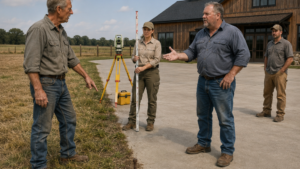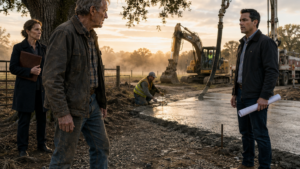
The Smoke Across the Fence Hid the Real Reason Their Farm Was Running Out of Time
Chapter 1: Smoke Crossed the Fence Before Anyone Knew Why
Karen Green raised her phone above the cedar fence and pointed it at George Allen as though she were documenting a crime.
“I already called the county,” she said. “They’re on their way.”
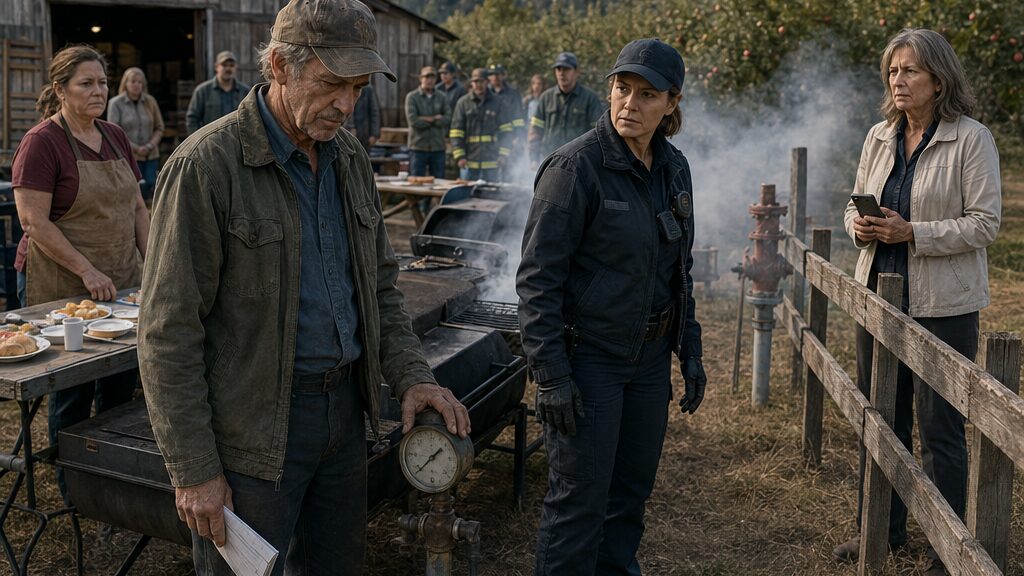
Smoke rolled between them in gray sheets, thinning as it crossed the dry lane beside her property. Behind George, hamburger patties hissed across two propane grills while folding tables sagged beneath pies, paper plates, and jars marked for donations. Families stood beneath the packing-yard roof, talking over the rattle of an old box fan. A hand-painted banner read SUPPORT OUR RURAL CLINIC.
George lowered the lid on the nearest grill.
“All right,” he said.
Karen’s phone dipped. She had expected an argument.
“This is the third weekend,” she said. “My porch smells like a burn barrel. My laundry smells like grease. And there are children standing ten feet from dry grass.”
George glanced toward the mowed strip between the packing yard and the fence. Thirty feet wide, scraped to bare soil at the far end, it was cleaner than it had been in years.
“The wind shifted,” he said.
“That doesn’t make smoke safe.”
“No.”
His answer seemed to irritate her more than denial would have.
Emma Lewis left the donation table and crossed the yard, wiping her hands on her floral apron. “Karen, this is a clinic fundraiser. We’ll be finished before dark.”
“A fundraiser doesn’t suspend fire rules.”
“No one said it did.”
“George acts like they don’t apply to him.”
Several conversations behind them softened. George could feel people listening without looking. He kept one hand on the grill lid and the other against the steel pipe rising from the ground beside it. A dented pressure gauge was bolted to the pipe at waist height.
Its needle trembled below sixty pounds.
He shifted his palm over the glass.
Karen aimed her phone toward the gauge. “What are you hiding?”
“Nothing you need to worry about.”
The words came out harsher than he intended. Emma looked at him. Karen smiled once, without humor.
“That’s what you always say.”
A child ran past carrying a paper cup. George caught the boy gently by the shoulder before he reached the grill line and turned him back toward the tables.
“Walk near the cooking area,” George said.
The boy nodded and hurried away.
Karen kept filming. “You see? Crowded yard, dry grass, smoke over the property line. The county can decide whether I need to worry.”
George looked beyond her toward the adjoining field. Karen had let most of it grow high since returning to the property in spring, but a pale strip had recently been cut around the house. She had done that after his note about the permitted brush burn. She had never acknowledged the note, but she had cut the strip.
A siren chirped once from the county road.
The packing yard fell quiet.
A white county utility truck came through the orchard entrance, followed by a volunteer fire unit. Michelle Carter stepped out of the first vehicle wearing tan work pants and a navy county shirt. Two volunteer firefighters climbed from the second truck.
Karen moved immediately toward the gate.
“Thank you for coming,” she called. “He’s been sending smoke onto my land for weeks.”
Michelle surveyed the grills, the tables, the children, and the cleared lane. Her gaze stopped briefly on the fundraiser banner.
“My office received a complaint of excessive smoke and unsafe open burning,” she said.
“We’re cooking hamburgers,” George replied.
“There’s also smoke coming from the north rows,” Karen said. “He burns whenever he feels like it.”
George took a folded permit from his shirt pocket and handed it to Michelle.
She opened it. “This covers the public event and food-service fire setup.”
“That’s today.”
“It doesn’t cover orchard debris burning.”
“I’m not burning debris today.”
Karen swiped through photographs on her phone. “He did three days ago.”
“With a permit,” George said.
Michelle looked up. “Do you have that one?”
“In the office.”
Karen gave a short laugh. “Of course it’s somewhere else.”
George met Michelle’s eyes. “You can inspect the whole yard.”
One of the firefighters walked the perimeter, measuring distances from the grills to the roof posts and grass lane. The other checked extinguishers. Emma stood beside the donation jars, her arms folded tightly.
Michelle examined the propane connections, then looked at the nearest grill. “Wind’s carrying the smoke, but cooking smoke by itself isn’t a county burn violation.”
Karen’s face tightened. “So he gets to ruin my property because he put a charity sign up?”
“That isn’t what I said.”
“My family donated to the clinic too. That doesn’t make this safe.”
The remark changed the air. Emma’s expression softened for a moment, but Karen had already turned back toward George.
Michelle handed him the permit. “Your event authorization is valid. The grill spacing is acceptable. The extinguishers are current.”
A murmur moved through the crowd. Someone behind George released a breath. For half a second, he felt the weight lift.
Then Michelle saw his hand covering the gauge.
“What pressure are you carrying on the emergency line?”
George removed his palm.
The needle had fallen below forty.
Michelle leaned closer. “Is that accurate?”
“It sticks.”
“When was it calibrated?”
“It’s old.”
“That wasn’t my question.”
Robert Nelson emerged from the packing shed with a tray of uncooked patties. He saw Michelle beside the gauge and stopped.
George answered, “Last season.”
Robert’s eyes moved from him to the needle.
Michelle signaled to one of the firefighters. “Open the yard hydrant.”
The firefighter crossed to the red standpipe near the fence and attached a short test hose. Karen stepped closer, still recording. Families drew their children away from the grills.
George could hear the pump cycling under the ground—a faint mechanical shudder, then silence, then another shudder. It had been doing that for eleven days.
The firefighter cracked the valve.
A brown burst of water struck the dirt, then narrowed to a weak stream.
Michelle watched the gauge drop past thirty.
Robert set down the tray. “Uncle George.”
“Not now.”
“You said the pressure issue was the south block.”
“It is.”
“This line feeds from the main pump.”
Michelle turned to George. “How long has this been happening?”
Karen’s phone remained fixed on him. Emma waited near the tables, her face no longer defensive.
George looked at the weak water spreading through the dust. He could have said the pump had failed that morning. He could have blamed sediment, a bad gauge, a temporary draw from the packing shed.
Instead, he said, “It’s being handled.”
Michelle’s expression hardened. “Shut down one grill. Keep the other under direct supervision. No additional ignition sources anywhere on the property.”
Karen said, “You’re letting him continue?”
“For today, under supervision. The cooking setup passed. The water system did not.”
The crowd’s relief vanished as quickly as it had come.
George closed the second grill and disconnected its propane tank. Smoke escaped around the lid, crossed the yard, and slid through the cedar slats toward Karen’s property.
At the hydrant, the firefighter opened the valve farther.
The pipe coughed once, released a pocket of air, and went dry.
Chapter 2: The Permit Was Valid but the Water Was Not
The red suspension notice hung beside the fundraiser banner before the last volunteer had carried away the folding chairs.
PUBLIC EVENTS SUSPENDED PENDING FIRE-WATER INSPECTION.
The paper moved whenever the box fan turned, tapping the wooden post with a dry, repetitive sound.
George pulled trash bags from their frames while Emma counted the donations at the far table. No one spoke above a murmur. The hamburgers had sold, but families had left early, glancing toward the hydrant as though it might explain something if they looked long enough.
Michelle stood near her truck completing the notice.
“The cooking smoke did not violate the county limit,” she told George. “I’ll put that in the report.”
Karen had gone home twenty minutes earlier. Her absence felt less like relief than a space she had left behind.
George tied a bag. “Then why suspend the events?”
“You know why.”
“The hydrant isn’t part of the grill permit.”
“It is part of your emergency plan. Your application says the yard has an active high-volume line.”
“It does.”
Michelle looked toward the dry hose lying in the dirt.
“It has a line,” she said. “It does not have dependable pressure.”
Robert came out of the shed carrying the dented gauge and a wrench. “I’m checking the pump house.”
“I’ll do it,” George said.
“You’ve been doing it.”
The words were quiet, but Emma looked up.
Michelle handed George a copy of the notice. “No public gatherings, controlled burns, or paid events until the system passes inspection. I’ll return after repairs.”
“How long do I have?”
“That depends on what’s wrong.”
“The clinic has another fundraiser next Saturday.”
“Then move it.”
Emma closed the metal cash box. “We don’t have another site with power, refrigeration, and parking.”
Michelle’s face softened, but her voice did not. “I can’t write a different fire code for a good cause.”
George folded the notice once and put it into his pocket.
Michelle studied him for a moment. “You invited me to inspect the entire yard. That was the right decision.”
He almost laughed. It had not felt like a decision. It had felt like stepping aside before a door struck him.
After the county trucks left, Emma brought him the cash box.
“We cleared a little over three thousand,” she said. “Less than expected, but enough to keep the equipment order open.”
George nodded.
“You should have told me about the water.”
“It’s a pump.”
“It was an empty hydrant in a yard full of children.”
“I know what it was.”
Emma’s mouth tightened. “Do you?”
She carried the box to her car before he could answer.
By dusk, the smell of smoke had worked into George’s jacket. He hung it inside the packing shed, but the odor remained on his shirt and hands. It followed him down the orchard road to the pump house, where Robert had already removed two access panels.
The pump house was a square concrete room half sunk into the slope. The motor filled most of it, connected to a web of rusting pipes and electrical boxes. Robert knelt beside the main intake valve with a flashlight between his teeth.
“What did you touch?” George asked.
Robert removed the light. “Nothing yet.”
“Then don’t.”
“There’s wire on the bypass.”
George looked past him.
A length of baling wire had been twisted around the bypass lever, holding it partially open. It allowed water to keep moving through the orchard blocks when the control valve should have redirected reserve pressure to the hydrants.
Robert touched the wire. “This didn’t happen by itself.”
“It kept the north rows alive.”
“It drained the emergency reserve.”
“For short cycles.”
“During a public event.”
George reached for the pliers on the floor. Robert took them first.
“How long?”
“The pressure controller started cutting out last week.”
“You told me it was a bad gauge.”
“The gauge is bad.”
“The hydrant wasn’t.”
George stepped around him and checked the motor housing. It was hotter than it should have been.
Robert watched him. “You knew.”
“I knew the controller was weak. I didn’t know the line would collapse.”
“You wired the bypass open.”
“I kept water on the trees.”
“And you brought two hundred people into the yard.”
“There weren’t two hundred.”
Robert stood. “That’s your answer?”
George looked away.
Robert cut the wire.
The lever snapped shut with a metallic crack. Somewhere in the pipe network, water hammered against a valve. The gauge mounted over the motor jumped, then dropped again.
“There,” George said. “Now the west block loses pressure by morning.”
“Then we repair it.”
“With what?”
Robert’s anger paused.
George opened the electrical cabinet and reset the controller. The motor started, groaned, and tripped off.
Robert looked toward a shelf where invoices were stacked beneath an oil-stained manual. “You ordered the replacement assembly in May.”
“I postponed it.”
“Twice?”
George said nothing.
Robert pulled the invoices down. The first estimate had been dated May 14. The second carried a handwritten note from the supplier: HOLD UNTIL PAYMENT CLEARS.
“You told me the part was back-ordered,” Robert said.
“It was.”
“For six weeks?”
George took the papers from him and set them back on the shelf. “We’ll manage until harvest.”
“With a motor that trips under load?”
“We reduce irrigation hours.”
“The fruit is sizing now.”
“I know what month it is.”
Robert stepped into the doorway, blocking the last of the evening light. “What happened to the repair account?”
George reached for the controller again.
Robert caught his wrist.
The gesture shocked them both. Robert let go immediately, but neither man moved.
“I’m not a hired hand,” Robert said. “You don’t get to send me outside while you decide which part of the farm fails.”
George closed the cabinet. “Go home.”
“No.”
“Then sleep in the truck. I’m done talking.”
The following morning, Robert was already in the packing shed when George arrived. The fundraiser banner had been rolled and placed on a table. The red suspension notice remained nailed to the post.
Robert stood beside the desk with an invoice in his hand.
It was not the supplier’s estimate George had left in the pump house. It was the final pump invoice, unpaid, with George’s handwriting across the bottom.
FUNDS TRANSFERRED.
Robert laid it flat between them.
“Transferred where?”
Chapter 3: Karen Had Photographs George Could Not Explain Away
Karen placed six photographs across Michelle Carter’s desk in a straight line.
In every image, smoke crossed the cedar fence.
One showed the fundraiser grills beneath the packing-yard roof. Another showed a brush pile burning in the north orchard. A third had been taken close enough to make a thin plume look like a wall of gray. In the last photograph, children stood near folding tables while smoke blurred the trees behind them.
“I want a seasonal event ban,” Karen said. “Not another warning.”
Michelle remained standing. Her office was too small for the rolled maps, equipment cabinets, and two visitors’ chairs crowded against the wall. She examined each photograph without touching it.
“These dates?”
Karen handed her a printed list.
“And you took all of them from your property?”
“Yes.”
Michelle picked up the brush-burn image. “This one was Tuesday.”
“Correct.”
“George had a permit Tuesday.”
“A permit doesn’t control the wind.”
“No. It controls timing, fuel type, clearance, and staffing.”
“The smoke still entered my land.”
Michelle set the photograph down. “Smoke crossing a property boundary isn’t automatically a violation.”
Karen leaned back. “Then what is?”
“Unsafe conditions. Prohibited materials. Burning outside the approved window. Failure to maintain suppression equipment.”
“His suppression equipment failed in front of you.”
“That applies to the fundraiser inspection. I’m investigating it.”
Karen’s fingers pressed into the strap of her handbag. “Investigating is what officials say when they want the problem to outlast the complaint.”
Michelle’s gaze sharpened. “You worked in insurance, didn’t you?”
“Claims review.”
“Then you know documentation matters.”
“That’s why I brought photographs.”
“Documentation includes what happened before and after the frame.”
Karen said nothing.
Michelle selected the third image, the one in which smoke appeared darkest. “Where were you standing?”
“Near my south fence.”
“What’s outside the crop on the left?”
Karen looked at the photograph. “The lane.”
“The bare lane George graded last month?”
“A strip of dirt doesn’t make smoke harmless.”
“No, but it is part of the firebreak you said he never maintained.”
Karen felt heat climb the back of her neck. She had spent the morning arranging the photographs by visual strength, not date. She had cropped the lane because it distracted from the smoke.
Michelle moved to the next image. “And this one was after George notified you of the permitted burn?”
“He left a note on my gate.”
“So you were notified.”
“I was told. I was not consulted.”
“That isn’t the same thing.”
“To him it is.”
Michelle sat at last. “Why didn’t you include the notice in your complaint?”
“Because notice doesn’t change the damage.”
“What damage?”
“My porch furniture had ash on it. I had to rewash bedding. A buyer drove away before viewing the back acreage.”
There it was—the detail Karen had not planned to offer.
Michelle looked up. “Your property is listed?”
“Not formally.”
“But you’re preparing to sell.”
“I’m considering options.”
“And a nuisance record on the neighboring parcel could affect value.”
Karen’s chair creaked as she shifted. “A fire would affect it more.”
Michelle waited.
Karen reached into her handbag and removed a smaller photograph with worn edges. She placed it apart from the others.
The picture showed a child standing beside the blackened frame of a house. Smoke hung over the field behind her. The child’s face was pale beneath a layer of soot.
“That was my mother’s house,” Karen said. “I was nine. A grass fire crossed from the next property after a man said he had it under control.”
Michelle studied the image.
“No one died,” Karen continued. “People always add that part, as if losing the house only counts if someone was inside. My mother spent the next fifteen years smelling smoke that wasn’t there.”
For the first time that morning, Michelle’s posture eased.
“I’m not dismissing your concern,” she said.
“George does.”
“George doesn’t tell anyone much.”
“That’s not restraint. It’s contempt.”
“Or fear.”
Karen gave a dry laugh. “George Allen is afraid of nothing except paperwork.”
Michelle gathered the photographs into two groups: the fundraiser images and the permitted-burn images.
“I can support continued suspension of public events until the water system passes. I cannot recommend a seasonal ban based on these photographs alone.”
“You saw the hydrant fail.”
“I also saw legal grills, extinguishers, cleared access, and a valid event permit.”
“He knew the system was weak.”
“That is part of the investigation.”
Karen stood. “By the time you finish, he’ll host another event and call it a misunderstanding.”
“If he violates the suspension, enforcement follows.”
“That’s not enough.”
Michelle’s voice cooled. “It has to be enough until the facts support more.”
Karen collected the old family photograph but left the six others on the desk. At the door, Michelle stopped her.
“One more thing. George’s insurer contacted the county this morning.”
Karen turned.
“They’re reviewing the orchard’s fire-water certification and public-use coverage.”
Karen felt a quick, involuntary relief. An insurance review could do what the county would not. It could force repairs, terminate event coverage, perhaps make the entire operation too expensive to continue.
Michelle noticed.
“You knew they might be involved?”
“I knew they should be.”
“That wasn’t my question.”
Karen opened the door. “I filed a nuisance notice. Insurers monitor county records.”
Outside, the afternoon sun lay flat across the Green property. Karen drove home past the Allen orchard and parked beside the house she had inherited from her mother.
The back field needed mowing again. Along the boundary, George’s freshly graded firebreak ran like a pale scar beside the cedar fence.
She walked to the spot where she had taken the darkest photograph. From the exact angle, the bare lane disappeared behind the fence rails. Shift two steps left, and the full width of the firebreak became visible.
Karen lifted her phone, then lowered it.
A truck slowed on the county road and turned into the orchard entrance. The lettering on the door belonged to George’s insurance carrier.
An adjuster climbed out carrying a hard case and a clipboard.
Karen stood motionless behind the fence as George came from the packing shed to meet him. Even from a distance, she recognized the way George set his shoulders: not surprise, but preparation.
The adjuster pointed toward the pump house.
George did not look at Karen. He led the man down the orchard road as though he had been expecting him all along.
Chapter 4: The Fundraiser Money Had Already Left the Farm
Emma Lewis was holding the clinic’s equipment notice when George entered the office, and the first thing she said was, “Why is your name on this?”
The rural clinic occupied a converted feed store near the county road. Its waiting room still had wide plank floors and a loading door that no longer opened. Through the glass partition, George could see two patients sitting beneath a wall clock that had stopped three minutes slow.
Emma stood behind the reception counter with a white envelope open in front of her. The clinic administrator remained near the copier, pretending not to listen.
George took off his cap. “What notice?”
Emma turned the paper toward him.
The supplier’s logo was printed across the top. Beneath it, a sentence had been underlined twice: ORDER SECURED BY PERSONAL GUARANTEE.
George read no farther.
“You told me the grant extension kept the order active,” Emma said.
“It did.”
“This says your check covered the deposit.”
“It covered part of it.”
“How much?”
The administrator looked down at a stack of forms.
George lowered his voice. “Enough.”
Emma folded the notice once, then unfolded it. “That isn’t a number.”
“The equipment was going to be released to another clinic.”
“So you used your own money.”
“It was temporary.”
“From where?”
He put his cap on the counter. Smoke still clung faintly to the canvas, though the fundraiser had been four days earlier. Emma smelled it too. Her eyes moved from the cap to his face.
“George.”
“The orchard account.”
“Which orchard account?”
He did not answer quickly enough.
Emma set both palms on the counter. “The pump repair?”
The clinic administrator quietly carried the forms into the back hall.
George looked through the waiting-room window. An older man rubbed his hands together beneath the stopped clock. A mother held a child asleep against her shoulder.
“The supplier needed a deposit,” George said. “The grant office said the extension was likely.”
“Likely.”
“We had one day.”
“And you decided the orchard could wait.”
“The controller was still operating.”
“It failed at a public event.”
“It didn’t fail completely.”
“The hydrant went dry.”
George’s jaw tightened. “I know what happened.”
Emma walked around the counter and closed the office door. “Then explain why you said nothing.”
“Because you would have stopped the fundraiser.”
“Yes.”
“That machine serves half the county.”
“So does the orchard, according to you.”
He glanced at her.
“You keep saying this place matters,” Emma continued. “You keep saying the farm matters. But every time one needs saving, you decide alone which one gets hurt.”
“The clinic had no other money.”
“You didn’t ask.”
“There wasn’t time.”
“You didn’t ask me.”
“What would you have done?”
“I would have told the board. Called donors. Delayed the order honestly.”
“And watched the supplier sell it.”
“Maybe.”
“That scanner replaces trips people cannot afford.”
Emma’s anger faltered. For a moment, admiration passed across her face, but it did not stay.
“You guaranteed the balance too, didn’t you?”
George looked at the floor.
The paper shifted in her hand.
“How much is still exposed?”
“If the grant clears, none.”
“And if it doesn’t?”
“The fundraiser closes the gap.”
“The fundraiser the county just suspended.”
He reached for his cap.
Emma kept her hand over it. “Does Robert know?”
“No.”
“Does your insurer?”
“No.”
“That won’t last.”
As if summoned by the word, George’s phone vibrated in his shirt pocket.
He answered.
A clipped voice identified itself as the insurance adjuster who had visited the orchard. The man spoke long enough that Emma’s expression changed merely from watching George listen.
“When?” George asked.
A pause.
“I understand.”
Another pause.
“Yes. I’ll be there.”
He ended the call.
Emma released the cap. “What happened?”
“Emergency inspection. Tomorrow morning.”
“Because of Karen’s complaint?”
“Because the county filed the hydrant failure.”
“And if they see the pump invoice?”
“They’ll see whatever they ask for.”
“That is not the same as telling them.”
George put on his cap.
Emma moved between him and the door. “If they suspend public-use coverage, what happens to the guarantee?”
“The clinic keeps the equipment if we pay the balance.”
“We?”
“The fundraiser.”
“There is no fundraiser.”
“There will be.”
“Michelle’s notice says otherwise.”
“I’ll fix the pump.”
“With what money?”
He said nothing.
Emma’s voice dropped. “You don’t have it.”
“The harvest will cover it.”
“The harvest needs water.”
George reached for the door handle.
She did not move.
“You used the repair money because you thought the orchard could absorb one more delay,” she said. “Then you kept the event because you thought the county wouldn’t inspect. Now you’re still acting as though the next thing will save the last thing.”
“I made a choice.”
“No. You made several choices and told no one until they became everyone’s emergency.”
The words landed harder because she did not raise her voice.
George opened the door once she stepped aside. In the waiting room, the child had awakened and was watching him.
Outside, the county road shimmered in the heat. He sat in his truck without starting it and studied the clinic’s faded sign. A delivery truck stood at the side entrance, its rear doors open. Inside, a large crate was strapped to a wheeled pallet.
The equipment had already arrived.
For a few seconds, George felt the old satisfaction of seeing a problem solved before anyone else had found a way to solve it. Then he noticed the supplier’s driver standing beside the crate with a clipboard, waiting for the clinic administrator to sign.
By evening, the insurance adjuster’s truck was parked at the orchard again.
The inspection began in the pump house. Robert stood beside the motor with his arms folded while the adjuster photographed the wired bypass marks, the tripped controller, and the repair estimates.
“You altered the reserve configuration?” the adjuster asked.
George answered, “Temporarily.”
“Without notifying the carrier?”
“Yes.”
“While hosting public events?”
George looked toward Robert.
“Yes.”
The adjuster wrote for several seconds. “Your public-use endorsement is under immediate review. Agricultural coverage remains active for now, subject to fire-water restoration.”
“For now?”
“You have an increased hazard and a documented nondisclosure.”
Robert’s expression sharpened at the word.
The adjuster closed the hard case. “I need account records showing why the scheduled repair was postponed.”
George felt Robert turn toward him.
“I’ll provide them,” George said.
“When?”
“Tomorrow.”
The adjuster handed him a card. “Until then, no events. No burns. If the pump fails completely, notify us before operating any public-access area.”
After the truck left, Robert followed George into the farmhouse kitchen.
The unpaid pump invoice lay on the table where Robert had left it. Beside it sat the clinic’s supplier notice, which Emma had given George before he left.
Robert picked it up.
His eyes moved down the page, then back to George.
“You transferred it to the clinic.”
George filled a glass at the sink. The faucet coughed before the water ran clear.
“They were going to lose the equipment.”
“So you risked the farm.”
“I bought time.”
“You spent the pump money and kept me repairing around a problem you knew we couldn’t afford.”
“I knew what the system could carry.”
“No, you knew what it used to carry.”
George set the glass down.
Robert held up the supplier notice. “Is the orchard guaranteeing the rest?”
“I am.”
“With what?”
George looked through the kitchen window toward the dark rows.
Robert understood before he answered.
“The land.”
“Not all of it.”
“How much?”
“Enough collateral to secure the balance.”
Robert lowered the paper. “You promised Granddad you wouldn’t divide it.”
“I haven’t.”
“You put part of it behind a clinic order.”
“I put my guarantee behind it.”
“That is the same thing if the grant fails.”
George gripped the edge of the sink. “People need that equipment.”
“And the trees need water.”
“I know.”
“No, you keep saying that when you mean you’ve already decided.”
The old refrigerator clicked off. In the sudden quiet, the faint smell of smoke rose from George’s jacket hanging by the back door.
Robert placed the supplier notice beside the pump invoice.
“Which one are you paying?” he asked.
George looked from one paper to the other.
“I can’t cover both.”
Chapter 5: The Orchard Could Survive Only by Losing Control
Robert cut the baling wire from the bypass valve and dropped it at George’s feet.
“No more temporary fixes.”
The pump house vibrated around them as the motor struggled through another cycle. The pressure needle climbed to forty-two, paused, then slipped backward.
George picked up the severed wire. “The north rows will dry out.”
“They’ll get rotation pressure.”
“Not enough.”
“Enough to keep the trees alive until we replace the controller.”
“With money we don’t have.”
Robert closed the access panel. “Then we use Karen’s well.”
George stared at him.
Robert unrolled a county parcel map across the motor housing. A blue pencil line ran from the Green property well, under the boundary lane, and into the orchard’s reserve tank.
“You’ve been talking to her.”
“I’ve been talking to Michelle.”
“That wasn’t my question.”
“Yes. I talked to Karen.”
George folded the map shut.
Robert opened it again. “Her well tested at enough flow to back up the hydrants. We run a temporary line across the boundary, install a check valve, and cut a permanent firebreak along the fence.”
“No.”
“You didn’t even look at the numbers.”
“I don’t need her pipe on our land.”
“You need water.”
“We have water.”
“The hydrant released air in front of the county.”
George reached for the map, but Robert held it down.
“This doesn’t divide the orchard,” Robert said. “It keeps it standing.”
“It gives her leverage over every operation near the boundary.”
“It gives the fire line reserve pressure.”
“For one season, then she changes the terms.”
“Then we write terms that she can’t change.”
George laughed once. “You trust paper now?”
“I trust it more than baling wire.”
The words left a silence between them.
Robert rolled the map and walked out. George followed him along the boundary lane, where smoke stains darkened the upper rails of the cedar fence. The firebreak George had graded ran pale and bare beside it.
Karen waited near the gate with Michelle and a county zoning clerk. She wore work boots instead of the polished shoes she usually wore when dealing with officials. A folder was tucked under her arm.
Michelle looked from George to Robert. “We have a workable emergency proposal.”
“We have a proposal,” George said.
Karen opened the folder. “My well supplies your reserve tank only. Not irrigation.”
“I understand plumbing.”
“Then you understand I need protection.”
She handed him a draft agreement.
George read the first page. The temporary water connection was there. So was a twenty-foot firebreak easement. By the second page, the restrictions widened: no public events within two hundred feet of the boundary, no controlled burning without her written acknowledgment, and access for inspection with twenty-four hours’ notice.
He handed it back.
“No.”
Karen’s chin lifted. “Those terms protect my property.”
“They give you authority over mine.”
“They give me notice before smoke enters my house.”
“You already get county notice.”
“I got a note tied to my gate.”
“And you cut your grass after reading it.”
“That does not make it consultation.”
Michelle stepped between them before either could move closer. “The county only requires the water connection and firebreak. The additional terms are private.”
“Then remove them,” George said.
Karen held the folder against her side. “I’m assuming liability by connecting my well to a system you failed to maintain.”
“You’re selling.”
Her expression changed.
Robert looked at George. “That isn’t relevant.”
“It is if she wants the orchard restricted before listing.”
Karen said, “A recorded nuisance next door lowers my value.”
“So this is about money.”
“It is about not watching another property burn because a man said he had everything under control.”
The force in her voice stopped him.
For an instant, George saw not the phone held over the fence but the worn photograph she had shown Michelle, though he had never seen it himself. He had heard about it from Robert that morning. A childhood house. A grass fire. A mother who smelled smoke for years afterward.
Karen pressed on. “You think calm is the same as safe. It isn’t.”
George looked toward the orchard. Beyond the first rows, leaves hung dull under the afternoon heat. He had spent his life reading trees by shade, curl, and the way fruit held to a branch. The north block needed water within two days.
Michelle took a second document from the clerk. “This version is narrower. Emergency reserve connection. Thirty-foot maintained firebreak. Mutual access only for line repair or active fire response. One season, renewable by agreement.”
Robert handed it to George.
The blue pipeline crossed the old property line in a single straight mark.
“This is what I proposed,” Robert said.
George read every clause. It was reasonable. That made it worse.
His father had refused a similar easement forty years earlier when the county wanted a utility route across the south field. He had stood at the kitchen table and said, Once somebody else controls a strip, they start believing they own the whole place.
George had been twenty-three and had believed him completely.
“No,” he said.
Robert’s shoulders dropped. “Why?”
“We repair our system.”
“With what?”
“Harvest revenue.”
“The insurer may suspend coverage before harvest.”
“Then we appeal.”
“And the clinic guarantee?”
George folded the agreement.
Karen watched him with something close to disbelief. “You would rather lose your insurance than share a pipe.”
“This is not your decision.”
“No. But your decisions keep reaching my land.”
He handed the agreement back to Michelle.
Robert stepped away from the group. “Make one change.”
George looked at him.
“Give me authority over the pump house and irrigation rotation. I’ll take the narrow agreement, supervise the connection, and make sure Karen has no operational control beyond the reserve line.”
“No.”
“You don’t trust her. Fine. Trust me.”
“This is my responsibility.”
“That is the problem.”
The clerk looked down at the map. Michelle said nothing.
Robert’s face tightened, not with anger now, but with exhaustion.
“I have spent ten years trying to be useful here,” he said. “Every time something matters, you close the door and tell me you’ll handle it.”
“You’re useful.”
“That isn’t the same as having a say.”
George glanced toward Karen and the officials. “We’re not doing this here.”
“Where would we do it? In the kitchen, after you’ve already moved the money? In the pump house, after you’ve wired something open?”
Robert reached into his pocket and removed a folded sheet.
“I was offered a maintenance job out of state,” he said. “I accepted this morning.”
George did not take the paper.
“When?”
“I leave Monday.”
“You said you were considering it.”
“I was. Then you turned down the only repair plan we can afford.”
“You don’t leave in the middle of harvest preparation.”
Robert gave a small, tired nod. “That sentence is why I’m leaving.”
He placed the paper on the fence post.
Karen looked away. Michelle’s eyes remained on George.
Robert tapped the narrow agreement in Michelle’s hand. “You have forty-eight hours. Give me real authority and sign that, or find someone else to keep the system alive.”
He walked toward the packing yard without waiting for an answer.
The job offer remained on the post, held in place by the same dark smoke stain that marked the fence.
Chapter 6: The Final Barbecue Ended Before the First Burger Cooked
George removed the propane tanks before the first volunteer arrived.
He carried them one at a time from beneath the grills and locked them inside the packing shed. The metal cylinders knocked together in the dimness, each sound sharper than the last.
Outside, the fundraiser banner still hung beneath the roof.
Emma had asked him twice whether he wanted it taken down. He had said no.
By nine o’clock, trucks began turning into the orchard. Families arrived carrying pies, coolers, folding chairs, and boxes of paper plates. Two neighboring growers unloaded extra meat. Someone had heard the county suspension might be lifted. Someone else had heard George intended to ignore it.
Robert stood beside the pump house with his duffel bag already in his truck.
He had not spoken to George since the boundary meeting.
Emma approached the grills and lifted one lid. The grate beneath it was cold.
“Where are the tanks?”
“Locked up.”
She looked toward the arriving volunteers. “You didn’t tell them.”
“I told them to come.”
“For what?”
George adjusted the corner of the fundraiser banner where it had pulled loose. “They need to hear why there won’t be a barbecue.”
Michelle’s county truck appeared at the entrance. Karen followed in her own car and parked near the cedar fence.
The crowd noticed both vehicles. Conversations thinned.
Michelle came directly to George. “My office received three calls saying you planned to resume the event.”
“I’m not resuming it.”
She looked at the tables, the banner, and the two hundred or so people gathering under the roof.
“Then what is this?”
“The part I should have done before.”
Emma searched his face. “George.”
He stepped onto the low loading platform outside the packing shed. No microphone had been set up. He waited until people stopped moving.
A child asked where the hamburgers were.
George rested both hands on the platform rail.
“There won’t be any today,” he said.
The answer traveled through the yard in fragments.
He saw Karen lift her phone, then lower it again. Robert remained near his truck.
“The county did not shut down a safe fundraiser because of one complaint,” George continued. “They suspended events because our emergency water line failed.”
Someone near the tables said the complaint had caused the inspection.
“It did,” George said. “And the inspection found something real.”
The crowd quieted further.
He could have blamed the controller. The old pump. The drought. Karen’s photographs. The insurer.
Instead, he said, “I knew the pressure was unstable before last Saturday.”
Emma closed her eyes briefly.
George kept going.
“I wired a bypass open to keep water on the north rows. That reduced the reserve pressure. I believed I could carry both systems through the event.”
A volunteer firefighter near Michelle shifted his weight.
“I was wrong.”
No one applauded. No one rushed to defend him. That helped.
George looked toward Karen. “Mrs. Green was partly right about the danger.”
Karen’s face tightened at the formal address.
“She was not right about every burn or every photograph,” he added. “But she was right that I treated my judgment as enough.”
The words scraped on the way out.
Robert looked up.
George took the clinic supplier notice from his pocket.
“The pump repair was postponed because I transferred the money to secure medical equipment for the clinic. I did that without telling Emma, Robert, the insurer, or anyone whose work and property were affected.”
A murmur rose beneath the roof.
Emma stepped beside the platform but did not interrupt.
“The clinic needed the equipment,” George said. “That does not make the way I did it responsible.”
Michelle folded her arms. Her expression remained official, but less guarded.
George held up the notice. “The grant has not cleared. If the balance is not replaced today, the supplier can take back the equipment.”
Emma turned toward him sharply. “Today?”
“The deadline was moved forward after the insurance review.”
“You knew this morning?”
“Yes.”
Her jaw tightened, but she faced the crowd.
Karen moved closer to the platform.
“I need to say something,” she said.
George stepped down.
Karen stood where he had been. For a moment, she looked less certain than she ever had behind the fence.
“My complaint included photographs of smoke crossing onto my property,” she said. “Those photographs were real.”
Several people murmured.
“But I cropped out part of the firebreak in two of them. And I did not include that George notified me before a permitted burn.”
She looked toward Michelle.
“I believed the complaint would be taken less seriously if I included anything that made him look careful.”
The admission settled heavily over the yard.
Karen gripped the rail. “I had reasons to be afraid. I still do. But fear is not permission to arrange the facts.”
She stepped down without looking at George.
Emma climbed onto the platform next. “The clinic still needs the equipment. The orchard still needs the pump. We are not going to pretend one of those needs matters and the other does not.”
She opened the metal cash box and placed it on the rail.
“The money raised last week will remain with the clinic. Today’s donations will be divided under a written plan approved by both the clinic board and the county—part to preserve the equipment order, part to restore emergency water.”
A neighboring grower called out, “That won’t cover both.”
“No,” Emma said. “It won’t.”
Michelle unfolded the narrow easement agreement.
“It does not have to cover both immediately,” she said. “A temporary connection to the Green well can restore reserve pressure while the controller is replaced. The county can approve the connection today if both landowners sign.”
Every face turned toward George.
Robert’s duffel bag sat in the bed of his truck.
George stepped toward the folding table where Michelle placed the agreement. The pipeline crossed the boundary in blue pencil. The thirty-foot firebreak ran beside it. Mutual access. One season. No broad restrictions.
He read the signature lines.
Karen stood opposite him.
“I’ll sign,” she said. “And I’ll remove the additional conditions.”
George looked at the cedar fence. Smoke had crossed it three weekends in a row. For years, he had treated the boundary as a line proving where his responsibility ended and someone else’s began.
But the failed hydrant had pulled air from both sides of it.
He signed.
Karen signed after him.
Michelle added the county approval and handed the document to the zoning clerk.
A low movement passed through the crowd—not applause, but people shifting toward work. One grower offered trenching equipment. A volunteer firefighter began listing compatible fittings. The clinic administrator opened a ledger beside Emma’s cash box.
George walked to Robert’s truck.
Robert did not move.
“I signed it,” George said.
“I saw.”
“The pump house needs one operator.”
Robert glanced at the duffel bag.
George took the ring of keys from his belt. The largest key opened the pump house. The smaller brass key opened the irrigation control cabinet. His father had worn the same ring for thirty-seven years.
George held it out.
Robert looked at the keys but did not take them.
“Not until you say what they mean.”
George’s hand remained extended.
“They mean you decide the repair sequence, water rotation, and reserve settings,” he said. “You deal directly with the county and insurer. You do not need my permission to shut down a block if the system is unsafe.”
“And if we disagree?”
“You have authority over the water.”
Robert’s eyes lifted to his.
“That includes telling you no.”
“Yes.”
The word cost less than George expected and more than he wanted anyone to see.
Robert took the keys.
Behind them, volunteers began clearing the tables of food and replacing them with maps, tools, donation ledgers, and coils of temporary pipe.
The grills remained cold beneath the fundraiser banner.
For the first time since smoke had crossed the fence, George did not try to make the yard look as though nothing was wrong.
Chapter 7: When Smoke Rose Again Everyone Knew Its Purpose
Michelle Carter held one hand above her shoulder and waited for the orchard to become still.
The small burn pile sat inside the new firebreak, no wider than a kitchen table and surrounded by thirty feet of bare earth. A county hose lay charged beside it. The repaired hydrant stood ten yards away with fresh red paint around its valve and a new pressure gauge mounted above the outlet.
Beyond the cedar fence, Karen Green watched from her side of the boundary.
Michelle looked toward Robert Nelson at the pump controls.
“Reserve line ready?”
Robert checked the gauge clipped to his belt. “Holding at seventy-two.”
“Orchard rotation isolated?”
“North and west blocks closed.”
“Green well connection?”
Karen answered before Robert could. “Open and recorded.”
Michelle nodded. “Light it.”
A volunteer firefighter touched a torch to the dry trimmings at the center of the pile. Flame moved through the branches in a clean orange line. A thin column of smoke rose almost straight upward, pale against the morning sky.
George Allen stood near the hydrant with his hands empty.
For six weeks, every repair decision had passed through Robert. The new controller had arrived first. Then came the check valve, the temporary connection beneath the fence, and two days of trenching through ground packed hard by machinery and drought. George had carried pipe, cleared brush, and signed invoices when asked. He had not entered the pump house without Robert’s approval.
The first week had been the hardest.
By the third, he had stopped reaching automatically for the keys that were no longer on his belt.
Michelle walked the firebreak perimeter while the smoke climbed. “Wind remains inside the approved window. No drift toward structures.”
Karen’s eyes stayed on the plume.
George could not tell whether she was measuring it against the county markers or against another fire from decades earlier.
Emma Lewis arrived from the packing yard carrying a cardboard tray of coffee. Behind her, the fundraiser banner had been replaced with a smaller sign identifying the orchard as an emergency water partner for the county’s volunteer response system. No slogans. No photograph of George. That had been Emma’s condition.
She handed him a cup.
“The clinic called,” she said.
George looked at her.
“The community fund cleared the remaining equipment balance yesterday.”
He lowered the cup without drinking.
“All of it?”
“The clinic board reassigned part of its winter drive. The growers’ association covered the delivery fee. Today’s orchard donations finished the service contract.”
George looked toward the county road, as though a supplier’s truck might appear and take the machine away despite her words.
Emma said, “It stays.”
He nodded once.
She did not let him hide inside the gesture.
“You could say you’re relieved.”
“I’m relieved.”
“That sounded painful.”
“It wasn’t.”
She smiled and moved on to offer coffee to Michelle.
At the burn pile, the branches settled inward. Smoke passed over the blackened center and rose without crossing the fence.
Robert stood at the pump controls, watching two needles at once. He had not left for the out-of-state job. He had called the company on the Monday after George gave him the keys and asked for a week. By the end of that week, he had declined.
He had not told George why.
George had not asked.
The pressure gauge above the hydrant held at sixty-eight, then dipped to sixty.
Robert straightened.
Michelle saw it. “Pressure change.”
“I have it.”
George took one step toward the pump house.
Robert raised a hand without looking at him.
George stopped.
The needle fell to fifty-four.
A firefighter reached for the hydrant valve, but Robert said, “Leave it open.”
Karen crossed to her well controls on the other side of the fence. “My side is steady.”
“Then the drop is orchard-side,” Robert said.
George could hear the motor cycling beneath the slope. The rhythm was wrong: start, strain, pause.
He knew the sound. An air pocket had entered the reserve branch after the west isolation valve closed.
“Bleed the upper line,” he said.
Robert looked at him.
George nearly added an explanation. Instead, he waited.
Robert studied the piping diagram mounted beside the controls, then opened the small brass bleeder above the reserve manifold. Air hissed out. A thin stream of water followed.
The gauge climbed past sixty.
Robert closed the valve and reset the controller.
“Seventy,” he called.
Michelle checked her watch. “Hold it for two minutes.”
George remained where he was.
Robert glanced toward him. “You were right about the air pocket.”
George took a drink of coffee. “You handled it.”
The words felt different from praise. They carried no instruction hidden inside them, no correction waiting to follow.
Robert returned his attention to the controls.
Across the firebreak, Karen watched the smoke thin above the burn pile. The tension in her shoulders had eased, though she still stood close to her shutoff valve.
When the two minutes ended, Michelle signaled the firefighter to reduce the hose flow.
“System passes,” she said. “Public-use coverage can be reconsidered after the insurer receives my report. Controlled burns remain permit-only.”
George nodded.
Michelle pointed at him. “That last part was not optional before, either.”
“I know.”
Karen gave a quiet sound that might have been a laugh.
The burn was extinguished before noon. The firefighters soaked the ash bed until no steam rose from it. George watched the last thread of smoke disappear above the firebreak.
Six weeks earlier, smoke had hidden the failed pressure line, the clinic guarantee, and every choice he had made alone. Now it marked a test conducted in front of everyone who depended on the result.
Nothing about the orchard was private simply because the deed carried his name.
At the packing yard, Emma had set out sandwiches and fruit beneath the roof. The cold grills remained against the wall, but one had been cleaned and fitted with a new shutoff tag. A county-approved event plan hung beside the fire extinguisher.
Robert joined George at the edge of the yard.
“The north block can return to full rotation tomorrow,” he said. “If the pressure holds overnight.”
“What about the west?”
“Half cycle. I’ll decide after the morning reading.”
George nodded.
Robert studied him. “You don’t have to agree that quickly.”
“I do if you’re right.”
“And if I’m wrong?”
“Then we fix it.”
Robert looked toward the pump house. “Together?”
George took a moment before answering.
“Yes.”
Karen approached carrying the easement folder.
The original agreement had been written for one season. Without renewal, the water connection would close after harvest, and the county would no longer treat her well as part of the orchard’s reserve plan.
She placed the folder on the nearest table.
“I signed the extension,” she said.
George opened it. The renewal continued the narrow terms for three years, with annual inspection and either party allowed to withdraw after documented repairs provided equivalent fire-water capacity.
There were no added restrictions.
“Thank you,” he said.
“It protects both properties.”
“It does.”
Karen looked beyond him toward the sandwiches. Emma had left open seats along the end of one table.
George closed the folder. “Stay for lunch.”
Karen glanced at the packing yard, then back toward her house.
“Not today.”
He did not ask why.
She started toward the fence, then stopped beside the new pipeline marker.
“My mother would have hated this,” she said.
“The pipe?”
“Depending on a neighbor.”
George looked at the blue marker running between their properties. “My father too.”
Karen considered that.
“They were wrong about some things,” she said.
“Yes.”
She walked through the gate and closed it behind her.
George carried the signed renewal to the office, where he placed it in the cabinet beside the pump records instead of in the locked drawer where his father had kept deeds and agreements no one else could touch.
When he returned, Robert had taken the seat at the head of the lunch table without appearing to notice.
George chose the chair beside him.
Beyond the packing yard, the repaired hydrant stood beside the bare firebreak. No smoke crossed the cedar fence. Only the narrow blue pipeline disappeared beneath it, carrying water in either direction whenever it was needed.
The story has ended.