The HOA President Told Her to Stop Questioning Him, Then an Ambulance Reached the Locked Gate
Chapter 1: The Plan Nobody Wanted Her to Read
“Stop questioning the board in front of homeowners.”
David Clark said it without raising his voice, which somehow made the sentence carry farther across the clubhouse.
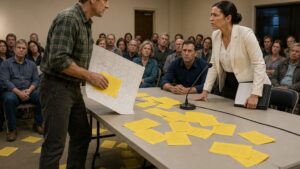
Susan Anderson kept one hand on the folded site plan in front of her. Twelve residents sat in metal chairs facing the board table. Two board members stared at their folders. The HOA treasurer took a drink of water and studied the plastic cup as if something important had appeared inside it.
David leaned back.
“We voted on the gate,” he continued. “The contractor finished the work. This discussion is over.”
Susan had managed the community for eight years and associations like it for fourteen. She knew the difference between losing an argument and discovering something that could not safely be ignored.
“This isn’t about whether the gate was approved,” she said. “It’s about the emergency-access configuration.”
A man in the second row sighed loudly.
David glanced toward him, then back at Susan. “Residents have been asking for controlled access for eighteen months. We finally give them what they asked for, and now management wants another delay.”
Susan unfolded the plan.
The creases had gone soft from weeks in her bag. Near the entrance diagram, a small notation showed the approved emergency-release arrangement. She placed one finger beside it.
“The installed controller isn’t configured this way.”
David did not look down.
“You’re a property manager, Susan. You are not the fire marshal and you are not the gate engineer.”
A few residents shifted in their seats.
There it was—the clean little line between his authority and hers.
Susan felt heat rise behind her ears, but she kept her voice level. “I’m the person required to confirm that the installation matches what the association approved.”
“The contractor confirmed it.”
“The contractor confirmed installation.”
David’s jaw tightened.
“Not independent emergency-access verification.”
The treasurer finally looked up.
“When was that supposed to happen?”
“Monday.”
A murmur moved through the room.
David spread his hands. “So three days.”
“Three days after activation.”
“The manual release works.”
“I know the manual release works.”
“Then what exactly is the danger?”
Susan looked at the plan again.
That was the question everyone wanted reduced to one sentence. She wished she could give them one.
The approved system was supposed to provide emergency access without requiring a resident, manager, or board member to reach the control cabinet first. The installed setup appeared to depend on a different sequence. The contractor had called it temporary. David had called it sufficient.
Susan called it unverified.
But unverified was a terrible word in a room full of people tired of technical delays.
One resident stood.
“My daughter rides her bike on that road. We had a delivery van doing forty last month. Why are we acting like leaving the entrance open is the safe choice?”
Susan recognized the frustration. She had fielded six complaints about speeding in the last month alone.
“I’m not asking for the project to be abandoned.”
“Sounds like another delay,” the resident said.
David nodded once, accepting the opening.
“We have two kinds of safety here,” he said. “Real traffic coming through our streets every day, and a theoretical problem with a system that has a manual backup.”
Susan looked at him.
“The problem becomes real only once.”
For the first time, the room went quiet.
David’s expression hardened.
“We’re not doing this.”
“Doing what?”
“Turning a board decision into a public confrontation because you disagree with it.”
Susan almost answered immediately.
Then she stopped.
That instinct—to lower the temperature, take the disagreement offline, solve it privately—had kept her employed through fourteen years of angry meetings. Boards remembered embarrassment longer than they remembered competent administration.
So she folded the plan.
“All right,” she said. “We can finish this after the meeting.”
David moved to the next agenda item.
By seven-thirty, residents were arguing about landscaping assessments as though the gate had never been mentioned.
Susan sat at the side table, but she barely heard them.
She opened the plan again.
This time she compared the original approval notes with a photograph she had taken that afternoon inside the control cabinet.
Approved emergency function: automatic access interface.
Installed temporary setup: manual release plus pending emergency interface verification.
She read it twice.
Then a third time.
The distinction was not cosmetic.
After the meeting, the other board members left quickly. Chairs scraped across the floor. Someone turned off half the ceiling lights.
David stacked his papers.
Susan carried the plan to him.
“Leave it inactive until Monday.”
He exhaled through his nose. “We already discussed this.”
“No. We discussed it in front of residents. I’m asking you now.”
“And I’m telling you the manual release has been tested.”
“By the installer.”
“Yes.”
“Not by the fire department.”
David pushed his chair in.
“Do you know how many emails I got after we delayed this project last month?”
Susan said nothing.
“Thirty-seven. One homeowner threatened to stop paying dues. Another said the board should resign. We’ve spent twelve thousand dollars on this thing, and every week it sits open people say we’re incompetent.”
“That doesn’t make Monday come sooner.”
“It makes tomorrow matter.”
Susan felt the old calculation begin.
She could send a formal stop-work notice to the contractor and copy the board. She could write that she did not recommend activation until final verification.
And by Monday morning, her regional supervisor would probably have three angry calls accusing management of overruling elected directors.
Or she could keep working it privately.
David picked up his keys.
“The gate goes active tomorrow.”
Susan looked at him.
“What time?”
“Eight.”
“David—”
“Eight a.m.”
He walked toward the clubhouse door.
Susan remained beside the empty board table with the creased plan under her palm.
The system had a manual release.
The inspection was only two days away.
And she had spent enough years in this job to know how easily a temporary compromise could become permanent if nothing went wrong.
At 7:58 the next morning, the new gate began closing across the entrance road.
Chapter 2: The Ambulance Stopped Outside the Gate
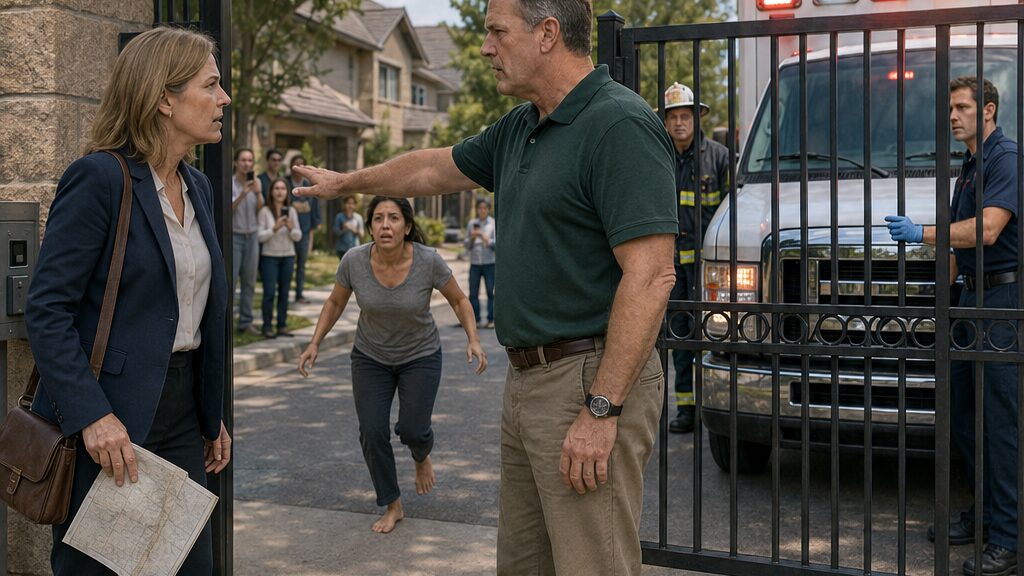
The ambulance reached the entrance with its lights flashing and stopped behind the closed gate.
Susan saw it from halfway down the sidewalk.
For one second she did not understand what she was seeing.
Then the driver hit the horn.
A short, brutal blast.
Susan started running.
She had been walking toward the clubhouse to meet a landscaper when Sarah Perez called from the cul-de-sac twenty minutes earlier. Kevin was having trouble breathing. Sarah had already called 911. Susan had told her help was coming.
Now help was fifty yards away and not moving.
The gate stood across the private lane, black metal bars bright in the Saturday afternoon sun.
A paramedic climbed out of the ambulance and approached the entry pedestal.
Nothing happened.
Susan pulled her phone from her pocket and called the gate number.
The resident-access function worked.
Emergency access did not.
Her stomach dropped.
She opened her bag while running and nearly spilled everything onto the pavement. Pens, keys, a small notebook, the folded site plan.
Behind her, tires squealed.
David’s SUV stopped near the clubhouse.
He got out fast.
“What happened?”
“Emergency access didn’t trigger.”
“What do you mean?”
“I mean the ambulance is outside.”
David looked toward the gate.
The driver sounded the horn again.
Several residents were already stepping out of houses. One raised a phone, then lowered it when Susan looked in that direction.
David reached the control pedestal first.
“Use the resident code.”
“The crew shouldn’t need a resident code.”
“We can argue about that later.”
He punched the code.
Nothing.
Susan stared at the control screen.
“Why didn’t it take?”
David tried again.
The gate did not move.
A paramedic shouted through the bars. “We need this open now.”
Sarah appeared at the far end of the street.
“Please!”
She was barefoot.
Susan had never seen her without the composed posture she carried to association meetings. Now she was running toward them with one hand over her mouth.
“Kevin can’t breathe.”
Susan turned to the cabinet beside the masonry column.
She knew where the manual release was.
The contractor had shown her.
David stepped between her and the cabinet.
“Hold on.”
Susan stared at him.
“Move.”
“Don’t start pulling equipment apart.”
“I’m releasing the gate.”
“The board controls this system.”
A neighbor standing several feet away said, “David, there’s an ambulance.”
“I can see that.”
Then he looked at Susan.
“You were told yesterday not to override the board’s decision.”
For a moment the whole scene became unnaturally sharp.
The ambulance lights pulsed against the gate.
Sarah was crying.
The folded plan was crushed in Susan’s fist.
And David was still talking about authority.
Susan’s fear disappeared.
Not because she became brave.
Because there was no room left for it.
“This isn’t a board decision anymore.”
She stepped around him.
David caught her forearm.
“Susan.”
She pulled free.
“Do not touch me.”
The neighbors went silent.
Susan unlocked the cabinet with the management key.
Inside, the controller displayed normal power. She pressed the release command the contractor had demonstrated.
Nothing happened.
Her pulse jumped.
David saw it.
“You don’t know what you’re doing.”
Susan ignored him.
She opened the lower compartment.
There it was.
The mechanical release.
A safeguard that worked only if someone knew where the key was, had access to the cabinet, and happened to be standing beside it while a child waited for an ambulance.
She inserted the key.
Turned.
The gate motor disengaged.
“Help me.”
The paramedic on the other side grabbed one section through the bars while Susan pulled from inside. The heavy gate rolled slowly at first, then faster.
The ambulance moved through before it was fully open.
Sarah ran after it toward her house.
Susan stood beside the cabinet, breathing hard.
David said nothing.
The site plan had fallen onto the pavement.
A fire-response SUV entered behind the ambulance. The fire captain stopped beside Susan.
“What happened to the emergency access?”
Susan picked up the plan.
“It didn’t activate.”
“Was it tested?”
“The manual release was.”
“That’s not what I asked.”
Susan looked toward David.
He was watching the ambulance disappear around the curve.
“No,” she said. “Not in its current configuration.”
The captain’s face changed.
“Then why is the system live?”
David turned.
“The installer told us it was operational.”
Susan felt his choice of words land between them.
Operational.
Not verified.
The same distinction from the clubhouse.
The captain looked at the control cabinet, then at Susan’s plan.
“Keep this gate open.”
David stepped closer. “We have traffic issues.”
“I’m not discussing traffic issues.”
“We have a private road and documented speeding.”
“Then put someone here with cones.”
David opened his mouth.
The captain cut him off.
“This gate stays physically open until the emergency-access system is reviewed.”
For once David did not answer.
Susan folded the plan again, but her hands were shaking now.
The ambulance remained outside the Perez house for several minutes before pulling away toward the main road.
Sarah rode with Kevin.
No one knew yet whether he would be all right.
That uncertainty hollowed out every argument around Susan.
The fire captain examined the cabinet while another responder photographed the equipment.
“You management?”
Susan nodded.
“Who signed off on activation?”
She looked at David.
He looked back.
The obvious answer was standing six feet away in a polo shirt with the HOA logo on the chest.
Board president.
Project advocate.
The man who had said eight a.m.
But the captain had not asked who wanted the gate activated.
He had asked who signed off.
Susan felt something colder than fear move through her.
“I’ll get you the paperwork.”
The captain held her gaze.
“I need the name of whoever approved this configuration for operation.”
Susan looked down at the folded plan in her hand.
For the first time since the ambulance arrived, she could not answer immediately.
Chapter 3: Her Initials Were on the Turnover Sheet
“Why are your initials on the activation form?”
Susan’s regional supervisor slid the page across the conference table Monday morning.
Susan already knew the answer before she looked down.
Still, seeing the marks made something inside her sink.
S.A.
Two letters beside the line marked temporary operational turnover.
The date was Friday.
The day before Kevin’s emergency.
Her supervisor sat opposite her in the management office, hands folded.
“I need the sequence, not the version that makes anyone look better.”
Susan placed the folded site plan beside the turnover sheet.
“The contractor completed the gate installation Thursday. The emergency interface inspection was scheduled for Monday.”
“And this?”
Susan stared at her initials.
“They asked me to confirm that the physical installation was complete.”
“That is not what this line says.”
“I know.”
“Did you know on Friday that emergency verification was pending?”
“Yes.”
Her supervisor leaned back.
“Then help me understand why you initialed temporary operation.”
Susan wanted to say because David was going to activate it anyway.
That was true.
It was also incomplete.
“The manual release had been tested,” she said.
“That’s not the question.”
Susan almost smiled at the echo.
The fire captain had said the same thing.
“No,” she said. “It isn’t.”
Outside the glass wall, an office printer started and stopped.
Her supervisor waited.
Susan had spent years getting good at silence in difficult rooms. Silence gave angry people time to hear themselves. Silence kept meetings from becoming fights.
This silence offered her nowhere to hide.
“I thought I could get the final verification done Monday without turning it into another board confrontation.”
“So you accepted temporary operation.”
“I did not recommend full activation.”
“Did you document that?”
Susan looked at the paper.
“No.”
Her supervisor’s expression tightened, not with anger but disappointment.
“That matters.”
“I know.”
“Now it matters a great deal.”
At ten, the municipal fire-prevention inspector met Susan and the gate contractor at the entrance.
The gate remained chained open.
Orange cones narrowed one side of the road, and a temporary sign directed drivers to slow down.
David did not attend.
The contractor removed the controller cover.
“The installed hardware is correct,” he said.
The inspector glanced at him. “Then show me the emergency interface test.”
The contractor hesitated.
Susan noticed immediately.
“There isn’t one.”
The contractor looked at her.
“We were scheduled to perform it today.”
The inspector turned.
“Was this system represented as fully verified?”
“No. We turned over manual operation pending interface test.”
Susan closed her eyes briefly.
There it was.
Clean.
Undramatic.
And devastating.
The inspector pointed toward the gate.
“If an emergency vehicle arrived Saturday, what was supposed to happen?”
“The interface should have triggered once configured.”
“Should have?”
“It had not been commissioned.”
Susan unfolded the plan.
“The approved drawing shows automatic emergency access.”
“Yes.”
“The installed system was not functioning that way.”
“Correct.”
The inspector wrote something on his pad.
The contractor shifted his weight.
“Management knew the commissioning date was Monday.”
Susan looked at him.
He was not accusing her.
That made it worse.
“Yes,” she said.
The inspector looked from the contractor to Susan.
“And the association still activated the gate.”
Susan folded the plan carefully.
“Yes.”
For most of the weekend, neighbors had treated her like the person who had saved the situation.
Someone left flowers outside the management office.
A resident emailed her supervisor calling her “the only competent person involved.”
Another wrote that David should resign immediately.
Susan had not answered any of them.
Now she understood why the praise had made her uncomfortable.
Her warning had been right.
Her action at the gate had been right.
But those facts did not erase Friday.
Back at the office, she opened the project folder.
Emails.
Contractor notes.
Board instructions.
Her own messages.
Thursday, 4:18 p.m.:
Emergency interface final commissioning Monday 9:00 a.m. Manual release tested successfully. Temporary operation available if association elects to proceed.
Friday, 11:06 a.m., from David:
We cannot delay again. Residents were promised Saturday activation.
Susan had replied:
Recommend caution until Monday verification. Manual access remains available.
Recommend caution.
She read the phrase twice.
It sounded professional.
It sounded reasonable.
It also sounded optional.
At 12:22 p.m., David responded:
Understood. Proceeding Saturday.
Susan had not answered.
Instead, she had driven to the gate, watched the contractor demonstrate the manual release, and initialed the temporary turnover.
She remembered exactly what she had told herself.
Two days.
The key is in management control.
I’ll get this cleaned up Monday.
She had not believed the gate was perfectly safe.
She had believed the risk of challenging the board formally was greater than the chance of an emergency during one weekend.
That was the calculation.
And she had made it.
Her phone rang.
The regional supervisor.
“Kevin Perez is home,” she said.
Susan closed her eyes.
“Is he okay?”
“Recovering. His mother says the paramedics stabilized him quickly.”
Relief came so hard Susan had to put one hand on the desk.
“Thank God.”
“There’s more.”
Susan opened her eyes.
“The fire-prevention office wants the full approval chain by tomorrow morning.”
“I’m working on it.”
“And the board is already telling residents the contractor installed the wrong system.”
Susan looked through the office window toward the road.
“That isn’t accurate.”
“I know.”
Susan’s supervisor paused.
“Neither is the version where you tried to stop everything.”
Susan said nothing.
“I’m not saying that to punish you,” the supervisor continued. “I’m telling you because you need to decide what record you’re willing to stand behind.”
After the call, Susan printed the full email chain.
She placed it beside the site plan and turnover form.
Her warning.
David’s instruction.
Her silence.
Her initials.
Four pieces of paper that refused to become the simple story everyone wanted.
Late that afternoon, Susan drove back to the entrance.
The gate still stood open.
She unlocked the control cabinet and removed the manual-release key.
For weeks she had thought of it as proof that there was a backup.
Now it looked different.
A safeguard was not a safeguard if the entire plan depended on the right person being present at the worst possible moment.
Susan closed the cabinet.
And then she remembered what David had said after Friday’s meeting, when she asked him to wait until Monday.
Thirty-seven emails.
Homeowners threatening dues.
A board accused of incompetence.
She remembered herself standing there with the power to make the disagreement formal.
She had chosen not to.
Not because she thought he was right.
Because she thought she could manage the risk quietly.
Susan stood beside the open gate with the creased site plan under her arm.
For the first time, the question was no longer why David had taken the risk.
It was why she had helped him take it.
Chapter 4: The Reason David Wanted the Road Closed
The mailbox at the edge of David Clark’s driveway had a long white scrape across its side and a dent deep enough to fold the metal inward.
Susan stopped beside it.
“That’s what started all this,” David said.
It was Monday evening, less than three hours after the fire-prevention inspector had confirmed that the gate’s emergency interface had never been commissioned. Susan had expected David to meet her at the clubhouse.
Instead, he had asked her to walk two houses farther down the private road.
He touched the damaged mailbox.
“Delivery van came through here in June. Too fast.”
Susan looked at the shallow tire mark still visible along the grass.
“Your grandson was here?”
“On the sidewalk.”
David’s voice had changed. The board-president cadence was gone.
“He dropped his scooter. Stepped toward the street to get it. I grabbed the back of his shirt.”
Susan said nothing.
“The van missed him by maybe three feet.”
David stared toward the entrance.
“Maybe less.”
The story did not make Saturday disappear.
It did make the road look different.
Susan had processed the incident report after that near miss. At the time it had been one complaint among dozens: speeding deliveries, visitors cutting through, residents furious that the association’s private lane had become a shortcut.
She had not known the child involved was David’s grandson.
“You should have told me,” she said.
“What difference would that have made?”
“I would have understood why you were pushing so hard.”
“I wasn’t asking people to understand.”
“That was part of the problem.”
David gave her a tired look.
“You think this is about my pride.”
“I think some of it is.”
He almost laughed.
“At least you’re consistent.”
They walked toward the clubhouse.
The gate was visible at the end of the road, still chained open. Cars passed through slowly between the temporary cones.
David watched each one.
“After that van,” he said, “every time I saw a truck come through here, all I could see was him stepping off that curb.”
Susan adjusted the strap of her bag. The folded site plan pressed against her side.
“So when residents demanded the gate—”
“I agreed.”
“Even before everything was ready.”
“I agreed with the reason for it.”
“That isn’t the same thing.”
“No.”
It was the first time he had said the word without fighting it.
At the clubhouse parking area, David stopped beside his SUV.
“The contractor told us the manual release worked.”
Susan looked at him.
“And you knew the emergency interface hadn’t been verified.”
He looked away.
“That inspection had already been pushed once.”
“That isn’t an answer.”
David’s jaw tightened.
“Another delay meant another weekend with the road open.”
“You could have left the gate open and posted temporary traffic control.”
“We had done that.”
“Then do it again.”
“Residents were done hearing ‘again.’”
Susan pulled the site plan from her bag but did not unfold it.
“Were you afraid someone would get hurt, or were you afraid the board would look weak?”
David stared at the folded paper.
“Both.”
The answer stopped her.
He leaned against the SUV.
“We promised the gate in May. Then June. Then the electrical work was wrong. Then the county wanted a revised detail. Then the contractor had a scheduling problem. Every meeting became the same meeting.”
He rubbed a hand over his face.
“People don’t elect a board so we can keep telling them we’re waiting for somebody else.”
Susan heard the logic because she had lived beside it for years.
Homeowners wanted certainty from people who rarely controlled all the variables.
Boards wanted managers to make uncertainty disappear.
Managers learned to soften language until risks sounded temporary.
She had done exactly that Friday.
David looked at her.
“You think I didn’t understand what you were saying?”
Susan felt something tighten in her chest.
“You understood?”
“I understood the final verification was Monday.”
“And you activated it anyway.”
“I believed the manual release was enough for two days.”
Susan stared at him.
It was nearly the same sentence she had told herself.
The difference was that David had ordered the gate closed.
Susan had chosen not to put her objection in a form that could stop him.
“You knew,” she said quietly.
“I knew it wasn’t final.”
“That matters.”
“I know that now.”
“No. It mattered Friday.”
David looked toward the road.
A sedan entered through the open gate.
“I was trying to prevent one kind of emergency.”
“And created another.”
“Yes.”
No excuse followed.
Susan had wanted that admission since Saturday.
Receiving it did not feel like victory.
David opened his car door, then paused.
“The board is blaming the contractor.”
“I heard.”
“They’ll want you to support that.”
“I won’t.”
His mouth tightened.
“You understand what that could do to your contract.”
“Yes.”
“And your company is reviewing your initials.”
“Yes.”
For several seconds they stood on opposite sides of the same mistake.
Then David said, “If I tell them I knew the inspection was pending, they’ll remove me.”
Susan looked at him.
“You knew when you made the decision.”
“That isn’t what I asked.”
“No.”
The clubhouse door opened behind them.
Sarah Perez stepped into the parking area.
She looked exhausted, but she was dressed for work now, shoes on, hair pulled back. Kevin was home recovering. Susan had learned that much from her supervisor.
Sarah walked directly toward them.
David straightened.
“How is Kevin?”
“Better.”
Relief crossed his face before caution returned.
“I’m glad.”
Sarah nodded once.
Then she looked at Susan.
“I need to ask you something.”
David started toward his SUV.
Sarah stopped him.
“You should probably hear it too.”
He remained where he was.
Sarah took a folded photocopy from her bag.
Susan recognized the turnover sheet before Sarah opened it.
Her initials sat at the bottom.
Sarah held the paper between them.
“Everyone keeps telling me you tried to stop that gate.”
Susan said nothing.
Sarah’s voice stayed controlled.
“But your initials are on the approval.”
She looked directly at Susan.
“Did you personally approve it?”
Chapter 5: The Mother Asked for the Whole Record
Sarah placed Susan’s signed turnover sheet on the kitchen table beside a thin plastic hospital bracelet.
Kevin’s name was printed on the bracelet.
Susan tried not to stare at it.
“He keeps asking when he can go back outside,” Sarah said.
Susan sat across from her.
“How is his breathing?”
“Better. They changed his medication and want him taking it easy for a few days.”
Sarah touched the bracelet with one finger.
“Saturday, I thought I was watching him run out of air while the people responsible for the entrance argued over who controlled a box.”
Susan looked down.
“I know.”
“No, I don’t think you do.”
The words were sharp, but Sarah did not raise her voice.
“You opened it. I’m grateful for that. I will always be grateful for that.”
Then she tapped the turnover form.
“But I’m not going to pretend this isn’t here.”
Susan had spent the drive over deciding how to explain herself.
The sentences now seemed useless.
“I initialed temporary operation.”
“Why?”
“Because the manual release had been tested and the final emergency-interface verification was scheduled for Monday.”
Sarah waited.
Susan continued.
“I recommended waiting.”
“Where?”
“In an email.”
“Did you tell them not to activate it?”
Susan looked at Sarah.
“No.”
“Did you have authority to stop it?”
“I had authority to issue a formal management objection and hold contractor turnover pending review.”
“Did you?”
“No.”
Sarah leaned back.
“Why not?”
Susan could have said David would have fought her.
She could have said the board controlled the management contract.
She could have explained fourteen years of association politics.
All of it was true.
None of it changed the answer.
“I thought I could manage the risk until Monday.”
Sarah looked at the hospital bracelet.
“So did he.”
“Yes.”
That single word changed something in the room.
Sarah had been braced for Susan to defend herself.
Susan watched some of the anger lose its direction.
Not disappear.
Just become more complicated.
“You’re not telling me David did nothing wrong.”
“No.”
“He knew?”
“He knew verification was pending.”
“And pushed activation.”
“Yes.”
Sarah stood and went to the kitchen counter.
When she returned, she carried a notebook.
“I cover county government and municipal issues.”
Susan looked at her.
“I thought you worked from home.”
“I do.”
Sarah sat again.
“Mostly civic affairs. Budgets, zoning, school boards, public contracts. Nothing glamorous.”
Susan glanced at the notebook.
“You’re writing about this.”
“I’m trying to decide whether I am.”
The late reveal did not frighten Susan as much as she expected.
What frightened her was the version Sarah might already have.
Nurse against doctor.
Employee against HOA president.
One brave person, one reckless person.
Simple stories traveled well.
This one was not simple.
Sarah opened the notebook.
“I have residents saying you warned everyone and David ignored you.”
“That’s partly true.”
“Partly.”
“I also signed that.”
Susan pointed to the turnover sheet.
Sarah studied her.
“You want me to include your mistake?”
“If you write it, yes.”
“Most people don’t volunteer that.”
“Most people weren’t standing beside the gate when the ambulance stopped.”
Sarah closed the notebook halfway.
“Why did you go around David?”
“Because Kevin needed help.”
“No hesitation?”
Susan thought of David catching her forearm.
The cabinet refusing the first command.
The mechanical key in her hand.
“The hesitation happened the day before.”
Sarah did not write that down.
For the first time, she simply listened.
On Wednesday, Susan spent most of the day assembling records for the fire-prevention review.
Complaints about speeding filled an entire folder.
A resident had photographed a delivery truck crossing the entrance line too fast.
Another had emailed after nearly being sideswiped while walking a dog.
David’s urgency had not appeared from nowhere.
But neither had his willingness to override delays.
Susan found three messages from earlier in the summer.
One said the board could not “keep letting procedural details stop a safety project.”
Another instructed the contractor to “keep moving unless something is legally prohibited.”
A third, sent after Susan requested clarification on emergency access, read:
We need solutions, not another reason to leave this road uncontrolled.
Susan printed all three.
Thursday afternoon, Sarah came to the management office.
She placed her phone on Susan’s desk.
“I want a picture of the site plan.”
Susan hesitated.
“For the article?”
“If I publish.”
Susan unfolded the old creased sheet.
The paper had begun to tear slightly along one fold.
Sarah photographed the emergency-access detail.
Then she looked at Susan.
“One of the residents told me you’re the hero in this.”
Susan almost laughed.
“No.”
“You opened the gate.”
“I also helped make it possible for the gate to be closed that day.”
“You warned them.”
“I warned them in a way that let everyone continue.”
Sarah was quiet.
Susan slid the turnover sheet toward her.
“If you quote me as the employee who tried to stop everything, I won’t participate.”
Sarah frowned.
“That’s an odd condition.”
“It’s the only one I have.”
“What do you want me to say?”
“The truth.”
“That’s usually what people claim they want right before they ask me to leave something out.”
“I’m asking you to leave nothing out.”
Sarah looked at her for a long moment.
Then she reopened the notebook.
Susan told her about the Friday meeting.
The private conversation afterward.
The contractor’s temporary turnover.
David’s instruction.
Her own choice not to issue a formal hold.
She did not soften the sequence.
When she finished, Sarah asked, “Do you think David should resign?”
Susan shook her head.
“That isn’t my decision.”
“Do you think he’s responsible?”
“Yes.”
“And you?”
“Yes.”
Sarah wrote that one down.
At five-thirty, Susan’s email chimed.
A board notice.
Emergency association meeting.
Friday, 7:00 p.m.
Purpose: review gate activation, contractor responsibility, management actions, and interim safety procedures.
Susan read the attendee list.
Board members.
Management.
Contractor.
Residents invited.
Her phone rang immediately.
Her regional supervisor.
“You saw it?”
“Yes.”
“They are going to try to narrow this to contractor failure.”
Susan looked at the stack of records on her desk.
“That isn’t what happened.”
“I know.”
“Will the company support me saying that?”
A pause.
“We will support accurate testimony.”
Susan understood the distinction.
Accurate testimony did not mean protection from discipline.
“What happens to me afterward?”
“We’ll address your part separately.”
Susan looked at her initials on the turnover form.
Across the desk, the creased site plan lay open beside Sarah’s photograph notes.
For years Susan had believed professionalism meant keeping messy disagreements from becoming public.
Friday night, she would have to do the opposite.
The meeting was already official.
The residents were coming.
And the only way to tell the truth about David was to begin with the part that belonged to her.
Chapter 6: She Admitted Her Mistake Before Naming His
“My initials belong in this review.”
Susan said it before anyone could blame the contractor.
The clubhouse was full.
Every folding chair had been taken, and several residents stood along the back wall. David sat at the center of the board table. The gate contractor occupied a chair near the end. Susan’s regional supervisor sat beside her with a closed folder.
The treasurer had just called the meeting to order.
Susan placed the turnover sheet in front of her.
“This is my signature.”
David looked at her.
No one spoke.
Susan continued.
“I knew the final emergency-access verification was scheduled for Monday. I allowed temporary operational turnover on Friday because the manual release had been tested.”
A resident near the wall muttered something.
Susan did not look toward him.
“I recommended caution. I did not issue a formal hold.”
Her regional supervisor remained still.
The contractor shifted forward.
“So management did approve activation.”
Susan looked at him.
“I approved temporary turnover. The board chose activation.”
David’s eyes narrowed slightly.
The distinction mattered now.
Susan unfolded the emergency-access site plan and laid it across the center of the table.
The old creases would no longer lie flat.
She placed a water cup on one corner.
“The approved plan required an emergency-access function that had not been commissioned when the gate went live.”
The contractor nodded reluctantly.
“That’s correct.”
The treasurer turned to him.
“Then why was it turned over?”
“Because the manual release was complete and the association wanted temporary operation.”
A board member leaned forward.
“Who told you that?”
The contractor looked toward Susan.
Susan shook her head.
“Read the email chain.”
Her regional supervisor opened the folder.
Copies moved down the table.
The room became quiet enough for Susan to hear pages turning.
David did not touch his copy.
He already knew what it said.
The treasurer read aloud the relevant sequence.
Final verification Monday.
Susan recommending caution.
David responding that the association would proceed Saturday.
A resident near the front said, “So David ignored management.”
Susan felt the easy version forming again.
“No.”
Several faces turned toward her.
“I did not make my objection formal.”
David looked at her for the first time with something other than defensiveness.
Susan continued.
“I had a way to escalate it. I chose not to because I believed the manual release reduced the risk enough for the weekend.”
The resident frowned.
“But you told him it wasn’t ready.”
“Yes.”
“Then this is on him.”
Susan paused.
“No. Not entirely.”
A murmur moved through the clubhouse.
This was the part no one had come to hear.
They wanted innocence and guilt divided cleanly across the table.
Susan looked at David.
“You knew the emergency interface hadn’t been verified.”
He took a breath.
“Yes.”
The room changed.
The treasurer stared at him.
“You knew?”
“Yes.”
“Then why did you order activation?”
David looked toward the residents instead of the board.
“Because we had spent months telling people we were fixing a real traffic problem.”
A man in the second row said, “That doesn’t answer it.”
David’s jaw tightened.
“My grandson was almost hit on that road.”
The room quieted.
He told them about the delivery van.
The dropped scooter.
His hand catching the back of the boy’s shirt.
No one interrupted.
“When you have a child step toward a moving vehicle,” David said, “you stop thinking about a gate as landscaping.”
Susan watched the anger in the room become less certain.
David looked down at the plan.
“I thought leaving that road uncontrolled for another weekend was a greater risk than using a gate with a tested manual release.”
The treasurer asked, “Did Susan tell you to wait?”
“She asked me to.”
“Did you understand final verification was pending?”
“Yes.”
“And you proceeded?”
“Yes.”
There was no applause.
No shouting.
Just the uncomfortable sound of a room losing its simple villain.
The fire-prevention inspector, seated near the side wall, finally spoke.
“The problem I see is not that one person failed.”
Everyone turned toward him.
“You had an approved safety function that was not operational. The contractor allowed temporary turnover. Management allowed temporary turnover without formal objection. The board activated the system despite knowing final verification was pending.”
He tapped the plan.
“Each decision assumed the next safeguard would cover the previous gap.”
Susan looked at the folded paper.
That was exactly what had happened.
The contractor trusted the manual release.
Susan trusted the short timeline.
David trusted someone being available if necessary.
And Kevin had needed all of those assumptions to work at once.
They had not.
The board moved next to responsibility.
The contractor agreed to complete modifications at no additional labor cost.
David’s authority to approve operational changes without full board confirmation was suspended pending the association’s internal review.
Then Susan’s regional supervisor spoke.
“Management also completed its employment review.”
Susan knew what was coming.
She kept her hands flat on the table.
“Susan will receive a formal written reprimand for authorizing temporary turnover without documenting a safety hold.”
Several residents protested at once.
“She opened the gate.”
“She warned them.”
“That’s ridiculous.”
Susan raised one hand.
The room settled.
“My company is right.”
Even her supervisor looked at her.
Susan glanced toward Sarah, seated near the back with her notebook closed on her lap.
“I did the right thing Saturday.”
She touched the turnover sheet.
“I should have done more Friday.”
Nothing dramatic followed.
No one stood.
No one changed the consequence.
The reprimand remained.
Strangely, Susan felt lighter.
For three days she had feared losing the version of herself everyone wanted to believe in.
The competent manager.
The person who saw the danger first.
The woman who opened the gate.
Now the room knew the part that did not fit.
She was still standing.
Near the end of the meeting, the fire-prevention inspector recommended that no future change affecting emergency access be activated without two independent approvals: management verification and written emergency-access confirmation.
The treasurer wrote it down.
David looked at the proposed language.
“Put it on the next agenda.”
The treasurer glanced at him.
“You support it?”
David looked toward the open clubhouse doors.
Beyond them, the entrance gate could just be seen in the distance, still fixed open.
“Yes.”
He paused.
“I think we’ve established that one person’s judgment shouldn’t be enough.”
Susan met his eyes.
For the first time, neither of them looked away.
The treasurer added the proposed policy to the next meeting agenda.
Two approvals.
No temporary activation based only on assumption.
No quiet workaround because the delay felt inconvenient.
The paper slid across the table toward Susan.
She read the proposed rule once.
Then she placed it beside the old creased site plan.
The gate had been opened.
The truth had been opened with it.
Now the neighborhood had to decide whether it would close either one the same way again.
Chapter 7: Two Signatures Before the Gate Can Close
The repaired gate stood open while the board argued about whether it should ever close again.
Three weeks had passed since the emergency meeting. The contractor had replaced the controller, the emergency interface had been commissioned, and the municipal fire-prevention inspector had already watched the system respond correctly in two preliminary tests.
Still, the black metal gate remained fixed open.
A line of orange cones narrowed the entrance, and every vehicle entering the neighborhood had to slow almost to walking speed.
Susan stood at the end of the clubhouse table with the old site plan in front of her.
Beside it lay a new form.
Two signature lines appeared at the bottom.
One for management verification.
One for emergency-access approval.
The treasurer tapped the proposed policy.
“I understand why we want this,” she said. “I’m asking whether we’re building a process that makes every future repair take twice as long.”
A resident near the back nodded.
“And cost twice as much.”
Another added, “We can’t call the fire department every time somebody changes a gate sensor.”
The fire-prevention inspector, seated against the wall, shook his head.
“That isn’t what the policy says.”
The room had changed since the previous meeting.
People still disagreed, but no one looked eager for a villain.
David sat with the other board members rather than at the center.
He had stepped down as president during the internal review. The board had not removed him entirely, but his authority to approve operational changes alone was gone.
Susan’s written reprimand had become official two days earlier.
Her regional supervisor had handed it to her in a plain envelope and asked her to sign acknowledgment.
She had signed.
No argument.
No appeal.
It was now part of her employment file.
The knowledge still stung.
But it no longer felt like an accusation she had to outrun.
The treasurer looked toward Susan.
“You helped draft this. Explain the practical version.”
Susan placed both palms on the table.
“If a change can affect emergency access, nobody activates it based on one person’s judgment.”
“That sounds simple,” a resident said. “Until the manager is unavailable.”
“Then it waits.”
Several people reacted at once.
Susan let them.
A month earlier she would have softened the sentence.
She would have said they could probably find an interim solution, or that management would work with the board, or that exceptions might be considered.
This time she waited until the room quieted.
“The gate waiting is inconvenient,” she said. “An emergency vehicle waiting is worse.”
No one answered immediately.
A resident in the second row crossed his arms.
“What about the speeding problem?”
“It’s real.”
Susan pointed toward the entrance.
“That’s why the cones are still there. It’s why we added temporary traffic control while the gate stayed open. One safety problem doesn’t cancel another.”
David looked at her.
That sentence belonged to both of them now.
The fire-prevention inspector opened the final review folder.
“The investigation identified four separate failures.”
He read them without emphasis.
The contractor allowed temporary operational turnover before commissioning.
Management accepted the turnover without issuing a formal safety hold.
The board activated the gate knowing final emergency verification was pending.
And the association had no rule requiring independent confirmation before an emergency-access change became operational.
No single sentence erased the others.
The contractor had corrected its procedure.
Susan had received discipline.
David had lost unilateral authority.
Now the last question belonged to the association itself.
Would it change anything beyond the people involved?
The treasurer turned to the residents.
“The proposed rule requires two approvals before activation of any system affecting emergency access.”
A man near the aisle raised his hand.
“And if that delays a project?”
“It delays the project,” Susan said.
He looked irritated.
“That’s easy for management to say. We’re the ones paying for these delays.”
Susan glanced down at the old plan.
The crease where it had been folded across the emergency-access detail had nearly split the paper.
For weeks she had carried that page as evidence that she had been right.
Later it became evidence that being right was not enough.
Now it looked like something else entirely.
A warning no one person should have to carry alone.
Susan lifted the new form.
“This is not about making projects slower,” she said. “It’s about making uncertainty visible.”
The resident frowned.
“What does that mean?”
“It means if one required signature is missing, everyone knows the project is not ready.”
She set the form beside the old plan.
“No verbal understanding. No assumption that someone else checked. No temporary approval that quietly becomes operation.”
David leaned forward.
“And no board president deciding the remaining risk is acceptable by himself.”
Several people looked at him.
He did not flinch.
The treasurer asked, “You still support this?”
David nodded.
“Yes.”
The answer carried more weight because of what it cost him.
A resident who had complained loudly about the open entrance during earlier meetings raised her hand.
“I still want the gate closed.”
Susan nodded.
“So do I.”
The woman seemed surprised.
“I just want it closed after we can prove it will open when it has to.”
The vote began.
It was not unanimous.
Two board members worried about administrative delays.
One abstained.
But the policy passed.
No one applauded.
Susan was grateful for that.
The meeting moved to landscaping expenses and reserve funding, ordinary problems reclaiming their place.
Afterward, Sarah waited near the clubhouse door.
Kevin stood beside her.
He looked smaller than Susan remembered from before the emergency, though perhaps that was only because she now pictured him through the bars of a gate he had never actually seen.
“You’re supposed to be taking it easy,” Susan said.
Kevin shrugged.
“My mom says walking counts as easy.”
Sarah smiled.
“He negotiated.”
Kevin looked toward the entrance.
“Is that the gate?”
Susan nodded.
“It is.”
“The one the ambulance couldn’t get through?”
Sarah touched his shoulder gently.
Susan answered anyway.
“Yes.”
Kevin considered that for a second.
“Does it work now?”
“We’re about to find out.”
The fire-prevention inspector was waiting at the entrance with the contractor.
Susan walked down with him while Sarah and Kevin stayed near the sidewalk.
David followed several steps behind.
The temporary cones had been moved aside.
For the first time since the emergency, the repaired gate stood ready for formal activation.
The inspector placed the new approval sheet on the hood of his vehicle.
“Management verification first.”
Susan checked the controller status, power backup, manual release, and installed configuration against the corrected plan.
She did not rush.
When she finished, she signed the first line.
The inspector completed his own verification of the emergency-access function.
Then he signed the second.
Two names.
Two separate judgments.
Neither replacing the other.
Susan looked at the sheet.
A few weeks earlier, seeing her initials on an activation document had made her feel exposed.
This time she understood exactly what her signature meant.
The inspector handed her the emergency test device.
“You want to do the honors?”
Susan shook her head.
“You trigger it.”
He smiled slightly.
“Fair enough.”
The contractor activated the gate.
The motor engaged.
Black metal sections rolled slowly across the private road until the entrance closed.
Susan heard the latch settle.
For several seconds no one moved.
Then the inspector initiated the emergency-access test.
A signal sounded inside the controller cabinet.
The latch released.
The gate immediately began opening.
No management key.
No board member.
No person standing beside the cabinet making a judgment under pressure.
The opening widened until an emergency vehicle could pass without stopping.
The inspector checked his timer.
“Good.”
David stood a few feet away with his hands in his pockets.
Susan looked toward him.
He watched the open lane.
“I should’ve waited,” he said.
Susan could have let the statement belong entirely to him.
Instead she said, “So should I.”
David nodded.
Nothing more was needed.
Across the sidewalk, Kevin had already lost interest in the machinery. He was showing Sarah something on the ground, crouching beside the curb until she reminded him to stand up slowly.
Ordinary again.
That was the point.
Susan folded the old site plan one final time.
Then she stopped.
The crease was nearly torn through.
Instead of putting it back into her bag, she opened it flat and carried it toward the clubhouse with the new dual-signature form resting on top.
Behind her, the gate completed another test cycle.
It closed.
The emergency signal activated.
And this time, without anyone having to argue about whose authority mattered more, it opened.
The story has ended.