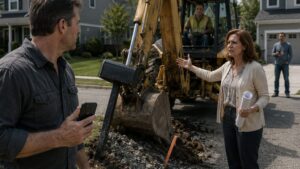
The HOA Turned My Private Driveway Into a Delivery Route—Then Sent Me the Repair Bill
Chapter 1: The Truck That Arrived at 7:15
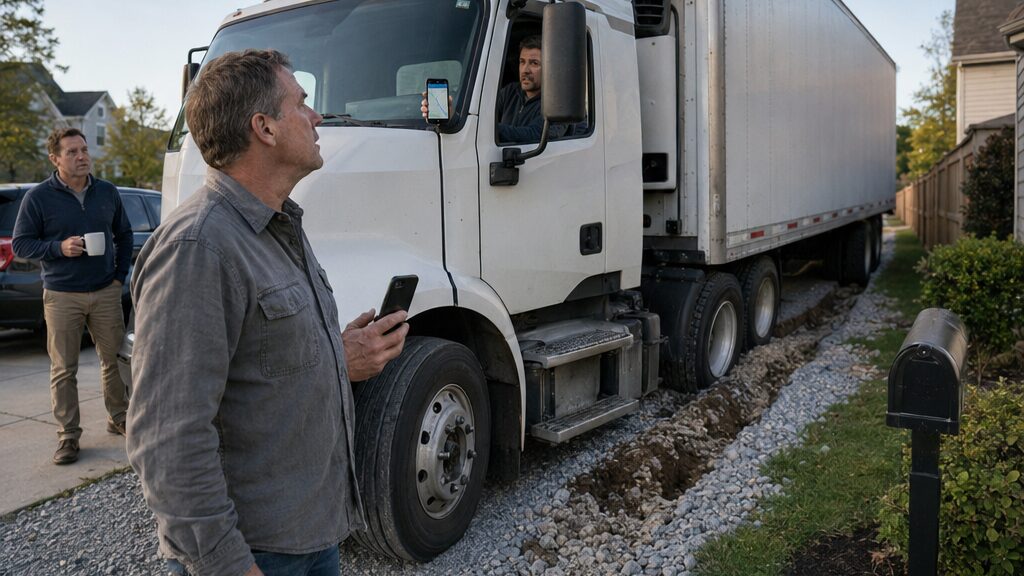
At 7:15 on Monday morning, Charles Walker woke to the sound of an eighteen-wheeler grinding past his bedroom window.
Not on the street.
Not on the main entrance road.
On his gravel lane.
He was out of bed before the truck reached the rear corner of his property. By the time he stepped onto the back porch in jeans and an old work shirt, the refrigerated trailer was crawling between his fence and a row of HOA-maintained shrubs, its tires compressing the fresh gravel he had spread only three months earlier.
The lane was narrow by design. Charles had rebuilt it for his own pickup, utility trailer, and occasional landscaping delivery. It ran along the side of his lot and joined the small paved apron behind his garage.
It had never been a community road.
The truck’s rear wheels dropped off the packed centerline.
A dark groove opened in the shoulder.
Charles watched gravel push outward into the grass.
He raised one hand.
The driver saw him and stopped.
Air brakes sighed through the quiet neighborhood.
Charles walked toward the cab.
The driver lowered the window.
“Morning,” Charles said. “You know this isn’t the service road?”
The driver looked down at him, then at something mounted beside the steering wheel.
“This is what they gave me.”
“Who gave you what?”
“The route.”
Charles glanced behind the truck. Its trailer nearly filled the lane from hedge to fence.
“Can you show me?”
The driver hesitated, then held out his phone.
Charles expected a navigation app.
Instead, the screen showed a simple site diagram.
The clubhouse sat at the center. The construction staging area was marked behind it. A thick route line came off the neighborhood entrance, turned behind Charles’s property, and followed his gravel lane.
At the bottom was a label.
HOA SERVICE ACCESS.
Charles stared at it.
“Where did this come from?”
“Contractor packet.”
“Your company made it?”
“Don’t think so. Site people sent it.”
Charles took out his own phone and photographed the screen.
The driver frowned slightly.
“Am I good to keep going?”
Charles looked at the rut behind the trailer.
“No.”
The driver glanced toward the clubhouse.
“I’ve got refrigerated material. They told us this was approved.”
“Approved by who?”
“I don’t know.”
Charles stepped aside from the truck but did not wave him forward.
“Back it out.”
The driver’s mouth tightened.
“That’s going to be a problem.”
“So is this.”
For several seconds they looked at each other.
Then the driver nodded.
The reversing alarm started.
Three houses down, Robert Lewis came outside carrying a coffee mug. He watched the truck begin the slow process of backing toward the residential street.
“What happened?” Robert called.
Charles pointed at the lane.
“Wrong access.”
Robert came closer.
“They’re doing the clubhouse delivery.”
“I know what they’re doing.”
“Then why are you turning him around?”
Charles looked at him.
“Because this is my driveway.”
Robert glanced at the truck, then at the lane.
“I thought this was part of the service route.”
“So did he.”
The truck’s tires crunched backward over the gravel.
Robert lowered his voice.
“They’re already behind schedule.”
Charles said nothing.
“The accessibility work was supposed to be finished last month.”
“I didn’t design the schedule.”
“No, but if they can’t get deliveries in—”
“They have a service entrance.”
Robert looked toward the far side of the clubhouse.
“Apparently they’re not using it.”
“That doesn’t make this one theirs.”
Robert rubbed one hand over the side of his mug.
“I’m just saying, Charles, if it’s temporary—”
Charles turned toward the fresh rut.
The shoulder had been pressed several inches lower than the packed center. Loose stone was scattered into the grass.
“I rebuilt this myself.”
Robert did not answer.
Charles had spent three weekends on the lane. He had rented a compact roller, ordered two loads of crushed stone, and corrected the drainage pitch by hand because the previous surface washed toward the foundation every time it rained.
He had not asked the HOA to contribute.
That had been part of the point.
His father would have turned a damaged driveway into a neighborhood campaign. Charles had grown up watching small disagreements become permanent grudges. Fence posts. Tree limbs. Snow pushed six inches over a line.
By the time Charles bought his own home, he had developed one rule.
If he could handle something himself, he did.
That rule had made his life quieter.
Most of the time.
The truck finally reached the street.
The driver stopped again.
Charles walked to the cab.
“Who should I call about that route sheet?”
The driver pulled a folded packet from beside his seat.
He turned pages.
“Site contact says Laura Smith.”
Charles knew the name.
Community manager.
He took another photograph.
“Thanks.”
The driver nodded.
“Nothing personal.”
“I know.”
The truck pulled away.
At eight sharp, Charles called the management office.
Laura answered on the third ring.
He explained what had happened.
There was a pause.
Then she said, “That sounds like a routing error.”
“It wasn’t GPS.”
“I’m sorry?”
“The driver showed me the site map. My lane is marked HOA service access.”
Another pause.
“I’ll need to look into that.”
“Please do.”
“I’m sure it’s just a contractor navigation issue.”
Charles looked through the kitchen window at the fresh groove beside the lane.
“It came from a contractor packet.”
“I understand.”
“Do you?”
Laura’s tone remained even.
“I’ll contact the project superintendent and get the map corrected.”
Charles exhaled.
“Good.”
“I apologize for the inconvenience.”
He almost corrected the word.
Inconvenience.
He looked again at the gravel scattered into his grass.
But he stopped himself.
This was exactly the sort of thing that could become larger if handled badly.
“Just make sure they stop using it.”
“I will.”
The call ended.
Charles made coffee and tried to return to his morning.
At 9:40, he went outside with a rake.
He pulled loose gravel back from the grass and filled the deepest section of the rut. He tamped it with the flat back of a shovel.
When he finished, the lane looked almost normal again.
Almost.
Before going inside, Charles opened the photograph he had taken of the driver’s phone.
He enlarged the route map.
The line across his property was not faint or approximate.
It was deliberate.
It entered from the street, followed the full length of his lane, then curved toward the clubhouse construction area.
And directly beside it, in clean printed lettering, were the words:
HOA SERVICE ACCESS.
Charles stared at the screen longer than he wanted to admit.
Someone had not simply made a wrong turn.
Someone had drawn his property into the plan.
Chapter 2: The Route Nobody Would Remove
At 7:42 the next morning, Charles heard another diesel engine.
He stepped outside before the truck finished turning.
This one was smaller than Monday’s refrigerated trailer but heavy enough to make the same mistake expensive. A flatbed loaded with wrapped building materials eased toward the gravel lane.
Charles walked into view and raised both hands.
The driver stopped.
“You’ve got the wrong entrance.”
The driver leaned toward the open window.
“This is the construction access.”
“No. It isn’t.”
He held up his phone.
“I called management yesterday.”
The driver glanced at a paper clipped to the dashboard.
“This is what I’ve got.”
Charles already knew what he was going to see.
“Let me guess. HOA service access.”
The driver’s expression changed.
“Yeah.”
Charles felt something settle in him.
Not surprise.
Something harder.
“Back out, please.”
By Thursday, he had turned away three trucks.
One ignored him long enough to reach the rear of the lane before a construction worker waved it through to the clubhouse site.
That truck left two new depressions where the shoulder softened near a drainage swale.
Charles photographed them.
He photographed the tire tracks.
He photographed the truck.
Then he drove to the community management office.
Laura Smith met him in a small conference room.
She was in her forties, neatly dressed, tablet beside her, a printed project schedule under one hand.
“I spoke to the contractor,” she said. “They’ve been told to correct their navigation.”
Charles slid his phone across the table.
“Three different drivers. Same map.”
Laura looked at the photographs.
“These vendors use different routing systems.”
“They’re not using different routing systems.”
He swiped to a photograph of a printed sheet.
“They’re using this.”
Laura looked down.
“This came from today’s driver.”
She studied it.
Charles watched her face.
Very little changed.
“That appears to be an older logistics map.”
“It was handed to a driver this morning.”
“I’ll speak with the superintendent again.”
Charles leaned back.
“Where did the map come from?”
“I can’t tell you that without checking the project files.”
“Monday’s driver said the site contact was you.”
“That doesn’t mean I created the route.”
“I didn’t say you did.”
For the first time, Laura looked irritated.
Then it disappeared.
“The practical issue is getting the vendors redirected.”
“That’s what I asked for Monday.”
“And that’s what we’re doing.”
Charles held her gaze.
“If that’s what you’re doing, why am I still standing in front of trucks?”
Laura folded her hands.
“The renovation has a lot of subcontractors. Information doesn’t always move as quickly as we’d like.”
Charles almost laughed.
He didn’t.
“You’ve had three days.”
“I understand your frustration.”
“No, I don’t think you do.”
Laura’s eyes moved briefly toward the project schedule.
Charles noticed.
“What happens if they use the other entrance?”
She looked back at him.
“The logistics are more complicated.”
“How?”
“Charles, that’s really a contractor question.”
He let the silence sit.
Laura finally said, “I will get this corrected.”
He stood.
“I need that in writing.”
That changed the room.
Laura’s expression remained polite, but the pause was unmistakable.
“I’m happy to send you a confirmation.”
“Today.”
“Yes.”
Charles left.
The clubhouse sat only a few hundred yards from the office, so he stopped there on his way home.
Construction fencing surrounded the rear patio. Concrete forms, pallets, and equipment filled what had once been lawn.
A foreman in a reflective vest approached him.
“You looking for somebody?”
“I’m Charles Walker. My driveway is on your delivery route.”
Recognition showed immediately.
“Oh.”
“So you know about it.”
“I know there was some confusion.”
“Where did you get the route map?”
The foreman pointed toward a portable office trailer.
“Management package.”
“From the HOA?”
“Project coordination.”
“Who told the drivers to use my lane?”
The foreman shifted his weight.
“It’s on the approved logistics sheet.”
Charles pulled up the photograph.
“This one?”
“Yeah.”
“Approved by who?”
The foreman hesitated.
“That’s the sheet we got.”
It was not an answer.
But it was enough.
Charles looked past him toward the far side of the clubhouse.
“What’s wrong with the real service road?”
The foreman glanced in that direction.
“That’s not our access.”
“Why not?”
“You’d have to ask management.”
Charles looked at him for another second.
Then he said, “Don’t send another truck through my property.”
The foreman nodded.
“I’ll tell the crews.”
At home, Charles found Laura’s email.
It was short.
The management office was “working with project vendors to correct delivery navigation.”
Nothing said the lane was private.
Nothing said access had not been authorized.
Nothing promised it would stop.
Charles read it twice.
Then a third time.
He called a paving contractor he had used years earlier at a commercial property.
The contractor came Friday afternoon.
He walked the lane slowly.
At the shoulder, he pushed the toe of his boot into loose gravel.
“You built this for passenger vehicles?”
“Pickup. Utility trailer. Nothing like what they’ve been sending.”
The contractor crouched at one of the depressions.
“They’re breaking the edge.”
“How bad?”
“Depends whether they stop.”
He walked farther.
“Base is moving here.”
Charles folded his arms.
“What if they keep using it another week?”
The contractor stood.
“Then you’re not fixing ruts anymore.”
He took measurements.
Later that evening, he emailed the estimate.
Charles opened it at his kitchen table.
The number at the bottom was $5,840.
Not catastrophic.
Not trivial.
He stared at it.
Then his phone rang.
Laura.
He answered.
“I wanted to update you,” she said. “We’ve had another conversation with the contractor.”
“Good.”
“There may still be a few deliveries already scheduled under the old routing instructions.”
Charles did not speak.
“Just for the next several days.”
“You told me Monday you were correcting it.”
“We are.”
“Then correct it.”
“We’re asking for a little flexibility while the revised routing reaches all vendors.”
Charles looked at the repair estimate.
“How much flexibility?”
“A few days.”
“And if they damage the lane?”
“We can discuss that if there’s documented damage.”
Charles slowly sat back.
“Laura.”
“Yes?”
“You’re asking permission now.”
Silence.
“What do you mean?”
“You’ve been telling me this was a mistake. Now you’re asking me to let them keep doing it.”
“That isn’t how I would characterize it.”
“How would you characterize it?”
“As a temporary operational issue.”
Charles looked again at the number.
$5,840.
“I characterize it as private property.”
Laura sighed softly.
“Nobody is disputing that you maintain the lane.”
“That isn’t what I said.”
Another pause.
Charles felt the old instinct rising in him.
End the argument. Fix the damage. Move on.
It would be easier.
He hated that he knew exactly how to make this disappear: tell Laura fine, let them finish, repair the lane himself afterward.
That was what he always did.
Then he remembered the truck shoulder dropping beneath the trailer wheels.
“No more deliveries through my lane.”
“Charles—”
“No.”
He ended the call.
For several seconds he sat alone at the table.
Then he opened a new folder on his laptop.
He named it simply:
Truck Access.
Inside it he saved the repair estimate, the photographs, Laura’s emails, and the images of the route sheets.
The first file was Monday’s photograph.
7:15 a.m.
The next morning, another truck came.
Chapter 3: The Damage Became His Violation
The HOA violation notice arrived on Tuesday at 8:06 a.m.
Charles opened the resident portal because his phone had chimed while he was photographing another tire mark.
He expected a response to the complaint he had submitted the night before.
Instead, the screen displayed a photograph of his own gravel lane.
Below it was a notice citing loose stone, rutting, and an improperly maintained shoulder visible from common landscaping.
Charles read it twice.
Then he laughed once.
There was no humor in it.
He enlarged the photograph.
The timestamp showed it had been taken Sunday afternoon.
Two days after a loaded delivery truck had crushed the edge.
The violation instructed him to restore the area to community maintenance standards.
Charles carried the phone outside.
He stood exactly where the compliance photograph had been taken.
From that angle, the damage looked worse than it did from his porch.
A deep rut curved along the shoulder. Gravel had spread into the grass. One drainage edge had collapsed enough to hold muddy water.
He took his own photograph from the same position.
Then he went inside.
For the next hour, he stopped trying to solve the problem and started building a record.
He created a spreadsheet.
Date.
Time.
Vehicle type.
Direction.
Photograph number.
Driver information, if available.
Damage observed.
Management contact.
He went through every image on his phone.
Monday, 7:15.
Tuesday, 7:42.
Wednesday, 10:18.
Thursday, 6:56.
Friday, 11:03.
Saturday, 8:21.
He had six confirmed entries.
The small security camera mounted under the eave gave him more.
He scrolled backward through motion alerts.
Two trucks he had not personally seen had used the lane while he was away.
One entered forty minutes after Laura had sent him the written message saying vendors were being redirected.
Charles leaned toward the screen.
He replayed it.
The truck moved slowly past the camera.
The trailer’s rear wheels climbed the edge.
Gravel sprayed outward.
He checked the timestamp again.
Then he opened Laura’s email.
The dates lined up exactly.
He created another column.
After notice to management.
He marked every entry after Monday.
Seven.
Then eight.
The violation notice stopped feeling insulting.
It became useful.
The HOA had accidentally documented the condition of the lane after repeated contractor use.
Charles downloaded the notice and saved the compliance photograph beside his own images.
At noon he called the management office.
Laura did not answer.
At 12:37, Nancy Davis called him instead.
“Charles, I saw your message.”
Nancy was the HOA treasurer. Charles knew her mostly from annual meetings and neighborhood emails about reserve studies.
“I assume you saw the violation.”
“Yes.”
“Did you also see the truck logs?”
There was a pause.
“What truck logs?”
Charles closed his eyes.
“I sent them through the portal.”
“I haven’t seen those.”
“Eight commercial vehicles in nine days.”
“That many?”
“Yes.”
Nancy sounded genuinely surprised.
Charles said, “One of them used the lane after management told me the route was being corrected.”
Nancy was quiet.
Then she asked, “Can you email everything directly to me?”
“I can.”
“I’ll ask that the violation be paused until we sort this out.”
“Paused?”
“I can’t void it myself.”
“I’m being cited for damage caused by contractors working for the association.”
“I understand what you’re saying.”
“No. You understand what I’m claiming. The photographs prove it.”
Nancy did not answer immediately.
Her restraint reminded Charles of Laura’s, but not in the same way.
Laura spoke as though every problem needed to fit inside a manageable category.
Nancy sounded as though she was beginning to realize the categories did not fit.
“Send me the file,” she said.
“I will.”
“And Charles?”
“Yes?”
“Don’t repair anything yet.”
That surprised him.
“Why?”
“If this becomes an insurance question, they may want the existing condition documented.”
Charles looked through the window at the lane.
For the first time, someone from the HOA was treating the damage as something other than his maintenance problem.
“Okay.”
He emailed the folder.
Not all of it.
Only the relevant pieces.
Old habits held on.
He still disliked handing his whole problem to someone else.
By late afternoon, Nancy called again.
“The fine is on hold.”
“Good.”
“I also spoke with Laura.”
Charles waited.
“She says the contractor route was temporary.”
“Temporary doesn’t mean authorized.”
“I know.”
Her voice had changed.
Something careful entered it.
“Charles, did you ever agree to let them use the lane?”
“No.”
“Not verbally?”
“No.”
“Not even for a few deliveries?”
Charles thought about Laura’s phone call.
She had asked him to tolerate the route.
He had refused.
“No.”
Nancy exhaled slowly.
“All right.”
“Why?”
Another pause.
“Because the board was told homeowner access had been cleared.”
Charles stood very still.
“What does that mean?”
“It means when the project routing issue came up, management reported that the temporary access arrangement had been handled.”
“Handled how?”
“I don’t have the exact wording in front of me.”
“Was my name attached to it?”
“Your lot was.”
Charles looked toward the lane.
A dark strip of damp gravel marked the latest rut.
“Nancy.”
“Yes?”
“I never authorized anything.”
“I believe you.”
That was not what he had expected.
It made him more uneasy, not less.
“Then who told the board I did?”
“I don’t know yet.”
Charles sat down at the kitchen table.
For almost two weeks, he had assumed the problem moved in one direction.
Contractor to driver.
Driver to lane.
Complaint to manager.
Now another line had appeared.
Manager to board.
Board to project.
And somewhere inside that chain, his refusal had changed shape.
Nancy continued.
“There may be a misunderstanding.”
Charles stared at the spreadsheet on his screen.
Eight truck entries.
Three written complaints.
One repair estimate.
One violation notice.
He said, “That’s what everybody keeps calling it.”
“I know.”
“Routing mistake. Navigation issue. Temporary access. Misunderstanding.”
Nancy did not respond.
Charles clicked on Monday’s photograph of the driver’s phone.
HOA SERVICE ACCESS.
Then he opened Laura’s first email.
Working with project vendors.
Then the violation notice.
Improperly maintained shoulder.
For the first time, the pieces did not look like separate mistakes.
They looked like a system protecting itself by changing the name of the problem every time it moved.
Nancy said, “I’m going to pull the board notes.”
“Send me whatever mentions my property.”
“I’ll see what I can release.”
“Don’t summarize it.”
There was another brief silence.
“Okay.”
Charles almost apologized for the sharpness in his voice.
He didn’t.
His father would have turned the moment into a fight.
Charles had spent most of his adult life trying not to become that man.
But there was a difference, he was beginning to understand, between refusing unnecessary conflict and refusing to speak plainly.
Before hanging up, Nancy said, “Charles, there’s one more thing.”
“What?”
“The board discussion wasn’t about whether your lane was private.”
Charles frowned.
“What was it about?”
“Whether the project could use it.”
He felt the distinction immediately.
Someone had known those were two different questions.
“Who raised that?”
“I need to check the minutes.”
The call ended.
Charles remained at the table.
Outside, nothing moved on the lane.
For once, it was quiet.
He opened his email and created a new message to Laura.
He attached the county parcel reference he already had in his closing documents.
Then he stopped.
He had spent two weeks asking people to correct a mistake.
That question no longer made sense.
He deleted the draft.
Instead, he wrote one sentence to Nancy.
Please send me the record showing when the board was told I approved temporary access.
He hit send.
Six minutes later, Nancy replied.
I will look for it.
Charles read the words.
Not: I’ll send it.
Not: I found it.
I will look for it.
He turned toward the window.
The lane outside his house had not changed.
The map had.
The board’s understanding had.
And somehow, without him saying yes, the people managing the neighborhood believed he already had.
Chapter 4: Temporary Access Was Never Temporary
The county parcel map showed Charles’s lane entirely inside his lot.
No shared strip.
No service easement.
No ambiguous line.
The records clerk rotated the monitor toward him and traced one finger along the boundary.
“Your parcel runs to here.”
Charles leaned closer.
The gravel lane sat comfortably inside the dark boundary line.
“And the association?”
“Common property starts beyond that point.”
“What about this old service notation?”
The clerk enlarged an archived subdivision plan.
A faded line crossed behind several lots, but it did not follow Charles’s driveway. It ran farther north, behind the clubhouse.
“That looks like planned common access,” she said. “But it’s not on your parcel.”
Charles photographed the screen and requested certified copies.
For two weeks, everyone had spoken as though the problem lived somewhere between interpretation and inconvenience.
The county map did not.
It was clean.
That should have felt like relief.
Instead, Charles felt more unsettled.
If the property line was this obvious, then the repeated use of his lane had required someone to ignore something equally obvious.
Back home, he spread the records across his kitchen table.
The contractor route went on the left.
The county parcel map went on the right.
The two lines looked almost insulting beside each other.
One showed what existed.
The other showed what someone had decided was useful.
His phone rang.
Nancy.
“I found the board notes.”
Charles sat down.
“And?”
“There was a project update about access.”
“What did it say?”
Nancy hesitated.
“That management had addressed temporary homeowner access.”
Charles looked at the route map.
“That’s not consent.”
“No.”
“Did it say I agreed?”
“Not exactly.”
“What does not exactly mean?”
“It says, ‘temporary access coordinated with affected owner.’”
Charles was silent.
The phrasing was polished enough to sound official and vague enough to survive questions.
“When was that entered?”
“The day after your first complaint.”
Charles felt something cold move through him.
“That was after I told Laura to stop the trucks.”
“I know.”
“You know because I sent you the email.”
“Yes.”
“So somebody turned a refusal into ‘coordinated.’”
Nancy did not defend it.
“I think you need to raise this at the work session.”
“I think Laura needs to explain it.”
“She will be there.”
That evening, Charles searched his email archive.
He went back months.
Then years.
He found newsletters, reserve notices, landscaping schedules, and routine maintenance messages.
At last he found an older exchange from the previous summer.
The subject line concerned drainage along the side of his property.
Charles had written that runoff from common landscaping was washing gravel from his private lane.
Laura had replied:
Because the lane is privately maintained and lies within your lot, the association cannot authorize repairs there without owner approval.
Charles read the sentence twice.
Then he printed it.
For several seconds he stood over the page.
The same person now calling his lane temporary service access had previously used its private status as the reason the HOA could not spend a dollar maintaining it.
He added the email to his folder.
The next afternoon, he spoke with a property attorney.
He did not dramatize the problem.
He showed the deed, county map, truck photographs, route sheet, repair estimate, board note, and Laura’s older email.
The attorney moved slowly through the stack.
“Has anyone claimed there is a recorded easement?”
“Laura has mentioned old planning documents.”
“That’s not what I asked.”
“No.”
“Has anyone produced an agreement signed by you?”
“No.”
“Have you ever accepted payment for access?”
“No.”
The attorney tapped the route sheet.
“Repeated use doesn’t create a right just because it’s convenient.”
Charles nodded.
“What about temporary use?”
“Temporary use still needs permission if they’re crossing private property.”
“So I can stop it.”
“You already told them to stop.”
Charles looked at him.
The attorney pushed the papers back.
“The stronger question is why they kept going after notice.”
That question followed Charles into the HOA work session.
The meeting room smelled faintly of coffee and dry-erase markers.
Laura sat near the front with her tablet. Nancy had a binder open beside her. The HOA president occupied the center seat.
Charles placed his documents in a neat stack.
Laura spoke first.
“There appears to be a difference between the recorded parcel configuration and older operational plans for the property.”
Charles slid the county map forward.
“There isn’t a difference in ownership.”
“No one is disputing your deed.”
“Then what are we discussing?”
“We’re discussing access history.”
Charles put Laura’s old email beside the map.
“Last summer you told me the HOA couldn’t authorize repairs on that lane because it was private property.”
Laura’s eyes moved to the page.
He continued.
“So when did it become association service access?”
She said nothing for a moment.
The president leaned toward the document.
“Laura?”
She read the email.
Then she looked at Charles.
“The lane did not become association property.”
“Then why was it put on the contractor map?”
“The construction team needed temporary access.”
“That answers why they wanted it.”
Charles kept his voice level.
“It doesn’t answer who authorized it.”
Laura folded her hands.
“The map was prepared during project coordination.”
“By management?”
“With contractor input.”
“And did you know the lane was private?”
Her eyes flicked once toward the old email.
“Yes.”
The room changed.
Nancy lowered her pen.
Charles did not feel vindicated.
He felt worse.
“Then why did the trucks keep coming?”
Laura’s voice hardened slightly.
“Because shutting that route immediately would have disrupted active deliveries and potentially delayed the project.”
“So you knew.”
“I knew there was a property issue that needed to be resolved.”
“I had already resolved it. I said no.”
“You also have to understand the scale of the project.”
Charles almost answered sharply.
Instead, he waited.
Laura continued.
“There are multiple subcontractors, scheduled deliveries, accessibility work, contract deadlines, and penalties associated with delays.”
“All of which are real.”
“Yes.”
“And none of which make my driveway yours.”
Laura’s jaw tightened.
“No one is saying that.”
“You used it after I told you not to.”
Silence.
Nancy turned toward Laura.
“Why wasn’t the common service entrance used?”
Laura looked down at her tablet.
The president asked the same question.
This time Laura did not answer immediately.
Charles watched her.
For two weeks, every explanation had been administrative.
Navigation.
Routing.
Coordination.
Temporary access.
Now the words seemed to run out.
Finally she said, “The regular service route isn’t usable right now.”
Charles leaned forward.
“What does that mean?”
Laura met his eyes.
“It means trucks can’t safely use it.”
“Why?”
Another pause.
“Because of an infrastructure condition.”
“What condition?”
Laura closed the tablet cover.
“That needs to be discussed with the board.”
Charles looked toward the far side of the neighborhood in his mind, toward the service road nobody had bothered to mention.
The problem had just moved again.
His driveway had never been the real access problem.
It had been the substitute.
Chapter 5: The Road the Board Did Not Want to Fix
The official service road was blocked by two orange barricades and a sagging section of retaining wall.
Charles stood beside Nancy the following morning and stared down the slope.
He understood immediately why no contractor had been sent that way.
A drainage channel had eroded beneath the pavement. One edge of the road had dropped several inches. The retaining wall below it bowed outward, its concrete blocks separated by dark gaps.
A loaded truck crossing that section would have been reckless.
Nancy folded her arms.
“How long has it been like this?”
Charles asked.
She did not answer right away.
“That depends what you mean by like this.”
“Bad enough to close.”
“Since winter.”
He looked at her.
“The project started after winter.”
“I know.”
A thin stream of water ran along the cracked pavement and disappeared behind the wall.
Charles walked closer to the barricade.
“So before they hired contractors, the board knew the service road couldn’t take trucks.”
“Yes.”
“And they started construction anyway.”
“We believed there were temporary alternatives.”
Charles turned.
“My property.”
Nancy’s expression tightened.
“I didn’t understand that was the alternative.”
“But somebody did.”
“Yes.”
They returned to the board meeting that evening with photographs of the failed road.
This time the mood was different.
No one called Charles’s problem a routing error.
The HOA president opened a reserve report.
“We have an engineering estimate for the service-road repair.”
Charles looked toward Nancy.
She kept her eyes on the binder.
The president read the range.
Even the low figure was several times larger than Charles’s driveway estimate.
A homeowner near the back asked, “Why wasn’t this handled earlier?”
Nancy answered.
“The drainage issue has appeared in reserve studies before.”
“How far back?”
“Several years.”
Murmurs moved through the room.
Charles watched Laura.
She looked tired rather than defensive now.
The president asked Nancy to explain.
She turned a page.
“The retaining wall was classified as a future capital item. Drainage improvements were recommended first. The board deferred the larger work twice because the reserve balance was below target.”
Another homeowner said, “So now it’s worse.”
Nancy nodded.
“Yes.”
“And that’s why trucks were sent through Charles’s driveway?”
Laura answered.
“That was not how the situation was presented at the start.”
Charles looked at her.
“How was it presented?”
“As temporary secondary access.”
“Authorized by me?”
Laura paused.
“No.”
The admission was quiet.
No gasp followed it.
No one applauded Charles.
The room simply became uncomfortable.
That felt more real.
The president asked, “Why did it continue after he objected?”
Laura rubbed one thumb against the edge of her tablet.
“Because stopping access would have affected the project schedule.”
There it was.
Not greed.
Not revenge.
A decision.
A bad one, but a decision made for reasons she still believed mattered.
Laura looked around the room.
“The clubhouse project was already behind. The contractor had warned us about delay charges. The accessibility work was tied to reopening dates. We were trying to avoid additional costs.”
Charles said, “By moving the cost to me.”
Laura looked at him.
“At the time, I believed the lane could be used briefly without significant damage.”
“You didn’t ask.”
“No.”
That mattered more than Charles expected.
Not because it repaired anything.
Because for the first time she did not rename what had happened.
Nancy opened another page.
“There is also a budget issue everyone should understand.”
Charles glanced toward her.
“If the service road is repaired correctly, the reserve account won’t cover the full cost without deferring other work.”
Someone asked, “Meaning what?”
Nancy said, “Potentially a special assessment.”
The room changed again.
Now Charles felt attention shifting toward him.
Not hostile yet.
But calculating.
Robert sat two rows back.
He raised one hand.
“How long would service-road repair delay the clubhouse project?”
Laura answered carefully.
“Several weeks, depending on contractor availability.”
Robert leaned forward.
“The accessibility entrance is part of that project.”
“Yes.”
“My mother has been waiting for that ramp.”
Charles turned toward him.
Robert met his eyes.
“This isn’t just cosmetic work.”
“I know.”
“Then I’m asking a practical question. If the trucks stop using your lane tomorrow, does the project stop?”
Laura said, “Some deliveries would.”
Robert looked back at Charles.
“So what are we supposed to do?”
Charles felt the room waiting.
His first reaction came quickly.
Not my problem.
It was true.
And suddenly it did not feel sufficient.
Robert continued.
“I thought this was about a few trucks and some gravel.”
Charles placed the repair estimate on the table.
“It’s almost six thousand dollars already.”
Robert’s face changed slightly.
“I didn’t know that.”
“No one told you.”
Laura shifted in her seat.
Robert looked at the damaged-lane photographs.
“My point is, people have been waiting on this project.”
“My point is, waiting doesn’t give the HOA my property.”
“I didn’t say it did.”
“You asked what you’re supposed to do.”
Robert exhaled.
“I’m asking whether there’s a temporary solution.”
The same word again.
Temporary.
Charles looked down at his photographs.
He had come to prove he was right.
Now everyone knew he was.
And nothing had become simpler.
If he shut the lane immediately, the HOA would have to confront repairs it had postponed for years. The clubhouse work could stop. An assessment might follow. Robert’s family would wait longer for the accessible entrance.
None of those facts justified what Laura had done.
But they existed.
The meeting ended without a vote.
The next afternoon, Laura asked Charles to meet privately at the management office.
Nancy was there.
So was the HOA president.
A two-page agreement sat on the table.
Charles did not touch it.
The president said, “We’re proposing reimbursement for documented driveway damage.”
“How much?”
“The paving estimate plus an additional allowance for restoration.”
Charles looked at Laura.
“And?”
She slid the document toward him.
“In exchange, the association would receive temporary access through completion of the current construction phase.”
Charles read the first page.
They would repair his lane.
They would cover new documented damage.
They would limit delivery hours.
They would require spotters for large vehicles.
On paper, it looked reasonable.
Then he reached the authorization clause.
His signature would make the thing he had spent three weeks opposing legitimate.
Only temporarily.
But legitimately.
Nancy said, “This avoids a project shutdown while we address the service-road issue.”
Charles kept reading.
The offer was enough to make him whole.
Maybe more than whole.
He could sign it, let the remaining trucks through, and never pay a dollar for the damage.
No lawsuit.
No public fight.
No assessment discussion caused by him.
His father would never have signed.
His father would have turned the board meeting into a war.
Charles had spent his life choosing the opposite direction.
Quiet solution.
Practical solution.
Handle your own problem.
The document seemed built for exactly that instinct.
Laura said, “This gives everyone a path forward.”
Charles looked at the signature line.
It would solve his problem.
That was what bothered him.
Only his.
Chapter 6: The Offer That Would Make It Legal
The agreement on Charles’s kitchen table would pay every dollar of his repair estimate.
It would also authorize the next truck.
He had read the document so many times that the pages no longer sounded like English.
Temporary access.
Limited duration.
Indemnification.
Restoration.
Mutual resolution.
He set it beside the truck photographs.
Monday, 7:15.
Tuesday, 7:42.
Wednesday.
Thursday.
Friday.
A line of machines moving through a place they had never been invited to enter.
Beside the photographs sat a glass jar half full of gravel.
Charles had scooped it from the damaged shoulder after the first week. Gray stone, crushed finer than the material he had originally laid.
He picked up the jar.
It had seemed ridiculous when he collected it.
Now it felt like the simplest piece of evidence he owned.
The HOA had avoided grinding down its own money, schedule, and infrastructure by grinding down something that belonged to him.
His phone buzzed.
Robert.
Charles nearly let it go unanswered.
Then he picked up.
“Hey.”
“Can I come by?”
Charles looked at the agreement.
“For what?”
“To talk.”
Ten minutes later, Robert stood in the kitchen.
He saw the paperwork immediately.
“They offered to pay you.”
“Yes.”
Robert sat across from him.
“You going to take it?”
“I don’t know.”
Robert nodded slowly.
For once he did not have a quick answer.
Charles pushed the repair estimate toward him.
Robert glanced at the number.
“I really didn’t know it was that much.”
“You said that already.”
“I know.”
Charles waited.
Robert rubbed his palms together.
“My mother moved in with us last year.”
Charles knew that much.
“She can’t manage the clubhouse steps anymore. The new ramp was supposed to be finished before summer programs started.”
Charles leaned back.
“So when I started stopping trucks—”
“I thought you were making some property-rights point over a road nobody used except for a few deliveries.”
Charles looked at him.
Robert winced.
“I know how that sounds now.”
“It sounded like that then.”
“Yeah.”
Silence settled between them.
Robert looked at the jar.
“What’s that?”
“What’s left of part of my shoulder.”
Robert almost smiled.
Then he didn’t.
“I was angry because every delay meant another week my mother couldn’t use the building without going around back and asking someone to open the service door.”
Charles had not known that.
Robert continued.
“That doesn’t make what they did right.”
“No.”
“But that’s why I kept pushing you.”
Charles looked at the agreement again.
For weeks he had imagined the neighborhood pressure as something shallow.
People wanted convenience.
People did not care who paid.
That explanation had made anger easy.
Robert had just complicated it.
“I don’t want your mother waiting because of me.”
Robert shook his head.
“She wouldn’t want your driveway wrecked for her ramp either.”
Charles looked up.
Robert said, “That’s the part I got wrong.”
Later that afternoon, Nancy came by.
Charles laid the agreement, repair estimate, truck log, and photographs across the table.
She studied the arrangement.
“You’ve been busy.”
“I’ve been thinking.”
“That can be dangerous.”
It was the first dry joke either of them had made in weeks.
Charles tapped the agreement.
“If I sign this, what happens to the service road?”
Nancy did not answer immediately.
“Engineering work continues.”
“That’s not what I asked.”
She nodded.
“Probably nothing immediately.”
“And after the clubhouse project?”
“We would have to schedule it against other reserve priorities.”
“So it could be deferred again.”
“Yes.”
Charles sat back.
Nancy looked at the truck photographs.
“The board has avoided a special assessment for a long time.”
“Is that what this really is?”
“In part.”
“How much?”
Nancy named a preliminary range per household.
It was not ruinous.
It was enough to make people angry.
Enough to become campaign material at the next board election.
Enough for neighbors to ask why the problem had not been addressed years earlier.
Charles looked at her.
“Did most homeowners know the clubhouse budget assumed this access route?”
“No.”
“Did they know the service road was unusable?”
“Some did. Not the extent of it.”
“So the project looked cheaper because my lane was absorbing part of the cost.”
Nancy stared at him.
Then she nodded.
“Yes.”
That sentence settled the question.
The issue was no longer whether Charles could get his money back.
The money had always existed somewhere.
In his gravel.
In deferred maintenance.
In Laura’s schedule.
In Robert’s delay.
In a reserve account that looked healthier because one repair had not been done.
Charles pushed the agreement away.
“My father would’ve loved this.”
Nancy raised an eyebrow.
“The fight?”
“The chance to prove somebody wrong.”
He looked toward the window.
“He could turn a property line into a ten-year relationship.”
“You’re not your father.”
“I know.”
He paused.
“Sometimes I use that as an excuse not to push at all.”
Nancy did not answer.
Charles tapped the agreement.
“This is the kind of deal I usually take.”
“Why?”
“Because it ends the argument.”
“And now?”
“It ends my argument.”
Nancy understood.
“Not the problem.”
“No.”
The special HOA meeting was scheduled for Thursday evening.
Before it began, Laura approached Charles near the back wall.
“I understand you haven’t signed.”
“I haven’t.”
“Is there something in the agreement you want changed?”
“Yes.”
“What?”
“The part where the neighborhood never has to decide what this actually costs.”
Laura’s expression tightened.
“Charles, an open debate could make a workable solution much harder.”
“Workable for who?”
“For everyone.”
“That word has done a lot of work lately.”
Laura lowered her voice.
“You’re entitled to compensation. We’re offering it.”
“And in exchange, you keep the shortcut.”
“Temporarily.”
Charles looked at her.
“I told you no before the second truck.”
Laura glanced away.
He did not press.
He did not need to.
Inside the meeting room, chairs filled slowly.
Robert arrived with his arms folded, then took a seat near the middle instead of the back.
Nancy organized budget sheets at the front table.
Charles carried only one folder and the jar of gravel.
The president called the meeting to order.
Laura gave a brief project update.
Then she said, “We have a proposed access agreement that may allow construction to proceed while the service-road issue is evaluated.”
Charles stood.
Every old instinct told him to sit back down.
Take the money.
Repair the lane.
Avoid becoming the man everyone blamed for an assessment.
Avoid becoming his father.
Instead, he walked to the front.
“I don’t agree to the proposed access.”
A few people shifted in their chairs.
Laura’s face remained composed.
Charles placed the jar of gravel on the table.
“I also don’t want this handled privately anymore.”
The room went still.
He handed the agreement back to the president without signing it.
Then he placed his truck log beside it.
“If using my property saves the association money, then everyone should know what is being saved and who has been paying for it.”
Nancy looked at him.
Robert did too.
Charles took his seat.
The president stared at the unsigned agreement.
Then at the room.
Charles had spent three weeks trying to keep the conflict small.
Now, by his own choice, the whole neighborhood was going to see it.
Chapter 7: The Cost Had Always Gone Somewhere
Charles began the special meeting by declining the HOA’s offer.
He did not describe it as insulting.
He did not call Laura dishonest.
He did not ask anyone to choose sides.
He simply placed the unsigned agreement on the table and said, “This pays me to make the current arrangement legal. I don’t think that’s the same thing as fixing the problem.”
The room was fuller than it had been at any previous meeting.
Some residents stood along the back wall. Others had folded copies of the agenda in their laps. Charles could feel the attention on the jar of crushed gravel beside his folder.
The HOA president looked toward Laura.
“Do you want to respond?”
Laura adjusted the tablet in front of her.
“The proposed agreement was intended to compensate Charles fairly while allowing the clubhouse project to continue.”
Charles nodded.
“I believe that.”
A few heads turned toward him.
Laura seemed surprised too.
Charles continued.
“But the trucks were sent through my property because the association didn’t want to stop the project and didn’t have a usable service road. Paying me now doesn’t change either of those things.”
Nancy opened a thick packet.
“That brings us to the infrastructure issue.”
The room tightened.
Charles had learned that money changed neighborhood conversations faster than almost anything else.
Nancy displayed photographs of the damaged common-service entrance.
The bowed retaining wall.
The eroded pavement.
The drainage channel.
Then she showed the engineering estimate.
A low murmur moved through the room.
One homeowner asked, “Is that the final number?”
“No,” Nancy said. “It’s a planning estimate. Final bids could move in either direction.”
Another voice came from the back.
“And the reserves?”
Nancy gave the figure.
Then she explained what remained committed to roof work, drainage maintenance, and other scheduled repairs.
The arithmetic was simple enough that nobody needed a spreadsheet to understand it.
The association could not repair the service road properly and pretend nothing else would change.
A special assessment was the most likely outcome.
The first angry question came immediately.
“Why are we finding this out now?”
Nancy did not look at Laura.
“Because the repair was deferred.”
“By this board?”
“More than one board.”
The room grew louder.
The president lifted one hand.
“Please. One at a time.”
A homeowner near the aisle said, “I don’t understand why we should pay thousands because one driveway got damaged.”
Charles felt the sentence land.
It was the argument he had expected.
He did not answer.
Nancy did.
“The assessment isn’t for Charles’s driveway.”
She changed the projected image.
The common-service road filled the wall.
“This belongs to the association.”
She pointed to the retaining wall.
“This is what we deferred.”
Then she displayed Charles’s contractor estimate.
“The driveway damage is separate.”
The distinction quieted the room.
For the first time, the costs sat beside one another where everyone could see them.
Charles’s lane had not created the HOA’s problem.
It had hidden it.
Laura stood.
“I need to clarify something.”
The room settled.
She kept both hands on the table.
“When the clubhouse contractor raised concerns about service access, I believed temporary routing through Mr. Walker’s lane would prevent a significant delay while we developed another solution.”
Charles watched her carefully.
She did not say misunderstanding.
She did not say navigation error.
“I knew the lane was privately maintained,” Laura continued. “I also knew Mr. Walker objected after the first delivery.”
A few residents shifted.
Laura glanced at Charles once, then back toward the room.
“I should have stopped contractor use at that point until written authorization existed.”
The admission was small in volume and large in effect.
The president asked, “Why didn’t you?”
Laura’s jaw tightened.
“Because the contractor had already warned us that delivery interruptions could affect the schedule and cost. I made the decision that keeping the project moving was the lower-risk option.”
Someone said, “Lower risk for who?”
Laura looked toward the voice.
“At the time, I thought for the association.”
Charles looked at the jar of gravel.
There it was.
The entire dispute reduced to one assumption.
The association was everyone.
Therefore a cost moved onto one homeowner could be treated as smaller.
Laura continued.
“That judgment was wrong.”
No applause followed.
Charles was glad.
An apology could not repack a road base.
It could not restore three weeks of trust.
But it could finally stop the language from hiding what happened.
Nancy moved to the next part of the presentation.
She outlined three choices.
Continue temporary access under Charles’s agreement.
Suspend deliveries and postpone part of the clubhouse project while seeking alternatives.
Or authorize emergency stabilization of the common-service road, complete permanent repairs, and fund the gap through a homeowner assessment.
The first option disappeared as soon as Charles confirmed he would not sign.
The second drew immediate concern.
Then Robert stood.
Charles turned.
Robert looked uncomfortable under the attention.
“My mother needs the accessible entrance at the clubhouse,” he said. “I’ve been pretty loud about keeping that project moving.”
He looked toward Charles.
“I was also wrong about what that meant.”
Charles said nothing.
Robert continued.
“I thought Charles was refusing to help over a temporary inconvenience.”
He pointed toward the repair estimate.
“That wasn’t what was happening.”
Someone asked, “So you’re okay with an assessment?”
Robert gave a tired half-smile.
“No.”
A few people laughed softly.
“I’m not okay with paying more than I expected. But I use the common property. My family uses it. If the service road belongs to all of us, then fixing it belongs to all of us too.”
The room stayed quiet.
Robert sat down.
Charles looked at him.
Weeks earlier, Robert had stood on the curb holding coffee and asked why Charles could not just let one truck through.
Now he was accepting a bill he did not want because he finally understood where the cost belonged.
That meant more to Charles than an apology would have.
The vote took nearly another hour.
Questions came about payment schedules, contractor bids, insurance coverage, reserve transfers, and whether prior board decisions should be reviewed.
Nothing was simple.
No one became cheerful.
In the end, the board approved immediate stabilization of the legitimate service entrance, authorized bids for permanent drainage and retaining-wall repairs, and approved a special assessment structured over multiple payments.
Charles’s documented driveway damage would be reimbursed separately.
The violation against him was formally withdrawn.
The contractor route map was ordered corrected.
Then Nancy proposed one additional policy.
“No privately owned lot or driveway may be designated for association, vendor, or contractor access without written authorization from the owner specifying duration and conditions.”
The board adopted it.
Charles looked at Laura.
She was taking notes.
After the meeting, she approached him.
“Management oversight is going to change.”
“I heard.”
“The board wants contractor-routing approval reviewed before anything is distributed.”
“That seems reasonable.”
Laura nodded.
For a second, neither knew what else to say.
Then she said, “I am sorry.”
Charles studied her face.
Not for an excuse.
Not for proof of sincerity.
Just to decide what the sentence required from him.
Finally he said, “Thank you.”
He did not tell her it was fine.
It wasn’t.
Several weeks later, the paving contractor returned to Charles’s property.
The damaged shoulder was excavated instead of merely filled. The weakened base was replaced. Fresh stone went down in compacted layers.
Charles stood nearby as the roller passed over the surface.
The sound was familiar.
Years earlier, rebuilding the lane himself had felt like proof that he did not need anyone else’s help.
Now the clean gravel meant something different.
A boundary could belong to one person without every burden behind it belonging to that person too.
At the far end of the neighborhood, the common-service entrance had also changed.
The retaining wall was straight.
The drainage channel had been rebuilt.
Fresh pavement crossed the repaired section.
A plain marker directed construction traffic toward it.
No marker pointed toward Charles’s house.
On the first morning that clubhouse deliveries resumed, Charles heard a diesel engine shortly after seven.
For an instant, his body reacted before his mind did.
He walked to the side window.
A large delivery truck entered the neighborhood.
It reached the intersection where drivers had once turned toward his lane.
The truck slowed.
Then it continued straight.
Charles stepped outside.
From his driveway he could see the top of the trailer moving behind the clubhouse landscaping toward the restored common entrance.
Its engine faded.
His own lane remained empty.
Robert was walking past and stopped near the mailbox.
“Looks strange without a truck in it.”
Charles looked at him.
“I could probably arrange one.”
Robert smiled.
“I’m good.”
They stood there for a moment.
The repaired gravel was still lighter than the older stone farther up the lane. It would darken with rain and settle under ordinary tires.
Robert nodded toward it.
“They did a good job.”
“They did.”
“My first assessment payment came out yesterday.”
Charles glanced at him.
“Mine too.”
Robert shook his head.
“Still don’t enjoy being right.”
“I wasn’t asking you to.”
Robert looked toward the clubhouse.
“My mother used the new ramp Saturday.”
Charles nodded.
“Good.”
“She liked it.”
“Good.”
Robert started walking again, then stopped.
“For what it’s worth, I should’ve asked what was happening before I decided what you were doing.”
Charles considered the sentence.
“I could’ve explained sooner.”
Robert raised an eyebrow.
“You tried.”
“Not to everyone.”
That surprised Robert.
It surprised Charles a little too.
For years, he had believed there were only two ways to handle conflict.
Fight until somebody surrendered.
Or handle the problem yourself and keep the peace.
The past month had given him a third option.
Say exactly what the problem is.
Show what it costs.
Let other people decide whether they are willing to carry their share.
Robert gave him a small nod and continued down the sidewalk.
Charles remained by the mailbox.
At 7:15, another contractor truck entered the neighborhood.
He watched it reach the same intersection.
For a moment, the driver slowed as if checking directions.
Then the truck turned toward the repaired common-service road.
Charles heard its tires on pavement.
Behind him, his gravel lane stayed quiet.
No diesel engine.
No reversing alarm.
No fresh rut cutting into the shoulder.
Just a driveway again.
The story has ended.