I Inherited the Ground Beneath Their HOA Entrance, but the Old Agreement Changed Everything
Chapter 1: The Survey Line Through the Entrance
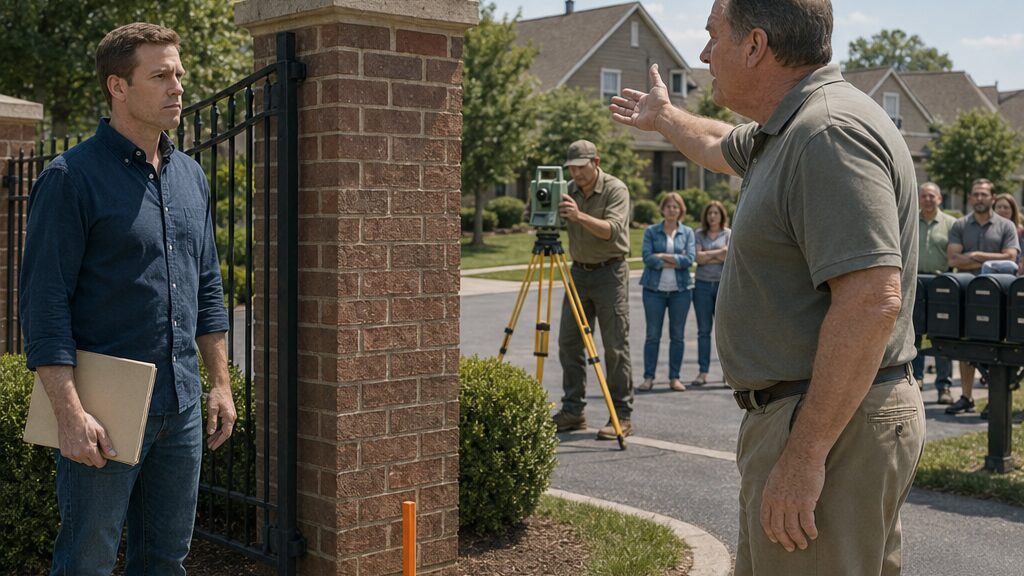
The orange survey flag looked absurd beside the brick pillar.
It stood six inches from the manicured bed of boxwoods at the entrance to Cedarwood Estates, its thin wire trembling whenever a car passed. Behind it rose one of the subdivision’s matching brick columns, complete with a black metal lantern and a stone cap that made the structure look as permanent as the houses beyond it.
Timothy Adams stared at the flag.
“You’re sure?”
The surveyor checked the screen on his equipment, then glanced toward the second marker farther down the grass.
“I’ll run it again before I leave. But yes. That’s where the recorded line falls.”
Timothy had owned the parcel for seven days.
Until that morning, he had thought of it as Uncle Jacob’s two acres—a strange, narrow piece of ground left over from the days before the subdivision existed. Some grass. A stand of aging maples. A drainage swale. Nothing Timothy had ever expected to matter.
Now the surveyor walked toward the roadway connecting Cedarwood Estates to the county road.
Timothy followed.
The line did not stop at the landscaping.
It continued beneath the mailbox cluster.
Then beneath the paved shoulder.
Then toward the iron entrance gate.
A sedan slowed as it passed. The driver stared at the equipment, then at Timothy.
“What exactly are you doing?”
The voice came from behind them.
William Mitchell approached from the subdivision side in a tucked-in polo shirt and khakis. Timothy recognized him from the email he had received after probate closed: HOA president, nine years.
William did not offer his hand.
The surveyor answered first. “Boundary verification.”
“For what property?”
Timothy looked at him. “Mine.”
William’s expression barely changed.
“This entrance is association property.”
“That’s what I’m trying to confirm.”
“You don’t need a survey crew to confirm it. We’ve maintained this entrance for nineteen years.”
Two residents had stopped near the mailbox cluster. Another stood beside a dog on a leash.
Timothy noticed the audience immediately.
He disliked that he noticed it.
The surveyor returned to his equipment instead of participating.
William pointed toward the grass. “Your uncle owned the vacant parcel beside the development.”
“According to the deed, he owned more than that.”
“According to whose interpretation?”
“The county description.”
William gave a tight smile. “Legal descriptions can be messy.”
“So can assumptions.”
The words came out sharper than Timothy intended.
William folded his arms.
That was the moment Timothy could have explained himself.
He could have said he did not intend to put up a chain. He could have said he had no plan to block residents from getting home. He could have admitted he was standing there because probate papers had shown a property line that made no sense and he wanted to understand it before doing anything.
Instead, he said nothing.
The surveyor called from beside the pillar.
“Mr. Adams?”
Timothy walked over.
The surveyor showed him the map on the screen, then pointed toward the pavement.
“The recorded boundary carries through this landscaped section and continues across part of the entrance footprint.”
William came close enough to hear.
“That can’t be right.”
“I’m not offering a legal opinion,” the surveyor said. “I’m marking the deed description.”
William looked at Timothy.
“Do you understand what you’re implying here?”
Timothy looked past him at a minivan entering the subdivision. A child’s bicycle was strapped to the back. The gate stood open, as it apparently did during daytime hours.
“I understand where the line is.”
“You’re talking about the entrance used by more than a hundred homes.”
“I didn’t design the subdivision.”
“No, but you inherited a technicality and now you’re having survey stakes driven into our landscaping.”
The woman with the dog was still watching.
Technicality.
Something in Timothy hardened.
He opened the folder under his arm.
He had brought probate documents, the deed, a printed parcel map and several photocopies from Jacob’s old files. Most of it still meant very little to him.
But one page had caught his attention the previous night.
Timothy removed it.
“Do you recognize my uncle’s name?”
William frowned.
Timothy handed him the photocopy.
At the top was Jacob Brown’s name. Below it appeared an old Cedarwood Estates association heading and language referring to use of property adjoining the community entrance.
Only the first page had been in the folder.
No signature page. No schedule of terms. No clear expiration date.
William read enough to lose the dismissive smile.
Timothy watched that happen.
“This proves nothing,” William said.
“I didn’t say it did.”
“Then what are you trying to accomplish?”
“For now? Find out what I own.”
William handed the page back.
“And after that?”
Timothy slid it into the folder.
He could have answered.
Instead, he looked toward the orange flag beside the brick pillar.
“That depends on what I find.”
William’s jaw tightened.
By lunchtime, the surveyor had placed six markers.
The most visible one remained beside the pillar.
Timothy took photographs of each marker, then drove to Jacob’s old house, which he was still clearing for sale.
The basement smelled of cardboard and furnace dust. Jacob had saved everything badly: tax returns mixed with appliance manuals, insurance statements stuffed beside seed catalogs, warranties for machines he had not owned in fifteen years.
Timothy spent two hours going through boxes.
Near the bottom of a cracked plastic tote, he found an accordion file labeled PROPERTY.
Inside were folders arranged by year.
One contained the original purchase documents for the two-acre parcel.
Another contained survey sketches from before Cedarwood Estates had been built.
And tucked behind them was a yellowing index sheet typed on an old printer.
Timothy scanned the entries.
Taxes.
Utility easement.
Drainage correspondence.
Then one line stopped him.
CEDARWOOD ESTATES — ENTRANCE LAND USE.
Beside it, in Jacob’s handwriting, were three words:
Agreement. Payments. Renewal.
Timothy searched the folder behind the index.
The section was empty.
Chapter 2: Nineteen Years of Assumed Ownership
The legal description on the recorded deed matched the survey.
Timothy read it three times at the county recorder’s office before accepting that the strange line of bearings and distances really did describe the same ground marked by orange flags at Cedarwood Estates.
The recorder clerk turned the monitor slightly toward him.
“This is the current vesting deed.”
“And there’s no transfer after my uncle bought it?”
“Not that I see.”
Timothy pointed at the entrance strip on the parcel image.
“No deed to Cedarwood Estates?”
The clerk searched again.
“No recorded conveyance from Jacob Brown for that parcel.”
That should have felt like victory.
Instead, Timothy heard William’s question from Saturday.
Do you understand what you’re implying here?
He asked the clerk about easements.
Several appeared.
A utility easement crossed one edge of the property. A drainage easement followed another section. Neither matched the entrance.
“What about an agreement between the property owner and the HOA?”
“If it wasn’t recorded, it may not appear here.”
Timothy thought about Jacob’s empty file.
Agreement. Payments. Renewal.
“So they could have had permission without having ownership.”
“Certainly.”
“And the paperwork could have been private.”
“Yes.”
The clerk looked at him over the monitor.
“If this is turning into a dispute, you’ll want someone qualified to review the actual documents.”
“I’m still trying to find the actual documents.”
That afternoon Timothy spread copies across his dining table.
The oldest aerial image showed Jacob’s parcel before Cedarwood Estates existed. The county road ran along one end. The future entrance was still grass.
Five years later, the first houses appeared.
Then the entrance roadway.
Then landscaping.
Then two brick pillars.
Timothy enlarged the photographs on his laptop.
The earliest pillars were smaller than the current ones. Later images showed stone caps, lights, fresh masonry, upgraded plantings.
The entrance had not appeared overnight.
It had grown.
So had the neighborhood’s certainty that it belonged there.
His phone rang.
William.
Timothy considered letting it go to voicemail, then answered.
“I understand you went to the recorder’s office,” William said.
Timothy leaned back.
“That traveled fast.”
“I’m trying to prevent this from becoming more complicated than it needs to be.”
“Then send me whatever document gives the HOA rights to the land.”
A pause.
“We’re reviewing our files.”
“Good.”
“But I want to be clear. Cedarwood has maintained that entrance since the subdivision opened.”
“You mentioned that.”
“We mow it. We landscape it. We pay for lighting, repairs, snow clearing, insurance associated with the entrance.”
“I understand.”
“Your uncle never objected.”
Timothy looked at the old photographs.
“That’s not the same as transferring ownership.”
“No, but nineteen years of continuous use matters.”
“Maybe. That’s why I’m asking for the paperwork.”
William exhaled.
“You’re approaching this like we’re strangers trespassing in your backyard.”
“I’m approaching it like I inherited property with somebody else’s gate on it.”
Neither man spoke for several seconds.
Then William said, “Our property-management office has older records. I’ll have them check.”
The call ended without goodbye.
The next morning Timothy met the property-management representative at a small office near the subdivision.
She brought three archive boxes.
“We don’t have everything,” she warned. “Management companies changed before us.”
Timothy worked through board minutes, annual budgets and maintenance records.
Most of it was painfully ordinary.
Mulch replacement.
Streetlight repair.
Insurance renewals.
Pool contracts.
Then, in a budget from seventeen years earlier, he saw a line:
Entrance land access.
The amount was modest.
It appeared again the following year.
And again.
Then the wording changed slightly.
Private entrance parcel.
The next year: land access expense.
The references continued for several years, then disappeared.
Timothy photographed each page.
“Do you know what these payments were for?”
The representative shook her head.
“Before my time.”
“Is there a supporting contract file?”
“I can search.”
She disappeared into a storage room.
Twenty minutes later she returned carrying a thin folder.
Timothy sat straighter.
She placed it on the table.
The label read LAND USE — BROWN PARCEL.
Inside were copies of correspondence.
One letter from Jacob asked that an annual adjustment be reflected beginning January.
Another thanked the HOA for repairing damaged landscaping along the entrance.
Another referenced “terms of existing agreement.”
But the agreement itself was missing.
Timothy held the folder open.
“Where’s the original?”
“If it was here, I’d give it to you.”
“Could the board have it?”
“Possibly.”
“Could someone have removed it?”
She hesitated.
“I don’t know.”
That answer stayed with him.
Back home, Timothy built a timeline.
Jacob acquired the parcel.
Cedarwood Estates was developed.
The entrance appeared.
Land-access payments began.
Payments continued for years.
Then vanished from later budgets.
No deed transfer appeared anywhere.
No recorded document gave the HOA ownership.
But something had clearly existed.
Timothy was beginning to understand why William kept returning to nineteen years of maintenance.
If the missing agreement could not be found, history itself would become the argument.
His email chimed.
William Mitchell.
Subject: Proposed Resolution.
Timothy opened the attachment.
The first paragraph described the entrance as infrastructure “historically maintained and operated for the benefit of Cedarwood Estates.”
The second said the board wished to resolve “any uncertainty arising from recent title succession.”
Then Timothy reached the attached document.
It was a deed.
The association proposed that Timothy transfer the entrance portion of his inherited parcel to Cedarwood Estates.
He read the consideration clause twice.
The amount was nominal.
Not rent.
Not a purchase reflecting the land’s importance.
A token payment, plus the HOA’s promise to continue maintaining the property.
Timothy stared at the screen.
They had not produced the old agreement.
They had produced a new deed.
Chapter 3: The Deed They Expected Him to Sign
The deed was already waiting at Timothy’s seat when he entered the HOA clubhouse.
A pen lay beside it.
William Mitchell sat at the far end of the rectangular table with two board members. Kathleen Walker sat to his right, a binder open in front of her.
Nobody said anything about the pen.
Timothy pulled out the chair and remained standing.
“You expected me to sign this tonight?”
William gestured toward the seat.
“We expected to discuss a practical solution.”
“You sent it yesterday.”
“So you’d have time to review it.”
“One day.”
William’s mouth tightened.
“We’re trying to avoid unnecessary expense for everyone.”
Timothy sat.
The clubhouse walls displayed framed photographs from Cedarwood Estates’ history. Groundbreaking ceremonies. Holiday events. A summer picnic.
Directly behind William hung an old photograph of the entrance.
Timothy recognized the brick pillars immediately.
They were shorter then.
But they stood in the same place.
On Jacob’s land.
William folded his hands.
“The association has invested in that entrance for almost two decades. Lighting. Landscaping. Repairs. Pavement. Snow removal.”
“And that means I should give you the property?”
“It means we need to look at this realistically.”
“I am.”
“One strip of land has no practical value to you independent of the subdivision.”
Timothy felt his irritation rise.
“It seems to have practical value to you.”
One board member shifted in his chair.
Kathleen looked down at her binder.
William stayed composed.
“We’re not denying your deed contains the parcel. We’re saying the community has relied on that entrance since the development was completed.”
“Then there should be paperwork establishing the right to use it.”
“Our attorney is reviewing that.”
“You said that Saturday.”
“These records are old.”
Timothy placed copies of the historic budgets on the table.
“So old that the HOA used to pay for something called entrance land access?”
For the first time, William’s gaze dropped to the papers.
Kathleen looked at them too.
“Where did you get those?”
“Your management archives.”
William said, “Historic accounting terminology doesn’t establish an enforceable agreement.”
“I agree.”
That answer surprised him.
Timothy continued.
“But it establishes that somebody thought the land was worth paying to use.”
Kathleen turned one of the pages toward herself.
Her fingertip stopped beside the line item.
“I remember this.”
William looked at her.
“Kathleen.”
“I’m saying I remember the category.”
“You were not treasurer then.”
“No. But I was on the finance committee for part of that period.”
The room changed.
Timothy leaned forward slightly.
“What was it?”
Kathleen did not answer immediately.
William said, “This isn’t the purpose of tonight’s meeting.”
“It seems directly related.”
“The purpose is to resolve ownership cleanly.”
Timothy tapped the deed.
“By transferring it to you.”
“By eliminating uncertainty.”
Kathleen was still studying the budget.
Then she said, almost to herself, “There was a check.”
William turned toward her.
“What check?”
“Once a year, maybe more often. I remember because it wasn’t sent to a vendor.”
Timothy’s irritation vanished beneath concentration.
“Who was it made out to?”
Kathleen frowned.
“I don’t remember.”
William closed the binder in front of him.
“We are getting distracted by fragments of old records.”
Timothy looked at him.
“You keep calling them fragments, but you still haven’t shown me anything proving the HOA owns the entrance land.”
“We never said we had a deed.”
“Then why are you acting like my ownership is the problem?”
William’s restraint slipped.
“Because a hundred and eighteen households should not have to wonder whether one newly inherited parcel is going to interfere with their entrance.”
There it was.
Not law.
Fear.
Timothy heard it clearly, and for a second he understood William better.
The entrance was not ornamental to him. It was the route residents used every day. Any board president would be worried.
Then William added, “Your uncle understood that.”
Timothy’s sympathy disappeared.
“You don’t get to use him against me.”
“I’m telling you the reality.”
“No. You’re telling me what you want the reality to be.”
“Timothy—”
“If Jacob agreed to something, show me. If he sold it, show me. If there’s an easement, show me. But don’t hand me a deed and tell me nineteen years of mulch and snowplowing somehow makes the land yours.”
Silence filled the room.
Kathleen looked at him carefully.
One board member cleared his throat.
William said, “Nobody said it makes the land ours.”
“You’re asking me to make it yours.”
“For nominal consideration because the association has already borne the cost of maintaining it.”
Timothy laughed once, without humor.
“That’s your argument?”
“It’s a relevant fact.”
“No. It’s convenient.”
William pushed back from the table.
“This is exactly why we wanted counsel involved.”
“Good. Let counsel find the old agreement.”
“And if there isn’t one?”
Timothy looked at the deed.
He knew the intelligent answer.
He should have said they would review the legal position. He should have said they could negotiate temporary access while records were located. He should have made it clear that he had no intention of closing a road families depended on.
Instead, anger chose for him.
“If there isn’t one, then you have a bigger problem than I do.”
Kathleen’s eyes lifted.
William went still.
Timothy knew immediately what the sentence sounded like.
He let it stand anyway.
He pushed the unsigned deed back across the table.
“I’m not transferring anything tonight.”
William took the document.
“Then I suppose we’ll proceed formally.”
“Do that.”
Timothy gathered his papers.
Kathleen spoke before he reached the door.
“Mr. Adams.”
He turned.
She was holding one of the old budget pages.
“I’ll look through my records.”
William said, “Kathleen, anything association-related needs to go through counsel.”
She glanced at him.
“I said my records.”
Timothy left without responding.
Outside, the entrance pillars were visible through the clubhouse windows, their lanterns glowing against the dark.
For the first time, they did not look permanent to him.
They looked dependent.
That thought should have satisfied him.
Instead, he remembered William’s reference to a hundred and eighteen homes.
He drove home still angry.
At 10:47 p.m., his phone buzzed.
A message from Kathleen.
No greeting.
Just a photograph of an old ledger page.
One line had been circled.
LAND ACCESS — J. BROWN.
Beside it was a payment date.
Kathleen had typed beneath the photograph:
This is the last one I can find.
Timothy zoomed in.
The payment had been made eleven years earlier.
His uncle had been alive for nearly a decade after that.
Chapter 4: The Agreement Hidden Behind the Ledger
At seven the next morning, Timothy found the agreement in a box he had already searched twice.
The box sat beneath Jacob’s old workbench, wedged behind a rusted toolbox and a stack of paint trays. Timothy had pulled it out only because Kathleen’s photograph of the ledger had kept him awake.
LAND ACCESS — J. BROWN.
A payment eleven years old.
Nothing after that.
He carried the box upstairs and emptied it across the kitchen table.
Utility bills. Property tax receipts. Insurance renewals. Receipts for gravel deliveries. A folder marked GATE REPAIR.
Then a carbon copy folded inside an envelope with no label.
Timothy opened it carefully.
The first line contained Jacob Brown’s name.
The second named Cedarwood Estates Homeowners Association.
Timothy sat down.
It was not a deed.
It was not an easement recorded with the county.
It was a private land-use agreement.
The document granted the association permission to use a defined portion of Jacob’s parcel for the subdivision entrance, including roadway access, landscaping, lighting, signage, and related improvements.
Timothy read the paragraph again.
Permission.
Not ownership.
He continued.
The association was required to pay Jacob three hundred eighty dollars per month. The amount increased annually according to a formula stated in the agreement.
Timothy reached for his calculator.
He stopped before entering anything.
For a few seconds, satisfaction came too quickly.
William had spent days talking about maintenance and nineteen years of use as though time itself had rewritten the deed.
It had not.
Someone on the HOA side had signed an agreement acknowledging that Jacob owned the land.
Someone had agreed to pay for using it.
Timothy turned the page.
There were signatures.
Jacob’s.
An association officer’s.
A witness line.
Dates matching the earliest budget records he had found.
He took photographs of every page.
Then he reached the paragraph titled SUCCESSORS.
The obligations did not end simply because Jacob died.
The language extended certain rights and duties to successors and assigns.
Timothy leaned back.
“So it follows the property.”
The empty kitchen gave him no answer.
He read further.
Maintenance responsibilities belonged largely to the association. That explained William’s repeated claim that Cedarwood had maintained the entrance for years.
They had.
Because the agreement required them to.
Timothy almost laughed.
William had been presenting contractual performance as evidence of ownership.
Then Timothy reached the termination section.
His expression changed.
If the agreement ended under specified circumstances, the association could be required to restore the affected property substantially to its pre-improvement condition unless both sides reached another written arrangement.
Timothy read the sentence twice.
The brick pillars.
Lighting.
Landscaping.
Parts of the paved entrance.
Potentially all of it.
He pictured the orange survey flag trembling six inches from the brick.
For the first time, the power he had wanted felt heavy.
His phone rang.
He expected William.
It was the HOA attorney.
“Mr. Adams, I understand you declined the proposed conveyance.”
“I did.”
“I’d like to discuss preserving the status quo while we determine everyone’s rights.”
Timothy looked at the agreement.
“Have you found the old land-use contract?”
A pause.
“We have references to an agreement.”
“That wasn’t my question.”
“No, we have not located a complete executed copy.”
“I have.”
Silence.
This time it lasted longer.
The attorney’s voice changed when he spoke again.
“Would you send it to me?”
“After I have it reviewed.”
“That would be prudent.”
Timothy had expected resistance.
The absence of it unsettled him more.
The attorney continued. “Whatever that document says, I would strongly recommend against either party making unilateral changes to access.”
“I haven’t threatened to make any.”
“I’m not saying you have.”
“Has William told people I have?”
Another pause.
“I’m advising both sides to avoid escalation.”
Timothy looked again at the restoration clause.
“I’m beginning to understand why.”
After the call, he returned to the box.
If the agreement had existed all these years, the missing piece was no longer whether the HOA had permission.
It was why the payments stopped.
He found old deposit slips clipped together with bank statements.
The amounts matched the agreement for several years.
Then the increases appeared.
Then the ledger entries stopped.
No sale followed.
No termination document.
No amendment.
No deed.
Timothy searched every folder until nearly noon.
At the bottom of the GATE REPAIR file, he found correspondence from eleven years earlier.
The tone had changed.
Jacob complained about contractors widening a landscaped section without notifying him.
The HOA responded that the improvements were necessary for safer traffic flow.
Jacob replied that permission to use the parcel did not mean permission to alter it without consultation.
Another letter followed.
Then another.
The exchanges became shorter.
Sharper.
The final association letter disputed a requested annual adjustment and suggested that years of association maintenance should be credited against future payments.
Timothy stared at the sentence.
William’s argument had not begun with William.
It had history.
Jacob’s response was missing.
Timothy searched the folder again.
Nothing.
He went back to the original agreement.
At first it had felt like a weapon.
Now it looked more like an unfinished argument passed from one generation to another.
His attention returned to the termination clause.
If he wanted maximum leverage, that was where it was.
He could send the provision to William.
He could let the board imagine contractors removing pillars, landscaping, pavement.
He could force them to negotiate while residents panicked.
The thought came easily.
Too easily.
Timothy closed the agreement.
Something fell from behind the last page.
A small square of yellowed paper landed on the table.
Jacob’s handwriting.
Timothy recognized it from birthday cards, tool labels, notes taped to containers in the basement.
Only one sentence was written across it.
Do not close their only safe entrance.
Timothy remained still.
He looked from the note to the restoration clause.
Then back to the note.
The agreement had finally told him what legal arrangement existed.
The scrap of paper created a harder question.
If Jacob had stopped accepting—or stopped asking for—payment, why had he also made sure the entrance stayed open?
Chapter 5: Why Jacob Let the Payments Stop
Kathleen Walker recognized the note before Timothy finished sliding it across her dining table.
“Oh.”
That single sound changed the room.
Timothy kept his hand beside the paper.
“You’ve seen this?”
“Not that note.”
“But you know what it means.”
Kathleen looked toward the front window before answering.
Her house sat three streets inside Cedarwood Estates. From the dining room, Timothy could see ordinary suburban things: trimmed lawns, a basketball hoop, two garbage bins somebody had not brought in.
Nothing suggested that the neighborhood’s entrance was becoming a legal problem.
Kathleen touched the edge of the note.
“Jacob used to say something similar.”
Timothy waited.
“He could be difficult,” she said.
“That seems to be everybody’s favorite description of him.”
“I didn’t mean it as an insult.”
“You didn’t exactly mean it as praise.”
Kathleen gave him a tired look.
“No. I meant he was stubborn when he thought someone was taking liberties.”
That sounded familiar enough that Timothy looked away.
Kathleen opened an old binder she had brought from a cabinet.
“I joined the finance committee after most of the original development work was done. Jacob’s agreement already existed.”
“You knew the land belonged to him.”
“Yes.”
“Did William?”
“Eventually.”
Timothy leaned forward.
“Eventually?”
“He wasn’t president then. He joined the board later.”
“But the board knew.”
Kathleen nodded.
“When the last payment was made, yes. The people involved knew the entrance parcel was privately owned.”
The answer should have made Timothy feel vindicated.
Instead, it made the years afterward more confusing.
“Then why did the payments stop?”
Kathleen pulled out a photocopy of an old meeting summary.
“There was a dispute over improvements.”
“I found the letters.”
“Then you saw how it started.”
“Jacob objected to widening.”
“He objected to not being asked.”
Kathleen corrected him gently but immediately.
Timothy said nothing.
“The road needed work,” she continued. “Traffic had increased. Delivery trucks were getting wider. Snow piles narrowed the entrance in winter. The board thought the changes were minor.”
“And Jacob didn’t.”
“No.”
“What happened?”
“The board started arguing that maintenance costs should offset some of the land payment. Jacob said maintenance was already their obligation.”
Timothy thought of William using almost the same argument at the clubhouse.
“So nobody learned anything.”
Kathleen gave a small, humorless smile.
“Homeowner associations have institutional memory until it becomes inconvenient.”
Timothy glanced at the ledger.
“The last payment was eleven years ago.”
“Yes.”
“Did Jacob terminate the agreement?”
“No.”
“Did the HOA?”
“Not that I know of.”
“Did he forgive the payments?”
“I don’t know.”
“That’s a big distinction.”
“I understand.”
His tone had sharpened.
Kathleen closed the binder halfway.
“You asked me what happened. I’m telling you what I remember, not testifying under oath.”
Timothy exhaled.
“Sorry.”
She studied him for a moment before opening the binder again.
“The dispute got ugly for a while. Not dramatic. Letters. Meetings. People complaining. Jacob threatening to require formal approval for every change. The board accusing him of holding up safety work.”
“And then?”
“Nothing.”
“That’s not an answer.”
“It is, actually. Nothing happened.”
She pointed toward the note.
“That was Jacob.”
Timothy frowned.
Kathleen explained.
“He would push until people understood he wasn’t going to be ignored. Then if pushing any further hurt somebody who had nothing to do with the dispute, he’d stop.”
Timothy thought of the note again.
Do not close their only safe entrance.
Kathleen continued. “The development has another connection on paper, but it was never built out properly. It’s narrow, steep in one section, and not suitable as the normal entrance. Jacob knew that.”
“So he let them use his land for free.”
“I didn’t say that.”
“You said the payments stopped.”
“I said the records I have stop.”
Timothy held her gaze.
Kathleen sighed.
“There were years when Jacob sent invoices and the board disputed them. Then there were years when he stopped sending invoices. At some point everybody behaved as if not talking about it was a solution.”
“Until he died.”
“Until you inherited it.”
They drove to the entrance after lunch.
Kathleen wanted to show him where the widening dispute had occurred.
She stopped beside the eastern brick pillar.
“Here.”
Timothy looked at the base.
The masonry itself was newer than the lower course. A narrow strip of paving curved farther into the parcel than the older photographs showed.
“Jacob hated this?”
“He hated that they did it without asking.”
She crouched slightly and pointed to a repaired section of mortar.
“That crack opened a year later.”
“The HOA repaired it?”
Kathleen shook her head.
“Jacob did.”
Timothy stared at her.
“Why?”
“The maintenance contractor kept saying it was cosmetic. Jacob got tired of looking at it.”
That detail struck him harder than any legal clause had.
His uncle had fought over permission, refused to sell the land, disputed payment, and then repaired a pillar he did not own because nobody else would do it properly.
Kathleen stood.
“He wasn’t trying to own the neighborhood.”
“No.”
“He just didn’t like people pretending his property stopped being his because it was useful to them.”
Timothy looked at the pillar.
For days it had symbolized leverage.
Now he saw Jacob kneeling beside it with mortar on his gloves.
A sedan turned into the subdivision and passed them.
The driver slowed.
Timothy recognized the look.
People knew who he was now.
His phone vibrated.
An email.
Emergency Board Meeting — Monday, 7:00 P.M.
Kathleen checked her own phone almost simultaneously.
Her face tightened.
“What?”
She showed Timothy the message.
William had called an emergency meeting “to address potential interruption or alteration of primary community access arising from the disputed entrance parcel.”
Timothy read it twice.
“I never threatened to interrupt access.”
“I know.”
“He knows.”
Kathleen did not answer.
Timothy looked at her.
“He knows that, right?”
“He knows you haven’t said you would close it.”
“That’s not what I asked.”
Kathleen put her phone away.
“William is under pressure.”
“So that makes this acceptable?”
“No.”
“Then say it.”
She met his eyes.
“No. It doesn’t.”
That evening, Cedarwood residents received a separate notice.
Timothy knew because one of them forwarded it to an email address he had used in his initial letter to the board.
The language was careful.
No direct accusation.
No statement that Timothy had threatened anyone.
Only phrases about “uncertain access rights,” “potential consequences,” and “protecting uninterrupted entry.”
It was enough.
By nine o’clock, two residents had emailed Timothy asking whether he intended to install a gate of his own.
A third asked whether emergency vehicles would still be able to enter.
A fourth accused him of trying to “hold the neighborhood hostage over inherited dirt.”
Timothy typed three different replies.
He deleted all of them.
He told himself he should not negotiate through frightened residents.
He told himself William had created the misunderstanding and should correct it.
He told himself facts would matter more at Monday’s meeting.
Then he closed his laptop without sending a single response.
For the second time in a week, Timothy had the chance to tell people he was not going to close the entrance.
For the second time, pride persuaded him that he should not have to.
Chapter 6: The Meeting Where Fear Became Leverage
A woman Timothy had never met stopped him before he reached the clubhouse door.
“My mother uses that entrance for her medical transport.”
Timothy halted.
Behind her, residents were filing into the building.
“I’m not blocking the entrance.”
“That’s not what the notice said.”
“The notice didn’t say I was blocking it either.”
“It said access is at risk.”
Timothy looked through the glass doors.
William stood near the front of the room.
Kathleen was arranging papers at the board table.
The woman crossed her arms.
“So is it?”
Timothy could have blamed William.
Instead he said, “Not because of anything I’ve threatened.”
Her expression softened only slightly.
“That’s not very reassuring.”
She walked inside.
Timothy stayed outside another second.
He had spent the weekend telling himself that silence was discipline.
Standing at the door, he finally recognized what it had become.
An empty space other people had filled for him.
The clubhouse was nearly full.
William opened the meeting with procedural language about protecting community access and clarifying property rights.
Behind him, a projector displayed photographs of the entrance.
The brick pillars looked enormous on the screen.
Timothy sat at the end of the front table.
A resident spoke before William finished inviting comments.
“Can he legally close the road?”
The HOA attorney leaned toward his microphone.
“There are unresolved contractual and property questions. I would caution against assuming any immediate outcome.”
Another resident looked directly at Timothy.
“Are you planning to close it?”
The answer was simple.
Timothy realized, with some embarrassment, that it had always been simple.
“No.”
A murmur moved through the room.
William looked at him.
Timothy continued.
“I have never told the board I intend to close the entrance. I have never told the board I intend to block emergency access. I have never threatened to put up a chain, a barricade, or another gate.”
The woman from outside was sitting in the second row.
She stared at William now.
A resident asked, “Then why did we get that notice?”
William leaned forward.
“Because responsible board leadership requires us to consider possible consequences before they occur.”
Timothy said, “You could also have told them I hadn’t threatened any of those consequences.”
William’s eyes hardened.
“I wasn’t going to assure residents that access was secure while you were refusing to tell us what you intended to do.”
There it was.
Timothy felt the old urge to answer with documents.
Instead he waited.
William filled the silence.
“You told this board that if no agreement existed, we had a bigger problem than you did.”
“I did.”
“Would you like to explain how we were supposed to interpret that?”
Timothy looked at the residents.
“Exactly the way it sounded. I was angry.”
A few people shifted.
“I also should have been clearer. I found out the land under your entrance is part of property I inherited. The board offered me a deed to transfer it almost immediately. I refused. That does not mean I intend to trap anybody inside the subdivision.”
The room quieted.
Kathleen opened her binder.
William said, “You’re leaving out the fact that the association has maintained that property for nineteen years.”
“No, I’m not.”
Timothy removed a copy of the old agreement.
“I finally found out why.”
He placed it on the table.
The attorney already had a copy now. He did not look surprised.
Several residents did.
Timothy kept his explanation short.
“The association had permission to use the parcel. It paid for that use. The agreement required the association to maintain parts of the entrance.”
William said, “That agreement is old and its current enforceability is still under review.”
“Agreed.”
The answer deprived him of momentum.
Timothy added, “I’m not asking this room to decide the legal questions tonight.”
A board member asked, “Then what are we deciding?”
“Whether we keep pretending the only two choices are that I give you the land or I close the entrance.”
Kathleen looked toward William.
“There were payments.”
William’s jaw tightened.
“Kathleen—”
“There were,” she said. “I found them.”
A resident called from the back, “So the HOA knew it wasn’t ours?”
Kathleen answered carefully.
“Earlier boards knew the entrance parcel was privately owned.”
The room changed again.
Not outrage.
Something quieter and more dangerous for William: doubt.
He leaned back.
“You all need to understand the position this put the board in.”
Timothy watched him.
William’s voice lost some of its polished meeting tone.
“When I became president, the entrance had been operating the same way for years. The budgets no longer showed a land payment. The property manager treated the landscaping and roadway as association-maintained infrastructure. Nobody raised an ownership dispute.”
Kathleen said, “That doesn’t mean there wasn’t one.”
“I know that now.”
The admission stopped several whispers.
William looked around the room.
“You want to know why I pushed for a deed? Because if I tell a hundred and eighteen households that the association never cleaned up the ownership of its own entrance, that is not a small administrative error.”
He glanced toward the projected image of the pillars.
“It affects insurance questions. Maintenance authority. Future sales. Lending questions. And yes, it reflects on every board that failed to review it.”
“Including yours,” Kathleen said.
William looked at her.
“Yes.”
The word came out quietly.
Timothy had expected denial.
The admission unsettled the clean picture he had built of William as a man protecting power for its own sake.
William continued.
“I thought acquiring the strip outright was the safest solution.”
“For the HOA,” Timothy said.
“Yes.”
“And easiest for you.”
William did not answer.
Timothy knew the answer anyway.
The attorney cleared his throat.
“There is another issue everyone should understand. The agreement contains a restoration provision.”
The room erupted into overlapping questions.
William raised a hand.
Timothy closed his eyes briefly.
This was the part he had not wanted residents to hear before he understood it himself.
The attorney explained that termination could create obligations concerning improvements on the private parcel.
A resident asked, “You mean the gate?”
“Potentially portions of the entrance infrastructure, depending on interpretation and circumstances.”
The woman whose mother used medical transport went pale.
Timothy spoke before William could.
“I am not asking for that.”
The room quieted.
The attorney turned toward him.
“You should preserve every available option until negotiations conclude.”
“I understand.”
“You may be giving away leverage.”
“I understand that too.”
William studied him.
Timothy pulled the unsigned deed proposal from his folder and placed it beside the old agreement.
“I’m not signing this.”
Then he placed the restoration clause beside it.
“And I’m not demanding this.”
Kathleen’s gaze stayed on him.
Timothy felt something inside himself release—not weakness, exactly. The need to make William feel as cornered as he had felt.
“I want three things.”
He took out one final sheet.
“First, a written access agreement that gets recorded properly so nobody inherits this mess again.”
He placed a finger on the second paragraph.
“Second, fair compensation tied to a clear adjustment formula.”
Then the third.
“And third, a boundary and maintenance plan that says exactly who owns what, who maintains what, and what changes require permission.”
A resident asked, “That’s it?”
Timothy looked around the room.
“That’s enough.”
William picked up the sheet.
His eyes moved down the page.
“You drafted this?”
“I outlined it. Lawyers can make it complicated later.”
A few people laughed nervously.
The tension broke just enough for everyone to breathe.
William did not laugh.
“You’re asking the association to formally acknowledge that the entrance land is privately owned.”
“Yes.”
“And resume payments.”
“Yes.”
“And record the arrangement.”
“Yes.”
“What happens if we refuse?”
Timothy looked at the projected photograph behind him.
The brick pillars stood bright and perfect on the screen.
He could have answered with the restoration clause.
He could have reminded William exactly how much leverage had shifted across the table.
Instead he said, “Then we keep paying lawyers to argue about a problem we already know how to solve.”
William stared at him.
Kathleen closed her binder.
For the first time since the survey flag went into the ground, nobody in the room was asking whether Timothy would close the entrance.
They were looking at the page William held.
Three terms.
Access.
Compensation.
Recognition.
William lowered the proposal to the table.
“I’ll have counsel review it.”
Timothy nodded.
“No deed transfer.”
“I heard you.”
“No notice implying I threatened a closure unless I actually do.”
William’s face tightened.
Then he nodded once.
“Fair.”
The meeting began to break apart slowly.
Residents gathered in small groups. Some still watched Timothy cautiously. The woman from outside approached him before leaving.
“You really weren’t going to block it?”
“No.”
“You could have said that sooner.”
Timothy looked past her toward William.
Then back at her.
“Yes.”
She gave him a short nod and walked away.
Timothy remained beside the table.
His proposal was still in William’s hand.
For the first time, the question was no longer what Timothy had inherited.
It was what kind of owner he intended to become.
Chapter 7: The Price of Keeping the Gate Open
Two weeks later, the HOA attorney placed both hands on the conference table and told Timothy something William had spent nearly a month trying not to say.
“You are not required to convey the parcel.”
William sat across from Timothy without reacting.
Kathleen looked down at the final draft in front of her.
The attorney continued. “The association can dispute certain interpretations of the old agreement. It can negotiate compensation. It can seek clarification of specific obligations. But based on the deed, the survey, and the documents we have reviewed, I cannot advise this board that it owns the entrance parcel.”
Timothy looked toward William.
For once, there was no argument waiting.
Outside the clubhouse windows, the entrance pillars stood beyond a row of houses, their lanterns already on in the late afternoon.
The same pillars that had looked immovable three weeks earlier.
The attorney tapped Timothy’s proposal.
“The question now is whether the parties can replace an uncertain historic arrangement with something workable.”
Timothy had spent the previous two weeks doing something he had resisted from the beginning.
He had stopped asking what he could force the HOA to do and started asking what agreement he could live with ten years from now.
The new draft did not transfer ownership.
Instead, it granted Cedarwood Estates a recorded long-term right to use the defined entrance portion of Timothy’s parcel.
The boundary was attached as a survey exhibit.
The association retained responsibility for normal maintenance.
Any material widening, new structure, relocated lighting, or change beyond the defined footprint required written approval.
Compensation began at a negotiated amount based on the old agreement and modern use, with future increases tied to a clear index rather than whatever argument happened to arise at the next board meeting.
And one sentence appeared repeatedly in the document:
Title to the underlying land remains with the property owner.
William finally spoke.
“The rent is higher than Jacob’s last payment.”
“Yes.”
“Substantially.”
“Jacob’s last documented payment was eleven years ago.”
“I’m aware.”
“The old agreement had increases built into it.”
“The board still has to explain this expense to residents.”
Timothy nodded.
“That’s your job.”
William’s face tightened.
Three weeks earlier, Timothy would have enjoyed saying it.
Now he simply meant it.
Kathleen turned a page.
“The amount is less than what prolonged litigation would cost us.”
William looked at her.
“That’s not the only measure.”
“No,” she said. “It isn’t.”
She placed her finger beside the survey exhibit.
“This is also the first version that tells future boards exactly where our rights stop.”
Timothy noticed William glance at the attorney.
The attorney said, “That matters.”
William leaned back.
“And if a future board violates these terms?”
“Then you address the violation,” Timothy said.
“And termination?”
Timothy knew what he was really asking.
The restoration clause.
The possibility that the brick pillars, lights, landscaping, or pavement could someday become bargaining chips again.
The draft in front of them did not erase consequences. It defined them more carefully.
“There are cure periods,” Timothy said. “Written notice. Time to fix a breach. Mediation before either side takes major action.”
William looked at him.
“You took out immediate restoration.”
“I replaced it with something that gives both sides a chance to fix the problem first.”
The attorney added, “That is considerably more predictable than the old provision.”
William studied Timothy for a long moment.
“You could have demanded removal.”
Timothy thought of the yellowed note in Jacob’s handwriting.
Do not close their only safe entrance.
“I could have demanded a lot of things.”
“Why didn’t you?”
The answer was not as simple as generosity.
Timothy had imagined forcing the board to choose between paying him and dismantling the entrance.
For a few angry days, the image had satisfied him.
Then he had pictured the woman whose mother relied on medical transport.
He had pictured the minivan that passed the survey crew.
He had pictured Jacob repairing mortar on a pillar he did not own because he could not stand watching a small problem become someone else’s burden.
“Because ownership doesn’t make every use of leverage a good idea,” Timothy said.
Nobody responded immediately.
Kathleen gave the smallest nod.
William looked back down at the agreement.
There remained one condition he disliked more than the money.
The final approval required the HOA to provide residents with a written explanation acknowledging that the association entrance had historically occupied privately owned land under an agreement that had not been properly maintained in association records.
Not a confession of wrongdoing.
Not an accusation.
Just the truth.
William had tried twice to soften it into “uncertain historic title conditions.”
Timothy had refused.
“You still want that paragraph,” William said.
“Yes.”
“You know what residents will hear when they read it.”
“That the board made a mistake.”
“Boards. Plural.”
“Fine.”
William’s jaw worked slightly.
“And that includes mine.”
“Yes.”
Timothy did not soften the answer.
William turned to the window.
For the first time, Timothy understood that this was the part costing him most.
Not the payment.
Not even the legal correction.
William had built his identity around being the person who kept Cedarwood orderly. Budgets balanced. Contractors scheduled. Rules followed. Problems handled before residents had to worry.
The entrance dispute had exposed something he could not organize away.
For years, he had managed infrastructure without asking who owned the ground beneath it.
Kathleen broke the silence.
“We can either explain how we corrected it, or someday somebody else can explain why we didn’t.”
William looked at her.
“You could have pushed harder on this years ago.”
Kathleen accepted the accusation without flinching.
“Yes.”
Timothy glanced at her.
She continued.
“I remembered enough to know there had once been an arrangement. I let myself believe that if management wasn’t flagging it, somebody else had handled it.”
William looked down at his hands.
“So everybody gets to admit they should have done something sooner.”
Kathleen gave a faint smile.
“That seems fair.”
The board voted forty minutes later.
One member approved immediately.
The second asked three questions about the annual adjustment formula, then approved.
Kathleen voted yes.
William was last.
He held the agreement in front of him while the room waited.
Timothy did not look away.
William finally said, “For the record, the association should never have assumed that continued use and maintenance resolved ownership.”
The sentence was not required.
Timothy knew that.
William continued.
“We should have reviewed the underlying documents years ago. We didn’t.”
He glanced toward Timothy.
“And when the issue surfaced, I pushed for the solution that protected the association fastest instead of acknowledging the problem clearly.”
Kathleen watched him.
William drew a breath.
“I vote yes.”
There was no applause.
Timothy was glad.
The papers still needed signatures. The recording still had to happen. Residents would receive the explanation. The first payment would eventually appear in the association budget.
Ordinary consequences followed ordinary mistakes.
That felt more honest than victory.
A few days later, Timothy met the surveyor at the entrance again.
The orange flags were gone.
In their place, a small permanent boundary marker had been installed near the eastern brick pillar, low enough not to disrupt the landscaping.
The HOA had also agreed to place a simple maintenance reference marker in its records corresponding to the surveyed boundary.
Kathleen arrived while Timothy was inspecting it.
“So that’s it?” she asked.
“That’s it.”
She looked at the pillar.
“It seems smaller now.”
Timothy smiled.
“I was thinking the same thing.”
A maintenance worker was trimming the boxwoods nearby.
Cars moved through the entrance as they always had.
Nobody slowed.
Nobody stared.
The gate opened for an approaching vehicle and closed again behind it.
William appeared from the subdivision side carrying a folder.
He stopped beside Timothy.
“The recorded copy.”
Timothy accepted it.
“Thanks.”
William looked down at the boundary marker.
“We’ll probably have residents complain about the new line item in the budget.”
“Probably.”
“Some will say we should have fought.”
“Probably.”
William glanced at him.
“You could say something reassuring.”
Timothy almost laughed.
Then he recognized the invitation hidden inside the complaint.
“I’ll tell anyone who asks that I intend to honor the agreement.”
William nodded.
“That helps.”
Timothy slipped the recorded document into the folder.
For weeks, he had thought protecting Jacob’s inheritance meant refusing to give anything away.
Now he understood that Jacob had been trying, imperfectly, to protect two things at once.
His land.
And other people’s ability to get home.
The mistake had not been generosity.
The mistake had been leaving too much unspoken.
Timothy rested one hand on the brick pillar.
The mortar repair Kathleen had shown him was still visible if he knew where to look.
Jacob’s work.
A small patch on an HOA monument built on private ground.
Timothy had inherited the contradiction along with the property.
He did not have to inherit the silence.
A car passed through the gate.
Timothy stepped away from the pillar and looked once at the new boundary marker.
The entrance remained exactly where it had been.
But now everyone knew whose ground was underneath it, who had the right to use it, who had to maintain it, and what they owed for the privilege.
Nothing had been torn down.
Nothing had been surrendered.
For Timothy, that was enough.
The story has ended.