They Poured Concrete Across Larry’s Private Road, Then the HOA Had to Pay to Remove Every Inch
Chapter 1: The Concrete Truck Outside Larry’s Window
The sound that woke Larry Hall was not loud enough to be alarming at first.
It was a low mechanical churn beneath the kitchen window, followed by the sharp hiss of air brakes.
Larry opened one eye, listened, then sat upright.
No delivery truck had any reason to be beside his house at six-thirty on a Saturday morning.
He crossed the hallway barefoot and pulled one edge of the curtain aside.
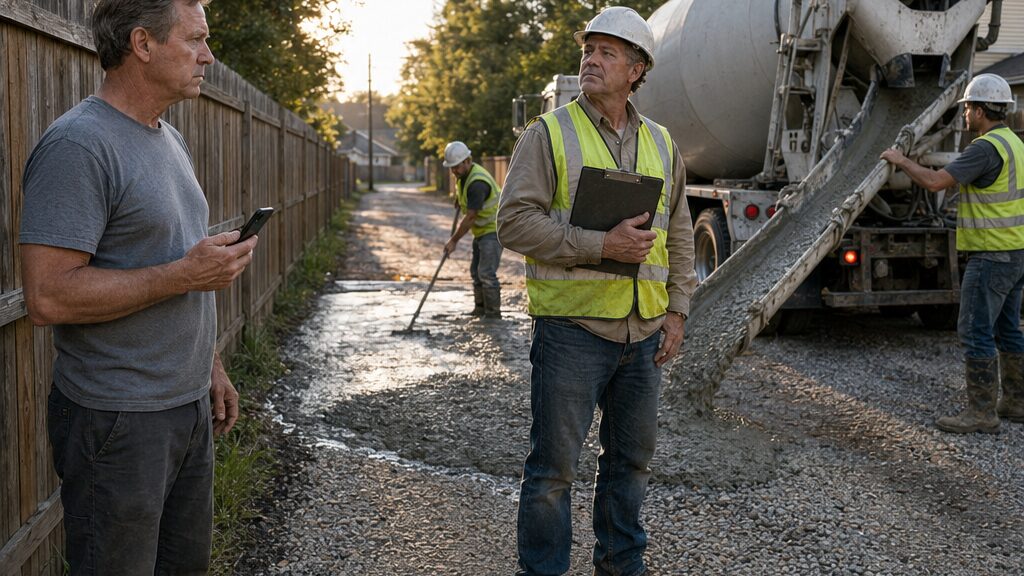
A yellow concrete mixer filled the narrow view beyond his side yard.
Its rear wheels were standing partly on the gravel road that ran along his wooden fence. Two workers in reflective vests were guiding the chute backward.
Straight toward the road.
Larry stared for perhaps three seconds before understanding what he was seeing.
Then gray concrete began sliding out.
“No.”
The word came out quietly.
He was already moving.
By the time he reached the side door, the crew had poured a wet ribbon several feet long across gravel Larry had driven over for nearly two decades.
The road was not impressive. It was narrow, uneven in places, and edged by grass that always grew faster near the fence. But it was his access route to the rear half of the property. It also predated most of the homes behind him.
Larry stepped onto the grass.
“Stop the pour.”
One worker looked toward him but kept hold of the chute.
Larry raised his voice just enough to carry over the mixer.
“Stop pouring. This is private property.”
The worker glanced toward a man standing near the truck with a clipboard.
The man walked over without hurrying.
“You the homeowner?”
“Yes.”
“I’m the foreman.”
“Good. Then stop the truck.”
The foreman looked toward the wet concrete and then back at Larry.
“We’re doing the pedestrian connection.”
“You’re doing it on my road.”
The foreman frowned as if Larry had corrected a street name.
“This is the association project.”
“I didn’t ask who hired you.”
The foreman shifted the clipboard against his hip.
“The HOA hired us to put in a community walking path from the cul-de-sac to the entrance sidewalk.”
Larry pointed at the gravel disappearing beneath the concrete.
“That strip belongs to me.”
The foreman looked down at the paper on his clipboard.
“We’ve got authorization.”
“From whom?”
“The association.”
“The association doesn’t own it.”
Behind them, the mixer continued rotating.
Wet concrete folded onto itself in slow, heavy waves.
Larry felt his jaw tighten.
For years he had disliked HOA meetings precisely because every question seemed to require forty minutes of discussion and six people repeating the same sentence. He paid what he owed, kept his property maintained, and expected the board to do the same with its property.
The arrangement had worked because distance worked.
Until now.
“Show me where your authorization says you can build on my parcel.”
The foreman turned the clipboard slightly but did not hand it over.
The top page showed a work order, a contractor logo, and a simplified drawing Larry could not read from where he stood.
“I don’t determine ownership,” the foreman said.
“Then you shouldn’t be pouring until somebody does.”
“We were given the approved plan.”
Larry took a breath through his nose.
He could feel the old instinct rising—the urge to step between the chute and the ground and make the problem physically impossible to ignore.
Instead he pulled his phone from his pocket.
The foreman noticed.
Larry opened the camera.
“I’m recording this.”
“That’s fine.”
Larry aimed first at the wet concrete, then at the gravel still visible ahead of it, then at the fence posts.
He spoke clearly.
“Saturday, six forty-two a.m. I have informed the contractor that this road is private property belonging to my parcel. I have asked the contractor to stop work.”
The foreman’s expression hardened slightly.
“Sir, I already told you. You need to take this up with the board.”
Larry kept recording.
“Are you refusing to stop?”
“I’m telling you we have a contract.”
“That isn’t what I asked.”
The foreman looked toward the crew.
For a moment Larry thought he might signal them to pause.
Instead he said, “Keep it moving.”
The chute shifted forward.
Another section of gravel vanished.
Larry felt something inside him go cold.
He filmed the truck’s position. The crew. The edge of the fence. The stretch of untouched gravel ahead of them.
A neighbor stood across the street in slippers, watching from the end of a driveway. Larry ignored him.
The foreman turned away.
Larry followed two steps.
“Who authorized this specifically?”
“The HOA president signed off.”
“Andrew Clark?”
“Yes.”
That surprised him less than it should have.
Andrew had been talking for months about improving pedestrian access near the neighborhood entrance. Larry had heard enough fragments of it to know residents disliked walking along the narrow vehicle lane.
But he had never heard anyone say they intended to use his road.
Or, he corrected himself, he had never listened long enough to find out.
That thought irritated him, so he pushed it aside.
“You have a survey?” Larry asked.
The foreman stopped.
“Not with me.”
“Recorded easement?”
“You’ll need to ask the board.”
“Property owner authorization?”
“Sir.”
The foreman finally faced him fully.
“We are not going to litigate property lines beside a concrete truck. I have an approved job. If you think the HOA made a mistake, call them.”
Larry looked past him.
The concrete was spreading almost to the inside tire track.
Once cured, this would not be a misunderstanding that could be brushed back into gravel with a rake.
It would be permanent until somebody paid to break it.
Larry lowered the phone.
For several seconds the only sounds were the truck engine and the workers scraping wet concrete into form.
Then he lifted the phone again and photographed the work order from as close as the foreman would allow.
He did not touch the chute.
He did not block the truck.
He did not shout.
He walked the length of the road, filming every fence post and every remaining patch of gravel before the crew reached it.
At the far end, he called the HOA number.
Voicemail.
He called Andrew directly.
Voicemail again.
Larry left one message.
“Andrew, this is Larry Hall. Your contractor is pouring concrete on my private road. I have told them to stop. They are continuing. Call me immediately.”
He ended the call.
Behind him came the scrape of a shovel.
Larry looked down the long gray ribbon already replacing the brown gravel.
For the first time, a small doubt entered his anger.
He knew what his deed said.
He knew what he had bought.
But the foreman had come with plans, a work order, and the confidence of someone who expected no dispute at all.
If Andrew believed the association could build here, Larry needed to know why.
The foreman walked past him.
“You’ll have to take it up with the board.”
Then he raised one hand toward the driver.
The mixer drum kept turning.
Chapter 2: The Plat Says Something the Board Never Mentioned
Larry found the deed in the metal file box under his desk within seven minutes.
Finding the answer Andrew Clark apparently believed existed somewhere inside it took longer.
He spread the pages across the kitchen table while the concrete truck continued rumbling outside.
The property description was exactly as he remembered: boundaries, bearings, references to an older survey, and the narrow access strip running along the eastern side.
Nothing said community path.
Nothing said pedestrian access.
Nothing said homeowners association.
But Larry knew enough to understand that a deed was not necessarily the whole history of a piece of land.
An easement could have been recorded separately.
A later agreement could exist.
Some old plat notation could complicate what appeared obvious.
He disliked the possibility, but not as much as he disliked being wrong loudly.
Larry called the county records office.
After being transferred twice, he reached a clerk who asked for his parcel number.
He read it from the tax statement pinned beside the refrigerator.
“I’m trying to confirm whether there’s any pedestrian or association easement over the east access strip.”
The clerk typed for several seconds.
“I can tell you what our index shows. I can’t give you legal advice.”
“I’m not asking for legal advice.”
More typing.
“There’s a utility easement near the rear line.”
“I know about that one.”
“And there’s a drainage notation along the north boundary.”
“Not that.”
“I’m not seeing a recorded pedestrian easement on the east strip.”
Larry stood a little straighter.
“What about an HOA access easement?”
“Not under the instruments tied to this parcel.”
“Can I get the recorded plat?”
“Yes.”
The clerk explained where to find the scanned filing online and which document number to use.
Larry wrote it on the back of an unopened envelope.
Before ending the call, he asked, “If the association had a recorded right to use that strip, would it normally appear there?”
“It should be indexed somewhere against the property, but again, I can only tell you what I see.”
“That’s enough.”
It was more than enough for the moment.
Larry downloaded the plat.
The scan was old and slightly crooked. Thin black lines marked parcels that had existed before the newest section of the subdivision had been built. His own lot sat at the edge like an irregular piece that had been fitted into a cleaner grid later.
He zoomed in.
There it was.
The gravel road was not labeled as a road at all. It appeared as part of his parcel, a narrow rectangular extension running along the eastern fence line.
Larry printed two copies.
Then he carried one outside.
The concrete crew had advanced farther.
The wet surface now covered nearly half the route.
Larry held the plat beside his phone and recorded again.
“County recorded plat. Parcel boundary includes this strip.”
He moved the camera from the black line on the page to the fence, then down to the concrete.
The act steadied him.
It turned the morning from an argument into a record.
Andrew finally called at eleven sixteen.
“Larry, I got your message.”
“You need to stop the contractor.”
“I’m trying to understand what the issue is.”
“The issue is they are pouring concrete on my land.”
Andrew exhaled.
“The pedestrian connection has been discussed for months.”
“That doesn’t answer ownership.”
“The site plan shows that connection.”
“A site plan is not an easement.”
A pause.
“You’ve checked?”
“Yes.”
“With whom?”
“The county.”
Another pause, shorter this time.
“Larry, I’m not going to decide a title question over the phone.”
“You apparently decided one before the concrete truck arrived.”
“I’m saying the board approved a project based on the information we had.”
“And I’m telling you that information is wrong.”
“Send me what you have.”
Larry looked through the window at the gray strip.
“They should stop while you check.”
Andrew’s voice tightened.
“The contractor is already mobilized.”
“That is not my problem.”
“It becomes everybody’s problem when the association starts paying change orders.”
Larry nearly laughed.
“You’re worried about a change order while they’re paving my property?”
“I’m worried about getting facts before making a decision.”
“The fact is in the plat.”
“Send it.”
Andrew ended the call before Larry could answer.
Larry sent the deed, the plat, and three still images from his video.
Then he drafted a short written objection.
He printed it, signed it, scanned it, emailed it, and drove a second copy to the post office for certified delivery.
The whole process felt satisfyingly precise.
By early afternoon, the truck was gone.
The poured section sat pale and wet beside the fence.
Some gravel remained exposed farther down the road where the crew had stopped for the day.
Larry walked it slowly.
His anger had changed shape.
That morning it had been helpless and hot.
Now he had documents.
A parcel number.
A recorded plat.
A timestamped video.
And an unanswered question that belonged to Andrew.
Back inside, Larry returned the deed to the file box.
While clearing the kitchen table, he noticed a stack of mail he had pushed behind an old tool catalog weeks earlier.
HOA envelopes.
He almost threw them into the recycling without looking.
Instead he stopped.
The top one was dated three months earlier.
Community Improvement Planning Notice.
Larry remembered it vaguely.
He had opened it, seen the words pedestrian safety, and decided he had better things to do than attend another meeting about benches, landscaping, or sidewalk paint.
The next envelope had never been opened.
Neither had the one beneath it.
He slit the second envelope with his thumbnail.
Inside was a one-page notice about a proposed walking connection near the eastern edge of the neighborhood.
His eyes moved faster.
Residents with questions regarding adjacent boundaries were invited to contact the board before final design approval.
Larry sat down.
He opened the third envelope.
A sketch showed a dotted line connecting the cul-de-sac to the entrance sidewalk.
The drawing was crude and not drawn to legal scale.
But the dotted line ran exactly where his gravel road ran.
At the bottom was a sentence he had never read:
Owners of adjacent parcels are requested to contact the association regarding the proposed eastern pedestrian connection.
Larry stared at it for a long time.
The county plat had not changed.
The road had not changed.
His ownership had not changed.
But something about the morning had.
He had been right that nobody had permission to pour concrete simply because he failed to attend a meeting.
Still, the board had asked a question months earlier.
And Larry had answered with silence.
Chapter 3: Andrew Calls the Ownership Claim Unsubstantiated
Larry’s certified letter sat in the middle of the HOA conference table like an object nobody wanted to touch.
He knew because Sarah Wilson had told him to attend the meeting and watch what happened to it.
Larry had called her Monday morning after the contractor confirmed it intended to return.
Sarah had listened without interrupting while he described the deed, the plat, the concrete, and the notices he had ignored.
When he finished, she asked only one question.
“Did you ever give the HOA permission?”
“No.”
“Then don’t confuse poor communication with consent.”
That sentence was the reason Larry was sitting beneath fluorescent lights two evenings later instead of staying home.
Andrew Clark sat at the head of the table.
Nancy Brown, the treasurer, had a binder open in front of her. Three other board members occupied the remaining seats.
About a dozen homeowners sat in folding chairs behind Larry.
Andrew opened the meeting by describing the path as a safety improvement.
Nobody objected to that part.
The main entrance road had no sidewalk for roughly seventy yards. Larry himself had seen parents step onto grass when cars approached.
Then Andrew reached the agenda item concerning Larry’s property objection.
“We received a certified notice from Mr. Hall asserting ownership of the eastern connection.”
“Asserting?” Larry said.
Andrew looked toward him.
“You’ll have a chance to speak.”
“You have the plat.”
“And we’re reviewing it.”
Nancy looked up from her binder.
“Have we confirmed whether there’s an easement?”
Andrew’s mouth tightened.
“We have the approved development plan.”
“That’s not what I asked.”
For the first time that evening, Larry looked directly at Nancy.
Andrew slid a large sheet onto the table.
“This is the conceptual site plan used during the pedestrian-project design.”
Larry almost stood.
A colored line ran along the eastern edge of the neighborhood.
It looked official from six feet away.
From two feet, it looked like exactly what it was: a planning drawing.
Larry placed his county plat beside it.
“Show me the recording information.”
Andrew looked at him.
“For what?”
“For the easement you say lets you build on my road.”
“We’re determining whether the association has access rights based on the original development documents.”
“So you don’t have one.”
“I didn’t say that.”
“You don’t have a recorded easement in front of you.”
Andrew leaned back.
“No, not in front of me.”
A murmur moved through the chairs behind Larry.
Andrew immediately turned toward the audience.
“This is precisely why the board needs to complete its review instead of drawing conclusions from one document.”
Larry felt his temper rise.
Sarah, seated beside him, tapped one finger lightly against her legal pad.
He understood the warning.
Stay specific.
Larry pointed at the plat.
“This is not one random document. This is the recorded boundary.”
Andrew’s expression changed.
Not much, but enough.
“You also received three notices about the proposed connection.”
There it was.
Larry had known it was coming.
“I did.”
“And you never objected.”
“I never agreed.”
“You didn’t respond at all.”
“Silence does not give you my property.”
“No one is saying it does.”
“You poured concrete on it.”
The room went quiet.
Andrew looked down at his papers.
When he spoke again, his voice was lower.
“The board believed the proposed path followed an existing association connection reflected in our planning documents. We sent notice to affected residents. You had months to raise a boundary concern.”
Larry wanted to reject every word.
Instead, annoyingly, part of it was true.
He had received the notices.
He had dismissed them because he believed nothing the HOA discussed could alter his deed.
He had been correct legally, perhaps.
But correctness had not prevented a concrete truck.
Nancy turned several pages in her binder.
“Who verified title before the contract was signed?”
Andrew looked at her.
“The project was reviewed.”
“By whom?”
“The design committee and contractor.”
“That’s design. I’m asking about title.”
One of the other board members shifted uncomfortably.
Andrew rubbed a thumb along the edge of his folder.
“We relied on the site plan and prior association maps.”
Nancy said, “So nobody pulled the current parcel record?”
“We had no reason to think there was a conflict until Mr. Hall raised one.”
Larry almost answered.
Sarah spoke first.
“Now you have reason.”
Andrew looked toward her.
Sarah continued calmly.
“My client has provided a recorded plat and deed materials. The county index does not show the pedestrian easement your project would require. At minimum, construction should remain paused while title is confirmed.”
Andrew folded his hands.
“The contractor stopped after Saturday’s scheduled pour.”
“Will they remain stopped?”
A pause.
“We have finishing work scheduled.”
Larry stared at him.
“On my road?”
Andrew’s patience finally cracked.
“On the project area, Larry.”
“That is my road.”
“That is your claim.”
Larry stood before he realized he was doing it.
The folding chair scraped loudly behind him.
Sarah did not pull him back.
Andrew looked up.
Larry kept both hands flat on the table.
“You called the county plat a claim?”
“I called your interpretation of the overall property rights unsubstantiated until our review is complete.”
Larry felt something settle inside him.
Not calm exactly.
Something harder.
“Then vote.”
Andrew blinked.
“If you believe your paperwork is enough to continue pouring after receiving mine, put your names behind it.”
Nancy turned toward Andrew.
“I think we should pause.”
One board member nodded.
Another shook his head.
“We already have the crew committed. If we stop now and find out the association was right, we pay twice.”
Nancy replied, “And if we continue and we’re wrong?”
Nobody answered.
Andrew looked toward the residents sitting behind Larry, then at the project schedule.
That glance told Larry more than the speech about safety had.
This was no longer only about a path.
The board had promised something.
Money had been spent.
Contractors had been scheduled.
Stopping would mean explaining why none of them had settled ownership first.
Andrew called for a motion.
The motion was to continue previously contracted finishing work while the association sought clarification of access rights.
Nancy voted no.
Another member voted no.
Three voted yes.
Andrew cast the final yes.
Larry remained standing.
“So that’s it?”
Andrew closed the folder.
“That’s the board’s decision.”
Sarah gathered her papers.
“No,” she said quietly. “It’s the board’s decision for tonight.”
Outside, Larry walked with her toward the parking lot.
He expected Sarah to tell him they had what they needed.
Instead she said, “You understand what happened in there?”
“They ignored the plat.”
“Yes.”
“And?”
“They’re going to use your failure to respond as part of their narrative.”
“It doesn’t create an easement.”
“No. But it gives them a story about reasonable reliance.”
Larry unlocked his truck.
“I don’t care about their story.”
Sarah stopped beside the passenger door.
“You should. Judges hear stories attached to documents.”
That irritated him because it sounded too close to what Andrew had said.
Sarah continued.
“You can be legally right and still make your own case harder by acting like every fact you dislike is irrelevant.”
Larry said nothing.
At home, he found an email from the HOA sent at 9:14 p.m.
Attached was the contractor schedule.
He opened it.
Crew arrival: 7:00 a.m.
Concrete finishing and extension preparation: 7:30 a.m.
Larry checked the clock.
Less than ten hours.
He forwarded the schedule to Sarah.
Her reply came less than a minute later.
Call me now.
Larry looked through the kitchen window toward the pale strip of concrete beside the fence.
Beyond it, untouched gravel disappeared into the dark.
Tomorrow morning, the crew was coming back.
Chapter 4: The Stop-Work Order Is Not the Victory Larry Expected
At 6:56 the next morning, Larry heard a diesel engine outside.
He was already dressed.
Sarah Wilson was on speakerphone at the kitchen table, reading back the final language of the emergency filing when Larry crossed to the window.
A contractor pickup rolled beside the fence.
Behind it came a smaller concrete truck.
“They’re here,” Larry said.
Sarah stopped reading.
“Do not interfere with them.”
“I know.”
“I mean it. Record. State your objection once. Don’t touch equipment, forms, barricades, anything.”
Larry looked at the pale section poured Saturday. The surface had hardened enough to look permanent now, a smooth gray strip interrupting the brown gravel.
The crew began unloading tools.
“Sarah.”
“Yes?”
“How long?”
“I’m sending the filing now.”
“That doesn’t answer me.”
“No. It doesn’t.”
Larry ended the call only after she told him she would call back.
Outside, the same foreman recognized him immediately.
“Morning.”
“Not particularly.”
The foreman glanced at Larry’s phone.
“We’re finishing the contracted section.”
“You were informed Saturday this is disputed private property.”
“I know what you told me.”
“And you’re continuing.”
“I was told the board reviewed it.”
Larry began recording.
He stated the date and time. He filmed the untouched gravel beyond the existing concrete, the truck, the workers, and the fence.
The foreman watched without comment.
One worker began setting forms along the edge.
Larry’s chest tightened.
The court filing existed somewhere between Sarah’s computer, the clerk’s office, and a judge who had no reason to treat Larry’s morning as more urgent than anybody else’s.
The crew, meanwhile, had shovels in their hands.
At 7:23 Sarah called.
“It’s filed.”
“What happens now?”
“We wait for the judge.”
“That’s the entire plan?”
“That is how courts work, Larry.”
He looked at the crew.
“They don’t appear interested in court procedure.”
“Then keep documenting.”
At 8:05, the first concrete slid down the chute.
Larry stood ten feet away.
He had never hated the sound of wet material hitting the ground before.
It landed with a heavy slap.
For a moment, every instinct he had resisted on Saturday returned. He could park his truck across the road. He could stand in front of the chute. He could make the contractor decide whether finishing a sidewalk was worth touching a homeowner.
Instead, he filmed.
At 8:41 Sarah called again.
“The judge is reviewing it.”
“Reviewing.”
“Yes.”
“Concrete is being poured.”
“I understand.”
“No, Sarah. You understand a sentence. I’m looking at it.”
Her answer came after a pause.
“That is exactly why you hired me. So you don’t have to make the next decision angry.”
Larry said nothing.
He kept the phone aimed at the work.
By ten, another long section of gravel had disappeared.
At 10:18 the contractor paused to reposition the truck.
The sudden silence felt strange.
Then Larry heard a vehicle approaching from the subdivision entrance.
A white county SUV stopped beside the contractor pickup.
A second vehicle pulled in behind it.
The man who stepped from the SUV wore a county identification badge clipped to his belt and carried a folder. A deputy got out of the second vehicle.
The foreman walked toward them.
Larry lowered his phone slightly.
The inspector introduced himself, asked who was responsible for the site, and spoke quietly with the foreman.
The foreman pointed toward Larry.
The inspector came over.
“Mr. Hall?”
“Yes.”
“I have an emergency stop-work order affecting this disputed strip.”
Larry looked at the folder.
For several seconds he said nothing.
The inspector added, “This does not determine final ownership. It preserves the current condition until the court can address the dispute.”
The qualification barely registered.
Behind him, the foreman had raised one hand.
The concrete chute stopped moving.
For the first time since Saturday morning, somebody other than Larry had told the crew to stop, and they had stopped.
Workers began shutting equipment down.
Larry felt an almost embarrassing rush of relief.
He called Sarah.
“They stopped.”
“I know.”
“You knew?”
“I just received the signed order.”
Larry looked across the road.
Andrew Clark was standing near the sidewalk.
Larry had not seen him arrive.
Andrew’s arms were folded, his face unreadable from the distance.
The two men looked at each other.
Larry expected anger.
Instead Andrew looked tired.
He walked over after the inspector finished speaking with the contractor.
“I assume you’re satisfied.”
Larry almost said yes.
Then he remembered Sarah’s wording.
“This doesn’t settle ownership.”
“No.”
“So what are you going to do?”
Andrew looked at the half-finished path.
“Wait for the court.”
“You could agree to remove it now.”
“And spend association money tearing out something before ownership is decided?”
“You spent association money putting it there before ownership was decided.”
Andrew’s jaw tightened.
“That is your version.”
“No. That concrete is not a version.”
Andrew looked past Larry toward the fence.
“We had a plan showing the connection. We notified adjacent owners. We approved a project. You didn’t raise an issue until the contractor was already there.”
“And once I did?”
Andrew did not answer.
Larry took one step closer.
“Once I showed you the county plat, you voted to continue.”
“I’m not discussing litigation in the street.”
“You were comfortable discussing my silence at the board meeting.”
Andrew turned away.
“The order is temporary, Larry.”
There was no threat in the words.
That made them more unsettling.
By noon, the contractor had removed its tools.
The mixer left last.
What remained looked worse than either gravel or finished concrete: a broad hardened section, a fresh wet extension, exposed forms, and untouched gravel beyond it.
A project stopped in the middle of becoming permanent.
Sarah arrived shortly after one.
She walked the edge without stepping on the new pour.
“This is useful.”
Larry gave her a look.
“Useful.”
“Legally.”
“I’d prefer attractive.”
“You may have to live with ugly for a while.”
They went inside.
Sarah opened her laptop at the kitchen table.
“The judge preserved the site. That’s all we asked for today.”
“I asked for them to get off my road.”
“And we got them off your road.”
“I want the concrete gone.”
“That is the next fight.”
Larry leaned against the counter.
He had imagined the order differently. In his mind, legal authority arrived and corrected the mistake. Instead it had frozen the mistake in place.
Sarah scanned an email.
Then her expression changed.
“What?”
She turned the screen slightly.
“Nothing yet.”
“That face wasn’t nothing.”
Before she could answer, her phone vibrated.
She read the message.
“Interesting.”
Larry waited.
Sarah looked toward the window, where the wet concrete reflected the afternoon light.
“That’s Nancy Brown.”
“The treasurer?”
“She wants to know whether you’ve seen the board’s internal title-review email.”
Larry straightened.
“What title-review email?”
Sarah was already typing.
“That,” she said, “is exactly what I’m asking her.”
Chapter 5: The Email Andrew Could Not Explain
Three days later, Sarah placed a single printed email on the conference table and pushed it toward Larry.
“Read the highlighted paragraph.”
Larry did.
Then he read it again.
The email had been sent more than two weeks before the concrete truck arrived. The sender was the attorney who occasionally advised the HOA board.
The language was cautious, but not vague.
Existing association materials appeared to show an intended pedestrian connection near the eastern boundary, the attorney had written, but the available records did not establish a recorded easement across the Hall parcel. Title verification was recommended before permanent improvements were installed.
Larry looked up.
“They knew.”
Sarah folded her hands.
“They knew there was a question.”
“That’s a polite way to say it.”
“It’s an accurate way.”
Larry tapped the page.
“They were told to verify title.”
“Yes.”
“And they poured anyway.”
“Yes.”
“So Andrew lied at the meeting.”
Sarah shook her head.
“Not necessarily.”
“He said they had no reason to think there was a conflict.”
“That could mean he believed the planning documents were enough. It could mean he distinguished between uncertainty and an actual adverse claim. Or it could mean exactly what you think it means.”
Larry leaned back.
“You always make the satisfying answer less satisfying.”
“That’s why you pay me.”
The conference-room door opened.
Andrew entered with Nancy Brown and another attorney representing the association.
Andrew saw the email in front of Larry.
His face changed almost imperceptibly.
Nancy noticed.
Nobody mentioned it until they were seated.
The association attorney began with procedural issues.
Sarah interrupted.
“I think we should start with the title-review warning.”
Andrew looked toward Nancy.
Nancy did not look back.
The attorney said, “The email recommended additional verification. It did not conclude that Mr. Hall owned the strip free of any association rights.”
Sarah nodded.
“Correct. What verification occurred?”
Silence.
Andrew answered.
“We reviewed the original development materials.”
“After the email?”
“Yes.”
“Did anyone order a title search?”
“No.”
“Did anyone locate a recorded easement?”
“We located references to the connection in historic planning documents.”
“That was not my question.”
Andrew rubbed his thumb across a pen.
“No.”
Larry watched him.
Andrew no longer looked like the man at the board meeting who had called Larry’s claim unsubstantiated.
He looked cornered, but not confused.
That mattered.
Sarah said, “Why proceed with permanent work before resolving the issue?”
Andrew glanced at the association attorney.
The attorney began, “My client—”
“I’ll answer.”
Andrew put the pen down.
“We had already delayed the path twice.”
Larry said nothing.
Andrew continued.
“The safety committee wanted it completed before the annual meeting. Residents had been asking for a pedestrian alternative at the entrance for more than a year. We had engineering fees, contractor deposits, and a grant window tied to completion.”
Nancy finally spoke.
“And we were already over the original estimate.”
Andrew looked at her.
She held his gaze.
Larry felt some of his anger shift—not disappear, but become more precise.
Andrew said, “If we paused again, we risked losing the contractor slot and part of the funding. The board believed the site-plan history supported proceeding while we confirmed the records.”
“You believed,” Larry said, “that it would be cheaper to pour first.”
Andrew met his eyes.
“I believed the project was legitimate.”
“Even after your lawyer said you didn’t have the document that made it legitimate?”
“That is not what the email says.”
“It says verify before permanent improvements.”
Andrew’s voice hardened.
“And you received three notices asking adjacent owners to raise boundary issues.”
There it was again.
Larry’s own mistake placed back on the table.
Sarah did not stop Andrew.
“You never answered,” Andrew continued. “Not once. We had a conceptual route that had appeared in planning documents for years. We notified residents. Nobody raised a title objection. Then on construction morning you came outside and said the entire project was on private land.”
“Because it was.”
“I understand what you are saying now.”
“No. You understand what the county plat says now.”
Andrew looked away.
Nancy spoke more quietly.
“He understands.”
The room changed.
Andrew turned toward her.
Nancy’s hands were clasped over her binder.
She looked at Larry.
“This was not about taking your road.”
Larry waited.
“The board had made the path a promise,” she said. “People complained about the entrance. We said we’d fix it. We spent money. Then the title question showed up late.”
“It didn’t show up late,” Larry said. “The road was there the whole time.”
Nancy nodded.
“Yes.”
The simple agreement took some of the force out of him.
She continued.
“Andrew thought stopping would make the board look incompetent.”
Andrew’s face tightened.
“Nancy.”
“You asked why we continued.”
“I can answer for myself.”
“You already did.”
Nobody spoke.
Nancy looked at Larry again.
“I voted to pause because I thought the cost of being wrong was worse than the embarrassment of waiting. But I should have asked that before the contract was signed.”
Larry had expected somebody from the board eventually to admit a mistake.
He had imagined enjoying it.
Instead he saw four adults around a table, each with some smaller piece of the failure in front of them.
Andrew’s pride.
Nancy’s silence.
The board’s shortcuts.
Larry’s unopened letters.
None of those erased the property line.
But the line was no longer the only thing he could see.
After the association representatives left, Sarah kept Larry in the room.
“You heard what Nancy said?”
“Yes.”
“And?”
“They knew there was a problem.”
“That isn’t what I’m asking.”
Larry looked at her.
Sarah reached into her folder and pulled out copies of the three notices from his kitchen.
“You ignored every attempt to discuss the route.”
“I did not grant permission.”
“No.”
“I didn’t waive ownership.”
“No.”
“Then why do you keep putting these in front of me?”
“Because if your goal is to protect your title, we can do that. If your goal is to prove you behaved perfectly, I can’t.”
Larry stared at the envelopes.
He remembered tossing the first notice aside because it came from the HOA.
Not because he had read the proposal and disagreed.
Because he had decided in advance that anything inside the envelope was somebody else’s problem.
“What are they offering?” he asked.
Sarah studied him before answering.
“Nothing formal yet.”
“Then why are we talking about my personality?”
“Because you’re about to receive an offer, and I want you to know what you actually want before you reject it.”
The offer arrived that afternoon.
Andrew proposed that the HOA pay part of Larry’s legal expenses and complete the existing concrete path if Larry granted the association a permanent pedestrian easement across the road.
Larry read the first page.
Then the second.
The concrete would stay.
Residents would gain permanent access.
His ownership would remain technically recorded, but the road would never again function as exclusively his.
He set the paper down.
“No.”
Sarah was quiet.
“No negotiation?”
“No easement.”
“You haven’t read the compensation term.”
“I don’t care.”
Sarah leaned back.
“That answer may be right.”
“It is right.”
“But I want you to notice how quickly you gave it.”
Larry looked at the offer again.
Outside the conference-room window, cars moved through the parking lot.
For weeks, he had wanted one simple thing: his road left alone.
Now the HOA had finally placed a choice in front of him.
Keep the concrete and surrender permanent public access.
Or force the dispute farther.
Larry slid the proposal back toward Sarah.
“They can find another route.”
Sarah did not pick it up.
“Then perhaps,” she said, “you should help them find one.”
Chapter 6: Larry Refuses the Easement but Changes the Offer
Sarah had not reached the second page of Andrew’s revised proposal when Larry said, “No.”
They were standing beside his fence rather than sitting in a conference room.
Sarah lowered the document.
“You don’t know what I was about to read.”
“If it says permanent pedestrian easement over this road, the answer is no.”
“It does.”
“Then we saved time.”
Sarah looked toward the concrete.
The stopped project now had the dull, cured color of something older than it was. Grass clippings had collected along one edge. Beyond it, the remaining gravel curved toward Larry’s rear property.
“Walk with me,” she said.
“Where?”
“Your road.”
Larry gave her a suspicious look but followed.
They stepped around the concrete and onto the exposed gravel.
The crunch under his shoes sounded unusually distinct after days of seeing gray pavement dominate the argument.
Sarah said, “Tell me why this strip matters beyond the deed.”
Larry frowned.
“It accesses the rear of my property.”
“That’s function. I asked why it matters.”
“It’s mine.”
“That’s law.”
Larry stopped.
“You practicing therapy now?”
“No. I’m trying to understand what cannot be traded.”
Larry looked down the length of the fence.
For years the road had been useful precisely because nobody else thought much about it. He moved equipment along it. Contractors used it when he had work done behind the house. Sometimes he simply walked it because it gave him a route from the porch to the back field without going through the lawn.
But what bothered him most about the concrete was not inconvenience.
It was the assumption.
Somebody had looked at the strip and decided that because it appeared unused, it was available.
“I bought this place because I was tired of negotiating space,” he said.
Sarah waited.
“I spent years living places where somebody else decided where cars went, what could sit outside, when repairs happened, which wall belonged to whom. When I bought this property, I wanted one thing I didn’t have to discuss.”
He nudged a loose stone with his shoe.
“I know that sounds stubborn.”
“It is stubborn.”
Larry looked at her.
Sarah almost smiled.
“That doesn’t mean it’s meaningless.”
They continued walking.
At the far end of the fence, Larry stopped.
Ten feet beyond the boundary was a strip of HOA-maintained grass separating the rear of several lots from a drainage area.
He had seen maintenance crews mow it for years.
He looked from the grass to the entrance sidewalk in the distance.
Then back toward the cul-de-sac.
“Whose strip is that?”
Sarah followed his gaze.
“The common area?”
“Yes.”
“Association, according to the plat.”
Larry stared.
The route would not be as straight.
It would require a slight curve around the drainage edge and probably a short retaining section near one slope.
But it connected the same two general points.
Sarah saw it at the same time.
“Oh.”
Larry stepped closer to the boundary but did not cross.
“They could put the path there.”
“They could.”
“They’d lose maybe fifteen feet of direct alignment.”
“And spend more money.”
“It’s their land.”
Sarah folded Andrew’s proposal.
“Now we have something to negotiate.”
Larry shook his head.
“No. We have something to offer.”
The mediation took place the following afternoon.
Andrew sat across from Larry with the same association attorney. Nancy sat beside him.
Sarah began by rejecting the permanent easement.
Andrew’s expression barely changed.
“I assumed as much.”
Larry said, “There’s another route.”
Andrew looked at him.
Larry unfolded a copy of the county plat.
Instead of pointing at his own parcel, he traced the common strip beyond it.
“Move the path here.”
Andrew leaned forward.
“That area isn’t graded for a walkway.”
“Then grade it.”
“There’s a drainage slope.”
“Then design around it.”
Andrew sat back.
“You make that sound simple.”
“I didn’t say simple. I said yours.”
Nancy leaned toward the map.
“How much farther?”
Sarah answered.
“Not significantly in walking distance. Construction cost would be higher because of site preparation.”
Andrew looked at Larry.
“So the solution is that the entire neighborhood pays more.”
“The solution is that the association builds on association property.”
“We already paid to build here.”
“You were warned to verify title first.”
The attorney raised a hand.
“Let’s keep this focused on settlement.”
Larry almost continued.
Then he stopped himself.
He knew where the old version of this conversation went.
Andrew pushed.
Larry pushed harder.
Nobody moved.
He put both hands flat on the table.
“I’m not offering the common strip because I want to help you save face.”
Andrew’s eyes narrowed.
“I’m offering it because you were right about one thing.”
Nancy looked up.
Larry continued.
“The entrance isn’t good for pedestrians. I’ve seen people step into the grass when cars pass.”
Andrew said nothing.
“That still doesn’t make my road yours.”
“No.”
The answer came so quickly Larry almost missed it.
Andrew looked at the plat.
“No, it doesn’t.”
For the first time, neither man had added another sentence after the boundary was stated.
Sarah let the silence remain.
Then Andrew said, “The alternate alignment adds retaining work. Probably drainage review. Maybe another permit.”
“Then do those things.”
“It could cost several thousand more.”
Larry nodded.
“That is what happens when the cheap route belongs to somebody else.”
Nancy lowered her eyes, hiding what might have been a smile.
Andrew did not smile.
But neither did he argue.
The settlement took shape slowly.
The HOA would acknowledge that no pedestrian easement currently burdened Larry’s eastern access road.
The existing concrete would be removed.
The disturbed gravel would be restored.
Larry’s reasonable legal expenses tied to the emergency action would be reimbursed.
The board would pursue the alternate route only on association-owned land, subject to proper review.
In exchange, Larry would resolve the current claim without seeking additional punitive damages.
Sarah leaned toward him.
“You understand what you’re giving up?”
“I do.”
“You may have leverage for more.”
“I know.”
Andrew watched him.
Larry looked back.
“I want my road back. I don’t need your annual budget as a trophy.”
Andrew’s face showed something Larry had not seen before.
Not gratitude.
Perhaps relief.
Then the association attorney reached the difficult part.
“The board has to approve this.”
Larry frowned.
“You’re the president.”
“I don’t own the association,” Andrew said.
It was the first thing he had said during the entire dispute that Larry could not argue with.
Andrew continued.
“I can support it. Nancy can support it. But removal costs money. The alternate route costs more money. Legal reimbursement costs money. The board members who voted to continue will have to explain why they’re now voting to undo the project.”
Larry looked at Nancy.
“Will they?”
Nancy closed her binder.
“They will have to decide whether embarrassment is still more expensive than being wrong.”
The meeting ended without signatures.
At home, Larry walked the gravel section once more.
The concrete remained beside it, hard and useless.
For days he had seen that gray strip as proof that somebody had crossed a line.
Now he could also see the grass beyond his fence.
Another route.
A boundary did not have to be an obstacle if people were willing to walk around it.
At 7:08 that evening, Andrew called.
Larry answered on the porch.
“The board is meeting tonight,” Andrew said.
“And?”
“I’m recommending removal and the alternate alignment.”
Larry waited.
Andrew added, “I can’t promise the vote.”
“When will you know?”
“Tonight.”
The call ended.
Larry remained on the porch as lights came on one by one in houses across the subdivision.
For the first time since the mixer arrived, the next move belonged entirely to the HOA board.
And this time, everyone in the room would know exactly what saying yes—or no—would cost.
Chapter 7: The Same Crew Came Back With Jackhammers
The contractor truck returned the following Tuesday at 7:12 in the morning.
Larry was standing at the kitchen window when it turned beside the fence, and for one brief second his body reacted before his mind did.
His shoulders tightened.
His hand moved toward the phone on the counter.
Then he noticed what was missing.
No concrete mixer followed it.
Instead, a second truck pulled in carrying a compressor, demolition tools, and stacks of empty debris bins.
Two workers climbed out. One of them was the same foreman who had stood beside the wet concrete eleven days earlier.
The foreman saw Larry through the window.
This time he did not raise a clipboard.
He simply nodded.
Larry stepped outside.
“You get different instructions today?”
The foreman glanced toward the gray strip running beside the fence.
“Very different.”
He handed Larry a work sheet.
Larry read only enough to see the words removal and restoration.
“All of it?”
“All of it that crosses the disputed strip.”
Larry handed the paper back.
“Good.”
The foreman gave him a careful look.
“I want you to know something. The first day, I wasn’t trying to make your life difficult.”
“I know.”
“I had an approved plan.”
“I know that too.”
The foreman shifted his weight.
“That usually means we’re supposed to build.”
Larry looked at the concrete.
“And today?”
“Today it means we’re supposed to undo it.”
There was no satisfaction in the man’s voice.
That made Larry trust the answer more.
The first jackhammer started at 7:36.
The sound punched through the quiet neighborhood in hard, regular bursts.
Larry stood near the porch rail and watched cracks spread through the surface that had seemed permanent only days earlier.
The concrete did not come out elegantly.
It fractured.
Workers pried sections loose, lifted them into bins, exposed the aggregate below, then worked farther down the strip.
Gray slowly gave way to brown.
The gravel road reappeared in pieces.
A week earlier Larry had imagined this moment many times.
In those versions, Andrew Clark stood somewhere visible, humiliated. Neighbors watched. Somebody admitted Larry had been right from the beginning.
Reality was less theatrical.
Most residents went to work.
A delivery van passed.
Someone walking a dog slowed briefly and continued.
The crew kept breaking concrete.
And Larry discovered that was enough.
Sarah Wilson called shortly after eight.
“You watching?”
“Yes.”
“How satisfying is it?”
Larry considered the question.
“Louder than I expected.”
Sarah laughed.
“The signed settlement was recorded this morning.”
Larry straightened.
“Everything?”
“Association acknowledgment of no pedestrian easement across your eastern access strip. Reimbursement terms. Restoration obligation. Alternate-route commitment.”
He looked toward the exposed gravel.
“So that part’s finished.”
“The legal part we needed finished.”
“What did the board vote?”
“Four to two.”
Larry was surprised.
“Andrew voted yes?”
“He made the motion.”
Larry said nothing.
Sarah seemed to understand why.
“He also agreed the meeting minutes should reflect that title verification should have happened before construction.”
“That must have hurt.”
“Probably.”
Larry looked toward the crew.
“Good.”
Then, after a moment, he added, “Not that it hurt. That he said it.”
Sarah was quiet for a beat.
“That sounds almost healthy.”
“Don’t ruin it.”
By midmorning, half the concrete was gone.
A familiar SUV stopped near the entrance.
Andrew got out.
Larry watched him approach without leaving the porch.
Andrew stopped beside the work area first.
He spoke with the foreman, inspected the excavation, then crossed toward Larry.
“No mixer today,” Larry said.
Andrew looked back at the truck.
“No.”
For a few seconds neither man spoke.
The jackhammer filled the gap for them.
Andrew finally said, “The alternate route has been approved for design review.”
“On association land?”
“Entirely.”
“No corner cuts?”
Andrew met his eyes.
“Entirely.”
Larry nodded once.
Andrew looked toward the exposed gravel.
“The retaining section may make it more expensive than we first thought.”
“I assumed so.”
“We’ll have to explain that at the annual meeting.”
“You should.”
Andrew did not react defensively.
That was new.
“We will.”
Larry leaned against the porch post.
Andrew looked tired again, but this time there was less hardness in it.
“I should have stopped the work when you raised the title issue.”
Larry waited.
Andrew continued.
“I thought pausing would look like we didn’t know what we were doing.”
Larry glanced toward the crew breaking apart the path.
“And continuing fixed that?”
“No.”
It was the closest thing to an apology Larry had expected from him face-to-face.
Maybe better than one.
Andrew added, “You also could have answered one of those notices.”
There it was.
Larry nearly smiled.
“You couldn’t leave without saying that.”
“I’m not wrong.”
“No.”
Andrew seemed surprised.
Larry looked at him.
“I should have answered.”
The words felt unpleasant.
Not impossible.
Just unpleasant.
“It wouldn’t have given you permission.”
“I know.”
“But we probably would’ve had this argument around a table instead of around a concrete truck.”
Andrew nodded.
“Probably.”
The jackhammer stopped.
The sudden quiet pulled both men’s attention toward the road.
A worker raked fresh gravel over an exposed section.
The route did not look exactly as it had before.
The color was slightly different where new stone had been added.
There were fresh tire marks along one edge.
But it was a gravel road again.
Andrew said, “The property committee has an opening.”
Larry looked at him.
“No.”
Andrew almost laughed.
“I haven’t asked yet.”
“You were going to.”
“I was.”
“No.”
“All right.”
Andrew turned toward the street.
Then Larry said, “What does the committee actually do?”
Andrew stopped.
“Reviews boundaries, common-area projects, contractor access, stuff like that.”
“That sounds miserable.”
“Frequently.”
Larry looked at the road.
“Meet every month?”
“Only when there’s business.”
“How many meetings last longer than an hour?”
Andrew considered lying.
“Too many.”
Larry shook his head.
“I’m not joining your committee.”
“I understood that the first time.”
Andrew took another step.
Larry said, “Send me the meeting notices.”
Andrew turned back.
“You already get meeting notices.”
“The actual ones. With the agenda.”
A small change crossed Andrew’s expression.
“Okay.”
“I didn’t say I’d attend.”
“Of course not.”
“And if you send me thirty pages about landscaping colors, I’m deleting it.”
“I would expect nothing less.”
Andrew walked away.
By early afternoon, the last slab was loaded into a debris bin.
The crew compacted new gravel where the concrete had been.
The foreman walked the length of the road with Larry before leaving.
“You want more stone near the gate?”
Larry looked down.
The surface was rough, but level.
“No. That’ll settle.”
The foreman nodded.
“Then we’re done.”
Larry stood aside while the trucks backed out.
For the first time since the Saturday morning when the mixer arrived, no contractor equipment remained beside his fence.
No forms.
No barricades.
No wet concrete.
Only gravel.
Larry went inside and poured iced tea into a tall glass.
He carried it back to the porch and sat down.
The victory felt smaller than he had once imagined.
Also better.
Nobody had lost a house.
The HOA had not collapsed.
Andrew had not been publicly destroyed.
The neighborhood would still get its walking path, just not across Larry’s property.
The association would pay for the mistake, and Larry’s road would remain his.
That was enough.
Two weeks later, another HOA envelope arrived.
Larry brought the mail inside and sorted it over the kitchen counter.
Utility bill.
Advertisement.
Insurance statement.
Then the familiar association logo.
For years, that logo had been enough to send most envelopes toward the recycling bin unopened.
Larry turned this one over.
Property Committee Meeting.
He stood beside the trash can for several seconds.
Then he opened it.
The agenda included one item about the alternate pedestrian route and another concerning contractor verification for future common-area projects.
Larry read both.
He did not circle the meeting date.
He did not promise himself he would go.
He carried the notice to the kitchen table and placed it beside the recorded plat that Sarah had returned to him.
Through the window, he could see the gravel road beside the fence.
It was still a boundary.
It was still his.
But for the first time, Larry understood that answering a knock at the boundary was not the same thing as opening the gate.
He left the notice on the table.
The story has ended.