The HOA Board Laughed When He Challenged Their New Gate—Then the County Closed Their Own Entrance
Chapter 1: The Gate Was Locked Before Anyone Asked Him
Jonathan Walker pressed the button on the gate remote twice before he understood the problem was not the remote.
A red light blinked obediently beneath his thumb.
The steel gate did not move.
He lowered the remote and stared through his windshield at the structure stretching across the narrow side entrance to the neighborhood. On Friday afternoon, the lane had been open. There had been two faded posts, a strip of cracked asphalt, and a low hedge that the landscaping crew trimmed badly every other Thursday.
Now there was a black steel gate anchored between fresh concrete footings. A keypad stood on one side. New shrubs filled the space where a vehicle might otherwise squeeze around it.
Jonathan checked the clock on the dashboard.
7:12 a.m.
He was already late enough that the main entrance on the opposite side of the subdivision would add another twelve minutes to his drive.
He pressed the remote again.
Nothing.
A man in a work shirt was kneeling beside the controller cabinet near the gate. Jonathan rolled down his window.
“Is it live yet?”
The contractor looked over.
“Not fully.”
“Then why is it closed?”
The man stood and wiped his hands on his pants. “That’s how the association wanted it left.”
Jonathan glanced at the keypad.
“I’m a homeowner. My remote should open it.”
The contractor shook his head. “Not this one.”
That answer made Jonathan look at him more carefully.
“What do you mean, not this one?”
“This entrance is being treated as common-area controlled access now. Board’s direction.”
Jonathan rested his forearm against the window frame.
“For whom?”
The contractor hesitated in the way people did when they realized a simple work order had become somebody else’s dispute.
“You’d need to ask management.”
Jonathan looked past him at the lane.
His house sat three lots inside the eastern edge of the subdivision. The side entrance was not simply shorter for him. It was the natural approach to his driveway from the county road. Delivery trucks used it. Contractors used it. For years, utility crews had used it. When he had bought the house, the route had been shown on the neighborhood map tucked into his closing packet.
He had never once heard anyone call it common-area controlled access.
“When did the board approve this?”
“Work order came through Friday afternoon.”
“Was there a notice?”
The contractor gave him a small shrug.
“I just install gates.”
Jonathan nearly asked another question, then stopped.
The answer would not come from the man standing beside the controller box.
“Thanks.”
He reversed slowly, made a three-point turn in the narrow approach, and drove back toward the main entrance.
On the way, he passed Robert Campbell walking toward the end of his driveway with a trash bin.
Robert lifted one hand.
Jonathan stopped.
“You know anything about the new gate?”
Robert glanced toward the eastern end of the street.
“About time they did something.”
That was not the answer Jonathan expected.
“You knew?”
“I knew they were talking about traffic control.”
“Talking about it isn’t the same as locking it.”
Robert leaned on the trash bin handle.
“Too many delivery vans cutting through there. Contractors too. People fly around that bend like it’s a public road.”
Jonathan looked at Robert for a moment.
“It has been an access road since before either of us moved in.”
Robert’s mouth tightened.
“Doesn’t mean it has to stay wide open.”
A car turned onto the street behind Jonathan. He pulled forward rather than block it.
“Board meeting tonight?” he asked.
“Seven.”
Jonathan nodded and drove away.
By the time he reached work, annoyance had settled into something more precise.
The language bothered him.
Common-area controlled access.
That was not how homeowners usually described a gate. It sounded like phrasing taken from a work order, a site plan, or an attorney’s memo.
At lunch he opened the HOA portal.
The weekend announcement was buried beneath a landscaping update and a reminder about trash-can storage.
EAST ACCESS IMPROVEMENT.
The project description mentioned safety, beautification, delivery management, and the reduction of unauthorized cut-through traffic. It said the board had approved installation pending formal ratification at Monday’s meeting.
Pending ratification.
Jonathan read that phrase twice.
The gate was already standing.
He downloaded the notice and found no attached site plan, no county review, no traffic study, and no explanation of which residents would retain access.
For years Jonathan had worked around people who assumed permits were paperwork that came after decisions. Eight years in municipal permit and right-of-way review had cured him of that assumption.
But he had also learned something less flattering about himself.
Whenever somebody used procedural language loosely, he wanted to correct them before he understood what they meant.
That habit had not made his old job easier.
He closed the portal.
Maybe the lane was entirely within association-owned land. Maybe the developer had granted the HOA broad control over it. Maybe his memory of the closing documents was wrong.
He would check before he decided what the board had done.
That evening, an hour before the meeting, Jonathan carried a cardboard file box from the guest-room closet to the dining table.
The box still contained material from the purchase of the house: title documents, inspection photographs, insurance papers, disclosures, a property survey, and a thick packet bearing the name of the original development company.
He had not opened most of it in years.
Near the bottom he found a folded neighborhood map.
Not the marketing map.
The recorded subdivision plat.
Jonathan spread it flat beneath the dining-room light and held the corners down with a coffee mug and two unopened envelopes.
Lot numbers. Utility lines. Drainage easements. Common parcels.
He traced the eastern edge of the subdivision with one finger.
There was the lane.
A narrow strip ran from the county road inward along the property boundary before turning toward the interior street.
He leaned closer.
Beside it was a notation in small print.
ACCESS RESERVATION.
Jonathan sat back.
That by itself proved almost nothing. Recorded plats were full of reservations and easements that had been modified later. Some served utilities. Some preserved emergency access. Some expired when roads were dedicated or property ownership changed.
He kept looking.
His deed packet contained another reference, this one to access rights subject to recorded restrictions and agreements affecting the subdivision.
Jonathan pulled the HOA announcement closer and placed it beside the plat.
The board’s notice described the lane as common-area access subject to association control.
The old plat described something else.
He heard the garage door opening as his wife returned home, but for several seconds he did not move.
Then he noticed the line.
It was faint, running beneath the lane in a different weight from the property boundaries. It continued through the exact spot where the new gate had been installed and extended all the way to the county road.
Jonathan bent lower until his face was only inches from the paper.
The line did not stop at the HOA boundary.
It connected to something outside it.
He folded the plat carefully along its old creases, slid it into his closing folder, and checked the time.
The meeting started in forty-three minutes.
Whatever that line meant, the board had already poured concrete on top of it.
Chapter 2: They Laughed at the Wrong Question
Frank King began the meeting by congratulating the board.
Jonathan had barely taken a seat.
“Most of you have already seen the east entrance improvement,” Frank said from behind the folding table at the front of the clubhouse. “This is something residents have requested for a long time, and I think the finished project will make a noticeable difference in both safety and appearance.”
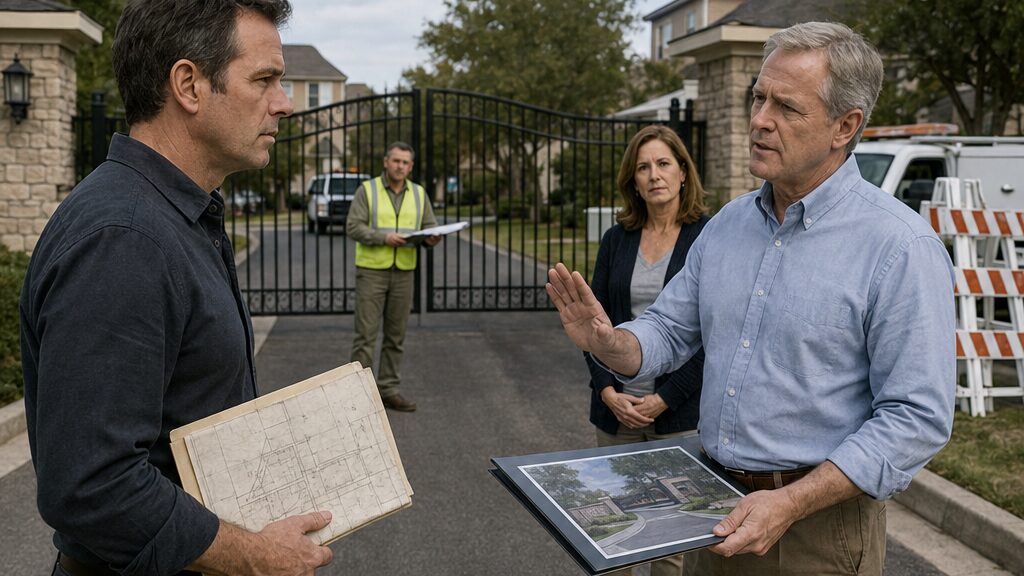
A glossy rendering stood on an easel beside him.
The image showed neat landscaping, a black decorative gate, stone pillars, and a small sign identifying the subdivision. There were no delivery vans. No trash trucks. No utility vehicles.
And no indication of the narrow line Jonathan had spent the afternoon thinking about.
Around thirty homeowners filled the metal chairs.
Samantha Hill sat at Frank’s right with a binder open in front of her. The property manager occupied the other end of the table. Robert Campbell sat two rows ahead of Jonathan.
Frank moved through the agenda quickly.
Landscaping.
Pool repairs.
Reserve balances.
Then the east entrance.
“The purpose of tonight’s vote is to formally ratify the traffic-control improvements already approved under the board’s maintenance authority.”
Jonathan raised his hand before Frank could call for the motion.
Frank noticed him.
“Public comment comes after the board discussion.”
“I have a question about the site authorization.”
A few heads turned.
Frank’s expression changed only slightly.
“You’ll have your opportunity.”
Jonathan lowered his hand.
For the next ten minutes, Frank described speeding complaints, delivery vehicles entering the wrong side of the development, and residents worried about strangers using the lane to bypass traffic on the county road.
Samantha reviewed the project cost.
It was higher than Jonathan expected.
Robert spoke before public comment officially began.
“I’ve been asking for something there for two years,” he said. “People come through that entrance too fast.”
Frank nodded.
“Exactly.”
Robert turned enough to address the room.
“Three weeks ago a service van came around that curve so fast my wife had to jump back onto our lawn.”
The room quieted.
Jonathan stopped taking notes.
Robert had mentioned speeding that morning. He had not mentioned his wife.
“How close?” one homeowner asked.
“Close enough.”
Robert’s jaw tightened.
“She was picking up a package near the curb. The driver never even slowed down.”
Jonathan looked at the glossy rendering again.
For the first time that evening, the board’s project did not look purely cosmetic.
That complicated things.
It did not answer his question.
But it complicated it.
When Frank finally opened the floor, Jonathan stood with his closing folder under one arm.
“I understand the safety concern,” he said. “I’m not asking the board to ignore it.”
Frank leaned back.
“Good.”
“I am asking whether the county reviewed the closure before the gate was installed.”
Frank’s face hardened slightly.
“The association owns and maintains the common area.”
“That wasn’t my question.”
A murmur passed through the chairs.
Jonathan opened the folder.
“I have the recorded subdivision plat from my closing documents.”
He carried it to the table and unfolded it beside the glossy site plan.
The contrast was almost absurd.
The board’s rendering was clean and bright, with ornamental shrubs and computer-generated shadows.
Jonathan’s plat was yellowing at the creases.
He pointed to the eastern lane.
“This notation shows an access reservation running through the same area.”
Frank glanced down.
“That plan is decades old.”
“Yes.”
“Which is why the board relies on current association documents.”
“Then there should be something showing the reservation was extinguished, relocated, or placed entirely under HOA control.”
Samantha leaned slightly toward the papers.
Frank did not.
Jonathan pointed again.
“I’m asking whether county approval was obtained before the gate was installed.”
Frank folded his hands.
“We’re not going to turn this into a zoning seminar.”
A few people laughed.
Jonathan felt warmth rise behind his ears.
Frank continued.
“One homeowner’s inconvenience cannot hold up a safety improvement supported by the neighborhood.”
“It isn’t about inconvenience.”
“You use that entrance more than most people.”
“That doesn’t change the recorded line.”
Frank gave a short laugh.
This time several board supporters joined him.
“Jonathan, with respect, you’re treating an old map as if it overrides the association’s responsibility to manage its own property.”
Jonathan looked down at the two plans.
That was when he saw it clearly.
The new site plan showed the gate centered several feet farther south than the boundary line marked on the old plat.
Not just across the lane.
Across the narrow corridor represented by the faint secondary line.
He turned the old plat slightly.
Samantha followed his movement.
“What are you looking at?” she asked.
Jonathan ignored the question for a moment.
Instead he looked at Frank.
“Who prepared this site plan?”
“The contractor.”
“Based on what survey?”
Frank’s patience broke.
“This is exactly what I mean. We have people here who are concerned about safety, and you want to argue over line weights on a thirty-year-old document.”
Robert shifted in his chair.
Jonathan heard someone behind him whisper, “He just wants his shortcut back.”
That landed harder than Frank’s laughter.
Because Jonathan knew how the room saw him now.
A homeowner with paperwork.
A man annoyed that he had to drive around the block.
He could have told them then.
He could have explained that he had spent eight years reviewing permit packages, dedications, encroachments, and right-of-way records. He could have described how many expensive mistakes began with somebody saying, We own the property, so we can do what we want.
He did not.
Partly because he wanted to verify the document before making the claim.
Partly because the old instinct had returned: let them be wrong first.
He hated admitting that second reason.
Jonathan folded the plat.
Frank looked almost relieved.
“Anything else?”
Jonathan slid the document back into his folder.
“One thing.”
Frank waited.
“If the county has not reviewed the closure, will you pause operation of the gate until someone confirms whether approval is required?”
“No.”
The answer came quickly.
“The gate was approved by the board. It was installed under association authority. We are not delaying a safety project because you have a question about an old plat.”
Jonathan nodded.
There was another ripple of quiet laughter near the back.
He returned to his chair and stopped speaking.
From that point on, he listened.
That surprised Frank more than another argument would have.
Jonathan wrote down the contractor’s company name from the presentation. He wrote down the project cost Samantha read aloud. He noted that the board repeatedly used the phrase traffic management but never mentioned county review.
Then Samantha said something that caught his attention.
“The gate controller will switch to permanent operation tomorrow morning at seven.”
Jonathan looked up.
Residents approved for access would receive instructions later.
“What qualifies a resident?” someone asked.
The property manager answered.
“Emergency, maintenance, and board-authorized needs.”
Jonathan almost laughed at that.
Instead, he wrote the phrase in his notebook.
The motion passed.
Not unanimously, but comfortably.
Robert voted in favor.
Afterward, homeowners gathered around the refreshments table. Jonathan slipped the folder under his arm and walked toward the door.
Samantha caught up with him.
“Jonathan.”
He stopped.
She glanced around before speaking.
“Are you sure that line means what you think it means?”
“No.”
Her eyebrows lifted.
“That’s why I asked for the pause.”
She looked back toward Frank.
“Then what are you going to do?”
“Find out.”
Frank called across the room.
“Seven o’clock tomorrow, Jonathan. You’ll need to use the main entrance like everyone else.”
A couple of people smiled.
Jonathan looked at him.
“I heard you.”
He left the clubhouse without another word.
At home he spread the plat across his desk again.
He enlarged a scanned copy on his computer and searched the county property index using the subdivision name, the original developer, and the parcel identification number.
The online records gave him deed references.
Older plats.
A drainage agreement.
Then a document number attached to the eastern boundary.
Jonathan clicked.
The file was not available online.
County records office only.
He wrote the number on a yellow note and stuck it to the corner of his monitor.
At exactly 7:00 the next morning, somewhere down the street, he heard the mechanical clunk of the gate locking into permanent mode.
Jonathan picked up the old plat and the document number.
If the board was right, the county file would tell him.
If the board was wrong, the same file might tell him how wrong.
Chapter 3: The Line on the Plat Led Somewhere
The county clerk slid the first file across the counter, and Jonathan recognized the notation before he finished opening it.
ACCESS RESERVATION—SEE AGREEMENT.
Same wording.
Same document number.
Same eastern boundary.
For the first time since the gate appeared, Jonathan felt the sharp satisfaction of a pattern confirming itself.
He immediately distrusted that feeling.
That was how people made mistakes.
They found one document that matched what they already believed and stopped reading.
Jonathan carried the file to a public research table beneath fluorescent lights and set the old subdivision plat beside it.
The county records office looked almost exactly as he remembered municipal document rooms looking years earlier: low shelves, battered binders, oversized map drawers, printers that sounded irritated every time they worked.
He had taken the morning off.
His notebook already held three references.
The agreement was recorded years before the HOA had assumed control of the common property.
It described a corridor running from the county road along the eastern boundary of the subdivision. The language referred to access, public-service use, and preservation of ingress and egress under specified conditions.
Jonathan read the operative paragraph three times.
Then a fourth.
It was not as simple as he had hoped.
A county right-of-way technician approached the table after Jonathan asked for help interpreting a later amendment.
“You’re looking at the eastern corridor?”
“Yes.”
The technician examined the plat.
“What are you trying to determine?”
“Whether an HOA can install a locked gate here.”
The technician did not answer immediately.
“That depends.”
Jonathan almost smiled.
Municipal work had taught him that depends was often the most honest answer anyone could give.
“On what?”
“Whether the access interest is still active, what kind of traffic control they installed, whether emergency access is maintained, and whether the county approved a modification.”
“So the recorded agreement doesn’t prohibit all controls.”
“No.”
The satisfaction Jonathan had felt twenty minutes earlier faded.
The technician pointed to a paragraph near the bottom.
“See this? Traffic-management devices can be permitted if they don’t extinguish the access function.”
Jonathan read it.
The language allowed barriers, controls, or design changes subject to approval by the relevant county authority and continuing access requirements.
“So they could install a gate.”
“Potentially.”
“Locked?”
“Potentially.”
“Restricted to board-authorized residents?”
The technician’s expression changed.
“That I’d want to see the approval for.”
Jonathan leaned back.
He had spent most of Monday imagining two possibilities.
The board had authority.
Or it did not.
The actual answer was more irritating.
The board might have had a lawful path to do nearly what it wanted, but only if it followed a process.
“Is there a permit number tied to this corridor?”
“Let’s check.”
They moved to another terminal.
The technician searched the subdivision address, parcel numbers, the HOA name, and the gate contractor.
A resurfacing permit appeared from six years earlier.
A stormwater repair.
Two utility excavations.
Nothing for a gate.
“Could it be filed under the contractor only?” Jonathan asked.
“Possible.”
Another search.
Nothing.
The technician looked at him.
“When was it installed?”
“Over the weekend.”
“And it’s blocking the corridor now?”
“Yes.”
“Blocking all access?”
“Not all. The board says emergency and authorized users will have access. Homeowners like me apparently don’t.”
The technician tapped one finger against the desk.
“I can’t give you a legal opinion.”
“I’m not asking for one.”
“But from a records standpoint, I’m not seeing an approved modification.”
Jonathan nodded.
That was enough for now.
He requested certified copies of the agreement, the relevant plat, and the amendments.
While the clerk processed them, he called the property manager.
She answered on the fourth ring.
“Management office.”
“This is Jonathan Walker. I’m following up on the east gate.”
A pause.
“Yes.”
“Can you send me the county approval number for the installation?”
“I don’t have that in front of me.”
“Who would?”
“The board president handled the project with the contractor.”
“Then please ask Frank.”
Another pause.
“Jonathan, the board already addressed this last night.”
“They addressed whether they wanted the gate. I’m asking whether the county approved it.”
“I can forward your request.”
“Please do.”
He ended the call.
Ten minutes later his phone buzzed.
A message from Frank.
The board has authority over common-area improvements. Please direct further concerns through management.
Jonathan read it twice.
No permit number.
No approval reference.
Nothing answering the question.
He could already feel the old habit taking hold—the urge to move from uncertainty to certainty faster than the facts justified.
He forced himself back to the documents.
The recorded agreement mattered.
The missing approval mattered.
But neither established whether the gate had to be removed, whether homeowner access had to be restored immediately, or whether the county would simply require a paperwork correction.
He searched the agreement for termination language.
None.
Then he found an amendment recorded twelve years later.
That amendment changed maintenance responsibility from the original developer to the association.
Frank might seize on that sentence.
Jonathan nearly did too.
Then he read the next paragraph.
Maintenance responsibility transferred.
The underlying access reservation remained.
He copied the page.
By early afternoon, Jonathan had enough to answer the first question.
The lane was not merely an ordinary private driveway the HOA could erase from practical use at will.
But the second question had become larger.
Why had nobody checked?
At home, Jonathan laid the documents across his desk.
Old plat.
Recorded agreement.
Amendment.
HOA notice.
His notes from the meeting.
The documents did not prove Frank knew the gate required review.
Frank might simply have relied on the property manager or contractor. Volunteer HOA boards made that kind of mistake constantly.
Jonathan knew that too.
He opened the association’s online records again.
The project packet included a contractor proposal, but several attachments listed in the index were unavailable to homeowners.
One line interested him:
Site conditions subject to jurisdictional verification.
Jonathan stared at it.
That phrase could mean drainage.
Electrical permitting.
Setbacks.
Or the corridor.
He sent a formal written request to management asking for the complete project file, including contractor correspondence and any county approvals.
Then he called the county again.
The right-of-way technician transferred him to an inspector’s voicemail.
Jonathan left a concise message.
“I’m a homeowner in the subdivision. A locked gate was installed across a recorded access corridor this weekend. I’m trying to confirm whether the county approved a modification. Records staff cannot locate one.”
He gave the document number and his phone number.
He deliberately did not say illegal gate.
He did not say HOA violation.
He did not say Frank ignored the law.
Those were conclusions.
He was not there yet.
Just before five, the technician emailed him a final search confirmation.
Jonathan opened it at the kitchen counter.
No permit or approved traffic-control modification had been located for the eastern access corridor under the association, contractor, parcel, or subdivision records searched.
Jonathan read the sentence once.
Then again.
He looked through the kitchen window toward the street.
Somewhere beyond the houses, the new gate stood locked.
The board had voted to keep it operating after he had asked one specific question.
Now he knew the answer.
There was no county approval on file.
What he still did not know was whether Frank had failed to ask—or had asked and decided to build anyway.
Chapter 4: The Safety Argument Was Not a Lie
“I’d vote for the gate again.”
Robert Campbell said it before Jonathan had finished crossing the driveway.
Jonathan stopped beside the mailbox. The old subdivision plat was folded inside the leather folder under his arm, but he had no intention of taking it out.
“You know there’s no county approval on file.”
Robert set down the garden hose he had been coiling.
“I know what you told me.”
“That’s not the same thing.”
“No. It isn’t.”
Robert’s voice was flat enough that Jonathan almost turned around. They had lived three houses apart for six years. They borrowed tools occasionally, complained about trash pickup, and once spent an entire Saturday helping another neighbor pull a broken fence post from concrete.
They had never spoken to each other like this.
Robert looked toward the curve at the end of the street.
“You think this is about Frank.”
“I think Frank installed a restricted gate across a recorded access corridor without confirming he was allowed to do it.”
“And I think that road has been dangerous for years.”
“Both things can be true.”
Robert gave a short humorless laugh.
“That’s convenient now.”
Jonathan felt the familiar impulse to reach for the folder.
To show him the agreement.
To point to the clause.
Instead he kept his hands still.
“What happened with your wife?”
Robert’s expression changed.
Not much.
Enough.
“She was standing right there.”
He pointed to the edge of the driveway.
“A package got dropped at the wrong house. She walked out to get it. Service van came through the side entrance, rounded that bend too fast, crossed halfway over the center.”
Jonathan followed his gesture.
The curve was tighter than it looked from a car.
“What happened?”
“She jumped onto the grass.”
“Was she hit?”
“No.”
Robert looked at him.
“Does that make it nothing?”
Jonathan shook his head.
“No.”
“She came inside shaking. Driver was gone before I even got outside.”
Robert picked up the hose again, but instead of winding it, he gripped it between both hands.
“I emailed management that afternoon. Frank called me himself. Said they’d had other complaints. Said they were finally going to fix it.”
Jonathan had assumed the safety language was cover for a project the board wanted for appearance and control.
He had assumed Robert’s support came from irritation with delivery traffic.
He had been wrong about both.
Not completely.
But enough to matter.
“If the county says the gate can’t stay as designed,” Jonathan said, “that doesn’t mean the lane has to go back to exactly what it was.”
Robert stared at him.
“Then what are you asking for?”
“Right now? Verification.”
“You sound like a permit office.”
Jonathan almost smiled.
“I used to work in one.”
Robert blinked.
Jonathan regretted saying it immediately.
Not because it was secret.
Because of the satisfaction he felt when Robert’s expression shifted.
That was exactly the instinct Jonathan distrusted in Frank—the pleasure of knowing something before the other person did.
Robert rubbed the back of his neck.
“That what all this is about? You know some loophole?”
“No.”
Jonathan answered more sharply than he intended.
Then lowered his voice.
“It’s not a loophole. And knowing the process doesn’t mean I’m automatically right.”
Robert looked toward the street again.
“But you think you are.”
Jonathan did not answer.
That afternoon he went to the HOA management office.
Samantha Hill was there with the property manager, reviewing invoices at a small conference table. Frank was absent.
Samantha looked up as Jonathan entered.
“If this is about the gate, management already sent your request to the board.”
“It is about the gate.”
The property manager shifted in her chair.
Jonathan placed a printed copy of the county search confirmation on the table.
“No approval was found.”
Samantha read the first paragraph.
Her eyes slowed halfway down.
“That doesn’t mean none exists.”
“I agree.”
She glanced at him, perhaps surprised.
“That’s why I want the project file.”
“The board has counsel reviewing your request.”
“I’m entitled to association records relating to an approved expenditure.”
“Some correspondence may be privileged.”
“Contractor correspondence usually isn’t.”
The property manager looked between them.
Samantha closed the paper.
“Jonathan, what are you trying to accomplish?”
He could have answered restore access.
Instead he heard Robert’s question from that morning.
What are you asking for?
“I want to know whether the board knew county review might be required before construction.”
Samantha’s face went still.
Jonathan noticed.
“You already know something.”
“I didn’t say that.”
“You didn’t have to.”
“Don’t do that.”
“Do what?”
“Turn every pause into evidence.”
The rebuke landed because it was accurate.
Jonathan leaned back.
Samantha lowered her voice.
“The contractor asked a question during planning.”
“What question?”
“I don’t remember the exact wording.”
“About county approval?”
“About whether any outside approval might be needed.”
Jonathan waited.
Samantha glanced toward the property manager, then back at him.
“It was one email. Early in the project.”
“What happened to it?”
“Frank said the association owned the common area and management had confirmed the board’s authority.”
“Did management confirm county approval?”
“I don’t know.”
“Can I see the email?”
“No.”
“Why?”
“Because you submitted a records request this morning, and now there’s a process. I’m not going around it because you came in here.”
Jonathan tightened his jaw.
“You voted for a project after the contractor raised jurisdiction.”
“And I believed the issue had been resolved.”
“By whom?”
“Frank.”
There it was.
Not proof that Frank knowingly broke anything.
But the first indication that the question had existed before Jonathan raised it at the clubhouse.
Samantha gathered the invoices into a stack.
“You think everyone at that table ignored something obvious.”
“I think nobody checked.”
“That isn’t the same accusation.”
“It may lead to the same result.”
Her expression hardened.
“And that is exactly why you make people defensive.”
Jonathan said nothing.
Samantha pushed the county search printout back toward him.
“You walk in knowing the rule, or thinking you know it, and you wait for everyone else to prove they don’t. Then you act surprised when they stop listening.”
He looked at her.
For several seconds, the only sound in the office was the printer behind the reception desk.
Jonathan picked up the paper.
“I’ll wait for the records response.”
“Good.”
At home, he unfolded the old plat on his desk.
Then, after a moment, he folded it again.
He did not need to stare at the line anymore.
The question had changed.
By three-thirty, he had submitted two formal requests: one to the HOA for the complete gate-project records, including contractor correspondence, and one to the county reporting a possible obstruction of the recorded access corridor.
He attached the plat, the agreement reference, and photographs of the installed gate.
He described only what he could prove.
No accusation of intent.
No claim that the board had acted knowingly.
At 4:17, confirmation emails arrived for both submissions.
Jonathan read them side by side.
The county inquiry had been assigned for review.
The HOA had five business days to respond to the records request.
Somewhere inside that second request was the answer Samantha would not give him across the conference table.
Not whether the gate was wrong.
Jonathan increasingly believed that it was.
The harder question was whether Frank had been warned before anyone poured the concrete.
Chapter 5: The Email Frank Should Have Stopped For
The records packet arrived Friday morning with forty-three pages and one sentence Jonathan read three times.
Please verify whether county or right-of-way review is required before final placement of the proposed gate.
The sentence appeared in an email from the gate contractor dated almost three weeks before installation.
Jonathan stood at his kitchen counter, coffee cooling beside him.
Below the contractor’s question was Frank’s reply.
Management confirms this is association-maintained common area. Proceed with pricing and site preparation while we finalize board authorization.
Jonathan scrolled farther.
No written county confirmation followed.
No permit.
No right-of-way determination.
There were invoices, revised drawings, landscaping estimates, electrical costs, and repeated scheduling messages.
The gate had advanced from concept to concrete without anyone answering the first question.
Jonathan printed the email.
Then he stopped himself from smiling.
It was not the feeling he wanted to have.
Vindication was clean in theory. In practice, it felt uncomfortably close to enjoyment.
He laid three things across the kitchen table.
The old plat.
The contractor email.
The glossy gate plan he had downloaded from the HOA packet.
The same physical space appeared three different ways.
On the plat, it was a corridor.
In the contractor’s email, it was a jurisdictional question.
On the board plan, it was already a finished amenity.
His phone rang.
Samantha.
“Did you get the records?”
“I’m looking at them now.”
Silence.
Then she said, “So you saw it.”
“The contractor asked.”
“Yes.”
“And nobody answered.”
“Not in writing.”
Jonathan pulled out a chair.
“Why did the project continue?”
Samantha exhaled.
“That’s not one question.”
“It seems like one.”
“It isn’t.”
He waited.
“The first estimate was lower,” she said. “A lot lower.”
Jonathan glanced at the invoices.
He had noticed the revisions but had not totaled them.
“How much?”
“By the time the electrical work and controller changes were added, we were already over the approved project allowance.”
“Before installation?”
“Yes.”
“How far?”
“Enough that delaying it would have meant taking another vote.”
Jonathan sat down.
That detail changed the shape of Frank’s decision.
Not the responsibility.
The motive.
Samantha continued.
“The annual budget review is next month. Frank has been telling homeowners for a year that the board can finish visible improvements without another assessment.”
“So stopping the gate would have exposed the overrun.”
“I didn’t say that’s why he did it.”
“You don’t have to.”
“Jonathan.”
He closed his eyes briefly.
“Right. Every pause isn’t evidence.”
“Thank you.”
He heard irritation in her voice, but also exhaustion.
“Why did you vote for it?”
“I thought the contractor question had been resolved. Frank said management had checked authority. I assumed that included whatever outside review applied.”
“And when I asked at the meeting?”
“I thought you were making a property-rights argument because you didn’t like losing the entrance.”
Jonathan stared at the plat.
“That’s what everyone thought.”
“You didn’t exactly explain yourself.”
He had no defense for that.
He had enjoyed knowing the room was missing something.
Not enough to admit it aloud.
Enough to know it was true.
“What does Frank say now?”
“He says the county agreement doesn’t prohibit gates.”
“That part is true.”
Samantha went quiet.
“You’re saying he might still be right?”
“No. I’m saying the agreement allows traffic controls under approved conditions. The problem is that nobody seems to have obtained approval.”
“So what happens?”
“The county decides what happens.”
Another silence.
Then Samantha said, “Please don’t turn this into a war.”
Jonathan’s first instinct was resentment.
The board had mocked him. Locked his access. Ignored his question. Continued operating the gate after he asked them to verify authority.
Why was restraint suddenly his responsibility?
Then he remembered Robert pointing to the edge of his driveway.
“She was standing right there.”
“I filed an obstruction inquiry,” Jonathan said. “I asked them to determine what’s required.”
“Not penalties?”
“I didn’t ask for penalties.”
“Frank thinks you’re trying to force removal.”
“I’m trying to force review.”
After the call, Jonathan totaled the project invoices.
Samantha was right.
The original cost had crept upward in stages small enough to sound manageable separately and large enough to matter together. Electrical trenching. Controller upgrades. Masonry changes. Landscape replacement after equipment damage.
Frank’s insistence on momentum made more sense now.
A delayed project would not merely look delayed.
It would expose that the board had already spent beyond its initial figure before checking whether the design could lawfully operate as planned.
At noon, an email from the county arrived.
An inspector would visit Monday morning.
Jonathan read the message carefully.
The county had not made a determination. The inspection would verify corridor conditions, access functionality, and the installed traffic-control device.
He forwarded it to management.
Fifteen minutes later, Frank called.
Jonathan let it ring once before answering.
“I received your email,” Frank said.
“I assumed you would.”
“You went to the county before the board had a chance to respond.”
“I asked the board Monday night to pause operation until approval was verified.”
“And we answered.”
“You told me you had authority. You never produced an approval.”
Frank’s voice tightened.
“The county agreement expressly permits traffic controls.”
“With review.”
“That is your interpretation.”
“It’s in the paragraph.”
“Jonathan, you are not the association’s attorney.”
“No.”
“Then stop presenting your interpretation as a ruling.”
Jonathan looked at the printed contractor email.
“I’m not the one who treated an interpretation as permission to build.”
Silence.
The line had landed harder than he intended.
When Frank spoke again, his voice was quieter.
“You don’t understand what we’ve been dealing with.”
“Then explain it.”
“Residents have been complaining for months. Robert’s wife nearly got hit. Delivery drivers ignore signage. Homeowners want action, not another six-month study.”
“I know.”
“You know now.”
“Yes.”
Another pause.
Jonathan could hear Frank breathing.
“We made a decision,” Frank said. “Maybe the paperwork should have been cleaner. That doesn’t make the decision irresponsible.”
“The contractor specifically asked about county review.”
“Management told us the association controlled the parcel.”
“That wasn’t the question.”
“You enjoy saying that.”
Jonathan almost answered.
Then stopped.
Frank had found the weak place.
Not in the documents.
In him.
“I’ll be at the inspection Monday,” Jonathan said.
“So will we.”
Frank ended the call.
That afternoon, Jonathan received a second message from the county inspector.
It was addressed to the HOA management office, Frank, and Jonathan.
No party was to alter, remove, activate, disable, relocate, or otherwise modify the gate installation before the inspection.
The device was to remain in its current condition pending field review.
Jonathan read the instruction twice.
It was not an enforcement order.
Not yet.
But for the first time since the gate went up, the board no longer controlled what happened to it next.
He printed the message and set it beside the plat.
Then he looked at the contractor’s warning again.
Frank had been given an opportunity to stop.
Maybe only briefly.
Maybe amid budget pressure and real resident complaints.
But the question had been placed directly in front of him.
On Monday, the county would decide what ignoring it had cost.
Chapter 6: When the Barricades Faced the Board
The first county truck arrived at 7:38 Monday morning.
The HOA manager was not there yet.
Jonathan watched from the edge of his driveway as a white utility pickup stopped beside the locked gate. A second county vehicle pulled in behind it two minutes later.
The inspector stepped out carrying a clipboard and a rolled set of plans.
Jonathan had brought the old plat.
He kept it under his arm.
For once, he had no desire to unfold it first.
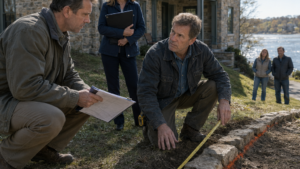
The inspector walked the length of the gate, examined the fresh concrete footings, measured from the pavement edge, and photographed the controller cabinet.
The right-of-way technician Jonathan had spoken with at the records office arrived next.
Frank appeared at 7:52.
He parked behind the HOA manager, who had pulled up moments earlier.
Samantha came separately.
Robert stood at the end of his driveway with his arms folded.
Nobody laughed.
The inspector gathered them near the shoulder.
“I’m going to explain what we’re looking at before anyone starts arguing conclusions.”
Jonathan appreciated that immediately.
The inspector unrolled a county copy of the subdivision plat across the hood of the truck.
It was the same plat Jonathan had carried into the clubhouse.
Only cleaner.
The inspector traced the eastern corridor.
“This recorded access reservation remains active.”
Frank spoke.
“The agreement permits controlled access.”
“Yes.”
Jonathan saw Frank straighten slightly.
Then the inspector continued.
“Subject to approval and preservation of the corridor’s access function.”
Frank’s expression changed.
“We preserve emergency access.”
“That is one function. It is not necessarily the only function.”
The inspector pointed to the gate location.
“The current device restricts ordinary ingress and egress through a corridor whose recorded terms do not give the association unilateral authority to extinguish that use.”
“We’re not extinguishing it.”
“For homeowners without board authorization?”
Frank glanced at the property manager.
The inspector waited.
“No,” Frank said. “They use the main entrance.”
“Then their practical access here has been removed.”
“It’s an alternate entrance.”
“That is not the question I’m answering.”
Jonathan looked down before Frank could notice the reaction on his face.
The words were almost identical to his own.
But there was no pleasure in hearing them now.
Only finality.
The inspector asked for the county approval associated with the gate.
Frank produced the project packet.
Contractor plan.
Board authorization.
Electrical permit for the controller.
No corridor modification approval.
The technician checked the county system again from a tablet.
Nothing.
The inspector walked to the landscaping bed beside the gate.
“These shrubs also narrow the clear corridor.”
“They’re ornamental,” the property manager said.
“They’re still physical obstructions.”
The contractor arrived just after eight.
He looked unhappy before anyone spoke to him.
The inspector asked whether he had requested jurisdictional confirmation.
“Yes.”
Frank’s jaw tightened.
“From whom?”
“I put it in the planning email.”
“You were told the association controlled the property.”
“I was told to proceed with pricing and preparation.”
“Which you did.”
“Correct.”
The inspector raised one hand.
“This is not a fault-allocation meeting.”
That ended the exchange.
For another half hour, the county team measured, photographed, and compared the installed configuration against the recorded corridor.
Jonathan answered only when asked.
At one point the inspector unfolded Jonathan’s copy of the plat beside the county copy.
The crease ran directly through the gate location.
For days Jonathan had treated that line like a blade.
Now it looked different.
Less like a weapon.
More like what it had always been: an instruction everyone should have read before construction began.
The inspector finally called them together.
“The county’s preliminary determination is that the current configuration interferes with the recorded access function and was installed without the required review.”
Frank’s lips pressed into a thin line.
“What are you ordering?”
“First, the gate cannot operate as a restrictive barrier.”
“So leave it open.”
“Not in its current state.”
The inspector pointed toward the controller and the landscaping.
“We need a corrective plan. Until then, this entrance is going to be placed under temporary traffic control.”
A county worker opened the back of the utility truck.
Jonathan heard metal scrape against metal.
Red-and-white barricades came out.
For one strange second, nobody moved.
Then the workers carried them toward the gate.
They positioned the barricades to prevent the HOA from closing and operating the disputed gate while leaving the corridor under county-directed temporary conditions. A notice was attached to the installation.
Frank stared at it.
The board that had installed a gate to control the lane now stood watching county barricades control the gate.
Jonathan should have felt triumphant.
Part of him did.
He could not deny that.
The memory of Frank laughing in the clubhouse returned with perfect clarity.
One homeowner’s inconvenience.
Old map.
Seven o’clock tomorrow.
Jonathan looked toward Robert.
Robert was not smiling.
Neither was Samantha.
The inspector continued.
“The association will receive written corrective requirements. You’ll have a deadline to submit a compliant plan or restore the corridor.”
“What costs are we talking about?” Samantha asked.
“County inspection and review fees apply. Any corrective construction is the owner’s responsibility. Continued noncompliance can result in additional enforcement costs.”
Samantha looked at Frank.
That look contained more accusation than anything Jonathan could have said.
Frank asked, “Are you requiring complete removal?”
“Not necessarily.”
Everyone turned toward the inspector.
“If the association can produce a design that preserves required access and meets safety standards, the county can review it.”
Robert stepped forward.
“So you’re saying the road has to stay open.”
“I’m saying the recorded access has to function.”
“What about speeding?”
“That’s a separate design problem.”
Robert’s shoulders dropped.
Jonathan saw the distinction hit him.
Winning the access question did not solve what had nearly happened to his wife.
The inspector rolled up the county plat.
“You can address both. But you cannot solve one by ignoring the other.”
Jonathan felt those words settle more heavily than the ruling itself.
Frank approached him after the county workers finished.
For a moment Jonathan thought he was going to argue.
Instead Frank said, “Happy?”
Jonathan considered several answers.
The easiest was yes.
The cruelest was very.
He chose neither.
“I wanted the gate reviewed.”
“That isn’t what I asked.”
Jonathan looked at the barricades.
“No. I’m not happy.”
Frank gave him a skeptical stare.
“The association is now paying to fix something that could have been handled internally.”
“I asked you to pause it internally.”
“And if we had, Robert and every homeowner who complained would have heard one more delay.”
“That doesn’t make building first the right answer.”
Frank’s eyes hardened.
“No. It just makes the decision less simple than you keep pretending.”
Jonathan almost responded that Frank had ignored the contractor.
Almost unfolded the whole case again in words.
But the county had already done that.
He did not need to win the same argument twice.
Samantha joined them with the inspector’s preliminary notice.
“We have ten business days for a corrective proposal,” she said. “If we miss it, restoration requirements escalate.”
Frank took the paper.
“How much?”
“Not finalized.”
Her tone made clear that the number was not going to improve.
By noon, residents had begun slowing their cars to look at the barricades.
Jonathan avoided the neighborhood discussion thread entirely.
He had no interest in watching people choose sides from photographs.
That evening, he put the old plat back on the dining table.
Beside it, he placed a blank sheet of paper.
For the first time, he began sketching possible solutions rather than violations.
Maintain the corridor.
Limit cut-through use without discretionary homeowner exclusion.
Add speed control before Robert’s curve.
Preserve emergency width.
Maybe a narrower automated design.
Maybe raised pavement.
Maybe signage with actual enforcement rather than decorative warnings.
He was drawing a second option when his phone rang.
FRANK KING.
Jonathan stared at the screen.
Until now, Frank had communicated through meeting remarks, board notices, management emails, or arguments.
He had never called Jonathan at home except to defend the project.
Jonathan answered.
“Hello.”
Frank did not apologize.
He did not mention the laughter.
He did not argue about the county.
His first words were quieter than Jonathan expected.
“I need your help.”
Chapter 7: Winning the Argument Was Not the Same as Fixing It
“I need your help.”
Jonathan looked down at the blank sheet beside the old plat.
Frank King did not sound apologetic. He sounded like a man who had reached the end of a hallway and found the door locked.
“With what?”
“The corrective plan.”
Jonathan leaned back in his chair.
“Your attorney told the county you were handling it.”
“Our attorney handles legal exposure. I’m talking about a design that actually gets approved.”
“And you’re calling me because?”
“You know what they’re looking for.”
Jonathan almost laughed.
A week earlier, Frank had mocked him for treating an old map like authority. Now he wanted Jonathan to interpret the same rules.
“That isn’t the same as being their engineer.”
“I know.”
“Do you?”
Frank ignored that.
“The contractor can redesign the gate. Samantha is getting revised costs. But every version solves one problem and creates another.”
“What problems?”
“If we leave it completely open, Robert and half the eastern side of the neighborhood will say we abandoned the safety issue. If we restrict it, the county says we can’t interfere with the corridor. If we tear everything out, we eat the full installation and removal costs.”
Jonathan looked at the sketch he had begun before the phone rang.
“What exactly are you asking me to do?”
There was a pause.
“Tell us what you would propose.”
Jonathan stared at the line running across the plat.
For days he had wanted the board to acknowledge that line.
Now Frank was offering him something more dangerous than an argument.
Influence.
“I’ll look at options,” Jonathan said. “That’s all.”
“Fine.”
“And I’m not doing it privately.”
Frank’s voice cooled.
“What does that mean?”
“If there’s a corrective proposal, it goes through the board and county process. I’m not becoming the person you later say designed it.”
“I didn’t ask you to.”
“You asked for help.”
Another silence.
Then Frank said, “Special meeting Thursday.”
“I’ll be there.”
Jonathan ended the call.
The next evening, Frank, Samantha, Robert, and the property manager sat around Jonathan’s dining table.
It was the first time the old plat had been unfolded there for someone other than Jonathan.
He held the corners flat with four coffee mugs.
Samantha placed a contractor sketch beside it.
“This version keeps the gate,” she said. “But the county staff said the opening width still creates a problem.”
Jonathan studied it.
The redesign preserved an automatic gate but moved the control pedestal and widened the usable lane. Residents would no longer need discretionary board authorization. The barrier would function more like a traffic-management device than an exclusion point.
“It still creates a full stop here,” Jonathan said.
Robert leaned forward.
“Isn’t that the point?”
“For speed, maybe. For access, the county might see it as unnecessary obstruction.”
Robert shook his head.
“So we went through all this and the answer is just open the road?”
“No.”
“That’s what it sounds like.”
Jonathan looked at him.
“What do you actually want fixed?”
“The speeding.”
“Not the gate?”
Robert hesitated.
“The gate was supposed to fix the speeding.”
“That isn’t the same answer.”
Frank crossed his arms.
“Then propose something.”
Jonathan ignored the challenge in his tone and pointed to the curve near Robert’s property.
“Traffic is accelerating before it gets here. The gate is at the boundary, but the dangerous point is farther inside.”
Robert followed his finger.
Jonathan continued.
“A raised speed table before the curve would physically slow vehicles. Narrowed pavement markings would change how fast the lane feels. Better delivery routing could keep large vehicles from using it unless they have an address on this side.”
Samantha looked at the contractor sketch.
“And the gate?”
“Keep a control structure if the county accepts it, but not one that decides which ordinary homeowners are allowed through. It can manage speed and after-hours conditions without turning access into a board privilege.”
Frank frowned.
“That defeats the security purpose.”
“What security purpose?”
“Unauthorized vehicles.”
Jonathan looked at him.
“The board kept using that phrase. What exactly is an unauthorized vehicle on a road residents have lawful access to?”
Frank did not answer immediately.
“A vehicle with no reason to be in the community.”
“And how does the gate know that?”
“Access codes.”
“Which delivery drivers get from residents. Contractors get from residents. Guests get from residents. Anyone following another car gets nothing checked at all.”
Samantha rubbed her forehead.
“So the expensive part of the system may not even solve the thing we said it solved.”
Frank’s face tightened.
“It creates control.”
Jonathan heard the sentence and understood, perhaps for the first time, exactly why Frank liked the project.
Not because he enjoyed keeping Jonathan out.
Because a gate was visible.
It moved.
It locked.
It looked like action.
A speed table and revised traffic pattern did not give the same feeling of authority.
Robert tapped the plat.
“My wife doesn’t care whether the solution looks impressive. She cares whether a van comes around that bend at thirty-five again.”
The room went quiet.
Frank looked at him.
Robert continued.
“If a speed table actually slows them, I’ll support it.”
“You were the strongest supporter of the gate,” Frank said.
“I was the strongest supporter of doing something.”
Jonathan watched Frank absorb the distinction.
It was not a document defeating him this time.
It was one of the residents he believed he had been protecting.
Samantha turned to Jonathan.
“Would the county accept this?”
“I don’t know.”
Frank gave him a tired look.
“That’s helpful.”
“It’s the honest answer.”
Jonathan traced the corridor.
“But it gives us something to submit that preserves access instead of trying to justify taking it away.”
At Thursday’s special meeting, the contractor presented a revised concept built around that approach: the gate structure would be narrowed and repositioned so it no longer functioned as a homeowner-exclusion barrier, the landscaping would be pulled back from the corridor, and a raised traffic-calming feature would be added before Robert’s curve.
County review would still be required.
Several homeowners disliked the cost.
Others disliked reopening the side lane.
Robert stood during comments.
“If there’s no physical speed control, I oppose reopening it.”
The statement drew murmurs.
Jonathan understood the fear beneath it now.
He stood.
“The county ruling doesn’t require us to pretend there was never a safety problem. It requires us to stop solving that problem by eliminating access we didn’t have authority to eliminate.”
Frank looked at him from the board table.
Jonathan continued.
“We can preserve the corridor and slow traffic. Those are not competing goals unless we make them competing goals.”
He sat down.
No applause followed.
He was grateful for that.
Samantha reviewed the estimated costs. Correcting the project would hurt the budget, but a compliant redesign would cost less than full demolition and reconstruction.
The board appeared close to agreement.
Then Jonathan noticed what was missing.
The draft motion described the problem as an unforeseen county interpretation.
He raised his hand.
Frank sighed.
“Yes?”
“The motion needs to say the board proceeded before completing the required review.”
The room changed.
Samantha looked down at the motion.
Frank’s face became guarded.
“That wording is unnecessary.”
“It’s accurate.”
“The county determination is already part of the record.”
“That’s not the same thing.”
Frank’s jaw tightened.
“You want a confession.”
“No.”
“That’s exactly what you want.”
Jonathan felt the old satisfaction rising again—the temptation to force Frank to say the words publicly because he finally could.
He waited until the feeling passed.
“I want the next board to understand what actually failed.”
Frank stared at him.
Jonathan pointed at the revised plan.
“If the record says this was just an unexpected interpretation, then the lesson becomes ‘we were unlucky.’ That isn’t what happened. The contractor raised the review question. We proceeded without resolving it.”
“We?”
Jonathan accepted the correction.
“You proceeded.”
Frank’s eyes narrowed.
Jonathan continued quietly.
“I’ll support the redesign. I’ll tell the county I believe it addresses the access issue and the safety concern. But I won’t help turn the correction into a story where nobody made a decision.”
Samantha looked at Frank.
Robert did too.
The revised plan lay between them.
For once, Jonathan left the old plat unfolded.
Frank could accept the truth that came with Jonathan’s help—or face the deadline without it.
Chapter 8: The Old Plat Stayed on the Table
Three weeks later, the same clubhouse was quiet when Jonathan stood to speak.
No one laughed.
The glossy rendering of the original gate was gone.
In its place sat the old recorded plat, unfolded across the board table beside the county-stamped corrective plan.
The crease through the eastern corridor was softer now from repeated handling.
Frank sat behind it.
Samantha had the revised budget open in front of her. Robert occupied the first row, his hands resting on his knees.
Jonathan looked at the room where, less than a month earlier, someone had whispered that he only wanted his shortcut back.
He had imagined this moment several times.
In some versions, he listed every mistake.
In others, he reminded Frank of every dismissive sentence.
Standing there now, none of it seemed useful.
“The county accepted the revised configuration this afternoon,” Jonathan said.
A few people shifted in their chairs.
“The side corridor remains open to normal residential access. The restrictive authorization system is removed. The landscaping has been moved outside the required clear area. And the traffic-calming installation near the interior curve was accepted as part of the safety plan.”
Robert nodded once.
Jonathan continued.
“The result isn’t what I originally expected, and it isn’t what the board originally built. I think that’s probably why it works.”
He sat down.
Frank did not immediately begin the vote.
Instead he picked up a sheet of paper.
“There is one statement I need to make before the motion.”
Jonathan looked at him.
Frank’s voice was steady, but the confidence that had once filled the room so easily now seemed deliberate rather than automatic.
“The board proceeded with installation of the east gate before completing the county review required by the recorded access agreement.”
Nobody moved.
Frank glanced down at the page.
“The contractor raised the possibility of outside review during planning. I relied on our understanding that the association controlled the common property and authorized the project to continue without confirming whether that understanding satisfied the county agreement.”
Samantha watched him without expression.
Frank continued.
“That was my decision as board president. It was a mistake.”
There it was.
No dramatic apology.
No humiliation.
No one clapped.
Jonathan found that he preferred it that way.
Frank set the paper down.
“The safety concerns behind the project were real. The process we used to address them was not adequate.”
Robert raised his hand.
Frank recognized him.
“I want something in the minutes too,” Robert said.
The property manager looked up.
Robert shifted in his chair.
“I supported closing the entrance. I’d probably have supported almost anything that week.”
He rubbed his palms together.
“My wife came within a few feet of getting hit by a van out there. I was angry. I thought Jonathan was arguing over convenience while the rest of us were trying to keep the street safe.”
Jonathan met his eyes.
Robert went on.
“I was wrong about what he was arguing. But I wasn’t wrong that the speed problem needed fixing.”
“No,” Jonathan said. “You weren’t.”
Robert nodded toward the revised plan.
“The speed table is already doing more than the gate did.”
There was a little laughter then.
Not at anyone.
Just the relieved kind that comes when people realize an argument may finally be becoming ordinary again.
Samantha moved to approve the corrective design, final county submission, and revised project expenditure.
Another board member seconded.
The motion passed.
This time Jonathan did not feel as though someone had won.
After the meeting, homeowners gathered around the table to look at the plat.
A month earlier, Jonathan had carried it like evidence.
Now Robert used a fingertip to trace the location of the speed table.
“So this part was always here?”
“The corridor line?”
“Yeah.”
“Long before our houses were finished.”
Robert shook his head.
“Funny that nobody knew.”
Jonathan looked at the paper.
“Somebody knew. That’s why it was recorded.”
Robert smiled faintly.
“Fair point.”
Across the room, Samantha closed her binder.
“You ever think about joining the board?”
Jonathan looked up.
Frank, who was stacking papers nearby, paused.
Samantha continued.
“I’m serious. We could use someone who actually reads these things.”
Jonathan considered it for perhaps two seconds.
“No.”
Frank gave a short laugh.
Jonathan looked at him.
Frank lifted both hands.
“That wasn’t mockery.”
“I know.”
Samantha smiled.
“Why not?”
Jonathan folded his arms.
“Because knowing how a rule works doesn’t mean I should be the person making every decision under it.”
Frank studied him.
“That sounds suspiciously reasonable.”
“I’ve had a difficult month.”
This time even Jonathan smiled.
Outside, the eastern lane was open.
The decorative gate had not disappeared entirely. The county-approved redesign retained part of the structure, but its purpose had changed. It no longer stood locked across the route deciding which homeowners deserved access.
The keypad pedestal had been removed.
The shrubs no longer squeezed the pavement.
Farther inside the subdivision, the new raised speed table crossed the lane before Robert’s curve. White markings made it impossible to miss.
Jonathan drove through slowly.
His tires rose over the traffic-calming surface and settled on the other side.
Robert stood near his driveway and lifted a hand.
Jonathan returned the gesture.
At his own house, he parked in the garage and carried the closing folder inside.
The old plat went back into it.
He hesitated before putting the folder away.
For weeks, the paper had represented everything the board had missed and everything Jonathan had known that they did not.
That meaning felt smaller now.
The plat had not solved the conflict.
It had only forced everyone back to the question they should have asked first: what was the road supposed to do, and who had to live with the answer?
Jonathan returned the folder to the closet.
On the kitchen counter lay the original gate remote.
He picked it up.
The plastic casing was scratched from years on his key ring. The red button still worked. If he pressed it, the light would still flash.
There was simply nothing left for it to command.
He turned it over once in his palm, then dropped it into the junk drawer.
The next morning he approached the eastern lane on his way to work.
No button.
No authorization list.
No board permission.
He slowed over the speed table, watched another car do the same in his mirror, and continued toward the county road.
Behind him, the old gate remained open.
The story has ended.