He Built a Fence to Protect His Yard, but the Survey Exposed What His Neighbor Had Been Hiding for Years
Chapter 1: The Tire Tracks That Finally Crossed the Line
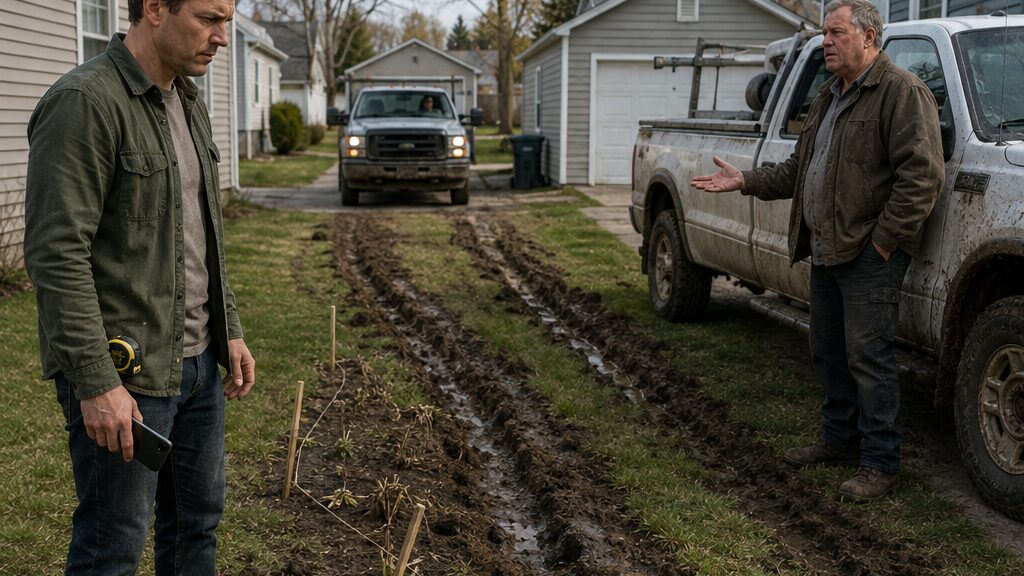
The tire tracks cut straight through the corner where Benjamin Carter had hammered four wooden stakes into the ground the night before.
He stood at the edge of the driveway with one hand around a cooling mug of coffee, staring at two muddy grooves that crossed his side yard, flattened the new grass, and clipped one of the strings marking his future garden beds. The string had snapped. One end lay half-buried in a rut filled with brown water.
For several seconds, Benjamin did nothing.
That worried him more than anger would have.
He had spent most of the winter sketching the garden on graph paper while sitting through remote meetings at his kitchen table. Three raised beds. A narrow gravel path. Tomatoes against the back fence where the afternoon sun stayed longest.
Now a truck tire had gone directly through the place where the first bed was supposed to sit.
The sound of a metal garage door rattling open came from next door.
Benjamin looked up.
Richard Miller stepped out of his detached garage wearing work pants and a faded jacket. He glanced once toward the damaged grass, then toward Benjamin.
“Morning.”
Benjamin set his mug on the porch rail.
“Richard.”
Richard seemed to recognize the tone. His shoulders changed slightly.
Benjamin pointed at the yard.
“You drove through again.”
Richard looked at the tracks as though they belonged to someone else.
“Ground’s soft.”
“That isn’t what I said.”
Richard exhaled and glanced toward the street.
The narrow strip between the houses had been a problem almost from the day Benjamin bought the place. Richard’s garage sat behind his house, and the angle from his own driveway was awkward for the larger of his two work trucks. Cutting across several feet of Benjamin’s side yard made the turn easy.
At first, Benjamin had treated it as an occasional inconvenience.
Then occasional became routine.
He had asked Richard the previous fall to stop. Richard had nodded, said he understood, and crossed again three days later.
Benjamin had said nothing that time.
That silence now seemed to be standing between them.
“I told you already,” Benjamin said. “I don’t want the trucks coming across here.”
Richard rubbed a hand over his jaw.
“I’ve been using that turn longer than you’ve lived here.”
“That doesn’t make the yard yours.”
“I didn’t say it did.”
“You’re driving on it.”
Richard looked toward the garage. “It’s ten feet of grass, Ben.”
Benjamin disliked the shortened version of his name in Richard’s mouth at that moment. It made the disagreement sound friendly, almost silly.
“It’s ten feet of my grass.”
Richard gave a tired laugh.
“There it is.”
“What?”
“Property-line courtroom before nine in the morning.”
Benjamin felt the old instinct rising in him: lower the temperature, say it was fine, move on before the entire block heard.
His father had spent twenty years fighting neighbors over tree limbs, parking spaces, drainage, barking dogs. Every disagreement had become a campaign. Benjamin had promised himself he would never live like that.
So for three years, he had confused not becoming his father with never drawing a hard line.
Richard stepped toward his truck.
“I’ve got a job in forty minutes.”
Benjamin looked at the driveway.
“You’re taking the street.”
Richard stopped.
“My other truck’s coming back.”
“Then it’s taking the street too.”
Richard turned fully toward him.
The quiet between them changed.
Across the road, a garage door opened. One of the neighbors stepped outside carrying a trash bag, slowed when he saw the two men, then kept moving.
Richard lowered his voice.
“You know I can’t swing the long truck clean from my side.”
“That’s not my problem.”
Richard’s jaw tightened.
“It hasn’t been a problem for anybody until you decided it was.”
Benjamin looked down at the ruts.
“Those weren’t here yesterday.”
“Grass grows.”
“My garden doesn’t.”
Richard glanced toward the stakes.
For the first time, his expression changed from irritation to recognition.
“You’re putting beds there?”
“I was.”
Richard shook his head.
“You picked the one spot I have to cross.”
Benjamin almost laughed.
“You hear what you just said?”
Before Richard could answer, the growl of a diesel engine came from the street.
Both men turned.
Richard’s second work truck appeared at the corner, driven by his employee. It slowed, signaled, then began turning toward the narrow approach beside Richard’s house.
The driver had made this maneuver enough times to know the shortcut. His front wheels angled toward Benjamin’s lawn.
Benjamin moved before he had time to argue himself out of it.
He stepped into the strip and raised one hand.
The truck stopped.
Its engine idled ten feet away.
Richard stared at him.
“Come on.”
Benjamin took out his phone.
He photographed the existing ruts.
Then the broken string.
Then the front tires of the truck waiting at the edge of his property.
Richard’s face reddened.
“What are you doing?”
“Documenting it.”
“Documenting what? A tire mark?”
Benjamin walked toward the nearest old metal marker he had noticed near the rear corner when he first bought the house. He had never known whether it was actually part of the boundary.
He crouched, measured roughly from it toward the driveway, and took another picture.
Richard gave a humorless laugh.
“You’re surveying now?”
“No.”
Benjamin stood.
“I’m done guessing.”
Richard folded his arms.
“I’ve crossed here for years. The people before you never made an issue of it. The HOA knows I use it. Half the block knows I use it.”
“That still doesn’t tell me where the legal line is.”
“You think a piece of paper changes where my garage has been for twenty years?”
“No.”
Benjamin looked toward the garage.
“But it might change how you get to it.”
For once, Richard had no immediate answer.
The employee remained inside the truck, looking straight ahead.
Benjamin stepped aside—but toward the pavement, not the grass.
“You’ll have to back out and come around.”
Richard stared at him long enough that Benjamin felt the familiar pressure to soften what he had said.
He didn’t.
Finally Richard waved to the driver.
“Back it out.”
The truck reversed.
Its tires stayed on the pavement.
Benjamin watched until it disappeared toward the far entrance.
Richard stood beside him, breathing through his nose.
“You’re making this bigger than it is.”
Benjamin looked at the muddy grooves again.
“No. I think I’ve been pretending it was smaller than it is.”
Richard walked back toward his garage without answering.
Inside his house, Benjamin opened his laptop before his coffee had gone completely cold.
He found the county property-record website, entered his parcel number, and downloaded the deed he had barely looked at since closing.
The legal description meant almost nothing to him.
He searched for an easement.
Nothing obvious appeared.
Then he opened the HOA directory and found the architectural-contact email.
He hesitated over the keyboard.
His first draft sounded angry.
He deleted it.
His second sounded apologetic.
He deleted that too.
The third was four sentences long.
He requested any records concerning rear access between the two lots and asked whether a boundary fence required architectural approval.
Then he called a licensed surveyor.
When the receptionist offered him an appointment, Benjamin looked through the kitchen window at the tracks crossing his yard.
“Take the first opening you have,” he said.
Chapter 2: What the Old Property Records Never Promised
Christine Wilson placed a photocopied page on the HOA office table and tapped one line with the end of her pen.
“Rear contractor access.”
Benjamin read it twice.
The phrase appeared in meeting notes from more than a decade earlier, buried between a complaint about holiday lighting and a discussion of drainage near the common sidewalk.
Nothing on the page said Richard’s name.
Nothing said easement.
Nothing said permanent.
But Benjamin still felt some of his certainty loosen.
Christine watched him carefully.
“This is what I meant when I emailed you. The board has known about that route for a long time.”
“Knew about it isn’t the same as approved it.”
“I didn’t say approved.”
“You called it an arrangement.”
“Because that’s what people treated it as.”
The HOA office occupied a small converted room near the community entrance, with two filing cabinets, an aging printer, and shelves of binders that seemed to contain every disagreement the neighborhood had ever had.
Benjamin slid the photocopy back toward her.
“Does the HOA own the strip?”
“No.”
“Did the HOA record an easement?”
“Not that I’ve found.”
“Then why am I here?”
Christine leaned back.
“Because you asked for the history, and the history is messier than your deed.”
That answer irritated him because it was reasonable.
She pulled out another folder.
“There are references in three different years. Delivery access. Contractor access. One note about keeping the rear lane clear during roof work.”
“There is no rear lane.”
“I know.”
“It’s my yard.”
“I know that too.”
Benjamin looked at her.
Christine closed the folder.
“Benjamin, I’m not trying to tell you Richard owns anything. I’m telling you people have thought of that space as usable access for years.”
“People who didn’t own it.”
“Yes.”
He let the word sit there.
Christine’s expression softened, but not enough to feel like an apology.
“This neighborhood is old enough that some things happened with handshakes. Somebody needed to get a trailer through. Somebody let them. Then ten years pass and everyone forgets which part was permission and which part was necessity.”
“That sounds like exactly why records matter.”
“It is.”
She glanced toward the window.
“It’s also why changing things can make people feel like something was taken from them even when it never belonged to them.”
Benjamin thought of Richard saying the people before you never made an issue of it.
For the first time, the line sounded less like pure arrogance.
Not justified. But less simple.
He spent the afternoon at his kitchen table with the deed, county parcel map, and scanned HOA notes spread across the surface.
The recorded deed listed utility easements along another edge of the property.
Nothing crossed the side yard.
He searched the county index under Richard’s parcel.
No access easement appeared there either.
That was the small piece of certainty Benjamin had wanted.
Yet Christine’s files had created a larger problem.
The old notes did not give Richard a legal right, but they explained why he behaved as though Benjamin was changing a neighborhood rule rather than enforcing one.
Around five, Christine called.
“I found another reference.”
Benjamin stared at the ceiling.
“Good or bad?”
“I don’t know.”
“That usually means bad.”
“It says the prior homeowner had no objection to occasional work access.”
“Occasional.”
“That’s the word.”
Benjamin sat forward.
“Anything about a permanent right?”
“No.”
“Anything recorded?”
“No.”
He rubbed his forehead.
“So that helps me.”
“Legally, maybe.”
There was a pause.
“Christine.”
“Yes?”
“What aren’t you saying?”
She exhaled.
“If you put up a fence, you still need architectural approval. Height, material, setback, visibility. Richard can object during review.”
“Can he stop it?”
“I didn’t say that.”
“You keep saying that.”
“Because you keep asking me to turn HOA procedure into a property-law opinion.”
Benjamin almost smiled despite himself.
“So he can delay it.”
“He can make an argument.”
“He’s already making an argument.”
“I know.”
After they hung up, Benjamin looked through the window.
The muddy ruts had begun drying into hard grooves.
The string from his garden marker still lay broken beside them.
A week earlier, the marks had made everything feel obvious.
Now the same tracks seemed to carry more history than he wanted.
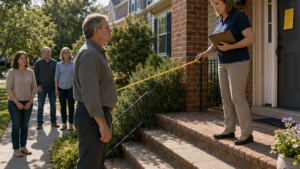
The following morning, Patrick Thomas arrived with a vest, tripod, metal detector, and the careful manner of someone accustomed to being watched by nervous property owners.
Richard noticed within ten minutes.
He came out of his garage but stayed on his own side.
Patrick ignored him.
Benjamin followed as Patrick worked from the front corner toward the rear, comparing measurements against the recorded plat.
“What do you think?” Benjamin asked.
Patrick did not look up.
“I think I’m about halfway done.”
“I mean generally.”
“I generally don’t think until I’m finished.”
Benjamin understood why people hired him.
Near the back corner, Patrick swept the detector over the grass.
It chirped.
He moved six inches.
It chirped again, sharper.
Richard stepped closer.
“That where he told you it was?”
Patrick knelt and began clearing dirt with a narrow hand tool.
“He didn’t tell me where anything was.”
After another minute, the top of a rust-darkened iron pin appeared beneath the soil.
Benjamin leaned forward.
The pin sat almost directly beside one of Richard’s hardened tire grooves.
Patrick cleaned around it, checked his measurements, then looked toward the front of the property.
“That’s consistent with the plat.”
Richard’s face tightened.
“It’s been there the whole time?”
Patrick stood.
“Looks that way.”
Benjamin stared at the pin.
For years, trucks had crossed back and forth inches from a boundary marker buried quietly in the soil.
The line had never moved.
Only everyone’s willingness to see it had.
Patrick lifted his equipment.
“I’ll confirm the remaining monuments and send you the completed survey.”
Benjamin nodded.
Behind him, Richard said nothing.
But the way he looked at the old iron pin made Benjamin wonder whether the survey was about to settle the argument—or uncover a worse one.
Chapter 3: The Survey Stakes Changed More Than the Yard
The first orange survey stake stood directly in the path of Richard Miller’s truck.
Benjamin noticed it before he noticed anything else.
Patrick had returned early that morning to finish marking the line, and the bright stake now rose from the grass less than a foot from one of the old tire grooves. From the driveway, there was no ambiguity left. The legal boundary cut through the route Richard had been using.
Richard came outside while Patrick was setting the second stake.
He stopped.
“What is that?”
Patrick continued checking a measurement.
“A boundary marker.”
“I can see that.”
Richard pointed toward the line.
“That can’t be right.”
Benjamin stood several feet away near his garage.
Patrick looked at Richard only long enough to answer.
“It matches the recorded plat and the monuments I located.”
Richard walked toward the stake.
Benjamin moved instinctively but stopped himself. Richard did not touch it.
“You’re telling me my truck’s been crossing his lot all these years?”
Patrick glanced at the tire marks.
“I’m telling you where the boundary is.”
“That wasn’t my question.”
“It’s the answer I’m qualified to give.”
Richard looked toward Benjamin.
“So this is what you wanted.”
Benjamin frowned.
“I wanted to know where the line was.”
“You knew.”
“No. I suspected.”
“You brought a surveyor out here because you wanted stakes in the ground.”
“I brought him because you kept telling me the route was established.”
“It is established.”
Patrick gathered his measuring rod and walked farther toward the rear corner, leaving the two of them beside the bright stake.
Richard lowered his voice.
“You planning a fence now?”
“I’m looking at my options.”
“That means yes.”
“It means I haven’t filed anything.”
Richard gave a short laugh.
“You put a fence on that line, I can’t get the long truck into the garage.”
Benjamin looked toward Richard’s driveway.
For years he had assumed the shortcut merely saved Richard from a difficult turn.
Now he studied the geometry differently.
Richard’s pavement narrowed near the house. The garage sat behind it at an angle. A standard pickup could probably maneuver through with care, but Richard’s larger work truck carried side boxes and a ladder rack that widened its turning circle.
“You can’t make it at all?” Benjamin asked.
Richard heard the surprise.
“What did you think I was doing? Saving thirty seconds?”
“I thought it was easier.”
“It is easier. Because the other way doesn’t work with the big truck.”
Benjamin looked again at the stake.
The dispute shifted inside him.
Richard had not been crossing merely because he was lazy.
He had built part of his working routine around those few feet.
That did not make them his.
But it made the consequence of closing them heavier than Benjamin had let himself imagine.
“You should’ve told me that,” Benjamin said.
Richard stared at him.
“I did.”
“No. You told me you’d been doing it for years.”
“Because that should’ve told you something.”
“It told me you thought time made it yours.”
Richard’s face hardened.
“There. That’s the part you don’t get. Nobody treated it like this before you.”
“Like what?”
“Like a border checkpoint.”
Benjamin almost answered sharply, but Patrick returned.
“The monuments are consistent,” he said. “I’ll send the drawing this afternoon.”
Richard pointed at the line.
“So there’s no chance that’s off by a couple feet?”
Patrick shook his head.
“Not based on what I found.”
“How much?”
Patrick looked at him.
“How much what?”
“How far could another surveyor move it?”
Patrick’s expression went flat.
“A surveyor doesn’t move a boundary because somebody needs more room.”
Richard looked away.
That afternoon, the orange stakes became a neighborhood object.
One homeowner paused near the common walkway and asked Benjamin whether he was “finally doing something about the truck path.”
Another said Richard had been driving through there since before Benjamin moved in.
Neither statement was openly hostile, but together they made Benjamin feel observed.
By dinner, Christine called.
“Richard filed a complaint.”
Benjamin closed his eyes.
“With the city?”
“With the HOA.”
“About what?”
“Boundary interference, access disruption, and proposed fencing.”
“I haven’t proposed fencing yet.”
“He says you told him you were considering it.”
“I did.”
Christine was silent for a moment.
“Benjamin, I’m going to say this carefully. He filed before you submitted an architectural request. That means the board will likely want to discuss his access concern during your fence review.”
“My fence review that does not exist yet.”
“I understand.”
“No, I don’t think you do.”
His voice had sharpened.
Christine answered calmly.
“I understand that you’re frustrated.”
“His truck is on my property. The survey confirms it. Somehow I’m now the one being reviewed?”
“He’s asking the board to consider an established use pattern.”
“Established use isn’t ownership.”
“I know.”
“Then why does it matter?”
“Because the HOA can regulate your fence even if it can’t rewrite your deed.”
Benjamin paced to the kitchen window.
The survey stakes were visible in the fading light.
“So if I apply, he objects.”
“Probably.”
“And if I don’t apply, he keeps crossing.”
“I didn’t say that.”
Benjamin gave a tired laugh.
“You really should put that on the HOA letterhead.”
Christine ignored it.
“Submit your application if that’s what you want. Just understand this is no longer two neighbors arguing beside a driveway.”
After they hung up, Benjamin printed Patrick’s survey.
The line was clean.
Measured.
Professional.
It gave him exactly what he had asked for.
Yet when he looked out at Richard’s garage, he no longer saw a man taking a lazy shortcut. He saw a business setup that might not function without land Richard did not own.
The distinction mattered.
It just did not change the line.
Near dusk, Richard came outside carrying an envelope.
He did not cross the stakes.
That, more than anything, caught Benjamin’s attention.
Richard stopped on his own side.
“You get the survey?”
“Yes.”
“You happy?”
“No.”
Richard seemed surprised.
Benjamin folded the printout.
“You filed a complaint.”
“I filed before you boxed me out.”
“I haven’t built anything.”
“You’re going to.”
Benjamin said nothing.
Richard looked toward the orange stakes, then toward his garage.
“You think I made this whole thing up because I like driving on your grass?”
“I think you kept using it after I told you not to.”
“And I think you moved into a situation you didn’t understand.”
Benjamin felt his patience tighten.
“Then explain it.”
Richard studied him for several seconds.
When he spoke again, the anger had dropped from his voice.
“Ask the man who owned your house before you.”
Benjamin frowned.
“About what?”
Richard looked directly at him.
“Ask him what he promised me.”
Chapter 4: The Promise Nobody Had Put in Writing
Christine Wilson did not look at Benjamin when she read the sentence aloud.
“Access may continue until another arrangement is made.”
The HOA hearing room went still.
Benjamin sat with both hands folded over Patrick Thomas’s survey. Across the table, Richard Miller leaned back in his chair as though the sentence had proved everything he had been saying.
Christine lowered the photocopy.
“That note is dated seventeen years ago,” she said. “It refers to the prior owner of Benjamin’s property.”
Richard looked at Benjamin.
“There. That’s what I told you.”
Benjamin kept his eyes on the page.
“Read the rest.”
Richard’s expression changed.
Christine did.
“The owner has no objection to occasional contractor access across the side strip. No easement will be granted. Access may continue until another arrangement is made.”
The HOA president shifted in his chair.
“That’s different.”
Richard leaned forward.
“It still says access.”
“It says permission,” Benjamin said.
Richard turned toward him.
“You think that distinction mattered when everybody used it for seventeen years?”
“It matters now.”
Christine set the paper beside Patrick’s survey.
The two documents looked almost absurd next to each other. One was precise, measured, stamped. The other was an old meeting note typed in plain black text.
Yet the old page seemed heavier.
Benjamin had spent weeks wanting proof that Richard was wrong.
Now he had it.
What he did not have was the clean feeling he expected to come with it.
The HOA president cleared his throat.
“The board cannot create an easement where none exists. That’s outside our authority.”
Richard looked at him sharply.
“But you can stop the fence.”
“We can review it under the architectural rules.”
“Same thing.”
“No,” Christine said. “It isn’t.”
Richard pushed his chair back slightly.
Benjamin recognized the movement. It was what Richard did when he felt cornered but did not want to look cornered.
The president continued.
“The board can consider height, materials, sight lines, setbacks. We cannot require Benjamin to provide permanent vehicle access over his property simply because it was previously tolerated.”
Richard stared at the table.
For the first time since the tire tracks appeared, Benjamin saw something underneath his anger.
Not confusion.
Fear.
The meeting ended without a decision because Benjamin had not yet formally submitted a fence request.
In the parking lot, Richard caught up to him.
“Benjamin.”
Benjamin stopped beside his car.
Richard held the old photocopy Christine had given him.
“You got what you wanted.”
“I found out what happened.”
“Same difference.”
“No.”
Richard looked toward the building.
“Everybody keeps acting like I invented this.”
“I don’t think you invented it.”
“You did two weeks ago.”
“I thought you were using the yard because it was easier.”
Richard gave a short, bitter laugh.
“It was easier.”
Benjamin waited.
Richard folded the photocopy once, then unfolded it.
“My first truck fit from my side. Barely. Then I bought the longer one.”
“When?”
“Years ago.”
“And you knew there wasn’t an easement?”
Richard looked away.
That was the answer before he said anything.
Benjamin felt his stomach tighten.
“You knew.”
“I knew nothing was recorded.”
“That’s the same thing.”
“No. It isn’t.”
“Richard.”
Richard rubbed a thumb along the crease in the paper.
“The old owner told me I could keep using it until I figured something else out.”
“And you didn’t.”
“I got estimates.”
“When?”
“Twice.”
Benjamin stared at him.
Richard finally met his eyes.
“First one was more than I had. Second one was worse.”
“So you just kept using mine.”
“I kept working.”
The defensiveness returned, but this time it came with something rawer.
“My business isn’t some fleet operation, Benjamin. Those trucks pay my mortgage. Garage holds the tools, compressor, inventory. I lose easy access for a month, I’m moving stuff by hand or paying for storage.”
“That still doesn’t make it my responsibility.”
“I know that.”
The words came so quietly Benjamin almost missed them.
That stopped him.
Richard looked toward the road.
“I knew eventually somebody might say no. Then your first year went by. Then another. You saw me crossing. You didn’t stop me.”
“I did stop you.”
“Eventually.”
Benjamin felt that one land.
Richard continued.
“Every year nobody made me fix it, fixing it felt less urgent.”
“That’s not permission.”
“I didn’t say it was.”
Benjamin almost answered, then realized Richard had used his own phrase against him.
For three years, Benjamin had told himself he was preserving peace.
Richard had interpreted the same silence as stability.
Neither interpretation had been written down.
The result was standing between them.
“How bad is the driveway work?” Benjamin asked.
Richard’s jaw tightened.
“Bad enough.”
“That’s not a number.”
“I don’t have one that matters yet.”
“You said you had estimates.”
“Old ones.”
Richard folded the paper again.
“Regrading. Drainage. Widening. Maybe moving part of the apron. Depends what the city makes me do.”
Benjamin pictured the deep ruts beside his garden stakes.
Weeks ago, hearing this would have felt like justice arriving early.
Now it felt different.
Richard had made choices.
Bad ones.
But Benjamin had made one too.
He had seen the trucks and chosen silence because silence was easier than conflict.
He had waited until resentment made every crossing feel like theft.
That did not transfer ownership.
It did mean the story was not as simple as he had wanted it to be.
That evening, Benjamin sat at his kitchen table with the fence application open on his laptop.
He reread the architectural requirements.
Six-foot cedar privacy fence.
Posts entirely within the surveyed line.
Gate facing inward.
Nothing unusual.
His cursor hovered over the submission button.
Through the window, he could see Richard moving equipment inside his garage.
The orange survey stakes glowed faintly along the grass.
Benjamin thought of his father, who had once spent eighteen months refusing to speak to a neighbor over a maple branch.
He had built his adult life around avoiding that kind of certainty.
But avoidance had not prevented a feud.
It had only delayed the moment when he had to say what he meant.
He attached Patrick’s survey.
Attached the fence drawing.
Attached photographs of the damaged strip.
Then he stopped.
For one brief moment, he wondered whether understanding Richard’s position obligated him to change his own.
It did not.
Understanding was not surrender.
Benjamin clicked Submit.
Chapter 5: When the Cedar Fence Finally Closed the Shortcut
The first cedar post went into the ground exactly where Richard’s rear tire usually crossed.
Benjamin stood beside the fence contractor while the auger pulled dark Ohio soil from the hole in wet clumps.
Richard watched from his driveway.
He had known the installation date for more than a week. The HOA had approved the materials and height after requiring a small adjustment near the front sight line. Patrick’s survey had been attached to the approval.
Nothing about the morning was a surprise.
Still, Richard looked as though somebody had arrived without warning.
The contractor checked the string line.
“You want all posts six inches inside the survey line like we discussed?”
Benjamin nodded.
“Yes.”
Richard called from his driveway.
“Six inches?”
Benjamin turned.
Richard walked toward the boundary but stopped before the orange stakes.
“You’re giving up six inches just to make sure?”
“I’m keeping the fence inside my lot.”
“That’s what I mean.”
Benjamin did not answer.
The auger started again.
By ten-thirty, three posts stood upright in concrete.
Richard disappeared into his garage.
Benjamin went inside to work.
He kept his desk facing away from the window, but every mechanical sound outside pulled his attention back. He hated that. He had expected construction day to feel decisive.
Instead, it felt like waiting for something to break.
Around noon, a diesel engine approached from the street.
Benjamin stood.
Richard’s larger work truck turned into the driveway.
The employee was driving.
Richard came out of the garage and began waving him forward.
The driver made the familiar angle toward Benjamin’s side yard.
Then stopped.
A fresh cedar post stood where the front tire normally passed.
The driver straightened the wheel and tried again.
The rear corner of the truck drifted too close to Richard’s house.
He backed up.
Tried a sharper turn.
Stopped.
Richard walked beside the truck, signaling with both hands.
“Come on. Come on. Cut it.”
The truck moved another foot.
Richard slapped the side panel.
“Stop.”
Benjamin watched from behind his window.
There it was.
The consequence everyone had been arguing around.
Richard could not make the turn.
Not with the large truck.
Not without Benjamin’s land.
The driver backed toward the street again.
Richard saw Benjamin through the window and walked over.
Benjamin met him outside.
“You need to stop them for ten minutes.”
Benjamin looked toward the contractor.
“Why?”
“So I can get the truck in.”
“Across where?”
Richard stared at him.
“You know where.”
“The posts are already set.”
“Then between them.”
“No.”
Richard lowered his voice.
“One last time.”
Benjamin felt the temptation to agree simply because the request sounded temporary.
That was how this had begun.
One crossing.
One favor.
One thing too small to make a fight over.
“No,” Benjamin said.
Richard’s mouth tightened.
“I have equipment in that truck I need inside.”
“You knew construction started today.”
“My job ran late.”
“You knew.”
Richard stepped closer.
“So that’s it?”
Benjamin kept his voice level.
“That’s the line.”
Richard looked past him toward the cedar posts.
For a moment Benjamin thought he might start shouting.
Instead Richard said, “You enjoying this?”
“No.”
“Could’ve fooled me.”
Benjamin looked directly at him.
“I would’ve enjoyed it if you’d stopped when I asked.”
Richard flinched almost imperceptibly.
Then the anger came back.
“You waited three years too.”
Benjamin did not deny it.
Richard turned away.
The employee backed the truck onto the street.
By late afternoon, the fence had become a solid wall of cedar boards. The old tire path vanished behind it from certain angles. The gate opened inward toward Benjamin’s yard and latched from his side.
The contractor walked the line with him.
“Everything’s inside your survey. You’ve got your drawing and final measurements.”
Benjamin ran a hand over one of the posts.
For weeks, he had imagined this moment.
No more tire marks.
No more waiting for engines.
No more argument about where the property ended.
He expected triumph.
What came instead was relief so quiet it almost felt like exhaustion.
Across the fence, Richard’s garage door remained open.
His larger truck was parked on the street.
Two days passed.
Then three.
Richard used the smaller truck and moved equipment by hand between the street and garage.
Benjamin noticed without meaning to.
On Thursday evening, Christine called.
“He challenged the survey.”
Benjamin leaned against the kitchen counter.
“Through the HOA?”
“And with the city review process.”
“On what basis?”
“Setback, boundary accuracy, obstruction of established access.”
“We already did this.”
“I know.”
“The HOA approved the fence.”
“I know.”
“Patrick found the pins.”
“I know.”
Benjamin rubbed his eyes.
“So what happens?”
“The board isn’t reversing its approval tonight. But if he’s formally disputing the boundary, they want confirmation before closing the complaint.”
“Another survey?”
“Possibly a review of Patrick’s survey and the recorded monuments.”
Benjamin looked through the window.
The cedar fence stood straight and new across the side yard.
His garden string had been reset on his side.
The problem looked finished.
Apparently it was not.
Christine continued.
“Richard is also arguing the fence obstructs an access pattern the HOA historically recognized.”
“We already established it was permission.”
“Yes.”
“Then why are we still pretending that means ownership?”
“We’re not.”
“It feels like it.”
There was a pause.
Then Christine said, “Benjamin, he’s under pressure.”
“So am I.”
“I know.”
“No, every time Richard gets uncomfortable, somebody calls me and asks if I can be flexible.”
Christine did not answer immediately.
Benjamin regretted the sharpness but not the point.
Finally she said, “The review will happen whether either of us likes it. Send me Patrick’s final stamped survey again.”
“I already sent it.”
“Send it again.”
He did.
The following Monday, a postal carrier handed Benjamin a certified envelope.
He signed for it on the porch.
The return address belonged to the city office handling the boundary review.
He opened it standing beside the fence.
The notice did not order removal.
Not yet.
It stated that Richard had formally disputed the boundary placement and requested review of the survey information associated with the approved fence.
Benjamin read the page twice.
Then he looked at the cedar boards.
For the first time since they went up, he imagined them coming back down.
Chapter 6: Richard’s Complaint Opened the Door He Feared
The reviewing surveyor spent less than twenty minutes at the rear corner before Richard asked the question everyone had been avoiding.
“How far off?”
The surveyor straightened from the old iron pin.
“Off from what?”
“His survey.”
Patrick stood several feet away with his arms folded, present because Benjamin had asked him to attend the review.
Richard pointed at the cedar fence.
“How much did he miss by?”
The reviewing surveyor looked from the pin to Patrick’s field notes.
“So far? Nothing meaningful.”
Richard’s face went still.
Benjamin felt relief move through him, but he kept his expression neutral.
The surveyor checked the front monuments, compared bearings, and spent another hour working along the lots.
When he finally returned, he spoke to all three men at once.
“The recorded monuments are consistent with Mr. Thomas’s work. The fence is also inside the surveyed parcel.”
Richard looked toward the street.
“What about the access?”
“That isn’t a survey question.”
Richard laughed once.
“Apparently nothing is anybody’s question.”
Patrick gathered his equipment.
Benjamin almost said something.
He stopped himself.
Winning did not require commentary.
The city closed the boundary portion of the complaint three days later.
The HOA followed.
The fence stayed.
That should have ended it.
Instead, Richard’s complaint forced a second issue into the open.
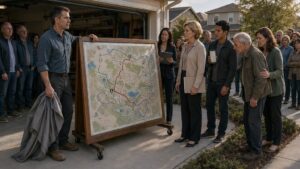
At the permit counter, a city zoning clerk spread an aerial parcel map across the desk.
Richard stood on one side.
Benjamin had come only because Christine requested that he attend the access discussion as the adjoining owner.
The clerk pointed toward Richard’s existing driveway.
“If you want vehicle access to the detached garage without crossing the neighboring parcel, this approach needs to be modified.”
Richard leaned over the plan.
“How much modification?”
“I can tell you what has to comply. Contractor tells you what it costs.”
The clerk traced the area with a pencil.
“Likely widening here. Regrading here. You have drainage to address, and depending on the final design, the apron may require a new permit.”
Richard stared at the map.
“What if I just keep the existing drive and change the angle?”
“For the larger vehicle?”
“Yes.”
The clerk shook her head.
“Not without encroaching over the line you just had reviewed.”
Benjamin looked down.
The irony was too obvious to enjoy.
Richard had challenged the boundary hoping to move it.
Instead, he had helped establish precisely how much of his working access depended on land he did not own.
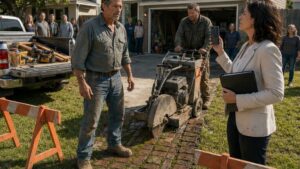
A driveway contractor came two days later.
Benjamin saw him measuring slopes from his yard but did not approach.
That evening Richard stood beside his mailbox holding several sheets of paper.
He looked older than he had a month earlier.
Benjamin was taking the trash cans out when Richard called to him.
“Got your victory.”
Benjamin stopped.
“I got my boundary confirmed.”
“Same thing.”
“No.”
Richard gave him a tired look.
“Still doing that?”
“Doing what?”
“Correcting every word.”
Benjamin let go of the trash-can handle.
“What did they quote you?”
Richard glanced at the papers.
Benjamin expected him to refuse.
Instead Richard crossed to the edge of his driveway and held out the estimate without stepping over the fence line.
Benjamin took it.
The total sat near the bottom.
Just over nine thousand dollars, depending on drainage work and final permit requirements.
Benjamin read it again.
Richard said, “That doesn’t include whatever I lose while they tear it up.”
Benjamin handed the pages back.
“I’m sorry.”
Richard looked genuinely offended.
“Don’t.”
“I mean it.”
“No, you don’t.”
Benjamin felt his temper rise.
“You think I wanted you to get a nine-thousand-dollar estimate?”
“I think you wanted the fence.”
“Yes.”
“And this comes with it.”
“No. This came with depending on my property.”
Richard looked away.
Benjamin continued, quieter now.
“And I came with part of it too.”
Richard looked back.
Benjamin nodded toward the yard.
“I should’ve said no clearly the first year.”
That surprised Richard enough to silence him.
“I saw you crossing,” Benjamin said. “I didn’t like it, but I kept telling myself it wasn’t worth a confrontation. Then every time you did it, I got angrier. That part’s on me.”
Richard folded the estimate.
“Doesn’t help me much.”
“No.”
“But you’re right about one thing.”
Benjamin waited.
Richard looked toward his garage.
“I should’ve fixed it when the first owner told me he wouldn’t sign an easement.”
Benjamin said nothing.
Richard rubbed his thumb along the folded paper.
“I got a quote back then. Didn’t like it. Figured I’d wait a year.”
“And the year kept getting longer.”
Richard gave a faint, humorless smile.
“Something like that.”
For the first time, they were talking about the same event without arguing over what it meant.
It did not feel like reconciliation.
It felt like two men finally standing on the same map.
Richard went inside.
Benjamin thought the conversation was over.
An hour later, someone knocked on his front door.
Richard stood on the porch holding a plain folder.
No raised voice.
No complaint paperwork.
No HOA forms.
“I want to ask you something,” he said.
Benjamin looked at the folder.
“What?”
Richard held it out.
“Sell me an easement.”
Chapter 7: The Easement Offer That Would Start Everything Again
Richard set the folder on Benjamin’s kitchen table and placed a check on top of it.
Benjamin did not touch either one.
For several seconds, neither man sat down.
The room felt too small for the amount of history lying between them.
Richard finally pulled out a chair.
“I had somebody draw it up.”
Benjamin looked at the folder.
“A permanent easement.”
“Yes.”
“For the same route.”
Richard nodded.
“Basically.”
Benjamin sat across from him and opened the folder.
The language was dense but clear enough. Vehicle access across a defined strip. Ongoing use. Maintenance responsibilities. Transfer with the property.
Benjamin read the first page, then the second.
The check amount made him stop.
It was enough money to cover the fence several times over.
Richard noticed where his eyes landed.
“I’m not asking for a favor.”
Benjamin closed the folder.
“You’re asking me to put the shortcut back.”
“I’m asking you to sell access.”
“Permanently.”
“That’s what an easement is.”
Benjamin leaned back.
Richard’s voice stayed controlled.
“I can’t keep running the business like this. I’m loading out on the street. Half the tools are trapped in the garage behind that turn. The driveway work is going to cost me over nine grand before I lose a week of use.”
“So you want to pay me instead.”
“I want the problem solved.”
Benjamin looked toward the side window.
The cedar fence was visible beyond the kitchen, the boards new enough that their color had barely started changing.
A month earlier, a permanent easement would have sounded like surrender.
Now the offer was harder because it came without shouting.
Richard had finally done what Benjamin had asked him to do from the beginning.
He had stopped assuming.
He had asked.
That should have made the answer easier.
It did not.
Richard tapped the folder.
“The HOA thinks it’s reasonable.”
“Christine said that?”
“She said a recorded agreement would be cleaner than what we had before.”
Benjamin believed that. A written easement would be cleaner than years of informal crossings.
But clean was not the same as wise.
He reopened the folder and traced the route on the attached sketch.
It followed almost exactly where the old tire tracks had run.
Through the strip where the garden was supposed to go.
Across the same ground he had fought to make unambiguous.
He imagined selling the right.
The trucks would return.
Not illegally this time.
Not rudely.
But permanently.
The line would remain on paper while daily life blurred it again.
“You’d still be crossing here after you sold the house,” Benjamin said.
Richard frowned.
“The easement would transfer, yes.”
“And if I sold mine?”
“Same thing.”
Benjamin looked up.
“So neither of us would control it anymore.”
“That’s the point. Nobody has to argue again.”
Benjamin almost agreed with that logic.
Then he remembered the old HOA note.
Access may continue until another arrangement is made.
Someone years earlier had tried to preserve flexibility.
Everyone afterward had turned flexibility into expectation.
A permanent easement would solve Richard’s current problem by making Benjamin’s strip part of Richard’s future property use forever.
It was not compromise.
It was a different kind of permanence.
Christine arrived twenty minutes later at Benjamin’s request.
She sat at the far end of the table and reviewed the papers.
Richard watched her.
Benjamin waited.
Finally she said, “It would resolve the historical ambiguity.”
“That’s what I told him,” Richard said.
Christine looked at Benjamin.
“But whether you want an easement is entirely your decision.”
Richard’s shoulders tightened.
“Come on.”
Christine did not change her expression.
“I said it would be cleaner. I did not say the HOA could require it.”
Benjamin slid the check back toward Richard.
“No.”
Richard stared at it.
“You haven’t even countered.”
“I’m not selling it.”
“You don’t know what number I’d go to.”
“It’s not the number.”
Richard’s face hardened.
“So after all this, you just want me to eat the driveway cost.”
Benjamin felt the old anger move toward the surface.
He stopped it there.
“No. I want the permanent problem to end.”
“It ends if I buy the easement.”
“No. It becomes permanent.”
Richard pushed his chair back.
“You’re splitting words again.”
“No, Richard. This is exactly the word that matters.”
Benjamin opened the sketch and turned it around.
“This line exists because we spent years pretending permission and ownership were close enough.”
Richard looked at the drawing.
Benjamin continued.
“If I sign this, every truck you own, every truck somebody after you owns, gets a permanent right across my land.”
“That’s how recorded access works.”
“I know.”
He closed the folder.
“That’s why I’m saying no.”
Richard stood.
Christine said quietly, “Sit down.”
Richard looked at her.
She did not raise her voice.
“You came here asking for an agreement. Let him answer without turning it back into the old fight.”
For a moment, Benjamin expected Richard to walk out.
Instead he sat.
The silence stretched.
Benjamin noticed something on the contractor estimate Richard had brought with him. A note in the margin referred to temporary equipment access during regrading.
He pulled the estimate closer.
“What’s this?”
Richard looked.
“Contractor needs room during the first phase.”
“On which side?”
“Probably yours for part of it.”
Benjamin stared at the page.
“How long?”
Richard shrugged.
“Four days. Maybe five.”
“And after that?”
“Once they widen and regrade, everything stays on my lot.”
Benjamin looked at Christine.
She understood before he said it.
“A temporary license,” she said.
Richard frowned.
“What?”
“Written temporary access. Limited dates. Limited purpose. Automatic expiration.”
Benjamin turned the sketch over and found a blank sheet beneath it.
He drew the fence line.
Then Richard’s driveway.
Then a narrow temporary crossing point large enough for equipment but not positioned as a permanent vehicle route.
Richard watched him.
Benjamin said, “You don’t need an easement forever. You need enough access to build yourself a route that doesn’t depend on me.”
Richard stared at the drawing.
“And you’d agree to that?”
“With conditions.”
“Of course.”
Benjamin ignored the tone.
“Exact dates. Contractor only. No regular work trucks. Any damage gets restored. If weather delays the job, extension has to be in writing.”
Richard leaned closer.
“What about taking down part of the fence?”
“We use the gate and whatever opening the contractor actually needs. Anything removed goes back.”
Christine pulled a legal pad toward herself.
“I can help document the basic terms, but both of you should make sure you understand what you’re signing.”
Richard looked at Benjamin.
The anger was gone again.
“What changed?”
Benjamin thought about it.
“Nothing about the line.”
Richard waited.
Benjamin tapped the temporary route he had drawn.
“What changed is I don’t need you to suffer to prove it exists.”
Richard looked down.
For several minutes, they worked through dates, restoration, insurance, contractor access, and the exact expiration point.
There were disagreements.
But they were smaller now.
Measurable.
Writable.
At the end, Christine placed the final agreement between them.
Richard read it twice.
Benjamin watched his hand pause over the signature line.
“You know,” Richard said, “this would’ve been easier three years ago.”
Benjamin gave a faint smile.
“Yes.”
“For both of us.”
“Yes.”
Richard signed.
Then he passed the pen across the table.
Benjamin signed beneath him.
The line between their properties had not moved an inch.
For the first time, neither man was pretending it had to.
Chapter 8: Where the Old Tire Path Became a Garden
Richard’s larger work truck made the turn into his garage without touching Benjamin’s property.
Benjamin was standing beside the garden bed when it happened.
He heard the diesel engine first and looked up automatically, the old reflex still lodged somewhere in him.
The truck came down Richard’s driveway, slowed near the widened section, then turned.
Its rear wheel cleared the cedar fence.
Not by much.
But it cleared.
Richard stopped the truck halfway to the garage, leaned out the window, and looked toward Benjamin.
Neither man waved.
Richard simply nodded once.
Benjamin nodded back.
Then the truck disappeared behind the garage.
For the first time in years, the sound of that engine did not mean Benjamin had to check his lawn.
The driveway work had taken six days instead of four.
Rain delayed the grading, and the contractor needed an extra afternoon to reset the drainage edge.
Under the old arrangement, that would probably have become another argument.
This time Richard texted Benjamin before the extension deadline.
One sentence.
Need two more days because of rain. Same access terms.
Benjamin replied yes.
Nothing else.
The temporary route across his property took a beating during construction.
A small loader crossed twice.
Gravel spilled near the side gate.
One section of grass turned to compacted dirt.
Benjamin noticed every mark.
He said nothing because the agreement already said what would happen next.
The morning after construction finished, a landscaping crew arrived at Richard’s expense.
They raked the compacted soil.
Added topsoil.
Reseeded the damaged patch.
Reset the gate.
By late afternoon, the temporary tracks were barely visible.
Richard came over while Benjamin was measuring lumber for the first raised bed.
“Crew miss anything?”
Benjamin looked around.
“No.”
Richard pointed toward a shallow depression near the fence.
“That spot?”
Benjamin walked over and pressed it with his shoe.
“Maybe a little.”
Richard called the crew back before Benjamin could say it was good enough.
That mattered more than Benjamin expected.
Not because the depression mattered.
Because Richard no longer waited to see how much Benjamin would tolerate.
He fixed it.
A week later, Christine stopped by carrying a thin folder.
Benjamin was kneeling beside the second garden bed, filling it with soil.
“I brought you a copy of the board update.”
He stood and brushed dirt from his hands.
“What update?”
“New policy recommendation.”
Benjamin gave her a suspicious look.
“Should I be worried?”
“Probably not.”
She handed him the folder.
The board planned to require documentation whenever residents created ongoing access arrangements across neighboring lots. Not every favor needed a contract, but recurring vehicle access, shared maintenance routes, and anything that could affect future owners would have to be clearly identified.
Benjamin read the first page.
“You wrote this because of us.”
Christine smiled.
“I wrote it because of seventeen years of people saying, ‘Everybody knows how it works.’”
“That sounds familiar.”
“It should.”
She looked toward Richard’s widened driveway.
“The board got lazy too.”
Benjamin glanced at her.
Christine shrugged.
“We had notes. We had assumptions. We had people referring to private property like it was a neighborhood lane because that made meetings easier.”
“That’s unusually self-critical for an HOA.”
“Don’t get used to it.”
Benjamin laughed.
Across the fence, Richard was organizing equipment near the garage.
Christine watched him for a moment.
“He doing okay?”
“I think so.”
“You two speaking?”
“Sometimes.”
“That sounds promising.”
“I wouldn’t go that far.”
Christine closed the folder.
“Probably healthier.”
The garden slowly took shape through late summer.
Benjamin built three raised beds after all.
The first sat near the rear fence.
The second ran parallel to the new cedar boards.
The third occupied the corner that had once held the deepest tire rut.
When he dug there, the soil was still slightly harder beneath the surface.
He struck the shovel down, loosened it, and worked compost through the compacted earth.
The old route did not disappear simply because trucks stopped using it.
The ground remembered.
So did he.
One evening, Richard appeared at the gate carrying a short length of edging that had been left behind after the driveway project.
“This yours?”
Benjamin looked at it.
“No.”
“Mine either.”
They both stared at it.
Richard said, “Guess it belongs to the disputed republic.”
Benjamin laughed before he could stop himself.
Richard smiled.
It was the first joke either of them had made about the conflict.
Not a reconciliation.
Not forgiveness.
Just enough space to acknowledge how absurd some of it had become.
Richard rested the edging against the fence.
“Garden looks good.”
“Not finished.”
“You putting tomatoes there?”
Benjamin looked at the bed.
“Next year.”
Richard nodded.
A few seconds passed.
Then he said, “I was angry about the fence.”
“I noticed.”
“I thought you were doing it to make a point.”
“Partly.”
Richard looked at him.
Benjamin did not take it back.
“I was angry too.”
Richard nodded.
“Fair.”
Benjamin rested both hands on the shovel handle.
“I should’ve been clearer earlier.”
Richard looked toward his new driveway.
“I should’ve stopped making your silence mean yes.”
Neither man said anything after that.
There was nothing left to prove.
Richard went back through the gate and latched it behind him.
By September, green shoots covered the patch the landscaping crew had repaired.
The old tire tracks became difficult to see.
Benjamin finished the final bed on a Saturday morning.
He carried a tray of late-season herbs outside and set it beside the fence.
The orange survey stakes had been removed months earlier. Patrick’s iron pin remained underground where it had always been.
Benjamin no longer needed to see it.
The cedar fence showed the line now.
But even the fence had changed meaning.
When it first went up, it felt like a verdict.
Then like a shield.
Now it was simply part of the yard.
Richard’s truck started next door.
Benjamin did not look up.
He pressed the first plant into the soil where one of the deepest ruts had once crossed.
Then another.
And another.
By the time the truck rolled out toward the street, it stayed completely on Richard’s side.
Benjamin packed soil around the roots and brushed the dirt from his palms.
The line between the properties remained exactly where it had always been.
What had changed was that both men finally knew how to live beside it.
The story has ended.