My Neighbor Said the HOA Gave Him the Right to Use My Electricity—Then I Found the Original Agreement
Chapter 1: The Orange Cord That Should Not Have Been There
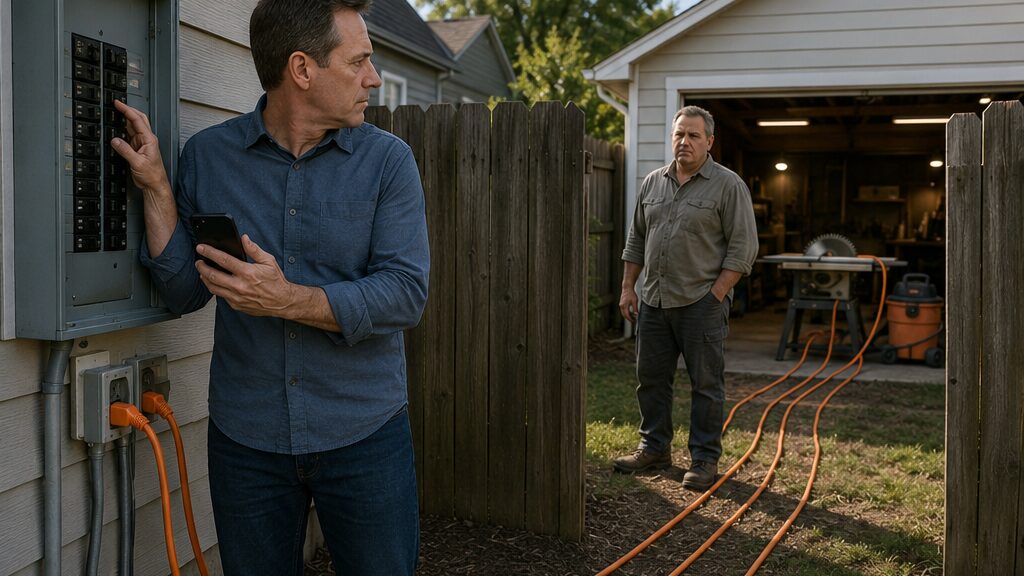
Michael Carter had one hand on the weatherproof cover of his outdoor outlet when he realized something was already plugged into it.
A thick orange extension cord disappeared beneath the narrow strip of shrubs between his house and the wooden fence.
He stared at it for several seconds.
The cord was not his.
Michael crouched and touched the plug, as though the plastic might somehow explain itself. It was seated firmly in the lower receptacle. The outlet cover had been bent upward to accommodate it.
From somewhere beyond the fence came the rising whine of a power tool.
Michael straightened.
The sound stopped.
Then started again.
He had come outside that Saturday morning intending to plug in a small electric trimmer. For the last two weekends he had postponed cutting back the shrubs along the side yard, and now they were beginning to brush against the siding.
Instead, he found himself following the orange cord toward the rear of the house.
It slipped behind a downspout, crossed a patch of mulch, then disappeared beneath the bottom edge of the fence.
Michael stopped.
He knew where that fence led.
Raymond Green’s detached garage sat less than twenty feet beyond it.
Michael pulled out his phone and took a photograph.
His first instinct was to yank the cord free.
His second was the one he trusted more.
Find out what this is first.
He stepped around the corner toward the backyard. Near the exterior electrical panel, another orange cord ran from a second outlet. This one had been tucked along the foundation behind a row of plastic edging.
Michael frowned.
He followed it.
At the fence, it vanished through a narrow gap where one board had warped away from the post.
Two cords.
He walked farther.
A third came from an outlet near the patio.
Then he found a fourth.
For a moment he simply stood there, phone hanging at his side.
Four bright orange lines seemed to point toward the same answer.
He photographed each outlet, then photographed the cords where they crossed his yard. He took a wider picture showing the fence and Raymond’s garage roof beyond it.
The power tool next door started again.
This time Michael recognized the sound as a saw.
He walked to the fence and looked through the gap.
Raymond’s garage door was open. Inside, Raymond stood over a workbench. Sawdust hung in the light. A large saw sat near the center of the garage, and orange cords snaked across the concrete floor.
Michael could not see exactly where all of them connected.
He did not need to.
The saw screamed through another cut.
Michael stepped back from the fence.
For months his electric bill had bothered him.
Not enough to make him call anyone. Not enough to make him investigate. Just enough to irritate him every time the statement arrived.
He had blamed the air conditioner in summer, then the old refrigerator in the garage, then rate increases. During the previous winter he had told himself the electric space heater in his home office must have been responsible.
Every explanation had been reasonable enough to let him stop thinking about it.
That was one of Michael’s talents.
He could turn almost anything into something that did not need to be discussed.
His daughter Emily had once told him that he could find a polite reason to ignore a fire alarm.
He had laughed.
Standing beside the four orange cords, he no longer found the habit amusing.
Michael went inside and opened his utility account on his laptop.
The latest bill appeared first.
He clicked backward.
June.
May.
April.
March.
The amounts varied, but certain months stood out. He opened the usage graph and changed the display from monthly to daily.
Small bars filled the screen.
Michael leaned closer.
The previous Saturday had a visible jump.
So had the Saturday before that.
He scrolled farther back.
Another weekend spike.
Then another.
His stomach tightened.
He pulled a notebook from the kitchen drawer and began writing dates.
The saw outside started again.
Michael looked toward the window.
He could march next door right now.
He could hold up his phone, point toward the cords, and ask Raymond what he thought he was doing.
Part of him wanted exactly that.
Another part remembered every fence conversation they had had since Michael moved into the house three years earlier.
Raymond borrowed a ladder once and returned it the same afternoon.
Michael collected a package for Raymond during a trip.
They waved. They talked about lawn care. They complained about the HOA landscaping contractor trimming too aggressively near the entrance.
Nothing about their relationship had ever suggested that Raymond believed Michael’s electrical panel was available for community use.
Michael returned to the side yard.
He unplugged nothing.
Instead, he checked each cord again.
One ran toward the front section of Raymond’s property. Another appeared to serve the garage. The other two vanished behind the fence where Michael could not see them.
He photographed the plug faces.
Then the outlet covers.
Then the meter.
He felt ridiculous doing it until Raymond’s saw started again.
The meter display changed.
Michael watched it long enough to feel the pulse of his own anger.
He went back inside and found a folder containing old utility statements. He rarely threw financial records away. The habit had seemed unnecessary to Emily, who had once accused him of maintaining paperwork for arguments he never planned to have.
Now he spread twelve months of bills across the kitchen table.
Certain weekends matched higher usage.
Not every high bill.
Not every spike.
But enough to make the orange cords feel less like something Raymond had plugged in that morning.
Michael kept going.
He found the folder from the year before.
Then the one before that.
Three years of statements filled the table.
His first year in the house showed a pattern he had never noticed because he had never placed the bills beside one another.
Weekend increases.
Irregular, but recurring.
Michael sat back.
Three years.
He had seen orange cable near the fence before.
Once while mowing, perhaps the previous summer.
He remembered lifting a cord with his shoe and assuming Raymond had been running something temporarily.
Another time he had noticed a line disappearing under the fence and thought the landscaping crew must have left it.
He had not asked.
He had not wanted to sound territorial.
He had not wanted the uncomfortable five-minute conversation.
Outside, a power tool wound down.
Michael opened his utility account again and expanded the historical chart.
Saturday.
Saturday.
Sunday.
Saturday.
The pattern did not prove what he wanted it to prove.
But it proved something he could no longer ignore.
Whatever Raymond had connected to Michael’s house had not begun that morning.
And Michael suddenly had no idea how long he had been paying for it.
Chapter 2: One Breaker Silenced the Garage Next Door
Raymond’s saw started while Michael was photographing the fourth cord.
The sound came through the fence with enough force that Michael could feel the vibration in the wooden boards.
He took one more picture.
Then Raymond’s voice came from the other side.
“You documenting my landscaping now?”
Michael looked through the gap.
Raymond had stepped out of the garage. He wore an old gray work shirt dusted with sawdust and held a pair of safety glasses in one hand.
Michael raised the phone slightly.
“I’m documenting my outlets.”
Raymond’s expression changed.
Not much.
Just enough.
Michael noticed.
He pointed toward the orange cord running beneath the fence.
“Why is your garage connected to my house?”
Raymond glanced down as if the cord were something neither of them had seen before.
“That line’s always been there.”
“That isn’t what I asked.”
Raymond walked closer.
“It’s the utility hookup.”
“My utility hookup.”
Raymond gave a short sigh.
“Michael, this was worked out years ago.”
Michael waited.
Raymond seemed to expect that sentence to end the conversation.
It did not.
“Worked out with who?”
“With the property owner.”
“I’m the property owner.”
“You are now.”
The answer irritated Michael more than a denial would have.
He slipped the phone into his pocket.
“I found four cords.”
Raymond shrugged. “Depends what I’m running.”
For a second Michael thought he had misunderstood.
“You know they’re plugged into my house?”
“Of course I know.”
“And you never thought to ask me?”
Raymond’s forehead tightened.
“I didn’t need to ask you every time I turned on a saw. The access was already approved.”
“By the HOA?”
“By the association and the guy who owned your place before you.”
Michael looked at the open garage.
Inside, the large saw sat beneath fluorescent lights. Another cord ran toward a smaller machine near the rear wall. A shop vacuum stood beside the bench.
“How much of that is running off my circuit?”
Raymond glanced backward.
“Not all of it.”
“That wasn’t the question either.”
Raymond’s tone sharpened.
“You bought a house with an existing arrangement. I didn’t create it because you moved in.”
Michael felt the familiar impulse to soften the conversation.
He could hear himself almost saying, All right, maybe there’s been a misunderstanding.
That phrase had rescued him from dozens of uncomfortable situations.
It had also left four extension cords attached to his house.
“I want them unplugged.”
Raymond shook his head.
“No.”
The word was quiet.
That made it worse.
Michael stared at him.
Raymond folded his safety glasses and tucked them into his shirt pocket.
“I’m in the middle of work. You can check the paperwork if you want. But I’m not tearing everything apart because you suddenly noticed something that’s been in place for years.”
Michael looked toward his own wall.
The electrical panel sat under a metal cover near the back corner.
He walked toward it.
Raymond followed him to the fence.
“What are you doing?”
“I’m checking which circuit it is.”
“Michael.”
Michael opened the panel.
Rows of labeled breakers faced him.
The handwritten labels were faded but legible.
Kitchen.
Garage.
Patio.
Exterior rear.
He looked toward the cords.
Raymond’s saw started again.
Apparently someone had pressed the switch inside the garage, or Raymond had left it set while stepping outside. The blade spun with a high mechanical whine.
Michael put one finger on the breaker marked Exterior rear.
Raymond saw what he was doing.
“Don’t.”
Michael turned his head.
“You’re telling me I can’t turn off a circuit in my own panel?”
“I’m telling you there’s an agreement.”
“Then show it to me.”
“I will.”
“Until you do, I’m shutting off my circuit.”
Raymond stepped closer to the fence.
“You’re going to create a bigger problem than you think.”
Michael almost smiled, though there was nothing funny in it.
“I already have a bigger problem than I thought.”
He flipped the breaker.
The click was small.
The effect was not.
The saw next door died instantly.
The fluorescent light nearest the workbench went dark.
A shop vacuum fell silent.
For the first time that morning, Raymond’s garage was quiet enough that Michael could hear birds in the trees beyond the subdivision.
Michael stared through the fence.
Three machines.
At least.
All of them connected, directly or indirectly, to one circuit on his house.
A grim satisfaction moved through him.
There.
Proof.
Not a theory.
Not a billing pattern.
A switch on Michael’s wall had just silenced Raymond’s workshop.
Raymond did not say anything for several seconds.
Then he turned and walked into his garage.
Michael thought the conversation was over.
He closed the electrical panel.
By the time he reached the patio, Raymond came through the side gate carrying a worn manila folder.
He walked straight across the grass and stopped several feet from Michael.
“You wanted paperwork.”
He opened the folder.
Inside were photocopied pages, some yellowed at the edges.
Raymond pulled one loose and held it out.
Michael did not take it immediately.
“What is it?”
“The agreement you just decided doesn’t exist.”
Michael took the page.
At the top was the name of their subdivision association.
Below it was a property description involving both lots.
Michael read more slowly.
Temporary utility access.
Rear garage improvement.
Adjacent electrical service.
The language was formal enough to make his confidence thin.
He moved to the signature section.
Raymond had signed.
An HOA board representative had signed.
Then Michael saw the third signature.
The previous owner of his house.
He knew the name.
It appeared on the closing documents Michael had signed three years earlier.
Raymond watched his face.
“I told you.”
Michael read the page again.
The words did not clearly grant permanent access.
But they clearly granted something.
“How long was this supposed to last?”
Raymond crossed his arms.
“It doesn’t give an expiration date on that page.”
“That page?”
Raymond’s jaw tightened.
“That’s the copy I have.”
Michael looked through the remaining papers.
A sketch showed the garage and fence line. Another sheet referenced utility access during improvements. One paragraph mentioned continued access according to association requirements, but the wording was vague.
Michael’s certainty from thirty seconds earlier had disappeared.
He looked back at the dead garage.
“So you believe this lets you use my electricity indefinitely.”
“I believe I was told the access remained in place.”
“By who?”
“The board at the time. And the previous owner knew about it.”
“That isn’t the same as me agreeing to it.”
“No,” Raymond said. “But you buying the house doesn’t automatically erase property arrangements either.”
It was the first thing Raymond had said that Michael could not dismiss.
Michael folded the paper carefully.
“I’m keeping the breaker off.”
Raymond’s face hardened again.
“Then I’m contacting the HOA.”
“Do that.”
“I will.”
Michael handed the paper back.
Raymond did not take it.
“Keep it,” he said. “You’re going to need it.”
He turned and walked toward his property.
Michael looked down at the signatures.
The previous owner’s name sat beneath a sentence Michael had read twice and still did not fully understand.
For three years, Michael had believed every wire, outlet, switch, and breaker attached to his house belonged entirely to him.
Now he was holding a signed document suggesting that somebody might have agreed otherwise before he ever received the keys.
Chapter 3: The Agreement Was Real, but One Sentence Was Missing
Karen Wilson did not make Michael wait until the end of the conversation.
“Raymond didn’t invent the agreement,” she said.
Michael stood in the small HOA management office with Raymond’s photocopy inside a folder under his arm.
Karen turned her monitor slightly, though not enough for him to read it from across the desk.
“We have a record of an approved temporary utility-access arrangement between the two lots.”
“Temporary,” Michael said.
“That is how the file is categorized.”
“But Raymond says it continued.”
Karen pressed her lips together.
“What Raymond says and what the association file establishes may not be the same thing.”
It was Monday morning. Michael had spent most of Sunday resisting the urge to send Raymond a written demand for three years of electricity charges.
Emily had talked him out of it.
“Find out what the paper says first,” she had told him over the phone. “You’ve been angry for one day. The document has existed for years.”
He had not enjoyed hearing that.
Now Karen opened a scanned document.
“The approval was issued during garage improvement work,” she said. “The neighboring owner granted limited electrical access while the work was underway.”
“Then why does Raymond still have it?”
“That’s what I’m trying to determine.”
Michael leaned forward.
“You’re the HOA.”
“Yes.”
“You have the agreement.”
“We have part of the agreement.”
That stopped him.
Karen opened another file.
“Our archive was digitized years ago. Some older packets were scanned as separate documents. This one contains the approval page and property sketch, but I don’t see the full closing section.”
Michael set Raymond’s copy on the desk.
“This is what he gave me.”
Karen compared the first page.
“Same document.”
“So he has the same incomplete version you do.”
“It appears so.”
Michael sat back.
On Saturday he had been certain he had discovered theft.
Then he had been certain the agreement was a bluff.
Now the HOA was telling him the agreement was genuine but incomplete.
He disliked every stage of the process in which certainty lasted less than twenty-four hours.
Karen pointed to a paragraph.
“The purpose is clear. The previous owner of your lot allowed power to be supplied temporarily during improvements to the detached garage next door.”
“What isn’t clear?”
“The termination condition.”
Michael looked at her.
“There was supposed to be one?”
“Usually, yes. Something tied to completion, inspection, a date, or written revocation. But I’m not going to tell you what this one said when I don’t have that page.”
It was the first thing anyone involved had said that Michael fully trusted.
Not because it helped him.
Because it did not pretend to.
He left the office with two printed pages and a suggestion that he check his own closing packet.
At home, the disconnected orange cord lay coiled beside the patio wall.
Michael had unplugged the ends from his outlets after switching off the breaker, but he had not pulled the cords through the fence. He did not want Raymond later claiming that Michael had damaged anything.
The coil looked different now.
On Saturday it had seemed like evidence of something obvious.
Now it looked like a question.
Michael brought a storage box from the hall closet to the kitchen table.
His closing papers were inside.
Mortgage documents.
Inspection report.
HOA disclosures.
Title paperwork.
He worked through them one folder at a time.
An hour passed.
Then he found a document titled Property Association Disclosures.
Halfway down the second page was a reference to “existing temporary utility-access accommodation affecting rear improvement area.”
Michael stopped reading.
He read it again.
He had signed the bottom.
The page had been in his possession for three years.
He sat very still.
Nothing in the phrase said Raymond could use Michael’s electricity forever.
Nothing clearly said Raymond could use it now.
But Michael could no longer tell himself he had been given no notice at all.
He remembered the closing day. Too many signatures. Too many initials. The title representative had explained assessments, architectural restrictions, common-area maintenance.
Had anyone mentioned this line?
He could not remember.
Maybe they had.
Maybe Michael had nodded because the word temporary made it sound irrelevant.
His phone rang.
Emily.
“Well?”
“The agreement exists.”
A pause.
“That sounded painful.”
“It was in my closing papers.”
“More painful.”
Michael rubbed his forehead.
“It says temporary access. It doesn’t say when temporary ends.”
“So Raymond isn’t completely making it up.”
“No.”
“But he still plugged four cords into your house without asking.”
“Yes.”
“Both things can be true.”
Michael looked through the kitchen window at the coiled orange cable.
“That’s becoming an irritating theme.”
Emily laughed once.
Then her voice softened.
“Dad, you don’t have to decide today whether he’s a thief or whether you somehow owe him electricity. Just figure out what the agreement actually says.”
After the call, Michael studied the property sketch attached to his paperwork.
A permit reference appeared near the garage notation.
He circled it.
The county records office was only fifteen minutes away.
By early afternoon, he was standing at a counter while a records clerk searched the permit number.
The clerk frowned at the screen.
“This is old enough that the attachments may not all be indexed together.”
“That seems to be happening a lot.”
The clerk glanced at him.
“You’d be surprised.”
Several minutes later, a list appeared.
Garage electrical improvement.
Inspection.
Correction.
Final approval.
Michael felt his attention sharpen.
“Can I see the completion record?”
The clerk opened the entry.
A scanned form appeared showing the garage project had passed final inspection years before Michael bought the property.
Michael leaned closer.
There was a notation at the bottom referencing an attached access authorization.
“Is that attachment available?”
The clerk clicked.
Nothing opened.
She tried again.
“It isn’t scanned under this record.”
Michael exhaled.
“Of course.”
“But there’s a cross-reference number.”
She wrote it on a slip of paper.
“This looks like the continuation sheet from the original authorization packet. It may be stored under the property record instead of the permit.”
Michael took the slip.
“Can you pull it?”
“Not from this terminal. I can request the archived file.”
“How long?”
“If it’s where it should be, we’ll know soon.”
Michael looked once more at the final inspection date.
The garage work had been completed.
That much was no longer in question.
If the electrical access existed specifically to support that project, then the date mattered.
Maybe it mattered more than anything Raymond had shown him.
Michael left the county office carrying copies of the completion record and the handwritten cross-reference number.
At home, he placed them beside the old agreement.
The orange cord remained coiled near the back door, visible through the glass.
For the first time, Michael could see the shape of the real dispute.
The permission had existed.
The project had ended.
What he still did not know was whether the first fact had ended with the second.
And somewhere in a county archive was a missing page that might answer exactly that.
Chapter 4: Three Years of Bills Did Not Prove What Michael Wanted
By Tuesday afternoon, Michael had a number written at the bottom of a yellow legal pad that made Emily stop halfway through taking off her coat.
“You’re asking him for that?”
Michael turned the pad toward himself.
“It’s what the bills show.”
“No,” she said. “It’s what you added.”
He looked back at the figure.
Three years of unusually high months, estimated weekend spikes, rate changes, fees, and what he considered a reasonable share of the unexplained usage. He had spent most of the morning building the calculation from old statements.
The total had felt satisfying when he finished it.
Now, with Emily standing across his kitchen table, it looked less solid.
“He used my electricity for years.”
“I know.”
“He admitted using it.”
“I know that too.”
“And the access was supposed to be temporary.”
“Probably.”
Michael frowned.
“Probably?”
“We still don’t have the missing page.”
“The garage work was completed.”
“That tells us the project ended. It doesn’t tell us exactly what he used after that.”
Michael tapped the stack of utility statements.
“These bills do.”
Emily pulled out a chair.
“Then show me.”
Michael opened the spreadsheet on his laptop.
He had marked every Saturday and Sunday with above-average electrical consumption. Beside some of them he had written notes from memory.
Saw noise.
Garage open.
Raymond working.
Cord visible.
Emily studied the columns.
“What about this one?”
She pointed to a Saturday in January.
“Big spike.”
“Yes.”
“Was Raymond working?”
“I don’t know.”
“You were home?”
“Probably.”
“Were you using that space heater?”
Michael leaned back.
“It was January.”
Emily looked at him.
“That’s my point.”
He closed his mouth.
She moved to another date.
“This one’s July.”
“Raymond does a lot of woodworking in summer.”
“You also have air conditioning.”
Michael disliked the direction the conversation had taken.
He had expected Emily to help him organize evidence, not dismantle it.
His phone rang before he could answer.
The utility company.
Michael had requested a usage review the previous day. He put the call on speaker.
The customer-service representative confirmed his identity, then explained that historical interval data could show total household demand in short periods but could not identify individual devices unless Michael had separate monitoring equipment.
“So you can see the spikes,” Michael said.
“Yes.”
“But you can’t tell me what caused them.”
“Not from the meter alone.”
Michael glanced at Emily.
She said nothing.
He asked, “Can you tell whether the rear exterior circuit was responsible?”
“No. Your meter records total service consumption.”
Michael rubbed the edge of the legal pad.
“What if I know someone was operating equipment during those times?”
“That could help you make an estimate,” the representative said, “but the utility can’t certify what appliance or circuit created historical usage.”
After the call ended, the kitchen felt too quiet.
Emily reached for the legal pad.
Michael kept his hand on it.
“I’m not saying Raymond didn’t cost you money,” she said.
“He did.”
“Yes. But you’re trying to make every mystery on your bill belong to him.”
Michael looked toward the glass door.
The orange cord still lay coiled outside.
“I’ve been paying for his tools.”
“Some of them. For some amount of time.”
“Four cords.”
“I saw the pictures.”
“He knew exactly what he was doing.”
Emily’s expression changed.
“That doesn’t make numbers more accurate.”
The sentence landed harder than Michael expected.
He stood and carried his coffee to the sink.
For two days, anger had been useful. It had kept him moving through records, phone calls, and permit searches. It had made him feel less foolish about the years when he had noticed higher bills and done nothing.
But now he recognized something underneath it.
If Raymond was responsible for everything, then Michael’s own silence had cost him nothing except money.
If the truth was messier, Michael had to admit that he had ignored warning signs because speaking up made him uncomfortable.
He turned from the sink.
“What would you do?”
Emily shrugged.
“Prove what you can.”
“And forget the rest?”
“I didn’t say forget it.”
The doorbell rang.
The electrician Michael had called that morning stood outside carrying a small tool case.
Michael showed him the outlets, the breaker, and photographs of the cords before anything had been unplugged.
The electrician removed the panel cover, checked the breaker rating, then walked the exterior circuit with a tester.
“You said his saw shut off when you flipped this?”
“Yes. Saw, shop vacuum, one bank of lights.”
The electrician gave him a look.
“At the same time?”
“Apparently.”
“That’s a lot to be leaning on one residential branch circuit.”
“Could it handle it?”
“It handled it until it didn’t.”
He checked the outlet near the patio and shook his head at the worn cover.
“Your question isn’t really whether he used electricity. If your pictures are accurate and his equipment died when this breaker opened, he used electricity.”
“My question is how much.”
“That’s harder.”
They returned to the kitchen.
Michael showed him photographs of Raymond’s visible equipment.
The electrician studied them.
He pointed at the table saw.
“That motor has a rated load.”
Then the shop vacuum.
“This too.”
He asked how often Michael had heard them running, for how many hours, and whether the garage lighting appeared to be connected continuously.
Michael answered carefully.
For the first time all week, he forced himself to say “I don’t know” whenever he did not know.
The electrician wrote several figures.
“If you had exact run times, you could estimate consumption pretty well. Without that, you need a range.”
“A range.”
“Minimum you can reasonably support. Maximum if all the known equipment operated for the periods you actually observed. Anything beyond that is guessing.”
Michael looked toward his spreadsheet.
Three years suddenly seemed less like evidence and more like fog.
The electrician tapped one photograph.
“But this matters.”
It showed the four orange cords crossing Michael’s property edge.
“Whatever agreement exists, electrically speaking, that’s not some invisible shared utility arrangement. That’s equipment being powered through your residential service.”
Michael felt a small piece of certainty return.
Not the certainty he had wanted.
Something narrower.
Better.
That evening, after Emily left, Michael deleted his original reimbursement total.
He did not enjoy doing it.
The number had carried the emotional weight of every bill he had resented and every time Raymond had treated the connection like it belonged to him.
Michael started again.
Only known equipment.
Only periods he could reasonably connect to Raymond’s use.
Only electricity that the exterior circuit could realistically have supplied.
When he finished, the new figure was much smaller.
It was also one he could explain without raising his voice.
He saved the file.
Then he looked at the electrician’s final note.
Based on the observed equipment and circuit capacity, the exterior line could not have caused several of the largest spikes Michael had blamed on Raymond.
Michael read that sentence twice.
Raymond had crossed a boundary.
But Michael had nearly crossed one too.
Chapter 5: Raymond Finally Explained Why He Never Unplugged
Michael went to the fence on Friday expecting to hear Raymond’s saw.
Instead, he heard nothing.
The garage door was open, but the large table saw had been pulled away from the center of the floor. Its cord was wrapped around its base.
Raymond stood near the workbench coiling another orange extension cord.
For several seconds neither man spoke.
Michael had brought a folder containing the revised usage estimate.
Raymond noticed it.
“You bringing me another bill?”
“A smaller one.”
Raymond gave a humorless laugh.
“That supposed to make me feel better?”
“No.”
Michael walked closer to the fence.
Raymond finished the coil and set it on the garage floor.
That small act changed something.
Until then, every orange cord Michael had seen pointed from his property toward Raymond’s.
Now Raymond was gathering one back.
Michael held the folder against his leg.
“The county found the final inspection date.”
Raymond’s shoulders stiffened.
“I figured they would.”
“You knew when the garage work was completed.”
“Obviously.”
“Then you knew the temporary reason for the hookup was over.”
Raymond looked down at the cord.
“The project was over.”
“That’s not an answer.”
“It’s the answer I have.”
Michael waited.
Raymond wiped his hands on his work pants.
“The old owner knew I kept using the line.”
“Did he tell you that you could?”
“He never told me I couldn’t.”
Michael almost interrupted.
Then he remembered Emily saying both things could be true.
Raymond leaned against the garage doorway.
“When they did this garage, my service wasn’t enough for everything. The temporary line was supposed to get me through the work. Afterward, I talked to your previous owner. He didn’t care if I used it occasionally.”
“Occasionally became four cords.”
“Yes.”
“And three years after I bought the house.”
Raymond’s face tightened.
“Yes.”
It was the first clean admission Michael had received.
No HOA.
No paperwork.
No argument about inherited rights.
Just yes.
Michael opened the folder.
“I recalculated the usage.”
Raymond looked suspicious.
“I had an electrician identify what the circuit could have carried. I removed the spikes I can’t connect to your equipment.”
Raymond did not reach for the pages.
“How generous.”
Michael felt the quick rise of anger.
He kept his voice flat.
“I’m trying not to charge you for things I can’t prove.”
“You can’t prove most of it.”
“I can prove your saw, vacuum, and lights were connected to my circuit last Saturday.”
“One Saturday.”
“And you just admitted you kept using the line after the project ended.”
Raymond pushed away from the doorway.
“I said the previous owner knew.”
“I’m not the previous owner.”
“I know that.”
“Did you ever ask me?”
Raymond looked away.
The silence answered before he did.
“No.”
Michael let the word sit between them.
Raymond bent and picked up the coiled cord, then set it on a shelf.
“I should have.”
Michael had imagined hearing that admission several times during the week.
In every version, it brought satisfaction.
The real thing did not.
It made Raymond look older.
Michael noticed a portable heater near the wall, an old fuse panel farther back, and a section of exposed conduit that stopped short of the newer workshop outlets.
“You said the access stayed because it was allowed,” Michael said.
Raymond rubbed the back of his neck.
“It also stayed because fixing this properly isn’t cheap.”
Michael followed his glance toward the old panel.
“How bad?”
“Electrician quoted me more than I can comfortably spend right now.”
“That doesn’t make my house your solution.”
“I know.”
“Do you?”
Raymond looked at him sharply.
“Yes, Michael. I know now.”
There was no apology in it.
Not yet.
But there was something Michael had not heard before.
Embarrassment.
Raymond walked deeper into the garage and pointed toward the panel.
“When the temporary hookup went in, I was supposed to upgrade the service after the rest of the work. Then my wife lost her job for a while. We put it off.”
Michael said nothing.
“Then your previous owner didn’t mind me using the line sometimes. Then he sold. By then it had been years.”
“And you decided not mentioning it to me was easier.”
Raymond gave him a tired look.
“Apparently we both have that habit.”
The comment irritated Michael because it was accurate.
He handed Raymond the revised estimate.
Raymond read the total.
His eyebrows rose.
“You still think I owe this?”
“Yes.”
“This is impossible.”
“It’s based on equipment and periods I can support.”
“I don’t mean the math.”
Raymond lowered the paper.
“I mean I can’t pay this and rewire the garage at the same time.”
Michael felt his sympathy stop at the edge of the sentence.
“That doesn’t mean the solution is I keep paying your bill.”
“I didn’t say that.”
“You kept doing it.”
Raymond folded the estimate.
“Because every time I thought about dealing with the service, there was something else. Furnace. Property taxes. Medical bills. Whatever.”
“And every time you chose not to deal with it, the cord stayed connected to my house.”
Raymond looked at the shelf where he had placed the coil.
“Yes.”
This time the admission carried no defense.
Michael exhaled.
“I’m not turning the circuit back on.”
“I figured.”
“And whatever the original agreement says, this ends with separate power.”
Raymond nodded once.
Then his expression hardened again.
“But I’m not agreeing to this amount.”
Michael nearly told him the original figure had been much higher.
He stopped himself.
That would turn fairness into a threat.
“Then we need the complete records.”
As if summoned by the words, Michael’s phone vibrated.
A message from Karen.
He read it.
Raymond watched his face.
“What?”
“She scheduled a records review.”
“When?”
“Next Wednesday.”
Raymond held out his hand.
Michael gave him the phone.
Karen’s message said archived HOA material and the county-referenced attachment would be reviewed together, with both homeowners invited.
Raymond handed the phone back.
“So now we get to sit in a room while the HOA pretends none of this is their problem.”
Michael looked at the garage, the old electrical panel, and the orange cord Raymond had finally coiled himself.
“Maybe part of it is their problem.”
“And the rest?”
Michael met his eyes.
“That’s what we’re going to have to stop lying to ourselves about.”
Raymond did not answer.
For the first time since the dispute began, Michael walked back to his house without feeling that one of them had won the conversation.
The next decision would be made in a room with the full file open between them.
And whatever that missing page said, neither man would be able to hide behind the same story afterward.
Chapter 6: The Missing Page Changed the Argument, Not the Damage
The missing sentence was halfway down a page neither Michael nor Raymond had ever seen.
Michael found it before Karen finished arranging the documents.
Upon final inspection and completion of the approved rear-garage improvement, temporary electrical access through the adjacent property shall terminate unless renewed by written agreement of both property owners.
Michael read it once.
Then again.
Across the HOA meeting table, Raymond stopped moving.
Karen sat between them with the archived packet spread across the table. An HOA board member occupied the chair at the far end, mostly silent.
The recovered page was cleaner than Raymond’s old photocopies. A county attachment number appeared in the upper corner. Below the termination paragraph were inspection references that matched the completion record Michael had obtained.
There was no permanent easement.
No indefinite utility right.
No automatic transfer of electrical access.
The permission had ended.
Karen broke the silence.
“The final inspection date was entered six years ago.”
Raymond looked at her.
“And the association had this page?”
“The original board had it.”
“That’s not what I asked.”
Karen folded her hands.
“Our current digital file did not.”
Raymond leaned back.
Michael expected to feel vindicated.
Instead, he was watching the argument divide itself into separate pieces.
Raymond had been wrong.
The HOA record had been incomplete.
The previous owner had apparently tolerated continued use.
Michael had ignored the disclosure reference.
None of those facts canceled the others.
Karen turned toward Michael.
“I want to be clear about the association’s role. The HOA approved temporary access during the improvement project. It did not grant permanent electrical rights between the properties.”
Michael nodded.
“So Raymond had no association authorization after final inspection.”
“Not under this document.”
Raymond gave a short laugh.
“That qualifier sounds important.”
“It is important,” Karen said. “Because I’m not going to claim the association knows every private conversation between you and the previous owner.”
Raymond looked at Michael.
“There. He knew.”
Michael kept his eyes on the document.
“The previous owner may have allowed you to keep using it.”
“He did.”
“But he didn’t sign a renewal.”
Raymond said nothing.
Karen pointed to the termination paragraph.
“And this agreement specifically required written renewal by both owners.”
The board member finally spoke.
“Do you have one?”
Raymond’s jaw worked.
“No.”
The room became quiet.
Michael looked at the photograph he had placed beside the agreement before the meeting began.
Four orange cords crossed the side yard toward Raymond’s garage.
A week earlier, the image had represented simple theft to him.
Now it represented something less clean and, in some ways, more troubling.
A temporary favor had outlived the reason for its existence. Then habit had replaced permission. Then silence had been treated as consent.
Michael slid the photograph toward the center of the table.
“This is what I found.”
Karen studied it.
“How many of these were actively in use?”
“At least three devices lost power when I opened the breaker. There were four cords connected.”
Raymond said, “I’m not disputing that.”
Michael looked at him.
A week ago, that sentence would have been impossible.
Karen turned to Raymond.
“Then the remaining issue is reimbursement and future separation.”
Raymond folded his arms.
“The amount he wants is ridiculous.”
“The amount I originally wanted was ridiculous,” Michael said.
Everyone looked at him.
He opened his folder.
“I went through three years of bills and tried to attribute every unusual increase to Raymond.”
Raymond gave a slight shake of his head.
Michael continued.
“I couldn’t.”
The board member leaned forward.
Michael placed the electrician’s estimate beside the photograph.
“The utility company can’t identify which historical devices caused household usage. The electrician can estimate what the exterior circuit could support, and I can document some periods when Raymond’s equipment was operating. That’s it.”
Raymond looked at the new total.
“This is less than what you gave me Friday.”
“Yes.”
“Why?”
“Because I found another assumption in the calculation I couldn’t support.”
Karen read the estimate.
Michael felt an uncomfortable pressure in his chest.
He could have kept the higher number.
Raymond had taken his power without permission.
The missing page proved the formal right had ended years ago.
Michael could have used that certainty to make every disputed dollar feel deserved.
Instead, he said, “I’m not charging you for electricity I can’t honestly connect to your use.”
Raymond stared at him.
For once there was no quick defense.
Karen placed the agreement flat on the table.
“The association can confirm the temporary authorization ended. It can also correct the property file so future owners aren’t given an incomplete record.”
Michael looked at her.
“How did this page disappear?”
“We don’t know that it disappeared intentionally.”
“I didn’t ask whether it was intentional.”
Karen paused.
“When the archives were digitized, parts of older project packets were scanned separately. This termination page was attached to the permit completion record rather than the HOA approval record.”
“So anyone checking the HOA file would have seen only half the arrangement.”
“Yes.”
Raymond leaned forward.
“That’s what I’ve been saying. I checked the file years ago. The page I had didn’t show an end date.”
Karen’s expression remained controlled.
“But you knew the garage project was finished.”
Raymond looked down.
“Yes.”
“And you knew Michael had never personally agreed to continued use.”
Another pause.
“Yes.”
Michael watched Raymond answer.
This was the part no missing document could solve for him.
Raymond had not forged anything.
He had not secretly altered the HOA records.
He had simply found ambiguity convenient and stopped asking questions that might remove it.
Michael understood that impulse better than he wanted to.
He had done the opposite version of the same thing.
He had seen strange bills and occasional cords and chosen not to ask because the answer might require conflict.
Karen closed the archive folder.
“So where does this go from here?”
Raymond nodded toward the estimate.
“I can’t pay that all at once and upgrade the garage.”
Michael had expected the objection.
He removed a single sheet from his folder.
“I have three terms.”
Raymond’s expression tightened.
“Of course you do.”
“First, no more connection to my electrical service. Not temporary. Not while you wait for an electrician. Nothing.”
Raymond did not object.
“Second, you get independent service to the garage or stop using equipment your current service can’t safely support.”
“That’s my property.”
“Yes. Which is why the solution stays on your property.”
The board member looked down, hiding what might have been approval.
Michael continued.
“Third, reimbursement based on this estimate. Not my original number. This one.”
Raymond tapped the page.
“And if I can’t pay it immediately?”
“We make a schedule.”
Raymond looked surprised.
Michael was a little surprised himself.
“I’m not asking you to pretend nothing happened,” Michael said. “And I’m not pretending the HOA file gave you permanent rights. It didn’t.”
Raymond leaned back.
“But you’re not asking for three years of every high bill anymore.”
“No.”
“Why?”
Michael thought about the answer.
Because Emily had stopped him.
Because the utility data had contradicted him.
Because being right about the boundary did not make him right about everything.
Finally he said, “Because I want the amount you owe me. Not the amount I’m angry enough to blame on you.”
Raymond looked down at the photograph of the cords.
His hand rested near the missing page.
For several seconds he said nothing.
Then he pulled Michael’s three-term sheet toward himself.
“I need to talk to an electrician.”
“That’s fine.”
“And look at what I can pay monthly.”
“That’s fine too.”
Raymond raised his eyes.
“I’m not saying yes yet.”
Michael nodded.
“I know.”
But Raymond did not push the paper back.
He folded it once and placed it inside his own folder.
The permanent-access argument was over.
The larger question was not.
Raymond would now have to decide whether giving up the convenience, paying for what could be proven, and repairing his garage service was worth more to him than continuing a fight he could no longer justify with the HOA agreement.
Michael watched him leave the meeting carrying the three terms.
For the first time, the next move belonged entirely to Raymond.
Chapter 7: The Last Cord Came Back Across the Fence
The electrician’s truck turned into Raymond’s driveway at eight twelve on Monday morning.
Michael saw it through the kitchen window and stood so quickly his chair scraped the floor.
For nearly three weeks, nothing visible had changed between the two houses. Raymond had kept the orange cords disconnected. Michael had kept the rear exterior breaker off except when he needed the patio outlet himself. They exchanged occasional nods across the yards, but neither man mentioned the reimbursement schedule or the electrical work.
The three-term agreement had been signed.
The first payment had cleared.
Still, Michael had learned that a signed page and an actual change were different things.
Now a white service truck sat beside Raymond’s garage, and an electrician was unloading conduit.
Michael carried his coffee outside.
Raymond was standing near the garage door with both hands in his jacket pockets.
He noticed Michael immediately.
“They’re doing the service upgrade today.”
Michael looked toward the equipment.
“I figured.”
Raymond glanced toward the fence.
“You want to see where they’re separating everything?”
Michael hesitated.
Three weeks earlier, he would have crossed the yard without waiting to be invited.
Now he walked to the side gate.
Raymond opened it.
Inside the garage, the old arrangement looked even more improvised than Michael remembered. An aging panel served the original circuits. Newer workshop outlets had been added in stages. A section of conduit ended near the wall where the temporary feed had once supplemented Raymond’s available power.
The electrician pointed toward the equipment.
“We’ll move the workshop loads onto the upgraded service. The old external feed won’t be needed.”
Michael nodded.
Raymond said, “Show him the cord.”
The electrician looked puzzled.
Raymond reached behind the workbench.
He pulled out one of the orange extension cords.
Michael recognized it immediately.
There was a dark smear near one connector and a flattened section where it had once passed beneath the fence.
Raymond held it in both hands.
“This one was still routed through the gap,” he said.
Michael looked toward the fence.
“I thought they were all back.”
“So did I.”
The cord was unplugged. It had been unplugged since that first Saturday. But part of it remained threaded through the fence, one end on each property.
Raymond walked outside with it.
Michael followed.
At the narrow gap between two boards, Raymond pulled.
The cord resisted.
He changed the angle and pulled again.
Several feet of orange cable slid through the opening and dropped into Raymond’s grass.
Then more.
And more.
Michael watched the last loop cross the property line.
There was no dramatic snap, no argument, no official standing nearby.
Just rubber dragging over wood.
Raymond gathered the cord into a loose coil and placed it beside his garage.
For the first time since Michael had discovered the connection, every inch of it was on Raymond’s property.
Raymond wiped his palms on his jeans.
“That’s the last one.”
Michael looked at the empty gap.
“Good.”
The electrician spent most of the morning working.
Michael tried not to watch.
He answered emails in his home office, carried laundry downstairs, and started lunch. Yet every unfamiliar sound from the garage drew his attention toward the window.
Shortly after noon, his phone buzzed.
A payment notification.
Raymond’s second reimbursement installment had arrived.
The amount was exactly what they had agreed.
No message accompanied it.
Michael stared at the screen longer than necessary.
A few weeks earlier, he had imagined reimbursement as the moment that would make the whole thing feel corrected.
Instead, the payment felt ordinary.
That surprised him.
Money could return.
The months of quiet irritation could not.
Neither could the fact that Raymond had knowingly used an arrangement that no longer belonged to him.
But Michael also knew something else could not be undone: the years when he had noticed clues and chosen not to ask questions.
By midafternoon, the electrician knocked on Michael’s back door.
“Raymond asked if you’d come over.”
Michael followed him to the garage.
A new service panel had been installed. Fresh conduit ran cleanly along the wall. The large saw, shop vacuum, lights, and workshop outlets were now connected to Raymond’s own service.
The electrician gestured toward the side wall.
“There’s no electrical connection between the properties anymore.”
Raymond stood a few feet away.
“Can we check your side too?”
Michael looked at him.
“You want me to?”
“I’d rather you know.”
They walked together to Michael’s exterior panel.
Michael opened it.
The breaker marked Exterior rear remained off.
The electrician tested the outlets, checked the old path, then confirmed what he had already said.
Nothing on Raymond’s property depended on Michael’s circuit.
Raymond nodded toward the breaker.
“You can turn it back on.”
Michael put his thumb against the switch.
For a brief second, he remembered the first time he had touched it with Raymond standing on the other side of the fence telling him not to.
Then he pushed the breaker upward.
Click.
The patio outlet came alive.
Nothing happened in Raymond’s garage.
No saw stopped.
No light flickered.
No machine depended on Michael’s wall anymore.
Raymond gave a quiet breath.
“That’s how it should’ve been.”
Michael closed the panel.
“Yes.”
The electrician packed his tester and headed back toward the garage.
Raymond remained beside the fence.
“I owe you an apology.”
Michael looked at him.
Raymond did not rush.
“I knew the original project was over. I knew you hadn’t personally agreed to the hookup.”
Michael said nothing.
“I told myself the old owner had allowed it and the HOA file didn’t say it ended. Both things were convenient.”
“They were.”
Raymond nodded.
“When you moved in, I should have asked.”
“Yes.”
“And when I added more equipment, I definitely should have asked.”
Michael almost smiled.
“That would’ve been a useful time.”
Raymond gave a short, embarrassed laugh.
Then his expression settled again.
“I’m not asking you to say I didn’t know better.”
Michael appreciated that more than he expected.
Raymond continued.
“I knew I was stretching it. I just didn’t want to pay for the upgrade, and after enough time passed, it started feeling normal.”
Michael looked through the fence toward the place where the cords had once crossed.
“That happens.”
Raymond glanced at him.
Michael understood the question in the look.
He added, “Doesn’t make it right.”
“No.”
They stood quietly.
A car passed at the end of the street. Somewhere farther down the block, a lawn mower started.
Raymond put his hands into his pockets.
“For what it’s worth, I was angry when you shut the breaker off because I thought you were trying to embarrass me.”
“I wasn’t.”
“I know that now.”
Michael looked at him.
“I was angry because I felt stupid.”
Raymond raised an eyebrow.
“For not noticing?”
“For noticing and not asking.”
That seemed to surprise him.
Michael leaned against the fence post.
“I saw cords before. I saw strange bills. I kept deciding there was probably an explanation because I didn’t want to be the guy starting trouble with the neighbor.”
Raymond looked down.
“And I kept deciding your silence meant permission.”
“There’s the problem.”
Raymond nodded.
Neither man apologized for the other.
Neither pretended the situation had been a harmless misunderstanding.
But something had shifted.
The boundary between them had stopped being something implied.
It had become something spoken.
Later that evening, Michael walked along the side of his house with the same small electric trimmer he had intended to use on the morning this started.
He reached the exterior outlet.
For a moment he looked at the weatherproof cover.
Then he opened it.
The receptacle was empty.
Michael plugged in his own cord.
Before starting the trimmer, he glanced toward Raymond’s garage.
The lights were on.
A few seconds later, the table saw started.
It ran steadily.
Michael looked at his electrical meter.
Nothing changed except the ordinary load of his own house.
He smiled despite himself.
Then he trimmed the shrubs.
When he finished, he unplugged his cord and wound it carefully around his hand.
Near the fence, the warped board still held the narrow gap where Raymond’s cables had passed for years.
Michael considered fixing it immediately.
Instead, he left it.
The opening did not bother him anymore.
A gap was not permission.
Silence was not permission either.
Those were things people had to decide together.
Michael returned to the outlet and closed the weatherproof cover until it clicked.
The breaker remained on.
The power was available.
But this time, it was available only where it belonged.
The story has ended.