She Poured Champagne on His Muddy Farm Truck, Then Learned Why Twelve Acres Could Change Everything
Chapter 1: Champagne Running Down a Muddy Hood
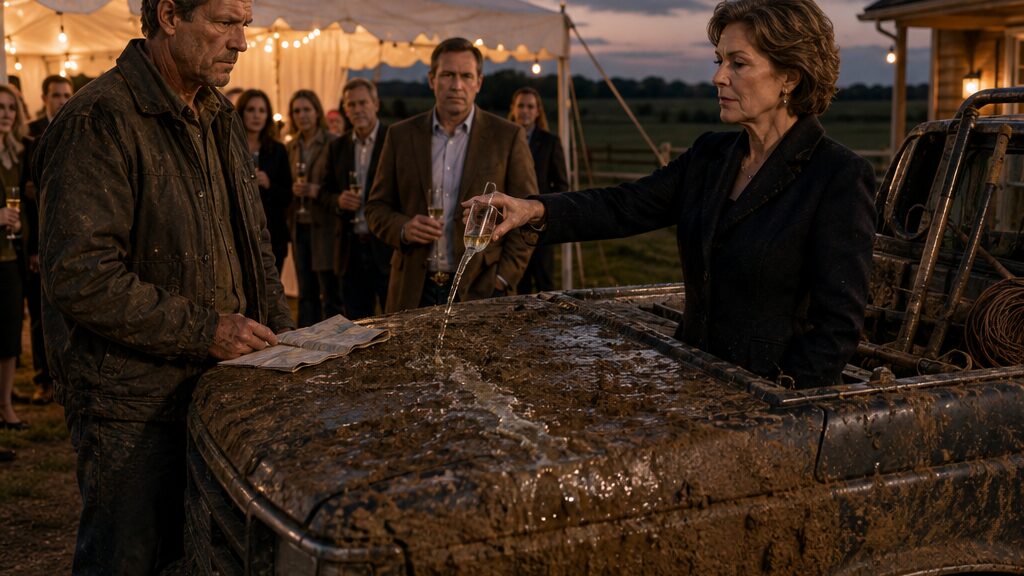
The champagne hit Anthony Hill’s truck hard enough to splash his boots.
For a second, nobody under the white event tent moved.
A pale stream ran across the hood, cutting clean paths through dried brown mud before spilling over the grille. Anthony watched bubbles collect in the grit beside a coil of fencing wire and the handle of a post driver resting in the bed.
Sharon Moore lowered the empty bottle.
“There,” she said. “At least something around here got washed.”
A few people near the entrance gave uncertain laughs.
Anthony did not.
He had spent most of the afternoon waist-deep in a drainage cut below the north pasture, resetting two fence posts after spring runoff had loosened them. He had changed nothing except his gloves. His brown work jacket still held a dark streak where wet soil had dried against one shoulder.
He looked past Sharon toward the lighted tent.
White tablecloths. Glassware. A string quartet near the clubhouse wall. Men in jackets and women in formal dresses talking beneath strands of warm bulbs.
Then he looked back at his truck.
“You poured that on purpose,” he said.
Sharon smiled as though he had finally understood a simple instruction.
“You were told contractor parking was behind the maintenance shed.”
“I wasn’t told that.”
“The attendant spoke to you.”
“He told me deliveries went around back.”
“Exactly.”
Anthony reached into the open passenger window and took out a folded cream envelope. The paper had picked up a faint thumbprint of dirt at one corner.
“I’m not making a delivery.”
Sharon’s expression changed only slightly.
Behind her, the gala attendant who had stopped Anthony twenty minutes earlier shifted his weight. He had been polite for the first five seconds, then amused when Anthony said he was attending.
The invitation had come addressed to Anthony Hill, Parcel Holder.
The association had mailed one to every owner connected to Ridge Line’s membership rolls.
The attendant had looked at Anthony’s boots and truck and said, “You sure you don’t want service entrance?”
Anthony had shown him the envelope.
The man had glanced at it but not opened the gate.
Now Sharon held out her hand.
Anthony gave her the invitation.
She read it once.
“This was a mailing error.”
“My name seems right.”
“It went to parcel owners.”
“That’s what I am.”
Sharon gave a short laugh.
“Mr. Hill, these people paid good money to be here tonight.”
Anthony glanced beneath the tent.
“I did too.”
“That isn’t what I mean.”
He knew exactly what she meant.
He folded the invitation and returned it to his jacket.
Sharon stepped closer.
“You smell like diesel and ditch water.”
“Mostly ditch water.”
Her mouth tightened.
“This is our annual capital fundraiser. We have donors here, contractors, county people, families who have invested real money into this community. I’m not letting someone come straight out of a field and turn the entrance into a farmyard.”
Anthony’s hand rested against the hood.
Cold champagne slid under his fingers.
He thought of leaving.
It would have been easy.
His father had hated public arguments. A man who needed an audience, he used to say, usually needed something besides the truth.
Anthony had carried that sentence for years.
Sometimes too far.
“I’ll move the truck,” Anthony said.
“Good.”
“But I’m staying.”
Sharon’s eyes sharpened.
“No.”
The attendant took one step toward them.
Anthony noticed it.
So did Sharon.
“I can have you removed,” she said.
Anthony folded his arms.
“On what basis?”
“This is a private association event.”
“To which I was invited.”
“By mistake.”
“You’ve said that.”
“Then stop making this difficult.”
Anthony looked past her toward the clubhouse.
The building sat on a limestone rise that had once been part of his grandfather’s pasture. The first version had been a simple timber pavilion. Thirty years of additions had turned it into a polished meeting hall with a covered terrace, catering kitchen, and stone entrance.
Beyond it, twelve acres rolled down toward Anthony’s hayfield.
Most people at the gala knew the place as association property.
It was not.
Anthony had never felt the need to correct them.
Until now.
Sharon saw him looking at the building.
“If you have a complaint about an invoice, submit it Monday.”
“I don’t have an invoice complaint.”
“Then what do you want?”
He rubbed his thumb along the edge of the folded paper in his pocket.
One question would be enough.
“Who’s handling the spring land-lease renewal?”
The change in Sharon’s face was small, but immediate.
Her chin lifted.
“What?”
“The lease.”
“I heard you.”
“Who’s handling it?”
One of the nearby conversations stopped.
Sharon glanced toward the tent before answering.
“That is board business.”
Anthony nodded.
“Then you know which lease I mean.”
“I know every agreement connected to this association.”
“Good.”
She crossed her arms.
“The clubhouse land is held through an old family trust. It has been for decades. We deal through counsel.”
“Which counsel?”
Her irritation returned.
“You’re standing here covered in mud interrogating me about documents you clearly don’t understand.”
Anthony said nothing.
Sharon continued, louder now.
“The trust is practically dormant. Nobody from that family has involved themselves in Ridge Line operations for years.”
“Is that what the board believes?”
“It’s what the records show.”
“No,” Anthony said. “It’s what nobody bothered to question.”
The attendant looked from Sharon to Anthony.
Inside the tent, someone turned down the microphone as a speaker finished welcoming donors.
Sharon’s voice dropped.
“If this is some attempt to embarrass me because I asked you to move your vehicle—”
“You poured a bottle on it.”
“You parked it at the front entrance.”
“That doesn’t answer my question.”
Her cheeks colored.
“You’re not entitled to answers about private association negotiations.”
Anthony looked down at the streaks of champagne drying through the mud.
Then he pulled a worn folded parcel map from his inside pocket.
The paper was soft at the creases from years of being opened on truck hoods and kitchen tables.
A wet drop from his sleeve hit one corner.
He spread it across the hood.
Sharon stared at it.
“What is that?”
“A map.”
“I can see that.”
Anthony put one finger on the clubhouse.
Then he traced the access lane, the pasture strip, and the lower drainage corridor.
“Twelve acres.”
Sharon looked at him with open contempt now.
“You think carrying an old map makes you part of a land trust?”
“No.”
“Then stop wasting my time.”
Anthony folded the map slowly.
“I asked because the renewal papers should’ve come to me.”
Silence settled between them.
Sharon’s smile disappeared.
Anthony slipped the parcel map back into his jacket.
“The lease ends in less than five months,” he said. “If your board intends to keep using those twelve acres, somebody should probably know who they’re negotiating with.”
Chapter 2: The Twelve Acres Beneath Their Party
“Give me the parcel number.”
Nicholas Allen said it before Sharon could answer.
He had come out from under the tent carrying his phone and a glass he no longer seemed interested in drinking from. He was broad-shouldered, nearly bald, and still wore the name badge from the association’s finance committee.
Sharon turned on him.
“Nicholas.”
He ignored her.
“Mr. Hill. The parcel number.”
Anthony studied him.
“You’re the treasurer.”
Nicholas nodded.
“Then you’ve seen the lease.”
“I’ve seen the payment schedule.”
“Not the same thing.”
“No.”
That answer interested Anthony more than anything Sharon had said.
He gave Nicholas the number.
Nicholas typed it into his phone.
Sharon stepped closer.
“This is absurd. County mapping won’t establish contractual authority.”
“No,” Anthony said. “But it’ll tell him where he’s standing.”
Nicholas stopped typing.
His eyes moved across the screen.
Then toward the clubhouse.
Then back to Anthony.
“What name was your father?”
Sharon stared at him.
Anthony answered.
Nicholas typed again.
His mouth tightened.
“That doesn’t prove he controls the trust,” Sharon said.
Nicholas lowered the phone.
“It proves the Hill family owns the parent parcel.”
A few people close enough to hear went quiet.
Anthony disliked that immediately.
He had not come to stage a revelation.
He had come because the annual invitation had arrived while the renewal correspondence had not.
That contradiction had bothered him enough to attend.
Nothing more.
At least, that was what he had told himself.
Sharon looked toward the audience gathering around them.
“This conversation is over.”
Anthony nodded toward the map in his pocket.
“Works for me.”
He turned toward the truck.
“You can’t just make a claim like that and leave,” she said.
Anthony looked back.
“You wanted me gone.”
Nicholas nearly smiled, but stopped himself.
Sharon did not.
“I want documentation.”
“You’ll get it through counsel.”
“Tonight.”
“No.”
Her voice sharpened.
“Then I’m supposed to believe that after thirty years some muddy farmer arrives at our fundraiser and suddenly announces he owns the land?”
Anthony’s expression hardened.
“Careful.”
“With what?”
“With deciding what makes somebody believable.”
That silenced her.
He got into the truck.
The driver’s seat still held fine gray dust from the feed road. His gloves sat on the floorboard. The windshield reflected the strings of gala lights.
Nicholas came to the open window.
“Can I call you tomorrow?”
Anthony looked at him.
“About what?”
“The lease.”
“You should already know about the lease.”
Nicholas glanced back at Sharon.
“That’s becoming clear.”
Anthony drove home.
The next morning, the truck sat outside his farmhouse office with dried champagne trapped beneath a new crust of dust.
He left it there.
At nine-thirty, Nicholas arrived.
No suit this time.
Just jeans, a button-down shirt, and a legal pad tucked under one arm.
Anthony opened the side door of the old farmhouse office.
“You bring Sharon?”
“No.”
“Her attorney?”
“No.”
“Then come in.”
The room smelled faintly of coffee, paper, and machine oil from the adjoining workshop.
Anthony placed a file on the desk.
Nicholas sat opposite him.
Inside were copies of the original lease, two renewal amendments, county maps, tax records, and correspondence dating back to Anthony’s father.
Nicholas read in silence.
After several minutes, he stopped on the current amendment.
“This expires March thirty-first.”
“Yes.”
“We’ve been operating as though it automatically renews.”
“It doesn’t.”
Nicholas looked up.
“Sharon said counsel had everything in hand.”
“Maybe counsel has something. They haven’t contacted me.”
“You’re the trustee?”
“Current manager and authorized signatory.”
Nicholas leaned back.
“You could have said that last night.”
Anthony looked through the window at his truck.
“I could’ve said a lot of things.”
Nicholas followed his gaze.
“You wanted her to make the mistake.”
“No.”
“Come on.”
Anthony looked at him.
“I wanted to see whether she’d ask one question before deciding what I was.”
Nicholas lowered his eyes.
“That fair?”
“No,” Anthony said. “Probably not.”
The answer surprised him as much as Nicholas.
His father’s rule returned to him.
Never use land to make a neighbor feel small.
Anthony had obeyed it so completely that he had turned noninvolvement into a virtue.
Yet he had known for months that Ridge Line’s board had become more aggressive.
Not details.
Enough.
Nicholas flipped to the parcel map.
“So all of this?”
Anthony pointed.
“Clubhouse footprint. Main entrance. Lower gravel lane. Pavilion field. Drainage strip.”
“And the twelve acres.”
“Yes.”
Nicholas rubbed his forehead.
“If you don’t renew, the association loses legal use of the entrance.”
“Not exactly. There are temporary access provisions.”
“For how long?”
“Long enough to keep anyone from getting stranded. Not long enough to run this place as if nothing changed.”
Nicholas looked toward the window.
“You know what everyone thinks you’re going to do.”
Anthony did.
Refuse renewal.
Lock the gate.
Make Sharon beg.
The idea had already started circulating before he left the fundraiser. He had seen it in the way strangers looked at him when the county parcel search confirmed his family name.
Justice had become entertainment before he reached his truck.
“I’m not doing anything today,” he said.
Nicholas exhaled.
“That might be worse.”
“For Sharon?”
“For all of us.”
Anthony looked at him.
Nicholas tapped the lease.
“Five months is nothing.”
“Then the board should’ve noticed sooner.”
“That’s fair.”
“No,” Anthony said. “It’s factual.”
Nicholas closed the file.
“Those aren’t always the same thing.”
After he left, Anthony remained at the desk.
Around noon he heard tires on gravel.
Susan Jackson stepped out of an aging pickup and carried a thick blue folder against her chest.
Anthony knew her enough to wave at the feed store.
Her husband had once helped Anthony’s father bring in hay before a storm.
Susan entered without smiling.
“I heard about last night.”
Anthony gestured toward a chair.
She stayed standing.
“You going to throw them off the land?”
“No.”
“Going to renew?”
“I haven’t decided.”
She nodded once, as if that was the answer she expected.
Then she put the blue folder on his desk.
It landed harder than its size suggested.
“What’s this?”
“Three years.”
Anthony opened it.
Assessment letters.
Penalty notices.
Copies of checks.
Photographs of standing water near her hayfield gate.
A lawyer’s letter concerning access charges.
Anthony turned another page.
Then stopped.
He had seen that form before.
Not Susan’s copy.
Another copy.
His own.
Susan noticed.
“You recognize it.”
Anthony did not answer.
She looked toward the file cabinet behind him.
“You’ve got these too, don’t you?”
The room suddenly felt smaller.
Anthony closed the blue folder.
Susan put both hands on the desk.
“If you’ve been keeping their notices all this time, Anthony, I want to know why.”
Chapter 3: The Notices He Filed Away
Susan did not wait for permission.
She crossed the office, pulled open the bottom drawer of Anthony’s metal file cabinet, and stopped.
Inside sat three thick folders marked only by year.
Anthony stood behind her.
“You could’ve asked.”
“I did.”
She lifted the first folder.
“You didn’t answer.”
Mud had dried along one corner of the cardboard from the day Anthony had carried the box in from his truck during a rainstorm.
Susan opened it on the desk.
The first notice concerned an access-road fee.
The second involved pasture drainage.
The third was a copy of the same penalty form she had brought.
Her jaw tightened.
“How many?”
“Notices?”
“People.”
“I don’t know.”
“That’s not an answer.”
Anthony pulled out his chair but did not sit.
“I started keeping copies because some of their requirements affected the lease acreage.”
“Three years ago.”
“Yes.”
“And you never thought to tell anybody?”
“I wasn’t on their board.”
Susan stared at him.
“You owned the road under their tires.”
“Part of it.”
“Oh, good. Then never mind.”
Anthony let the sarcasm pass.
She pulled another document free.
“This one is mine.”
“I know.”
“My husband had been dead six months.”
Anthony looked at the date.
“I remember.”
“No, you remember the funeral. You didn’t know what came after.”
She slid the paper toward him.
“The board said my culvert wasn’t compliant. They charged for inspection, then a correction fee, then an access penalty because the contractor couldn’t get through while the lane was flooded.”
Anthony read the amounts.
“You disputed this?”
“Three times.”
“What happened?”
“They reduced one fee and added another.”
He looked up.
Susan laughed once without humor.
“That sound familiar?”
Anthony turned toward the file cabinet.
It did.
Not her particular numbers.
The pattern.
He had seen late charges stacked on inspection costs. Repair deadlines shorter than contractor availability. Administrative fees appearing after owners questioned original assessments.
Each individual notice had looked irritating.
Together they looked deliberate.
Susan watched him understand.
“You knew enough to save them.”
“I knew enough to be concerned.”
“But not enough to say anything.”
Anthony’s jaw tightened.
“What exactly would you have had me say?”
“How about, ‘The land under part of this association belongs to my family, and the board may want to stop treating every small owner like an account to squeeze’?”
“That would’ve helped?”
“It would’ve made them listen.”
“You don’t know that.”
“No. You know what I do know?”
She tapped the desk.
“They listened to you Saturday night.”
Anthony looked away.
The words landed harder because they were true.
Susan’s anger softened only slightly.
“I’m not asking you to save me.”
“I know.”
“Do you?”
She picked up the blue folder.
“Because everybody’s talking like you’re about to ride in and fix Ridge Line.”
“I’m not.”
“Good.”
She slid out another notice.
“This is what I want fixed.”
Anthony read it.
A charge for emergency gravel access after flooding.
He remembered the storm.
His own lower pasture had taken water that week.
The association’s drainage ditch had backed up against the leased strip, and Anthony had spent most of one night clearing branches from a culvert.
He had never billed them.
His father would not have.
Susan pointed to the page.
“They charged me for using the alternate farm track while their road was underwater.”
Anthony frowned.
“That track’s mine.”
“I know that now.”
He looked at her.
“They can’t charge association access fees for that.”
“They did.”
“Did you tell them?”
“They told me the route was under their management.”
“It isn’t.”
Susan gave him a long look.
“And who would have known that?”
Anthony lowered the paper.
He had no answer that did not indict him.
They spent the next two hours sorting documents.
Anthony brought out every folder.
Susan brought out hers.
They arranged notices by category across the desk: road maintenance, drainage, appearance violations near rural lots, gate-access fees, legal costs, administrative penalties.
The longer the rows became, the less random they looked.
Some charges were plainly legitimate.
Gravel had to be purchased.
Culverts had to be cleared.
Insurance had risen.
But the penalties layered on top of those costs told another story.
“Here,” Susan said.
Three owners had received nearly identical notices within eight weeks.
Same language.
Same short response deadline.
Same administrative fee when they objected.
Anthony ran his finger down the copies.
“Sharon signed all three.”
Susan looked at him.
“You surprised?”
“No.”
“That worries me more.”
Anthony leaned against the desk.
He had spent three years telling himself he was documenting boundaries.
That if an association notice affected the family lease, he filed it.
That if a drainage dispute crossed their acreage, he saved it.
That if the board acted foolishly, it was the members’ job to correct their own leadership.
He had called that restraint.
From Susan’s side of the desk, it looked like distance.
“What did your father think of Ridge Line?” she asked.
“He thought associations were useful until people forgot they were neighbors.”
“That sounds like him.”
“He also told me not to wave ownership around.”
Susan closed one of the folders.
“So you didn’t.”
“No.”
“Even when waving it once might have stopped something.”
Anthony rubbed a hand over his face.
“I didn’t know that.”
“You didn’t want to know.”
The words stayed in the room.
Susan gathered her papers.
At the door she stopped.
“You want the truth?”
“I think I’ve had enough for one morning.”
“You liked being outside it.”
Anthony looked at her.
She continued.
“You didn’t like Sharon. You didn’t like the board. But as long as they weren’t telling you how to run your farm, you could watch them make fools of themselves and still tell yourself you weren’t part of it.”
“That’s not fair.”
“No.”
Susan opened the door.
“It’s just factual.”
She left.
Anthony stood alone beside the desk.
For the first time since Saturday night, the champagne incident felt small.
He went outside.
The truck sat beside the shed, its hood still streaked where the liquid had cut through dried mud.
He had intended to wash it.
Instead he opened the passenger door and pulled out the mud-stained file box he had been carrying between the farmhouse and truck for months.
Inside were lease letters, drainage maps, copies of board correspondence, and handwritten notes.
One note was dated almost two years earlier.
Anthony recognized his own handwriting.
Ask board about penalty authority over farm-track access.
He had never asked.
He sat on the truck’s running board.
Across the field, the association clubhouse roof showed above a line of bare trees.
Twelve acres was not much land by farm standards.
But it was enough to place him inside a problem he had spent years standing outside.
His phone rang.
Nicholas Allen.
Anthony almost let it go to voicemail.
Then answered.
“Nicholas.”
“I need to meet you.”
“About the lease?”
A pause.
“Not exactly.”
Anthony looked at the file box.
“What then?”
“The money.”
“What money?”
“All of it.”
Anthony stood.
Nicholas lowered his voice.
“The board meeting is Wednesday. Sharon can’t know I’m talking to you before then.”
Anthony’s grip tightened around the phone.
“If you’re asking me to keep another secret, you called the wrong person.”
“I’m asking you to see numbers she hasn’t shown the membership.”
Anthony looked across the field toward Ridge Line.
“How bad?”
Another pause.
Then Nicholas said, “Bad enough that those notices on your desk might not mean what you think they mean.”
Chapter 4: The Numbers Sharon Would Not Show
The repair estimate on Nicholas Allen’s desk was higher than Ridge Line’s entire annual reserve.
Anthony read the figure twice.
Then he looked through the equipment-shed window toward the gravel lane that ran past the association property.
“That’s for one drainage section?”
Nicholas shook his head.
“Drainage, road base, two culvert replacements, and the retaining work below the clubhouse.”
Anthony turned the page.
Another estimate sat underneath.
Insurance.
Then engineering.
Then a contractor’s revised road bid.
The numbers did not look like the work of a board inventing problems to collect fees. They looked like a place that had delayed maintenance until every neglected thing had become expensive at once.
“How long have you known?” Anthony asked.
Nicholas rested both forearms on the metal desk.
“About the road? Two years.”
“The deficit.”
Nicholas hesitated.
“Long enough.”
“That’s not a number.”
“Fourteen months.”
Anthony leaned back.
Outside, a skid steer moved past the shed carrying a bucket of wet gravel. Mud dropped from its tires in thick slabs.
Fourteen months.
Long enough for the board to know exactly what it was facing while sending owners increasingly aggressive notices.
“How far short?”
Nicholas slid another sheet across the desk.
Anthony read it.
He felt some of his anger lose its clean edges.
Not disappear.
Change.
“You’re not bankrupt.”
“No.”
“You’re close to empty.”
“If nothing changes.”
Anthony studied the columns.
Membership dues covered normal operations.
They did not cover the repair backlog.
A jump in liability insurance had taken another bite. A washout on the lower lane had required emergency gravel. The clubhouse roof had needed work the previous winter.
“Why wasn’t this in the annual report?”
Nicholas gave a tired laugh.
“It was.”
Anthony looked up.
“In pieces.”
“That’s what Sharon wanted.”
“Why?”
“Because if you tell two hundred property owners that the reserve is failing, everybody asks who let it fail.”
“They should.”
“I agree now.”
“Now?”
Nicholas looked down at his hands.
“I told myself we could catch up.”
Anthony said nothing.
Nicholas continued.
“We increased assessments. Delayed cosmetic projects. Renegotiated a few contracts. Then the drainage section failed again.”
Anthony tapped one of the invoices.
“And the penalties?”
Nicholas’s face tightened.
“Some were supposed to improve collection.”
“Improve.”
“That was the language.”
“Whose?”
“Sharon’s.”
Anthony stood and walked to the window.
Beyond the equipment shed, the lower drainage corridor curved toward his pasture. He had worked that ditch himself more than once when water jumped the culvert.
He had always thought Ridge Line’s board simply preferred spending money on appearance while farmers handled the ugly parts.
That was still partly true.
But not entirely.
“What happens if they stop collecting penalties tomorrow?” Anthony asked.
Nicholas joined him at the window.
“We still have a problem.”
“How bad?”
“We could cover essential work if we cut the pavilion expansion, postpone the clubhouse interior project, and restructure reserves.”
Anthony turned.
“There’s a pavilion expansion?”
Nicholas nodded once.
Anthony stared at him.
“You’re short on road money and expanding event space.”
“It hasn’t started.”
“Why was it approved?”
“Because donors pledged toward it.”
“That isn’t the same as having money.”
“I know.”
“Does Sharon?”
Nicholas’s jaw moved.
“Yes.”
That answer told Anthony more than the documents.
He left the shed with copies of the financial summaries and drove the lower lane.
Rain from two days earlier had softened the shoulder. Near the drainage cut, his tires sank enough to throw fresh mud along both doors.
He stopped where the ditch narrowed.
Water pooled beneath a crushed section of bank.
A row of orange flags marked the proposed repair area.
Anthony stepped down.
His boots sank at the heel.
The local contractor was standing beside an excavator farther down the line.
Anthony walked over.
“How much of this is urgent?”
The contractor pointed with a gloved hand.
“That section fails again, you lose shoulder. Lose the shoulder, trucks start riding center. Then you’re rebuilding twice as much road.”
“So the estimate’s real.”
“Wish it wasn’t.”
Anthony looked toward the clubhouse roof above the trees.
“Could it have been cheaper last year?”
“Sure.”
“Two years ago?”
“Cheaper still.”
That was the problem with neglected ground.
It did not care who had the better argument.
By Wednesday evening, the Ridge Line boardroom was full.
Anthony sat in the back.
He had not planned to speak.
Sharon stood at the head table with a printed agenda and the calm posture of someone determined to make the room obey the order of her pages.
She did not look at Anthony when she began.
“We have significant infrastructure obligations this year.”
A board member asked whether reserves were sufficient.
Sharon answered smoothly.
“We are managing within a difficult but controlled environment.”
Nicholas looked down.
Anthony noticed.
Another owner asked why administrative penalties had risen.
“To encourage timely compliance,” Sharon said.
“Compliance with what?”
“Maintenance obligations.”
Anthony shifted in his chair.
Susan Jackson sat three rows ahead.
She did not turn around, but he could see her shoulders tighten.
Sharon continued.
“Without enforcement, responsible owners subsidize those who delay.”
There it was.
Not entirely false.
That made it more dangerous.
Anthony had seen the numbers.
Some people had delayed payments.
Some work had to be funded.
But Sharon was taking a real problem and using it to justify every method she had chosen.
A board member lifted a hand.
“Is the reserve under target?”
Sharon paused.
“We have temporary pressure.”
Nicholas finally looked up.
Anthony watched him.
Nicholas said nothing.
The silence irritated Anthony more than Sharon’s answer.
Then Sharon moved to the next item.
“Given infrastructure needs, I am recommending an emergency assessment before the first quarter concludes.”
The room stirred.
Susan turned now.
Her eyes found Anthony’s.
Not pleading.
Accusing.
You know.
Anthony looked toward Nicholas.
The treasurer had gone pale.
“How much?” someone asked.
Sharon named the amount.
A low murmur spread through the room.
For Susan, Anthony knew, it would be several thousand dollars.
A board member asked whether members would see the underlying repair documentation before the vote.
Sharon folded her hands.
“Relevant materials will be summarized.”
“Summarized by who?”
“The finance committee.”
Nicholas inhaled.
Anthony waited for him to speak.
He did not.
Sharon began outlining the voting timeline.
Anthony understood then why Nicholas had called him.
Not because Nicholas had suddenly become brave.
Because he wanted Anthony to carry the confrontation he had avoided himself.
The realization cooled Anthony’s anger.
He had been doing his own version of the same thing for years.
Let somebody else own the ugliness.
Sharon concluded the item.
“The emergency assessment will be presented for approval next week, before lease matters complicate the spring calendar.”
Anthony sat straighter.
Before lease matters.
She knew.
Maybe not everything, but enough.
He rose.
Several heads turned.
Sharon stopped speaking.
Anthony said, “Before you charge everybody again, you might want to tell them what the reserve actually looks like.”
Nicholas closed his eyes.
Sharon’s expression hardened.
“That is not your agenda item.”
“No.”
Anthony looked around the room.
“But apparently it’s my land underneath part of your problem.”
For the first time since the gala, Sharon did not look embarrassed.
She looked afraid.
Chapter 5: The Meeting Anthony Could No Longer Avoid
The first thing Anthony saw when he entered the meeting hall the following week was his own letter copied onto the projector screen.
LEASE RENEWAL DISCUSSIONS PAUSED.
No one had bothered to remove his name from the bottom.
Every folding chair was occupied.
People stood along the back wall.
Anthony stopped just inside the door.
Susan sat near the aisle.
Nicholas was at the board table.
Sharon stood beside the projector with one hand resting on a stack of papers.
“So,” she said, looking directly at Anthony, “perhaps Mr. Hill can explain why he has chosen to threaten the entire association.”
Anthony took off his work cap.
“I paused negotiations.”
“That is a threat.”
“No. It’s a pause.”
“To someone whose home access crosses that land, there isn’t much difference.”
A few people murmured agreement.
Anthony felt it immediately.
The gala had been simple.
One woman had humiliated one man.
This was not.
Here, every decision had edges that reached somebody else.
He walked to an empty chair at the front rather than stand.
Mud from his boots left faint marks on the floor.
Sharon noticed.
She did not comment.
That surprised him.
“What do you want?” she asked.
“Full financial disclosure before I sign anything.”
“To you?”
“To the membership.”
“That exceeds your role.”
“My role is deciding what kind of agreement I’m willing to enter.”
“Our internal governance is none of your business.”
Anthony looked at Susan.
Her face was unreadable.
“It became my business when your enforcement crossed onto Hill property.”
Sharon’s voice sharpened.
“One disputed access fee does not entitle you to supervise this association.”
“No.”
Anthony leaned forward.
“But renewing a lease without knowing whether the tenant can maintain what it uses would be stupid.”
That quieted the room.
Nicholas finally spoke.
“He’s right about that.”
Sharon turned toward him.
“You’ve made your position clear.”
“Not publicly.”
“Then perhaps now isn’t the time.”
Nicholas looked around the room.
“It should’ve been fourteen months ago.”
The room changed.
Anthony could almost feel it.
A private disagreement had become public.
Sharon’s face held still, but her fingers tightened around the papers.
One of the board members asked, “Fourteen months ago what?”
Nicholas did not answer quickly.
Anthony knew that hesitation.
He had lived inside it himself.
“The reserve fell below what I considered safe,” Nicholas said.
Someone near the wall cursed under his breath.
Sharon stepped in.
“We had projected repair needs—”
“You told us finances were stable,” another owner said.
“They were manageable.”
“Is that the same thing?”
“No,” Nicholas said.
Sharon stared at him.
Anthony saw something pass across her face.
Not merely anger.
Betrayal.
She had expected him to hold the line.
Anthony knew the feeling of someone changing sides only after safety disappeared.
He almost sympathized.
Almost.
Sharon turned back to the room.
“The roads still have to be repaired. Drainage still has to work. Insurance still has to be paid. None of that disappears because you dislike how information was presented.”
That was true.
Anthony stood.
“She’s right.”
The room went quiet again.
Susan looked at him sharply.
Sharon seemed equally surprised.
Anthony continued.
“The road needs work. I walked it with the contractor. The drainage estimate isn’t invented. Insurance didn’t get cheaper because Sharon handled this badly.”
Sharon’s shoulders eased by a fraction.
Then Anthony said, “But being right about the problem doesn’t make every way of solving it right.”
Her expression closed again.
He looked toward the members.
“I’ve spent three years receiving copies of notices that touched my family’s lease ground.”
Susan watched him without blinking.
“I filed them.”
Anthony paused.
“I didn’t do much else.”
A chair creaked somewhere behind him.
“I told myself Ridge Line was your association. Your board. Your problem.”
His mouth felt dry.
“I thought staying out of it meant I wasn’t using land ownership to push people around.”
Susan lowered her eyes.
Anthony continued.
“What it also meant was that when people got charged for routes the association didn’t own, or got squeezed by deadlines I knew didn’t match the land, I stayed quiet.”
Sharon folded her arms.
“So this is confession now?”
“No.”
Anthony looked at her.
“It’s ownership.”
The word landed between them.
“My father expected this lease to renew cooperatively,” Anthony said. “He never intended it to become permanent use with no questions asked. He also never intended our land to become a weapon.”
A man near the back asked, “Are you refusing renewal?”
Anthony did not answer immediately.
That was what everyone wanted.
A yes or no.
A villain.
A victory.
Something simple.
“I’m not signing the current terms.”
The room erupted.
Sharon raised both hands.
“There. That’s what this is about.”
Anthony waited until the noise lowered.
“If the lease expired today, temporary access provisions would keep the road open for a limited period.”
“How limited?” someone asked.
“Long enough to negotiate. Not long enough to ignore this.”
Susan stood.
“What about farm access?”
Anthony turned toward her.
“Protected temporarily.”
“Temporarily.”
“Yes.”
Her face hardened.
“My hayfield doesn’t become decorative because you and Sharon can’t agree.”
“I know.”
“Do you?”
The question echoed what she had asked him in his office.
Anthony took it without defense.
“I’m learning.”
That answer seemed to frustrate her more than an argument would have.
Sharon stepped forward.
“This is exactly why land agreements should not be subject to personal leverage.”
Anthony looked at her.
“You’re asking for another long lease while concealing financial risk.”
“I’m trying to keep this place functioning.”
“And Susan?”
Sharon’s eyes shifted.
“What about her?”
“You charged her for using my farm track during a flood.”
“That was an association-managed detour.”
“No.”
“It served association members.”
“Still mine.”
Sharon’s voice dropped.
“We were trying to keep traffic moving.”
“Then send her the gravel cost. Not a penalty.”
For the first time, Sharon had no immediate answer.
Anthony looked toward Nicholas.
“How much of the emergency assessment is required for critical repairs?”
Nicholas gave a figure.
It was substantial.
But far lower than Sharon’s proposed total.
“What’s the difference?”
Nicholas hesitated.
“Reserve rebuilding. Deferred projects.”
“What projects?”
Sharon interrupted.
“This is not appropriate.”
Anthony faced her.
“Then make it appropriate.”
“What does that mean?”
“Open the books.”
“To you?”
“To everybody.”
The room stirred again.
Anthony felt the old urge to stop talking.
He hated the attention.
Hated that every face had turned toward him.
Hated even more that part of him wanted to retreat into paperwork and let someone else finish.
He thought of the note in his own handwriting.
Ask board about penalty authority.
Two years unanswered because he had never asked.
He took a folded document from his jacket.
“I’m giving the board forty-eight hours.”
Sharon laughed once.
“You don’t issue deadlines to us.”
Anthony put the document on the table.
“I do for my signature.”
Her smile vanished.
“Within forty-eight hours, I want the full reserve history, repair obligations, planned capital projects, assessment schedules, and penalty revenue shown to the membership.”
“And if we refuse?”
Anthony looked around the hall.
At Susan.
At Nicholas.
At people who wanted roads, gates, fields, and homes to remain usable after everyone’s anger cooled.
“Then I negotiate from what I know.”
Sharon stared at the document.
“That sounds like nonrenewal.”
“Maybe.”
The word passed through the room like a cold draft.
Anthony picked up his cap.
He had not meant to frighten them.
But he understood now that avoiding pressure entirely was impossible.
The question was what pressure was for.
As he turned toward the door, Sharon spoke behind him.
“You think opening the books will make you look righteous?”
Anthony stopped.
“No.”
He looked back at her.
“I think it might make all of us look worse.”
Chapter 6: What Renewal Would Actually Cost
The books showed that Ridge Line was in trouble.
They also showed it was not doomed.
Anthony sat at his farmhouse table forty-eight hours later with Nicholas on one side and stacks of financial reports spread across every available inch of wood.
Outside, his truck waited near the porch.
That morning Anthony had cleaned the windshield because dried champagne and road grit were beginning to obscure the glass.
He had left the rest of the truck alone.
Nicholas pointed to a budget column.
“If we cancel the pavilion expansion, delay the clubhouse interior renovation, and renegotiate the landscaping contract, we can fund most of the drainage work without the full emergency assessment.”
“Most.”
“Yes.”
“What about the rest?”
“Smaller assessment. Longer payment window.”
Anthony turned a page.
“And penalties?”
Nicholas exhaled.
“If enforcement revenue drops, the gap widens.”
“Then stop budgeting penalties like income.”
“I know.”
“No. You know now.”
Nicholas accepted that.
The association attorney sat farther down the table, saying little.
Sharon had declined to attend the first review session, then arrived halfway through with a binder tucked against her side.
She had been quiet for nearly twenty minutes.
Anthony suspected that frightened her more than arguing did.
Finally she said, “You’re assuming members will accept reduced amenities.”
Anthony looked up.
“I’m assuming roads matter more than event upgrades.”
“You don’t live inside Ridge Line.”
“No.”
“That matters.”
“It does.”
Sharon opened her binder.
“Property values depend on standards.”
“So do working culverts.”
“Don’t reduce this to one ditch.”
“I’m not.”
Anthony tapped the budget.
“I’m reducing it to things you can pay for.”
Sharon’s mouth tightened.
“You think because your name is on the land you understand what keeps two hundred owners from turning on each other?”
Anthony leaned back.
“No.”
The answer interrupted her.
He continued.
“I think I understand what keeps water off a road and cattle behind a fence. You understand the people better than I do.”
Sharon looked suspicious.
“That isn’t a compliment.”
“It isn’t an insult either.”
Nicholas closed one spreadsheet.
“We can make this work.”
Sharon glanced at him.
“Under his conditions.”
“No,” Nicholas said. “Under arithmetic.”
For a moment, Anthony saw how tired she was.
Not defeated.
Tired.
The polished control from the gala had thinned. There were faint lines beneath her eyes. Her binder was filled with colored tabs and handwritten notes.
She had worked hard.
That did not erase what she had done.
But it complicated the satisfaction Anthony had once imagined feeling when she lost.
The association attorney asked, “Mr. Hill, are you prepared to state what renewal terms you’d consider?”
Anthony looked at the parcel map laid beside the financial reports.
“I’m working on them.”
Sharon gave a small, disbelieving laugh.
“You stopped our renewal without having terms?”
“I stopped the automatic version.”
“That was reckless.”
“Maybe.”
Susan’s field came to mind.
He had spent the previous afternoon walking its access route.
If the Hill lease lapsed completely, temporary rights would keep residents moving for a while.
But Susan’s hay equipment used the lower corridor in a way that was not protected as clearly as Anthony had assumed.
The discovery had unsettled him.
He looked at the association attorney.
“If this lease ends, what happens to agricultural access on the lower track after the temporary period?”
The attorney paused.
“It becomes fact-specific.”
Anthony disliked that phrase immediately.
“Meaning?”
“Some owners may have alternative easement arguments. Others may need negotiated access.”
“Susan?”
The attorney checked a page.
“Her recorded route relies significantly on the leased corridor.”
Anthony sat still.
Nicholas watched him.
Sharon did too.
“So if I refuse renewal,” Anthony said, “she gets hurt before you do.”
Sharon’s expression softened, but only slightly.
“Yes.”
He hated that she was the one saying it.
She continued.
“That’s what I’ve been trying to tell you.”
“No. You’ve been telling me everybody collapses unless I sign your lease.”
“Because uncertainty has consequences.”
“So does your enforcement.”
“I know.”
The words came quietly.
Anthony looked at her.
It was the first time he had heard her say them without qualification.
Sharon stared at the financial pages.
“I pushed too hard.”
Nicholas looked surprised.
She went on.
“I thought if collections slipped, the reserve would become impossible to rebuild. Then every owner who paid on time would be punished for the ones who didn’t.”
“That happened anyway,” Anthony said.
“Yes.”
She looked at him.
“But not because I enjoyed it.”
“I didn’t think you did.”
“Saturday night you did.”
Anthony glanced toward the window.
The truck hood was still marked with the pale trails where champagne had run through mud.
“Saturday night I didn’t know you.”
“You still don’t.”
“No.”
Sharon closed her binder.
“But you intend to strip the board’s enforcement authority.”
“I intend to limit it.”
“That board exists because somebody has to make decisions.”
“Make them.”
Anthony slid a draft page toward her.
“But no more stacking administrative penalties before an appeal is heard. No more charging for access over land the association doesn’t control. Disputed assessments get independent review.”
Sharon scanned the page.
“And full financial disclosure.”
“Yes.”
“Annual.”
“Yes.”
“Protected agricultural access.”
“Yes.”
She looked up.
“And a shorter lease.”
“Five years.”
The association attorney shifted.
“The current term is fifteen.”
“I know.”
Sharon pushed the page away.
“This makes the association dependent on your approval every five years.”
“No. It makes both sides pay attention every five years.”
“You want control.”
Anthony almost answered quickly.
Then he stopped.
Did he?
Part of him did.
Not the kind Sharon meant.
But after years of silence, control had begun to feel dangerously close to responsibility.
He folded his hands.
“I want a reason not to disappear from this again.”
Nicholas studied him.
Sharon did not.
She looked at the draft.
“I won’t sign this.”
“You’re not the only signer.”
“I’m president.”
“For now.”
Her eyes flashed.
Anthony regretted the line as soon as he said it.
It sounded like exactly the kind of public leverage his father had warned him against.
He corrected himself.
“That wasn’t necessary.”
Sharon looked at him for a long moment.
“No. It wasn’t.”
He nodded.
They sat in silence.
Then she pushed the draft back.
“I won’t agree to terms that turn every enforcement decision into an outside review.”
“Not every decision.”
“Enough of them.”
“Only disputes over penalties and access.”
“You’re dismantling authority.”
“I’m putting limits around it.”
Sharon stood.
“Same thing, from where I’m sitting.”
She gathered her binder.
Nicholas said, “Sharon.”
“No.”
She looked at Anthony.
“You want a conditional lease? Fine. Present it to the board.”
“I will.”
“Where?”
Anthony glanced through the window toward the gravel road.
The clubhouse suddenly seemed like the wrong place.
Too polished.
Too easy to mistake for the center of everything.
“At the gate.”
Sharon frowned.
“What gate?”
“The lower access gate.”
“That’s not a meeting venue.”
“It’s where the lease matters.”
The association attorney looked between them.
Anthony folded the parcel map.
“Friday morning. Eight o’clock.”
Sharon held the binder against her side.
“And if I don’t come?”
Anthony looked at her.
“Then somebody else decides whether Ridge Line wants the road to stay open.”
Chapter 7: The Gate Stayed Open Under New Terms
Anthony reached the lower access gate at seven forty-three Friday morning.
No one else was there.
He parked the truck on the shoulder where the gravel widened beside the fence. Fresh mud covered both doors from checking a low field before sunrise. The windshield was clean. The hood was not.
He unlocked the gate and swung it open.
Then he waited.
The first vehicle to arrive belonged to Nicholas.
He stepped out carrying a folder and two paper cups.
“You’re early,” Nicholas said.
“So are you.”
“I brought coffee.”
Anthony took one.
Nicholas looked at the open gate.
“That intentional?”
“Yes.”
Nicholas nodded as if that answered more than Anthony had said.
A few minutes later Susan arrived in her pickup. She parked farther back, climbed out, and looked from Anthony to the open gate.
“You inviting spectators now?”
“No.”
“You invited me.”
“You’re affected.”
“That makes me a spectator with paperwork.”
She held up a thin folder.
Anthony almost smiled.
The association attorney arrived next, followed by two board members in separate vehicles.
Sharon came last.
She drove herself.
No formal clothes this time. Dark slacks, boots suited for gravel, plain wool coat.
She got out and immediately looked at the gate.
“You opened it.”
“It wasn’t closed.”
“You know what I mean.”
Anthony did.
The gate had become larger in everyone’s imagination than it was in the fence.
He motioned toward the tailgate of his truck, where he had laid out copies of the proposed lease terms.
“No clubhouse today?”
Sharon asked.
“Thought we should stand where the agreement actually matters.”
Her eyes moved to the muddy truck.
For half a second Anthony remembered champagne running through dried dirt while people watched.
Sharon looked away first.
No apology came.
Anthony had stopped expecting one.
Nicholas opened his folder.
“Board reviewed the draft last night.”
“And?”
“One member wants fifteen years.”
“Not happening.”
“Another wants ten.”
“Also not happening.”
Sharon said, “Five years creates instability.”
Anthony faced her.
“It creates review.”
“It creates leverage.”
“Yes.”
The honesty seemed to annoy her.
“You admit it.”
“I admit a lease gives both sides leverage.”
“And you’re comfortable with that now?”
“No.”
Anthony rested one hand on the tailgate.
“That’s why the terms are written down.”
The association attorney began reviewing the document point by point.
Five-year term.
Protected agricultural access across the lower corridor.
Annual financial disclosure to membership.
Separate accounting for infrastructure reserves.
No administrative penalties charged on disputed access assessments before review.
Independent review for contested penalty cases above a set threshold.
No association charges for roads or tracks outside association control.
Critical road and drainage maintenance prioritized over discretionary capital expansion.
The attorney paused.
“The association requests language allowing emergency action without prior review.”
Anthony nodded.
“For actual emergencies.”
Sharon said, “Who decides what qualifies?”
“Immediate safety, access, drainage failure, road washout. Define it.”
“And if we disagree afterward?”
“Then review it afterward.”
She looked down at the pages.
“You make it sound simple.”
“No.”
Anthony glanced toward the ditch beyond the fence.
“I make it sound written.”
Susan shifted beside her truck.
The attorney continued.
A disputed portion of Susan’s charges would be placed into independent review, along with similar cases from the prior three years.
Not automatically erased.
Reviewed.
Susan read the clause twice.
“You added the last three years?”
Anthony nodded.
“For eligible disputes.”
“Not just mine.”
“No.”
Her mouth tightened.
Anthony could not tell whether she was relieved or disappointed that he had refused to make her an exception.
Then she said, “Good.”
Sharon folded her arms.
“And who pays for these reviews?”
“Association administration.”
“So members pay.”
“Yes.”
“That is exactly my point. Every protection costs something.”
Anthony met her eyes.
“So does getting it wrong.”
She started to answer, stopped, then looked toward Nicholas.
“What did the revised budget show?”
Nicholas opened his folder.
“With the pavilion expansion removed, clubhouse interior deferred, and landscaping contract reduced, the association can fund the critical drainage package and road base work.”
“Without the emergency assessment?”
“A smaller one.”
“How much smaller?”
Nicholas gave the figure.
Susan let out a breath.
One board member asked, “And reserve rebuilding?”
“Slower,” Nicholas said. “But sustainable if dues remain current.”
Sharon stared at him.
“You make that sound certain.”
“I don’t.”
Nicholas’s voice stayed calm.
“I’m done making uncertain things sound certain.”
Anthony looked at him.
That might have been the first useful thing Nicholas had said without needing someone else to say it first.
Sharon walked several steps away from the group.
The gravel crunched beneath her boots.
Anthony gave her room.
Eventually she turned.
“This agreement weakens the president’s office.”
“It weakens unilateral penalty authority.”
“Same result.”
“No.”
Anthony pointed toward the clubhouse roof, barely visible beyond the trees.
“You can still set budgets. Manage maintenance. Negotiate contractors. Enforce standards you actually control.”
“And every time someone objects, they run outside the board.”
“Only on defined disputes.”
“It teaches people not to respect the institution.”
Susan spoke before Anthony could.
“Respect isn’t the same as never being able to challenge it.”
Sharon looked at her.
“You owed legitimate maintenance costs.”
“I paid legitimate maintenance costs.”
“You disputed almost everything.”
“I disputed what kept changing.”
Sharon’s expression tightened.
Susan held her gaze.
“I didn’t need Anthony to rescue me. I needed somebody to stop charging me for a road he owned.”
The words settled.
Anthony felt the old discomfort rise.
Everybody looking toward him.
Everybody making the land itself sound like authority.
He stepped away from the tailgate.
“This isn’t about who owns more dirt.”
Sharon gave him a tired look.
“It became about that the minute you paused the lease.”
“You’re right.”
The answer surprised her.
Anthony continued.
“I should’ve dealt with this before it reached that point.”
Susan said nothing.
Nicholas lowered his folder.
Anthony looked at Sharon.
“I spent years telling myself staying out of Ridge Line kept me from using ownership against anybody.”
He glanced at the open gate.
“What it actually did was leave everyone else to deal with decisions that were partly built on my family’s land.”
Sharon’s face softened by a fraction.
“And now?”
“Now I’m not giving you a blank check for fifteen years.”
“That’s not what I asked.”
“It’s what the old agreement became.”
She looked down at the draft.
“Five years.”
“Five.”
“Annual disclosure.”
“Yes.”
“Independent review.”
“For the defined cases.”
“Protected farm access.”
“Yes.”
Sharon gave a humorless laugh.
“You’ve thought this through.”
“Late.”
She looked at him for several seconds.
Then at the board members.
“If I recommend this, every decision I make from now on will be questioned against it.”
Nicholas said, “Some should be.”
Sharon’s head turned sharply.
Anthony watched her absorb the remark.
For years, Nicholas had helped preserve her authority by softening numbers, postponing arguments, and keeping bad news inside committees.
Now he was no longer doing that.
The change hurt her.
That much was obvious.
She closed the draft.
“I won’t sign it.”
Susan stiffened.
One board member started speaking at once.
Sharon raised a hand.
“I said I won’t sign it.”
Anthony waited.
She looked directly at him.
“If the board wants these conditions, another officer can execute the renewal.”
Nicholas frowned.
“Sharon.”
“No.”
Her voice was steady.
“I believe the board has to retain enough authority to function. I also know I’m not going to be the person arguing every six months that these restrictions are an insult to my office.”
She glanced toward Susan.
“Or pretending I handled the last three years well.”
Susan did not answer.
Sharon turned toward the two board members.
“I’ll resign from the lease committee effective today.”
One of them asked, “From the presidency?”
“No.”
A pause.
“Not today.”
That mattered.
Anthony had half expected resignation to become another public punishment, a clean ending everyone could applaud.
Instead Sharon remained.
Still responsible for the association.
Still answerable to the people inside it.
Only no longer controlling this negotiation.
Anthony preferred that.
The attorney asked, “Mr. Hill, will you allow the board to designate another signatory?”
“Yes.”
“If terms remain substantially unchanged?”
“Yes.”
Nicholas looked toward the board members.
One of them nodded slowly.
“We can work with this.”
The other looked less certain but did not object.
Susan closed her folder.
“So the gate stays open?”
Anthony looked at her.
“Yes.”
“For how long?”
He almost smiled.
“Five years, if they sign.”
“That’s better than temporarily.”
“It is.”
Sharon walked toward her car.
Anthony called after her.
“Sharon.”
She stopped.
He could have said something about the gala.
The bottle.
The truck.
The way she had looked at him and decided what he was before asking his name.
Instead he said, “The drainage repair starts Monday. Your board still needs to coordinate equipment access.”
She turned.
For a moment, she seemed almost offended by the ordinariness of the statement.
Then she nodded.
“I’ll make sure it happens.”
Anthony believed she would.
By ten-thirty, the attorney had marked the final revisions.
Nicholas and the two board members took the documents back for formal execution.
Susan stayed behind.
She stood near the gate while Anthony loaded his papers into the truck.
“You could’ve shut it,” she said.
“The gate?”
“The whole thing.”
Anthony closed the passenger door.
“Would’ve felt good for about ten minutes.”
Susan nodded.
“Maybe fifteen.”
He smiled.
She looked at the mud along the truck’s doors.
“You ever going to wash that?”
“Eventually.”
“Champagne probably ruined the finish.”
“Truck had survived worse.”
Susan looked toward the open gate.
“My husband used to say your father never locked anything unless cattle were behind it.”
“He exaggerated.”
“He usually did.”
She climbed into her pickup.
Before closing the door, she said, “For what it’s worth, I still think you should’ve spoken sooner.”
Anthony nodded.
“So do I.”
She drove away.
Anthony remained by the fence.
There was no crowd now.
No gala lights.
No polished glasses.
Just tire tracks, a drainage ditch, pale winter grass, and a gate held open by a rusted chain looped around the post.
He climbed into the truck.
The lower drainage section still needed clearing before the contractor arrived Monday. A fallen limb had lodged near the culvert, and the cattle fence beyond it needed another brace.
Work he understood.
He started the engine.
As he pulled through the gate, the rear tires found the soft edge of the lane and threw fresh mud across the truck’s already dirty side.
Anthony looked at it in the mirror.
He did not slow down.
The gate stayed open behind him.
The story has ended.