The HOA Paved His Side Yard for Guest Parking—Then the Old Emails Changed Everything
Chapter 1: Six Parking Spaces Beside His House
The first thing Timothy Hill noticed was the silver sedan parked where his storage bins had been.
The second was the asphalt beneath it.
He slowed halfway into his driveway, one hand still on the steering wheel, and stared across the passenger seat toward the side of his house. For eleven years, that strip had been a plain piece of his property—grass worn thin near the driveway, two resin storage boxes against the fence, enough open ground to park his utility trailer when he needed it.
Now it was blacktop.
Fresh blacktop.
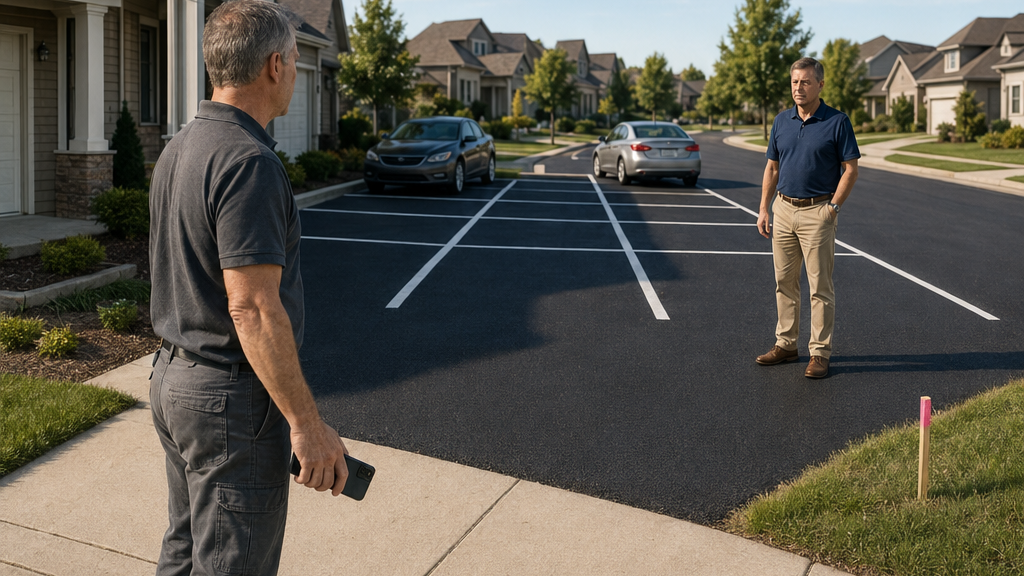
Six white parking lines ran across it in clean rectangles.
A second car, a blue crossover Timothy did not recognize, occupied the space closest to the sidewalk.
He stopped the truck.
For several seconds he thought he had turned onto the wrong street.
Then he saw his own kitchen window above the shrubs.
Timothy got out without closing the truck door.
The August heat had softened the smell of the new pavement into something thick and oily. Loose gravel crackled beneath his shoes where the blacktop met his driveway. At the far end of the new parking area stood a temporary sign mounted on two short posts.
HOA GUEST PARKING.
Six arrows had been painted beneath it.
Timothy walked to the place where his storage boxes had stood.
Gone.
So was the narrow strip of grass he had reseeded in spring.
His side lot measured a little under twenty-eight hundred square feet. He knew that because he had paid for a survey when he bought the corner property and another boundary verification eight years later when the association replaced a drainage swale behind the neighboring homes.
The lot was not decorative common space.
It was not an easement.
It was his.
A car door shut behind him.
The woman getting out of the blue crossover lifted a tote bag from the back seat. She glanced at Timothy.
“Is this okay for visitors?”
He looked from her to the sign.
“Apparently somebody thinks so.”
Her smile vanished.
Timothy did not ask her to move. Not yet.
He took out his phone instead.
One photograph of the sign.
One of the six spaces.
One wide shot showing the side wall of his house, his driveway, and the parking area together.
Then he walked the perimeter.
Near the rear corner, where asphalt ended beside a narrow ribbon of surviving grass, something orange caught his eye.
A survey stake.
Most of it was nearly buried, but three inches of faded plastic still protruded beside the black edge.
Timothy crouched.
The paving crew had missed it by less than a foot.
He photographed that too.
“Tim?”
He looked up.
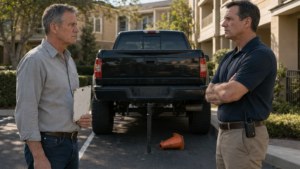
Ryan Lewis was crossing the street.
Ryan wore khaki shorts and a navy polo with the subdivision logo embroidered on the chest. He had been HOA president for three years and a resident for nearly twice that long. He was one of those men who always looked as if he were between meetings even when carrying his trash cans to the curb.
He stopped near the first parking stripe.
“You got back early.”
Timothy straightened.
“I got back when I said I would.”
Ryan’s eyes moved toward the truck, then to the parking lot.
“I was going to come over this afternoon.”
“That would have been after I found this.”
Ryan exhaled through his nose.
“It looks more dramatic than it is.”
Timothy looked at the six painted spaces.
“What part?”
“The board had a parking problem. We solved it.”
“You paved my property.”
Ryan’s expression tightened, but his voice remained measured.
“We used an area that’s been discussed for overflow before.”
“Discussed.”
“Yes.”
“That isn’t the same word as approved.”
Ryan glanced toward the woman at the crossover. She had stopped pretending not to listen.
“We had contractors scheduled. The alternative site fell through. We’ve got the neighborhood event coming up, and emergency access has been a problem every time cars line the main street. This gives us six spaces off the road.”
Timothy studied him.
Ryan was not embarrassed.
That bothered him more than if Ryan had come over defensive and apologetic.
Ryan seemed to believe he was explaining something reasonable.
“You called this guest parking.”
“It is guest parking.”
“On my lot.”
Ryan rubbed the back of his neck.
“Tim, I understand why you’re reacting. But this is a community improvement. It solves something residents have complained about for years.”
Timothy felt heat rise into his face.
He had spent most of his working life in logistics, solving problems caused by other people’s assumptions. Trucks appeared at wrong docks. Purchase orders vanished. Somebody always believed urgency erased procedure.
He had learned that shouting rarely corrected paperwork.
So he asked the simplest question he could think of.
“Do you have my written permission?”
Ryan did not answer immediately.
A lawn sprinkler clicked somewhere across the street.
Timothy waited.
Ryan finally said, “There were old site discussions.”
“That wasn’t my question.”
“I’d have to check the file.”
“Do you have something with my signature on it?”
Ryan’s jaw shifted.
“The property manager has the project documents.”
Timothy nodded once.
“Then bring me whatever says you were allowed to do this.”
“Tim, before this turns into—”
“It already turned into something when somebody put asphalt over my yard.”
The woman with the crossover quietly shut her rear hatch.
Ryan lowered his voice.
“We should talk about this without making it bigger than it needs to be.”
Timothy almost laughed.
He looked over the black surface.
Twenty-eight hundred square feet of his side lot had been scraped, compacted, paved, striped and signed while he was away.
Yet somehow he was being warned not to make the matter bigger.
He crouched again beside the surviving survey stake.
Ryan followed his gaze.
“What’s that?”
“You tell me.”
Ryan came closer.
Timothy brushed dirt from the top of the marker with two fingers.
“It’s from the survey.”
Ryan looked toward the asphalt edge.
“The paving contractor stayed inside the area we gave them.”
“That’s an interesting sentence.”
“What does that mean?”
“It means somebody gave them an area.”
Timothy stood.
“Somebody also told them they had authority to pave it.”
Ryan’s face changed slightly.
Not fear.
Calculation.
Timothy recognized it.
He had seen supervisors wear the same expression when they realized a shipping error was no longer about where a pallet had gone but about who had approved the instruction.
Ryan looked toward the street.
“I’ll get you the file.”
“When?”
“This afternoon.”
“Good.”
Ryan started away, then turned.
“We really did think this was available for community use.”
Timothy looked at him.
“We?”
“The association.”
“That isn’t a person.”
Ryan said nothing.
Timothy went inside.
His home smelled stale from being closed during his trip. He left his suitcase beside the hallway and walked directly to the small office off the kitchen.
The filing cabinet stood beneath the window.
Second drawer.
Property.
He pulled out the thick folder containing his deed, closing papers and surveys.
Eleven years earlier, Timothy had paid attention to the side parcel because it was one reason he bought the corner lot. Not because it was beautiful. It wasn’t. But it gave him breathing room.
No neighbor directly beside his kitchen.
Space for storage.
Space for a trailer.
Space that belonged to nobody else.
He spread the original survey across his desk.
The property line ran exactly where he remembered.
Straight down the edge now covered by asphalt.
The boundary had not moved.
Only the world above it had.
At 3:18 that afternoon, Ryan returned.
He carried no file.
Timothy met him on the front walk.
“The manager is pulling the records,” Ryan said. “Some of them are archived.”
“You said this afternoon.”
“I thought they were easier to access.”
Timothy held the folded survey at his side.
Ryan noticed it.
“We’re not disputing that you own your home.”
“My home isn’t the question.”
“I know.”
“Then show me the authorization for the side lot.”
Ryan looked past him toward the six spaces.
The silver sedan was gone. The blue crossover had left too.
For the first time since Timothy arrived home, the parking lot stood empty.
Ryan said, “I can’t put my hand on a signed authorization right now.”
Timothy unfolded the survey.
He did not raise his voice.
“Then what exactly did you rely on before you paved it?”
Ryan looked down at the property line.
And this time, he had no answer.
Chapter 2: The Email Ryan Should Have Remembered
Ryan’s name appeared in Timothy’s inbox at 7:42 that evening, attached to an email Timothy had not opened in almost six years.
He stared at the subject line.
Side Parcel / Overflow Parking Discussion.
Timothy clicked it.
The exchange began with a message from the former property manager asking whether he would consider allowing temporary visitor parking on the side portion of his lot during large community events.
Timothy remembered the request now.
He remembered where he had been sitting when he answered it.
Same desk.
Same window.
Different computer.
His response had been three sentences.
He read them twice.
I’m not interested in granting parking access across the side parcel. I use that area and intend to keep it private. Please do not include it in future parking plans.
Below that sat Ryan’s reply.
Understood. We’ll look elsewhere.
Timothy leaned back.
There it was.
No legal terminology.
No ambiguity.
No need to interpret faded maps or old plats.
Ryan had been included in the exchange and had answered him personally.
Timothy printed the chain.
The printer fed out the pages with a mechanical whir that seemed strangely loud in the quiet office.
He carried them outside.
The temporary guest-parking sign cast a narrow shadow across the asphalt. Nobody was parked there now.
Timothy walked to the surviving survey stake and laid the pages on the hood of his truck.
Ryan’s sentence looked almost insulting in daylight.
Understood. We’ll look elsewhere.
Timothy photographed the printed page with the blacktop visible behind it.
Then he called Ryan.
No answer.
He left no message.
That was an old habit.
Timothy disliked leaving emotional evidence. He preferred documents to conversations, records to confrontations. At work, that had served him well. A written dispatch could not later deny where a truck had been sent.
Neighborhood life was less orderly.
People interpreted silence.
They filled it.
Timothy returned to his office and opened the property folder.
The deed confirmed the side parcel.
The survey confirmed it again.
A later survey showed the same line after the drainage project.
He began building a timeline.
Six years ago: parking request.
His written refusal.
Ryan’s acknowledgment.
Four years ago: landscaping committee asked whether the association could plant two ornamental trees near the edge. Timothy had approved only one, inside the common verge.
Three years ago: a message about boundary markers.
He stopped.
That email did not feel familiar.
Timothy opened it.
The property manager had written that the HOA was updating site drawings and asked corner-lot owners to verify certain private/common boundaries. A surveyor could re-stake questionable lines at a discounted group rate if owners responded by the end of the month.
Timothy searched for his reply.
There was none.
He searched again by subject.
Nothing.
A small knot formed behind his ribs.
He remembered the message now.
He had read it on his phone while standing in line at a hardware store. The request had irritated him immediately.
He had already paid for surveys twice.
The association had copies.
Why should he spend another afternoon confirming a boundary they already knew?
He had intended to answer later.
He never had.
A second reminder had arrived.
He had ignored that one deliberately.
Timothy sat still.
The fact did not change who owned the land.
It did not create permission to pave it.
But it changed the story he had been telling himself since morning.
He had imagined a clean line between careful homeowner and careless association.
The line was less clean now.
His property boundary was not ambiguous.
His willingness to participate in clarifying it had been.
The doorbell rang just after eight.
Ryan stood outside.
No polo now. Gray T-shirt, jeans, tired expression.
Timothy opened the door but did not invite him inside.
“I found something,” Timothy said.
Ryan looked at the papers in his hand.
“So did I.”
Timothy handed him the old email chain.
Ryan read the first page.
His eyes stopped at his own reply.
For several seconds he said nothing.
Then: “I remember this.”
Timothy’s anger sharpened precisely because Ryan did not pretend otherwise.
“You told me you’d look elsewhere.”
“That was six years ago.”
“Did I later tell you yes?”
“No.”
“Did I sign anything?”
“No.”
“Then why is there a parking lot beside my house?”
Ryan handed the page back.
“The planning changed over time.”
“That isn’t permission.”
“I didn’t say it was.”
“You told me this morning the association thought the land was available.”
“We had old community plans that showed overflow use near that corner.”
“Near that corner.”
Ryan’s mouth tightened.
“Tim, you also didn’t respond when we asked everyone to confirm their boundaries.”
There it was.
Timothy felt the sting because it was true enough to be irritating.
“I own the property whether I answer your email or not.”
“I know that.”
“Do you?”
“Yes.”
Ryan looked toward the side lot.
“We were trying to reconcile old drawings. You never objected to the updated plan.”
“I never approved it.”
Ryan paused.
Timothy saw what had happened.
Not legally.
Psychologically.
His silence had not granted authority, but it had given Ryan a story to tell himself.
Timothy folded the old email.
“You took no response and turned it into consent.”
“I took several things together.”
“Such as?”
“The older site plans. The fact that area had been used informally before.”
“My guests used it.”
“I know.”
“Then that isn’t community use.”
Ryan exhaled.
“We had a situation.”
“You keep saying that like emergencies change ownership.”
“You weren’t here.”
Timothy stared at him.
Ryan immediately seemed to hear the sentence himself.
“That came out wrong.”
“No. I think it came out exactly right.”
Timothy stepped back and closed the door before he said something he would regret.
Ten minutes later he searched for property attorneys.
Rachel Baker’s office was fifteen minutes away.
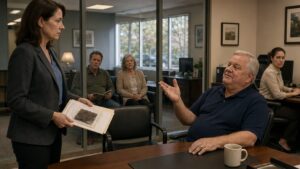
The next morning Timothy carried the deed, two surveys, printed email chains and photographs into a conference room that smelled faintly of coffee and copier toner.
Rachel read before she talked.
Timothy appreciated that.
After nearly twenty minutes she tapped the survey.
“This part is easy.”
“Ownership?”
“Yes. Unless there’s another recorded instrument we haven’t seen, this is your parcel.”
She touched the old email.
“This is useful too.”
“He remembered it.”
“That matters.”
Timothy told her about the later unanswered request.
Rachel looked up.
“You should have responded.”
“I know.”
“It doesn’t give them ownership.”
“I know that too.”
“But if this becomes a fight over whether they acted reasonably, they’ll use it.”
Timothy folded his hands.
“So I helped them?”
“No. Don’t simplify it that way.”
Rachel leaned back.
“You failed to answer a boundary-administration request. That was unhelpful. They paved private land without obtaining permission. Those are not equal mistakes.”
Timothy looked toward the window.
“I didn’t want to become the guy who turns every HOA email into a property dispute.”
“And now?”
“Now I have six parking spaces.”
Rachel almost smiled, but didn’t.
She gathered the documents into three piles.
“What do you want?”
“My yard back.”
“Anything else?”
“I want them to stop acting like it was available to them.”
“That’s two different remedies.”
Timothy looked at her.
Rachel pointed to the deed.
“One is physical restoration. The other is certainty.”
She opened her laptop.
“Before we decide how aggressive to be, I want the county records. Every easement, restriction and plat tied to your parcel.”
“You think they have something?”
“I think we verify.”
Timothy nodded.
Rachel closed the old email printout.
“And there’s another question.”
“What?”
“Not whether the land is yours.”
She slid Ryan’s six-year-old reply across the table.
Understood. We’ll look elsewhere.
“The important question now is who knew it was yours and authorized the paving anyway.”
Timothy looked at Ryan’s words.
Until that moment he had wanted to know how the HOA made such a mistake.
Now he was beginning to wonder whether it had been a mistake at all.
Chapter 3: Seventy-Two Hours to Undo the Asphalt
Rachel’s draft began with a deadline.
Seventy-two hours.
Timothy read the number twice while sitting across from her Tuesday morning.
The county records search had produced no parking easement, no recorded license, no access agreement and nothing granting the HOA a right to use his side parcel.
Rachel had reduced the issue to four pages.
Remove the asphalt.
Restore the affected property.
Preserve all project records.
Stop directing vehicles onto the parcel.
If the association refused, Timothy would seek court relief and damages.
“You’re comfortable with this?” Rachel asked.
Timothy turned the final page.
“I’m comfortable with getting my property back.”
“That wasn’t my question.”
He looked at her.
“Once this goes out, they’ll probably involve counsel. Insurance may get involved. Somebody will start calculating what removal costs compared with fighting you.”
“They should have calculated that before paving.”
Rachel nodded.
“Yes. But from here forward, your decision matters too.”
Timothy signed.
By noon, the letter had been delivered electronically and by courier to the HOA’s management office.
At 2:15, the temporary parking sign disappeared.
At 3:00, the property manager sent residents a short notice directing visitors to existing designated spaces.
For the first time since Timothy came home, the association had changed something without pretending nothing was wrong.
It was a small victory.
It lasted less than three hours.
HOA counsel responded before six.
Rachel forwarded the letter.
The association did not concede trespass. It cited older development drawings showing “potential overflow functionality” near Timothy’s corner property and suggested a history of intermittent parking use might support an implied-use argument.
Timothy called Rachel immediately.
“Implied use?”
“Lawyers write broad letters when they’re buying room.”
“Can they actually claim that?”
“They can claim almost anything. Winning is different.”
Timothy paced beside his kitchen counter.
“They know my guests parked there. That doesn’t make it theirs.”
“Correct.”
“And Ryan has the email.”
“Correct.”
“So why not just remove it?”
“Because removal costs money, and institutions dislike admitting a sunk cost was unauthorized.”
The phrase stayed with him.
Sunk cost.
The asphalt itself had become leverage.
The more expensive it was to undo, the more pressure existed to leave it.
Timothy went outside.
The empty blacktop glowed under the afternoon sun. Without cars, it looked even more absurd—a small commercial parking lot attached to the side of a private house.
He followed the painted lines to the surviving survey stake.
One bright piece of plastic against all that black.
Rachel called again Wednesday morning.
“The association wants to meet.”
“About removing it?”
“About alternatives.”
“What alternatives?”
“License agreement. Compensation. Limited event use.”
Timothy laughed once.
“They pave it first, then ask to rent it?”
“That is one way to describe the sequence.”
“There’s another?”
“Their way will be that everyone can avoid further expense.”
Timothy looked out the office window.
He understood the argument.
That irritated him too.
If he accepted payment, the neighborhood would avoid demolition costs. The spaces already existed. The main road really did become crowded during events. He had seen cars squeezed near hydrants and mailboxes.
There was a practical reason for extra parking.
There simply had never been a practical reason for taking his land without asking.
The meeting took place Wednesday afternoon in the HOA management office.
Ryan sat at one end of the table.
Sandra King sat beside him with a yellow legal pad and a folder thick with budget reports.
Timothy had known Sandra for years in the casual way subdivision residents knew one another. A wave from the mailbox. A short conversation after annual meetings. She handled the association’s finances and rarely spoke unless numbers were involved.
Rachel sat beside Timothy.
HOA counsel joined by speakerphone.
Ryan began.
“We want to find a workable solution.”
Rachel said, “Restoration is workable.”
Sandra looked down at her folder.
“It’s also expensive.”
Timothy glanced at her.
She met his eyes.
“I’m not saying that makes what happened okay. I’m saying the association is already carrying an unplanned drainage repair this quarter.”
Ryan leaned forward.
“The community event is Saturday. We’ve had repeated complaints about street congestion. Last year a fire apparatus had trouble getting through the west loop.”
Timothy knew about that.
He also knew Ryan was using a true problem to defend a false solution.
“That still doesn’t explain why you used my land.”
Ryan rubbed his thumb against the edge of a paper.
“We believed the parcel had historically been identified for overflow.”
Rachel placed a copy of the old email on the table.
“You personally acknowledged Mr. Hill’s refusal.”
Ryan did not touch it.
“That was years before the newer site review.”
“And the newer review produced what signed permission?” Rachel asked.
Silence.
Sandra looked toward Ryan.
“I thought this was cleared.”
Ryan turned.
“It was handled through the site plan process.”
Sandra’s expression changed.
“Handled how?”
“The revised plan showed the spaces.”
“That’s not what I asked.”
Ryan looked frustrated now.
“We were under time pressure.”
Sandra opened her folder.
“I voted for money to solve overflow parking. I did not vote to acquire private property.”
“No one acquired anything.”
Timothy spoke before Rachel could.
“You paved it.”
Ryan looked at him.
“We can pay you for temporary use.”
“No.”
“For six months.”
“No.”
“One event season.”
“No.”
Ryan sat back.
“There has to be some room here.”
“There was room before the paving crew came.”
For a moment, nobody spoke.
Timothy immediately disliked how satisfying the line felt.
He did not want satisfaction to become the reason he kept going.
Sandra broke the silence.
“What would restoration actually cost?”
Rachel gave a preliminary range.
Sandra’s lips pressed together.
Ryan shook his head.
“That would hit reserves.”
“The alternative,” Rachel said, “is that my client seeks injunctive relief and damages while the unauthorized improvement remains.”
The speakerphone crackled.
HOA counsel finally spoke.
“There may be merit in exploring whether existing plans create a reasonable basis for continued temporary use pending resolution.”
Rachel’s expression cooled.
“You are welcome to make that argument to a judge.”
Ryan looked at Timothy.
“Is that really where you want this to go?”
Timothy thought about the neighborhood event.
About reserve accounts.
About residents who had not ordered anyone to pave his land.
He also thought about Ryan saying, You weren’t here.
The sentence settled the question.
“Yes,” Timothy said, “if that’s what it takes to make you stop.”
The meeting ended without agreement.
Thursday morning, with fewer than twenty-four hours left on Rachel’s deadline, Sandra called Timothy directly.
“I need to ask you something.”
He stood beside the side lot, looking at the empty spaces.
“Okay.”
“Do you remember the board ever voting specifically on your parcel?”
“No.”
“Neither do I.”
Timothy straightened.
Sandra continued.
“I’ve been through the minutes from the last six meetings. We approved funding for an overflow-parking solution. We approved contractor expenditures within a cap. We discussed two possible areas.”
“Was mine one of them?”
“Not by parcel number.”
Timothy looked toward the clubhouse at the far end of the street.
“So what does that mean?”
“It means I’m trying to figure out what exactly the contractor was told.”
“And who told them.”
Sandra was quiet.
“Yes.”
Timothy heard papers moving on her end.
“There’s another problem,” she said. “The alternative site we originally planned to use failed inspection. That’s why everything accelerated. But I thought Ryan had already resolved your side-lot issue before he redirected the contractor.”
“Resolved it with whom?”
“That’s what I’m trying to find out.”
Timothy looked down at the asphalt.
For three days he had been asking what document gave the HOA authority.
Now Sandra had found a different absence.
There might not have been a document at all.
“Can you get the contractor file?” he asked.
“I already requested it.”
“When?”
“This morning.”
“And?”
“The manager says the work order came with direct board authorization.”
“From the board?”
Sandra hesitated.
“That’s the problem, Tim.”
Her voice had lost its careful treasurer’s neutrality.
“I can’t find the vote.”
Timothy stared at the painted parking lines.
The question was no longer whether somebody had misunderstood a map.
Somebody had told a paving crew to proceed.
And if the board had never approved his parcel, then one person had made that decision for everyone else.
Chapter 4: The Parking Crisis Behind Ryan’s Decision
Sandra King did not begin with an apology.
She began with a map.
By Friday morning, the conference table at the HOA office held three different versions of the neighborhood: the recorded plat Rachel had obtained from the county, an older landscape plan, and a newer parking diagram covered with blue pen marks.
Sandra pointed to an empty rectangle near the clubhouse.
“This was supposed to be the overflow area.”
Timothy looked at it.
It sat on common property, well away from his corner lot.
“What happened?”
“The inspector rejected it.”
“For what?”
“Drainage and access.”
Sandra turned another page.
“The ground drops toward the retention area. The contractor said stabilizing it properly would cost more than the board approved. Then we had the fire-access complaint from the west loop.”
Ryan sat across from Timothy, unusually quiet.
Rachel occupied the chair beside Timothy with a slim folder open in front of her.
Sandra continued.
“We had the event scheduled. Vendors. Children’s activities. Residents had prepaid for some of it. Canceling would have meant refunds we weren’t budgeted to absorb.”
Timothy looked toward Ryan.
“So you needed another place.”
Ryan nodded.
“Yes.”
“And my property was closer.”
“It was level. It connected cleanly to the street. There was already some gravel near your driveway.”
“My gravel.”
“I know.”
Timothy watched him carefully.
The explanation made the choice easier to understand.
That did not make it easier to accept.
Sandra slid the newer parking diagram across the table.
Six blue rectangles had been drawn onto Timothy’s side parcel.
Above them someone had written a short note.
Temporary overflow.
Timothy tapped it.
“Who drew this?”
Ryan answered.
“I did.”
Rachel looked up.
“When?”
“After the other site failed.”
“Before or after you contacted Mr. Hill?”
Ryan said nothing.
Sandra’s face hardened.
“Ryan.”
He looked at her.
“I thought the issue had already been handled.”
“That’s what you kept telling us,” Sandra said.
“It had been discussed.”
“Discussed with who?”
Ryan exhaled.
“With Tim, years ago. With management later. The updated site drawing included the corner.”
Rachel pushed the old email forward.
“The discussion years ago ended with a refusal.”
Ryan did not look at it.
Sandra did.
“I never saw this.”
Timothy glanced at her.
“You were on the board then?”
“Not yet.”
“But you approved the paving money.”
“I approved money for overflow parking.”
She tapped the map.
“I thought we were putting it here.”
Her finger landed on the rejected common-area site.
Ryan leaned forward.
“By the time that failed, we had days, not months.”
Sandra looked at him.
“You could have called another vote.”
“We wouldn’t have had time.”
“You could have called Timothy.”
“I did try to reach him.”
Timothy frowned.
“When?”
“While you were away.”
“My phone had service.”
“I sent a message through management.”
Rachel asked, “Do you have it?”
Ryan’s eyes shifted toward the property manager’s empty chair.
“I assume they do.”
Timothy already knew how that sentence sounded.
Assume.
The same word hiding inside every step.
Assume the old site plan meant access.
Assume Timothy’s later silence meant flexibility.
Assume a board vote for one parking project could be stretched onto different land.
Assume a homeowner away for a few days would complain after the work was finished but not force anyone to undo it.
Sandra closed the map.
“I want the contractor file.”
Ryan looked irritated.
“We’re already getting it.”
“No. I want the complete work order, authorization, invoice and whatever proof of site control they were given.”
Ryan’s voice tightened.
“You’re acting like I hid something.”
“I’m acting like I signed checks based on what I was told.”
The room went still.
Timothy had expected Sandra to defend the board.
Instead, she looked angry at having been used as part of the machinery.
That mattered.
It also complicated something Timothy had been doing all week without admitting it: mentally grouping everyone under the same label.
The HOA.
As if the association were one person with one motive.
Sandra had wanted parking too.
She had supported spending money.
She had trusted Ryan.
That was not the same as deciding Timothy’s land could be taken.
Rachel broke the silence.
“Mr. Lewis, why didn’t you send Mr. Hill the final plan before construction?”
Ryan rubbed both hands over his face.
“Because I knew what he’d say.”
Nobody moved.
Timothy felt something cold settle in his stomach.
“What would I say?”
Ryan looked directly at him.
“You’d say no.”
Sandra whispered, “Ryan.”
He ignored her.
“You always say no when the association asks about that side lot.”
“It’s my side lot.”
“I understand that.”
“No. You understand it now because there’s a lawyer sitting here.”
Ryan’s chair scraped slightly as he shifted.
“I understood it then.”
The words hung there.
Rachel’s pen stopped.
Timothy stared at him.
“You understood it then.”
Ryan closed his eyes for a second.
“I knew you considered it private. Yes.”
“Considered?”
“You know what I mean.”
“I want to hear what you mean.”
Ryan’s expression finally lost its practiced board-president composure.
“I mean I knew you would object.”
Timothy waited.
Ryan continued.
“I also knew the parking problem was real. The common area failed inspection. The event was days away. We’d had complaints for two years. The budget was already bleeding from drainage work. And every time we tried to get you to formally settle the boundary question, you wouldn’t engage.”
Timothy felt the accusation land.
Partly because it contained a fact.
He had ignored those messages.
Ryan went on.
“I thought you’d be angry. I thought we’d work out compensation afterward.”
Sandra stared at him.
“You paved first because you thought he’d negotiate after?”
Ryan looked at the table.
“I thought once the improvement existed, we could find a practical arrangement.”
Timothy almost admired the honesty.
Almost.
“You counted on me not making you take it out.”
Ryan did not answer.
That was answer enough.
The meeting ended shortly afterward.
Outside, Timothy and Rachel walked toward the parking lot.
Rachel said nothing until they reached her car.
“You okay?”
Timothy looked back through the office windows.
“I wanted him to be stupid.”
Rachel waited.
“That would have been easier,” Timothy said.
“Yes.”
“He knew.”
“Enough to create a problem for himself.”
Timothy shook his head.
“He knew me too.”
Rachel studied him.
“What do you mean?”
“He thought I’d complain quietly. He thought I’d be irritated, maybe demand money, then decide tearing it up would make me look unreasonable.”
Rachel did not contradict him.
Timothy looked toward the subdivision entrance.
That was the part that angered him most.
Not just that Ryan had gambled on the property.
He had gambled on Timothy’s personality.
By afternoon, Rachel called.
“The contractor produced the work order.”
Timothy stood in his kitchen.
“And?”
“There’s no board resolution attached.”
His grip tightened around the phone.
“Who signed it?”
“Ryan.”
“Only Ryan?”
“Only Ryan.”
Timothy looked through the window toward the six white lines.
The project had begun as a question about where a boundary sat.
Then it became a question about whether the HOA had permission.
Now the paper trail had narrowed to one signature.
And the man who signed it had just admitted he expected Timothy to object only after it was too late.
Chapter 5: The Morning the Blacktop Came Back Up
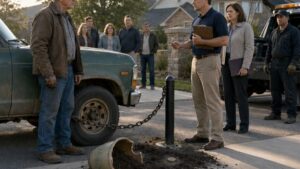
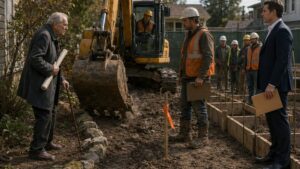
At seven o’clock Tuesday morning, the first strike of the jackhammer shook Timothy’s kitchen window.
He stood at the back door with a mug of coffee and watched the demolition crew cut into the nearest parking space.
The painted white line split first.
Then the black asphalt beneath it fractured into rough plates.
A week earlier, Timothy had returned home to find the lot transformed without him.
Now he was watching it change back one piece at a time.
The legal pressure had moved quickly after the contractor file surfaced. HOA counsel stopped arguing that an old site plan justified continued use. Their insurer became involved. A temporary court order preserved Timothy’s right to halt use of the parcel while the parties negotiated restoration.
By Monday afternoon, the association had agreed to removal rather than risk a broader injunction fight.
The victory looked less elegant in person.
The jackhammer was deafening.
Dust collected along Timothy’s siding.
A skid-steer loader carried chunks of broken pavement into a dump trailer, each load landing with a heavy crash.
Two neighbors stood across the street watching.
Neither came over.
Timothy preferred that.
At eight fifteen, Ryan appeared.
He wore jeans and a work jacket despite the heat already rising from the pavement. He stayed near the sidewalk while the crew worked.
Timothy noticed him but did not walk over.
For almost an hour Ryan simply watched.
The first three spaces disappeared.
Under the asphalt, the crew exposed compacted gray stone packed tightly into the soil.
The demolition contractor motioned Timothy over.
“You had irrigation through here?”
Timothy frowned.
“A line runs along the back edge.”
The contractor pointed with a gloved hand.
A shallow trench had appeared beneath the broken base material. Inside it lay a crushed section of black irrigation tubing.
Timothy crouched.
“That wasn’t broken before.”
“Probably got hit during grading.”
“How much farther?”
“Won’t know until we open it up.”
Timothy stood.
The cost calculation changed again.
The asphalt was not merely sitting on top of his lot.
The ground beneath it had been stripped, compacted and altered.
Ryan approached while the contractor returned to work.
“I didn’t know they damaged irrigation.”
Timothy looked at him.
“You didn’t know a lot about what they did.”
Ryan accepted that without argument.
Another section of asphalt cracked behind them.
“I’m sorry about that part,” Ryan said.
Timothy almost asked which part he meant.
Instead he watched the loader lift broken blacktop.
Ryan shoved his hands into his pockets.
“Do you really think all of this was necessary?”
Timothy turned.
Ryan nodded toward the demolition.
“This. Tearing everything out.”
“You’re asking now?”
“I’m asking because we offered to compensate you.”
“After you paved it.”
“Yes.”
“You offered to rent something you had already taken.”
Ryan looked toward the crew.
“We could have reached an arrangement.”
“Maybe.”
Ryan seemed surprised.
Timothy continued.
“If you had asked first.”
The jackhammer started again, forcing them to wait.
When it stopped, Timothy lowered his voice.
“That’s the part you still keep trying to skip. You’re talking about whether the parking was useful. Maybe it was. You’re talking about whether I could have been paid. Maybe I could have.”
Ryan said nothing.
“But none of that answers why you got to decide before I did.”
Ryan looked tired.
Not defeated.
Just tired.
“We had a real problem.”
“I know.”
“We still have it.”
“I know that too.”
“So six spaces get removed and now the association has the same parking problem plus a repair bill.”
Timothy glanced across the street.
“That’s not because I removed them.”
Ryan’s jaw tightened.
“No. It’s because I put them there.”
Timothy looked at him.
It was the first time Ryan had said it that plainly.
There was no apology after it.
There did not need to be.
Not yet.
By ten thirty, most of the asphalt was gone.
Near the rear of the lot, the skid-steer scraped back the crushed stone base.
The demolition contractor stopped the machine.
He stepped down and waved Timothy over.
“Take a look.”
A narrow iron reference pin had appeared beside the old orange stake.
It sat exactly where Timothy’s survey showed it should.
The original boundary had survived beneath everything.
Timothy stared at the metal.
For days, the line had existed mostly as ink on paper.
Now it was physically visible again.
Ryan stood several feet behind him.
The contractor asked, “That your marker?”
“Yes.”
“We’ll leave a buffer around it.”
“Please.”
Timothy crouched and brushed loose dirt away.
The asphalt had buried the line but had not moved it.
That thought gave him less satisfaction than he expected.
He had imagined the demolition as the moment when everything would feel corrected.
Instead he saw crushed irrigation tubing, compacted soil and scraped ground where grass had been.
Undoing an action did not restore the time before it happened.
At noon, the last large asphalt slab went into the trailer.
The six spaces were gone.
What remained was an uneven gray rectangle of exposed base material and dirt.
The contractor walked the site with Timothy.
“We’ll need soil brought in. Irrigation repaired. Then grading and seed.”
“How much?”
“I’ll have to update the estimate.”
“Ballpark.”
The contractor named a figure.
Timothy looked toward Ryan.
Ryan had heard it.
His face changed.
The original removal estimate had already been painful.
This was worse.
Sandra arrived shortly afterward with the property manager.
She examined the crushed irrigation line, then the exposed ground.
“Was this included?”
“No,” Timothy said.
Sandra closed her eyes briefly.
“Of course it wasn’t.”
She did not sound angry at Timothy.
She sounded angry at arithmetic.
The property manager began taking photographs.
Timothy walked back toward his driveway.
Ryan followed.
“Tim.”
Timothy stopped.
Ryan looked over the torn-up lot.
“I know you think I did this because I didn’t respect your property.”
Timothy waited.
Ryan continued.
“I thought I was choosing between one angry homeowner and a whole neighborhood angry about parking.”
“That was your mistake.”
“I know.”
“No.”
Timothy looked at him.
“Your mistake was deciding my answer mattered less because it was inconvenient.”
Ryan’s eyes dropped.
For several seconds neither man spoke.
Then Ryan nodded.
“That’s fair.”
Timothy expected the admission to feel like winning.
It didn’t.
It felt like arriving at the center of something he wished had never happened.
Rachel called just after one.
Timothy answered from the driveway while the crew swept loose gravel from the street.
“I got the updated restoration numbers,” she said.
“So did I.”
“There’s more.”
Timothy watched Sandra speaking quietly with the property manager.
“What?”
“Insurance wants documentation for loss of use, legal fees, landscaping restoration and the damaged irrigation. They’re evaluating the association’s total exposure.”
“I thought restoration was the main issue.”
“It was.”
Rachel paused.
“It isn’t anymore.”
Timothy looked at the bare rectangle where the parking spaces had been.
“What are we talking about?”
“Enough that you need to decide whether this is about recovering every dollar available or about getting the permanent property protection you told me you wanted.”
Timothy said nothing.
The physical fight was nearly over.
The blacktop was gone.
But Rachel’s question made clear that the harder choice had survived the demolition.
Chapter 6: The Number Was Not the Real Victory
Rachel placed two documents side by side.
The one on the left had a dollar figure near the top.
The one on the right had Timothy’s property line drawn across an attached exhibit.
He looked at the money first.
It was difficult not to.
The proposed settlement accounted for restoration, irrigation repair, legal expenses, loss of use and additional costs connected to returning the parcel to its prior condition.
It was more money than Timothy had expected when he first walked into Rachel’s office.
“Insurance is pushing them to resolve it,” Rachel said.
Timothy tapped the second document.
“And this?”
“Draft restriction.”
He read the first paragraph.
No association use of the identified parcel for parking, access, storage, staging or temporary event purposes without the owner’s written consent.
Timothy read it again.
Rachel watched him.
“The association’s first offer is higher if you drop that provision.”
He looked up.
“Why?”
“They don’t like permanent limitations.”
“It’s already my property.”
“I made that point.”
“And?”
“They’re concerned about future flexibility.”
Timothy gave a short laugh.
“That phrase again.”
Rachel leaned back.
“They’ll compensate you more now if the recorded language remains general.”
“How much more?”
She told him.
Timothy looked at the figure on the first document.
A month earlier, he might have found the offer impossible to ignore.
Now he pictured Ryan standing beside the demolition, explaining the choice as a practical necessity.
Future flexibility.
That was exactly what had started the problem.
Timothy pushed the higher offer away.
“I want the restriction.”
Rachel studied him.
“You understand you’re giving up money.”
“Yes.”
“I’m supposed to make sure.”
“I know.”
“Why?”
Timothy looked at the property exhibit.
“Because money pays for what happened.”
He traced the boundary line with one finger.
“This keeps it from happening again.”
Rachel nodded slowly.
“That’s a better answer than the one you gave me the first day.”
“What did I say then?”
“You said you wanted your yard back.”
“I still do.”
“No. You wanted the old situation back.”
Timothy looked at her.
Rachel continued.
“That isn’t possible. The question now is what replaces it.”
The distinction stayed with him during the drive home.
The side lot had been regraded and seeded. Fresh soil made the rectangle darker than the surrounding yard. The old survey stake remained near the edge, temporarily protected by a small flag so the landscaper would not disturb it.
Timothy parked and found an envelope taped to his front door.
No return address.
Inside was a photocopy of the HOA’s preliminary assessment discussion.
Someone had handwritten a note across the bottom.
Thanks for making the rest of us pay for your lawsuit.
Timothy stared at it.
Then he folded it once.
For several minutes he stood on the porch with the paper in his hand.
This was the thing he had feared years earlier when he ignored those boundary emails.
Not legal trouble.
Reputation.
Becoming the neighbor whose name entered conversations whenever dues increased.
The man who fought the association.
The man people avoided at mailboxes.
He almost called Rachel.
Instead he walked to the side lot.
A neighbor across the street was bringing in groceries.
She saw Timothy and hesitated before giving him a small wave.
He waved back.
Nothing dramatic happened.
That helped.
At the next settlement session, Ryan attended without his board polo.
Sandra came too.
HOA counsel handled most of the conversation.
The money moved in small increments.
The language moved more slowly.
At one point counsel proposed allowing “temporary emergency use” of Timothy’s parcel without written consent.
Timothy shook his head.
“No.”
“What if the use is necessary for public safety?”
“Then emergency services can use whatever authority the law gives them. The HOA doesn’t need private permission language for that.”
Rachel said nothing.
Timothy noticed.
She was letting him answer.
Counsel tried another version.
Temporary community staging.
“No.”
Sandra looked at Timothy.
“What if we need it for one afternoon someday? Something harmless.”
“Ask.”
Sandra smiled faintly.
“That simple?”
“Yes.”
Ryan had said almost nothing.
Finally he leaned forward.
“The association won’t contest the no-use-without-written-consent language.”
HOA counsel turned toward him.
“Ryan—”
“I said we won’t contest it.”
Sandra studied him.
Ryan looked at Timothy.
“You were right about that part.”
Timothy did not ask which part.
He knew.
Consent had to come before convenience.
Not after.
By the end of the meeting, the remaining settlement terms were close enough for Rachel to finish drafting.
The financial number would compensate Timothy fairly.
The restriction would be recorded.
The HOA would pay restoration costs.
For the first time, Timothy could see the end.
Then Sandra stopped him in the hallway.
“There’s a board meeting next Thursday.”
Timothy nodded.
“I know.”
“You should come.”
“I have an attorney.”
“I’m not talking about the settlement.”
Timothy looked at her.
Sandra held a folder against her chest.
“We’re proposing new property-verification rules. Written owner consent. Parcel check before contractors start work. Board approval tied to the actual location, not just a budget category.”
“That sounds sensible.”
“It does.”
She waited.
Timothy realized she wanted something else.
“What?”
“Some residents think this whole thing happened because you refused to cooperate with the association.”
His expression hardened.
Sandra raised a hand.
“I didn’t say they were right.”
“You want me to defend myself.”
“I think you should explain what happened.”
“Rachel can do that.”
“Rachel can explain the documents.”
Sandra’s voice stayed calm.
“She can’t explain why you ignored the later boundary request. And if you leave that part out, Ryan’s version will keep sounding more reasonable than it was.”
Timothy looked down the hallway.
There it was again.
The part he would have preferred to leave in a file.
His own silence.
Sandra continued.
“You weren’t responsible for the paving. But you were part of how the confusion stayed alive.”
“I know.”
“Then say that.”
Timothy looked at her.
“That’s easy for you.”
“No, it isn’t.”
Sandra tightened her grip on the folder.
“I approved money without checking the site authorization. I’m going to say that too.”
Timothy had no answer.
That evening he found another message in the neighborhood portal.
A resident complained that attorney fees and restoration costs would eventually affect everyone.
Timothy started typing a response.
Then deleted it.
His old instinct was to say nothing.
Let documents speak.
Let the recorded restriction speak.
Let the settlement close the matter.
But he could already see what silence would do next.
People would fill it.
Ryan had done that once with a boundary.
Timothy had no desire to let the neighborhood do it with the truth.
He called Rachel.
“I’m going to the board meeting.”
There was a brief pause.
“Good.”
“I’ll let you handle the legal parts.”
“Of course.”
“But I’m speaking for myself.”
Rachel’s voice softened slightly.
“That’s probably overdue.”
Timothy ended the call and looked through the window toward the fresh soil beside his house.
The boundary was visible again.
Next Thursday, he would have to make something else visible too.
Chapter 7: The Boundary They Could No Longer Pretend Not to See
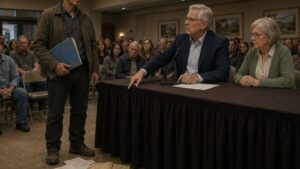
Timothy placed two pieces of paper on the folding table before anyone else arrived.
On the left was the email he had never answered.
On the right was the newly recorded restriction.
He aligned their bottom edges, then moved the first page half an inch away from the second.
For a moment he considered putting both back into his folder.
The HOA meeting room was still mostly empty. Fluorescent lights hummed overhead. A coffee urn clicked as it warmed near the wall. Through the glass doors, Timothy could see residents crossing the parking lot in pairs.
Rachel stood near the back row speaking quietly with HOA counsel.
Sandra was arranging packets at the board table.
Ryan had not arrived.
Timothy looked again at the unanswered email.
Three years earlier, the association had asked him to confirm the side-lot boundary.
He had ignored it.
The boundary had still been his.
The silence had still been his too.
That distinction was why he had brought the page.
People began taking seats.
Timothy recognized neighbors who had waved at him for years and others he knew only by mailbox and vehicle. Some glanced toward him. A few looked away too quickly.
He had received no more anonymous notes after the first one, but the neighborhood portal had been busy.
Questions about legal fees.
Questions about reserves.
Questions about whether the association had been forced to remove usable parking because one homeowner refused to cooperate.
Timothy had answered none of them.
Tonight would be the first answer.
Ryan entered five minutes before the meeting started.
No navy board polo.
Plain button-down shirt.
He paused when he saw Timothy at the front table.
Then he took his usual seat beside Sandra.
The property manager called the meeting to order.
Routine business moved quickly.
Drainage repair update.
Landscaping contract.
Treasurer’s report.
The room became noticeably quieter when Sandra reached the next agenda item.
“Property authorization procedures.”
She looked toward Timothy.
“Before we vote on the proposed changes, Mr. Hill asked to speak.”
Timothy stood.
He had written notes.
He left them on the table.
“I’m not going to go through every legal document,” he began. “That’s already been done.”
Someone shifted in the second row.
Timothy picked up the old unanswered email.
“This is something I should have answered.”
That was not the opening people expected.
He could tell.
“I received this three years ago when the association was trying to clarify some property lines. My side parcel was one of them. I had a survey. The association had records. I thought the request was unnecessary.”
He looked toward Ryan.
“So I ignored it.”
No one interrupted.
“That was a mistake.”
A man near the aisle folded his arms.
Timothy continued.
“It did not give anyone permission to pave my property. It did not transfer ownership. It did not create an easement. But it did leave one more thing unresolved in a place where people were already relying too much on assumptions.”
Sandra watched him closely.
Timothy placed the page down.
Then he lifted the old email showing his earlier refusal.
“Six years ago, the HOA asked to use that same parcel for overflow parking.”
He held the page where the front row could see it.
“I said no.”
His finger moved lower.
“Ryan answered the message.”
Ryan looked at the table.
Timothy did not read the words aloud.
He did not need to.
“The issue is not that nobody knew the property was mine. The issue is that the association had a problem and decided solving that problem was more important than getting a current yes from the person who owned the land.”
A woman in the middle row spoke.
“But wasn’t the street blocked last year?”
“Yes.”
“And didn’t the other parking area fail inspection?”
“Yes.”
“So there was an actual problem.”
“There was.”
Timothy nodded toward her.
“That’s why I don’t think everyone involved was trying to do something wrong.”
A few heads turned toward Ryan.
Timothy continued.
“The board needed parking. Sandra approved money because she believed it was going toward an authorized site. Residents wanted emergency access kept clear. Those were real concerns.”
He paused.
“But real problems don’t create permission.”
The room stayed quiet.
Sandra leaned toward her microphone.
“I want to add something.”
Timothy stepped slightly aside.
Sandra opened a folder.
“I approved the expenditure. I did not verify that the final location matched the site presented when we discussed funding.”
She looked toward the room.
“That was my failure as treasurer and as a board member.”
The sentence landed differently than Timothy expected.
There was no excuse attached to it.
No explanation designed to shrink it.
Sandra continued.
“The proposed rule would require three things before association-funded work touches privately owned property: written owner consent, parcel verification by management, and a board vote tied to the actual location.”
The property manager distributed copies.
A neighbor near the back asked, “Why wasn’t that already the rule?”
Sandra answered.
“We had procedures. They were not specific enough, and we relied too heavily on internal representations that the site issue had been resolved.”
Timothy looked toward Ryan.
Ryan finally raised his head.
“I told them it was handled.”
The room changed.
Even people who already knew the outline seemed to become more attentive.
Ryan folded his hands on the table.
“I believed we could make an arrangement after the paving was complete.”
Sandra did not look at him.
Ryan continued.
“I knew Tim had objected before.”
A murmur moved through the chairs.
He waited for it to stop.
“I also knew he had not responded to later requests about the boundary. I used that to convince myself the situation was less clear than it actually was.”
Timothy watched him.
This was more direct than anything Ryan had said during the private meetings.
Ryan looked toward Timothy.
“I expected him to be angry.”
He paused.
“I did not expect him to make us remove it.”
There it was.
The deepest part of the story, spoken without legal language.
Timothy felt no surge of triumph.
Only recognition.
Ryan had not believed the property was his.
He had believed Timothy’s resistance could be managed.
“I thought once the work was done,” Ryan continued, “the cost of undoing it would make a compromise more likely.”
A resident near the front said, “That sounds like you knew he’d say no.”
Ryan nodded once.
“I did.”
The room went still.
Timothy could have stopped there.
Could have asked for Ryan’s resignation.
Could have asked the board to censure him.
Could have let the anger in the room do the work.
Instead he picked up the newly recorded restriction.
“This is what I asked for in the settlement.”
He held it beside the unanswered email.
“Not the highest dollar amount.”
Rachel watched from the back.
“I wanted something that says the next person has to ask.”
He placed the restriction down.
“And I’ve learned something too. If somebody asks me about a boundary again, I’m going to answer.”
A few people smiled faintly.
Timothy did not.
He meant it.
“I don’t want the association afraid to contact homeowners. I want it required to contact them.”
Sandra turned toward the proposed policy.
“Then I move that we adopt the property-verification procedure as distributed.”
Another board member seconded.
Discussion lasted twenty minutes.
There were questions about emergencies.
Questions about contractor delays.
Questions about legal review.
The policy was amended once to clarify emergency-services access.
Then the board voted.
It passed.
No applause followed.
Timothy was glad.
Sandra marked the result in her packet.
The property manager moved to the next item.
Ryan touched the microphone.
“Before that.”
Sandra looked at him.
Ryan unfolded a single sheet.
“I’m resigning as board president effective tonight.”
The room stirred again.
“I’ll remain a homeowner here. I’ll finish turning over active files. But I don’t think I should be the person enforcing a procedure created because I bypassed one.”
He did not look at Timothy when he said it.
He did not ask forgiveness either.
That made the moment feel more real.
Sandra accepted the letter.
The meeting continued.
Timothy sat through the remaining agenda items, though he absorbed almost none of them.
Afterward, residents clustered near the doors.
One man approached Timothy.
“I still don’t like what this is going to cost us.”
Timothy nodded.
“I don’t either.”
The man seemed ready for an argument.
Timothy gave him none.
After a moment, the man said, “But they should’ve asked.”
“Yes.”
That was all.
Outside, Ryan was standing beside his car.
Timothy crossed the lot.
Ryan looked at him.
“You didn’t ask them to remove me.”
“No.”
“Why?”
Timothy considered the question.
“Because that wasn’t the boundary I needed fixed.”
Ryan looked toward the clubhouse.
“I made you prove something you shouldn’t have had to prove.”
“Yes.”
“And you ignored something you probably should’ve answered.”
Timothy almost smiled.
“Yes.”
Ryan nodded.
“I guess both can be true.”
“They can.”
There was nothing else to say.
Timothy drove home.
The corner of his property appeared under the headlights as he turned onto his street.
No sign.
No cars.
No painted lines.
The restored soil had darkened beneath the evening sprinklers, and the grass seed was beginning to show in thin green patches.
He parked and walked to the side lot.
The temporary orange marker still stood near the old survey reference.
Soon a permanent marker would replace it.
Timothy looked across the empty parcel.
For weeks, emptiness had seemed like something he needed to recover.
Now that he had it, it felt different.
Not empty.
Available.
But only on terms that belonged to him.
Chapter 8: What He Put Beside the Survey Stake
The new request arrived on a Wednesday morning three months later.
Timothy almost deleted it out of habit.
The subject line read: Temporary Side-Lot Access Request.
He stared at the screen.
Then he opened it.
The association was planning a fall neighborhood gathering near the clubhouse. A delivery truck needed somewhere to unload folding tables and rented chairs for approximately forty-five minutes. The common loading area would be occupied by another vendor.
The request asked whether the truck could use the front ten feet of Timothy’s side parcel between two specific times.
Attached was a small diagram.
Not an assumption.
Not a revised site plan.
Not a finished improvement waiting for his reaction.
A question.
Timothy leaned back in his chair.
The new policy required exactly this.
Written consent.
Defined area.
Defined time.
Property verification before use.
He read the message twice.
His first instinct was still no.
The word came quickly because no was clean.
No required no follow-up.
No prevented misunderstanding.
No kept the boundary quiet.
Then Timothy looked through the window.
The side lot was green again.
Not perfectly.
The restored grass remained lighter than the older lawn. Near the rear edge, the original survey marker sat beside a newer permanent boundary post installed after the settlement was recorded.
The asphalt was gone.
So were the painted lines.
The lot had returned to looking ordinary.
Timothy realized that was what he had wanted most.
Not a monument to the dispute.
Ordinary ground.
He returned to the email.
The requested truck was heavier than he wanted crossing the new grass.
He could refuse.
Instead, he clicked Reply.
He wrote that the truck could not use the lawn.
Then he offered a narrower alternative: the paved apron at the front edge of his driveway could be used for unloading for thirty minutes, provided the driver stayed within the marked area and management confirmed the time in writing.
He reread the response.
Precise.
Limited.
Clear.
Then he sent it.
For years Timothy had thought boundaries were strongest when they required no conversation.
He had been wrong.
A boundary nobody discussed could remain legally real while becoming socially blurred.
Clarity took maintenance.
The reply from management arrived twenty minutes later.
Thank you. We accept those conditions.
Timothy saved the email.
Then he laughed at himself.
He still saved everything.
Some habits deserved to survive.
The morning of the gathering, a delivery truck stopped exactly where agreed.
The property manager stood near the driveway with a printed diagram.
The driver unloaded tables.
Thirty minutes later, the truck was gone.
Nobody drove onto the grass.
Nobody expanded the arrangement.
Nobody interpreted cooperation as permanent access.
The entire event passed without incident.
Timothy watched from his porch for a few minutes before going inside.
Later that afternoon, Sandra knocked on his door.
She held a paper plate covered in foil.
“Too much food.”
“That seems to happen at every neighborhood event.”
“Yes.”
She handed him the plate.
For a moment neither of them mentioned the parking dispute.
Then Sandra glanced toward the side lot.
“Looks good.”
“The grass finally filled in.”
“I meant the marker.”
Timothy followed her gaze.
The permanent boundary marker was low and simple, set just inside the edge where the survey called for it.
No large warning sign.
No fence.
Nothing theatrical.
Just something that could no longer be mistaken.
Sandra said, “We’ve used the new authorization policy twice now.”
“Any problems?”
“Mostly paperwork.”
“That’s what paperwork is for.”
She smiled.
“You really were in logistics too long.”
“Probably.”
Sandra started back toward the street, then stopped.
“Ryan’s here, by the way.”
Timothy looked toward the clubhouse.
“I saw his car.”
“He helped set up tables.”
Timothy nodded.
Ryan had remained in the neighborhood.
That had mattered more than Timothy expected.
Resignation was clean on paper.
Living three streets apart afterward was not.
They had crossed paths several times.
At the mailbox.
At the grocery store.
Once while both were waiting behind a landscaping truck blocking half the street.
Their exchanges had been short.
Normal enough to be awkward.
Awkward enough to be honest.
Timothy had decided not to force more from them.
That afternoon he eventually walked toward the gathering.
Children moved between lawn games.
Adults stood beneath portable canopies.
The same neighborhood that had once seemed to divide itself into sides had returned to its ordinary mixture of small complaints, borrowed tools, forgotten names and casual conversations.
Ryan was carrying a stack of folded chairs.
He saw Timothy.
For half a second both men slowed.
Then Ryan tilted his head toward the side lot.
“Heard the delivery arrangement worked.”
“It did.”
“Good.”
Ryan shifted the chairs.
“The new rule is annoying.”
Timothy raised an eyebrow.
Ryan smiled slightly.
“Which probably means it’s doing its job.”
Timothy nodded.
“Probably.”
Ryan carried the chairs away.
No apology.
No reconciliation scene.
No promise that they would become friends.
Timothy found that acceptable.
The deepest repair had never required friendship.
It required recognition.
Near sunset, Timothy returned home.
He stopped beside the side parcel before going inside.
The old orange survey stake was still there, faded and leaning slightly from months of weather.
It had survived the paving.
The demolition.
The grading.
The new grass.
Timothy had left it beside the permanent marker longer than necessary.
For a while, he had liked seeing both.
One temporary.
One permanent.
One representing the line when people could pretend not to see it.
The other representing what happened after they no longer could.
He crouched and pulled the old stake from the ground.
The soil released it easily.
Timothy brushed dirt from the plastic.
He considered keeping it in the garage with the rest of the property records.
Then he changed his mind.
He carried it to the trash bin.
When he returned, only the permanent marker remained.
Low.
Plain.
Certain.
From down the street came the sound of the gathering winding down—chairs folding, car doors closing, someone calling for a child to bring back a ball.
Timothy stood beside the line for another moment.
Then he walked toward the voices.
The story has ended.