He Paid a Neighbor’s HOA Debt in Front of Everyone—Months Later, That Receipt Saved His Own Home
Chapter 1: The Balance She Could Not Pay
“Mom, are they going to take our car while we’re inside?”
The little girl asked it quietly, but the management office was small enough that everyone heard.
Edward Miller stopped halfway through folding the check he had just written for his own monthly assessment.
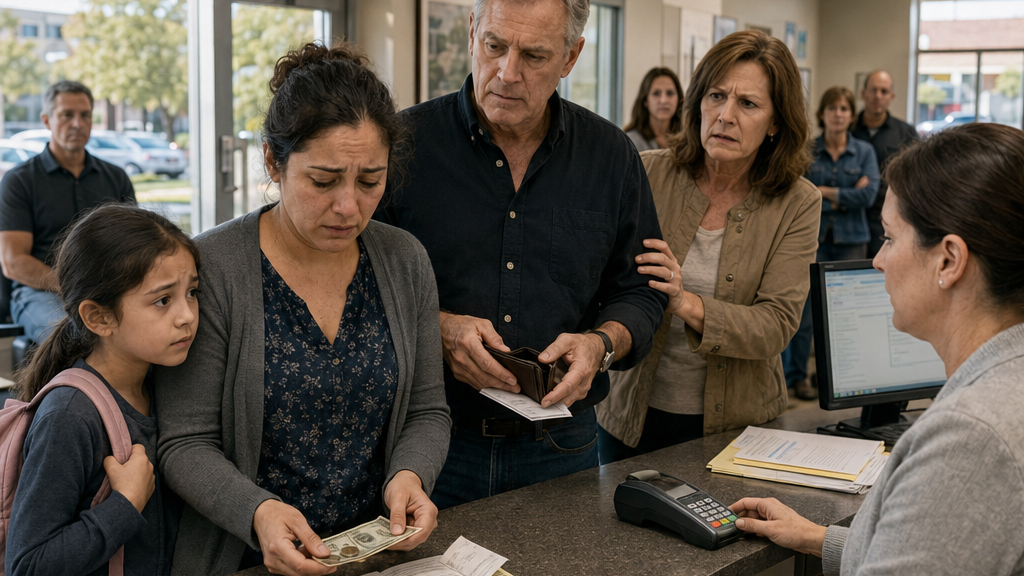
At the counter, Debra Garcia placed both hands around a stack of bills and coins as if she could keep them from shrinking. Her daughter stood against her hip with a pink backpack hanging from one shoulder. On the counter beside Debra’s money lay a yellow parking notice.
The receptionist looked uncomfortable.
“I’m not saying they’ll tow it today,” she said. “I’m saying the decal stays flagged until the balance is cleared.”
“How much am I short?”
The receptionist turned the monitor slightly away from the waiting line. “One hundred eighty-four dollars.”
Debra stared at her.
“That can’t be right.”
Behind Edward, Sharon Nelson shifted impatiently.
They had come to the clubhouse because Edward preferred paying the association in person when the office opened one Saturday each month. Sharon thought the habit belonged to another century, but she had come with him because they planned to spend the afternoon comparing apartments closer to her office.
Debra separated the papers on the counter.
“I brought the late assessment,” she said. “And the parking fine. You told me yesterday that was everything.”
“There’s an account administration charge.”
“What administration charge?”
The receptionist pointed to a line on the printed statement.
Debra leaned over it.
“Seventy-five dollars?”
“And the collection processing fee.”
“I haven’t been sent to collections.”
“It’s how the system categorizes the delinquent account.”
Debra’s face changed before her voice did. Edward had seen that expression before—in maintenance offices when hourly employees discovered an insurance deduction they hadn’t expected, at hospital desks, years ago on his mother’s face when she thought her children weren’t looking.
It was the effort of trying not to appear frightened by money.
Debra counted again.
Her daughter whispered, “I can ride the bus.”
Debra closed her eyes for half a second.
“No, sweetheart.”
Edward looked at the yellow notice. “How long before the parking flag takes effect?”
Sharon’s head turned toward him.
The receptionist answered, “Technically it already has.”
“Edward,” Sharon said.
He ignored the warning in her voice.
“If she pays the remaining one eighty-four, the decal is clear?”
The receptionist nodded.
Debra turned around. “No. Thank you, but no.”
“I didn’t offer yet.”
“You were going to.”
That almost made him smile.
Sharon did not.
She stepped closer and lowered her voice. “We need to go.”
Edward looked at Debra again. “Can I ask you something?”
Debra’s embarrassment hardened into defensiveness. “What?”
“Is the car how you get to work?”
She hesitated.
“And school drop-off,” she said.
Edward took his wallet out.
Sharon caught his wrist.
“Don’t.”
It was quiet enough that the gesture drew more attention than if she had raised her voice.
Edward looked at her hand, then at her face.
“We discussed our budget this morning,” she said.
“I know.”
“Then act like it.”
Debra immediately gathered her papers. “Please. I’ll figure it out.”
Her daughter picked up the yellow notice after it slipped off the counter.
Edward gently freed his wrist.
“How much did you say?” he asked.
“One eighty-four,” the receptionist said.
He handed over two hundred dollars.
For a moment nobody moved.
Then the receptionist accepted the money and began entering the payment.
Debra whispered, “I can repay you Friday.”
“No.”
“I get paid Friday.”
“Keep it.”
“I’m not asking you to give it to me.”
“I know.”
The printer rattled.
The receptionist tore off a fresh receipt and stamped the parking clearance. Debra looked down at it as though the small sheet of paper had become difficult to understand.
Edward noticed the line again.
ADMIN PROC.
Seventy-five dollars.
Below it was another abbreviated entry for collection processing.
“Is that seventy-five-dollar fee standard?” he asked.
The receptionist glanced at the growing line behind them. “It’s generated by management.”
“So the board approved it?”
“I’d have to check.”
Debra folded the receipt quickly.
“It doesn’t matter. It’s paid.”
Her voice said she wanted nothing more discussed in public.
Edward understood.
He stepped aside.
Debra held the receipt tightly in one hand and guided her daughter toward the door. Just before leaving, she looked back.
“Thank you.”
Edward nodded once.
Outside, the clubhouse parking lot was bright with late-morning sun. Sharon walked past Edward without speaking until they reached his truck.
Then she stopped.
“You took two hundred dollars out of the money we agreed not to touch.”
“It was one eighty-four.”
“That is not the point.”
“She needed her car.”
“You don’t know her.”
“I know she was standing there with her kid trying to keep her car from being towed.”
“You know one scene from her life.”
“And apparently that was enough to call her irresponsible.”
Sharon stared at him.
“I didn’t call her irresponsible.”
“You said, ‘People like that always have an emergency.’”
“I said it to you.”
“As though that makes it better.”
Her face reddened. “We have been saving for six months so we can make a move without putting everything on a credit card. You keep saying you want a future with me, and then the moment someone looks desperate, you decide our plan is optional.”
Edward felt the old instinct rise—the certainty that because his motive had been decent, he should not have to defend the decision.
“She had a child standing there.”
“And you had a partner standing beside you.”
He opened the truck door.
Sharon did not get in.
“Fine,” Edward said. “I should have told you before I did it.”
“No. You should have thought before you did it.”
That landed harder.
He turned back. “So what was I supposed to do? Watch?”
“You could have asked questions. You could have offered fifty dollars. You could have helped her call management Monday. You could have done something besides deciding, in ten seconds, that you were the only person in the room with a conscience.”
Edward stared at her.
The words felt unfair precisely because part of them were not.
Sharon reached into her purse.
When she held out her hand, his brass apartment key lay in her palm.
Edward looked from the key to her face.
“What are you doing?”
She set it in his hand.
“This isn’t about one hundred eighty-four dollars.”
“Then what is it about?”
“You really don’t know.”
She stepped away from the truck.
“Sharon.”
She stopped but did not turn.
“I helped somebody.”
“Yes,” she said. “And you still think that answers every other question.”
Then she walked toward the street, leaving Edward with the key pressed into his palm and no idea whether the thing he had just saved belonged to Debra Garcia or whether the thing he had just damaged belonged to him.
Chapter 2: What Sharon Was Really Afraid Of
Sharon returned Sunday afternoon carrying two empty storage bins.
Edward opened the door and understood immediately that she had not come to argue.
She walked past him toward the bedroom.
“You’re taking everything?”
“Everything that’s mine.”
He shut the door.
The apartment already felt altered. Her coffee mug was still beside the sink. A pair of reading glasses remained on the end table. Yet she moved through the rooms like someone checking out of a hotel.
Edward followed her.
“You could’ve called.”
“I did.”
“My phone was in the garage.”
“I know. You texted me that.”
She opened a drawer and began folding shirts into one bin.
Edward leaned against the doorframe. “So that’s it?”
Sharon kept folding.
“Over yesterday.”
“No.”
“That’s what it looks like.”
She stopped.
“You really want to do this?”
“I want to understand how paying somebody’s bill turned into you moving out.”
“I don’t live here.”
“You’re here four nights a week.”
“That’s not the same thing.”
He knew she was deflecting. He also knew he had started doing the same.
On the kitchen counter sat the key she had returned. Beside it was the receipt Debra had accidentally handed him while gathering her things. He had noticed it only after getting home: the management-office copy had been stapled to his own payment receipt.
He had meant to drop it at Debra’s door.
Instead, he had folded it once and put it in a drawer.
Sharon carried the first bin into the living room.
Edward said, “You embarrassed her.”
She froze.
“So we’re back to that.”
“You talked about her like she was trash.”
“I was angry.”
“That doesn’t excuse it.”
“No.”
The answer came so quickly that Edward lost the next sentence he had prepared.
Sharon set the bin down.
“No, it doesn’t excuse it. I shouldn’t have said what I said.”
Edward waited.
“But you’re doing something too,” she continued. “You keep making this a choice between kindness and cruelty because that lets you be the kind one.”
His jaw tightened. “What exactly are you accusing me of?”
“Not listening.”
“To what?”
“To me.”
She sat on the arm of the sofa.
For several seconds she looked not angry but tired.
“My last relationship ended with twenty-three thousand dollars in credit-card debt.”
Edward frowned.
She had told him her former partner had been bad with money. Nothing more.
Sharon rubbed her thumb across a scratch in the storage-bin lid.
“He was generous too,” she said. “That was what everybody loved about him. His brother needed rent, he paid it. A friend needed a transmission, he put it on a card. His mother had a medical bill, he covered that. He tipped fifty percent when we were already behind.”
“That isn’t the same thing.”
“I know.”
“Then why compare us?”
“Because every time I asked him to stop, he said the same kind of things you said yesterday. Somebody needed help. What was he supposed to do, just watch?”
Edward said nothing.
“He wasn’t a bad man,” Sharon continued. “That was the problem. He could always make the thing he had just done sound more moral than the bill that came later.”
The apartment seemed suddenly too quiet.
“How much of that debt was yours?” Edward asked.
“Enough.”
“You never told me.”
“I didn’t want a new relationship organized around an old one.”
“And now it is.”
“Yes.”
There was no triumph in her voice.
Edward looked toward the kitchen drawer containing Debra’s receipt.
“We’re not in debt.”
“No. But we agreed on something. We agreed to save a certain amount every month. Yesterday you decided the agreement mattered less than the situation in front of you.”
“It was two hundred dollars.”
Sharon gave him a small, humorless smile.
“And there it is.”
Edward looked away.
He understood what she meant now. The amount was not his defense. It was proof that he still believed intention settled the argument.
“I should’ve talked to you,” he said.
“Yes.”
“But you still judged her.”
“I did.”
“And I’m not going to pretend that part was okay because you’ve got a reason for being afraid.”
“I’m not asking you to.”
They stood in the middle of that uncomfortable truth.
Edward had wanted Sharon to become simple—a woman who cared more about money than people. Sharon had wanted his generosity to become simple too, an impulse she could label dangerous and dismiss.
Neither version survived the conversation.
Sharon lifted the second bin.
“I loved that you were the kind of man who would notice her,” she said.
Edward looked at her.
“I just didn’t trust that you knew when noticing somebody else meant forgetting the person beside you.”
He had no quick answer.
That was unusual enough that she noticed.
“Maybe if we’d had this conversation six months ago…” she began.
“What?”
She shook her head. “Nothing.”
“Say it.”
“No. Because then we turn this into a negotiation, and I don’t want to negotiate myself into staying because we finally said the right things after the damage.”
The sentence hurt, but Edward respected it.
He carried one bin to her car.
She carried the other.
At the curb, neither reached for the other.
“I am sorry for what I said about Debra,” Sharon told him.
“I’m sorry I made our agreement optional without asking.”
Sharon nodded.
Then she closed her trunk.
Edward stood there until her car disappeared beyond the entrance monument.
For the next week, the returned key stayed on the kitchen counter.
Debra’s folded receipt remained in the drawer.
Edward went to work, came home, ate simple dinners, and tried not to decide whether he had been right or wrong. The answer had become irritatingly more complicated than either.
Friday evening, he opened his mailbox.
Most of the envelopes were advertisements and utility notices. One thick white envelope carried the association’s logo.
He nearly left it unopened.
Instead, he tore along the top while walking back toward his building.
The first page was headed with a notice concerning the recently completed roof project.
Edward slowed.
The association had collected a special assessment the previous year. He had paid his portion in full.
The notice explained that project costs and owner ledgers were being reconciled following final contractor billing. Individual accounts could show credits or remaining balances.
Edward turned to the attached statement.
At the bottom was a line he had never seen before.
RECONCILIATION BALANCE PENDING.
No dollar figure yet.
He read the page twice.
Then he looked toward the clubhouse, its management-office windows dark for the weekend.
His own account had been settled for months.
At least, he had believed it was.
Chapter 3: The Charge That Appeared Twice
Three months later, Edward opened the HOA portal before work and found that he owed $3,487.62.
He stared at the number until the screen dimmed.
Then he moved the mouse and made it appear again.
The night before, his account had shown a balance of $420—the first installment of the roof-project reconciliation. He disagreed with the calculation but had expected to straighten it out before the due date.
Now the page showed the original amount plus a special-assessment adjustment, late charges, administrative processing, collection processing, and attorney referral.
Edward sat down harder than he intended.
“Attorney referral?”
He clicked into the account ledger.
The entries ran down the screen in neat rows.
He had spent thirty years supervising maintenance crews in commercial buildings. He distrusted neat rows. Broken systems often looked organized right up until somebody checked what the columns actually meant.
He printed the statement.
At eight-thirty, he called Samantha Lee.
She answered on the fourth ring.
“Community management, Samantha speaking.”
“This is Edward Miller, unit 214.”
“Good morning, Mr. Miller.”
“Maybe. My account gained three thousand dollars overnight.”
He heard keyboard clicks.
“Yes. I see the balance.”
“I disputed the reconciliation.”
“I see that too.”
“So why did it go to collections?”
“Your dispute was reviewed and the balance was upheld.”
“Reviewed by whom?”
“The account was reviewed through our reconciliation process.”
“That’s not a person.”
A pause.
“The roof assessment finalization was approved by the board.”
“I paid the roof assessment.”
“The final project amount exceeded the original projection.”
“I understand that. I’m asking why I have collection fees when the amount was under dispute.”
Samantha’s voice remained professional. “A dispute does not automatically suspend collection activity.”
“Did anyone tell me that?”
“It’s in the association collection policy.”
Edward looked down at the printed ledger.
There it was.
ADMIN PROC—$75.
Something about the abbreviation bothered him.
“Can you remove the collection charges while we review the calculation?”
“I’m not authorized to do that.”
“Then who is?”
“The board can consider an adjustment.”
“So my dispute wasn’t really reviewed by the board.”
“That isn’t what I said.”
“It’s what I’m asking.”
Another pause.
“Mr. Miller, I understand you’re frustrated.”
“I’m not frustrated yet. I’m confused.”
He said it deliberately.
Anger made people defend systems. Questions sometimes made them examine them.
“What exactly was reviewed?”
“The reconciliation calculation.”
“And the fees?”
“The fees posted according to the account status.”
“Automatically?”
“I’d have to look at the individual transaction history.”
“Please do.”
“I can submit an account inquiry.”
“How long?”
“Typically ten business days.”
“The portal says I have seven days before further collection action.”
“I understand.”
Edward looked at the total again.
“No,” he said quietly. “I don’t think you do.”
He ended the call before irritation changed his tone.
At work, he carried the ledger folded in his shirt pocket. During lunch he opened it on the break-room table and went line by line.
The $420 reconciliation amount was one problem.
The rest was another.
Seventy-five dollars for administrative processing.
One hundred twenty-five for collection processing.
A second administrative charge two weeks later.
An attorney referral fee.
He circled the first abbreviation.
ADMIN PROC.
He had seen it somewhere.
For the rest of the afternoon it stayed just beyond memory.
At home that evening, he opened the kitchen drawer looking for a calculator.
The returned brass key was still inside.
So was the folded receipt.
Edward stopped.
For months he had avoided touching either one.
He unfolded Debra Garcia’s receipt across the counter.
The paper had softened along the crease.
Monthly assessment.
Late charge.
Parking penalty.
Then the line that had bothered her at the office.
ADMIN PROC—$75.
Edward laid his own statement beside it.
Same abbreviation.
Same amount.
Different accounts.
Different circumstances.
Three months apart.
He sat down.
The first impulse was embarrassingly familiar: fix it.
Call Debra. Tell her management had probably charged her incorrectly. Demand the board correct both accounts.
Then he remembered Sharon’s voice.
You could have asked questions.
Edward took out a legal pad.
He wrote:
Who approved fee?
When does it apply?
Why collection fee before collections?
Why duplicate admin fee?
Then, beneath those questions:
Debra receipt.
The next morning, a certified letter was waiting at the post office.
The association’s attorney stated that if the delinquent balance was not paid or formally resolved within the specified period, additional collection remedies could follow, including a lien against the unit.
Edward read the sentence twice in his truck.
For the first time, the dispute felt less like bad bookkeeping and more like something capable of reaching into the equity he had spent sixteen years building.
He called Samantha again.
“I received the attorney letter.”
“Yes, Mr. Miller.”
“You said my inquiry could take ten business days.”
“That’s the normal processing time.”
“The collection deadline comes first.”
“I can note that an inquiry is pending.”
“Does that stop the deadline?”
“No.”
He closed his eyes.
“Then I need the fee authorization and the transaction history today.”
“I can send what I have.”
“Please do.”
Her email arrived that afternoon.
It contained his ledger, the association collection policy, and a general board resolution authorizing management to collect delinquent accounts.
It did not explain why the seventy-five-dollar fee appeared when it did.
Edward printed everything.
Then he walked two buildings over.
He had not spoken to Debra since the Saturday he paid her balance. They had exchanged waves in the parking lot, nothing more. Partly he had wanted to spare her the awkwardness of gratitude. Partly he had wanted to spare himself the reminder of what the day had cost.
Debra answered the door with her daughter behind her doing homework at the dining table.
“Edward?”
“Sorry to bother you.”
Her eyes went immediately to the papers in his hand.
“Is something wrong?”
“Maybe.”
He held up a copy of her old receipt.
“Do you remember this fee?”
She looked at it.
Her expression tightened.
“I remember all of them.”
“I got the same one.”
Debra stared at him.
“Same amount?”
“Same code. Same seventy-five dollars.”
She opened the door wider.
Edward remained on the threshold.
“I’m not asking for anything personal,” he said. “I’m trying to figure out whether it’s a standard charge or whether something posted wrong.”
Debra glanced toward her daughter.
Then back at him.
“That isn’t the only receipt I kept.”
Edward said nothing.
Debra stepped into the hallway and lowered her voice.
“I was embarrassed that day. I didn’t want you thinking I never paid my bills.”
“I never thought that.”
“Well, I did.”
She folded her arms.
“So afterward, I kept every notice they sent me. Every receipt. Even the envelopes.”
“How many?”
Debra gave a small, uneasy shake of her head.
“Enough that I stopped understanding what I was paying.”
Then she looked at the papers in Edward’s hand.
“If they put that fee on yours too, you should probably see the rest.”
Chapter 4: The Receipts Nobody Compared
Debra arrived at Edward’s door the next evening carrying a paper grocery bag against her chest.
It sagged at the bottom.
Edward stepped aside. “What’s in there?”
“Apparently my shame, organized by month.”
She set the bag on his dining table.
Inside were envelopes, receipts, account statements, certified-mail slips, parking notices, and printouts from the HOA portal. Some were unopened. Others had been folded until the creases had nearly split.
Edward did not reach for them.
“Are you sure you want me looking at this?”
Debra pulled out a chair.
“No. But I’m more sure than I was yesterday.”
Her daughter was spending the evening with a friend in another building. Without the child beside her, Debra looked less embarrassed and more irritated.
Edward opened his notebook.
“We don’t have to go through everything.”
“Yes, we do.”
He looked up.
Debra pushed the bag toward him. “That day at the office, I thought if I could just get current, all of it would stop.”
“All of what?”
“The little charges.”
They started with the oldest statement.
Edward arranged each receipt beside its matching notice. He did not know what he expected to find. A pattern, maybe. A mistake obvious enough that Samantha Lee could correct it with one phone call.
Instead, the records resisted simplicity.
One month showed a late fee.
The next showed an administrative processing charge.
Another included a collection processing charge even though Debra had made a partial payment before the account reached the association’s attorney.
Some charges disappeared after she paid. Others reappeared under slightly different descriptions.
Edward made columns on a legal pad.
Date.
Base assessment.
Late fee.
Administrative fee.
Collection fee.
Payment.
Balance.
Debra watched him write.
“You do this at work?”
“Not exactly.”
“It looks like work.”
“It’s how you find out whether a machine is actually broken or whether somebody just thinks it is.”
She gave him a tired smile. “And?”
“I don’t know yet.”
That answer mattered.
Three months earlier, Edward might have told her immediately that the HOA had overcharged her. He might have marched into the management office with one receipt and certainty.
Now he kept writing.
Near the bottom of the bag was a statement from six months earlier.
Edward stopped.
“What?”
He pointed.
“Here.”
A seventy-five-dollar administrative charge appeared on the first page.
On the second page, dated nine days later, another seventy-five-dollar charge appeared under a slightly different abbreviation.
Debra leaned closer.
“I paid that.”
“You paid both.”
“I thought one was late.”
“No. The late charge is separate.”
Her face tightened.
“So they charged me twice?”
“Maybe.”
“Edward.”
“Maybe. I need to see whether one was reversed somewhere else.”
They checked.
It wasn’t.
Debra pushed back from the table.
“That’s one hundred fifty dollars.”
“I know.”
“That was groceries.”
Edward looked at her.
She immediately shook her head. “I’m not asking you to—”
“I know.”
The words came out gently.
He turned the page instead of reaching for his wallet.
The next afternoon, Edward knocked on the door of a retired homeowner who had complained in the parking lot about association fees months earlier.
He did not ask to see her entire finances.
“I’m comparing only account charges,” he explained. “If you’re uncomfortable, don’t show me anything personal.”
She hesitated, then returned with two statements.
Another neighbor gave him one page with everything except the fee lines blacked out.
A third refused.
“I don’t need my name attached to some board fight,” the man said.
“I understand.”
“You planning to sue?”
“No.”
“Then what are you doing?”
“Trying to find out what’s true.”
That answer surprised both of them.
Within a week, Edward had six accounts laid out across his dining table.
The dates differed.
The balances differed.
The same small charges kept appearing.
One owner had paid a collection fee twice in the same billing cycle.
Edward checked the transaction history four times before believing it.
He called Samantha.
“I have a question about duplicate fees.”
“On your account?”
“Not only mine.”
Her tone changed.
“Mr. Miller, I can discuss your ledger with you. I can’t discuss other owners’ accounts.”
“I’m not asking you to. I’m asking whether the same administrative fee can be posted twice during one delinquency cycle.”
“That depends on the account activity.”
“What activity would justify it?”
“I would need a specific account.”
“I have one.”
“Is it yours?”
“No.”
“Then I can’t discuss it.”
Edward exhaled.
“Can you tell me the written rule?”
“I can send the management fee schedule.”
“Please do.”
That evening, someone knocked hard enough to make the loose picture frame beside Edward’s door rattle.
Jonathan Brown stood outside.
The HOA president was in his late fifties, broad-shouldered, wearing khakis and a quarter-zip with the community logo.
“I hear you’re collecting people’s account statements.”
Edward kept one hand on the door.
“I’m comparing fees.”
Jonathan’s jaw tightened. “You understand how that sounds?”
“Yes.”
“Do you?”
“I think so.”
“You’re creating the impression that the board has been improperly charging people.”
“I haven’t said that.”
“You’re circulating incomplete information.”
“I’m asking homeowners for documents they own.”
Jonathan looked past him toward the dining room table.
“People are nervous enough about the roof assessment.”
“So am I.”
“That’s exactly why this isn’t helpful.”
Edward studied him.
Jonathan did not look guilty. He looked exhausted.
“We had an eighty-thousand-dollar roof overrun,” Jonathan said. “Reserves are already below where they should be. Delinquencies are up. Every time somebody decides a fee shouldn’t apply to them, everybody else carries more.”
“That doesn’t make a duplicate fee correct.”
“I didn’t say it did.”
“Then review them.”
“We review disputed accounts.”
“My disputed account went to the attorney before anyone answered the dispute.”
Jonathan’s mouth flattened.
“I’m willing to look at yours personally.”
Edward waited.
Jonathan lowered his voice.
“If your reconciliation adjustment is the issue, I can recommend removing the disputed administrative and collection charges. Clean slate. You pay the actual assessment balance, and we’re done.”
Edward glanced toward the papers on his table.
“What about everybody else?”
Jonathan’s expression hardened again.
“We are discussing your account.”
“That’s the problem.”
“No. The problem is you’re turning a billing dispute into a community accusation.”
Edward did not answer.
Jonathan took a folded sheet from his pocket.
“I’ll have Samantha prepare the adjustment. If you agree to resolve your account and stop distributing unverified comparisons, I think we can put this behind us.”
He held the paper out.
Edward took it.
At the top was his unit number.
At the bottom, after the proposed adjustments, the balance would return to zero except for the underlying roof reconciliation.
For three months, Edward had wanted exactly that.
Now that it was in his hand, he could not stop looking past it at Debra’s first receipt lying among the others.
Jonathan nodded toward the page.
“Think about it.”
Then he walked away.
Edward closed the door and returned to the table.
One private correction.
Six questionable accounts.
And for the first time, he wondered why the board seemed more comfortable fixing his bill than finding out whether anyone else’s was wrong.
Chapter 5: The Easy Settlement Edward Refused
Jonathan slid the revised account sheet across the clubhouse conference table.
“Sign that, pay the underlying reconciliation amount, and your account is current.”
Edward did not touch it.
Across from him sat Jonathan and Samantha Lee. The room usually held committee meetings and holiday-planning sessions. That morning, the fluorescent lights made the table look more like an interrogation desk.
Edward read the page again.
Administrative processing charges: removed.
Collection processing charges: removed.
Attorney referral fee: credited.
The balance that had threatened his home for weeks was almost gone.
“You have authority to remove all of these?” Edward asked.
Jonathan nodded. “The board can approve an account adjustment.”
“Then why were they valid last week?”
Samantha shifted in her chair.
Jonathan said, “We’re trying to resolve your dispute.”
“That wasn’t my question.”
“Edward.”
It was the first time Jonathan had used his first name.
“We don’t have to turn everything into a fight.”
“I’m trying not to.”
Edward opened his folder and placed three anonymized statements on the table.
Jonathan did not look at them.
“I told you before,” he said. “Those other accounts may have facts you don’t know.”
“They might.”
“Then stop treating them like proof.”
“I’m treating them like a reason to check.”
Samantha finally picked up one page.
Edward had blacked out the homeowner’s name and unit number, leaving only dates and charges visible.
She scanned it.
“This account had repeated delinquency activity.”
“Does repeated delinquency allow two administrative charges in nine days?”
“I’d have to see the complete ledger.”
“That’s all I’m asking someone to do.”
Jonathan leaned back.
“You think we don’t care whether the statements are accurate?”
“I think you care about collections more than checking how the charges got there.”
“That’s easy to say when you’re not responsible for keeping this place solvent.”
Edward looked at him.
Jonathan opened a thick binder.
“Do you know where reserves are?”
“No.”
“Twenty-nine percent funded.”
Samantha glanced at him, but Jonathan continued.
“The roof project came in almost eighty thousand dollars over the bid after they found damaged decking nobody could see from inspection. Insurance went up. Landscaping went up. The pool pump replacement hit the same quarter. We have owners six months behind.”
He tapped the binder.
“You think I like sending collection letters to neighbors?”
Edward said nothing.
“My name is on every budget people complain about. If we stop enforcing assessments because every fee becomes a debate, the people who pay on time end up covering the people who don’t.”
There it was.
Not greed.
Fear.
Jonathan was afraid of the same thing Sharon had been afraid of: that generosity toward one person became an obligation imposed on someone else.
Edward understood the logic.
He also saw where it had bent.
“I’m not asking you to forgive valid assessments,” he said.
“Then what are you asking?”
“To know whether these extra charges were actually authorized and correctly applied.”
“They come through management.”
“That isn’t the same answer.”
Samantha set the statement down.
“Some charges are automated through our account system.”
“By whom?”
“The vendor configuration was established under the management contract.”
“Does the board review each one?”
Jonathan answered. “The board cannot personally review every late charge in a community this size.”
“I didn’t ask about late charges.”
Silence.
Edward pushed Debra’s old receipt onto the table.
The fold down its center was beginning to tear.
“This seventy-five-dollar fee appeared on her account months before mine.”
Jonathan’s eyes dropped to it.
“You shouldn’t have her financial information.”
“She gave it to me.”
“She was delinquent.”
“I know.”
Jonathan circled the receipt number with a pen.
“We can trace this individual transaction.”
Edward watched the pen.
“You’re circling the receipt.”
Jonathan looked up.
“The number lets us find the account.”
“But I’m asking about the fee.”
Jonathan put the pen down.
Edward finally understood what bothered him.
Every time he raised a pattern, Jonathan reduced it to one account.
One owner.
One exception.
One adjustment.
It kept the larger question from ever becoming large enough to require an answer.
Edward folded his hands.
“If the charges are legitimate, a review proves that.”
“And if they aren’t?” Jonathan asked.
“Then you correct them.”
Jonathan gave a short laugh without humor.
“You say that like correction is free.”
Edward waited.
“If we refunded every administrative or collection charge you think might be questionable,” Jonathan said, “we could create another reserve shortfall. Then we either cut services or assess everyone again.”
“So that’s why you don’t want to look?”
“That isn’t what I said.”
“It sounded close.”
Jonathan’s face tightened.
“I want the community functioning. Sometimes that means not blowing up a system over a handful of disputed entries.”
Edward looked again at the settlement page.
Zero balance.
No attorney fees.
No lien threat.
He could sign it and go home.
Months earlier, he had made another fast decision at this same clubhouse because the person in front of him needed immediate relief. He had not asked what came next.
Now immediate relief was being offered to him.
The similarity made him uncomfortable.
“What happens to the other accounts if I sign this?” he asked.
“Nothing automatically.”
“So nobody reviews them.”
“Not unless those owners dispute them.”
“Some of them already did.”
Jonathan’s eyes narrowed.
Edward had not meant to reveal that yet.
“How do you know?”
“Because they showed me.”
Jonathan pushed the settlement closer.
“Take the correction, Edward.”
Edward did not move.
“This is exactly the kind of thing I used to do.”
Jonathan frowned.
“What?”
“Take care of the problem in front of me and call that the whole problem.”
Samantha looked at him more carefully.
Edward pushed the paper back.
“I’m not signing it.”
Jonathan stared.
“You understand collection continues?”
“Yes.”
“You understand the attorney can proceed?”
“Yes.”
“This is your home.”
“I know what it is.”
For the first time, saying no did not feel impulsive.
It felt measured.
Jonathan gathered the papers.
“I hope you know what you’re doing.”
“So do I.”
That afternoon Edward sent Samantha a formal written request for the fee schedule, transaction coding rules, board authorization for account-level administrative charges, and the minutes approving the relevant management provisions.
He sent copies to the board.
He did not accuse anyone of theft.
He did not threaten a lawsuit.
He asked specific questions.
At 4:17 Friday afternoon, his email chimed.
The attached letter came from the association’s attorney.
Edward read the first paragraph standing at his kitchen counter.
Unless the outstanding amount was paid, formally resolved, or successfully challenged within the stated deadline, collection action would continue.
The deadline was the following Friday.
Seven days.
Edward set the letter beside Debra’s folded receipt.
This time, there was no easy payment he could make to get someone out of trouble.
The person facing the deadline was him.
Chapter 6: What the Board Never Reviewed
“I can’t find a vote.”
Samantha Lee said it without looking up.
Edward sat across from her desk Tuesday morning with his folder closed on his lap.
“What does that mean?”
“It means I can find the collection policy. I can find the management agreement. I can find the board resolution authorizing delinquency enforcement.”
She clicked through another folder on her computer.
“But I cannot find a board vote specifically approving this fee category.”
Edward kept his voice even.
“The seventy-five-dollar administrative charge?”
“Yes.”
“Then why was it posted?”
Samantha leaned back.
“Because it’s configured in the management system.”
“That tells me how.”
“I know.”
He waited.
She rubbed her forehead.
“The management contract permits certain account-processing costs. The software vendor mapped those costs to transaction codes years ago.”
“Before you managed this property?”
“Before I was assigned here.”
“Does that make the fee valid?”
“I didn’t say that.”
It was almost exactly what Edward had told her weeks earlier.
Neither mentioned it.
Samantha printed a transaction report.
“This is your account.”
Edward moved his chair closer.
Rows of dates, codes, triggers, and status changes filled the page.
She pointed to one entry.
“When the reconciliation balance passed the due date, the system changed your status.”
“While my dispute was pending.”
“Yes.”
“That triggered the seventy-five dollars?”
“Yes.”
“And this?”
“Collection processing.”
“Automatically?”
“Yes.”
Edward pointed lower.
“And the second administrative charge?”
Samantha went silent.
She clicked back through the account history.
“That shouldn’t have repeated there.”
Edward felt a quick surge of satisfaction and immediately distrusted it.
“One error doesn’t prove the others.”
Samantha glanced at him.
“No.”
“But it proves the system can duplicate them.”
“Yes.”
He opened his folder.
“Can we compare the dates on these?”
Samantha hesitated.
The statements were anonymized, but she knew what they represented.
“I can’t verify other owners’ accounts for you.”
“I’m not asking you to tell me whose they are.”
He placed them side by side.
“I’m asking whether this sequence could be generated by the same triggers.”
Samantha studied them.
Her professional distance began to erode by degrees.
One statement showed a delinquency status change followed by administrative processing.
Another showed an account returning current, then receiving a second processing charge after a manual adjustment.
A third showed collection processing before attorney referral.
Samantha stood.
“I need to pull something.”
She disappeared into the records room.
Edward waited fifteen minutes.
When she returned, she carried two binders and looked less certain than when she had left.
“The vendor posts automated charges based on status codes,” she said. “Management reviews exceptions.”
“What counts as an exception?”
“That’s part of the problem.”
She opened the first binder.
The written procedure listed examples but no requirement for routine account-by-account review.
“So if nobody complains?” Edward asked.
“The charge remains.”
“And if somebody complains?”
“We review it.”
“Did Debra complain?”
Samantha looked at the receipt.
“Not formally.”
“She asked about it in this office.”
“That isn’t the same as a written dispute.”
Edward almost argued.
Then he remembered Debra standing at the counter with her daughter while strangers listened.
No, she had not written a formal dispute.
She had wanted to leave.
“What about the other owners who did complain?”
Samantha’s mouth tightened.
She opened a folder of correspondence.
“I found several emails.”
Edward waited.
“Were they reviewed?”
“They were answered.”
“That wasn’t my question.”
Samantha looked directly at him.
“No. Not in the way you mean.”
One email had been forwarded to Jonathan months earlier with a note asking whether management should waive a repeated administrative fee.
His response was short.
Apply standard collection policy.
Another owner questioned a processing charge posted after payment.
Same answer.
Standard policy.
Edward read both.
Jonathan had not created the fees.
He had not secretly ordered anyone to overcharge residents.
But complaints had reached him.
He had treated each as resistance to collection instead of a reason to examine the mechanism.
“That’s what I needed to know,” Edward said.
Samantha closed the folder.
“Don’t misunderstand what this proves.”
“I don’t.”
“It does not prove every fee is invalid.”
“I know.”
“And it doesn’t mean the board intentionally charged people twice.”
“I know.”
She studied him.
“You’re calmer than most people would be.”
“I wasn’t at first.”
“What changed?”
Edward thought of Sharon’s key in the drawer.
“I got tired of being certain before I had enough information.”
Samantha looked down at the records.
“I should have checked the configuration sooner.”
The admission was quiet.
“What happens now?” Edward asked.
“I can recommend an account reconciliation.”
“For mine?”
“For the affected fee category.”
Edward leaned back.
That was the first time anyone from management had described the problem as something larger than his account.
“Will collections stop while you do that?”
“I can recommend it.”
“But?”
“The board has to authorize a suspension.”
Edward already knew the answer before she called Jonathan.
He heard only Samantha’s side.
“Yes.”
“No, I understand.”
“I’m saying we now have enough uncertainty that—”
She listened.
Her shoulders lowered.
“All right.”
She hung up.
“He won’t suspend collection activity without a board vote.”
“When is the next meeting?”
“Thursday evening.”
“My deadline is Friday.”
“I know.”
Edward gathered the documents.
At home, he spread everything across his dining table.
Debra’s old receipt went first.
Then his statement.
Then the other anonymized accounts.
Beside them he placed the emails Samantha had released as part of the association records request and the vendor procedure showing automated triggers.
Nothing alone proved much.
Together, they told a different story.
A system had been trusted.
Questions had been treated as exceptions.
Exceptions had never been compared.
And because nobody compared them, repetition had begun to look like authorization.
That evening Debra knocked.
“You look terrible,” she said.
“Thank you.”
She held up a page.
“I talked to two more people.”
Edward frowned. “I didn’t ask you to do that.”
“I know.”
“Debra, I don’t want people feeling pressured.”
“They don’t. They’re angry.”
“That can be worse.”
She handed him the page.
It was a request signed by homeowners asking that the fee issue be placed on the open-meeting agenda.
Edward counted the signatures.
Eleven.
“We need more than complaints,” he said.
“They’re not asking the board to agree with you.”
He looked up.
“They’re asking the board to discuss it in public.”
The distinction mattered.
By Wednesday evening, there were seventeen signatures.
Thursday morning, Samantha confirmed that the request met the association’s procedural requirements.
The fee review would be added to the agenda.
Edward read her email twice.
Then another message arrived from Jonathan.
It contained only three sentences.
I understand the issue will be discussed tonight. I intend to make clear that you were already offered a complete adjustment to your individual account. Homeowners should know that before deciding what motives are driving this dispute.
Edward stared at the screen.
Jonathan was no longer trying to keep the question private.
He was going to make Edward’s refusal public.
Edward folded Debra’s original receipt along its worn crease, placed it on top of the stack, and closed the folder.
By evening, everyone in the clubhouse would know he had been given a way out.
What they did not yet know was why he had refused it.
Chapter 7: The Meeting Where One Receipt Became Twenty
Jonathan Brown opened the meeting by telling the room that Edward Miller had already been offered a solution.
Edward had expected it.
Hearing it said in front of nearly forty homeowners still tightened something in his chest.
“The board offered to remove the disputed administrative and collection charges from Mr. Miller’s account,” Jonathan said from the folding table at the front of the clubhouse. “He declined.”
A murmur moved through the chairs.
Jonathan did not raise his voice.
“I think that fact is relevant before we discuss allegations that our collection practices are unfair.”
Edward sat in the second row with a folder on his knees.
Debra was three seats away.
Samantha Lee sat beside the board with a laptop open. Two other board members had stacks of financial reports in front of them.
Jonathan looked toward Edward.
“Would you disagree with anything I just said?”
Every face seemed to turn at once.
Edward stood.
“No.”
The murmur stopped.
Jonathan appeared almost surprised.
“You were offered an adjustment?”
“Yes.”
“And it would have removed the disputed fees from your account?”
“Yes.”
“Yet you refused it.”
“I did.”
Someone near the back whispered, “Why?”
Edward heard it.
He walked to the small table reserved for homeowner comments and set down his folder.
“I refused because by then I knew my bill wasn’t the only one that needed checking.”
Jonathan folded his arms.
“You believed that.”
“No.”
Edward opened the folder.
“I suspected it first.”
That distinction changed the room.
He took out Debra’s original receipt.
The paper had yellowed slightly where the fold had been handled over and over.
He set it at the far left edge of the table.
“This was the first one.”
Debra lowered her eyes.
Edward did not identify her account.
He placed his own statement beside it.
“Same seventy-five-dollar administrative code. Different account. Different month.”
Then another statement.
“And this homeowner was charged it twice within nine days.”
Another.
“This account was charged collection processing before attorney referral.”
Another.
“This one returned current, then received another administrative charge after a manual adjustment.”
By the time Edward finished, a line of documents stretched almost the length of the table.
Jonathan leaned forward.
“How many of those owners formally disputed their charges?”
“Not all of them.”
“Then you don’t know whether each account had circumstances justifying the fee.”
“That’s true.”
Jonathan turned toward the room.
“That matters.”
“It does,” Edward said.
Jonathan stopped.
Edward continued.
“That’s why I’m not asking this room to declare every charge invalid.”
He took out the vendor procedure Samantha had shown him.
“I’m asking why no one compared them before they became a pattern.”
Samantha’s eyes stayed on the table.
Edward explained the automated triggers as simply as he could.
A delinquent status generated one charge.
A collection status generated another.
Certain manual changes could trigger additional processing.
Exceptions were supposed to be reviewed.
But there was no routine account-level review.
Questions were handled individually.
Sometimes they were dismissed as ordinary delinquency complaints.
Jonathan tapped one of the statements.
“The board cannot manually audit every transaction in a community this size.”
“No one is asking you to.”
“It sounds like you are.”
“I’m asking what happens when the system charges something twice.”
Samantha spoke before Jonathan could answer.
“It should be reviewed.”
The room shifted toward her.
Jonathan looked sideways.
Samantha kept her hands folded in front of the laptop.
“I reviewed Mr. Miller’s transaction history this week,” she said. “One of his administrative charges should not have repeated.”
A louder murmur followed.
Jonathan waited for it to settle.
“One error does not make the entire collection system improper.”
“No,” Edward said.
Again Jonathan looked at him.
Edward was not giving him the fight he expected.
“That’s the point,” Edward continued. “One error doesn’t prove twenty errors. But twenty similar entries are enough to justify checking.”
A homeowner in the back raised a statement.
“I have the same code.”
Another woman said, “So do I.”
Jonathan lifted a hand.
“We need to keep this orderly.”
Edward looked at the line of papers.
Months earlier, he had seen one woman short of money at a counter and decided he understood enough to act.
Now he understood how dangerous that kind of certainty could become even when the motive was decent.
“I was wrong about something too,” he said.
The room quieted.
“I thought this was simple.”
Debra looked up.
“I thought either the association was charging people correctly or it wasn’t. It’s not that simple. Some of us paid late. Some fees are legitimate. The roof cost more than expected. The reserves are low.”
Jonathan’s expression changed slightly.
Edward faced the homeowners.
“If we correct bad charges, that money doesn’t magically reappear. The association still has bills.”
Someone called, “Then why should we pay for management mistakes?”
Jonathan answered this time.
“Because the association is all of us.”
The room erupted into overlapping voices.
Edward stepped away from the microphone.
He let Jonathan deal with the anger.
That, too, felt different.
After several minutes, one of the other board members asked Samantha the question that finally mattered.
“If we suspend collection on the disputed fee category, can management perform a full reconciliation?”
“Yes,” Samantha said. “But I recommend an outside accounting review so management isn’t auditing its own configuration.”
“How long?”
“Several weeks.”
“And what happens to cash flow?”
Samantha hesitated.
Jonathan answered.
“We tighten spending immediately. And if refunds or credits are substantial, the reserve plan changes.”
Nobody liked that answer.
Edward did.
Not because it was pleasant.
Because it was real.
Jonathan looked at him from across the room.
“You understand that if we do this, you may still owe the underlying roof reconciliation.”
“Yes.”
“You may even owe part of a future reserve assessment.”
“Yes.”
“So you’re not asking for your account to go to zero.”
“No.”
That was the moment several homeowners seemed to understand him.
Edward had been offered a private zero.
He had refused it knowing an honest correction might still cost him money.
Debra reached into her purse and removed another copy of her receipt.
She placed it beside the first.
“I want mine reviewed too,” she said.
One homeowner followed.
Then another.
Within minutes, the table held far more than the six accounts Edward had originally examined.
Not proof of guilt.
Not proof of innocence.
Just enough evidence that nobody could reasonably call the problem imaginary anymore.
The board recessed.
Edward stood near the back wall while people talked around him.
Jonathan approached.
“You made this harder than it needed to be.”
Edward nodded.
“Probably.”
Jonathan frowned at the answer.
Edward said, “You were right about the reserves.”
“That doesn’t make me right about everything else.”
“No.”
Jonathan looked toward the documents.
“I should’ve asked more questions when those complaints started coming in.”
Edward said nothing.
Jonathan gave him a tired look.
“You could make that easier to hear.”
“I don’t think it’s supposed to be easy.”
When the board returned, Jonathan read the motion himself.
Collection activity tied to the disputed administrative and processing fee categories would be suspended.
An independent account reconciliation would begin.
Any unsupported or duplicate fees would be credited or refunded.
Management would propose a revised approval and review procedure.
The motion passed.
There was no applause.
A few people sighed.
Someone asked immediately whether dues would rise.
Jonathan did not soften the answer.
“They might.”
The room went quieter than it had during the accusations.
Justice, Edward realized, was much easier to demand when somebody else was expected to pay for it.
Jonathan closed the meeting with one final warning.
“If the reconciliation creates a larger reserve deficit, we will have to address that openly. Correcting the accounts does not eliminate the roof bill, insurance increases, or deferred maintenance.”
Edward gathered Debra’s worn receipt from the table.
The disputed collection against his home was suspended.
But the association’s money problem remained.
This time, nobody could solve it by hiding a charge inside somebody else’s statement.
Chapter 8: The Kindness He Kept, the Boundary He Learned
The corrected statement showed zero collection fees.
Edward read that line first.
Then he read the one beneath it.
His legitimate share of the revised reserve plan would begin in January.
He laughed once under his breath.
Not because it was funny.
Because there was no miracle in the envelope.
The independent reconciliation had taken five weeks.
Duplicate and unsupported fees had been credited across multiple accounts. The attorney withdrew the collection threat against Edward’s unit. Samantha implemented a review requirement for automated account charges, and the board adopted a written procedure requiring disputed transaction categories to be examined collectively when repeated complaints appeared.
The association still needed money.
The roof had still cost what it cost.
The reserve study had not become less alarming because bookkeeping had improved.
Edward would still pay.
Just not for charges nobody could justify.
That afternoon, Debra found him in the courtyard replacing a loose screw on a bench arm.
“I have something for you.”
She held out a clear plastic document sleeve.
Inside was the old receipt.
Edward recognized the fold immediately.
“You laminated my evidence?”
“Protected it.”
He smiled.
“You keep it.”
“I thought you’d want it.”
“I don’t need it anymore.”
Debra looked through the plastic at the faded printing.
“You paid one hundred eighty-four dollars because of this.”
“I remember.”
“The reconciliation credited me two hundred twenty-five.”
“Then you came out ahead.”
She laughed.
“Technically.”
Then her expression changed.
“I was going to pay you back.”
Edward straightened.
“No.”
“I can now.”
“That wasn’t the deal.”
“There wasn’t a deal.”
“Exactly.”
She studied him for a moment.
“You’re different.”
“That sounds dangerous.”
“You ask more questions.”
Edward tightened the screw.
“I’ve been told that’s useful.”
Debra tucked the receipt back against her chest.
A car pulled into the visitor spaces.
Edward recognized Sharon before she got out.
Debra followed his gaze.
“I should go.”
“You don’t have to.”
“Yes, I do.”
She smiled faintly.
“Some questions are not community business.”
Sharon waited near Edward’s building entrance.
She looked almost the same as she had months earlier, yet the sight of her no longer produced the sharp sense of unfinished argument he expected.
“I heard about the meeting,” she said.
“News travels.”
“I heard you refused to have your own account cleared.”
Edward nodded.
“That must have been painful for you.”
He smiled despite himself.
“Very.”
They sat on the courtyard bench.
For a while, neither spoke.
Then Sharon said, “I owe Debra an apology.”
“You already told me that.”
“I told you. That isn’t the same thing.”
“No.”
“I’m going to do it.”
Edward nodded.
She looked toward the clubhouse.
“I also owe you one.”
“For leaving?”
“For making fear sound like judgment.”
He waited.
“I had a reason to be scared of what you did,” Sharon said. “I didn’t have a reason to talk about her the way I did.”
Edward looked down at his hands.
“You were right about me too.”
Sharon turned.
“I acted like wanting to help somebody meant I didn’t have to think about who else was affected.”
“That wasn’t exactly what I meant.”
“It was close enough.”
She smiled slightly.
“So now what?”
Edward knew what she was asking before she said it.
“We both understand it better,” Sharon continued. “Maybe that means we could try again.”
Months earlier, he would have wanted that sentence.
He might even have mistaken wanting it for proof that it was right.
Now he let the silence last.
“I don’t think understanding why we hurt each other means we should go back,” he said.
Sharon’s eyes lowered.
“No?”
“No.”
There was no anger in it.
That seemed to make the answer harder and easier at the same time.
She nodded.
“Okay.”
Edward walked her to her car.
Before getting in, Sharon touched his arm.
“For what it’s worth, I’m glad you helped her.”
Edward looked toward Debra’s building.
“I’m glad too.”
Then he added, “I just wouldn’t do it exactly the same way now.”
Sharon laughed softly.
“That sounds healthier.”
After she left, Edward found Debra outside the clubhouse studying the association’s new payment-plan notice.
She looked frustrated.
“I can’t tell whether the three-month option or six-month option costs more.”
Edward took the paper.
His first instinct was immediate and familiar.
He could cover the difference.
It would be easy.
Instead, he pointed to the figures.
“This one spreads the same assessment over six months. No extra fee if you enroll before the deadline.”
“You sure?”
“Let’s check.”
They went through the numbers together.
Debra entered the plan on her phone herself.
When the confirmation appeared, she smiled.
“No rescue today?”
Edward handed back the notice.
“No rescue needed.”
Her daughter came running across the courtyard and took her mother’s hand.
Debra still carried the old receipt in its clear sleeve.
Edward watched them walk toward their building.
The paper had once meant embarrassment.
Then generosity.
Then a breakup.
Then evidence.
Now it belonged to the person whose account had created it in the first place.
Edward went upstairs carrying his own corrected statement.
He placed it in the kitchen drawer.
Beside it lay Sharon’s old brass key.
He considered both for a moment, then closed the drawer.
He had not stopped helping people.
He had simply learned that helping was not always the same thing as paying.
The story has ended.