The Stain Between Them
Part I — The White Mug
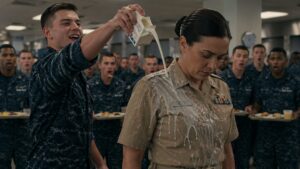
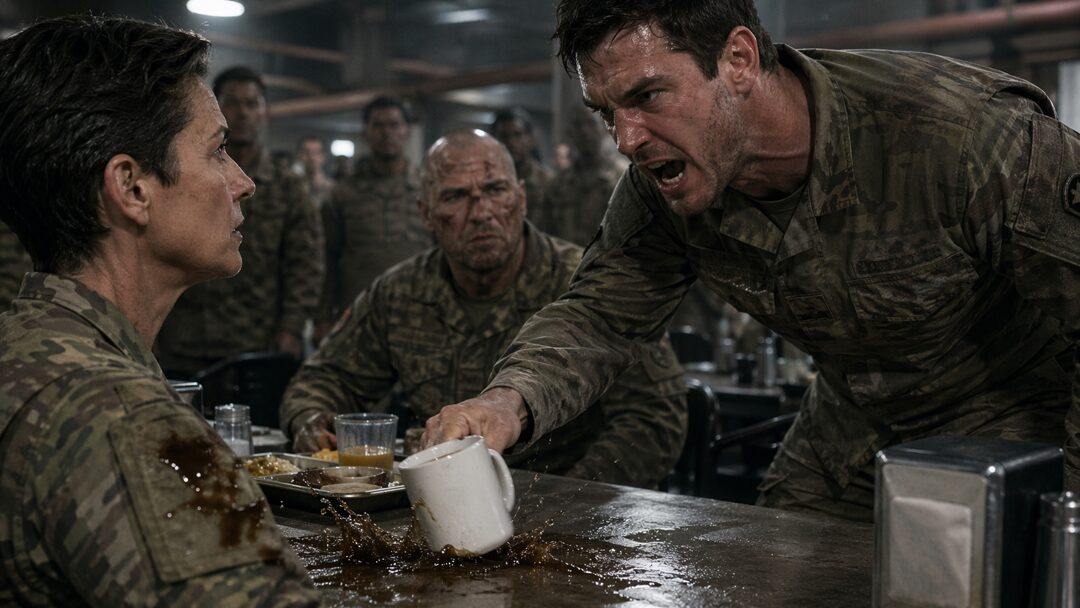
Captain Eli Stevens slammed the white coffee mug onto Colonel Mara Vance’s table so hard that every tray in the mess hall seemed to jump.
Coffee burst over the rim.
It ran across the fake wood, under Vance’s untouched eggs, and down the sleeve of her perfectly pressed uniform.
Two hundred soldiers stopped eating.
Stevens leaned over the table, broad shoulders trembling, eyes red from too little sleep and too much memory.
“Look at me,” he said. “Look at me while I say their names.”
Colonel Vance did not move.
She sat alone at the end of the long table beneath the fluorescent lights of Camp Redstone’s dining hall, her spine straight, her gray-threaded dark hair cut close against her head. Her name tape read VANCE. Her rank was visible to everyone in the room.
So was the coffee spreading over her cuff.
Stevens looked like he had dressed himself by force. His uniform was correct, but his jaw was unshaven, his eyes hollow, his hands raw at the knuckles. He had survived Ash Valley. That was the first thing everyone knew about him now.
The second thing was that he hated the woman sitting in front of him.
“You left them,” he said.
A fork slipped somewhere near the serving line.
No one picked it up.
Lieutenant Nora Reyes stood behind Vance’s right shoulder, small and rigid, one hand already half-raised as if to call security. Vance did not look at her. She only reached for a napkin, folded it once, and touched it to the edge of the spill before it reached the casualty roster Stevens had slapped onto the table.
Then she said to the nearest sergeant, quietly, “Let him finish.”
The words moved through the room like a dropped match.
Stevens heard permission.
His mouth tightened.
“You hear that?” he said, turning just enough for the nearest tables to catch it. “She’ll let me finish. That’s command, right? Sit there clean while other people do the bleeding.”
Nora’s face changed.
Vance’s hand shifted once, a small downward gesture.
Nora stopped.
Stevens saw it. His laugh came out flat and ugly.
“Still got someone else taking orders for you.”
The coffee reached Vance’s sleeve seam and darkened the cloth.
She did not look down.
Stevens bent closer.
“You watched us burn from a command post. Drone feed. Satellite overlay. Clean screens. Cold coffee. And when Glass called for help, you refused air support.”
Vance’s eyes lifted to his.
That was all.
The room seemed to lean with Stevens, waiting for her to deny it.
She didn’t.
He pulled the folded roster from his chest pocket. The paper had been opened and closed so many times the creases had gone soft. There were stains on it that were not coffee. He unfolded it with careful hands, which somehow made him look more dangerous than when he had struck the table.
“Nine names,” he said. “Nine soldiers outside the perimeter when you decided your career was worth more than their lives.”
Vance’s jaw tightened.
Only once.
Stevens saw that too.
Good, his face said. Bleed a little.
He placed the roster on the table between them.
“Sergeant Miles Harlan.”
The name landed heavier than the mug had.
At a table near the west wall, Staff Sergeant Caleb Boone closed his hand around his fork until his knuckles whitened. His prosthetic leg was tucked beneath the bench, hidden from most of the room, but not from Vance. Her eyes moved to him for the briefest moment.
Boone looked away.
Stevens went on.
“Private Jonah Marr. Specialist Luis Kent. Corporal Will Arledge. Sergeant Miles Harlan.”
“You already said Harlan,” Nora said.
Her voice was controlled, but too sharp.
Stevens turned on her.
“I’ll say him as many times as I want.”
Vance said, “Lieutenant.”
One word.
Nora swallowed the rest.
Stevens leaned back slowly, almost smiling now. He had found the first crack in the room.
“You know what the worst part is?” he said. “The report doesn’t even lie well. It says you redirected assets. It says you violated an evacuation directive. It says people died because Colonel Mara Vance made a command decision.”
His voice lowered.
“But it doesn’t say what you were doing when they died.”
No one moved.
Outside, beyond the low concrete buildings and razor wire and morning heat, the ceasefire zone sat quiet enough to be mistaken for peace. Inside the dining hall, every soldier heard the accusation and understood the danger of it.
A captain was publicly accusing a colonel of cowardice.
A survivor was accusing the officer who had come back from a classified hearing with no command, no explanation, and no defense.
Stevens pushed the casualty roster closer until the coffee touched its edge.
“Apologize,” he said.
Vance looked at the paper.
Then at him.
“Not here.”
His face hardened as if she had slapped him.
“Not here?” he repeated. “Where, then? In another closed hearing? Behind another stamped door? In whatever room they gave you so you could explain why my people were acceptable losses?”
Vance folded the wet napkin once more.
The gesture was small.
It infuriated him.
“Say it,” Stevens said. “Say you left them.”
Vance’s silence filled the mess hall until even the refrigerators seemed loud.
Part II — The Report Everyone Had Read
The sanitized inquiry summary had arrived on the base network at 0440.
By 0500, everyone had read it.
By 0530, everyone had picked a part of it to believe.
Ash Valley had been a bad mission before the first rotor lifted. Everyone at Camp Redstone knew that much. A ceasefire deadline was closing. Two platoons were still beyond the perimeter. Civilian interpreters were trapped at Ridge Seven. Communications were broken in three places. Weather had grounded half the aircraft. Command wanted senior personnel pulled first before the border sealed.
The report said Colonel Vance violated the evacuation directive.
The report said she split available lift assets.
The report said nine soldiers died.
It did not say why the directive existed.
It did not say who wrote it.
It did not say what was at Ridge Seven.
It did not say Colonel Vance had returned to Camp Redstone with blood under her fingernails and no helmet.
Stevens had read the report six times.
He had not read between the lines because grief leaves no room there.
Vance had come into the dining hall twenty minutes after sunrise, Nora Reyes one pace behind her. Conversation had dropped, then recovered in fragments. The colonel had taken a tray, selected toast, eggs, and black coffee, and sat alone at the end of the table as if she knew no one would join her.
Boone had watched her from three tables away.
He had been there in the valley. He had seen things the report buried. He had meant to stand the moment Stevens crossed the room.
But Stevens had Miles Harlan’s roster in his pocket.
And Boone had his own dead.
So he waited one second too long.
Then another.
Now the mess hall was trapped inside those seconds.
“You want discipline?” Stevens said. “Fine. I’ll be disciplined.”
He tapped the roster.
“Question one. Did you or did you not refuse the first request for air support from Checkpoint Glass?”
Vance said nothing.
“Question two. Did you or did you not order Glass to move north?”
Nora stepped forward again.
“Captain, you are out of line.”
Stevens did not look at her.
“No, Lieutenant. Out of line is dying on a radio while the person with birds in the air tells you to walk away from your wounded.”
Vance’s left thumb pressed against the seam of her trouser leg.
It was the first sign that her stillness cost something.
Nora saw it.
So did Boone.
Stevens did not.
He only saw a woman who would not answer.
“I had the net recording,” he said. “I had enough of it. Not all, because everything went to hell, but enough.”
Vance’s eyes sharpened slightly.
Stevens caught it and smiled without warmth.
“There she is,” he said. “That got through.”
A young private near the serving line whispered, “Jesus.”
No one shushed him.
Stevens pulled his phone from his pocket, but did not play anything yet. He held it like a weapon he was saving.
“Before we get there,” he said, “I want you to hear his name again.”
Nora’s voice dropped. “Don’t.”
Stevens finally looked at her.
“He was my brother-in-law. Did the report mention that? Did your colonel tell you that part? Miles Harlan married my sister under a courthouse flag with forty-eight hours’ leave and a ring from a pawn shop because he said war didn’t get to schedule everything.”
Something moved across Vance’s face.
Not enough for the room.
Enough for Nora.
Enough for Boone.
Stevens saw it too, but he misunderstood it.
“Good,” he said. “You remember him.”
Vance’s voice came quietly.
“I remember every soldier in that valley.”
“Then say what happened to him.”
The room waited.
Vance said, “Not like this.”
That was the worst answer she could have given him.
Stevens laughed once, short and broken.
“Not like this,” he repeated. “You hear that? There’s a proper way to talk about dead men. Apparently it’s not in front of the people who served with them. Not in front of the people who carried what was left.”
His hand struck the table again.
The white mug tipped fully this time, rolled once, and came to rest against Vance’s tray.
Coffee dripped onto the floor.
Vance did not flinch.
That made him angrier.
“Were you even there?” he demanded. “Or did you watch the valley burn in high definition?”
Boone’s bench scraped the floor.
Every head turned.
He stood too quickly and paid for it. Pain pulled his face tight. One hand dropped to the table for balance, the other curled near his thigh where the prosthetic met what was left of his leg.
“Sit down, Captain,” Boone said.
Stevens turned slowly.
For the first time that morning, uncertainty touched his face.
“Don’t,” Boone said. “Don’t make me say this in here.”
Stevens stared at him.
Then his grief found armor again.
“You survived,” he said. “Of course you want me to sit down.”
Boone’s eyes went flat.
Stevens knew he should stop.
He didn’t.
“You survived because she picked favorites.”
A sound moved through the room. Not quite a gasp. Not quite a warning.
Boone leaned both hands on the table.
“Vance wasn’t in a command post,” he said.
Vance’s head turned.
“Sergeant.”
But Boone was past the order now.
He looked at Stevens with a tiredness that seemed older than rank.
“She was on the second helicopter.”
Stevens blinked.
Boone said, “The one you never saw.”
Part III — The Second Helicopter
For a second, the mess hall changed shape.
Nothing moved, but the story everyone had been holding shifted in their hands.
Stevens looked from Boone to Vance.
“No.”
Boone gave a humorless smile.
“That’s your answer? No?”
“She was command,” Stevens said, but the words had lost force. “She was coordinating extraction.”
“She was coordinating it from the ground by the end.”
Vance stood.
Not abruptly. Not dramatically.
Just enough to remind everyone that she was still the senior officer in the room.
“That is enough, Staff Sergeant.”
Boone looked at her.
For one painful second, he looked like a man asking permission to stop lying by omission.
Vance’s eyes said no.
His face hardened around the hurt of it.
Stevens watched the exchange. The room did too.
“What are you hiding?” he asked.
Vance turned back to him.
“More than you can carry in this room.”
The line hit harder because she did not raise her voice.
Stevens stared at her.
Then rage rescued him from confusion.
“Don’t you dare make this about my capacity.”
“It is about all of ours,” Vance said.
There was a tremor under the calm now. Not fear. Restraint under strain.
Stevens pointed toward Boone.
“He says you were there. Fine. Then answer the question. If you were there, why didn’t you come for Glass first?”
Vance’s expression closed.
Stevens stepped closer.
“Why did Miles wait?”
A chair creaked somewhere behind him.
“Why did he die facing north, Colonel?”
The room went so still it seemed to lose air.
Vance’s hand closed around the wet napkin. Her knuckles blanched once. Then she released it.
Nora Reyes made her choice before she could talk herself out of it.
“The orders she disobeyed were not to save Glass,” Nora said.
Vance’s head snapped toward her.
“Lieutenant Reyes.”
Nora did not stop.
“They were to abandon everyone outside the perimeter.”
The sentence took the room apart.
A few soldiers looked at the floor. Others stared at Vance with the raw, helpless expression of people realizing the report had protected someone, but not the person they thought.
Stevens’ mouth opened, then closed.
Nora’s voice stayed steady because if she let it shake, she might not finish.
“Senior command wanted command assets and cleared personnel inside the wire before the ceasefire deadline. Ridge Seven was outside the priority radius. So was Glass. So were the interpreters. So were the wounded who couldn’t move.”
“That’s not in the report,” Stevens said.
“No,” Nora said.
“Why?”
Vance answered before Nora could.
“Because the report was not written for the dead.”
Stevens looked at her.
For the first time, he did not look furious.
He looked afraid of what he might have to learn.
Nora continued anyway.
“Colonel Vance split the extraction. Half the aircraft went toward your platoon. She took the other half into the valley herself.”
“You don’t get to say that like it absolves her,” Stevens said.
“It doesn’t,” Vance said.
That stopped him.
Her voice was still quiet, but there was something bare in it now.
“It does not absolve me.”
Boone closed his eyes.
Vance looked at Stevens.
“Thirty-one people came out because I violated that directive. Nine did not. If you need that to be simple, Captain, I cannot give you simple.”
Stevens’ face twisted.
“You chose.”
“Yes.”
The word was so clean it seemed cruel.
Stevens recoiled as if he had finally gotten the confession he wanted and found it useless.
“You chose who lived.”
Vance held his stare.
“I chose where to send the aircraft.”
“That’s the same thing.”
“No,” Vance said. “It only feels the same afterward.”
For a moment, no one breathed.
The fluorescent lights hummed overhead.
Outside, somewhere across the base, a vehicle backed up with three small beeps. The sound seemed obscene in its normalness.
Stevens looked down at the casualty roster. Coffee had soaked one corner. The ink near Miles Harlan’s name had begun to blur.
He touched the paper with two fingers and then pulled back as if it burned.
“You had birds,” he said. “You had enough to send one to Glass.”
Boone’s jaw clenched.
Nora looked at Vance.
Vance said nothing.
Stevens lifted his phone.
“I have your voice.”
Nora went still.
Vance did too, but differently. Like a door had closed behind her.
Stevens unlocked the screen with a shaking thumb.
“Maybe everyone should hear the part that made me stop sleeping.”
Part IV — Leave Glass
The recording began with static.
Then shouting.
Then a voice everyone in the room recognized.
Vance’s voice.
Thin through bad transmission. Clipped by interference. Cold enough to sound heartless.
“Leave Glass. Move north. Repeat, leave Glass. Move north.”
The mess hall heard it.
No one could pretend otherwise.
Stevens lowered the phone, breathing hard, almost relieved by the cruelty of proof.
“There,” he said. “There it is.”
Vance looked at the phone.
Her face had not changed, but the room had. Confusion had become accusation again. Not as strong as before, but alive.
Even Boone looked wounded by the sound of it.
Stevens turned the screen outward, as if the phone itself were a witness.
“That is your voice.”
“Yes,” Vance said.
“You ordered them away.”
“Yes.”
Nora stepped beside the table now, no longer behind Vance.
“You don’t have the next line.”
Stevens snapped his eyes to her.
“What?”
“You don’t have the next line.”
“I have enough.”
“No,” Boone said.
His voice had changed. It was rougher now, less controlled.
“You have the part that survived your radio.”
Stevens looked between them.
Vance said, “Stop.”
Boone shook his head.
“No, ma’am.”
It was the first direct refusal.
The room felt it.
Boone dragged in a breath, pain breaking through his face as he shifted weight onto the prosthetic.
“Glass had a battery lock on its signal,” he said. “They were painted. If they stayed, they were dead. If they moved north, maybe the lock broke long enough for pickup.”
Stevens’ face drained.
“No.”
Nora said, “The full transcript was in the hearing record.”
“Why wasn’t I given it?”
Vance’s expression turned almost gentle, which somehow hurt more.
“Because grief makes people believe classified means personal.”
Stevens flinched.
Nora continued, softer now but still precise.
“The next line was, ‘Move north, I am coming to you.’”
The words seemed to hang above the stained table.
Stevens stared at Vance.
“You said what?”
Vance did not answer.
Boone did.
“She sent her own bird.”
Stevens took one step back.
“No.”
Boone’s voice rose for the first time.
“She sent her own bird, Stevens. The second helicopter. She was on it. We took fire before landing. Hard enough to tear the tail open. We came down short.”
A few soldiers in the room looked at Boone’s hidden leg.
He saw them looking and hated it, but he kept speaking.
“She got us moving anyway. Pulled Marr by his vest. Dragged Kent until two medics could take him. She kept calling Glass until the net broke. She was not watching from a safe room.”
Vance’s face turned to stone.
But her hand, the one near the coffee stain, trembled once.
Stevens saw it this time.
Nora said, “Miles Harlan refused to move north without the two wounded who couldn’t walk.”
Stevens shut his eyes.
“Don’t.”
“You brought him into this room,” Nora said, and now her restraint cracked. “You don’t get to leave him halfway.”
Vance’s voice cut through.
“Lieutenant.”
Nora stopped, breathing hard.
Stevens’ phone lowered slowly to his side.
His anger was still there, but it had nowhere clean to go.
“Did he call?” he asked.
Vance’s eyes moved to the casualty roster.
“Yes.”
“What did he say?”
“Captain—”
“What did he say?”
Vance held silence for one more second.
Then the main doors opened.
Base Commander Harding entered with two military police behind him.
“What the hell is going on in here?”
Every soldier in the room straightened by instinct.
Stevens did not move.
Harding’s eyes went from the spilled coffee to the roster, from Stevens’ phone to Vance’s stained sleeve.
“Captain Stevens,” Harding said, cold and formal. “Step away from the colonel.”
Stevens’ mouth barely moved.
“Sir.”
“Now.”
Vance turned toward Harding.
“Do not remove him.”
Harding’s jaw shifted.
“Colonel, he has crossed every line in the building.”
“Yes,” Vance said. “He has.”
The words should have ended Stevens.
Instead, Vance looked back at him.
“But not all lines are crossed for the same reason.”
Harding said, “That is not your call anymore.”
The room caught the last word.
Anymore.
Stevens caught it too.
His eyes narrowed.
“What does that mean?”
Vance did not look at Harding.
“It means I am no longer in field command.”
The admission fell with no drama at all.
That made it worse.
Stevens stared at her.
“Because of Ash Valley?”
“Because of what I chose in Ash Valley.”
He swallowed.
For the first time all morning, he looked younger than thirty-four.
“And you still wouldn’t defend yourself?”
Vance’s hand moved to the breast pocket of her uniform.
Nora looked down.
Boone bowed his head.
Vance drew out a small metal tag on a broken chain.
It was bent, scorched along one edge, the stamped letters still readable from where Stevens stood.
HARLAN, MILES D.
Stevens stopped breathing.
Part V — The Salute
Vance placed the dog tag on the table beside the spilled coffee.
The sound was almost nothing.
It was enough.
Stevens stared at it as if the room had disappeared around him.
His hand lifted, then stopped halfway.
Vance did not push the tag toward him.
She left it between them.
“Miles died facing north,” she said.
Her voice was low. No performance. No defense.
“He had Private Weller by the collar. Weller’s legs were gone below the knee. Miles was dragging him with one hand and firing with the other.”
Stevens’ lips parted.
Vance continued.
“He was angry.”
A strange, broken sound came from Stevens’ throat.
Vance’s eyes held his.
“He was cursing me over the radio for being late.”
Boone wiped his mouth with the back of his hand.
Nobody pretended not to see.
Vance looked at the tag.
“I was late.”
Nora whispered, “Ma’am.”
Vance did not stop.
“He got Weller into the open. The smoke was too thick for the crew to mark him. He stood up so they could see where to land.”
Stevens closed his eyes.
Vance said, “The second strike hit before they touched down.”
The room did not move.
Even Harding said nothing.
Vance’s voice lowered further.
“I carried his tag out because there was no time for his body.”
Stevens’ hand dropped to the table, but not on the tag.
Beside it.
He bent forward slightly, as if some invisible weight had finally found his spine.
“All this time,” he said.
No one answered.
He looked at Vance with eyes that had lost their target.
“You had that.”
“Yes.”
“And you let me—”
“Yes.”
The single word was not forgiveness.
It was fact.
Stevens’ face twisted with shame.
“Why?”
Vance’s gaze did not soften.
“Because the dead are not a shield.”
The line silenced even the men by the doors.
Stevens looked down again.
At the roster.
At the coffee.
At the dog tag.
At the proof of the man he had loved and the proof of the woman he had hated.
His fingers reached for the metal.
They hovered.
He could not pick it up.
Boone moved first.
It took effort.
The scrape of his bench was loud. His prosthetic caught for a moment under the table. He grabbed the edge, jaw tight, and pulled himself upright.
His salute was not perfect.
It was painful.
It was real.
Vance turned toward him.
“Staff Sergeant—”
Boone held the salute.
His eyes shone, but his voice was steady.
“For Ridge Seven, ma’am.”
Nora stood next.
Her salute was sharp enough to cut.
“For the record they didn’t write.”
Then a medic rose near the back.
Then a young corporal with his arm still in a sling.
Then a cook who had been on casualty detail the night the helicopters came back.
Then one table.
Then another.
The room did not rise like a movie.
It rose badly.
Benches scraped. Boots tangled. A private knocked over a tray and cursed under his breath before snapping upright. A soldier near the east wall took too long because his hands were shaking. Someone cried silently and looked furious about it.
One by one, the mess hall stood.
Two hundred soldiers saluted Colonel Mara Vance.
Not because of the rank on her chest.
Because of what she had refused to spend.
Vance looked at them.
For the first time, the room saw how tired she was.
She returned the salute.
Her hand was steady going up.
It trembled coming down.
No one missed that.
Stevens stood alone beside the stained table, the only person in the room not saluting and the only person who could not seem to move.
His eyes were closed.
His face had gone slack with the awful privacy of public shame.
Vance did not look at him as if he had been defeated.
That was almost worse.
She looked at him as if he had finally arrived somewhere terrible.
Harding lowered his eyes.
The military police at the door stood frozen, unsure whether to enforce order or honor what order had failed to contain.
At last, Vance said, “Carry on.”
The soldiers lowered their hands.
Breakfast did not resume.
No one knew how to return to eggs after that.
Stevens opened his eyes.
The dog tag still lay on the table.
He whispered, “I’m sorry.”
It was too small for the room.
Vance heard it anyway.
She did not answer.
Not because she wanted to punish him.
Because some apologies are only the beginning of what has to be carried.
Part VI — What the Truth Cannot Fix
By 0930, the mess hall was empty except for the stain.
The coffee had dried into a dark, irregular mark across the table, with one thin line where it had run toward the floor and stopped. Someone had cleared the trays. Someone had picked up the fallen fork. Someone had set the white mug upright near the edge as if manners could be restored after the fact.
Vance still sat where she had been.
Her sleeve was dry now, stiff with coffee.
The dog tag was gone from the table, but not far. It rested in her closed hand.
When Stevens returned, he stopped just inside the door.
He had shaved.
That almost made him look worse.
Without the stubble, there was nothing to hide the exhaustion in his face.
Vance did not turn.
“I thought you’d be gone,” he said.
“I thought you would.”
He walked to the table slowly and sat across from her without asking permission. The dried stain lay between them like a border neither of them wanted to cross.
For a while, neither spoke.
The morning formation outside sent faint voices through the walls. Boots struck gravel in uneven rhythm. Somewhere, a sergeant barked a correction, and life kept doing what life did around grief. It continued without asking permission.
Stevens looked at the stain.
“I needed him to have died because someone failed him.”
Vance opened her hand.
Miles Harlan’s tag lay against her palm.
“Someone did,” she said. “Just not the way you wanted.”
He absorbed that.
It hurt him. She did not soften it.
“Did he suffer?”
Vance looked toward the doors.
“Yes.”
Stevens nodded once, eyes fixed on the table.
“Did he know you came?”
“Yes.”
His mouth tightened.
“Did he hate you?”
Vance’s thumb touched the bent edge of the tag.
“At that moment? Probably.”
A broken laugh escaped him.
It almost became a sob.
Vance gave him the dignity of not reacting.
Stevens wiped his face with both hands and sat back.
“What happens to you now?”
“Review board finalizes next week.”
“And then?”
“Retirement, most likely.”
He looked up.
“The salute won’t change that?”
“No.”
His eyes moved over her face, searching for anger, bitterness, something he could understand.
“You saved thirty-one people.”
“Nine died.”
“You disobeyed an order meant to abandon them.”
“I disobeyed an order.”
He stared at her.
“You really won’t take a clean version of anything.”
Vance’s expression almost became a smile.
Almost.
“Clean versions are usually written by people who didn’t have to choose.”
Stevens looked at the tag again.
“His wife,” he said.
Vance waited.
“My sister. Clara. She got the letter. The official one. It said he died during repositioning under hostile fire.” His voice hardened. “Repositioning.”
Vance said nothing.
“I want to tell her.”
“What?”
He swallowed.
“That he didn’t run. That he didn’t get left because nobody cared. That he was carrying Weller. That he stood up so they could see him.”
Vance placed the tag on the table and slid it halfway across the stain.
Not all the way.
Halfway.
“You can tell her what helps her stand tomorrow.”
Stevens looked at her.
“And the rest?”
“Write what you can live with,” Vance said. “Leave out what she cannot.”
His hand covered the tag.
This time, he picked it up.
The metal disappeared inside his fist.
For a moment he looked like he might say more. Something larger than sorry. Something that would try to fix the morning, or Ash Valley, or the wrong enemy he had made out of the woman across from him.
Instead, he stood.
It was the first wise thing he had done all day.
At the door, he stopped.
“Colonel.”
Vance looked at him.
He did not salute.
Not this time.
Maybe because the room was empty.
Maybe because what passed between them now was not for rank.
“I don’t know what to do with the anger,” he said.
Vance’s face stayed calm, but her eyes did not.
“Carry it until it becomes something useful.”
He nodded.
Then he stepped outside into the hard white morning.
A formation was gathering near the motor pool. Soldiers turned when they saw him, then looked away. Not out of contempt. Out of mercy.
Stevens walked toward them with Miles Harlan’s tag in his fist and no clean story left to protect him.
Inside the mess hall, Mara Vance remained at the table.
The coffee stain stayed where it was.
No one had wiped it away.
She sat with her stained sleeve, her empty hand, and the silence she had chosen before anyone understood the cost of it.
Outside, the morning orders began.
Inside, the colonel closed her eyes for one breath.
Then she opened them.
And stayed.