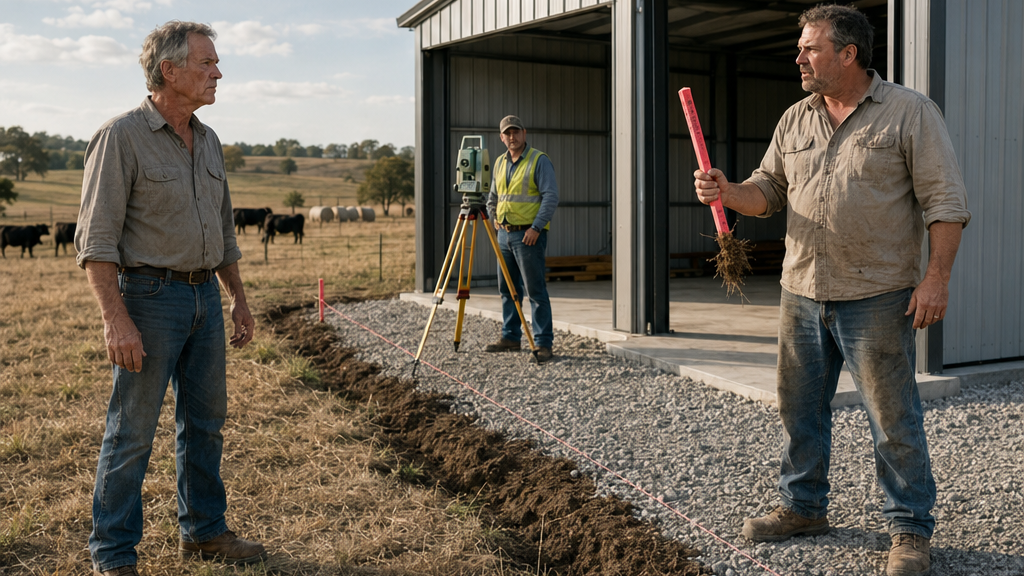
He Moved the Farm Boundary a Few Feet Each Summer—Then the New Survey Cut Through His $40,000 Equipment Shed
Chapter 1: The Stake Was Three Feet Farther West
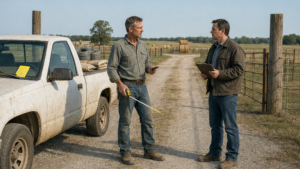
William Hall knew the stake had moved before he even stepped out of the truck.
The bright orange top should have been almost even with the old hedge apple at the edge of his hay pasture. He had driven past it the evening before while checking cattle, and it had stood where he had reset it three weeks earlier.
Now it was nearly three feet west.
Three feet deeper into his ground.
William shut off the truck and sat with one hand on the steering wheel. Across the fence line, a skid steer idled in Anthony Clark’s machinery yard. Fresh gray gravel had been spread from the yard toward the pasture, flattening what had once been a ragged strip of grass.
Anthony stood beside the displaced stake with a shovel in one hand.
William got out.
“Morning.”
Anthony looked over. “Morning.”
William walked to the stake and crouched. The soil around it was loose and darker than the hard August ground surrounding it.
“Did you move this?”
Anthony rested both hands on the shovel handle.
“It was in the way.”
“That isn’t what I asked.”
Anthony glanced toward the skid steer. “I put it where that line has always run.”
William stared at him.
For years, their disagreements had been small enough to ignore. A tractor wheel clipping William’s grass. A trailer cutting wide during hay season. A stack of fence panels sitting a little too close to the line for a month before disappearing again.
William had always told himself the same thing.
They were neighbors.
Neighbors made room.
His father had said it too, although the older man had meant opening a gate when somebody’s cattle got loose or pulling a truck from mud before a storm. William had slowly turned the phrase into permission for nearly anything that avoided an argument.
He touched the stake.
“I put this back myself.”
Anthony shrugged. “Based on what?”
“The old line.”
“The old line according to you.”
William stood.
Anthony was sixty or close to it, broad through the shoulders, sun-dark around the neck. His family had run cattle on the adjoining ground longer than William had owned the Hall farm outright. He spoke with the confidence of someone accustomed to equipment routes becoming roads simply because enough tires had followed them.
“There used to be another marker down by the drainage dip,” William said.
Anthony’s expression barely changed. “Used to be a lot of things.”
The skid steer moved behind him, its bucket scraping gravel flat.
William looked past Anthony.
Heavy tire tracks crossed the disputed strip and curved onto William’s side before looping back toward Anthony’s equipment yard. The grass there had been crushed into two dark arcs.
They weren’t one set of accidental tracks.
They formed a route.
“How long have you been turning through here?”
Anthony looked at the tracks as if noticing them for the first time.
“Big trailers need room.”
“So you made room on my side.”
“It’s a pasture edge, William.”
“That doesn’t make it yours.”
Anthony let out a breath.
“This is exactly why I didn’t ask before every load came through. We’d spend half the day measuring tire marks.”
William felt the familiar instinct to let the argument die.
He hated scenes. Hated raising his voice across fence lines. Hated the way one disagreement could become coffee-shop gossip before lunch.
But the loose soil around the stake bothered him more than Anthony’s tone.
William pulled out his phone.
Anthony watched him take a photograph.
“You documenting dirt now?”
“I’m documenting the stake.”
“For what?”
William did not answer.
He took another photograph with the hedge apple visible behind it, then one showing the gravel edge and tire tracks.
Anthony shook his head and turned toward the skid steer.
“Suit yourself.”
William drove back to his equipment shed instead of continuing toward the cattle.
Inside his small farm office, he opened the folder on his phone where he kept pasture pictures, fence repairs, culvert washouts, and anything else he thought he might need later.
He searched by summer dates.
Three years earlier, the orange stake had stood almost directly beneath the outer branches of the hedge apple.
Two years earlier, it was slightly west of that.
Last summer, farther again.
William leaned closer to the screen.
He found another picture taken after a thunderstorm. He had photographed a broken limb, not the property line, but the stake showed clearly in the corner.
Farther east.
His stomach tightened.
He began arranging the images by date.
One move might have been memory.
Two might have been careless equipment.
Five photographs were harder to dismiss.
The line seemed to be walking.
Not dramatically.
A foot here. Another couple there.
Just enough that each individual change could sound foolish if spoken aloud.
William sat back.
He thought of every time he had noticed something and said nothing.
Once, he had found a stake lying beside a tire rut and driven it back where he thought it belonged. Anthony later moved it again.
Another summer, William had noticed gravel spreading west. Anthony said rain had washed it.
William had let that go too.
Now the photographs showed a pattern his memory had kept softening.
His phone rang.
Frank Lee’s name appeared.
William answered.
“You busy?” Frank asked.
“Depends.”
“I’ve got two wagons coming through tomorrow. Anthony said his side entrance might be tight with construction. Said I could swing around by your pasture corner if I needed.”
William stared toward the window.
“What construction?”
There was a pause.
“You haven’t seen it?”
“I’ve seen gravel.”
“He’s putting up a machinery shed.”
William stood.
“How big?”
“Pretty good size. Steel frame. Three bays, I think.”
William walked outside before Frank finished speaking.
From the rise behind his barn, he could see through a break in the trees along the boundary.
Metal posts stood beyond Anthony’s yard.
New concrete footings ran in a straight line beside them.
William ended the call without remembering exactly what he said.
He drove back toward the pasture, parked beside the hedge apple, and walked farther down the line than he had that morning.
The gravel widened as he went.
Then the trees opened.
Anthony’s new shed frame stood ahead, its roof trusses beginning to take shape over the machinery yard.
One row of concrete footings sat far closer to William’s pasture than he expected.
He looked down at the orange stake.
Then at the footings.
For the first time, three feet no longer felt small.
Chapter 2: Eleven Feet Became a Working Yard
William printed five photographs and laid them across his desk in chronological order.
The oldest showed a straight fence remnant, knee-high grass, and a bright orange stake near the hedge apple.
The newest showed gravel.
Lots of it.
William placed a ruler along the background features that had not moved—the tree trunk, the corner of the old woven-wire fence, the drainage dip.
He knew photographs were not surveys. Perspective could lie. Angles could distort distance.
But the stake kept drifting in only one direction.
West.
Toward him.
He pulled out the county tax map he kept with his farm papers. It was not precise enough to settle a boundary dispute either, but the shape of the parcels confirmed something important: the line was supposed to run much straighter than Anthony’s machinery use suggested.
By midmorning, William had marked every place where Anthony’s gravel or tire tracks appeared beyond what William remembered as the old boundary.
The widest point was near the turning area.
He paced it.
Ten long steps.
Nearly eleven feet.
William stood there looking at the compacted gravel.
Eleven feet was not an accident made by one wide trailer.
It was a yard.
Anthony had turned William’s pasture edge into part of his working yard without ever calling it that.
A diesel engine growled from the county road.
A feed truck came through Anthony’s entrance carrying bulk feed. William stayed beside the fence and watched.
The driver entered slowly, lined up with the storage area, then swung wide.
The front tires stayed on Anthony’s gravel.
The rear tandem did not.
They crossed the faded grass strip, rolled deep into William’s side, and followed the dark arc he had photographed the day before.
Nobody stopped.
Nobody hesitated.
The truck moved as if that ground had always belonged to Anthony.
William waited until the delivery was finished, then walked over.
Anthony was checking a hopper connection beside the truck.
“We need a survey.”
Anthony did not look up.
“We need feed unloaded.”
“I mean the boundary.”
“I know what you mean.”
“Then let’s have somebody mark it properly.”
Anthony secured the line and finally faced him.
“You want to spend money proving where a fence has been for thirty years?”
“I want to know where the line is.”
“I know where it is.”
“Then a survey shouldn’t bother you.”
Anthony wiped dust from his hands.
“You’ve watched equipment turn there for years.”
“That’s not the same as giving you the ground.”
“Never said it was.”
“You moved my stake yesterday.”
Anthony’s jaw tightened.
“I moved a plastic stick.”
“You moved a boundary marker.”
“It wasn’t a legal monument.”
William paused.
That answer landed differently.
Anthony knew enough to distinguish an informal stake from a legal survey monument.
William studied him.
“Then you understand why I want a real survey.”
Anthony looked toward the new shed.
The steel skeleton was farther along than William had realized. Roof panels covered more than half of it now.
“You do what you want,” Anthony said. “But don’t make a problem out of normal farm use.”
William nearly laughed.
Instead he said, “Normal use ends somewhere.”
Anthony turned away.
That afternoon William returned to his photographs.
He enlarged one from five summers earlier. Anthony’s old equipment yard had been narrower. The turnaround ended well east of the hedge apple. There was no gravel beside the drainage dip.
Another photo, two years later, showed a shallow band of crushed stone.
Last year’s showed more.
William wrote dates on the backs of the prints.
The gradual nature of it bothered him most.
If Anthony had dumped eleven feet of gravel onto William’s pasture in one morning, William would have stopped him before lunch.
But nobody took eleven feet in one morning.
They took enough each year that objecting felt petty.
William had helped make that possible.
Frank stopped by near evening.
He found William standing beside the turning area.
“You measuring?”
“Trying to.”
Frank looked toward Anthony’s shed.
“That’s a nice building.”
“That’s what worries me.”
Frank frowned.
William pointed to the hedge apple.
“I’ve got pictures from five years ago. The working edge was over there.”
Frank followed the line with his eyes.
“And now?”
William stepped to the outer edge of the gravel.
“Here.”
Frank’s expression changed slightly.
“That much?”
“Close to eleven feet at the widest point.”
Frank rubbed his chin.
“You two ought to sit down before this gets expensive.”
“I tried.”
“Try again.”
William looked at him.
Frank had hauled hay through both properties for years. He valued whatever arrangement kept trucks moving and gates open. William understood that.
“You think I’m being stubborn?”
“I think both of you know how to be.”
“That isn’t an answer.”
Frank looked toward the shed.
“If that building’s across the line, somebody should’ve figured it out before the roof went on.”
William said nothing.
The following morning, he drove past Anthony’s place before breakfast.
The roofing crew was already there.
By noon, the final metal panels covered the third bay.
William watched from his pasture while Anthony stood with two farmhands beneath the finished roof.
For one irrational moment, William hoped the building itself would settle the question—that from this angle it would obviously sit on Anthony’s side.
It did not.
The outer row of posts seemed almost aligned with where William remembered the old line.
Almost.
That word had protected the problem for years.
William went home and searched for licensed surveyors serving the county.
He called the first office. Their schedule was full for a month.
The second could come in three weeks.
The third had a cancellation.
“Next Thursday,” the surveyor said. “Morning.”
William looked through the window toward Anthony’s roof shining above the trees.
“Book it.”
“Will the adjoining owner be notified?”
“I’ll handle that.”
When he ended the call, William realized he had made the appointment without telling Anthony.
Part of him knew he should walk over immediately.
Instead, he put the phone down.
For once, he wanted the line established before another conversation could move it.
Chapter 3: The New Line Ran Through Steel Posts
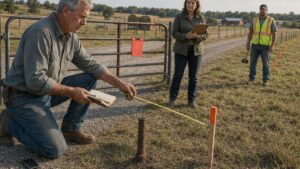
The surveyor drove the first bright stake into the ground less than a foot from one of Anthony’s new steel posts.
William stared at it.
The surveyor checked the instrument again.
Then the prism.
Then the measurement notes.
He did not react.
That frightened William more than surprise would have.
“You sure?” William asked.
The surveyor glanced at him.
“I’m sure of this point.”
Across the yard, Anthony had stopped walking.
He came toward them slowly.
“What are you doing?”
William kept his voice level.
“Getting the boundary surveyed.”
“You didn’t tell me they were coming today.”
“No.”
Anthony looked at the instrument tripod, then at the stake beside the post.
“That isn’t right.”
The surveyor said nothing.
Anthony pointed.
“That line has never been there.”
William folded his arms.
“That’s why I hired somebody.”
Anthony stepped closer to the stake.
“You’ve got the wrong reference.”
The surveyor finally spoke.
“I’m working from recorded control points and the recovered monument at the south end.”
“There’s an old fence line.”
“I saw it.”
“That’s the boundary.”
“Not according to the record evidence I’ve recovered so far.”
Anthony looked at William.
“Your dad never treated it like that.”
The mention of his father tightened something in William’s chest.
“My dad isn’t the survey.”
“No, but he knew how this place worked.”
William almost answered too quickly.
He remembered himself at forty, standing beside his father while Anthony’s father backed a hay wagon across the same corner. Nobody had objected. Nobody had measured tire tracks.
Temporary use had once been trust.
Somewhere along the way, trust had become gravel.
“Finish the survey,” William said.
The surveyor moved north.
Anthony followed.
So did William.
The next measurement took longer.
The surveyor positioned the prism beyond the shed, checked the reading, shifted slightly, then drove another stake.
It landed on the opposite side of the outer bay.
William looked from one bright marker to the other.
A straight line between them would pass directly beneath Anthony’s roof.
Anthony understood it at the same moment.
“No.”
He walked to the first stake.
“No, that can’t be right.”
The surveyor began pulling marking string from his truck.
Anthony turned to William.
“You’re telling me your property comes through my building?”
“I’m not telling you anything. He is.”
“This building cost me forty thousand dollars.”
William looked at the finished steel posts, roof, concrete pad, and the equipment already parked beneath it.
He had expected satisfaction.
Instead he felt sick.
The surveyor stretched the line.
Bright cord ran from stake to stake.
It crossed under the outer bay, over the concrete edge, then through the gravel apron beyond it.
The visual was brutally simple.
Anthony’s expensive new structure did not sit beside the disputed boundary.
The boundary ran through it.
The surveyor continued south toward the drainage dip.
Another stake went into the ground beyond Anthony’s trench.
William followed the line with his eyes.
The gravel apron crossed onto his parcel.
So did part of the drainage channel Anthony had installed to move water away from the new shed.
The machinery turning area extended farther still.
Years of little adjustments had not created one problem.
They had created three connected ones.
Anthony stood beside the first steel post.
“You’ve got to move that line.”
The surveyor looked at him.
“I don’t move lines.”
“You know what I mean.”
“I’m marking what I recover and calculate from the record.”
Anthony turned to William.
“We can work this out.”
William heard the sentence and nearly accepted it from habit.
Work it out.
That was what he had been doing for years.
A tire crossing here. Gravel spreading there. One stake shifted because it was inconvenient.
He looked at the cord beneath the shed.
“What does working it out mean?”
Anthony lowered his voice.
“It means you don’t turn this into something bigger than it is.”
William stared at him.
“The line goes through your building.”
“A corner of it.”
The surveyor glanced over but did not interrupt.
William pointed toward the drainage trench.
“And the apron.”
“We need turning room.”
“And the drainage.”
“We had water coming through the shed site.”
“You built the shed site there.”
Anthony’s face hardened.
“You stood over there for years and never said a word about tractors turning through here.”
“I said plenty about the stakes.”
“You complained about sticks in the ground.”
William felt heat rising through his neck.
He kept his hands at his sides.
“That’s what you thought they were?”
Anthony did not answer.
The surveyor moved toward the truck for another piece of equipment.
Anthony bent suddenly and grabbed the first bright stake.
William stepped forward.
“Leave it.”
Anthony pulled it free.
Loose soil dropped from its point.
For a second nobody spoke.
Anthony held the stake in his hand.
“This is ridiculous.”
William’s anger sharpened into something colder.
“Put it back.”
“You think driving a piece of wood beside my building changes thirty years?”
“No.”
William looked toward the surveyor.
“The measurement does.”
Anthony tossed the stake onto the gravel.
The surveyor walked back.
His expression was controlled, but his tone changed.
“Don’t remove my markers while I’m working.”
“It’s on my yard.”
The surveyor looked at the string crossing beneath the shed.
“That is precisely what we’re determining.”
Anthony opened his mouth, then stopped.
The surveyor replaced the stake using his measurements and photographed it.
Then he photographed the steel post, the line, the trench, and the gravel edge.
William took out his own phone.
Anthony noticed.
“You really doing this?”
William photographed the replaced stake.
“Yes.”
Anthony shook his head.
“You could’ve come to me before bringing somebody out here.”
William almost laughed at the unfairness of that.
“I did.”
“No, you came over wanting to prove something.”
“I asked for a joint survey.”
“And I told you that line’s been used the same way for years.”
“That wasn’t an answer.”
Anthony looked toward the shed.
For the first time since William had known him, his confidence seemed less like certainty than calculation.
“How much do you think is over?” he asked.
The surveyor answered carefully.
“I’ll give you dimensions when I finish the fieldwork.”
By late afternoon, the preliminary picture was clear enough.
One outer shed bay crossed the boundary substantially.
Most of the usable gravel apron on that side lay on William’s parcel.
The drainage trench crossed it too.
William stood alone after the survey crew packed their equipment.
Anthony had gone back toward his house without saying goodbye.
The line remained.
Bright stakes.
Taut string.
Steel posts rising over it.
William should have felt vindicated.
For years he had wondered whether he was imagining the movement, remembering things incorrectly, turning ordinary farm use into a private grievance.
He had not imagined it.
That small payoff brought no relief.
The surveyor closed his truck door.
“You need to keep records from today.”
“I have pictures.”
“Keep all of them. And if any marker gets disturbed again, photograph that too.”
William glanced toward Anthony’s yard.
“Why?”
The surveyor paused.
“Because a disagreement about where a line is can be an honest dispute.”
He looked at the freshly replaced stake.
“Removing a marker after it has been measured is a different kind of fact.”
William looked back at the shed.
Until that moment, he had been asking how far Anthony had crossed the line.
Now a worse question had taken its place.
How long had Anthony known there was a line worth moving?
Chapter 4: The Permit File Was Almost Empty
The county zoning technician searched the property address twice before turning the monitor slightly toward William.
“I have an application entry,” she said. “I don’t have a completed setback review.”
William looked at the screen without touching the desk.
“There should be something for the shed.”
“There is something for a shed.”
“That one?”
She read the parcel number again.
“Yes.”
Anthony had told him three days earlier, standing beside the bright survey line, that the building had been approved. He had said it with enough irritation that William had almost believed the permit question was one more unnecessary complication he was creating.
The technician clicked through another page.
“No final structural approval either.”
William leaned closer.
“What does that mean?”
“It means I can tell you what’s in the file. I can’t tell you yet what should happen out there.”
She printed several pages and slid them across the counter.
The application showed a machinery-storage building. There was a rough site sketch with a rectangle placed well inside Anthony’s parcel.
No survey coordinates.
No measured setback from the western property line.
No notation showing the drainage trench William had watched being dug.
At the bottom of one page, a review box remained blank.
William looked at it longer than he expected.
Anthony had not fabricated the entire thing. He had started a county process. There was paperwork. There had apparently been enough discussion for somebody to enter the project into the system.
But that was different from what Anthony had said.
Approved.
The word had sounded finished.
This file was not finished at all.
“What happens now?” William asked.
The technician tapped the copy of his survey.
“If the licensed survey is accepted and the structure crosses the line, the building inspector will need to look at it. Setbacks may also become an issue depending on the actual building footprint.”
William had come in wanting confirmation.
He left carrying consequence.
Outside, he sat in his truck with the papers on the passenger seat.
He had imagined finding something clean: either Anthony had a valid approval and the county had somehow relied on a bad line, or he had built with nothing at all.
Instead there was a half-completed process.
That bothered him more.
It looked less like an obvious mistake than a decision made somewhere between asking permission and waiting for the answer.
The building inspector came out two days later.
Anthony was waiting beside the shed when the county truck pulled into the gravel yard. William stayed on his own side of the boundary until the inspector waved him closer.
The bright stakes still stood where the surveyor had replaced them.
Anthony had not touched them again.
The inspector walked the line slowly with the survey in one hand and a measuring wheel in the other.
He stopped at the first steel post.
Then he measured to the second.
Then to the drainage trench.
Anthony followed him.
“You can see this isn’t some house addition,” Anthony said. “It’s an agricultural building.”
“I see what it is.”
“The yard has been used this way for years.”
The inspector looked down at the marked line.
“That’s a separate issue.”
“It’s the same issue.”
“No. Use and ownership aren’t the same question.”
William said nothing.
The inspector moved to the outside edge of the concrete pad and checked his notes.
“The site sketch in the application shows this building farther east.”
Anthony’s expression tightened.
“That sketch wasn’t exact.”
“That’s why setbacks get reviewed.”
“I was told farm buildings were straightforward.”
“They often are.”
Anthony pointed toward the field.
“This is what happens when somebody decides to turn a working boundary into a courthouse problem.”
William felt the accusation hit him.
For a moment, he saw how the whole situation must look from Anthony’s side: a neighbor who had tolerated turning traffic for years suddenly arriving with professional measurements, county paperwork, and an inspector.
That part was true.
William had tolerated it.
His silence had helped create the assumption.
But he had not poured the concrete.
The inspector finished measuring.
He stood beside the survey stake and made several notes.
“The building crosses the surveyed parcel line,” he said. “And if this line is correct, the outer bay also fails the setback shown in the county standard.”
Anthony stared at him.
“How much?”
“I’ll put it in writing after I review the file.”
“Are you telling me I have to tear down the whole shed?”
“I didn’t say that.”
“That’s where this is going.”
The inspector closed his notebook.
“I’m telling you there’s an unresolved encroachment and an incomplete review. What correction is required depends on what can be brought into compliance.”
William noticed Anthony glance at him.
Not angry this time.
Calculating again.
The same look he had worn when the survey line first crossed beneath the roof.
Over the next week, nothing seemed to happen.
Then a certified envelope appeared in Anthony’s mailbox.
William knew because Anthony came to his gate carrying it.
He did not drive over.
He walked.
The county notice was folded once in his hand.
William met him beside the chain.
Anthony held the paper out, not offering it exactly, just making sure William could see the county letterhead.
“You happy?”
William looked at him.
“No.”
Anthony gave a short, humorless laugh.
“They’ve given me a correction deadline.”
“How long?”
“Long enough for them to say it’s reasonable.”
“What are they requiring?”
Anthony opened the paper.
“Submit a compliant plan. Correct the encroachment. Correct the drainage. Bring the structure into the proper setback or remove the noncompliant portion.”
William absorbed the words.
Not full demolition.
Not yet.
But enough.
Anthony refolded the notice.
“You know what it costs to cut a steel building apart after it’s finished?”
“No.”
“I do now.”
William looked past him toward the roof.
A month earlier, he had wanted somebody official to confirm the line.
Now the county had done more than confirm it.
It had attached a clock.
Anthony lowered the paper.
“You could tell them we have an agreement.”
“We don’t.”
“We could.”
William waited.
Anthony’s voice hardened slightly.
“You’ve got land sitting there doing nothing.”
“It’s pasture.”
“You don’t run cattle against that edge half the year.”
“That doesn’t make it yours.”
Anthony looked away.
There it was again.
The old argument wearing new clothes.
Use as ownership.
Need as permission.
Silence as consent.
William rested one hand on the gate.
“If you want to talk about fixing it, I’ll talk.”
Anthony looked back at him.
“If fixing it means tearing apart forty thousand dollars because you suddenly care where eleven feet sits, that’s not fixing anything.”
He turned and walked away with the county notice in his hand.
William watched him cross the lane.
For the first time, the question was no longer whether Anthony would acknowledge the line.
The county had made that harder to avoid.
The question now was whether Anthony would negotiate before the deadline—or spend every remaining day fighting the fact that it existed.
Chapter 5: Rebecca Knew Why He Never Called the Surveyor
Rebecca Davis placed the old boundary stake on William’s workbench and kept her hand on it.
“I took this out of Anthony’s scrap pile,” she said.
William stared at the faded orange top.
One side was scarred where machinery had rubbed it. The point still carried dried clay.
“You’re sure that’s mine?”
“I’m sure it’s one he pulled.”
“Before the survey?”
Rebecca nodded.
The equipment shed smelled of diesel, cut hay, and metal dust. William had been changing a hydraulic hose when her truck appeared in the lane.
He had expected Anthony.
He had not expected Rebecca to walk in carrying evidence.
She released the stake.
“I’m not here to tell you he was right.”
William wiped his hands on a rag.
“Then why are you here?”
“Because the county deadline doesn’t care why he did it.”
Neither did the stake.
It lay between them with the blunt honesty of any object that had been handled too many times.
Rebecca looked tired. William knew she kept the books for Anthony’s livestock operation, handled invoices, feed accounts, equipment payments, and whatever else arrived in an envelope marked due.
“The shed loan is tied into two equipment notes,” she said. “We had a bad hay year, then feed went up. We were storing machinery outside and paying repairs we couldn’t keep up with.”
William leaned against the bench.
“So he took my ground because he had payments.”
“No.”
Her answer came quickly.
“He used your ground because he convinced himself he was already entitled to it.”
That distinction surprised him.
Rebecca looked toward the open shed door.
“Anthony’s father turned trailers through that strip. Your dad never complained. Anthony did it too. Then he widened the gravel a little. Then somebody delivered stone too far west and he left it there.”
William said, “And then he moved stakes.”
“Yes.”
Silence settled between them.
William touched the faded orange top.
“How long did he know?”
Rebecca’s mouth tightened.
“He knew there was a problem before the concrete.”
That was the sentence William had been waiting for without knowing who would say it.
“How?”
“The contractor asked for the exact property line.”
William felt something go still inside him.
Rebecca continued.
“Anthony told him the working edge was the line. Contractor said he wanted a survey if the building was going to sit that close.”
“And Anthony?”
“He said he wasn’t paying somebody thousands of dollars to tell him where he’d been driving for twenty years.”
William looked down.
“That isn’t the same as knowing he was across it.”
“No.”
Rebecca met his eyes.
“But then the contractor said if the survey came back differently, the footings might have to move.”
There it was.
Not certainty.
Risk.
Anthony had not possessed a secret map proving he was taking William’s pasture.
He had known the question existed.
And he had chosen not to ask it.
“Why didn’t you stop him?” William said.
Rebecca gave a tired laugh with no amusement in it.
“You think I didn’t try?”
She pulled a folded page from her jacket pocket.
Not official paperwork. A handwritten list.
Feed.
Fuel.
Equipment payment.
Roofing.
Concrete.
Insurance.
Numbers beside each.
“I told him to survey it. He told me if we waited another month, steel prices might go up again and we’d lose the contractor slot.”
William glanced at the total near the bottom.
The farm was tighter than he had understood.
Rebecca saw him looking.
“I knew he was taking a chance. I let myself believe the chance was small because I wanted the building too.”
That admission altered the room more than an apology would have.
She was not asking William to pretend nothing had happened.
She was telling him how ordinary decisions, each justified by pressure, had hardened into something neither of them could undo cheaply.
“The county says correct it,” William said.
“I know.”
“They didn’t say I could erase the notice.”
“I know that too.”
“Then what do you want from me?”
Rebecca looked at the stake.
“Time, if there’s a lawful way to get it.”
“How much?”
“Enough to avoid losing the whole building before winter.”
William frowned.
“The inspector didn’t say the whole building had to come down.”
“Anthony hears the worst version of everything now.”
“That’s his problem.”
“Yes.”
She looked up.
“But if the outer bay has to go, we can survive that. If the entire structure gets condemned because he refuses to submit a plan, I’m not sure we do.”
William wanted to say that Anthony had created that risk himself.
The words were true.
They also felt insufficient.
He pictured cattle feed stored under tarps, machinery sitting exposed, repair bills multiplying. He thought of the shed roof shining above the trees and of how much he had resented it before he understood what it represented to the operation next door.
Then he pictured the survey string running beneath it.
Need did not move that line.
Rebecca slid the stake toward him.
“He kept saying you wouldn’t do anything.”
William looked at her.
“What?”
“He said you’d grumble, take pictures, maybe move the stake back. But you wouldn’t make it official.”
The words hurt because they described him accurately.
Not kindly.
Accurately.
Anthony had gambled on William’s avoidance.
William had given him years of evidence that it was a good gamble.
Rebecca picked up her keys.
“I’m sorry I didn’t push harder.”
William nodded once.
She started toward the door.
“Rebecca.”
She turned.
“If he’d asked before the concrete, I might’ve agreed to some turning access.”
“I know.”
“That’s the part that makes me angriest.”
She looked at him for a long moment.
“I think that’s the part that makes him angriest too.”
After she left, William remained beside the workbench.
The old stake lay next to the new hydraulic hose.
He had spent weeks wanting proof that Anthony was wrong.
Now he had something worse than proof.
He had motive.
Not greed alone.
Not malice alone.
Fear, debt, pride, convenience—and a calculated belief that William would choose peace over confrontation again.
That afternoon, Frank Lee stopped by.
He found William walking the disputed edge.
“You hear anything?”
“Enough.”
Frank nodded toward Anthony’s shed.
“He’s been calling everybody.”
“County?”
“County. Contractor. Somebody about an appeal.”
William looked at the outer bay.
“What happens if that whole building goes?”
Frank hesitated.
“Depends how ugly winter gets.”
“That bad?”
“Could be.”
William did not answer.
Frank nudged a loose piece of gravel with his boot.
“Still doesn’t make the ground his.”
“No.”
“Just means whatever you do next is going to cost somebody.”
William returned to the county office the following morning.
The building inspector recognized him.
“I have a question,” William said.
“If it’s whether you can waive the property line, that’s between you and whatever legal documents are appropriate. It doesn’t automatically cure the building review.”
“That’s not what I’m asking.”
The inspector waited.
William put the survey on the counter.
“If the encroaching bay comes off, and the drainage is moved back, does the rest of the building have to go?”
The inspector studied him.
“Not necessarily.”
William felt the answer open a door he had not expected.
“What would it take?”
“A revised site plan. Contractor details. Setback compliance. Inspection of whatever structural changes are made.”
“And the deadline?”
“If a credible correction plan is approved and work starts, enforcement can account for that.”
William looked at the survey line.
For weeks, he had believed justice meant forcing Anthony to face what he had built.
Now another question stood in front of him.
Could he protect the pasture without destroying the farm beside it?
Chapter 6: The Deadline Left Only One Legal Choice
The excavation contractor painted a bright mark across the concrete beneath Anthony’s outer shed bay.
“This section comes out,” he said.
He walked to the next steel post and marked that too.
Then he looked at the survey stakes.
“If we remove this bay, shift the drainage east, and narrow the turning apron, the remaining two bays can stay where they are.”
Anthony stood with his arms crossed.
William could see the anger in the way he held himself, rigid and quiet.
The county deadline was five days away.
Five days to submit the approved correction plan and authorize the work, or the enforcement process would move toward a broader removal order.
The building inspector had already reviewed the contractor’s proposal.
It could work.
That should have made the morning easier.
It did not.
Anthony pointed toward the gravel.
“You’re cutting my turning radius in half.”
“Not in half,” the contractor said.
“It might as well be with a livestock trailer.”
William said, “Then we talk about access.”
Anthony turned to him.
“I’ve been trying to.”
“No. You’ve been trying to keep the land.”
Anthony looked toward the survey stakes.
For the first time, the old faded stake Rebecca had returned stood beside one of the new bright ones. William had placed it there that morning, not as evidence but as a reminder.
The old marker leaned slightly.
The new one did not.
Anthony noticed it.
“You putting up a museum now?”
“No.”
“Then what’s that doing there?”
“Showing me how far we let this go.”
Anthony gave him a sharp look.
“We?”
William did not retreat from the word.
“Yes. We.”
That seemed to disarm him more than blame would have.
William continued.
“You moved the stakes. You poured the concrete. You built knowing a survey could stop you.”
Anthony’s jaw tightened.
“And I kept seeing it happen and saying almost nothing.”
The contractor stepped away toward his truck, giving them space.
Anthony stared at William.
“So now what?”
“Now I’m offering you seasonal turning access.”
Anthony’s expression changed.
“What kind?”
“Feed deliveries and livestock trailers when you need the extra swing. Limited use. Agreed times during the heavy season. No gravel expansion. No permanent storage. No drainage. No new structures.”
Anthony shook his head immediately.
“That doesn’t solve anything.”
“It solves turning.”
“Until you change your mind.”
“That’s why it goes in writing.”
Anthony laughed once.
“A permission slip to use ground we’ve used for thirty years.”
“There.”
William pointed at him.
“That’s the problem.”
Anthony’s face hardened.
“What?”
“You still think using it made it yours.”
“I think practical reality matters.”
“So do I. That’s why I’m offering access.”
“I need an easement.”
William had expected the word eventually.
He still disliked hearing it.
“A permanent easement?”
“Yes.”
“Across the same strip you moved stakes into?”
Anthony looked away.
“For equipment access.”
“No.”
“Then this isn’t a compromise.”
“It is. You just don’t get permanent rights to the thing you tried to take by habit.”
Anthony stepped closer.
“Tried to take?”
“You knew enough to avoid the survey.”
“I knew enough to know your dad never cared.”
William felt the old reaction rise at the mention of his father.
This time he did not swallow it.
“My father made room for neighbors. He did not give away the farm.”
Anthony’s eyes narrowed.
“You think I was stealing from him?”
“I think you turned kindness into precedent.”
Neither man spoke.
From the road came the low rumble of a truck passing the entrance.
The sound faded.
Anthony looked at the marked bay.
“If I sign this correction, I lose storage, concrete, drainage, and turning room.”
“Yes.”
“And I pay the contractor.”
“Yes.”
“And the survey.”
“Yes.”
Anthony’s voice sharpened.
“You getting anything out of this besides satisfaction?”
William looked across the pasture.
The grass near the boundary was thin from years of tires.
He thought about how easy it would be to say yes.
Satisfaction.
Vindication.
Winning.
Instead he said, “I get my land back.”
Anthony stared at him.
“That’s all?”
“That should’ve been enough from the beginning.”
Rebecca arrived half an hour later with a folder.
She did not ask what had been said.
She opened the contractor estimate on the hood of Anthony’s truck.
Partial removal.
Drainage relocation.
Concrete cutting.
Gravel reshaping.
The number was painful but survivable.
Full replacement was not.
Anthony read it without speaking.
Rebecca said, “We can finance this.”
He looked at her.
“Barely.”
“Barely counts.”
His eyes moved toward William.
“And the access?”
William repeated the proposal.
Scheduled seasonal turning access. Revocable only for defined reasons if Anthony complied. No permanent easement. No ownership claim. Written boundaries. Maintenance responsibilities spelled out.
Frank Lee came by near noon and listened from the fence.
When Anthony complained that the narrower yard would make large deliveries difficult, Frank walked the turn himself.
“You can make most of it,” he said. “Big feed trailer might need William’s corner twice a month.”
Anthony shot him a look.
“That’s what I’ve been saying.”
Frank shrugged.
“Difference is now you ask.”
The sentence hung there.
Anthony walked away.
William watched him stop beside the outer steel post marked for removal.
The building had been standing barely a month.
Already one bay carried chalk and paint showing where it would be cut apart.
William felt no pleasure in it.
Only inevitability.
By midafternoon the contractor needed authorization.
He set the form on Anthony’s truck hood.
“If we start tomorrow, we stay inside the county schedule.”
Anthony did not pick up the pen.
Rebecca stood beside him.
“Sign it.”
He looked at her.
“You’re fine with this?”
“No.”
Her voice was quiet.
“I’m fine with not losing the other two bays because you’re angry about one.”
Anthony looked at William.
“If I sign this, you sign permanent access.”
“No.”
“Then I’m supposed to spend all this and hope you stay reasonable?”
William reached into his truck and brought out a single-page draft he had prepared.
“I sign this.”
Anthony took it.
Seasonal turning permission.
Defined equipment use.
No storage.
No improvements.
No expansion.
Boundary acknowledged according to the licensed survey.
Anthony read the last line twice.
“You want me to acknowledge the survey.”
“Yes.”
“That’s your real price.”
“No. That’s the real boundary.”
Anthony handed the page back.
“I’m not signing that today.”
William’s stomach tightened.
The deadline was too close for another delay.
But he also understood, finally, that forcing Anthony to confess in the same moment he agreed to dismantle part of his building would produce compliance without acceptance.
William folded the paper.
“Then don’t.”
Rebecca looked at him sharply.
Anthony did too.
William pointed to the contractor form.
“Sign the correction work. Save the building. We’ll settle access after.”
Anthony searched his face.
“You trust me to come back to it?”
“No.”
William let the answer stand.
“I trust the line because it’s recorded now. That’s different.”
Something in Anthony’s expression shifted.
Not agreement.
Perhaps recognition.
He picked up the contractor’s pen.
For several seconds he held it above the page.
Then he signed.
The contractor took the authorization and headed toward his truck.
Rebecca exhaled.
Anthony handed the pen back without looking at William.
“You’re still not getting that boundary agreement today.”
“I know.”
“You might not get it at all.”
William looked at the two aligned stakes beside the marked concrete.
“Then you’ll still have to live with the line.”
Anthony walked into the shed.
The correction work was authorized.
The larger demolition had been avoided.
But as William drove home, the unsigned boundary agreement remained on the seat beside him.
Anthony had agreed to cut apart the building.
He still had not agreed that the ground beneath it had never been his.
Chapter 7: The Stakes Stayed Where They Belonged
The excavator lifted the last slab of encroaching concrete from William’s pasture six weeks later.
The broken section rose slowly in the bucket, dirt clinging to its underside, while the excavation contractor guided the operator away from the new boundary posts.
William stood beside the old hedge apple and watched.
Anthony stood on the other side.
Neither man spoke.
Where the outer shed bay had once crossed the line, there was now open ground. One steel post had been removed, the roof shortened, and the outer wall rebuilt several feet east. The remaining two bays still sheltered Anthony’s machinery, but the structure no longer reached into William’s parcel.
The change was less dramatic than William had imagined when the survey line first appeared.
No ruined building.
No empty foundation.
Just a smaller shed and a strip of ground returned to where it belonged.
The contractor lowered the concrete beside the truck.
“That’s the last of it.”
William looked at the newly exposed soil.
For years that strip had disappeared slowly beneath gravel and tire tracks. Now, with the concrete gone, he could see traces of pasture underneath—compacted, damaged, but still recognizable.
Anthony came closer.
“County coming tomorrow?”
“That’s what the inspector said.”
Anthony nodded.
He had paid for the survey costs, the concrete removal, the structural work, and the drainage correction. Rebecca had arranged the payments in stages so the farm could keep operating.
None of it had been painless.
But the livestock still had shelter.
The machinery still fit beneath the remaining roof.
And William still owned every foot the survey said he owned.
The excavation contractor pointed toward the drainage trench.
“We need to finish that outlet before we leave.”
Anthony looked toward the old route.
The original trench had crossed William’s parcel before turning toward the low ground.
The corrected plan kept it entirely east of the boundary.
“I’ll handle the last section,” Anthony said.
The contractor raised an eyebrow.
“You sure?”
“I dug half the first one.”
William almost said that was part of the problem.
He stopped himself.
Anthony climbed onto the small machine and began reshaping the ditch.
William watched from the fence.
There was no inspector standing over him.
No surveyor.
No contractor directing every bucket.
Anthony checked the permanent boundary posts twice before cutting the new channel. When he reached the lower end, he stopped, backed up, and shifted the trench farther east by another foot.
William noticed.
Anthony noticed him noticing.
Neither said anything.
That small movement carried more weight than any apology William had imagined.
Later that morning, Frank Lee arrived pulling an empty hay wagon.
He slowed near the reconstructed yard and whistled.
“Looks different.”
Anthony climbed down from the machine.
“Smaller.”
Frank walked the new turn.
He studied the reduced apron, then looked toward William’s pasture.
“You can make this with most equipment.”
“Most,” Anthony said.
“Not the big feed trailer.”
“I know.”
Frank looked at William.
“So what happened with the access agreement?”
William had been waiting for that question.
The unsigned draft had spent six weeks in his desk drawer.
During that time, Anthony had completed every physical correction the county required. He had not moved another marker. He had not spread gravel over the line.
But he had also not asked to sign the agreement.
William could have left it that way.
The boundary was recorded now. Permanent posts stood along it. The county file documented the corrected structure.
He no longer needed to depend on memory.
Still, the first large feed delivery of winter would bring the same practical problem that had started everything.
A long trailer needed room.
William looked at Anthony.
“We finish it today.”
Anthony’s expression tightened slightly.
Frank took the hint.
“I’ve got somewhere else to be.”
He climbed back into his truck and drove off.
William returned to his equipment shed and brought out two copies of the agreement.
Anthony met him at the workbench.
The faded orange stake still lay there.
William had never thrown it away.
Anthony noticed it immediately.
“You keeping that thing forever?”
“Probably not.”
“You should burn it.”
William smiled faintly.
“That would be convenient.”
Anthony gave him a look, then sat down.
William pushed the papers across.
The agreement acknowledged the licensed survey as the boundary. It allowed Anthony limited seasonal turning access for large feed trucks and livestock trailers when the narrower yard could not accommodate them.
No storage.
No permanent surfacing.
No drainage.
No structures.
No claim created by continued use.
Anthony read every line.
At the bottom he stopped.
“This says either side can suspend access for damage or misuse.”
“Yes.”
“So technically you could shut it down.”
“If you damage the pasture or start treating it like your yard again.”
Anthony tapped the paper.
“You always this cheerful in contracts?”
“I should’ve been clearer years ago.”
That ended the argument before it began.
Anthony leaned back.
“You know what I thought?”
William waited.
“I thought if the line really mattered to you, you would’ve stopped me.”
William looked at him.
Anthony continued.
“First time gravel went over, you said nothing. Then the trucks kept turning. Then another stake got knocked out and you put it back without coming over.”
“I thought I was keeping peace.”
“I thought you didn’t care.”
William looked at the old stake.
“That was my mistake.”
Anthony rubbed a thumb along the edge of the agreement.
“Mine was deciding that meant I could choose the line.”
It was the closest thing to an apology he had offered.
William did not ask for more.
Anthony signed.
Then William signed.
They each kept a copy.
That afternoon the county building inspector walked the corrected footprint, checked the new wall, measured the setback, and followed the drainage outlet to its end.
When he finished, he closed his notebook.
“This satisfies the correction plan.”
Anthony nodded.
William felt something release inside him.
Not triumph.
Completion.
The inspector drove away.
Anthony stood beside the rebuilt shed.
“Lost a bay.”
“Kept two.”
“Cost more than I want Rebecca reminding me about.”
William almost smiled.
“She probably will.”
Anthony nodded toward the pasture.
“Feed truck comes Friday.”
“Call first.”
“I will.”
The next week, William replaced the temporary stakes with permanent posts at the agreed points.
He drove them deep.
Not because he feared Anthony would move them.
Because he no longer wanted the boundary to depend on anybody remembering where it was.
At the hedge apple, he held the old orange stake beside the new post.
The difference between them seemed obvious now.
The stake had once meant accusation.
Then evidence.
Then consequence.
The permanent post meant something quieter.
A limit both men could live beside.
William carried the old stake back to his shed and leaned it behind the workbench.
He did not need it in the field anymore.
Several days later, he was checking cattle from the far side of the pasture when he heard a diesel engine.
Anthony was pulling a livestock trailer toward the machinery shed.
William was too far away for Anthony to know he was watching.
The easiest route was the old one.
A wide swing across William’s corner would have saved Anthony several careful reverses.
Instead Anthony slowed.
He pulled forward.
Backed once.
Corrected.
Backed again.
Then turned the trailer entirely inside his own yard, passing within a few feet of the new boundary posts without crossing them.
It took longer.
Nobody was there to stop him.
Nobody was there to photograph the tires.
Nobody was there to remind him where the line ran.
William watched until the trailer disappeared behind the smaller shed.
For years, he had believed peace meant not forcing people to choose.
Now he understood that sometimes peace depended on making the choice clear.
The posts stayed where they belonged.
So did the road between the two men.
The story has ended.