The HOA Ordered Him to Stop Helping His Elderly Neighbors—Then the Yard Revealed What Everyone Had Ignored
Chapter 1: The Mower Stopped Halfway Through the Weeds
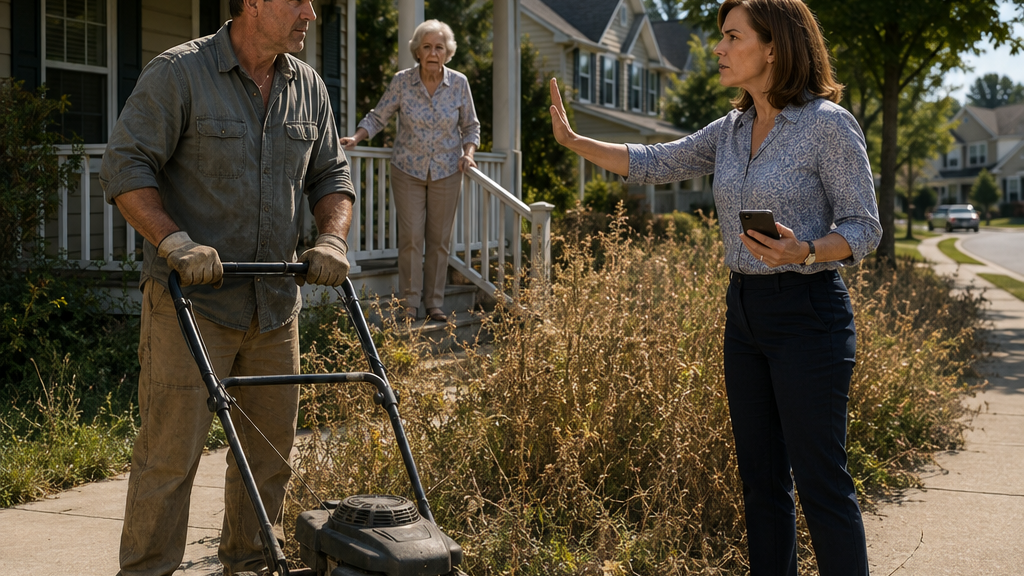
Katherine Young stepped directly in front of the mower.
Brian Harris killed the engine before the front wheels reached her shoes.
For a few seconds, the only sound was the ticking of hot metal and the dry hiss of grass clippings settling onto the concrete. Behind Katherine, half of the Davis sidewalk was visible for the first time in months. The other half disappeared beneath weeds that leaned across the pavement in tangled brown-green clumps.
“You need to stop,” Katherine said.
Brian kept both hands on the mower handle.
“I’m almost through this section.”
“I said stop.”
Across the yard, Margaret Davis stood on her porch with one hand wrapped around the railing. Gregory sat in a patio chair beside the front door, watching without moving.
Brian had passed their house dozens of times.
That morning, he had nearly done it again.
He had been walking home from the hardware store when he noticed that the sidewalk was no longer really a sidewalk. Weeds covered the edge. Dead stems crowded the curb. A strip of dirt had crept several inches over the concrete.
Margaret had been outside with a broom.
Not sweeping.
Just standing there with it.
Brian had slowed.
“You want a hand with that?”
Margaret had smiled too quickly.
“We’re fine.”
He had walked another twenty feet.
Then he had looked back.
Gregory had come outside and bent to pull one weed near the porch. He stopped halfway down, one hand against his knee.
Brian had gone home for his mower and trimmer.
Now Katherine pointed toward the equipment scattered near the curb.
“You cannot just come onto somebody’s property with power equipment and start doing this.”
Brian looked past her at Margaret.
“She asked me to keep going.”
“I’m talking about the association rules.”
“I’m talking about their yard.”
Katherine’s expression tightened.
She lived three houses down. Brian knew her mostly from annual meetings and emails about trash bins, fence stains, and parking. She had the kind of voice that stayed controlled when it got sharper.
“I chair the compliance committee,” she said. “There are contractor-hour restrictions, noise requirements, and liability rules.”
“I’m not a contractor.”
“You’re operating equipment.”
“At ten in the morning.”
“That isn’t the only issue.”
Brian glanced at the cleared concrete behind him. A dark line marked where the dirt and weeds had covered the sidewalk for so long that the exposed section looked almost bleached by comparison.
“What’s the other issue?”
Katherine lowered her voice slightly.
“This property already has an active compliance matter.”
Margaret shifted on the porch.
Brian noticed it.
Katherine continued.
“You are altering the exterior condition while that matter is open.”
Brian laughed once, because the alternative was saying something worse.
“I’m cutting weeds.”
“You’re interfering with a documented violation.”
“By fixing it?”
“That isn’t how this works.”
Brian looked again at Margaret.
Her fingers had tightened around the porch rail.
He remembered his aunt during the last year she lived alone. Everybody had accepted her cheerful “I’m managing” until a neighbor called after finding groceries spoiled on the counter and unopened mail stacked beside the stove.
Brian had visited twice that month.
Both times, he had believed her.
He had promised himself afterward that he would notice sooner next time.
Maybe that was why Katherine’s voice bothered him so much.
Or maybe he simply hated rules that appeared after somebody started helping.
“Katherine,” Margaret said.
Katherine turned.
“I told Brian he could help.”
“I understand that, Margaret.”
“Then what’s the problem?”
“The problem is that there’s a procedure.”
Gregory pushed himself upright in the chair.
His movement was slow enough that Brian pretended not to watch.
“We tried procedures,” Gregory said.
Katherine’s face changed for half a second.
Not guilt.
Recognition.
“You received notices,” she said.
Gregory gave a small nod.
“And?”
“We’re not discussing that out here.”
Brian looked from one of them to the other.
That was the first moment he understood he had walked into something older than the weeds.
Katherine stepped closer to him.
“Pack the equipment up. Call the management office Monday. If the owners want a landscaping change, they can handle it properly.”
Brian felt his jaw set.
“It isn’t a landscaping change.”
“Brian.”
“It’s a sidewalk.”
“It is an active compliance property.”
“Then you should be happy somebody is doing something.”
A nearby garage door opened. A resident stood just inside, pretending to rearrange something on a shelf.
Katherine noticed.
Her posture became straighter.
“Turn the equipment off and remove it from the property.”
“It is off.”
“Keep it off.”
Brian turned toward Margaret.
He forced himself to ask instead of assuming.
“Do you want me to stop?”
Margaret looked at Katherine first.
Then at the weeds.
Her voice was quiet.
“No.”
Katherine exhaled.
“Margaret, this is exactly the kind of situation that creates problems later.”
Margaret’s hand trembled once against the porch rail.
“I want the sidewalk cleared.”
Brian nodded.
He pulled the starter cord.
The mower engine caught.
Katherine stepped back as if the noise itself were an answer.
Brian pushed forward.
He managed less than six feet.
Katherine raised her phone.
“If you continue after being told there is a compliance issue, I’m calling the police.”
Brian stopped again.
This time he let the engine run.
“You’re calling the police because I’m mowing weeds?”
“I’m calling because I’ve asked you to stop interfering with an active association matter and you are refusing.”
“The association doesn’t own their lawn.”
“That is not what I said.”
“It’s what you’re acting like.”
Margaret came down one porch step.
“Please.”
Brian could not tell which of them she meant.
That stopped him more effectively than Katherine had.
He released the mower bar. The engine died.
Gregory stared at the concrete.
The exposed sidewalk now ended in an abrupt line at the mower’s front wheels. Clean pavement behind. Tangled growth ahead.
It looked unfinished enough to be deliberate.
Brian pulled off his work gloves.
“Fine,” he said. “We’ll call management Monday.”
Katherine lowered her phone but did not put it away.
“And the remaining work stops until then.”
Brian said nothing.
A minute later he was coiling the extension cord for the trimmer when he heard an engine turn onto the subdivision’s main road.
Margaret looked toward the entrance.
So did Katherine.
A black-and-white patrol car rolled past the stone neighborhood sign and began moving slowly toward them.
Brian looked at Katherine.
“You called anyway?”
She did not answer.
The patrol car turned onto the Davis street.
Chapter 2: The Couple Who Stopped Answering Notices
Margaret laid the envelopes on the kitchen table as if they weighed more than paper should.
There were eleven of them.
Brian stood beside the chair she had offered him and stared at the association logo printed in the upper-left corner of every envelope.
Some had been opened.
Most had not.
Outside the front window, his mower sat exactly where he had left it beside the half-cleared sidewalk.
The patrol officer had settled the morning without settling anything. He had listened to Katherine, listened to Brian, confirmed that Margaret wanted Brian on the property, and then said the HOA dispute was not something he could decide from the curb.
No arrest.
No dramatic warning.
Just a suggestion that everyone stop escalating the situation and sort out the association issue through management.
Brian should have felt relieved.
Instead, he had spent the next hour wondering why Margaret looked more embarrassed by the envelopes than by the weeds.
She pushed the stack toward him.
“There.”
Brian sat.
“I’m not trying to pry.”
“Yes, you are.”
He looked up.
A faint smile touched the corner of her mouth.
“At least be honest about it.”
Gregory sat across from him with both hands around a mug of coffee.
“She was a nurse for thirty-six years,” he said.
Margaret glanced at him.
“That has nothing to do with this.”
“It has everything to do with this.”
Brian waited.
Gregory looked toward the front window.
“I was with the fire department. Thirty-two.”
Brian knew enough not to praise them immediately.
People sometimes turned long careers into monuments when the people who had lived them were trying to talk about something else.
Margaret opened the first envelope.
The notice was straightforward: edging, weeds, exterior maintenance.
The next was similar.
Then another.
The language became firmer as the dates advanced.
Corrective action requested.
Follow-up inspection.
Continued noncompliance.
Potential fine.
Brian put the papers down.
“How long has this been going on?”
Margaret looked at Gregory.
“Six months,” he said.
“Closer to seven.”
Brian stared toward the yard.
“Why didn’t you tell anybody?”
Margaret folded one of the envelopes along an existing crease.
“Who?”
“Management. The board. A neighbor.”
She looked directly at him.
“And say what?”
“That you needed help.”
Her eyes moved away.
Brian knew immediately he had chosen the wrong words.
Gregory rubbed his thumb along the handle of his mug.
“The first time we got one, I took care of it.”
Margaret said, “You nearly fell.”
“I didn’t fall.”
“You ended up sitting on the curb for twenty minutes.”
“I was tired.”
“You were dizzy.”
Gregory looked at Brian.
“You see how this goes?”
Brian almost smiled.
Margaret did not.
She pulled another paper from the pile.
“We called a lawn company after the second notice.”
She told Brian the estimate.
He blinked.
“For the front?”
“For cleanup, hauling, trimming, then regular service.”
Gregory added, “Second company wasn’t much better.”
Their fixed income was not dire, Margaret explained. They paid their mortgage years ago. They managed groceries, utilities, property taxes, association dues.
But every new recurring expense had begun to feel permanent.
The lawn.
A leaking water heater.
Prescription costs.
A repair to Gregory’s truck they had postponed twice.
Nothing catastrophic.
That was almost worse.
There was no single crisis big enough to justify asking anyone to reorganize their life around them.
Just a series of small things they could no longer do as easily as before.
Brian picked up a notice dated two months earlier.
“Did you answer this one?”
Margaret shook her head.
“This one?”
“No.”
“The one before?”
Gregory said, “We answered that.”
“What happened?”
Margaret looked at the wall.
“They sent contractor information.”
Brian waited.
“That’s it?”
“They told us to submit confirmation once the work was completed.”
“So you stopped replying.”
Margaret’s mouth tightened.
“Every reply turned into another thing we were supposed to arrange.”
Gregory said, “And every conversation started sounding like we had to explain why we couldn’t keep up.”
Brian looked at the unopened envelopes.
The story he had constructed that morning—elderly couple ignored by heartless association—became less clean.
The HOA had written.
The Davises had gone silent.
From an office, silence could look like refusal.
From this kitchen, it looked different.
Margaret touched the corner of the newest envelope.
“I know what people think when they see that yard.”
“What?”
“That we’ve let ourselves go.”
Brian said nothing.
“I spent my whole career telling patients they needed to accept help when they needed it,” she continued. “Funny how wise you can be in somebody else’s room.”
Her voice stayed level.
Only her fingers betrayed her, trembling lightly against the paper.
Gregory reached over and put his hand on hers.
“We thought we’d catch up.”
“Then winter came,” Margaret said. “Then his knee got worse. Then I started having trouble with my hands.”
Brian looked at them.
“You don’t have to explain—”
“That’s exactly the problem,” Margaret said.
He stopped.
She pulled the newest notice free and handed it to him.
This one was different.
The language referred to escalating fines if the property remained out of compliance after the next inspection period.
Brian read it twice.
“Did Katherine know about all of this?”
“She knew we had notices,” Gregory said.
“Did she know why?”
Margaret shrugged.
“She never asked.”
Brian felt the same heat he had felt beside the mower.
“She should have.”
Margaret’s expression sharpened.
“And we could have answered.”
Brian leaned back.
He disliked that sentence because it complicated his anger.
“We shouldn’t have had to tell the whole neighborhood our business.”
“No,” Margaret said. “But there’s a difference between the whole neighborhood and answering a letter.”
The kitchen went quiet.
Outside, the mower stood in sunlight.
Behind it, a clean strip of sidewalk ended at a dark band of packed soil. Brian could see exactly how far the weeds had once reached. The dirt had left a stain across the concrete like a waterline after a flood.
He thought of Katherine taking photographs.
Of the patrol car.
Of Margaret standing between everybody while they argued over what was best for her house.
Brian gathered the notices into chronological order.
“I’m going to the management office Monday.”
Margaret immediately said, “No.”
Brian looked up.
“I’m not letting them fine you because Katherine got carried away.”
“That isn’t what I said.”
“I’ll find out what authority she actually has.”
Gregory watched the two of them.
Brian continued.
“And if those fines came from this morning, we challenge them.”
“There aren’t fines from this morning yet.”
“Then we stop them before there are.”
Margaret pushed back from the table.
Her chair scraped softly across the floor.
“Brian.”
He waited.
She looked tired now, but not fragile.
That distinction mattered.
“You were kind to stop this morning,” she said. “And I’m grateful.”
He nodded.
“But don’t make a war out of this because you’re angry.”
“It already became a war when somebody called the police.”
“No. That was a bad decision. A war is what happens if everybody decides they have to win.”
Brian looked down at the stack of envelopes.
Margaret rested her trembling hand flat on top of them.
“If you’re going Monday, find out what the rules actually say.”
Then she met his eyes.
“Don’t go there to fight for us until you know whether we asked you to.”
Chapter 3: A Rule That Nobody Had Actually Read
Rebecca Martin slid the governing documents across her desk and said, “Show me the rule.”
Brian had expected resistance.
He had not expected homework.
He looked from the thick printed packet to Rebecca.
“The contractor-hours rule Katherine quoted Saturday.”
“I heard what you said on the phone.” Rebecca folded her hands. “Show me the provision.”
Brian opened the packet.
The HOA management office occupied two rooms beside the subdivision clubhouse, with filing cabinets along one wall and framed photographs of landscaped entrances along another. Nothing about the place looked powerful enough to justify how angry he had been all weekend.
Rebecca turned her monitor slightly away from him and waited.
Brian found the section Katherine had referenced.
“There.”
Rebecca read silently.
Then she tapped one line with her pen.
“Keep going.”
He read the paragraph again.
Work by commercial vendors using powered landscaping equipment was restricted before eight on weekdays and nine on weekends.
Brian looked up.
“It was ten.”
“Yes.”
“And I’m not a commercial vendor.”
“No.”
“So she had no basis.”
Rebecca lifted one hand.
“I didn’t say that.”
Brian felt his patience tighten.
“What part am I missing?”
“The part where there are several different issues.”
She opened a folder.
On top was a color photograph of the Davis frontage taken before Saturday.
The sidewalk had nearly disappeared.
Brian stared at it.
Seen frozen in a photograph, the yard looked worse than it had while he was standing inside it.
Rebecca placed a second photograph beside the first.
This one showed the mower stopped midway through the job.
Clean concrete on the left.
Dense growth on the right.
Katherine must have taken it during their confrontation.
“There is a legitimate maintenance case,” Rebecca said.
“I know.”
“Do you?”
Brian looked at her.
“Because when we spoke Saturday, you described this as though Katherine invented the whole problem when she saw you with a mower.”
“That’s not what I meant.”
“It’s what it sounded like.”
Brian sat back.
Rebecca was perhaps in her early fifties, with the calm manner of someone who had spent years dealing with residents who arrived believing volume was evidence.
It annoyed him precisely because it worked.
“So what authority did Katherine have?”
Rebecca pulled another document from the folder.
“The compliance committee can inspect, document, recommend corrective action, and refer unresolved violations to the board or management.”
“Can she order an owner to stop yard maintenance?”
Rebecca scanned the page.
“Not under this section.”
“Can she order a guest to leave an owner’s property?”
“No.”
“Can she call police?”
“Anybody can call police.”
“That’s not what I asked.”
Rebecca met his eyes.
“No. She cannot use the police as an HOA enforcement arm.”
For the first time since Saturday, Brian felt something loosen in his chest.
“So she overstepped.”
“Yes.”
The word came without drama.
That made it more satisfying.
Brian almost smiled.
Rebecca closed the document.
“But.”
There it was.
“The Davis property still has unresolved violations.”
“The yard was being fixed.”
“Part of it was.”
“I would’ve finished if Katherine hadn’t stopped me.”
“And if you finish today, the record still shows six months of unanswered notices.”
Brian’s satisfaction faded.
Rebecca opened the file farther.
Copies of letters appeared beneath the photographs.
Dates.
Inspection notes.
A logged phone call.
A contractor-resource sheet.
Brian recognized several pages from Margaret’s kitchen table.
“You have all of these.”
“We sent them.”
“And nobody thought it was strange that two people who had apparently maintained the same house for years suddenly stopped?”
Rebecca paused.
It was the first time her professional rhythm broke.
“We process a large number of cases.”
“That isn’t an answer.”
“It is part of one.”
Brian leaned forward.
“Margaret was a nurse for thirty-six years. Gregory was a firefighter. They’re not people who woke up one morning and decided rules don’t apply to them.”
Rebecca’s expression changed slightly.
Not because of their professions, Brian thought.
Because he had started making Margaret’s case without her again.
He heard her voice from Saturday afternoon.
Don’t go there to fight for us until you know whether we asked you to.
Brian stopped himself.
Rebecca noticed.
“What?”
“Nothing.”
“You were about to say something.”
“I was about to make this bigger than the question I came here to ask.”
Rebecca leaned back.
“And what question is that?”
“Did Katherine have authority to stop the work?”
“No.”
“Did the contractor-hours rule apply to me?”
“Not as you’ve described the situation.”
“Can the Davises authorize me to do ordinary yard maintenance on their property?”
“Generally, yes, assuming you comply with normal noise rules and aren’t doing work that requires architectural approval.”
Brian nodded.
That was the answer he had wanted.
It should have felt like victory.
Instead, the file remained open between them.
Rebecca tapped the photograph of the overgrown sidewalk.
“This part does not disappear because Katherine handled Saturday badly.”
“I know.”
“She may have confused her committee role with more authority than it gives her. We’ll address that.”
Brian looked at the notices.
“What happens to the Davises?”
“That depends.”
“On?”
“Whether they respond.”
Brian rubbed his forehead.
“What if they can’t afford the kind of regular service you keep recommending?”
“Then there may be options.”
“What options?”
“Payment arrangements if fines are assessed. Board review. In some situations, residents can request additional time or propose an alternative maintenance plan.”
“Was that in the letters?”
Rebecca hesitated.
“Not clearly enough.”
Brian looked at her.
She did not defend it.
That was the second thing he had not expected.
Rebecca turned one of the notices around.
“The letters are compliance notices. They are written to document requirements, deadlines, and consequences.”
“They sound like orders.”
“They are orders, in a sense.”
“Then why would somebody who is already embarrassed call and ask for special treatment?”
Rebecca’s pen stopped.
Brian regretted the phrasing immediately.
“Not special treatment,” he corrected. “Help figuring out what they can actually do.”
Rebecca looked at the file for several seconds.
“When did their situation change?”
Brian said nothing.
He realized he did not know.
He knew Gregory’s knee bothered him.
He knew Margaret’s hands trembled.
He knew contractor estimates were too high.
But he did not know when the yard first became impossible, or what had happened when the first notice arrived, or why they had answered one letter and ignored the next six.
He had filled those gaps with anger.
Rebecca pulled out a correspondence log.
“First notice was seven months ago. They responded within three days.”
She traced downward.
“Second notice, they called.”
Another line.
“Third, no response.”
She turned the page.
“Fourth, fifth, sixth. Nothing.”
Brian stared at the sequence.
Rebecca looked at him.
“You came here because Katherine quoted a rule she apparently had not read closely enough.”
Brian nodded.
Rebecca placed one finger on the correspondence log.
“Before you decide that explains everything, you might want to ask why Margaret and Gregory stopped answering people who had been hearing from them just fine.”
Brian looked again at the photograph.
The sidewalk edge was buried completely beneath the weeds.
For the first time, he wondered whether the line hidden under all that growth was not the beginning of the problem.
Maybe it was only where the problem had finally become visible.
Chapter 4: Margaret Refused to Be Brian’s Cause
Margaret pushed the folder back across the kitchen table without opening it.
Brian had spent most of Tuesday evening assembling it.
Copies of the HOA notices. The contractor-hours provision. Rebecca’s explanation of the compliance committee’s actual authority. A timeline of Saturday morning. Photographs of the yard before he started and after Katherine stopped him.
He had even written three pages of notes for what he intended to say at the next board meeting.
Margaret rested two fingers on the folder as if making sure it stayed on his side of the table.
“No.”
Brian stared at her.
“No what?”
“No to all of that.”
“You haven’t even looked at it.”
“I don’t need to.”
Gregory stood at the counter behind them, cutting an apple into thin slices with deliberate care.
Brian leaned forward.
“Rebecca confirmed Katherine didn’t have authority to order me off the work.”
“I know.”
“She used the wrong rule.”
“I know.”
“She called the police over something the HOA couldn’t even enforce that way.”
Margaret’s face tightened.
“And you think that means every letter in that folder becomes wrong?”
Brian stopped.
Outside the kitchen window, the front sidewalk was visible through the side yard. The section he had cleared on Saturday ended abruptly where the mower had stopped.
Clean concrete.
Then weeds.
A straight, unfinished boundary.
Margaret followed his eyes.
“Katherine was wrong about Saturday,” she said. “She was not wrong that the yard had become a problem.”
Brian looked back at her.
“That doesn’t excuse how she treated you.”
“I didn’t say it did.”
“She stood on your property and talked like you weren’t there.”
Margaret’s hand, the one nearest the folder, began to tremble faintly.
She placed it flat against the tabletop.
“And now you’re sitting in my kitchen doing something similar.”
The sentence landed harder than anything Katherine had said.
Brian leaned back.
Gregory stopped cutting the apple.
Margaret’s voice remained quiet.
“You keep talking about what they did to us. What you’re going to challenge. What you’re going to demand.”
“I’m trying to help.”
“I know.”
“Then what am I missing?”
Margaret looked down at the folder.
“That I don’t want to be anybody’s cause.”
Brian opened his mouth.
She held up one finger.
“Please.”
He closed it.
For several seconds, Gregory’s knife moved again against the cutting board.
Margaret said, “You want to know why we stopped answering those letters?”
Brian nodded.
“The first one embarrassed me.”
He waited.
“The second one embarrassed Gregory.”
Gregory gave a small, reluctant shrug.
“The third one made us angry.”
“Why?”
“Because by then we had called two landscaping companies. We had tried doing part of it ourselves. We had asked for more time once.”
Brian frowned.
“You asked?”
Margaret nodded.
“What happened?”
“They gave us thirty more days.”
“That’s it?”
“That was what we requested.”
“But it didn’t solve anything.”
“No.”
Gregory carried the apple slices to the table and sat down.
“We thought thirty days would be enough.”
Margaret gave him a tired look.
“We thought a lot of things would be enough.”
Gregory picked up a slice.
“Didn’t want to make it permanent.”
Brian understood before either of them explained.
A permanent lawn service meant admitting the problem was permanent.
Not a bad month.
Not a sore knee.
Not a temporary setback.
A new life.
Margaret looked at him.
“If I called the manager and said, ‘We cannot keep up with our yard anymore,’ what happens next?”
“They help you figure something out.”
“Maybe.”
Her tone made it clear she did not believe that answer as easily as he did.
“Or somebody writes it down. Somebody puts us on a list. Somebody decides we need checking on.”
Brian shook his head.
“That’s not what this is.”
Margaret gave him a look that was not angry, only precise.
“You don’t know that.”
He thought of Rebecca’s files.
Inspection notes.
Photographs.
Dates.
Case numbers.
Margaret continued.
“I spent years watching people lose control of their own lives one little decision at a time. First somebody tells them when to take their pills. Then when they can drive. Then where they should live.”
“You’re talking about medical care.”
“I’m talking about what it feels like when everybody else starts deciding what is reasonable for you.”
Brian looked toward the front window.
He remembered Saturday.
Katherine ordering.
Him restarting the mower.
Margaret between them.
Two people arguing about her yard while she stood ten feet away.
The realization made his stomach turn.
“I should’ve asked before I started it again.”
Margaret’s expression softened slightly.
“Yes.”
Brian rubbed both hands over his face.
“I thought you wanted me to.”
“I wanted the yard cleaned.”
“That’s not the same thing.”
“No.”
Gregory slid the plate of apple slices toward Brian.
“You’re learning.”
Brian laughed despite himself.
“Apparently.”
The tension eased for perhaps ten seconds.
Then Brian touched the folder.
“So what do you want?”
Margaret did not answer immediately.
It was the first time he had asked the question without already carrying an answer inside it.
She looked toward Gregory.
He nodded once.
“We want the fines reviewed,” she said.
“Removed?”
“Reviewed.”
Brian frowned.
“If the notices are valid—”
“Some of them are.”
“But—”
“You asked.”
He stopped again.
Margaret continued.
“If there are penalties tied to Katherine escalating things improperly, I want those gone. But I’m not going to stand in front of the board and pretend the weeds weren’t there.”
Brian looked at Gregory.
He was staring at the table, but his jaw had tightened.
“And the yard?” Brian asked.
“We need a plan.”
“A lawn company?”
“Maybe partly.”
“Volunteers?”
“Maybe partly.”
“What do you want to keep doing yourselves?”
That question changed something.
Gregory looked up.
“The beds along the porch.”
Margaret nodded.
“He can still do those if he stops trying to finish them in one afternoon.”
Gregory said, “I can finish them.”
“You can finish them in three afternoons.”
He considered this.
“Fine.”
Margaret continued.
“I can still deadhead the flowers. I can prune the small things if my hands cooperate.”
Brian looked toward the half-cleared sidewalk.
“And the heavy work?”
“That’s the part we need help with.”
Brian nodded slowly.
Not everything.
Not nothing.
A line.
Like the sidewalk edge he had uncovered.
He pulled the folder toward himself.
“I can rewrite this.”
“No.”
He looked at Margaret.
She pushed herself carefully to her feet.
“I’m going to the board meeting.”
Brian stared at her.
“You don’t have to.”
“I know.”
“That room gets ugly even when people are arguing about fence colors.”
A faint smile appeared.
“I worked an emergency room on holiday weekends.”
“That’s different.”
“Yes. People in the emergency room were usually less dramatic.”
Gregory laughed.
Brian did too.
Then Margaret’s expression settled.
“I’ve spent seven months not saying enough.”
She put her trembling hand against the back of the chair until it steadied.
“I’m not going to fix that by having you say everything for me.”
Brian closed the folder.
For once, he did not argue.
“What do you want me to do?”
“Bring the rules.”
“Anything else?”
“Bring the photographs.”
He nodded.
“And if I get stuck,” she said, “then you help.”
Brian waited.
Margaret met his eyes.
“But only then.”
Chapter 5: Katherine Had Reasons, but Not Permission
“Exceptions are how rules become meaningless.”
Katherine said it before anyone had finished settling into the folding chairs.
Brian sat beside Margaret near the middle of the clubhouse meeting room with the closed folder on his lap. Gregory was on Margaret’s other side.
Across the front table, two board members sat with Rebecca between them.
Katherine stood rather than taking the empty chair at the end.
She had brought her own binder.
Brian noticed that immediately.
Of course she had.
Katherine looked toward the board.
“I want to be clear that this is not about whether anyone likes the Davises. Everybody likes the Davises.”
Margaret shifted beside Brian.
He felt the urge to interrupt.
He did not.
Katherine continued.
“This association spent the last two years hearing complaints that some owners get warnings while others get fined. That some yards are overlooked because somebody knows a board member. That one fence gets approved and another doesn’t.”
One of the board members nodded.
Brian had heard some of those arguments himself.
Katherine placed a photograph on the table.
The Davis yard before Saturday.
The weeds looked thick enough to swallow the lower half of the mailbox.
“If we stop enforcing because a situation makes us uncomfortable, then we are not enforcing fairly.”
Brian looked at Margaret.
She was studying the photograph.
No embarrassment showed on her face now.
Only attention.
Katherine flipped to another page.
“I was told there was powered landscaping work occurring during an active compliance case. I went over to determine what was happening.”
Brian’s jaw tightened.
That was technically true.
It was also not the whole truth.
Rebecca spoke.
“Katherine, before we get into Saturday, I need to separate two issues.”
Katherine turned toward her.
Rebecca placed copies of the governing documents in front of the board members.
“The Davis property was, and remains, subject to valid exterior-maintenance standards.”
Katherine nodded.
“But the compliance committee does not have unilateral authority to order an owner-authorized guest to cease ordinary yard maintenance.”
Silence.
Katherine’s shoulders stiffened.
Rebecca continued.
“The contractor-hours provision cited Saturday applies to commercial vendors. It did not apply to Mr. Harris in the circumstances described.”
One board member looked toward Katherine.
“Did you know that?”
Katherine answered immediately.
“I knew there were equipment-hour restrictions.”
“That wasn’t the question.”
A pause.
“No.”
Brian felt the small pulse of satisfaction he had felt in Rebecca’s office.
This time it was stronger.
Public.
Clear.
Katherine had been wrong.
He could almost feel the argument he had prepared opening inside him.
Then Margaret touched his sleeve.
Just once.
Brian looked down.
Her hand withdrew.
He stayed quiet.
Rebecca said, “There’s another point. Calling law enforcement is available to any resident, obviously, but association officers should not imply police are acting as HOA enforcement unless there is a genuine legal or safety issue.”
Katherine looked at the table.
“I believed the situation was escalating.”
Brian nearly laughed.
She looked directly at him.
“You restarted the mower while I was standing there.”
There it was.
The part he wanted to pretend did not matter.
“I did.”
“You were angry.”
“Yes.”
“And you deliberately ignored the request to pause until management could review the situation.”
“Yes.”
Margaret glanced at him.
Brian kept his voice even.
“I also should’ve asked Margaret how she wanted me to handle it before I restarted.”
Katherine appeared surprised.
So did Rebecca.
Brian hated how much effort it took not to add anything else.
Katherine closed her binder halfway.
“I could have handled Saturday differently.”
Not an apology.
But not nothing.
Then she looked toward the board.
“What I will not agree with is the idea that the underlying violation disappears because I made a procedural mistake.”
Brian’s satisfaction drained away almost exactly as it had in Rebecca’s office.
One board member asked, “What are you recommending?”
“Consistent treatment.”
“That means?”
“The Davises should receive the same opportunity to correct the condition as any other owner. If they need an extension, there is a process. If they need to propose a maintenance arrangement, the board can consider it. But we cannot simply say that because Mr. Harris volunteered, the compliance history no longer matters.”
Gregory shifted in his chair.
Margaret remained still.
Katherine looked toward them.
“My concern is not personal.”
Brian believed that she believed it.
Katherine continued.
“Last spring, we were accused of giving one owner extra time because he played golf with a board member. In January, three residents disputed fines because another yard wasn’t cited quickly enough. Every exception becomes somebody else’s evidence that the rules are selective.”
There was weariness in her voice now.
Brian had not heard it Saturday.
Perhaps it had been there.
Perhaps he had been too angry.
A board member asked, “Then what would you have done differently?”
Katherine hesitated.
“I would have documented the work and called management.”
“Would you have let Brian continue?”
Another pause.
“If Margaret confirmed she authorized it, probably.”
Brian looked at her.
Probably.
He wanted to dislike the answer.
Instead, it sounded human.
Imperfect.
Defensive.
Real.
Rebecca slid the two photographs side by side.
Before.
Halfway cleaned.
“The more important question,” she said, “is what happens next.”
Brian stared at the photographs.
The contrast was almost absurd.
One image showed a property that plainly needed attention.
The other showed a man in the middle of providing it.
Both images were true.
That was the problem.
One board member turned toward Brian.
“You brought documents?”
Brian’s hand moved automatically toward the folder.
“Yes.”
“Anything you want to add?”
He opened it.
The first page was his timeline.
The second, the rule.
The third, his notes.
He had rewritten them after Margaret rejected the first version.
Still, the argument was there.
He could make it clean.
Katherine overstepped.
The HOA notices were opaque.
The Davises had been treated like a case number instead of people.
He could say all of that.
Then Katherine spoke before he did.
“I want to ask one thing.”
Brian looked at her.
“If the board retracts anything connected to Saturday—and I think it should—what happens next month?”
She pointed toward the photograph.
“And the month after that?”
Nobody answered.
“The property cannot depend on whether one neighbor happens to notice and has a free Saturday.”
Brian slowly closed the folder.
That was the sentence he had not prepared for.
Because she was right.
Not about Saturday.
Not about the police.
But about that.
He had spent days trying to win an argument over what had already happened.
Margaret and Gregory needed something that worked after his anger cooled.
A board member looked again toward Brian.
“Mr. Harris?”
Brian took a breath.
“I can explain the rules issue if you need me to.”
Then he stopped.
He turned toward Margaret.
She was looking at the front table.
Her hand rested beside a paper cup of water.
Not shaking.
“Margaret,” Brian said quietly.
She looked at him.
He nodded once.
Her eyes widened slightly.
Then she understood.
Brian leaned back.
“I think she should answer the rest.”
Katherine glanced at Margaret.
So did Rebecca.
Gregory placed his hand over his wife’s wrist for a moment, then removed it.
Margaret raised her hand.
Chapter 6: She Did Not Ask Them for Mercy
“The HOA was right about one thing.”
Margaret’s voice was not loud, but the room went quiet enough that she did not need to repeat herself.
“The property became neglected.”
Brian watched Katherine’s expression shift.
Not triumph.
Surprise.
Margaret lowered her raised hand and placed it flat on the table in front of her.
Brian noticed the steadiness of it.
On Saturday, that same hand had trembled against the porch rail while he and Katherine argued over her yard.
Now it did not.
Margaret looked toward the board.
“I don’t want anybody pretending otherwise.”
One board member said, “Mrs. Davis, you don’t need to—”
“Yes, I do.”
The board member stopped.
Margaret continued.
“We received the notices. We answered the first ones. Then we stopped.”
Rebecca nodded slightly.
“Can you tell us why?”
Margaret looked at Gregory.
He gave her the smallest nod.
“At first we thought the problem was temporary.”
She explained Gregory’s knee.
Her hands.
The contractor estimates.
The thirty-day extension they had requested because thirty days sounded manageable.
“We thought if we could get through one month, we would catch up.”
Gregory said quietly, “Then the next month came.”
A few people shifted in their chairs.
Margaret kept her attention on the board.
“After a while, every letter felt like it was asking us to admit something we weren’t ready to admit.”
Katherine frowned.
“What?”
Margaret turned toward her.
“That we weren’t going back to the way things were.”
Katherine did not answer.
Margaret said, “If you hurt your knee, you tell yourself it will heal. If your hands stop cooperating, you tell yourself next week will be better. If the yard gets behind, you say you’ll catch it up Saturday.”
She looked briefly at Gregory.
“And then Saturday starts taking three days.”
Gregory stared at his hands.
Brian felt something tighten behind his ribs.
Margaret continued.
“We didn’t want an exception from having to care for our property.”
Katherine opened her mouth.
Margaret held up one finger.
“I’m not finished.”
Katherine closed it.
“We wanted a way to care for it that did not require pretending we could still do every part ourselves.”
Rebecca leaned forward.
“That distinction matters.”
“Yes,” Margaret said. “It does.”
She looked at the photographs.
The buried sidewalk in one.
The half-cleared edge in the other.
“When Brian started Saturday, the first thing I noticed wasn’t the weeds coming down.”
Her voice softened.
“It was the sidewalk.”
Brian looked at the photograph.
“You could see the edge again,” Margaret said.
Nobody spoke.
“That sounds small.”
“It doesn’t,” Rebecca said.
Margaret nodded once.
“To me it did not feel like somebody taking over our house. It felt like getting one piece of it back.”
Brian looked down at his folder.
That was what he had misunderstood.
He had thought dignity was the act of helping.
Margaret was describing something narrower and harder.
Help that stopped before becoming ownership.
A board member asked, “What are you asking us to do?”
Margaret took a breath.
“I want any penalty connected to the way Saturday was escalated reviewed.”
Katherine shifted but said nothing.
“I do not want legitimate maintenance expectations erased.”
Brian glanced at her.
Margaret continued.
“I want more time when we need it, but not endless time. I want the option to tell management what work we can still do and what work we need assistance with.”
Rebecca began writing.
Margaret looked toward her.
“And I don’t want that conversation to start with us proving we are helpless.”
Rebecca’s pen stopped.
“What would you want it to start with?”
“What needs doing.”
The simplicity of it seemed to unsettle the room more than anger would have.
Margaret said, “Ask us what the problem is. Ask us what part we can handle. Ask what would make the rest possible.”
Katherine folded her arms.
“How would that be applied fairly?”
There was no accusation in the question this time.
Only caution.
Margaret turned toward her.
“The same way you apply anything fairly.”
Katherine raised an eyebrow.
“You write down the rule.”
A board member smiled despite himself.
Margaret did not.
“I’m serious. If somebody asks for extra time, define how much. If somebody wants volunteer help, require the owner’s permission. If there are safety rules, write them down. If the property still has to meet a standard, say what the standard is.”
Katherine looked toward Rebecca.
“That creates administration.”
Rebecca said, “So does six months of repeated notices.”
The room went quiet again.
Brian almost spoke.
He wanted to add that the notices themselves should explain the alternatives more clearly. He wanted to point out the missing language Rebecca had admitted in her office.
He felt the argument rising.
Then he looked at Margaret’s hand.
Still flat.
Still steady.
He stayed silent.
One board member asked Gregory, “Mr. Davis, does that reflect what you want?”
Gregory cleared his throat.
“Mostly.”
Margaret turned.
“Mostly?”
“I want to keep doing the front beds.”
Margaret closed her eyes briefly.
Brian smiled.
Gregory continued.
“I’m not ready to turn every rake and shovel over to somebody else.”
“No one is asking you to,” Rebecca said.
“Good.”
“But the sidewalk edging?”
Gregory looked at Brian.
“That can be his problem.”
A small laugh moved through the room.
Not applause.
Not relief.
Just enough air returning to people’s lungs.
Katherine looked at Brian.
“You’re willing to keep helping?”
Brian answered carefully.
“If they ask me.”
Margaret glanced at him.
The corner of her mouth lifted.
One board member leaned back.
“What about liability?”
Rebecca turned a page in her notes.
“We can address that.”
“How?”
“For resident volunteers, we can create a simple owner-consent form. No structural work. No roof work. No tree removal. Basic exterior maintenance only. Work during normal hours.”
Katherine said, “And if ten people suddenly ask for help?”
“Then we learn whether we actually have a neighborhood problem rather than treating each case as a personal failure.”
Katherine looked at her.
That sentence stayed between them.
A second board member asked, “Would this apply only to age?”
Rebecca shook her head.
“That would be unnecessarily narrow. Temporary injury, disability, caregiving situations, financial hardship—there are several circumstances where a defined maintenance plan could make more sense than repeated enforcement.”
Katherine tapped one finger against her binder.
“What prevents people from abusing it?”
Margaret answered before Rebecca could.
“The fact that asking for help is not nearly as easy as you think it is.”
Katherine’s finger stopped.
For the first time that evening, she looked at Margaret rather than at the documents.
Something changed in her face.
Brian could not name it.
Recognition, perhaps.
Or discomfort.
Maybe both.
Katherine said, “I thought you were ignoring us.”
Margaret nodded.
“We were.”
Katherine seemed taken aback.
Margaret continued.
“That doesn’t mean you understood why.”
“No.”
“And I didn’t make it easy to understand.”
“No,” Katherine said again.
The word came more quietly.
Margaret looked at her.
“You still should not have called the police.”
Katherine inhaled.
“I know.”
It was the closest thing to an apology she had given.
Margaret accepted it with a small nod and nothing more.
That felt right.
No reconciliation large enough to erase Saturday.
No enemy converted into a friend.
Just one truth acknowledged.
Rebecca gathered the loose pages into a single stack.
“I think we’re trying to solve two problems with one process.”
One board member asked, “Which two?”
“Enforcement that becomes inflexible because nobody knows how to handle hardship, and hardship that becomes invisible because residents are too embarrassed to explain it.”
Brian looked at Margaret.
Her eyes remained on Rebecca.
“What are you proposing?” Katherine asked.
Rebecca turned her legal pad around.
At the top she had written three words.
Hardship Maintenance Pilot.
“Temporary,” she said. “Six months. Defined eligibility. Owner-requested, not committee-imposed. Written maintenance plans. Volunteer assistance allowed for basic work with consent. Clear review dates.”
One board member said, “And the Davises?”
“Their existing violations remain under review. Any penalties tied specifically to Saturday’s improper escalation should be removed. The underlying maintenance issue moves into the pilot if they choose to participate.”
Margaret looked at Gregory.
He gave a slow nod.
She turned back.
“We choose to participate.”
Brian felt a release inside himself he had been waiting for since Saturday.
Not victory.
Something better.
A path.
Katherine closed her binder.
“I want the consistency language very clear.”
Rebecca nodded.
“I expected you would.”
Katherine almost smiled.
Brian did not.
He was still looking at Margaret.
A week earlier, she had stood on her porch holding a broom she was not using, telling him she was fine.
Now she had told an entire board exactly where help should begin and where it should stop.
Rebecca gathered her notes.
“I’ll draft the pilot and circulate it before the next vote.”
The board members nodded.
Margaret sat back.
Her hand finally left the table.
Brian leaned toward her.
“You okay?”
She whispered, “Ask me tomorrow.”
He smiled.
At the front of the room, Rebecca tapped the words she had written.
Hardship Maintenance Pilot.
For the first time, the solution was not another warning, another extension, or another person deciding what the Davises needed.
It was a process built around asking them.
And now the board had to decide whether it was willing to make that process real.
Chapter 7: The Sidewalk Edge Stayed Visible This Time
Brian parked at the curb with the mower in the back of his truck and did not unload it.
That was new.
Three weeks earlier, he would have had the tailgate down before Gregory could make it to the porch.
Instead, he stood on the sidewalk with his hands in his pockets and waited.
The entire concrete edge was visible now.
Not freshly scrubbed. Not perfect. A faint brown stain still marked where dirt had covered part of the walk for months, and a few stubborn weeds had already returned along the expansion joints.
But the line was there.
Clear.
Unbroken.
Margaret opened the front door.
“You planning to work today,” she called, “or admire the sidewalk?”
Brian smiled.
“Waiting for instructions.”
She stepped onto the porch.
“That must be painful.”
“You have no idea.”
Gregory appeared behind her wearing work gloves and carrying a short-handled rake.
Brian pointed at it.
“What’s that?”
“A rake.”
“I recognize the species.”
“Then why ask?”
“Because Rebecca’s maintenance plan says heavy edging and mowing are on the volunteer list.”
Gregory came down one step.
“It says nothing about my flower beds.”
Margaret looked at Brian.
“He has been waiting all morning to make that argument.”
“I practiced it.”
Brian finally lowered the tailgate.
The new arrangement had taken longer to approve than anyone expected.
The board had spent one meeting arguing over the word hardship, another over whether volunteer assistance needed insurance language, and a third rewriting the owner-consent form after Rebecca pointed out that the first draft sounded more complicated than hiring a contractor.
Katherine had insisted on review dates.
Brian had expected to resent that.
He did not.
The final version was simple enough to fit on two pages.
Owners requested participation themselves.
They identified what maintenance they could manage and what they could not.
Volunteer help was limited to ordinary exterior work.
No structural repairs.
No roof work.
No large-tree removal.
Normal work hours still applied.
The arrangement was reviewed periodically instead of becoming an indefinite exemption.
The Davises were the first household to sign.
Two other residents had requested information within a week.
That had surprised everyone except Rebecca.
Brian lifted the mower out.
Margaret handed him the consent sheet.
“You already signed this.”
“New work day.”
“The form says ongoing authorization.”
“I know.”
“Then why are you giving it to me?”
“Because I enjoy watching you follow procedure.”
Brian stared at her.
Gregory laughed from the flower bed.
“You created this monster.”
Brian tucked the sheet into his truck.
“Fine. What am I doing?”
Margaret pointed toward the side strip.
“Mow that. Edge the sidewalk. Leave the beds alone.”
Brian looked at Gregory.
“You heard the boss.”
Gregory raised the rake.
“I outrank you both in this section.”
The work took shape differently this time.
Brian mowed.
Gregory worked slowly through the front bed, pulling loose leaves into a small pile and stopping every few minutes without pretending he was only checking something.
Margaret sat on a low garden stool near the porch and clipped spent flowers.
Nobody rushed.
That mattered more than Brian expected.
Before, he had measured success in how fast the yard changed.
How many weeds disappeared.
How much concrete emerged.
Now the work was divided by consent instead of urgency.
At one point Brian reached the corner near Gregory’s bed and automatically angled the mower toward a strip of grass beside it.
Gregory lifted one hand.
“That part’s mine.”
Brian stopped.
The patch could not have been more than six feet long.
“You sure?”
“Yes.”
“It’s already in my path.”
“I noticed.”
Brian backed the mower away.
“Fine.”
Gregory waited until the engine moved farther down the sidewalk.
Then he took a hand trimmer from beside the porch.
His first cut was uneven.
The second was better.
He worked slowly, one short section at a time.
Brian glanced over twice.
The third time, Gregory caught him.
“Keep looking and I’ll charge you.”
Brian turned away.
By late morning, the sidewalk edge had sharpened into a clean line from the driveway to the corner.
Brian shut the mower off and reached for the blower.
That was when he saw Katherine crossing the street.
She carried a folder under one arm.
His body reacted before his thoughts did.
Shoulders tight.
Hands still.
For one second he was back on the first Saturday with the mower between cleared concrete and waist-high weeds.
Margaret noticed her too.
Gregory stopped trimming.
Katherine reached the curb.
Brian waited for the first rule.
Instead she looked at the yard.
“This is better.”
Gregory said, “High praise.”
Katherine ignored him.
Her eyes moved toward Brian’s equipment, then toward Margaret.
“Everything still working with the maintenance plan?”
Margaret nodded.
“So far.”
“Rebecca asked me to check whether the pickup schedule matched what you needed.”
Brian frowned.
“What pickup?”
Katherine opened the folder.
“Debris collection. The pilot allows management to coordinate one bulk green-waste pickup each month if volunteer work produces more than the regular bins can handle.”
Brian looked toward the two filled bags near the porch.
He had missed that line.
Margaret had not.
“We probably need it this week,” she said.
Katherine made a note.
“I can add you to Thursday.”
Gregory leaned on the rake.
“That all?”
Katherine looked at him.
“That was the purpose of my visit.”
He nodded slowly.
Brian waited.
Some part of him expected the old conflict to reappear simply because all four of them were standing in roughly the same place.
It did not.
Katherine closed the folder.
Then she looked at the sidewalk.
“You can actually see where it meets the grass now.”
Margaret smiled faintly.
“That was the idea.”
Katherine’s gaze lingered on the concrete.
“I should have asked what was happening that first day.”
Margaret did not rescue her from the silence.
After a moment, Katherine continued.
“I saw an open compliance case and work happening without anything in the file. I thought if I ignored it, I’d be doing exactly what people had accused us of doing before.”
“Playing favorites,” Brian said.
Katherine looked at him.
“Yes.”
“You still went too far.”
“I know.”
There was no edge in her answer.
Brian had imagined this conversation more than once.
In most versions, Katherine admitted everything and he said something precise enough to leave her speechless.
Now that the moment had arrived, that fantasy seemed embarrassingly small.
Margaret stood from her garden stool.
“The process is clearer now.”
Katherine nodded.
“It is.”
“That matters more.”
Katherine looked almost relieved, though Margaret had not exactly forgiven her.
Brian understood why.
Sometimes being allowed to do better was more useful than being told you had been wrong for the tenth time.
Katherine glanced at Gregory’s narrow strip.
“You doing that yourself?”
Gregory straightened.
“Yes.”
“It looks good.”
Brian turned away so Gregory would not see him grin.
Katherine tucked the folder against her side.
“I’ll put in the debris request.”
She started toward the street.
Then she stopped.
“Do you need the association pickup to include the branches behind the side gate?”
Margaret looked at Brian.
Brian looked at Gregory.
Gregory considered the question like it was a negotiation.
“Those can go too.”
Katherine wrote it down.
“Thursday, then.”
She crossed the street without another word.
Brian watched her go.
Gregory picked up the rake.
“Well.”
Brian said, “That was almost normal.”
Margaret sat again.
“Don’t ruin it.”
They worked another hour.
When Brian finished, the grass was even, the sidewalk edged, and the bags stacked neatly near the curb.
Gregory’s six-foot strip was not as straight as Brian would have made it.
That was not the point.
Margaret stood beside it with her pruning shears.
“You missed one.”
Gregory looked offended.
“Where?”
She pointed.
He bent carefully and clipped the last piece of grass.
“There.”
Brian loaded the mower.
Before closing the tailgate, he looked back.
The house did not look transformed in the dramatic way it had after that first morning.
There was no sudden before-and-after contrast anymore.
That, he realized, was its own success.
The yard no longer had to become a crisis before somebody noticed it.
Margaret could still do what her hands allowed.
Gregory could still claim his six feet of stubborn independence.
Brian could help without arriving as if he owned the answer.
And when the work exceeded what any of them could manage, there was now a process that began with a request instead of a violation.
Brian walked back toward the sidewalk to say goodbye.
Margaret was standing near the place where the buried edge had first appeared beneath the weeds.
She looked down at it.
“You know what I like?”
Brian followed her gaze.
“What?”
“You can tell where the yard ends.”
He smiled.
“That’s usually how edging works.”
She gave him a look.
“You know what I mean.”
He did.
The line had once seemed like evidence of neglect.
Then it became the place where Katherine stopped him.
Later, it became a photograph in a complaint file.
Now it was simply a boundary again.
Visible.
Maintained.
Ordinary.
Gregory called from the porch.
“Brian, you coming next Saturday?”
Brian looked at Margaret first.
She nodded.
“If you’re free.”
He looked back at Gregory.
“Apparently I’m invited.”
Gregory raised the rake.
“Bring your own tools.”
Brian climbed into his truck.
Before he pulled away, he saw Katherine at the far end of the street talking with the debris contractor and pointing toward the Davis address.
No confrontation.
No clipboard held like a shield.
Just a practical arrangement being made.
Brian started the engine.
Margaret stood beside the cleared sidewalk while Gregory returned to his flower bed.
The concrete edge stayed visible all the way to the corner.
This time, nobody had to disappear for someone else to help.
The story has ended.