She Said Fourteen Inches of His Hayfield Didn’t Matter—Then the Survey Reached Her New Event Patio
Chapter 1: Fourteen Inches Beside the Fresh Concrete
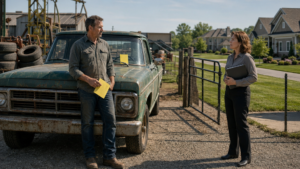
The concrete truck was already backing toward the barn when William Thompson saw the wooden form crossing the line he had carried in his head for thirty years.
He stopped his pickup beside the hayfield and left the door open.
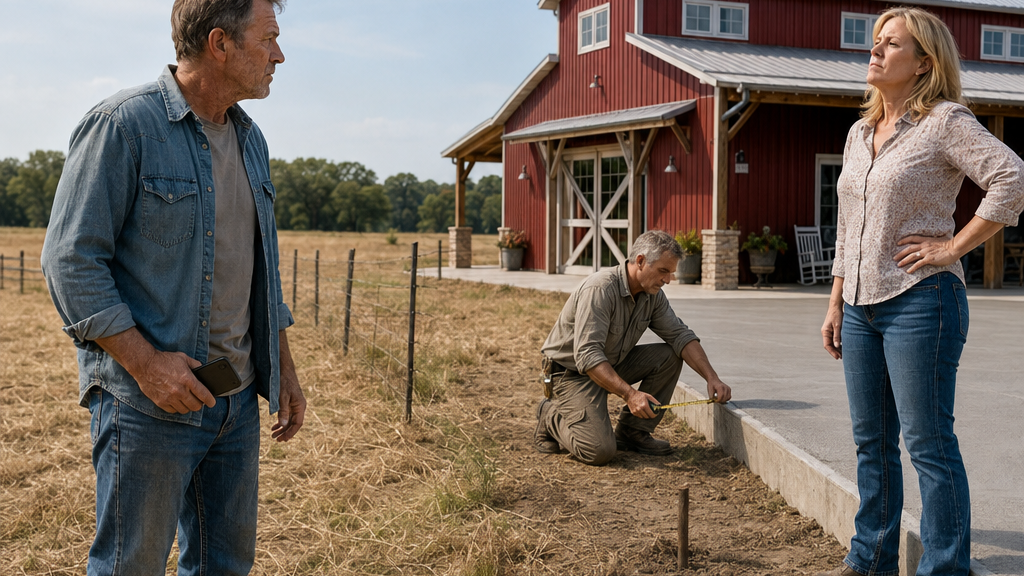
Across the grass, the old red barn Catherine Davis had spent most of the summer converting into an event venue looked nearly finished. New windows reflected the morning sun. A broad stone patio wrapped around the south side, where workers had set chairs and pallets aside for the final concrete edge.
The form nearest William’s field bothered him immediately.
It sat too far west.
William crossed the clipped hay stubble while the truck’s warning alarm pulsed behind the barn.
“Hold up a minute,” he called.
The concrete contractor looked toward him, then toward Catherine.
She came around the corner of the barn with her phone in one hand and a folder tucked beneath her arm.
“What is it now?”
William pointed at the form.
“That’s over.”
Catherine followed his finger. “Over what?”
“My line.”
Her eyes went from the form to the grass and back. There was no painted stripe, no new fence, nothing dramatic enough to support the certainty in his voice.
“The fence is six feet over there,” she said.
“The fence isn’t the deed line.”
One of the workers rested a boot against a wheelbarrow. Nobody moved.
Catherine lowered her phone. “William, we went through this when we started grading.”
“No. You told me where you thought the line was.”
“And you told me the fence was old.”
“I told you not to assume it was the boundary.”
The concrete truck idled behind them.
William walked toward the edge of the grass. Near a patch where years of mower tires had flattened the soil, he crouched and pushed aside dry stems with two fingers.
A rust-dark piece of metal barely showed through the dirt.
“There.”
Catherine leaned forward without coming closer. “That could be anything.”
“It’s the old survey pin.”
“You don’t know that.”
“I know where it’s been.”
She gave a short breath that was almost a laugh.
The sound did more to anger him than if she had raised her voice.
He stood.
“If that’s the corner, your form is across it.”
“By what? Six inches?”
“I don’t know yet.”
“Exactly.”
She looked at the contractor.
William stepped sideways, not blocking anyone, but making sure she could see him.
“Don’t pour that edge until it’s measured.”
Catherine’s face tightened.
“I have an event booked in three weeks. The stone crew comes Monday. Railings after that. If I lose this pour, I lose another week.”
“That doesn’t move the property line.”
“And your hay won’t know whether it lost a few inches.”
The contractor looked down.
William stared at her.
There it was—the part of the argument he would remember later, not because it was cruel, but because Catherine said it as if it were practical.
A few inches.
He glanced across his field. The second cutting had come off ten days earlier, leaving faint parallel tracks across the slope. His father had taught him to turn the mower before the low ditch and keep the outer swath straight. William had followed the same path so long that the mowing line looked more permanent than anything recorded on paper.
Catherine pointed toward it.
“You cut to there every year.”
“That’s where the mower fits.”
“You’ve treated that as the edge since before I inherited this place.”
“That doesn’t make it yours.”
“No, but it makes this a little less clear than you’re pretending.”
The concrete truck’s drum kept turning.
William felt his temper climbing toward the kind of argument he hated: two people repeating themselves louder because neither could produce anything the other had to accept.
He looked again at the buried metal.
“All right.”
Catherine blinked. “All right what?”
“I’m done arguing about it.”
He took out his phone.
For a moment she seemed relieved.
Then William photographed the form, the grass, the corner of the patio and the half-buried pin.
“What are you doing?”
“Getting it surveyed.”
Catherine folded her arms.
“Do that.”
“I am.”
“But I’m not losing today’s concrete because you remember a line differently.”
William looked toward the contractor.
“I’m telling you now that I dispute where that form sits.”
The contractor wiped a hand on his jeans. “That’s between the owners.”
“I know.”
Catherine said, “Start the pour.”
The chute swung.
Gray concrete slid into the wooden form with a heavy wet slap.
William stood beside his hayfield and watched it spread.
He wanted to shout. Instead, he took another photograph.
Then another.
When the workers began raking the mix into the corner nearest the metal pin, he turned away and called Benjamin Allen.
Benjamin had surveyed rural parcels around the county for more than twenty years. He answered on the fourth ring.
“Allen Survey.”
“Benjamin. William Thompson.”
“Morning.”
“I need a boundary checked.”
“How soon?”
William looked over his shoulder as fresh concrete filled the disputed edge.
“Yesterday.”
Benjamin was quiet for a second.
“Something already built?”
“Being built.”
“Old plat or recent?”
“Old.”
“Pins still there?”
“One might be.”
“Might?”
William rubbed soil from his fingertips.
“It’s where I remember one being.”
Benjamin asked for the parcel number, then paused.
“One thing before I come out.”
“What?”
“Where’s the old fence in relation to the pin?”
William looked toward the sagging wire fence Catherine had pointed at.
Farther inside his field than he wanted to explain.
Benjamin waited.
“William?”
“I’ll show you Monday.”
Chapter 2: The Pin Beneath Thirty Years of Grass
Benjamin Allen found the metal marker in less than ten minutes, exactly where Catherine had said no reliable marker existed.
His locator chirped over the flattened patch of grass.
“There,” he said.
William stood with his hands on his hips while Benjamin cut a neat square of sod and worked carefully with a narrow shovel. Two inches down, rust gave way to the squared top of an old iron pin.
Catherine had come out from the barn when she saw Benjamin’s tripod.
She stopped beside the completed patio.
“That’s supposed to prove something?”
Benjamin did not look up.
“It proves there’s an iron monument here. What it represents depends on the records.”
He cleaned the pin, took measurements, and moved toward another reference point near the road.
William tried not to smile.
He had spent two days replaying Saturday’s pour. The form was gone now. The concrete edge looked smooth and permanent, curving naturally into the stonework as though it had always belonged there.
Benjamin returned an hour later with his field book.
“Let’s check the edge.”
He hooked a tape at the established line and stretched it toward the patio.
William watched the numbers pass beneath Benjamin’s thumb.
Catherine came closer.
Benjamin adjusted the tape, checked again, then laid a small marker at the widest point.
“Fourteen inches.”
Catherine frowned.
“Fourteen inches what?”
“Past the surveyed boundary.”
William heard the words without immediately feeling what he had expected.
He had imagined relief. Vindication. Maybe even satisfaction.
Instead he looked at the hard gray concrete.
Fourteen inches.
A strip narrower than his boot was long.
Catherine stared at the tape.
“You’re saying I built fourteen inches onto his property?”
“At this point,” Benjamin said, “I’m saying the finished patio crosses the record line here by fourteen inches. Less as it runs north.”
Catherine shook her head.
“That is ridiculous.”
William’s jaw tightened.
“The number isn’t ridiculous because you don’t like it.”
She turned on him.
“You called a surveyor over fourteen inches.”
“I called him before either of us knew how much.”
“And now we know.”
Benjamin began photographing his markers.
Catherine pointed toward the old wire fence.
“Then explain that.”
William felt something in his stomach pull tight.
The fence followed the field edge twenty yards away before bending toward the barn. Its weathered posts leaned at different angles, repaired over the years with whatever wire had been available.
Benjamin followed her finger.
“What about it?”
“That’s been treated like the boundary my entire life.”
William said, “It isn’t.”
Catherine gave him a sharp look. “You keep saying that like everyone else was supposed to know.”
Benjamin walked toward the fence.
William followed reluctantly.
The surveyor took another reading, then another.
His expression changed—not dramatically, but enough for William to notice.
“How far?” William asked.
Benjamin closed the distance to one post.
“This fence is inside your record line.”
“I know.”
Catherine looked at him.
Benjamin glanced up.
“How long have you known?”
William ignored the question.
“How far inside?”
“It varies.”
“Benjamin.”
“At this section? A little over six feet.”
Catherine let out one astonished laugh.
“Six feet.”
“The fence wanders,” Benjamin said. “That’s common on old farms. People built around trees, wet ground, rocks, whatever made sense. Fence and title line aren’t automatically the same thing.”
“But people used it as the line.”
“That can matter to the history,” Benjamin said. “It doesn’t automatically change the survey.”
William seized on that.
“So the concrete is over.”
“According to the record boundary I’m retracing, yes.”
Catherine folded her arms.
“And the six feet of field between the fence and his recorded line?”
“Also according to the survey, his.”
Her expression said plainly what she thought of that answer.
William photographed Benjamin’s tape stretched from the cleaned iron pin toward the new patio. Fourteen inches showed clearly.
He sent the image to himself, then took a wider photograph showing the barn, concrete and hayfield.
For the first time since Saturday, he possessed something Catherine could not dismiss as memory.
Still, Benjamin’s earlier question followed him.
How long have you known?
They drove to the county records office that afternoon.
The title-clerk employee pulled the old parcel materials and set scanned plats on a monitor. Lines drawn decades apart did not always look identical, but the controlling descriptions put the boundary where Benjamin had retraced it.
William leaned toward the screen.
“There.”
Benjamin nodded.
“That supports the monument.”
“So we’re done.”
Benjamin did not answer.
William looked at him.
“What?”
“A survey tells you where the record line is. It doesn’t tell you why that fence is six feet off it.”
“I don’t care why.”
“You may.”
William straightened.
Benjamin tapped the old image.
“Look at the fence notation.”
It appeared on more than one prior drawing.
Not as a property line.
As an existing fence.
Years earlier.
William’s certainty began to feel heavier.
On the drive home he stopped at the field edge and studied the old posts.
The concrete was across his property. That remained true.
But Catherine had also been right about one thing: anyone looking only at the ground could easily believe the old fence marked the boundary.
His phone rang.
Patricia.
William almost let it go.
He answered.
“What?”
“I heard you had Benjamin Allen out there.”
“Who told you?”
“Does it matter?”
“He found the pin.”
Patricia was silent.
“And?”
“Catherine’s patio is over fourteen inches.”
Another silence.
William waited for her to say he had been right.
Instead she asked, “Did you tell him about Daddy’s survey?”
William looked across the field.
“What survey?”
“Don’t do that.”
“Patricia—”
“You already knew about that fence.”
Chapter 3: The Boundary William Never Corrected
Patricia Hill laid the old survey on William’s kitchen table before he had finished pouring her coffee.
The paper had been folded so many times that white cracks ran through the blue photocopied lines.
William recognized it immediately.
He wished he had not.
Patricia flattened one corner with her palm.
“Still want to tell me you forgot?”
“I didn’t say I forgot.”
“You said, ‘What survey?’”
“That’s not the same thing.”
She gave him the look their mother used to give both of them when they tried arguing over wording.
William sat opposite her.
The survey was dated seventeen years earlier.
Their father had ordered it during the inheritance planning that followed their mother’s death. William remembered the truck in the yard. He remembered the surveyor walking the fence. Most of all, he remembered the argument afterward.
The line on the photocopy showed the same thing Benjamin had measured now.
The fence was not the boundary.
Patricia tapped the page.
“We knew.”
“We knew the fence wandered.”
“Six feet isn’t wandering.”
“It is on an eighty-year-old farm fence.”
“William.”
He looked away.
The kitchen window faced the lower field. From there, Catherine’s renovated barn was barely visible beyond the tree line.
Patricia sat back.
“When Daddy saw this, he wanted to move the fence.”
“I remember.”
“And I asked him not to.”
“You did more than ask.”
Her mouth tightened.
The narrow frontage strip along the road had been part of a larger family disagreement—small in acreage, large in emotion. Patricia had feared that moving posts would trigger another round of arguments with adjoining owners and complicate the division their father was trying to settle.
Their father, already tired of lawyers and family meetings, finally rolled the survey and put it in the equipment shed.
“Leave well enough alone,” he had said.
William had treated those words like an instruction long after they stopped making sense.
Patricia ran a finger along the copy.
“After Daddy died, you could’ve fixed it.”
“You could have too.”
“I wasn’t farming it.”
“But your name was on the frontage piece.”
“That’s why I didn’t want another fight.”
William gave a humorless smile.
“And now here we are.”
Patricia looked at him steadily.
“That’s my point.”
He stood and carried his untouched coffee to the sink.
“She still built over the recorded line.”
“I didn’t say she didn’t.”
“She was told not to pour.”
“Before or after you showed her where the actual line was?”
William turned.
“I told her the fence wasn’t the boundary.”
“That isn’t what I asked.”
He hated how precisely she said it.
On Saturday he had pointed toward a mostly buried pin and told Catherine he believed the form was over. But before that day, how clearly had he ever explained the old survey?
Not clearly at all.
For years Catherine’s family had mowed and maintained their side to the fence while William cut hay on his. Nobody had needed precision until concrete arrived.
Patricia folded her arms.
“If I inherited that barn and saw that fence, I might’ve thought the same thing she did.”
“She had a survey done for construction.”
“Did it stake this line?”
William hesitated.
“I don’t know.”
“Then find out.”
He did not like the suggestion because it moved the argument away from the simple version in which Catherine had ignored what any reasonable person should have known.
Patricia picked up the survey.
William put his hand on it.
“Leave it.”
She did.
That afternoon he carried the old photocopy to the equipment shed and found the rusted filing cabinet where their father had kept machinery receipts, acreage maps and tax papers.
Most of it smelled of dust and mouse-chewed cardboard.
Near the bottom was the original survey folder.
William sat on an overturned bucket and read every sheet.
There was no secret deed. No hidden transfer. Nothing that made the boundary different from what Benjamin had found.
But there were notes.
“Existing fence—approximate, not boundary.”
He read the phrase twice.
His father had known.
William had known.
And for seventeen years they had left the visible landscape telling a different story.
When William returned outside, Catherine was near the patio talking with the concrete contractor.
She saw the folder beneath his arm.
“More paperwork?”
“Yes.”
“Good.”
The flatness in her voice surprised him.
She walked toward the boundary.
“Your surveyor sent his preliminary sketch.”
“He copied you?”
“I asked him to.”
William nodded.
Catherine looked toward the old fence.
“Fourteen inches.”
“Yes.”
“And apparently you own six feet on my side of what everyone thought was the line.”
“It isn’t your side.”
“You know what I mean.”
He did.
For once, neither argued.
Catherine rubbed the heel of her hand against her forehead.
“If you knew that fence was wrong, you could have said something years ago.”
William felt the accusation land because it was deserved.
“I should have.”
She stared at him, apparently unprepared for the admission.
Then she said, “That doesn’t help me now.”
“No.”
“What do you want?”
“I want the boundary respected.”
“That can mean ten different things once concrete is down.”
“I haven’t decided.”
Catherine’s face hardened slightly.
“Well, decide soon. I have contracts tied to this place.”
She went back toward the barn.
William remained beside the grass.
That evening he opened his phone and began looking through photographs from the construction.
He had taken more than he remembered: grading equipment, pallets, stonework, a trench beside the barn.
Then he found one from the previous Friday.
The iron pin was visible after rain had washed dirt from the top. William had photographed it beside a tape and sent it to Catherine with a message.
He opened the conversation.
The photograph had gone through at 6:42 p.m.
Below it, his message read:
I believe this is the southwest boundary monument. Your form looks over it. Please hold the final edge until we can verify.
William stared at the screen.
Beneath the message sat the delivery indicator.
Read.
Friday, 6:47 p.m.
The concrete had been poured Saturday morning.
Chapter 4: The Warning Sent Before the Pour
The message receipt was still on William’s phone when the title-clerk employee slid the parcel file across the counter.
Friday, 6:47 p.m.
Read.
William looked at the timestamp again while the clerk brought up the recorded description on the monitor.
“You need copies?”
“Yes.”
“Current deed and prior transfer?”
“Both.”
“And survey references?”
“All of them.”
She glanced at the stack already in front of him.
“Boundary issue?”
William put the phone facedown.
“Yes.”
The word sounded smaller than the problem had become.
By noon he had copies of the deed chain, Benjamin’s preliminary sketch, the old family survey, and the photograph he had sent Catherine before the pour. Nothing changed where the line sat. What changed was the order of events.
Catherine had seen the warning.
Then she had poured.
William drove back to the farm with the papers on the passenger seat and his earlier shame still riding with them. Patricia had been right: he had known the fence was misleading. He could not erase that by waving a survey in Catherine’s face.
But neither could Catherine erase Friday evening.
She was waiting beside the barn when he arrived.
Not smiling. Not angry.
Just tired.
The patio had been swept clean. Stacks of chairs stood under the barn overhang, still wrapped in plastic.
“You went to the title office,” she said.
“Yes.”
“I called them too.”
William stopped a few feet from her.
“So you know.”
“I know what the record says.”
“And?”
“And I still think any reasonable person would have looked at that fence and assumed it meant something.”
“It did mean something.”
“Apparently not ownership.”
William let that pass.
Catherine looked at his folder.
“You brought the message.”
“Yes.”
Her eyes shifted away.
“You read it Friday.”
“I did.”
“And told them to pour Saturday.”
“I did.”
The admission came so plainly that William did not know what to do with the anger he had prepared.
He waited.
Catherine looked toward the patio.
“I had the stone crew scheduled Monday. The railing contractor Tuesday. Photographer Thursday. First wedding walk-through the following weekend.”
“You could’ve stopped for a survey.”
“I could’ve.”
“You didn’t.”
“No.”
William opened the folder and took out the printed photograph. The rust-dark pin sat in the lower corner. The wooden form was visible beyond it.
Catherine did not touch the paper.
“I thought you were trying to delay me,” she said.
“Why?”
“Because you never liked this place becoming an event venue.”
William frowned.
“I never said that.”
“You didn’t have to.”
“What did I do?”
“You complained about cars before we had cars. You asked where music would face before we had speakers. You asked about drainage before the grading was finished.”
“That’s called living downhill from a construction project.”
“To you.”
“To anybody.”
Catherine’s voice sharpened.
“To me it sounded like you’d already decided the business was a problem.”
William opened his mouth, then stopped.
There was enough truth in it to bother him.
He had watched the old barn turn from a quiet structure into something with lighting crews, gravel deliveries and weekend schedules, and he had disliked the change before Catherine had done anything wrong.
“You still had the picture,” he said.
“Yes.”
“And you still poured.”
“Yes.”
“Why?”
Catherine looked toward the barn doors.
“Because I was already too far in.”
The answer came softly.
“My loan payment doesn’t pause because a survey takes another week. Deposits don’t wait. Contractors move on. Every delay has another delay behind it.”
“That doesn’t make my land yours.”
“I know that now.”
“You knew there was a dispute then.”
She looked at him.
“Yes.”
That was the sentence William had needed.
Not because it made her cruel.
Because it separated two truths that had been tangled together.
His old fence had been misleading.
Her choice after warning had still been hers.
A county zoning officer came out two days later after reviewing Benjamin’s sketch and the recorded parcel documents. She walked the boundary, studied the patio edge, and asked both of them the same questions separately.
When had construction started?
When was the concern raised?
Was the boundary formally staked beforehand?
Had either owner agreed to an adjustment?
No.
By the end of the visit she made no dramatic pronouncement. She simply said that permanent construction crossing onto another recorded parcel would need to be resolved either through a lawful boundary adjustment or by correcting the construction.
Catherine stood with her arms folded.
“So those are the choices?”
“Assuming the final survey confirms what we’re seeing, yes.”
William watched Catherine absorb it.
Later that afternoon she came to his farmhouse.
He almost did not invite her in.
She carried a legal pad and no folder.
“I have another option.”
William stayed near the kitchen door.
“What?”
“I buy the strip.”
He said nothing.
“Not six feet,” she added quickly. “Just enough to cover the patio edge and give me a clean setback. We record it properly. You get paid. I keep the concrete.”
William stared at her.
“How much land?”
“I don’t know yet. Whatever the surveyor says makes sense.”
“You mean move the line.”
“Yes.”
“So the concrete becomes legal because the land under it becomes yours.”
“That’s the idea.”
She spoke carefully, as if she knew how the sentence sounded.
“I’m not asking you to give it away.”
William looked through the window toward the lower field.
Fourteen inches was almost nothing.
That had been Catherine’s argument from the beginning.
But now the same small distance would alter a recorded line that had existed longer than either of them.
“How much?” she asked.
William turned back.
“What?”
“What amount would make this reasonable?”
He thought of the old fence. His father’s survey. Patricia telling him he had helped create the ambiguity by leaving the land to speak for itself.
For a moment the simplest answer seemed to be a number.
Then he thought of writing that new line into the county record because concrete had arrived before certainty.
“No.”
Catherine’s face tightened.
“You haven’t even heard an offer.”
“I’m not selling the boundary to fit the patio.”
Chapter 5: The Offer That Would Move the Line
Catherine arrived at the county meeting room with a survey sketch William had never seen.
The proposed transfer was shaded in pale yellow.
William recognized his field immediately, then saw the narrow wedge running along Catherine’s patio.
Fourteen inches at the widest point.
Wider near the corner.
Long enough to change more than he had expected.
Catherine set the sketch between them.
“I had somebody draw a possible adjustment.”
William looked at Benjamin, who had agreed to attend only to explain the surveying implications.
“You do this?”
“No.”
Benjamin leaned closer.
“It’s conceptual.”
Catherine nodded.
“I know. I wanted to show what I meant.”
The county zoning officer sat at the end of the table with the parcel records open.
William traced the proposed line with one finger.
“If this moves here, what happens at the lower access?”
Benjamin answered.
“The width narrows.”
“How much?”
“Depends on the final geometry.”
William looked at him.
“Enough to matter?”
Benjamin did not soften it.
“Potentially.”
Catherine sat back.
“For a tractor?”
“For access, future division, drainage work, utility placement. Depends what William ever wants to do with the parcel.”
William followed the line toward the road.
For years he had thought of that edge as nothing but the outer swath of hay. Mow it, rake it, bale it, repeat.
The sketch made him see it as something else.
An entrance corridor.
A future lot boundary.
A place Patricia’s share might someday need access across.
A space where a culvert could be widened.
Fourteen inches at one end did not remain fourteen inches everywhere once a legal line was redrawn to make the geometry work.
Catherine watched his face.
“I’m not trying to take your field.”
“I know.”
“Then what are we doing?”
William looked at the sketch.
“Figuring out whether fixing your mistake creates another one.”
She pressed her lips together.
The zoning officer pointed to the drawing.
“A boundary adjustment can be done if both owners agree and the resulting parcels meet county requirements. But this is not just a matter of purchasing the exact footprint under the concrete.”
Catherine looked frustrated.
“Why not?”
“Because parcel lines need workable legal descriptions. Setbacks may change. Access may change. Future use may change.”
William leaned back.
The room was quiet except for the low hum of the air conditioner.
For the first time, he understood why his refusal had felt instinctive before he could explain it.
He was not protecting fourteen inches of hay.
He was protecting the ability to decide what the land would be later.
Catherine tapped the sketch.
“I can pay enough to make that worthwhile.”
“This isn’t about the price.”
“Everything has a price when you’re talking about land.”
William looked at her.
“No. Sometimes land has a consequence.”
Her expression cooled.
“That sounds convenient coming from the person whose fence has been wrong for seventeen years.”
The words landed hard.
Benjamin looked down at his notes.
William felt his temper rise, then held it.
“You’re right about the fence.”
Catherine seemed almost more irritated by the admission.
“I should’ve corrected it.”
“Yes.”
“I didn’t.”
“No.”
“And you still poured after I sent you the pin.”
She looked away.
The conversation had reached the point neither of them could escape.
The zoning officer spoke.
“If there is no transfer, the construction needs to be brought back inside the verified parcel.”
Catherine looked at her.
“By order?”
“If necessary. I’d rather see the owners resolve it before it reaches that point.”
William glanced at Catherine.
She looked exhausted again.
Not defeated.
Just trapped between a decision she had already made and costs that kept multiplying afterward.
They walked the boundary together after the meeting.
Benjamin had put temporary flags along the surveyed line. The old iron pin sat exposed now, impossible to mistake for a random piece of farm metal.
Catherine stopped beside it.
“That little thing has caused more trouble than the whole barn.”
William crouched and touched the top of the pin.
“No. We caused the trouble.”
She looked at him.
He straightened.
“I left the fence wrong because it was easier.”
“And I kept pouring because stopping was harder.”
They stood in silence.
From the barn came the sound of someone testing a door latch.
Catherine looked toward the patio.
“If I remove it, I lose the railing schedule.”
William said nothing.
“I’ll probably lose the first event.”
“That’s your call.”
“I know.”
She rubbed her palms against her jeans.
“What if I ask for one week?”
“For what?”
“To get my contractor back. To see if he can cut it without wrecking the whole corner. To arrange it myself before the county sends anything formal.”
William studied her.
A week earlier he might have heard the request as another delay.
Now it sounded different.
“You’re agreeing to remove it?”
“If the transfer is off the table, yes.”
“Because the county told you?”
Catherine shook her head.
“Because I can’t build a business on a piece of land that’s only mine if you decide not to object.”
William said nothing.
She looked down at the iron pin.
“I thought if it was small enough, it didn’t matter.”
“And now?”
“Now I think small things are the ones that get expensive.”
William almost smiled.
Almost.
“One week,” he said.
Catherine nodded.
“And if your contractor says he can’t do it?”
“Then I find one who can.”
Chapter 6: The Concrete Comes Back Out
The concrete saw started at 7:13 on a Monday morning exactly where Catherine had once said nobody measured that closely.
William heard it from the equipment shed.
The high mechanical whine carried across the field before he saw the dust.
He walked toward the boundary slowly.
Catherine’s contractor had marked a cut line well inside the verified parcel edge. A temporary protective cap covered the old survey pin. Bright tape around it warned the crew not to disturb it.
Catherine stood near the barn in work boots and a faded sweatshirt.
No phone in her hand.
No folder.
William stopped beside her.
“They came back.”
“They did.”
The contractor approached.
“I need to show you both something before we go farther.”
He led them to the patio corner.
William expected a neat cut fourteen inches from the edge.
Instead, chalk lines ran several feet back.
Catherine pointed at them.
“That’s what I asked him about.”
The contractor crouched.
“The outer section is tied into the rest of the pour. Reinforcement runs through here. If I just shave the edge, I leave a weak strip and a bad finish.”
“How much has to come out?” William asked.
“This corner section.”
Catherine stared at him.
“That’s four feet.”
“Closer to five at the widest.”
“For fourteen inches?”
“For a sound repair.”
William said nothing.
Catherine let out a slow breath.
“Do it.”
The contractor looked at her.
“You sure?”
“No,” she said. “But do it.”
The saw bit into the slab.
Dust rose in a pale cloud.
William stepped back.
The sound was harsher than he expected. Not satisfying. Not triumphant.
The first cut ran straight through concrete Catherine had paid to pour less than three weeks earlier.
Then came the jackhammer.
Chunks broke free around the reinforcing steel. Workers hauled them into the loader bucket one by one.
Catherine watched without speaking.
William found himself watching her more than the demolition.
When the contractor discovered the railing footing was tied into the same corner, he stopped again.
“This has to come too.”
Catherine closed her eyes for a second.
“How much more?”
“I won’t know until it’s open.”
William looked toward the barn.
Plastic-wrapped chairs were still stacked under the overhang.
“You lose the event?”
She nodded.
“They moved it.”
“I’m sorry.”
Catherine looked at him sharply.
“Are you?”
“Yes.”
She studied him as if deciding whether she believed it.
Then she nodded once.
“I’m not sorry the line got fixed,” William added.
“I know.”
By noon the corner of the patio looked worse than the original problem ever had.
Broken concrete exposed steel. The neat edge was gone. Gravel spilled into the excavation.
And beside all of it, under its protective cap, the survey pin remained untouched.
William stared at it.
Fourteen inches.
The smallest object in the scene seemed to control everything around it.
Catherine brought two bottles of water from the barn and handed him one.
He took it.
“This is going to cost more than the whole first pour,” she said.
William unscrewed the cap.
“I figured.”
“Stonework has to be reset. Railings remeasured. Grade adjusted.”
He glanced at her.
“You blaming me?”
Catherine looked at the crew.
“No.”
That surprised him.
“I blamed you last week.”
“I noticed.”
“I blamed the survey too.”
“That seems harder.”
She gave a tired laugh.
“Then I blamed the contractor. Then I looked at the message again.”
William waited.
“I could’ve stopped Saturday morning.”
“Yes.”
“I didn’t.”
The concrete saw started again.
Catherine raised her voice slightly over the noise.
“That part is mine.”
William looked toward the old fence.
A crooked run of wire still stood well inside the boundary, presenting the same false picture it had presented to Catherine.
His part was still standing.
He felt the realization settle heavily.
If he let the fence remain after forcing Catherine’s concrete back, then he had learned nothing except how to win one dispute.
He walked over to Benjamin’s temporary flag.
The true line ran between the pin and another marker farther north. The fence drifted away from it almost immediately.
Catherine followed his gaze.
“What?”
William pointed.
“That needs to move.”
“Your fence?”
“Yes.”
She looked genuinely surprised.
“You’re going to move all of it?”
“I don’t know how much yet.”
“You don’t have to for me.”
“That’s not why.”
He crouched beside the protected survey pin and brushed dust from the cap.
For seventeen years he had believed leaving the fence alone prevented trouble.
Now Catherine was paying to remove good concrete because both of them had trusted what was visible instead of what had been made clear.
William stood.
“Benjamin only checked this corner closely.”
“So?”
“I want the whole shared line done.”
Catherine looked toward the long fence.
“That could get expensive.”
William looked at the broken patio.
“I know.”
That afternoon, after the crew shut down and the dust settled, he called Benjamin.
“I need you back.”
“For the repair?”
“No.”
William looked from the exposed survey pin to his crooked fence.
“Survey the whole boundary.”
Chapter 7: A Line Both Neighbors Can See
The first fence post came out with a sound William felt in his chest.
The excavator operator curled the bucket around the weathered cedar, lifted slowly, and pulled thirty years of packed earth loose around it. Wire sagged between the remaining posts. Dry grass shook free from the staples.
William stood beside Benjamin Allen’s new line of flags and watched the post swing over the field.
For seventeen years, he had known it was in the wrong place.
Knowing had been easier than moving it.
Benjamin walked toward him carrying a field book.
“That section’s the worst of it.”
William nodded toward the north end.
“How bad up there?”
“Less than two feet in most places. Comes back close near the ditch.”
“No other buildings across?”
“No.”
“Catherine?”
“Clear.”
William looked toward the event barn.
The repaired patio corner was finished now, though the fresh concrete was slightly lighter than the older section. New stone edging concealed most of the reconstruction. Unless someone knew where to look, the expensive mistake had nearly disappeared.
The survey pin had not.
Benjamin had installed a bright temporary witness stake beside it so the new fence crew could not mistake the corner.
William had once preferred the old pin buried.
A thing underground could not start an argument.
It also could not prevent one.
The excavator operator set the cedar post in a pile.
“You want these saved?”
William examined it. The bottom was dark with rot.
“No.”
The operator moved to the next.
Patricia arrived before noon carrying sandwiches in a paper sack.
She stopped when she saw the open stretch where the old fence had been.
“That looks strange.”
“It is strange.”
She handed him a sandwich.
“You sure you want to move all of it?”
William glanced at her.
“That question sounds familiar.”
Patricia smiled without much humor.
“I was wrong the first time.”
“We both were.”
She looked toward Benjamin’s flags.
Their father had walked this same field when the posts were already old. William could almost picture him standing there, weighing a survey against another disagreement, deciding that leaving things alone cost less.
For a while, it had.
Then the bill came due to somebody else.
Patricia opened her sandwich.
“What did Catherine say?”
“Nothing.”
“She upset?”
“She hasn’t complained.”
“That isn’t what I asked.”
William took a bite and chewed.
“I don’t know.”
Patricia studied him.
“You could ask.”
He looked at her.
She raised her eyebrows.
William shook his head.
“You’ve gotten irritating.”
“I’ve always been irritating. You just used to walk away sooner.”
The excavator pulled another post.
This time William laughed.
Catherine came across the grass that afternoon while Benjamin and the fence crew were setting the new corner.
She carried a folded sheet of paper.
William’s shoulders tightened automatically.
She noticed.
“It’s not another offer.”
“What is it?”
“Estimate for the permanent markers.”
Benjamin looked over.
Catherine handed him the sheet.
“I want monuments at both accessible corners and witness posts where the line runs through the brush.”
Benjamin scanned the estimate.
“That’s more than we discussed.”
“I know.”
William said, “Why?”
Catherine looked along the new flags.
“Because I don’t ever want somebody standing here twenty years from now saying the line is where a fence used to be.”
William glanced at Benjamin.
“How much?”
Catherine told him.
It was not a small number.
“I’ll pay half,” William said.
She shook her head.
“You’re already moving the fence.”
“That’s my problem.”
“And the markers affect both properties.”
He studied her.
She added, “I’m not asking you to split the patio.”
“I know.”
“That was my cost.”
William nodded.
There was no apology in her voice.
He realized he did not need one.
The repaired concrete, the canceled event, and the contractor invoices had said enough.
“All right,” he said. “Half.”
Benjamin folded the estimate.
“I’ll get them ordered.”
Catherine remained beside the temporary marker.
The excavator moved farther up the field, leaving a strip of churned soil where the old posts had stood.
She looked at William.
“I thought you’d keep the fence.”
“I almost did.”
“Why didn’t you?”
He considered giving her the easy answer: because it was wrong.
Instead he said, “Because if I left it there, the next person could make the same mistake you did.”
Catherine’s face changed slightly.
“And you’d still be able to blame them.”
William looked at her.
“Yes.”
It was uncomfortable because it was true.
She nodded.
“That’s what I figured.”
He gestured toward the patio.
“You could’ve blamed me for all that.”
“I did.”
“I mean afterward.”
Catherine watched the workers.
“I blamed you until they cut the first section out.”
“What changed?”
“The contractor asked me three times if I was sure I wanted to proceed when you first complained.”
William had not known that.
She rubbed dirt from the toe of her boot.
“I kept saying the fence was the line because that was the answer I needed.”
William looked toward the barn.
“And I kept saying everybody should’ve known it wasn’t because that was the answer I needed.”
Catherine gave a small nod.
Neither said anything for a while.
A fence crew member called William over to approve the placement of the corner post.
Benjamin had set it back slightly from the monument, leaving the survey pin exposed beside a permanent witness marker.
William looked at the distance between them.
“You sure that’s enough room?”
Benjamin smiled.
“Plenty.”
The new fence followed the surveyed line cleanly across the field.
Where the old fence had curved around stones and wet ground, the new one used braced corners and straight runs. Near the ditch, they left enough clearance for equipment instead of pretending the fence itself had to occupy the exact legal line.
That part mattered to William.
A fence could be practical without being mistaken for the record.
By late afternoon, the first half was finished.
William stood at the new corner with Patricia.
She touched the permanent marker Benjamin had set beside the iron pin.
“Daddy would’ve hated this.”
William smiled faintly.
“The bill?”
“The conversation.”
“That too.”
She looked at him.
“He wasn’t always right.”
William stared at the marker.
“No.”
“You know keeping the farm intact didn’t mean freezing every decision he made.”
“I know now.”
Patricia nodded toward Catherine’s barn.
“Maybe that’s the expensive part.”
“What?”
“Learning which promise you were actually supposed to keep.”
William said nothing.
His father had asked him to keep the farm intact.
William had turned that into a rule against disturbing anything.
Those were not the same promise.
Two weeks later, the first autumn event at Catherine’s barn filled the gravel lot.
William heard car doors closing while he hooked the mower behind the tractor.
Music drifted faintly across the field during the afternoon setup, low enough that he could still hear the engine.
He drove toward the boundary.
For years he had turned where the grass changed color beside the crooked fence.
There was no crooked fence now.
The new wire stood farther out, straight and unmistakable. Beside the corner, the permanent marker caught the light.
William slowed.
The mower deck approached the line.
He turned exactly where Benjamin’s markers showed he should.
Not six feet early.
Not fourteen inches late.
Exactly there.
Near the barn, Catherine was arranging chairs with an event-venue customer. She looked toward the field when she heard the tractor.
William lifted one hand from the wheel.
After a second, Catherine lifted hers.
That was all.
No apology across the grass.
No celebration.
No agreement that either of them had been entirely right.
William continued down the field, the mower leaving a clean strip behind him.
At the far end he turned and looked back.
The new fence was visible from the tractor now.
So was the old iron pin beside its permanent marker.
For decades, the true boundary had existed whether anyone could see it or not.
William had once thought that was enough.
Now, as the first guests began arriving next door and his mower followed a line both properties could recognize, he understood the difference.
The land had not changed.
Only their willingness to make the truth visible had.
The story has ended.