The Mark in the Mud
Part I — The Bell She Would Not Touch
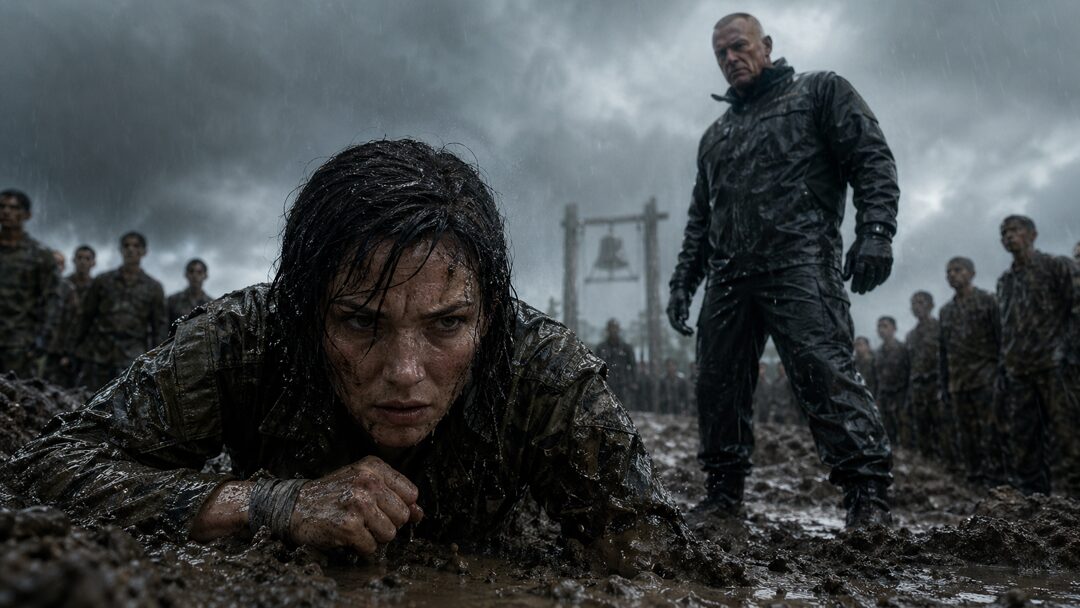
Mara Voss was face-down in the mud when Sergeant Major Dane Rourke told her to quit.
Rain hammered the training field so hard the ground had turned to brown water. It ran under her collar, into her sleeves, between her clenched teeth. Her cheek was pressed into the trench. Her lungs burned. Her hands, stripped raw from the crawl, sank deeper every time she tried to push herself up.
Ten yards ahead, the washout bell hung from a black steel frame.
One ring, and it would end.
Behind her, thirty candidates stood in formation, soaked through and silent. Nobody cheered. Nobody encouraged her. They had already watched her fail the mud lane twice.
Rourke stood above her in a spotless rain shell, black gloves folded behind his back.
“Get up, legacy weight.”
Mara’s fingers dug into the mud.
The words landed harder than the rain.
“Candidate Voss,” he said, louder now, so the whole squad could hear, “this course does not exist to make people feel special. It does not exist for family names. It does not exist for anyone who wants to borrow honor from the dead.”
Mara lifted her head an inch.
Mud slid from her jaw.
“I said get up.”
Her elbows shook. Her knees dragged under her. For one second, she looked less like a soldier than something pulled from a flooded ditch.
Then she pushed.
A few candidates looked away.
Rourke did not.
He was built like the kind of man weather gave up trying to move. Broad shoulders. Shaved head. A face cut by years of sun, command, and restraint. He had a voice that never had to rise to become dangerous.
But that morning, he let it rise.
“You want out?” he barked. “The bell is right there.”
Mara’s gaze went to it.
The bell swung faintly in the wind, black against gray sky. Its rope was clean compared to everything else.
Clean things looked obscene in that field.
She crawled one more foot.
Her left wrist slipped from beneath her body, and a faded strip of gray cloth showed under the mud.
Rourke saw it.
“What is that?”
Mara tucked her wrist under her chest.
Rourke stepped closer.
“I asked you a question.”
She said nothing.
The silence changed the weather around them. It made the watching candidates shift their boots in the sludge.
Rourke crouched just enough for her to hear without the squad catching every word.
“You don’t get relics here,” he said. “You don’t get charms. You don’t get grief jewelry. You get standards.”
Mara’s mouth was full of rainwater and dirt.
Still, she spoke.
“No, Sergeant Major.”
His eyes narrowed.
“No what?”
“No, I won’t remove it.”
For the first time that morning, a few candidates turned fully toward her.
Rourke stood. Slowly.
“All candidates,” he called, “back to the start.”
A groan moved through the formation before discipline killed it.
Mara froze.
Rourke looked at her like he had been waiting for her to understand the cost.
“Since Candidate Voss brought something precious to the mud,” he said, “you can all help her learn what the mud does to precious things.”
No one looked at Mara kindly after that.
The squad turned and marched back through the rain.
Mara remained on her knees, breathing hard. Her wrist cloth was half-buried in mud now, but one corner of it had come loose. She pressed it down with her thumb.
Rourke leaned over her.
“You can save them the trouble,” he said. “Ring it.”
Mara stared at the bell.
Her whole body wanted the rope.
Her bones wanted it. Her torn hands wanted it. The child inside her, the one who still remembered smoke and screaming and being carried by someone whose blood had soaked through a field jacket, wanted any sound that meant stop.
But the dead had not stopped.
So she did not either.
Mara pushed one foot underneath herself and rose just enough to stand.
The candidates watched.
Rourke watched harder.
She swayed once in the rain, mud dripping from her sleeves.
Then she walked back to the start.
Part II — The Weight of Everyone Watching
By noon, the squad hated her.
Not openly. Fort Calder did not allow the luxury of open resentment. But resentment showed in the speed of a shoulder turning away. In the silence when she stumbled. In the way no one met her eyes when Rourke sent them all through the crawl again because she had come in last.
The mud lane was only eighty yards.
It felt older than that.
It began under a low run of wire and ended at a wooden post marked with three words carved deep into the grain:
STAY. CARRY. RETURN.
No one explained the words. At Calder, nothing meaningful was explained before it hurt.
Mara crawled until her elbows stopped feeling like part of her body. Water pooled under her chest. Mud sucked at her boots. Twice the wire caught the back of her jacket and held her like a hand.
Rourke walked along the lane above her.
“Too slow.”
She dragged forward.
“Too soft.”
She dragged again.
“Too much memory and not enough muscle.”
That almost stopped her.
Not because it was true.
Because it was close.
At the end of the lane, Eli Park was bent over with his hands on his knees, breathing through his teeth. He was compact, quick, one of the better candidates. Earlier that morning, he had made jokes under his breath to keep people moving.
He had stopped joking after the third repeat.
When Mara reached the post, he turned toward her.
His voice was low. “You need to quit.”
She wiped mud from one eye and looked at him.
He glanced toward the others. “I’m serious. He’s going to smoke all of us until you do.”
“I know.”
“Then ring the bell.”
Mara pulled herself upright, using the post.
Eli stared at her like she had missed something obvious. “You trying to prove a point?”
“No.”
“Then what?”
She wrapped her hand around her muddy wrist, covering the cloth.
“I’m not here for them to like me.”
Eli’s face hardened.
“That’s convenient,” he said. “Because they don’t.”
He walked away before she could answer.
Not that she had one.
The next evolution was a pack drag through knee-deep water. The one after that was a casualty carry over slick timber. By late afternoon, the rain turned colder. Fog settled low across the field. The candidates moved like punished ghosts.
Rourke never looked tired.
That was part of his cruelty. He did not seem human enough to fatigue.
When a candidate vomited beside the obstacle pit, Rourke gave him ten seconds, then ordered him back into formation. When another slipped and split his eyebrow on a beam, Captain Lena Saye appeared from under the awning with her medical kit, checked the cut, taped it closed, and sent him on.
Saye was the only person on the field who seemed to belong to neither the candidates nor Rourke.
She watched more than she spoke.
Her hair was braided close to her scalp, rain shining along it like wire. She carried a waterproof notebook in one pocket and a flat, calm sadness behind her eyes. She did not interfere when Rourke pushed them.
But she counted everything.
How long a candidate stayed down.
How their hands shook.
How they answered when asked their name.
When Mara fell again near dusk, Saye stepped forward.
Rourke’s head turned.
“Medical hold?” he asked.
“Assessment,” Saye said.
“That is not the same thing.”
“No,” she said. “It is what comes before one.”
Rourke did not like that. Everyone could feel it.
Saye knelt beside Mara in the mud and took her hands. The palms were torn open, skin peeled in red crescents under the dirt.
“You feel your fingers?” Saye asked.
Mara nodded.
“Say it.”
“I feel them.”
“Both hands?”
“Yes.”
Saye’s thumb paused at Mara’s wrist.
The gray cloth had shifted.
Mara pulled back too quickly.
Saye noticed.
So did Rourke.
“Candidate,” Saye said quietly, “I’m checking circulation.”
Mara forced herself to hold still.
Saye lifted the wrist just enough to feel for pulse. The cloth was old, not issued. It had once been gray. The edges were frayed thin, almost soft enough to disintegrate.
Saye did not ask about it.
Instead, she moved up Mara’s arm, checking range and bruising. At the collar, where the soaked fabric had stretched, Saye saw the scars.
Not training scars.
Not childhood accident scars.
Small pale bursts along the shoulder, uneven and deep, like old shrapnel had entered and been badly removed.
Saye’s eyes flicked to Mara’s face.
“Where did you serve?”
Mara looked at her through rain and mud.
“I never served.”
The lie was calm.
That made it worse.
Saye held her gaze for another second, then let go.
“Hands are bad but usable. Watch for numbness.”
Rourke stepped closer. “She continues?”
Saye stood. “She continues if she can stand.”
Rourke looked down at Mara.
Mara stood.
For one moment, even Eli looked impressed.
Rourke did not.
He said, “Formation.”
The squad moved.
Mara followed.
Behind them, Saye wrote something in her notebook and watched Rourke watch Mara.
That night, while the candidates tried to sleep in wet socks and aching silence, Rourke sat alone in the administrative trailer and opened Mara Voss’s file.
It should have been simple.
Age twenty-four. Civilian transfer track. Above-average endurance score. Below-average upper body power. No prior active service. No disciplinary record. No sponsor listed.
Then he reached the family section.
Three lines were blacked out.
Rourke stared at the redactions.
In thirty years, he had learned that empty spaces in records made more noise than words.
He scrolled further.
Birthplace: provisional resettlement zone, North Corridor.
His jaw tightened.
Outside, thunder moved over Fort Calder.
Rourke closed the file.
But he did not forget what he had seen.
Part III — The Name That Changed the Rain
The next morning, the candidates marched before sunrise.
No one spoke. Speech required spare energy, and Calder took spare energy as an insult.
Mara’s hands had stiffened overnight. When she flexed them, the skin split again. She did it under her blanket so no one would see.
Eli saw anyway.
He sat across from her on the barracks floor, tying his boots.
“You’re going to get yourself recycled,” he said.
Mara pulled her sleeve over the wrist cloth. “Probably.”
“That doesn’t bother you?”
“Does it bother you?”
He gave a tired laugh with no humor in it. “Everything about you bothers me.”
She almost smiled.
Almost.
Before she could answer, the door slammed open.
Rourke stood in the frame.
“On your feet.”
They moved.
Outside, rain still fell, but softer now. The field beyond the barracks had disappeared under fog. The candidates were marched past the mud lanes, past the bell, past the obstacle pits, toward the northern ravine.
Someone behind Mara whispered, “Memorial day.”
The words went through the formation like a current.
Mara kept walking.
The ravine opened suddenly from the fog. It was wide, flooded, and steep-banked, with a rope bridge half-submerged where the water had risen. On the far side, a black stone marker stood under a skeletal pine.
Rourke stopped them before the marker.
His voice changed.
Not softer.
Older.
“Fifteen years ago,” he said, “Seventeenth Recon Detachment crossed a border they were not supposed to cross for a mission no one was supposed to know about. They had orders, training, weapons, and experience.”
Mara looked at the stone.
Rain slid down its face.
Seventeenth Recon Detachment
STAY. CARRY. RETURN.
Names Withheld by Order
Her chest tightened so violently she almost missed Rourke’s next words.
“They died because discipline failed.”
The world narrowed.
Rourke walked in front of the formation.
“They hesitated when they should have moved. They carried what they should have left. They let sentiment override procedure. That is how units die.”
Mara’s fingers curled.
The gray cloth under her sleeve felt suddenly too tight.
Rourke’s eyes found her.
He had been watching for exactly that.
“Candidate Voss,” he said.
She looked forward.
“You disagree?”
The squad went still.
Mara’s throat worked once.
“No, Sergeant Major.”
It was the first time she had hated herself for silence.
Rourke stepped closer. “No?”
“No.”
He studied her face.
“Good. Then you’ll have no trouble crossing.”
The ravine evolution was simple in description and miserable in fact. Candidates had to descend the slick bank, cross through chest-deep water with packs above their heads, climb the far side, touch the marker, and return with a weighted litter.
The water was cold enough to steal breath.
When Mara reached the far bank, her boots slipped twice. Her shoulder hit rock. Pain flashed white through the old scars.
For half a second she was not at Fort Calder.
She was small again.
Smoke low to the ground.
A woman’s hand pushing her head down.
A voice saying, Don’t look back, Mara.
A patch on a sleeve: eagle wings spread over XVII.
Then rain struck her face, and she was twenty-four again, clawing up a ravine while Sergeant Major Rourke watched.
She touched the marker.
Her hand covered the carved words.
STAY. CARRY. RETURN.
She stayed there too long.
“Move,” Rourke shouted.
Mara moved.
By the time the squad completed the crossing, two candidates had been pulled for hypothermia risk. One had twisted an ankle. Eli’s lips were blue, and he no longer looked angry, only afraid of what might come next.
Saye intercepted Rourke near the medical awning as the candidates changed into dry outer layers with numb hands.
“You saw her react,” Saye said.
Rourke did not look at her. “They all react.”
“Not like that.”
“She’s playing at ghosts.”
Saye’s calm eyes sharpened. “Or you are.”
That made him turn.
The space between them tightened.
Rourke spoke quietly. “Careful, Captain.”
“No. You be careful.” Saye glanced toward the candidates. “You’re not training her anymore. You’re punishing a ghost.”
Rourke’s face went still in a way that would have scared most people into silence.
Saye did not scare easily.
“She has shrapnel scars,” she said. “Old ones. Civilian placement zone. Redactions in her file, I assume?”
His silence answered.
“What are you afraid she knows?” Saye asked.
Rourke looked toward the ravine marker.
For a moment, the rain seemed to hang between drops.
“I was supposed to go,” he said.
Saye waited.
Rourke’s gloved hands flexed once.
“Seventeenth’s final operation. I was on the list. Reassigned six hours before wheels up.” His jaw moved. “My best friend was not.”
Saye said nothing.
“The report said they broke movement protocol. Got attached to a refugee convoy. Lost speed. Lost position. Lost extraction window.” His mouth hardened. “People died because they could not separate mission from feeling.”
“You believe that?”
“I taught myself to.”
“That’s not the same thing.”
Rourke looked at her then, and for the first time he looked less like a monument than a man standing beside one.
“If they died for nothing,” he said, “then everything after has been—”
He stopped.
Saye finished nothing for him.
The candidates were forming up again. Mara stood at the far end, arms at her sides, gray cloth hidden, face unreadable.
Rourke’s expression closed.
“Final endurance evolution at 1600,” he called.
A few candidates looked like they had been punched.
Rourke’s eyes stayed on Mara.
“Pack drag. Mud lane. Full course. No assists.”
Mara did not move.
But under her sleeve, her fingers closed around the cloth.
Part IV — What the Mud Takes
At 1600, the rain became freezing.
It hit the field in hard silver lines, flattening the grass, dimpling the mud, turning every breath white.
The candidates stood with weighted packs at their feet.
Rourke walked the line.
“This evolution is not about speed,” he said. “It is about what you do when speed is gone.”
No one answered.
He stopped in front of Mara.
“Some of you think endurance is emotion with better posture,” he said. “It is not. Endurance is obedience after feeling has become useless.”
Mara looked past him.
To the bell.
To the mud lane.
To the post at the end.
STAY. CARRY. RETURN.
“On my command,” Rourke said. “Drag.”
They moved.
The pack weighed nearly as much as a person. It snagged on buried roots and sank in the mud. Candidates leaned forward into harness straps, boots slipping, bodies bent under dead weight.
Mara’s first twenty yards were slow.
By thirty, her hands had reopened.
By forty, the old shoulder injury began to pulse with each pull.
At fifty, Eli passed her, gasping. He looked back once.
Not angry this time.
Worried.
That almost undid her.
Pity was heavier than resentment.
“Don’t,” she said through clenched teeth.
He slowed anyway.
Rourke’s voice cracked across the lane. “Candidate Park. Did I authorize charity?”
Eli stopped.
Mara looked up at him from the mud.
“Go.”
His face twisted.
Then he went.
The pack lurched behind her. She dragged it another yard. Then another.
The world became small: rain, breath, rope, mud, pain.
A memory broke through.
Not a full one. Full memories were too dangerous. Just a hand pressing gray cloth into hers. Her mother’s hand. Blood under the nails. A voice ragged and calm.
If you live, carry us right.
Mara had not understood. She had been nine. She had thought carrying meant remembering every face, every scream, every bootstep running past the convoy.
Later, adults had told her survival was a gift.
They were wrong.
Survival was weight.
She dragged.
At the end of the pack lane, the mud crawl waited.
Rourke stood beside it.
“Drop harness. Under the wire.”
Mara dropped the harness and nearly fell with it.
Her shoulder screamed when she lowered herself to the ground. The mud was colder now, thick enough to hold her ribs when she breathed.
She crawled.
The first ten yards took forever.
The second ten took something from her she did not know how to name.
Candidates gathered at the finish. Some had completed. Some were still staggering in. Saye stood near the medical kit, eyes fixed on Mara’s movement.
Rourke paced above the wire.
“Too slow, Voss.”
She pulled forward.
“Too weak.”
She pulled again.
“Still waiting for the dead to do your work?”
That stopped her.
Not completely.
But enough.
The field went quiet in a way even rain could not fill.
Saye’s head turned sharply.
Eli whispered, “Jesus.”
Mara’s forehead rested in the mud.
Under her sleeve, the gray cloth had loosened from the wet. One end trailed into the muck.
Rourke stepped closer, voice lower now. “That’s what this is, isn’t it? You think pain makes you connected to them.”
Mara’s breath came ragged.
“You think crawling through mud gives you a right to names you never earned.”
Her hand moved.
Not forward.
To her wrist.
She tried to press the cloth back into place.
Rourke saw.
“Leave it.”
Mara did not.
“Candidate.”
She shoved her wrist under her chest.
Rourke crouched at the edge of the lane.
“Still hiding the charm?”
Her face lifted.
Mud covered one side of it entirely. Only one eye was clear.
“It isn’t a charm.”
“Then show it.”
“No.”
That single word moved through the candidates like a spark.
Rourke stood.
“Then crawl.”
Mara crawled.
Her sleeve caught on the wire.
The fabric tore.
So did the cloth.
For one second, she did not understand what had happened. She only felt cold air against skin that had been covered for years.
Then Rourke stopped walking.
His face changed.
Not softened.
Not yet.
Changed.
Mara looked down.
The rain washed mud from her wrist in broken streaks.
An eagle spread its wings across the inside of her forearm.
Beneath it, dark and clean despite the dirt, were four characters.
XVII.
No one spoke.
The bell moved in the wind behind them.
Rourke stepped into the lane.
“Where did you get that?”
Mara stayed on her elbows, breathing hard.
His voice sharpened. “Where did you get that mark?”
She pushed herself to her knees.
The torn cloth hung from her wrist like a dead thing.
Rourke’s face had lost color.
“That belongs to men and women who died before you knew what service was.”
Mara stood.
Not quickly. Not gracefully.
She rose like someone lifting a door off herself from the inside.
Mud slid down her uniform. Her legs trembled. Her hand shook when she raised it, palm inward, the eagle and XVII facing him.
“The mark was mine before the ink was,” she said.
Rourke stared.
“My mother wore it on her sleeve.”
The rain seemed to fall harder.
Mara’s voice stayed low, but everyone heard it.
“She was the Seventeenth’s medic.”
Saye closed her eyes briefly.
Rourke said nothing.
Mara’s mouth tightened.
“You called them weak.”
Rourke’s jaw worked.
“You said they died because they carried what they should have left.”
Her hand remained raised between them.
“I was what they carried.”
No one breathed.
Mara looked at the marker far beyond the field, though it could not be seen from there.
“I was nine. North Corridor convoy. They stayed after the extraction window closed. My mother put me under a truck and told me not to look back.” Her voice almost broke, then hardened around the fracture. “I looked back.”
Rourke’s gloves curled into fists.
Mara lowered her hand a few inches.
“This is not decoration.”
Her eyes met his.
“It’s a witness mark.”
Part V — The Truth That Stayed
Rourke moved first.
Not toward her.
Away from whatever had opened in his face.
“Back in formation,” he said.
The words were automatic. A wall rebuilt by instinct.
Mara did not move.
The candidates did not move either.
For the first time all day, Rourke gave an order and the field did not obey.
His head snapped toward them.
“What did I say?”
No one answered.
Eli stood at the edge of the lane, mud up to his knees, face pale with cold and shame.
Saye stepped forward.
“Sergeant Major.”
Rourke did not look at her. “Not now.”
“Yes,” Saye said. “Now.”
The authority in her voice was quiet, but it cut cleanly.
Rourke turned.
Saye held her notebook in one hand. “Her scars are consistent with fragment injuries from the North Corridor evacuation. Age of injury matches the operation window.”
Rourke’s expression hardened. “You don’t have clearance for that file.”
“No,” Saye said. “I have eyes.”
Something like anger passed over his face, but beneath it was fear.
Not fear of punishment.
Fear of truth arriving too late.
Mara let her hand fall.
The tattoo disappeared partly under mud again.
Rourke looked at the candidates. Every face was turned toward him. Young, exhausted, afraid, waiting. The kind of faces he had spent years shaping into something harder.
The kind of faces the Seventeenth had died carrying.
He looked at Mara.
For the first time, he did not look above her, through her, or past her name.
He looked at her.
“You don’t know what the report said,” he said.
Mara’s answer came without heat.
“I know what they did.”
That was worse.
A report could be argued with. Memory could not.
Rourke looked toward the mud lane, the bell, the black frame swaying in rain. For fifteen years he had told candidates the same story. Not the whole story. Not even a lie he had invented. Just the version he could survive repeating.
Discipline failed.
Sentiment killed them.
Hardness saves lives.
It had turned grief into something useful. It had given shape to a guilt he could not carry barehanded.
His best friend, Calder Hayes, had been on that operation. Calder, who laughed too loudly in mess halls and mailed half his pay to a sister who never answered. Calder, who had said, before wheels up, Don’t worry, Rourke. I’ll bring back a story ugly enough to make you miss me.
He had brought back nothing.
Not even a body.
Rourke looked at Mara’s wrist again.
The eagle.
XVII.
The mark had survived on someone they had saved.
That should have comforted him.
Instead, it undid him.
He turned back to the lane.
“Candidate Voss.”
Mara straightened.
There was no contempt in it this time.
Not gentleness.
But not contempt.
“Finish the crawl.”
A sound moved through the candidates. Disbelief. Anger. Confusion.
Eli took a step forward. “Sergeant Major—”
“Silence.”
Eli stopped, but his face stayed open, wounded by the order.
Saye watched Rourke carefully.
Mara did too.
Rourke removed his black gloves.
It was such a small thing that it took a second for anyone to understand it.
He never removed them on the field.
He folded them once and tucked them under his belt. Then he stepped down into the mud beside the lane.
Not in front of Mara.
Beside it.
The rain struck his bare hands.
He faced the candidates.
“Seventeenth Recon did not fail because they were weak.”
His voice carried across the field, rougher than before.
“They did not die because they hesitated. They did not die because they forgot discipline.”
Mara stood very still.
Rourke swallowed once.
“They died because they stayed.”
The words landed into the mud like something buried finally finding air.
“They stayed with a convoy command had already written off. They carried civilians when carrying meant missing extraction. They held a line that was not supposed to exist long enough for children to get out.”
No one moved.
Rourke did not look at Mara as he said the next part.
“I have spent fifteen years teaching the wrong lesson because the right one was harder to survive.”
Saye’s expression shifted, barely.
Eli looked down at the mud.
Rourke turned back to Mara.
“Finish it,” he said again.
This time, the order did not sound like punishment.
It sounded like permission.
Mara lowered herself into the mud.
Her body protested so violently that her vision blurred. The wire pressed her back. Her hands sank into cold brown water. The tattoo brushed the ground and disappeared beneath mud again.
She crawled.
No one shouted.
That almost made it harder.
Pain liked noise. Noise gave it something to push against. Silence left only the body and the choice.
She dragged one elbow forward.
Then a knee.
Then the other elbow.
The post waited at the end.
STAY. CARRY. RETURN.
Halfway through, her shoulder buckled.
Her cheek hit mud.
Eli stepped forward without thinking.
Rourke lifted one bare hand.
Not harshly.
Just enough.
Eli stopped.
Mara saw the movement from the corner of her eye.
She understood.
No assists.
Not because they wanted her broken.
Because this last stretch belonged to her.
She crawled again.
A memory came with her, but it did not drown her this time.
Her mother’s hand.
The smell of diesel.
The gray cloth tied tight around a child’s wrist so she would have something to hold when everything else was gone.
If you live, carry us right.
Mara had thought that meant suffering.
For years, she had made survival into a debt that could never be paid. She had hidden the mark because showing it felt like asking the world to admire a wound. She had come to Calder believing the mud would decide whether she was worthy of the dead.
But the dead had not asked her to be worthy.
They had asked her to live without letting the truth rot.
She reached the post.
Her fingers touched the carved word.
RETURN.
For a second, she could not move.
Then she pushed herself upright.
Mud covered her from throat to boots. Her hair clung to her face. Blood and rain streaked her hands.
She turned.
Rourke stood in the lane, bare hands at his sides.
The candidates lined the edge.
Saye stood slightly apart, notebook closed.
Mara lifted her right hand.
Slowly.
The rain washed the mud away from the inside of her wrist.
The eagle emerged first.
Then XVII.
She held it facing Rourke.
Not as accusation.
Not as proof.
As something that had survived both of them.
Part VI — Candidate Voss
Rourke saluted first.
It happened so quietly that for a heartbeat the field did not understand it.
His spine straightened. His right hand rose to his brow. Bare fingers. Mud on the cuff. Rain running down his face in lines that made him look older than he had that morning.
He did not salute rank.
Mara had none worth saluting.
He saluted witness.
He saluted the mark.
He saluted the people he had spent fifteen years grieving badly.
Captain Saye followed.
Her salute was clean, controlled, and steady.
Then Eli Park raised his hand.
He was not quick this time. He did not look around to see who else moved first. He saluted like a man accepting the weight of what he had misjudged.
One by one, the candidates followed.
The line that had watched her crawl now stood in the rain and honored her standing.
Mara did not smile.
A smile would have made it smaller.
Her hand shook, but she kept it raised long enough to receive what none of them could properly give back.
The dead remained dead.
The report remained buried.
The operation remained classified behind black ink and careful language.
But the lie had cracked in public.
Sometimes that was the only beginning truth got.
At last, Mara lowered her hand.
The torn gray cloth hung loose from her wrist. She looked at it for a moment. Then she tied it back over the tattoo, not to hide it this time, but to keep it close.
Her fingers fumbled.
Eli stepped forward, stopped himself, and let her finish.
Rourke saw that.
So did Mara.
When the knot was done, she returned to formation.
No one shifted away from her.
Rourke picked up his gloves from his belt but did not put them on.
He looked over the squad. The old hardness was still there. It had not vanished. It had only lost the right to call itself truth.
“Selection is not over,” he said.
No one expected mercy.
No one asked for it.
Rourke’s gaze settled on Mara.
“Candidate Voss.”
The name carried across the field.
Plain.
Exact.
Clean of the contempt he had wrapped around it all day.
Mara stood straighter.
“Yes, Sergeant Major.”
He held her gaze for one second longer than necessary.
Then he turned toward the far trail.
“Move out.”
The squad moved.
Boots pulled from mud. Packs were lifted. Breath rose white in the cold. The rain softened, not enough to forgive the day, only enough to let them hear each other walking.
Eli fell into step beside Mara.
For a while, he said nothing.
Then, without looking at her, he said, “I’m sorry.”
Mara kept her eyes ahead.
“For what?”
He gave a short, pained breath. “For thinking I knew what you were carrying.”
She did not answer right away.
The trail narrowed past the training field, skirting the ravine where the black marker stood beyond the fog. The words were invisible from this distance, but Mara felt them anyway.
Stay.
Carry.
Return.
Finally she said, “You know now.”
Eli nodded.
It was not forgiveness.
It was not refusal.
It was a place to begin.
Ahead, Rourke walked at the front of the column, bare hands exposed to the rain. He did not look back.
Mara was grateful for that.
Some recognitions were too heavy to meet twice in the same day.
She walked until the mud began to dry on her uniform, until her hands stopped shaking, until the bell disappeared behind the fog.
She had not rung it.
She had not been healed.
She had not brought anyone back.
But for the first time since childhood, Mara wondered if carrying the dead did not have to mean crawling forever.
Sometimes it meant standing long enough for others to see what had been buried.
Sometimes it meant returning to formation after the salute.
And sometimes, when the rain finally thinned and the field behind her grew quiet, it meant taking one more step under the weight of a name no longer carried alone.