The Midnight Parking Lot Where The Corrupt Motorcycle Cop Stood Exposed
CHAPTER 1: THE SPLASH IN THE MIDNIGHT STALLS
The midnight autumn downpour drumming against the expansive blacktop of the Walmart Supercenter in Plano was unrelenting, turning the thirty-acre commercial parking lot into a glistening lake of oil-sheened puddles. Overhead, thirty-foot steel stanchions buzzed with the harsh, cold luminescence of high-output LED floodlights, casting blue-white halos through the driving sheets of rain. Along the far perimeter, rows of abandoned chrome shopping carts stood tangled like forgotten wire skeletons against the chain-link fence bordering State Highway 121.
Marcus Vance sat in the quiet, temperature-controlled sanctuary of his dark blue 2021 Toyota Camry, parked neatly between two yellow thermoplastic lines in Row 4, eighty yards from the 24-hour pharmacy entrance. He was thirty-four years old, wearing wire-rimmed reading glasses, a clean charcoal zip-up hoodie over a navy collared shirt, and dark chinos. Before driving rideshare full-time, Marcus had served six years as an avionics telemetry specialist in the United States Air Force, followed by four years as an instrument technician for a defense contractor in Richardson. His posture was upright, calm, and disciplined.
Mounted to the central console of his Camry, a high-resolution tablet displayed the active interface of the regional rideshare network. The screen indicated a confirmed reservation: Passenger: Sarah Sterling, Pickup: 12:05 AM, Status: Rider en route from pharmacy counter. Beside the dispatch terminal, a custom three-channel dashcam system—recording forward 4K wide-angle, interior cabin infrared, and high-definition rear transit—glowed with steady green status lights, drawing regulated power from a dual-capacitor backup battery.
A violent, concussive metallic crash echoed through the rain just outside Marcus’s driver-side door.
A heavy forged-steel motorcycle kickstand was slammed down hard onto the rain-soaked asphalt with deliberate, theatrical violence. The impact sent a heavy sheet of muddy water splashing across Marcus’s driver-side window, the spray rattling against the glass like a handful of gravel. The heavy touring motorcycle—a black-and-white police-package Harley-Davidson Electra Glide with chrome crash bars, high-output auxiliary pursuit strobes, and dual fiberglass pursuit saddlebags—rocked heavily on its suspension, its air-cooled V-twin engine ticking with rapid, metallic clicks as heat radiated into the wet night air.
Officer Greg Pratt dismounted with a slow, exaggerated swagger, his tall, polished black leather riding boots splashing heavily through the two-inch puddle beside Marcus’s car. Pratt was forty-four years old, stocky and thick-necked, his white motorcycle half-helmet tucked casually beneath his left arm. Beneath his heavy black leather patrol jacket with gold chevron sleeve patches, an embroidered tactical vest held an array of high-intensity flashlights, batons, and an oversized municipal service pistol. His face was weathered, ruddy from windburn, and set into a smug, predatory smirk that radiated the absolute confidence of a man who believed himself beyond the reach of scrutiny.
Pratt leaned his heavy forearm onto the roof of Marcus’s car, the hard plastic of his tactical jacket scraping against the clear-coat paint. With his free right hand, he tapped his heavy brass knuckles aggressively against the glass directly beside Marcus’s ear.
“Window down, driver,” Pratt ordered, his voice carrying the oily, condescending rasp of a veteran highway patrolman conducting a midnight shakedown. “Roll it all the way down. Don’t play games with me.”
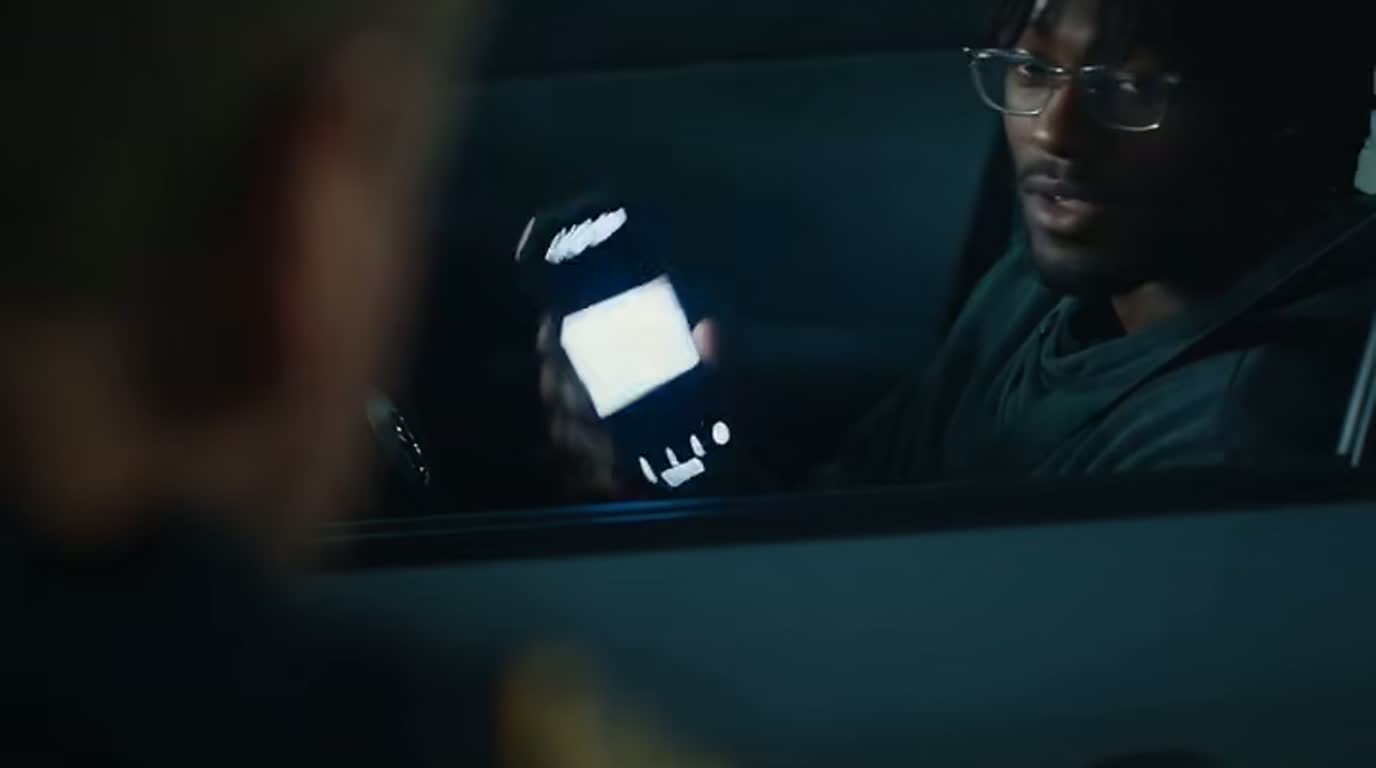
Marcus lowered the window exactly three inches—enough to speak clearly without allowing the rain to drench his electronics. His hands rested comfortably at the ten-and-two positions on the leather-wrapped steering wheel, fingers open, relaxed, and fully visible under the soft interior ambient lighting.
“Good evening, officer,” Marcus said, his voice flat, low, and devoid of the slightest tremor. “How can I assist you tonight?”
Pratt leaned down until his sneering face filled the window opening, his breath carrying the pungent odor of stale spearmint gum and greasy convenience-store beef jerky.
“You can assist me by explaining why you’ve been loitering on private commercial property for the past thirty-five minutes, son,” Pratt said, his voice dripping with false authority. “Plano municipal ordinance section twenty-two dash four. Unlawful commercial staging on private retail property without written lease authorization. That’s an immediate four-hundred-dollar non-consent municipal tow and an administrative citation for criminal trespass.”
Marcus looked calmly into Pratt’s eyes, adjusting his spectacles with a subtle nudge of his index finger.
“Officer Pratt,” Marcus said, gesturing smoothly toward the glowing dashboard screen, “I arrived in this stall exactly seven minutes ago. I am operating under an active commercial rideshare dispatch through the city’s approved transportation network. My rider, Ms. Sterling, is currently checking out at the pharmacy counter. Under Texas Transportation Code Chapter 2402, section 107, licensed rideshare operators possess an explicit statutory safe-harbor window of up to twenty minutes to stage in commercial parking facilities while awaiting confirmed dispatched passengers.”
Pratt let out a short, mocking chuckle that ended in a wet sneer. He took two fingers and rapped them hard on the roof metal, leaning in closer.
“You think a state code book protects you out here at midnight, boy?” Pratt whispered, his voice tightening into a predatory edge. “Out here on this lot, the retail manager signed a master towing enforcement contract with my private interdiction unit. Your app doesn’t mean squat to me. I say this car is an abandoned public hazard, and that means a flatbed wrecker hooks your front axle in ten minutes. Unless, of course, you want to settle the administrative convenience bond right here on the hood. Cash simplifies a lot of paperwork, Marcus.”
Marcus looked at Pratt’s grinning face, then turned his gaze down to his smartphone.
“I don’t carry cash, Officer Pratt,” Marcus said quietly. “And you might want to look at what my system recorded twenty minutes ago.”
Marcus pivoted his smartphone so the screen faced directly out the driver’s window.
During his military tenure with the 388th Fighter Wing at Hill Air Force Base, Marcus had maintained the complex sensor suites and digital flight computers of modern multi-role aircraft. He had learned that systems never lied—human operators might panic, exaggerate, or fabricate narratives to protect their careers, but solid-state flight recorders and telemetry feeds recorded only raw physical reality. He had applied that exact technical rigor to outfitting his rideshare vehicle, wiring independent circuit breakers, surge protectors, and an uninterruptible power supply into the car’s secondary battery tray. In Marcus’s view, a vehicle operating in the chaotic gig economy was not merely a taxi; it was an airborne transport node navigating an environment filled with unforeseen hazards.
The psychological posture assumed by Officer Pratt was a textbook manifestation of street-level extortion tactics Marcus had observed during peace-keeping deployments overseas. Corrupt actors always established dominance through sudden sensory overload: a concussive physical impact, aggressive invasion of personal space, and an immediate barrage of arbitrary regulatory threats designed to induce cognitive paralysis. By forcing the victim into panic, the extortionist positioned himself as the sole arbiter of relief, offering an informal cash settlement as a benevolent alternative to catastrophic legal ruin. But Marcus was an avionics technician trained to troubleshoot emergency cockpit alarms under extreme duress. Panic was a luxury he had discarded years ago.
On the screen was high-definition 4K footage captured by Marcus’s forward dashcam, timestamped at exactly 11:42 PM. The video displayed the wide, rain-slicked entrance lane of the same Walmart lot. In the center of the frame, Pratt’s police motorcycle was clearly visible, tearing across the pedestrian crosswalk at over sixty miles an hour, its front wheel lofted two feet into the air in an aggressive, reckless power wheelie that sent water spraying ten feet into the air.
Pratt’s smug smile vanished in an instant, his jaw dropping open in paralyzed shock.
CHAPTER 2: THE REFLECTION ON THE HANDLEBARS
The steady drumming of the midnight rain seemed to fade into a hollow, ringing silence. Officer Greg Pratt stared at the glowing four-inch screen in Marcus’s hand, the reflection of the blue-and-white video footage dancing across his pale, widened eyes.
On the recorded video, the audio was pristine: the deafening roar of the Harley’s screaming high-RPM exhaust, the high-pitched squeal of rubber spinning on wet asphalt, and the distinct, unmistakable profile of Officer Pratt—wearing the exact same white helmet, the same black leather jacket with gold sergeant chevrons, and his personal tactical vest—carving a reckless, ninety-degree drift between two empty rows of shopping carts before parking under the distant light stanchion.
Pratt’s right hand twitched on the roof of the car, his fingers curling into a tight, trembling fist.
“Where… where did you get that footage?” Pratt demanded, his voice cracking with sudden, uncontrolled adrenaline. The former swagger had completely evaporated, replaced by a defensive, cornered hostility.
“My vehicle is equipped with a hardwired, continuous-buffering surveillance platform,” Marcus answered calmly, keeping the screen held steady. “When I entered the access lane off Highway 121 at eleven-forty, my forward camera captured your high-speed stunt across the pedestrian right-of-way. Under Texas Penal Code Section 42.03, operating a motor vehicle with willful and wanton disregard for the safety of persons or property in a public parking facility constitutes reckless driving—a Class B misdemeanor. Furthermore, city municipal policy strictly prohibits stunt riding or aggressive operation of municipal police vehicles outside authorized pursuit training.”
Pratt took a panicked half-step backward, his eyes darting across the empty parking lot toward his idling motorcycle, then back to Marcus’s face.
“That’s… that’s not admissible!” Pratt hissed, leaning forward again, his voice dropping into a harsh, conspiratorial whisper. “You can’t record an on-duty peace officer from inside a private vehicle without an administrative disclosure notice! You give me that phone right now! That device is now subject to evidence seizure under an ongoing internal traffic investigation!”
Pratt reached his heavy gloved hand through the three-inch window opening, his fingers attempting to grasp the top of the glass to force it down.
Marcus did not flinch, but his finger touched a small, red tactile button mounted beneath his steering column.
A sharp, high-frequency electronic beep sounded from the dashboard. The Camry’s central locking system engaged with a solid, definitive clunk, and the heavy laminated safety glass remained rigidly in place, refusing to budge beneath Pratt’s downward pressure.
“Under the Fourth Amendment of the United States Constitution and established Fifth Circuit precedent in Turner v. Driver, private citizens have a clearly established First Amendment right to record police officers performing official duties in public spaces,” Marcus said, his voice as smooth and immutable as tempered steel. “Attempting to unlawfully seize a recording device to suppress evidence of official misconduct is a violation of Title 18, United States Code, Section 242—deprivation of rights under color of law.”
Marcus tapped the screen of his phone with his thumb, bringing up a secondary video feed.
“And Officer Pratt, look closer at the timestamp on the telemetry overlay,” Marcus added.
Marcus zoomed into the upper right quadrant of the video frame.
Through the clear polycarbonate windshield of Pratt’s own motorcycle, mounted on a custom aluminum RAM bracket beside the speedometer, the screen of Pratt’s departmental Axon Fleet 3 camera was clearly visible. The digital readout on Pratt’s own unit was illuminated, displaying the identical time code: 23:42:18.
Beneath the camera, a compact digital tablet mounted to Pratt’s handlebars was displaying an active wireless screen-mirroring session, broadcasting the live video feed to an unauthorized commercial cloud storage IP address titled Apex Recovery Escrow.
Pratt’s throat worked convulsively. The blood had completely drained from his face, leaving his skin the color of wet sidewalk chalk.
“You… you don’t know what you’re looking at, driver,” Pratt stammered, his hand pulling back from the window as if the glass were red-hot.
“I know exactly what I am looking at, Officer Pratt,” Marcus replied quietly. “You disabled your department’s automated GPS locator so dispatch would think you were on stationary radar surveillance at the municipal boundary. But you left your private cloud link active to monitor your commercial kickback payouts from Apex Towing.”
Pratt’s jaw tightened. With a vicious, desperate motion, he reached for the tactical microphone pinned to his epaulet.
The three-channel surveillance system Marcus had engineered utilized Sony Starvis 2 image sensors with dual-exposure high dynamic range, capable of resolving license plate characters, vehicle identification numbers, and facial features under near-zero lux illumination. The optical processing algorithms dynamically compensated for the blinding glare of high-intensity LED emergency strobes, preventing the sensor blowout that typically compromised standard consumer dashboard cameras. Every frame was embedded with an invisible SHA-256 cryptographic watermark and synchronized to within five milliseconds of the national GPS constellation time broadcast.
Under Texas evidentiary law and the Federal Rules of Evidence Rule 902, self-authenticating electronic records accompanied by a certified hash algorithm were admissible in criminal proceedings without requiring prior testimony from a forensic examiner. Marcus had designed the system specifically to meet federal court admissibility standards. Pratt was not merely dealing with a video file recorded on a phone; he was facing a forensic dossier engineered to survive the scrutiny of the most aggressive defense litigation.
“We’ll see how smart you talk when my wrecker hooks your rear axle,” Pratt snarled into the rain.
Before Pratt could press the transmit button, the passenger-side door of Marcus’s Camry clicked open.
CHAPTER 3: THE RAIN ON THE WINDSHIELD
The sudden opening of the passenger door startled Pratt so violently that his boot slipped in the grease-slick puddle, forcing him to grab the Camry’s side mirror to keep his balance.
A woman in a tailored camel-hair wool overcoat and dark waterproof boots slid into the passenger seat, shaking the rain from her black umbrella before pulling the door firmly shut with a solid, reassuring thunk. She was forty-six years old, with sharp, intelligent hazel eyes behind wire-rimmed tortoiseshell glasses, her silver-streaked dark hair pulled back into an immaculate French twist. In her lap, she carried a heavy leather briefcase embossed with the gold seal of the State of Texas, along with a white pharmacy bag containing prescription pediatric cardiovascular medication.
It was Sarah Sterling—the First Assistant Criminal District Attorney for Collin County.
“Good evening, Marcus,” Sarah said, glancing at the dashboard terminal where her name was displayed on the rideshare interface. “Thank you for waiting through the storm. The pharmacy had to compound the specialty liquid suspension for my daughter’s cardiac prescription.”
“Good evening, Ms. Sterling,” Marcus said smoothly. “No problem at all. We are fully secure.”
Outside the driver’s window, Officer Pratt’s jaw hung open. His eyes shifted from Sarah’s face to the gold state seal on her leather briefcase, his complexion turning from pale chalk to a sickly, mottled gray.
“M-Ms. Sterling?” Pratt choked out, his voice cracking into a high, frightened squeak.
Sarah Sterling turned her head toward the half-open driver’s window, her sharp gaze locking onto Pratt with the chilling, analytical precision of a veteran homicide prosecutor. She did not smile, and she did not raise her voice.
“Officer Greg Pratt,” Sarah said, her tone as cold as the November rain. “Explain to me why you are standing in a flooded parking lot with your hands on this vehicle, threatening an authorized commercial rideshare driver.”
“Ms. Sterling, ma’am!” Pratt stammered, frantically wiping rainwater from his forehead with the back of his sodden leather glove. “I… I was conducting a routine commercial loitering check! We’ve had reports of suspicious vehicles staging on this retail parcel after midnight! I had no idea this was your dispatched driver!”
“Suspicious vehicles?” Sarah repeated, her voice dripping with lethal skepticism. “Marcus Vance has been a registered, vetted commercial transportation provider with the county judiciary shuttle network for eighteen months. He holds a Department of Defense secret security clearance from his military service, and his vehicle is fully inspected and licensed under state transportation statutes.”
Sarah gestured toward the smartphone still resting in Marcus’s dashboard mount.
“Furthermore, Officer Pratt,” Sarah continued, “as I walked out of the pharmacy lobby three minutes ago, my mobile terminal received an automated civilian safety broadcast through the county public integrity network. I watched Marcus’s dashcam feed live on my phone. I watched you perform a sixty-mile-per-hour power wheelie across an active pedestrian corridor at eleven-forty-two. And I heard you demand a cash ‘administrative convenience bond’ on the hood of this car.”
Pratt’s knees appeared to buckle slightly. He leaned heavily against the Camry’s roof stanchion, his breath coming in ragged, wheezing gasps.
“Ms. Sterling, that… that was a misunderstanding!” Pratt pleaded, his arrogance completely shattered. “It was an off-the-cuff joke! A figure of speech! I would never solicit an unlawful payment!”
“A figure of speech?” Sarah said, reaching into her leather briefcase and pulling out an encrypted state prosecutor tablet. “Over the last four months, my office has received eleven separate administrative complaints from night couriers, food delivery drivers, and rideshare operators working the Highway 121 retail corridor. Every single complaint described a motorcycle officer matching your badge number threatening immediate non-consent tows unless the driver handed over eighty to one hundred dollars in cash.”
She held up the tablet screen. Displayed on the display was an active dispatch map showing a heavy flatbed tow truck—bearing the green-and-white logo of Apex Recovery—turning into the north entrance of the Walmart lot just two hundred yards away.
Sarah Sterling’s presence in the vehicle transformed the roadside standoff into an immediate institutional catastrophe for Pratt. In Collin County, the District Attorney’s office had been aggressively investigating allegations of municipal revenue padding along commercial transit corridors, where suburban townships utilized aggressive towing enforcement to supplement depleted municipal tax coffers. Sarah had personally authored the county’s public integrity guidelines regarding non-consent commercial tows, mandating that all commercial property removals be accompanied by a digitally signed complaint from a verified property owner with photographic proof of a minimum twenty-minute continuous obstruction.
Furthermore, Sarah knew that predatory towing cartels operated like corporate syndicates: tow truck drivers paid kickbacks to rogue officers to steer lucrative commercial impounds, while private storage facilities charged inflated administrative gate fees, labor charges, and daily impound fees that quickly exceeded the retail value of an older vehicle. For a working parent or an independent courier living paycheck to paycheck, the sudden loss of a vehicle was an economic death sentence that led to eviction, job loss, and personal bankruptcy.
“And look at that,” Sarah whispered, her eyes boring into Pratt. “Apex Recovery just arrived on scene without a single call being logged through Plano Police Central Dispatch. You called this tow through a private backchannel, didn’t you, Greg?”
Before Pratt could formulate a response, the headlights of two unmarked black Chevrolet Tahoe pursuit vehicles swept across the parking lot, their emergency strobes pulsing in a silent, hypnotic rhythm of crimson and cobalt.
CHAPTER 4: THE MIDNIGHT AUDIT AT THE SUPERCENTER
The two unmarked Chevrolet Tahoes pulled into Row 4 with practiced tactical coordination, boxing in Pratt’s Harley-Davidson motorcycle and blocking the incoming Apex Recovery flatbed truck in the middle of the access lane.
The driver’s door of the lead Tahoe swung open, and Sergeant David Thorne stepped into the driving rain. Thorne was forty-eight years old, six-foot-one, with close-cropped salt-and-pepper hair, wearing an insulated charcoal trench coat over a tailored suit. Pinned to the lapel of his coat was the gold badge of the Collin County Sheriff’s Office Public Integrity and Special Investigations Unit.
Thorne walked with deliberate, unhurried strides toward Marcus’s car, flanked by two senior internal affairs investigators carrying evidence collection cases and digital forensic imaging kits.
“Step away from the vehicle, Officer Pratt,” Sergeant Thorne ordered, his voice cutting through the roar of the rain like a sharp steel blade. “Hands out of your pockets. Keep your palms open and flat against the hood of your motorcycle. Now.”
Pratt swallowed hard, his limbs trembling as he turned away from Marcus’s window and stumbled toward his Harley-Davidson. He placed his hands flat on the wet fiberglass fuel tank, his head hanging low as water dripped steadily from the tip of his nose onto the chrome instrument cluster.
Sergeant Thorne stopped beside Marcus’s open window, giving Marcus a respectful, appreciative nod before turning his attention to Sarah Sterling.
“Good evening, Ms. Sterling,” Thorne said. “Your emergency telematics priority dispatch came through our desk ten minutes ago. We were already monitoring Pratt’s encrypted commercial relay from our mobile surveillance unit off the tollway.”
Sarah stepped out of the Camry, holding her umbrella overhead to shield Thorne from the storm.
“Sergeant Thorne,” Sarah said, “Marcus Vance has captured complete multi-angle 4K telemetry and optical recordings of Officer Pratt’s reckless driving and his attempted cash extortion. But we need the Walmart exterior high-mast surveillance footage secured immediately before the retail security server begins its scheduled midnight archiving cycle.”
Thorne turned to his junior investigator, Detective Alvarez.
“Alvarez, take Detective Vance and proceed directly to the Walmart loss prevention office,” Thorne commanded. “Serve the emergency grand jury preservation order on the night manager. Subpoena all external high-definition camera feeds covering Lots A through D from twenty-three hundred hours forward. Mirror the raw RAID arrays to our encrypted solid-state drives.”
“Copy that, Sergeant,” Alvarez said, sprinting across the wet asphalt toward the sliding glass doors of the retail center.
Thorne then walked to the rear of Pratt’s motorcycle, where the black leather pursuit saddlebags were locked with stainless-steel keyed latches.
“Officer Pratt,” Thorne said, his voice cold and devoid of sympathy. “Under the authority of Article 18.01 of the Texas Code of Criminal Procedure and pursuant to an exigent public integrity warrant signed by Presiding Judge Evelyn Brooks thirty minutes ago, I am taking custody of your official motorcycle, your communications gear, and your department-issued equipment. Surrender your department keys, your secondary mobile device, and your sidearm.”
Pratt’s shoulders heaved. Slowly, with trembling fingers, he reached down to unholster his Glock 17, placing it carefully on the motorcycle seat. Then he unclipped a heavy ring of brass keys and handed them to Thorne.
Thorne inserted the smallest brass key into the lock of the left saddlebag, clicking the latch open and lifting the heavy leather lid.
Inside the saddlebag, illuminated by Thorne’s high-intensity inspection light, lay an unsealed manila envelope bulging with thick stacks of United States currency, held together by colored rubber bands. Tucked beside the cash was a carbon-copy receipt book bearing the pre-printed header: Apex Recovery & Municipal Impound Mitigation Services.
Thorne pulled on a pair of blue nitrile gloves, carefully lifting the top stack of bills.
“Twelve thousand, four hundred dollars in twenty-dollar and fifty-dollar denominations,” Thorne murmured, his eyes hardening as he examined the ledger entries. “Every receipt corresponds to an out-of-state courier, an overnight delivery driver, or a late-night gig worker stopped along the 121 retail corridor over the last forty-eight hours.”
Marcus stepped out of his car, holding his umbrella, his face reflecting quiet sorrow rather than anger.
“My daughter Chloe is seven years old, Sergeant,” Marcus said softly, his voice carrying clearly over the rain. “She has a congenital ventricular septal defect. Every dollar I earn driving these night shifts goes into an escrow account at Children’s Medical Center in Dallas for her corrective surgery next month. To think that an officer sworn to protect this community would use his badge to shake down working parents in the dark… it’s an outrage that words can hardly describe.”
Sergeant Thorne had spent over two decades in law enforcement, beginning as a patrol deputy on the rural backroads of North Texas before moving into specialized internal investigations. He understood that nothing eroded public trust more profoundly than an officer who used his badge as an instrument of armed extortion. The men and women who served with honor put their lives on the line every day to protect their neighbors; a rogue officer shaking down late-night drivers dishonored every sacrifice made by the profession.
As Thorne methodically inventoried the thick envelopes of cash recovered from Pratt’s saddlebag, the methodical nature of the operation became indisputable. Each envelope was meticulously labeled with the make and model of the target vehicle, the date, and the specific retail parking lot where the shakedown had occurred. Pratt had kept a meticulous private ledger of his illicit income, demonstrating a degree of cold, calculating premeditation that destroyed any possible claim of an isolated error in judgment.
Thorne looked at Marcus, his jaw setting into an expression of unyielding resolve.
“Mr. Vance,” Thorne said with absolute conviction, “the law is going to protect your family tonight. And Officer Pratt is about to discover that the shield he disgraced cannot save him from the justice he tried to sell.”
CHAPTER 5: THE LEDGER IN THE LEATHER SADDLEBAG
The rain continued to fall in torrents across the Collin County Justice Center in McKinney as the clock on the municipal clock tower struck three in the morning. Inside the secure third-floor conference suite of the District Attorney’s Public Integrity Division, the air smelled of strong roasted coffee, damp wool, and the electric ozone of laser printers churning out hundreds of pages of financial audit records.
Marcus Vance sat at the long conference table, clean and dry, reviewing his vehicle’s synchronized telemetry logs alongside First Assistant District Attorney Sarah Sterling. Across the table, forensic accountants from the Texas Department of Public Safety were cross-referencing the serial numbers of the recovered cash with electronic banking records seized from Apex Recovery’s main office in Frisco.
Sergeant David Thorne entered the room, carrying a heavy red evidence binder. He set the binder down with a firm, satisfying thud that resonated across the polished oak table.
“The forensic extraction of Officer Pratt’s secondary mobile device is complete,” Thorne announced, taking a seat beside Sarah. “It’s far worse than an isolated shakedown racket. Pratt wasn’t just pocketing cash on the side; he was operating as an equity partner in a multi-jurisdictional predatory towing syndicate.”
Sarah opened the red binder, her eyes skimming the decrypted text message transcripts extracted from Pratt’s personal iPhone.
“Look at this sequence from two days ago,” Sarah said, pointing to a message thread with an individual identified as ‘Vance R. — Apex GM.’ “Pratt was receiving an encrypted kickback notification for every non-consent tow dispatched from the retail parking corridors along Highway 121. Apex charged stranded motorists four hundred and eighty dollars for an expedited release. Pratt received a flat two hundred dollars per vehicle, wired directly into an offshore cryptocurrency wallet hosted in the Cayman Islands.”
“And the total volume?” Marcus asked, his analytical mind tracking the systemic scale.
“Over eighty-six thousand dollars laundered through that crypto account in the last five months alone,” Thorne replied. “They targeted out-of-state couriers, young female rideshare drivers, and solo workers who they assumed lacked the resources, legal knowledge, or time to contest an administrative municipal citation. Pratt would tell them that if they paid eighty dollars in cash on the spot, he would cancel the wrecker call and mark the loitering infraction as an ‘informal verbal warning.’ Most people, terrified of losing their vehicles and their livelihoods in the middle of the night, handed over whatever cash was in their wallets.”
Thorne turned to Marcus, his expression warm with genuine professional admiration.
“If you hadn’t maintained your composure, Marcus, and if you hadn’t hardwired that multi-channel 4K telemetry system with synchronized optical time-codes, Pratt would have claimed you were a belligerent trespasser. He would have had your Camry hauled to the Frisco impound yard, and the department would have taken his word over yours. You didn’t just protect yourself tonight; you dismantled an extortion network that has terrorized hundreds of vulnerable citizens across this county.”
Marcus looked at the digital display of his phone, where a framed photograph of his daughter Chloe smiling in her hospital bed served as his wallpaper.
“My father was a sergeant in the 1st Cavalry Division at Fort Hood, Sergeant Thorne,” Marcus said softly. “He taught me that integrity is what you do when you think no one is watching in the dark. Out on that wet asphalt at midnight, Pratt thought the dark belonged to him. He thought his badge made him an untouchable predator. But truth doesn’t need a siren to be heard; it just needs someone willing to stand firm and let the facts speak.”
The financial investigation into Apex Recovery exposed an intricate corporate shell structure designed to shield the syndicate’s principal organizers from criminal asset forfeiture. Working alongside forensic accountants from the Texas Department of Public Safety, Sarah Sterling traced the flow of cash from the Frisco impound facility through multiple intermediary limited liability companies registered in Delaware and Nevada, before being funneled into offshore cryptocurrency accounts.
The scheme had preyed upon over two hundred independent gig-economy workers, delivery couriers, and out-of-state students over an eighteen-month period. Many of the victims had been forced to take predatory high-interest payday loans to pay the four-hundred-dollar impound fees, while others had lost their jobs when their delivery vehicles were wrongfully held for weeks under fraudulent administrative holds. The scale of the human suffering caused by Pratt’s greed was immense, reinforcing Marcus’s determination to see the investigation through to its complete legal conclusion.
Suddenly, Detective Alvarez pushed open the conference door, holding a signed legal document.
The digital extraction also yielded a series of recorded voice memos in which Pratt boasted to his brother-in-law about his ability to exploit ambiguous municipal parking codes to generate steady off-the-books revenue. In one particularly damning audio recording, Pratt described how he deliberately targeted drivers operating older foreign sedans, knowing that rideshare drivers in modest vehicles were least likely to retain legal counsel or file formal administrative appeals with the city manager’s office.
Sarah Sterling took notes with surgical precision, categorizing each recorded admission under corresponding felony statutory definitions. As a veteran prosecutor, she knew that presenting a jury with the defendant’s own arrogant voice was the most devastating forensic tool available in public corruption trials. Pratt had built a digital monument to his own greed, providing prosecutors with an airtight, self-authenticating record of criminal conspiracy that would guarantee consecutive convictions under state anti-racketeering statutes.
“Ms. Sterling,” Alvarez announced, “Judge Brooks has just signed the emergency search warrants for the Apex Recovery corporate headquarters and the personal residence of Officer Pratt. State troopers are breaching the facility right now. And the grand jury foreperson has convened an emergency quorum for eight o’clock this morning.”
CHAPTER 6: THE HEARING AT THE JUSTICE CENTER
By eight-thirty in the morning, the heavy rain had cleared, leaving the limestone columns of the Collin County Courthouse glistening under the pale, sharp sunlight of a pristine Texas autumn dawn. Inside Courtroom 402, every wooden pew was occupied by local rideshare drivers, delivery couriers, municipal police officers, and investigative journalists from the Dallas media market.
At the prosecution table sat Sarah Sterling and Sergeant David Thorne, with Marcus Vance seated between them in a dark wool suit and blue tie.
At the defense table, seated between two high-priced defense attorneys, was Officer Greg Pratt. He was dressed in a drab civilian suit that looked two sizes too large for his slumping frame. His head hung low, his face pale and haggard, his hands trembling as he stared at the polished mahogany surface before him.
Presiding Judge Evelyn Brooks, a jurist renowned throughout North Texas for her zero-tolerance stance on public corruption, adjusted her glasses and brought her heavy lignum-vitae gavel down with a sharp, resonant strike that commanded absolute silence.
“Let the record reflect,” Judge Brooks stated, her clear voice carrying to every corner of the gallery, “this emergency preliminary hearing is called pursuant to an emergency grand jury indictment returned this morning against Gregory Allen Pratt, charging twelve felony counts of extortion under color of official authority, six counts of tampering with governmental records, and one count of engaging in organized criminal activity.”
Defense counsel stood up, his tone defensive and strained.
“Your Honor,” the attorney argued, “my client has served this municipality for eighteen years. While there may have been procedural irregularities regarding commercial towing coordination, the prosecution’s request for pre-trial detention without bail is entirely disproportionate. Officer Pratt is a lifelong resident of this county and poses no risk of flight.”
Sarah Sterling rose to her feet, holding a high-definition tablet connected to the courtroom’s large projection monitors.
“Your Honor,” Sarah said, her voice resonant and unyielding, “the evidence before this court demonstrates that Officer Pratt was not engaged in ‘procedural irregularities.’ He was operating an organized criminal shakedown racket targeting the most vulnerable working people in this community.”
Sarah activated the presentation screen.
The massive display illuminated with Marcus Vance’s forward 4K dashcam footage. The gallery watched in stunned silence as Pratt’s police motorcycle tore across the screen at sixty miles an hour in an illegal power wheelie. Then, the synchronized audio filled the courtroom with crystalline clarity:
“I say tow. Unless you make it worth my while. Cash simplifies a lot of paperwork, Marcus.”
The courtroom erupted into a storm of gasps and murmurs.
Sarah pressed another key, displaying the recovered financial ledgers from Apex Recovery, showing over one hundred thousand dollars in illicit kickbacks.
“Officer Pratt used the threat of state violence and economic destruction to shake down rideshare drivers who were working through the night to feed their families and pay medical bills,” Sarah continued, looking directly at Pratt. “His actions represent a catastrophic betrayal of the badge, a violation of the public trust, and a danger to every citizen who travels our roadways.”
Judge Brooks leaned forward, her eyes burning with cold, judicial fury.
“Mr. Pratt,” Judge Brooks said, her voice trembling with righteous indignation, “the uniform of a peace officer is a sacred covenant of public safety, not a license to operate a highway extortion ring. The evidence presented by the prosecution is overwhelming, pristine, and devastating. Your conduct is an absolute disgrace to the honorable men and women of law enforcement.”
Judge Brooks brought her gavel down with an explosive crack.
Courtroom 402 of the Collin County Courthouse was a solemn monument to the majesty of statutory law. Its high ceilings of Texas limestone, brass chandeliers, and towering cedar panels had witnessed generations of frontier jurisprudence, from land boundary disputes to high-profile public corruption trials. Judge Evelyn Brooks sat upon the bench with the quiet, formidable authority of a jurist who viewed public integrity as the very lifeblood of a free society.
When Sarah Sterling displayed the synchronized telemetry evidence on the courtroom monitors, the technical precision of Marcus’s documentation stunned the gallery. The forensic timeline correlated every second of Pratt’s reckless motorcycle stunts with his arrival at Marcus’s driver-side window, dismantling every claim of legitimate law enforcement procedure. In the back rows of the gallery, several rideshare drivers who had previously fallen victim to Pratt’s predatory shakedowns watched with tears of vindication in their eyes as the cuffs were locked around the officer’s wrists.
“Bail is denied. The defendant is remanded into the immediate custody of the Texas Department of Criminal Justice pending trial. Furthermore, this court orders an immediate freeze on all assets associated with Apex Recovery, and orders the immediate dissolution of the commercial towing contract with the City of Plano.”
Outside the courtroom, the corridors were filled with representatives from regional transportation labor associations and community advocacy groups who had gathered to support Marcus. Many carried printouts of Marcus’s viral dashcam video, which had garnered over two million views on national social media channels overnight, turning the quiet avionics technician into a symbol of grassroots resistance against predatory law enforcement practices.
As Judge Brooks concluded the arraignment, she took a moment to address Marcus directly from the bench. She praised his extraordinary composure, noting that in an era often characterized by hostility and cynicism, Marcus had demonstrated that the most effective weapon against official corruption was not violence or rage, but the calm, unyielding insistence upon statutory truth. Her words resonated deeply through the courtroom, eliciting a spontaneous round of applause from the gallery that the bailiffs made no attempt to silence.
Two uniformed county bailiffs stepped forward, clicking heavy steel handcuffs around Pratt’s wrists and leading him out of the courtroom to the holding cells below.
CHAPTER 7: THE CLEAR HIGHWAY TOWARD DALLAS
Two weeks later, the morning sun rose over the rolling blackland prairies of North Texas, casting a brilliant golden glow across the glass skyscrapers of the Dallas skyline. The autumn breeze was cool, crisp, and clean, carrying the distant hum of traffic moving smoothly along the sunlit highway corridors.
In the sunlit family waiting pavilion of Children’s Medical Center Dallas, Marcus Vance sat beside his wife Angela, holding a pair of paper cups filled with hot cinnamon tea. Outside the high arched windows, a manicured garden filled with native Texas redbuds and live oaks rustled gently in the morning light.
The heavy double doors of the pediatric intensive care unit opened, and Dr. Harrison, the chief pediatric cardiac surgeon, walked into the waiting lounge. He was in surgical scrubs, a warm, reassuring smile spreading across his tired face as he removed his surgical cap.
“Marcus, Angela,” Dr. Harrison said, walking straight to them and extending both hands. “Chloe’s surgery was an absolute, flawless success. The ventricular patch is seated perfectly, her arterial pressures are textbook normal, and she is breathing completely on her own. She is going to live a long, completely normal, healthy life.”
Angela buried her face in Marcus’s shoulder, weeping tears of overwhelming joy and relief. Marcus closed his eyes, wrapping his arms around his wife, feeling an immense, crushing weight of worry and sleepless nights lift from his shoulders like mist before the sun.
“Thank you, Dr. Harrison,” Marcus whispered, his voice thick with emotion. “Thank you with all our hearts.”
An hour later, Marcus and Angela were permitted into the private recovery room. Chloe lay propped up on clean white pillows, her cheeks glowing with a healthy, rosy color that Marcus had not seen in two years. Her dark eyes were bright, and she beamed as Marcus gently took her small hand in his.
“Daddy!” Chloe said, her voice soft but full of life. “Look at the monitors! The lines are smooth! No more bumpy beeps!”
“Smooth lines, sweetie,” Marcus said, kissing her forehead. “Just like I promised you. Smooth lines all the way.”
On the bedside table sat an ornate embossed leather certificate that had been presented to Marcus that morning by the Mayor of Plano and First Assistant District Attorney Sarah Sterling.
The certificate was the Civic Medal of Exceptional Valor and Integrity, recognizing Marcus Vance for his extraordinary courage in defending public accountability and dismantling municipal corruption. Attached to the certificate was a formal proclamation establishing the Collin County Transportation Workers Defense Endowment, funded by the seized assets of the corrupt towing syndicate, which had fully covered the entire four-hundred-thousand-dollar medical cost of Chloe’s surgery.
That afternoon, Marcus stepped out onto the hospital concourse to retrieve his car. His Toyota Camry stood gleaming in the Texas sunlight, the new ceramic coating reflecting the endless blue sky like a polished mirror. Every glass panel was pristine, every electronic system was fully calibrated, and the road ahead stretched wide, open, and free.
The healing atmosphere inside Children’s Medical Center was filled with quiet miracles. Marcus sat beside Chloe’s recovery bed, listening to the steady, rhythmic beeping of her cardiac monitor. For years, every night had been haunted by the terror that his daughter’s failing heart would falter in her sleep, driving him to accept exhausting overnight shifts in the rain to build an insurmountable medical savings fund. Now, watching her sleep peacefully with color in her cheeks, Marcus felt an overwhelming surge of gratitude that washed away every memory of fatigue and hardship.
The community had rallied around Marcus and his family with astonishing generosity. The local rideshare drivers’ collective had established a permanent peer-support network to protect drivers against predatory towing, while the municipal government had reformed its commercial parking statutes to guarantee permanent safe-harbor protections for transportation workers. Marcus’s quiet courage in the midnight rain had not merely saved his own family; it had forged a lasting shield of safety and dignity for thousands of working people across North Texas.
Marcus sat behind the steering wheel, took a deep breath of the fresh morning air, and looked at the smiling photograph of Chloe on his dashboard.
Later that evening, as twilight painted the Texas prairie in shades of violet and gold, Marcus drove Chloe and Angela home from the hospital along the open expanse of State Highway 121. The car was filled with the gentle, sweet melody of Chloe’s favorite children’s songs playing softly over the stereo. Chloe leaned against the window, her small hand waving happily at the passing fields of bluebonnets and waving prairie grass.
Marcus adjusted his rearview mirror, catching Angela’s eyes and sharing a smile of quiet, profound joy. He knew that life would continue to present challenges, but they had weathered the darkest storm and emerged into the dawn with their dignity, their family, and their faith intact. The road ahead was long and bright, guided by the enduring principles of honor, love, and the unyielding protection of the truth.
As they pulled into their driveway in Plano, Chloe unbuckled her seatbelt and reached over to give Marcus a tight, warm hug around the neck. “I’m proud of you, Daddy,” she whispered. Marcus held his daughter close, feeling the steady, healthy rhythm of her heartbeat against his chest. It was the sweetest sound in the universe—a living testament to a father’s devotion, an unbreakable spirit, and the enduring victory of justice over darkness.
The midnight storms of Collin County had passed into memory. Truth had stood its ground, justice had triumphed, and the future was filled with boundless light.