The Stolen Harbor And The Broken Pride Of Cape Ann
CHAPTER 1: THE STAND-IN AT MIDNIGHT
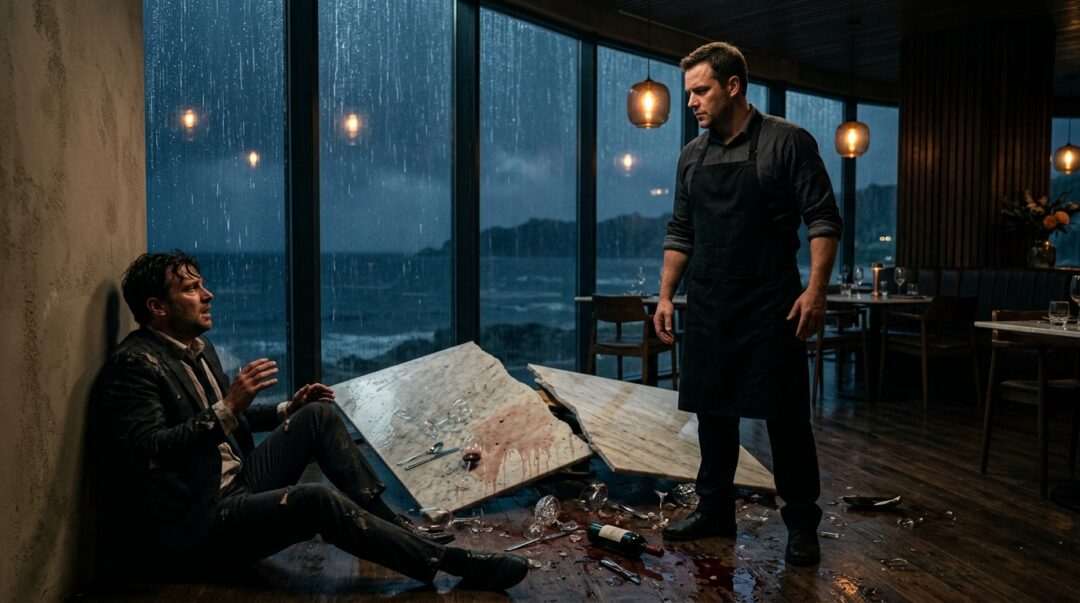
The North Atlantic gale drove sheets of salt-laced rain against the ten-foot tempered glass walls of L’Estran, turning the dark harbor of Cape Ann into a churning mirror of black water and whitecaps. Inside the empty three-hundred-seat dining room, the only light came from three brass pendant fixtures suspended over the sixty-foot Honduran mahogany bar.
Ren Calder stood behind the brass rail, a clean white linen service towel folded into precise geometric thirds in his left hand. He wore a faded charcoal work shirt with the sleeves rolled tight to his forearms, a black denim utility apron, and scuffed oil-resistant kitchen boots. His posture was perfectly erect, shoulders relaxed, breathing deep and slow through his nose. His knuckles, ridged with old faint burn scars from commercial fryers and pastry ovens, were relaxed against the polished wood.
Across the room, standing beside a round table dressed in crisp Belgian linen, Vex Marlowe swirled two fingers of four-hundred-dollar Napa cabernet in a hand-blown Riedel crystal glass. Vex wore a bespoke three-piece navy chalk-stripe suit that fit like wet silk, his silver-streaked dark hair combed straight back with pomade, a heavy gold signet ring catching the amber pendant light on his right pinky.
Vex slowly brought his hands together in a mocking, rhythmic clap. Three hollow slaps that echoed off the empty leather banquettes.
“Look at you,” Vex said, his voice dripping with smooth, theatrical condescension. “Closing up at one in the morning. Checking the brass taps. Bleaching the sink drains. You know what they call you in the front-of-house group chat, Ren? The ghost. The stand-in. The guy who was never quite good enough to hold the pass.”
Ren did not look up from the mahogany counter. He drew the folded linen towel down the grain in one continuous, even stroke, gathering three errant water droplets into the cotton fibers.
Vex smiled, showing porcelain veneers that gleamed under the warm lighting. He took four measured strides across the parquet floor, stopping two feet from the bar where Ren stood. He tilted his head back, inhaling the dry scent of the cedar paneling, then looked down at Ren’s boots.
“Do you remember three years ago, Ren?” Vex asked, his tone dropping into confidential cruelty. “The night the gas line blew in the bakery annex? You were curled up on the tile holding your blistered hands, begging someone to turn the main valve. You looked up at the inspectors and said it was an accident. But nobody believed you, did they? The board wanted an innovator, not a liability. When you walked out that service door with your chef’s knives in a canvas roll, everybody in the kitchen laughed. But I laughed loudest.”
Ren set the folded linen towel down on the mahogany surface with surgical precision.
“You’re still talking,” Ren said. His voice was quiet, pitched low beneath the drumming of the storm outside, devoid of anger or trembling.
Vex’s smirk tightened into a sneer of irritation. He turned the heavy crystal wine glass in his fingers, paused for a beat of pure theatrical malice, and turned his wrist upside down.
A dark crimson flood of cabernet splashed across the pristine honey-colored hardwood, spattering the toes of Ren’s leather work boots.
Vex spread his arms wide, leaning forward over the bar with mock theatrical pity. “Oops. Clean it up, dishwasher. That’s what you’re paid twenty dollars an hour for.”
Ren stepped out from behind the bar.
He didn’t rush. His weight shifted effortlessly from his rear foot to his front foot, his center of gravity dropping three inches into a centered, defensive Wing Chun posture. His eyes remained locked on Vex’s chin.
“Hey,” Vex snapped, startled by the sudden shift in space. His upper lip curled. “Back up before I have the harbor patrol drag you out of here in zip ties.”
Ren closed the final three feet without a sound.
Vex panicked. He reared back his right arm and swung a wild, clumsy overhand right aimed at Ren’s temple—a fighter’s punch thrown by a man who had only ever fought with signed contracts and lawyers.
Ren didn’t flinch. He slipped his head three inches to the left, inside the trajectory of the swinging arm. His left forearm came up in a crisp deflection wedge, guiding Vex’s wrist harmlessly over his shoulder, while his right palm struck forward like a hydraulic piston directly into the center of Vex’s sternum.
The impact sounded like a wet sandbag dropping onto concrete. The air left Vex’s lungs in a loud, ragged gasp.
Vex stumbled backward four paces, flailing his arms, before his thighs hit a vertical stack of six bentwood dining chairs. The chairs tipped with a thunderous clatter, legs splintering and varnished rungs snapping as Vex crashed into the heap, his tailored jacket tearing at the armpit.
Ren advanced at a steady, rhythmic walk, his hands held open at chest height. “Stop talking.”
Vex scrambled up out of the broken furniture like a cornered animal, his hair falling into his eyes, his silk tie crooked. Pure rage overtook his vanity. He reached down, grabbed the stainless-steel frame of a heavy rolling dessert cart loaded with crystal dessert plates, and shoved it forward like a battering ram.
Ren stepped sideways, letting the cart squeal past him on its casters. As the rear edge passed, Ren trapped Vex’s outstretched left wrist with an iron grip, spun his hips, and redirected the rest of Vex’s momentum straight into the marble counter of the hostess station.
Vex slammed face-first into the polished Carrara stone. Glasses rattled. Vex rebounded, gasping, and threw a desperate knee toward Ren’s groin.
Ren checked the strike with an iron shin block that numbed Vex’s peroneal nerve. Before Vex could set his foot down, Ren drove a short, concussive elbow strike into his left collarbone, followed instantly by a sweeping reap of Vex’s standing ankle.
Vex was launched airborne. His spine crashed down across the centerpiece of the main dining room—a four-foot, solid two-inch-thick Italian Carrara marble round table.
The marble groaned, held for a split second, and then fractured down its center vein with an explosive crack like a rifle shot. The two halves collapsed into the carpet under Vex’s shuddering weight.
Vex rolled off the shattered stone, coughing weakly, clutching his bruised ribs as he crawled backward against the wainscoted wall. Blood trickled from his split bottom lip, dripping onto his ruined chalk-stripe lapel. His eyes were wide with terror, the sneer completely erased from his face.
“Wait—” Vex wheezed, lifting one shaking palm. “Ren… please… wait—”
Ren stood over him, perfectly still, his breathing completely calm. He reached up with two fingers and casually brushed a fleck of white marble dust from his rolled sleeve.
Ren crouched down until his eyes were level with Vex’s trembling face.
“You were loud,” Ren said softly. “I was listening. That was your mistake.”
Vex’s chest heaved. But before Ren could stand, the shattered halves of the marble table shifted on the floorboards, revealing an antique iron ring recessed into the pine subfloor—an old rum-runner trapdoor that had been nailed shut since prohibition.
And from the breast pocket of Vex’s torn suit jacket, an encrypted two-way radio hissed to life with static, followed by a harsh, gravelly voice that Ren recognized instantly:
“Marlowe. The trawler is tying off at Pier Nine with the offshore crates. Did you put Calder in the ground yet? The city inspector is en route.”
CHAPTER 2: THE SOUND OF BREAKING GLASS
The crackle of the two-way radio died out into cold silence, leaving only the sound of rain hammering against the dark windows and Vex Marlowe’s ragged, terrified wheezing.
Ren reached down with two fingers and plucked the tactical radio from Vex’s torn jacket pocket. The casing was military-grade plastic, stamped with the private security insignia of Vance Maritime Logistics.
“Corliss Vance,” Ren said, turning the radio over in his hand. His gaze shifted from the radio down to the exposed iron ring between the broken slabs of Carrara marble. “The largest shipping magnate in Essex County is asking if you’ve killed me. That’s a strange conversation for an executive chef to have on a Tuesday night.”
Vex swallowed hard, his throat clicking. He pressed his back flat against the mahogany wainscoting, his knees pulled up to protect his bruised ribs. The arrogance that had carried him through television interviews and culinary galas had evaporated completely.
“You don’t understand what you’re stepping into, Ren,” Vex whispered, his voice trembling so violently his teeth chattered. “This isn’t about recipes. It was never about recipes.”
Ren knelt on one knee in the spilled wine, his eyes level with Vex’s. “Start with the lease.”
“The… the lease?”
“Tomorrow morning at eight,” Ren said, his voice flat as an ocean swell. “The Cape Ann Port Authority is holding an extraordinary public session to transfer the municipal deepwater lease of Pier Nine. My family held that wharf for seventy-five years before you and Vance filed the fraudulent insolvency petition. You came here tonight to make sure I spent the next twenty-four hours in a county holding cell on an assault charge so I couldn’t attend the hearing.”
Vex closed his eyes, a shudder wracking his frame. “Corliss Vance owns sixty percent of the waterfront development consortium. He bought the zoning board last winter. If Pier Nine is privatized tomorrow, they can deepen the channel for container barges and bypass federal customs inspections entirely.”
“And L’Estran?” Ren asked, gesturing to the luxurious dining room.
“It’s the front,” Vex gasped, wiping blood from his chin with the back of a trembling hand. “The cellar connects directly to the pre-revolutionary drainage tunnels that run beneath the sea wall to the old fish pier. The midnight shipments come off the trawlers in vacuum-sealed seafood totes. We process ten million dollars of untaxed offshore diamonds and narcotics through the kitchen cold storage every quarter. Vance promised me twenty percent of the deepwater terminal if I kept the municipal inspectors out.”
“And the fire three years ago?” Ren leaned forward, his knuckles resting lightly on his thigh.
Vex shrank back, tears cutting clean tracks through the dust on his cheeks. “Vance told me your grandfather left the original 1954 tidal charter in the building. You were getting too close to the financial books. You were questioning the foreign suppliers. Vance told me to cut the copper line behind the pastry deck. He said it would just be a small flash fire to destroy the filing cabinets. I didn’t know you’d be in the prep room at two in the morning!”
A sudden heavy thud vibrated through the floorboards beneath their boots.
It wasn’t thunder. It was the hydraulic screech of the iron delivery lift located in the rear scullery.
The kitchen doors sixty feet away swung open with a muffled squeak. Two men stepped through the threshold into the dim amber light of the dining room. Both wore dark foul-weather oilskins, heavy work boots, and black neoprene gloves. In the hands of the lead man was a matte-black pistol fitted with an eight-inch cylindrical suppressor.
Across the room, the main circuit breaker panel near the front vestibule snapped with a sharp electrical pop. The three pendant lights died instantly, plunging the dining room into near-total darkness, illuminated only by the rhythmic flash of the harbor lighthouse sweeping through the rain-streaked windows every ten seconds.
“Vex?” a gruff voice called out from the dark. “Where the hell are you? The boss said wrap this up.”
Vex opened his mouth to scream for help, but Ren’s hand clamped over his mouth like an iron vise.
“Make one sound,” Ren whispered directly into Vex’s ear, “and I leave you here for them to clean up.”
Vex nodded frantically, his eyes wide in the dark.
Ren released him, reached down, and grasped the recessed iron ring set into the floorboards. With a slow, silent pull of his back muscles, he lifted the oak hatch four inches. The cool, brackish smell of low-tide mud, salt spray, and aging oak wine barrels drifted up from the subterranean blackness below.
Ren slid backward into the opening, his boots finding the rusted rungs of an iron ladder. “Down,” he signaled to Vex.
Vex scrambled on hands and knees across the broken marble and tumbled into the hatchway just as the beam of a high-powered tactical flashlight swept across the shattered dining room.
Ren caught Vex by the belt, guided him down the ladder, and pulled the heavy oak hatch shut above their heads with a gentle, airtight click.
CHAPTER 3: THE TIDE BENEATH THE FLOOR
The subterranean tunnel smelled of two hundred years of salt rot, wet granite, and diesel fuel.
Water dripped steadily from the vaulted brick ceiling, splashing into a shallow trench of black brine that ran along the center of the flagstone floor. The only light came from Ren’s small penlight, its narrow beam cutting through the damp mist that rose from the tidal sump.
On either side of the passage, massive French oak wine casks—relics from the restaurant’s historical cellar—stood in double tiers, their black iron hoops swollen with rust. Behind the casks, heavy wooden shipping pallets were stacked high with white plastic insulated seafood crates, each secured with heavy-duty yellow zip ties and marked with the stencil: VANCE OFFSHORE HARVEST – COD FILLET.
Ren guided Vex through the narrow gap between the casks. Vex was shivering uncontrollably, his silk socks soaked in muddy brine, his breath hitching with every step.
“Where does this lead?” Vex whispered, his teeth chattering.
“It leads under the seawall to the foundation pilings of Pier Nine,” Ren replied, keeping his voice beneath the rumble of the sea above. “My grandfather used to store spare gillnets down here during the winter nor’easters. He knew every loose stone in this foundation.”
Ren stopped beside a reinforced stainless-steel prep table bolted to the masonry wall. On the table sat a digital scale, a vacuum heat-sealer, and an industrial box cutter. Scattered across the floor were empty burlap coffee sacks with Colombian export stamps.
Vex leaned against a wine cask, his eyes darting into the shadows. “Ren, Vance has four men on the trawler and two more guarding the harbormaster’s office. You can’t fight them. Let me take the radio. I can tell Vance you ran out the fire escape. We can both walk away from this.”
Ren turned the penlight directly into Vex’s face. The harsh white glare illuminated the desperation in the restaurateur’s eyes.
“You spent three years telling the culinary world that I was a broken failure who lost his nerve in the kitchen fire,” Ren said evenly. “You took my grandfather’s recipes, you took my reputation, and you built a criminal empire over my family’s wharf. You don’t negotiate tonight, Vex. You follow.”
Ren reached out and sliced open the zip tie on the nearest seafood crate with the box cutter. He lifted the styrofoam lid.
Inside, beneath a two-inch layer of crushed flake ice, lay six rectangular parcels wrapped in heat-sealed waterproof vinyl. Ren cut into the corner of the top parcel. A cascade of raw, uncut diamonds—industrial clarity, rough and crystalline—spilled into his palm.
“Offshore smuggling conduits through the international fishing fleet,” Ren murmured, letting the stones clatter back into the crate. “Vance isn’t just evading customs. He’s laundering cartel assets through the harbor redevelopment fund.”
Suddenly, Ren’s penlight beam caught something else lying on the lower shelf of the prep table—a blue spiral-bound notebook, its waterproof paper swollen and water-stained.
Ren’s pulse spiked. He dropped the box cutter and seized the notebook.
Stamped on the inside cover in neat, bold handwriting was the name: Clara Calder – Maritime Forensic Audit.
Ren flipped open the pages. The handwriting was his sister’s—detailed balance sheets tracing wire transfers from Vance Maritime Logistics to offshore accounts in Grand Cayman, complete with bank routing numbers and dates corresponding to the fraudulent insolvency hearings.
Tucked into the back pocket of the notebook was Clara’s laminated Massachusetts CPA license, stained with fresh, wet seawater.
Ren felt the cold air freeze in his lungs. “Clara was supposed to be in Boston.”
Vex flinched, shrinking back into the darkness between the casks. “Vance found her three days ago,” he stammered, his voice rising in panic. “She was snooping around the harbor authority filing room. Vance’s men intercepted her car on Route 128. They brought her here tonight.”
Ren dropped the notebook into his apron pocket and seized Vex by the lapels of his ruined coat, lifting the larger man until his toes barely grazed the wet flagstones.
“Where is she?” Ren whispered, the quiet stillness in his voice replaced by something terrifying and absolute.
“The salt-ice house!” Vex choked out, clutching Ren’s wrists. “At the end of Pier Nine! They’re holding her until the auction gavel falls at eight in the morning!”
Above them, the muffled sound of footsteps echoed through the ceiling joists. The trapdoor in the restaurant dining room was wrenched open, and the beam of a high-powered tactical spotlight lanced down through the cellar mist.
CHAPTER 4: THE WHARF AT DEAD LOW
The storm had ripped the canvas awnings off the old fishing shanties along the Cape Ann waterfront, whipping them into shredded ribbons that snapped like pistol shots in the gale. Dead low tide had exposed the rotting, barnacle-encrusted greenheart pilings of Pier Nine, where the sea churned against the granite seawall like boiling pitch.
Ren Calder emerged from the rusted iron outflow pipe beneath the pier, his boots sinking six inches into the freezing black mud of the harbor floor. Above him, the heavy wooden deck of the wharf shuddered under the force of the forty-knot wind.
Behind him, Vex Marlowe stumbled out of the pipe, groaning as the freezing salt spray hit his bruised face.
“Stay down,” Ren commanded, pulling Vex behind the thick timbers of a structural support trestle.
Fifty yards down the length of the pier stood the salt-ice house—a cavernous, windowless corrugated-steel structure where the commercial fishing fleet loaded crushed ice and coarse rock salt into their fish holds. Heavy industrial refrigeration compressors hummed on the roof, spewing clouds of white vapor into the freezing sleet.
Parked outside the steel roll-up door was a black Dodge Ram heavy-duty truck, its engine idling with low, rhythmic diesel rumble. Two armed men in foul-weather gear stood near the tailgate, their carbines slung across their chests beneath heavy oilskins, checking their watches.
Ren observed the layout with the cold analytical focus of a tactician. The wind was blowing off the harbor from the northeast, carrying the scent of diesel and brine directly toward the ice house. If he moved along the lower cross-bracing of the pier, the noise of the surf and the compressors would mask his approach entirely.
“What are you going to do?” Vex asked, his voice shaking with cold. “They have rifles, Ren. You have an apron and a box cutter.”
Ren turned his head, his dark eyes fixing Vex in place. “My grandfather spent forty years on these wharves. He taught me that the ocean doesn’t care how loud a man shouts; it only respects the man who knows where the foundation is anchored. Stay under this trestle. If you try to run, the harbor police will shoot you on sight as an intruder.”
Ren dropped onto his hands and knees, traversing the slippery timber stringers beneath the pier deck. He moved with the fluid, calculated economy of a predator, his fingers locking into barnacle-free hollows in the wood, his feet finding purchase on iron bracing rods.
He reached the access ladder beneath the salt-ice house in two minutes.
The lower service hatch—used to drain brine runoff from the ice crushers—was secured with a simple padlock. Ren pulled the steel box cutter, slipped the heavy utility blade into the locking mechanism, and twisted with sudden, sharp torque. The corroded brass shackle snapped.
Ren pushed the hatch open and climbed up into the freezing gloom of the ice storage bay.
The temperature inside was twenty degrees below zero. Towering mountains of pulverized white ice rose thirty feet toward the corrugated ceiling, kept frozen by industrial refrigeration coils lined with frost. The air was so dry and cold it burned Ren’s throat with every breath.
In the center of the bay, seated on an overturned plastic brine tub beside an industrial ice-crusher hopper, sat Clara Calder. Her hands were bound in front of her with heavy industrial zip ties, her dark woolen coat covered in white frost. Her lips were blue, but her chin was lifted, her eyes blazing with stubborn defiance.
Standing five feet away, smoking a cigarette, was a thickset man holding a pump-action twelve-gauge shotgun.
Ren didn’t hesitate. He stepped across the crushed ice, his rubber-soled boots making zero sound on the frozen surface.
As the guard raised his cigarette to his lips, Ren surged forward. He drove his left palm into the man’s armpit, locking the shoulder joint, while his right forearm swept across the man’s throat in a devastating Wing Chun close-quarters clothesline.
The guard’s head snapped back. He went down into the ice bank without making a sound, the shotgun slipping from his numb fingers.
Ren caught the weapon before it hit the floor, ejected the shells into his pocket, and tossed the empty shotgun into the dark corner.
“Ren,” Clara whispered, her voice cracking with cold and disbelief.
Ren knelt beside her, slicing through the plastic zip ties with the box cutter. He took her freezing hands in his and chafed them vigorously until the color began to return to her skin.
“Can you walk?” he asked gently.
“I can run,” Clara said, her teeth chattering. “Ren… Corliss Vance is on his private yacht at Slip 4. He has the mayor and the chairman of the port authority on board. They’re signing the provisional transfer deed right now.”
“They can sign whatever they want,” Ren said, helping her to her feet. “The 1954 tidal charter gives this family permanent veto power over any commercial conveyance. We just need the original parchment.”
Clara grabbed his arm, her eyes wide with urgency. “The original charter isn’t in the building, Ren. Grandfather hid it inside his brass marine chronometer in the harbormaster’s historic vault. But Vex stole the key three years ago!”
Before Ren could answer, the heavy steel roll-up door of the ice house rattled upward with a deafening screech.
Through the blinding snow outside, the halogen floodlights of a seventy-foot luxury yacht docked at Slip 4 illuminated the entire pier in harsh white brilliance.
Over the yacht’s marine public address system, the smooth, aristocratic voice of Corliss Vance resonated across the freezing harbor:
“Ren Calder. Step out onto the dock with your sister. The Cape Ann Police Department has just issued a shoot-on-sight warrant for your arrest for the murder of Vex Marlowe. You have sixty seconds to surrender.”
CHAPTER 5: THE SMELL OF SCORCHED PROPANE
The blinding white beams of the yacht’s halogen spotlights sliced through the freezing mist of the ice house, reflecting off millions of airborne ice crystals until the cavernous room looked like the inside of a fractured diamond.
Ren pulled Clara behind the heavy steel frame of the industrial ice crusher. The massive steel hopper provided four inches of solid armor plate against small arms fire, but the bitter sub-zero cold was already turning their breath into sharp clouds of ice.
“Murder?” Clara whispered, her voice trembling as she pressed her back against the frozen iron. “Did you… did you kill Vex?”
“He was breathing when I left him under the trestle,” Ren said, his voice level and steady. “Vance is staging the narrative. If the police find me dead on this pier, the port authority will declare the Calder claim permanently abandoned and sign the deepwater lease over to Vance’s development trust.”
Outside, the marine megaphone crackled again: “Thirty seconds, Calder! Chief Higgins is on the wharf with eight armed officers. There is nowhere to run!”
Ren looked at the heavy industrial refrigeration manifold bolted to the concrete wall five feet away. A thick copper pipe, wrapped in frost-bitten insulation, fed liquid propane and ammonia into the chilling coils that lined the ceiling. The distinct, oily smell of mercaptan—the sulfur additive in propane—hung faintly in the air, identical to the smell that had filled the bakery annex three years ago.
“The safety valves,” Ren murmured, pointing toward the manifold.
Clara followed his gaze, her breath catching. “The high-pressure bypass?”
“Vex didn’t design this refrigeration system; my grandfather did,” Ren said, pulling the heavy steel box cutter from his pocket. “The bypass vents directly into the seawater intake pipe below the dock. If I crack the manual pressure release, the ammonia gas will flood the lower deck of the pier in ten seconds.”
“It’ll blind them,” Clara said.
“It will give us three minutes of total cover to reach the harbormaster’s vault,” Ren said. He gripped her shoulder. “When I trip the valve, cover your face with your wool scarf and stay three inches behind me. Do not breathe through your mouth.”
Ren stepped out from behind the steel hopper, reached the brass wheel of the emergency bypass valve, and threw his entire body weight into the turn.
The corroded brass valve groaned, then spun free.
A deafening hiss of super-pressurized ammonia vapor roared from the relief vents, billowing out through the roll-up door in a thick, choking cloud of white fog that rolled across the snow-covered wharf like an avalanche.
Shouts of panic erupted from the dock.
“Gas! Mask up! Fall back to the cruisers!”
Through the blinding chemical mist, Ren took Clara’s hand and sprinted out of the ice house into the howling blizzard.
The white fog had completely swallowed the pier. The yacht’s powerful spotlights were reduced to dull yellow blurs in the murk. Armed port authority officers were coughing violently, stumbling backward toward the safety of the municipal access road as the pungent ammonia gas stung their eyes and throats.
Ren guided Clara along the outer edge of the wharf, using the wooden bull-rails as a tactile guide. They slipped past two coughing officers who were blindly retreating into the snow, and reached the heavy oak door of the historic Cape Ann Harbormaster’s office at the base of the pier.
The building was a century-old granite structure, its slate roof laden with wet snow.
Ren wedged the flat edge of the box cutter into the door jamb, popped the brass latch, and pulled Clara inside, slamming the heavy timber door shut against the freezing chemical fog.
Inside, the air was warm and smelled of old paper, leather logbooks, and linseed oil. In the center of the office stood an antique six-foot Mosler cast-iron safe, its heavy combination dial painted with gold leaf.
And sitting on the wooden desk beside the safe, shivering in a soaked wool overcoat with an ice pack pressed to his swollen face, was Vex Marlowe.
Vex stared at Ren with wide, terrified eyes, holding up a small brass barrel key in trembling fingers.
“Vance didn’t send an ambulance,” Vex whispered, tears spilling down his bruised cheeks. “His yacht opened fire on the pier with birdshot while I was crawling up the ladder. He tried to kill me, Ren. He tried to kill both of us.”
CHAPTER 6: THE CHRONOMETER IN THE TIDE
The grandfather clock in the corner of the harbormaster’s office ticked with slow, rhythmic gravity, its pendulum slicing through the heavy silence of the room. Outside, the wail of sirens grew louder as state police cruisers joined the port authority perimeter at the edge of the wharf.
Ren Calder did not move. He stood between Clara and the desk, his gaze locked on the small brass barrel key resting in Vex’s trembling palm.
“Give it to me,” Ren said.
Vex didn’t hesitate. He held out the key, his fingers shaking so violently that the brass clicked against the mahogany desk. “It’s in the bottom drawer of the Mosler safe. The combination is 34-18-92. Your grandfather told my father the numbers before the restaurant even opened.”
Clara stepped forward, knelt before the massive cast-iron safe, and spun the heavy brass dial. Three crisp mechanical clicks echoed through the quiet room. She gripped the heavy iron handle and hauled back.
The four-hundred-pound safe door swung open on balanced hinges.
Inside, sitting on a bed of green billiard cloth, was an antique eight-inch marine chronometer encased in a heavy brass gimballing mount and a mahogany box. The glass face was pristine, its blued-steel hands stopped at 3:15.
Clara lifted the chronometer from the safe and set it on the desk. She inserted the brass barrel key into the small keyhole beside the winding arbor and turned it ninety degrees.
The false bottom of the mahogany case popped open with a dry wooden click.
Inside lay two documents:
The first was a yellowed parchment map dated August 12, 1954, bearing the embossed gold seal of the Commonwealth of Massachusetts and the signature of Governor Christian Herter. Across the top in calligraphy were the words: Irrevocable Tidal and Deepwater Covenant of Pier Nine, Cape Ann.
The covenant explicitly stated that the municipal rights to the wharf were deeded to the heirs of Thomas Calder in perpetuity, and that no commercial restructuring, dredging, or privatization could take place without the unanimous written consent of the living heirs.
The second document was a modern, typewritten contract on Vance Maritime letterhead, dated forty-eight hours before the bakery explosion three years earlier. It was an insurance policy rider for five million dollars on Ren Calder’s physical hands, payable entirely to Vex Marlowe and Corliss Vance in the event of industrial disability.
Attached to the contract was a miniature audio microcassette labeled in Vex’s handwriting: Vance Meeting – July 14.
Ren picked up the tape. “What is this, Vex?”
Vex buried his face in his hands, his shoulders shaking with silent sobs. “Vance made me record it. He wanted leverage on the port authority commissioners. On that tape, Corliss Vance and Commissioner Higgins discuss the exact amounts paid to stage the fire, oust you from L’Estran, and force the public auction.”
Clara looked at her brother, her eyes blazing with triumph and fury. “This isn’t just an objection to the auction, Ren. This is twenty years in federal prison for racketeering, industrial sabotage, and conspiracy to commit murder.”
A sudden heavy thump shook the granite wall of the office.
Through the frosted window facing the harbor, the silhouette of Corliss Vance’s seventy-foot yacht was maneuvering alongside Pier Nine. The yacht’s searchlights swept the granite facade of the office, illuminating the falling snow in harsh, blinding white.
Over the external speakers, Corliss Vance’s voice echoed across the frozen wharf:
“Calder! Chief Higgins has confirmed that Vex Marlowe is inside that room with you. If you do not open the door in two minutes, state tactical units will deploy tear gas and flashbangs. You are completely surrounded.”
Ren picked up the brass chronometer, the 1954 tidal covenant, and the microcassette, placing them securely inside the inner pocket of his coat.
He looked at Clara, then turned his gaze upon Vex.
“Get up, Vex,” Ren said quietly.
Vex looked up through swollen, blackened eyes. “Where are we going?”
“To the auction,” Ren said. “The gavel falls in fifteen minutes.”
CHAPTER 7: DAWN OVER CAPE ANN
The grand ceremonial chamber of the Cape Ann Municipal Building was packed to the oak wainscoting with fishermen, dockworkers, city councilors, and reporters from the Boston media. The air was thick with the smell of wet wool coats, stale coffee, and tense anticipation.
At the raised mahogany dais at the front of the hall, Port Commissioner Higgins sat behind a wooden gavel, flanked by two armed municipal bailiffs. In the front row of spectator seats sat Corliss Vance, dressed in an immaculate camel-hair overcoat, his silver hair neatly styled, his hands resting serenely upon a gold-topped walking cane.
Higgins raised the heavy wooden gavel. “The time is 7:58 AM. We will now conclude the extraordinary public session regarding the transfer of commercial operating rights for Pier Nine to the Vance Maritime Waterfront Consortium. Seeing no registered objections from surviving claimants—”
The massive double oak doors at the back of the hall slammed open with a concussive bang that made the crystal chandeliers tremble.
The room went dead silent.
Framed in the doorway stood Ren Calder.
He wore his scuffed work boots, his dark utility coat dusted with fresh snow, his rolled sleeves showing the old pale scars of the kitchen fire. His eyes were cold, clear, and unyielding.
Beside him walked Clara Calder, carrying the heavy brass marine chronometer, and behind them, limping painfully on a bruised knee with his face swollen and purple, was Vex Marlowe.
A collective gasp swept through the crowd of dockworkers. Reporters leaped from their seats, camera shutters clicking like a flock of birds.
Corliss Vance’s face drained of color. He gripped his walking cane so hard his knuckles turned chalk-white.
Commissioner Higgins slammed the gavel down three times in rapid, panicked succession. “Bailiffs! Remove those individuals! Calder is a fugitive with an active warrant—”
“Cancel the warrant, Higgins,” a deep, authoritative voice cut through the room from the side aisle.
Special Agent Marcus Diaz of the Massachusetts Attorney General’s Financial Crimes Division stepped forward, accompanied by four uniformed State Police troopers in blue coats and Stetson hats.
“We took over the dispatch log forty minutes ago, Commissioner,” Diaz said, displaying his gold badge. “Sit down and put the gavel on the table.”
Higgins froze, his arm suspended in mid-air, his eyes darting toward Corliss Vance in sheer panic.
Ren walked down the center aisle between the wooden benches, his boots rhythmic and unhurried on the marble floor. He stopped directly before the dais, three feet from Corliss Vance.
“Three years ago, you cut the gas lines in my kitchen,” Ren said, his voice carrying effortlessly into every corner of the vast hall. “You took my grandfather’s wharf, you took my reputation, and you told this town that the Calders were finished.”
Ren reached into his coat and laid the 1954 Commonwealth covenant flat on the mahogany table before the commission.
“This is the original tidal charter signed by Governor Herter,” Ren said. “It has never been revoked, never been surrendered, and never been signed over. Pier Nine belongs to the working fishermen of Cape Ann.”
Clara stepped up beside him, setting down the audio recorder and pressing the play button.
The quiet murmurs of the chamber vanished as Corliss Vance’s recorded voice blasted through the room with crystal-clear clarity:
“…pay Higgins fifty thousand out of the escrow account to fast-track the condemnation. Once Calder’s hands are broken in the blast, Marlowe takes the restaurant and we control the deepwater channel…”
The room erupted in an uproar of shouts and fury from the assembled fishermen.
Corliss Vance pushed himself up from his bench, his patrician dignity collapsing into wild, frantic rage. “It’s a forgery! Marlowe is a disgraced embezzler! You have no legal standing to bring this hearsay into a public hearing!”
Vex Marlowe stepped forward, his voice cracking with shame and raw emotion. “It isn’t hearsay, Vance. I recorded the conversation. And I’ve already signed a full confession for Agent Diaz.”
Agent Diaz signaled the state troopers. Two officers stepped forward, caught Corliss Vance by the elbows, and snapped steel handcuffs around his wrists behind his back. Two more troopers moved to the dais and secured Commissioner Higgins.
As the disgraced developers were led down the aisle in chains, the entire chamber rose to its feet, a thunderous roar of applause and cheers echoing off the oak rafters.
Ren did not join in the cheering. He stood quietly beside his sister, looking out through the tall arched windows of the municipal hall.
Outside over Cape Ann, the winter storm had finally broken. The Atlantic gale had blown out to sea, leaving a sky of crisp, brilliant azure. Golden morning sunlight washed across the granite wharves of Pier Nine, where the working trawlers were already untying their mooring lines, their diesel engines thrumming with life as they headed out into the open ocean.
Clara reached out and squeezed Ren’s arm, her eyes shining with tears. “We have the wharf back, Ren. What do we do now?”
Ren looked down at his scarred hands, then out at the sparkling harbor water. A faint, quiet smile touched the corners of his mouth.
“We go back to work,” Ren said. “We build the kitchen.”