The Ridge Of Thousand Riders: A Lone Frontiersman’s Sacred Covenant
CHAPTER 1: THE RIDGE OF SHADOWS
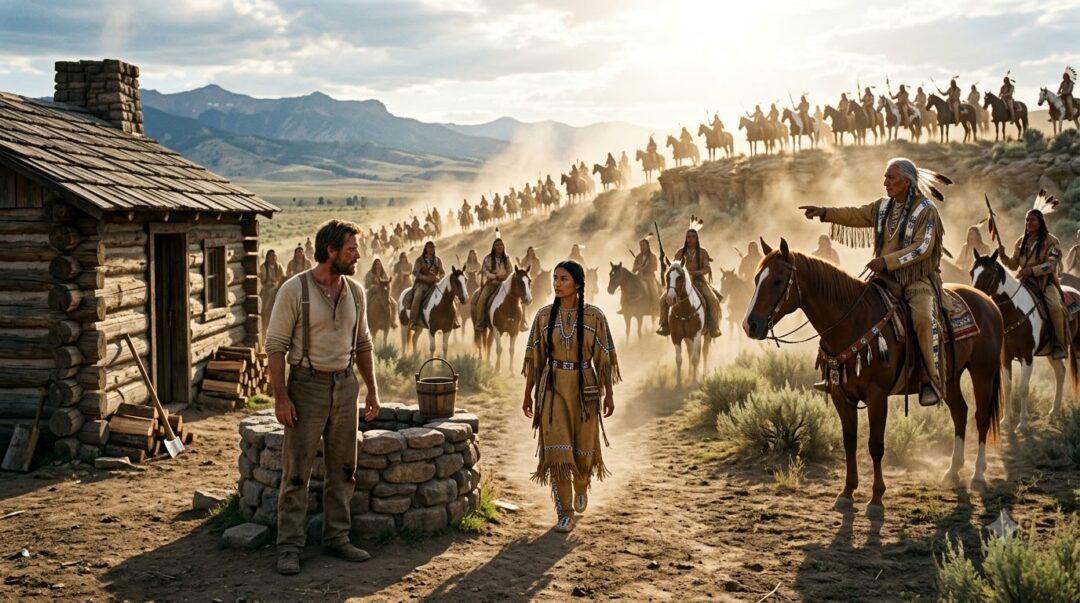
The high prairie dawn broke not with birdsong, but with the heavy, rhythmic vibration of the earth itself. Caleb Vance felt it through the soles of his worn leather boots before his ears registered the low thunder rolling across the limestone basin. He stood on the rough-hewn pine porch of his one-room cabin, a tin mug of chicory coffee cooling in his left hand, his right thumb hooked into the brass buckle of his canvas suspenders. The morning air in the Powder River country was knife-sharp, smelling of curing needlegrass, wild sage, and the dry, flinty chalk of the bluffs that encircled his quarter-section like the walls of a fortress. For three years, since the war had broken his spirit and sent him west into the silence of the Wyoming territory, Caleb had lived without company, without neighbors, and without fear. Solitude was a shield he had forged with his own sweat, chopping cedar logs, digging the limestone well casing stone by stone, and coaxing corn from the stubborn red loam beside the dry creek bed.
Then the ridgeline moved.
It began on the eastern crest, half a mile away, where the sandstone bluffs caught the first blinding glare of the morning sun. A single dark silhouette appeared against the pale horizon—a rider on a broad-shouldered mustang, feathers fluttering from the lance tip held upright against the sky. Before Caleb could set his tin cup down, another rider appeared beside the first, then ten more, then fifty, pouring along the spine of the rimrock in an unbroken line of muscle, painted hide, and iron. Within sixty heartbeats, the entire crescent ridge surrounding the homestead was crowned with hundreds of mounted warriors. The sunlight glinted off rifle barrels, polished silver conchos, and the sharp steel tips of hunting spears. The silence that followed was suffocating. There were no war cries, no brandishing of weapons, no frantic galloping down the scree slopes. There was only the immense, terrifying stillness of an army watching a single man.
Caleb’s throat went dry. His combat instincts, dormant since the bloody siege of Petersburg a decade ago, flared to life with cold clarity. He turned smoothly on his heel, stepped through the cabin door, and lifted his seven-shot Spencer repeating carbine from the deer-antler rack above the stone hearth. He pulled two extra tubular magazines from his cartridge pouch, slipping them into the deep pockets of his wool trousers, and racked the lever with a deliberate metallic clack. If this was how his solitude ended—if the treaties broken in the southern valleys had finally spilled over the mountains in a wave of retributive fire—he would meet it outside on his feet, not trapped like a cornered badger inside four cedar walls.
He walked past the timber washstand and out into the yard, kicking up small puffs of alkaline dust. The sun was higher now, blazing down with unfiltered high-plains heat. The horses on the ridge shifted their weight, tails swishing against the prairie flies, but their riders remained motionless as stone statues against the sky. Caleb reached the circular stone well he had built with his own two hands. He set his carbine across the cedar rail, leaning his forearms on the cool rock, breathing slowly through his nose to steady the hammer of his pulse. He counted twenty, then forty, then stopped counting. There were easily five hundred men up there, perhaps a thousand. If they fired a single coordinated volley, they would turn his homestead into kindling and his flesh into bone meal.
“What are you waiting for?” Caleb whispered into the dry wind.
As if answering the silent question, the center of the eastern line parted. A solitary horseman descended the rocky slope, his mount picking its way down the steep shale path with effortless grace. Behind him rode four outriders carrying long ceremonial coup sticks bound in red trade cloth. The leader was an old man, his hair long and braided with strips of otter fur and grey owl feathers, wearing a heavy buckskin tunic embroidered with intricate geometric porcupine quillwork. Even from two hundred yards away, the man’s posture radiated the absolute, uncontested authority of a sovereign king. It was Chief Makya, the elder patriarch of the northern tribal alliance—a leader whose name was spoken in Fort Reno with equal parts dread and hushed reverence.
Caleb did not raise his rifle. To raise iron against an approaching leader accompanied by an army was an invitation to slaughter. Instead, he stood tall, squaring his broad shoulders, his sun-cured face unreadable beneath his thick beard.
The old chief reined his bay war horse in fifty paces from the well. The horse snorted, stamping its unshod hoof into the dry loam, white foam dripping from its rawhide bit. Makya studied Caleb with eyes as dark and sharp as obsidian chips, assessing the homesteader’s calm demeanor, the Spencer rifle resting untouched on the stone well, the steady gaze of a man who had already bargained with death.
For several agonizing seconds, only the wind whistled through the gap in the bluffs. Then, Makya slowly raised his right arm. He opened his weathered palm toward the sky in the universal sign of peace, held it there, and then dropped his hand, extending his index finger directly toward Caleb.
Caleb flinched slightly, expecting the riders behind the chief to draw bowstrings. But they did not draw.
Instead, the two outriders behind Makya turned their mounts aside, creating an open corridor. Through that corridor walked a figure on foot.
Caleb’s breath hitched in his throat. His knuckles turned white against the limestone rim of the well.
It was a young woman, walking with a calm, unhurried stride across the dusty hardpan. She wore a pristine buckskin dress fringed at the hem and shoulders, heavy with sky-blue and white seed beads that caught the blinding desert light. Her glossy black braids fell over her shoulders, tied with supple elk hide. As she drew closer, the shadows lifted from her face, revealing high cheekbones, dark almond eyes, and a thin, pale scar slicing across her left collarbone just above the neckline of her tunic.
Caleb took an involuntary step forward, his boot scuffing the dirt. The world around him seemed to lose all sound, collapsing inward until there was only the girl and the memory of a howling winter storm.
“It’s you,” Caleb gasped, the words tearing from his throat in a raw whisper.
The young woman stopped ten paces away. A faint, knowing smile touched the corners of her lips, her eyes glistening with deep, unspoken emotion. She raised her hand to her throat, fingering a carved bone medallion that Caleb had last seen around her neck four months ago when she lay dying by his hearth.
Before Caleb could speak her name, Chief Makya turned his horse in a slow, majestic circle, raising his coup stick toward the southern valley. Above the jagged rim of the canyon three miles away, a thick plume of black greasy smoke began to coil into the clear blue sky, accompanied by the faint, rhythmic percussion of galloping iron-shod hooves. Sixty armed railroad mercenaries were riding hard toward the basin, and behind them came the heavy iron carriage of a mountain artillery howitzer.
CHAPTER 2: THE WINTER SANCTUARY
The black smoke rising from the southern pass seemed to pull Caleb backward across time, back into the dead of winter when the Powder River basin was not a crucible of sun and dust, but a frozen wasteland of blinding white. Four months ago, in the brutal freeze of late November, the temperature had plummeted thirty degrees below zero. A gale out of the Montana passes had buried his cabin in six-foot drifts, howling through the cedar eaves like a chorus of dying wolves. Caleb had ventured out into the blinding whiteout wrapped in heavy buffalo robes, an iron pry-bar in his gloved hand, intending only to chop through eight inches of river ice so his draft mule would not perish of thirst.
Instead, near the bend where the willows grew crooked against the frozen cutbank, he had seen the crimson stain.
It had looked like spilled berry juice on the crusted snow, fresh enough that the driving flakes had not yet masked it. Ten paces further along the bank, half-submerged beneath the bowed branches of a snow-laden alder, lay the body. Caleb had dropped his iron bar, sinking to his knees in the drift. When he brushed away the icy crust, he had expected to find a frozen trapper or a cavalry scout caught out of season. Instead, his frost-rimmed gaze had fallen upon the face of a girl, no older than twenty, her skin the color of polished copper, her braided hair frozen solid against her temples. A ragged tear in the shoulder of her buckskin tunic was caked with blackened, frozen blood where a large-caliber rifle slug had passed clean through muscle and gristle.
Her pulse had been a faint, flickering bird trapped beneath cold ribs. Without hesitation, Caleb had scooped her into his arms, ignoring the fiery protest in his own frostbitten lungs, and carried her back across the frozen flats to the cabin.
For the next twelve days, the cabin had smelled of woodsmoke, boiled pine needles, and the pungent copper stench of infection. Caleb had stripped away the bloody leather, built up the stone hearth until the cedar rafters glowed with radiant heat, and cleaned the shattered wound with boiled spring water and carbolic salve. The bullet had missed her lung by less than an inch, but the cold had done nearly as much damage as the lead. When the fever spiked on the fourth night, causing her to thrash and speak in delirious, rapid bursts of a language Caleb could not decipher, he had stayed awake beside her bed of spruce boughs and wool blankets. He had bathed her burning forehead with melted snow, spoon-feeding her thin venison broth seasoned with dried sage, holding her trembling hands through the shivering fits until the dawn broke pale and grey through the ice-coated windowpanes.
She had opened her eyes on the thirteenth morning. They were wide, coal-black, and filled with the terrifying, razor-sharp vigilance of an elk facing a wolf pack. She had recoiled against the log wall, her hand instinctively reaching toward her throat, where a small carved bone medallion hung from a greasy leather cord.
Caleb had simply set down his wooden spoon, raised his open hands, and stepped back to the stove. “You’re safe here,” he had said quietly, his voice low and devoid of threat. “No one is going to harm you in this house.”
She did not speak English, or if she did, she chose the absolute armor of silence. But in the weeks that followed, as the winter locked down the valley in iron stillness, a strange, profound communion had formed between them. She was patient, observant, and fiercely proud. Once her strength returned, she refused to remain idle. With one arm bound in a linen sling, she helped him shell the dried seed corn, mended his woolens with neat, microscopic stitches using bone needles, and prepared wild roots she had carried in a dried bladder pouch. In the long winter evenings, while the blizzard rattled the cedar shingles, Caleb had sat by the hearth carving pine figures, while she watched the flames, fingering her carved bone medallion. It was etched with the image of a swooping hawk circling a rising sun.
One thing she had guarded with her life: a dented, seamless brass cylinder, eight inches long, sealed with beeswax and stamped with an official federal eagle insignia. She kept it tucked inside the lining of her inner tunic, never letting it more than an arm’s reach away, even while sleeping.
By the end of April, the chinook winds had begun to blow warm across the high plains, melting the drifts into roaring muddy torrents. One morning, Caleb had rolled out of his bunk to find the fire stoked with fresh dry cedar, a pot of clean water simmering on the stove, and the girl gone. The door had been left unlatched, swinging gently in the spring breeze. On the rough pine table lay a gift: the carved bone medallion, neatly snapped in half along its center line. The half depicting the rising sun was gone; the half depicting the hawk remained behind on his table, beside a single white eagle feather.
Now, standing under the scorching noon sun beside his limestone well, Caleb stared at the woman who had returned from the winter dead.
Winona took two slow steps toward him. The silence of the encircling army was so absolute that Caleb could hear the rustle of the buckskin fringes against her moccasins. She reached beneath the beaded yoke of her tunic and withdrew the missing half of the carved bone talisman. She held it out in her palm. The jagged fracture lines matched the half Caleb still carried in his trouser pocket every day of his life.
“You saved my life, Caleb Vance,” she said, her voice clear, melodious, and carrying the crisp, precise diction of someone educated in territorial mission schools. “When Silas Brand’s mercenaries shot me at the river ford and left me to freeze, they believed the truth was buried beneath the snow.”
Caleb’s eyes widened. “You speak English.”
“I was taught by the sisters at the Wind River agency,” Winona replied softly. Then her expression hardened into cold granite as she reached inside her waistband. She drew out the heavy, beeswax-sealed brass cylinder, its polished metal reflecting the blazing sun like a torch. “Brand wanted this. He shot three of my brothers to take it. Inside is the original 1868 boundary survey commissioned by President Grant, carrying the unbroken wax seal of the territorial governor.”
She pointed toward the rising column of black smoke three miles away. “Silas Brand has burned the telegraph station at the river crossing. He has eighty cavalry deserters and two mountain howitzers at his back. He believes this valley is empty, and he is coming to burn your homestead to ashes so no one living can ever swear to what is written on this parchment.”
Curiosity Lock: As Winona unsealed the brass cap, revealing the parchment within, a distant boom rolled through the mountain pass—and an artillery shell shrieked overhead, obliterating Caleb’s timber barn in a blinding fireball of splinters and black powder smoke.
CHAPTER 3: THE SOVEREIGN WORD
The concussive shockwave from the exploded barn washed over the homestead yard in a violent gust of burning air and pine splinters. Caleb ducked instinctively behind the solid masonry of the limestone well, his hands shielding his eyes from falling cinders. Where his hand-built hay barn and winter cedar tack room had stood moments earlier, a jagged crater now smoldered beneath a churning cloud of oily black smoke. Yet on the ridges above, among the hundreds of silhouetted war horses and their riders, not a single beast bolted, and not a single warrior cried out in panic.
Chief Makya remained seated upright upon his heavy war horse, his aged face carved from dark oak, impassive as the mountains behind him. He merely flicked his horse’s rawhide rein, letting the animal step through the drifting veil of smoke until he was ten feet from where Caleb stood.
“The white man’s thunder is loud,” Makya said, his voice deep, gravelly, and resonant as an iron bell. He spoke in fluent, articulate English, with the measured cadence of an orator who had addressed senate committees in Washington. “It burns the dry wood, but it cannot alter the truth written into the stone.”
Caleb rose slowly, dusting gray ash from the shoulders of his beige henley. He looked at the old chief with renewed astonishment. “You speak the language of the capital, Chief Makya.”
“I walked the stone halls of your great White Father in the winter of 1868,” the old chief answered, his dark eyes fixing upon Caleb with an intensity that seemed to pierce his very soul. “I sat across the mahogany table from General Grant and General Sherman. We dipped iron pens in black ink and drew the boundary of peace along the ridge where my riders now stand. We gave our word, and they gave their parchment. But men like Silas Brand believe a treaty is merely paper to be shredded by cannon fire when gold and iron tracks run through the valley.”
Winona walked to the old chief’s stirrup, resting her hand upon his horse’s braided mane. “Grandfather,” she said softly in their native tongue, before turning back to Caleb. “Colonel Silas Brand was commissioned by the Transcontinental Railroad Syndicate to mark the right-of-way for the northern line. But the syndicate discovered that the bedrock beneath this basin is rich with veins of anthracite coal and silver. The 1868 treaty explicitly granted this entire valley to our sovereign nation as sacred hunting territory, while granting three individual quarter-sections to white veterans who chose to settle peacefully with tribal consent. You are one of those three men, Caleb Vance.”
Caleb felt the ground shift beneath his feet. “My homestead patent… it was granted by the federal land office in Cheyenne after the war. I was told the land was empty.”
“It was not empty,” Makya said firmly. “It was entrusted. When your government surveyors arrived last autumn, Silas Brand bribed the territorial clerks. He drew a false line thirty miles to the west, cutting our nation out of the water rights and designating your farm as an illegal squatter claim on rail property. When my granddaughter’s patrol rode out to inspect the survey markers, Brand’s mercenaries ambushed them without warning. They murdered three young men of our council and shot Winona through the back. They believed they had destroyed the last copy of the true treaty map.”
Winona held up the dented brass cylinder. “They did not know that my father had sewn the original parchment into the rawhide of my saddle before he died. When you pulled me from the snow, Caleb, you did not ask which nation I belonged to. You did not ask what blood flowed in my veins. You burned your own firewood, you fed me your winter stores, and you guarded my sleep with your rifle. In our nation, the debt of life is not repaid with silver. It is paid with blood, with honor, and with the shields of a thousand warriors.”
A profound silence descended upon the scorched yard, punctuated only by the crackle of burning timbers from the barn ruins. Caleb looked up at the endless line of warriors crowning the bluffs. They had not assembled to conquer, nor had they come to wage war against the settlements. They had ridden eighty miles across mountain passes through the spring mud solely to stand as an impenetrable shield between a solitary white homesteader and the ruthless mercenaries hunting the truth.
“Brand isn’t going to turn back,” Caleb said, his jaw tightening as he reached for his Spencer carbine and checked the follower spring in the stock. “I served under men like him in the Virginia campaigns. Silas Brand was cashiered from the Union army after the slaughter at Cold Harbor for looting dead officers. He has no conscience, no master, and eighty cutthroats with repeaters and artillery. If he sees your warriors on this ridge, he’ll ride back to Fort Reno and claim the tribes have launched a general uprising. The territorial governor will send three regiments of federal cavalry and Gatling guns to sweep the entire basin.”
“He will not have the chance,” Makya replied with icy certainty.
At that moment, the rapid clatter of iron hooves sounded along the dry creek bed. A young Lakota scout, his buckskin tunic torn and stained with dark blood, galloped his lathered horse directly into the yard. He slid from the bareback pad before the horse had fully stopped, dropping to one knee before Chief Makya. In his trembling hands, the scout held a cracked leather officer’s dispatch case, stamped with the insignia of the Department of the Platte.
“Grandfather,” the scout gasped in their native tongue, coughing as dust and blood flecked his lips. He switched to ragged English so Caleb could understand. “Brand’s vanguard is two miles down the canyon. They have brought two field guns and three wagons of black powder. I killed their point rider, but they shot through my side. Inside their scout’s saddlebag… look.”
Makya took the leather dispatch case and opened the brass clasp. Inside lay a bundle of official telegram transcripts and a folded parchment bearing the red wax seal of the Territorial Executive Office in Cheyenne. The old chief unfolded the document and handed it down to Caleb.
Caleb’s eyes scanned the black ink, and a cold fury ignited in his chest. The order was signed by the Territorial Governor’s chief land commissioner, dated three days ago. It declared Caleb Vance an outlaw squatter collaborating with hostile renegades, and granted Colonel Silas Brand total military authority to liquidate all occupants of the basin and burn all physical records under summary martial law.
CHAPTER 4: THE SURVEYOR’S IRON FIST
Two miles south of the homestead, the narrow throat of the Powder River canyon boiled with the clanking iron, churning dust, and coarse curses of eighty armed mercenaries. Colonel Silas Brand sat atop a seventeen-hand black stallion at the head of the column, chewing on an unlit cigar, his squinting gray eyes as cold and predatory as a hawk hunting prairie dogs. He wore a tailored wool uniform of Union blue with the officer epaulets stripped away, replaced by silver cord trim that marked him as the private security commander of the Transcontinental Northern Trust. Beside him, two bronze twelve-pounder mountain howitzers rattled violently over the limestone gravel on heavy oak caissons, their iron-banded wheels shrieking in protest against the dry axles.
Brand was a man who measured human life solely by the price of rail tonnage and mineral assay certificates. When his geologists had brought him core samples from the limestone bluffs six months earlier showing eighty-foot seams of high-grade coking coal and silver veins running under the creek bed, he had not seen an Indian reservation or a homesteader’s valley. He had seen an empire waiting for an owner bold enough to take it. The 1868 treaty was an administrative inconvenience easily bypassed by money and fire. The territorial clerks in Cheyenne had been bought for three thousand dollars in gold coin; the land office maps had been redrawn with a stroke of a pen. Only two obstacles had remained: the hereditary chieftain’s daughter who had slipped away with the original treaty draft, and the reclusive Union veteran whose cabin occupied the exact geographical junction where the railroad mainline had to cross the creek.
Brand had assumed both problems were solved. The girl had been shot through the shoulder and left to freeze in a blizzard; the squatter would either flee when his barn was blown to splinters, or perish inside his flaming cabin.
“Colonel,” muttered Captain Miller, a scarred ex-Quantrill guerrilla who served as Brand’s enforcer, riding up beside him. “The point scouts ain’t reported back. And that smoke from the homesteader’s yard… it went straight up fifteen minutes ago, but we ain’t heard no gunfire. If that veteran had fight in him, he’d have fired off a few rounds.”
Brand spat a fleck of tobacco onto the dry stones. “He was a sergeant in the Pennsylvania sharpshooters, Miller. He won’t waste lead shooting at empty sky. He’ll be hunkered down behind his stone chimney, shaking in his boots, waiting for the cavalry to rescue him. Ride forward and unlimber the second gun. If he doesn’t walk out with his hands up the moment we breach the bend, level the cabin into firewood.”
“Yes, sir,” Miller grunted, turning his horse.
The column rounded the sharp bend where the canyon walls flattened out into the natural amphitheater of the basin. The dust hung thick in the dead midday heat, the sun beating down like an iron hammer. Miller was raising his hand to signal the lead wagon when his horse suddenly reared, neighing in terror, its iron shoes slipping on the river rock.
Miller cursed, fighting the reins, and looked up at the bluffs. The curse died in his throat.
Silas Brand trotted his stallion forward, his hand resting on the ivory grip of his Colt .45. “What in hell is the matter with you, Miller? Get those guns—”
Brand’s voice choked off. His hand froze against the holster.
Lining the curved rimrock on every side, towering two hundred feet above the canyon floor in a three-mile crescent, stood the sovereign host of the Lakota and Shoshone nations. A thousand war horses stood shoulder to shoulder, their riders armed with Henry repeaters, Sharps buffalo rifles, and steel lances adorned with red and black horsehair. The sunlight caught hundreds of rifle barrels simultaneously, creating a blinding, silver glare that illuminated the canyon floor in an incandescent halo. Below the ridge, in the open yard beside the smoldering ruins of the barn, stood Caleb Vance and the old chief, flanking the young woman in beaded buckskin whose brass cylinder gleamed like a beacon in the sun.
“Jesus in heaven,” whispered one of the lead mercenary teamsters, dropping the reins of the artillery team. “That ain’t no war party. That’s a whole bloody army.”
A murmur of sheer panic rippled down the column of eighty hired men. Men who had fought for money in saloons and border skirmishes suddenly found themselves trapped in the belly of a natural killing bowl, outgunned, outmaneuvered, and surrounded by the most feared light cavalry on the North American continent.
Brand’s face turned an ugly, mottled shade of purple. His heart hammered against his ribs, but the cold, narcissistic venom that had driven his entire career refused to surrender. He knew frontier law. If he turned and ran, the girl’s treaty map would reach the territorial governor, the fraud would be exposed, and he would swing from an oak tree at Fort Laramie for treason and murder. His only salvation lay in precipitating an immediate bloodbath. If he opened fire with his artillery, the tribes would be forced to annihilate his column—and the telegraph lines thirty miles south would scream to the War Department that an Indian massacre had wiped out an expedition of peaceful surveyors, bringing three regiments of the United States Army to cleanse the basin forever.
“Hold your lines!” Brand roared, his saber flashing from its steel scabbard. “Stand fast, damn you! They won’t charge! It’s a bluff! Unlimber the twelve-pounders! Train them on the cabin! Gunner, load canister! Prepare to fire on my mark!”
Half a mile up the slope, concealed in a fissure of eroded limestone above the dry creek bed, Caleb Vance lay prone with his Spencer carbine. Beside him, Winona knelt with an ancient, brass-tacked Winchester lever-action rifle, her dark eyes tracking every movement of the mercenary column below.
“He is ordering the big guns to fire,” Winona said quietly, her voice steady as mountain water. “He intends to force the battle so the soldiers at the fort must come.”
Caleb pulled his brass field telescope from his pocket, extending the lenses to inspect the artillery wagon. He needed to identify the gunner and the powder master before the first lanyard could be pulled. He swept the glass across the mercenary front rank, past Miller’s terrified horse, past the brass muzzle of the lead howitzer, and onto the heavy ammunition caisson parked beneath a lone cottonwood tree.
Caleb’s breath locked in his chest. His fingers clamped so hard around the brass barrel of the telescope that the metal groaned.
Chained by his wrists to the heavy iron tire of the powder wagon, his head slumped forward in bloody exhaustion, was an older man in a battered broadcloth coat. Pinned to his torn vest, gleaming dully beneath the desert sun, was the solid silver star of a United States Territorial Circuit Marshal. And pinned to the wagon frame above the prisoner’s head was a ticking clockwork fuse attached directly to a fifty-pound crate of blasting dynamite.
CHAPTER 5: THE AMBUSH AT THE CREEK BED
“That is Marshal Elias Cooper,” Caleb hissed, his voice trembling with a mixture of rage and recognition as he lowered the brass telescope. “He is the chief federal circuit marshal for the territory. He’s the only man in Wyoming who cannot be bought by rail money. Silas Brand didn’t just forge the documents—he ambushed the federal court escort to take Cooper hostage.”
Winona leaned close, her dark hair brushing Caleb’s shoulder as she peered over the limestone parapet. “The white container on the wagon… it has a cord running to an iron clock. If the cannon fires, the spark will trigger the powder, and the marshal will be blown into the sky. Brand will tell the world that our warriors burned the marshal alive.”
“He wants to destroy the witness and justify an army invasion in one strike,” Caleb said, his mind calculating angles, wind drift, and distance with the ruthless precision of a military sniper. The powder caisson sat four hundred and twenty yards down the arroyo. A light crosswind blew from the west at five miles an hour, kicking up thin veils of alkaline dust. The clockwork fuse mechanism was a brass box four inches wide, mounted on top of the dynamite casing. If Caleb hit the dynamite directly, the heat and friction of the lead slug could detonate the nitroglycerin compound instantly. He had to sever the clockwork pendulum or clip the copper detonator wire before Brand’s gunner could yank the cannon lanyard.
Caleb turned his head toward the ridge and flashed three swift, distinct hand signals to Chief Makya. The old chief nodded once. With a silent flick of rawhide quirts, two hundred warriors on swift, unshod mustangs peeled away from both wings of the rimrock, vanishing into the dry gulleys and sandstone ravines to envelop the mercenary rear without making a sound.
“Winona,” Caleb murmured, steadying his elbows on the rock. “When I fire, take out the lead artillery team’s harness. If those horses bolt, the cannon flips into the wash.”
“Understood,” she replied, bringing her brass-tacked Winchester to her shoulder, her dark eyes locking onto the leather traces of the six-horse team.
Caleb settled the walnut stock of the Spencer carbine against his right shoulder. He exhaled slowly, watching the brass pendulum of the clockwork mechanism swing back and forth beneath the scorching sun. Down below, Silas Brand raised his saber into the air. “Gunner!” Brand screamed. “Stand by the lanyard! Fire on the cabin!”
The artillery gunner gripped the rawhide cord, bracing his heels against the chalky ground.
Caleb squeezed the trigger.
The Spencer carbine cracked with a sharp, whip-like report. A puff of white smoke blossomed from the muzzle, and four hundred yards away, the lead slug struck the brass clockwork mechanism with pinpoint precision. The brass casing shattered into spinning shards, the copper detonator wire snapping like a violin string, tumbling harmlessly into the dust inches from Marshal Cooper’s boots.
Before the echoes could bounce off the canyon bluffs, Winona’s Winchester roared twice in rapid succession. Her heavy lead bullets sliced through the leather trace harness of the artillery team. Terrified by the crack of gunfire right above their ears, the six heavy draft horses panicked, rearing and plunging sideways. The heavy twelve-pounder howitzer tilted wildly, its iron wheels slipping over the crumbling edge of the gravel wash, crashing onto its side with a deafening groan of splintering timber and bent bronze.
“Ambush!” Captain Miller shrieked, drawing his twin revolvers. “They’re in the rocks! Return fire!”
A chaotic, ragged volley erupted from the mercenary ranks, bullets chipping limestone from the ledge above Caleb’s head. But the mercenary fire was blind, panicked, and uncoordinated.
From the surrounding ridges, the earth itself seemed to rise up in wrath. A rolling chorus of tribal war cries shook the basin, followed by the deafening drumroll of hundreds of unshod horse hooves descending the slopes like an avalanche of iron and bone. Two hundred warriors burst from the hidden ravines on both sides of the column, their arrows and rifle fire striking the ground in front of the mercenary mounts. They did not fire into the men; instead, with astonishing discipline and precision, they targeted the horses’ reins and shot the weapons from the mercenaries’ hands, encircling the terrified hired guns in an unbroken, swirling vortex of speed and thunder.
“Throw down your arms!” Makya’s booming voice rang out across the canyon floor, magnified by the acoustic bowl of the bluffs. “Throw down your iron, or the earth will drink your blood!”
Panicked mercenaries began flinging their revolvers and rifles into the gravel, raising their hands in terror as the mounted warriors hemmed them in against the rock wall.
Only Silas Brand and Miller refused to yield. Brand kicked his black stallion violently, spurring the beast toward the powder wagon where the battered federal marshal was chained. Brand drew his heavy Colt, intending to execute Cooper himself and ride for the southern pass.
“Not today, Brand!” Caleb yelled.
Caleb launched himself over the limestone ledge, sliding down sixty feet of loose scree in a cloud of white chalk dust. He hit the valley floor on his feet, sprinting through the swirling smoke. Miller stepped into his path, leveling a Colt at Caleb’s chest. Without breaking stride, Caleb swung the heavy walnut butt of his empty Spencer carbine in a sweeping horizontal arc. The stock collided with Miller’s jaw with a sickening crunch, sending the outlaw captain crashing into the gravel, unconscious before he hit the dirt.
Brand turned, his gun leveled directly at the chained marshal’s forehead. “Stay back, Vance! One more step and I blow Cooper’s brains to hell!”
A whirring sound sliced through the air. A rawhide lariat whipped through the smoke, snapping around Brand’s wrist with brutal force. Winona, mounted on a swift dun mare that had raced down from the ridge, yanked the rawhide cord back with all her weight. Brand’s revolver discharged into the dirt, torn violently from his grip as he was pulled from his saddle, crashing heavily onto his back in the creek bed.
Caleb lunged forward, pressing the steel muzzle of his carbine against the hollow of Brand’s throat. The mercenary commander stared up in wild terror, coughing blood and dust, pinned beneath the unyielding gaze of the Union sharpshooter he had underestimated.
Winona leaped from her horse, drawing a heavy bowie knife to sever the iron chains binding Marshal Elias Cooper to the wagon wheel. The old lawman groaned, slumping into Caleb’s arms, his clothes torn and his face bruised from savage beatings.
“Marshal,” Caleb said gently, supporting the older man’s shoulders. “You’re safe. The syndicate is disarmed.”
Marshal Cooper coughed, spitting black grit, his eyes burning with fever and urgent terror. He gripped Caleb’s wrist with shocking strength and pulled a blood-soaked leather envelope from the lining of his torn coat.
“Caleb… listen to me,” Cooper rasped, his voice ragged. “Brand is just the hired dog… The man who ordered my execution… who drew the false treaty lines… is Commissioner Arthur Sterling from the Governor’s office. He is riding right behind us with three companies of the Fifth Cavalry from Fort Reno. Sterling told the cavalry commander that Chief Makya had scalped seventy settlers. They are coming with four Gatling guns, Vance… and they will shoot anything that breathes in this valley!
CHAPTER 6: THE BROKEN COMMAND
The revelation hit the dust of the Powder River basin like a bolt of lightning. For a long, suffocating moment, the only sound was the crackle of smoldering cedar from Caleb’s ruined barn and the wind rattling through the cottonwood leaves. Eighty captured mercenaries sat in the dirt, their hands bound with rawhide thongs, surrounded by a ring of mounted warriors who watched them with cold, unwavering vigilance. Silas Brand lay face-down in the gravel, guarded by two Lakota lancers, groaning as the reality of his total defeat sank in.
Yet the greatest danger was not the defeated mercenaries; it was the blue-clad storm galloping north from Fort Reno.
“Major Harrison is a soldier of the old school,” Caleb said, his voice grim as he knelt beside Marshal Cooper. “He served under General Thomas at Nashville. He doesn’t slaughter civilians, but he follows orders to the letter. If Arthur Sterling rode into Fort Reno waving executive warrants and swearing that Chief Makya had burned homesteads and slaughtered women and children, Harrison would have saddled every company he had. And if Harrison’s vanguard rounds that southern ridge and sees five hundred armed warriors in a battle line, those four Gatling guns will shred this entire basin into meat before anyone can utter a single word of explanation.”
Chief Makya rode up, looking down at the battered federal marshal. The old chief’s face was solemn, his gaze heavy with the tragic weight of thirty years of broken promises and bloody misunderstandings between red and white. “My warriors will not break,” Makya said firmly. “They will hold the high ridge. They will sheath their hunting knives and lay their rifles across their saddle pommels. But if the blue coats come with the iron guns that spit lead like hail, flesh and spirit cannot endure without fighting back. Blood will call for blood, and the entire territory will be bathed in ash.”
“We cannot let them reach the mouth of the basin,” Winona declared, her dark eyes flashing with determination as she adjusted the strap of the brass treaty cylinder across her chest. “The truth must meet the cavalry before they unlimber the guns. If Major Harrison sees the federal seal with his own eyes, if he hears Marshal Cooper speak the name of the traitor, he cannot pretend he is fighting renegades.”
“Cooper can barely sit a saddle,” Caleb said, looking at the bruised lawman.
“Then tie me to the leather, Vance,” Cooper wheezed, clenching his bloodied fists as he pulled himself up against Caleb’s shoulder. “I’ve carried this silver star for twenty-two years through every hellhole in the Dakota territory. I won’t lie in the dirt while a corrupt political lackey uses the United States Army as his private firing squad. Give me a horse and a canteen of cold well water.”
Within five minutes, three swift mounts were prepared: a stout buckskin gelding for the marshal, a long-striding bay mare for Winona, and Caleb’s own rugged mountain horse. Makya raised his hand in a silent blessing as they mounted, his warriors raising their lances in unison as the three riders wheeled their horses and galloped toward the narrow northern defile known as Devil’s Gap.
By cutting through the steep, rocky fissure of Devil’s Gap, they could bypass the winding river canyon and intercept the military road four miles south of the basin—at the very choke point where the cavalry column would be forced to transition from marching order into battle formation.
The ride was a blur of flying gravel, lathered horseflesh, and burning wind. Caleb rode on the marshal’s right, keeping a firm grip on the older man’s reins whenever Cooper swayed with dizziness. Winona rode point, her keen eyes picking out the safest paths along the crumbling scree slopes with instinctive grace. As they crested the high pass of Devil’s Gap and looked down onto the broad wagon road below, Caleb’s heart seized.
Half a mile south, a massive column of dust billowed into the afternoon sky. Two hundred cavalrymen in dark blue wool coats and yellow kerchiefs were trotting forward in tight four-man columns, guidons snapping in the breeze. At the front of the column rode two heavy timber wagons carrying the sinister, multi-barreled brass cylinders of four Model 1874 Gatling guns. Riding beside the cavalry commander was a slender, portly man in a tailored broadcloth suit and silk cravat—Commissioner Arthur Sterling.
“There they are,” Caleb shouted over the pounding of hooves. “Spur your mounts! We have to beat them to the crossroads!”
The three riders plunged down the rocky hillside, sliding down the shale banks in a roaring wave of dust. The cavalry point scouts immediately spotted them, reining in their mounts and throwing their carbines to their shoulders.
“Halt! Dismount and identify yourselves!” a cavalry sergeant bellowed, his voice echoing off the canyon walls.
Major Harrison, a grizzled, silver-haired officer with a campaign medal pinned to his chest, raised his gauntleted hand, bringing the entire two-hundred-man column to an immediate halt. Behind him, Arthur Sterling’s face turned pale as lard. He recognized Winona, and he recognized the battered lawman slumped over the saddle of the buckskin horse.
“Shoot them!” Sterling shrieked hysterically, pulling a pearl-handled pocket revolver from his coat. “Major Harrison, those are the renegade sympathizers who butchered my surveyor team! Fire on them before they ambush the column!”
“Hold your fire, Sergeant!” Major Harrison snapped, his cold blue eyes sweeping over Caleb’s Union sharpshooter badge and the glinting silver star on Cooper’s chest. “I said hold!”
Caleb pulled his lathered mount to a halt twenty paces from the cavalry line, raising both hands empty into the air. “Major Harrison! I am Caleb Vance, late First Pennsylvania Sharpshooters! Behind me is United States Circuit Marshal Elias Cooper, whom you were told was murdered by tribal warriors!”
Cooper straightened his battered spine in the stirrups, holding his silver badge high against the blazing sun. “Major Harrison… by authority of the Federal Circuit Court of the United States, I order you to place Commissioner Arthur Sterling under immediate arrest for grand treason, conspiracy to commit murder, and the unlawful deployment of federal troops!”
Sterling went wild, leveling his revolver directly at Marshal Cooper’s head. “You lying drunkard! I am the personal representative of the territorial governor! I have executive authority—”
Curiosity Lock: Before Sterling could squeeze the trigger, Winona whipped the brass treaty cylinder from her shoulder and slammed it against Sterling’s wrist, sending the gun spinning into the dirt, as Major Harrison drew his saber and placed the cold steel point directly against the commissioner’s throat.
CHAPTER 7: THE ETERNAL COVENANT
The cold steel of Major Harrison’s cavalry saber resting against Arthur Sterling’s jugular shattered the commissioner’s arrogant façade like brittle glass. The pearl-handled revolver lay in the dirt, covered in alkaline dust, while two burly cavalry sergeants pulled the screaming commissioner from his thoroughbred gelding and clamped heavy iron shackles around his wrists. Sterling’s legs buckled, his high-collared silk shirt drenched in sweat as he wept, babbling admissions of bank deposits in Omaha, forged land grants, and secret payoffs to territorial surveyors.
“Major,” Marshal Cooper gasped, dismounting with Caleb’s assistance. “You have prevented the darkest slaughter in the history of this territory. The army was ten minutes away from being turned into an instrument of corporate execution.”
Major Harrison sheathed his saber with a sharp metallic snap, his face pale with fury and remorse. “Sergeant Major, take six men and escort Commissioner Sterling to the rear. If he opens his mouth again, gag him with a saddle blanket. Column of fours, prepare to escort Marshal Cooper to the Vance homestead!”
When the cavalry column rounded the southern bluffs and entered the natural basin of the Powder River, a profound silence fell over the two hundred soldiers. The young troopers, who had ridden fifty miles expecting to charge through burning cabins and mutilated settlers, stared in awe at the sight before them.
Eighty disarmed mercenaries sat peacefully on the gravel banks of the dry creek, guarded by Lakota and Shoshone lancers who sat their mounts in perfect, disciplined immobility. Along the high rimrock, the hundreds of silhouetted warriors remained in place, their lances upright against the vast expanse of the Wyoming sky. The only wreckage in the entire valley was Caleb’s smoldering barn, shattered by Brand’s own mountain howitzer.
Silas Brand looked up from the dirt where he knelt, his face caked with dried blood. When he saw Arthur Sterling in cavalry irons beside Major Harrison and Marshal Cooper, his jaw slackened, and he slumped forward in total surrender.
In the center of the yard, beside the hand-hewn limestone well, Caleb, Winona, and Chief Makya met Major Harrison and Marshal Cooper. The sun was beginning its long, golden descent toward the jagged crest of the Bighorn Mountains, bathing the valley in an amber glow that softened the harsh lines of the chalk bluffs.
Winona stepped forward, unthreading the beeswax cap from the heavy brass cylinder. With steady, reverent hands, she withdrew the thick sheepskin parchment and unrolled it across the flat limestone rim of Caleb’s well.
Major Harrison and Marshal Cooper leaned over the parchment. The ink was dark and unfaded, bearing the signatures of Chief Makya, Red Cloud, General William Tecumseh Sherman, and the bold, sweeping stroke of President Ulysses S. Grant, alongside the deep red wax seal of the United States Department of the Interior. Clearly delineated in vermilion ink were the sovereign borders of the northern territory, and situated squarely within the neutral buffer zone was the precise quarter-section deed granted to Caleb Vance for distinguished service in the Pennsylvania volunteer infantry.
“It is authentic,” Major Harrison breathed, touching the embossed seal with a gauntleted thumb. “Every boundary marker Brand claimed to survey was a deliberate lie. This valley belongs to your people, Chief Makya, by sacred federal law. And this homestead is the legal, untouchable property of Caleb Vance.”
Marshal Cooper took an official leather ledger from his saddlebag, dipping an ink horn pen, and wrote an emergency federal stay of execution and territorial protection order. He signed it with the full authority of the federal circuit bench, affixing his silver star seal into warm sealing wax.
“By authority of the President of the United States,” Cooper declared, his voice ringing across the yard so that every soldier and mercenary could hear, “Colonel Silas Brand, Captain Miller, Commissioner Arthur Sterling, and sixty-two surviving members of the Northern Trust security detachment are remanded to federal military custody to stand trial in Cheyenne for murder, treason, and armed insurrection against the sovereign treaties of the United States.”
The cavalry troopers moved quickly, loading the bound prisoners into the empty supply wagons and hitching the captured howitzers to their caissons. Within an hour, the blue-clad column had begun its long march back down the canyon toward Fort Reno, escorting the conspirators toward their reckoning before the federal gallows.
As the dust of the military escort settled, the golden hour of the high plains bathed the basin in serene peace.
Chief Makya mounted his war horse, turning the magnificent animal toward the high bluffs. He raised his right hand to Caleb Vance. “Three years ago, you walked into this valley seeking to bury the ghosts of your war,” Makya said, his dark eyes warm with respect. “You thought you were alone. But the Great Spirit watches the heart that shows mercy when the winter winds blow. When you opened your door to my granddaughter, you bound our people to yours with a thread stronger than iron tracks or gold coin.”
Winona walked to Caleb’s side. She held out both halves of the carved elk-bone medallion. She pressed the half depicting the rising sun into Caleb’s calloused palm, folding his fingers over it, while keeping the hawk against her own breast.
“We will not forget this well, Caleb Vance,” Winona whispered, her eyes shining with unshed tears. “Whenever the summer heat dries the southern rivers, my people will come to this spring to water our herds, and your cabin will be our home. And whenever danger threatens your gate, you need only look to the ridge.”
“Thank you, Winona,” Caleb said, his voice thick with emotion as he clasped her hands. “For everything.”
She smiled, stepped back, and mounted her bay mare with effortless athletic grace.
Chief Makya gave a single, resonant cry that echoed like thunder off the sandstone bluffs. Across the three-mile crescent of the rimrock, a thousand voices rose in a triumphant, rolling chorus of honor and farewell. The warriors wheeled their painted horses in unison, their feathers and lances catching the fiery purple and gold of the setting sun, and began their descent down the western slopes toward their homeland.
Caleb Vance stood beside his stone well, the cool limestone beneath his palms, watching the magnificent host disappear over the spine of the continent. The valley was silent once more, but it was no longer empty. The wind that blew through the high sage carried the scent of rain, freedom, and an enduring promise carved into the bedrock of the frontier.