The Desert Well Stranger: A Sacred Cup And The Homestead Reckoning
CHAPTER 1: THE DIPPER AT THE RIM
The high noon sun beat down upon the arid floor of Red Butte Wash like an anvil of molten copper. In the border country between northern Arizona and the red rock canyons of Utah, the heat was not merely an element of weather; it was an invisible, suffocating predator that sucked moisture from living marrow and turned the blood to alkaline grit. Heat shimmers danced across the cracked white salt flats, warping the distant crimson sandstone buttes into wavering, liquid towers. For thirty miles in any direction, every seasonal arroyo was bone-dry, every creek reduced to caked mud and bleach-white pebbles. Only one place in the entire scorched valley yielded water: Eli Mercer’s hand-dug artesian well.
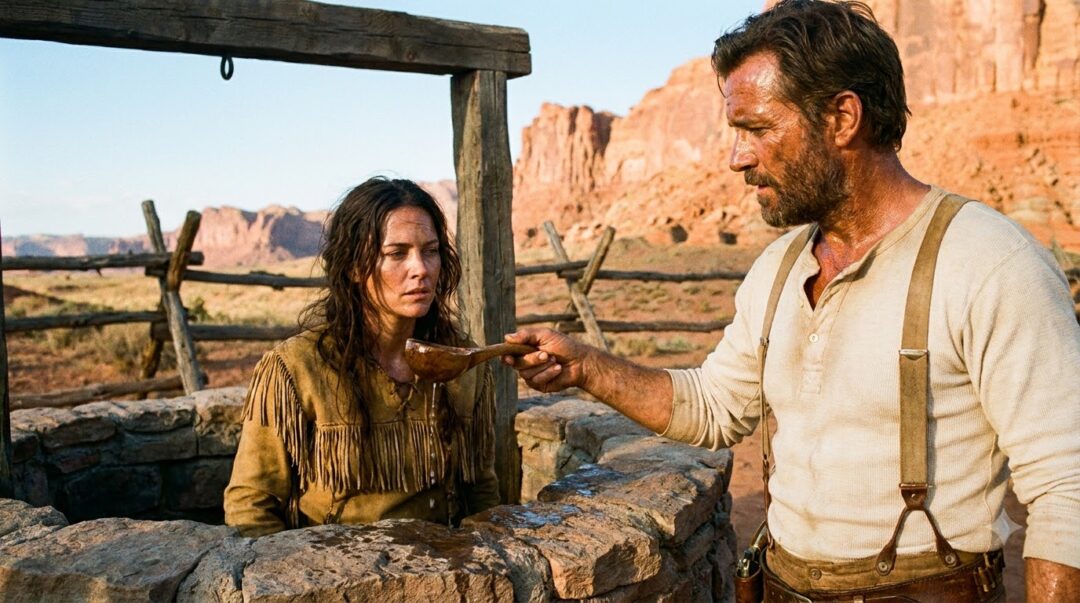
Eli hauled the heavy cedar bucket up from the sixty-foot limestone casing, his sun-browned forearm muscles straining against the iron crank handle. He was thirty-five, tall and lean, wearing a cream-colored cotton henley with the sleeves rolled to his elbows, heavy work trousers, and cross-stitched leather suspenders. His face was weathered by desert wind and etched with the quiet, lingering sadness of a widower who had spent two years burying his heart in this barren soil. When the cedar bucket crested the circular stone rim, cold water sloshed over the weathered limestone flags with a musical splash that sounded almost holy in the dead silence of the desert.
Eli reached for the carved wooden dipper hanging from a cedar post, intending to quench the dry fire in his own throat.
Then he stopped.
Resting against the low split-rail cedar fence that bordered his sunken stone dugout was a human figure.
At first glance, Eli had thought it was a bundle of discarded rags or a calf fallen to sunstroke. But as his vision adjusted to the blinding glare, he saw the dark, glossy braids dusted in chalky red dirt, the fringed hem of a buckskin tunic, and the rise and fall of shallow, laboring breath.
It was a young Native American woman. She sat curled against the bottom cedar rail, half-concealed in the cool shadow of the sunken stone dugout entrance. Her bare arms and neck glistened with a sheen of greasy sweat. Her cracked, sun-scorched lips were parted, drawn tight in agony, her forehead pressed against the weathered wood as if the rough cedar were the only thing keeping her soul inside her parched body. On her shoulder, dried brown stains crusted the deer hide where thorny mesquite bushes had shredded the fringe.
Eli did not hesitate. In this country, to withhold water was murder, regardless of tribe, color, or creed.
He stepped smoothly across the dusty yard, dipping the wide wooden ladle into the brim of the icy bucket. The clear mountain water rippled in the midday light, droplets dripping from the polished oak bowl. He walked slowly, his boots crunching softly on the dry gravel so as not to startle her, his posture relaxed and unthreatening.
He halted three paces away and knelt in the red dust.
“Water?” Eli said softly.
The woman’s head jerked upward. Her movement was that of a wounded cougar—fast, defensive, and vibrating with razor-sharp vigilance. Her eyes locked onto his. They were dark, deep as obsidian pools, rimmed with red exhaustion, yet burning with an intense, guarded intelligence that no desert sun could scorch away. For two long heartbeats, she studied his face—the calm grey eyes, the lack of iron at his hip, the trembling surface of the clear spring water held out in his hands.
Her parched throat worked as she swallowed dry air. With trembling, sun-browned fingers, she reached out and took the wooden handle from his grasp.
She raised the ladle to her lips with urgent desperation. The cold water spilled into her mouth, a thin rivulet tracing the dust on her throat, soaking into the beaded collar of her tunic. She drank in long, greedy gulps, her eyes closing in sheer, ecstatic relief as life flooded back into her veins. When the dipper was empty, she held the vessel against her chest, her breathing slowing to a steady, rhythmic cadence.
Eli watched her in silence, noting the regal poise that exhaustion had failed to conquer.
Then, to his utter astonishment, the woman did not cower or beg for food. She set her moccasined boots firmly against the stone steps of the dugout and rose to her full height. She stepped out of the sunken shadow and into the full, blinding glare of the desert sun.
She was tall, slender, and carried herself with the majestic dignity of a chieftain’s daughter. Her fringed buckskin dress was adorned with thousands of white river shells and turquoise stones that clinked softly with every movement. She swept a strand of windblown black hair from her cheek, straightened her spine, and looked down at Eli.
With deliberate, solemn grace, she extended both hands, offering the empty wooden dipper back to him handle-first—a gesture of profound, sovereign respect.
Eli rose slowly, taking the cup from her fingers. “You walked a long way across the salt flats, miss. There’s no living camp within forty miles.”
The woman held his gaze, her dark eyes narrowing with intense urgency. She reached into an elk-hide medicine pouch slung across her chest and withdrew a heavy, stoppered brass apothecary flask.
Curiosity Lock: As Eli took the wooden dipper, the sharp, rhythmic pounding of galloping horses echoed off the red sandstone bluffs a mile to the north, and the woman gripped Eli’s wrist, whispering in urgent, fluent English: “They are coming to finish the kill. That flask is filled with the water of Bitter Creek—and it is poisoned with arsenic and quicksilver to murder my people.”
CHAPTER 2: THE TASTE OF ARSENIC
The distant thunder of galloping hooves was a warning no desert dweller could ignore. Eli caught Sitkala by the elbow, guiding her swift, unresisting steps down the limestone stairway into the cool interior of his dugout cabin. He closed the heavy, iron-strapped cedar door, dropped the four-inch oak crossbar into its iron brackets, and pulled the wool storm curtain across the narrow glass transom.
The subterranean room was thirty degrees cooler than the scorching wash outside. Sunlight filtered through two high arrow-slit window casements cut into the masonry, illuminating walls of hand-hewn limestone, bundles of dried sage and chamomile hanging from the ceiling beams, and a long pine worktable crowded with glass reagent bottles, a brass balance scale, and medical surgical instruments.
“My name is Sitkala,” the young woman said, leaning back against the cool rock wall, catching her breath. “My father is a medicine keeper of the Diné clan in the canyon of Bitter Creek. Three days ago, our world ended.”
“Sitkala,” Eli repeated, pouring another mug of water from an earthen jug and placing it in her hands. “I am Eli Mercer. I was a surgeon with the Army of the Potomac before I came west. What happened at Bitter Creek?”
Sitkala held up the stoppered brass flask, her dark eyes flashing with grief and fury. “Jonathan Blackwood’s cattle syndicate has wanted our canyon for ten years. The spring at Bitter Creek never dries, even during the seven-year drought. Two weeks ago, Blackwood rode into our council circle with armed riders, offering twenty silver dollars for the entire watershed. When my father refused to leave the bones of our ancestors, Blackwood told us the desert had a way of cleansing itself.”
She took a shuddering breath, her fingers tightening around the brass flask. “Four nights ago, three of Blackwood’s riders dumped six heavy wooden kegs into the upper cavern where the spring emerges from the sandstone. The next morning, the water tasted sweet and metallic. By midday, our cattle were bloating and dying in the brush. By sunset, forty of our children and elders were writhing in agony on their sleeping robes—vomiting black bile, their throats burning as if swallowed by fire, their muscles locked in violent convulsions. Six of our elders died before the sun rose. My father ordered me to take the water sample, saddle our swiftest mare, and ride for the federal commissioner in Vermilion Cliffs. Blackwood’s men chased me across the mesa, shot my horse from under me at the salt flats, and tracked me on foot to your well.”
Eli’s face had drained of all color. His hands trembled as he took the brass flask from her. He walked to the pine workbench, lit a small brass spirit burner with a sulfur match, and pulled a coil of pure copper wire from an iron tin.
During the war, Eli had treated soldiers poisoned by contaminated wells in the Virginia swamps. He knew the gruesome chemistry of death all too well. He poured an ounce of the cloudy spring water into a glass test tube, added ten drops of concentrated hydrochloric acid, and suspended the bright copper wire directly into the boiling liquid.
Within ninety seconds, a sinister chemical reaction took place.
The bright salmon-pink surface of the copper wire turned a dark, lustrous steel-gray, coated with a crystalline film of pure metallic arsenic and mercury.
“Arsenic trioxide and mercuric chloride,” Eli whispered, his voice trembling with horror as he stared at the tarnished wire. “The miners call it quicksilver slag. It is the waste residue from the stamp mills in the mountains. It dissolves completely in cold water, leaves no smell, and destroys the human stomach within twenty-four hours.”
Suddenly, Eli froze.
A memory, buried beneath two years of suffocating grief, tore through his mind like a hot bayonet.
In the scorching July of 1877, his beloved wife Clara had fallen violently ill after drinking water from the seasonal wash during a sudden summer flash flood. She had suffered for three agonizing days—vomiting blood, screaming that her throat was burning with hot coals, her hands curling in painful spasms until her heart gave out in his arms. The circuit doctor from the settlement had called it “summer cholera” or “mountain fever.” Eli had blamed himself every night since, cursing his inability as an army surgeon to save the woman he loved.
Now, staring at the grey poison on the copper wire, the truth crashed down upon him with devastating certainty. Clara had not died of disease. She had drunk the drainage runoff from Blackwood’s initial poisoning experiments upstream. She had been murdered.
A cold, lethal fury settled over Eli Mercer’s features, erasing every trace of the gentle homesteader.
“Wait here,” Eli said quietly, unhooking his sixteen-shot Henry repeating rifle from the wall.
He stepped out the heavy cedar door, unbarring the iron latch, and walked into the blistering sunlight. He strode across the dusty yard to his limestone well. The sixty-foot casing was deep, tapping into an ancient subterranean limestone river that ran pure and cold beneath the desert floor. It was the only unpolluted well within thirty miles—the only obstacle preventing Jonathan Blackwood from owning every drop of water in the county.
Eli knelt in the damp loam beside the well curb, inspecting the ground with the trained eye of a scout.
In the shaded dust beneath the cedar windlass, he saw the fresh, distinct impressions of three pairs of heavy spurred boots, accompanied by the horseshoe tracks of three heavy horses. The tracks were no more than twelve hours old—made between midnight and dawn.
Eli leaned over the circular stone rim, peering down into the dark abyss of the shaft.
Curiosity Lock: Suspended thirty feet down the limestone casing, caught on a splinter of the cedar cribbing, hung a heavy zinc cylinder wired to an uncoiled hemp rope—and drifting from the submerged perforated bottom of the cylinder was a milky, yellow plume of arsenic dissolving directly into the pure mountain drinking water.
CHAPTER 3: THE THREE RIDERS OF BLACKWOOD
Eli’s hands moved with surgical calmness, despite the ice in his veins. He sprinted to his timber tool shed, grabbed an iron four-pronged grappling hook attached to fifty feet of braided hemp rope, and returned to the wellhead. Leaning over the circular rim, he guided the iron hooks down the dark limestone shaft until the tines snagged the zinc cylinder’s perforated rim. With steady, agonizingly careful pulls, he hauled the heavy metal tube upward, ensuring it did not bump against the cedar cribbing and release more of the deadly yellow powder.
When the cylinder reached the surface, Eli hoisted it directly into an empty iron kerosene drum, sealing the zinc lid with three heavy pine wedges. The deep, rushing artesian vein seventy feet down had a powerful upward hydraulic flow, discharging thousands of gallons through a subterranean limestone fissure. Because the zinc canister had caught on the dry timber cribbing thirty feet above the water level, only a few spoonfuls of chemical dust had drifted into the upper shaft. Eli quickly lowered his cedar bucket, hauling up ten full loads of water and dumping them down the dry wash until the well water tasted pure, icy, and sweet once more.
He had barely wiped the cold water from his brow when the unmistakable drumroll of galloping horses echoed across the alkaline flats.
Three riders burst through the dusty heat shimmer at the mouth of the arroyo, their horses loping into a trot as they approached the homestead.
Eli did not run for the dugout. He stood his ground in the center of the yard, resting his sixteen-shot Henry lever-action rifle across the cedar rail of the well curb, his finger hooked loosely inside the iron lever.
The lead rider pulled his sweat-lathered sorrel stallion to a halt ten paces from the well. He was a broad, thick-necked man with a black beard stained with tobacco juice, wearing a grease-darkened buckskin vest and a wide-brimmed slouch hat banded with the dried skin of a prairie rattlesnake. A pair of ivory-handled Colt .45 revolvers hung low from a double-rigged gunbelt.
It was Cole Vance, Jonathan Blackwood’s notorious range boss—a ruthless mercenary who had cleared three counties of homesteaders and sheep herders through arson and cold-blooded murder. Flanking him on either side were two hired gunmen in canvas dusters, holding short-barreled ten-gauge shotguns balanced across their saddle horns.
Vance leaned forward over the horn of his saddle, spitting a brown stream of tobacco juice that sizzled in the hot sand inches from Eli’s boots.
“Afternoon, Mercer,” Vance said, his voice a coarse, grating rasp. “Hot day to be pumping water.”
“The water is always cold sixty feet down, Vance,” Eli replied, his grey eyes cold, steady, and unblinking. “What brings Blackwood’s hired guns onto my patented quarter-section?”
Vance smiled, but his eyes remained as cold and dead as a pair of granite marbles. “We’re tracking a runaway, Mercer. An Indian girl from the Bitter Creek reservation broke into the ranch infirmary last night. Stole some medical supplies, a brass cash box, and poisoned two of our pedigree bulls before she lit out across the mesa. Tracks led straight down the wash toward your place.”
Eli did not look toward the dugout. He did not shift his stance. “The only tracks around my well this morning were coyotes and jackrabbits. I haven’t seen an Indian in two weeks.”
Vance’s gaze drifted slowly across the yard, settling on the sunken stone dugout entrance. The heavy cedar door was shut, but a thin footprint in the red dust remained near the split-rail fence. Vance’s eyes narrowed, his left hand dropping casually to the pommel of his saddle.
“Is that so?” Vance murmured. “Well, Mercer, Mr. Blackwood is a generous man. He’s offering twenty dollars in gold coin to any homesteader who helps us recover his stolen property. How about you step aside and let my boys take a quick look through your cellar? Just to make sure she ain’t hiding under your potato sacks.”
“Under territorial homestead law,” Eli said, his voice flat as an iron plate, “this land is a deeded federal patent. You have no legal warrant, no deputy star, and no business on my ground. Turn your horses around and ride back to the river.”
The two gunmen behind Vance shifted their weight, their fingers tightening on the shotgun triggers. Vance’s smile vanished, replaced by an ugly, sneering snarl that revealed yellowed teeth.
“You’ve got a lot of sand for a dirt farmer, Mercer,” Vance growled, leaning down from his stirrup until he was staring directly into Eli’s eyes. “Ever since your pretty little wife died of the summer shakes two years ago, you’ve been living out here like a hermit, pretending this well belongs to you. But Mr. Blackwood is filing water monopoly rights with the county recorder at noon on Monday. This valley ain’t big enough for stubborn men who don’t know when to sell.”
Eli felt the hammer of his pulse against his temples, the memory of Clara’s agonized death burning in his chest like white phosphorus. He raised the muzzle of his Henry rifle three inches, aiming it squarely at the silver buckle of Vance’s gunbelt. The unmistakable, sharp double-click of the rifle’s hammer cocking sounded in the dead silence of the yard.
“I buried my wife on the knoll behind this house, Vance,” Eli said in a voice so soft it was terrifying. “If you or your hired dogs take one step toward that door without a federal marshal, I will bury all three of you right beside her.”
Vance’s hand froze an inch above his Colt. He looked at Eli’s eyes—the utter, fearless detachment of an army veteran who had seen thousands of men die in the Virginia trenches—and he knew, with chilling certainty, that the first shot would rip his spine in two before he could draw his weapon.
A cold smirk slowly returned to Vance’s lips as he pulled his horse’s head around.
Curiosity Lock: “Have it your way, Mercer,” Vance whispered, leaning close with a venomous sneer. “Enjoy your cold water while the sun is up. Because Mr. Blackwood bought two crates of mining dynamite from the rail freight office yesterday—and when the moon goes down tonight, thirty sticks of nitro are going right down that limestone hole, and you won’t have enough water left to wash your own blood out of the dirt!”
CHAPTER 4: THE MIDNIGHT DEFENSE
The desert twilight faded into an indigo night, sweeping across Red Butte Wash in a tide of deep violet shadows. The furnace heat of the afternoon dissipated, replaced by a biting mountain chill that smelled of dry sage, alkaline dust, and cold limestone. Inside the subterranean dugout cabin, Eli Mercer worked by the steady amber glow of a single tallow candle. He disassembled, cleaned, and oiled the brass receiver of his sixteen-shot Henry repeating rifle, ensuring the follower spring fed every forty-four caliber flat-nose cartridge smoothly.
Sitkala knelt beside the stone hearth, testing the sinew backing of a short Osage orange hunting bow from her travel gear. Her sun-browned fingers tested the tension of the cord with practiced familiarity, while her keen dark eyes followed every motion of Eli’s hands.
“Cole Vance will not bring a sheriff,” Sitkala said quietly, her voice cutting through the stillness like a honed blade. “Jonathan Blackwood does not waste gold on court trials when he can hire night riders to light fires in the dark. If they dynamite your artesian well tonight, they erase the physical evidence of the zinc cylinder and leave you with no water to survive. You will be forced to abandon your claim, and they will declare both of us outlaws who perished in the desert.”
“I know how bushwhackers operate,” Eli replied, his jaw set like an iron anvil. “During the war, cavalry raiders attempted to torch our field hospital three nights in a row. They will use the southern arroyo where eroded cutbanks hide their horses. They will send two men with kerosene to ignite the corral to draw my fire, while their sapper crawls along the dry irrigation ditch toward the wellhead with the dynamite satchel.”
Sitkala’s dark eyes flashed with tactical understanding. “Then we give them the trap they expect. You take the high ground from the sod roof behind the stone parapet. Your rifle commands the open yard. I will take the irrigation ditch. The desert night does not show my shadow to white men holding lanterns.”
Eli looked into her eyes—the quiet, resolute courage, the total absence of fear. For two years, he had lived as an isolated ghost, paralyzed by Clara’s death. Now, standing side by side with a woman who had lost her elders to the same ruthless predator, a fierce fire had rekindled in his soul.
By midnight, all lights inside the cabin were extinguished. Eli climbed through the ceiling hatch, lying prone behind a parapet of stacked limestone fieldstones. From here, he had an unobstructed view covering the yard, the corral, and the circular well curb thirty yards away. The sky was an immense dome of cold stars casting silver light across the clay. Down below, Sitkala slipped into the dry irrigation ditch, vanishing completely into the shadows.
Two hours passed in suffocating silence. Then, at two in the morning, a faint click of iron against shale drifted from the southern arroyo.
Four men advanced on foot across the dry wash, slouch hats pulled low. Two split off toward the cedar barn carrying glass jugs of amber kerosene, while the other two crouched low toward the wellhead. One carried a heavy canvas satchel with a protruding coil of white sulfur slow fuse.
Eli waited until the kerosene carriers reached the timber corral posts. Sighting down the octagonal barrel of the Henry, he aligned the brass blade on the glass jug in the lead man’s hand.
Eli squeezed the trigger.
The rifle cracked with rolling thunder. The forty-four caliber slug shattered the glass jar in a blinding burst of liquid spray. Kerosene splashed across the man’s canvas coat, and Eli’s second shot struck flint at his boots, igniting the spilled fuel into a roaring sheet of orange flame.
“Ambush! He’s on the roof!” the arsonist shrieked, rolling in the dirt to smother the flames on his sleeve. The second arsonist fired two wild shotgun blasts toward the roof, buckshot chipping stone above Eli’s head. Eli calmly ducked, levered the rifle, and fired three rapid shots that kicked up dirt around the shooter’s heels, driving him behind the woodpile.
Near the wellhead, the man with the dynamite satchel thought Eli was occupied with the corral fire. He broke into a dead sprint toward the limestone casing, pulling a sulfur match from his pocket to ignite the fuse.
He never reached the stone curb.
A dark figure rose from the irrigation ditch like a desert phantom. Sitkala stepped into his path, her short bow drawn to full anchor.
Thwack!
The hunting arrow buried itself cleanly through his forearm. The man screamed, dropping the match, the heavy satchel of dynamite slipping from his fingers into the loam. Before he could draw his sidearm, Sitkala drove her moccasined boot into his solar plexus, followed by the heavy walnut butt of her Colt striking his temple. The saboteur collapsed unconscious.
The remaining two mercenaries panicked, dragged their burned comrade into the arroyo, mounted their horses, and fled toward the northern bluffs at a dead gallop.
Eli swung down the ladder and joined Sitkala beside the limestone well. Together, they dragged the unconscious saboteur into the dugout, throwing him into a heavy oak chair and binding his wrists with rawhide rope.
Eli dashed cold well water into the man’s face.
The saboteur sputtered, blinking through blood and sweat. It was Hank Brody, one of Blackwood’s veteran range riders. Staring at Eli’s cold grey eyes and the hunting knife resting in Sitkala’s hand, his bravado dissolved into trembling terror.
“Don’t kill me, Mercer!” Brody wept. “I was just following Vance’s orders! Blackwood paid us a hundred dollars each to blow the casing!”
“Who sent the arsenic, Brody?” Eli asked, his voice low and devoid of mercy. “Who ordered my wife poisoned two years ago?”
Brody’s face turned gray as ash. “It was Blackwood! He hired Vance to drop quicksilver slag into the upper creeks back in seventy-seven to clear the valley! But you don’t understand, Mercer… you’re already dead!”
Curiosity Lock: Brody coughed blood, his voice cracking with hysterical panic. “Blackwood rode out at midnight with six gunmen to Vermilion Cliffs! He’s meeting Judge Pendelton at sunrise to execute a forged water deed and probate seizure—and Vance has ten men setting an ambush right now at Devil’s Throat to make sure you never reach the courthouse alive!”
CHAPTER 5: THE CANYON GAUNTLET
The cold pre-dawn wind howled across the red sandstone mesa, whipping plumes of crimson grit into the air as Eli Mercer and Sitkala prepared their departure from the homestead. There was no time to wait for the desert sunrise. In the root cellar beneath the cabin, Hank Brody sat securely gagged, his arms bound to an iron roof support with wet rawhide rope. On the sturdy pack mule, Eli had lashed the sealed iron drum containing the zinc arsenic canister, along with his heavy oak field surgical box holding the test tubes, copper Reinsch wires, and his sworn medical journal documenting Clara’s fatal symptoms from 1877.
Sitkala checked the cinch on her mount—a muscular, sure-footed bay gelding Eli had provided from his corral. Her dark eyes swept the jagged horizon where the first silver light was beginning to silhouette the Vermilion Cliffs.
“Devil’s Throat is a death trap if Cole Vance controls the rimrock,” Sitkala warned, tightening the rawhide strap of her hunting quiver across her buckskin shoulder. “The canyon walls rise three hundred vertical feet from the dry wash and narrow to scarcely twelve paces wide. If their riflemen hold the high perches, they can rain lead down upon our hats without ever showing their faces.”
“The wagon road around the southern salt flats is forty miles longer,” Eli replied, checking the action of his sixteen-shot Henry rifle before sliding it into the scabbard. “If we take the open flats, the sun will bake us into the alkali, and we will not reach Vermilion Cliffs until two in the afternoon. By then, Judge Pendelton will have already signed Blackwood’s water monopoly charter and certified our land as abandoned. Devil’s Throat cuts straight through the sandstone mountain. If we ride through the narrows before the sun illuminates the floor, we can reach the courthouse before nine.”
They vaulted into their saddles, kicking their mounts into a swift, ground-eating lope across the red gravel plains. The cold desert night rushed past them in a blur of twisted juniper, prickly pear cactus, and dry washes. The eastern horizon shifted rapidly from deep indigo to the fiery crimson of an Arizona dawn, bathing the soaring red sandstone cliffs in an incandescent, bloody glow.
Within an hour of riding, the open desert gave way to the vertical labyrinth of the canyonlands. Devil’s Throat was a subterranean fissure carved by millions of years of ancient floods through solid Navajo sandstone. The gorge floor was choked with dry limestone boulders, gravel bars, and gnarled cottonwood roots. Overhead, the narrow ribbon of sky grew constricted until it seemed no wider than a wagon track, the sheer walls of blood-red stone blotting out the morning light in chilly shadows.
Eli rode point, his keen grey eyes constantly scanning the high canyon rims two hundred feet above. The air in the gorge was dead, heavy, and smelled of ancient dust and stagnant mineral pools. Every clatter of their horses’ shoes against the limestone bed echoed with terrifying clarity between the rock faces.
Three miles into the gorge, where the trail curved sharply around an overhanging amphitheater known as the Whispering Caves, Eli’s horse suddenly snorted, throwing its head high, ears pinning flat in panic.
“Hold your mount,” Eli hissed, raising his right hand in warning.
From two hundred feet above, a single loose shale pebble bounced down the vertical cliff face, clicking against the stone like a cocked pistol.
Before Eli could wheel his horse around, a booming voice echoed down from the high rimrock: “Drop the reins, Mercer! You rode straight into the butcher’s box!”
A blistering volley of rifle fire erupted from the jagged ledges above. Heavy fifty-caliber lead slugs from Sharps buffalo rifles slammed into the canyon floor, ricocheting off boulders with deafening metallic shrieks and showering the trail in lethal shards of flying rock.
Eli’s pack mule reared in terror, taking a heavy buffalo slug through the chest. The animal collapsed into the dry wash with a shuddering scream, dumping the sealed iron drum and surgical supply boxes into the gravel.
“Get beneath the cave overhang!” Eli roared, launching himself from his saddle and slapping Sitkala’s mount violently on the hip to drive her into the shelter of the recessed rock wall.
A deep rumble shook the canyon walls. High above on the rim, Vance’s mercenaries used iron railroad pry-bars to dislodge a massive slab of red sandstone. The monolithic boulder sheared away from the cliff face, hurtling down through the chasm like an avalanche, shattering against the walls and filling the gorge with a deafening roar and a blinding cloud of red dust.
Eli lunged backward toward the cave entrance, but the cascading edge of the rockslide caught him. A jagged four-hundred-pound slab of sandstone crashed onto his lower right leg, pinning his leather boot and shin against the bedrock beneath a crushing weight of shattered stone.
Agony exploded through Eli’s leg, sharp as white-hot iron. He gritted his teeth until his jaw groaned, planting his elbows in the gravel and heaving with all his strength, but the massive stone held him fast like an iron vise. His Henry rifle lay ten feet away in the open dirt, out of reach.
Through the settling red dust haze, the coarse laughter of Cole Vance drifted down from the rocks.
“Looks like the army doctor broke a bone!” Vance shouted from a sandstone ledge sixty feet above. “Saves us the trouble of digging a grave!”
Curiosity Lock: As Eli wiped blinding red dust from his eyes, Cole Vance and two riflemen leaned out over the edge directly above him, and Vance struck a sulfur match against the stone, touching the yellow flame to the fuse of a three-stick bundle of mining dynamite lashed to a braided rawhide rope, slowly lowering the hissing explosive right toward Eli’s trapped chest.
CHAPTER 6: BLOOD ON THE SANDSTONE
The hissing sulfur fuse burned down toward the dynamite sticks, throwing bright orange sparks that drifted toward Eli Mercer’s trapped chest. With his right leg pinned beneath the crushing weight of the four-hundred-pound sandstone slab, Eli had nowhere to move. He strained against the rock, his fingernails clawing into the flinty gravel until they bled, his teeth bared in defiance. Above him, sixty feet up on the narrow ledge, Cole Vance leaned over the abyss with a sadistic leer, slowly paying out the rawhide cord.
He had forgotten Sitkala.
While Vance’s attention had been consumed by his trapped victim, Sitkala had vanished into the shadows of the cave overhang. Behind the cave wall lay an ancient eroded chimney—a vertical crack in the porous Navajo sandstone carved by centuries of wind and water. To an untrained white man, the fissure was an impassable vertical chute. To a daughter of the desert whose people had scaled the sheer walls of Canyon de Chelly for generations, it was a natural ladder.
Shedding her heavy deerskin pouch, Sitkala wedged her moccasins and fingers into microscopic pockets in the rock. She climbed with breathtaking speed and silent grace, her muscles burning with resolve as she ascended sixty vertical feet through the dark chimney.
She emerged onto the sunlit sandstone terrace directly behind Cole Vance and his remaining sniper.
Sitkala drew an ash-wood hunting arrow from her back, nocked it to the string, brought the fletching to her jaw, and released.
Whistle—snap!
The steel hunting broadhead sliced cleanly through the braided rawhide rope inches above Vance’s gloved hand.
The severed dynamite bundle plummeted straight down past Eli’s head, tumbling sixty feet into a deep limestone fissure beneath the wash floor. Two seconds later, a muffled concussive roar erupted from the subterranean crevice. The ground bucked violently, throwing gray dust into the air, but the shockwave vented harmlessly out the bottom of the gorge, leaving Eli untouched.
“What the—” Vance gasped, spinning around in disbelief.
Before the sniper beside Vance could raise his Sharps rifle, Sitkala drew her heavy cavalry Colt and fired. The forty-four caliber slug punched through the rifleman’s shoulder, spinning him around and sending his rifle clattering down into the chasm. The wounded gunman shrieked in agony, scrambled across the rocks, and fled down the rear trail.
Cole Vance drew his twin ivory-handled Colts, opening fire on Sitkala as she dove behind a fluted sandstone pillar. Lead slugs pulverized the soft rock, showering her in red dust.
Down in the gorge, Eli seized the distraction. Grabbing a heavy iron pry-bar that had rolled from the shattered mule pack, Eli jammed the beveled edge beneath the granite slab pinning his boot. He threw his entire upper body weight onto the bar with desperate strength.
With a grinding shriek, the massive boulder shifted three inches. Eli yanked his boot free, rolling clear of the rubble. His right ankle was heavily bruised, but the reinforced leather of his army cavalry boot had kept the bone intact. He scooped up his Henry rifle and levered a fresh round into the chamber.
Ignoring the white-hot throbbing in his leg, Eli scrambled up the eroded scree trail to the upper terrace.
On the high ledge, Vance had pinned Sitkala behind the pillar, advancing with his revolvers cocked, his black beard flecked with spittle. “You red-skinned bitch,” Vance snarled, stepping around the rock. “I’ll skin you alive!”
“Vance!”
The roar echoed off the sandstone amphitheater. Vance froze, spinning toward the ledge.
Eli Mercer stood twenty paces away, his cream henley caked in red dust and sweat, his grey eyes burning with icy intensity. The brass receiver of the Henry rifle was leveled directly at Vance’s chest.
Vance snapped his right Colt up, firing a split-second shot that clipped the fabric of Eli’s sleeve.
Eli pulled the trigger of the Henry.
The rifle boomed with deafening authority. The heavy lead slug struck Vance squarely through his right wrist, shattering the bone and tearing the revolver from his mangled grip in a spray of blood. Vance cried out, stumbling backward, desperately trying to bring his left revolver to bear.
Eli levered the rifle with mechanical rhythm and fired his second shot.
The bullet punched through the center of Vance’s chest, lifting the outlaw off his boots and slamming him backward against the sandstone wall. Vance slumped onto the red rock, his second revolver slipping from limp fingers.
Eli limped forward, his rifle pointed at Vance’s forehead. Sitkala stepped from behind the pillar, her Colt ready.
Vance coughed crimson froth, looking up at Eli’s unyielding face as terror replaced his arrogance.
“Who paid you, Vance?” Eli demanded, his voice a low growl. “Tell me the truth about Clara, or I leave you to the vultures.”
Vance wheezed, his chest rattling. “Blackwood… it was Blackwood, Mercer,” Vance gasped. “He gave me twenty gold double-eagles in July of seventy-seven. Said your quarter-section was the key to the valley. I dropped three jars of quicksilver slag into the spring above your cabin. I didn’t know your woman would drink it… but Blackwood didn’t care. He laughed when he heard she died.”
Two years of gnawing self-blame dissolved into cold resolve. Clara had been murdered by a corporate parasite.
“Where is Blackwood now?” Sitkala demanded.
“Vermilion Cliffs courthouse…” Vance rasped, his vision glazing over. “He’s meeting Judge Pendelton at ten o’clock sharp. He brought five thousand dollars in gold coin to buy the water monopoly charter. You’re too late… Mercer…”
With a final rattle, Cole Vance slumped sideways onto the sandstone, lifeless.
Eli stepped back, leaning against his rifle, breathing the thin mountain air. The ghost that had haunted his cabin was finally laid to rest.
Sitkala walked to the western edge of the rim, looking out toward the mouth of Devil’s Throat. Her dark eyes suddenly widened in wonder. She raised her arm, pointing across the red gravel plains.
Curiosity Lock: Approaching the canyon mouth at a gallop came fifty mounted Diné warriors on painted war horses carrying lances—and riding at the head was Sitkala’s father, Chief Hoskin, alive and fully recovered from the poison, riding to bring the reckoning of an entire nation to the gates of Vermilion Cliffs.
CHAPTER 7: THE WATERS OF JUSTICE
The morning sun had climbed above the jagged crest of the Vermilion Cliffs by the time the thunderous cavalcade rode into the dusty county seat. At the center of the town square stood the two-story red-brick courthouse, surrounded by hitching rails where town merchants, cattle buyers, and freight drivers had gathered.
Inside the oak-paneled courtroom on the second floor, the atmosphere was thick with the scent of cigar smoke, leather law books, and corrupt certainty.
Seated behind the elevated mahogany bench was Judge Horace Pendelton, a corpulent man with slicked grey hair, mutton-chop whiskers, and small piggish eyes that flicked nervously toward the heavy cast-iron safe in the corner. Across from him, leaning casually against the mahogany railing with an unlit Havana cigar between his teeth, was Jonathan Blackwood. The cattle baron wore a bespoke black broadcloth suit, a silk brocade vest with a gold eagle watch fob, and polished alligator boots. On the defense table rested an open brass-bound leather valise overflowing with five hundred twenty-dollar gold double eagles, beside a five-page vellum charter conferring total, exclusive monopoly rights over all surface and subterranean water within thirty miles of Bitter Creek and Red Butte Wash.
“It is nine fifty-five, Judge,” Blackwood murmured with a thin, predatory smile. “The statutory forty-eight-hour notice for contested water claims has expired. Eli Mercer has failed to appear to defend his patent, and the Bitter Creek reservation has been vacated due to pestilence. Affix your judicial seal and certify the monopoly.”
Judge Pendelton dipped his gold-nibbed pen into the crystal inkwell. “Under the powers vested in this territorial circuit court—”
The heavy double oak doors of the courtroom burst inward with a concussive crash that rattled the glass chandeliers.
Standing in the doorway, framed against the morning light, stood Eli Mercer. His cream henley was stained with red dust and powder burns, his right trouser leg torn and bandaged, but his grey eyes burned with the unyielding authority of an army veteran who had conquered death itself. In his left hand, he carried the dented zinc cylinder; under his right arm, he held his sixteen-shot Henry rifle at low ready.
Beside him strode Sitkala in full buckskin regalia, holding high the brass apothecary flask of poisoned Bitter Creek water. And flanking them down the center aisle, their moccasins stepping silently on the pine floorboards, were Chief Hoskin and twelve mounted tribal council elders in ceremonial eagle-feather headdresses.
Behind the bench, seated at the clerk’s table as an official observer, sat Territorial Governor’s Circuit Inspector Major Nathan Powell. Major Powell rose instantly to his feet, his hand resting on his dress saber.
“What is the meaning of this armed intrusion?” Judge Pendelton sputtered, dropping his pen and spilling black ink across the parchment charter. “Sheriff, clear this court!”
“There is no sheriff to call, Pendelton,” Eli’s voice boomed through the courtroom like an iron chime. He marched down the center aisle and slammed the heavy zinc cylinder onto the judge’s mahogany bench with a deafening thud. “This zinc canister was fished out of my artesian well at Red Butte Wash yesterday morning. It contains twenty pounds of mercury chloride and arsenic trioxide, manufactured by the Blackwood Stamp Mill in Prescott.”
Eli set his brass spirit burner, test tubes, and the dark silver-coated copper Reinsch wires onto the table beside the canister. “I am Eli Mercer, former field surgeon, Army of the Potomac. This chemical analysis proves that the water of Bitter Creek and Red Butte Wash was deliberately poisoned with industrial quicksilver slag. Sixty members of Chief Hoskin’s clan were poisoned; six elders were murdered; and two years ago, my wife Clara was murdered by the same poison dropped into our spring.”
A collective gasp of horror rippled through the spectators in the gallery. Merchants and cattlemen stood up in their seats, staring in revulsion at the chemical evidence.
Blackwood’s face paled, but his arrogant sneer remained fixed. “This is an outrageous fabrication by a deranged squatter and hostile savages! You have no proof connecting my ranch to that scrap metal!”
“We have Cole Vance’s dying declaration,” Sitkala spoke, her clear, melodious voice ringing with majestic power through the hall. She unrolled a bloodstained piece of paper signed with Vance’s thumbprint and witnessed by Eli and herself. “Cole Vance died an hour ago in Devil’s Throat after attempting to dynamite Eli Mercer. Before he drew his last breath, he confessed under oath that Jonathan Blackwood paid him twenty gold double-eagles to poison Clara Mercer, and five thousand dollars to purchase this fraudulent charter from Judge Pendelton today!”
Chief Hoskin stepped forward, his dark, weathered face carved with ancient dignity. He placed an iron ring of keys and a sworn statement onto the bench. “Hank Brody is currently in irons in Mercer’s cellar. He has confessed to transporting the poison kegs under Blackwood’s direct personal orders.”
Major Nathan Powell stepped around the mahogany bench, his eyes blazing with fury as he inspected the gold coins in the open valise, the chemical test tubes, and the signed confession.
“Major Powell, I assure you—” Judge Pendelton began, trembling so violently his mutton-chops quivered.
“Silence, you corrupt disgrace!” Major Powell roared. He turned to the two federal marshals standing at the courtroom doors. “Marshals, arrest Jonathan Blackwood and Judge Horace Pendelton immediately! Charge them with six counts of first-degree murder, conspiracy to commit mass poisoning, armed treason, and high judicial bribery!”
Blackwood lunged for his pocket derringer, but before his fingers could clear his coat, Eli’s Henry rifle swung in a tight horizontal arc. The brass receiver slammed into Blackwood’s jaw, knocking the cattle baron over the mahogany railing, spilling the gold double-eagles across the floorboards in a glittering cascade of worthless metal.
Two deputy marshals hauled the groaning baron to his feet, clamping heavy iron handcuffs around his wrists, while Pendelton was stripped of his robes and led away in tears.
Three days later, beneath a vast, cloudless Arizona sky, the desert air was cool and sweet after a gentle mountain rain.
Beside the hand-hewn limestone well at Red Butte Wash, Eli Mercer and Sitkala stood side by side on the stone flags. Behind them, pinned to the cedar post beneath the hand-carved dipper, hung a newly executed executive decree signed by the Territorial Governor. The decree established Eli Mercer’s artesian well and the Bitter Creek watershed as a permanent, sovereign public sanctuary, owned jointly by the homestead and the Diné nation, protected forever under federal law against private monopoly or sale.
Sitkala lowered the cedar bucket into the cool depths, hauling up sixty feet of crystal-clear mountain water that sparkled like diamonds in the desert sun. She dipped the wooden ladle into the brim, raised it with both hands, and offered it to Eli.
“To the life that survived the fire,” Sitkala said softly, her dark eyes shining with deep, enduring peace.
Eli took the wooden dipper, drinking the sweet, icy water that tasted of mountain stone, rain, and freedom. He looked out across the boundless red rock valley that was no longer an empty desert of grief, but a shared homeland blessed by an unbreakable covenant.
He handed the cup back to Sitkala with a warm, steady smile. “To the waters that will never run dry.”