The Silent Child Who Remembered A Name In The Rain
CHAPTER 1: THE SPOKEN NAME AT PUMP NUMBER FOUR
The relentless Pacific Northwest rain fell in cold, gray curtains across Coos Bay, Oregon, drenching the towering Sitka spruce and pooling in oil-slicked puddles across the asphalt forecourt of Cape Arago Fuel & Timber. It was a bleak, freezing Tuesday afternoon in late October. The air tasted of ocean salt, raw cedar sawdust, and diesel exhaust from the heavy log trucks rumbling north along Highway 101.
Under the corroded corrugated-metal canopy of the gas station, Ray Callahan stood beside his custom-built 1999 Harley-Davidson Road Glide. At fifty-four, Ray looked like an old cedar tree that had weathered fifty Pacific gales. He was broad-shouldered and thick-chested, his face carved with deep lines of hard work, his iron-gray beard neatly trimmed. Beneath the faded denim sleeves of his work shirt, both forearms were covered in thick, pale graft scars—the permanent legacy of twenty years as a volunteer timber-country firefighter. On his back, he wore the worn black leather cut of the Pacific Coast Motorcycle Club, bearing the crossed-axe and lighthouse insignia.
At pump number four, twenty feet away, a rusted 2012 Subaru Outback idled with a squeaking alternator belt.
Standing beside the pump, holding the freezing nozzle, was Claire Thorne. At thirty-two, Claire was slender and pale, wrapped in an oversized yellow rain slicker that had lost its waterproofing. Her brown hair clung to her cheeks in wet strands, and her hollow, exhausted eyes darted nervously toward the highway as if every passing logging truck carried a death warrant.
Sitting on the rear tailgate of the Subaru, sheltered beneath the raised hatch, was a seven-year-old girl.
She wore a faded red wool coat, oversized green rubber boots, and had her knees pulled tightly against her chest. Her name was Lily Thorne. She had massive, dark hazel eyes and porcelain skin, her face frozen in the eerie, heart-wrenching stillness of profound psychological trauma. For three long years—ever since the catastrophic log-truck crash on Dead Man’s Curve that had claimed the life of her father David Thorne—Lily had not uttered a single sound. Doctors and state psychiatrists had labeled her muteness irreversible post-traumatic mutism. She had not cried, she had not laughed, and she had not spoken a word.
Cape Arago was a rugged, tempest-tossed finger of land jutting into the wild Pacific Ocean, where ancient basalt reefs broke the monstrous winter swells into towering geysers of spray. The rain on this coast didn’t just fall; it lived. It soaked through waxed tin-cloth jackets, rusted heavy timber machinery, and seeped into the marrow of the men who logged the mountains. For sixty miles around Coos Bay, the economy was measured in board-feet of old-growth Douglas fir and Western hemlock. When a loaded log truck went into the ditch, it wasn’t just a traffic accident; it was a tragedy that reverberated through church pews, high school bleachers, and the wood-paneled taverns along the waterfront.
Ray Callahan had hauled timber down every treacherous mountain grade between Mount Hood and the California border. He knew the terrifying physics of forty tons of wet hemlock logs pushing a three-axle tractor down an eight-percent grade on rain-slicked asphalt. When air brakes failed on a steep descent, there was no gentle coasting to a stop; the massive machine transformed into a kinetic missile of iron and steel, tearing through guardrails and obliterating anything in its path.
Ray wiped diesel fuel from his gloves with a shop rag. He walked toward the station office to pay for his fuel.
As his heavy work boots crunched across the wet gravel, passing within six feet of the Subaru’s tailgate, Lily’s dark eyes suddenly locked onto him.
The little girl’s breathing stopped. Her small, pale fingers unclasped from her knees. She leaned forward, staring at the silver scars covering Ray’s wrists, then up at his weathered face.
Her lips parted. A tiny, trembling gasp escaped her throat.
“Ray…”
The word was barely louder than a raindrop hitting a cedar shingle. But in the cold stillness beneath the canopy, it struck like a thunderbolt.
Claire dropped the gas nozzle. The rubber hose clattered against the concrete, splashing gasoline into the puddles. Claire spun around in sheer, hysterical shock, her hands flying to her mouth, her eyes wide with disbelief.
“Lily?” Claire gasped, her voice cracking in a sob. “Did you… did you just speak?”
Lily did not look at her mother. Her eyes never left the tall, bearded biker.
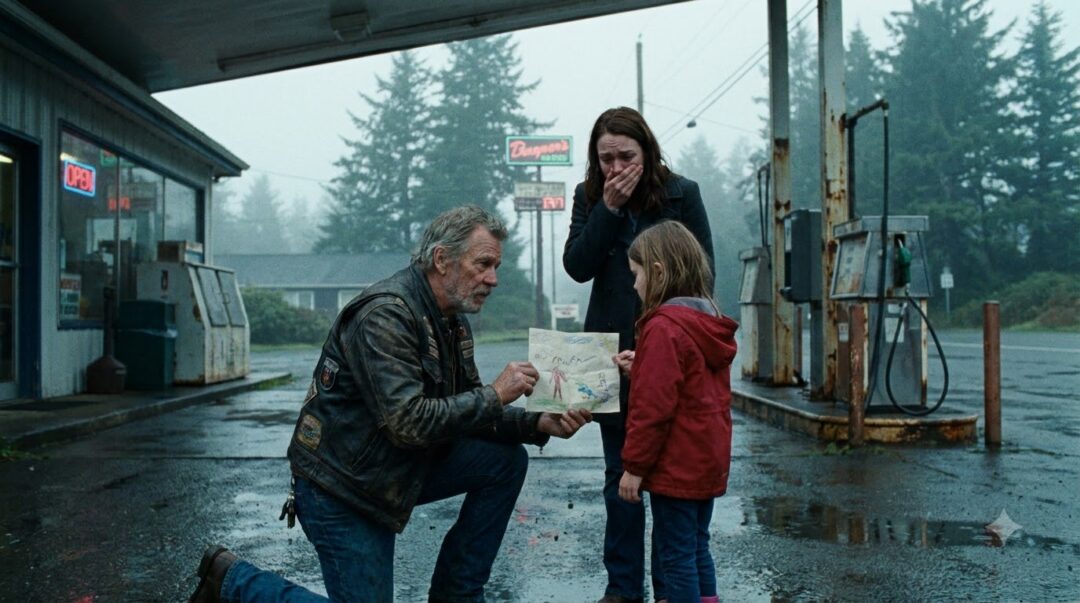
With trembling hands, Lily reached deep into the inside pocket of her red wool coat. She pulled out a small, heavily folded piece of paper—worn soft as flannel at the edges, creased and stained with salt water and old charcoal dust.
She extended the paper toward Ray with both hands.
Ray froze in his tracks. His breath caught in his throat. The shop rag slipped from his calloused fingers into the slush.
Slowly, Ray reached into the left breast pocket of his leather cut.
From inside his vest, Ray pulled out an identical piece of paper: a folded child’s drawing done in bright blue and red crayon.
Ray walked to the tailgate with slow, reverent steps. He unfolded his paper and laid it gently onto Lily’s small lap.
The drawing depicted a large, bright blue motorcycle with oversized wheels, carrying a smiling, bearded man with two big hands. On the back of the motorcycle sat a little brown bear holding a red umbrella in the pouring rain. In the bottom right corner, scrawled in unsteady five-year-old printing, were the words: THANK YOU RAY FOR PULLING ME OUT OF THE FIRE.
Claire stood frozen, her face turning as white as coastal seafoam. She looked from the drawing to the massive biker, then down at Ray’s scarred forearms.
“You…” Claire whispered, her voice trembling with an agonizing mixture of terror and confusion. “You’re Raymond Callahan? The driver of the tanker truck? Julian… my brother-in-law Julian told me… he told the police you were drunk! He said you cut David off on Dead Man’s Curve and forced his log truck over the cliff! He said you murdered my husband!”
Ray slowly raised his gray eyes to Claire’s face. His expression was etched with three years of unbearable, silent grief.
“I didn’t cut David off, ma’am,” Ray said, his deep baritone voice shaking with quiet emotion. “David was my friend. We hauled timber together for fifteen years. On that curve, David’s brakes failed completely. His air lines had zero pressure. He steered into the rocky ditch to avoid smashing into a school bus full of kids.”
Ray reached down and turned the drawing over on the tailgate.
The drawing had not been made on ordinary sketch paper. It had been drawn on the back of an official, carbon-copy corporate dispatch invoice from Thorne Timber Syndicate, dated the morning of the crash.
In the bottom right corner of the dispatch slip, stamped in red ink by the lead mechanic, was a single word: BRAKES DEFECTIVE – VOID FOR HIGHWAY USE.
And below the stamp was the personal signature of the man who had ordered the truck onto the mountain road anyway: Julian Thorne.
CHAPTER 2: THE GASLIGHTING OF COOS BAY
Claire stared down at the red ink stamp, her chest heaving as if she were drowning on dry land. Her knees buckled. Ray reached out with one massive, steady hand, catching her by the elbow before she hit the wet pavement, guiding her gently onto the dry tailgate beside her daughter.
“Julian…” Claire whispered, tears streaming down her face, mingling with the cold Pacific rain. “Julian signed this? But Julian told me the insurance company inspected the wreckage. He said the state police found empty whiskey bottles in your cab. He said that’s why you vanished from the hospital before the inquest.”
“I was in the burn ICU at Oregon Health & Science University in Portland for four months, Claire,” Ray said softly, his voice heavy with ancient pain. “I had third-degree burns over forty percent of my upper body. When David’s tanker ruptured and caught fire, I crawled through the flames into the cab. I couldn’t get David out… his legs were pinned beneath the steering column. But David looked at me and said, ‘Save my little girl, Ray. Take Lily and run.’ I cut Lily’s seatbelt with my knife and pulled her through the rear window just as the second fuel tank exploded.”
Lily reached out with her small hand, her tiny fingers gently tracing the white, ridged burn scars across Ray’s knuckles. She leaned her small head against Ray’s leather sleeve, letting out a soft, contented sigh that she had held inside her chest for three long years.
The memory of that burning December morning was burned into Ray’s flesh forever. He could still smell the sweet, nauseating stench of scorched diesel fuel and burning hydraulic oil. He could still feel the blistering, two-thousand-degree heat that had melted his leather work gloves to his skin as he smashed the Peterbilt’s rear cab glass with a five-pound tire iron. In the cab, through the swirling black smoke, he had seen David Thorne—his best friend, a man who had stood as godfather to his own late son—trapped beneath the crushed dashboard, his legs broken, his hands desperately trying to shield five-year-old Lily from the encroaching fire.
‘Take her, Ray!’ David had screamed, his voice choked with soot and agonizing pain. ‘Don’t let her burn! Promise me, Ray! Promise me you’ll take care of my little girl!’
Ray had reached through the jagged glass, his bare forearms searing against the superheated cab frame as he cut Lily’s seatbelt with his folding knife. He had dragged the screaming child through the window into the freezing mud just seconds before the secondary saddle tank exploded in a hundred-foot fireball that incinerated the cab. For three years, Ray had awakened in cold sweats in the dead of night, hearing David’s final words echoing in his ears, feeling the phantom burn of the flames across his arms.
“When I woke up from my second skin graft in Portland,” Ray continued, his jaw tightening into iron, “the state police investigator told me the truck’s hydraulic brake line had mysteriously disappeared from the impound yard. Julian had David’s shares of Thorne Timber Syndicate tied up in probate court, claiming David was criminally liable for the crash. Julian took seventy percent of the company, leaving you with five hundred thousand dollars in fabricated corporate debt.”
“He told me I was crazy,” Claire sobbed, burying her face in her trembling hands. “Every time I asked to see David’s maintenance records, Julian told me I was having a mental breakdown. He said grief had ruined my mind. He made me sign an agreement giving him power of attorney over David’s estate, promising he would support Lily’s medical care.”
Suddenly, the blare of a horn shattered the rain.
A sleek, silver Mercedes-Benz G-Wagon pulled off Highway 101, parking diagonally across the gas station forecourt, blocking Claire’s Subaru.
The door opened, and a man in a black cashmere trench coat stepped out, holding a large golf umbrella. He was forty-eight, impeccably groomed, with slicked-back silver hair, sharp features, and cold, predatory eyes.
It was Julian Thorne.
Behind him stepped an attorney carrying a leather briefcase and two private security guards in black tactical raincoats.
“Claire, dear,” Julian said, his voice smooth, cultured, and dripping with venomous condescension. “What on earth are you doing talking to this vagrant? I’ve been looking for you all morning. The court hearing has been moved up to nine o’clock tomorrow morning.”
Julian motioned to his attorney, who stepped forward holding a blue-backed legal document.
“Under the emergency provisions of the Oregon Probate Code,” Julian smiled coldly, “I have filed an expedited Petition for Involuntary Medical Conservatorship. The county psychiatrist has reviewed Lily’s three-year history of mutism. You are declared psychologically unfit to manage her rehabilitation. Tomorrow morning, Lily will be remanded to the custody of the St. Jude’s Psychiatric Residential Care Facility in Salem. And full ownership of David’s remaining thirty percent of Thorne Timber will transfer permanently to the corporate trust.”
Claire stood up, shielding Lily behind her body like a mother cougar. “You’re a monster, Julian! You killed your own brother! You cut the brake lines on his truck!”
Julian’s eyes narrowed into slits of ice. He looked past Claire, locking eyes with Ray Callahan standing beside the Harley.
“Be very careful what words come out of your mouth, Claire,” Julian whispered, his voice dropping to a chilling threat. “Accusing a corporate CEO of murder without proof is criminal slander. You have until nine o’clock tomorrow morning to surrender Lily at my office. If you fail to appear… the county sheriff will take her from your home in handcuffs.”
CHAPTER 3: THE SEVERED BRAKE LINE IN LOCKER 42
Julian’s Mercedes roared away into the coastal rain, leaving a sickening silence under the timber canopy.
“He’s going to take my baby,” Claire wept, her voice trembling with hysteria. “He owns the county judges, Ray! He owns the bank! How can we prove he cut those brakes before nine o’clock tomorrow?”
Ray looked down at the child’s crayon drawing. “Because Julian made one critical mistake three years ago. He thought the impound lot destroyed David’s truck.”
Ray turned to Claire. “Get in your car. Follow me to the Coos Bay harbor.”
Twenty minutes later, the Subaru followed Ray’s Harley down the rain-swept docks of the industrial port, pulling into the gated compound of Pacific Coast Marine & Salvage. The yard was stacked high with rusted marine winches, diesel engine blocks, and weathered shipping containers.
Standing in the open bay of the repair shop were four members of Pacific Coast MC: Silas, a sixty-year-old master machinist with a white ponytail; Tank, a former Navy hull technician; and Bear, a broad-shouldered heavy-wrecker driver.
“Silas,” Ray commanded, stepping off his motorcycle. “Open Storage Locker Forty-Two.”
Silas nodded, grabbing a heavy set of brass keys. He led them to an insulated, climate-controlled steel container at the rear of the lot. Silas unlocked the heavy padlock and swung the door open.
Inside, resting on a padded wooden workbench under bright fluorescent lights, was the severed front-axle brake assembly from David Thorne’s 1998 Peterbilt logging truck.
Claire gasped, stepping into the container. “You saved it?”
“I bought the entire wrecked chassis from the scrap auction under a false corporate name three years ago,” Ray said. “Look here.”
Claire walked along the metal shelving of Storage Locker 42, her trembling hands brushing the heavy steel crates containing David’s personal work gear: his grease-stained canvas logging overalls, his scarred yellow hardhat stenciled with THORNE TIMBER #1, and his heavy leather work boots. Seeing these relics of her husband’s life preserved with such reverence by Ray and his club brothers, Claire felt the suffocating fog of isolation that had surrounded her for thirty-six months begin to dissolve. She had believed herself entirely alone in the world, abandoned by a community that had bowed to Julian’s wealth. But here, in this quiet container smelling of machine oil and rain, she realized that David’s true friends had never stopped fighting for his name.
Ray brought a high-powered forensic ultraviolet inspection light over the high-pressure steel-braided hydraulic brake line.
Under the violet light, the failure point was glaringly obvious. The hydraulic line had not burst from pressure or worn through from friction.
The braided stainless-steel casing had been cleanly scored with an industrial pipe cutter, three-quarters of the way through the metal core. When David hit the forty-ton log weight on the seven-percent downgrade of Dead Man’s Curve, the weakened steel had sheared instantly, venting all hydraulic fluid in less than three seconds.
“Look at the microscopic striations on the cut edge,” Tank said, pointing with a steel probe. “That’s not a standard hardware store cutter. It has a four-point circular blade with a unique micro-bevel. There are only two of those German-made hydraulic cutters in Coos County.”
“And where are they?” Claire asked, her heart hammering against her ribs.
“One is in the maintenance shop at Thorne Lumber Mill,” Ray said, his eyes blazing with cold resolve. “In Julian Thorne’s private engineering office.”
Pacific Coast Marine & Salvage had been founded forty years ago by Ray’s father, a veteran of the Navy Seabees. The yard was an iron sanctuary for working men who had given their youth to the timber woods and the sea. The men of Pacific Coast MC weren’t outlaws in the Hollywood sense; they were heavy mechanics, crane operators, commercial tugboat deckhands, and timber haulers who lived by an unyielding frontier code: you protect your crew, you honor your debts, and you never leave a brother’s family behind in the storm.
In Locker 42, the air was cool and dry, smelling of mineral spirits, gun oil, and clean hydraulic fluid. Silas had preserved the wrecked Peterbilt’s front brake assembly under heavy plastic sheeting, keeping the severed lines coated with light protective oil to prevent surface oxidation from destroying the microscopic tool striations. Silas was a master forensic machinist who had spent thirty years rebuilding hydraulic systems for commercial fishing trawlers. He had calibrated the digital micrometer, measuring the precise depth of the score marks across the high-pressure steel-braided line down to the ten-thousandth of an inch.
Suddenly, Lily walked into the storage container.
The seven-year-old girl walked straight to the workbench. Her small fingers reached out, touching the charred metal of the brake assembly.
She looked up at Ray, her large hazel eyes clear and steady.
Then she opened her mouth.
“Uncle Julian did it,” Lily spoke, her voice clear, resonant, and distinct. “In the big barn. With the red tool.”
Claire dropped to her knees on the concrete floor, clutching her daughter, sobbing uncontrollably as Lily wrapped her small arms around her mother’s neck. “You remember, baby? You saw him?”
Lily nodded solemnly. “I was in the truck sleeping. Uncle Julian had a red tool. He was under the wheels. When daddy got in, Uncle Julian smiled and waved goodbye.”
Ray reached for his heavy leather cut, sliding his arms into the sleeves. His jaw was set like an anvil.
“Silas, call the Oregon State Police Major Crimes Division in Salem,” Ray ordered. “Tell them Captain Raymond Callahan is delivering the physical evidence to Thorne Mill. Now.”
CHAPTER 4: THE SIEGE OF THE TIMBER MILL
The night was black as pitch as twenty custom motorcycles of the Pacific Coast Motorcycle Club escorted Claire’s Subaru through the heavy wooden gates of Thorne Lumber Mill.
The mill was a sprawling, eighty-acre industrial complex situated on the banks of the Coos River: towering mountains of Douglas fir logs, three-story bandsaw pavilions, and giant cyclone sawdust hoppers roaring against the rainy sky.
At the main entrance to the corporate office, six private security guards in black tactical gear stood with fiberglass riot batons and high-intensity spotlights.
Julian Thorne stood on the elevated timber catwalk outside his second-story executive suite, looking down at the motorcycles with cold, arrogant amusement.
“Raymond Callahan!” Julian’s voice echoed through the mill’s public address system. “You are trespassing on private industrial property! If you don’t turn those motorcycles around in sixty seconds, my security team will use lethal force!”
Ray swung his leg off his Harley. He walked to the front of the formation, flanked by Tank and Bear. Ray carried a heavy twenty-pound steel toolbox containing the forensic brake assembly and the certified ultraviolet inspection photos.
“Open the gates, Julian!” Ray’s deep baritone voice boomed through the rain. “The Oregon State Police are twenty minutes behind us! We have the severed line! We have the forensic tool marks! And we have the eyewitness!”
Julian’s face went rigid. His eyes darted to Lily sitting in the passenger seat of the Subaru.
“She’s a mute, traumatized child!” Julian screamed, panic cracking through his cultured facade. “Her testimony is legally worthless! She couldn’t remember her own name for three years!”
“She remembers your name, Julian!” Claire yelled from the driver’s window, her voice ringing with unbreakable fury. “She remembers the red pipe cutter! She remembers you waving goodbye to David!”
Julian’s mask of corporate civility completely shattered. His eyes bugged with wild, cornered hysteria.
He spun around to his head of security. “Lock down the mill! Start the main conveyor lines! Burn the maintenance records in the incinerator! Do it now!”
The mill’s emergency sirens began to wail—a deafening, mechanical scream that echoed across the Coos River.
Heavy steel drop-gates slammed down across the access roads.
Inside the main sawmill pavilion, the giant seven-foot industrial bandsaws spun to life with a terrifying, ear-splitting whine, and the overhead conveyor belts began moving hundred-foot logs toward the de-barking drums.
“Bear! Take the front gates with the heavy wrecker!” Ray commanded.
Bear dumped the clutch of his massive ten-ton Peterbilt recovery truck. The heavy steel push-bumper smashed into the timber mill gates at thirty miles an hour.
With a deafening crash of splintering white-pine logs and sheared iron bolts, the gates collapsed inward onto the asphalt.
The twenty motorcycles of Pacific Coast MC swept through the breach like a cavalry charge, their headlights slicing through the steam and sawdust.
Julian turned and sprinted along the elevated catwalk toward the top of the forty-foot sawdust cyclone hopper—the highest vantage point in the mill.
Thorne Lumber Mill was an industrial empire built on the blood and sweat of three generations of Pacific Northwest loggers. The mill occupied eighty acres of prime riverfront real estate, processing five hundred thousand board-feet of timber every twenty-four hours. Inside the vast processing pavilions, the air vibrated with the thunderous drone of twin eight-foot circular head-rig saws slicing through five-foot-thick logs like butter, sending showers of aromatic yellow cedar sawdust into the air.
Julian Thorne had spent the last three years transforming the family enterprise into a corporate fortress, replacing the veteran union millwrights with private corporate security contractors equipped with Kevlar vests, tactical batons, and high-frequency acoustic crowd-control gear. Julian had convinced the local townspeople that he was modernizing the valley, bringing outside capital and high-efficiency automation to save the mill from bankruptcy. But behind the glossy public relations brochures lay a brutal reality of stripped pensions, slashed safety inspections, and systematic intimidation of any employee who questioned why David Thorne’s maintenance protocols had been scrapped.
Ray didn’t hesitate. He tossed his toolbox to Tank and took the metal stairs three at a time, charging up the gantry into the roaring heart of the mill.
CHAPTER 5: THE INFERNO ON THE SAWDUST GANTRY
Forty feet above the concrete mill floor, the wind screamed off the Coos River, driving freezing rain through the open-sided steel pavilion.
The sawdust cyclone hopper was a massive, cone-shaped steel structure containing fifty tons of bone-dry cedar and pine shavings, waiting to be fed into the mill’s industrial drying kilns. The air up here was thick with airborne wood flour—highly flammable, combustible dust that could ignite with the force of high explosives.
Julian stood on the narrow metal catwalk at the summit of the hopper. In his trembling right hand, he held a heavy marine emergency flare, his thumb resting on the striker cap. In his left hand, he clutched a sleek silver briefcase containing David’s forged stock certificates and three million dollars in bearer bonds.
“Stay back, Callahan!” Julian shrieked, his silver hair plastered across his bloodshot eyes. “Take one more step and I drop this flare down the intake chute! Fifty tons of cedar dust will turn this entire valley into a fireball! We’ll both burn to cinders!”
Ray stopped ten feet away on the rain-slicked diamond-plate catwalk. The wind whipped his leather vest against his ribs. Below them, forty feet down, Claire and Lily stood beside the motorcycles, watching the confrontation in breathless terror.
“You’re not dropping that flare, Julian,” Ray said, his voice terrifyingly calm, steady as an anchor chain. “You’re a coward who hires men to cut brake lines in the dark. A coward doesn’t want to die. A coward wants to live with his stolen money.”
“You don’t know what it’s like!” Julian screamed, his voice cracking with venomous resentment. “David was always the favorite! David had the respect of the mill workers! David had the patents! David had Claire! My father gave David seventy percent of the company and left me with crumbs! I built the international sales network! I made Thorne Timber rich! David was going to fire me the day after that haul!”
“David was going to expose your embezzlement, Julian,” Ray said, taking a slow, measured half-step forward. “David found out you were laundering drug money through the Coos Bay log exports. He was protecting his family.”
“It was my company!” Julian roared.
The gantry catwalk sixty feet above the mill floor vibrated violently as the industrial de-barking drums below spun at three hundred revolutions per minute. Rain swept in through the open structural steel trusses, turning the fine sawdust on the diamond-plate metal deck into a slick, treacherous paste. Below them, the massive mechanical river of logs surged through the flumes, sixty-foot timber stems churning the dark river water into yellow foam.
Julian Thorne backed away along the catwalk railing, his tailored trench coat soaked through, his face distorted into a mask of pure, homicidal paranoia. In his twisted mind, he was not a murderer; he was an aggrieved visionary who had simply removed an obstacle to his rightful destiny. For thirty years, he had lived in the shadow of his brother David—the brother who was stronger, beloved by the workers, trusted by the banks, and blessed with a beautiful, devoted family. When Julian had cut that hydraulic brake line in the dark of the mill barn on that fateful December morning, he had believed he was claiming his birthright. Now, cornered on his own industrial gantry by the very man who had pulled Lily from the ashes, the full, crushing weight of his damnation was staring him in the face.
Julian struck the flare.
A blinding, hissing cone of brilliant crimson fire erupted into the rainy night, throwing thick plumes of choking sulfur smoke across the catwalk.
Julian raised his arm, preparing to hurl the hissing flare down the sawdust chute.
Ray moved like a striking panther.
He didn’t try to tackle Julian’s body. Ray lunged low, his right work boot kicking upward in a brutal, lightning-fast arc.
His steel-toed boot caught Julian’s wrist with bone-shattering force.
The flare was kicked high into the air, tumbling over the safety railing, falling harmlessly into the dark, rushing waters of the Coos River forty feet below, where it was swallowed with a brief, angry hiss of steam.
Julian shrieked in pain, dropping the silver briefcase. He pulled a small, stainless-steel Colt .380 pistol from his trench coat pocket, swinging the barrel toward Ray’s chest.
Ray closed the distance in a fraction of a second.
His massive left hand clamped over the pistol’s slide, driving the metal backward, jamming the firing mechanism. With his right fist, Ray delivered a thunderous, short-range right hook directly into Julian’s jaw.
The sound of cartilage breaking was followed by Julian’s body lifting off the catwalk and crashing heavily onto the diamond-plate steel.
Julian lay groaning in the rain, blood pouring from his mouth, his arrogance completely shattered.
Ray knelt down, pressing his heavy knee into Julian’s chest until the timber baron could barely draw breath. Ray reached down and pulled the stainless-steel handcuffs from his belt, ratcheting them around Julian’s wrists behind his back.
“David Thorne sent you a message, Julian,” Ray whispered, his voice shaking with thirty-six months of avenged honor. “The debt is paid in full.”
CHAPTER 6: THE CONFESSION IN THE RAIN
Down below on the mill floor, the sirens of twelve Oregon State Police cruisers and three unmarked federal vehicles lit up the timber stacks in brilliant blue and red strobe lights.
State troopers armed with tactical rifles secured the security team, while Captain Marcus Vance of the Major Crimes Division climbed the metal catwalk stairs.
Captain Vance looked down at the handcuffed Julian Thorne, then at Ray Callahan standing in the rain, his chest heaving, his scarred forearms covered in soot and grease.
“Raymond,” Captain Vance said, holstering his sidearm. “We executed a federal search warrant on Julian’s private office five minutes ago. In his personal wall safe, my detectives found the German hydraulic pipe cutter. The micro-bevel matches your forensic photographs with a ninety-nine-point-nine percent ballistic certainty.”
Captain Vance looked at Julian with cold disgust. “Julian Thorne, you are under arrest for first-degree premeditated murder, corporate grand larceny, and felony evidence tampering.”
Two state troopers hauled Julian to his feet, marching him down the gantry stairs in heavy chains. As he was pushed into the back of a state police cruiser, the mill workers who had gathered on the night shift stood in silent, contemptuous condemnation, watching the tyrant fall.
Captain Marcus Vance was a legendary veteran of the Oregon State Police, having spent thirty years tracking corporate timber theft and organized environmental crime throughout the Cascades. He had known David Thorne since they were boys playing Little League baseball on the muddy diamonds of North Bend. When David’s death had been hurriedly ruled an accidental equipment failure three years ago by a compromised county coroner, Vance had refused to close his confidential case file.
Vance walked to the edge of the mill catwalk, looking down at the handcuffed corporate tycoon. ‘You thought you could buy this county, Julian,’ Vance said, his voice hard as Douglas fir heartwood. ‘You thought that because you had lawyers in Portland and cash in the Cayman Islands, nobody would remember what honest men look like. But truth has a way of rising to the surface on this coast, just like old cedar logs after a winter flood.’
Ray walked down the long metal stairs to the mill yard.
Claire was waiting at the bottom. She looked at Ray, her eyes shining through her tears, her face radiant with an overwhelming, miraculous peace.
Beside her stood Lily.
The little girl walked toward Ray. She didn’t look at the police cars or the flashing lights. She walked straight to the big, bearded biker who had pulled her from the burning truck three years ago.
Lily stopped in front of Ray. She reached up with both small hands, gently taking Ray’s calloused right hand in her own.
“Ray,” Lily said, her voice clear and sweet as a silver bell. “My daddy said you were the bravest man in the woods. Thank you for bringing my daddy’s honor home.”
Ray fell to his knees in the wet sawdust, pulling the little girl into his arms.
For three years, Ray Callahan had carried the weight of a dead friend, the agony of severe burn scars, and the bitter slander of a corrupt town. Now, holding David Thorne’s little girl against his chest, feeling her arms wrap tightly around his neck, the massive, grizzled biker buried his face in her wool coat and wept tears of pure, unadulterated redemption.
CHAPTER 7: THE PORTRAIT BY THE PACIFIC
Six weeks later, the winter sun broke brilliant and golden over Cape Arago, illuminating the majestic sea stacks of the Oregon Coast in blinding white spray.
The air was crisp, clean, and scented with pine resin and wild coastal heather.
At the Thorne Lumber Mill, the dark cloud of corruption had been entirely swept away.
Under an emergency decree of the Oregon Probate Court, Julian’s fraudulent shares had been fully revoked and returned to David’s rightful estate. Claire Thorne was now the majority owner and president of Thorne Timber Syndicate, with the full, devoted backing of every mill worker in Coos County.
The company had instituted the David Thorne Worker Safety & Pension Trust, ensuring that no truck would ever leave the timber landings without rigorous, independent mechanical certifications.
Down at the clubhouse of Pacific Coast MC, nestled atop the bluffs overlooking the Cape Arago Lighthouse, a massive celebration was underway.
Parked along the gravel drive were thirty pristine motorcycles, their chrome engines gleaming in the Pacific sun. The outdoor pit barbecue was smoking with fresh Columbia River salmon, garlic-butter dungeness crab, and thick ribeye steaks.
Sitting on the wide cedar deck overlooking the crashing waves were Claire, Ray, and little Lily.
Claire wore a warm woolen sweater, looking vibrant, healthy, and deeply happy, her laugh carrying over the roar of the ocean breakers.
Sitting beside Ray at the picnic table, holding a set of brand-new professional artist colored pencils, was Lily. She was chattering happily, telling Tank and Silas about the sea lions she had seen on the rocks below the lighthouse.
The restoration of Thorne Lumber Mill was more than a corporate restructuring; it was the rebirth of an entire coastal community. Within two weeks of Julian’s arrest, the union banners of the International Woodworkers of America were proudly re-hung across the main saw-gate. Over three hundred timber workers who had been illegally laid off during Julian’s predatory cost-cutting campaign were rehired with full back-pay and restored pension seniority.
Every Sunday afternoon, the thunderous rumble of the Pacific Coast Motorcycle Club echoed through the coastal headlands as Ray led his riders up the winding driveway of the Thorne homestead. The house sat on a high bluff overlooking Sunset Bay, surrounded by ancient Sitka spruces that had sheltered four generations of Thornes. Claire and Lily had planted a memorial garden of wild coastal lupines and native redwoods on the southern lawn, surrounding a polished granite bench dedicated to David Thorne’s memory.
In the evenings, as the coastal fog rolled in from the Pacific, the fireplace in the great stone hearth filled the living room with the comforting scents of seasoned alder and cedarwood. Ray sat in the deep leather armchair beside the hearth, teaching Lily how to carve small wooden whales from driftwood blocks, his scarred hands moving with patient, grandfatherly gentleness. The silence that had gripped the little girl’s life for three agonizing years had been replaced by endless questions, bright laughter, and songs she had learned at school.
Lily tapped Ray’s leather sleeve with her pencil. “Ray, look! I finished the new picture!”
Ray looked down at the heavy sheet of white drawing paper on the table.
The drawing showed a magnificent, bright blue Harley-Davidson parked beside the Cape Arago Lighthouse under a brilliant yellow sun.
Sitting on the motorcycle was Ray, smiling broadly with his gray beard. Beside him stood Claire, holding a bouquet of wild coastal lupines.
And sitting on Ray’s shoulders, with her arms spread wide toward the sky, was Lily, wearing a miniature leather vest with the Pacific Coast MC patch.
Across the top of the drawing, written in neat, confident seven-year-old cursive, were the words:
OUR NEW FAMILY BY THE SEA.
Ray stared at the drawing. A deep, radiant warmth spread through his chest—a feeling of absolute wholeness that he thought had died on Dead Man’s Curve three years ago.
Ray took the drawing, holding it with gentle reverence. He reached into his vest pocket, pulling out a beautifully crafted polished silver frame made from marine stainless steel, and carefully slid the drawing inside.
“It’s the most beautiful thing I’ve ever seen, Lily,” Ray said softly, his baritone voice thick with fatherly love.
Claire smiled, slipping her hand gently into Ray’s scarred palm. “We made a place for it on the mantle above the fireplace at the house, Ray. And we set a place at the dinner table for you every single night.”
Lily threw her arms around Ray’s neck, kissing his bearded cheek. “Because family doesn’t leave each other behind in the rain, right Ray?”
“Never again, little bird,” Ray smiled, pulling both Lily and Claire close against his broad chest. “Never again.”
Down on the rocks, the great Pacific waves crashed in thunderous, joyful applause, carrying the spirit of David Thorne out into the golden horizon.