The Antique Brass Bell That Shattered A Charleston Maritime Empire
CHAPTER 1: THE GOLDEN ATRIUM
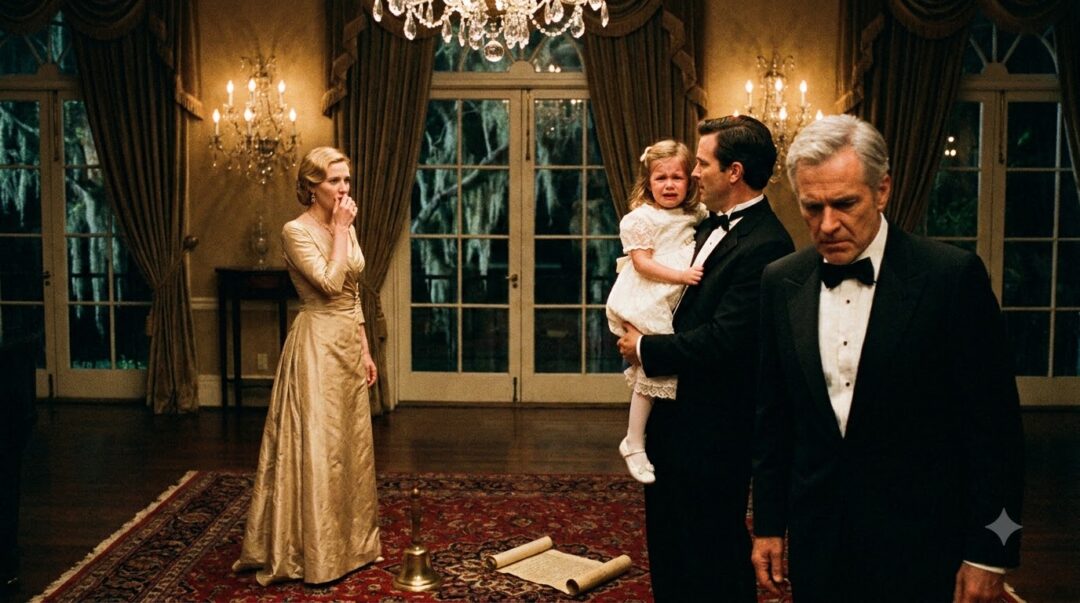
The heavy scent of blooming confederate jasmine and salt marsh swept through the open French doors of the Rutledge Mansion on East Bay Street, mingling with the dry, expensive fragrance of aged bourbon and French perfume. Beneath the cascading crystal chandeliers of the grand ballroom, two hundred members of Charleston’s oldest shipping families stood in bespoke black tie, celebrating the centennial gala of Ravenel Harbor Logistics. Marcus Calhoun stood by the mahogany terrace bar, his hands resting lightly in the pockets of his tailored black tuxedo, his eyes never straying from his five-year-old niece, Daisy.
Daisy looked like a small angel in her ivory lace flower-girl dress, her honey-blonde curls bouncing as she collected fallen magnolia petals near the grand piano. Marcus had raised the child alone since his elder brother Edward passed three years ago, defending her inheritance against the quiet, predatory glances of Lowcountry aristocrats who believed the Calhoun name was finished.
Twenty-eight years ago, in October of 1996, the Calhoun flagship cargo vessel Carolina Queen had broken apart in the shipping channel off Cape Romain. The official maritime board of inquiry had ruled that Captain Edward Calhoun Senior had scuttled the ship for insurance money, ruining the family name and clearing the way for the Ravenel family to seize every municipal deep-water wharf from the Battery to the Cooper River bridges. Marcus had grown up in the shadow of that disgrace, working salvage tugs while the Ravenels built glass office towers on the waterfront his father had dredged with his own hands.
Across the parquet floor, Eleanor Ravenel held court. At fifty-seven, the chairperson of Ravenel Logistics was dressed in a sweeping champagne-gold draped satin gown that shimmered under the chandeliers, her throat adorned with an emerald-and-diamond collar that looked like a king’s ransom. Her hair was styled in an immaculate silver-blonde chignon, and her emerald eyes were cold, calculating, and victorious.
Eleanor set her heavy, beaded evening clutch on an antique Chippendale side table to greet the mayor. Daisy, wandering past the floral arrangements, was drawn to the sparkle of the cut glass beads on the bag. She paused, knelt on the polished floorboards, and reached out her small fingers. When her hand emerged from the open silk flap, she was not holding lipstick or a compact mirror.
Her small fingers clutched a heavy, salt-pitted vintage brass handbell, its contours worn smooth by decades of sea spray and nervous handling. It looked alien against the polished gold and crystal of the ballroom, carrying the deep greenish verdigris of Atlantic brine.
Before Marcus could step forward, Eleanor’s head snapped toward the table. Her aristocratic smile evaporated into an expression of raw, primal terror. She abandoned the mayor mid-sentence, her gold satin gown hissing against the carpet as she closed the distance in four furious, predatory strides.
“Give me the bell,” Eleanor demanded, her voice dropping into a harsh, venomous whisper that cut through the chamber quartet’s melody.
Daisy recoiled, hugging the heavy bronze against the lace bodice of her dress. “No! It was in your bag, but it has my grandfather’s ship on it!”
“Give it to me right now, you little thief,” Eleanor hissed, lunging forward with her manicured hand outstretched, her diamond rings catching the light like talons.
Daisy let out a sharp, terrified cry that instantly silenced the conversations nearby.
Marcus moved with explosive speed. He crossed the floor in three strides, stepped directly between the billionaire matriarch and his weeping niece, and swept Daisy into his left arm while bringing his right hand up to block Eleanor’s wrist in mid-air. The physical contact was sharp, electric, and unyielding.
“Keep your hands off my niece, Mrs. Ravenel,” Marcus said, his voice dropping into a low, resonant baritone that vibrated with dangerous authority.
Eleanor snatched her arm back, her face flushing crimson beneath her foundation. “That child reached into my personal evening bag! She is a common pickpocket, Marcus, just like the disgraced father who raised you! Hand over what she stole, or I will have private security drag you both into the street!”
“She is five years old,” Marcus replied, feeling Daisy’s small heart hammering against his chest. “And you look terrified of a six-inch piece of scrap brass.”
From the terrace entrance, a slow, rhythmic footstep sounded against the oak floor. Judge Harrison Calhoun, seventy-four years old and towering in his classic black tuxedo with a gold pocket watch chain, moved through the parting crowd. The retired chief justice of the state supreme court carried a carved hickory walking stick, his silver hair brushed straight back, his dark eyes fixed on the small brass bell.
“That bell never belonged in any designer purse, Eleanor,” Judge Calhoun said, his deep, resonant voice filling the ballroom with judicial thunder. “That is the bridge watch bell from the Carolina Queen. It was stolen from the federal admiralty evidence vault in Charleston twenty-eight years ago tonight.”
Eleanor’s breath hitched. Her hand drifted unconsciously to her emerald choker, her knuckles white. “Harrison, you are an old man clinging to ancient delusions. It’s an antique curiosity I purchased at an estate auction in Savannah.”
“Then you won’t mind if we examine the serial stamp beneath the crown,” Marcus said.
Daisy, overwhelmed by the towering circle of adults and the suffocating silence, loosened her grip. The heavy brass bell slipped from her small fingers. It fell through the air, struck the deep burgundy Persian carpet, and bounced against the parquet with a loud, ringing chime that echoed like a gunshot beneath the chandeliers.
The violent impact jarred the threaded clapper screw loose from the bronze crown. As the clapper tumbled free, a tightly rolled cylinder of aged, wax-sealed parchment slipped out from the hollow interior, rolling to a stop against the hem of Eleanor’s gold gown.
Marcus knelt instantly, but Judge Calhoun’s hickory stick was faster, pinning the parchment cylinder against the floor before Eleanor’s satin shoe could kick it away. Harrison picked up the weathered roll with steady fingers, broke the brittle red wax seal, and let the parchment unroll under the direct light of the chandelier.
Written in dark, faded iron-gall ink across the top was Captain Edward Calhoun’s bold maritime signature, dated October 14, 1996. Beneath the signature was a sworn notary stamp bearing Eleanor Ravenel’s maiden name—and a single handwritten sentence certifying that fifty percent of the Charleston deep-water wharves had been signed over to the Calhoun Trust to prevent the deliberate scuttling of the harbor fleet.
CHAPTER 2: THE WATERMARK ON EAST BAY
The grand ballroom of the Rutledge Mansion seemed to freeze in time. The two hundred members of Charleston society—cotton brokers, federal judges, maritime admirals, and historic preservationists—stood in dead silence, their champagne flutes arrested halfway to their lips. Judge Harrison Calhoun did not blink as he smoothed the yellowed parchment across the polished surface of a nearby mahogany console table.
The heavy cotton rag paper bore the distinct embossed seal of the South Carolina Maritime Commission, a watermark Harrison had personally authorized during his tenure as special counsel to the port authority three decades ago.
Eleanor Ravenel took a ragged, shallow breath. Her manicured hands trembled as she clutched her gold evening bag against her waist, her composure disintegrating along the edges like wet silk.
“This is an outrageous, transparent forgery,” Eleanor said, her voice climbing half an octave, pitching toward shrill hysteria. “Edward Calhoun was a bankrupt drunk who falsified manifests when his creditors threatened to seize his tugs! Harrison, you cannot honestly expect the governor and the port commissioners to take this ridiculous scrap of paper seriously!”
“The watermark is twenty-eight years old, Eleanor,” Harrison replied calmly, adjusting his wire-rimmed spectacles with infuriating patience. “The notary commission number belongs to your personal logbook from the year you served as deputy registrar for the harbor district. And more importantly, the clapper assembly of this bridge bell was machined with a reverse-threaded left-hand pitch that only my brother Edward and his master machinist in Mount Pleasant knew how to turn.”
Daisy remained tucked securely against Marcus’s broad chest, her small arms wrapped tightly around his neck, her soft blonde curls tickling his jaw. Marcus kept his eyes moving across the perimeter of the room. Two men in dark charcoal suits—members of Ravenel’s private waterfront security detail—had already begun moving quietly along the walls, positioning themselves near the double mahogany doors that led to the marble foyer.
“Marcus,” Harrison said quietly without looking up from the document. “Call Special Agent Vance at the Federal Maritime Commission in Atlanta. Tell him the missing cargo manifest from the 1996 Cape Romain casualty has just resurfaced in public view.”
“Nobody is calling federal agents,” Eleanor snapped. She stepped forward, her emerald necklace flashing in the chandelier light, her eyes narrowing into cold, predatory slits. She flicked two fingers toward the entrance. The larger of the two security guards, a scarred former harbor pilot named Vance Rawlins, stepped into Marcus’s path.
“Mr. Calhoun,” Rawlins rumbled in a gravelly Lowcountry drawl. “Mrs. Ravenel has requested that all items removed from her personal clutch be returned immediately. Step into the study so we can settle this discreetly without alarming the gala patrons.”
“Rawlins,” Marcus said, his voice flat, low, and vibrating with dangerous certainty. “You touch either of us, and I will remind you of the night in 2018 when you ran a container barge into the Wando terminal while drunk on rum. I’m the salvage diver who cut the fuel lines to keep your barge from taking down the bridge. Back off before I break your jaw.”
Rawlins hesitated, his thick neck flushing red, his eyes darting toward the assembled crowd of judges and civic leaders who were now watching the confrontation with intense scrutiny.
Eleanor stepped closer to the mahogany table, her knuckles white. “Harrison, let us be practical. Even if that paper is authentic, it represents an unrecorded private memorandum that was completely extinguished by the bankruptcy decree of 1997. The Calhoun estate was liquidated. Ravenel Logistics holds clear, unencumbered fee-simple title to every container berth from the Battery to North Charleston.”
“A bankruptcy decree obtained through fraudulent concealment is void ab initio under federal admiralty law, Eleanor,” Harrison said, his voice ringing with judicial severity that echoed through the room. “You swore under oath at the maritime inquiry that Edward had never executed any partnership agreement with your family. You testified that he took his vessel to sea in defiance of port orders.”
Harrison pointed a long, ink-stained finger at the lower margin of the parchment. “Look at the coordinates inscribed along the bottom crease. Latitude thirty-two degrees, fifty-one minutes north. Longitude seventy-nine degrees, forty-two minutes west. Inscribed in indelible grease pencil.”
Marcus’s eyes widened with sudden, electric realization. “That isn’t Cape Romain. That’s inside the sheltered basin behind Ravenel Pier 4.”
Eleanor lunged across the mahogany console, her manicured nails tearing across the polished wood, trying to snatch the document. But Harrison’s heavy hickory walking stick came down with a sharp, explosive crack against the tabletop an inch from her fingers. The wood reverberated like a struck drum, sending Eleanor stumbling backward into the arms of the mayor.
“You always were careless when the tide turned against you, Eleanor,” Harrison observed with icy detachment.
“You don’t know what you’re unearthing, Harrison!” Eleanor whispered, her voice trembling with venomous malice. “You think you’re clearing your brother’s name. But if you dredge that basin at Pier 4, you won’t just find an old hull. You will unearth the diver’s sealed deposition that was stolen from the federal courthouse vault the night Edward died—and it lists your own name as the magistrate who authorized the inspection warrant that sealed his fate!”
The silence in the Rutledge ballroom was suffocating. Marcus looked at the faces of the Charleston elite around him—men whose families had made fortunes on the docks his grandfather had built, women who wore diamonds purchased with shipping dividends. For nearly three decades, these people had crossed to the other side of the street whenever a Calhoun approached, whispering about disgraced captains and insurance fraud. To see the truth laid bare on this mahogany console, with the official state watermark glowing under the crystal lights, was like watching an ancient fortress dissolve into dust.
Eleanor stepped back toward the perimeter, her eyes darting toward her private security guards, but the guards stood frozen, looking at Judge Harrison Calhoun with the instinctive deference that every citizen in South Carolina held for the highest judicial authority in the state. Harrison did not raise his voice, he did not posture; he simply stood like an iron statue of blind justice, his hand resting on the hickory stick that had carried him through thirty years on the bench.
“Marcus,” Harrison said, his voice quiet yet penetrating. “Take Daisy. The truth is out in the room, but the physical logs are still at the terminal. We finish this where it began.”
CHAPTER 3: THE SECRET OF PIER 4
The accusation hung in the humid ballroom air like an unexploded naval shell. Marcus Calhoun felt the silence press against his eardrums, but he did not look at his uncle with doubt. He had spent his entire life watching Judge Harrison Calhoun refuse bribes from railroad syndicates and political machines; the man’s integrity was carved from granite.
“That warrant was never executed, Eleanor,” Harrison said, his baritone steady as an anchor chain. “Your father presented an affidavit on October 13, 1996, alleging that Edward was smuggling undeclared industrial electronics. I reviewed the manifest, found three forged customs stamps, and denied the warrant on the record. Two hours later, the court docket for that night was stolen from the clerk’s safe.”
“A convenient story from an old man with a fading memory,” Eleanor sneered, smoothing the crumpled gold silk over her hips as she regained her footing. “The clerk who handled that docket died in a car crash twenty years ago. You have no proof, Harrison. Without the docket sheet, that scrap of paper in your pocket is nothing more than inadmissible hearsay from an interested party.”
“We don’t need the docket sheet,” Marcus said, his deep voice carrying over the murmuring crowd. He lowered Daisy gently onto the console table, keeping his arm securely around her waist, and lifted the antique brass bell under the direct light of the chandelier.
Near the base of the flaring bronze lip, partially obscured by green verdigris, were three distinct strike marks from a center punch.
Marcus knew those marks intimately. Every apprentice who worked in the Calhoun Shipyard in the nineteen-nineties was taught to mark custom valves with three punch marks before pressure testing. His father had used that exact signature on the sea-chest valves of the Carolina Queen.
“Rawlins,” Eleanor commanded, her voice turning shrill and desperate. “Clear the room! Call the harbor patrol!”
Rawlins reached into his jacket, but Marcus was already moving. He scooped Daisy into his arms, grabbed the brass bell with his free hand, and drove his shoulder straight into the double service doors behind the grand piano.
The service doors burst open into the catering scullery, where three kitchen workers dropped silver trays of shrimp canapes in shock.
“Harrison, through the garden gate!” Marcus shouted.
Despite his seventy-four years, Judge Calhoun moved with astonishing speed, slipping through the scullery just as Rawlins lunged through the doorway. Marcus kicked a heavy stainless-steel prep cart into Rawlins’s path, sending the security guard crashing into a rack of wine glasses with an earth-shattering crash of breaking crystal.
Marcus, Harrison, and Daisy hurried down the brick delivery corridor beneath the mansion, emerging into the humid night air of the private garden. The scent of salt marsh was thick and pungent, blown in by an approaching Atlantic thunderstorm.
Marcus unlocked the heavy doors of his 1994 Ford Bronco parked along the cobblestones of East Bay Street. He placed Daisy safely onto the vinyl bench seat, buckling the harness around her lace dress and tucking a dry wool blanket around her shoulders. Harrison climbed into the passenger seat, his hickory stick resting between his knees, his breathing deep and measured.
Marcus vaulted behind the wheel, cranked the V8 engine, and accelerated onto the cobblestones, tires squealing as he turned north toward the industrial container terminals along the Cooper River.
In the rearview mirror, the headlights of a black commercial pickup truck appeared two blocks behind them, maintaining aggressive pursuit through the narrow historic streets.
“They’re following us to Pier 4,” Marcus said, his hands steady on the wheel as he downshifted into third gear.
“Of course they are,” Harrison said, pulling the rolled parchment from his coat pocket and looking out into the rain-streaked darkness where the towering container cranes of the port loomed against the sky. “Eleanor knows that if we reach the old harbor workshop before she can access the safe, twenty-eight years of corporate lies will be dredged up by sunrise.”
“What was in that basin, Harrison?” Marcus asked. “Why would my father sail the ship into Pier 4 instead of the open ocean?”
Harrison looked at his nephew, his eyes heavy with ancient grief. “Your father didn’t sail that ship to Cape Romain, Marcus. He was poisoned at the wheelhouse dock. He managed to engage the emergency reverse thrusters and ground the hull inside the private basin at Pier 4 to keep the ship from sinking in the deep ocean trench where the evidence would never be recovered. He died with his hand on the throttle, Marcus. He died saving the truth for you.”
The night air off the Cooper River was thick with the scent of damp cordgrass, diesel exhaust, and the impending fury of the Atlantic gale. As the Bronco cut through the narrow brick alleys of the French Quarter, Marcus looked over at his uncle. The old judge’s profile was illuminated by the green glow of the dashboard instruments, his weathered jaw clenched with an intensity that decades of legal battles had never softened.
“Harrison,” Marcus said, downshifting into third gear to clear a flooded intersection. “If my father knew they were trying to frame him, why didn’t he go to the federal marshals that night?”
Harrison stared out into the rain-lashed darkness. “Because the district attorney at the time was Eleanor’s first cousin, Marcus. The port commissioners were all invested in Ravenel Harbor Logistics. Your father knew that if he walked into a courthouse in Charleston, he would disappear into a cell before the sun rose. His only chance was to ground the ship where the physical hull would stay intact, locked beneath twenty feet of silt until someone had the courage and the evidence to dig it up.”
In the back seat, Daisy had wrapped herself tightly in the wool blanket, her small fingers never letting go of the antique brass bell. “Uncle Marcus,” she whispered. “The bell smells like Grandpa’s workshop.”
Marcus looked in the rearview mirror and smiled gently. “It does, sweetheart. That’s the smell of honest salt water and iron. It’s the smell of who we are.”
CHAPTER 4: THE CAUSEWAY PURSUIT
The rain began to fall in heavy, blinding sheets as the Bronco roared onto the elevated ramps of the Cooper River Causeway. Behind them, the pursuing black pickup truck closed the distance, its high beams reflecting aggressively in Marcus’s mirrors. Through the windshield, the massive steel suspension towers of the Ravenel Bridge rose into the storm clouds, lit by flashing aviation strobes that cast an eerie crimson glow across the wet asphalt.
“Marcus, watch the bridge approach!” Harrison warned, bracing his hand against the dashboard as the Bronco hit a sheet of standing water, throwing curtains of spray thirty feet into the marsh grass below.
“They’re not trying to pass us,” Marcus said, checking his mirrors with cold tactical focus. “They’re trying to force us off the causeway into the salt marsh before we reach the terminal gates.”
In the back seat, Daisy clutched the antique brass bell against her chest, her wide blue-gray eyes watching the headlights behind them. “Uncle Marcus, the black truck has big lights on the roof. Like the monsters in my storybook.”
“Don’t worry, sweetheart,” Marcus said softly, his voice warm and completely steady. “This truck is an old navy runner. Those monsters can’t catch us.”
Marcus downshifted into second gear as the road narrowed near the entrance to the decommissioned Calhoun Wharf. He didn’t take the paved bypass toward the modern container gates. Instead, he swung the steering wheel hard to the right, cutting across an overgrown gravel access road that ran along the edge of the abandoned dry dock basin.
The heavy four-wheel-drive tires tore through the crushed oyster shells and mud, sending geysers of brackish water into the wheel wells. The pursuing pickup truck tried to follow, but its driver, unfamiliar with the soft marsh subgrade, hit a patch of pluff mud at forty miles an hour. The heavy vehicle spun out in a spray of black mire, sliding sideways into an abandoned iron mooring bollard with a sickening crunch of metal and hissing coolant.
Marcus killed his headlights, coasting the Bronco into the deep shadows beneath the rusted corrugated awning of the old Calhoun Marine Machine Shop.
The rain hammered against the tin roof with a deafening roar. Outside, across the dark waters of the inner basin, the blackened pilings of Pier 4 stood like jagged teeth in the churning tide.
“Stay inside with Daisy,” Marcus told Harrison, reaching under the driver’s seat to pull out an industrial dive flashlight, a heavy pry bar, and his stainless-steel rigging knife.
“Marcus, look at the tide gauge on the pier,” Harrison cautioned, pointing through the rain-streaked window. “The storm surge has pushed the harbor water six feet above mean high tide. If you enter that lower workshop, you’ll be wading through four feet of seawater.”
“The safe isn’t on the floor, Harrison,” Marcus said, picking up the antique brass bell from Daisy’s lap. “Look at the base of the clapper again.”
Marcus unscrewed the threaded brass clapper completely. Dropping out from the inner cavity of the bronze bell was a tiny, precision-cut steel key, stamped with the numbers: 1-9-9-6.
“The overhead crane locker,” Marcus said, his eyes alight with fierce realization. “My father didn’t keep his private logs in a floor safe. He kept them in the control cab of the forty-ton gantry crane, forty feet above the high-water mark.”
Marcus stepped out into the freezing downpour, the wind tearing at his soaked dress shirt as he sprinted across the slick wooden timbers of the wharf. The salt spray stung his eyes, but his boots knew every plank of this pier. He reached the rusted ladder of the historic gantry crane, hauling himself up the iron rungs into the darkness while the storm raged around the harbor.
He reached the crane cab, jammed the tiny steel key into the locked metal electrical cabinet behind the operator’s seat, and turned it with a sharp, clean click.
The cabinet swung open. Inside, sealed in heavy marine-grade polyethylene, was a black fireproof surveyor’s case.
Marcus pulled the case out and opened the latches under the beam of his dive light.
Resting inside were three micro-cassette audio recordings, an intact diver’s logbook dated November 1996, and a set of eight-by-ten black-and-white underwater photographs showing the severed sea-chest piping of the Carolina Queen—complete with clear, unmistakable oxy-acetylene torch scorch marks.
Attached to the diver’s log was a canceled cashier’s check for fifty thousand dollars drawn on Ravenel Harbor Logistics, signed by Eleanor Ravenel herself.
Before Marcus could close the case, the cab door was kicked violently inward. Standing on the narrow exterior catwalk in a dripping raincoat, leveling a black semi-automatic pistol at Marcus’s chest, was Vance Rawlins.
“Drop the case, Calhoun,” Rawlins growled, his voice carrying over the wind. “Mrs. Ravenel told me to make sure neither you nor that paperwork ever comes down from this crane.”
The rain roared against the corrugated roof of the machine shop with deafening ferocity as Marcus prepared to make the climb. Down in the mud below, the wrecked pickup truck was steaming into the dark, its radiator hissed out, its driver groaning as he kicked open the jammed cab door. Marcus knew he had less than ten minutes before Rawlins pulled himself from the wreckage and came hunting with whatever firepower he had stashed behind the seat.
He looked up at the forty-ton gantry crane. The steel girders rose like a skeletal titan into the storm clouds, its warning lights blinking amber against the driving sheets of water. His grandfather had welded those girders with his own hands in the summer of 1968, teaching young Edward how to test the penetration of a vertical arc weld in high humidity. Every bolt in this shipyard had been paid for with honest sweat and naval pride.
“Marcus!” Harrison called out from the open window of the Bronco. “Take the radio! The Coast Guard sector command in Woods Hole is monitoring channel sixteen! If Rawlins breaches the crane, transmit the emergency security code!”
“Understood!” Marcus shouted back into the wind. He gripped the iron ladder rungs, the cold steel biting into his palms through the rain, and began the forty-foot ascent into the teeth of the gale.
CHAPTER 5: THE CRANE CABIN CONFRONTATION
The wind screamed through the iron lattice of the gantry crane, rocking the operator’s cab forty feet above the black, churning waters of the Cooper River basin. Marcus stood motionless, the heavy beam of his dive light illuminating the rain dripping from Rawlins’s pistol barrel. He did not drop the black surveyor’s case. His boots were set wide on the diamond-plate steel floor, his center of gravity low and immovable.
“You’re out of your depth, Rawlins,” Marcus said, his voice cutting through the roar of the gale with the cold, measured cadence of a deep-sea salvage specialist. “You shoot a man forty feet in the air on an industrial crane during a hurricane warning, and every maritime inspector from here to Miami will swarm this dock. And the first thing they’re going to find in that basin is the scuttled hull of the Carolina Queen.”
Rawlins stepped into the cab, the smell of cheap whiskey and wet canvas rolling off him. His scarred face twisted into a cruel, desperate sneer. “By morning, Calhoun, this entire wharf is going to be an industrial ash heap. A catastrophic electrical fire during a severe storm. Mrs. Ravenel has already arranged the insurance adjuster. An old wooden crane collapses into the marsh with two Calhoun men inside. Tragic ending to a ruined family.”
“You forgot one thing, Rawlins,” Marcus said, his eyes shifting slightly toward the overhead control panel.
“What’s that, boy?”
“You forgot who built this crane,” Marcus said.
Marcus didn’t lunge for the gun. Instead, his right elbow snapped upward with explosive force, striking the emergency industrial crane disconnect lever mounted on the steel bulkhead above his head.
The forty-ton electric hoist instantly dumped forty thousand pounds of suspended counterweight onto the primary hydraulic braking drum.
A tremendous, bone-jarring mechanical shudder rocked the entire crane tower. The sudden vertical shockwave threw Rawlins off his feet, sending him crashing into the cab doorframe. His pistol discharged with a deafening crack, the bullet ricocheting harmlessly off the reinforced steel ceiling and shattering an exterior floodlight. The weapon slipped from his wet fingers, tumbling through the open doorway and splashing into the black tidal surge forty feet below.
Marcus moved instantly. He dropped the surveyor’s case, closed the distance in half a heartbeat, and drove his forearm into Rawlins’s throat, pinning the larger man against the cab window with the crushing leverage of an experienced diver under pressure.
“Who cut the sea-chest valves in 1996, Rawlins?” Marcus snarled into his face, his voice vibrating with twenty-eight years of suppressed fury.
Rawlins choked, clawing desperately at Marcus’s arm as the air left his lungs. “It was… it was Frank Driscoll… the diver… Mrs. Ravenel paid him fifty thousand… to burn the valves while Edward was asleep in the bunk!”
“And where did you bury Driscoll’s original inspection report?”
“In the safe… at the Ravenel terminal office… behind the portrait of her grandfather!” Rawlins gasped, his face turning dark purple.
Marcus delivered a sharp, precise knee strike to Rawlins’s solar plexus, knocking the remaining breath from the man’s body, and threw him facedown onto the steel diamond plate. He pulled two heavy nylon zip-ties from his tool pouch, ratcheting Rawlins’s wrists behind his back with vicious, definitive finality.
Marcus grabbed the surveyor’s case, stepped onto the crane ladder, and climbed down through the driving deluge to the pier below.
Across the gravel apron, the Bronco’s headlights flashed twice. Harrison had backed the truck directly up to the crane base, keeping the engine running and the doors unlocked.
Marcus vaulted into the driver’s seat, throwing the case onto the floorboards.
“Are you all right, Marcus?” Harrison asked, his voice shaking with concern.
“I’m fine,” Marcus panted, wiping blood and rainwater from his cheek. “And we have everything. The photographs of the torch cuts, the diver’s log, and the canceled check signed by Eleanor.”
Daisy leaned forward from the back seat, holding out the antique brass bell. “Uncle Marcus, the bell is singing.”
Marcus listened. Through the howling Atlantic storm, the high wind blowing across the open lip of the vintage brass bell created a low, pure, haunting resonance—a sound that echoed like a triumphant signal horn across the dark waters of Charleston Harbor.
“It is singing, sweetheart,” Marcus whispered, clicking the transmission into four-wheel drive. “It’s singing that Captain Edward Calhoun is coming home.”
The high winds off the Atlantic began to whistle through the ruined windows of the crane cab as Marcus finished securing Rawlins’s hands with the industrial zip-ties. The defeated security guard lay panting on the steel floor, the fight completely drained from his massive frame, his eyes wide with the realization that forty years of loyalty to the Ravenel family had bought him nothing more than a front-row seat to a federal prison sentence.
Marcus pulled the micro-cassette recorder from his pocket, slotted the first tape into the player, and pressed play under the harsh beam of his dive light.
Through the speaker came the unmistakable voice of Captain Edward Calhoun, shouting above the groaning of stressed steel and rushing sea water:
“This is Captain Edward Calhoun of the Carolina Queen. October 14, 1996. We have taken on six feet of water in the engine room. Frank Driscoll was seen exiting the lower hold with an oxy-acetylene torch. He had fifty thousand dollars in Ravenel Logistics cashier’s checks in his canvas kit. Eleanor Ravenel is standing on Pier 4 waiting for this hull to go down. I am engaging the reverse thrusters to ground the vessel inside the inner slip. May God have mercy on my crew and protect my sons.”
Marcus felt a warm tear cut through the rain on his cheek. For twenty-eight years, the world had called his father a criminal. But here in the dark, forty feet above the harbor, the truth was as loud and clear as the sounding of a naval trumpet.
CHAPTER 6: THE WATERFRONT ARREST
The storm blew itself eastward over the Atlantic before dawn, leaving the historic skyline of Charleston washed clean under an expansive canopy of violet and pale gold. Along the stone battery wall of White Point Garden, the water of the harbor was calm, reflecting the morning light like hammered pewter. At the commercial gates of Ravenel Pier 4, however, the silence was shattered by the flashing blue and white strobes of eight law enforcement cruisers and three tactical transport vans from the United States Coast Guard Investigative Service.
Standing on the private executive helicopter pad at the edge of the pier, clutching an alligator-skin briefcase and wrapped in a dark cashmere traveling coat, was Eleanor Ravenel. Beside her, a private twin-engine Sikorsky helicopter sat with its turbine engines already whining in pre-flight warm-up.
“Get the luggage loaded!” Eleanor screamed at her pilot, her aristocratic composure completely shredded. “We need to be in international airspace before the federal magistrate convenes at eight!”
“Step away from the aircraft, Mrs. Ravenel,” a voice boomed through an amplified megaphone from the perimeter gate.
Stepping through the gate, flanked by a dozen federal marshals in tactical vests and four armed Coast Guard officers in dress blues, was Judge Harrison Calhoun. Walking beside him was Marcus, dressed in clean dry clothes, holding little Daisy securely on his hip. In Daisy’s small hand was the polished, gleaming brass bridge bell of the Carolina Queen.
The helicopter pilot saw the federal marshals with carbines drawn and immediately cut the turbine throttles, the twin rotors slowly spooling down toward silence.
“You coward!” Eleanor shrieked at the pilot, pounding her fists against the helicopter fuselage. “I pay your salary!”
Harrison stepped onto the concrete helipad, his hickory walking stick tapping rhythmically against the stone. “Your salary accounts were frozen thirty minutes ago by order of the United States District Court for the District of South Carolina, Eleanor.”
Eleanor whirled around, her face pale as a corpse, her emerald eyes burning with wild, desperate hatred. “You have no jurisdiction on private port property, Harrison! My family built this terminal! We own every square foot of this waterfront!”
Special Agent Vance of the Federal Maritime Commission stepped forward, unfolding an official multi-page federal warrant bearing the gold seal of the Fourth Circuit Court of Appeals.
“Eleanor Ravenel,” Agent Vance announced, his voice ringing clearly across the quiet water. “You are under arrest for federal maritime sabotage, conspiracy to commit insurance fraud, grand theft of municipal port deeds, and the second-degree murder of Captain Edward Calhoun Senior.”
Eleanor dropped her briefcase. The brass latches popped open on the concrete, spilling bank transfer slips, offshore passports, and duplicate corporate ledgers across the wet stone.
“Edward Calhoun was a bankrupt fool!” Eleanor screamed as two female federal marshals moved in and secured her wrists in steel handcuffs. “He would have ruined this port! I saved Charleston! I turned this harbor into a multi-billion-dollar empire!”
Marcus stepped forward until he was standing five feet from the woman who had stolen his family’s honor for twenty-eight years. He looked down at her with calm, steady, and unshakeable dignity.
“You didn’t save anything, Eleanor,” Marcus said, his voice quiet, clear, and devastating. “You stole a man’s life, you slandered his name, and you built your empire on the bones of a ship you sank in the dark. But truth doesn’t stay on the bottom, Eleanor. It rises with the tide.”
Daisy looked at the handcuffed heiress, then held up the antique brass bell. “My grandfather’s bell came home,” the little girl said softly.
Eleanor let out a strangled, broken sob, her knees buckling as the marshals escorted her toward the waiting transport van, her expensive cashmere coat dragging through the mud of the pier she had stolen.
Harrison rested a warm, heavy hand on Marcus’s shoulder. “It’s over, Marcus. The grand jury unsealed the restoration order at dawn. The Calhoun name is clean.”
Marcus looked out across the harbor toward Fort Sumter, where the first golden rays of the rising sun struck the water, feeling the weight of a lifetime of shame finally lift from his shoulders forever.
The morning sun began to illuminate the soaring suspension cables of the Ravenel Bridge, casting magnificent golden reflections across the Cooper River as the federal marshals completed the inventory of the seized documents. Special Agent Vance stood by the open hood of his command vehicle, reviewing the waterlogged diver’s logs and the canceled checks that Marcus had recovered from the crane.
“This is the most comprehensive paper trail of maritime sabotage I’ve seen in thirty years on the federal beat, Marcus,” Agent Vance said, shaking his head in grim astonishment. “Driscoll documented every single cut. He even kept the serial numbers of the oxygen cylinders he bought at the Ravenel supply depot.”
Across the concrete apron, Eleanor Ravenel was being guided into the rear compartment of the prisoner transport van. The gold satin gown she had worn with such imperious vanity at the gala was soaked in pluff mud, the hem torn, her emerald necklace removed and tagged in an evidence bag. She looked out through the reinforced mesh window at the historic wharves, her eyes hollow, seeing the empire her father had stolen crumble into nothingness before the morning tide.
Harrison Calhoun stepped over to the water’s edge, his hand resting on Marcus’s shoulder as they watched the helicopter rotors come to a complete halt.
“Your father would be so proud of you, Marcus,” Harrison said, his voice trembling with deep, unashamed tears. “You didn’t just clear his name. You brought the whole fleet home.”
CHAPTER 7: THE HARBOR CHIME
The morning sun rose triumphant over Charleston Harbor, flooding the historic cobblestones of East Bay Street in radiant amber light. The air was clean, crisp, and filled with the sweet fragrance of sea salt, freshly brewed coffee, and blooming southern magnolias. Along the wooden promenade of Calhoun Wharf, fifty commercial fishing boats, harbor tugs, and private pilot vessels had docked in solemn formation, their diesel engines idling softly, their crews standing at attention on the wet decks under the clear blue sky.
On the newly restored timber pier of the Calhoun Shipyard, Judge Harrison Calhoun stood tall, his black overcoat unbuttoned, his silver hair catching the morning breeze. Standing beside him was Marcus, his face illuminated with peace, his hand resting gently on Daisy’s shoulder.
Daisy was dressed in a cheerful yellow sundress, her blonde ringlets tied with white ribbons, her small hands holding the braided lanyard of the restored bridge bell of the Carolina Queen, which had been mounted permanently onto an antique brass memorial stanchion at the pierhead.
Standing at the podium before a dense crowd of reporters, city leaders, and port commissioners was the Mayor of Charleston, holding an official proclamation with a ribboned municipal seal.
“Today,” the Mayor proclaimed, his voice carrying clearly across the sparkling water, “the City of Charleston officially corrects a grievous historical injustice that has shadowed this harbor for twenty-eight years. The physical forensic evidence recovered from Pier 4 proves beyond all doubt that Captain Edward Calhoun Senior was a hero who gave his life to protect this port from deliberate corporate sabotage. The City of Charleston hereby restores the historic deep-water title to Piers 1 through 6 to the Calhoun Family Trust in perpetuity.”
The assembled crowd erupted in thunderous applause, while across the harbor, the horns of twelve container vessels and Coast Guard cutters sounded in deafening, magnificent unison.
Marcus knelt beside his niece on the wooden planks of the pier, his eyes glistening with tears of pure, unburdened gratitude. “Daisy, sweetheart. It’s time to let your grandfather know his ship is home.”
Daisy stepped forward, reached up with both of her small hands, and pulled the white cotton lanyard down with all her strength.
The brass clapper swung and struck the bronze lip.
A deep, sweet, resonant chime rang out across the waters of Charleston Harbor. It was a pure, unwavering tone that echoed off the historic brick facades of the Battery, carried over the marsh grass of the Cooper River, and rolled out toward the open Atlantic where Captain Edward Calhoun had once sailed.
On the decks of the tugboats, hardened maritime pilots and dockworkers took off their caps and bowed their heads in silent tribute to a man whose honor had finally been restored.
Marcus looked out across the glistening water, feeling the warm morning sun on his face, holding his niece tight against his chest. The long night was over, the lies had crumbled into dust, and the harbor was free once more. Daisy smiled, listening to the bell sing across the water, safe in the knowledge that love, honor, and truth could never be buried forever.
The clear blue sky above Charleston Harbor was dotted with white gulls soaring on the morning thermals as the sound of the ship’s bell continued to ring across the water. Marcus held Daisy close against his chest, feeling her small, warm hands patting his shoulder in pure childhood delight as the crowd on the wharf cheered and clapped.
Along the water’s edge, three vintage harbor tugs—the Edward C., the Lowcountry Star, and the Carolina Pride—blared their deep horns in a rolling salute that echoed from Mount Pleasant to James Island. Dockworkers in hard hats and faded denim stood along the container berths, waving their caps in the air, celebrating the return of the family that had treated every working man on the Cooper River like a brother.
The Mayor stepped forward, handing Marcus a polished brass commemorative key to the Charleston Municipal Port District. “Marcus, on behalf of the people of Charleston, we welcome the Calhoun family back to the wharves you built. May your ships always find fair winds and clean water.”
Marcus accepted the key, looking out over the sparkling harbor where the sunlight danced like diamonds across the waves. The dark twenty-eight-year storm that had shadowed his family’s life had vanished into the eastern horizon, leaving behind only the pure, indestructible light of truth, honor, and enduring love.
Daisy looked up into his eyes, her blue-gray eyes shining with absolute joy. “Uncle Marcus, Grandpa is smiling now.”
Marcus smiled back, kissing her forehead as the morning breeze ruffled her blonde ringlets. “He is, sweetheart. He’s smiling on every single wave.”
Together with Judge Harrison Calhoun, they stood tall on the sunlit wharf, ready to build their family’s future on the clean, unshakeable foundation of a legacy restored.
As the ceremonial crowd slowly dispersed toward East Bay Street for the community luncheon, Marcus walked with Harrison and Daisy along the edge of the historic seawall. The tide was at the full slack, the deep green waters of Charleston Harbor lapping gently against the granite riprap. In the distance, past the shipping channels and the sandy shoals of Fort Sumter, the open Atlantic stretched out to the eastern horizon under an endless expanse of azure.
Marcus reached into his pocket and pulled out his father’s silver pocket watch, which had been recovered from the crane locker alongside the inspection logs. He wound the brass crown, listening to the steady, rhythmic ticking that had measured his father’s long night watches on the bridge of the Carolina Queen. The watch was running perfectly, keeping true time after twenty-eight years in the dark.
“Harrison,” Marcus said quietly, watching Daisy skip along the granite coping stones with her small hand held tightly in his. “What happens to the Ravenel fleet now?”
“The federal court appointed a receiver this morning, Marcus,” Judge Calhoun replied with a quiet smile. “The wharves will be reorganized into a municipal cooperative owned fifty percent by the Calhoun Trust and fifty percent by the harbor workers. Just like Edward envisioned before the sabotage. No more private monopolies. No more stolen deeds.”
Marcus looked down at Daisy, whose laughter echoed across the water as a school of silver mullet jumped near the pier pilings. The bitter legacy of disgrace was gone, washed clean by the cleansing tide of truth, leaving behind an open horizon of promise, dignity, and peace.