The Stolen Fortune That Sparked A Suburban Front Porch Reckoning
CHAPTER 1: THE IMPACT ON PARKLAND DRIVE
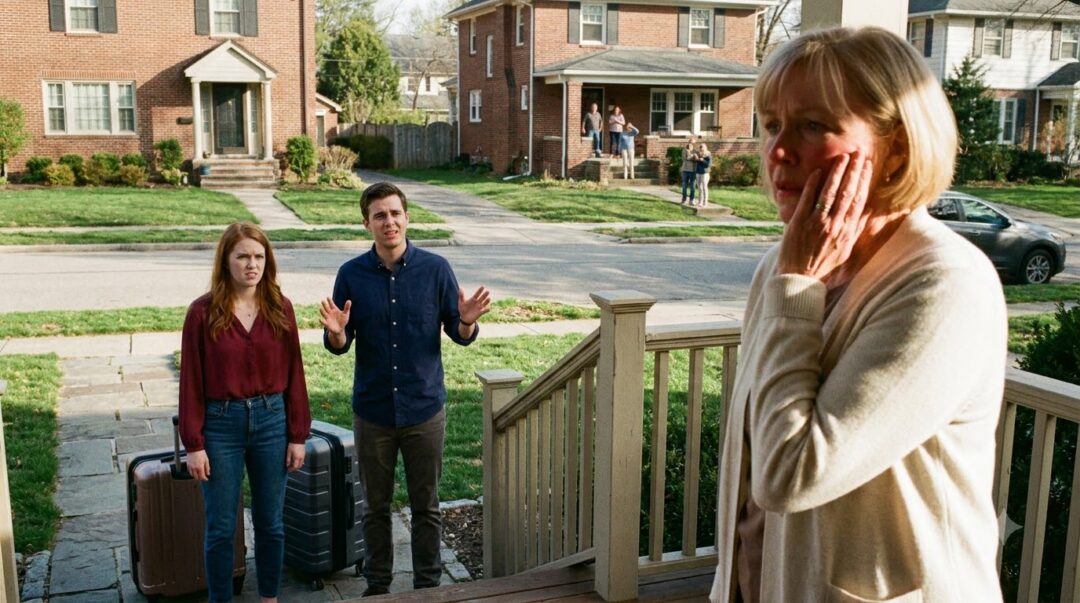
The humid midday heat of early August settled like wet wool over Parkland Drive in Shaker Heights, carrying the sharp scent of gasoline from a neighbor’s distant lawnmower and the heavy fragrance of blooming purple hydrangeas. Margaret Holloway stood on the red brick landing of her two-story colonial home, her short blonde hair neat, her cream knit cardigan buttoned to the collar despite the eighty-degree weather. Her fingers were trembling, but not from the summer heat. In her right hand, she clutched a crumpled white envelope from the Cleveland Trust & Savings Bank that she had retrieved twenty minutes earlier from the bottom of her son’s laundry basket.
Standing on the flagstone walkway two steps below her were her thirty-one-year-old son Brian and his wife of eighteen months, Cheryl. Between them sat four enormous hard-shell roller suitcases in metallic silver and rose gold, their tags stamped for an afternoon flight out of Cleveland Hopkins International Airport.
Brian wore a rumpled navy button-down shirt that showed dark circles of sweat under the armpits, his soft, indecisive face mottled with guilt. Cheryl, on the other hand, stood with her weight shifted aggressively to one hip, her maroon silk blouse clinging to her sharp collarbones, her heavy gold hoop earrings catching the harsh overhead sun. Her auburn hair was pulled into a high, severe ponytail, and her manicured fingers tapped impatiently on the telescoping handle of her luggage.
Across the street, Mrs. Henderson had paused her golden retriever’s walk along the manicured sidewalk, whispering to Mr. Gable, who held a garden hose in mid-air over his marigolds. In Shaker Heights, where families lived for three generations behind neat wrought-iron gates and polished brass door knockers, voice volumes were never supposed to rise above a conversational murmur.
“Where did you think you were going, Brian?” Margaret asked, her voice cracking with the brittle strain of an unmentionable betrayal.
“Mom, we talked about this,” Brian stammered, stepping from one foot to the other on the flagstones. “Cheryl and I found a fantastic real estate opportunity in Boca Raton. A turnkey condo management firm. We were going to surprise you once we got settled and set up the guest suite for you.”
“A surprise?” Margaret took a step down to the second brick tier, holding out the crumpled bank statement. Her gray eyes, usually warm and patient from thirty-five years of balancing municipal school budgets, burned with an icy, devastating clarity. “Arthur worked forty years in the city water department. He walked the underground tunnels in rubber boots every winter so that when he died, his pension and life insurance would guarantee that this house remained in our family. The account balance on his survivor escrow account is zero dollars, Brian. Zero.”
Cheryl stepped forward, her acrylic nails clicking sharply against the luggage handle. “Margaret, you are being completely hysterical, as usual. We invested those funds in a high-yield digital asset trust. Brian is the executor of Arthur’s estate now. He has the legal authority to allocate capital where it generates actual returns instead of letting it rot in a one-percent savings bond.”
“You forged my name on the durable power of attorney,” Margaret said, her voice dropping into a register that made Mr. Gable turn his head across the street. “I went to the branch on Shaker Square this morning. The teller showed me the signature card. You used an electronic notary stamp from your brother’s office in Lakewood. You stole six hundred and twenty thousand dollars from my husband’s grave.”
Margaret took another step down, placing her body directly between Cheryl and the walkway leading to the driveway where an idling black rideshare sedan sat waiting. “You are not taking one piece of luggage off this property until the police arrive.”
“Get out of our way, Margaret,” Cheryl snarled, her face contorting with ugly, unrestrained venom. “You’re a senile old woman who can’t even remember where she put her house keys. We have court paperwork that says Brian is your guardian!”
“Don’t you dare touch those bags,” Margaret commanded, reaching out her hand to grab the handle of the nearest suitcase.
Cheryl’s reaction was explosive and savage.
She dropped the handle, stepped into Margaret’s space, and swung her right hand in a vicious, blinding arc.
The sound of the open-palmed slap cracked across the quiet suburban street like a small-caliber gunshot. The force of the blow snapped Margaret’s head to the side, sending her stumbling back two paces against the painted white railing of the porch. Her wire-rimmed reading glasses flew from her face, clattering across the brick steps and landing in the mulch bed below.
Across the street, Mrs. Henderson gasped aloud, dropping the dog leash.
Margaret stood frozen against the porch pillar. Her face burned where Cheryl’s rings had grazed her cheekbone, a brilliant scarlet handprint rising rapidly on her fair skin. Her ears rang with the sharp metallic sting of the impact. Slowly, with hands that shook with bone-deep shock, she raised her fingers to touch her throbbing cheek.
Brian let out a choked, terrified gasp, his hands flying to his mouth as his eyes bulged. “Cheryl! Oh my God… what did you do?”
Cheryl didn’t apologize. She stood with her chest heaving, her nostrils flared, her lips pulled back in a feral sneer. “She touched our private property, Brian! Tell her to back off, or I swear to God I’ll have the medics take her straight to the psychiatric ward in an ambulance!”
Margaret lowered her hand from her cheek. The shock in her eyes died, replaced by a cold, majestic fury that turned her spine into forged iron. She stood to her full height, looking down at the two young people from the elevation of the porch.
“Get off my porch,” Margaret said, her voice quiet, steady, and carrying the crushing finality of an iron door slamming shut.
Brian scrambled up the stairs on trembling knees, reaching out his hands in pathetic, sniveling desperation. “Mom… please! Please don’t call the police! Cheryl didn’t mean it, she just panicked! Mom, if you call the police, I’ll lose my compliance license! They’ll send me to prison!”
Margaret looked down at her only son, feeling the last ember of maternal pity burn away into cold, gray ash.
She slid her hand into the pocket of her cream cardigan, pulled out her heavy brass key ring, and stepped back toward the front door.
“Then tell me where the six hundred and twenty thousand dollars went, Brian,” Margaret demanded, her voice ringing across the neighborhood like a church bell. “Because if that money isn’t back in Arthur’s account before the sun sets on Parkland Drive, you will spend the next twenty years in a federal penitentiary.”
CHAPTER 2: THE LOCKED DEADBOLT
The front door of the Parkland Drive colonial slammed shut with a heavy, concussive thud that rattled the leaded glass sidelights. Margaret threw the heavy brass deadbolt into place, slid the auxiliary security bar down its steel tracks, and leaned her back against the solid oak wood, her breath coming in ragged, shallow gasps. Her cheek throbbed with a burning, pulsing heat where Cheryl’s signet ring had sliced a half-inch scratch into the skin near her eye.
Outside, Brian’s fists began pounding desperately against the wood panels.
“Mom! Open the door! Please, Mom, let’s talk about this inside!” Brian’s muffled voice cracked with terror. “Don’t ruin my life over an investment! We can transfer the funds back! It just takes seventy-two hours for the liquidity pool to unlock!”
“Open the damn door, Margaret!” Cheryl’s voice shrieked from the porch, punctuated by the violent rattle of the brass door handle. “We know you have Arthur’s passport in the safe! Hand over the passport and the safety deposit key, or I will call adult protective services right now and show them the bruises on your arms!”
From the top of the center hall staircase, a soft whine sounded. Toby, Margaret’s ten-year-old golden retriever, trotted down the carpeted steps with his ears pinned back, his tail tucked low in distress. The old dog approached Margaret, pressing his warm, velvety muzzle directly against her trembling hands.
“I’m all right, Toby,” Margaret whispered, burying her fingers into the dog’s thick golden fur. “I’m all right, boy.”
Margaret walked swiftly down the hardwood corridor to the kitchen, where the landline telephone hung on the wall beside the pantry. She lifted the receiver, but when she pressed it to her ear, there was no dial tone—only a faint, rhythmic electronic clicking that signaled the line had been physically disconnected from the exterior junction box.
Brian and Cheryl had cut the landline before wheeling their luggage onto the porch.
Margaret’s pulse kicked into high gear. Her mind, trained over decades to spot irregularities in complex municipal balance sheets, immediately shifted from domestic heartbreak to tactical self-preservation. This was not a sudden, panicked quarrel over a bad stock tip; this was a calculated, premeditated extraction. They had severed her communications, booked international flights, and attempted to isolate her in her own home.
She opened the lower drawer of the kitchen island, pulling out her personal cell phone—a simple flip phone she kept in a leather pouch. She powered it on, but before she could dial 911, her gaze caught a manila document folder resting on the kitchen counter beneath Brian’s forgotten laptop charger.
Stenciled across the top of the folder in red ink were the words: CUYAHOGA COUNTY PROBATE COURT – EMERGENCY PETITION FOR ADULT INVOLUNTARY CONSERVATORSHIP.
Margaret opened the folder with steady fingers.
The petition, filed forty-eight hours earlier, alleged that Margaret Holloway was suffering from rapid-onset vascular dementia, severe paranoid delusions, and an inability to manage her daily affairs. Attached to the petition was a signed medical evaluation bearing the letterhead of a private Lakewood medical clinic. The report stated that Margaret had been examined on July 28th and found incapable of rational decision-making.
Margaret had never set foot in Lakewood in her life. On July 28th, she had been attending her fifty-year high school reunion in Columbus.
Beneath the medical evaluation was a court-ordered transfer directive assigning full custody of Margaret’s physical person and her real property to Brian Holloway—along with an immediate placement authorization for the Shaker Woods Memory Care Pavilion, an expensive, locked facility thirty miles south in Medina County.
“They were going to lock me away,” Margaret whispered aloud, the cold horror settling into her stomach like lead.
Outside, the heavy thumping on the front door suddenly stopped. Margaret hurried to the bay window in the formal living room, peering cautiously through the lace curtains.
Standing on the driveway beside the idling rideshare vehicle was a second car—a black unmarked Ford Crown Victoria that had pulled up to the curb with its tires partially on the lawn. A stocky, gray-haired man in a wrinkled brown leather jacket and dark slacks climbed out of the vehicle, his gold shield catching the midday sun as he pinned it to his lapel.
Detective Carl Brennan of the Cuyahoga County Financial Crimes Division did not run. He walked up the stone walkway with the deliberate, heavy-footed confidence of a former marine, his keen eyes instantly registering the four silver suitcases, Brian’s sweat-soaked shirt, and the red mark on Cheryl’s knuckles.
“Afternoon, folks,” Detective Brennan said, his deep Ohio drawl carrying easily across the lawn. “Mind telling me why two different neighbors called the emergency dispatcher reporting an assault on Arthur Holloway’s front porch?”
The quiet ticks of the grandfather clock in the foyer seemed to echo like thunder in Margaret’s ears. She remembered bringing Brian home from the hospital to this very house thirty-one years ago, carrying him through that same oak doorway in Arthur’s proud arms. Arthur had carried the mortgage on his back through the steel recessions of the nineteen-eighties, refusing to sell a single square foot of the garden. Every brick, every strip of white oak flooring had been earned with honest labor, clean tax returns, and unwavering family loyalty.
To realize that the child she had nursed and protected had conspired with an outsider to drug her tea, fabricate dementia, and steal the very roof over her head felt like having a blade twisted slowly between her ribs. She looked at her reflection in the gilded hallway mirror. The red welt across her cheek was darkening into a deep purple bruise, but beneath the pain, her eyes were clearer than they had been in six months. The artificial chemical fog that had made her doubt her own balance and arithmetic had evaporated, burned away by the cold adrenaline of truth.
She picked up Toby’s worn leather leash from the hall credenza, clipping it to his collar. “Good boy, Toby. You stay right beside me. We’re going to see this through to the very end.”
Toby gave a soft, reassuring woof, pressing his warm shoulder against her hip as she walked back toward the front parlor, ready to face whatever lay on the flagstones outside.
CHAPTER 3: THE BAGGAGE INSPECTION
The sudden appearance of a county detective holding an official badge turned Cheryl’s aggressive posture into an awkward, defensive freeze. She dropped her hands to her sides, attempting to smooth her maroon blouse, but her breathing was too fast, her chest heaving with the frantic energy of an animal trapped against a fence. Brian looked ready to faint; he leaned against the brick balustrade of the porch, his knees visibly shaking, his eyes darting toward the idling rideshare sedan thirty feet away.
“Detective,” Cheryl began, her voice pitching into an overly sweet, rehearsed cadence that dripped with condescension. “Thank heavens you’re here. There’s been a terrible misunderstanding. My mother-in-law has severe late-stage dementia. She had a violent psychotic episode when she saw us packing our bags for a weekend trip. She attacked me, and I had to physically restrain her to protect my husband. We were just about to call the county crisis team.”
Detective Brennan didn’t answer immediately. He adjusted his wire-rimmed glasses, pulled a small spiral notebook from his leather jacket, and clicked his ballpoint pen. He glanced up at the front window of the colonial, where Margaret stood framed behind the lace curtains, her face pale, her jaw set, her hand resting on the head of her golden retriever.
“Is that so, ma’am?” Brennan asked mildly, stepping closer to the luggage on the walkway. “Because Mrs. Henderson across the street gave a very specific description of an open-palmed strike delivered by a red-haired female against an older woman standing on the top step. She said the older woman flew backward into the railing.”
“Mrs. Henderson is eighty years old and practically blind!” Cheryl snapped, her veneer of charm cracking instantly.
“Mrs. Henderson was the head of radiology at the Cleveland Clinic for twenty-five years,” Brennan replied without looking up from his notes. “Her eyesight is certified twenty-twenty with corrective lenses. Now, whose luggage is this?”
“It’s ours,” Brian stammered, stepping down onto the flagstones. “We’re just going to Miami for a long weekend, Detective. A little vacation. We have our boarding passes right here on my phone.”
“Funny thing about weekend trips to Miami,” Brennan said, tapping the toe of his boot against the heavy silver suitcase. “Most folks don’t pack two hard-shell cases apiece for three days in Florida. And they usually don’t have four hundred thousand dollars in certified cashier’s checks drawn against a municipal school district pension fund tucked into the lining.”
Brian let out a sharp, choked noise, stumbling backward until his back hit the porch pillar. “How… how do you know about the checks?”
“Because your mother isn’t the only one who checks bank activity in Cuyahoga County, Brian,” Brennan said, his tone sharpening into pure steel. “Two hours ago, the automated anti-money-laundering clearinghouse in Columbus flagged three sequential cashier’s checks totaling six hundred and twenty thousand dollars, issued by the Shaker Square branch of Cleveland Trust. All three checks were made out to an offshore shell entity called Blue Horizon Wealth Management, registered to a post office box in Grand Cayman.”
Brennan took two steps forward, positioning his broad frame directly between the couple and the driveway. “The authorized signature on those checks was Arthur Holloway—who has been resting in Lake View Cemetery for fourteen months. Now, unless your father has figured out a way to sign bank drafts from six feet under the sod, somebody in this driveway just committed federal bank fraud.”
Cheryl lunged toward the nearest rose-gold suitcase, grabbing the handle with both hands. “You don’t have a search warrant, Brennan! You can’t touch our bags on private property!”
“I don’t need a warrant to search luggage in an active domestic assault investigation, Miss Davenport,” Brennan said, his voice dropping into an authoritative command that made the rideshare driver in the street immediately put his car in drive and speed away down Parkland Drive.
Margaret turned the deadbolt from the inside, pushed the heavy oak door open, and stepped out onto the porch into the full glare of the August sun. She had replaced her broken glasses with a spare pair from her desk, and in her hands, she carried the red manila conservatorship folder.
“Detective Brennan,” Margaret called out, her voice clear, resonant, and steady. “Before you search those bags, you might want to look at this.”
She walked down the brick steps, completely ignoring her cowering son, and handed the folder to the detective. “They filed an emergency conservatorship petition forty-eight hours ago to have me committed to a memory care home in Medina County. The medical report is signed by Dr. Gregory Davenport—Cheryl’s brother.”
Brennan opened the folder, his eyes scanning the forged medical affidavit. A slow, dangerous smile touched the corners of his mouth. “Gregory Davenport lost his state medical license two years ago for prescribing controlled narcotics to underage patients. He couldn’t legally certify a case of the common cold, let alone a neurological diagnosis.”
Cheryl backed toward the sidewalk, her eyes wild with panic. “Brian, you idiot! Run!”
The summer heat on Parkland Drive was oppressive, but Detective Brennan’s voice was like an arctic front blowing off Lake Erie. He stepped closer to Brian, his stocky frame casting a long shadow across the flagstones that swallowed the young man whole. Over the years, Brennan had investigated corporate embezzlement, dirty contractors, and fraudulent medical clinics, but nothing turned his stomach quite like an adult child picking the bones of an elderly parent who had given them everything.
Across the street, Mrs. Henderson had been joined by three other neighbors from Parkland Drive—Dr. Evans, a retired pediatrician, and the Miller sisters from the corner brick Tudor. They stood quietly along the curb, their expressions turning from curious embarrassment to open outrage as they recognized the silver suitcases and heard the figures being called out. In a community where families knew each other’s children from Little League and high school orchestra concerts, the public unmasking of Brian Holloway was a seismic shock that would reverberate through Shaker Heights for decades.
Brian wiped the sweat from his eyes with his trembling forearm, looking like a cornered animal searching for an escape that didn’t exist. “Carl… Detective Brennan… please. We can resolve this without making a scene. My father was your friend! You two were in the Kiwanis Club together! You played golf at Highland Park every spring!”
“Arthur Holloway was an honest man, Brian,” Brennan said, his voice flat, icy, and unforgiving. “He served his community with honor, and he never stole a dime in his life. The fact that you dare invoke his name while standing over four hundred thousand dollars of his stolen pension checks makes me sick to my stomach.”
CHAPTER 4: THE HALOPERIDOL VIAL
Cheryl turned to bolt down Parkland Drive toward Shaker Square, but Detective Brennan moved with the surprising speed of a trained athlete. He closed the distance in three strides, caught Cheryl by the shoulder of her maroon silk blouse, and spun her around against the hood of his Crown Victoria. The impact rattled the metal panels as Brennan brought her right arm behind her back with a textbook compliance hold.
“Cheryl Holloway, you are under arrest for aggravated assault, domestic battery, and felony document forgery,” Brennan barked, snapping a set of stainless-steel handcuffs around her wrists.
“Get off me! Brian, help me!” Cheryl shrieked, thrashing against the hot hood of the patrol vehicle, her gold hoop earrings swinging wildly as her makeup smeared against the dusty paint. “Call my father! Call the governor’s office! You don’t know who you’re dealing with!”
Brian did not move. He stood frozen on the lawn, his arms hanging limply at his sides, staring at the handcuffs on his wife’s wrists with the numb, hollow gaze of a condemned man.
Two additional marked Shaker Heights police cruisers screeched to a halt along the curb, their sirens giving short, sharp yelps as three uniformed officers stepped onto the grass, their hands resting on their duty belts.
“Officer Kowalski,” Brennan instructed one of the arriving patrolmen. “Secure the male subject. Place him in the second car.”
As the officer approached Brian with handcuffs drawn, Brian broke down entirely, dropping to his knees on Margaret’s lawn and burying his face in the green fescue grass. “Mom… I’m sorry! I’m so sorry! Cheryl said we would pay it back! She told me if we didn’t invest in the offshore fund, her family’s creditors would take everything! She made me sign Dad’s name!”
Margaret stood on the lower walkway, her cream cardigan wrapped tightly around her frame, watching her son being cuffed on the lawn where he had learned to throw a baseball twenty years ago. The pain in her chest was suffocating, a heavy physical ache that made every breath burn, but her voice remained steady, clear, and uncompromising.
“Nobody made you do anything, Brian,” Margaret said softly. “You chose this. You looked at your father’s hard work, you looked at your mother’s home, and you decided our lives were expendable so you could buy a condo in Florida.”
Detective Brennan knelt on the walkway beside the rose-gold suitcase Cheryl had been guarding so fiercely. Using a small tactical blade from his pocket, he cut the nylon travel lock on the zipper and pulled the case open.
Inside, resting on top of expensive designer dresses and Italian leather shoes, was a black nylon toiletry organizer. Brennan unzipped the center pouch.
He pulled out two sealed manila envelopes containing the cashier’s checks totaling four hundred and twenty thousand dollars, drawn on Cleveland Trust. But resting beneath the checks, wrapped in bubble wrap, was a five-hundred-milliliter amber glass medical bottle with an official pharmaceutical prescription label.
Brennan held the bottle up to the midday sunlight, reading the label aloud with rising disgust: “HALOPERIDOL ORAL CONCENTRATE – 2 MG/ML – DISPENSE ONLY BY SPECIALIST PROTOCOL.”
Margaret’s breath caught in her throat. She stepped closer, her hand flying to her throat as the puzzle pieces of the last six weeks snapped together with terrifying clarity.
“Haloperidol…” Margaret whispered, her voice trembling with cold horror. “That’s an antipsychotic sedative. Used for severe psychiatric agitation.”
“Look at the dosage instructions, Margaret,” Brennan said, turning the bottle so she could see the handwritten notes on the side. “Administer five drops twice daily in warm liquid. Margaret… have you been having memory lapses lately? Dizziness? Confusion in the mornings?”
Margaret felt the ground tilt beneath her sandals. “Every evening… Cheryl insisted on making me a cup of chamomile tea before bed. She said it would help me sleep after Arthur passed. Every morning for the last month, I woke up feeling groggy, disoriented… I forgot where I left my checkbook. I forgot what day of the week it was. Brian told me I was losing my memory. He told me Dad had the same symptoms before his stroke.”
Brennan looked at Brian, who was weeping uncontrollably on the grass, his forehead pressed into the dirt. “You were drugging your own mother,” Brennan snarled, his voice vibrating with absolute disgust. “You and this sociopath were poisoning her tea with high-dose neuroleptics to create synthetic dementia symptoms so the probate court would rubber-stamp your conservatorship petition without an independent examination.”
Cheryl lifted her head from the hood of the car, her face twisted in a sneer of pure, unadulterated hatred. “She was an obstacle, Brennan! An old woman sitting on half a million dollars that she was never going to spend! We were going to give her a private room in Medina! She would have had nurses! She would have had a garden!”
“You’re going to have a private room too, Cheryl,” Brennan replied coldly, signaling the officers to load her into the cruiser. “In the Marysville Women’s Correctional Institution. And you’ll have twenty-five years to think about what kind of garden you like.”
CHAPTER 5: THE TITANIUM LEDGER
The afternoon sun began to slant through the mature oak trees of Parkland Drive, casting long, dark shadows across the manicured lawns. A Cuyahoga County emergency medical unit had arrived, its rear doors open on the street as two paramedics conducted a comprehensive neurological and toxicology evaluation on Margaret. They drew blood samples to verify the haloperidol levels and administered an intravenous saline drip to flush the lingering sedatives from her system.
Margaret sat on the tailgate of the ambulance, wrapped in a light cotton blanket, sipping a bottle of cold spring water. Beside her on the grass, Toby the golden retriever sat vigilantly, his head resting against her knee, his tail giving a gentle thump whenever she stroked his golden ears.
Detective Brennan walked over from the driveway, carrying a heavy digital evidence bag containing Brian’s confiscated laptop, three smartphones, and a small, matte-gray titanium cylinder no larger than an automotive spark plug.
“The paramedics say your vitals are stabilizing, Margaret,” Brennan said, offering a rare, gentle smile. “Your liver and kidneys are healthy. In seventy-two hours, the neuroleptic trace will be completely cleared from your system.”
“Thank you, Carl,” Margaret said softly, looking at the gray cylinder in his hand. “What is that?”
“This is the rest of your money,” Brennan explained, holding up the titanium drive. “Cheryl wasn’t just using cashier’s checks. She transferred the first two hundred thousand dollars of Arthur’s pension into a cold-storage cryptocurrency hardware wallet—a Ledger Nano X. When the patrol car pulled up, she tried to drop this drive into the storm drain beside the driveway. Officer Kowalski saw the drop and recovered it from the gutter.”
Margaret looked down at the small piece of metal. “Is the money still there?”
“The county cyber-crimes unit in Cleveland accessed the public blockchain ledger twenty minutes ago,” Brennan replied. “Because she hadn’t reached Miami to broadcast the transfer to the Cyprus exchange, the funds are currently locked in a multisig escrow address on the Ethereum network. We have seized the recovery seed phrase from the back of Cheryl’s planner. By tomorrow morning, the federal magistrate will issue a restitution freeze, and every single penny will be returned to Arthur’s estate account.”
Margaret let out a long, shuddering breath that seemed to lift a crushing weight from her chest. For six weeks, she had lived in a terrifying fog of manufactured confusion, doubting her own sanity, wondering if her mind was truly failing her as her late husband’s had in his final weeks. To know that her mind was sound, that her memories were real, and that Arthur’s legacy was safe brought tears of profound relief to her eyes.
Across the lawn, Brian was being led out of the second cruiser by two deputies to sign the evidence property release forms. His face was blotchy and swollen from crying, his navy shirt stained with dirt and grass. When he saw Margaret sitting on the ambulance tailgate, he stopped, trying to step toward her with handcuffed hands outstretched.
“Mom…” Brian choked out, his voice cracking with miserable supplication. “Mom, please… talk to the prosecutor. Tell them it was all Cheryl! Tell them I was under duress! If I get a felony conviction, my career is finished! I’ll never be able to work in finance again!”
Margaret looked at her son. She did not look at him with hatred, nor with anger; she looked at him with the quiet, devastating clarity of a mother who had finally seen the truth of what she had raised.
“You worried about your career, Brian,” Margaret said, her voice carrying clearly across the quiet street. “You didn’t worry about my heart when you let that woman strike me on my own porch. You didn’t worry about my life when you watched her pour poison into my tea every night. You didn’t worry about your father’s memory when you forged his name on a document that would have locked me in a cage.”
“Mom, I was weak!” Brian sobbed.
“Being weak is not a defense against cruelty, Brian,” Margaret said, each word falling like an iron gavel. “You made your bed with a thief. Now you will sleep in the cell she built for you.”
Brian bowed his head, his shoulders shaking with silent sobs as the deputies guided him into the rear cage of the patrol car. The door slammed shut with a heavy, mechanical finality.
Detective Brennan rested a comforting hand on Margaret’s shoulder. “The county prosecutor has already confirmed that Cheryl’s brother Gregory was arrested thirty minutes ago at his clinic in Lakewood. The entire ring is in custody, Margaret. You are safe.”
Margaret looked up at the warm afternoon sky, where the breeze was rustling the green oak leaves overhead. “Thank you, Carl. Thank you for answering the call.”
The afternoon breeze off the lake brought a temporary reprieve from the stifling heat, rustling the high canopy of oak and maple trees that lined Parkland Drive. Margaret watched the paramedics pack their equipment, feeling the cool saline drip finally wash away the persistent metallic taste of the haloperidol that had lingered in her mouth for weeks. The physical relief was immediate, but the emotional clarity was even more profound; her mind felt sharp, agile, and completely restored.
Officer Kowalski returned from the side yard, holding a clear evidence bag containing Cheryl’s personal leather handbag, which she had attempted to shove beneath the cedar hedge when the first siren sounded. Brennan unzipped the bag on the hood of his cruiser, revealing three additional driver’s licenses bearing Cheryl’s photograph but different names, along with an encrypted key generator card from an offshore bank in the Bahamas.
“Cheryl wasn’t just working on your family, Margaret,” Brennan said, examining the forged IDs with grim professional admiration. “She ran this exact play in Pittsburgh three years ago against an elderly retired steel executive. She marries the insecure son, isolates the surviving parent, fabricates cognitive decline, and drains the estate into digital assets before anyone can file for an audit. She’s an absolute professional predator.”
Margaret looked down at the forged documents, shaking her head slowly. “And Brian was her ticket through the front door.”
“Brian was the useful fool who signed the paperwork,” Brennan agreed. “Without his signature as the surviving son, the probate court never would have accepted the petition. He traded his own mother’s freedom for a fantasy of easy wealth.”
Margaret reached out, touching the cold metal of Arthur’s titanium memory drive. “Arthur always said that an easy dollar is the most expensive thing a man can ever buy. Brian never listened to his father. But he’s going to learn the lesson now.”
CHAPTER 6: THE PROBATE RECKONING
Forty-eight hours later, the marble corridors of the Cuyahoga County Probate Court in downtown Cleveland were bathed in the cool light of an overcast Thursday morning. Margaret Holloway walked through the heavy bronze doors of Courtroom 4B, accompanied by Detective Brennan and her longtime family attorney, David Albright. She wore her best navy wool blazer, a crisp white silk blouse, and the gold pearl necklace Arthur had given her for their thirtieth wedding anniversary. Her step was firm, her head held high, the faint scratch on her cheekbone already healing under the summer air.
Seated at the defense table, wearing orange county detention jumpsuits and wrist shackles linked to their waist chains, were Cheryl and Brian Holloway. Cheryl sat with her jaw clenched, her red hair unwashed, staring down at the wooden table with sullen, bitter hostility. Brian looked broken, his eyes red-rimmed and hollow, unable to lift his gaze to meet his mother’s eyes.
Presiding from the elevated bench was Judge Evelyn Montgomery, a veteran magistrate known for her zero-tolerance policy regarding elder financial exploitation.
Judge Montgomery adjusted her reading spectacles, surveying the thick stack of financial audits, medical reports, and video evidence resting on her mahogany desk.
“In thirty-two years on this bench,” Judge Montgomery began, her voice ringing through the vaulted courtroom with judicial severity, “I have rarely witnessed a case of familial betrayal as calculated, cruel, and morally bankrupt as the one before me today.”
The judge looked down at the defense table, her gaze pinning Cheryl like a specimen under glass.
“The evidence presented by Detective Brennan and the county prosecutor proves beyond a shadow of a doubt that the defendants engaged in a premeditated conspiracy to defraud Margaret Holloway of six hundred and twenty thousand dollars in municipal pension assets. More egregiously, the defendants actively administered prescription neuroleptic sedatives to the victim over a period of six weeks to fabricate clinical symptoms of severe cognitive impairment in order to deceive this court into issuing an involuntary conservatorship order.”
Judge Montgomery tapped her gavel once with sharp, decisive authority.
“The emergency petition for conservatorship is hereby dismissed with prejudice. The durable power of attorney executed under the name of Arthur Holloway is declared void ab initio as a criminal forgery. The court hereby orders the immediate return of all four hundred and twenty thousand dollars in cashier’s checks, along with the two hundred thousand dollars in cryptocurrency assets recovered by county detectives, to the sole and exclusive control of Margaret Holloway.”
The courtroom erupted into quiet murmurs of approval among the spectators, which included several members of the Shaker Heights School Board and Margaret’s former colleagues from the district administration.
Judge Montgomery turned her stern gaze toward the prosecutor. “Regarding the criminal charges: Cheryl Holloway is remanded to the Cuyahoga County Jail without bond on counts of aggravated assault, grand theft, domestic battery, and felony identity fraud. Brian Holloway’s bond is set at five hundred thousand dollars cash, with immediate surrender of his passport.”
As the bailiffs stepped forward to escort the handcuffed defendants toward the holding cells, Brian suddenly turned, his voice breaking in a desperate cry across the courtroom. “Mom! Please! Don’t leave me in here!”
Margaret stood beside her attorney. She looked at her son for a long, quiet moment, feeling the final traces of lingering grief transform into peace. She did not speak. She gave him a slow, dignified nod of farewell, turned her back, and walked down the center aisle toward the open bronze doors, stepping into the sunlit marble rotunda as a free, vindicated woman.
The courtroom was utterly silent as Judge Montgomery finished reading the formal findings into the official county record. The afternoon light filtered through the arched stained-glass windows of the historic courthouse, casting warm amber squares across the polished walnut benches. Margaret sat with her hands folded calmly in her lap, feeling an immense, unshakeable dignity that no amount of familial cruelty could diminish.
Her family attorney, David Albright, leaned over and whispered: “The state banking division has already processed the emergency restitution order, Margaret. The funds are being wired directly into the probate escrow account at Cleveland Trust. By tomorrow noon, every single cent of Arthur’s pension will be safely back in your name.”
Across the aisle, Brian sat with his face buried in his handcuffed hands, his shoulders hitching in silent, broken sobs. Cheryl was staring at the marble floor with cold, unrepentant hatred, her knuckles white where the steel shackles bit into her wrists. When the bailiffs instructed them to rise for transport to the county jail, Cheryl turned her head and hissed at Margaret: “You think you won, you old bitch? You’re going to die alone in that brick mausoleum!”
Judge Montgomery’s gavel struck the sound block like a rifle shot. “Bailiff, remove that defendant immediately! Add thirty days for direct criminal contempt of court!”
The heavy mahogany doors swung open as Cheryl was dragged away into the holding cells, her curses echoing down the marble hallway until the sound was swallowed by the thick oak doors.
Margaret stood up slowly, smoothing the fabric of her navy blazer. She looked at the empty defense table, took a deep, clean breath of the courtroom air, and turned to Detective Brennan with a calm, serene smile. “Let’s go home, Carl. Toby is waiting for his dinner.”
CHAPTER 7: TEA ON PARKLAND DRIVE
Three weeks later, the late-summer sun washed over Parkland Drive in warm, golden splendor, turning the manicured lawns of Shaker Heights into an emerald carpet. The air was clean, sweet, and scented with ripening apples from the backyard orchard and the rich, comforting fragrance of freshly baked cinnamon scones cooling on the kitchen counter.
On the front porch of the brick colonial, the flagstone steps had been thoroughly washed clean, the painted white railings gleamed under a fresh coat of enamel, and the flowerboxes overflowed with brilliant scarlet geraniums and white petunias.
Margaret Holloway sat in her white wicker armchair on the porch, wearing a soft lavender linen dress and her favorite silver cardigan, sipping a fresh cup of Earl Grey tea from Arthur’s favorite porcelain mug. Her skin was clear, her eyes bright and sharp, her mind completely unburdened by the dark chemical fog that had shadowed her summer. Resting his head peacefully across her leather shoes was Toby, snoring softly in the afternoon warmth, his golden tail thumping with lazy contentment whenever a gentle breeze stirred the wind chimes.
Walking up the stone walkway was Detective Carl Brennan, dressed in a comfortable polo shirt and khakis, carrying a baker’s box tied with red string.
“Afternoon, Margaret,” Brennan called out with a warm smile, stepping onto the porch and setting the box on the wicker table. “Fresh peach pastries from the West Side Market. Thought they might go well with your afternoon tea.”
“Carl, you spoil me,” Margaret said, her face lighting up with genuine warmth as she poured him a cup of tea from a vintage silver teapot. “Sit down. Toby was just asking about you.”
Brennan chuckled, scratching the old dog behind the ears as he took the adjacent wicker chair. “How are the bank accounts looking, Margaret?”
“Every single dollar was restored yesterday,” Margaret replied, taking a slow sip of tea. “The probate court finalized the estate transfer. Arthur’s pension is secure, the house title is unencumbered, and I established an educational scholarship in Arthur’s name for vocational students at the high school. He would have loved knowing his sweat is helping working kids build honest lives.”
“And your son?” Brennan asked gently.
Margaret looked out across the quiet street, where Mr. Gable was waving cheerfully from his front lawn and Mrs. Henderson was walking her golden retriever in the sunshine. Her heart carried a quiet, tender scar, but it was a scar that had healed clean in the light of truth.
“Brian accepted a plea agreement this morning,” Margaret said softly. “Three years at the Grafton Correctional Camp, followed by five years of mandatory restitution. His attorney asked if I would visit him.”
“Will you?”
“In time, Carl,” Margaret said, her gray eyes steady and full of grace. “When he has finished serving his sentence, and when he understands what it truly means to be Arthur Holloway’s son. A mother’s love never dies, but it must be rooted in truth, or it becomes poison.”
She looked out over her front lawn, feeling the warm summer sun on her face. The door behind her was open, the windows let in the clean Ohio breeze, and her home was filled with light once more. She raised her porcelain cup in a silent, joyful toast to the memory of the man who had built this sanctuary, confident that the truth, like the deep roots of the oak trees on Parkland Drive, would stand strong through every season yet to come.
The golden evening light began to stretch across Parkland Drive, turning the brick facades of Shaker Heights into warm shades of rose and terracotta. Margaret walked down the flagstone steps to the edge of her lawn, where Toby was happily investigating a patch of clover while Mr. Gable walked across the street carrying a basket of fresh heirloom tomatoes from his garden.
“Evening, Margaret,” Mr. Gable said, his voice warm and neighborly as he handed her the basket. “Sarah and I thought you might enjoy some beefsteaks for your dinner. We’re having the neighborhood block party next Saturday, and the committee insists that your lemon drizzle cake has to be the centerpiece.”
“Thank you, Thomas,” Margaret smiled, accepting the basket with genuine pleasure. “I would be honored to bake the cake. In fact, I think I’ll make two.”
After Mr. Gable returned across the street, Margaret stood on her front lawn for a long moment, looking up at the stately brick colonial that Arthur had built with his own hands. The house looked magnificent in the evening sun, its windows glowing with warm light, its foundation rooted deep into the rich Ohio soil. The pain of the past months had not broken her; it had tested her strength, proved her resilience, and revealed the deep reservoir of courage she had inherited from generations of proud, hardworking people.
She walked back up the brick steps, pausing at the threshold to scratch Toby behind his golden ears. “Come on inside, boy. Let’s get your dinner ready.”
As she stepped through the door, leaving the lock unlatched to let the clean evening breeze sweep through the open foyer, Margaret knew that her life was whole once more. The dark chapter was finished, the truth had triumphed, and her home was filled with peace, dignity, and light.