The Silent Retired Sniper Who Pierced Her Arrogant Pride
CHAPTER 1: THE SCORE SHEET IN THE COLD FOG
The low-hanging November fog rolled off the limestone bluffs of the Blue Ridge Mountains, pooling across the thousand-yard military firing range of Fort Kessler like cold, grey cotton. It was eight o’clock in the morning, and the air was bite-cold, smelling of damp red oak leaves, crushed wet gravel, and the sharp, sulfurous bite of freshly burned cordite. Along the firing line, ten heavy timber shooting benches sat spaced ten feet apart, facing south across a cleared mountain draw where orange wind flags hung limp and lifeless on steel poles. At three hundred, four hundred, five hundred, and six hundred meters downrange, round steel silhouette gongs hung from heavy iron chains, their faces scarred by thousands of jacketed hollow-point impacts.
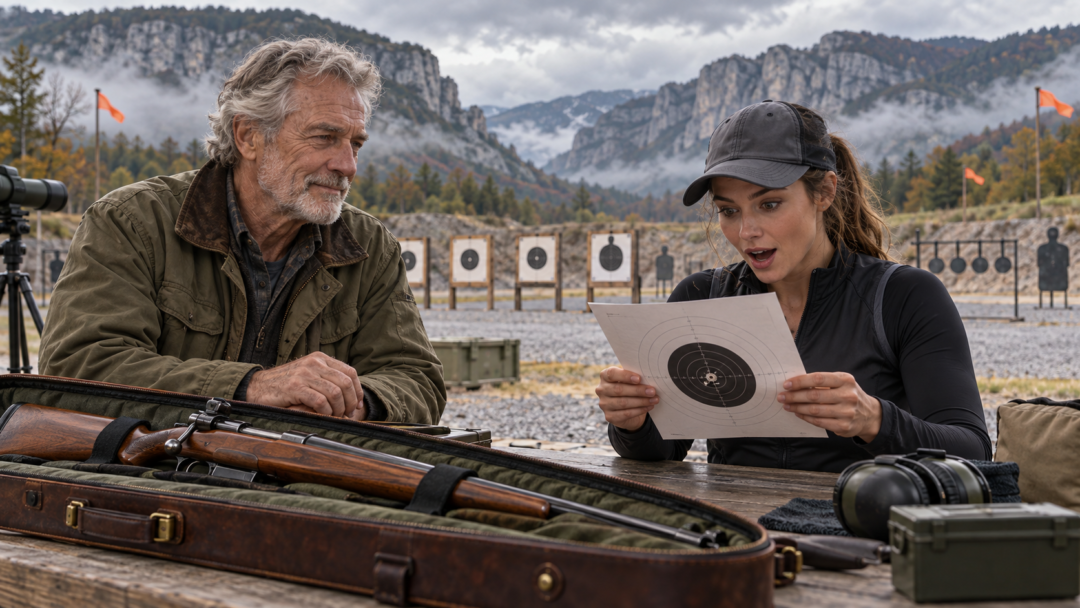
Standing behind bench number four was Lieutenant Sera Voss. She was thirty-two years old, the reigning base marksmanship champion, and the favored daughter of retired three-star General Marcus Voss. Sera wore immaculate, form-fitting tactical field gear, the subdued green fabric crisp and uncreased, with high-end shooting earmuffs resting around her slender neck. Her face was sharp, aristocratic, and fiercely intense, dominated by pale green eyes that demanded perfection from everyone around her. In her right hand, she clutched an official paper score card displaying a tight, three-inch cluster of ten bullet holes fired from five hundred yards—a grouping that had just secured her third consecutive post marksmanship trophy.
Three junior officers and two enlisted sergeants stood behind her in the gravel, clapping with polite deference.
Standing twenty feet to her right, leaning quietly against the weathered timber rail of the spectator shelter, was Elias Kade.
Kade was seventy years old, tall and spare, with broad shoulders that had settled into a slight, stoic slouch. He wore an old, faded olive drab M-65 field jacket with frayed cuffs and no rank insignia, worn denim trousers tucked into scuffed leather work boots, and a wool watch cap pulled down over hair the color of frosted iron. His face was deeply lined, etched by decades of desert sun, arctic wind, and mountain blizzards. Beneath bushy silver brows, his grey eyes were clear, steady, and utterly still, taking in the limestone ridges with an unhurried, ancient calm.
As Kade stepped out from the shelter toward the open firing line, his right hand trembled slightly—an involuntary, minor tremor that had troubled his fingers ever since an artillery concussive shockwave in the Balkan mountains twenty-five years earlier.
Sera Voss turned, her pale eyes tracking the old man’s slow, measured footsteps over the gravel. A smirk touched the corner of her thin lips—a smile sharp with condescension and the easy cruelty of youthful arrogance.
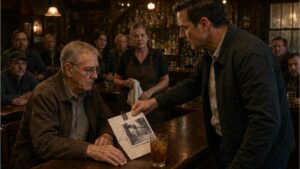
“Muster ended thirty minutes ago, Mr. Kade,” Sera said, her voice cutting through the damp mountain chill with crisp, dismissive efficiency. She waved her pristine score sheet directly in his face, the white paper fluttering inches from his nose. “This line is reserved for active competitive personnel preparing for the inter-service qualifiers. You’re cluttering up lane four.”
Elias Kade stopped. He did not look at the paper. He did not look at her rank insignia. His gaze dropped to the rifle resting on the bench—a standard Army M24 Sniper Weapon System, bolt-action, chambered in 7.62x51mm NATO, fitted with a ten-power fixed Leupold telescopic sight.
“I received an invitation from the garrison commander, Lieutenant,” Kade replied softly. His voice was low, gravelly, and quiet as dry leaves brushing over rock. “The annual heritage exhibition. He asked for an old marksman to inspect the line.”
Sera let out a short, mocking laugh that echoed off the damp timber walls of the shelter.
“An exhibition?” She gestured pointedly at his right hand, where the faint tremor was visible against his jacket seam. “With all due respect to the museum generation, Mr. Kade, marksmanship isn’t storytelling around a campfire. Look at your fingers. Look at your eyes. Your eyes are older than my father’s, and your hands are shaking like dry leaves in a gust. You couldn’t hold a steady sight picture on a barn door at two hundred yards. Pick up your coat and head up to the officers’ club for coffee before you embarrass yourself in front of active soldiers.”
The two enlisted sergeants shifted uncomfortably in the gravel, exchanging nervous glances. Range Master Clint Hall, a grizzled fifty-two-year-old master sergeant with twenty-eight years on the range, stepped forward from the control shed, his jaw tight.
“Lieutenant,” Hall said quietly. “Mr. Kade has full range clearance signed by Colonel Vance—”
“I don’t care who signed his guest pass, Master Sergeant,” Sera snapped, her voice rising with icy irritation. “I run this firing line today, and I won’t have range safety compromised by a pensioner whose reflexes retired before I graduated middle school. Pack your kit, Mr. Kade. Step off the line.”
Elias Kade did not argue. He did not raise his voice or show anger.
Instead, his weathered hand reached slowly into the deep inner pocket of his faded field jacket. When his hand emerged, his calloused thumb was rubbing the smooth, worn surface of an antique military dog tag made of tarnished silver. The metal gleamed faintly in the misty morning light.
He looked directly into Sera Voss’s pale green eyes with a gaze so heavy, piercing, and ancient that the breath hitched in her throat.
“Tell your father,” Kade said, his voice dropping to a calm, icy murmur that sent a shiver through the junior officers, “that Elias Kade came to collect the debt he owed twenty-five years ago on Hill 840.”
CHAPTER 2: FOUR BULLETS IN THE DEAD CENTER
Lieutenant Sera Voss’s eyes narrowed into slits of cold fury. Hill 840 was a name she had heard whispered only once in her life—an obscure, classified skirmish in the snowy ridges of the southern Balkans during the late nineties, a file that her father, retired General Marcus Voss, had always forbidden anyone in the family from discussing. Hearing this ragged old man utter the coordinates in front of her subordinates felt like an electric shock to her spine.
“Hill 840 is closed classified history, old man,” Sera hissed, stepping into his personal space, her knuckles white around her clipboard. “Don’t come to my range trying to play cryptic parlor games. If you think you’re still a sniper, prove it. Right now. Take the M24. Four targets: three hundred, four hundred, five hundred, and the six-hundred-meter silhouette tucked behind the limestone outcrop. Four shots. If you drop a single point off dead center, you hand over that guest pass, clear off this installation, and never show your face at Fort Kessler again.”
“Lieutenant,” Master Sergeant Hall warned, stepping between them. “The crosswind through the draw is shifting every thirty seconds. There’s a cold inversion layer rising off the creek—”
“Quiet, Master Sergeant,” Sera commanded, her chin tilted high. “Mr. Kade claims he’s here on official heritage business. Let’s see what the heritage is worth.”
Elias Kade did not utter a word.
He turned slowly and walked to bench number four. He did not touch the electronic weather meter resting on the timber table. He did not look at the laser rangefinder or the digital ballistic calculator that Sera had used to adjust her elevation dials. He looked only at the distant hillside, watching the subtle sway of the tall wild fescue grass near the target berm, feeling the cold, damp pressure of the mountain air against his weathered cheek.
He reached down to the wooden bench.
The moment Kade’s fingers closed around the cold steel receiver and textured composite stock of the M24, something miraculous occurred. The visible tremor in his right hand vanished completely, as if his muscles had instantly remembered fifty years of muscle memory. His hands became as still, rigid, and immovable as the granite cliffs rising above the range.
Kade bypassed the shooting bench. He walked five paces forward to the open gravel, lowered his tall frame with practiced, deliberate grace, and assumed a classic prone shooting position.
His body melted into the earth. His chest rested flat against the shooting mat, his elbows formed a rock-solid tripod against the gravel, and his cheek welded to the cheekpiece with absolute, mechanical symmetry. His breathing slowed until his chest barely moved.
He slid the heavy steel bolt forward, chambering a match-grade 175-grain cartridge with a clean, hydraulic snick.
Downrange, the six-hundred-meter gong was a mere speck of grey metal against the wet limestone bluffs, partially masked by the swirling morning mist.
Sera stood behind him with her spotting scope pressed to her eye, her lips pressed in an eager, arrogant sneer, waiting for the inevitable miss that would validate her authority.
Kade took one slow, deep breath, expanding his lungs, and let half of it out.
In the natural respiratory pause between heartbeats, his index finger met the smooth curve of the trigger.
CRACK.
The sharp, high-velocity report of the 7.62 round cracked through the valley, echoing off the distant cliffs like lightning.
One second later, through the spotting scope, Sera saw the three-hundred-meter steel gong rock violently on its chains. A clean, round grey mark blossomed exactly in the dead center of the painted white silhouette—splitting the exact millimeter mark of the crosshair.
Before the echo died, Kade cycled the bolt with lightning efficiency: clack-snick.
CRACK.
The four-hundred-meter moving target silhouette, swaying in the rising wind, was struck dead through the heart. The heavy iron plate spun backward with a resounding metallic clang that rang like a church bell across the valley.
Clack-snick.
CRACK.
Five hundred meters. The small twelve-inch circular gong tucked beneath an overhanging pine branch shattered the painted red center ring into flying white flakes.
Clack-snick.
Now Kade paused. The crosswind in the draw suddenly gusted, snapping the distant wind flags out straight to the left for three seconds before dying into a swirling thermal draft. Most marksmen would have frantically dialed their windage turrets.
Kade did not touch the dials. He merely adjusted his point of aim by two fractions of an inch, his eye unblinking behind the glass, feeling the density of the air through the skin of his face.
CRACK.
The six-hundred-meter target—obscured behind the limestone outcrop, visible only as an eight-inch silhouette edge in the swirling mist—took the bullet straight through the center plate. The heavy steel plate swung ninety degrees on its forged eyebolt with a deep, concussive TONG that vibrated through the limestone floor beneath their boots.
Four shots. Four dead centers. Elapsed time: eleven seconds.
A suffocating, stunned silence descended upon the firing range.
The two junior officers stood with their mouths hanging open. Master Sergeant Hall let out a slow, reverent whistle through his teeth, shaking his head in sheer disbelief.
Sera Voss lowered her spotting scope. Her hands were shaking so violently that the aluminum tripod rattled against the bench. Her face was drained of all color, her pale green eyes wide with a mixture of terror and awe. She had spent ten years mastering digital ballistics, wind formulas, and laser telemetry, yet she had just witnessed an old man with shaking hands outperform her entire military career in eleven seconds with cold iron.
Elias Kade rose from the gravel with smooth, unhurried dignity. He opened the rifle bolt, caught the smoking spent brass casing in his palm, and placed the weapon neatly across the wooden rack.
He walked past Sera, stopping three inches from where she stood frozen.
He looked down into her pale, trembling face with eyes that held no malice, no triumph, and no cruelty—only the profound, tragic weight of forty years of war.
“You shoot with your father’s ego, Lieutenant,” Kade murmured softly, his voice cutting into her heart like a scalpel. “Your uncle shot with his heart.”
CHAPTER 3: THE GHOST BEHIND THE FIRING LANE
The name hit Sera Voss like a physical blow.
“My uncle?” Sera gasped, her voice trembling as the score sheet slipped from her numb fingers, fluttering across the wet gravel into the muddy grass. “My uncle died in a civilian training helicopter accident in Texas when I was four years old. That’s what my father told the entire family.”
Elias Kade did not answer. He turned his back, pulled his wool cap down against the rising wind, and walked away down the gravel access road toward the base gate, his long, weathered strides swallowing the distance until his faded field jacket disappeared into the thick mountain fog.
For the rest of the day, the thousand-yard range was dead.
Sera canceled the remaining competitive heats, locked the armory, and dismissed the cadre. Her mind was in a violent, chaotic tailspin. For three decades, her entire life had been defined by the towering shadow of her father, General Marcus Voss—a celebrated hero of the Gulf War and the Balkan campaigns, a man whose portrait hung in the Pentagon and whose strategic treatises on precision marksman doctrine were standard reading at West Point. But the old sniper’s words had drilled an unbearable question into her mind: Why did Elias Kade carry Thomas Voss’s silver dog tag? And why did Hill 840 make her father turn pale whenever it was mentioned?
At seven o’clock that evening, while the rest of Fort Kessler was under evening curfew, Sera used her command security pass to enter the underground archives of the garrison historical records building.
The basement air was cold and dry, smelling of stale paper, cardboard, and archival microfiche chemicals. Walking past rows of grey steel filing cabinets, Sera accessed the terminal for the 1998 European Theater Special Operations Command archives.
Her fingers flew across the keyboard: VOSS, THOMAS J. – CORPORAL – SPECIAL RECONNAISSANCE.
The terminal screen blinked amber, then displayed a brief, sanitized summary: DECEASED – NON-COMBAT AVIATION INCIDENT – CLASSIFIED SEAL LEVEL FOUR.
Sera frowned. She entered her officer clearance code to bypass the summary and open the primary after-action logs.
Instead of the detailed telemetry logs, flight records, or autopsy reports standard for any military fatality, the digital folder was empty—stripped bare of all field logs, radio transcripts, and witness depositions. Across the center of the terminal screen, a flashing red banner appeared:
WARNING: ACCESS RESTRICTED UNDER COMMAND EXECUTIVE DIRECTIVE 98-44. SECURITY OVERRIDE NOTIFIED: RETIRED DIVISION HEADQUARTERS, VOSS ESTATE, MCLEAN, VIRGINIA.
Sera’s heart hammered against her ribs. The archive terminal hadn’t just denied her access—it had instantly transmitted an alert to her father’s private estate in northern Virginia.
Before she could process the realization, her personal encrypted military cell phone buzzed violently on the metal desk.
The caller ID displayed the private, unlisted satellite number of General Marcus Voss.
Sera swallowed hard, picking up the receiver with a trembling hand. “Father?”
“Sera,” her father’s voice boomed over the secure line—a voice used to commanding twenty thousand troops, but now laced with a cold, razor-sharp edge of panic. “Why are you pulling closed personnel files from the 1998 theater archives?”
“Father… someone was on the range today,” Sera whispered, her throat dry. “An old man named Elias Kade. He was invited by the post commander. He shot four dead centers at six hundred yards without touching a dial. And he told me that my uncle Thomas didn’t die in Texas. He carried Uncle Thomas’s dog tag.”
A heavy, suffocating silence fell over the satellite connection. For five seconds, the only sound was the faint hiss of static and her father’s labored, shallow breathing.
“Listen to me very carefully, Sera,” Marcus Voss hissed, his voice dropping into a venomous, urgent command. “Elias Kade is a disgraced, unstable rogue who was discharged for dereliction of duty and mental instability twenty-five years ago. He is trespassing on federal property. I am sending two security specialists from my foundation to Fort Kessler to take him into protective custody. You will leave the archives immediately. You will not speak to him, and you will not mention this to anyone on base. Do you understand me?”
“Father, who was Thomas?” Sera demanded, her voice cracking. “Was he your spotter? Or was he Kade’s?”
“Obey your direct order, Lieutenant!” Marcus roared, and severed the connection with a deafening click.
Sera stood in the dim, humming basement of the archives, staring at the dead phone in her hand. For the first time in her thirty-two years, the golden pedestal on which she had placed her father cracked down the middle.
She didn’t return to her quarters.
She walked out to the parking lot, climbed into her civilian four-wheel-drive pickup truck, and typed a remote address into her private GPS: a secluded timber cabin nestled deep in the Shenandoah foothills, listed under the property deed of Elias Kade.
CHAPTER 4: THE CEDAR BOX IN THE SHENANDOAH CABIN
The winding mountain road leading into the upper ridges of the Shenandoah Valley was choked with fallen autumn leaves and wet limestone gravel. Rain began to fall again—a steady, freezing mountain downpour that hammered against the windshield of Sera’s truck as the headlights cut through the dense hemlock and hickory forest.
At the end of a long, unpaved logging trail stood a small, hand-hewn cedar log cabin. Smoke rose peacefully from a fieldstone chimney, and a single warm yellow light glowed behind the front windowpanes.
Sera parked her truck under the dripping branches of a white pine, stepped out into the freezing mud, and walked up the three timber steps to the porch.
Before her hand could knock against the heavy oak door, the latch lifted with a quiet click.
Elias Kade stood in the doorway. He had changed into a thick wool flannel shirt and heavy canvas trousers. In his hand, he held a warm porcelain mug of black coffee. He looked at her wet uniform, at the pale intensity in her face, and stepped aside without a word, allowing her to enter from the cold.
The cabin was warm and sparsely furnished. The walls were lined with bookshelves packed with volumes of natural history, meteorology, classical geometry, and topography. A cast-iron woodstove radiated dry, comforting heat from the corner. On a rough-hewn pine table at the center of the room sat a square, antique cedar box bound with polished brass straps.
Sera stood near the door, her breath pluming in the warm air, water dripping from the hem of her jacket onto the braided rag rug.
“My father called me forty minutes ago,” Sera said, her voice strained and raw. “He told me you were an unstable rogue who abandoned his post on Hill 840. He told me you were discharged in disgrace. And he told me he has security contractors heading here right now to take you into custody.”
Kade walked over to the table and set his coffee mug down.
“Your father has always been very efficient with stories, Lieutenant,” Kade said calmly. “A good story covers the blood on the floor. A better story gets you promoted to three stars and nominated for the Senate defense board.”
Kade reached out and lifted the brass clasp of the cedar box.
Inside lay three items: a faded military combat radio cassette tape labeled OPERATION COLD FORGE – 14 OCT 1998, a stained, handwritten leather-bound field journal with scorched edges, and an official set of typed orders bearing the signature of the Commander-in-Chief.
Kade picked up the leather journal and handed it to Sera.
“Open it,” he said softly.
Sera took the journal with trembling hands. The leather was stiff, darkened with old sweat and the brownish-red stains of dried blood. She opened the cover.
On the yellowed first page, written in clean, elegant architectural script, was the name: CORPORAL THOMAS J. VOSS – SCOUT SNIPER – 3RD BATTALION.
Sera turned the pages in breathless astonishment. The entire notebook was filled with meticulous, revolutionary ballistics calculations: charts showing how high-altitude mountain winds behaved against limestone bluffs, formulas for predicting bullet drop through cold inversion fog, and diagrams of circular wind deflection based on the tilt of wild fescue grass.
It was the exact, identical doctrine published in 2001 under the title The Voss Principle of Precision Engagement—the famous tactical manual that had made her father a military legend.
“This is my father’s manual,” Sera breathed, her eyes darting across the pages. “Every word… every diagram…”
“Not your father’s,” Kade said, his voice quiet as a tomb. “Thomas’s. Your uncle was the finest ballistics mathematician the United States military ever produced. He was my spotter for four years. We lived in hide sites for weeks, freezing in snow drifts, mapping the wind. Your father Marcus was our company commander. He stayed at the base headquarters five miles behind the lines, managing casualty ratios and political connections.”
Kade stepped toward the window, looking out into the rainy black forest.
“On October 14, 1998, on Hill 840, our reconnaissance team was ambushed by an irregular mercenary brigade. We were cut off on the high ridge. Thomas was shot through the chest while calling in coordinates to save an isolated platoon of eighteen trapped young soldiers. Your father, sitting in the command bunker, refused to authorize a helicopter extraction. He said the risk to the airframe was too high. He ordered an artillery strike directly onto our coordinates to wipe out the enemy—and to erase the evidence that he had sent our team into an unauthorized zone without support.”
Sera felt the world spin beneath her feet. “No… he wouldn’t…”
“I pulled Thomas off that ridge with my own two hands,” Kade whispered, his knuckles tightening. “I carried him three miles down the mountain through an artillery barrage. He died in my arms five hundred yards from the forward operating base. Before he died, he pressed this journal into my hands and told me to give it to his niece—to you. Because he said you were the only one in the family who had an honest heart.”
Suddenly, the beam of heavy halogen headlights swept through the cabin window, illuminating the rain-streaked glass in a brilliant, blinding flash.
The low rumble of two black, unmarked tactical SUVs echoed through the clearing outside, followed by the sound of doors slamming and heavy boots crunching over wet gravel.
Kade looked at Sera, his face stone-cold. “They’re here.”
CHAPTER 5: THE STANDOFF IN THE LIMESTONE QUARRY
Through the curtained window, Sera saw six men dressed in sterile black tactical rain gear, carrying suppressed submachine guns and halogen searchlights, advancing across the clearing toward the front porch. They were not military police; they were private paramilitary contractors from the Vanguard Strategic Foundation—her father’s personal security network.
“They’re moving in a breaching stack,” Sera hissed, drawing her service sidearm from her tactical holster, her military training taking over despite the storm of emotions raging in her chest. “They aren’t here to detain you, Kade. They’re here to wipe the cabin and burn everything.”
“Put the pistol away, Lieutenant,” Kade said calmly. He did not touch a modern weapon. From the corner behind the door, he reached for an antique Winchester Model 70 hunting rifle in .30-06 caliber, fitted with a simple four-power steel scope. He slipped five rounds into the internal magazine with steady, rhythmic clicks.
“We leave through the storm cellar,” Kade commanded. “The drainage tunnel leads into the old limestone quarry behind the ridge. Move.”
Sera grabbed the cedar box, tucking the leather journal and the cassette tape beneath her waterproof jacket. They slipped through the wooden trapdoor in the pantry floor, crawling down a damp stone tunnel that opened into the high amphitheater of the abandoned limestone quarry behind the cabin.
Rain poured down the sheer rock walls in glistening sheets. Freezing wind howled through the quarry chasm, carrying the scent of wet stone and moss.
Above them, on the cabin porch, the front door was kicked open with a concussive crash, followed by the muffled pops of flashbang grenades and the shatter of breaking glass.
“Clear the structure!” a harsh, gravelly voice bellowed through the rain. “Target is not in the primary residence! Check the cellar hatch!”
Flashlight beams swept down the stone tunnel behind them.
“They found the tunnel,” Sera whispered, her heart pounding against her ribs as they crouched behind a six-ton block of cut limestone on the quarry floor. “We’re trapped in a box canyon, Kade. If we open fire with handguns, they’ll surround us with automatic weapons.”
Elias Kade did not panic. He looked up at the sheer limestone walls rising eighty feet into the misty night sky. He looked at the shadows, at the angle of the rain, at the way the wind funnelled through the narrow stone breach at the quarry entrance.
“A marksman never fights the terrain, Lieutenant,” Kade said softly, his breath steady in the dark. “The terrain fights for the marksman.”
Kade raised the hunting rifle. He did not aim at the men emerging from the tunnel.
He aimed eighty feet up at a massive, precariously balanced limestone boulder hanging over the tunnel mouth—a rock ledge held in place by rusted iron stabilization cables installed seventy years earlier by quarry miners.
In the pitch-black mountain gale, with freezing rain pelting his face, Kade squeezed the trigger.
CRACK.
The heavy .30-06 bullet struck the rusted iron anchor pin with surgical precision. The rusted metal snapped under tension with a loud, ringing ping.
A heartbeat later, three hundred tons of loose limestone shale and gravel broke free from the cliffside, cascading down the rock wall in a thunderous, earth-shaking avalanche.
The slide buried the tunnel entrance in an impenetrable wall of shattered rock, cutting off the pursuers inside the house and throwing the remaining three contractors on the quarry rim into sheer, disorganized chaos.
One of the armed men on the rim spun around, training his weapon down toward the quarry floor, his tactical flashlight beam locking onto Sera’s jacket.
“There they are! Take them—”
Before the contractor could pull his trigger, Kade fired a second shot.
The bullet did not strike flesh. It sheared through the aluminum housing of the contractor’s heavy searchlight, exploding the bulb in a shower of white sparks and knocking the weapon from the man’s hands through hydraulic shock.
The contractor tumbled backward onto the grass, terrified, clutching his numb fingers.
Kade stood in the rain, his rifle lowered to the low ready, his voice echoing off the sheer stone walls of the quarry with the thunderous power of an Old Testament prophet:
“Tell Marcus Voss that the mountain remembers Hill 840! Go back to your master!”
Terrified by the supernatural precision of an invisible marksman who could shoot a light from a man’s hands in a howling blizzard without shedding a drop of blood, the surviving contractors scrambled back toward their vehicles. The engines roared to life, tires screaming over wet gravel as the SUVs retreated down the logging trail into the black valley.
Sera stepped out from behind the limestone boulder, looking at the fallen rock, then at the smoking barrel of Kade’s hunting rifle.
Lying in the mud near the quarry rim was an encrypted tactical radio that the fleeing contractor had dropped.
Sera picked up the radio. From the speaker, static sputtered, followed by the unmistakable, cold voice of General Marcus Voss:
“Strike Team Alpha, report. Have you eliminated the target and secured the journal? Confirm kill.”
Sera lifted the microphone to her lips. Tears mixed with the freezing rain on her cheeks, but her voice was as cold, steady, and sharp as tempered steel:
“Target confirmed, General Voss. But you missed the journal. And tomorrow morning, the entire Pentagon is going to hear your brother’s voice.”
CHAPTER 6: THE CONFRONTATION AT GARRISON COMMAND
At ten o’clock the following morning, the executive conference room of Fort Kessler Garrison Command was packed to capacity with high-ranking officers, CID investigators, and regional military staff.
Seated at the head of the long mahogany conference table was Garrison Commander Colonel Harrison Vance, flanked by two senior colonels from the Department of the Army Inspector General’s office.
Standing at the far end of the room was retired three-star General Marcus Voss.
Marcus was seventy-two years old, tall, impeccably groomed, wearing an expensive tailored civilian suit with a gold American Legion pin on his lapel. His silver hair was brushed back with military precision, his jaw set in an expression of haughty, aristocratic disdain. Behind him stood two senior defense attorneys and an active-duty brigadier general who had served as his former aide-de-camp.
“Colonel Vance,” Marcus Voss declared, his deep baritone voice commanding the room with absolute, effortless arrogance. “This emergency hearing is an insult to forty years of honorable service. You have detained my security personnel, and you are entertaining the psychotic fabrications of a deranged, court-martialed veteran who trespassed on this installation yesterday. Elias Kade belongs in a psychiatric ward, and my daughter Sera has clearly suffered a nervous collapse brought on by competitive stress.”
Colonel Vance did not blink. He looked down at the documents spread across the table before him.
“General Voss,” Colonel Vance said quietly. “Your daughter is outside. She requested permission to enter with her evidence.”
“My daughter is a junior officer under my parental guidance!” Marcus barked. “I forbid this charade—”
“Admit them,” Colonel Vance commanded.
The heavy walnut doors swung open.
Walking into the sunlight-filled conference room were Lieutenant Sera Voss and Elias Kade.
Sera wore her pristine service dress uniform, her medals straight, her back rigid as a ramrod. She walked with a confidence she had never possessed before—a clarity born from truth. Beside her walked Elias Kade, wearing a clean, pressed wool suit, his head held high, his silver dog tag resting against his lapel.
In Sera’s hands was the antique cedar box.
She walked straight to the center of the conference table, set the box down, and looked her father dead in the eye.
“Father,” Sera said, her voice ringing clear and steady through the silent room. “For thirty-two years, I believed your stories. I believed you were a hero. I believed you invented the precision marksman doctrine that won our wars.”
Marcus’s face tightened into an ugly, livid mask. “Sera, stop this instant. You are destroying your career—”
“No, Father,” Sera replied. “You destroyed Uncle Thomas’s life. And today, the truth comes into the light.”
Sera opened the cedar box.
She placed Corporal Thomas Voss’s original handwritten ballistics diary onto the table in front of the Inspector General.
“This is the original field journal of Corporal Thomas Voss, written in 1998,” Sera announced, presenting the yellowed, blood-stained pages. “Every formula, every wind calculation, and every diagram in General Marcus Voss’s 2001 treatise was copied verbatim from these pages. Thomas wrote them while freezing on mountain ridges. My father copied them from a dead brother’s pack.”
Gasps erupted around the conference table. The Inspector General leaned forward, comparing the handwriting in the journal with the published doctrine.
Marcus Voss’s attorney leaped up: “This is unauthenticated hearsay! Anyone could have forged an old diary—”
“Then listen to the command radio,” Sera said with icy calm.
She placed the vintage cassette tape into the portable military player on the table and pressed PLAY.
The mechanical hum of the tape filled the room, followed by the frantic roar of wind, exploding artillery, and the sound of heavy gunfire on Hill 840:
“Command, this is Recon Four! Thomas is hit! I have sixteen wounded men from Charlie Company pinned in the gully! We need immediate extraction!” (The voice was unmistakably a younger Elias Kade.)
Then came the cold, measured response from the headquarters bunker—unquestionably the unmistakable voice of Major Marcus Voss:
“Recon Four, air extraction is denied. The mission profile does not permit recovery of non-essential personnel. Stand by for defensive artillery bombardment on your grid.”
“Marcus, your brother is dying!” Kade’s voice screamed over the static. “Do not drop artillery on us! Marcus!”
“Battery, fire for effect,” Marcus’s voice replied, chilling and devoid of human warmth.
The tape clicked into silence.
The conference room was as still as a cemetery.
Every officer at the table turned their eyes toward Marcus Voss.
The retired general stood frozen, the color draining from his face until he looked like a hollow, withered corpse. His lips parted, but no sound came out. The golden legacy of forty years, the three-star rank, the books, the foundation—everything shattered into dust before the recorded voice of his own betrayal.
Colonel Vance stood up from his chair.
“General Marcus Voss,” Vance said, his voice ringing with cold, crushing finality. “Under the Uniform Code of Military Justice, federal statute mandates immediate referral to the Department of Justice for murder, fraudulent procurement of military honors, and conspiracy to commit murder. Military Police, take this man into custody.”
Two armed MPs stepped forward from the doors, their boots clicking on the parquet floor, placing their hands on Marcus Voss’s shoulders and escorting the ruined general out into the hall.
CHAPTER 7: THE TRUE NORTH ON THE OPEN HORIZON
The storm clouds that had smothered the Shenandoah Valley for a week finally parted, swept away by a clean, crisp mountain wind that left the Virginia sky a brilliant, crystalline sapphire blue.
Two weeks after the command inquiry, the garrison of Fort Kessler assembled on the main parade field for a historic ceremony.
The Department of Defense had moved with unprecedented speed. Marcus Voss had been formally stripped of his retired rank, his pension revoked, and his name removed from all military manuals and training academies. A federal grand jury in Alexandria had returned seven criminal indictments against him and his foundation executives.
On the elevated wooden review stand beneath the garrison colors stood Colonel Harrison Vance, flanked by the Secretary of the Army’s civilian representative.
Lined up on the green grass were five hundred soldiers of the training brigade, their rifles gleaming in the golden December sun.
At the center of the field stood Elias Kade, wearing a clean, modern service dress uniform bearing the master sniper tab and the Congressional Silver Star—newly awarded to correct twenty-five years of buried valor.
Beside him stood Captain Sera Voss. She had been promoted to captain, but more importantly, her eyes were clear, radiant, and free from the suffocating burden of living up to a lie.
Colonel Vance stepped to the microphone, his voice echoing across the parade grounds:
“For twenty-five years, Master Sergeant Elias Kade carried the truth in silence. He bore the slander of corrupt men so that the honor of his fallen brother might one day be restored to the light. Today, the United States Army apologizes for a quarter-century of silence, and we welcome home a true American warrior.”
The five hundred soldiers snapped into a thunderous, unified present-arms salute, the steel of their rifles catching the morning sun in a brilliant flash of silver.
Elias Kade returned the salute with his right hand—rock-solid, unyielding, and utterly still.
After the ceremony had concluded and the troops had marched off the field, Sera and Elias walked together toward the thousand-yard firing range.
The range was empty, peaceful, bathed in warm winter light. The orange wind flags fluttered gently in a clean, five-knot crosswind blowing from the limestone cliffs.
They stopped at lane four.
On the wooden bench lay Corporal Thomas Voss’s original leather-bound windage journal, its edges clean, now officially recognized as the foundational doctrine of the United States Army Sniper School.
Kade reached out, picked up the journal, and placed it gently into Sera’s hands.
“He wanted you to have it, Sera,” Kade said softly, his grey eyes warm and paternal. “He knew that one day, you would carry the rifle for the right reasons.”
Sera ran her fingers over the weathered leather, feeling a deep, profound warmth settle into her chest. For the first time in her life, she didn’t feel the need to win a trophy or prove her worth to an unyielding father. She was whole.
Beside the journal lay an M24 rifle.
Kade pointed toward the distant mountain draw, where a single six-hundred-meter steel silhouette hung from its chains.
“Show me your shot, Captain,” Kade said with a gentle smile. “No digital meters. No computer dials. Feel the air against your cheek. Watch the grass near the berm. Tell me what the mountain is saying.”
Sera stepped up to the line.
She didn’t hurry. She lowered herself smoothly onto the shooting mat, welding her cheek to the stock, breathing in the clean scent of the pine and the limestone. She felt the wind brush against her neck—three knots, dipping south by southeast, rising two fractions as it met the cliff face.
She closed her eyes, exhaled half her breath, and found the still, calm center of her soul.
Her eyes opened. The crosshair settled on the dead center of the distant steel plate.
In the quiet valley beneath the blue Virginia sky, her index finger pressed the trigger.
CRACK.
One second later, across six hundred meters of open mountain air, the steel gong rang out with a clean, triumphant chime that echoed through the valley like a song of freedom.
Elias Kade smiled, nodded his head in quiet approval, and looked up at the open horizon, where the mountain wind blew free at last.