The Historic Savannah Townhouse And The Senior Military Commander
CHAPTER 1: THE PAINT ON THE FRONT STEPS
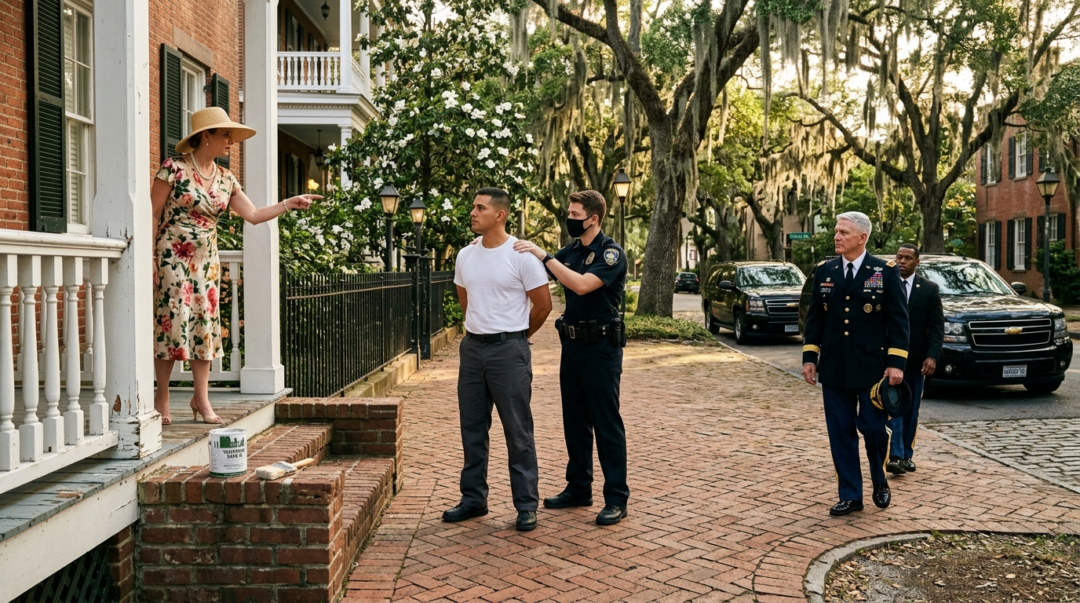
The warm, honeyed afternoon sunlight of late spring filtered down through the sweeping, moss-draped branches of ancient live oaks along Jones Street in Savannah, Georgia. Widely celebrated by architects, historians, and travelers as one of the most picturesque avenues in North America, the street was paved with hand-laid red vitrified brick that had settled into gentle, undulating waves over a century and a half of carriage and automobile traffic. Towering two- and three-story antebellum townhouses built of Savannah gray brick rose gracefully from high granite foundations, their high double-hung windows framed by dark forest-green cypress shutters, their grand entrances approached by sweeping twin staircases of weathered Georgia marble flanked by intricate, hand-wrought decorative iron railings cast by nineteenth-century foundry masters. The air was thick, fragrant, and intoxicatingly Southern—a rich perfume of blooming star jasmine climbing up wrought-iron verandas, sweet tea olive, flowering white Southern magnolias whose heavy blossoms gleamed like porcelain cups, and the warm, damp scent of salt marsh and river mist rolling off the Savannah River at slack tide. The neighborhood moved to a timeless, aristocratic rhythm: the muffled clop of carriage horses carrying sightseers through nearby Monterey Square, the gentle hum of ceiling fans on shaded upper piazzas, and the distant, deep horn of a container ship navigating the shipping channel.
Standing on the third step of the front stoop at Number 214 Jones Street was Mateo Cruz. He was thirty-two years old, lean, broad-shouldered, and impeccably fit, moving with the disciplined, quiet grace of an experienced combat engineer. He wore a clean, plain white cotton t-shirt, loose gray canvas work trousers splattered with small flecks of white paint, and scuffed leather work boots. His dark hair was clipped short in a military high-and-tight fade, and his warm amber eyes were focused with razor-sharp concentration on the historic woodwork before him. In his right hand, he held a two-inch badger-hair sash brush, delicately applying a fresh coat of historically certified oyster-white enamel to the intricate dental molding of the arched parlor window. Beside his boots on the marble landing sat an open one-gallon steel paint can and a brass scraper. Number 214 was the historic Rutledge estate, built in 1854 by a master shipbuilder, featuring exquisite plaster ceiling medallions, heart-pine floorboards, and marble hearths that had survived the Civil War and a century of hurricanes. For three years, the estate had sat neglected following the death of its elderly owner, its exterior sashes peeling, until Mateo had acquired the title through the state veterans trust and begun the painstaking, loving work of physical restoration with his own hands.
The peaceful, rhythmic silence of the afternoon was shattered by the sharp, aggressive clack of high-heeled designer shoes marching down the brick sidewalk.
Approaching the front gate was Evelyn Beaumont. She was forty-eight years old, slender and impeccably coiffed, her dyed auburn hair swept beneath a wide-brimmed Italian straw sun hat tied with a green silk scarf. She wore an expensive floral linen sheath dress, three strands of cultured pearls around her neck, and oversized designer sunglasses that perched haughtily on the bridge of her sculpted nose. In her right hand, she carried a heavy, monogrammed leather portfolio; in her left, an expensive smartphone that she tapped with manicured, crimson-tipped nails. For twelve years, Evelyn had served as the unelected, iron-fisted President of the Savannah Historic Architectural Society, treating the entire historic district as her personal feudal estate.
Behind her, looking visibly uncomfortable and sweating in his dark polyester duty uniform, was Officer Tyler Vance, a twenty-six-year-old municipal patrolman who had been transferred to the downtown precinct only three weeks earlier.
“Officer, there he is!” Evelyn declared in a shrill, piercing Southern drawl that cut through the quiet neighborhood like a buzzsaw. She pointed a manicured finger directly at Mateo Cruz on the front steps. “Right there on the stairs of the historic Rutledge estate! Look at him! He’s defacing the original nineteenth-century woodwork with non-conforming paint! I demand you remove this unauthorized trespasser from our historic district immediately!”
Mateo did not drop his brush. He did not jump with guilty alarm, nor did he flinch at the woman’s screeching accusation. With practiced, calm deliberation, he gently wiped the excess white enamel against the inner rim of the steel can, laid the brush across the top, and stood up straight on the marble steps. He wiped his hands on a clean cotton rag from his pocket, turning his gaze down toward the gate with quiet, impenetrable dignity.
“Good afternoon, ma’am,” Mateo said softly. His voice was deep, polite, and completely unhurried, carrying the natural composure of someone who had faced artillery fire without losing his nerve. “Officer, good afternoon. May I help you with something?”
“Don’t you dare speak to me, you vagrant!” Evelyn snapped, pushing open the heavy cast-iron gate with an indignant clang and marching onto the herringbone brick walkway. “You should have packed up your cheap supplies when I told you three days ago! You have no business loitering around this property! This is a landmark antebellum residence, not a day-labor staging site!”
Officer Vance stepped forward, his hand resting nervously on his duty belt, looking up at the polite young man on the porch. “Sir, step down from the stairs, please. We received an emergency call reporting suspicious activity and unauthorized alteration of a protected historical landmark.”
“Officer, there is no emergency,” Mateo replied calmly, descending the three marble steps to stand on the ground-level walkway. He stood at ease, his hands open and visible at his sides. “This property was deeded to me on Tuesday. I am the registered owner of this house. I am currently restoring the exterior trim in full compliance with municipal historical guidelines.”
Evelyn threw her head back and let out a shrill, mocking laugh that echoed off the neighboring brick facades. Several neighbors paused on their porches, peering through the live oak branches in curiosity.
“You? The owner of the Rutledge estate?” Evelyn scoffed, curling her lip with absolute, venomous disdain. “Do you take us for fools? This estate is valued at two point eight million dollars! Ordinary working-class laborers in dirty t-shirts do not buy landmark mansions on Jones Street! You’re probably a squatter hired by some predatory flipper! Officer, do your duty! He is trespassing, he has no identification that belongs in this neighborhood, and he is defacing a historic facade! Put him in handcuffs before he damages the plaster!”
Officer Vance looked from the haughty, connected socialite to the humble young man in the white t-shirt. Under the immense pressure of a prominent society figure who was known to dine with the mayor and the police commissioner, the young patrolman’s judgment faltered. He stepped behind Mateo, placing a firm hand upon the young man’s shoulder, guiding him firmly to bring his wrists together behind his back.
“Sir, until we verify the property deed with the county clerk, you are being detained for investigative trespass,” Officer Vance instructed, his voice tight with official authority. “Keep your hands behind your back and remain still.”
Mateo Cruz did not pull away. He did not resist, nor did he raise his voice in protest. With magnificent, calm military discipline, he held his wrists calmly behind his back, his head held high, his amber eyes gazing peacefully across the sunlit brick street.
“Officer Vance,” Mateo said softly, his voice steady as granite. “You are making a grave procedural error. But I will comply with your instructions until my identity is confirmed.”
Evelyn stepped up to the edge of the porch, folding her arms over her floral dress, a triumphant, vindictive sneer twisting her features.
“Let’s see how polite you sound down at the municipal holding cells, boy!” Evelyn gloated, tossing her chin in the air. “Nobody in this city knows who you are! You don’t belong on Jones Street, you don’t belong in Savannah, and by tomorrow morning, my architectural board will have a permanent municipal injunction locking you out of this ward forever!”
Mateo slowly turned his head to the left, his gaze meeting Evelyn’s hateful stare with quiet, devastating composure.
“You are mistaken, Mrs. Beaumont,” Mateo said softly. “The people who need to know me already do.”
At that exact moment, the deep, synchronized rumble of two heavy, high-output V8 engines broke through the quiet of the neighborhood.
Turning smoothly off Bull Street onto the brick pavement of Jones Street came two massive, gleaming black executive security SUVs with dark-tinted windows, chrome grill guards, and official government plates. They pulled smoothly up to the curb directly in front of Number 214, parking bumper-to-bumper to seal the frontage.
The passenger door of the lead SUV opened instantly.
Stepping out onto the red brick sidewalk into the golden afternoon sunlight was a tall, imposing, silver-haired gentleman in a formal, razor-sharp midnight-blue military service dress uniform. Gold braided oak-leaf embroidery gleamed across the stiff visor of his service cap; four rows of multicolored military decoration ribbons and the silver star of valor shone brilliantly across his left breast; and gold rank insignia flashed on his broad shoulder epaulets.
Walking up the herringbone brick walkway with the majestic, thunderous stride of an elite commanding general came Senior Military Commander Arthur Sterling.
His resonant, sovereign baritone cut through the humid Savannah air like an artillery shell:
“I know exactly who he is!”