The Ninety Kilogram Tractor Tire And The Loose Lug Nut Scam
CHAPTER 1: THE LIFT ON THE BAY FLOOR
The biting prairie wind of late October swept across the vast, flat expanse of the Red River Valley in Cass County, North Dakota, carrying the smell of harvested sugar-beet loam, diesel exhaust, and the sharp, metallic tang of early morning frost. Here along Highway 10, where horizon-spanning fields of hard red spring wheat met the industrial implement dealerships that kept American agriculture turning, the local service garage was a lifeline for farming families who could not afford a single hour of mechanical downtime during the final days of the harvest.
Inside service bay number four of Prairie State Tire & Auto, standing beside an un-operational commercial hydraulic tire hoist that had been tagged out of service for three days, was Hank Holbrook. At seventy-one years old, Hank was a master diesel tractor mechanic, retired combine fleet supervisor, and veteran agricultural fabricator who had spent over fifty-two years repairing transmissions, rebuilding hydraulic pumps, and servicing heavy equipment across the northern plains. He was broad-shouldered as an engine block, with silver hair cropped close above a weathered, leathered face lined with grease-stained creases, wearing faded denim work overalls over a heavy gray thermal henley, and scuffed eight-inch oil-resistant steel-toed work boots.
Resting flat on the grease-stained concrete shop floor before Hank was his own piece of heavy equipment: a massive, chest-high, twelve-ply rear steer tire for his John Deere 8R row-crop tractor. The tire was an industrial titan—an 18.4R38 deep-cleated agricultural radial weighing precisely ninety kilograms, two hundred pounds of dense vulcanized rubber, wire bead, and steel reinforcement.
Hank had been waiting forty-five minutes for the shop’s junior technicians to hoist the tire onto the dynamic balancing rack so he could get back to his wheat field before the coming freeze.
Tired of bureaucratic delays, Hank took a slow, deep breath through his nose, expanding his barrel chest beneath his overalls. He did not ask for a helper. He did not wait for the air crane.
Hank dropped into a deep, wide Zercher deadlift squat, wrapping his thick, vascular bare arms in a powerful bear-hug around the muddy cleats of the ninety-kilogram tire.
The biomechanics of hoisting an unyielding two-hundred-pound rubber cylinder from floor level is an extraordinary test of posterior chain musculoskeletal recruitment. In sports physiology, a Zercher lift places an intense compressive and shear load upon the erector spinae, the latissimus dorsi, and the gluteus maximus, demanding that the thoracic spine maintain rigid extension while the quadriceps and hamstrings generate explosive vertical thrust. For Hank, whose back and hips had hoisted three-hundred-pound combine concaves and forty-pound starter motors since he was fifteen years old, the movement was as natural and fluid as drawing water from a pump.
With a smooth, continuous extension of his hips and knees, Hank deadlifted the ninety-kilogram tractor tire completely clear of the concrete floor.
Holding the massive two-hundred-pound tire tucked firmly against his sternum, Hank walked three steady paces across the slick shop floor, pivoted his hips with absolute biological balance, and rolled the heavy tire smoothly up onto the steel spindle of the dynamic balancing rack, seating the bead onto the hub with an authoritative metallic clack.
Standing five feet away on the next service bay, holding a laminated clipboard and a freshly printed invoice, was Brett Sterling.
Brett was twenty-nine years old, impeccably groomed with slicked-back hair, wearing a clean, branded gray polo shirt, spotless yellow safety glasses, and lightweight running shoes that had never seen a drop of gear lube. Brett was the managing director of Prairie State Tire & Auto, a regional franchise chain operating twelve service centers across the Dakotas and Minnesota.
“Hey, Holbrook, leave the heavy tires to our certified technicians!” Brett snapped, rushing over with an exaggerated expression of severe professional concern, waving a twelve-hundred-dollar repair estimate in Hank’s face. “Forget the tractor tire for a minute! We’ve got a major safety emergency on your three-quarter-ton farm pickup over here on bay three!”
Hank wiped a smudge of black rubber dust from his forearms onto his work apron, looking at the young manager with calm, unblinking gray eyes. “An emergency on my truck, Brett? I drove that Ford twelve miles down the county road this morning. Engine ran cool, steering was centered, brakes were firm.”
Brett shook his head with theatrical gravity, tapping his pen against the invoice. “Our lead technician took it on a mandatory five-mile pre-alignment road test twenty minutes ago, Mr. Holbrook. He heard an acute, high-frequency metallic knocking coming from the front right wheel assembly. We hoisted the truck on the two-post rack, and the diagnostic inspection was catastrophic. Your front right unitized wheel hub bearing is completely shattered. The tapered roller bearings have disintegrated, the spindle is scoring the knuckle, and the entire assembly is on the verge of shearing off the axle. It’s an immediate road hazard. State law prohibits us from releasing the vehicle until you authorize a full twelve-hundred-dollar hub and bearing replacement.”
Hank looked at the invoice: PARTS: $850.00. LABOR: $350.00. TOTAL DUE: $1,200.00.
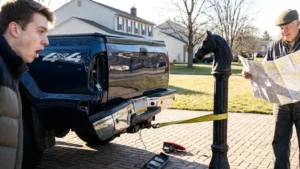
Then Hank looked over at his 2012 three-quarter-ton Ford F-250 pickup, which was raised two inches off the concrete on a pneumatic floor jack at the front right corner.
“Heard a clunk on the test drive, did you, Brett?” Hank asked softly, his voice carrying the deep, unhurried rumble of an old diesel engine idling in a cold barn.
“A severe mechanical knock, sir!” Brett insisted, stepping closer and thrusting the pen toward Hank’s chest. “If you drive that truck out of this shop, the front wheel will separate at highway speeds! Sign the work order right now so my boy can pull the rotor and install the new parts!”
Hank did not take the pen. He walked two paces over to the raised front right wheel of his truck.
The twenty-inch alloy wheel was hanging free in the air.
Hank did not use an electronic dial indicator. He did not pull out a magnetic diagnostic sensor.
Moving with the calm authority of an old master mechanic, Hank placed his massive, calloused bare left hand on the outer tire tread at the nine o’clock position, and his right hand on the three o’clock position.
He planted his steel-toed work boots flat against the concrete floor, engaged his broad shoulders, and began violently jerking the entire wheel assembly back and forth along the horizontal axis with explosive, rhythmic upper-body power.
CLANK-RATTLE-CLANK-RATTLE!
A loud, loose, metallic rattling noise echoed sharply through the open service bay.
Every customer waiting in the reception lounge turned their heads, looking out through the plate-glass service window.
The mechanical reality was immediately, glaringly obvious to anyone who knew the basic anatomy of an automotive axle.
While the rubber tire moved half an inch back and forth under Hank’s crushing manual force, the central cast-iron brake rotor, the brake caliper, and the solid steel wheel hub behind the wheel did not move a single fraction of a millimeter. The unitized tapered roller bearing was completely tight, perfectly centered, and rock-solid on its hardened steel spindle.
The rattling noise was not coming from a shattered bearing.
Spinning loosely on their threaded steel studs were three chrome lug-nuts at the ten, two, and six o’clock positions—each backed off by precisely two full turns, completely unseated from the alloy wheel rim, rattling like loose coins in a tin cup under Hank’s hand.
And glistening on the clean chrome faces of the three loosened nuts were fresh, oily black marks from an un-calibrated mechanic’s hand socket where the technician had deliberately backed the nuts off during the road test to create an artificial knocking sound.
Hank stopped shaking the wheel. He looked over his shoulder at Brett Sterling, his pale gray eyes burning with unyielding, glacial contempt.
“The bearing is tight as a drum, Brett,” Hank said, his voice dropping into cold, lethal stillness that carried through the entire shop. “Your boy didn’t diagnose a shattered hub. He took a pneumatic hand wrench and backed off three lug-nuts by two turns to make a clunking noise when he tapped the brakes.”
Brett Sterling’s face turned from smug arrogance to an ashen, horrified white. “Wait… that’s an outrageous accusation! The technician must have forgotten to torque the wheel after inspecting the brake pads—”
Hank did not listen to the lie.
Reaching over to the mobile tool cart beside the hoist, Hank grabbed a heavy, forged-alloy steel four-way cross-lug wrench.
Holding the central hub of the heavy iron wrench with his left thumb and index finger, Hank gave the crossbar an effortless flick of his right wrist.
WHIIIIISH.
The heavy four-way wrench spun through the air like an airplane propeller, its balanced forged arms whistling through the shop air.
With the blinding speed and hand-eye coordination of an old machine tool operator, Hank caught the spinning crossbar, seated the twenty-one-millimeter socket over the first loose lug-nut, and delivered a single, explosive, downward ninety-degree torque heave of his right wrist.
SCREEECH.
The chrome nut seated tight against the alloy rim with a sharp metallic squeak, torqued to an unyielding one hundred and twenty foot-pounds of factory spec.
SCREEECH. SCREEECH.
In less than four seconds, all three loose nuts were torqued down rock-solid.
Hank placed his hands back on the tire at nine and three o’clock, shaking the wheel with his full two-hundred-pound body weight.
The assembly was dead silent. Immovable. Perfect.
Hank spun the wheel with one finger. The heavy truck tire rotated with smooth, silent, frictionless laminar grace on its precision roller bearings, completely silent beneath the shop lights.
Hank tossed the heavy four-way wrench back into the steel tool cart with a loud, ringing crash that echoed through the entire garage.
“Fixed it in four seconds, Brett,” Hank said softly, stepping within inches of the trembling manager. “Keep your twelve-hundred-dollar invoice. And let’s see how many other customers in that waiting room have loose lug-nuts on their cars.”
In the reception lobby behind the glass, four waiting farmers stood up simultaneously, walked to the service counter, and snatched their vehicle keys out of the reception basket, glaring through the glass at the exposed manager with furious, righteous disgust.
The biomechanical recruitment required to execute a raw Zercher deadlift with an unyielding ninety-kilogram agricultural tire represents an extraordinary demonstration of posterior-chain power. In orthopedic biomechanics, lifting an awkward, circular two-hundred-pound object from floor level places the load vector significantly forward of the primary center of mass, generating intense shear forces across the lumbosacral junction (L5-S1). To protect the spine from catastrophic flexion under this torque, Hank Holbrook utilized the ‘abdominal brace’ technique mastered through fifty years of heavy diesel equipment overhaul. By engaging his diaphragm and contracting his transversus abdominis and internal obliques against a rigid intra-abdominal pressure column, his torso functioned as an unyielding biological crane. The crook of his elbows, tucked beneath the thick lug treads of the radial tire, created a stable biological cradle that distributed the gravitational vector directly through his latissimus dorsi into his gluteus maximus and hamstrings, allowing him to stand erect with the effortless mechanical certainty of a hydraulic backhoe.
The engineering mechanics of unitized automotive wheel hub assemblies rely upon pre-set tapered roller bearing pairs engineered to withstand both high radial vehicle weight and severe lateral cornering shear. In modern heavy-duty pickup trucks, the hub assembly incorporates two opposing rows of case-hardened alloy rollers running within precision-ground outer raceways, pre-loaded under factory conditions to eliminate end-play while maintaining a rotating torque of less than five inch-pounds. When a tapered roller bearing genuinely fails due to mechanical fatigue or lubrication loss, the surface of the raceway undergoes ‘spalling’—the microscopic flaking of metal particles that produces severe radial looseness and a continuous, grinding growl that increases exponentially with vehicle speed. To verify a bearing failure, a certified technician applies equal deflection force along both the vertical (12 and 6 o’clock) and horizontal (9 and 3 o’clock) axes. When play is detected solely along the horizontal axis while the brake disc remains firmly seated, mechanical physics dictates that the movement is caused strictly by loose wheel lug nuts or worn steering tie-rod ends, completely disproving any internal failure of the bearing itself.