The Falling Roof Ice And The Great Winter Driveway Dispute
CHAPTER 1: THE LEDGE ABOVE THE APRON
The arctic cold front descended from the Canadian plains like an iron curtain, dropping the temperature in Wayzata to twelve degrees below zero before sunrise. Along the quiet, winding cul-de-sacs overlooking the frozen expanse of Lake Minnetonka, the snow was dry, crystalline, and so light that the sub-zero wind sent white plumes dancing across the asphalt like pulverized glass. Owen Gallagher stood at the edge of his asphalt driveway, leaning his forearm on the handle of an ergonomic aluminum snow shovel, his heavy canvas Carhartt jacket dusted in frost. Owen was a civil engineer who specialized in municipal stormwater drainage and concrete load dynamics, a man who understood how moisture, freeze-thaw cycles, and gravity interacted with structural surfaces. His driveway was impeccably cleared, down to the black aggregate, edged by a precise forty-five-degree bevel of clean snow and salted with coarse calcium chloride crystals that crunched softly under his insulated winter boots. Beside him on the front porch, his eight-year-old daughter Mia, bundled in a bright red snowsuit and oversized mittens, was building a small snow hare on the cedar bench.
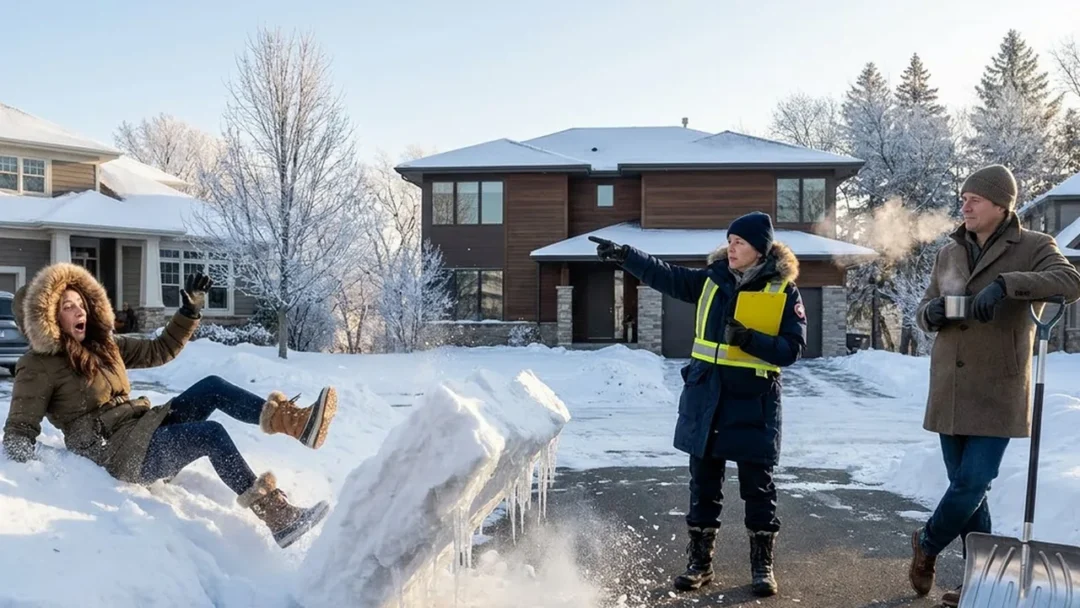
The sharp, abrasive squeak of rubber overpacked onto hard-packed snow echoed down the lane. Deirdre Vance-Kincaid marched across the property line, wrapped in an ankle-length silver goose-down coat trimmed in arctic fox fur, her face pinched behind oversized titanium-framed sunglasses that reflected the blinding glare of the morning snowpack. Beside her walked Inspector Astrid Lindholm, the senior winter public safety and municipal compliance officer for Hennepin County. Lindholm wore a heavy navy county parka with reflective silver safety chevrons, thermal boots, and carried a weatherproof aluminum clipboard tucked beneath her arm. Lindholm had worked twenty winters in the Twin Cities metro area, investigating ice dams, structural roof collapses, and municipal slip-and-fall claims; she had seen every conceivable manifestation of suburban winter spite.
“Look at this deliberate act of neighborly hostility, Inspector!” Deirdre demanded, thrusting a leather-mittened hand toward the boundary between their two homes. Her voice was shrill, cutting through the freezing air like an ice auger. “Look at that three-foot mountain of packed, dirty ice dumped directly across my driveway apron! I spent forty thousand dollars installing subterranean hydronic heating coils beneath my concrete pavers, and this man has willfully shoveled his heavy sidewalk slush straight onto my property, suffocating my heat sensors and creating a lethal liability hazard! I demand you cite him for malicious municipal right-of-way obstruction and issue an order for immediate professional snow removal at his expense!”
Owen did not lose his temper. He reached into his coat pocket, pulled out a steaming stainless steel thermos, and poured a splash of black coffee into the cap. “Good morning, Inspector Lindholm. Hello, Deirdre. If you look at my shovel blade, you’ll notice it’s an aluminum pusher, not a scoop. And if you look at the snow on your driveway, you’ll notice the aggregate isn’t sidewalk slush.”
Inspector Lindholm stepped through the break in the snowbank, her boots making sharp, rhythmic squeaks on the frozen surface. She knelt beside the three-foot mound of dense, compacted snow sitting squarely on Deirdre’s driveway apron. She pulled off her outer glove, picked up a fist-sized chunk of the debris, and examined it under the cold sunlight. The chunk was not loose, crystalline powder that had been tossed from a shovel; it was laminated, blue-tinted ice composed of stratified layers of compressed refrozen meltwater, embedded with pine needles and small granules of black roofing shingle grit.
Lindholm stood up, turning toward Deirdre with an expression of flat, procedural skepticism. “Mrs. Kincaid, Mr. Gallagher’s driveway is salted, cleared to the pavement, and his snowbanks are properly tapered back at a thirty-degree angle to preserve sightlines. Furthermore, this snow wasn’t moved by an aluminum shovel. This is laminated glacier ice from an overhead structural release.”
“That is completely impossible!” Deirdre shrilled, taking an aggressive step forward, her fox-fur collar quivering in the wind. “My roof is an architectural showpiece! I have automated thermal melting systems installed in the valleys! My roof does not shed ice onto my own driveway! He threw that slush there out of pure spite because my driveway is heated and his isn’t!”
Owen pointed calmly upward with his shovel handle. “Look up at your north eave, Deirdre. Directly above your head.”
Inspector Lindholm stepped back, tilting her neck back to inspect the roofline of Deirdre’s sprawling two-story lakeside home. Hanging along the entire thirty-foot length of the second-story north-facing cedar eave was a colossal, terrifying ice dam. The ice sheet was twelve inches thick, bowing the heavy zinc gutter downward under thousands of pounds of dead weight. Protruding from the bottom of the dam was a row of jagged, crystalline icicles measuring four feet in length, glistening like razor-sharp daggers directly over the driveway apron.
Suddenly, an ominous, deep structural crack echoed from the roofline—the sound of three-inch timber fracturing under tension.
“Look out!” Owen shouted, dropping his thermos and lunging forward.
A massive, thirty-pound slab of solid blue ice sheared cleanly off the gutter eave. It plummeted sixty feet through the freezing air, whistling as it fell, and obliterated onto the concrete driveway with an explosive, deafening crash right in front of Deirdre’s boots. The impact shattered the slab into thousands of flying ice shards, sending an explosive plume of powdery white snow into the air that enveloped Deirdre like an avalanche cloud.
Deirdre shrieked in terror, stumbling backward and tumbling into a deep snowbank, her silver coat covered in flying slush.
Inspector Lindholm didn’t flinch. She pulled a yellow citation sheet from her clipboard, uncapping her pen with cold, deliberate authority. “Section 18.4 of the Hennepin County Public Safety Code: Hazardous Winter Structural Maintenance. Failure to mitigate catastrophic overhead ice dams. You are officially cited three hundred dollars, Mrs. Kincaid.”
Deirdre scrambled to her feet, spitting snow from her lips, her face mottled with rage and humiliation. “That was not my fault! I didn’t push that ice! That was natural atmospheric gravity! If you want to write a citation, write a citation for gravity! Gravity is the real criminal here!”
Lindholm handed her the yellow ticket. “Gravity doesn’t hold title to a two-story cedar roof, Mrs. Kincaid. Clear this hazard in twenty-four hours, or the county will condemn the driveway.”
As Deirdre snatched the ticket, Owen knelt by the crater where the thirty-pound ice block had shattered. Beneath the crushed ice crystals, sticking out from the severed gutter downspout, was a scorched, blackened length of high-voltage industrial electrical cable, its copper wires frayed and smoking faintly in the sub-zero air.
Mia watched from the porch railing, her breath puffing like tiny clouds of steam into the arctic air. She knew her father’s routines by heart; every snowfall, Owen mapped the driveway drainage like a river basin, ensuring that meltwater flowed away from foundations and toward the municipal storm grate. He had taught Mia how water expanded by nine percent when freezing, exerting over thirty thousand pounds per square inch of hydraulic pressure against concrete if trapped in hairline fractures. Standing in the sub-zero cold, Owen looked at the shattered ice crater on Deirdre’s driveway, recognizing the unmistakable signature of unmitigated structural neglect. Deirdre’s accusations were not just unfair; they were physically illiterate, an attempt to override the immutable laws of physics with social aggression.
Owen had spent his entire professional life working with the physics of northern winters, designing bridge aprons, highway culverts, and municipal retaining walls across the Upper Midwest. He understood that ice was an unforgiving medium, expanding with irresistible force and yielding only to thermodynamics. He had watched neighbors cut corners for years, spraying chemical deicers that destroyed concrete surfaces or installing cheap heating cords that caused electrical shorts. But Deirdre’s behavior was different—it was intentional, calculated, and malicious. Owen kept his cool, letting the objective physics speak for themselves as Inspector Lindholm documented the scene with her camera and measurement tape.