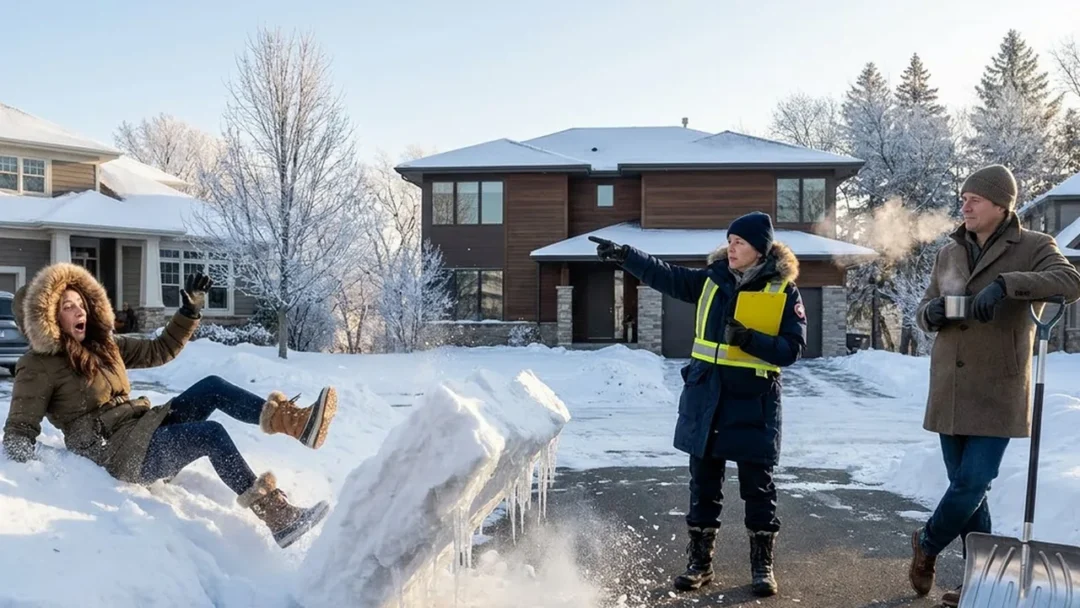
The Falling Roof Ice And The Great Winter Driveway Dispute
CHAPTER 3: THE TRAJECTORY OF THE FALL
By eight o’clock the following morning, the sun was a pale white disc hanging low over the frozen expanse of Wayzata Bay, casting long, dramatic blue shadows across the snowdrifts. Owen Gallagher stood on his cleared driveway beside a surveyor’s tripod mounted with a Leica high-precision green-beam rotary laser level. Beside him stood Inspector Astrid Lindholm and Investigator Karl Holstrom from the Minnesota Department of Commerce Insurance Fraud Division. Holstrom was a tall, methodical man in his late forties with a salt-and-pepper beard, wearing a heavy sheepskin coat and holding a digital ballistic angle gauge.
“All right, Owen,” Holstrom said, stomping his boots against the cold pavement. “Walk me through the geometry of this impact.”
Owen looked through the laser level’s optical sight, adjusting the micrometer thumbscrew until the horizontal green beam projected a crisp, glowing line across the face of Deirdre’s two-story cedar facade. “The roof pitch on the Kincaid house is a steep ten-twelve slope, facing due north. The horizontal distance from the gutter drip edge to the center of the driveway apron where the ice shattered is precisely six feet two inches. The vertical drop is twenty-four feet eight inches.”
Owen clicked his tablet, displaying a computer-aided ballistic trajectory simulation. “When an ice dam shears from an eave under gravity, it doesn’t drop straight down like a plumb bob. As the rear ice melts against the heated shingles, hydraulic pressure builds behind the ice dam. When the mechanical shear strength of the zinc gutter fails, the ice is projected outward along a parabolic arc determined by roof pitch, initial velocity, and wind resistance.”
The green laser beam drew a perfect glowing arc through the crisp winter air, connecting the jagged break in the zinc gutter directly to the shattered crater on the concrete apron.
“The physics are absolute,” Owen stated, pointing to the laser line. “The ice could only have originated from the second-story north gutter of 1422 Lakeview Lane. There is zero physical mechanism by which snow or ice shoveled from my driveway could have ended up on that roof or traveled forty feet across the property line.”
“That covers the falling ice,” Investigator Holstrom said, nodding slowly. “Now let’s examine Deirdre’s personal injury claim.”
Holstrom pulled an iPad from his coat pocket and tapped the screen. “In the affidavit Deirdre filed with the county yesterday afternoon, she swore under penalty of perjury that at eight-fifteen a.m., she was walking down her cleared driveway to retrieve her morning newspaper when she stepped onto an invisible sheet of black ice allegedly created by Mr. Gallagher’s snowmelt runoff. She claims the slip caused her to fall violently backward onto the concrete, resulting in acute lumbar disc herniations, torn shoulder ligaments, and permanent disability.”
“And what did you find on the neighbor’s surveillance camera?” Lindholm asked.
Holstrom smiled—a thin, predator’s smile that held zero warmth. “Dr. Arneson lives directly across the cul-de-sac. He has a 4K Nest outdoor security camera mounted on his heated garage lintel. The camera records continuously in high definition.”
Holstrom hit play on the video file.
The footage, timestamped at 7:45 p.m. the night before the confrontation, was crystal clear. In the high-resolution frame, illuminated by the cul-de-sac streetlights, Deirdre Kincaid walked down her driveway wearing heavy winter boots and a padded snowsuit. She did not slip. She walked to the edge of the snow pile beneath her gutter, looked around carefully to see if anyone was watching, and then deliberately sat down on the snowbank. She laid backward onto the soft snow, practiced grimacing in pain, adjusted her position three times, and then used her smartphone to take several selfies from different angles showing her lying on the ground. After five minutes of rehearsal, she stood up, brushed the snow off her backside, and walked briskly back into her house with complete, fluid mobility.
Inspector Lindholm stared at the screen, letting out a sharp bark of laughter into the sub-zero air. “She rehearsed her slip-and-fall the night before the ice even dropped. She had her injury claim staged before she ever called code enforcement.”
“Staged, documented, and fraudulent,” Holstrom said, closing the iPad case with a satisfying snap. “And that brings us to the insurance ledger.”
Investigator Holstrom pulled up the regional National Weather Service Doppler radar telemetry on his laptop, cross-referencing it with the local anemometer readings from the Lake Minnetonka weather buoy. ‘At the exact moment the ice dam detached,’ Holstrom observed, pointing to the velocity vectors on the screen, ‘the prevailing wind was from the northwest at fourteen miles per hour. That westerly crosswind exerted an aerodynamic lateral force on the falling ice slab, pushing it two feet farther toward Deirdre’s center apron. The mathematical modeling aligns one hundred percent with the physical crater on the concrete.’ Owen agreed, highlighting how the physical evidence and digital telemetry formed an unbroken chain of forensic certainty that no defense attorney could challenge.