What the Photograph Remembered
Part I — The Picture at Her Feet
The photograph landed faceup on the Manhattan sidewalk, directly in front of Elizabeth Carter’s black heels, and the city seemed to keep moving only because it did not know what it had dropped.
A woman in the picture held a newborn against her chest.
The woman was twenty-three, pale with exhaustion, hair damp at the temples, smiling as if pain had opened into something holy.
The woman was Elizabeth.
The baby had been gone for ten years.
A horn screamed at the crosswalk. Someone brushed past her shoulder. A doorman at the hotel called, “Ms. Carter? They’re ready for you inside.”
Elizabeth did not move.
Across from her stood a boy in a gray hoodie, no taller than her ribs, watching her with the careful stillness of someone who had been told not to expect too much. His backpack hung crookedly from one shoulder. One of the zippers was half open.
The cracked plastic sleeve that had held the photograph lay beside her shoe.
Elizabeth bent slowly and picked it up.
The paper was soft from years of handling. One corner had been folded and unfolded until it had nearly given up. There was a faint crease across her younger face. Across the baby’s blanket, someone had written a name in faded blue ink.
Samuel.
Her throat closed.
“Where did you get this?” she asked.
The boy looked at the photograph, then back at her face.
“The woman said you’d know me if you looked long enough.”
Elizabeth’s fingers tightened until the plastic crackled.
“What woman?”
He pointed across the street.
On a bench beneath a row of winter-bare trees sat a woman in black. Black coat. Black gloves. A dark hat low over her face. She sat with both hands folded around a purse in her lap, as if she had been waiting there all afternoon, maybe all month.
When Elizabeth looked at her, the woman lowered her head.
“Ms. Carter,” the doorman called again, softer this time. “Your father’s asking.”
Of course he was.
Inside the hotel, Robert Carter’s retirement gala had already begun. Donors, reporters, judges, foundation board members, all gathered beneath chandeliers to celebrate a man who had built a public life out of words like legacy and service. Elizabeth was expected to stand beside him, elegant and steady, the eldest daughter who never embarrassed the family.
Her father had taught her young that composure was not a virtue.
It was rent.
The boy took one step closer. “Are you her?”
Elizabeth looked down at the photograph again.
Ten years disappeared.
A private hospital room. Rain against the window. Michael Grant asleep in a chair with his hand still around hers. A nurse saying the baby needed tests. Her father’s voice outside the door, low and firm. Then medication. Then waking with an empty body and a motherless silence no doctor could explain gently enough.
She had been told there was nothing to hold.
She had believed them because grief had made belief easier than suspicion.
“What’s your name?” she asked.
He swallowed.
“Samuel.”
The sidewalk tilted.
Elizabeth reached for the nearest solid thing and found only the hotel’s brass railing. The boy saw her sway and stepped forward as if he, not she, was the adult.
Behind the glass doors, a hotel manager lifted a hand in greeting. A woman with a headset mouthed, They’re waiting.
Elizabeth looked once more across the street.
The woman in black had not moved.
“Come with me,” Elizabeth said to the boy.
His eyes flicked toward the bench.
“She said you might say that.”
“Did she tell you not to?”
“No.” He touched the edge of the photograph. “She said if you cried, I should wait.”
Elizabeth looked away before he could see that he had already obeyed too late.
She tucked the photograph inside her blazer, placed a hand lightly between Samuel’s shoulders, and guided him through the revolving doors into the hotel where her father was being applauded for his devotion to families.
Part II — A Name No Stranger Should Know
The lobby smelled of lilies, polished marble, and money pretending to be warmth.
Samuel stopped just inside the doors and stared up at the chandelier. He did not look frightened. That was what frightened Elizabeth. A ten-year-old alone in a luxury hotel should have been overwhelmed, excited, restless, anything but watchful.
He was measuring adults.
Elizabeth knew children like that. She represented them in custody hearings. Children who knew which parent drank before dinner. Children who smiled at judges because they understood their future depended on being pleasant. Children who learned early that the truth had to wait for the right room.
She knelt in front of him near a marble column, blocking him from the view of the gala entrance.
“Samuel,” she said, forcing steadiness into her voice. “I need you to tell me who brought you here.”
“The woman from the bench.”
“What’s her name?”
“She said it didn’t matter yet.”
“Where is the adult who takes care of you?”
“My mom died in October.”
The word landed softly. Too softly. He had practiced saying it so people would not ask him to perform sadness.
Elizabeth closed her eyes for half a second.
“I’m sorry.”
He nodded once. “She told me to find you when she couldn’t explain anymore.”
“Your mother told you that?”
“No. The woman in black.”
The hotel manager approached, smiling the careful smile of someone trained to remove inconvenience without appearing to touch it.
“Ms. Carter, everything all right?”
“No,” Elizabeth said.
The smile faltered.
“I need a private room. Now.”
“Of course.”
“And no one takes this child anywhere unless I say so.”
The manager glanced at Samuel, then at Elizabeth’s face, and found whatever he needed there. “This way.”
They moved toward a small consultation room off the lobby, but before they reached it, Samuel said, “She said you used to sing about the moon.”
Elizabeth stopped.
“What?”
“The woman. She said when I was little you sang something about the moon not being lonely.” He frowned, trying to remember. “I don’t know the song.”
Elizabeth’s hand found the wall.
No one knew that.
Not her father. Not Sarah. Not the nurses who moved through that room like ghosts. Only Michael had heard it, because he had laughed at her for making up lullabies before the baby was even born.
The moon is only lonely if the stars forget her name.
It had been foolish. Tender. The kind of private thing a person says before the world teaches her privacy can be stolen.
Samuel reached into his backpack and pulled out a folded paper.
“I have this too.”
Elizabeth did not touch it at first.
The paper was a hospital bracelet, flattened and taped inside a sandwich bag. The printed ink had blurred, but the name was still visible.
Baby Boy Carter.
Her knees weakened.
Behind her, a glass shattered in the ballroom.
Then she saw her father.
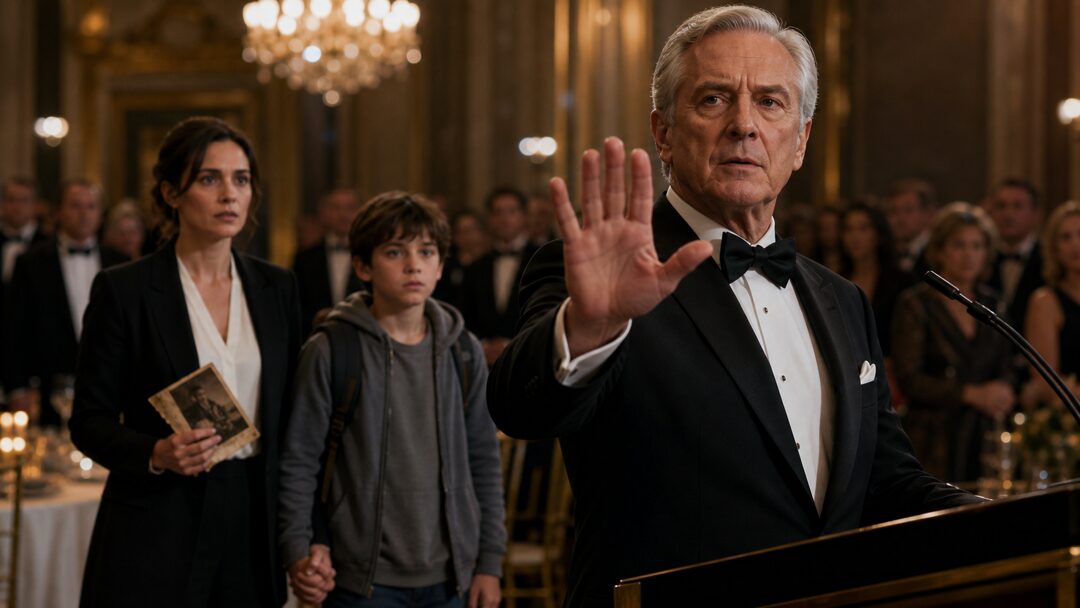
Robert Carter stood at the entrance to the gala hall in an immaculate tuxedo, silver hair combed back, one hand raised mid-greeting. He was looking at Samuel.
No confusion passed across his face.
No polite concern.
Only fear.
It lasted less than a second before he corrected it, but Elizabeth saw the original expression. She had spent her life studying her father’s face for weather. Approval. Disappointment. Warning.
This was weather he had never meant her to see.
Robert crossed the lobby quickly.
“Elizabeth,” he said, warm enough for everyone listening. “There you are. We’re moments from the presentation.”
“Who is he?” she asked.
Robert’s eyes moved to the boy, then back to her.
“A child who appears to be lost,” he said.
Samuel looked at him.
Elizabeth heard the sentence for what it was: a lid placed over a flame.
“He had my photograph.”
Robert smiled faintly, but his jaw had hardened. “You’re upset. Understandably. Let’s not do this here.”
“Do what?”
He lowered his voice.
“Invite spectacle.”
There it was. The family prayer.
Elizabeth pulled the photograph from inside her blazer and held it between them. Robert did not look down at it.
That was how she knew.
A person surprised by a photograph looked.
A person guilty of it refused.
“Tell me,” she said.
Robert’s voice softened, which meant danger. “You were in no condition to make decisions then.”
The lobby noise thinned.
Samuel looked from one adult to the other, his face tightening.
Elizabeth straightened slowly. “Then?”
Robert’s gaze flicked toward the ballroom. “Not now.”
“Dad.”
“Elizabeth.”
Her name in his mouth became a command.
For thirty-eight years, that tone had shaped her posture. It had sent her into the right schools, the right clothes, the right silences. It had pulled her back from Michael. It had stood beside her hospital bed and told her she would survive what she had not yet understood.
For the first time, it did not move her.
Samuel whispered, “Should I go?”
Elizabeth turned to him at once.
“No.”
The word came out sharper than she intended. His shoulders lifted.
She softened her voice. “No. You stay with me.”
Robert’s eyes chilled.
From inside the ballroom, applause rose.
A woman’s voice announced, “Please welcome Robert Carter, founder and chairman of the Carter Family Foundation.”
Robert looked at Elizabeth with a plea that managed to remain an order.
“We will discuss this privately.”
Elizabeth looked through the ballroom doors at the room waiting to celebrate him.
Then she looked at Samuel.
“Private is where this happened,” she said. “I’m not sure private deserves another chance.”
Part III — The Room That Watched
Elizabeth tried to keep Samuel in the consultation room with a hotel security guard and a bottle of water he did not drink.
She intended to buy five minutes.
Five minutes to breathe. Five minutes to call someone outside the family. Five minutes to find the woman in black.
But grief did not obey schedules, and neither did children who had already lost too many adults.
The ballroom doors were open when Elizabeth stepped inside. Two hundred people turned toward her with the mild hunger of the well-dressed. Her father stood onstage beneath blue-white lights, one hand on the podium, speaking about duty.
“Family,” Robert was saying, “is not simply the people we are given. It is the responsibility we accept.”
Elizabeth almost laughed.
Then Samuel walked in.
He must have heard her name. Or Robert’s. Or maybe he had simply learned that rooms with closed doors were where adults decided things without him.
He appeared at the edge of the ballroom, small beneath the chandeliers, gray hoodie stark against black tuxedos and silk dresses. The room shifted around him. People noticed him, then noticed Elizabeth noticing him.
A camera turned.
Elizabeth crossed the room fast and knelt in front of him.
“I told you to wait.”
“You left the picture,” he said.
He held it out.
The photograph trembled between them.
Whispers began.
Robert descended from the stage with a politician’s calm.
“My apologies,” he said to the nearest cluster of guests. “Elizabeth found this young man outside. He seems to have become attached.”
Attached.
The word struck harder than any insult would have.
Elizabeth rose with the photograph in her hand.
Robert smiled at Samuel. “We’ll make sure someone helps you, son.”
Samuel moved half a step closer to Elizabeth.
Robert saw it. So did the room.
Before Elizabeth could speak, Sarah appeared at their father’s side in a pale dress that looked chosen to catch every camera. Her younger sister’s smile was gentle, practiced, and terrible.
“Liz,” Sarah murmured. “People are staring.”
“Yes,” Elizabeth said. “They are.”
Sarah’s eyes dropped to the photograph. Something passed through her face and vanished.
Not surprise.
Recognition.
Elizabeth felt another floor give way beneath her.
Then Michael Grant entered the ballroom.
For a moment, every sound moved away from her.
He wore a dark suit that fit like success. His hair was shorter than she remembered, his face leaner, his eyes the same impossible blue-gray that had once made her believe defiance could be a home.
At twenty-four, he had stood outside her father’s house in the rain and said, “Come with me.”
At twenty-eight, Elizabeth had stopped waiting for him to come back.
Now he walked into Robert Carter’s gala with Sarah’s hand tucked around his arm.
The humiliation was so precise it almost felt designed.
Michael saw Elizabeth.
Then he saw Samuel.
His face changed.
Sarah noticed and tightened her hand on his sleeve.
Elizabeth saw that too.
Robert stepped between them with perfect timing.
“Michael,” he said, too loudly. “Glad you could make it.”
Michael did not answer him. His eyes stayed on the boy.
Samuel stared back.
Children did not know how to recognize blood. Adults pretended not to.
“Elizabeth,” Michael said.
Her name came from him differently than from her father. Not command. Not polish. Damage.
She held up the photograph.
“Do you know what this is?”
The room had gone quiet enough for the nearest guests to hear.
Sarah’s smile sharpened. “Maybe we should take this somewhere appropriate.”
Elizabeth looked at her.
“For once, Sarah, don’t tell me where my grief is allowed to stand.”
Sarah flushed.
Robert’s voice dropped. “Enough.”
That single word cracked across the room.
It used to end arguments.
Now it opened one.
Samuel looked up at Elizabeth. “Is he Michael?”
Michael flinched.
Elizabeth’s heart slammed once, hard.
“How do you know that name?” Michael asked.
Samuel reached into his backpack again and pulled out a second folded paper. “My mom wrote it down. She said if the photo lady didn’t want me, maybe Michael would.”
The sentence did what no shouting could have done.
It made everyone still.
Elizabeth saw Michael absorb the word want as if it had entered his chest and stayed there.
She wanted to hate him cleanly.
She could not.
That made it worse.
Robert moved toward the boy, smiling for the room. “Samuel, let’s have someone take you somewhere quieter.”
Elizabeth stepped in front of Samuel.
“No.”
Robert’s eyes turned flat. “You are making a scene.”
“No,” Elizabeth said. “I think I’ve been living inside one.”
Part IV — What Silence Bought
Michael found her in the service hallway ten minutes later.
Elizabeth had left Samuel with the same security guard, this time with strict instructions and the manager’s personal promise. Robert had returned to the ballroom to contain the donors. Sarah had followed him because Sarah always knew which side of a room held power.
Elizabeth stood near stacked banquet chairs, one hand braced against a metal shelf, the photograph lying beside a tray of untouched champagne flutes.
Michael closed the door behind him.
“Is he yours?” he asked.
Elizabeth turned.
“Don’t you dare ask me that like you don’t already know why I’m shaking.”
His face tightened. “I didn’t know.”
“You knew enough to look at him like that.”
Michael dragged a hand over his mouth. “Robert told me you signed papers.”
The hallway seemed to narrow.
“What papers?”
“He said the baby survived.” Michael’s voice broke on the word and hardened immediately after, as if he hated himself for letting it happen. “He said you didn’t want either of us tied to you. He said you’d chosen the family.”
Elizabeth stared at him.
No sound came out.
Michael stepped closer. “I was twenty-six, Elizabeth. Broke. Locked out of the hospital. Your father had lawyers, doctors, security. He told me if I came near you, he’d make sure I never saw the child. Then he told me you had already decided.”
“And you believed him?”
“I believed you were gone.”
“I was in a hospital bed.”
“I know that now.”
“Now?”
He looked away.
That was the answer.
Elizabeth laughed once, without humor. “How long have you known there might be a child?”
Michael’s silence changed shape.
Her stomach turned.
“How long?”
“A few years,” he said.
The words were quiet. They were not small.
Elizabeth stepped back.
Michael reached for her, then stopped before touching her. “I was trying to get enough leverage. Enough money. Enough position that Robert couldn’t shut me out again.”
“You mean you were waiting until you could stand in his rooms without being escorted out.”
His jaw flexed. “You don’t know what it was like to have nothing against people like him.”
“I know what it was like to lose everything while people like him held my hand.”
That landed.
Michael closed his eyes.
For one terrible second, she saw the young man he had been. The one who had loved her with hunger and pride and the desperate belief that love could outshout class. The one her father had called “temporary” at dinner, while Elizabeth sat frozen and Michael smiled as if he had not been cut.
But hurt did not excuse the shape he had chosen.
“You came tonight with Sarah,” Elizabeth said.
“She invited me because of the foundation contract.”
“And because she knew it would wound me.”
He did not deny it quickly enough.
Elizabeth picked up the photograph from the tray.
“You let my father turn you into someone he could use.”
Michael’s face went pale.
“I was waiting until I could protect you,” he said.
The line might once have broken her.
Now it revealed him.
“No,” Elizabeth said. “You were waiting until protecting me would not cost you too much.”
The service door opened behind him.
A woman in black stood there.
For a moment, she looked like a shadow that had decided to become a person.
Elizabeth knew her before the woman spoke. Not by name. By placement. By the way guilt held itself when it finally entered a room.
Michael turned. “Who are you?”
The woman looked only at Elizabeth.
“My name is Jennifer.”
Elizabeth’s pulse thudded.
“I was a nurse,” Jennifer said. “At St. Mercy. The night your son was born.”
Michael went still.
Elizabeth did not move.
Jennifer took a manila envelope from inside her coat. Her hands were gloved, but they trembled anyway.
“I helped them,” she said.
No apology came after it.
That almost made Elizabeth trust her more.
Jennifer placed the envelope on the metal shelf beside the champagne. “Your father arranged a private adoption through people who knew how not to leave questions in the right places. The woman who raised Samuel contacted the Carter Foundation six months ago. She was sick. She wanted medical records. She wanted to know if his birth mother might—”
Jennifer stopped.
“Might what?” Elizabeth asked.
“Might want him.”
The hallway lights hummed.
Jennifer looked at the floor. “Sarah Carter took the call.”
Michael whispered, “Sarah?”
Elizabeth felt the hallway tilt again, but this time she did not reach for the shelf.
Jennifer slid the photograph from the envelope’s outer pocket. It was a copy. In the copy, young Elizabeth held Samuel against her chest, and behind her shoulder a younger Jennifer could be seen reflected faintly in the hospital window.
“I kept the original,” Jennifer said. “I told myself it was because I might need proof someday. But that wasn’t all of it.”
Her eyes lifted.
“He deserved evidence that he had once been held.”
Elizabeth looked toward the ballroom doors.
Music had started again.
Her father had recovered enough to resume the evening.
Sarah was probably smiling.
Michael stood between the two women, caught in the architecture of all he had not done.
Jennifer pushed the envelope closer.
“Your father is offering a private statement,” she said. “He sent someone to find me before I found you.”
Elizabeth almost smiled.
Of course he had.
Even his fear came with staff.
Part V — The Offer
Robert Carter did not look like a man whose life had just cracked.
He looked like a man disappointed in the weather.
He stood in a private anteroom off the ballroom with Sarah beside him, Michael near the door, Elizabeth opposite them, Samuel seated in the corner with a glass of ginger ale he had not touched. Jennifer waited outside. She had refused to come farther.
No one had invited Samuel into the conversation.
Elizabeth had.
Robert folded his hands in front of him. “We can handle this responsibly.”
Sarah gave a small nod, as if responsibility were a shawl she could place over a body.
Elizabeth said nothing.
Robert continued. “We confirm the necessary facts privately. We involve counsel. We issue a careful statement if needed. Samuel is protected. You are protected.”
Samuel looked at Elizabeth when he heard his name.
Protected.
The word had done terrible things in that family.
Elizabeth opened the envelope. Inside were copies of hospital forms, a falsified transfer document, a payment record through a consulting firm, and a handwritten note from Samuel’s adoptive mother.
I was told she chose this. If that was a lie, please let him know he was not unwanted.
Elizabeth read that line twice.
Not because she needed to understand it.
Because Samuel did.
Sarah crossed her arms. “Liz, please. Think about him.”
Elizabeth looked up.
Sarah’s face was arranged into concern, but Elizabeth had known her since she was born. She knew the tiny tightening near Sarah’s mouth. The impatience beneath sympathy. The envy that had never called itself envy because it wore family loyalty like perfume.
“When did you know?” Elizabeth asked.
Sarah blinked. “Know what?”
“That Samuel might be mine.”
Michael turned toward Sarah.
Robert said, “This is not the point.”
“It is the point.”
Sarah’s gaze flicked to their father.
Elizabeth saw the permission being requested.
She had seen it all her life.
Sarah had always known how to be chosen. Elizabeth had always known how to be useful.
“Six months,” Sarah said finally.
Michael stepped forward. “Sarah.”
She rounded on him. “Don’t.”
Elizabeth’s voice stayed quiet. “You knew for six months.”
“I knew there was a possibility.”
“A possibility with my photograph?”
Sarah’s face hardened. “You don’t understand what was at stake.”
Elizabeth almost laughed again. “Tell me.”
“For once,” Sarah said, and now the polish cracked, “this night wasn’t supposed to be about you.”
The room went silent.
There it was.
Not the whole truth, but the human one.
Sarah’s eyes shone, furious and ashamed. “You were always the brilliant one. The wounded one. The one everyone handled carefully. Even your absence took up more room than I did.”
“My son was taken from me.”
“And I didn’t take him.”
“No,” Elizabeth said. “You just helped keep him away.”
Sarah flinched.
Robert stepped in. “Enough. Sarah did what she thought was necessary for the foundation.”
“For the foundation,” Elizabeth repeated.
Robert’s tone cooled. “That foundation feeds children, houses families, funds clinics. Do you understand the damage you could do tonight because of one emotional decision?”
Samuel’s hands tightened around his glass.
Elizabeth saw it. Robert did not.
Michael moved closer to her. “Elizabeth, listen. We can fight this tomorrow. We can get DNA, lawyers, whatever you want. But not like this. Not in front of cameras.”
She turned to him slowly.
“You too?”
His eyes filled with something like panic. “I’m trying to protect the boy.”
“The boy has a name.”
“Samuel,” Michael said immediately. “I know.”
“No,” she said. “You know how to say it.”
That wounded him.
Good, she thought.
Then hated herself for wanting anything in the room to bleed.
Samuel stood.
Everyone looked at him.
He held the photograph in both hands. The original. Jennifer must have given it back to him outside the room.
“Did you not want me?” he asked Elizabeth.
The question emptied her.
She crossed the room and knelt in front of him, not caring who watched.
“No,” she said, and her voice broke cleanly. “No. I wanted you before I knew your face. I wanted you when they told me there was no one to want. I wanted you so much I built my whole life around the empty place.”
Samuel’s mouth trembled, but he did not cry.
Children often waited until they were safe.
Robert looked away first.
Sarah second.
Michael did not.
Elizabeth stood, holding Samuel’s hand.
Robert’s voice sharpened. “If you walk back into that room with him, you cannot take it back.”
Elizabeth looked at her father.
For years, she had thought dignity meant not falling apart in front of him.
Now she understood.
Dignity was refusing to let him decide what falling apart meant.
“No,” she said. “You can’t.”
Then she opened the anteroom door.
Applause rushed in.
Part VI — The Name on the Podium
Robert had returned to the stage because men like him believed a room could be won back if they reached the microphone first.
He stood beneath the Carter Foundation seal, smiling with a careful warmth that did not reach his eyes.
“As I was saying,” he told the crowd, “legacy is not built by ease. It is built by sacrifice.”
Elizabeth entered through the side doors holding Samuel’s hand.
The crowd noticed in waves.
First the nearest tables. Then the reporters. Then the board members. Then the people who had always mistaken silence for good breeding.
Michael followed several steps behind her.
Sarah stayed near the wall, face pale.
Robert stopped speaking.
Elizabeth walked to the stage.
No one stopped her. That was the privilege of being a Carter in a Carter room. Even falling apart looked authorized until it was too late.
She climbed the steps slowly because Samuel’s hand was small and cold in hers.
At the podium, she placed the photograph in front of her father.
The microphone carried the faint sound of plastic touching wood.
Robert leaned toward her, smiling for the room. “Elizabeth. Not now.”
She looked at him.
All her life, those two words had been his greatest talent.
Not now.
Not at dinner.
Not while your mother is tired.
Not when the board is here.
Not while Michael is downstairs.
Not while you’re grieving.
Not while the family is vulnerable.
Not now had become ten years.
Elizabeth turned to the microphone.
“This is my son,” she said.
The room made a sound like fabric tearing.
Samuel’s hand tightened around hers.
Elizabeth did not look down yet. If she did, she might stop. If she stopped, every person in the room would rush to make her smaller than the moment.
She continued.
“Ten years ago, I was told he did not survive the night he was born. Tonight he came to me carrying this photograph.”
Robert moved beside her. “Elizabeth is under considerable distress—”
“No,” she said.
One word.
The room heard it.
She slid the hospital bracelet from the envelope and placed it beside the photograph.
“You told me there was nothing to hold because his life embarrassed you.”
Robert’s face changed.
Not enough for strangers.
Enough for daughters.
Sarah made a small sound near the wall and turned as if to leave.
Elizabeth saw her.
“Sarah knew for six months that he might be mine.”
Sarah froze.
Michael closed his eyes.
Robert reached for the microphone. “This is a private family matter.”
Elizabeth looked out at the room.
At donors who had praised her father’s compassion. At reporters who had come for a retirement quote and found something rawer. At foundation staff who looked horrified, not because they knew, but because they were beginning to understand what they had served.
Then she looked at Samuel.
He was staring at the photograph, not the crowd.
Elizabeth knelt so they were level, right there on the stage, in front of everyone.
“You don’t have to stand here,” she told him. “If you want to go somewhere quiet, we go. If you want to stay beside me, you can. No one gets to use you as proof. Not even me.”
Samuel’s eyes searched her face.
For a moment, he was just a boy in a gray hoodie holding too much history.
Then he stepped closer and wrapped both hands around hers.
“I want to stay.”
Elizabeth bowed her head.
The room blurred.
Behind her, Robert said something she did not hear. Sarah was crying now, silently, angrily. Michael stood at the foot of the stage like a man who had arrived too late to every version of his own life.
Elizabeth rose with Samuel beside her.
She did not explain everything.
She did not accuse everyone.
She had said enough to break the room.
And the room, for once, did not know how to put itself back together around her silence.
Part VII — The Song Outside
The cameras did not follow them all the way to the bench.
Maybe hotel security finally became useful. Maybe the reporters understood that the photograph had already given them enough. Maybe the city simply swallowed Elizabeth and Samuel back into its indifferent movement.
Outside, taxis slid through the cold evening. Steam lifted from a street grate. The hotel behind them glowed gold, as if nothing inside it had changed.
Samuel sat beside Elizabeth on the bench where the woman in black had waited.
Jennifer stood a few feet away.
Without the hotel lights, she looked older. Smaller. Not harmless, but human.
She held out the original photograph.
Samuel looked at Elizabeth before taking it.
That nearly undid her.
“It’s yours,” Elizabeth said.
He accepted it carefully.
Jennifer’s eyes met Elizabeth’s. “I’m not asking you to forgive me.”
“Good,” Elizabeth said.
Jennifer nodded once, as if that was the answer she deserved. Then she turned and walked down the sidewalk, disappearing into the same city that had hidden her for years.
Michael came out a minute later.
His tie was loose now. His face looked stripped of all the expensive distance he had worn inside.
He stopped in front of Elizabeth and Samuel.
For once, he did not speak first.
Samuel looked at him with open caution.
Michael crouched, but not too close. “I’m Michael.”
“I know,” Samuel said.
The words were not cruel.
That made them worse.
Michael looked at Elizabeth. “I loved you.”
She believed him.
That was the cruelest part.
“I know,” she said.
His eyes reddened. “But love didn’t make me brave.”
The street noise moved around them.
Elizabeth let the sentence stand. She did not rescue him from it. She did not soften it into something he could carry more easily.
After a long moment, she said, “Samuel deserves a father who can show up without needing permission from powerful men.”
Michael swallowed.
“Yes,” he said.
It was the first honest thing he had given without asking to be paid back.
He looked at Samuel. “If you ever want to know me, I’ll be there. But only when you want that.”
Samuel did not answer.
Michael accepted it, or tried to. Then he stepped back.
Through the hotel doors, Robert was visible for one brief second, surrounded by people, still upright, still speaking. Sarah stood near him with her arms folded tightly across her pale dress.
Elizabeth watched them both.
She felt no triumph.
Only distance.
Samuel unfolded the photograph on his lap. His small fingers traced the younger Elizabeth’s face, then the bundle in her arms.
“Did you really sing to me?” he asked.
“Yes.”
“Do you remember it?”
Elizabeth looked at him.
The city blurred again, but this time she let it.
“I remember trying.”
He leaned against her side, not fully, not yet. Just enough for warmth.
So Elizabeth began.
At first, the tune came out broken. Barely a hum. A thread pulled from a room she had been told was empty.
The moon is only lonely if the stars forget her name.
Samuel did not know the melody.
He closed his eyes anyway.
Elizabeth put her arm around him slowly, giving him time to move away.
He did not.
On the sidewalk, people passed without knowing what had been returned, or what never could be. A photograph rested in Samuel’s pocket now, creased and imperfect, no longer just evidence of what adults had done.
It belonged to him.
Elizabeth held her son while the city kept moving.
This time, she did not ask it to stop.