The Promise in the Garden
Part I — The Boy at His Knee
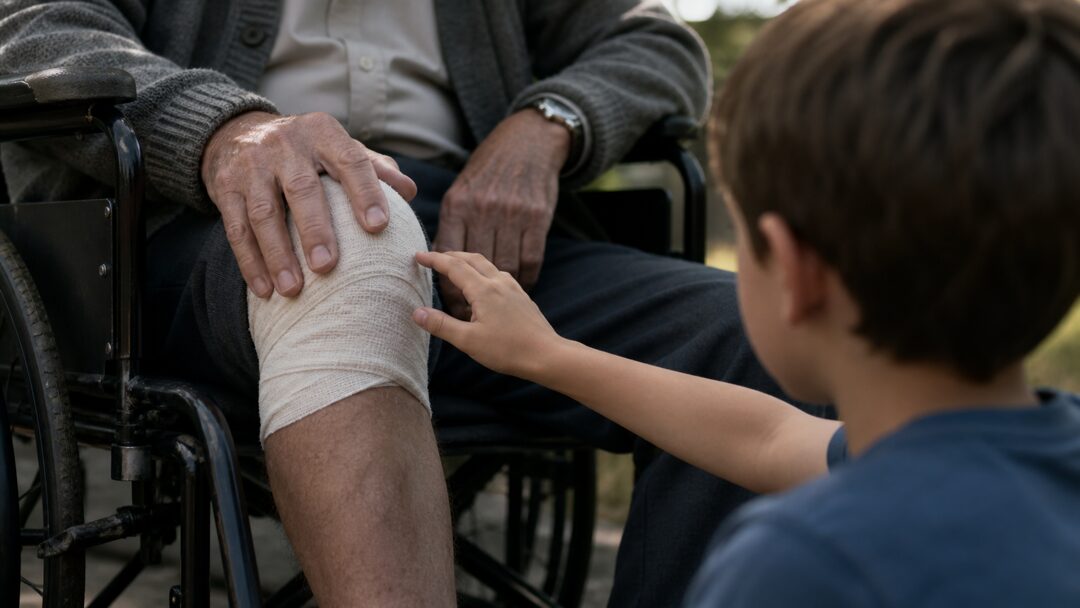
Charles had already decided he would not stand that day when the boy knelt in front of his wheelchair and looked at the bandage on his knee like it was asking him a question.
The garden had gone quiet around them.
Beyond the glass doors, the physical therapy room waited with its bright lights, rubber mats, cheerful posters, and people paid to say things like one more step as if steps were cheap. Charles kept one hand clamped over the fresh white wrap on his knee. The other gripped the arm of the chair.
The boy was small, maybe seven. His volunteer badge hung crooked from his shirt, almost reaching his stomach. His sneakers were scuffed. His eyes were too serious for his face.
He pointed at Charles’s knee.
“Does it hurt?”
Charles looked past him, toward the therapy doors.
“No.”
The boy studied him.
“My mom says grown-ups say no when they mean yes.”
Charles’s mouth twitched before he could stop it.
“Your mom talks too much.”
“She does,” the boy said, without judgment.
That almost made Charles laugh. Almost.
Across the courtyard, a group of volunteers moved between tables with lemonade, cookies, paper cups, and the forced cheer of visiting day. Most of them knew how to approach old men in wheelchairs. Smile. Speak loudly. Thank them for their service. Do not ask why they look at doorways like exits and exits like traps.
This boy did none of that.
He leaned closer.
Charles’s grip tightened.
“Don’t touch that.”
The boy’s hand froze in the air.
It was a small hand. Careful fingers. No threat in it at all.
Still, Charles heard the snap in his own voice and hated it.
The boy flinched but did not back away.
“I was only checking,” he said.
“Well, don’t.”
“My dad said you’re supposed to check.”
Charles looked at him then.
Something about the sentence entered the air wrong. Not childish. Rehearsed. Carried.
“Your dad a doctor?”
The boy shook his head.
“No. He said soldiers check wounds.”
The garden changed.
Not visibly. The fountain still clicked. The volunteer table still rustled. Somewhere, an old man coughed into his fist.
But Charles felt the old heat rise behind his eyes, the kind that had nothing to do with weather.
Before he could answer, a woman hurried across the stone path.
“Joshua.”
Her voice was soft, but the warning inside it was clear.
The boy turned. “I didn’t touch it.”
“I know.” She came up beside him, a tired woman in her thirties with a neat ponytail and a face trained into calm. “I’m sorry,” she said to Charles. “He slipped away from the group.”
“It’s a garden,” Charles said. “People slip.”
The woman put a hand lightly on Joshua’s shoulder.
That was when Charles saw the pin on her jacket.
Small. Folded flag. Silver edge. Quiet as a closed door.
Charles looked away first.
The woman noticed.
People always noticed when you noticed grief.
“I’m Emily,” she said. “This is Joshua.”
Charles gave a short nod.
“Charles.”
Joshua looked back at the bandage.
“Mr. Charles,” he said, as if the name now gave him permission to care, “you should not hold it so tight.”
Charles stared at him.
“Is that right?”
“You’ll make it mad.”
Emily closed her eyes for half a second. “Joshua.”
“What? Dad said that.”
Charles felt the old watch on his wrist, heavy against the thin skin. It had stopped keeping good time years ago, but he still wore it.
He said, “Your dad taught you a lot.”
Joshua nodded.
Emily’s hand tightened on his shoulder.
“He did,” she said.
Not does.
Charles heard it. He wished he hadn’t.
Part II — What Children Notice
Emily tried to lead Joshua back to the volunteer table, but the boy kept looking over his shoulder.
Charles hated that most of all.
Not the staring. He had been stared at by doctors, nurses, strangers in grocery stores, young men at parades, and people who wanted his sadness to make them feel grateful.
It was the way Joshua looked.
Not scared.
Not curious in the hungry way.
Concerned.
Like Charles was not old, not decorated, not difficult, not a problem assigned to a facility.
Like he was simply someone sitting there with something that needed tending.
A therapist appeared at the glass doors and called, “Charles? We’re ready when you are.”
Charles lifted two fingers without looking.
The therapist knew that gesture. It meant go away politely.
She did.
Joshua saw it.
“You’re supposed to go in there?”
Charles sighed. “You’re supposed to be over there.”
“I asked first.”
“That doesn’t make it your business.”
Joshua considered this.
Then he walked away.
Charles told himself he was relieved.
Three minutes later, the boy returned carrying a paper cup of water with both hands. The cup trembled, spilling a little over his fingers.
“This is for you.”
“I didn’t ask for water.”
“You looked dry.”
“I looked dry?”
Joshua nodded. “Like toast.”
Charles took the cup because refusing it felt more ridiculous than accepting it.
His fingers brushed the boy’s.
Joshua did not pull away.
That, too, hurt more than it should have.
Emily watched from the volunteer table, caught between apology and surrender. Charles could see her deciding whether to intervene. He knew that look. Parents had worn it in airports, waiting rooms, and funeral receptions. The fear that a child would ask the one question adults had spent years stepping around.
Joshua pointed at the therapy room.
“Why won’t you go?”
“Because I don’t feel like performing.”
“What’s performing?”
“Doing something badly while people clap anyway.”
Joshua absorbed this with grave attention.
“Maybe they clap because you tried.”
Charles let out a dry laugh.
“You always this optimistic?”
“What’s optimistic?”
“It means annoying, but in a nice shirt.”
Joshua looked down at his shirt. It was blue, with a cartoon dinosaur holding a balloon.
“I like this shirt.”
“I can tell.”
For a moment, Charles thought that would be the end of it. The boy would get bored. Children always did. They were built for motion, not old grief.
But Joshua crouched again, not as close this time.
“Did somebody fix your knee when you got hurt?”
Charles stopped drinking.
The paper cup bent slightly in his grip.
Emily had started toward them. She stopped when Charles looked up.
He could have lied.
He had lied for fifty years with easier words than these.
Doctors had asked about pain level. He had said four when it was eight.
Counselors had asked about dreams. He had said he did not remember.
His daughter had asked once, when she was twenty-one and tired of his silence, “Did you lose someone over there?”
And Charles had said, “Everybody lost someone.”
That was not an answer.
It was a wall.
Now a seven-year-old boy waited beside his knee with spilled water drying on his fingers.
Charles said, “Not the way you mean.”
Joshua frowned.
“What way do I mean?”
“The clean way.”
Joshua did not understand. Good. Charles hoped he never would.
Emily came closer now.
“Joshua, Mr. Charles may not want to talk about that.”
Joshua looked at Charles.
“Do you?”
Charles should have said no.
Instead, he looked at the boy’s volunteer badge, the crooked plastic sleeve, the name written in blue marker: JOSHUA.
“I got this knee in a place far from here,” Charles said.
Joshua sat back on his heels.
Emily went still.
Charles looked at the garden fountain because it was easier than looking at them.
“There was a younger man with me. Thomas. He was nineteen and talked too much. Sang badly. Cheated at cards. Wrote letters to a girl named Lisa who, according to him, was prettier than anybody had a right to be.”
Joshua listened with his whole face.
Charles swallowed.
“He got hurt. I carried him.”
Emily’s expression changed, not with shock, but with recognition. She knew the shape of stories that started simple and ended nowhere good.
Joshua asked, “Did you save him?”
The question was clean.
That made it cruel.
Charles looked down at his bandaged knee.
“No.”
The boy’s face folded, but only a little.
Charles expected him to look away.
He didn’t.
“Did you try?”
Charles closed his eyes.
A field flashed behind them. Heat. Weight. Thomas’s breath breaking in his ear. His own knee going bad under him. A hand slipping once, then catching cloth, then skin.
Not enough time.
Never enough time.
“Yes,” Charles said.
It came out rough.
“I tried.”
Part III — The Part He Never Told
Emily apologized again after that.
Not loudly. Not in a way that made Charles feel accused.
She came to stand beside him while Joshua was called to help place napkins on the table.
“I’m sorry,” she said. “He asks things before I can stop him.”
“Better than most adults.”
“He doesn’t always know what he’s asking.”
Charles watched Joshua count napkins with too much focus, like the task mattered.
“Sometimes they know enough.”
Emily looked toward her son.
There was the pin again. Small flag. Small announcement of a life split into before and after.
Charles said, “His father?”
Emily touched the pin without seeming to realize it.
“Daniel. Two years ago.”
Charles nodded once.
There were sentences people expected after that. He had heard all of them. He had said some of them, badly.
He chose silence.
Emily seemed grateful for it.
After a moment, she said, “Daniel always wanted to come here. When he got back. He wrote about it. Said there were men at places like this who had carried things longer than anyone should.”
Charles looked at her.
“He wrote that?”
Emily gave a small, tired smile.
“He wrote too much. I used to tease him for it.”
“And the boy?”
“Joshua thinks coming here is…” She stopped, searching for a word that would not break in her mouth. “A way to do something Daniel meant to do.”
Across the garden, Joshua had abandoned the napkins and was trying to pour lemonade from a pitcher too heavy for him. An older woman steadied it without fuss.
Emily watched him.
“I worry it’s too much.”
Charles said, “For him?”
“For him. For me. For everybody.” She breathed out. “Some days I want him to forget enough to be a child. Other days I’m terrified he will forget too much.”
Charles knew that fear in another form.
Forget and you betray them.
Remember and you never leave.
Joshua returned with a cookie wrapped in a napkin.
He handed it to Charles.
“This one has the most chocolate.”
Charles took it.
“You running a full medical service now? Water, cookies, inspection?”
Joshua nodded. “Yes.”
Emily almost smiled.
Then the therapist came back to the door.
“Charles,” she called gently. “We can try in five. No rush.”
He felt every eye that did not look at him.
That was the trick of places like this. Nobody stared, and yet everyone knew.
The chair suddenly felt enormous around him. A cage with wheels.
Joshua followed his gaze.
“What happens in there?”
“They make me stand.”
“Can you?”
Charles gave him a sharp look.
Emily said, “Joshua.”
But the boy’s face held no challenge. Only concern.
Charles hated concern almost as much as pity.
“I can,” he said.
“Then why don’t you?”
Because his knee might buckle.
Because the last time it did, he went down hard in front of two nurses and a young aide who said, You’re okay, with panic in her voice.
Because old men do not fall like children. They fall like furniture.
Because when his leg gave out, he was twenty again, dragging Thomas through mud, hearing him say something Charles had spent fifty years refusing to remember.
Because standing meant trusting someone else with the moment he failed.
Charles said, “Because I don’t want to.”
Joshua looked at the bandage again.
“My dad said not wanting to is different from not being able to.”
Emily’s face changed.
“Joshua,” she whispered.
But Charles was no longer in the garden.
He was in heat and noise and smoke. Thomas’s arm over his shoulder. Thomas laughing once, insanely, because fear did that to some men. Charles dragging him low, half-carrying, half-falling.
His knee twisting.
Pain white and immediate.
Thomas saying, “Don’t leave me.”
Charles had always remembered that.
Only that.
Don’t leave me.
And Charles had kept moving because stopping meant both of them might not make it. He told himself that was the right choice. He told others, when forced, that Thomas was gone before they reached help.
But there was a part between.
A second. Maybe two.
Thomas’s hand had found his wrist.
Charles had pulled free to lift him higher.
For fifty years, that was the memory: the hand, the release, the betrayal.
The cookie broke in Charles’s fist.
Joshua stared at the crumbs.
Emily stepped forward. “Charles?”
He opened his eyes.
“I didn’t stop,” he said.
No one spoke.
He looked at Joshua, though he should not have.
“He asked me not to leave. I didn’t stop.”
The boy’s face went pale with concentration.
Charles wished he could take the words back and shove them into the old locked room where he kept the rest.
“I carried him,” Charles said. “But I didn’t stop.”
Emily’s eyes shone, but she did not interrupt.
Joshua asked, “Did you let go?”
Charles looked down at his wrist.
“Yes.”
The boy thought about this.
“Maybe you let go because you needed both hands.”
Charles could not breathe.
It was too simple. Too merciful. Too undeserved.
Emily covered her mouth.
Charles turned his chair slightly away.
“That’s enough,” he said.
His voice had gone hard again.
The boy lowered his eyes.
Charles hated himself for that, too.
Part IV — The Question That Stayed
For the next half hour, Charles refused to look at them.
He watched the fountain. He watched a maple leaf spin in the water. He watched two volunteers tape a paper decoration to a table leg and fail three times.
Anything but the boy.
Joshua did not come back right away.
Charles told himself that was best.
Children should not be handed old men’s ghosts and asked to carry them around with cookies.
Emily came once to collect the empty cup from the arm of his chair.
“He’s okay,” she said quietly.
“I’m not sure I am.”
“I know.”
That answer made him look at her.
She did not soften it with a smile.
“I brought him here because I thought helping would make him feel close to Daniel,” she said. “Then I spent the whole morning afraid he’d touch something too sharp.”
Charles glanced toward Joshua, who sat on a bench now, turning his volunteer badge over in his hands.
“He shouldn’t have to fix people,” Charles said.
“No,” Emily said. “But maybe he needs to be allowed to love them.”
That landed where nothing else had.
Charles had spent years refusing visits from his own daughter because he did not want her driving three hours to watch him become less. He ignored calls from his grandson because boys sounded too much like men before you were ready.
He had called it dignity.
Maybe it was fear wearing a cleaner coat.
The therapy doors opened again.
This time it was not just the therapist. A young aide stood beside her with a walker.
Charles’s jaw locked.
“Not today,” he said before they crossed the courtyard.
The therapist, Karen, had the patience of someone who had seen every kind of refusal and knew which ones were anger and which were terror.
“Just to the door,” she said. “No more than that.”
“No.”
“We can adjust the brace.”
“No.”
“Charles.”
His hand clamped over the bandage.
The whole garden seemed to shrink around the word.
No.
Joshua stood from the bench.
Emily caught his shoulder, then stopped herself.
Charles saw it. The decision. The fear. The letting go.
Joshua walked back across the stones.
Not quickly.
Not dramatically.
He came to the front of Charles’s wheelchair and knelt exactly where he had knelt before.
Charles looked away.
“Kid.”
Joshua placed both hands near Charles’s hand, not touching yet.
“I’ll check the wound first.”
The therapist did not move.
Emily did not breathe.
Charles looked down.
The boy’s hands waited.
He could refuse. He was good at refusing. He had built a whole life from it. Refuse help, refuse memory, refuse softness, refuse the part of the past that might change if someone touched it kindly.
Joshua said, “I won’t pull.”
The words hit Charles in a place deeper than the knee.
Thomas’s hand on his wrist.
His own hand pulling free.
No.
Not free.
Charles closed his eyes.
The memory came again, but this time it did not stop where it usually stopped.
Thomas’s hand had found his wrist.
Charles had shifted him higher.
For one second, before lifting him, he had covered Thomas’s hand with his own.
One second.
He had forgotten that.
No—worse. He had buried it because it did not fit the punishment.
He had held him.
Not long enough to save him.
But he had held him.
Charles opened his eyes.
Joshua was still waiting.
Charles lifted his hand from the bandage.
The boy’s fingers touched the edge of the wrap with the seriousness of a promise.
“Okay,” Joshua whispered. “It’s still there.”
Charles gave a broken little laugh.
“Yes,” he said. “It is.”
“Does it hurt?”
The same question.
The first question.
But not the same anymore.
Charles looked at Emily. Then at Karen. Then at the boy kneeling before him.
“Yes,” he said. “But not as much when somebody stays.”
Joshua nodded as if this made perfect sense.
Then he wrapped both hands around Charles’s hand.
Part V — A Few Steps
Standing took longer than Charles wanted.
That was the first humiliation.
It was not one clean motion. It was instructions, adjustments, the walker placed too close, then farther out, the brace checked, Karen’s hand at his elbow, Emily hovering where she could help without crowding him.
Joshua stayed low beside the chair, holding Charles’s hand until Karen said, “He’ll need that hand for the walker.”
Joshua looked up at Charles for permission.
Charles gave the smallest nod.
The boy released him.
That was the second humiliation.
The release.
But this one did not feel like abandonment.
Charles gripped the walker.
His arms shook.
His knee flared with a hot, mean warning. The garden blurred at the edges. For a second, he was furious at his own body, at time, at the cheerful poster behind the glass, at every person who had ever said you’re strong when they meant please don’t fall apart where I can see you.
Then Joshua moved closer to Emily and took her hand.
Not leaving.
Just making room.
Charles pushed up.
The chair creaked.
His knee trembled.
Karen said, “Good. Slow.”
Charles wanted to tell her not to talk.
He wanted to sit back down.
He wanted to be alone with the old rules.
Instead, he stood.
Not straight. Not proud. Not like the photographs in the hallway where young men in pressed uniforms looked toward a future that had lied to them.
He stood like an old man with a bad knee and a boy watching.
That was enough.
Joshua’s face changed first.
Not joy. Not surprise.
Pride.
Quiet, total pride.
Charles took one step.
The walker scraped.
His knee held.
He took another.
The garden seemed to hold its breath.
On the third step, pain shot up his leg and his body folded forward. Karen caught his elbow. Emily reached instinctively, then stopped when Charles steadied himself.
Joshua whispered, “You tried.”
Charles looked at him.
The boy was not clapping.
No one was.
Thank God.
Charles took one more step.
Then he sat.
Not because he had failed.
Because four steps were four steps.
Karen’s eyes were wet, but she had the decency to pretend they weren’t.
“That’s enough for today,” she said.
Charles nodded.
His chest hurt more than his knee.
Joshua came back to him slowly, as if approaching something sacred.
“Did I check it right?”
Charles looked at the boy’s scuffed sneakers, the crooked badge, the serious face trying so hard to understand what could and could not be fixed.
“You did,” Charles said.
Joshua smiled a little.
Charles reached into the pocket of the faded blanket across his lap.
His fingers closed around the old patch he had carried there for years without knowing why. It was frayed at one corner, colors dulled by time, the stitching worn soft. He had taken it off an old jacket before giving the jacket away, then kept it hidden like a thing too small to matter and too heavy to throw out.
He held it out.
Emily went still.
Joshua looked at it but did not take it.
“What is it?”
“Something I kept too long,” Charles said.
“Is it important?”
“Yes.”
“Then you should keep it.”
Charles shook his head.
“I am.”
Joshua did not understand.
Charles placed the patch in the boy’s palm and closed Joshua’s fingers over it.
“For checking the wound.”
Emily’s face turned away, but not before Charles saw what moved through it.
Joshua looked at his mother.
She nodded.
Carefully, Joshua pinned the patch beside the small folded flag on Emily’s jacket. It sat there awkwardly, crooked and old beside polished silver.
Two pieces of memory.
One for absence.
One for staying.
Charles looked at it until his eyes blurred.
Part VI — What Stayed
The volunteer visit ended in pieces.
Paper cups gathered. Cookie trays covered. Folding chairs stacked against the wall. People said goodbye in the soft voices used around places where everyone was recovering from something.
Joshua came back one last time.
Emily stood a few steps behind him, letting him have the moment.
The boy held out his hand.
Charles looked at it.
This time he did not make him wait.
They shook.
Joshua’s hand was warm and small, but his grip was firm.
“You’ll go tomorrow?” he asked, glancing toward the therapy doors.
Charles sighed.
“You drive a hard bargain.”
“That means yes?”
“It means maybe.”
Joshua narrowed his eyes.
Charles gave in.
“Yes.”
The boy nodded.
“Good.”
Emily said, “Come on, Joshua.”
He turned, then stopped.
“Mr. Charles?”
“Yes?”
“If it hurts again, you can say yes.”
Charles felt the sentence settle over him like a blanket he had not asked for and badly needed.
“I’ll try,” he said.
Joshua accepted that. Children knew the difference between a promise and a miracle.
Emily gave Charles one last look.
“Thank you,” she said.
He knew she meant for Daniel. For Joshua. For telling the truth without making it ugly. For accepting what her son had offered.
Charles nodded.
After they left, the garden seemed larger.
Not emptier.
Larger.
Karen came to wheel him inside, but Charles raised a hand.
“Give me a minute.”
She did.
He sat alone beside the fountain, the bandage bright against his knee, his old watch ticking badly on his wrist.
For the first time in years, he let the memory come all the way through.
Thomas was nineteen. Thomas sang badly. Thomas was heavier than fear should be. Thomas asked not to be left.
And Charles, young and terrified and already injured, had covered Thomas’s hand for one second before lifting him again.
One second had not saved him.
But it had been real.
Charles looked toward the therapy doors.
He would go in tomorrow.
Maybe he would fall. Maybe he would curse. Maybe he would make it only four steps again. Maybe three.
But when his knee hurt, he would try to say yes.
And somewhere beyond the garden, a boy with a crooked badge was walking beside his mother with an old patch pinned near a folded flag, carrying two kinds of love he was still too young to name.
Charles rested his hand lightly over the bandage.
Not clamped.
Not guarding.
Just there.
Then he turned his chair toward the doors.