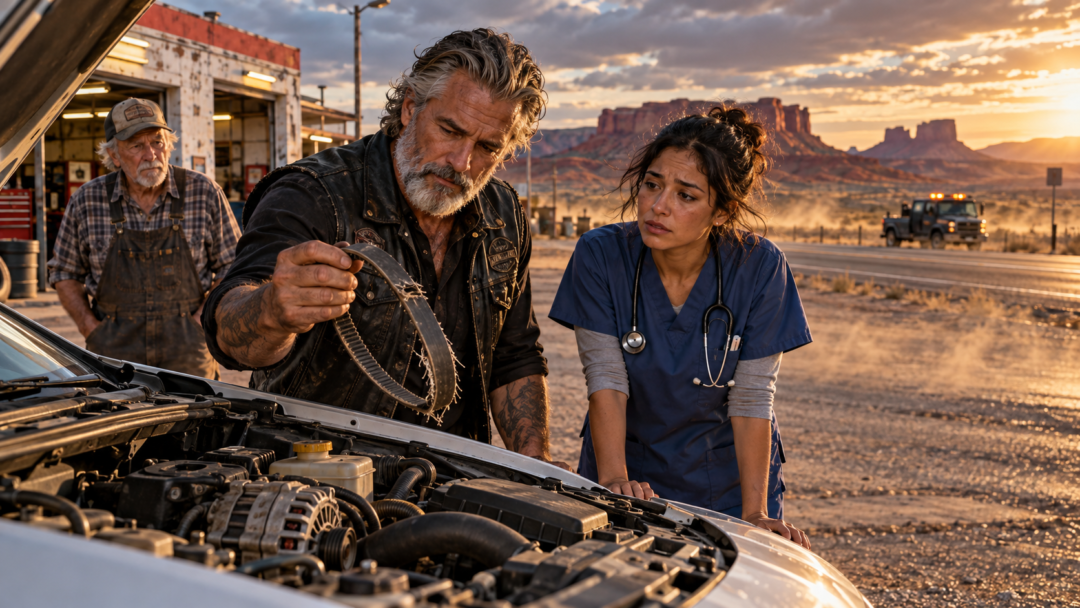
The Midnight Crossing At Red River And The Highway Of Brothers
CHAPTER 1: THE WIND AT GLENRIO
The afternoon wind tore across the red-clay mesa country of the New Mexico-Texas border like a blast furnace, carrying fine grains of caliche dust that stung the eyes and gritted between the teeth. At the Glenrio Rest Area on Interstate 40, thirty miles west of Adrian, the air smelled of sun-baked asphalt, sagebrush, scorched ethylene glycol, and overheated transmission fluid. Parked beside a sun-bleached concrete trash receptacle, a tired white 2011 Chevrolet Impala sat with its hood propped open on a battered steel rod, thin gray wisps of boiling coolant steaming from its radiator grill.
Standing beside the front fender was Vern, an older, gray-haired automotive mechanic in a greasy gray service shirt with a faded red embroidered breast patch that read VERN’S 24-HR TOWING. He wiped grease from his palms with a soiled shop rag, looking down at his customer with an uncomfortable, rehearsed expression of false sympathy.
Across from him stood Elena Ruiz. She was thirty-four years old, wearing faded beige hospital scrubs that hung loosely on her slender, exhausted frame, her official pediatric ICU nursing identification badge from Presbyterian Hospital in Albuquerque pinned crookedly to her left collar. Her dark brown eyes were rimmed with red, her face tight with a desperate, crushing panic that made her hands tremble violently.
Between her trembling fingers, Elena held open a worn, folded brown leather wallet. Inside the bill slot sat a single twenty-dollar bill and two crumpled one-dollar bills.
“I… I only have two hundred dollars left in my emergency checking,” Elena whispered, her voice cracking as a fresh tear cut a clean, pale track through the red dust on her cheek. “I gave you eighty dollars cash just to tow me off the highway shoulder. Please. My six-year-old son, Mateo… he’s in Amarillo at Northwest Texas Healthcare. He was transferred for emergency pediatric heart surgery. They’re taking him into the bypass suite at dawn. If I don’t get there before he goes under the anesthesia, I might never speak to him again.”
Vern sighed heavily, reached up with a thick, grease-blackened hand, and rubbed the back of his sunburnt neck in deliberate, awkward hesitation.
“Ma’am, I understand you’re in a terrible spot, truly I do,” Vern said, his flat Texas drawl devoid of genuine warmth. “But your alternator is completely seized up, and your lower radiator hose split clean across the seam. To replace that high-output GM alternator, flush the cooling loop, and patch the lines… that’s parts, highway labor, and hazardous waste disposal. That comes to eleven hundred and eighty dollars, cash or certified card before I turn a single wrench. Nobody works for free in this desert.”
Elena’s knees buckled slightly. She caught the hot steel edge of the sedan’s quarter-panel to keep from falling onto the cracked asphalt, a strangled sob breaking in her chest as she pressed her smartphone tightly against her ribs. She was six hundred miles from home, stranded on a forgotten stretch of desert highway with twelve dollars in cash and a dying engine.
Fifty feet away, seated at a weathered concrete picnic bench shaded by a rusted corrugated tin pavilion, sat four burly men in heavy, road-worn black leather cuts. Their four custom Harley-Davidson touring cruisers—matte black with polished chrome ape-hangers and leather saddlebags—were parked in a disciplined row against the curb, their heavy V-twin engines ticking as they cooled.
On the back of their leather vests was the embroidered rocker of the Desert Nomad MC, encircling a silver skull flanked by crossed combat engineering axes.
The leader of the group stood up. He was fifty-two years old, broad-shouldered and six-foot-two, with neatly groomed salt-and-pepper hair, a full silver beard trimmed close along a square, scarred jawline, and clear, intelligent gray eyes that took in every detail of the parking lot with combat-trained precision. He wore a heavy buffalo-hide vest over a faded black denim work shirt, his sleeves rolled up to reveal tattooed forearms corded with muscle from twenty years as a Marine Corps heavy-diesel mechanic.
He tossed the remains of his black coffee into the trash can, adjusted his vest, and strode with long, easy strides toward the smoking sedan.
“Mind if we take a look?” a deep, calm baritone voice rolled across the hot breeze.
Elena spun around abruptly, her defensive instincts flaring like a tripwire. She clutched her phone against her breast with both hands, stepping back against the sedan’s tire, her wide, frightened eyes darting over the skull emblem on his chest, the heavy silver rings on his fingers, and the three massive bearded riders who had stood up behind him.
“I can’t pay anyone else today!” Elena cried, her voice high, defensive, and trembling with exhaustion. “I don’t have any money! Just take whatever you want from the glovebox and leave me alone!”
Mason Vance stopped five paces away, his hands open and lowered at his sides, his bearded face softening into a warm, disarming smile that carried the absolute, unshakeable serenity of an older brother who had spent a lifetime defusing crises.
“We didn’t ask for money, ma’am,” Mason said softly, his voice steady as iron bedrock.
He closed the distance smoothly, stopped two feet from the car, and extended a thick, respectful right hand. “My name is Mason. These are my brothers, Doc, Preacher, and Tank. We’re on our way back from Oklahoma City. Let’s see what’s smoking under that hood before you start writing checks.”
Elena looked down at Mason’s outstretched palm, calloused and grease-stained from decades of honest labor. Slowly, the terrifying tension that had locked her shoulder blades began to dissolve, replaced by a wave of staggering, bewildering relief.
She reached out and placed her small, trembling hand into his. “Elena,” she whispered.
Mason gave her hand a gentle, respectful squeeze, then turned to the open engine bay. Doc Harlan, a former Navy combat hospital corpsman with silver spectacles, stepped up beside him, while Tank brought a heavy canvas tool roll from his motorcycle saddlebag.
Mason leaned his broad torso over the radiator core support, peering past the smoking plastic fan shroud. His gray eyes narrowed as he traced the black rubber of the lower radiator hose with his bare fingers.
He pulled his hand back, staring at the clean, slick residue on his thumb.
The hose had not ruptured from internal steam pressure. The rubber had been sliced with a surgical, forty-five-degree diagonal cut made by a brand-new utility razor, positioned precisely so the engine would run ten miles down the interstate before dumping its coolant and seizing the water pump bearing.